3-1   Forecasting


CHAPTER
       7

                     Forecasting
                     Prepared by :
               Arya Wirabhuana, ST, M.Sc
3-2   Forecasting


      FORECAST:
         A statement about the future value of a variable of
          interest such as demand.
         Forecasts affect decisions and activities throughout
          an organization
            Accounting, finance
            Human resources
            Marketing
            MIS
            Operations
            Product / service design
3-3   Forecasting

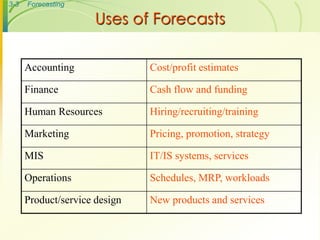
                     Uses of Forecasts

      Accounting               Cost/profit estimates

      Finance                  Cash flow and funding

      Human Resources          Hiring/recruiting/training

      Marketing                Pricing, promotion, strategy

      MIS                      IT/IS systems, services

      Operations               Schedules, MRP, workloads

      Product/service design   New products and services
3-4   Forecasting


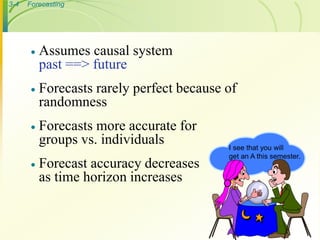
          Assumes causal system
           past ==> future
          Forecasts rarely perfect because of
           randomness
          Forecasts more accurate for
           groups vs. individuals           I see that you will
                                            get an A this semester.
          Forecast accuracy decreases
           as time horizon increases
3-5   Forecasting

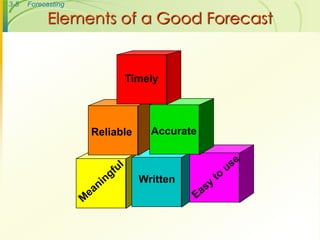
           Elements of a Good Forecast


                          Timely


                    Reliable     Accurate


                               Written
3-6   Forecasting

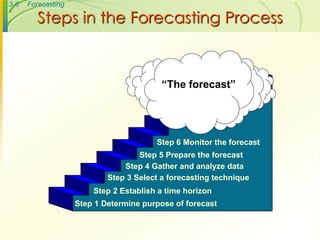
        Steps in the Forecasting Process


                                          “The forecast”


                                        Step 6 Monitor the forecast
                                    Step 5 Prepare the forecast
                                Step 4 Gather and analyze data
                            Step 3 Select a forecasting technique
                        Step 2 Establish a time horizon
                    Step 1 Determine purpose of forecast
3-7   Forecasting

                    Types of Forecasts

         Judgmental - uses subjective inputs
         Time series - uses historical data
          assuming the future will be like the past
         Associative models - uses explanatory
          variables to predict the future
3-8   Forecasting

                    Judgmental Forecasts

          Executive opinions
          Sales force opinions
          Consumer surveys
          Outside opinion
        Delphi     method
              Opinions of managers and staff
              Achieves a consensus forecast
3-9   Forecasting

                    Time Series Forecasts

        Trend - long-term movement in data
        Seasonality - short-term regular variations in
         data
        Cycle – wavelike variations of more than one
         year’s duration
        Irregular variations - caused by unusual
         circumstances
        Random variations - caused by chance
3-10 Forecasting

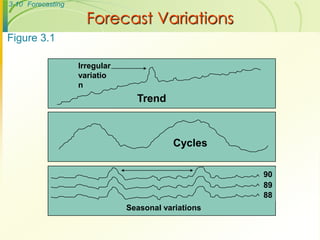
                     Forecast Variations
Figure 3.1

                   Irregular
                   variatio
                   n
                                 Trend


                                          Cycles

                                                     90
                                                     89
                                                     88
                               Seasonal variations
3-11 Forecasting

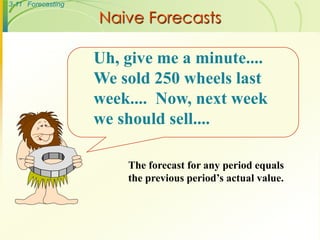
                   Naive Forecasts

                   Uh, give me a minute....
                   We sold 250 wheels last
                   week.... Now, next week
                   we should sell....

                       The forecast for any period equals
                       the previous period’s actual value.
3-12 Forecasting

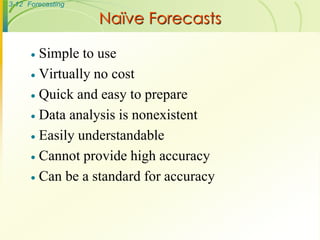
                   Naïve Forecasts

       Simple to use
       Virtually no cost

       Quick and easy to prepare

       Data analysis is nonexistent

       Easily understandable

       Cannot provide high accuracy

       Can be a standard for accuracy
3-13 Forecasting

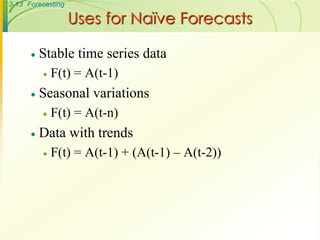
                   Uses for Naïve Forecasts

         Stable time series data
             F(t) = A(t-1)
         Seasonal variations
             F(t) = A(t-n)
         Data with trends
             F(t) = A(t-1) + (A(t-1) – A(t-2))
3-14 Forecasting

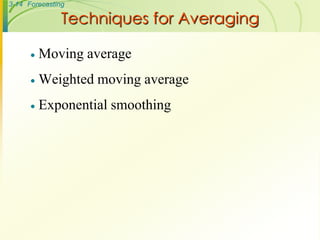
               Techniques for Averaging

         Moving average
         Weighted moving average
         Exponential smoothing
3-15 Forecasting

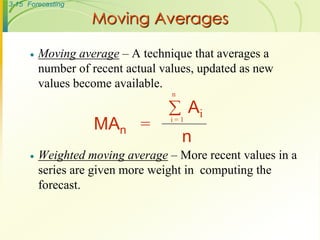
                    Moving Averages

         Moving average – A technique that averages a
          number of recent actual values, updated as new
          values become available.
                                    n

                                   1 Ai
                                   i=
                    MAn =
                                        n
         Weighted moving average – More recent values in a
          series are given more weight in computing the
          forecast.
3-16 Forecasting

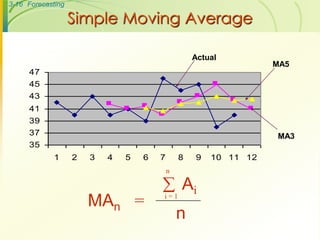
                   Simple Moving Average

                                                   Actual
                                                                  MA5
     47
     45
     43
     41
     39
     37                                                           MA3
     35
             1     2   3   4   5   6   7       8   9   10 11 12
                                           n

                                       1 Ai
                                       i=
                       MAn =
                                               n
3-17 Forecasting

                   Exponential Smoothing


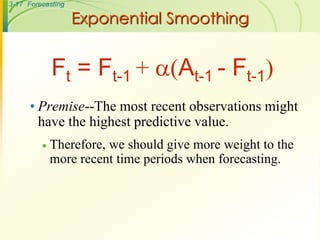
             Ft = Ft-1 + (At-1 - Ft-1)
      • Premise--The most recent observations might
        have the highest predictive value.
            Therefore, we should give more weight to the
             more recent time periods when forecasting.
3-18 Forecasting

                   Exponential Smoothing


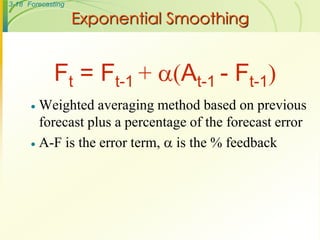
             Ft = Ft-1 + (At-1 - Ft-1)
       Weighted averaging method based on previous
        forecast plus a percentage of the forecast error
       A-F is the error term,  is the % feedback
3-19 Forecasting

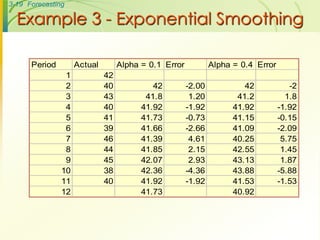
  Example 3 - Exponential Smoothing

      Period        Actual        Alpha = 0.1 Error           Alpha = 0.4 Error
                1            42
                2            40            42         -2.00            42            -2
                3            43          41.8          1.20          41.2           1.8
                4            40         41.92         -1.92         41.92         -1.92
                5            41         41.73         -0.73         41.15         -0.15
                6            39         41.66         -2.66         41.09         -2.09
                7            46         41.39          4.61         40.25          5.75
                8            44         41.85          2.15         42.55          1.45
                9            45         42.07          2.93         43.13          1.87
               10            38         42.36         -4.36         43.88         -5.88
               11            40         41.92         -1.92         41.53         -1.53
               12                       41.73                       40.92
3-20 Forecasting

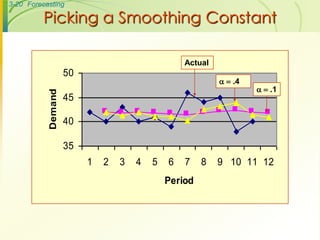
          Picking a Smoothing Constant

                                                 Actual
                    50
                                                            .4
                                                                     .1
           Demand


                    45

                    40

                    35
                         1   2   3   4   5   6   7    8   9 10 11 12
                                             Period
3-21 Forecasting

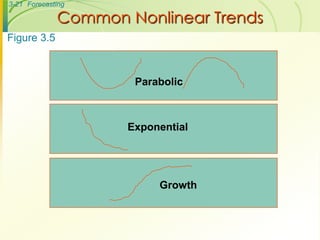
             Common Nonlinear Trends
Figure 3.5


                     Parabolic


                    Exponential


                         Growth
3-22 Forecasting

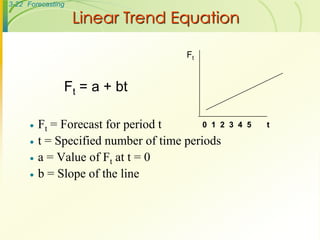
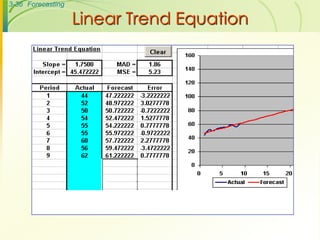
                   Linear Trend Equation

                                        Ft


               Ft = a + bt

         Ft = Forecast for period t       0 1 2   3 4 5   t

         t = Specified number of time periods
         a = Value of Ft at t = 0
         b = Slope of the line
3-23 Forecasting

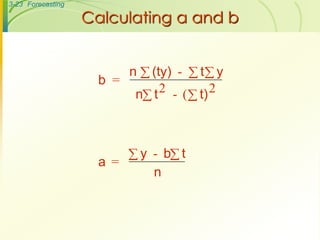
                   Calculating a and b


                         n  (ty) -  t  y
                     b =
                          n t 2 - ( t) 2
                                    


                          y - b t
                     a =
                             n
3-24 Forecasting

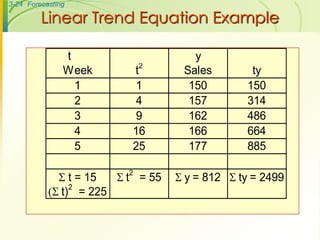
         Linear Trend Equation Example

               t                     y
                             2
               Week      t         Sales        ty
                 1       1          150        150
                 2       4          157        314
                 3       9          162        486
                 4       16         166        664
                 5       25         177        885

              t = 15   t = 55    y = 812  ty = 2499
                         2
                2
           ( t) = 225
3-25 Forecasting

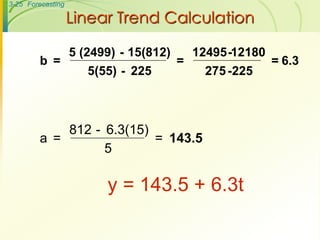
                   Linear Trend Calculation

                   5 (2499) - 15(812)       12495 -12180
        b =                             =                  = 6.3
                      5(55) - 225             275 -225


            812 - 6.3(15)
        a =               = 143.5
                  5

                         y = 143.5 + 6.3t
3-26 Forecasting

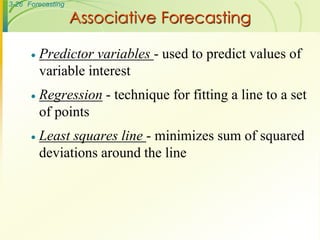
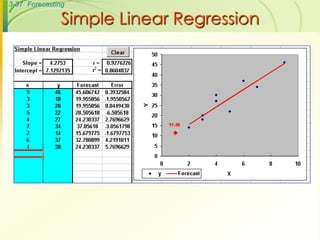
                   Associative Forecasting

         Predictor variables - used to predict values of
          variable interest
         Regression - technique for fitting a line to a set
          of points
         Least squares line - minimizes sum of squared
          deviations around the line
3-27 Forecasting

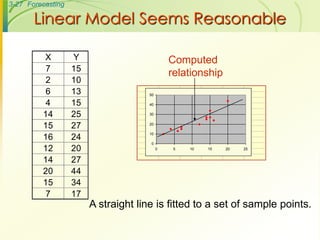
       Linear Model Seems Reasonable

         X         Y                           Computed
          7        15
                                               relationship
          2        10
          6        13                 50

          4        15                 40


         14        25                 30


         15        27                 20

                                      10
         16        24
                                      0
         12        20                      0    5   10   15   20   25


         14        27
         20        44
         15        34
          7        17
                        A straight line is fitted to a set of sample points.
3-28 Forecasting

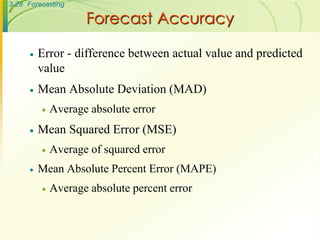
                     Forecast Accuracy

         Error - difference between actual value and predicted
          value
         Mean Absolute Deviation (MAD)
             Average absolute error
         Mean Squared Error (MSE)
             Average of squared error
         Mean Absolute Percent Error (MAPE)
             Average absolute percent error
3-29 Forecasting

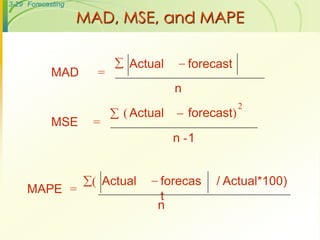
                   MAD, MSE, and MAPE

                          Actual       forecast
            MAD      =
                                      n
                                                    2
                          ( Actual    forecast)
            MSE     =
                                      n -1


                   ( Actual     forecas     / Actual*100)
     MAPE =
                                  t
                                 n
3-30 Forecasting

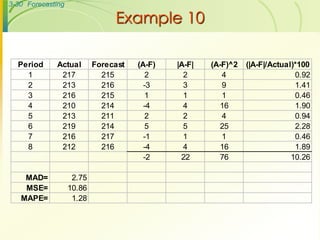
                                Example 10

  Period     Actual        Forecast   (A-F)   |A-F|   (A-F)^2   (|A-F|/Actual)*100
    1         217            215        2       2        4                    0.92
    2         213            216        -3      3        9                    1.41
    3         216            215        1       1        1                    0.46
    4         210            214        -4      4        16                   1.90
    5         213            211        2       2        4                    0.94
    6         219            214        5       5        25                   2.28
    7         216            217        -1      1        1                    0.46
    8         212            216        -4      4        16                   1.89
                                        -2     22        76                  10.26

    MAD=            2.75
    MSE=           10.86
   MAPE=            1.28
3-31 Forecasting

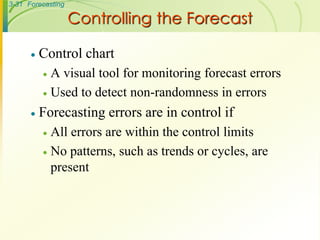
                   Controlling the Forecast

         Control chart
           A visual tool for monitoring forecast errors
           Used to detect non-randomness in errors

         Forecasting errors are in control if
           All errors are within the control limits
           No patterns, such as trends or cycles, are
            present
3-32 Forecasting

               Sources of Forecast errors

       Model may be inadequate
       Irregular variations

       Incorrect use of forecasting technique
3-33 Forecasting

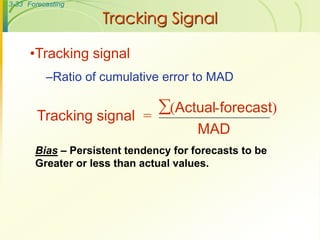
                    Tracking Signal

      •Tracking signal
          –Ratio of cumulative error to MAD


        Tracking signal =
                          (Actual-forecast)
                                       MAD
       Bias – Persistent tendency for forecasts to be
       Greater or less than actual values.
3-34 Forecasting

    Choosing a Forecasting Technique

       No single technique works in every situation
       Two most important factors
           Cost
           Accuracy

         Other factors include the availability of:
           Historical data
           Computers

           Time needed to gather and analyze the data

           Forecast horizon
3-35 Forecasting

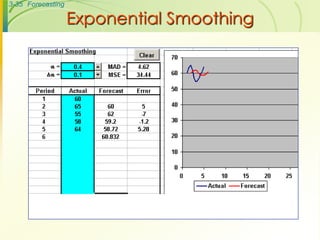
                   Exponential Smoothing
3-36 Forecasting

                   Linear Trend Equation
3-37 Forecasting

              Simple Linear Regression

Forecasting

  • 1.
    3-1 Forecasting CHAPTER 7 Forecasting Prepared by : Arya Wirabhuana, ST, M.Sc
  • 2.
    3-2 Forecasting FORECAST:  A statement about the future value of a variable of interest such as demand.  Forecasts affect decisions and activities throughout an organization  Accounting, finance  Human resources  Marketing  MIS  Operations  Product / service design
  • 3.
    3-3 Forecasting Uses of Forecasts Accounting Cost/profit estimates Finance Cash flow and funding Human Resources Hiring/recruiting/training Marketing Pricing, promotion, strategy MIS IT/IS systems, services Operations Schedules, MRP, workloads Product/service design New products and services
  • 4.
    3-4 Forecasting  Assumes causal system past ==> future  Forecasts rarely perfect because of randomness  Forecasts more accurate for groups vs. individuals I see that you will get an A this semester.  Forecast accuracy decreases as time horizon increases
  • 5.
    3-5 Forecasting Elements of a Good Forecast Timely Reliable Accurate Written
  • 6.
    3-6 Forecasting Steps in the Forecasting Process “The forecast” Step 6 Monitor the forecast Step 5 Prepare the forecast Step 4 Gather and analyze data Step 3 Select a forecasting technique Step 2 Establish a time horizon Step 1 Determine purpose of forecast
  • 7.
    3-7 Forecasting Types of Forecasts  Judgmental - uses subjective inputs  Time series - uses historical data assuming the future will be like the past  Associative models - uses explanatory variables to predict the future
  • 8.
    3-8 Forecasting Judgmental Forecasts  Executive opinions  Sales force opinions  Consumer surveys  Outside opinion  Delphi method  Opinions of managers and staff  Achieves a consensus forecast
  • 9.
    3-9 Forecasting Time Series Forecasts  Trend - long-term movement in data  Seasonality - short-term regular variations in data  Cycle – wavelike variations of more than one year’s duration  Irregular variations - caused by unusual circumstances  Random variations - caused by chance
  • 10.
    3-10 Forecasting Forecast Variations Figure 3.1 Irregular variatio n Trend Cycles 90 89 88 Seasonal variations
  • 11.
    3-11 Forecasting Naive Forecasts Uh, give me a minute.... We sold 250 wheels last week.... Now, next week we should sell.... The forecast for any period equals the previous period’s actual value.
  • 12.
    3-12 Forecasting Naïve Forecasts  Simple to use  Virtually no cost  Quick and easy to prepare  Data analysis is nonexistent  Easily understandable  Cannot provide high accuracy  Can be a standard for accuracy
  • 13.
    3-13 Forecasting Uses for Naïve Forecasts  Stable time series data  F(t) = A(t-1)  Seasonal variations  F(t) = A(t-n)  Data with trends  F(t) = A(t-1) + (A(t-1) – A(t-2))
  • 14.
    3-14 Forecasting Techniques for Averaging  Moving average  Weighted moving average  Exponential smoothing
  • 15.
    3-15 Forecasting Moving Averages  Moving average – A technique that averages a number of recent actual values, updated as new values become available. n 1 Ai i= MAn = n  Weighted moving average – More recent values in a series are given more weight in computing the forecast.
  • 16.
    3-16 Forecasting Simple Moving Average Actual MA5 47 45 43 41 39 37 MA3 35 1 2 3 4 5 6 7 8 9 10 11 12 n 1 Ai i= MAn = n
  • 17.
    3-17 Forecasting Exponential Smoothing Ft = Ft-1 + (At-1 - Ft-1) • Premise--The most recent observations might have the highest predictive value.  Therefore, we should give more weight to the more recent time periods when forecasting.
  • 18.
    3-18 Forecasting Exponential Smoothing Ft = Ft-1 + (At-1 - Ft-1)  Weighted averaging method based on previous forecast plus a percentage of the forecast error  A-F is the error term,  is the % feedback
  • 19.
    3-19 Forecasting Example 3 - Exponential Smoothing Period Actual Alpha = 0.1 Error Alpha = 0.4 Error 1 42 2 40 42 -2.00 42 -2 3 43 41.8 1.20 41.2 1.8 4 40 41.92 -1.92 41.92 -1.92 5 41 41.73 -0.73 41.15 -0.15 6 39 41.66 -2.66 41.09 -2.09 7 46 41.39 4.61 40.25 5.75 8 44 41.85 2.15 42.55 1.45 9 45 42.07 2.93 43.13 1.87 10 38 42.36 -4.36 43.88 -5.88 11 40 41.92 -1.92 41.53 -1.53 12 41.73 40.92
  • 20.
    3-20 Forecasting Picking a Smoothing Constant Actual 50   .4   .1 Demand 45 40 35 1 2 3 4 5 6 7 8 9 10 11 12 Period
  • 21.
    3-21 Forecasting Common Nonlinear Trends Figure 3.5 Parabolic Exponential Growth
  • 22.
    3-22 Forecasting Linear Trend Equation Ft Ft = a + bt  Ft = Forecast for period t 0 1 2 3 4 5 t  t = Specified number of time periods  a = Value of Ft at t = 0  b = Slope of the line
  • 23.
    3-23 Forecasting Calculating a and b n  (ty) -  t  y b = n t 2 - ( t) 2   y - b t a = n
  • 24.
    3-24 Forecasting Linear Trend Equation Example t y 2 Week t Sales ty 1 1 150 150 2 4 157 314 3 9 162 486 4 16 166 664 5 25 177 885  t = 15  t = 55  y = 812  ty = 2499 2 2 ( t) = 225
  • 25.
    3-25 Forecasting Linear Trend Calculation 5 (2499) - 15(812) 12495 -12180 b = = = 6.3 5(55) - 225 275 -225 812 - 6.3(15) a = = 143.5 5 y = 143.5 + 6.3t
  • 26.
    3-26 Forecasting Associative Forecasting  Predictor variables - used to predict values of variable interest  Regression - technique for fitting a line to a set of points  Least squares line - minimizes sum of squared deviations around the line
  • 27.
    3-27 Forecasting Linear Model Seems Reasonable X Y Computed 7 15 relationship 2 10 6 13 50 4 15 40 14 25 30 15 27 20 10 16 24 0 12 20 0 5 10 15 20 25 14 27 20 44 15 34 7 17 A straight line is fitted to a set of sample points.
  • 28.
    3-28 Forecasting Forecast Accuracy  Error - difference between actual value and predicted value  Mean Absolute Deviation (MAD)  Average absolute error  Mean Squared Error (MSE)  Average of squared error  Mean Absolute Percent Error (MAPE)  Average absolute percent error
  • 29.
    3-29 Forecasting MAD, MSE, and MAPE  Actual  forecast MAD = n 2  ( Actual  forecast) MSE = n -1 ( Actual  forecas / Actual*100) MAPE = t n
  • 30.
    3-30 Forecasting Example 10 Period Actual Forecast (A-F) |A-F| (A-F)^2 (|A-F|/Actual)*100 1 217 215 2 2 4 0.92 2 213 216 -3 3 9 1.41 3 216 215 1 1 1 0.46 4 210 214 -4 4 16 1.90 5 213 211 2 2 4 0.94 6 219 214 5 5 25 2.28 7 216 217 -1 1 1 0.46 8 212 216 -4 4 16 1.89 -2 22 76 10.26 MAD= 2.75 MSE= 10.86 MAPE= 1.28
  • 31.
    3-31 Forecasting Controlling the Forecast  Control chart  A visual tool for monitoring forecast errors  Used to detect non-randomness in errors  Forecasting errors are in control if  All errors are within the control limits  No patterns, such as trends or cycles, are present
  • 32.
    3-32 Forecasting Sources of Forecast errors  Model may be inadequate  Irregular variations  Incorrect use of forecasting technique
  • 33.
    3-33 Forecasting Tracking Signal •Tracking signal –Ratio of cumulative error to MAD Tracking signal = (Actual-forecast) MAD Bias – Persistent tendency for forecasts to be Greater or less than actual values.
  • 34.
    3-34 Forecasting Choosing a Forecasting Technique  No single technique works in every situation  Two most important factors  Cost  Accuracy  Other factors include the availability of:  Historical data  Computers  Time needed to gather and analyze the data  Forecast horizon
  • 35.
    3-35 Forecasting Exponential Smoothing
  • 36.
    3-36 Forecasting Linear Trend Equation
  • 37.
    3-37 Forecasting Simple Linear Regression