ADDITIONAL NOTES                                                                     BM014-3-3-DMKG

FORECASTING

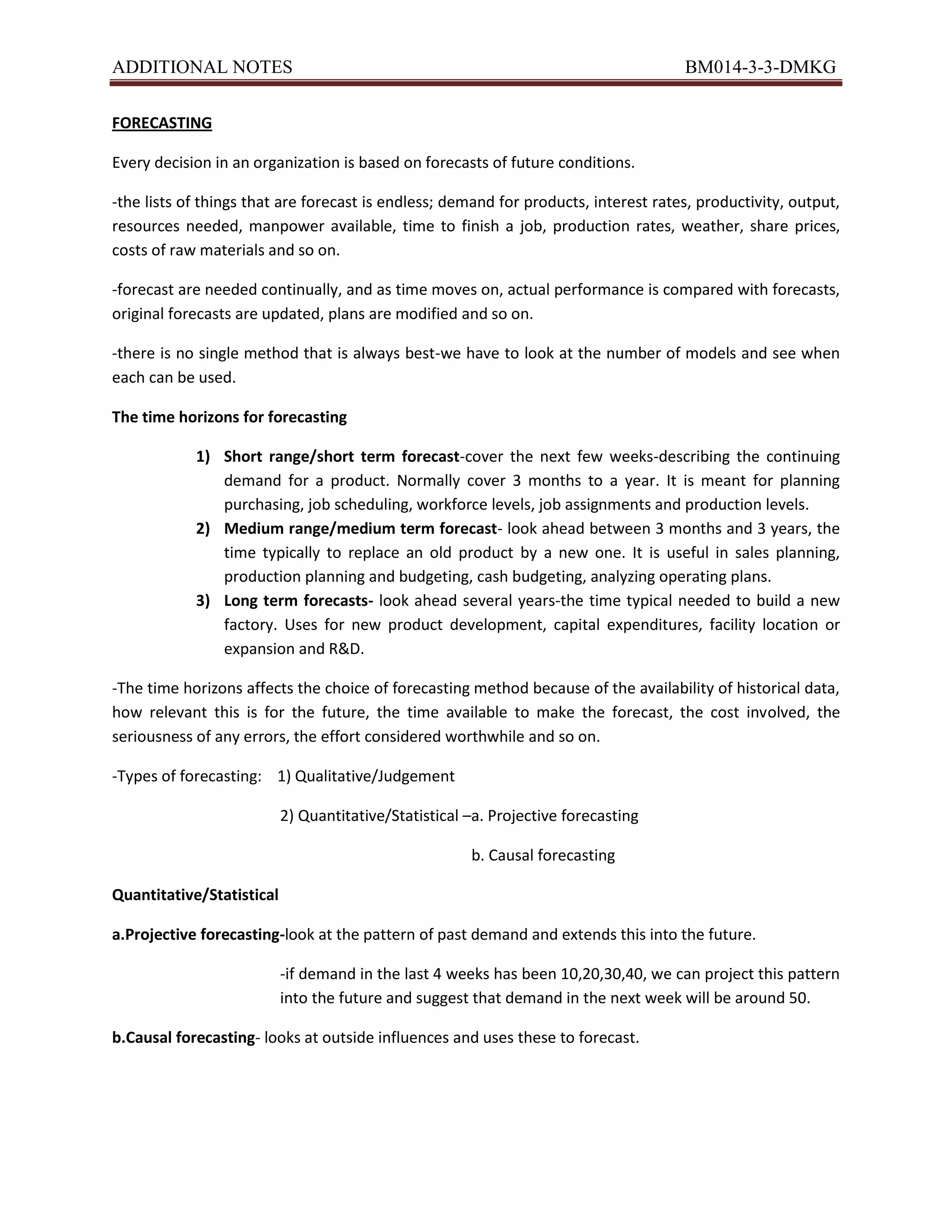
Every decision in an organization is based on forecasts of future conditions.

-the lists of things that are forecast is endless; demand for products, interest rates, productivity, output,
resources needed, manpower available, time to finish a job, production rates, weather, share prices,
costs of raw materials and so on.

-forecast are needed continually, and as time moves on, actual performance is compared with forecasts,
original forecasts are updated, plans are modified and so on.

-there is no single method that is always best-we have to look at the number of models and see when
each can be used.

The time horizons for forecasting

            1) Short range/short term forecast-cover the next few weeks-describing the continuing
               demand for a product. Normally cover 3 months to a year. It is meant for planning
               purchasing, job scheduling, workforce levels, job assignments and production levels.
            2) Medium range/medium term forecast- look ahead between 3 months and 3 years, the
               time typically to replace an old product by a new one. It is useful in sales planning,
               production planning and budgeting, cash budgeting, analyzing operating plans.
            3) Long term forecasts- look ahead several years-the time typical needed to build a new
               factory. Uses for new product development, capital expenditures, facility location or
               expansion and R&D.

-The time horizons affects the choice of forecasting method because of the availability of historical data,
how relevant this is for the future, the time available to make the forecast, the cost involved, the
seriousness of any errors, the effort considered worthwhile and so on.

-Types of forecasting: 1) Qualitative/Judgement

                           2) Quantitative/Statistical –a. Projective forecasting

                                                       b. Causal forecasting

Quantitative/Statistical

a.Projective forecasting-look at the pattern of past demand and extends this into the future.

                           -if demand in the last 4 weeks has been 10,20,30,40, we can project this pattern
                           into the future and suggest that demand in the next week will be around 50.

b.Causal forecasting- looks at outside influences and uses these to forecast.
ADDITIONAL NOTES                                                                     BM014-3-3-DMKG

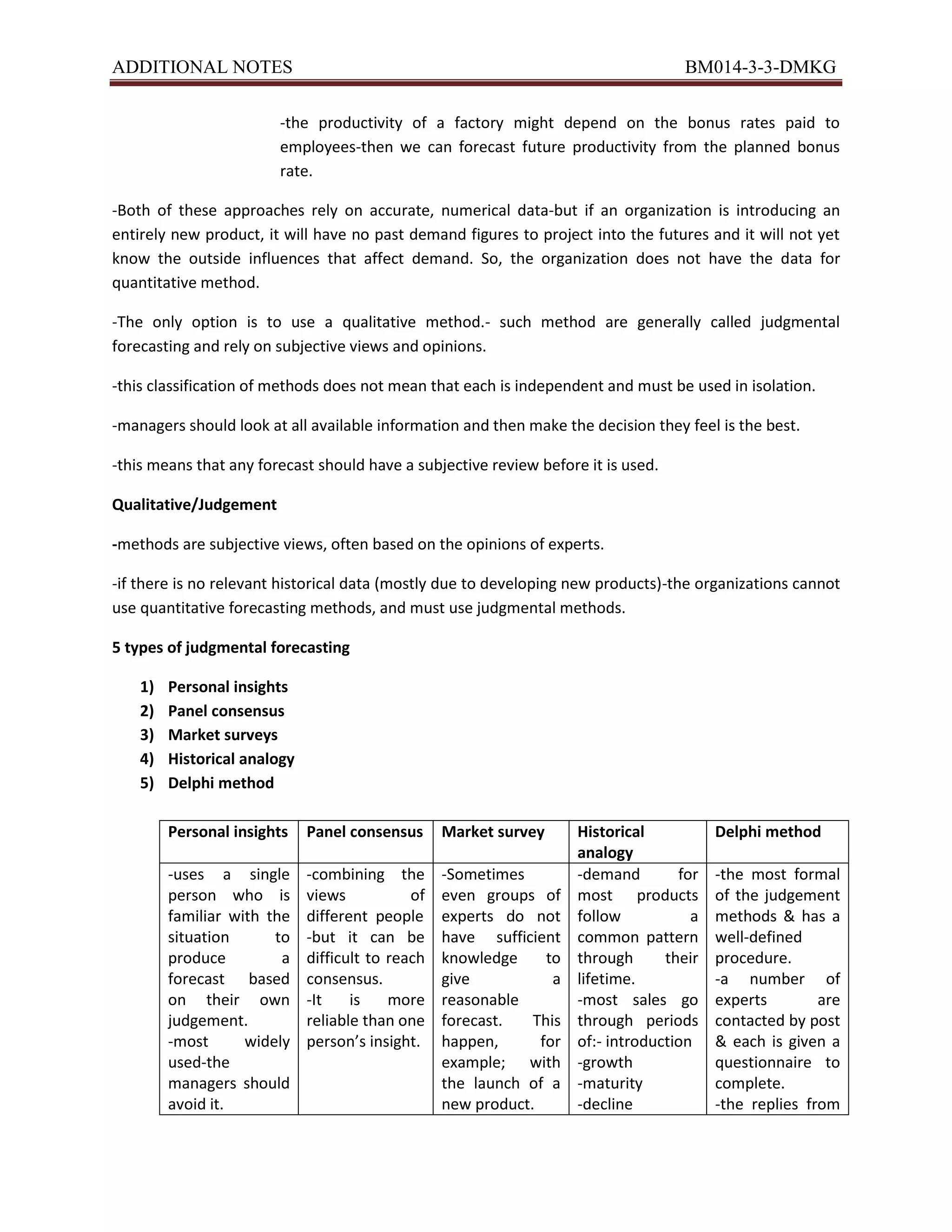
                        -the productivity of a factory might depend on the bonus rates paid to
                        employees-then we can forecast future productivity from the planned bonus
                        rate.

-Both of these approaches rely on accurate, numerical data-but if an organization is introducing an
entirely new product, it will have no past demand figures to project into the futures and it will not yet
know the outside influences that affect demand. So, the organization does not have the data for
quantitative method.

-The only option is to use a qualitative method.- such method are generally called judgmental
forecasting and rely on subjective views and opinions.

-this classification of methods does not mean that each is independent and must be used in isolation.

-managers should look at all available information and then make the decision they feel is the best.

-this means that any forecast should have a subjective review before it is used.

Qualitative/Judgement

-methods are subjective views, often based on the opinions of experts.

-if there is no relevant historical data (mostly due to developing new products)-the organizations cannot
use quantitative forecasting methods, and must use judgmental methods.

5 types of judgmental forecasting

    1)   Personal insights
    2)   Panel consensus
    3)   Market surveys
    4)   Historical analogy
    5)   Delphi method

         Personal insights    Panel consensus      Market survey      Historical           Delphi method
                                                                      analogy
         -uses a single       -combining the       -Sometimes         -demand        for   -the most formal
         person who is        views           of   even groups of     most products        of the judgement
         familiar with the    different people     experts do not     follow           a   methods & has a
         situation      to    -but it can be       have sufficient    common pattern       well-defined
         produce         a    difficult to reach   knowledge     to   through      their   procedure.
         forecast based       consensus.           give           a   lifetime.            -a number of
         on their own         -It    is    more    reasonable         -most sales go       experts        are
         judgement.           reliable than one    forecast.   This   through periods      contacted by post
         -most      widely    person’s insight.    happen,      for   of:- introduction    & each is given a
         used-the                                  example; with      -growth              questionnaire to
         managers should                           the launch of a    -maturity            complete.
         avoid it.                                 new product.       -decline             -the replies from
ADDITIONAL NOTES                                                                     BM014-3-3-DMKG

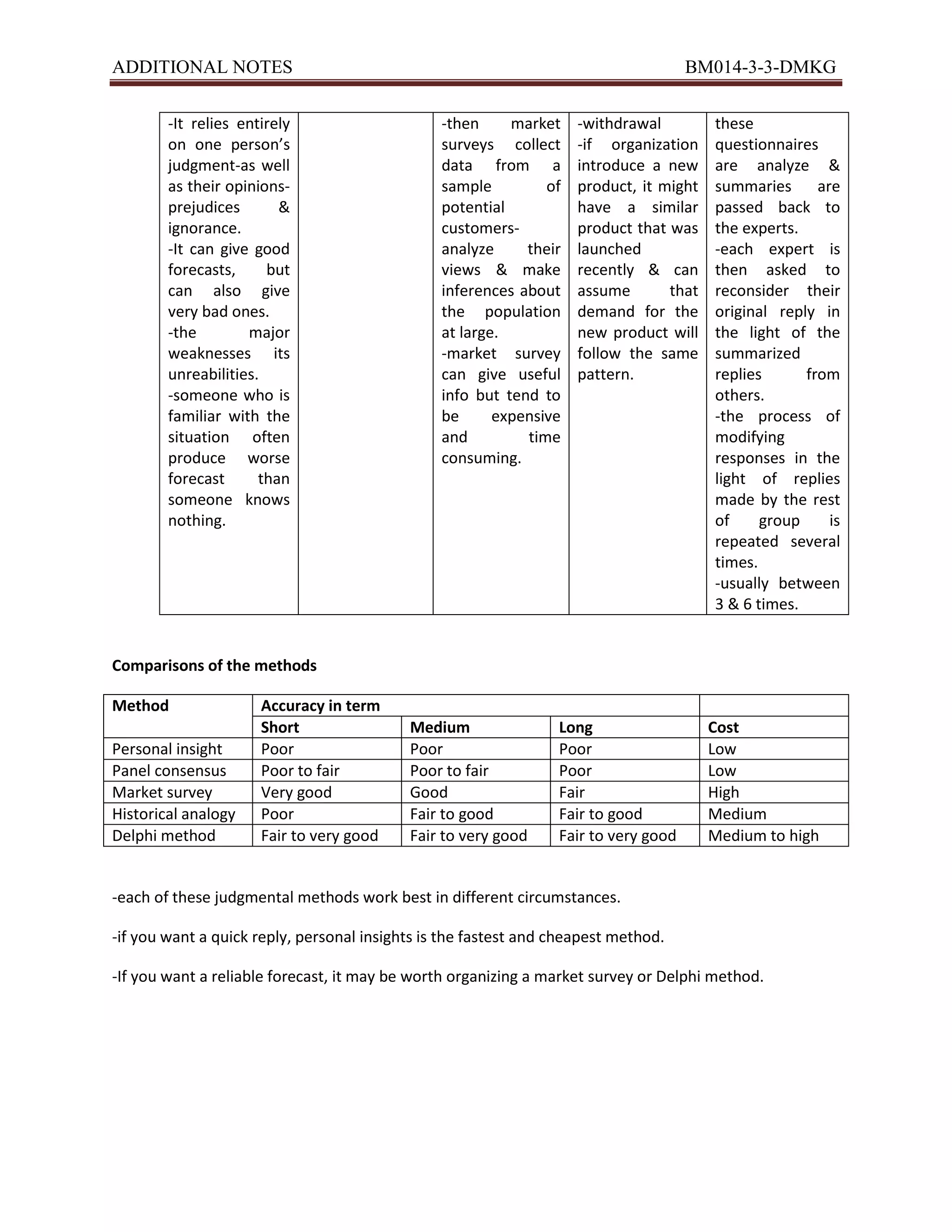
        -It relies entirely                     -then     market    -withdrawal         these
        on one person’s                         surveys collect     -if organization    questionnaires
        judgment-as well                        data from a         introduce a new     are analyze &
        as their opinions-                      sample         of   product, it might   summaries      are
        prejudices       &                      potential           have a similar      passed back to
        ignorance.                              customers-          product that was    the experts.
        -It can give good                       analyze     their   launched            -each expert is
        forecasts,     but                      views & make        recently & can      then asked to
        can also give                           inferences about    assume       that   reconsider their
        very bad ones.                          the population      demand for the      original reply in
        -the        major                       at large.           new product will    the light of the
        weaknesses its                          -market survey      follow the same     summarized
        unreabilities.                          can give useful     pattern.            replies      from
        -someone who is                         info but tend to                        others.
        familiar with the                       be      expensive                       -the process of
        situation often                         and         time                        modifying
        produce worse                           consuming.                              responses in the
        forecast      than                                                              light of replies
        someone knows                                                                   made by the rest
        nothing.                                                                        of     group     is
                                                                                        repeated several
                                                                                        times.
                                                                                        -usually between
                                                                                        3 & 6 times.


Comparisons of the methods

Method                Accuracy in term
                      Short                Medium                Long                   Cost
Personal insight      Poor                 Poor                  Poor                   Low
Panel consensus       Poor to fair         Poor to fair          Poor                   Low
Market survey         Very good            Good                  Fair                   High
Historical analogy    Poor                 Fair to good          Fair to good           Medium
Delphi method         Fair to very good    Fair to very good     Fair to very good      Medium to high


-each of these judgmental methods work best in different circumstances.

-if you want a quick reply, personal insights is the fastest and cheapest method.

-If you want a reliable forecast, it may be worth organizing a market survey or Delphi method.

Forecasting

  • 1.
    ADDITIONAL NOTES BM014-3-3-DMKG FORECASTING Every decision in an organization is based on forecasts of future conditions. -the lists of things that are forecast is endless; demand for products, interest rates, productivity, output, resources needed, manpower available, time to finish a job, production rates, weather, share prices, costs of raw materials and so on. -forecast are needed continually, and as time moves on, actual performance is compared with forecasts, original forecasts are updated, plans are modified and so on. -there is no single method that is always best-we have to look at the number of models and see when each can be used. The time horizons for forecasting 1) Short range/short term forecast-cover the next few weeks-describing the continuing demand for a product. Normally cover 3 months to a year. It is meant for planning purchasing, job scheduling, workforce levels, job assignments and production levels. 2) Medium range/medium term forecast- look ahead between 3 months and 3 years, the time typically to replace an old product by a new one. It is useful in sales planning, production planning and budgeting, cash budgeting, analyzing operating plans. 3) Long term forecasts- look ahead several years-the time typical needed to build a new factory. Uses for new product development, capital expenditures, facility location or expansion and R&D. -The time horizons affects the choice of forecasting method because of the availability of historical data, how relevant this is for the future, the time available to make the forecast, the cost involved, the seriousness of any errors, the effort considered worthwhile and so on. -Types of forecasting: 1) Qualitative/Judgement 2) Quantitative/Statistical –a. Projective forecasting b. Causal forecasting Quantitative/Statistical a.Projective forecasting-look at the pattern of past demand and extends this into the future. -if demand in the last 4 weeks has been 10,20,30,40, we can project this pattern into the future and suggest that demand in the next week will be around 50. b.Causal forecasting- looks at outside influences and uses these to forecast.
  • 2.
    ADDITIONAL NOTES BM014-3-3-DMKG -the productivity of a factory might depend on the bonus rates paid to employees-then we can forecast future productivity from the planned bonus rate. -Both of these approaches rely on accurate, numerical data-but if an organization is introducing an entirely new product, it will have no past demand figures to project into the futures and it will not yet know the outside influences that affect demand. So, the organization does not have the data for quantitative method. -The only option is to use a qualitative method.- such method are generally called judgmental forecasting and rely on subjective views and opinions. -this classification of methods does not mean that each is independent and must be used in isolation. -managers should look at all available information and then make the decision they feel is the best. -this means that any forecast should have a subjective review before it is used. Qualitative/Judgement -methods are subjective views, often based on the opinions of experts. -if there is no relevant historical data (mostly due to developing new products)-the organizations cannot use quantitative forecasting methods, and must use judgmental methods. 5 types of judgmental forecasting 1) Personal insights 2) Panel consensus 3) Market surveys 4) Historical analogy 5) Delphi method Personal insights Panel consensus Market survey Historical Delphi method analogy -uses a single -combining the -Sometimes -demand for -the most formal person who is views of even groups of most products of the judgement familiar with the different people experts do not follow a methods & has a situation to -but it can be have sufficient common pattern well-defined produce a difficult to reach knowledge to through their procedure. forecast based consensus. give a lifetime. -a number of on their own -It is more reasonable -most sales go experts are judgement. reliable than one forecast. This through periods contacted by post -most widely person’s insight. happen, for of:- introduction & each is given a used-the example; with -growth questionnaire to managers should the launch of a -maturity complete. avoid it. new product. -decline -the replies from
  • 3.
    ADDITIONAL NOTES BM014-3-3-DMKG -It relies entirely -then market -withdrawal these on one person’s surveys collect -if organization questionnaires judgment-as well data from a introduce a new are analyze & as their opinions- sample of product, it might summaries are prejudices & potential have a similar passed back to ignorance. customers- product that was the experts. -It can give good analyze their launched -each expert is forecasts, but views & make recently & can then asked to can also give inferences about assume that reconsider their very bad ones. the population demand for the original reply in -the major at large. new product will the light of the weaknesses its -market survey follow the same summarized unreabilities. can give useful pattern. replies from -someone who is info but tend to others. familiar with the be expensive -the process of situation often and time modifying produce worse consuming. responses in the forecast than light of replies someone knows made by the rest nothing. of group is repeated several times. -usually between 3 & 6 times. Comparisons of the methods Method Accuracy in term Short Medium Long Cost Personal insight Poor Poor Poor Low Panel consensus Poor to fair Poor to fair Poor Low Market survey Very good Good Fair High Historical analogy Poor Fair to good Fair to good Medium Delphi method Fair to very good Fair to very good Fair to very good Medium to high -each of these judgmental methods work best in different circumstances. -if you want a quick reply, personal insights is the fastest and cheapest method. -If you want a reliable forecast, it may be worth organizing a market survey or Delphi method.