FOLLICULITIS
BY
MR AJUNA NOBLE.
NURSING STUDENT BSU
2020.
3/2/2020 @NOBLE AJUNA 2020. 1
Definition.
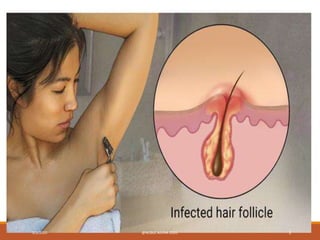
Folliculitis is the infection and inflammation of one or more hair
follicles.
The condition may occur anywhere on the skin except the palms of the
hands and soles of the feet.
The rash may appear as pimples that come to white tips on the face, chest,
back, arms, legs, buttocks, or head.
3/2/2020 @NOBLE AJUNA 2020. 2
3/2/2020 @NOBLE AJUNA 2020. 3
Causes
Staphylococcus aureus (staph) bacteria. (Common
cause)
viruses,
fungi
inflammation from ingrown hairs.
Follicles are densest on your scalp, and they occur everywhere on your
body except your palms, soles, lips and mucous membranes.
3/2/2020 @NOBLE AJUNA 2020. 4
Risk factors
Anyone can develop folliculitis, but certain factors make you more susceptible
to the condition, including:
Having a medical condition that reduces your resistance to infection, such as
diabetes, chronic leukemia and HIV/AIDS
Having acne or dermatitis
Taking some medications, such as steroid creams or long-term antibiotic therapy
for acne
Being a male with curly hair who shaves
Regularly wearing clothing that traps heat and sweat, such as rubber gloves or
high boots
Soaking in a hot tub that's not maintained well
Causing damage to hair follicles by shaving, waxing or wearing tight clothing
3/2/2020 @NOBLE AJUNA 2020. 5
signs and symptoms.
Clusters of small red bumps or white-headed pimples that
develop around hair follicles
Pus-filled blisters that break open and crust over
Itchy, burning skin
Painful, tender skin
A large swollen bump or mass
3/2/2020 @NOBLE AJUNA 2020. 6
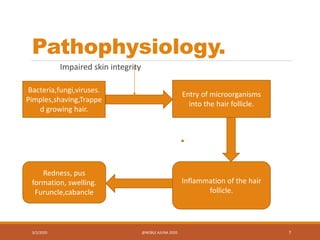
Pathophysiology.
Impaired skin integrity
Bacteria,fungi,viruses.
Pimples,shaving,Trappe
d growing hair.
Entry of microorganisms
into the hair follicle.
Redness, pus
formation, swelling.
Furuncle,cabancle
Inflammation of the hair
follicle.
3/2/2020 @NOBLE AJUNA 2020. 7
Types of folliculitis
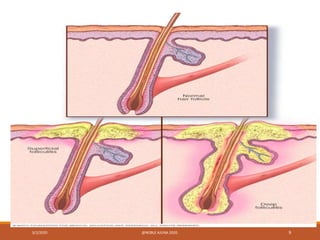
1. superficial folliculitis.
2. deep folliculitis.
3/2/2020 @NOBLE AJUNA 2020. 8
3/2/2020 @NOBLE AJUNA 2020. 9
The superficial folliculitis.
1)Bacterial folliculitis.
commonest type .
is marked by itchy, white, pus-filled bumps. It occurs when hair follicles
become infected with bacteria, usually Staphylococcus aureus (staph).
Staph bacteria live on the skin all the time.
3/2/2020 @NOBLE AJUNA 2020. 10
2)Hot tub folliculitis (pseudomonas folliculitis).
With this type you may develop a rash of red, round, itchy bumps one to two
days after exposure to the bacteria that causes it. Hot tub folliculitis is caused
by pseudomonas bacteria, which is found in many places, including hot tubs
and heated pools in which the chlorine and pH levels aren't well-regulated.
3)Razor bumps (pseudofolliculitis barbae).
This is a skin irritation caused by ingrown hairs. It mainly affects men with
curly hair who shave too close and is most noticeable on the face and neck.
People who get bikini waxes may develop barber's itch in the groin area. This
condition may leave dark raised scars (keloids).
4)Pityrosporum (pit-ih-ROS-puh-rum) folliculitis.
This type produces chronic, red, itchy pustules on the back and chest and
sometimes on the neck, shoulders, upper arms and face. This type is caused by
a yeast infection.
3/2/2020 @NOBLE AJUNA 2020. 11
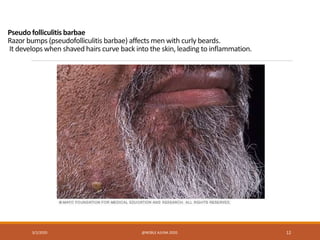
Pseudofolliculitis barbae
Razor bumps (pseudofolliculitis barbae) affects men with curly beards.
It develops when shaved hairs curve back into the skin, leading to inflammation.
3/2/2020 @NOBLE AJUNA 2020. 12
Forms of deep folliculitisSycosis barbae.
This type affects males who have begun to shave.
Gram-negative folliculitis.
This type sometimes develops if you're receiving long-term antibiotic therapy
for acne.
Boils (furuncles) and carbuncles.
These occur when hair follicles become deeply infected with staph bacteria. A
boil usually appears suddenly as a painful pink or red bump. A carbuncle is a
cluster of boils.
Eosinophilic (e-o-sin-o-FILL-ik) folliculitis.
This type mainly affects people with HIV/AIDS.
Signs and symptoms include intense itching and recurring patches of bumps and
pimples that form near hair follicles of the face and upper body. Once healed,
the affected skin may be darker than your skin was previously
(hyperpigmented). The cause of eosinophilic folliculitis isn't known.
3/2/2020 @NOBLE AJUNA 2020. 13
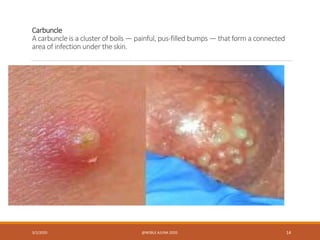
Carbuncle
A carbuncle is a cluster of boils — painful, pus-filled bumps — that form a connected
area of infection under the skin.
3/2/2020 @NOBLE AJUNA 2020. 14
Diagnosis
History taking
medical history.
physical exam diagnose folliculitis by looking at the skin
use a technique for microscopic examination of the skin (dermoscopy).
your doctor may use a swab to take a sample of your infected skin or hair
determine what's causing the infection.
Rarely, a skin biopsy may be done to rule out other conditions.
3/2/2020 @NOBLE AJUNA 2020. 15
Differential Diagnosis
Acne vulgaris
Papulopustular rosacea
Hidradenitis suppurativa
Scabies
Keratosis pilaris
Acne keloidalis nuchae
3/2/2020 @NOBLE AJUNA 2020. 16
Complications
Possible complications of folliculitis include:
Recurrent or spreading infection
Boils under the skin (furunculosis)
Permanent skin damage, such as scarring or dark spots
Destruction of hair follicles and permanent hair loss
3/2/2020 @NOBLE AJUNA 2020. 17
Prevention
Avoid tight clothes.
It helps to reduce friction between your skin and clothing.
Dry out your rubber gloves between uses.
If you wear rubber gloves regularly, after each use turn them inside out, rinse
with soap and water, and dry thoroughly.
Avoid shaving, if possible.
For men with razor bumps (pseudo folliculitis), growing a beard may be a good
option if you don't need a clean-shaven face.
Shave with care.
If you shave, adopt habits such as the following to help control symptoms by
reducing the closeness of the shave and the risk of damaging your skin.
3/2/2020 @NOBLE AJUNA 2020. 18
PREVENTION CONTI..
Shaving less frequently
Washing your skin with warm water and antibacterial soap before shaving
Using a washcloth or cleansing pad in a gentle circular motion to raise
embedded hairs before shaving
Applying a good amount of shaving lotion before shaving
Shaving in the direction of hair growth, though one study found that men who
shaved against the grain had fewer skin bumps. See what works best for you.
Avoiding shaving too close by using an electric razor or guarded blade and by
not stretching the skin
Using a sharp blade and rinsing it with warm water after each stroke
Applying moisturizing lotion after shaving
Avoiding the sharing of razors, towels and washcloths
3/2/2020 @NOBLE AJUNA 2020. 19
Treatment
Intermittent warm compression to allow lesion to point.
Incise and drain when ready, then cover with dressing.
Cloxacillin 250-500 mg every 6 hours before food for five days.
If penicillin allergy consider erythromycin 500 mg every 6 hours.
3/2/2020 @NOBLE AJUNA 2020. 20
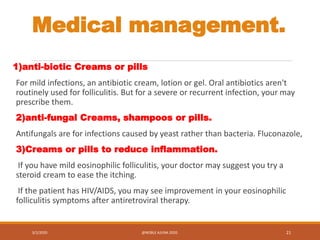
Medical management.
1)anti-biotic Creams or pills
For mild infections, an antibiotic cream, lotion or gel. Oral antibiotics aren't
routinely used for folliculitis. But for a severe or recurrent infection, your may
prescribe them.
2)anti-fungal Creams, shampoos or pills.
Antifungals are for infections caused by yeast rather than bacteria. Fluconazole,
3)Creams or pills to reduce inflammation.
If you have mild eosinophilic folliculitis, your doctor may suggest you try a
steroid cream to ease the itching.
If the patient has HIV/AIDS, you may see improvement in your eosinophilic
folliculitis symptoms after antiretroviral therapy.
3/2/2020 @NOBLE AJUNA 2020. 21
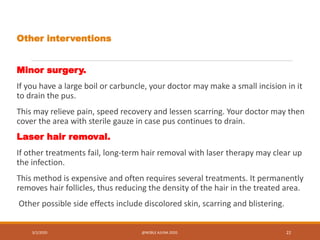
Other interventions
Minor surgery.
If you have a large boil or carbuncle, your doctor may make a small incision in it
to drain the pus.
This may relieve pain, speed recovery and lessen scarring. Your doctor may then
cover the area with sterile gauze in case pus continues to drain.
Laser hair removal.
If other treatments fail, long-term hair removal with laser therapy may clear up
the infection.
This method is expensive and often requires several treatments. It permanently
removes hair follicles, thus reducing the density of the hair in the treated area.
Other possible side effects include discolored skin, scarring and blistering.
3/2/2020 @NOBLE AJUNA 2020. 22
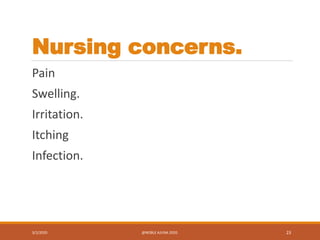
Nursing concerns.
Pain
Swelling.
Irritation.
Itching
Infection.
3/2/2020 @NOBLE AJUNA 2020. 23
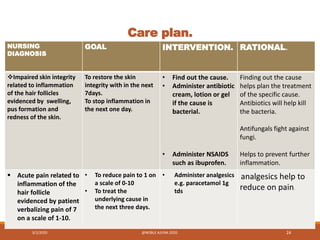
Care plan.
NURSING
DIAGNOSIS
GOAL INTERVENTION. RATIONAL.
Impaired skin integrity
related to inflammation
of the hair follicles
evidenced by swelling,
pus formation and
redness of the skin.
To restore the skin
integrity with in the next
7days.
To stop inflammation in
the next one day.
• Find out the cause.
• Administer antibiotic
cream, lotion or gel
if the cause is
bacterial.
• Administer NSAIDS
such as ibuprofen.
Finding out the cause
helps plan the treatment
of the specific cause.
Antibiotics will help kill
the bacteria.
Antifungals fight against
fungi.
Helps to prevent further
inflammation.
 Acute pain related to
inflammation of the
hair follicle
evidenced by patient
verbalizing pain of 7
on a scale of 1-10.
• To reduce pain to 1 on
a scale of 0-10
• To treat the
underlying cause in
the next three days.
• Administer analgesics
e.g. paracetamol 1g
tds
analgesics help to
reduce on pain.
3/2/2020 @NOBLE AJUNA 2020. 24
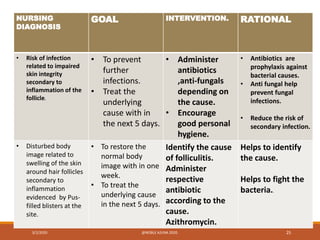
NURSING
DIAGNOSIS
GOAL INTERVENTION. RATIONAL
• Risk of infection
related to impaired
skin integrity
secondary to
inflammation of the
follicle.
• To prevent
further
infections.
• Treat the
underlying
cause with in
the next 5 days.
• Administer
antibiotics
,anti-fungals
depending on
the cause.
• Encourage
good personal
hygiene.
• Antibiotics are
prophylaxis against
bacterial causes.
• Anti fungal help
prevent fungal
infections.
• Reduce the risk of
secondary infection.
• Disturbed body
image related to
swelling of the skin
around hair follicles
secondary to
inflammation
evidenced by Pus-
filled blisters at the
site.
• To restore the
normal body
image with in one
week.
• To treat the
underlying cause
in the next 5 days.
Identify the cause
of folliculitis.
Administer
respective
antibiotic
according to the
cause.
Azithromycin.
Helps to identify
the cause.
Helps to fight the
bacteria..
3/2/2020 @NOBLE AJUNA 2020. 25
Thank you.
3/2/2020 @NOBLE AJUNA 2020. 26

Folliculitis

  • 1.
    FOLLICULITIS BY MR AJUNA NOBLE. NURSINGSTUDENT BSU 2020. 3/2/2020 @NOBLE AJUNA 2020. 1
  • 2.
    Definition. Folliculitis is theinfection and inflammation of one or more hair follicles. The condition may occur anywhere on the skin except the palms of the hands and soles of the feet. The rash may appear as pimples that come to white tips on the face, chest, back, arms, legs, buttocks, or head. 3/2/2020 @NOBLE AJUNA 2020. 2
  • 3.
  • 4.
    Causes Staphylococcus aureus (staph)bacteria. (Common cause) viruses, fungi inflammation from ingrown hairs. Follicles are densest on your scalp, and they occur everywhere on your body except your palms, soles, lips and mucous membranes. 3/2/2020 @NOBLE AJUNA 2020. 4
  • 5.
    Risk factors Anyone candevelop folliculitis, but certain factors make you more susceptible to the condition, including: Having a medical condition that reduces your resistance to infection, such as diabetes, chronic leukemia and HIV/AIDS Having acne or dermatitis Taking some medications, such as steroid creams or long-term antibiotic therapy for acne Being a male with curly hair who shaves Regularly wearing clothing that traps heat and sweat, such as rubber gloves or high boots Soaking in a hot tub that's not maintained well Causing damage to hair follicles by shaving, waxing or wearing tight clothing 3/2/2020 @NOBLE AJUNA 2020. 5
  • 6.
    signs and symptoms. Clustersof small red bumps or white-headed pimples that develop around hair follicles Pus-filled blisters that break open and crust over Itchy, burning skin Painful, tender skin A large swollen bump or mass 3/2/2020 @NOBLE AJUNA 2020. 6
  • 7.
    Pathophysiology. Impaired skin integrity Bacteria,fungi,viruses. Pimples,shaving,Trappe dgrowing hair. Entry of microorganisms into the hair follicle. Redness, pus formation, swelling. Furuncle,cabancle Inflammation of the hair follicle. 3/2/2020 @NOBLE AJUNA 2020. 7
  • 8.
    Types of folliculitis 1.superficial folliculitis. 2. deep folliculitis. 3/2/2020 @NOBLE AJUNA 2020. 8
  • 9.
  • 10.
    The superficial folliculitis. 1)Bacterialfolliculitis. commonest type . is marked by itchy, white, pus-filled bumps. It occurs when hair follicles become infected with bacteria, usually Staphylococcus aureus (staph). Staph bacteria live on the skin all the time. 3/2/2020 @NOBLE AJUNA 2020. 10
  • 11.
    2)Hot tub folliculitis(pseudomonas folliculitis). With this type you may develop a rash of red, round, itchy bumps one to two days after exposure to the bacteria that causes it. Hot tub folliculitis is caused by pseudomonas bacteria, which is found in many places, including hot tubs and heated pools in which the chlorine and pH levels aren't well-regulated. 3)Razor bumps (pseudofolliculitis barbae). This is a skin irritation caused by ingrown hairs. It mainly affects men with curly hair who shave too close and is most noticeable on the face and neck. People who get bikini waxes may develop barber's itch in the groin area. This condition may leave dark raised scars (keloids). 4)Pityrosporum (pit-ih-ROS-puh-rum) folliculitis. This type produces chronic, red, itchy pustules on the back and chest and sometimes on the neck, shoulders, upper arms and face. This type is caused by a yeast infection. 3/2/2020 @NOBLE AJUNA 2020. 11
  • 12.
    Pseudofolliculitis barbae Razor bumps(pseudofolliculitis barbae) affects men with curly beards. It develops when shaved hairs curve back into the skin, leading to inflammation. 3/2/2020 @NOBLE AJUNA 2020. 12
  • 13.
    Forms of deepfolliculitisSycosis barbae. This type affects males who have begun to shave. Gram-negative folliculitis. This type sometimes develops if you're receiving long-term antibiotic therapy for acne. Boils (furuncles) and carbuncles. These occur when hair follicles become deeply infected with staph bacteria. A boil usually appears suddenly as a painful pink or red bump. A carbuncle is a cluster of boils. Eosinophilic (e-o-sin-o-FILL-ik) folliculitis. This type mainly affects people with HIV/AIDS. Signs and symptoms include intense itching and recurring patches of bumps and pimples that form near hair follicles of the face and upper body. Once healed, the affected skin may be darker than your skin was previously (hyperpigmented). The cause of eosinophilic folliculitis isn't known. 3/2/2020 @NOBLE AJUNA 2020. 13
  • 14.
    Carbuncle A carbuncle isa cluster of boils — painful, pus-filled bumps — that form a connected area of infection under the skin. 3/2/2020 @NOBLE AJUNA 2020. 14
  • 15.
    Diagnosis History taking medical history. physicalexam diagnose folliculitis by looking at the skin use a technique for microscopic examination of the skin (dermoscopy). your doctor may use a swab to take a sample of your infected skin or hair determine what's causing the infection. Rarely, a skin biopsy may be done to rule out other conditions. 3/2/2020 @NOBLE AJUNA 2020. 15
  • 16.
    Differential Diagnosis Acne vulgaris Papulopustularrosacea Hidradenitis suppurativa Scabies Keratosis pilaris Acne keloidalis nuchae 3/2/2020 @NOBLE AJUNA 2020. 16
  • 17.
    Complications Possible complications offolliculitis include: Recurrent or spreading infection Boils under the skin (furunculosis) Permanent skin damage, such as scarring or dark spots Destruction of hair follicles and permanent hair loss 3/2/2020 @NOBLE AJUNA 2020. 17
  • 18.
    Prevention Avoid tight clothes. Ithelps to reduce friction between your skin and clothing. Dry out your rubber gloves between uses. If you wear rubber gloves regularly, after each use turn them inside out, rinse with soap and water, and dry thoroughly. Avoid shaving, if possible. For men with razor bumps (pseudo folliculitis), growing a beard may be a good option if you don't need a clean-shaven face. Shave with care. If you shave, adopt habits such as the following to help control symptoms by reducing the closeness of the shave and the risk of damaging your skin. 3/2/2020 @NOBLE AJUNA 2020. 18
  • 19.
    PREVENTION CONTI.. Shaving lessfrequently Washing your skin with warm water and antibacterial soap before shaving Using a washcloth or cleansing pad in a gentle circular motion to raise embedded hairs before shaving Applying a good amount of shaving lotion before shaving Shaving in the direction of hair growth, though one study found that men who shaved against the grain had fewer skin bumps. See what works best for you. Avoiding shaving too close by using an electric razor or guarded blade and by not stretching the skin Using a sharp blade and rinsing it with warm water after each stroke Applying moisturizing lotion after shaving Avoiding the sharing of razors, towels and washcloths 3/2/2020 @NOBLE AJUNA 2020. 19
  • 20.
    Treatment Intermittent warm compressionto allow lesion to point. Incise and drain when ready, then cover with dressing. Cloxacillin 250-500 mg every 6 hours before food for five days. If penicillin allergy consider erythromycin 500 mg every 6 hours. 3/2/2020 @NOBLE AJUNA 2020. 20
  • 21.
    Medical management. 1)anti-biotic Creamsor pills For mild infections, an antibiotic cream, lotion or gel. Oral antibiotics aren't routinely used for folliculitis. But for a severe or recurrent infection, your may prescribe them. 2)anti-fungal Creams, shampoos or pills. Antifungals are for infections caused by yeast rather than bacteria. Fluconazole, 3)Creams or pills to reduce inflammation. If you have mild eosinophilic folliculitis, your doctor may suggest you try a steroid cream to ease the itching. If the patient has HIV/AIDS, you may see improvement in your eosinophilic folliculitis symptoms after antiretroviral therapy. 3/2/2020 @NOBLE AJUNA 2020. 21
  • 22.
    Other interventions Minor surgery. Ifyou have a large boil or carbuncle, your doctor may make a small incision in it to drain the pus. This may relieve pain, speed recovery and lessen scarring. Your doctor may then cover the area with sterile gauze in case pus continues to drain. Laser hair removal. If other treatments fail, long-term hair removal with laser therapy may clear up the infection. This method is expensive and often requires several treatments. It permanently removes hair follicles, thus reducing the density of the hair in the treated area. Other possible side effects include discolored skin, scarring and blistering. 3/2/2020 @NOBLE AJUNA 2020. 22
  • 23.
  • 24.
    Care plan. NURSING DIAGNOSIS GOAL INTERVENTION.RATIONAL. Impaired skin integrity related to inflammation of the hair follicles evidenced by swelling, pus formation and redness of the skin. To restore the skin integrity with in the next 7days. To stop inflammation in the next one day. • Find out the cause. • Administer antibiotic cream, lotion or gel if the cause is bacterial. • Administer NSAIDS such as ibuprofen. Finding out the cause helps plan the treatment of the specific cause. Antibiotics will help kill the bacteria. Antifungals fight against fungi. Helps to prevent further inflammation.  Acute pain related to inflammation of the hair follicle evidenced by patient verbalizing pain of 7 on a scale of 1-10. • To reduce pain to 1 on a scale of 0-10 • To treat the underlying cause in the next three days. • Administer analgesics e.g. paracetamol 1g tds analgesics help to reduce on pain. 3/2/2020 @NOBLE AJUNA 2020. 24
  • 25.
    NURSING DIAGNOSIS GOAL INTERVENTION. RATIONAL •Risk of infection related to impaired skin integrity secondary to inflammation of the follicle. • To prevent further infections. • Treat the underlying cause with in the next 5 days. • Administer antibiotics ,anti-fungals depending on the cause. • Encourage good personal hygiene. • Antibiotics are prophylaxis against bacterial causes. • Anti fungal help prevent fungal infections. • Reduce the risk of secondary infection. • Disturbed body image related to swelling of the skin around hair follicles secondary to inflammation evidenced by Pus- filled blisters at the site. • To restore the normal body image with in one week. • To treat the underlying cause in the next 5 days. Identify the cause of folliculitis. Administer respective antibiotic according to the cause. Azithromycin. Helps to identify the cause. Helps to fight the bacteria.. 3/2/2020 @NOBLE AJUNA 2020. 25
  • 26.