



Urinary
Catheterization
• Catheterization of the urinary
bladder is the insertion of a
hollow tube through the
urethra into the bladder for
removing urine. It is an
aseptic procedure for which
sterile equipment is required.
PURPOSES OF URINARY
CATHETERIZATION
a. Relieve Urinary Retention.
b. Obtain a Sterile Urine Specimen
from a Female Patient.
c. Measure Residual Urine.
d. Empty the Bladder Before, During,
or After Surgery.
e. Allows accurate measurement of
urine output.
URINARY CATHETER
SIZES
• The French scale (Fr.) is used to denote the
size of catheters. Each unit is roughly
equivalent to 0.33 mm in diameter (that is,
18 Fr. indicates a diameter of 6 mm). The
smaller the number, the smaller the
catheter. A larger sized catheter is used for
a male because it is stiffer, thus easier to
push the distance of the male urethra.
Catheters come in several sizes:
– a. Number 8 Fr. and 10 Fr. are used for children.
– b. Number 14 Fr. and 16 Fr. are used for female
adults.
– c. Number 20 Fr. and 22 Fr. are usually used for male
adults.
TYPES OF URINARY
CATHETERS
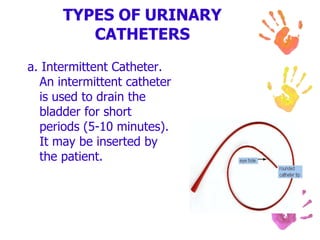
a. Intermittent Catheter.
An intermittent catheter
is used to drain the
bladder for short
periods (5-10 minutes).
It may be inserted by
the patient.
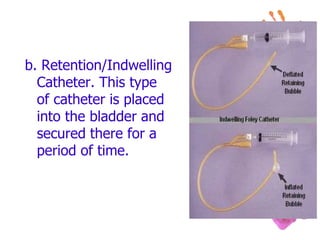
b. Retention/Indwelling
Catheter. This type
of catheter is placed
into the bladder and
secured there for a
period of time.
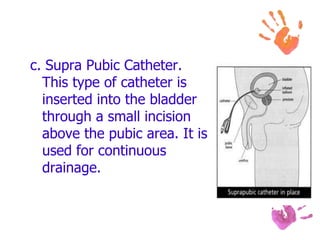
c. Supra Pubic Catheter.
This type of catheter is
inserted into the bladder
through a small incision
above the pubic area. It is
used for continuous
drainage.
PREPARING FOR
CATHETERIZATION
• A catheter should be used only when absolutely necessary
and the catheterization procedure itself should be done only
by trained personnel under sterile conditions. Infection is a
major risk of urinary catheterization.
a. Gather All Equipment.
– Catheter
– 10cc syringe
– Sterile water
– Cotton balls with betadine
– Lubricant
– Sterile gloves.
– Flashlight or lamp.
– Urine collection bag.
– Velcro leg strap or anchoring tape.
– Disposal bag.
b. Explain the Procedure to the Patient.
c. Provide for Privacy and Adequate Lighting.
d. Positioning
• Position the female patient in a dorsal
recumbent position with the knees flexed
and the feet about two feet apart. Cover
the upper body and each leg. Place the
catheter set between the female patient's
legs.
• Position a male patient in a supine position.
Drape the patient so that only the area
around the penis is exposed. Place the
catheter set next to the legs of the male
patient.
INSERTING THE FOLEY
CATHETER IN A MALE PATIENT
a. Cleanse the genital and perineal areas with warm soap
and water. Rinse and dry.
b. Wash your hands carefully.
c. Open the sterile catheterization kit, using sterile
technique.
d. Put on the sterile gloves.
e. Open the sterile drape and place on the patient's
thighs. Place fenestrated drape with opening on the
penis.
f. Apply sterile lubricant liberally to the catheter tip.
Lubricate at least six inches of the catheter. Leave the
lubricated catheter on the sterile field.
g. Pour the antiseptic solution over the cotton balls.
h. Place the urine specimen collection container within
easy reach.
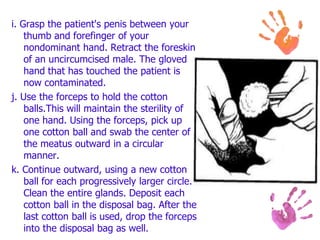
i. Grasp the patient's penis between your
thumb and forefinger of your
nondominant hand. Retract the foreskin
of an uncircumcised male. The gloved
hand that has touched the patient is
now contaminated.
j. Use the forceps to hold the cotton
balls.This will maintain the sterility of
one hand. Using the forceps, pick up
one cotton ball and swab the center of
the meatus outward in a circular
manner.
k. Continue outward, using a new cotton
ball for each progressively larger circle.
Clean the entire glands. Deposit each
cotton ball in the disposal bag. After the
last cotton ball is used, drop the forceps
into the disposal bag as well.
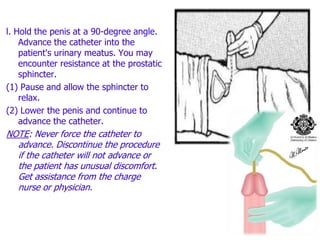
l. Hold the penis at a 90-degree angle.
Advance the catheter into the
patient's urinary meatus. You may
encounter resistance at the prostatic
sphincter.
(1) Pause and allow the sphincter to
relax.
(2) Lower the penis and continue to
advance the catheter.
NOTE: Never force the catheter to
advance. Discontinue the procedure
if the catheter will not advance or
the patient has unusual discomfort.
Get assistance from the charge
nurse or physician.
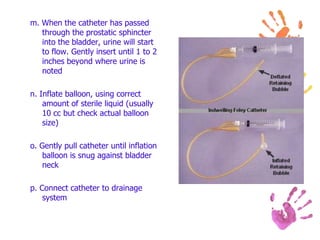
m. When the catheter has passed
through the prostatic sphincter
into the bladder, urine will start
to flow. Gently insert until 1 to 2
inches beyond where urine is
noted
n. Inflate balloon, using correct
amount of sterile liquid (usually
10 cc but check actual balloon
size)
o. Gently pull catheter until inflation
balloon is snug against bladder
neck
p. Connect catheter to drainage
system
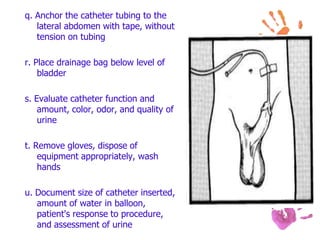
q. Anchor the catheter tubing to the
lateral abdomen with tape, without
tension on tubing
r. Place drainage bag below level of
bladder
s. Evaluate catheter function and
amount, color, odor, and quality of
urine
t. Remove gloves, dispose of
equipment appropriately, wash
hands
u. Document size of catheter inserted,
amount of water in balloon,
patient's response to procedure,
and assessment of urine
INSERTING THE FOLEY CATHETER
IN A FEMALE PATIENT
• Follow procedure same with
male from step a-h.
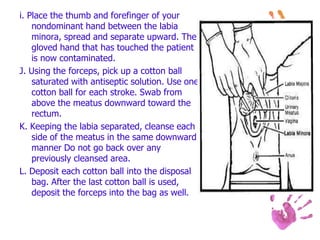
i. Place the thumb and forefinger of your
nondominant hand between the labia
minora, spread and separate upward. The
gloved hand that has touched the patient
is now contaminated.
J. Using the forceps, pick up a cotton ball
saturated with antiseptic solution. Use one
cotton ball for each stroke. Swab from
above the meatus downward toward the
rectum.
K. Keeping the labia separated, cleanse each
side of the meatus in the same downward
manner Do not go back over any
previously cleansed area.
L. Deposit each cotton ball into the disposal
bag. After the last cotton ball is used,
deposit the forceps into the bag as well.
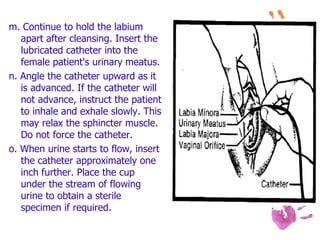
m. Continue to hold the labium
apart after cleansing. Insert the
lubricated catheter into the
female patient's urinary meatus.
n. Angle the catheter upward as it
is advanced. If the catheter will
not advance, instruct the patient
to inhale and exhale slowly. This
may relax the sphincter muscle.
Do not force the catheter.
o. When urine starts to flow, insert
the catheter approximately one
inch further. Place the cup
under the stream of flowing
urine to obtain a sterile
specimen if required.
p. Inflate balloon, using correct
amount of sterile liquid (usually 10
cc but check actual balloon size)
q. Gently pull catheter until inflation
balloon is snug against bladder
neck
r. Connect catheter to drainage
system
s. Connect the drainage bag to the catheter.
Secure the catheter to the inner aspect of
the female patient's thigh
t. Place drainage bag below level of bladder
u. Evaluate catheter function and amount,
color, odor, and quality of urine
v. Remove gloves, dispose of equipment
appropriately, wash hands
w. Document size of catheter inserted, amount
of water in balloon, patient's response to
procedure, and assessment of urine
MAINTAINING AN
INDWELLING CATHETER
a. Wash your hands before and after caring for the patient and wear gloves
when handling an indwelling catheter.
b. Clean the perineal area with soap and water twice daily and after each
bowel movement, especially around the meatus. Use a separate area of
the cloth for each stroke.
c. Avoid use of lotions or powder in the perineal area.
d. Arrange for the patient to take a shower or tub bath when permitted.
The collecting container may be hung over the side of the tub. The
catheter should be clamped temporarily if the collecting container is
higher than the bladder.
e. Teach the patient to maintain the catheter. Self-care helps the patient
develop a feeling of independence and promotes cleanliness. If the
patient is ambulatory, instruct him in use of the leg bag. Encourage the
patient to intake 2500 cc to 3000 cc of fluid daily.
f. Change the indwelling catheter as necessary or in accordance with local
policy.
REMOVING AN INDWELLING
CATHETER
a. Assemble all supplies and equipment.
(1) 10 cc syringe.
(2) Washcloth and towel.
(3) Exam gloves.
(4) Soap and water.
b. Identify the patient and explain the
procedure to him. Advise him that there
will be a slight burning during removal
of the catheter.
c. Provide privacy and assist the female
patient into a dorsal recumbent position.
The male should be in a supine position.
d. Wash your hands and put on exam gloves.
e. Empty the balloon by inserting the barrel of the syringe and
withdrawing the amount of fluid used during inflation.
f. Pinch off and gently pull on the catheter near the point where it
exits from the meatus.
g. Clean the perineum or penis with soap and water. Dry the area
well.
h. Inspect the catheter to be sure no remnants remained in the
bladder. If the catheter is not totally intact, report this promptly
and save the catheter for further inspection.
i. Empty the drainage bag. Measure the amount of urine and record
on the intake and output (I&O) sheet.
j. Remove the gloves and wash your hands.
k. Discard disposable supplies and return reusable supplies and
equipment to the appropriate area.
l. Record that the catheter was removed, the time and
date and by whom. Note the amount, color, and
clarity of the urine in the drainage bag. Also
document all patient teaching done and the
patient's level of understanding.
m. After removal of the catheter, assess the patient for
24 hours for patterns of urinary elimination. Note
the time and amount of the first voided urine.
Report any of the following:
(1) Inability to void within 8 to 10 hours.
(2) Frequency, burning, dribbling, or hesitation in starting the
stream of urine.
(3) Cloudiness or any other unusual color or characteristic of the
urine.
n. Provide a level of fluids similar to the intake when the catheter
was in place.
o. Record that the catheter was removed, the date and time, and by
whom.
Thank you
for
listening!!!!

Urinarycatheterization 091016170505-phpapp01

  • 1.
  • 2.
    • Catheterization ofthe urinary bladder is the insertion of a hollow tube through the urethra into the bladder for removing urine. It is an aseptic procedure for which sterile equipment is required.
  • 3.
    PURPOSES OF URINARY CATHETERIZATION a.Relieve Urinary Retention. b. Obtain a Sterile Urine Specimen from a Female Patient. c. Measure Residual Urine. d. Empty the Bladder Before, During, or After Surgery. e. Allows accurate measurement of urine output.
  • 4.
    URINARY CATHETER SIZES • TheFrench scale (Fr.) is used to denote the size of catheters. Each unit is roughly equivalent to 0.33 mm in diameter (that is, 18 Fr. indicates a diameter of 6 mm). The smaller the number, the smaller the catheter. A larger sized catheter is used for a male because it is stiffer, thus easier to push the distance of the male urethra. Catheters come in several sizes: – a. Number 8 Fr. and 10 Fr. are used for children. – b. Number 14 Fr. and 16 Fr. are used for female adults. – c. Number 20 Fr. and 22 Fr. are usually used for male adults.
  • 5.
    TYPES OF URINARY CATHETERS a.Intermittent Catheter. An intermittent catheter is used to drain the bladder for short periods (5-10 minutes). It may be inserted by the patient.
  • 6.
    b. Retention/Indwelling Catheter. Thistype of catheter is placed into the bladder and secured there for a period of time.
  • 7.
    c. Supra PubicCatheter. This type of catheter is inserted into the bladder through a small incision above the pubic area. It is used for continuous drainage.
  • 8.
    PREPARING FOR CATHETERIZATION • Acatheter should be used only when absolutely necessary and the catheterization procedure itself should be done only by trained personnel under sterile conditions. Infection is a major risk of urinary catheterization. a. Gather All Equipment. – Catheter – 10cc syringe – Sterile water – Cotton balls with betadine – Lubricant – Sterile gloves. – Flashlight or lamp. – Urine collection bag. – Velcro leg strap or anchoring tape. – Disposal bag.
  • 9.
    b. Explain theProcedure to the Patient. c. Provide for Privacy and Adequate Lighting. d. Positioning • Position the female patient in a dorsal recumbent position with the knees flexed and the feet about two feet apart. Cover the upper body and each leg. Place the catheter set between the female patient's legs. • Position a male patient in a supine position. Drape the patient so that only the area around the penis is exposed. Place the catheter set next to the legs of the male patient.
  • 10.
    INSERTING THE FOLEY CATHETERIN A MALE PATIENT a. Cleanse the genital and perineal areas with warm soap and water. Rinse and dry. b. Wash your hands carefully. c. Open the sterile catheterization kit, using sterile technique. d. Put on the sterile gloves. e. Open the sterile drape and place on the patient's thighs. Place fenestrated drape with opening on the penis. f. Apply sterile lubricant liberally to the catheter tip. Lubricate at least six inches of the catheter. Leave the lubricated catheter on the sterile field. g. Pour the antiseptic solution over the cotton balls. h. Place the urine specimen collection container within easy reach.
  • 11.
    i. Grasp thepatient's penis between your thumb and forefinger of your nondominant hand. Retract the foreskin of an uncircumcised male. The gloved hand that has touched the patient is now contaminated. j. Use the forceps to hold the cotton balls.This will maintain the sterility of one hand. Using the forceps, pick up one cotton ball and swab the center of the meatus outward in a circular manner. k. Continue outward, using a new cotton ball for each progressively larger circle. Clean the entire glands. Deposit each cotton ball in the disposal bag. After the last cotton ball is used, drop the forceps into the disposal bag as well.
  • 12.
    l. Hold thepenis at a 90-degree angle. Advance the catheter into the patient's urinary meatus. You may encounter resistance at the prostatic sphincter. (1) Pause and allow the sphincter to relax. (2) Lower the penis and continue to advance the catheter. NOTE: Never force the catheter to advance. Discontinue the procedure if the catheter will not advance or the patient has unusual discomfort. Get assistance from the charge nurse or physician.
  • 13.
    m. When thecatheter has passed through the prostatic sphincter into the bladder, urine will start to flow. Gently insert until 1 to 2 inches beyond where urine is noted n. Inflate balloon, using correct amount of sterile liquid (usually 10 cc but check actual balloon size) o. Gently pull catheter until inflation balloon is snug against bladder neck p. Connect catheter to drainage system
  • 14.
    q. Anchor thecatheter tubing to the lateral abdomen with tape, without tension on tubing r. Place drainage bag below level of bladder s. Evaluate catheter function and amount, color, odor, and quality of urine t. Remove gloves, dispose of equipment appropriately, wash hands u. Document size of catheter inserted, amount of water in balloon, patient's response to procedure, and assessment of urine
  • 15.
    INSERTING THE FOLEYCATHETER IN A FEMALE PATIENT • Follow procedure same with male from step a-h.
  • 16.
    i. Place thethumb and forefinger of your nondominant hand between the labia minora, spread and separate upward. The gloved hand that has touched the patient is now contaminated. J. Using the forceps, pick up a cotton ball saturated with antiseptic solution. Use one cotton ball for each stroke. Swab from above the meatus downward toward the rectum. K. Keeping the labia separated, cleanse each side of the meatus in the same downward manner Do not go back over any previously cleansed area. L. Deposit each cotton ball into the disposal bag. After the last cotton ball is used, deposit the forceps into the bag as well.
  • 17.
    m. Continue tohold the labium apart after cleansing. Insert the lubricated catheter into the female patient's urinary meatus. n. Angle the catheter upward as it is advanced. If the catheter will not advance, instruct the patient to inhale and exhale slowly. This may relax the sphincter muscle. Do not force the catheter. o. When urine starts to flow, insert the catheter approximately one inch further. Place the cup under the stream of flowing urine to obtain a sterile specimen if required.
  • 18.
    p. Inflate balloon,using correct amount of sterile liquid (usually 10 cc but check actual balloon size) q. Gently pull catheter until inflation balloon is snug against bladder neck r. Connect catheter to drainage system
  • 19.
    s. Connect thedrainage bag to the catheter. Secure the catheter to the inner aspect of the female patient's thigh t. Place drainage bag below level of bladder u. Evaluate catheter function and amount, color, odor, and quality of urine v. Remove gloves, dispose of equipment appropriately, wash hands w. Document size of catheter inserted, amount of water in balloon, patient's response to procedure, and assessment of urine
  • 20.
    MAINTAINING AN INDWELLING CATHETER a.Wash your hands before and after caring for the patient and wear gloves when handling an indwelling catheter. b. Clean the perineal area with soap and water twice daily and after each bowel movement, especially around the meatus. Use a separate area of the cloth for each stroke. c. Avoid use of lotions or powder in the perineal area. d. Arrange for the patient to take a shower or tub bath when permitted. The collecting container may be hung over the side of the tub. The catheter should be clamped temporarily if the collecting container is higher than the bladder. e. Teach the patient to maintain the catheter. Self-care helps the patient develop a feeling of independence and promotes cleanliness. If the patient is ambulatory, instruct him in use of the leg bag. Encourage the patient to intake 2500 cc to 3000 cc of fluid daily. f. Change the indwelling catheter as necessary or in accordance with local policy.
  • 21.
    REMOVING AN INDWELLING CATHETER a.Assemble all supplies and equipment. (1) 10 cc syringe. (2) Washcloth and towel. (3) Exam gloves. (4) Soap and water. b. Identify the patient and explain the procedure to him. Advise him that there will be a slight burning during removal of the catheter. c. Provide privacy and assist the female patient into a dorsal recumbent position. The male should be in a supine position.
  • 22.
    d. Wash yourhands and put on exam gloves. e. Empty the balloon by inserting the barrel of the syringe and withdrawing the amount of fluid used during inflation. f. Pinch off and gently pull on the catheter near the point where it exits from the meatus. g. Clean the perineum or penis with soap and water. Dry the area well. h. Inspect the catheter to be sure no remnants remained in the bladder. If the catheter is not totally intact, report this promptly and save the catheter for further inspection. i. Empty the drainage bag. Measure the amount of urine and record on the intake and output (I&O) sheet. j. Remove the gloves and wash your hands. k. Discard disposable supplies and return reusable supplies and equipment to the appropriate area.
  • 23.
    l. Record thatthe catheter was removed, the time and date and by whom. Note the amount, color, and clarity of the urine in the drainage bag. Also document all patient teaching done and the patient's level of understanding. m. After removal of the catheter, assess the patient for 24 hours for patterns of urinary elimination. Note the time and amount of the first voided urine. Report any of the following: (1) Inability to void within 8 to 10 hours. (2) Frequency, burning, dribbling, or hesitation in starting the stream of urine. (3) Cloudiness or any other unusual color or characteristic of the urine. n. Provide a level of fluids similar to the intake when the catheter was in place. o. Record that the catheter was removed, the date and time, and by whom.
  • 24.