FOCUSING
ASSESSMENT
ON PROCESS AND
PRODUCT
FOCUSING ASSESSMENT ON
PROCESS AND PRODUCT
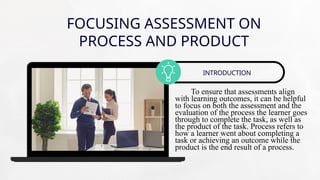
To ensure that assessments align
with learning outcomes, it can be helpful
to focus on both the assessment and the
evaluation of the process the learner goes
through to complete the task, as well as
the product of the task. Process refers to
how a learner went about completing a
task or achieving an outcome while the
product is the end result of a process.
INTRODUCTION
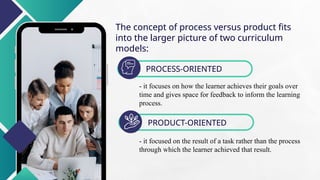
The concept of process versus product fits
into the larger picture of two curriculum
models:
- it focuses on how the learner achieves their goals over
time and gives space for feedback to inform the learning
process.
PROCESS-ORIENTED
- it focused on the result of a task rather than the process
through which the learner achieved that result.
PRODUCT-ORIENTED
PROCESS-ORIENTED
PERFORMANCE-BASED
ASSESSMENT
 Is concerned and evaluate with the actual task performance
rather than the output or product of an activity.
 It does not emphasize on the output or product of the
activity.
 It focuses on the process of learning and the development of
skills, knowledge, and understanding throughout the
learning journey.
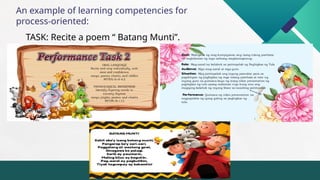
An example of learning competencies for
process-oriented:
TASK: Recite a poem “ Batang Munti”.
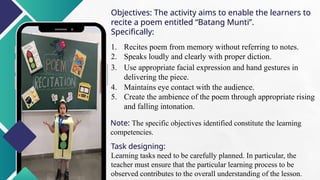
Objectives: The activity aims to enable the learners to
recite a poem entitled “Batang Munti”.
Specifically:
1. Recites poem from memory without referring to notes.
2. Speaks loudly and clearly with proper diction.
3. Use appropriate facial expression and hand gestures in
delivering the piece.
4. Maintains eye contact with the audience.
5. Create the ambience of the poem through appropriate rising
and falling intonation.
Note: The specific objectives identified constitute the learning
competencies.
Task designing:
Learning tasks need to be carefully planned. In particular, the
teacher must ensure that the particular learning process to be
observed contributes to the overall understanding of the lesson.
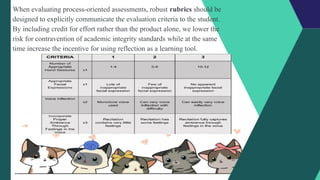
When evaluating process-oriented assessments, robust rubrics should be
designed to explicitly communicate the evaluation criteria to the student.
By including credit for effort rather than the product alone, we lower the
risk for contravention of academic integrity standards while at the same
time increase the incentive for using reflection as a learning tool.
PRODUCT-ORIENTED
PERFORMANCE-BASED
ASSESSMENT
 Is a kind of assessment where in the teacher views and scores the
final product made and not on the actual performance of making that
output/product.
 It is concern on the product alone and not on the process. It is more
concern to the outcome or the performance of the learner. It also
focuses on achievement of the learner.
 It focuses on the product of learner learning and measures the extent
to which learner have achieved the specific learning competencies.
j
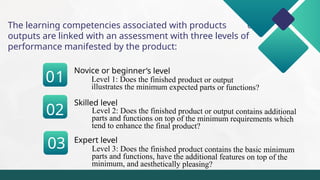
Novice or beginner’s level
01
Skilled level
02
Expert level
03
The learning competencies associated with products or
outputs are linked with an assessment with three levels of
performance manifested by the product:
Level 1: Does the finished product or output
illustrates the minimum expected parts or functions?
Level 2: Does the finished product or output contains additional
parts and functions on top of the minimum requirements which
tend to enhance the final product?
Level 3: Does the finished product contains the basic minimum
parts and functions, have the additional features on top of the
minimum, and aesthetically pleasing?
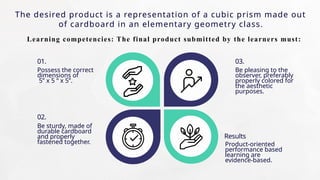
The desired product is a representation of a cubic prism made out
of cardboard in an elementary geometry class.
01. 03.
Results
02.
Possess the correct
dimensions of
5” x 5 “ x 5”.
Be sturdy, made of
durable cardboard
and properly
fastened together.
Be pleasing to the
observer, preferably
properly colored for
the aesthetic
purposes.
Product-oriented
performance based
learning are
evidence-based.
Learning competencies: The final product submitted by the learners must:
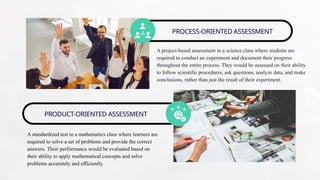
A project-based assessment in a science class where students are
required to conduct an experiment and document their progress
throughout the entire process. They would be assessed on their ability
to follow scientific procedures, ask questions, analyze data, and make
conclusions, rather than just the result of their experiment.
PROCESS-ORIENTED ASSESSMENT
A standardized test in a mathematics class where learners are
required to solve a set of problems and provide the correct
answers. Their performance would be evaluated based on
their ability to apply mathematical concepts and solve
problems accurately and efficiently.
PRODUCT-ORIENTED ASSESSMENT
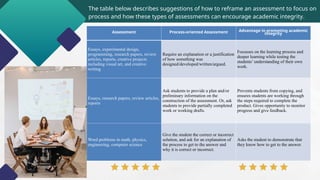
The table below describes suggestions of how to reframe an assessment to focus on
process and how these types of assessments can encourage academic integrity.
Assessment Process-oriented Assessment Advantage in promoting academic
integrity
Essays, experimental design,
programming, research papers, review
articles, reports, creative projects
including visual art, and creative
writing
Require an explanation or a justification
of how something was
designed/developed/written/argued.
Focusses on the learning process and
deeper learning while testing the
students’ understanding of their own
work.
Essays, research papers, review articles,
reports
Ask students to provide a plan and/or
preliminary information on the
construction of the assessment. Or, ask
students to provide partially completed
work or working drafts.
Prevents students from copying, and
ensures students are working through
the steps required to complete the
product. Gives opportunity to monitor
progress and give feedback.
Word problems in math, physics,
engineering, computer science
Give the student the correct or incorrect
solution, and ask for an explanation of
the process to get to the answer and
why it is correct or incorrect.
Asks the student to demonstrate that
they know how to get to the answer.
1
2
3
4
Both process-oriented and product-oriented performance-
based assessment methods have their own significance in
evaluating learners learning and achievement.
Process-oriented assessment focuses on the learning journey
and the development of skills and understanding, while
product-oriented assessment emphasizes the product or
output of the learning process.
It is important for educators to consider both approaches to
effectively assess and support learner learning journey.
By using a combination of both methods, learners can be
provided with a comprehensive and balanced assessment
that promotes their overall growth and development.
CONCLUSIONS
“It is important to assess pupils learning not only through
their outputs or products but also the processes which
the learners underwent in order to come up at these
products or outputs.”
THANK YOU

focusing assessment on process and product based result.pptx

  • 1.
  • 2.
    FOCUSING ASSESSMENT ON PROCESSAND PRODUCT To ensure that assessments align with learning outcomes, it can be helpful to focus on both the assessment and the evaluation of the process the learner goes through to complete the task, as well as the product of the task. Process refers to how a learner went about completing a task or achieving an outcome while the product is the end result of a process. INTRODUCTION
  • 3.
    The concept ofprocess versus product fits into the larger picture of two curriculum models: - it focuses on how the learner achieves their goals over time and gives space for feedback to inform the learning process. PROCESS-ORIENTED - it focused on the result of a task rather than the process through which the learner achieved that result. PRODUCT-ORIENTED
  • 4.
    PROCESS-ORIENTED PERFORMANCE-BASED ASSESSMENT  Is concernedand evaluate with the actual task performance rather than the output or product of an activity.  It does not emphasize on the output or product of the activity.  It focuses on the process of learning and the development of skills, knowledge, and understanding throughout the learning journey.
  • 5.
    An example oflearning competencies for process-oriented: TASK: Recite a poem “ Batang Munti”.
  • 6.
    Objectives: The activityaims to enable the learners to recite a poem entitled “Batang Munti”. Specifically: 1. Recites poem from memory without referring to notes. 2. Speaks loudly and clearly with proper diction. 3. Use appropriate facial expression and hand gestures in delivering the piece. 4. Maintains eye contact with the audience. 5. Create the ambience of the poem through appropriate rising and falling intonation. Note: The specific objectives identified constitute the learning competencies. Task designing: Learning tasks need to be carefully planned. In particular, the teacher must ensure that the particular learning process to be observed contributes to the overall understanding of the lesson.
  • 7.
    When evaluating process-orientedassessments, robust rubrics should be designed to explicitly communicate the evaluation criteria to the student. By including credit for effort rather than the product alone, we lower the risk for contravention of academic integrity standards while at the same time increase the incentive for using reflection as a learning tool.
  • 8.
    PRODUCT-ORIENTED PERFORMANCE-BASED ASSESSMENT  Is akind of assessment where in the teacher views and scores the final product made and not on the actual performance of making that output/product.  It is concern on the product alone and not on the process. It is more concern to the outcome or the performance of the learner. It also focuses on achievement of the learner.  It focuses on the product of learner learning and measures the extent to which learner have achieved the specific learning competencies.
  • 9.
    j Novice or beginner’slevel 01 Skilled level 02 Expert level 03 The learning competencies associated with products or outputs are linked with an assessment with three levels of performance manifested by the product: Level 1: Does the finished product or output illustrates the minimum expected parts or functions? Level 2: Does the finished product or output contains additional parts and functions on top of the minimum requirements which tend to enhance the final product? Level 3: Does the finished product contains the basic minimum parts and functions, have the additional features on top of the minimum, and aesthetically pleasing?
  • 10.
    The desired productis a representation of a cubic prism made out of cardboard in an elementary geometry class. 01. 03. Results 02. Possess the correct dimensions of 5” x 5 “ x 5”. Be sturdy, made of durable cardboard and properly fastened together. Be pleasing to the observer, preferably properly colored for the aesthetic purposes. Product-oriented performance based learning are evidence-based. Learning competencies: The final product submitted by the learners must:
  • 11.
    A project-based assessmentin a science class where students are required to conduct an experiment and document their progress throughout the entire process. They would be assessed on their ability to follow scientific procedures, ask questions, analyze data, and make conclusions, rather than just the result of their experiment. PROCESS-ORIENTED ASSESSMENT A standardized test in a mathematics class where learners are required to solve a set of problems and provide the correct answers. Their performance would be evaluated based on their ability to apply mathematical concepts and solve problems accurately and efficiently. PRODUCT-ORIENTED ASSESSMENT
  • 12.
    The table belowdescribes suggestions of how to reframe an assessment to focus on process and how these types of assessments can encourage academic integrity. Assessment Process-oriented Assessment Advantage in promoting academic integrity Essays, experimental design, programming, research papers, review articles, reports, creative projects including visual art, and creative writing Require an explanation or a justification of how something was designed/developed/written/argued. Focusses on the learning process and deeper learning while testing the students’ understanding of their own work. Essays, research papers, review articles, reports Ask students to provide a plan and/or preliminary information on the construction of the assessment. Or, ask students to provide partially completed work or working drafts. Prevents students from copying, and ensures students are working through the steps required to complete the product. Gives opportunity to monitor progress and give feedback. Word problems in math, physics, engineering, computer science Give the student the correct or incorrect solution, and ask for an explanation of the process to get to the answer and why it is correct or incorrect. Asks the student to demonstrate that they know how to get to the answer.
  • 13.
    1 2 3 4 Both process-oriented andproduct-oriented performance- based assessment methods have their own significance in evaluating learners learning and achievement. Process-oriented assessment focuses on the learning journey and the development of skills and understanding, while product-oriented assessment emphasizes the product or output of the learning process. It is important for educators to consider both approaches to effectively assess and support learner learning journey. By using a combination of both methods, learners can be provided with a comprehensive and balanced assessment that promotes their overall growth and development. CONCLUSIONS
  • 14.
    “It is importantto assess pupils learning not only through their outputs or products but also the processes which the learners underwent in order to come up at these products or outputs.”
  • 15.

Editor's Notes

  • #3 Both methods have their own unique characteristics and serve a specific purpose in assessing the performance of learners.
  • #5 Learning Competencies: The learning objectives in process-oriented performance based assessment are stated in direct observable behaviors of the learners. Competencies are defined as groups or cluster of skills and abilities needed for a particular task.
  • #6 Some generally accepted standards for designing a task include: -identifying an activity that would highlight the competencies to be evaluated. Example: reciting a poem, writing an essay, manipulating the microscope. Find a task that would be interesting and enjoyable for the learners.
  • #7 Rubric is a scoring scale used to assess learner performance a long a task-specific set of criteria. A rubric which contains the essential criteria for the task and appropriate levels of performance is typically created to measure learner’s performance. Descriptors tells learners more precisely what performance looks like at each level and how their work maybe distinguished from the work of others from each criterion.
  • #9 There are other way to state product-oriented learning competencies. For instances, we can define learning competencies for the products or outputs in the following way:
  • #10 Scoring rubrics These are descriptive scoring schemes that are developed by teachers to guide the analysis of the products or processes of learners’ efforts.