COLLINS V. VIRGINIA
BY LAURENCE FISHER
WHAT HAPPENED?
• Mr. Ryan Collins was seen by police
on an orange and black motorcycle
leaving the scene of more than two
traffic accidents. Officer David
Rhodes among others were
searching for Collins and the
motorcycle which they suspected
to be stolen.
WHAT HAPPENED?
• Officer David Rhodes came up with an idea to search face book for the
suspect and discovered pictures of the motorcycle sitting on someones
property.
WHAT HAPPENED?
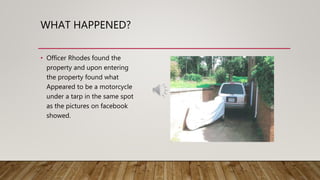
• Officer Rhodes found the
property and upon entering
the property found what
Appeared to be a motorcycle
under a tarp in the same spot
as the pictures on facebook
showed.
WHAT HAPPENED?
• Officer Rhodes removed the tarp and
discovered the black and orange
motorcycle that he had been searching
for then ran the plates and vin number
to confirm it was stolen. When Mr.
Collins arrived at his girlfriends house
where the motorcycle had been
stashed he was immediately taken into
custody and charged with receiving
stolen property.
TRIAL
• During the trial Collins and his
attorney argued that the motorcycle
was within the curtlige of the house
and not subject to the vehicle
acception of the fourth amendment.
The judge found that his rights were
not violated and the vehicle
acception does apply and his motion
to suppress the motorcycle as
evidence was denied. Collins was
subsequently found guilty for his
crimes and convicted.
APPEAL
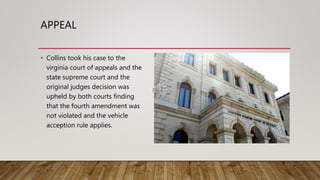
• Collins took his case to the
virginia court of appeals and the
state supreme court and the
original judges decision was
upheld by both courts finding
that the fourth amendment was
not violated and the vehicle
acception rule applies.
SUPREME COURT
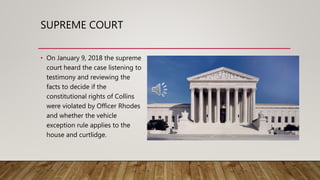
• On January 9, 2018 the supreme
court heard the case listening to
testimony and reviewing the
facts to decide if the
constitutional rights of Collins
were violated by Officer Rhodes
and whether the vehicle
exception rule applies to the
house and curtlidge.
SUPREME COURT
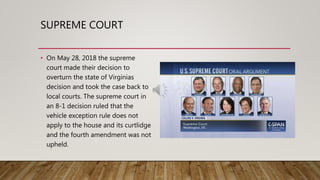
• On May 28, 2018 the supreme
court made their decision to
overturn the state of Virginias
decision and took the case back to
local courts. The supreme court in
an 8-1 decision ruled that the
vehicle exception rule does not
apply to the house and its curtlidge
and the fourth amendment was not
upheld.
WHAT DOES IT MEAN?
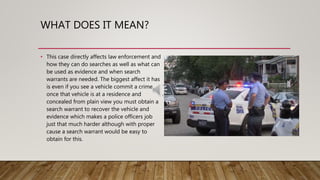
• This case directly affects law enforcement and
how they can do searches as well as what can
be used as evidence and when search
warrants are needed. The biggest affect it has
is even if you see a vehicle commit a crime
once that vehicle is at a residence and
concealed from plain view you must obtain a
search warrant to recover the vehicle and
evidence which makes a police officers job
just that much harder although with proper
cause a search warrant would be easy to
obtain for this.
REFERENCES
• 584 U. S. ____ (2018) . Collins v Virginia. Supremecourt.gov.
https://www.supremecourt.gov/opinions/17pdf/16-1027_7lio.pdf.
• Cornell Law School. (2018). Collins v Virginia. Legal Information Institute.
https://www.law.cornell.edu/supremecourt/text/16-1027.
• Wheeler L. (2018). Supreme Court Sets New Limits on Police Searches. The Hill.
http://thehill.com/regulation/court-battles/389697-supreme-court-sets-new-
limits-on-police-searches.
• Pictures from Wikipedia.

Fisher final

  • 1.
    COLLINS V. VIRGINIA BYLAURENCE FISHER
  • 2.
    WHAT HAPPENED? • Mr.Ryan Collins was seen by police on an orange and black motorcycle leaving the scene of more than two traffic accidents. Officer David Rhodes among others were searching for Collins and the motorcycle which they suspected to be stolen.
  • 3.
    WHAT HAPPENED? • OfficerDavid Rhodes came up with an idea to search face book for the suspect and discovered pictures of the motorcycle sitting on someones property.
  • 4.
    WHAT HAPPENED? • OfficerRhodes found the property and upon entering the property found what Appeared to be a motorcycle under a tarp in the same spot as the pictures on facebook showed.
  • 5.
    WHAT HAPPENED? • OfficerRhodes removed the tarp and discovered the black and orange motorcycle that he had been searching for then ran the plates and vin number to confirm it was stolen. When Mr. Collins arrived at his girlfriends house where the motorcycle had been stashed he was immediately taken into custody and charged with receiving stolen property.
  • 6.
    TRIAL • During thetrial Collins and his attorney argued that the motorcycle was within the curtlige of the house and not subject to the vehicle acception of the fourth amendment. The judge found that his rights were not violated and the vehicle acception does apply and his motion to suppress the motorcycle as evidence was denied. Collins was subsequently found guilty for his crimes and convicted.
  • 7.
    APPEAL • Collins tookhis case to the virginia court of appeals and the state supreme court and the original judges decision was upheld by both courts finding that the fourth amendment was not violated and the vehicle acception rule applies.
  • 8.
    SUPREME COURT • OnJanuary 9, 2018 the supreme court heard the case listening to testimony and reviewing the facts to decide if the constitutional rights of Collins were violated by Officer Rhodes and whether the vehicle exception rule applies to the house and curtlidge.
  • 9.
    SUPREME COURT • OnMay 28, 2018 the supreme court made their decision to overturn the state of Virginias decision and took the case back to local courts. The supreme court in an 8-1 decision ruled that the vehicle exception rule does not apply to the house and its curtlidge and the fourth amendment was not upheld.
  • 10.
    WHAT DOES ITMEAN? • This case directly affects law enforcement and how they can do searches as well as what can be used as evidence and when search warrants are needed. The biggest affect it has is even if you see a vehicle commit a crime once that vehicle is at a residence and concealed from plain view you must obtain a search warrant to recover the vehicle and evidence which makes a police officers job just that much harder although with proper cause a search warrant would be easy to obtain for this.
  • 11.
    REFERENCES • 584 U.S. ____ (2018) . Collins v Virginia. Supremecourt.gov. https://www.supremecourt.gov/opinions/17pdf/16-1027_7lio.pdf. • Cornell Law School. (2018). Collins v Virginia. Legal Information Institute. https://www.law.cornell.edu/supremecourt/text/16-1027. • Wheeler L. (2018). Supreme Court Sets New Limits on Police Searches. The Hill. http://thehill.com/regulation/court-battles/389697-supreme-court-sets-new- limits-on-police-searches. • Pictures from Wikipedia.