Cell BiologyBlock 1:  Cytoplasm, Nucleus, Gametogenesis, First Week of Development, Bilaminar Germ Disc, Triaminar Germ Disk, Third to Eight Weeks, Birth Defects and Prenatal Diagnosis, Epithelial Tissue, Connective TissueBlock 2: Cartilage and Adipose Tissue, Bone, Skeletal System Development, Blood, Hematopoiesis, Muscle Tissue, Muscular Tissue Development, Development of the Face, Nerve, Tissue, Cardiovascular SystemBlock 3:  Lymphatic System, Integumentary System, Body Cavity Development, Respiratory System, Respiratory System Development, Digestive System,  Digestive System DevelopmentBlock 4: Endocrine Organs, Urinary System, Male and Female Reproductive System, Urogenital System, and the  Eye
Gross AnatomyBlock 1:  Muscles of the back, joints of the vertebral column, spinal chord,, spinal nerves, thoracis wall, anterior thoracic wall, trachea, bronchi, lungs, pleura, pericardium, heart, superior/posterior mediastina, autonomic nervous systemBlock 2:  Skull, removal of the brain, face and blood vessels, nerves, and viscera of the neck, neck, face and scalp, anterior/posterior triangles of the neck, introduction to the brain and cranial nerves, orbit and eye, temporal and infratemporal fossae, circle of Willis, pterygopallatine fossa.
Gross Anatomy cont.Block 3: Thoracoappendicular/scapulohumeral muscles, axilla,  superficial upper limb,  shoulder, pectoral region, arm, cubital fossa, anterior compartment of the forearm, hand, posterior compartment of the forearm, joints of the upper limb, palm of the hand, dorsum of the hand, and joints of the upper limb , nasal cavity, paranasal sinus, oral cavity, pharynx,  larynx, earBlock 4:  Anterior abdominal wall, abdominal organs and peritoneum, stomach, liver, bile ducts, spleen, celiac trunk, small/large intestines, pancreas, mesenteric arteries, portal vein, pelvic walls, pelvic organs, perineum, pelvic cavity Block 5:  Gluteal region,  anterior/medial compartments of the thigh, posterior compartment of the thigh and popliteal fossa, leg,  anterior/lateral compartments of the leg , dorsum of the foot, foot, sole of the foot, joints of the lower limb
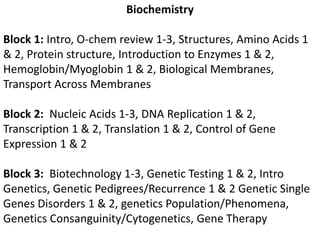
BiochemistryBlock 1: Intro, O-chem review 1-3, Structures, Amino Acids 1 & 2, Protein structure, Introduction to Enzymes 1 & 2, Hemoglobin/Myoglobin 1 & 2, Biological Membranes, Transport Across MembranesBlock 2:  Nucleic Acids 1-3, DNA Replication 1 & 2, Transcription 1 & 2, Translation 1 & 2, Control of Gene Expression 1 & 2Block 3:  Biotechnology 1-3, Genetic Testing 1 & 2, Intro Genetics, Genetic Pedigrees/Recurrence 1 & 2 Genetic Single Genes Disorders 1 & 2, genetics Population/Phenomena, Genetics Consanguinity/Cytogenetics, Gene Therapy
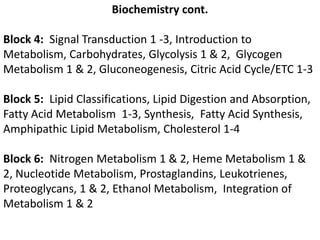
Biochemistry cont.Block 4:  Signal Transduction 1 -3, Introduction to Metabolism, Carbohydrates, Glycolysis 1 & 2,  Glycogen Metabolism 1 & 2, Gluconeogenesis, Citric Acid Cycle/ETC 1-3Block 5:  Lipid Classifications, Lipid Digestion and Absorption,  Fatty Acid Metabolism  1-3, Synthesis,  Fatty Acid Synthesis, Amphipathic Lipid Metabolism, Cholesterol 1-4Block 6:  Nitrogen Metabolism 1 & 2, Heme Metabolism 1 & 2, Nucleotide Metabolism, Prostaglandins, Leukotrienes,  Proteoglycans, 1 & 2, Ethanol Metabolism,  Integration of Metabolism 1 & 2
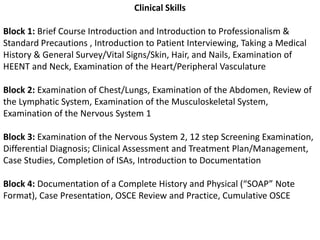
Clinical SkillsBlock 1: Brief Course Introduction and Introduction to Professionalism & Standard Precautions , Introduction to Patient Interviewing, Taking a Medical History & General Survey/Vital Signs/Skin, Hair, and Nails, Examination of HEENT and Neck, Examination of the Heart/Peripheral VasculatureBlock 2: Examination of Chest/Lungs, Examination of the Abdomen, Review of the Lymphatic System, Examination of the Musculoskeletal System, Examination of the Nervous System 1Block 3: Examination of the Nervous System 2, 12 step Screening Examination, Differential Diagnosis; Clinical Assessment and Treatment Plan/Management, Case Studies, Completion of ISAs, Introduction to DocumentationBlock 4: Documentation of a Complete History and Physical (“SOAP” Note Format), Case Presentation, OSCE Review and Practice, Cumulative OSCE
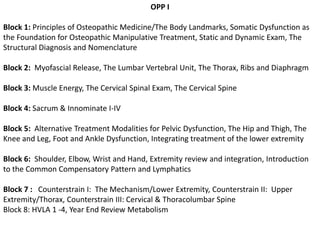
OPP IBlock 1: Principles of Osteopathic Medicine/The Body Landmarks, Somatic Dysfunction as the Foundation for Osteopathic Manipulative Treatment, Static and Dynamic Exam, The Structural Diagnosis and NomenclatureBlock 2:  Myofascial Release, The Lumbar Vertebral Unit, The Thorax, Ribs and DiaphragmBlock 3: Muscle Energy, The Cervical Spinal Exam, The Cervical SpineBlock 4: Sacrum & Innominate I-IVBlock 5:  Alternative Treatment Modalities for Pelvic Dysfunction, The Hip and Thigh, The Knee and Leg, Foot and Ankle Dysfunction, Integrating treatment of the lower extremityBlock 6:  Shoulder, Elbow, Wrist and Hand, Extremity review and integration, Introduction to the Common Compensatory Pattern and LymphaticsBlock 7 :   Counterstrain I:  The Mechanism/Lower Extremity, Counterstrain II:  Upper Extremity/Thorax, Counterstrain III: Cervical & Thoracolumbar SpineBlock 8: HVLA 1 -4, Year End Review Metabolism
Physiology Block 5:  Introduction to Physiology, Homeostasis & Body Fluids. Cell Function Review, Membranes & Transport, membrane Potentials, Action Potentials & Synapses, Neurotransmitters, ANS 1 & 2, Skeletal Muscle Contraction, Smooth Muscle, Bone, Bone HealingBlock 6:  Cardiac  Muscle & Cardiac Cycle, Conduction System, Normal EKG, EKG Abnormalities, Cardiac Arrhythmias,  Hemodynamics, Hemodynamics & Blood Flow Issues, Control of Blood Flow, Renal-CV Integration, Cardiac Output, Muscles & Coronary Circulation, Cardiac Failure, Heart Valves, Circulatory Shock
Physiology cont.Block 7:   Pulmonary Ventilation, Pulmonary Circulation, Gas Exchange, Gas Transport, Regulation of Respiration, Respiratory Insufficiency, Alterations in Pulmonary Function, GI Physiology, Propulsion and Mixing, Secretion, Absorption, and Digestion 1 & 2, Nutrient Metabolism, The Liver, GI Disorders Block 8:  Fluids and Kidneys, Fluids,  Edema, Urine Formation, GFR, Nephron Physiology 1 & 2,  Clearance Methods,  ECF Fluid Regulation 1 & 2, Electrolyte 1 & 2, Acid-Based Balance, Kidney Diseases , DiureticsBlock 9:  Intro to Endocrinology, Pituitary Gland & Hypothalamic Control, Thyroid Gland, Parathyroid Gland,  the Adrenal Gland, The Pancreas, Male Reproductive System, Female Reproductive System, Alterations of Reproductive Systems
Clinical Skills Practicum IBlock 5:  Course Syllabus Review  & Introduction, Introduction to Rx Writing, Male Prostrate and Genitourinary Exam, Female Breast and Pelvic Exam, Giving Injections, Introduction to SuturingBlock 6:  EKG Lab, OSCE 1, Surgical Knot TyingBlock 7:   Surgical Note, Case Studies (PCSOM Rounds)Block 8 :  OSCE 2
NeuroscienceBlock 6:  Introduction to Neuroscience, Spinal Chord, Brainstem, Diencephalon, Telencephalon ,  Arterial Supply of the CNS, Venous Drainage of the CNS, Cerebellum, Telencephalon (external features)Block 7:  Ventricular System and CSF, Cranial Nerves, Telencephalon (internal features), Cranial Nerves, Synaptic Transmission, Somatosensory System, Blood Supply of the CNS, Ventricular System, Physiology of Pain, Visual System, Vestibular System, Clinical Cases, Auditory System, Gustatory and Olfactory SystemsBlock 8: Peripheral Sensory and Brainstem Influences on Spinal  Cord Motor Neurons, Clinical Cases, Corticofugal Systems, Basal Nuclei, Cerebellum, Visual Motor Systems, Hypothalamus and ANS, Limbic System, Clinical Cases, Cerebral Cortex, Sleep and Arousal, Basic Principles of EEG, Clinical Cases
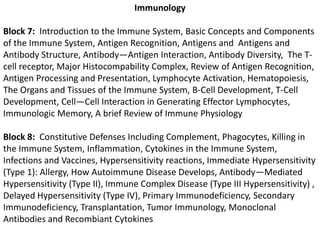
ImmunologyBlock 7:  Introduction to the Immune System, Basic Concepts and Components of the Immune System, Antigen Recognition, Antigens and  Antigens and Antibody Structure, Antibody—Antigen Interaction, Antibody Diversity,  The T-cell receptor, Major Histocompability Complex, Review of Antigen Recognition, Antigen Processing and Presentation, Lymphocyte Activation, Hematopoiesis, The Organs and Tissues of the Immune System, B-Cell Development, T-Cell Development, Cell—Cell Interaction in Generating Effector Lymphocytes, Immunologic Memory, A brief Review of Immune PhysiologyBlock 8:  Constitutive Defenses Including Complement, Phagocytes, Killing in the Immune System, Inflammation, Cytokines in the Immune System, Infections and Vaccines, Hypersensitivity reactions, Immediate Hypersensitivity (Type 1): Allergy, How Autoimmune Disease Develops, Antibody—Mediated Hypersensitivity (Type II), Immune Complex Disease (Type III Hypersensitivity) , Delayed Hypersensitivity (Type IV), Primary Immunodeficiency, Secondary Immunodeficiency, Transplantation, Tumor Immunology, Monoclonal Antibodies and Recombiant Cytokines
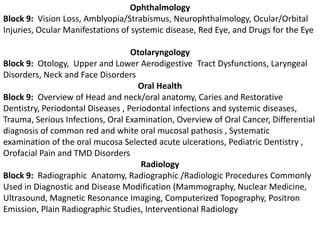
OphthalmologyBlock 9:  Vision Loss, Amblyopia/Strabismus, Neurophthalmology, Ocular/Orbital Injuries, Ocular Manifestations of systemic disease, Red Eye, and Drugs for the EyeOtolaryngologyBlock 9:  Otology,  Upper and Lower Aerodigestive  Tract Dysfunctions, Laryngeal Disorders, Neck and Face DisordersOral HealthBlock 9:  Overview of Head and neck/oral anatomy, Caries and Restorative Dentistry, Periodontal Diseases , Periodontal infections and systemic diseases, Trauma, Serious Infections, Oral Examination, Overview of Oral Cancer, Differential diagnosis of common red and white oral mucosal pathosis , Systematic examination of the oral mucosa Selected acute ulcerations, Pediatric Dentistry , Orofacial Pain and TMD Disorders RadiologyBlock 9:  Radiographic  Anatomy, Radiographic /Radiologic Procedures Commonly Used in Diagnostic and Disease Modification (Mammography, Nuclear Medicine, Ultrasound, Magnetic Resonance Imaging, Computerized Topography, Positron Emission, Plain Radiographic Studies, Interventional Radiology

First year boards

  • 1.
    Cell BiologyBlock 1: Cytoplasm, Nucleus, Gametogenesis, First Week of Development, Bilaminar Germ Disc, Triaminar Germ Disk, Third to Eight Weeks, Birth Defects and Prenatal Diagnosis, Epithelial Tissue, Connective TissueBlock 2: Cartilage and Adipose Tissue, Bone, Skeletal System Development, Blood, Hematopoiesis, Muscle Tissue, Muscular Tissue Development, Development of the Face, Nerve, Tissue, Cardiovascular SystemBlock 3: Lymphatic System, Integumentary System, Body Cavity Development, Respiratory System, Respiratory System Development, Digestive System, Digestive System DevelopmentBlock 4: Endocrine Organs, Urinary System, Male and Female Reproductive System, Urogenital System, and the Eye
  • 2.
    Gross AnatomyBlock 1: Muscles of the back, joints of the vertebral column, spinal chord,, spinal nerves, thoracis wall, anterior thoracic wall, trachea, bronchi, lungs, pleura, pericardium, heart, superior/posterior mediastina, autonomic nervous systemBlock 2: Skull, removal of the brain, face and blood vessels, nerves, and viscera of the neck, neck, face and scalp, anterior/posterior triangles of the neck, introduction to the brain and cranial nerves, orbit and eye, temporal and infratemporal fossae, circle of Willis, pterygopallatine fossa.
  • 3.
    Gross Anatomy cont.Block3: Thoracoappendicular/scapulohumeral muscles, axilla, superficial upper limb, shoulder, pectoral region, arm, cubital fossa, anterior compartment of the forearm, hand, posterior compartment of the forearm, joints of the upper limb, palm of the hand, dorsum of the hand, and joints of the upper limb , nasal cavity, paranasal sinus, oral cavity, pharynx, larynx, earBlock 4: Anterior abdominal wall, abdominal organs and peritoneum, stomach, liver, bile ducts, spleen, celiac trunk, small/large intestines, pancreas, mesenteric arteries, portal vein, pelvic walls, pelvic organs, perineum, pelvic cavity Block 5: Gluteal region, anterior/medial compartments of the thigh, posterior compartment of the thigh and popliteal fossa, leg, anterior/lateral compartments of the leg , dorsum of the foot, foot, sole of the foot, joints of the lower limb
  • 4.
    BiochemistryBlock 1: Intro,O-chem review 1-3, Structures, Amino Acids 1 & 2, Protein structure, Introduction to Enzymes 1 & 2, Hemoglobin/Myoglobin 1 & 2, Biological Membranes, Transport Across MembranesBlock 2: Nucleic Acids 1-3, DNA Replication 1 & 2, Transcription 1 & 2, Translation 1 & 2, Control of Gene Expression 1 & 2Block 3: Biotechnology 1-3, Genetic Testing 1 & 2, Intro Genetics, Genetic Pedigrees/Recurrence 1 & 2 Genetic Single Genes Disorders 1 & 2, genetics Population/Phenomena, Genetics Consanguinity/Cytogenetics, Gene Therapy
  • 5.
    Biochemistry cont.Block 4: Signal Transduction 1 -3, Introduction to Metabolism, Carbohydrates, Glycolysis 1 & 2, Glycogen Metabolism 1 & 2, Gluconeogenesis, Citric Acid Cycle/ETC 1-3Block 5: Lipid Classifications, Lipid Digestion and Absorption, Fatty Acid Metabolism 1-3, Synthesis, Fatty Acid Synthesis, Amphipathic Lipid Metabolism, Cholesterol 1-4Block 6: Nitrogen Metabolism 1 & 2, Heme Metabolism 1 & 2, Nucleotide Metabolism, Prostaglandins, Leukotrienes, Proteoglycans, 1 & 2, Ethanol Metabolism, Integration of Metabolism 1 & 2
  • 6.
    Clinical SkillsBlock 1:Brief Course Introduction and Introduction to Professionalism & Standard Precautions , Introduction to Patient Interviewing, Taking a Medical History & General Survey/Vital Signs/Skin, Hair, and Nails, Examination of HEENT and Neck, Examination of the Heart/Peripheral VasculatureBlock 2: Examination of Chest/Lungs, Examination of the Abdomen, Review of the Lymphatic System, Examination of the Musculoskeletal System, Examination of the Nervous System 1Block 3: Examination of the Nervous System 2, 12 step Screening Examination, Differential Diagnosis; Clinical Assessment and Treatment Plan/Management, Case Studies, Completion of ISAs, Introduction to DocumentationBlock 4: Documentation of a Complete History and Physical (“SOAP” Note Format), Case Presentation, OSCE Review and Practice, Cumulative OSCE
  • 7.
    OPP IBlock 1:Principles of Osteopathic Medicine/The Body Landmarks, Somatic Dysfunction as the Foundation for Osteopathic Manipulative Treatment, Static and Dynamic Exam, The Structural Diagnosis and NomenclatureBlock 2: Myofascial Release, The Lumbar Vertebral Unit, The Thorax, Ribs and DiaphragmBlock 3: Muscle Energy, The Cervical Spinal Exam, The Cervical SpineBlock 4: Sacrum & Innominate I-IVBlock 5: Alternative Treatment Modalities for Pelvic Dysfunction, The Hip and Thigh, The Knee and Leg, Foot and Ankle Dysfunction, Integrating treatment of the lower extremityBlock 6: Shoulder, Elbow, Wrist and Hand, Extremity review and integration, Introduction to the Common Compensatory Pattern and LymphaticsBlock 7 : Counterstrain I: The Mechanism/Lower Extremity, Counterstrain II: Upper Extremity/Thorax, Counterstrain III: Cervical & Thoracolumbar SpineBlock 8: HVLA 1 -4, Year End Review Metabolism
  • 8.
    Physiology Block 5: Introduction to Physiology, Homeostasis & Body Fluids. Cell Function Review, Membranes & Transport, membrane Potentials, Action Potentials & Synapses, Neurotransmitters, ANS 1 & 2, Skeletal Muscle Contraction, Smooth Muscle, Bone, Bone HealingBlock 6: Cardiac Muscle & Cardiac Cycle, Conduction System, Normal EKG, EKG Abnormalities, Cardiac Arrhythmias, Hemodynamics, Hemodynamics & Blood Flow Issues, Control of Blood Flow, Renal-CV Integration, Cardiac Output, Muscles & Coronary Circulation, Cardiac Failure, Heart Valves, Circulatory Shock
  • 9.
    Physiology cont.Block 7: Pulmonary Ventilation, Pulmonary Circulation, Gas Exchange, Gas Transport, Regulation of Respiration, Respiratory Insufficiency, Alterations in Pulmonary Function, GI Physiology, Propulsion and Mixing, Secretion, Absorption, and Digestion 1 & 2, Nutrient Metabolism, The Liver, GI Disorders Block 8: Fluids and Kidneys, Fluids, Edema, Urine Formation, GFR, Nephron Physiology 1 & 2, Clearance Methods, ECF Fluid Regulation 1 & 2, Electrolyte 1 & 2, Acid-Based Balance, Kidney Diseases , DiureticsBlock 9: Intro to Endocrinology, Pituitary Gland & Hypothalamic Control, Thyroid Gland, Parathyroid Gland, the Adrenal Gland, The Pancreas, Male Reproductive System, Female Reproductive System, Alterations of Reproductive Systems
  • 10.
    Clinical Skills PracticumIBlock 5: Course Syllabus Review & Introduction, Introduction to Rx Writing, Male Prostrate and Genitourinary Exam, Female Breast and Pelvic Exam, Giving Injections, Introduction to SuturingBlock 6: EKG Lab, OSCE 1, Surgical Knot TyingBlock 7: Surgical Note, Case Studies (PCSOM Rounds)Block 8 : OSCE 2
  • 11.
    NeuroscienceBlock 6: Introduction to Neuroscience, Spinal Chord, Brainstem, Diencephalon, Telencephalon , Arterial Supply of the CNS, Venous Drainage of the CNS, Cerebellum, Telencephalon (external features)Block 7: Ventricular System and CSF, Cranial Nerves, Telencephalon (internal features), Cranial Nerves, Synaptic Transmission, Somatosensory System, Blood Supply of the CNS, Ventricular System, Physiology of Pain, Visual System, Vestibular System, Clinical Cases, Auditory System, Gustatory and Olfactory SystemsBlock 8: Peripheral Sensory and Brainstem Influences on Spinal Cord Motor Neurons, Clinical Cases, Corticofugal Systems, Basal Nuclei, Cerebellum, Visual Motor Systems, Hypothalamus and ANS, Limbic System, Clinical Cases, Cerebral Cortex, Sleep and Arousal, Basic Principles of EEG, Clinical Cases
  • 12.
    ImmunologyBlock 7: Introduction to the Immune System, Basic Concepts and Components of the Immune System, Antigen Recognition, Antigens and Antigens and Antibody Structure, Antibody—Antigen Interaction, Antibody Diversity, The T-cell receptor, Major Histocompability Complex, Review of Antigen Recognition, Antigen Processing and Presentation, Lymphocyte Activation, Hematopoiesis, The Organs and Tissues of the Immune System, B-Cell Development, T-Cell Development, Cell—Cell Interaction in Generating Effector Lymphocytes, Immunologic Memory, A brief Review of Immune PhysiologyBlock 8: Constitutive Defenses Including Complement, Phagocytes, Killing in the Immune System, Inflammation, Cytokines in the Immune System, Infections and Vaccines, Hypersensitivity reactions, Immediate Hypersensitivity (Type 1): Allergy, How Autoimmune Disease Develops, Antibody—Mediated Hypersensitivity (Type II), Immune Complex Disease (Type III Hypersensitivity) , Delayed Hypersensitivity (Type IV), Primary Immunodeficiency, Secondary Immunodeficiency, Transplantation, Tumor Immunology, Monoclonal Antibodies and Recombiant Cytokines
  • 13.
    OphthalmologyBlock 9: Vision Loss, Amblyopia/Strabismus, Neurophthalmology, Ocular/Orbital Injuries, Ocular Manifestations of systemic disease, Red Eye, and Drugs for the EyeOtolaryngologyBlock 9: Otology, Upper and Lower Aerodigestive Tract Dysfunctions, Laryngeal Disorders, Neck and Face DisordersOral HealthBlock 9: Overview of Head and neck/oral anatomy, Caries and Restorative Dentistry, Periodontal Diseases , Periodontal infections and systemic diseases, Trauma, Serious Infections, Oral Examination, Overview of Oral Cancer, Differential diagnosis of common red and white oral mucosal pathosis , Systematic examination of the oral mucosa Selected acute ulcerations, Pediatric Dentistry , Orofacial Pain and TMD Disorders RadiologyBlock 9: Radiographic Anatomy, Radiographic /Radiologic Procedures Commonly Used in Diagnostic and Disease Modification (Mammography, Nuclear Medicine, Ultrasound, Magnetic Resonance Imaging, Computerized Topography, Positron Emission, Plain Radiographic Studies, Interventional Radiology