An Introduction to
Programming with C++
Sixth Edition
Chapter 1
An Introduction to Programming
Objectives
• Define the terminology used in programming
• Explain the tasks performed by a programmer
• Describe the qualities of a good programmer
• Understand the employment opportunities for
programmers and software engineers
• Explain the history of programming languages
An Introduction to Programming with C++, Sixth Edition 2
Objectives (cont’d.)
• Explain the sequence, selection, and repetition
structures
• Write simple algorithms using the sequence,
selection, and repetition structures
An Introduction to Programming with C++, Sixth Edition 3
Programming a Computer
• Programs are the directions given to computers
• Programmers are the people who write computer
programs
• Programming Languages enable programmers to
communicate with the computer
• Popular languages: C++, Visual Basic, C#, Java
• How are these languages used commercially?
An Introduction to Programming with C++, Sixth Edition 4
The Programmer’s Job
• Programmers help solve computer problems
• Employee or freelance
• Typical steps involved
– Meet with user to determine problem
– Convert the problem into a program
– Test the program
– Provide user manual
An Introduction to Programming with C++, Sixth Edition 5
An Introduction to Programming with C++, Sixth Edition 6
Do I Have What It Takes to Be a
Programmer?
• Qualities employers look for
– Logical and analytical thinking
– Close attention to detail
– Patience and persistence
– Ingenuity and creativity
– Good communication skills: technical and
nontechnical
– Business skills (for managerial positions)
Employment Opportunities
• Computer software engineer: designs an
appropriate solution to a user’s problem
• Computer programmer: codes a computer solution
• Coding is the process of translating a computer
solution into a language a computer can
understand
• Some positions call for both engineering and
programming
An Introduction to Programming with C++, Sixth Edition 7
A Brief History of Programming
Languages
• Enable programmer to communicate with computer
• Different types
– Machine languages
– Assembly languages
– High-level languages
An Introduction to Programming with C++, Sixth Edition 8
An Introduction to Programming with C++, Sixth Edition 9
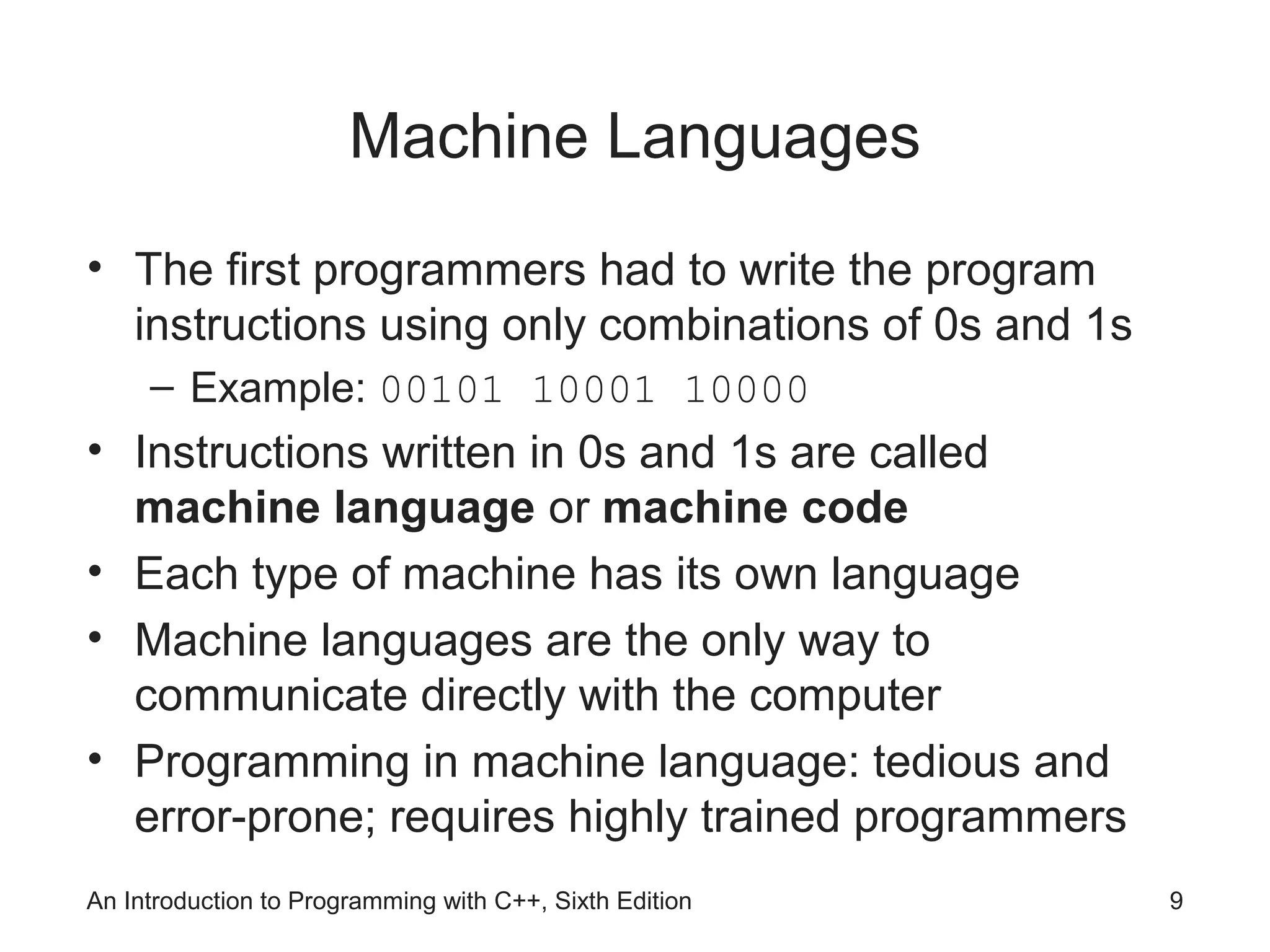
Machine Languages
• The first programmers had to write the program
instructions using only combinations of 0s and 1s
– Example: 00101 10001 10000
• Instructions written in 0s and 1s are called
machine language or machine code
• Each type of machine has its own language
• Machine languages are the only way to
communicate directly with the computer
• Programming in machine language: tedious and
error-prone; requires highly trained programmers
An Introduction to Programming with C++, Sixth Edition 10
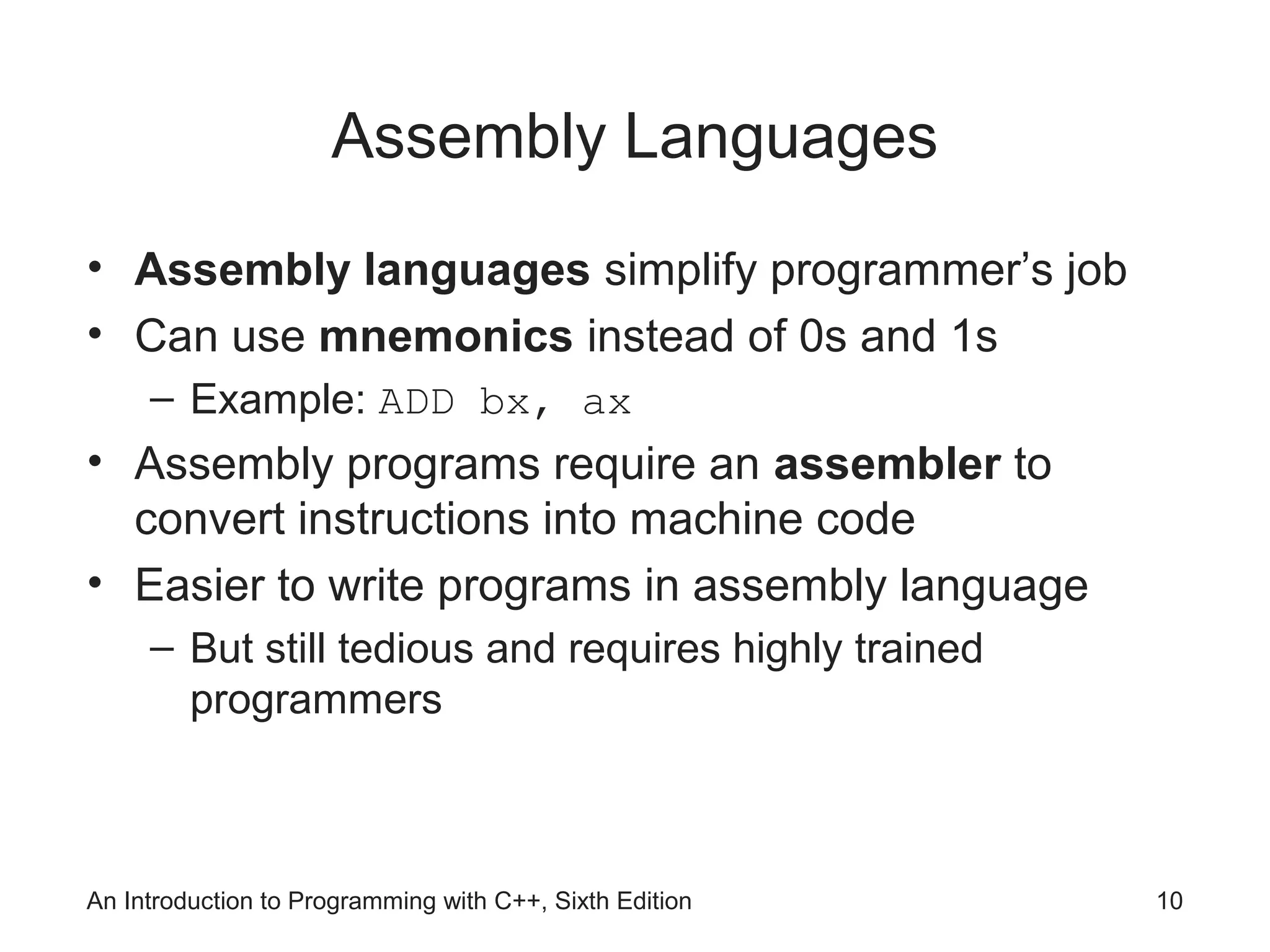
Assembly Languages
• Assembly languages simplify programmer’s job
• Can use mnemonics instead of 0s and 1s
– Example: ADD bx, ax
• Assembly programs require an assembler to
convert instructions into machine code
• Easier to write programs in assembly language
– But still tedious and requires highly trained
programmers
An Introduction to Programming with C++, Sixth Edition 11
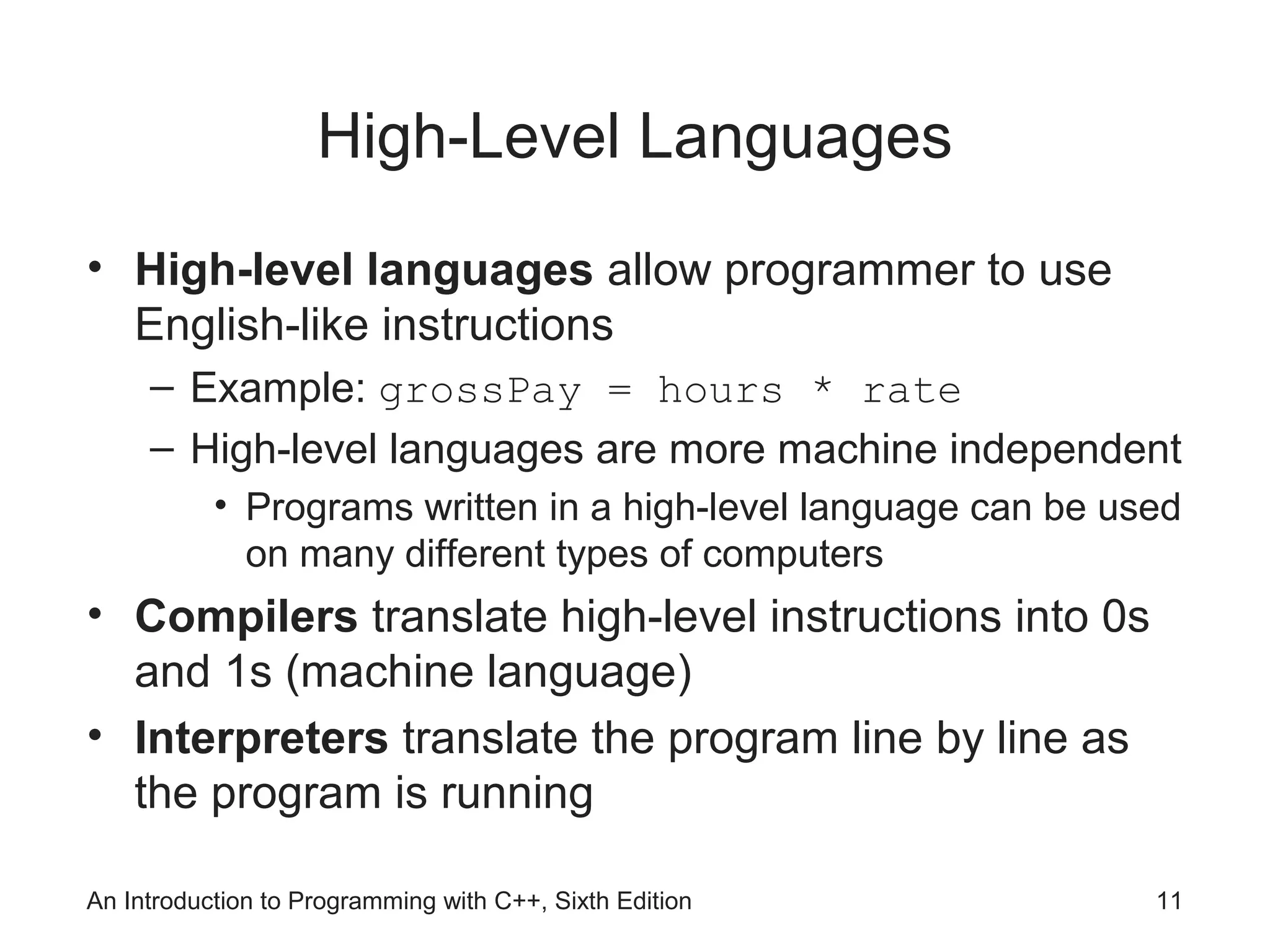
High-Level Languages
• High-level languages allow programmer to use
English-like instructions
– Example: grossPay = hours * rate
– High-level languages are more machine independent
• Programs written in a high-level language can be used
on many different types of computers
• Compilers translate high-level instructions into 0s
and 1s (machine language)
• Interpreters translate the program line by line as
the program is running
An Introduction to Programming with C++, Sixth Edition 12
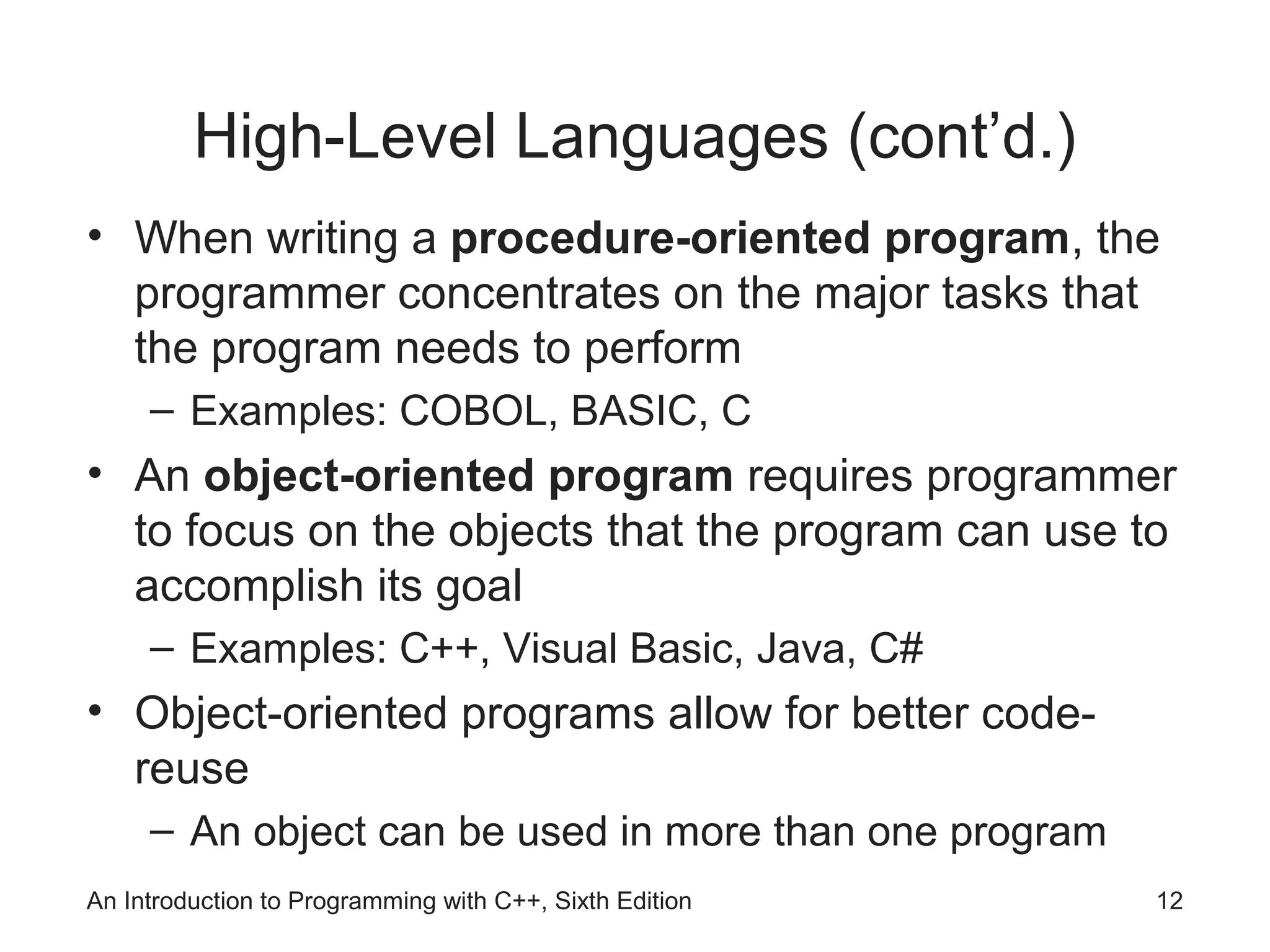
High-Level Languages (cont’d.)
• When writing a procedure-oriented program, the
programmer concentrates on the major tasks that
the program needs to perform
– Examples: COBOL, BASIC, C
• An object-oriented program requires programmer
to focus on the objects that the program can use to
accomplish its goal
– Examples: C++, Visual Basic, Java, C#
• Object-oriented programs allow for better code-
reuse
– An object can be used in more than one program
An Introduction to Programming with C++, Sixth Edition 13
Control Structures
• Programs are written using three basic structures
– Sequence
• Used in every program you write
– Repetition
• Used in most programs you write
– Selection
• Used in most programs you write
• These are called control structures or logic
structures
An Introduction to Programming with C++, Sixth Edition 14
The Sequence Structure
• The sequence structure directs the computer to
process the program instructions, one after
another, in the order listed in the program
• An algorithm is a set of step-by-step instructions
that accomplish a task
• Example: following a recipe to make cookies
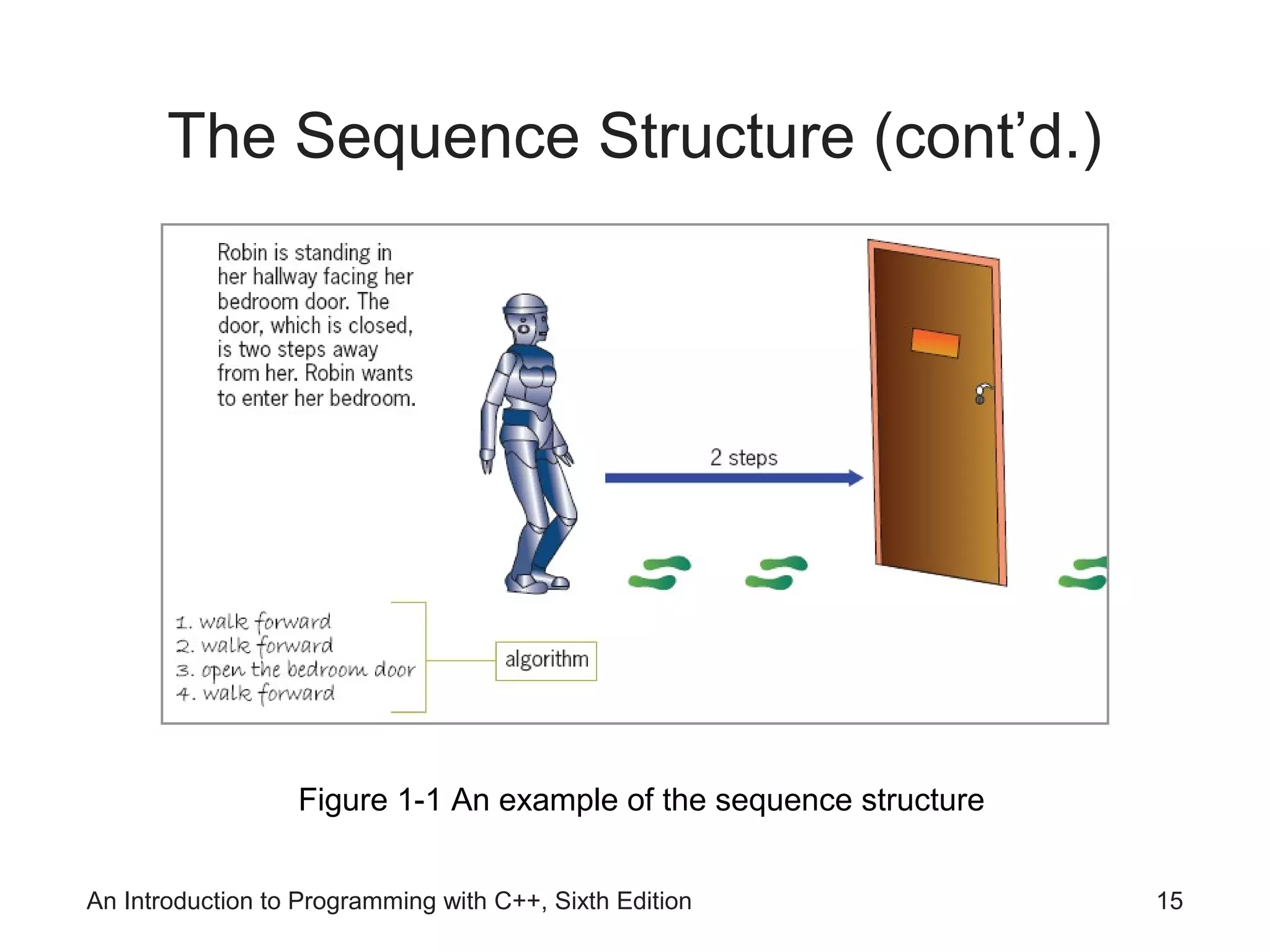
The Sequence Structure (cont’d.)
An Introduction to Programming with C++, Sixth Edition 15
Figure 1-1 An example of the sequence structure
An Introduction to Programming with C++, Sixth Edition 16
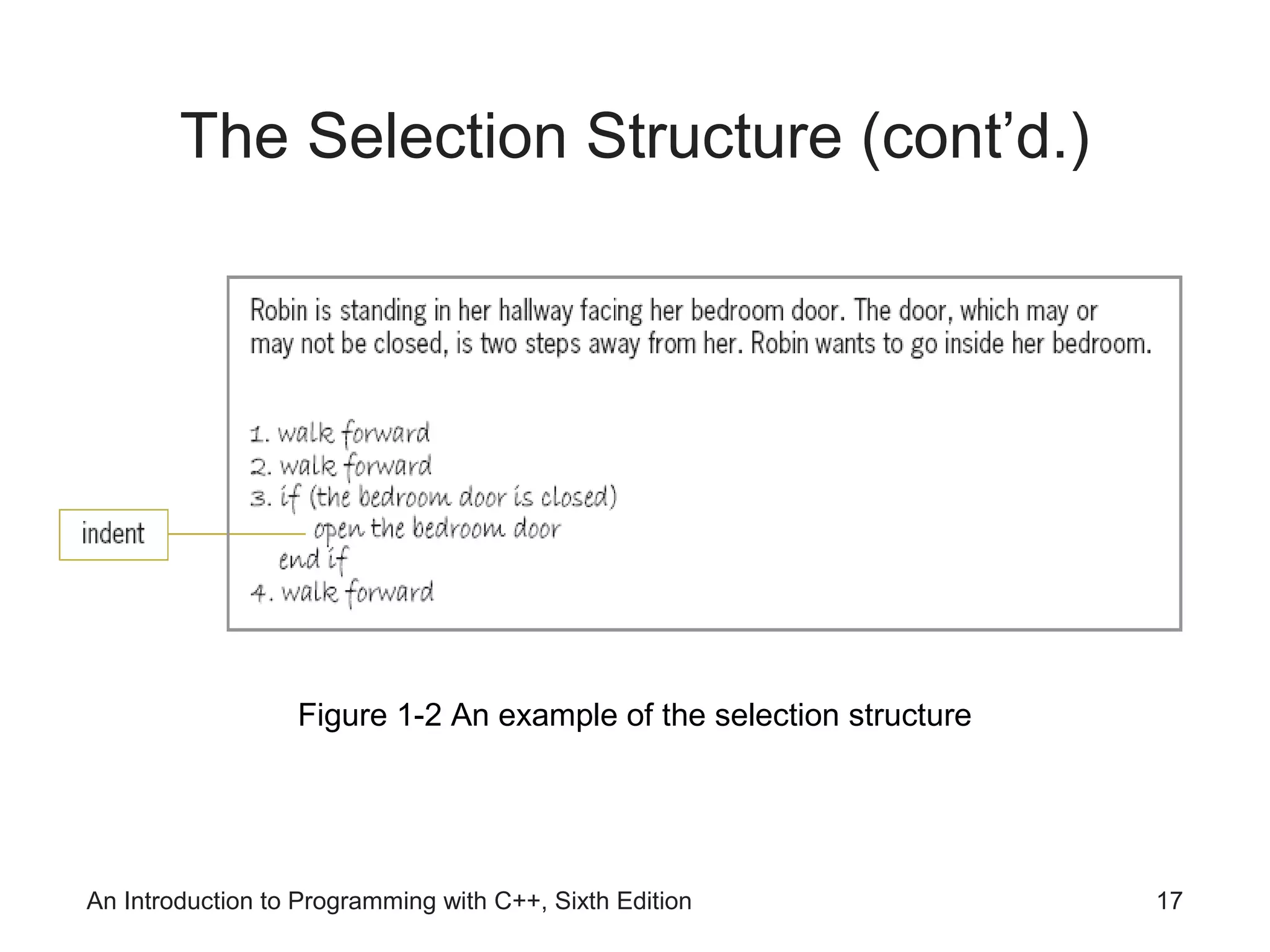
The Selection Structure
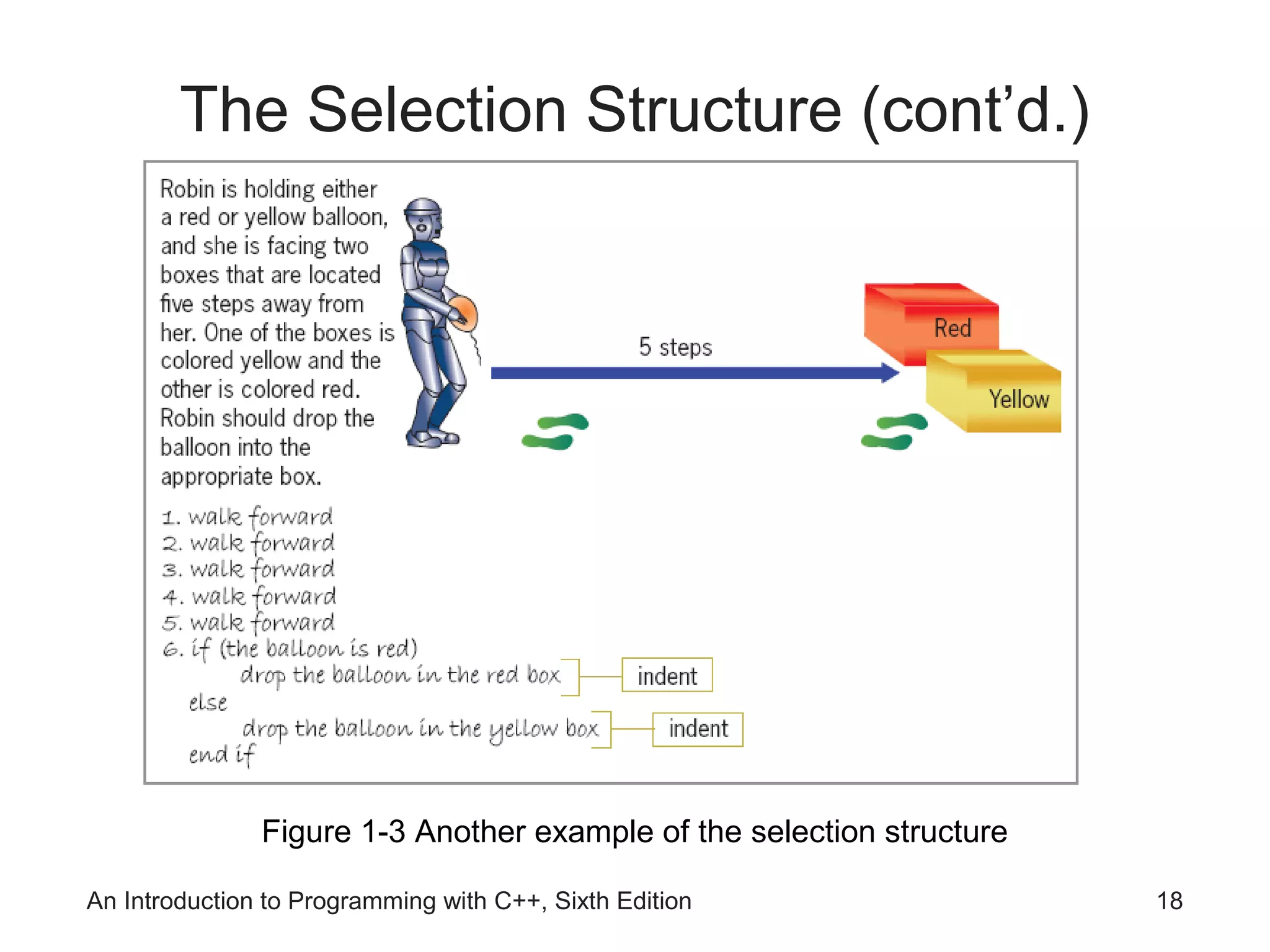
• Selection structure: makes a decision and then
takes an appropriate action based on that decision
– Also called the decision structure
• Example: waiting or crossing at railroad tracks
depending on signal lights
The Selection Structure (cont’d.)
An Introduction to Programming with C++, Sixth Edition 17
Figure 1-2 An example of the selection structure
An Introduction to Programming with C++, Sixth Edition 18
The Selection Structure (cont’d.)
Figure 1-3 Another example of the selection structure
An Introduction to Programming with C++, Sixth Edition 19
The Repetition Structure
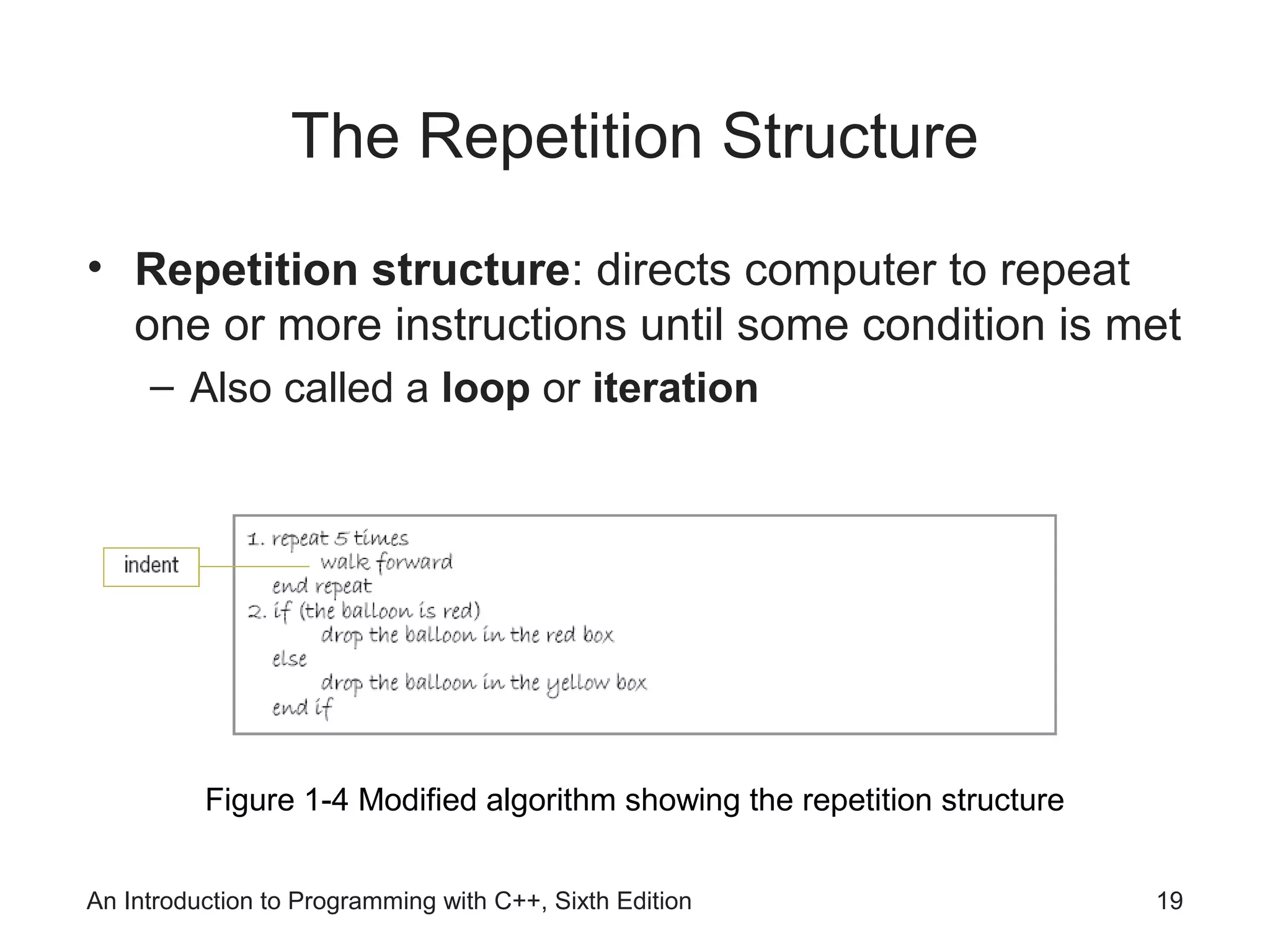
• Repetition structure: directs computer to repeat
one or more instructions until some condition is met
– Also called a loop or iteration
Figure 1-4 Modified algorithm showing the repetition structure
An Introduction to Programming with C++, Sixth Edition 20
The Repetition Structure (cont’d.)
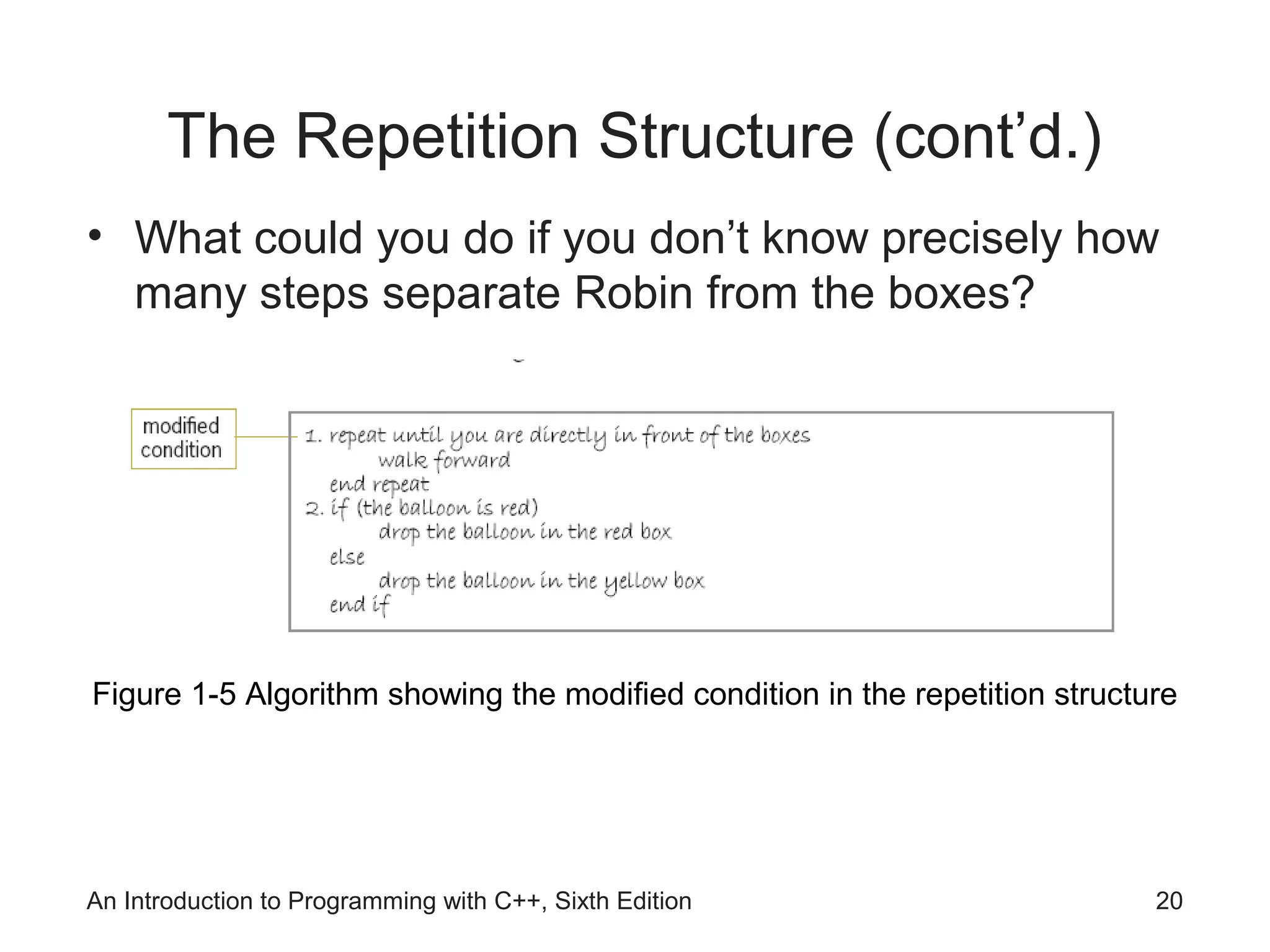
• What could you do if you don’t know precisely how
many steps separate Robin from the boxes?
Figure 1-5 Algorithm showing the modified condition in the repetition structure
Summary
• Programs are step-by-step instructions that tell a
computer how to perform a task
• Programmers use programming languages to
communicate with the computer
– First programming languages were machine
languages: 0s and 1s (machine code)
– Next came assembly languages, which allowed for
mnemonics
– High-level languages can be used to create
procedure-oriented programs or object-oriented
programs
An Introduction to Programming with C++, Sixth Edition 21
Summary (cont’d.)
• Algorithm: step-by-step instructions that
accomplish a task (not written in a programming
language)
– Algorithms contain one or more of the following
control structures: sequence, selection, and
repetition
• Sequence structure: process the instructions, one
after another, in the order listed
• Selection structure: directs the computer to make a
decision and then to select an appropriate action
based on that decision
• Repetition structure: repeat one or more
instructions until some condition is met
An Introduction to Programming with C++, Sixth Edition 22
YOUR Assignments –
Lab 1-1: Stop and Analyze
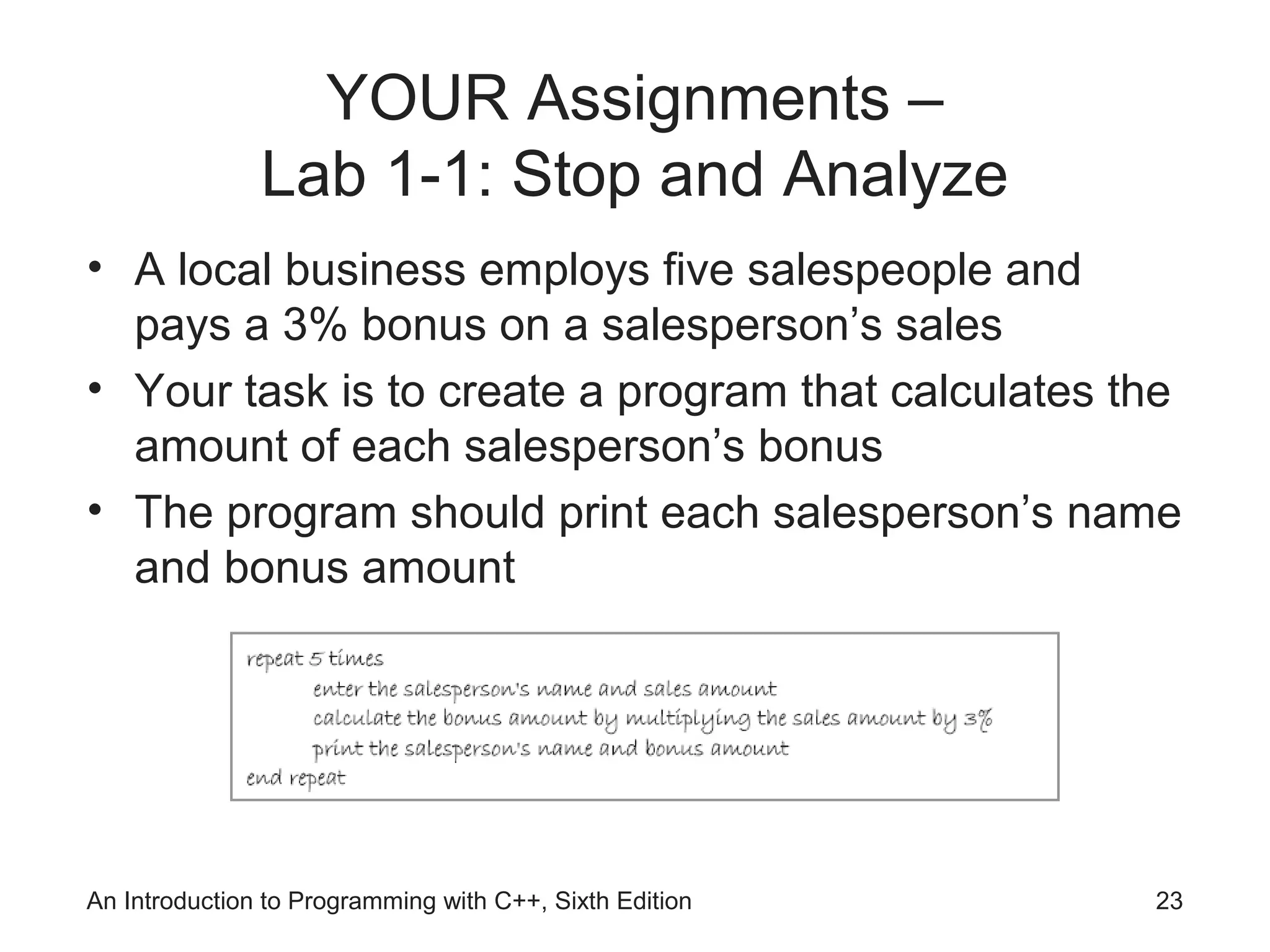
• A local business employs five salespeople and
pays a 3% bonus on a salesperson’s sales
• Your task is to create a program that calculates the
amount of each salesperson’s bonus
• The program should print each salesperson’s name
and bonus amount
An Introduction to Programming with C++, Sixth Edition 23
An Introduction to Programming with C++, Sixth Edition 24
YOUR Assignments –
Lab 1-2: Plan and Create
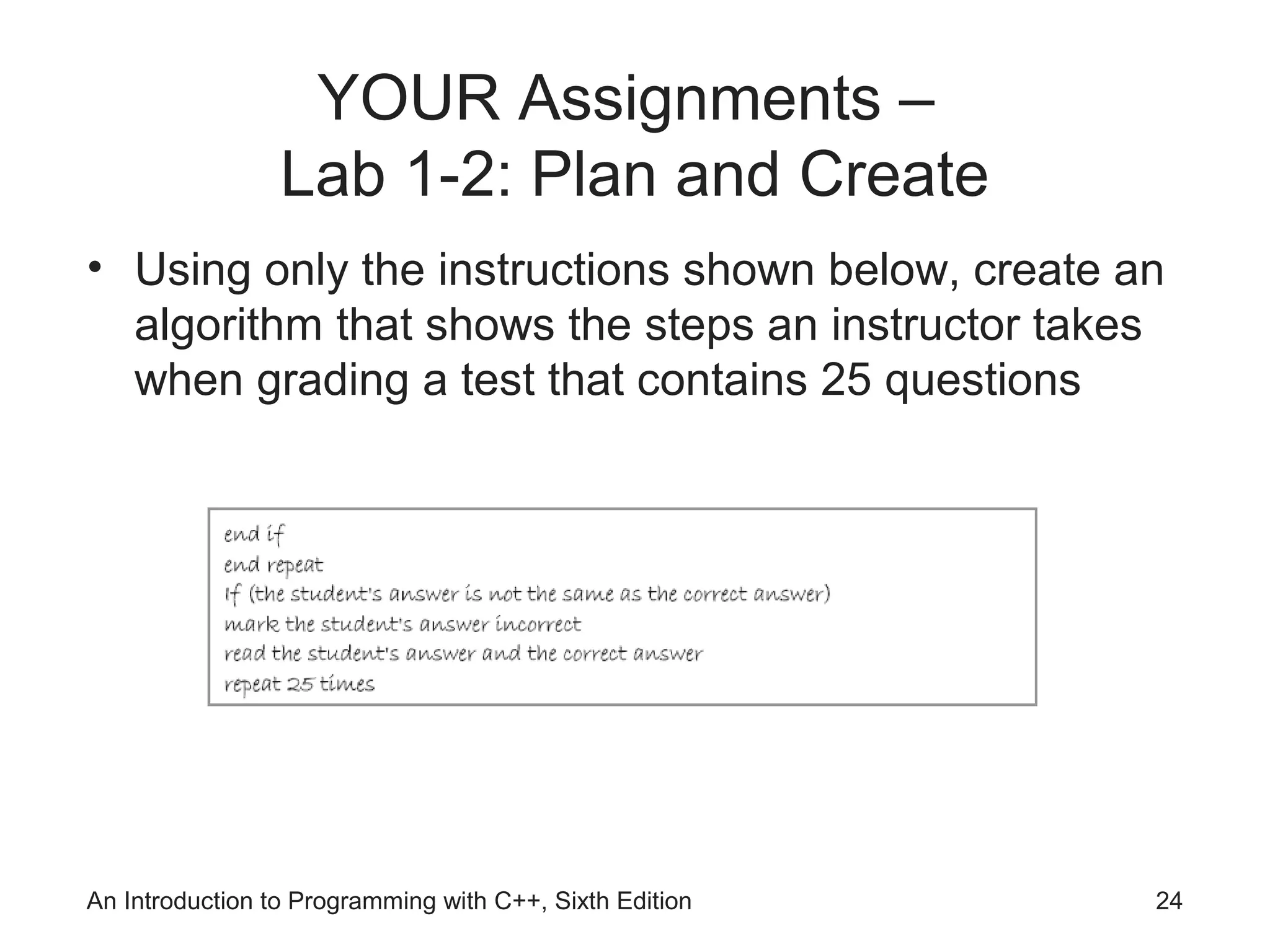
• Using only the instructions shown below, create an
algorithm that shows the steps an instructor takes
when grading a test that contains 25 questions
An Introduction to Programming with C++, Sixth Edition 25
YOUR Assignments –
Lab 1-3: Modify
• Modify the algorithm shown in Lab 1-1 so that it
gives a 3.5% bonus to salespeople selling more
than $2,000
• All other salespeople should receive a 3% bonus
Your Assignments -
Labs –
– Lab 1 – Stop and Analyze
– Lab 2 - Plan and Create
– Lab 3 – Modify
Review Questions – pages 13-15
Chapter 1 – Exercises – Pages 15-19
An Introduction to Programming with C++, Sixth Edition 26

First draft programming c++

  • 1.
    An Introduction to Programmingwith C++ Sixth Edition Chapter 1 An Introduction to Programming
  • 2.
    Objectives • Define theterminology used in programming • Explain the tasks performed by a programmer • Describe the qualities of a good programmer • Understand the employment opportunities for programmers and software engineers • Explain the history of programming languages An Introduction to Programming with C++, Sixth Edition 2
  • 3.
    Objectives (cont’d.) • Explainthe sequence, selection, and repetition structures • Write simple algorithms using the sequence, selection, and repetition structures An Introduction to Programming with C++, Sixth Edition 3
  • 4.
    Programming a Computer •Programs are the directions given to computers • Programmers are the people who write computer programs • Programming Languages enable programmers to communicate with the computer • Popular languages: C++, Visual Basic, C#, Java • How are these languages used commercially? An Introduction to Programming with C++, Sixth Edition 4
  • 5.
    The Programmer’s Job •Programmers help solve computer problems • Employee or freelance • Typical steps involved – Meet with user to determine problem – Convert the problem into a program – Test the program – Provide user manual An Introduction to Programming with C++, Sixth Edition 5
  • 6.
    An Introduction toProgramming with C++, Sixth Edition 6 Do I Have What It Takes to Be a Programmer? • Qualities employers look for – Logical and analytical thinking – Close attention to detail – Patience and persistence – Ingenuity and creativity – Good communication skills: technical and nontechnical – Business skills (for managerial positions)
  • 7.
    Employment Opportunities • Computersoftware engineer: designs an appropriate solution to a user’s problem • Computer programmer: codes a computer solution • Coding is the process of translating a computer solution into a language a computer can understand • Some positions call for both engineering and programming An Introduction to Programming with C++, Sixth Edition 7
  • 8.
    A Brief Historyof Programming Languages • Enable programmer to communicate with computer • Different types – Machine languages – Assembly languages – High-level languages An Introduction to Programming with C++, Sixth Edition 8
  • 9.
    An Introduction toProgramming with C++, Sixth Edition 9 Machine Languages • The first programmers had to write the program instructions using only combinations of 0s and 1s – Example: 00101 10001 10000 • Instructions written in 0s and 1s are called machine language or machine code • Each type of machine has its own language • Machine languages are the only way to communicate directly with the computer • Programming in machine language: tedious and error-prone; requires highly trained programmers
  • 10.
    An Introduction toProgramming with C++, Sixth Edition 10 Assembly Languages • Assembly languages simplify programmer’s job • Can use mnemonics instead of 0s and 1s – Example: ADD bx, ax • Assembly programs require an assembler to convert instructions into machine code • Easier to write programs in assembly language – But still tedious and requires highly trained programmers
  • 11.
    An Introduction toProgramming with C++, Sixth Edition 11 High-Level Languages • High-level languages allow programmer to use English-like instructions – Example: grossPay = hours * rate – High-level languages are more machine independent • Programs written in a high-level language can be used on many different types of computers • Compilers translate high-level instructions into 0s and 1s (machine language) • Interpreters translate the program line by line as the program is running
  • 12.
    An Introduction toProgramming with C++, Sixth Edition 12 High-Level Languages (cont’d.) • When writing a procedure-oriented program, the programmer concentrates on the major tasks that the program needs to perform – Examples: COBOL, BASIC, C • An object-oriented program requires programmer to focus on the objects that the program can use to accomplish its goal – Examples: C++, Visual Basic, Java, C# • Object-oriented programs allow for better code- reuse – An object can be used in more than one program
  • 13.
    An Introduction toProgramming with C++, Sixth Edition 13 Control Structures • Programs are written using three basic structures – Sequence • Used in every program you write – Repetition • Used in most programs you write – Selection • Used in most programs you write • These are called control structures or logic structures
  • 14.
    An Introduction toProgramming with C++, Sixth Edition 14 The Sequence Structure • The sequence structure directs the computer to process the program instructions, one after another, in the order listed in the program • An algorithm is a set of step-by-step instructions that accomplish a task • Example: following a recipe to make cookies
  • 15.
    The Sequence Structure(cont’d.) An Introduction to Programming with C++, Sixth Edition 15 Figure 1-1 An example of the sequence structure
  • 16.
    An Introduction toProgramming with C++, Sixth Edition 16 The Selection Structure • Selection structure: makes a decision and then takes an appropriate action based on that decision – Also called the decision structure • Example: waiting or crossing at railroad tracks depending on signal lights
  • 17.
    The Selection Structure(cont’d.) An Introduction to Programming with C++, Sixth Edition 17 Figure 1-2 An example of the selection structure
  • 18.
    An Introduction toProgramming with C++, Sixth Edition 18 The Selection Structure (cont’d.) Figure 1-3 Another example of the selection structure
  • 19.
    An Introduction toProgramming with C++, Sixth Edition 19 The Repetition Structure • Repetition structure: directs computer to repeat one or more instructions until some condition is met – Also called a loop or iteration Figure 1-4 Modified algorithm showing the repetition structure
  • 20.
    An Introduction toProgramming with C++, Sixth Edition 20 The Repetition Structure (cont’d.) • What could you do if you don’t know precisely how many steps separate Robin from the boxes? Figure 1-5 Algorithm showing the modified condition in the repetition structure
  • 21.
    Summary • Programs arestep-by-step instructions that tell a computer how to perform a task • Programmers use programming languages to communicate with the computer – First programming languages were machine languages: 0s and 1s (machine code) – Next came assembly languages, which allowed for mnemonics – High-level languages can be used to create procedure-oriented programs or object-oriented programs An Introduction to Programming with C++, Sixth Edition 21
  • 22.
    Summary (cont’d.) • Algorithm:step-by-step instructions that accomplish a task (not written in a programming language) – Algorithms contain one or more of the following control structures: sequence, selection, and repetition • Sequence structure: process the instructions, one after another, in the order listed • Selection structure: directs the computer to make a decision and then to select an appropriate action based on that decision • Repetition structure: repeat one or more instructions until some condition is met An Introduction to Programming with C++, Sixth Edition 22
  • 23.
    YOUR Assignments – Lab1-1: Stop and Analyze • A local business employs five salespeople and pays a 3% bonus on a salesperson’s sales • Your task is to create a program that calculates the amount of each salesperson’s bonus • The program should print each salesperson’s name and bonus amount An Introduction to Programming with C++, Sixth Edition 23
  • 24.
    An Introduction toProgramming with C++, Sixth Edition 24 YOUR Assignments – Lab 1-2: Plan and Create • Using only the instructions shown below, create an algorithm that shows the steps an instructor takes when grading a test that contains 25 questions
  • 25.
    An Introduction toProgramming with C++, Sixth Edition 25 YOUR Assignments – Lab 1-3: Modify • Modify the algorithm shown in Lab 1-1 so that it gives a 3.5% bonus to salespeople selling more than $2,000 • All other salespeople should receive a 3% bonus
  • 26.
    Your Assignments - Labs– – Lab 1 – Stop and Analyze – Lab 2 - Plan and Create – Lab 3 – Modify Review Questions – pages 13-15 Chapter 1 – Exercises – Pages 15-19 An Introduction to Programming with C++, Sixth Edition 26