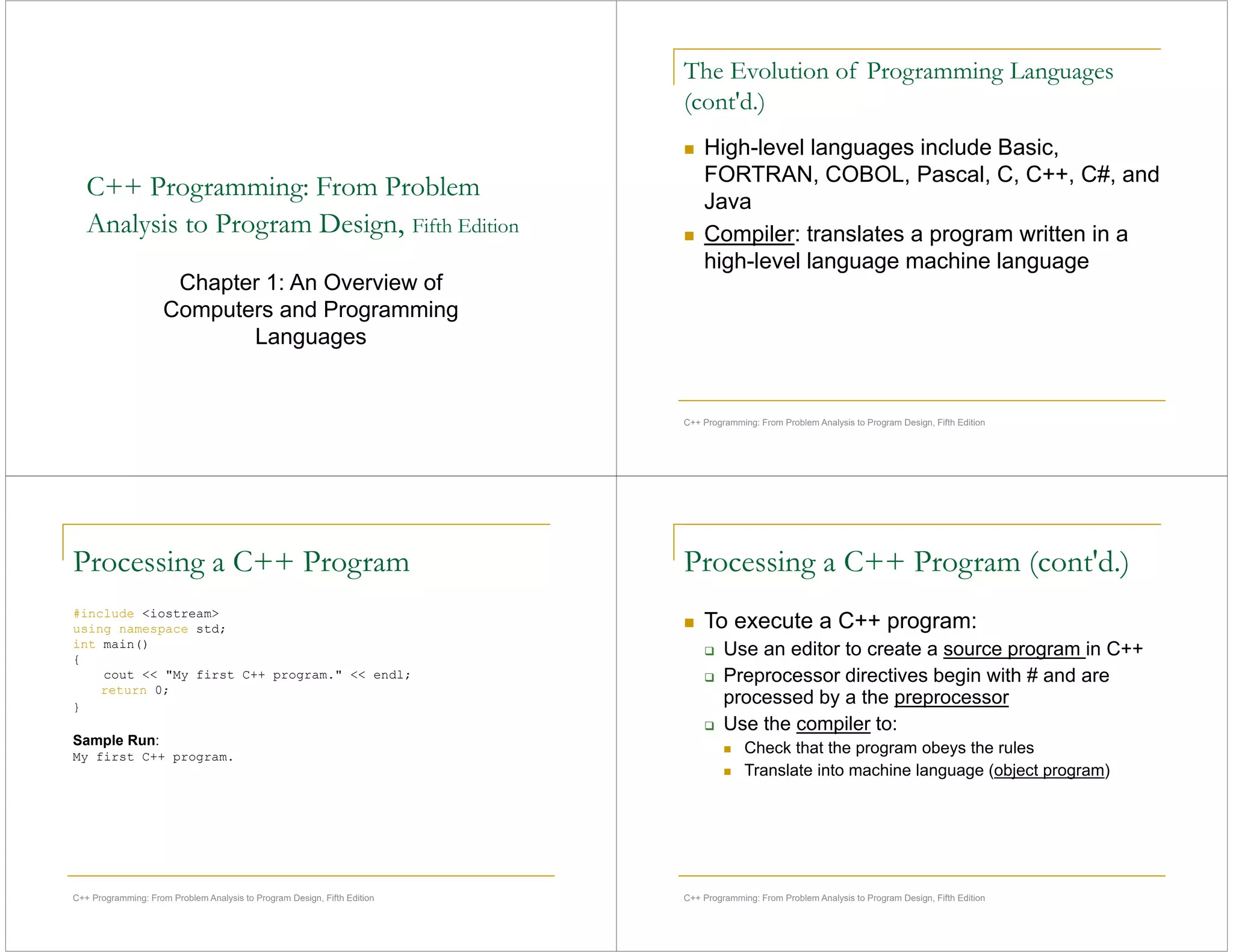
C++ Programming: From Problem
Analysis to Program Design, Fifth Edition
Chapter 1: An Overview of
Computers and Programming
Languages
The Evolution of Programming Languages
(cont'd.)
 High-level languages include Basic,
FORTRAN, COBOL, Pascal, C, C++, C#, and
Java
 Compiler: translates a program written in a
high-level language machine language
C++ Programming: From Problem Analysis to Program Design, Fifth Edition
Processing a C++ Program
#include <iostream>
using namespace std;
int main()
{
cout << "My first C++ program." << endl;
return 0;
}
Sample Run:
My first C++ program.
C++ Programming: From Problem Analysis to Program Design, Fifth Edition
Processing a C++ Program (cont'd.)
 To execute a C++ program:
 Use an editor to create a source program in C++
 Preprocessor directives begin with # and are
processed by a the preprocessor
 Use the compiler to:
 Check that the program obeys the rules
 Translate into machine language (object program)
C++ Programming: From Problem Analysis to Program Design, Fifth Edition
Processing a C++ Program (cont'd.)
 To execute a C++ program (cont'd.):
 Linker:
 Combines object program with other programs provided
by the SDK to create executable code
 Loader:
 Loads executable program into main memory
 The last step is to execute the program
C++ Programming: From Problem Analysis to Program Design, Fifth Edition
Processing a C++ Program (cont'd.)
C++ Programming: From Problem Analysis to Program Design, Fifth Edition
Programming with the Problem Analysis–
Coding–Execution Cycle
 Programming is a process of problem solving
 One problem-solving technique:
 Analyze the problem
 Outline the problem requirements
 Design steps (algorithm) to solve the problem
 Algorithm:
 Step-by-step problem-solving process
 Solution achieved in finite amount of time
C++ Programming: From Problem Analysis to Program Design, Fifth Edition
The Problem Analysis–Coding–Execution
Cycle (cont’d.)
C++ Programming: From Problem Analysis to Program Design, Fifth Edition
The Problem Analysis–Coding–Execution
Cycle (cont'd.)
 Run code through compiler
 If compiler generates errors
 Look at code and remove errors
 Run code again through compiler
 If there are no syntax errors
 Compiler generates equivalent machine code
 Linker links machine code with system
resources
C++ Programming: From Problem Analysis to Program Design, Fifth Edition
The Problem Analysis–Coding–Execution
Cycle (cont'd.)
 Once compiled and linked, loader can place
program into main memory for execution
 The final step is to execute the program
 Compiler guarantees that the program follows
the rules of the language
 Does not guarantee that the program will run
correctly
C++ Programming: From Problem Analysis to Program Design, Fifth Edition
Example 1-1
 Design an algorithm to find the perimeter and
area of a rectangle
 The perimeter and area of the rectangle are
given by the following formulas:
perimeter = 2 * (length + width)
area = length * width
C++ Programming: From Problem Analysis to Program Design, Fifth Edition
Example 1-1 (cont'd.)
 Algorithm:
 Get length of the rectangle
 Get width of the rectangle
 Find the perimeter using the following equation:
perimeter = 2 * (length + width)
 Find the area using the following equation:
area = length * width
C++ Programming: From Problem Analysis to Program Design, Fifth Edition

C++ ch1

  • 1.
    C++ Programming: FromProblem Analysis to Program Design, Fifth Edition Chapter 1: An Overview of Computers and Programming Languages The Evolution of Programming Languages (cont'd.)  High-level languages include Basic, FORTRAN, COBOL, Pascal, C, C++, C#, and Java  Compiler: translates a program written in a high-level language machine language C++ Programming: From Problem Analysis to Program Design, Fifth Edition Processing a C++ Program #include <iostream> using namespace std; int main() { cout << "My first C++ program." << endl; return 0; } Sample Run: My first C++ program. C++ Programming: From Problem Analysis to Program Design, Fifth Edition Processing a C++ Program (cont'd.)  To execute a C++ program:  Use an editor to create a source program in C++  Preprocessor directives begin with # and are processed by a the preprocessor  Use the compiler to:  Check that the program obeys the rules  Translate into machine language (object program) C++ Programming: From Problem Analysis to Program Design, Fifth Edition
  • 2.
    Processing a C++Program (cont'd.)  To execute a C++ program (cont'd.):  Linker:  Combines object program with other programs provided by the SDK to create executable code  Loader:  Loads executable program into main memory  The last step is to execute the program C++ Programming: From Problem Analysis to Program Design, Fifth Edition Processing a C++ Program (cont'd.) C++ Programming: From Problem Analysis to Program Design, Fifth Edition Programming with the Problem Analysis– Coding–Execution Cycle  Programming is a process of problem solving  One problem-solving technique:  Analyze the problem  Outline the problem requirements  Design steps (algorithm) to solve the problem  Algorithm:  Step-by-step problem-solving process  Solution achieved in finite amount of time C++ Programming: From Problem Analysis to Program Design, Fifth Edition The Problem Analysis–Coding–Execution Cycle (cont’d.) C++ Programming: From Problem Analysis to Program Design, Fifth Edition
  • 3.
    The Problem Analysis–Coding–Execution Cycle(cont'd.)  Run code through compiler  If compiler generates errors  Look at code and remove errors  Run code again through compiler  If there are no syntax errors  Compiler generates equivalent machine code  Linker links machine code with system resources C++ Programming: From Problem Analysis to Program Design, Fifth Edition The Problem Analysis–Coding–Execution Cycle (cont'd.)  Once compiled and linked, loader can place program into main memory for execution  The final step is to execute the program  Compiler guarantees that the program follows the rules of the language  Does not guarantee that the program will run correctly C++ Programming: From Problem Analysis to Program Design, Fifth Edition Example 1-1  Design an algorithm to find the perimeter and area of a rectangle  The perimeter and area of the rectangle are given by the following formulas: perimeter = 2 * (length + width) area = length * width C++ Programming: From Problem Analysis to Program Design, Fifth Edition Example 1-1 (cont'd.)  Algorithm:  Get length of the rectangle  Get width of the rectangle  Find the perimeter using the following equation: perimeter = 2 * (length + width)  Find the area using the following equation: area = length * width C++ Programming: From Problem Analysis to Program Design, Fifth Edition