How to organize and fund free
       culture projects


         Kevin Shockey
       Founder, Mis Tribus
What?


Free culture projects often fail
  due to a lack of resources.
So What?


   By focusing on raising funds,
a project can increase its' chances
            of survival
Why me?


      Freedom is not free!
(How many ways can you relate?)
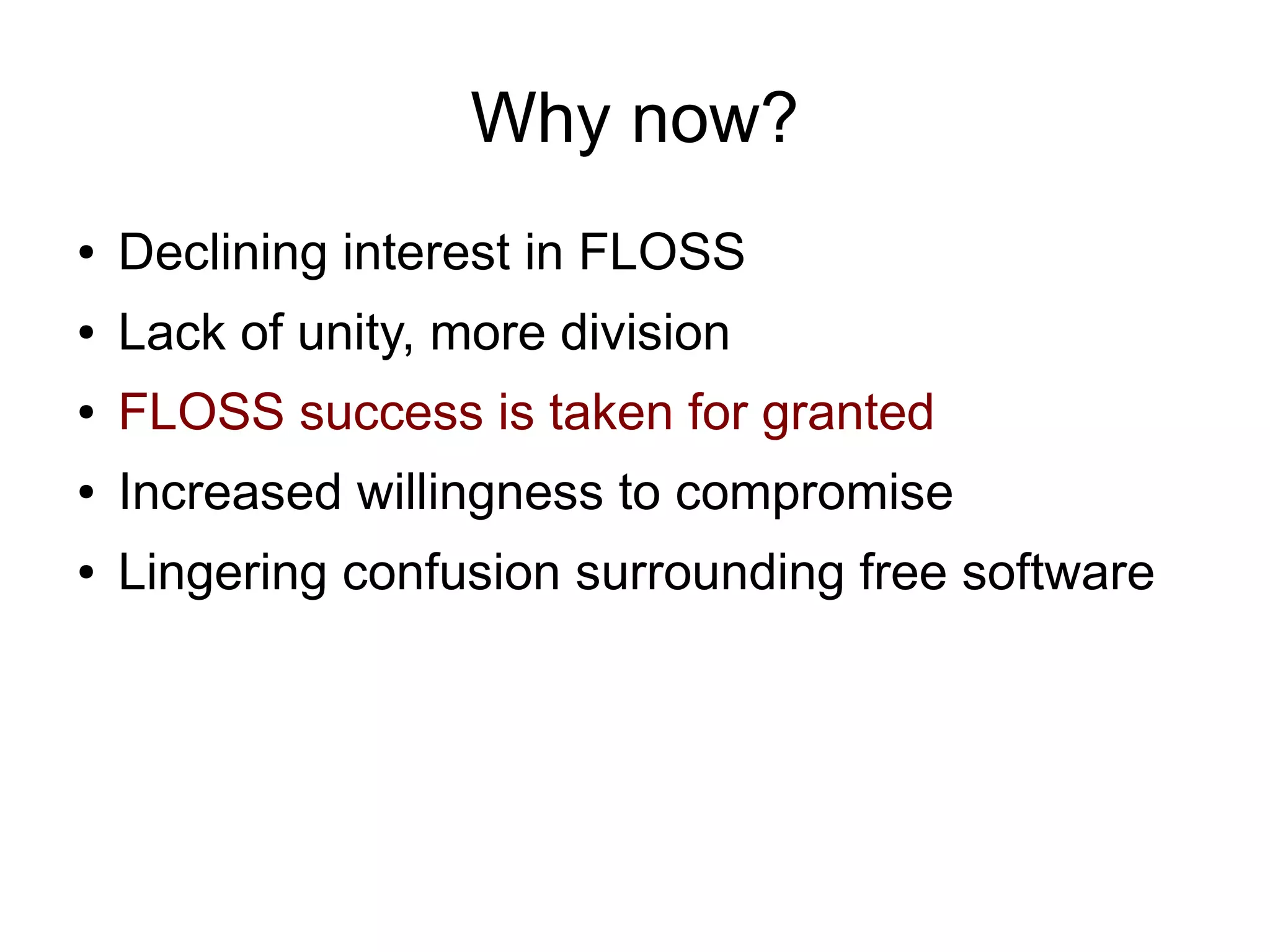
Why now?
●   Declining interest in FLOSS
●   Lack of unity, more division
●   FLOSS success is taken for granted
●   Increased willingness to compromise
●   Lingering confusion surrounding free software
Disclaimer


I'm not pretending to tell anyone what to do,
        I'm sharing my interpretation.
                  My story.
          (Your mileage may vary...)
So far...
●   Funding Free Culture:
    ●   Blog: FundingFreeCulture.MisTribus.com
    ●   blog.financingfreedom.com
    ●   @ffc_2012
    ●   Tumblr: FundingFreeCulture.Tumblr.com
●   One Blogger post triggers:
    ●   3 Automated tweets on 3 different accounts
    ●   Updated Linked In
    ●   Updated Finding Free Culture Page on Facebook
Assumptions
●   Free Culture
●   Project Execution
●   Project Funding
Free Culture Assumptions
●   Free culture projects often fail
●   People assume FLOSS's success is
    guaranteed
●   Division makes free culture weaker
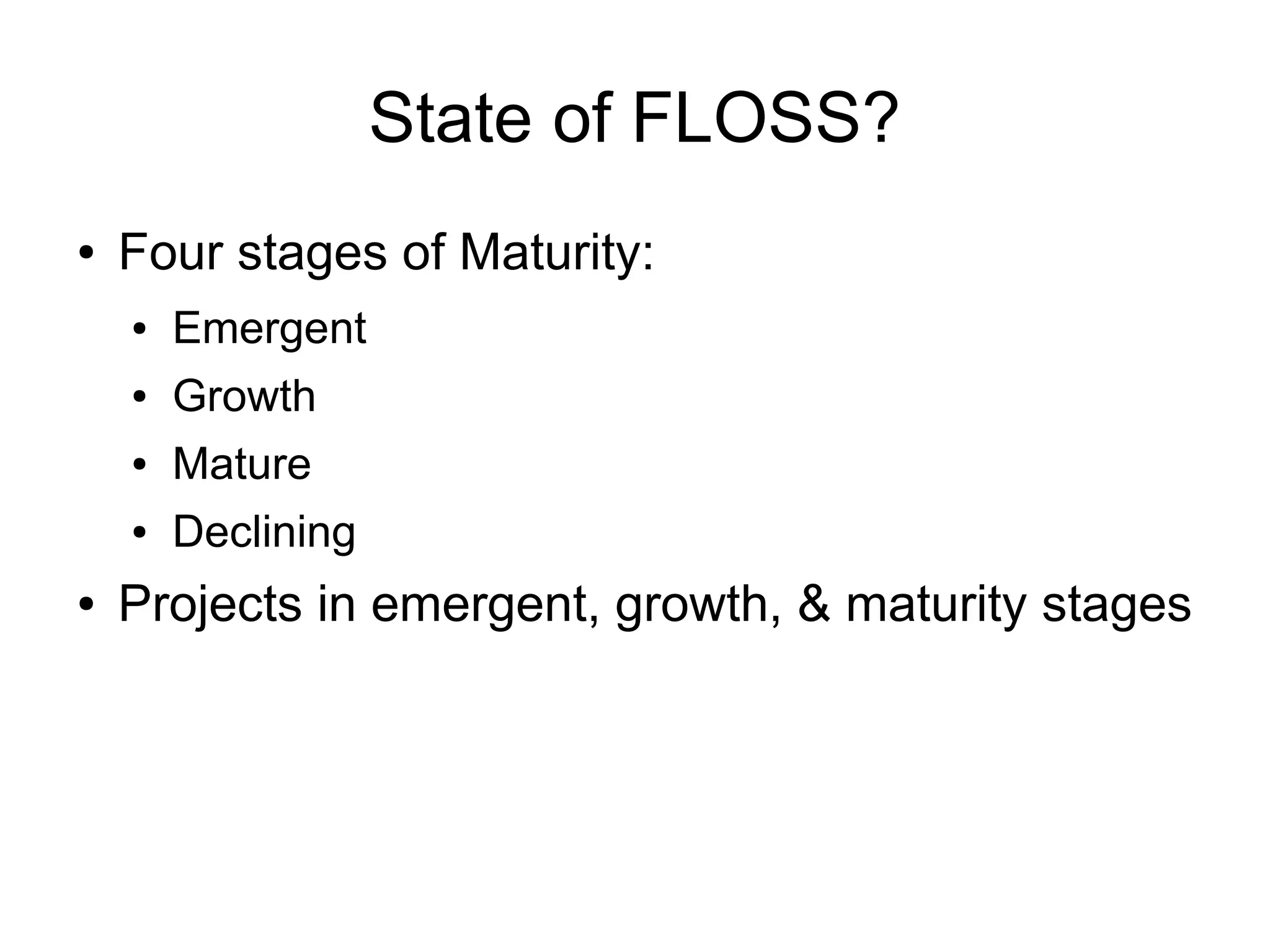
State of FLOSS?
●   Four stages of Maturity:
    ●   Emergent
    ●   Growth
    ●   Mature
    ●   Declining
●   Projects in emergent, growth, & maturity stages
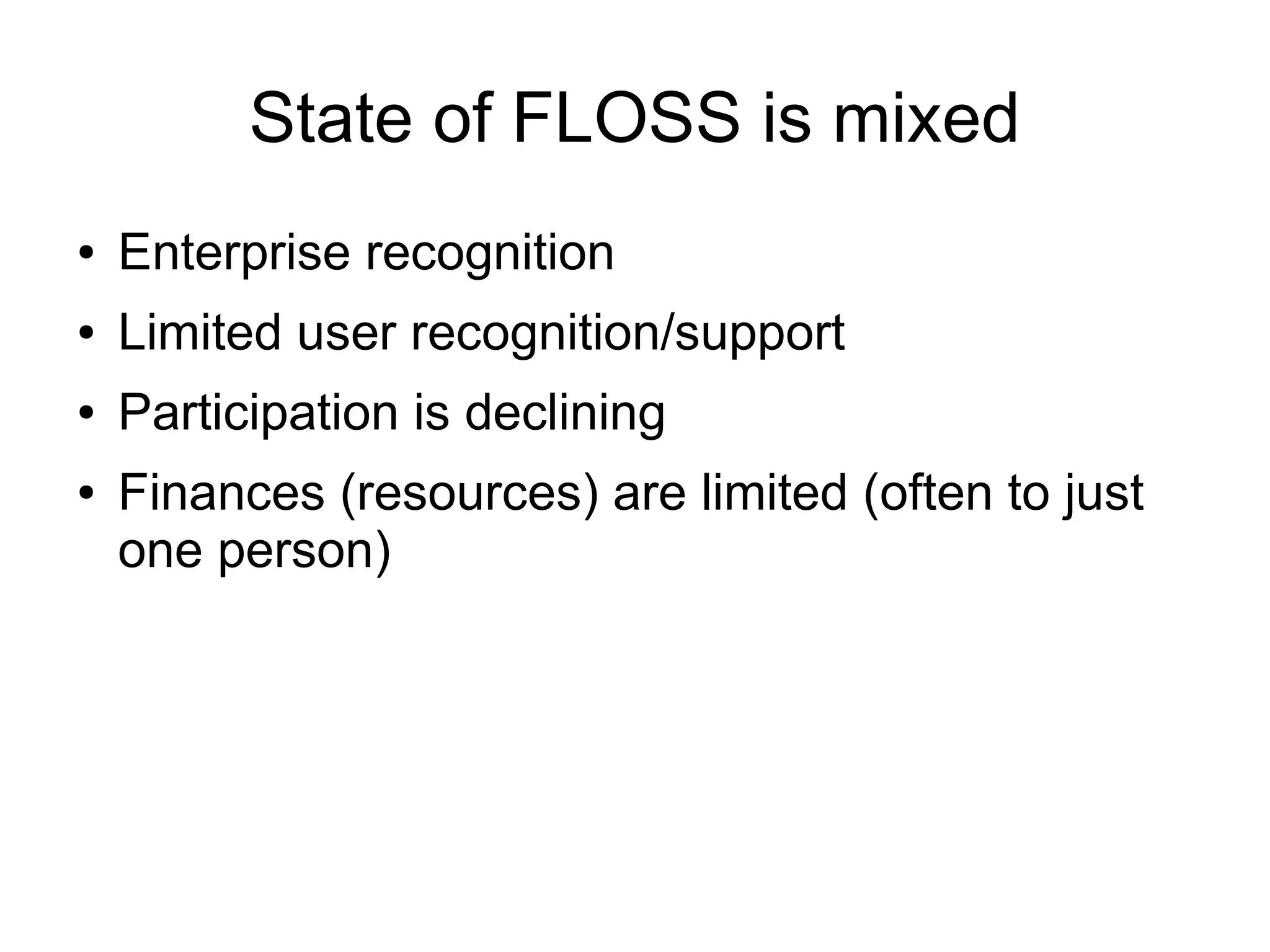
State of FLOSS is mixed
●   Enterprise recognition
●   Limited user recognition/support
●   Participation is declining
●   Finances (resources) are limited (often to just
    one person)
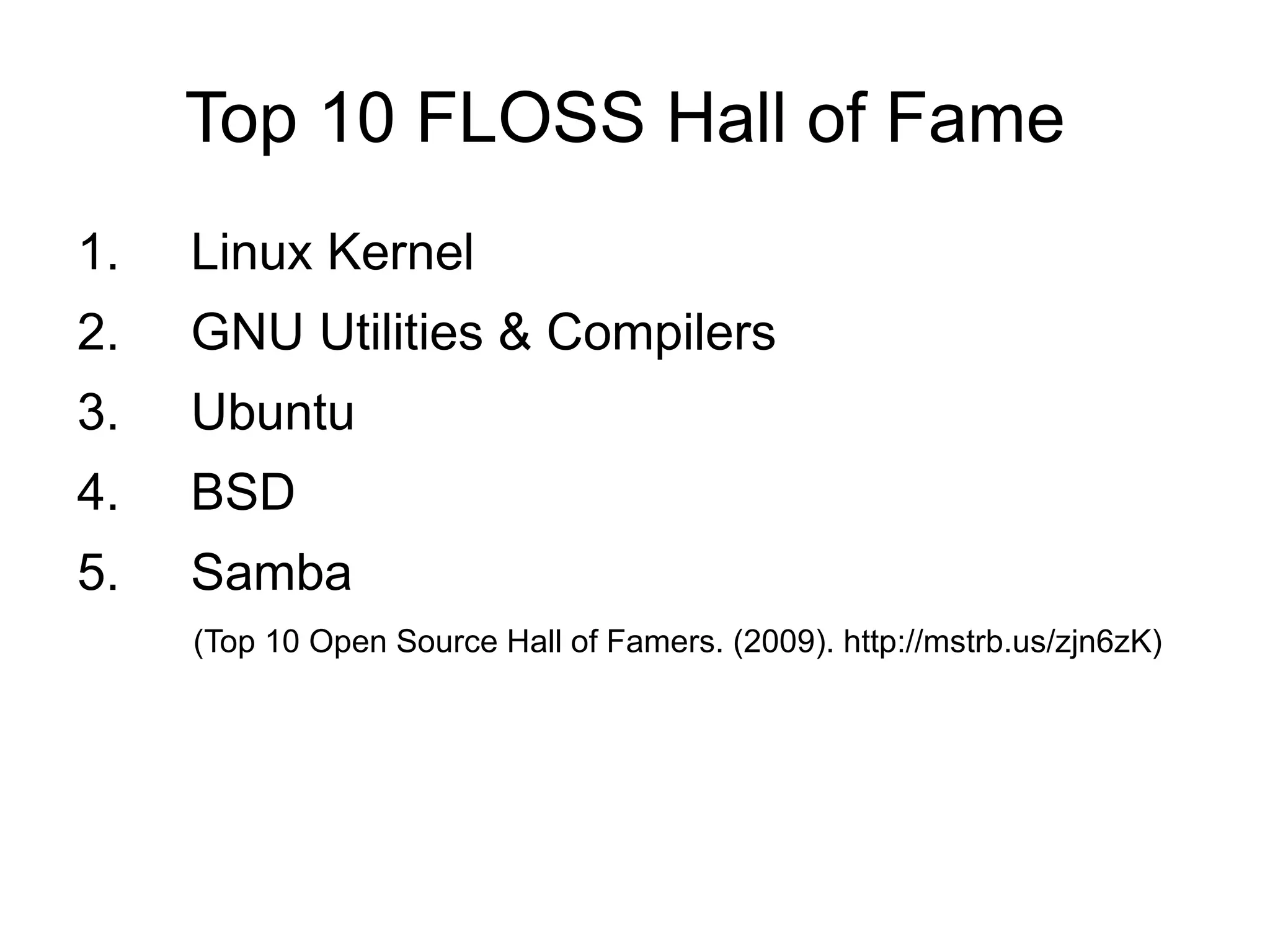
Top 10 FLOSS Hall of Fame
1.   Linux Kernel
2.   GNU Utilities & Compilers
3.   Ubuntu
4.   BSD
5.   Samba
     (Top 10 Open Source Hall of Famers. (2009). http://mstrb.us/zjn6zK)
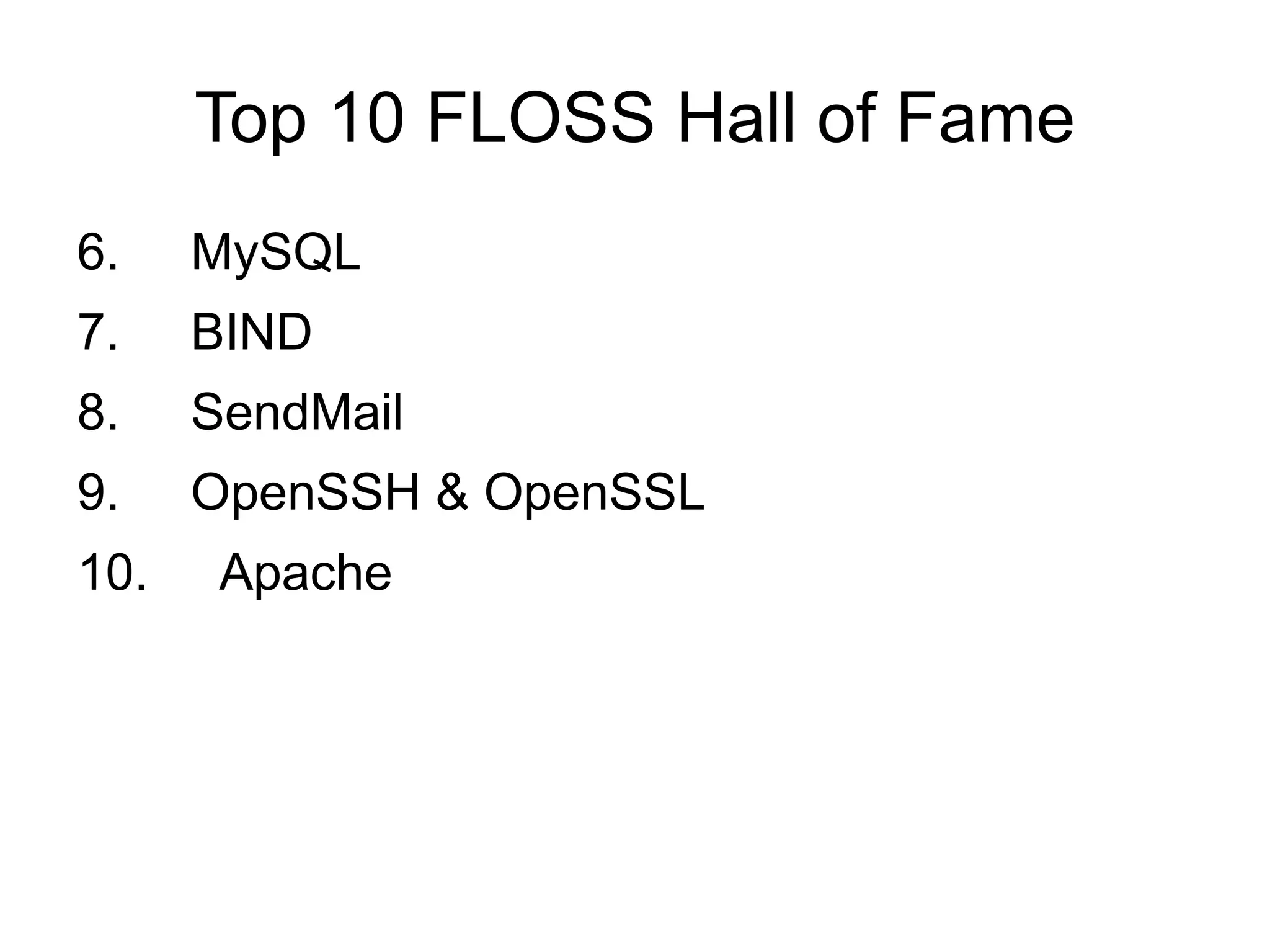
Top 10 FLOSS Hall of Fame
6.    MySQL
7.    BIND
8.    SendMail
9.    OpenSSH & OpenSSL
10.    Apache
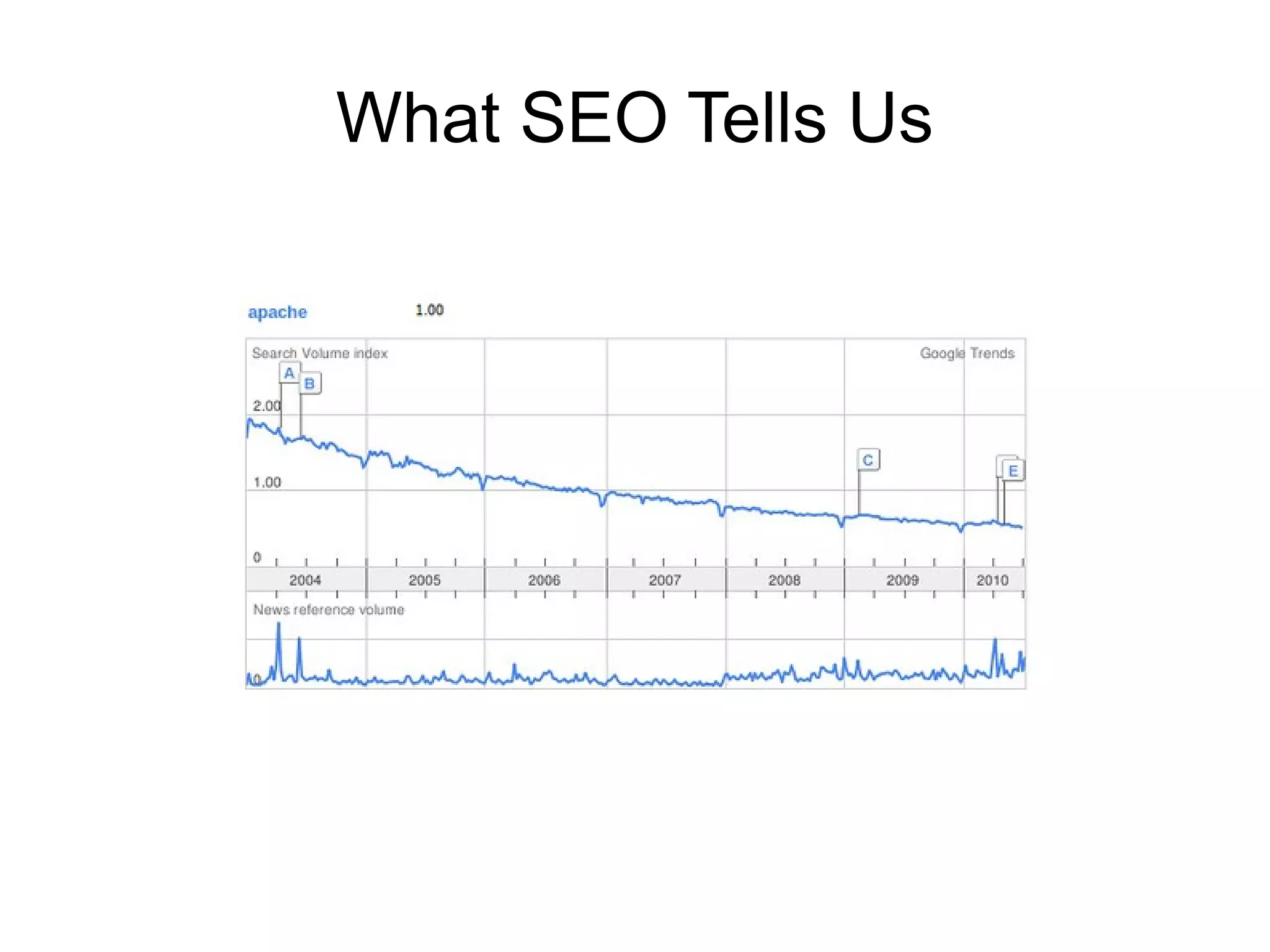
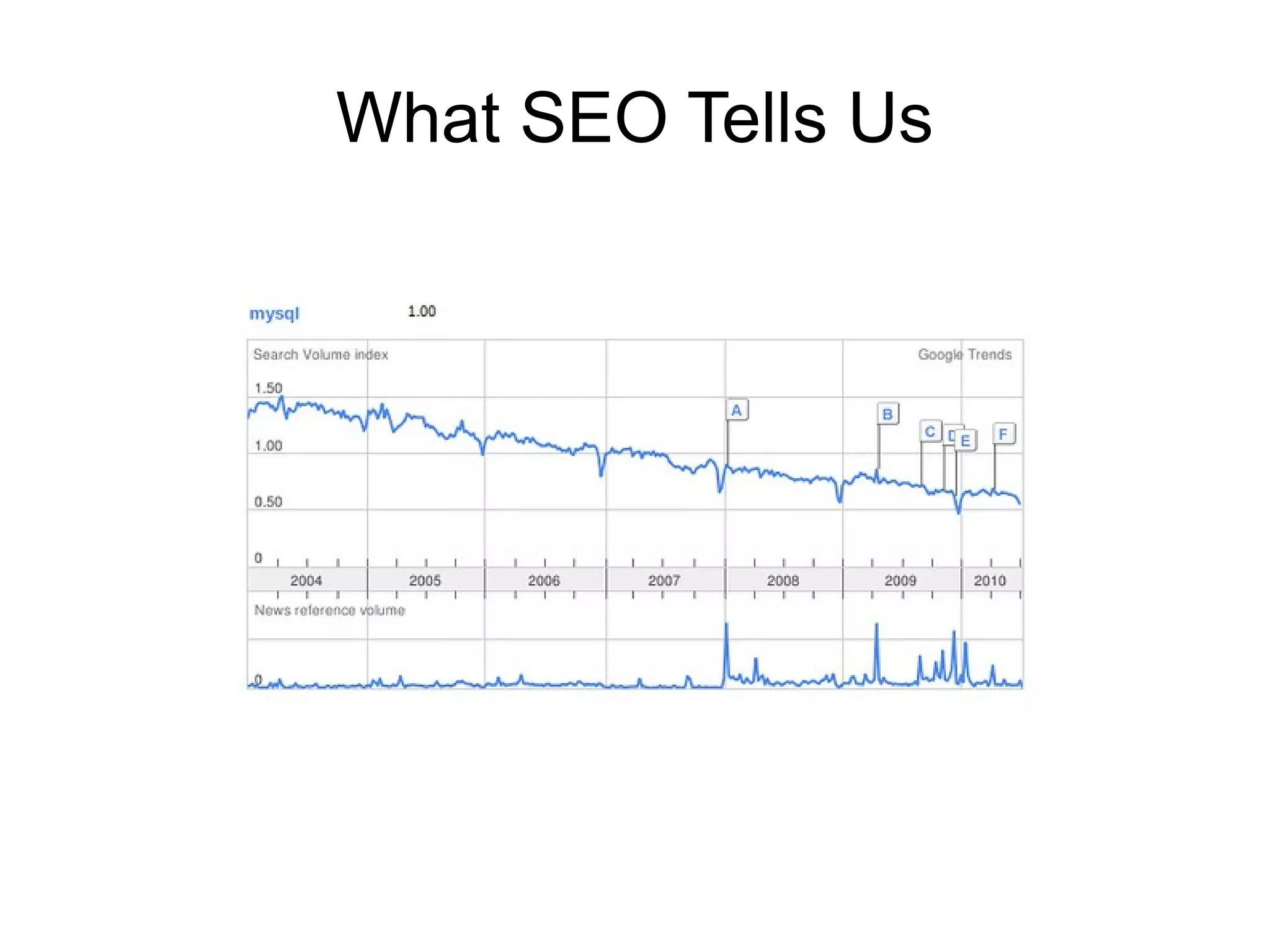
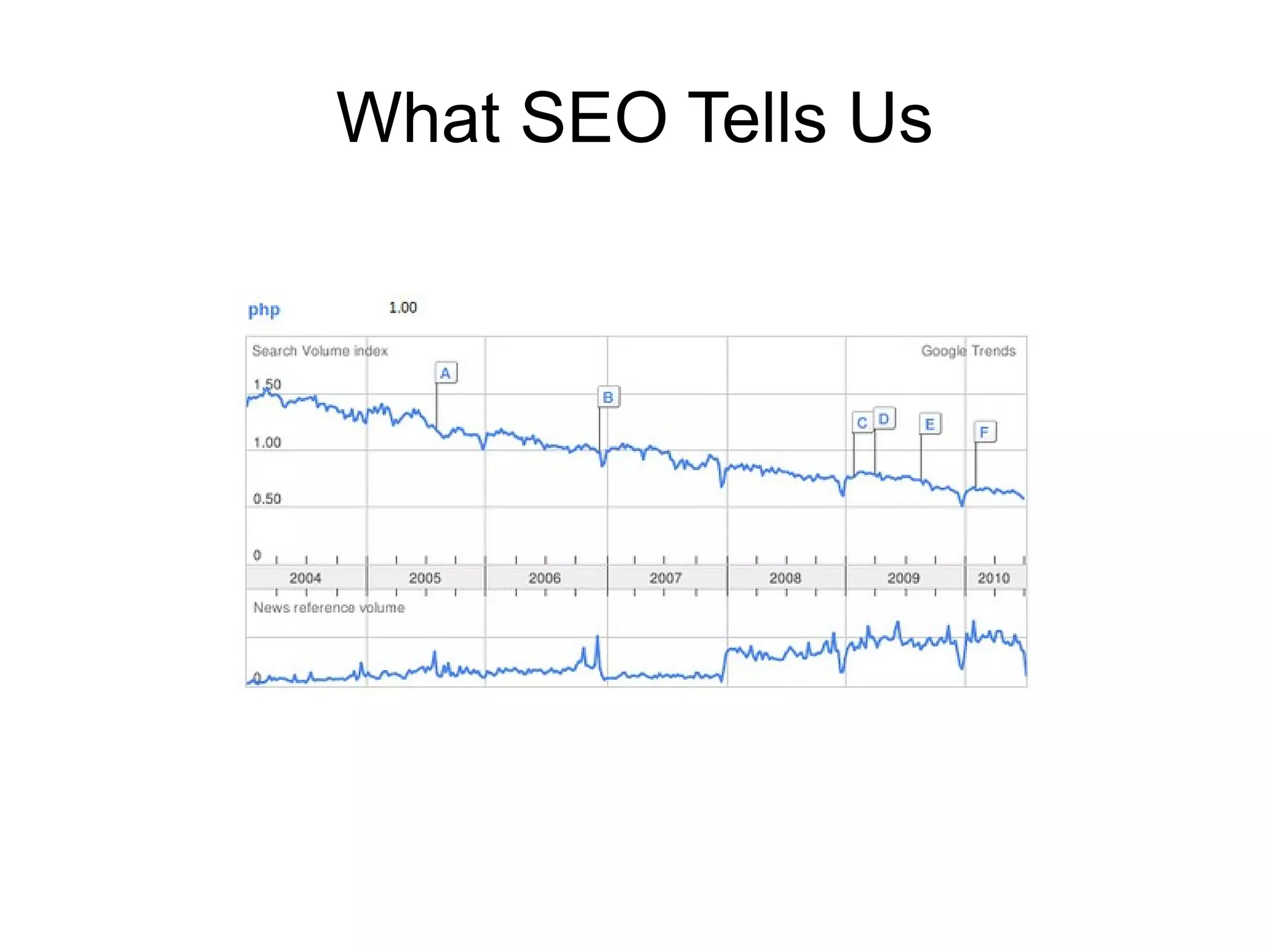
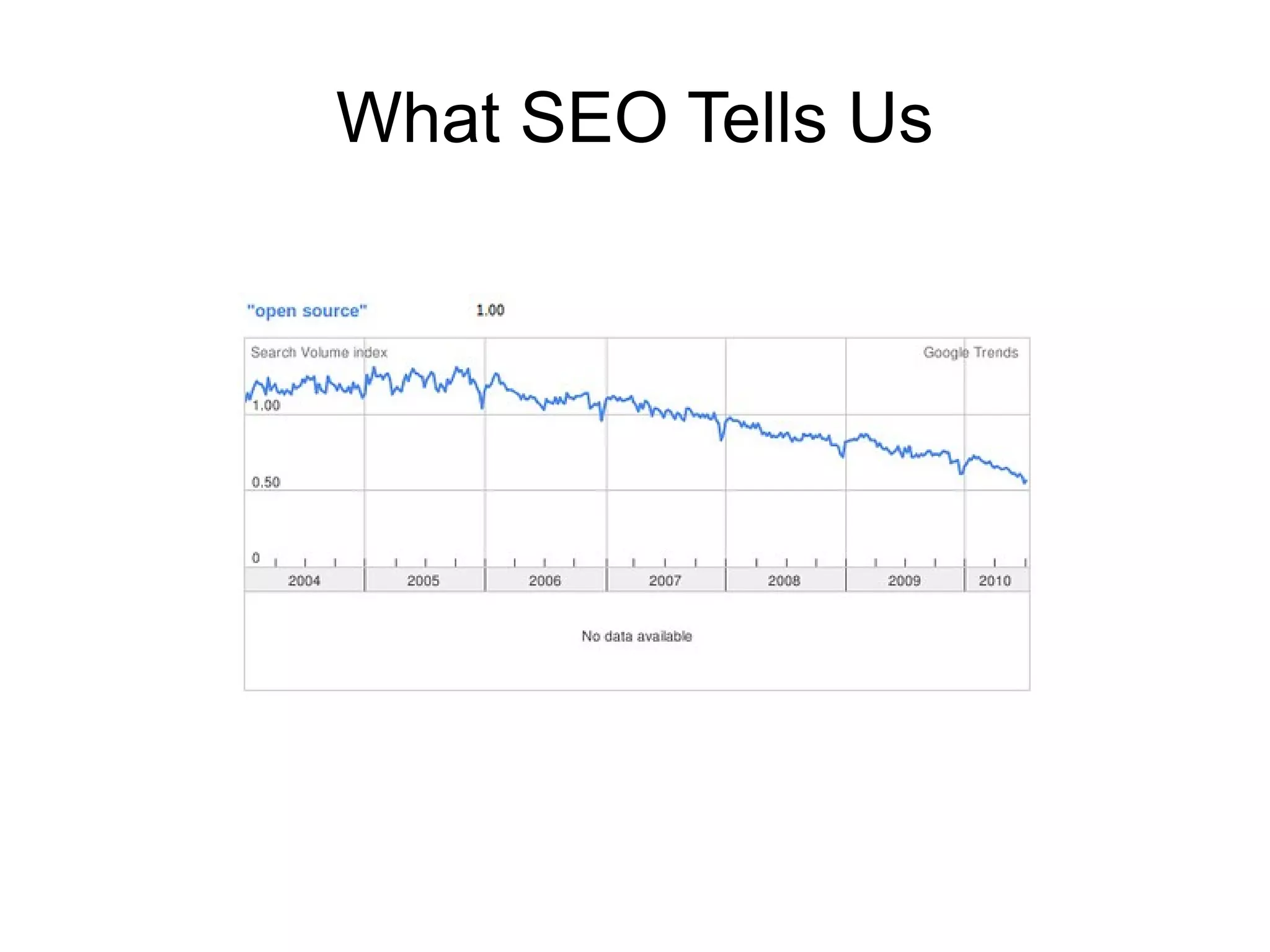
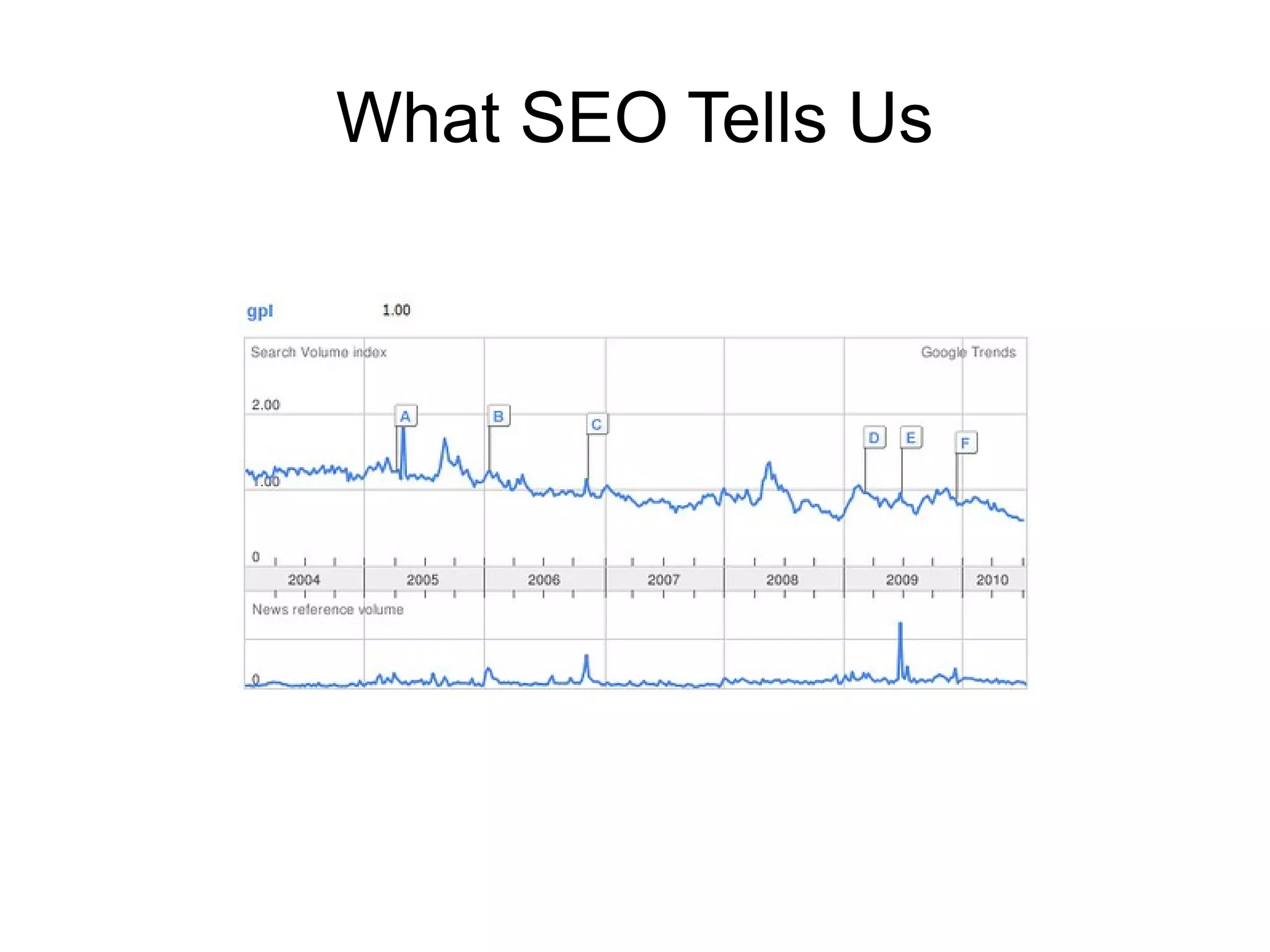
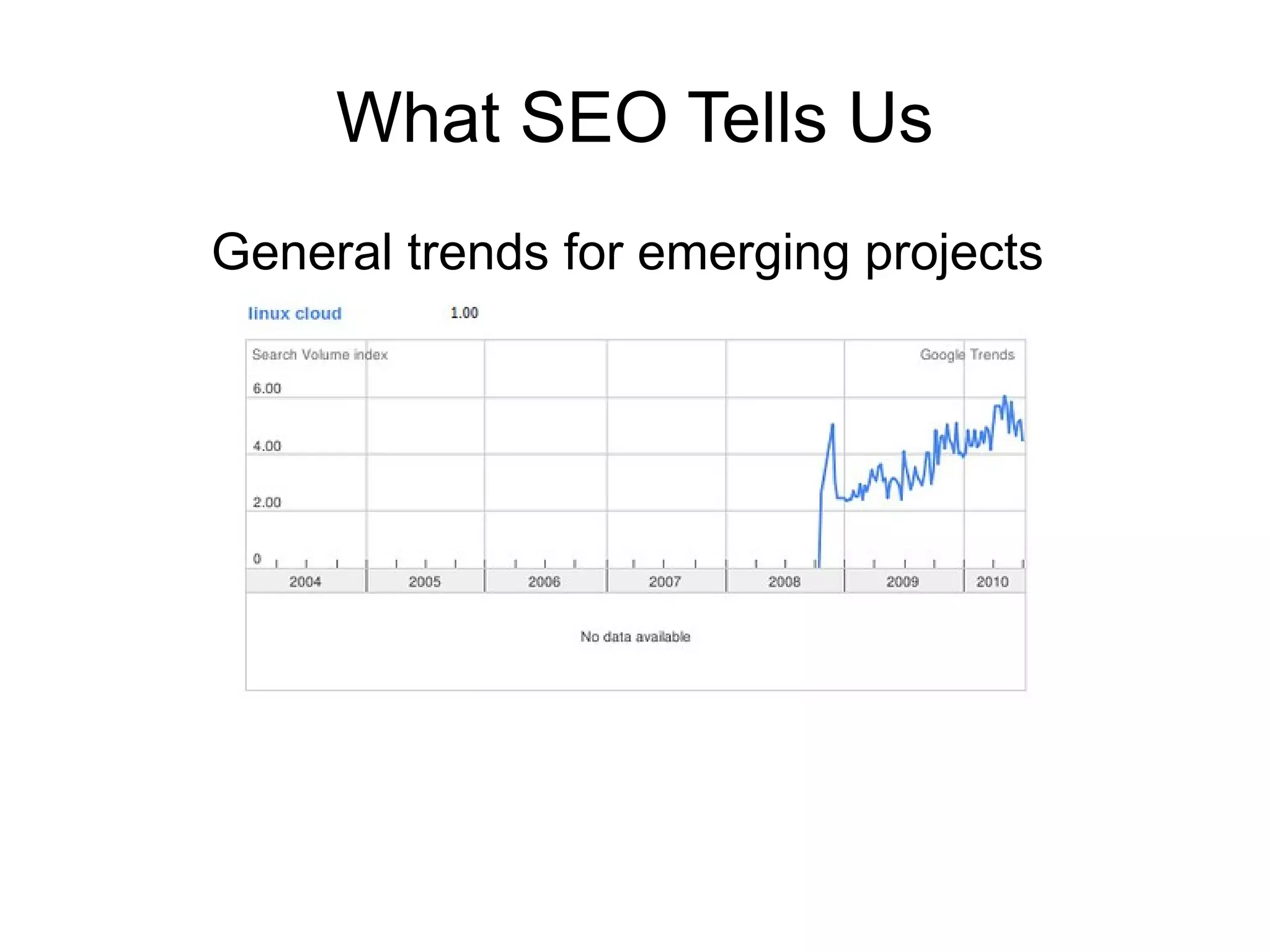
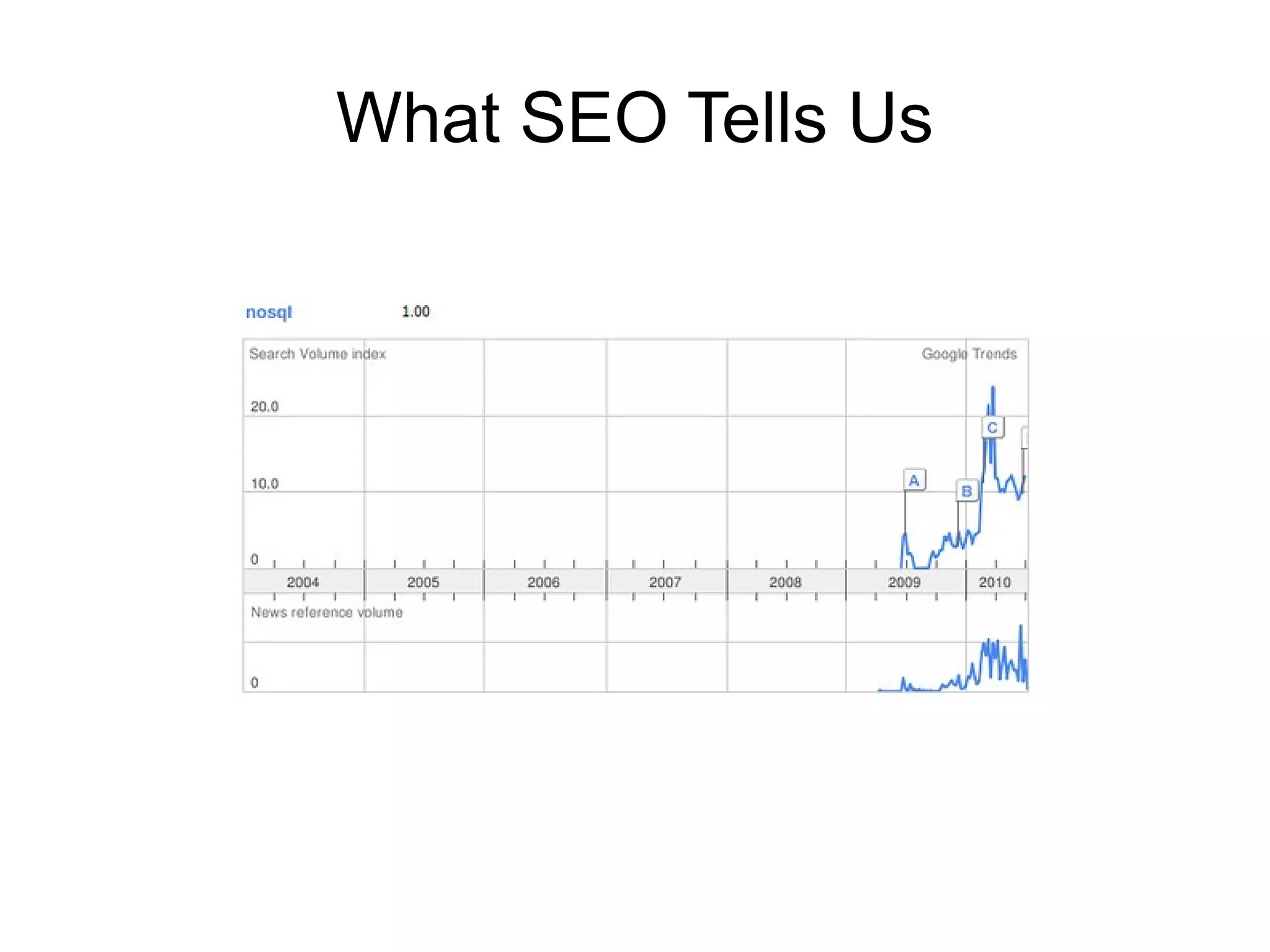
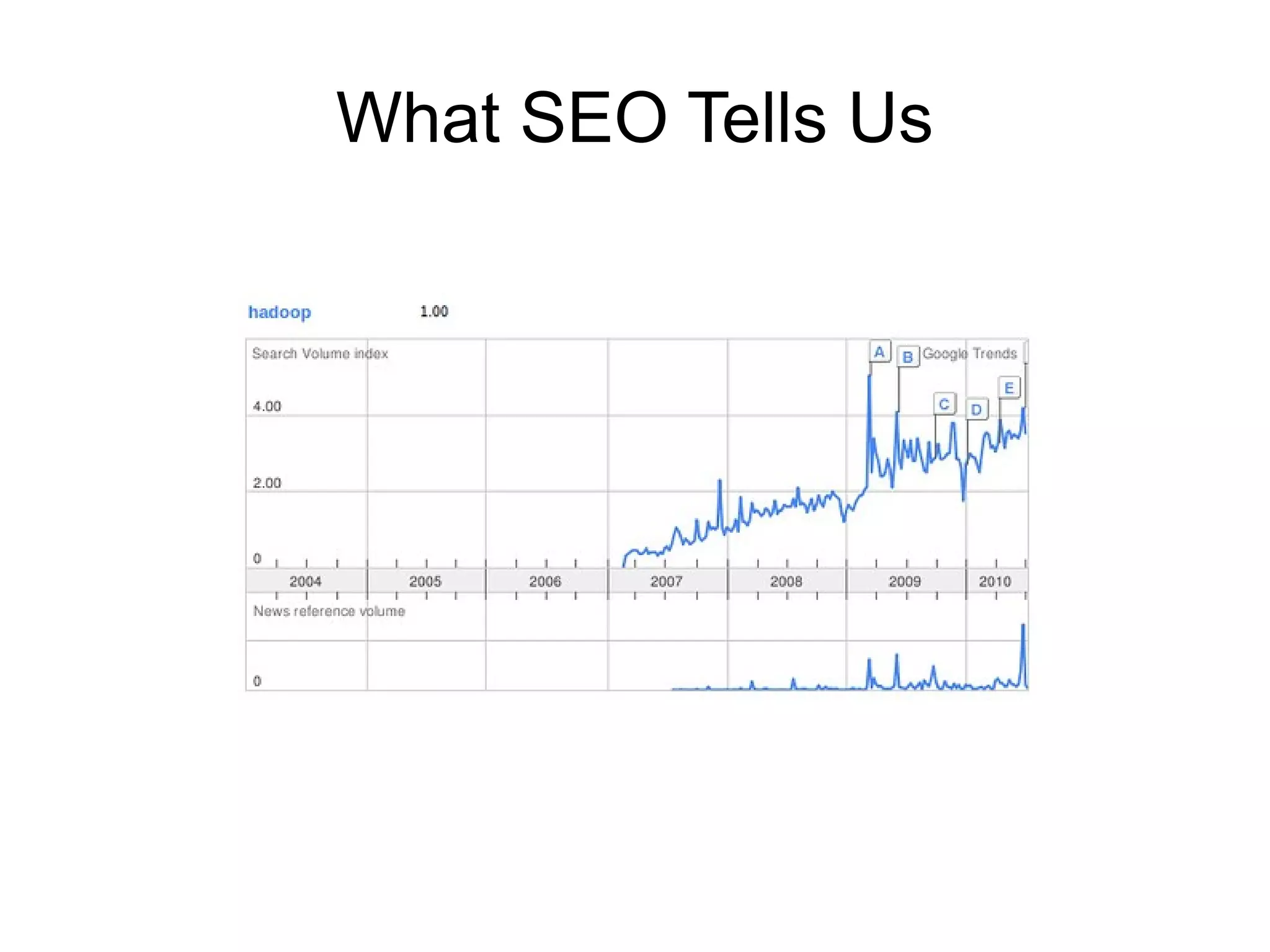
Measuring FLOSS
●   Through search, Google Trends
●   Through search, Google Scholar
●   Through investigation, Mining SourceForge.net
    Repository
Search is relative
●   Search is a simulation;
    ●   By measuring “reality” we affect reality
    ●   It is a proxy,
         –   We humanely can not understand the math involved
         –   Artificial intelligence
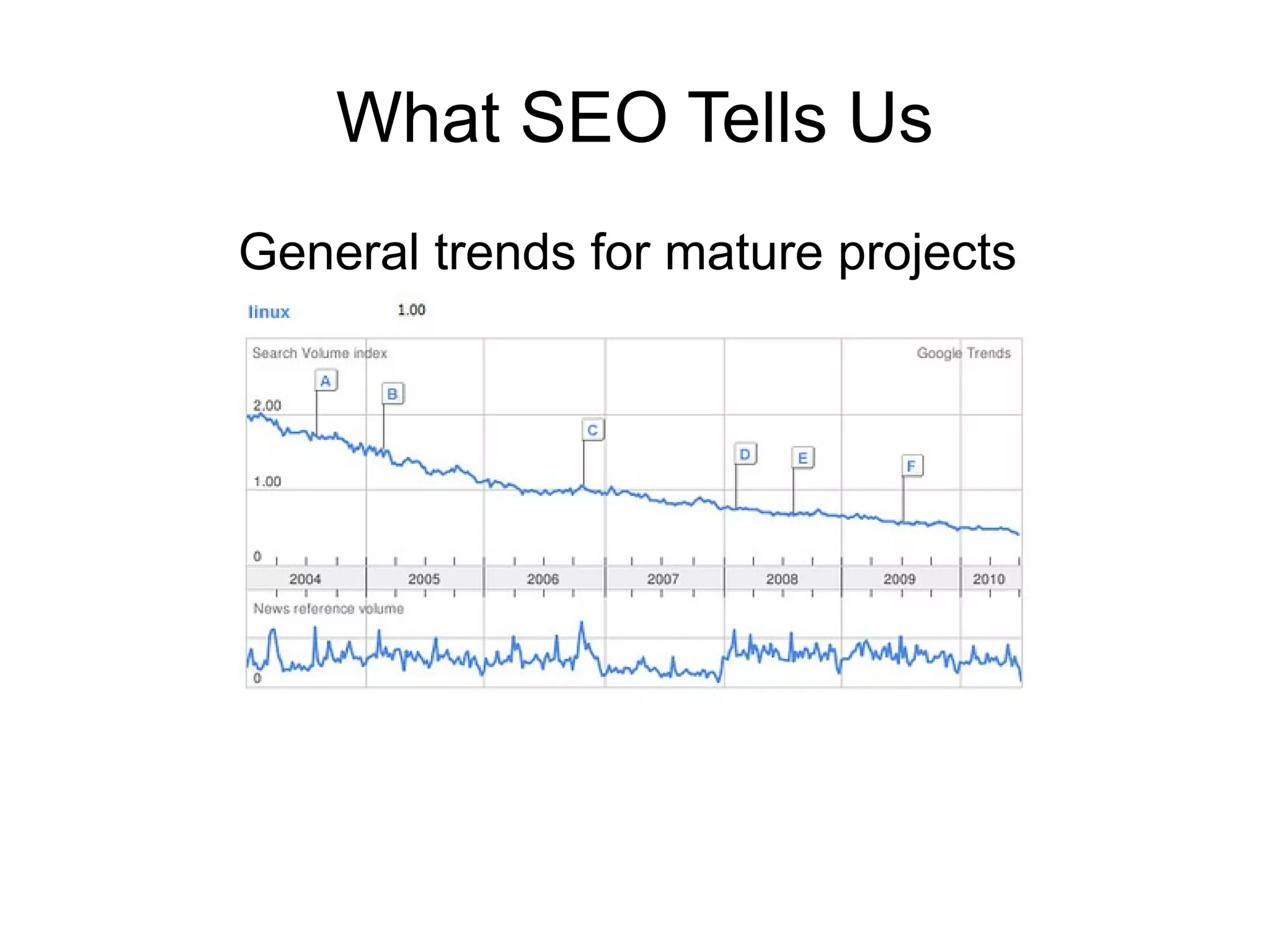
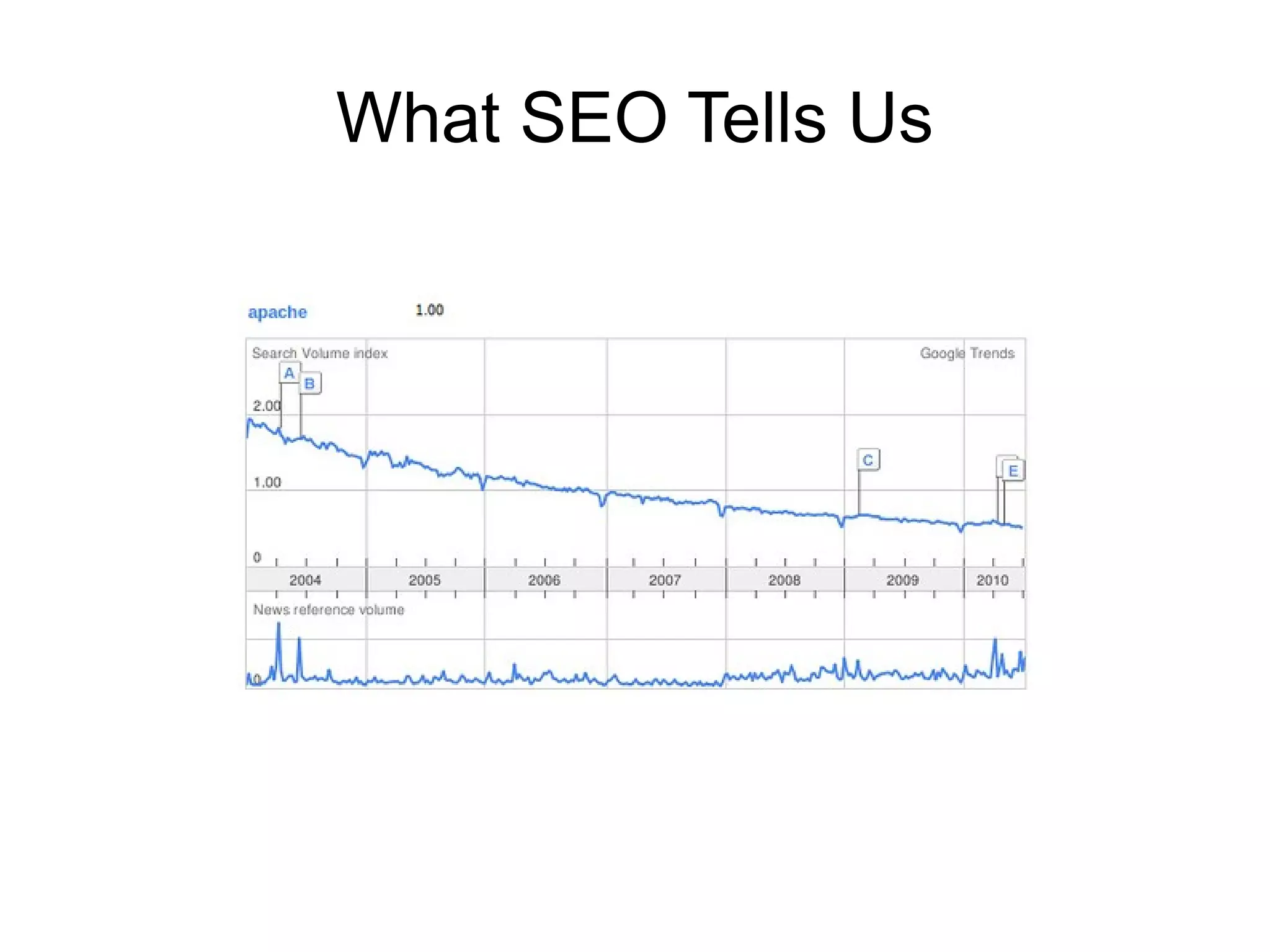
What SEO Tells Us
General trends for mature projects
What SEO Tells Us
What SEO Tells Us
What SEO Tells Us
What SEO Tells Us
What SEO Tells Us
What SEO Tells Us
What SEO Tells Us
General trends for emerging projects
What SEO Tells Us
What SEO Tells Us
Academic Publications
●   Collected in Google Scholar Advanced Search
●   Parameters
    ●   “Open Source” exact phrase all in title
    ●   “Engineering, Computer Science, and Mathematics”
        subject area
    ●   Year to Year (eg; 2012 to 2012, 2011 to 2011, etc.)
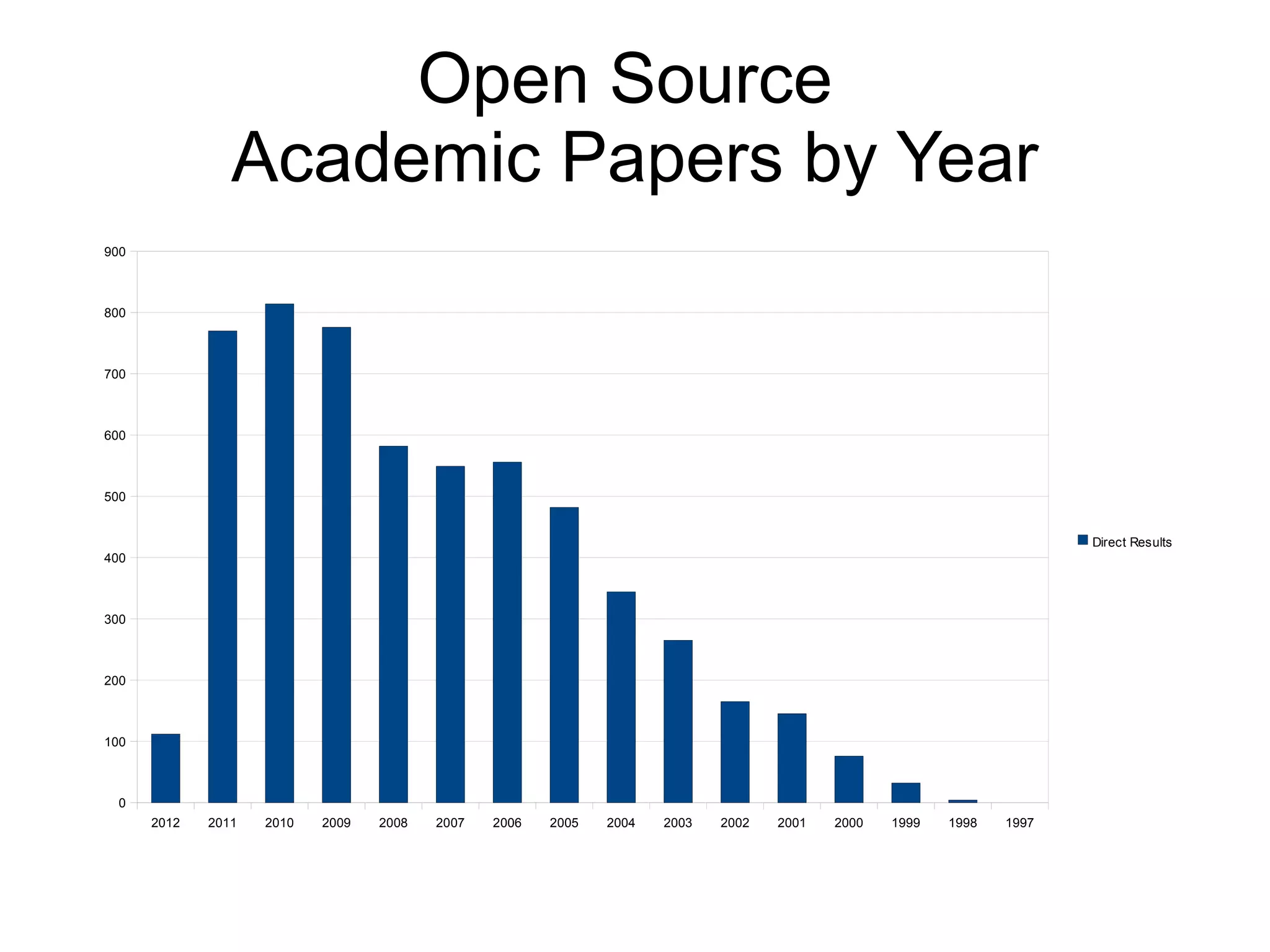
Open Source
                Academic Papers by Year
900


800


700


600


500


                                                                                                                      Direct Results
400


300


200


100


  0
      2012   2011   2010   2009   2008   2007   2006   2005   2004   2003   2002   2001   2000   1999   1998   1997
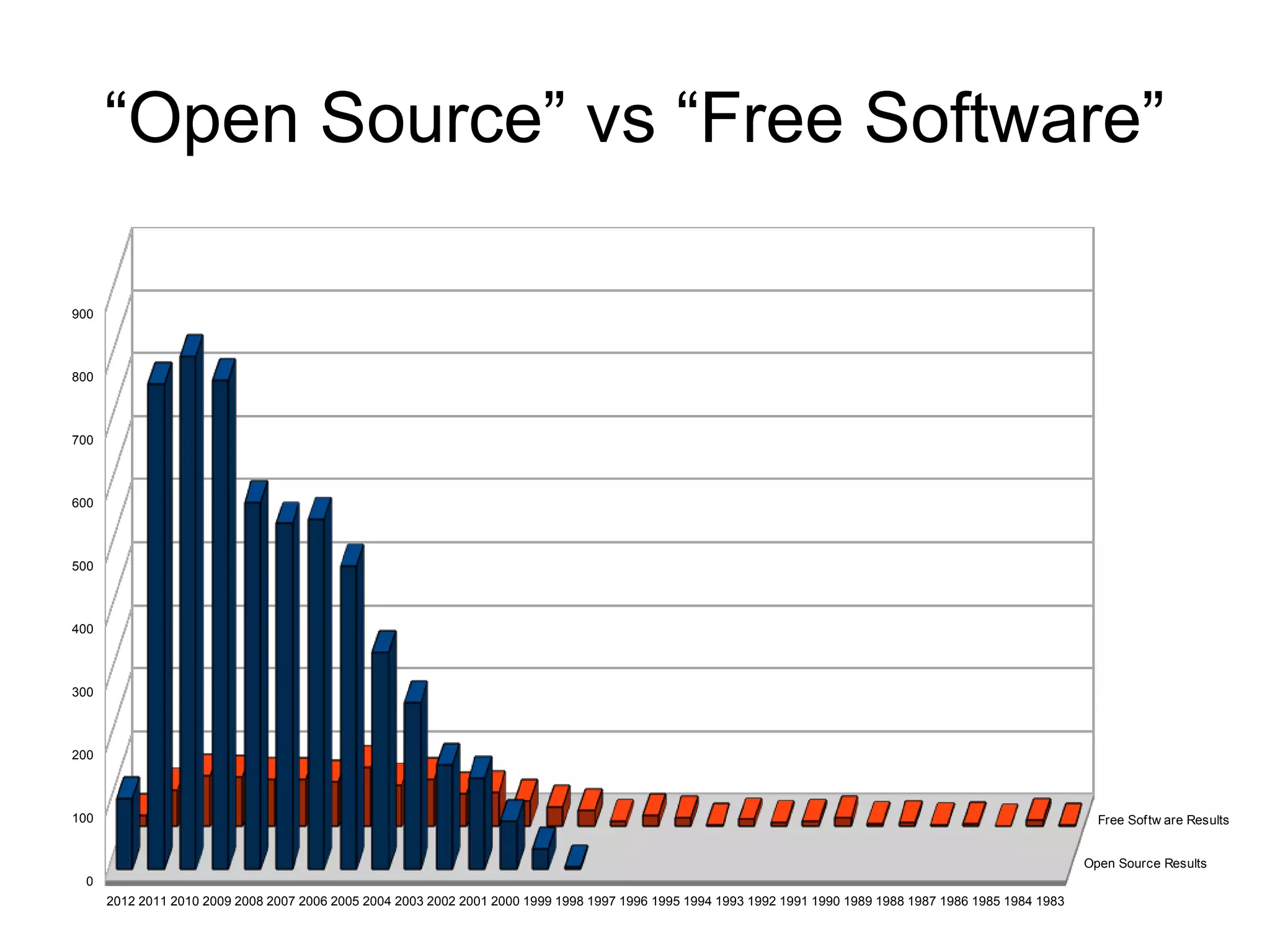
“Open Source” vs “Free Software”

900


800


700


600


500


400


300


200


100                                                                                                                                                             Free Softw are Results


                                                                                                                                                              Open Source Results
 0
      2012 2011 2010 2009 2008 2007 2006 2005 2004 2003 2002 2001 2000 1999 1998 1997 1996 1995 1994 1993 1992 1991 1990 1989 1988 1987 1986 1985 1984 1983
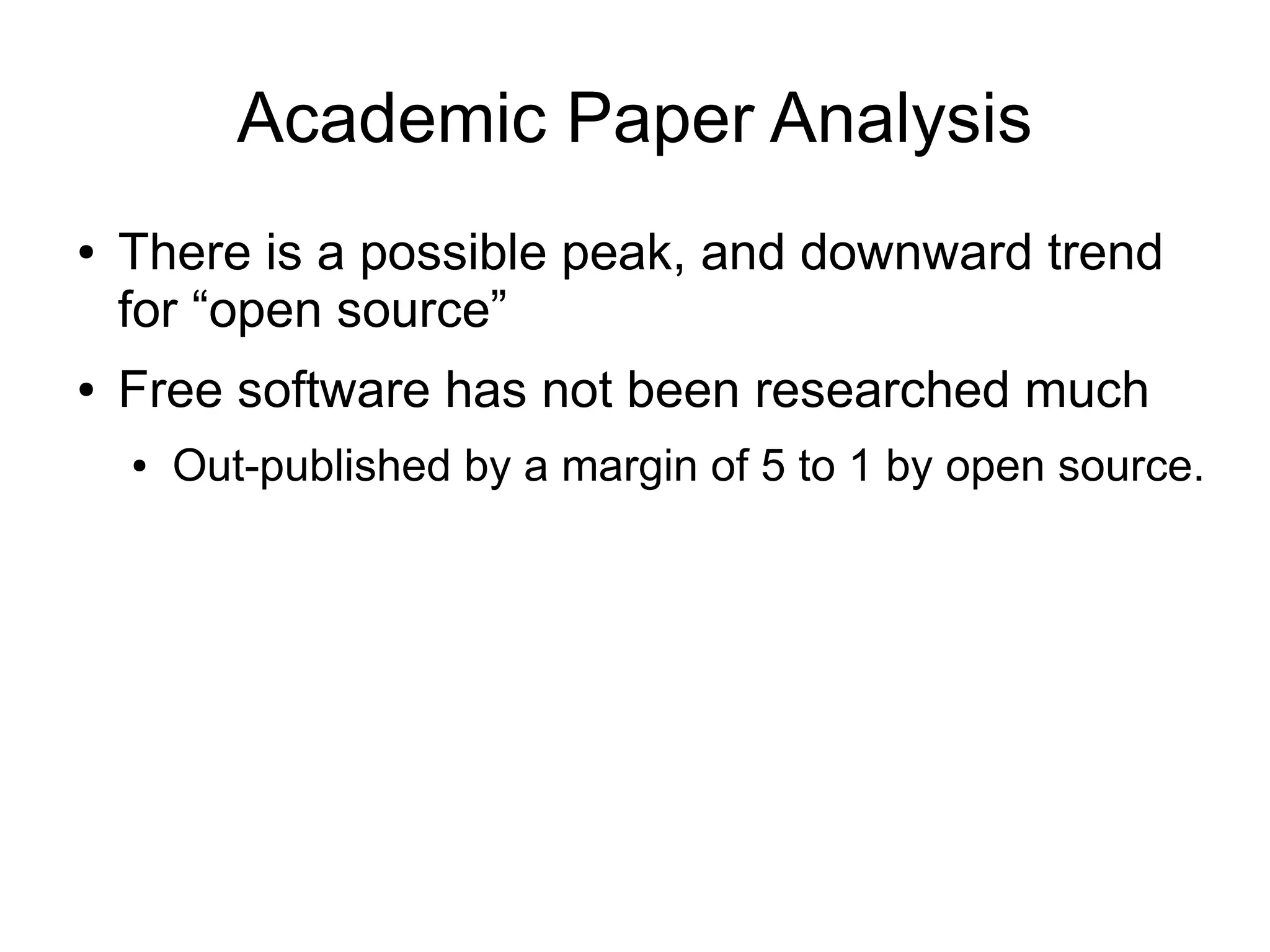
Academic Paper Analysis
●   There is a possible peak, and downward trend
    for “open source”
●   Free software has not been researched much
    ●   Out-published by a margin of 5 to 1 by open source.
Academic Paper Questions
●   Has research on “open source peaked?
●   Why isn't anyone researching “free software?”
●   Has “open source” obscured the importance of
    free software?
What Else?
●   Niche groups who are content with scratching
    their own itch
    ●   Dogmatic approach to community
●   Financial support (donations, purchases,
    memberships) is lacking
●   Large difference between public relationship
    strategies
    ●   Most successful projects use modern strategies
Project Execution Assumptions
●   Organizing a FLOSS project has changed.
●   FLOSS projects are similar to startups
●   Execution is achieved through testing
    assumptions
Project Funding Assumptions
●   Our software (product) is sufficient to obtain
    resources
●   There is an over abundance of data
    ●   Varying levels of “information”
●   Increasingly interact with more artificially
    intelligent systems
State of FLOSS
●   Build Measure Learn or Your Competition Will
    ●   Irrelevance is your enemy
    ●   Free Beer will NOT fuel your projects
●   In need of unity of purpose
    ●   In favor of software freedoms
    ●   In favor of asking for help
Build Measure Learn
Free LOSS


Freedom is not free!
Fund-raising Alternatives
●   Grants
●   Seed Funding
●   Donations
●   Merchandise
Finding Resources
●   Crowd-Sourced
Top Ten Fund-raising Lies
1.All we have to do is get 1% of the market
2.We filed patents so out intellectual property is
  protected
3.Our management team is proven
4.The large companies in our market are too big,
  dumb, and slow to compete with us
5.Our product will go viral
Top Ten Fund-raising Lies
6.Hurry up because our other investors are about
  to do our deal
7.No one else can do what we're doing
8.Several Fortune 500 companies are set to do
  business with us
9.Jupiter says our marker will be worth $50 billion
  in ten years
10.Our projections are conservative(Kawasaki, 2012)
Modeling


If we do not know who the customer is,
 we do not know what quality is.(Ries, 2011)
Questioning Assumptions


“What if they don’t care about [fill in the blank]
       in the same way we do?”(Ries, 2011)
Questioning Assumptions


“In fact, piercing the reality distortion field
      is quite uncomfortable. ”(Ries, 2011)
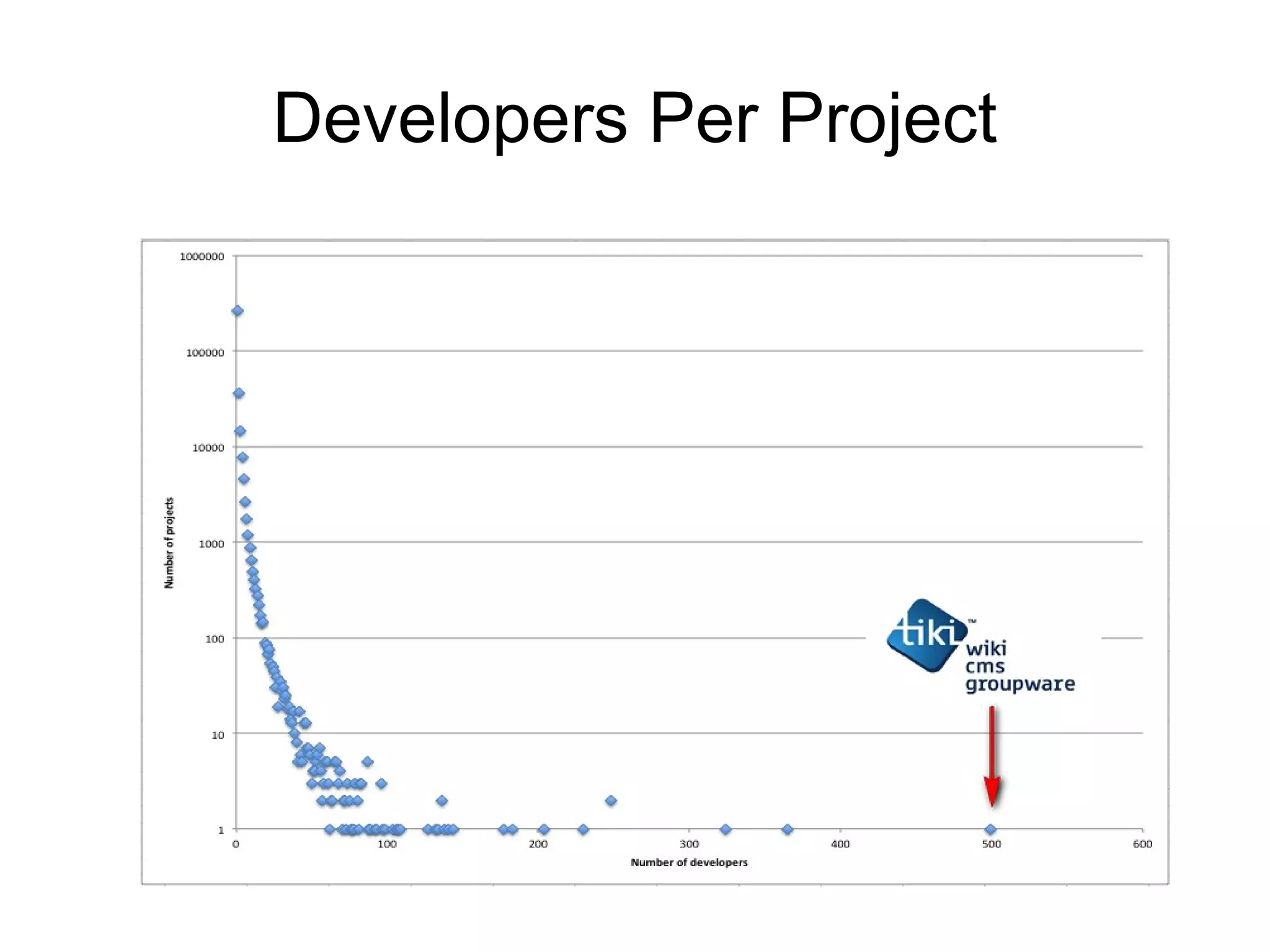
SourceForge Projects
●   324,000 projects
●   268,554 projects with only 1 developer (83%)
●   44,446 “viable” projects (14%)
Successful Free Culture Project


         When it's community
              is more than
     just the author of the project
Developers Per Project
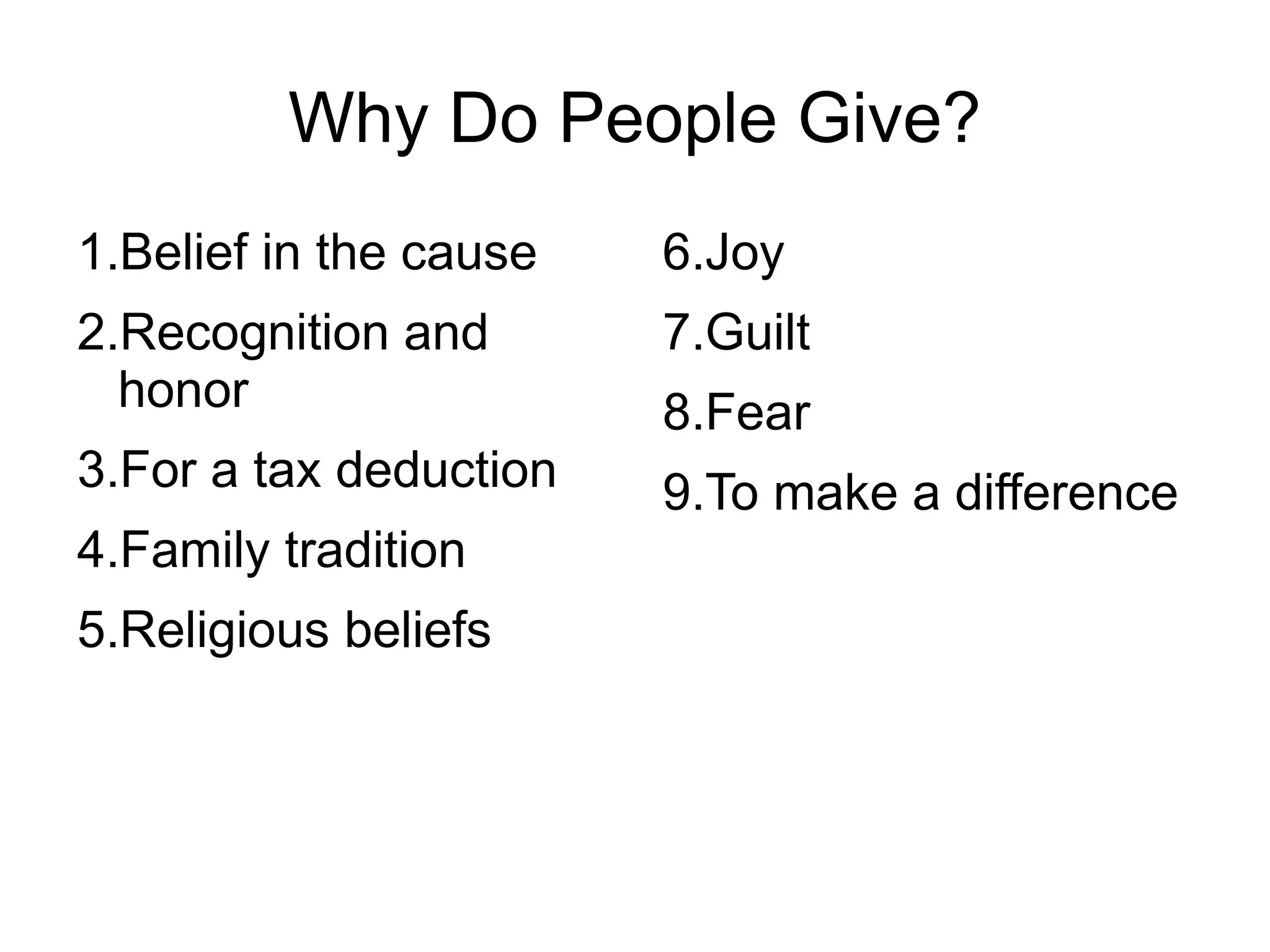
Why Do People Give?
1.Belief in the cause   6.Joy
2.Recognition and       7.Guilt
  honor                 8.Fear
3.For a tax deduction   9.To make a difference
4.Family tradition
5.Religious beliefs
Thought Experiment
●   Put the following non-profits in order of size of
    assets (donations):
    ●   Apache Foundation
    ●   Free Software Foundation
    ●   GNOME Foundation
    ●   Mozilla Foundation
    ●   Perl Foundation
    ●   Wikipedia Foundation
Case Study: Free Software
       Foundation
Case Study: GNOME Foundation
Case Study: Apache Foundation
Case Study: Mozilla Foundation
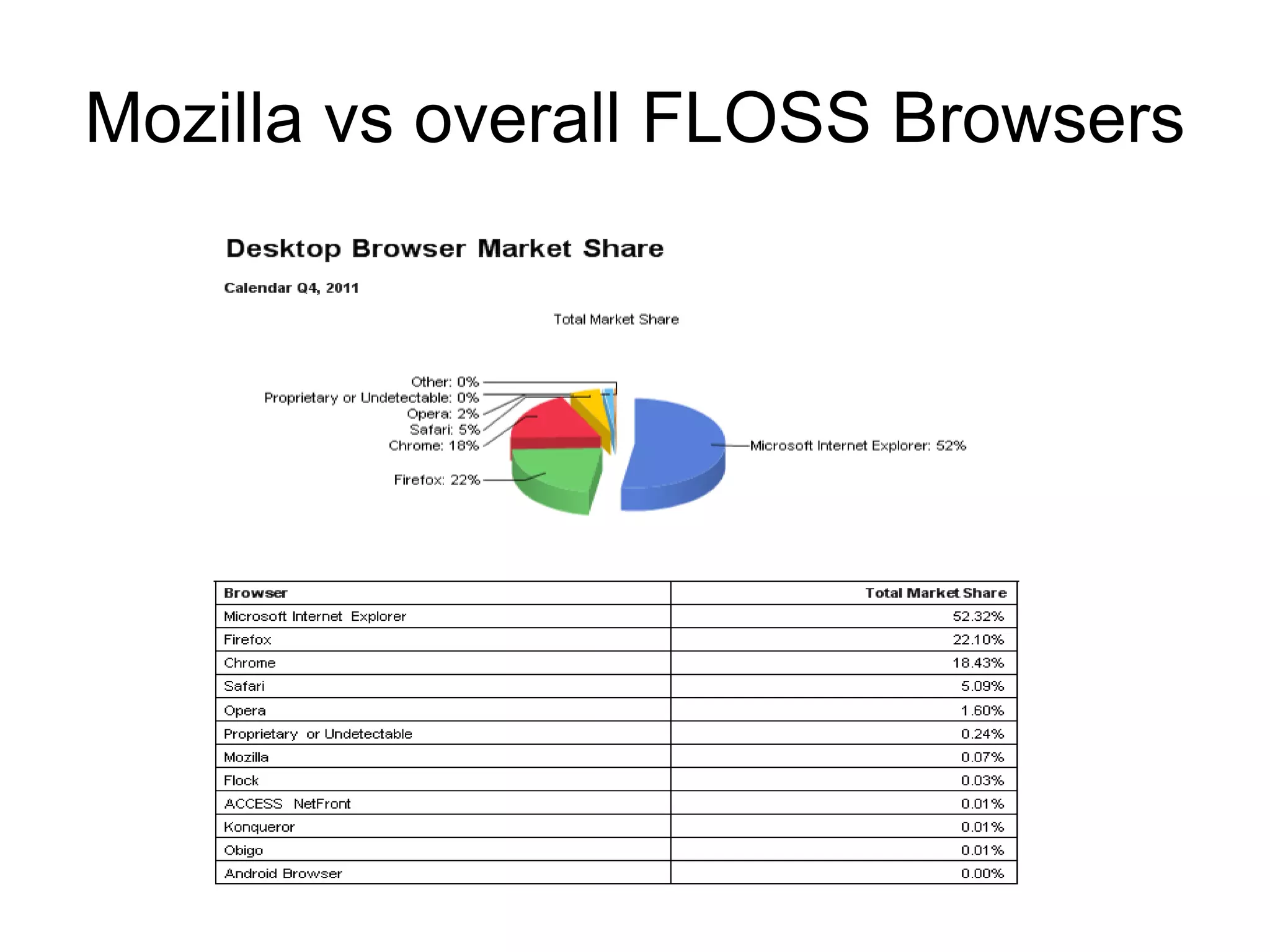
Mozilla vs overall FLOSS Browsers
Case Study: FSF Foundation
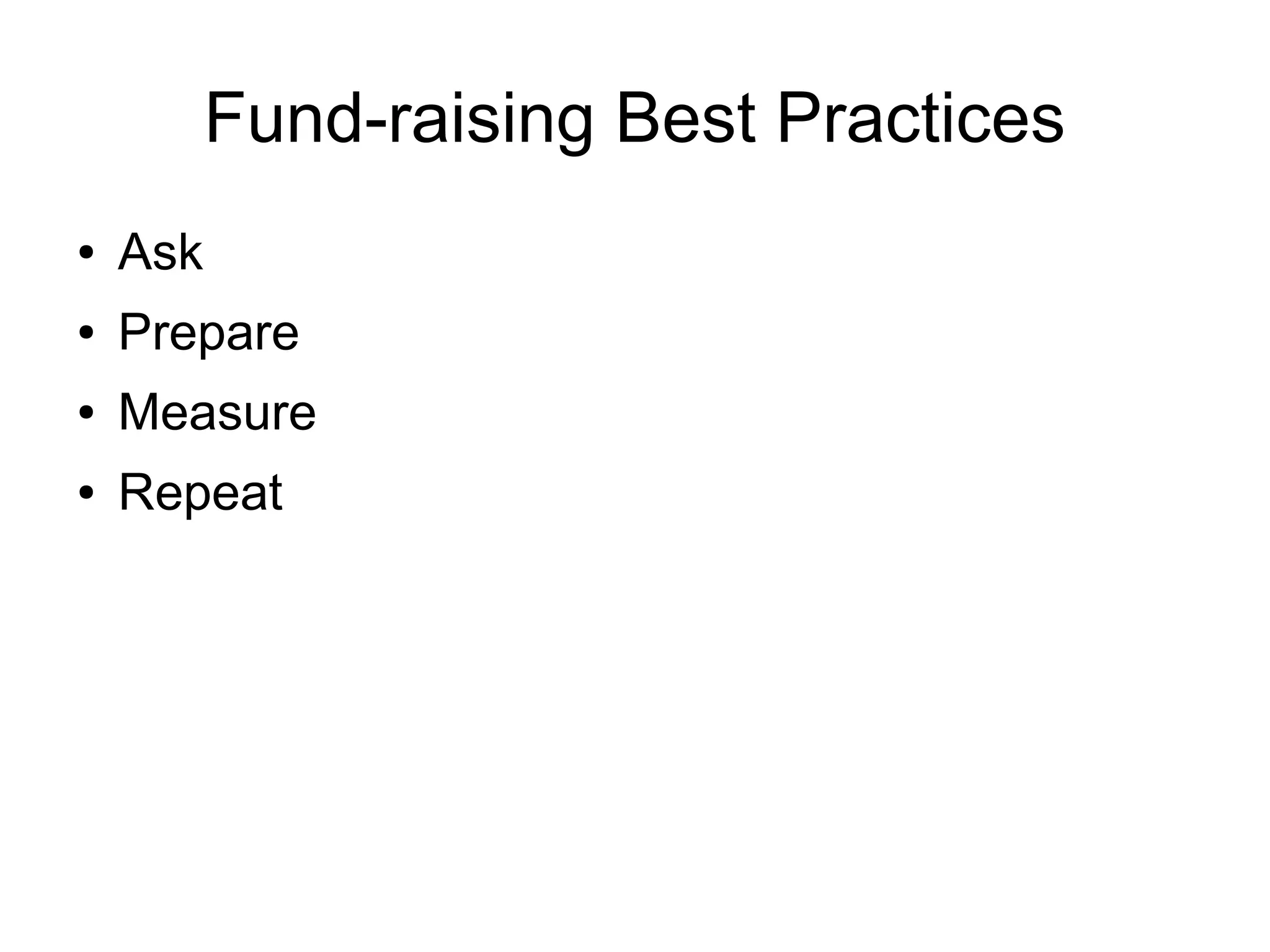
Fund-raising Best Practices
●   Ask
●   Prepare
●   Measure
●   Repeat
Best Practices for Startups
Best Practices for Politicians
Build


          A good design is
one that changes customer behavior
       for the better.(Ries, 2011)
Fund-raising 101
●   Build a Foundation
●   501(3)c
●   Grants
●   Corporate Donors
●   Community
Build a Foundation
●   Incorporation
●   Mission/Vision
●   Board of Directors
●   Transparency
Setting up a 501(3)c
Finding Grants
Corporate Donors
●   Pitch
●   Outbound Marketing
●
Community
●   Building a Community
●   Using Social Media
●   Build-Measure-Learn
References
●   Kawasaki, G. (2012). Raising Money: What Not to Say and
    What Not to Believe. http://mstrb.us/zfhxIl
●   Dvorak, J.C. (2009). The State of Open Source on Firefox's
    Fifth Birthday. http://mstrb.us/yF7CF3
●   Ries, E. (2011). The Lean Startup.
●   Fiscal Year 2010-2011 Annual Report for The Apache Software
    Foundation. http://mstrb.us/AzdrN2
●   Fiscal Year 2009-2010 Annual Report for The Apache Software
    Foundation. http://mstrb.us/yLiEIy
●   Fiscal Year 2008-2009 Annual Report for The Apache Software
    Foundation. http://mstrb.us/x8VKbv
References
●   Fiscal Year 2007-2008 Annual Report for The Apache Software
    Foundation. http://mstrb.us/xvGSe4
●   Fiscal Year 2006-2007 Annual Report for The Apache Software
    Foundation. http://mstrb.us/y63WzT
●   Fiscal Year 2005-2006 Annual Report for The Apache Software
    Foundation. http://mstrb.us/yNAbTE
●   Fiscal Year 2002-2003 Annual Report for The Apache Software
    Foundation. http://mstrb.us/wyCvAe
●   Fiscal Year 2001-2002 Annual Report for The Apache Software
    Foundation. http://mstrb.us/wRRw6w
●   2010 IRS Form 990 for the Mozilla Foundation.
    http://mstrb.us/yLAmX7
References
●   2009 IRS Form 990 for the Mozilla Foundation.
    http://mstrb.us/yOyW0n
●   2008 IRS Form 990 for the Mozilla Foundation.
    http://mstrb.us/xLdf1Y
●   2007 IRS Form 990 for the Mozilla Foundation.
    http://mstrb.us/xP1jqj
●   2006 IRS Form 990 for the Mozilla Foundation.
    http://mstrb.us/wDJDOV
●   2005 IRS Form 990 for the Mozilla Foundation.
    http://mstrb.us/yzTktK
●   2004 IRS Form 990 for the Mozilla Foundation.
    http://mstrb.us/zMnI1u
References


●   2003 IRS Form 990 for the Mozilla Foundation.
    http://mstrb.us/wDpQeo
●   Perens, B. (2008). State of Open Source Message: A New
    Decade For Open Source. http://mstrb.us/zre7oP
●   Perens, B. (2005). The Emerging Economic Paradigm of Open
    Source. http://mstrb.us/xVlTXC
●   Perens, B. The Covenant - A New Approach to Open Source
    Cooperation. http://mstrb.us/ybrmfO
●   FSF 2011 Audited Financial Statement. http://mstrb.us/zCy7VT
References


●   FSF 2010 filing information. http://mstrb.us/x2Rumq
●   FSF 2009 Audited Financial Statement. http://mstrb.us/zyoFHX

●   FSF 2008 filing information.
    http://mstrb.us/xtBZi1
●   FSF 2007 filing information.
    http://mstrb.us/zbSp0Q
●   FSF 2006 filing information.

    http://mstrb.us/xzNEzS
●   FSF 2006 filing information. http://mstrb.us/yTjZuR
References
●   FSF 2005 filing information. http://mstrb.us/xCUQeQ
●   FSF 2004 filing information.http://mstrb.us/zwOlhl
●   GNOME Foundation Detailed Financial Plan 2011.
    http://mstrb.us/zxoI4N
●   GNOME Foundation Detailed Financial Plan 2010.
    http://mstrb.us/A0jA2g
●   GNOME Budget 2009. http://mstrb.us/zdFT0B
●   GNOME Foundation Financial Statement for Fiscal Year 2007.
    http://mstrb.us/Aw7sGN
References
●   GNOME Foundation – Fiscal Year 2005 – Balance Summary.
    http://mstrb.us/wP8h59
●   GNOME Foundation Financial Statement for Fiscal Year 2004.
    http://mstrb.us/wxQVGB
●   GNOME Foundation Financial Statement for Fiscal Year 2003.
    http://mstrb.us/xoFnzh
●   Sourceforge.net. (2012). Developer Counts – The Stats.
    http://mstrb.us/xmAWfu
●   Browser Market Share. (2009). http://mstrb.us/znr3Iy
●   Wheeler., D. (2007). Why Open Source Software / Free
    Software (OSS/FS, FLOSS, or FOSS)? Look at the Numbers!
    http://mstrb.us/xBkuQP
●   Browser Market Share. (2111). http://mstrb.us/znr3Iy

Financing freedom section1.02

  • 1.
    How to organizeand fund free culture projects Kevin Shockey Founder, Mis Tribus
  • 2.
    What? Free culture projectsoften fail due to a lack of resources.
  • 3.
    So What? By focusing on raising funds, a project can increase its' chances of survival
  • 4.
    Why me? Freedom is not free! (How many ways can you relate?)
  • 5.
    Why now? ● Declining interest in FLOSS ● Lack of unity, more division ● FLOSS success is taken for granted ● Increased willingness to compromise ● Lingering confusion surrounding free software
  • 6.
    Disclaimer I'm not pretendingto tell anyone what to do, I'm sharing my interpretation. My story. (Your mileage may vary...)
  • 7.
    So far... ● Funding Free Culture: ● Blog: FundingFreeCulture.MisTribus.com ● blog.financingfreedom.com ● @ffc_2012 ● Tumblr: FundingFreeCulture.Tumblr.com ● One Blogger post triggers: ● 3 Automated tweets on 3 different accounts ● Updated Linked In ● Updated Finding Free Culture Page on Facebook
  • 8.
    Assumptions ● Free Culture ● Project Execution ● Project Funding
  • 9.
    Free Culture Assumptions ● Free culture projects often fail ● People assume FLOSS's success is guaranteed ● Division makes free culture weaker
  • 10.
    State of FLOSS? ● Four stages of Maturity: ● Emergent ● Growth ● Mature ● Declining ● Projects in emergent, growth, & maturity stages
  • 11.
    State of FLOSSis mixed ● Enterprise recognition ● Limited user recognition/support ● Participation is declining ● Finances (resources) are limited (often to just one person)
  • 12.
    Top 10 FLOSSHall of Fame 1. Linux Kernel 2. GNU Utilities & Compilers 3. Ubuntu 4. BSD 5. Samba (Top 10 Open Source Hall of Famers. (2009). http://mstrb.us/zjn6zK)
  • 13.
    Top 10 FLOSSHall of Fame 6. MySQL 7. BIND 8. SendMail 9. OpenSSH & OpenSSL 10. Apache
  • 14.
    Measuring FLOSS ● Through search, Google Trends ● Through search, Google Scholar ● Through investigation, Mining SourceForge.net Repository
  • 15.
    Search is relative ● Search is a simulation; ● By measuring “reality” we affect reality ● It is a proxy, – We humanely can not understand the math involved – Artificial intelligence
  • 16.
    What SEO TellsUs General trends for mature projects
  • 17.
  • 18.
  • 19.
  • 20.
  • 21.
  • 22.
  • 23.
    What SEO TellsUs General trends for emerging projects
  • 24.
  • 25.
  • 26.
    Academic Publications ● Collected in Google Scholar Advanced Search ● Parameters ● “Open Source” exact phrase all in title ● “Engineering, Computer Science, and Mathematics” subject area ● Year to Year (eg; 2012 to 2012, 2011 to 2011, etc.)
  • 27.
    Open Source Academic Papers by Year 900 800 700 600 500 Direct Results 400 300 200 100 0 2012 2011 2010 2009 2008 2007 2006 2005 2004 2003 2002 2001 2000 1999 1998 1997
  • 28.
    “Open Source” vs“Free Software” 900 800 700 600 500 400 300 200 100 Free Softw are Results Open Source Results 0 2012 2011 2010 2009 2008 2007 2006 2005 2004 2003 2002 2001 2000 1999 1998 1997 1996 1995 1994 1993 1992 1991 1990 1989 1988 1987 1986 1985 1984 1983
  • 29.
    Academic Paper Analysis ● There is a possible peak, and downward trend for “open source” ● Free software has not been researched much ● Out-published by a margin of 5 to 1 by open source.
  • 30.
    Academic Paper Questions ● Has research on “open source peaked? ● Why isn't anyone researching “free software?” ● Has “open source” obscured the importance of free software?
  • 31.
    What Else? ● Niche groups who are content with scratching their own itch ● Dogmatic approach to community ● Financial support (donations, purchases, memberships) is lacking ● Large difference between public relationship strategies ● Most successful projects use modern strategies
  • 32.
    Project Execution Assumptions ● Organizing a FLOSS project has changed. ● FLOSS projects are similar to startups ● Execution is achieved through testing assumptions
  • 33.
    Project Funding Assumptions ● Our software (product) is sufficient to obtain resources ● There is an over abundance of data ● Varying levels of “information” ● Increasingly interact with more artificially intelligent systems
  • 34.
    State of FLOSS ● Build Measure Learn or Your Competition Will ● Irrelevance is your enemy ● Free Beer will NOT fuel your projects ● In need of unity of purpose ● In favor of software freedoms ● In favor of asking for help
  • 35.
  • 36.
  • 37.
    Fund-raising Alternatives ● Grants ● Seed Funding ● Donations ● Merchandise
  • 38.
  • 39.
    Top Ten Fund-raisingLies 1.All we have to do is get 1% of the market 2.We filed patents so out intellectual property is protected 3.Our management team is proven 4.The large companies in our market are too big, dumb, and slow to compete with us 5.Our product will go viral
  • 40.
    Top Ten Fund-raisingLies 6.Hurry up because our other investors are about to do our deal 7.No one else can do what we're doing 8.Several Fortune 500 companies are set to do business with us 9.Jupiter says our marker will be worth $50 billion in ten years 10.Our projections are conservative(Kawasaki, 2012)
  • 41.
    Modeling If we donot know who the customer is, we do not know what quality is.(Ries, 2011)
  • 42.
    Questioning Assumptions “What ifthey don’t care about [fill in the blank] in the same way we do?”(Ries, 2011)
  • 43.
    Questioning Assumptions “In fact,piercing the reality distortion field is quite uncomfortable. ”(Ries, 2011)
  • 44.
    SourceForge Projects ● 324,000 projects ● 268,554 projects with only 1 developer (83%) ● 44,446 “viable” projects (14%)
  • 45.
    Successful Free CultureProject When it's community is more than just the author of the project
  • 46.
  • 47.
    Why Do PeopleGive? 1.Belief in the cause 6.Joy 2.Recognition and 7.Guilt honor 8.Fear 3.For a tax deduction 9.To make a difference 4.Family tradition 5.Religious beliefs
  • 48.
    Thought Experiment ● Put the following non-profits in order of size of assets (donations): ● Apache Foundation ● Free Software Foundation ● GNOME Foundation ● Mozilla Foundation ● Perl Foundation ● Wikipedia Foundation
  • 49.
    Case Study: FreeSoftware Foundation
  • 50.
  • 51.
  • 52.
  • 53.
    Mozilla vs overallFLOSS Browsers
  • 54.
    Mozilla vs overallFLOSS Browsers
  • 55.
    Case Study: FSFFoundation
  • 56.
    Fund-raising Best Practices ● Ask ● Prepare ● Measure ● Repeat
  • 57.
  • 58.
    Best Practices forPoliticians
  • 59.
    Build A good design is one that changes customer behavior for the better.(Ries, 2011)
  • 60.
    Fund-raising 101 ● Build a Foundation ● 501(3)c ● Grants ● Corporate Donors ● Community
  • 61.
    Build a Foundation ● Incorporation ● Mission/Vision ● Board of Directors ● Transparency
  • 62.
    Setting up a501(3)c
  • 63.
  • 64.
    Corporate Donors ● Pitch ● Outbound Marketing ●
  • 65.
    Community ● Building a Community ● Using Social Media ● Build-Measure-Learn
  • 66.
    References ● Kawasaki, G. (2012). Raising Money: What Not to Say and What Not to Believe. http://mstrb.us/zfhxIl ● Dvorak, J.C. (2009). The State of Open Source on Firefox's Fifth Birthday. http://mstrb.us/yF7CF3 ● Ries, E. (2011). The Lean Startup. ● Fiscal Year 2010-2011 Annual Report for The Apache Software Foundation. http://mstrb.us/AzdrN2 ● Fiscal Year 2009-2010 Annual Report for The Apache Software Foundation. http://mstrb.us/yLiEIy ● Fiscal Year 2008-2009 Annual Report for The Apache Software Foundation. http://mstrb.us/x8VKbv
  • 67.
    References ● Fiscal Year 2007-2008 Annual Report for The Apache Software Foundation. http://mstrb.us/xvGSe4 ● Fiscal Year 2006-2007 Annual Report for The Apache Software Foundation. http://mstrb.us/y63WzT ● Fiscal Year 2005-2006 Annual Report for The Apache Software Foundation. http://mstrb.us/yNAbTE ● Fiscal Year 2002-2003 Annual Report for The Apache Software Foundation. http://mstrb.us/wyCvAe ● Fiscal Year 2001-2002 Annual Report for The Apache Software Foundation. http://mstrb.us/wRRw6w ● 2010 IRS Form 990 for the Mozilla Foundation. http://mstrb.us/yLAmX7
  • 68.
    References ● 2009 IRS Form 990 for the Mozilla Foundation. http://mstrb.us/yOyW0n ● 2008 IRS Form 990 for the Mozilla Foundation. http://mstrb.us/xLdf1Y ● 2007 IRS Form 990 for the Mozilla Foundation. http://mstrb.us/xP1jqj ● 2006 IRS Form 990 for the Mozilla Foundation. http://mstrb.us/wDJDOV ● 2005 IRS Form 990 for the Mozilla Foundation. http://mstrb.us/yzTktK ● 2004 IRS Form 990 for the Mozilla Foundation. http://mstrb.us/zMnI1u
  • 69.
    References ● 2003 IRS Form 990 for the Mozilla Foundation. http://mstrb.us/wDpQeo ● Perens, B. (2008). State of Open Source Message: A New Decade For Open Source. http://mstrb.us/zre7oP ● Perens, B. (2005). The Emerging Economic Paradigm of Open Source. http://mstrb.us/xVlTXC ● Perens, B. The Covenant - A New Approach to Open Source Cooperation. http://mstrb.us/ybrmfO ● FSF 2011 Audited Financial Statement. http://mstrb.us/zCy7VT
  • 70.
    References ● FSF 2010 filing information. http://mstrb.us/x2Rumq ● FSF 2009 Audited Financial Statement. http://mstrb.us/zyoFHX ● FSF 2008 filing information. http://mstrb.us/xtBZi1 ● FSF 2007 filing information. http://mstrb.us/zbSp0Q ● FSF 2006 filing information. http://mstrb.us/xzNEzS ● FSF 2006 filing information. http://mstrb.us/yTjZuR
  • 71.
    References ● FSF 2005 filing information. http://mstrb.us/xCUQeQ ● FSF 2004 filing information.http://mstrb.us/zwOlhl ● GNOME Foundation Detailed Financial Plan 2011. http://mstrb.us/zxoI4N ● GNOME Foundation Detailed Financial Plan 2010. http://mstrb.us/A0jA2g ● GNOME Budget 2009. http://mstrb.us/zdFT0B ● GNOME Foundation Financial Statement for Fiscal Year 2007. http://mstrb.us/Aw7sGN
  • 72.
    References ● GNOME Foundation – Fiscal Year 2005 – Balance Summary. http://mstrb.us/wP8h59 ● GNOME Foundation Financial Statement for Fiscal Year 2004. http://mstrb.us/wxQVGB ● GNOME Foundation Financial Statement for Fiscal Year 2003. http://mstrb.us/xoFnzh ● Sourceforge.net. (2012). Developer Counts – The Stats. http://mstrb.us/xmAWfu ● Browser Market Share. (2009). http://mstrb.us/znr3Iy ● Wheeler., D. (2007). Why Open Source Software / Free Software (OSS/FS, FLOSS, or FOSS)? Look at the Numbers! http://mstrb.us/xBkuQP ● Browser Market Share. (2111). http://mstrb.us/znr3Iy