UNIT 1
Financial Management
Financial Management means planning, organizing,
directing and controlling the financial activities such
as procurement and utilization of funds of the
enterprise. It means applying general management
principles to financial resources of the enterprise.
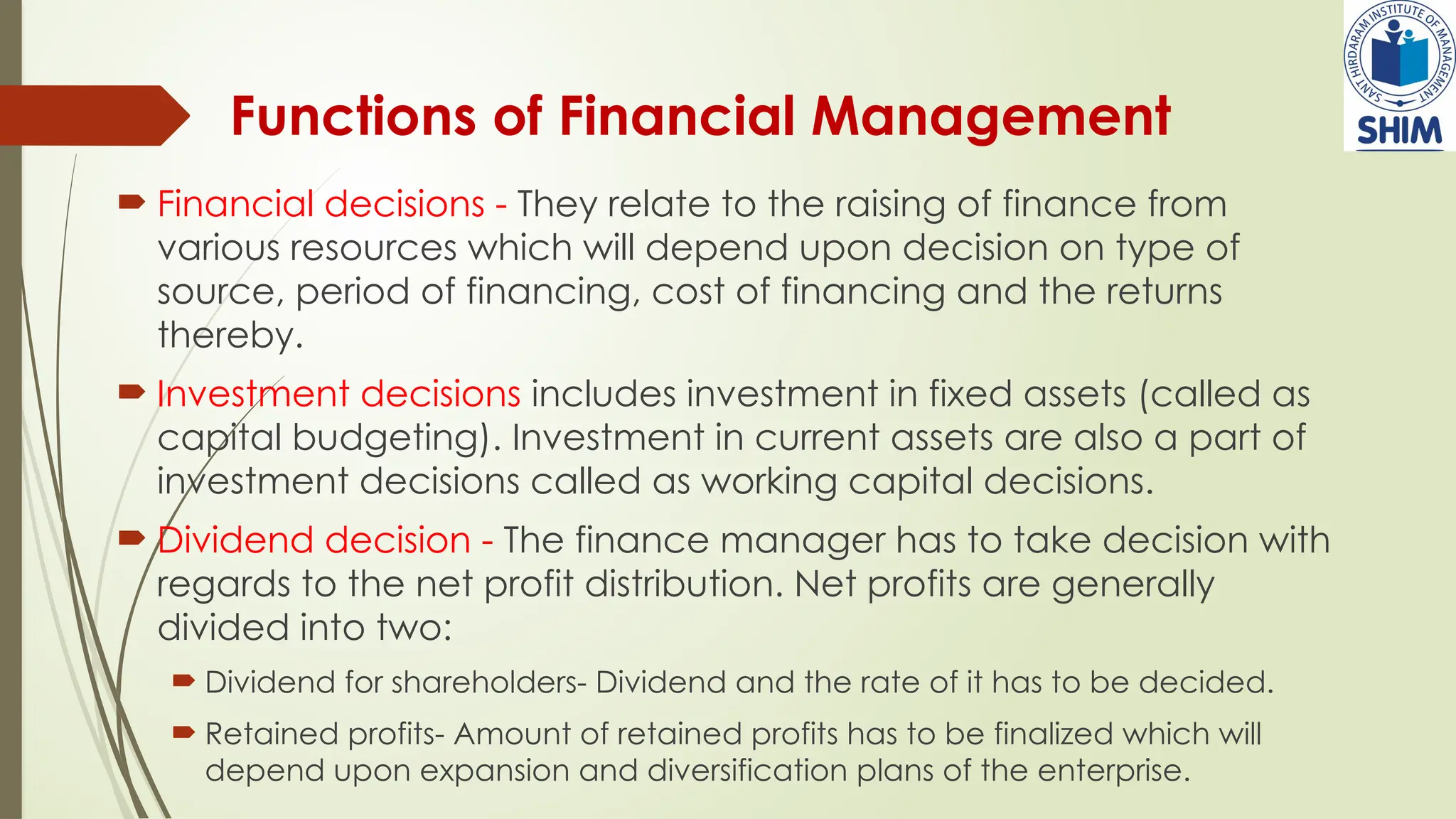
Functions of Financial Management
 Financial decisions - They relate to the raising of finance from
various resources which will depend upon decision on type of
source, period of financing, cost of financing and the returns
thereby.
 Investment decisions includes investment in fixed assets (called as
capital budgeting). Investment in current assets are also a part of
investment decisions called as working capital decisions.
 Dividend decision - The finance manager has to take decision with
regards to the net profit distribution. Net profits are generally
divided into two:
 Dividend for shareholders- Dividend and the rate of it has to be decided.
 Retained profits- Amount of retained profits has to be finalized which will
depend upon expansion and diversification plans of the enterprise.
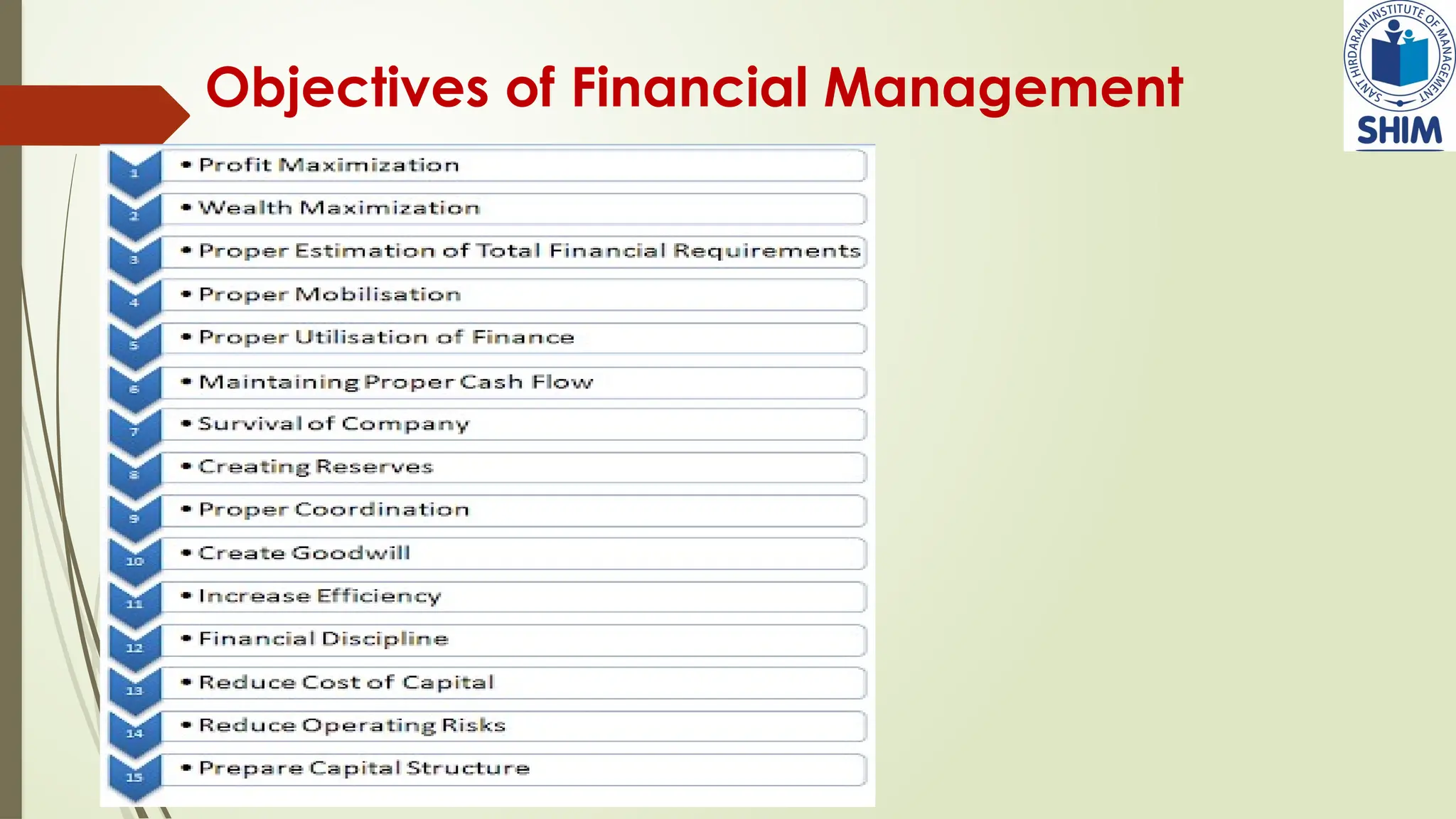
Objectives of Financial Management
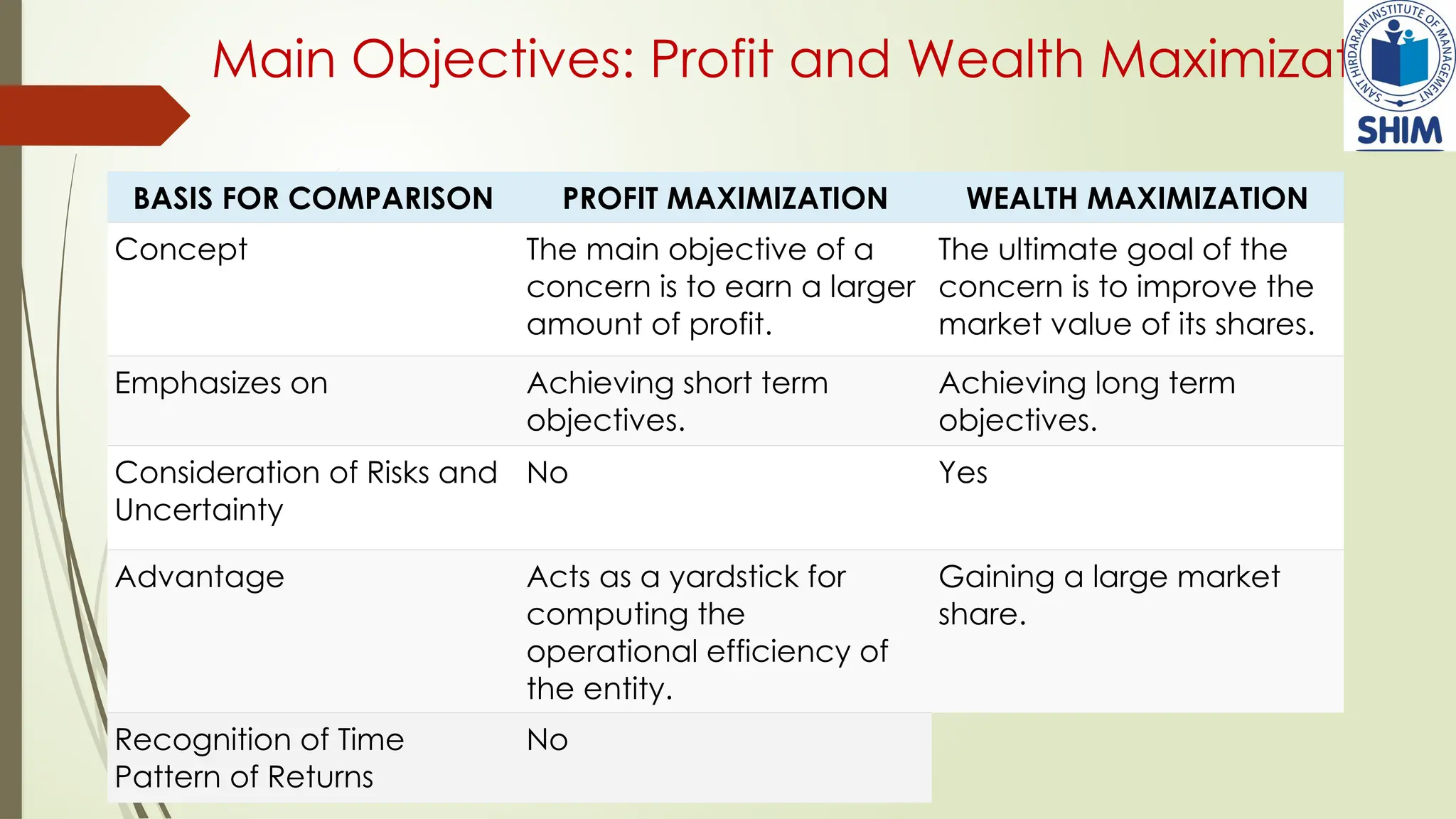
Main Objectives: Profit and Wealth Maximization
BASIS FOR COMPARISON PROFIT MAXIMIZATION WEALTH MAXIMIZATION
Concept The main objective of a
concern is to earn a larger
amount of profit.
The ultimate goal of the
concern is to improve the
market value of its shares.
Emphasizes on Achieving short term
objectives.
Achieving long term
objectives.
Consideration of Risks and
Uncertainty
No Yes
Advantage Acts as a yardstick for
computing the
operational efficiency of
the entity.
Gaining a large market
share.
Recognition of Time
Pattern of Returns
No
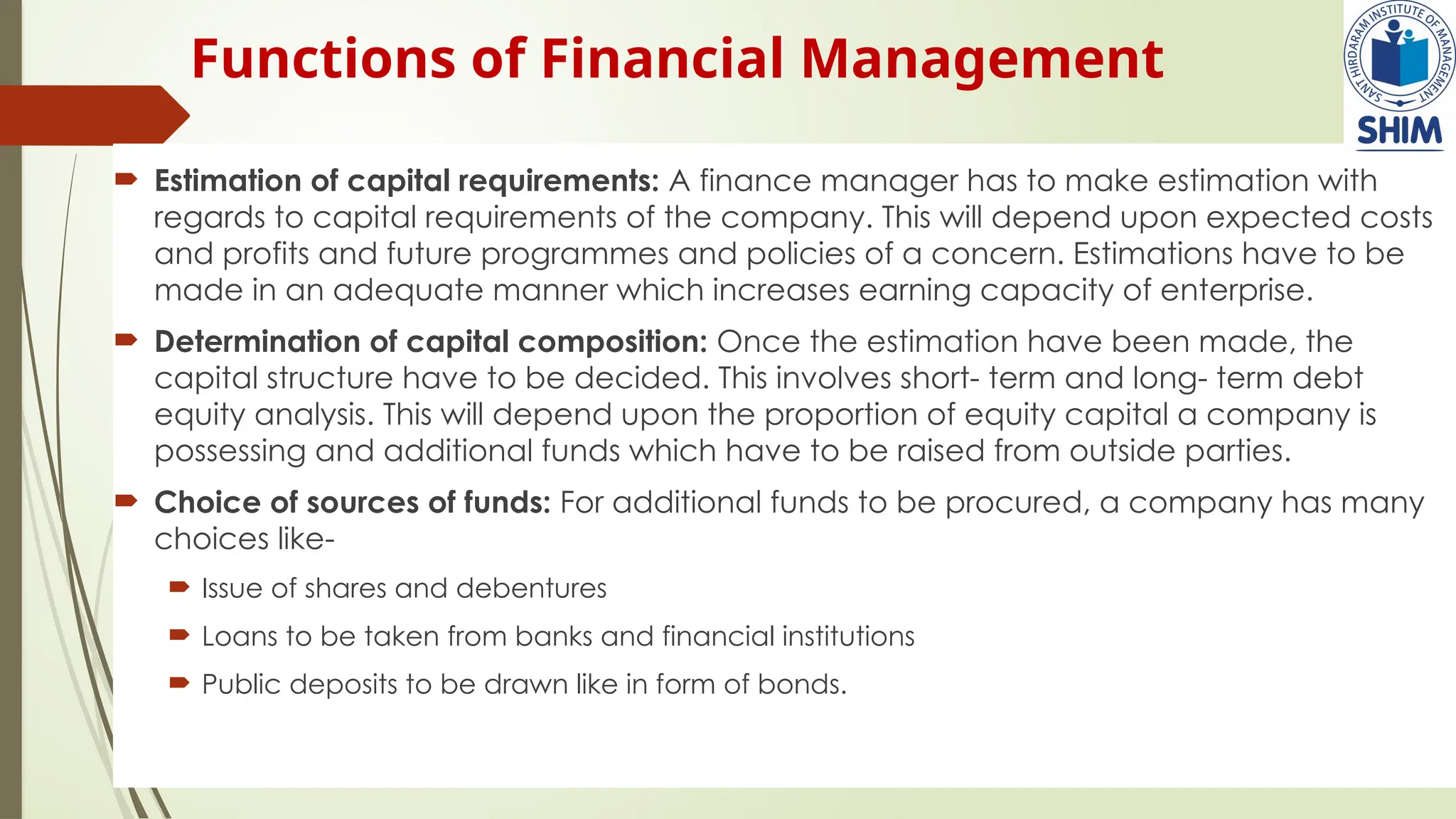
Functions of Financial Management
 Estimation of capital requirements: A finance manager has to make estimation with
regards to capital requirements of the company. This will depend upon expected costs
and profits and future programmes and policies of a concern. Estimations have to be
made in an adequate manner which increases earning capacity of enterprise.
 Determination of capital composition: Once the estimation have been made, the
capital structure have to be decided. This involves short- term and long- term debt
equity analysis. This will depend upon the proportion of equity capital a company is
possessing and additional funds which have to be raised from outside parties.
 Choice of sources of funds: For additional funds to be procured, a company has many
choices like-
 Issue of shares and debentures
 Loans to be taken from banks and financial institutions
 Public deposits to be drawn like in form of bonds.
Continued…..
 Investment of funds: The finance manager has to decide to allocate funds into profitable
ventures so that there is safety on investment and regular returns is possible.
 Disposal of surplus: The net profits decision have to be made by the finance manager. This
can be done in two ways:
 Dividend declaration - It includes identifying the rate of dividends and other benefits like bonus.
 Retained profits - The volume has to be decided which will depend upon expansional, innovational,
diversification plans of the company.
 Management of cash: Finance manager has to make decisions with regards to cash
management. Cash is required for many purposes like payment of wages and salaries,
payment of electricity and water bills, payment to creditors, meeting current liabilities,
maintainance of enough stock, purchase of raw materials, etc.
 Financial controls: The finance manager has not only to plan, procure and utilize the funds
but he also has to exercise control over finances. This can be done through many techniques
like ratio analysis, financial forecasting, cost and profit control, etc.
Financial Statement Analysis
 Financial Statement Analysis involves examining financial statements to
understand the financial health of an organization.
Objectives:
 - Assess past performance
 - Determine present financial position
 - Forecast future performance
 - Evaluate profitability, liquidity, and solvency
Key Financial Statements
 - Income Statement
 - Balance Sheet
 - Cash Flow Statement
 - Statement of Changes in Equity
 These statements provide a complete overview of a company’s financial
position and performance.
Standards of Comparison
 Comparisons in financial analysis are made using:
 - Intracompany comparison (same firm over time)
 - Intercompany comparison (competitor analysis)
 - Industry standards or benchmarks
 - Rule-of-thumb ratios
Tools of Financial Analysis
 - Ratio Analysis
 - Horizontal Analysis (Trend Analysis)
 - Vertical Analysis (Common-Size Statements)
 - Comparative and Common-size Statements
Ratio Analysis Categories
 1. Liquidity Ratios:
 - Current Ratio, Quick Ratio
 2. Profitability Ratios:
 - Net Profit Margin, Return on Assets (ROA), Return on Equity (ROE)
 3. Activity Ratios:
 - Inventory Turnover, Accounts Receivable Turnover
 4. Leverage Ratios:
 - Debt to Equity, Interest Coverage Ratio
 5. Market Ratios:
 - Earnings per Share (EPS), Price-Earnings Ratio
Horizontal (Trend) Analysis
 Horizontal Analysis compares financial data over a period of time to identify
trends.
 Example:
 Sales:
 2021: 5,00,000
₹
 2022: 6,00,000 → 20% increase
₹
 Useful for evaluating growth patterns and operational improvements.
Vertical (Common-Size) Analysis
 Vertical Analysis expresses each item in a financial statement as a
percentage of a base amount.
 Example:
 In Income Statement:
 Cost of Goods Sold = 60% of Sales
 Net Profit = 15% of Sales
 Useful for comparing companies of different sizes.
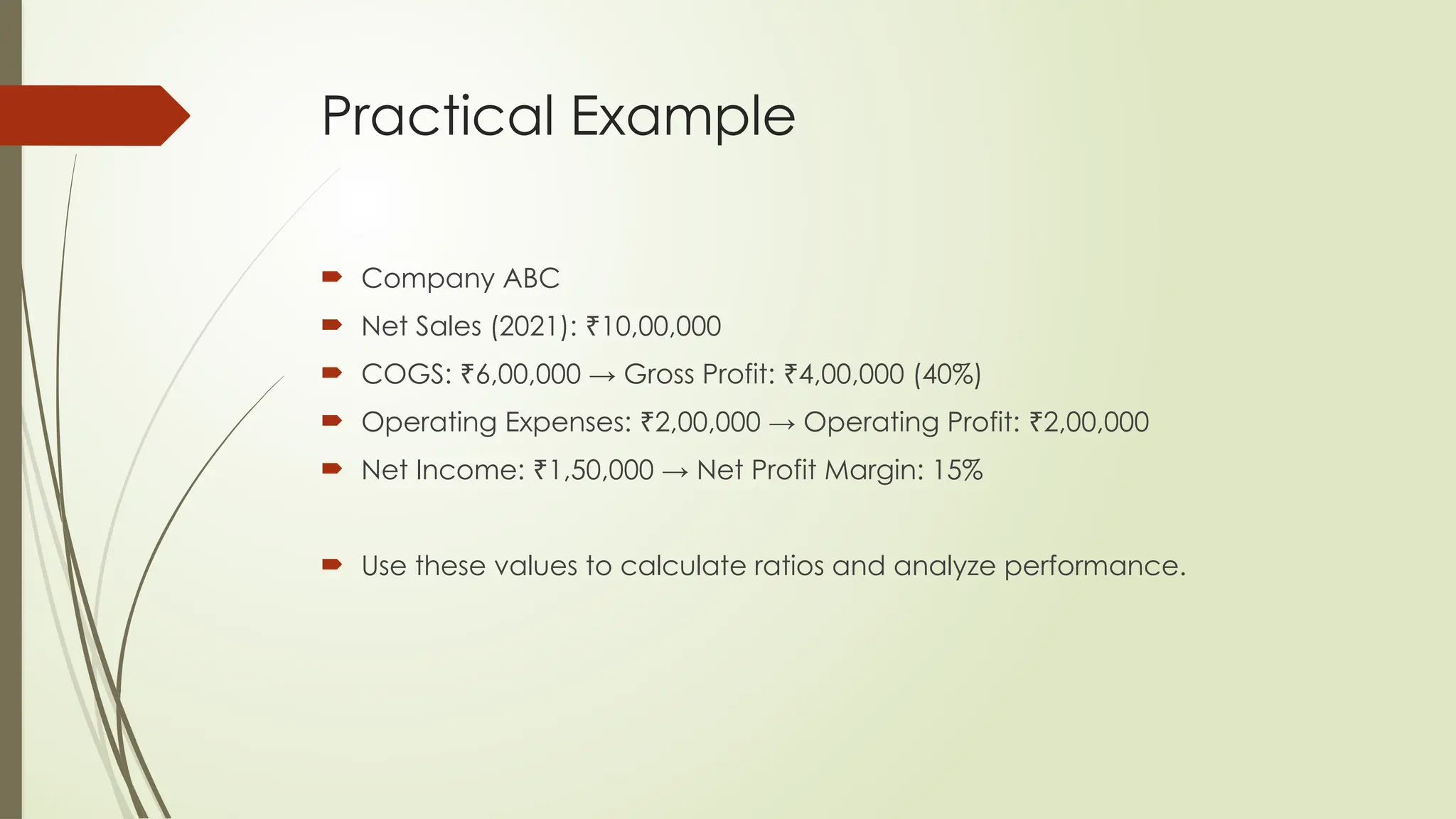
Practical Example
 Company ABC
 Net Sales (2021): 10,00,000
₹
 COGS: 6,00,000 → Gross Profit: 4,00,000 (40%)
₹ ₹
 Operating Expenses: 2,00,000 → Operating Profit: 2,00,000
₹ ₹
 Net Income: 1,50,000 → Net Profit Margin: 15%
₹
 Use these values to calculate ratios and analyze performance.
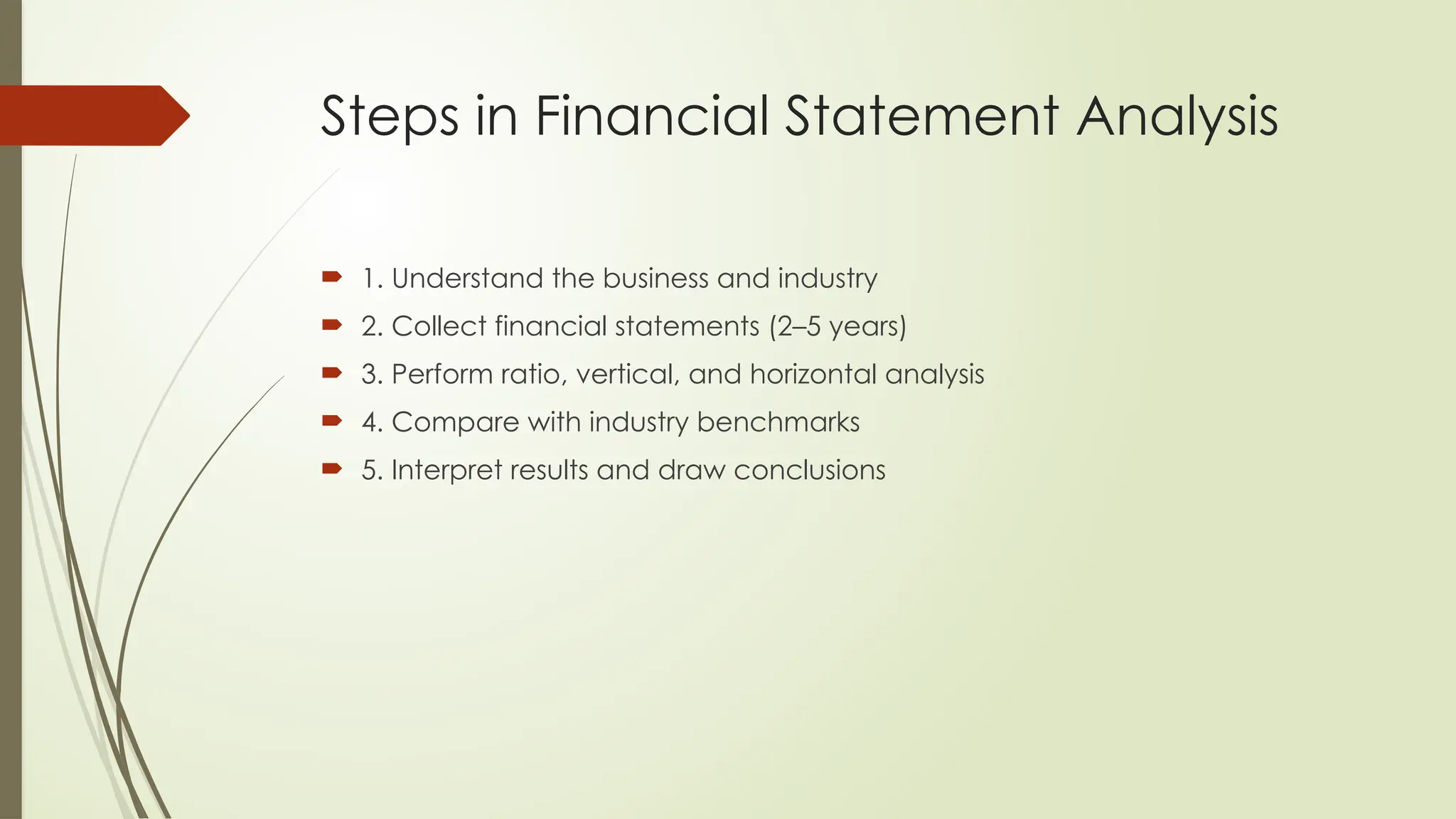
Steps in Financial Statement Analysis
 1. Understand the business and industry
 2. Collect financial statements (2–5 years)
 3. Perform ratio, vertical, and horizontal analysis
 4. Compare with industry benchmarks
 5. Interpret results and draw conclusions
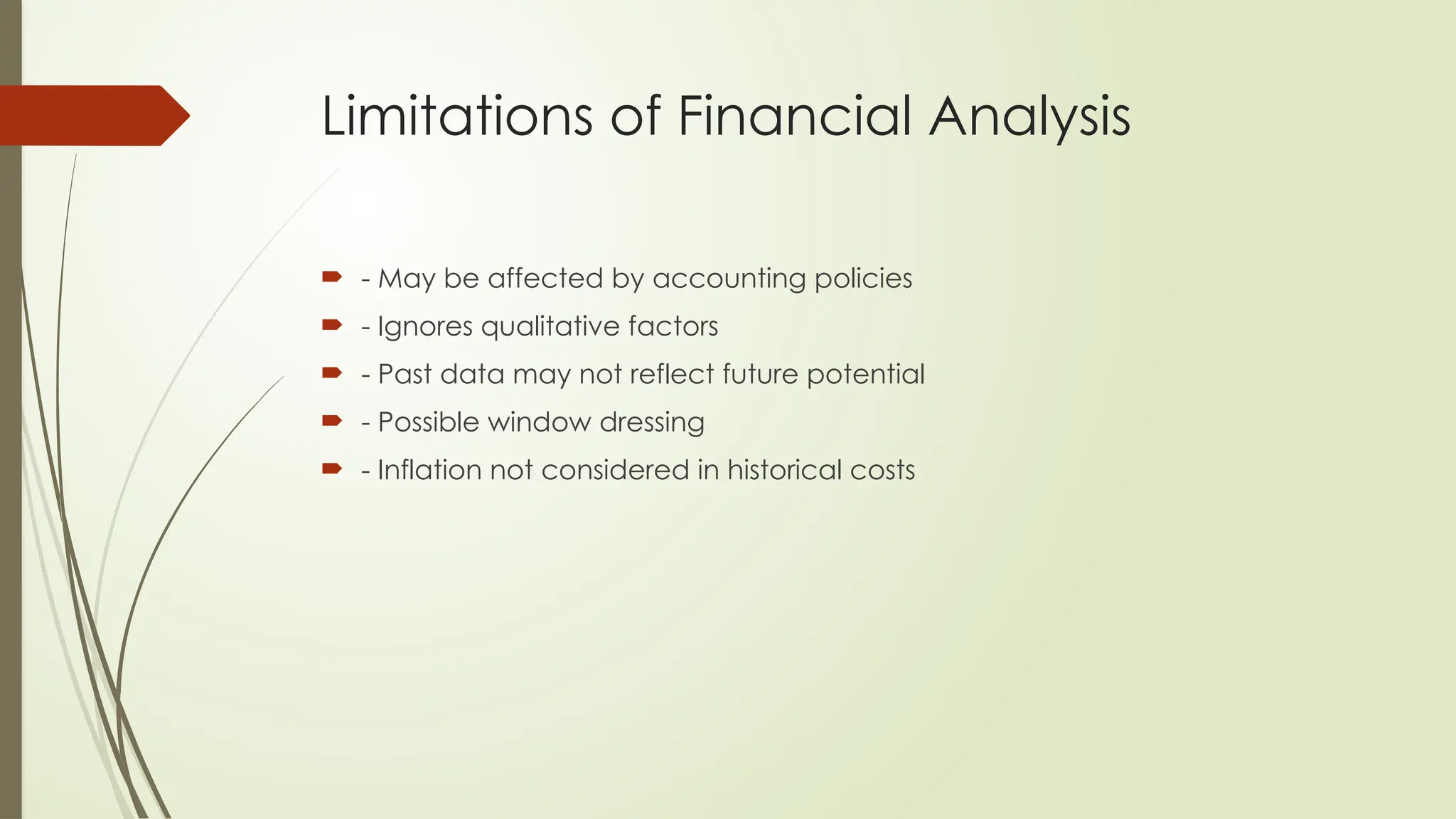
Limitations of Financial Analysis
 - May be affected by accounting policies
 - Ignores qualitative factors
 - Past data may not reflect future potential
 - Possible window dressing
 - Inflation not considered in historical costs
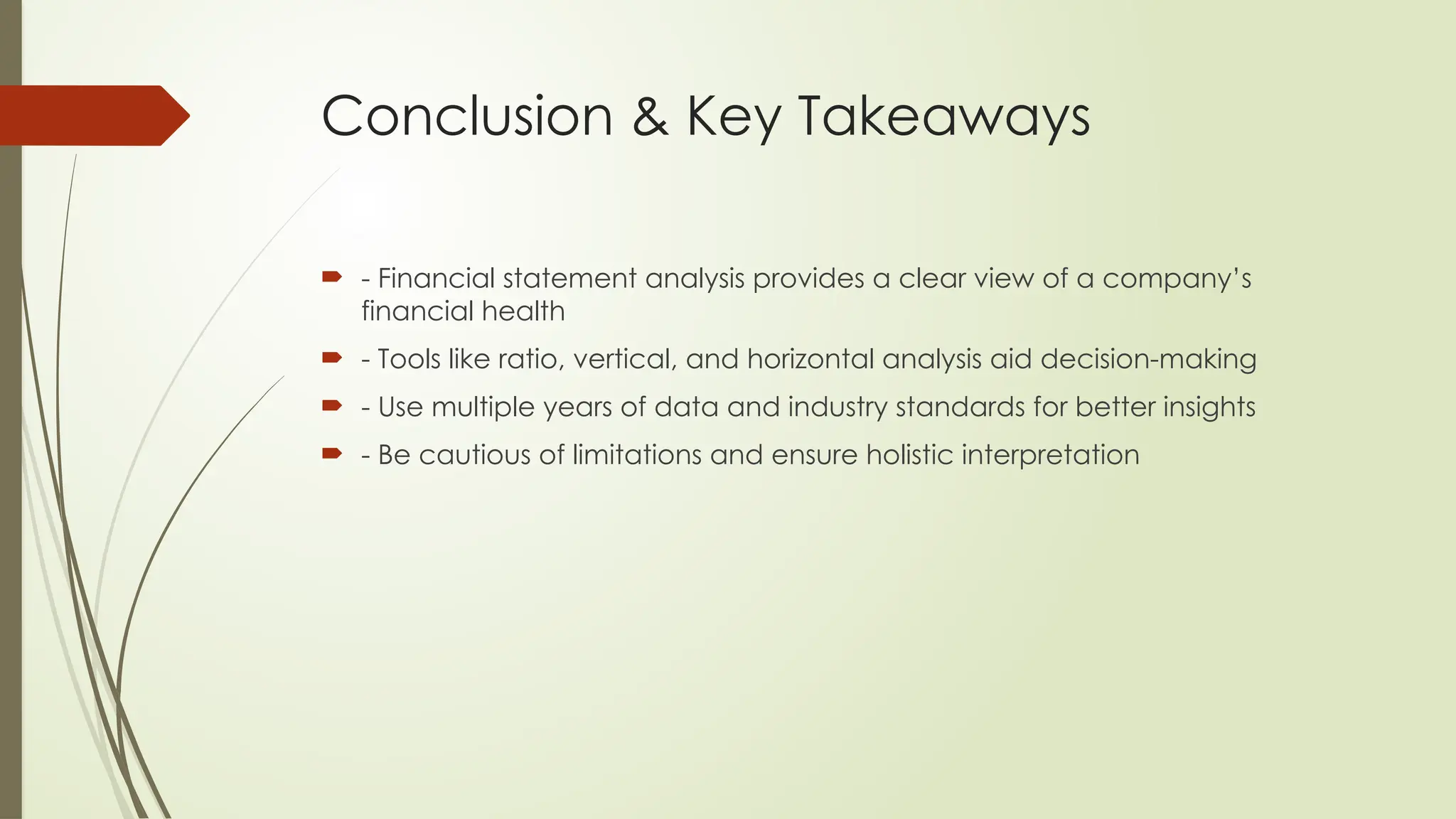
Conclusion & Key Takeaways
 - Financial statement analysis provides a clear view of a company’s
financial health
 - Tools like ratio, vertical, and horizontal analysis aid decision-making
 - Use multiple years of data and industry standards for better insights
 - Be cautious of limitations and ensure holistic interpretation

References
 - SlideShare: Financial Statement Analysis by Anuj Bhatia
 - Wikipedia: Financial Ratio, Financial Statement Analysis
 - Investopedia: Various Financial Concepts

Financial Management, Functions, Scope and objectives

  • 1.
  • 2.
    Financial Management Financial Managementmeans planning, organizing, directing and controlling the financial activities such as procurement and utilization of funds of the enterprise. It means applying general management principles to financial resources of the enterprise.
  • 3.
    Functions of FinancialManagement  Financial decisions - They relate to the raising of finance from various resources which will depend upon decision on type of source, period of financing, cost of financing and the returns thereby.  Investment decisions includes investment in fixed assets (called as capital budgeting). Investment in current assets are also a part of investment decisions called as working capital decisions.  Dividend decision - The finance manager has to take decision with regards to the net profit distribution. Net profits are generally divided into two:  Dividend for shareholders- Dividend and the rate of it has to be decided.  Retained profits- Amount of retained profits has to be finalized which will depend upon expansion and diversification plans of the enterprise.
  • 4.
  • 5.
    Main Objectives: Profitand Wealth Maximization BASIS FOR COMPARISON PROFIT MAXIMIZATION WEALTH MAXIMIZATION Concept The main objective of a concern is to earn a larger amount of profit. The ultimate goal of the concern is to improve the market value of its shares. Emphasizes on Achieving short term objectives. Achieving long term objectives. Consideration of Risks and Uncertainty No Yes Advantage Acts as a yardstick for computing the operational efficiency of the entity. Gaining a large market share. Recognition of Time Pattern of Returns No
  • 6.
    Functions of FinancialManagement  Estimation of capital requirements: A finance manager has to make estimation with regards to capital requirements of the company. This will depend upon expected costs and profits and future programmes and policies of a concern. Estimations have to be made in an adequate manner which increases earning capacity of enterprise.  Determination of capital composition: Once the estimation have been made, the capital structure have to be decided. This involves short- term and long- term debt equity analysis. This will depend upon the proportion of equity capital a company is possessing and additional funds which have to be raised from outside parties.  Choice of sources of funds: For additional funds to be procured, a company has many choices like-  Issue of shares and debentures  Loans to be taken from banks and financial institutions  Public deposits to be drawn like in form of bonds.
  • 7.
    Continued…..  Investment offunds: The finance manager has to decide to allocate funds into profitable ventures so that there is safety on investment and regular returns is possible.  Disposal of surplus: The net profits decision have to be made by the finance manager. This can be done in two ways:  Dividend declaration - It includes identifying the rate of dividends and other benefits like bonus.  Retained profits - The volume has to be decided which will depend upon expansional, innovational, diversification plans of the company.  Management of cash: Finance manager has to make decisions with regards to cash management. Cash is required for many purposes like payment of wages and salaries, payment of electricity and water bills, payment to creditors, meeting current liabilities, maintainance of enough stock, purchase of raw materials, etc.  Financial controls: The finance manager has not only to plan, procure and utilize the funds but he also has to exercise control over finances. This can be done through many techniques like ratio analysis, financial forecasting, cost and profit control, etc.
  • 8.
    Financial Statement Analysis Financial Statement Analysis involves examining financial statements to understand the financial health of an organization. Objectives:  - Assess past performance  - Determine present financial position  - Forecast future performance  - Evaluate profitability, liquidity, and solvency
  • 9.
    Key Financial Statements - Income Statement  - Balance Sheet  - Cash Flow Statement  - Statement of Changes in Equity  These statements provide a complete overview of a company’s financial position and performance.
  • 10.
    Standards of Comparison Comparisons in financial analysis are made using:  - Intracompany comparison (same firm over time)  - Intercompany comparison (competitor analysis)  - Industry standards or benchmarks  - Rule-of-thumb ratios
  • 11.
    Tools of FinancialAnalysis  - Ratio Analysis  - Horizontal Analysis (Trend Analysis)  - Vertical Analysis (Common-Size Statements)  - Comparative and Common-size Statements
  • 12.
    Ratio Analysis Categories 1. Liquidity Ratios:  - Current Ratio, Quick Ratio  2. Profitability Ratios:  - Net Profit Margin, Return on Assets (ROA), Return on Equity (ROE)  3. Activity Ratios:  - Inventory Turnover, Accounts Receivable Turnover  4. Leverage Ratios:  - Debt to Equity, Interest Coverage Ratio  5. Market Ratios:  - Earnings per Share (EPS), Price-Earnings Ratio
  • 13.
    Horizontal (Trend) Analysis Horizontal Analysis compares financial data over a period of time to identify trends.  Example:  Sales:  2021: 5,00,000 ₹  2022: 6,00,000 → 20% increase ₹  Useful for evaluating growth patterns and operational improvements.
  • 14.
    Vertical (Common-Size) Analysis Vertical Analysis expresses each item in a financial statement as a percentage of a base amount.  Example:  In Income Statement:  Cost of Goods Sold = 60% of Sales  Net Profit = 15% of Sales  Useful for comparing companies of different sizes.
  • 15.
    Practical Example  CompanyABC  Net Sales (2021): 10,00,000 ₹  COGS: 6,00,000 → Gross Profit: 4,00,000 (40%) ₹ ₹  Operating Expenses: 2,00,000 → Operating Profit: 2,00,000 ₹ ₹  Net Income: 1,50,000 → Net Profit Margin: 15% ₹  Use these values to calculate ratios and analyze performance.
  • 16.
    Steps in FinancialStatement Analysis  1. Understand the business and industry  2. Collect financial statements (2–5 years)  3. Perform ratio, vertical, and horizontal analysis  4. Compare with industry benchmarks  5. Interpret results and draw conclusions
  • 17.
    Limitations of FinancialAnalysis  - May be affected by accounting policies  - Ignores qualitative factors  - Past data may not reflect future potential  - Possible window dressing  - Inflation not considered in historical costs
  • 18.
    Conclusion & KeyTakeaways  - Financial statement analysis provides a clear view of a company’s financial health  - Tools like ratio, vertical, and horizontal analysis aid decision-making  - Use multiple years of data and industry standards for better insights  - Be cautious of limitations and ensure holistic interpretation
  • 19.
    References  - SlideShare:Financial Statement Analysis by Anuj Bhatia  - Wikipedia: Financial Ratio, Financial Statement Analysis  - Investopedia: Various Financial Concepts