Accounting  and  Financial  Management
Introduction to  Accounting  Accounting  & Financial Management
Accounting – An Information Process Users of Accounting Information GAAP  The Accounting Equation Double Entry System Introduction  to  Accounting
Accounting... is the language of business.
Accounting.. is an information system that... measures business activities, processes information, and... communicates financial information.
Accounting – The Language of Business Accounting is the information system that... measures business activities, processes data into reports, and communicates results to decision makers.
- a process of identifying, recording, summarizing, and reporting economic information to decision makers in the form of financial statements. Accounting
Definitions of Accounting “ The process of identifying, measuring, and communicating economic information to permit informed judgements and decisions by users of the information.” — American Accounting Association   (AAA) “ A service activity whose function is to provide quantitative information, primarily financial in nature, about economic entities that is intended to be useful in making economic decisions.”  — American Institute of Certified Public Accountants (AICPA)
Primary Functions of Accounting Recording data about business transactions - In the Egyptian era they used a quill pen to record the data and stored it on papyrus scrolls.  Today we might use a bar code and scan data into a computer system and store it on a magnetic disk. Summarizing results of business activity into useful report-  The balance sheet and income statement have been standard reports for many years.  More recently we added a statement of cash flows.  However, managers in today's environment demand more detailed reports like sales by district or sales by product type.
Providing assurances that the business is operating as intended  and that the assets of the organization are protected-  All parties to a business event have looked to accountants to provide assurance that the transaction is properly handled, accurately recorded, and accurately reported. Throughout most of this century the assurance has been based on a system of internal controls and an audit of the published financial statements.
Accounting as an Aid to Decision Making Accounting helps in decision making by showing where and when money has been spent, by evaluating performance, and by showing the implications of choosing one plan instead of another. Fundamental relationships in the decision-making process: Event Accountant’s analysis and recording Financial statements Users
Accounting — An Information Process  Identification of Users
User Information Needs Accounting — An Information Process  Identification of Users
Identification of Users User Information Needs Accounting System Accounting — An Information Process
Identification of Users User Information Needs Accounting System Economic Data and Activities Accounting — An Information Process
Identification of Users User Information Needs Accounting System Economic Data and Activities Reports Accounting — An Information Process
Identification of Users User Information Needs Accounting System Reports Economic Data and Activities Accounting — An Information Process  User Decisions
The Flow of Accounting Information 1. Business transactions occur 3. People make decisions. 2. Businesses prepare reports to  Show the results of their operations
The Flow of Accounting Information Accounting systems are designed to meet the needs of the decision makers who use the financial information. Every business maintains some type of accounting system. These accounting systems may be very complex or very simple, but the real value of any accounting system lies in the information that the system provides.
Users of Accounting Information Individuals Businesses Investors and creditors Government regulatory agencies Taxing authorities Nonprofit organizations
investors creditors regulators customers competitors EXTERNAL USERS Financial Accounting Users of Accounting Information
owners managers employees EXTERNAL USERS Financial Accounting investors creditors regulators customers competitors INTERNAL USERS Financial   Accounting Users of Accounting Information
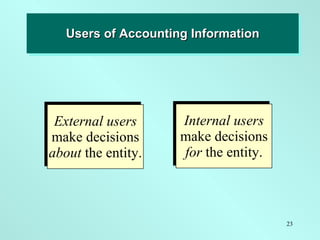
Users of Accounting Information External users make decisions about  the entity. Internal   users make decisions for  the entity. Users of Accounting Information
Financial Accounting Its focus is on reporting to external parties. It provides financial statements based on generally accepted accounting principles . It measures and records business transactions.
Management Accounting It measures and reports financial and nonfinancial information that helps  managers make decisions to fulfill the goals of an organization.
Cost Accounting It provides information for both management accounting and financial accounting.  It measures and reports financial  and nonfinancial data.
Some Definitions to remember : Inventory - goods held by a firm for resale to customers Account payable - a liability that results from the purchase of goods or services on account Compound entry - a transaction that affects more than two accounts Creditor - one to whom money is owed Debtor - one who owes money
Assets What is an asset? It is something a company owns which  has future economic value. land building equipment goodwill
Liability What is a liability? It is something a company owes. money service product
Revenues What are revenues? They are amounts received or to be  received from customers for sales of products or services. sales performance of services rent interest
What are Expenses? They are amounts that have been paid or will be paid later for costs that have been incurred to earn revenue. salaries and wages utilities supplies used advertising Expenses
Owner’s Equity What is owner’s equity? It is what’s left of the assets after liabilities have been deducted. the same as net assets the owner’s claim on the entity’s assets
Transactions that Affect Owner’s Equity OWNER’S EQUITY INCREASES OWNER’S EQUITY DECREASES Owner Investments in the Business Revenues Expenses Owner Withdrawals from the Business Owner’s Equity
Effects of Transactions on Owner’s Equity OWNER’S EQUITY
Effects of Transactions on Owner’s Equity decreased by OWNER’S EQUITY
Effects of Transactions on Owner’s Equity Owner’s withdrawals Expenses decreased by OWNER’S EQUITY
Effects of Transactions on Owner’s Equity increased by OWNER’S EQUITY
Effects of Transactions on Owner’s Equity Owner’s investments Revenues increased by OWNER’S EQUITY
Effects of Transactions on Owner’s Equity Owner’s withdrawals Expenses Owner’s investments Revenues decreased by increased by OWNER’S EQUITY
The Accounting Equation
The Accounting Equation Economic Resources Claims to Economic Resources Assets = Liabilities + Owner’s Equity
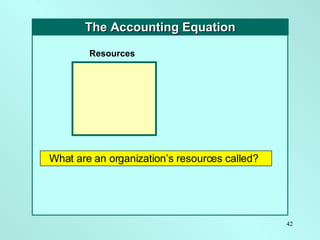
Resources The Accounting Equation What are an organization’s resources called?
Assets Resources  =  Sources  The Accounting Equation What are the sources of the assets? Resources used in the business
Assets Liabilities Owner’s Equity Resources  =  Sources  Resources used in the business Resources supplied by creditors and owners The Accounting Equation
Accounting data is represented by the following relationship among the assets, liabilities and owners’ equity of a business:  Assets = Liabilities + Owners’ Equity The equation must be in balance after  every  recorded transaction in the system. The Basic Accounting Equation
a. Sachin deposits RS 25,000 in a bank account  for ABC Ltd ASSETS = Business Transactions OWNER’S EQUITY LIABILITIES
a. Sachin deposits RS 25,000 in a bank account  for ABC Ltd. ASSETS = Business Transactions OWNER’S EQUITY Cash  25,000 LIABILITIES
a. Sachin deposits RS 25,000 in a bank account  for ABC Ltd. ASSETS = Business Transactions OWNER’S EQUITY Cash  25,000 LIABILITIES Sachin, Capital  25,000
Business Transactions b.  ABC Ltd. buys land for Rs 20,000. ASSETS = OWNER’S EQUITY LIABILITIES
Business Transactions b. ABC Ltd. buys land for Rs 20,000. ASSETS = OWNER’S EQUITY LIABILITIES Cash  (20,000)
Business Transactions b. ABC Ltd buys land for RS 20,000. ASSETS = OWNER’S EQUITY LIABILITIES Cash  (20,000) Land  20,000
Business Transactions ASSETS = OWNER’S EQUITY LIABILITIES c. ABC Ltd buys goods for RS1,350, agreeing to  pay the supplier in the near future.
Business Transactions ASSETS = OWNER’S EQUITY LIABILITIES c. ABC Ltd buys goods for RS1,350, agreeing to  pay the supplier in the near future. Accounts Payable 1,350 Purchases  1,350
Business Transactions ASSETS = OWNER’S EQUITY LIABILITIES e. ABC Ltd paid: wages Rs 2,125; rent, Rs 800;  utilities, Rs 450; and miscellaneous, Rs 275.
Business Transactions ASSETS = OWNER’S EQUITY LIABILITIES Cash  (3,650) e. ABC Ltd paid: wages Rs 2,125; rent, Rs 800;  utilities, Rs 450; and miscellaneous, Rs 275.
Business Transactions ASSETS = OWNER’S EQUITY LIABILITIES Cash  (3,650) Expenses (3,650) e. ABC Ltd paid: wages Rs 2,125; rent, Rs 800;  utilities, Rs 450; and miscellaneous, Rs 275.
Business Transactions ASSETS = OWNER’S EQUITY LIABILITIES f.  ABC Ltd pays Rs 950 to creditors on account.
Business Transactions ASSETS = OWNER’S EQUITY LIABILITIES Cash  (950) f.  ABC Ltd pays  Rs 950 to creditors on account.
Business Transactions ASSETS = OWNER’S EQUITY LIABILITIES Cash  (950) Accounts Payable (950) f.  ABC Ltd pays Rs 950 to creditors on account.
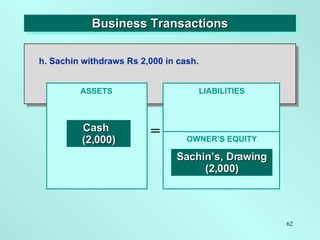
Business Transactions ASSETS = OWNER’S EQUITY LIABILITIES h. Sachin withdraws Rs 2,000 in cash.
Business Transactions ASSETS = OWNER’S EQUITY LIABILITIES Cash  (2,000) h. Sachin withdraws Rs 2,000 in cash.
Business Transactions ASSETS = OWNER’S EQUITY LIABILITIES Cash  (2,000) Sachin’s, Drawing (2,000) h. Sachin withdraws Rs 2,000 in cash.
Transaction Summary ASSETS = OWNER’S EQUITY LIABILITIES Cash 6,700 Purchases 550 Land 20,000
Transaction Summary ASSETS = OWNER’S EQUITY LIABILITIES Cash 6,700 Purchases  550 Land 20,000 Accts. Payable 400
Transaction Summary ASSETS = OWNER’S EQUITY LIABILITIES Cash 6,700 Purchases 550 Land 20,000 Accts. Payable 400 Sachin, Capital 25,000 Sachin, Drawing (2,000) Fees Earned 7,500 Wages Expense (2,125) Rent Expense (800) Commission  (450) Misc. Expense (275)
Role of  Accounting  Good managers plan for the future. They develop a  budget . A budget is a formal plan stated in monetary terms.
 Role of  Accounting  Accounting helps banks decide to whom they will lend money. Accounting provides information that helps investors pick stocks.
Role of  Accounting Budgeting Information systems design Cost accounting Internal auditing
Role of  Accounting Consulting Assurance services including auditing Tax accounting
Accounting as an Aid to Decision Making Accounting information is useful to anyone who makes decisions that have economic results. Owners want to know which employees are productive. investors want to know if a company is a good investment. Legislators want to know how a proposed law will affect budgets.  Managers want to know if a new product will be profitable. Creditors want to know if they should extend credit, how much to extend, and for how long.
ABUSIVE ACCOUNTING PRACTICES CREATIVE ACCOUNTING PRACTICES ENRON DEBTS NOT REPORTED RECOGNITION OF LOSSES WAS POSTPONED REPORT INCOME BEFORE BEING EARNED
Generally Accepted Accounting Principles
Financial Accounting Its focus is on reporting to external parties. It provides financial statements based on generally accepted accounting principles. It measures and records business transactions.
Generally Accepted Accounting Principles What is the primary objective of financial Accounting and Reporting? To provide information useful for making investment and lending decisions
Generally Accepted Accounting Principles and Basic Concepts If every accountant used his or her own rules for recording transactions, the financial statements would be useless in making comparisons. Therefore, accountants have agreed to apply a common set of measurement principles (a common language) to record information for financial statements.  Otherwise, decision makers could not use or compare financial statements.
Accounting: Principles and Concepts The rules that govern accounting are called GAAP (generally accepted accounting principles) . Accountants follow professional guidelines.
Generally Accepted Accounting Principles and Basic Concepts Generally accepted accounting principles (GAAP) - a term that applies to the broad concepts or guidelines and detailed practices in accounting, including all the conventions, rules, and procedures that make up accepted accounting practice at a given time
REGULATION OF THE ACCOUNTING PROFESSION Securities And Exchange Commission (SEC) Financial Accounting Standards Board (FASB) American Institute Of Certified Public Accountants (AICPA)
Standard Setting Bodies In the United States, GAAP is set primarily by the private sector with government oversight. In many other countries, such as France,  the government actually sets accounting standards.
Standard Setting Bodies Securities and Exchange Commission (SEC) - the agency designated by the U.S. Congress to hold the ultimate responsibility for authorizing GAAP for companies whose stock is held by the general investing public The SEC has informally delegated  the power to make accounting rules to the FASB.
Standard Setting Bodies Financial Accounting Standards Board (FASB) - responsible for establishing GAAP in the United States; A private sector body consisting of seven full-time members and a large support staff
Standard Setting Bodies International Accounting Standards Board (IASB) - an organization representing over 143 accountancy boards from 104 countries that is developing a common set of accounting standards to be used throughout the world
Standard Setting Bodies Interest in harmonizing accounting standards around the world by eliminating differences in accounting principles has grown. Investors are committing more of their money worldwide. Many multinational companies voluntarily issue their financial statements in conformity with the IASB standards.
IMPORTANT CONCEPTS ENTITY ASSUMPTION GOING CONCERN ASSET VALUATION HISTORICAL COST MARKET VALUE LIABILITY RECOGNITION
IMPORTANT CONCEPTS ACCOUNTING PERIOD REVENUE RECOGNITION MATCHING EXPENSES TO REVENUES UNIT OF MEASUREMENT CONSERVATISM FULL DISCLOSURE
Generally Accepted Accounting Principles and Basic Concepts The Entity Concept An accounting entity is an organization that stands apart from other organizations and individuals as a separate economic unit. The entity concept helps relate events to a clearly defined area of accountability.
The Entity Concept An accounting entity is an organization that stands apart as a separate economic unit.
The Entity Concept Example Assume that John decides to open up a  gas station and coffee shop. The gas station made Rs 250,000 in profits, while the coffee shop lost Rs 50,000.
The Entity Concept Example How much money did John make? At a first glance, we would assume that John made Rs 200,000. However, by applying the entity concept we realize that the gas station made Rs 250,000 while the coffee shop lost Rs 50,000.
Generally Accepted Accounting Principles and Basic Concepts The Going Concern Concept The entity will continue to operate in the future.
Generally Accepted Accounting Principles and Basic Concepts Going Concern Convention The assumption that in all ordinary situations an entity persists indefinitely This notion implies that a company’s existing resources will be used to fulfill the business needs of the company rather than be sold. If the continuity of an entity is in doubt, a liquidation approach to the balance sheet is taken, and the assets and liabilities are valued as if the entity were to be liquidated in the near future.
Record fixed assets at original cost and depreciate over a period of time. Take prepaid  expenses as assets. Business is concerned with net income or earning capacity as compared to market values.
Generally Accepted Accounting Principles and Basic Concepts Materiality Convention A financial statement item is material if its omission or misstatement would tend to mislead the reader of the financial statements under consideration Materiality often depends on the size of the organization – what is material to one company might not be material to another company.
AAA defines “An item should be regarded as material if there is reason to believe that knowledge of it would influence the decision of informed investor” Disclose only material information. No overburdening with minute details Material information differs organization to organization year to year (change in depreciation method) Materiality may depend upon amount or may not  be.
Generally Accepted Accounting  Principles and Basic Concepts Convention of Conservatism :- “ Anticipate no profits but provide for all possible losses” Policy of ‘caution’ & ‘playing safe’ Policy of safeguarding against possible losses in world of uncertainty
Kobler defines :- ‘ Conservatism’ as a guideline which chooses between acceptable accounting alternatives for recording events or transactions so that the least favorable immediate effect on assets , income and owner’s equity is reported. Example:- Making the provision for doubtful debts and discounts on debtors in anticipation of actual bad debts and discount
Generally Accepted Accounting Principles and Basic Concepts Cost-Benefit Criterion A system should be changed when the expected additional benefits of the change exceed its expected additional costs The benefits of information should exceed the cost of providing that information. Benefits > Costs
Generally Accepted Accounting Principles and Basic Concepts The Stable-Monetary-Unit Concept The purchasing power is  stable.
Generally Accepted Accounting Principles and Basic Concepts Stable Monetary Unit The monetary unit is the principle means for measuring assets and equities. It is the common denominator for quantifying the effects of transactions. A stable monetary unit is one that  is not expected to significantly  change in value over time.
Generally Accepted Accounting Principles and Basic Concepts The Cost Principle Assets and services acquired should be recorded at their actual cost.
Record assets at price paid to acquire and take it as base for subsequent years. Makes financial statements more objective. Limitations Financial statements become irrelevant  in case of inflation Remove cost of fixed assets by writing off their cost while asset may be in good condition Don’t show as asset for which no payment has been made for  e.g knowledge ,skill of Human Resources.
Cash Basis of Accounting Accrual Basis of Accounting TWO METHODS Reporting Revenue and Expense Accrual Basis
Revenue reported when cash is received Expense reported when cash is paid Does not properly match revenues and expenses Cash Basis of Accounting
Revenue reported when earned Expense reported when incurred Properly matches revenues and expenses in determining net income Requires adjusting entries at end of period It just sounds mean – it really isn’t Accrual Basis of Accounting
ACCRUAL VS CASH ACCOUNTING ACCRUAL ACCOUNTING - FOCUSES ON THE ECONOMIC IMPACT OF TRANSACTIONS FIRM MAXIMIZES ASSETS CASH ACCOUNTING - FOCUSES ON WHEN CASH IS RECEIVED AND PAID OUT FIRM MAXIMIZES CASH
Illustration 1-14 Full Disclosure Principle
Revenue Principle When is revenue recognized? When it is deemed earned. Recognition of revenue and cash receipts  do not necessarily occur at the same time.
Revenue Principle The revenue principle governs two things: When to record revenue and… the amount of revenue to record.
Revenue Principle Air & Sea Travel, Inc. Situation 1 No transaction has occurred. –  Do Not Record Revenue March 12 I plan to have you make my travel arrangements. photos Disney World Situation 2 The client has taken a trip arranged by Air & Sea Travel. – Record Revenue Air & Sea Travel, Inc. April 2
Recognition of Revenues Recognition - a test to determine whether revenues should be recorded in the financial statements for a given period To be recognized, revenue must be: Earned - goods are delivered or a service is performed Realized - cash or a claim to cash (credit) is received in exchange for goods or services
The Matching Principle What is the matching principle? It is the basis for recording expenses. Expenses are the costs of assets and the increase in liabilities incurred in the earning of revenues. Expenses are recognized when the benefit from the expense is received.
The Matching Principle It is the basis for recording expenses and includes two steps: Identify all the expenses incurred during the accounting period. Measure the expenses and match expenses against revenues earned.
The Matching Principle Revenue – Expense = Net income
The Matching Principle Revenue – Expense = (Net loss)
Example  Matching Expenses with    Revenues Revenues Rs 15,000 Cost of goods sold   8,000 Net income   Rs 7,000 May
Accounting Period concept Managers adopt an artificial period of time to evaluate performance.
Accounting Period concept It requires that accounting information be reported at regular intervals. Interacts with the revenue principle and the matching principle Requires that income be measured accurately each period
Accounting Period concept   The Time-Period Concept Businesses need regular progress reports, so accountants prepare financial statements for specific periods and at regular intervals . Monthly Quarterly
Dual concept Accounting information is based on the  double entry system . Under this system, the  two-sided effect  of a transaction is recorded in the appropriate accounts. The recording is done by means of a  “debit-credit” convention  (set of rules) applying to all accounts.
The Accounting Equation Assets  are the economic resources of a business that are expected to produce a benefit in the future. Liabilities   are “outsider claims,” or economic obligations payable to outsiders. Owners’ equity  represents the “ insider claims” of a business.
The Reliability Concept The quality of information that assures decision makers that the information captures the conditions or events it  purports to represent Reliable data are supported by convincing evidence that can be verified by independent parties. The impact of events should be measured in a systematic, reliable manner.
The Reliability (Objectivity) concept Information must be reasonably accurate. Information must be free from bias. Information must report what actually happened. Individuals would arrive at similar conclusions using same data.
The Double Entry System
Double-Entry Accounting “  Double-entry accounting is based on a simple concept: each party in a business transaction will receive something and give something in return. In bookkeeping terms, what is received is a debit and what is given is a credit. The T account is a representation of a scale or balance.”  Scale or Balance Receive DEBIT Give CREDIT T  account Left Side Receive DEBIT Right Side Give CREDIT Luca Pacioli Developer of Double-Entry Accounting
The Double-Entry System One debit One credit Each transaction is recorded with at least: Total debits must equal total credits. The Double Entry System
The Double-Entry System Each transaction must still be analyzed to determine which accounts are involved, whether the accounts increase or decrease, and how much the balance will  change. The Double Entry System
The Double-Entry system Some businesses enter into thousands of transactions daily or even hourly. Accountants must carefully keep track of and record these transactions in a systematic manner. Accountants use a double-entry accounting system in which at least two accounts are always affected by each transaction. The Double Entry System
Classification of Accounts There  are some asset accounts? Cash Notes Receivable Accounts Receivable Prepaid Expenses Land Building Equipment
Classification of Accounts There are some liability accounts? Notes Payable Accounts Payable Accrued Liabilities (for expenses incurred but not paid) Long-term Liabilities (bonds)
Classification of Accounts There are some owner’s equity accounts? Capital or owner’s interest in the business Withdrawals Revenues Expenses
Classification of Accounts Real  Account =  Debit –What comes in Credit- what goes out Personal Account = Debit –Receiver Credit - Giver  Nominal Account =Debit –Expenses/Losses Credit-  Incomes/Gains
The Double-Entry system The system records the  two-sided  effect  of transactions The Double Entry System Transaction   Two-sided effect Bought furniture for cash    Decrease in  one  asset   Increase in  another  asset Took a loan in cash     Increase in an asset   Increase in a liability
The Double Entry System Note that the accounting equation equality is  maintained after recording each transaction.
XYZ Ltd. A Sole Proprietorship “  On November 1, 2002, A started a sole proprietorship called XYZ Ltd. The following double-entry transactions show how amounts received (debits) always equal amounts given (credits).”
Amit deposits Rs25,000 in a bank account for XYZ Ltd.. Business Transactions Journal give Credit XYZ Ltd (investee) Amit (investor) give Credit Entry A. Date Description Debit Credit 11/1 receive Debit
Amit deposits Rs25,000 in a bank account for XYZ Ltd.. Business Transactions l Journal give Credit XYZ Ltd.(investee) Cash Amit (investor) give Credit Entry A. Date Description Debit Credit 11/1 Cash  25,000 receive Debit
Amit deposits Rs 25,000 in a bank account for XYZ Ltd.. Business Transactions Journal Date Description Debit Credit 11/1 Cash  25,000   Amit, Capital    25,000 give Credit XYZ Ltd.(investee) Cash A promise to the owner Amit (investor) give Credit Entry A. receive Debit
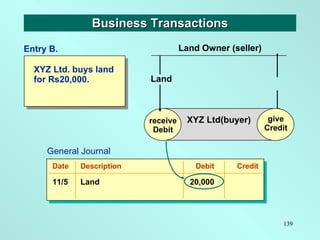
XYZ Ltd. buys land for Rs20,000. Business Transactions give Credit XYZ Ltd(buyer) Land Owner (seller) give Credit Entry B. Journal Date Description Debit Credit 11/5 receive Debit
XYZ Ltd. buys land for Rs20,000. Business Transactions give Credit XYZ Ltd(buyer) Land Land Owner (seller) give Credit Entry B. General Journal Date Description Debit Credit 11/5 Land  20,000 receive Debit
XYZ Ltd. buys land for Rs 20,000. Business Transactions give Credit XYZ Ltd(buyer) Land Cash Land Owner (seller) give Credit Entry B. Journal Date Description Debit Credit 11/5 Land  20,000   Cash    20,000 receive Debit
XYZ Ltd. buys supplies for Rs1,350, agreeing to pay in the near future. Business Transactions give Credit XYZ Ltd (buyer) Supplier (seller) give Credit Entry C. Journal Date Description Debit Credit 11/10 receive Debit
XYZ Ltd. buys goods for Rs1,350, agreeing to pay in the near future. Business Transactions give Credit XYZ Ltd. (buyer) Supplies Supplier (seller) give Credit Entry C. General Journal Date Description Debit Credit 11/10 Purchases  1,350 receive Debit
XYZ Ltd. buys goods for Rs1,350, agreeing to pay in the near future. Business Transactions give Credit XYZ Ltd. (buyer) Supplies Supplier (seller) give Credit Entry C. A promise to pay later Journal Date Description Debit Credit 11/10 purchases  1,350   Accounts Payable    1,350 receive Debit
XYZ Ltd. earns fees of Rs7,500, receiving cash. Business Transactions give Credit XYZ Ltd. (seller) Customer (buyer) give Credit Entry D. Journal Date Description Debit Credit 11/18 receive Debit
XYZ Ltd. earns fees of Rs7,500, receiving cash. Business Transactions give Credit XYZ Ltd. (seller) Cash Customer (buyer) give Credit Entry D. Journal Date Description Debit Credit 11/18 Cash  7,500 receive Debit
XYZ Ltd. earns fees of Rs7,500, receiving cash. Business Transactions give Credit XYZ Ltd. (seller) Cash Customer (buyer) give Credit Entry D. Services Journal Date Description Debit Credit 11/18 Cash  7,500   Fees Earned    7,500 receive Debit
Date Description Debit Credit XYZ Ltd. paid: wages, Rs 2,125; rent, Rs 800; commissions, Rs450; and misc, Rs275. Business Transactions Journal give Credit XYZ Ltd. (buyer) Various suppliers give Credit Entry E. receive Debit
Date Description Debit Credit 11/18  Wages Expense 2,125 Rent Expense 800 Commission 450 Misc. Expense 275 XYZ Ltd. paid: wages, Rs 2,125; rent, Rs 800; commissions, Rs450; and miscellaneous, Rs275. Business Transactions Journal give Credit XYZ Ltd. (buyer) Services, benefits Various suppliers give Credit Entry E. receive Debit
Date Description Debit Credit 11/18  Wages Expense 2,125 Rent Expense 800 Commission  450 Misc. Expense 275   Cash   3,650 XYZ Ltd. paid: wages, Rs 2,125; rent, Rs 800; commissions, Rs 450; and misc Rs 275. Business Transactions Journal give Credit XYZ Ltd. (buyer) Services, benefits Various suppliers give Credit Entry E. Cash receive Debit
XYZ Ltd. pays Rs950 to creditors on account. Business Transactions give Credit XYZ Ltd. (payor) Supplier (payee) give Credit Entry F. Journal Date Description Debit Credit 11/30 receive Debit
XYZ Ltd. pays Rs950 to creditors on account. Business Transactions give Credit XYZ Ltd. (payor) Reduction in obligation Supplier (payee) give Credit Entry F. Journal Date Description Debit Credit 11/30 Accounts Payable  950 receive Debit
XYZ Ltd. pays Rs950 to creditors on account. Business Transactions give Credit XYZ Ltd. (payor) Reduction in obligation Supplier (payee) give Credit Entry F. Cash Journal Date Description Debit Credit 11/30 Accounts Payable  950   Cash    950 receive Debit
Amit withdraws Rs  2,000 in cash. Business Transactions give Credit XYZ Ltd. (payor) Amit (payee) give Credit Entry H. Journal Date Description Debit Credit 11/30 receive Debit
Amit withdraws Rs 2,000 in cash. Business Transactions give Credit XYZ Ltd. (payor) Reduction in obligation Amit (payee) give Credit Entry H. Journal Date Description Debit Credit 11/30 Amit, Drawing  2,000 receive Debit
Amit withdraws Rs 2,000 in cash. Business Transactions give Credit XYZ Ltd. (payor) Reduction in obligation Amit (payee) give Credit Entry H. Cash Journal Date Description Debit Credit 11/30 Amit, Drawing  2,000   Cash    2,000 receive Debit
The Accounting Cycle
1. Analyze the transaction 2. Journalize the transaction 3. Post the transaction to accounts in  ledger 4. Prepare the  trial balance 5. Prepare financial statements The Accounting Cycle: Steps
The Recording Process The sequence of steps in recording transactions: Transactions Documentation Journal Financial Statements Trial Balance Ledger
The Recording Process The process starts with source documents, which are the supporting original records of any transaction. Examples are sales slips or invoices, check stubs, purchase orders, receiving reports, and cash receipt slips.
The Recording Process In the second step, an analysis of the transaction is placed in the book of original   entry, which is a chronological record of how the transactions affect the balances of applicable accounts. The most common example is the  general journal - a diary of all events  (transactions) in an entity’s life.
The Recording Process In the third step, transactions are entered into the ledger. Remember that a transaction is not entered in just one place; it must be entered in each account that it affects. Depending on the nature of the organization, analysis of the transactions could occur continuously or periodically.
The Recording Process The fourth step includes the preparation of the trial balance, which is a simple listing of all accounts from the  ledger with their balances. Aids in verifying accuracy and  in preparing the financial statements Prepared periodically as necessary
The Recording Process In the final step, the financial statements are prepared. Financial statements may be prepared after each quarter of the year. the companies may prepare  financial statements at  various other intervals to  meet the needs of their users. December 2002
1. Transactions are analyzed and recorded in journal. Documents Journal Journal, Ledger, Trial Balance
1. Transactions are analyzed and recorded in journal. Documents Journal 2. Transactions are posted   from  journal to ledger. Journal Ledger Journal, Ledger, Trial Balance
1. Transactions are analyzed and recorded in journal. Documents Journal 2. Transactions are posted   from  journal to ledger. Journal Ledger 3. Trial balance is prepared. Journal, Ledger, Trial Balance Trial Balance
Manual Accounting Cycle 1. Transactions are analyzed and recorded in journal. Documents Journal
Manual Accounting Cycle 1. Transactions are analyzed and recorded in journal. Documents Journal 2. Transactions are posted from journal to ledger. Journal Ledger
Manual Accounting Cycle 1. Transactions are analyzed and recorded in journal. Documents Journal 2. Transactions are posted from journal to ledger. Journal Ledger 3. Trial balance is prepared, Trial balance
Manual Accounting Cycle 1. Transactions are analyzed and recorded in journal. Documents Journal 2. Transactions are posted from journal to ledger. Journal Ledger 3. Trial balance is prepared, 4. Financial statements are prepared and distributed. Financial Statements IS SOE BS
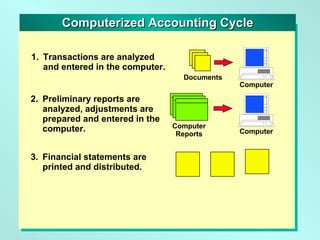
Computerized Accounting Cycle 1. Transactions are analyzed and entered in the computer. Documents Computer
Computerized Accounting Cycle 1. Transactions are analyzed and entered in the computer. Documents Computer 2. Preliminary reports are  analyzed, adjustments are prepared and entered in the computer. Computer Reports Computer
Computerized Accounting Cycle 1. Transactions are analyzed and entered in the computer. Documents Computer 2. Preliminary reports are  analyzed, adjustments are prepared and entered in the computer. Computer Reports 3. Financial statements are printed and distributed. Computer
Computerized Accounting Cycle 1. Transactions are analyzed and entered in the computer. Documents Computer 2. Preliminary reports are  analyzed, adjustments are prepared and entered in the computer. Computer Reports 3. Financial statements are printed and distributed. Computer 4. Reports are analyzed and interpreted for decision- making purposes. Financial Statements IS SOE BS SCF ?
JOURNAL
Journal What is a journal? It is a list in chronological order of all the transactions for a business. Identify transaction from source documents. Specify accounts affected. Apply debit/credit rules. Record transaction with description.
Journal entry Journal entry - an analysis of the effects of a transaction on the accounts, usually accompanied by an explanation of the transaction This analysis identifies the accounts to be debited and credited.
Journal entry What does a journal entry include? date of the transaction title of the account debited title of the account credited amount of the debit and credit description of the transaction (narration)
Record transactions in the journal.
Journalizing  Journalizing – It  is  the  process  of  entering  transactions  into  the  journal
JOURNALIZING TRANSACTIONS THE JOURNAL IS A CHRONOLOGICAL LISTING OF TRANSACTIONS. ENTER DATE IN FIRST COLUMN IDENTIFY APPROPRIATE ACCOUNTS ENTER THE TITLE OF THE ACCOUNT DEBITED ENTER THE TITLE OF THE ACCOUNT TO BE CREDITED INSERT APPROPRIATE  AMOUNTS IN DEBIT AND CREDIT COLUMN INSERT A BRIEF DESCRIPTION OF TRANSACTION
Recording Transactions On April 2, Garge invested Rs 30,000  in Gay GillenTravel. What is the journal entry? Date  Particulars  Debit  Credit April  Rs 2  Cash Account  Dr   30,000    To Garge Capital   30,000 (Received initial investment from owner)
Types of journal entries: Types of journal entries: Simple entry - an entry for a transaction that affects only two accounts Compound entry - an entry for a transaction that affects more than two accounts Remember: whether the entry is simple or compound, the debits (left side) and credits (right side)  must always   equal.
Ledger
Ledger What is a ledger? It is a digest of all accounts utilized by an entity during an accounting period. Bound books Computer printout Cards Loose leaf pages
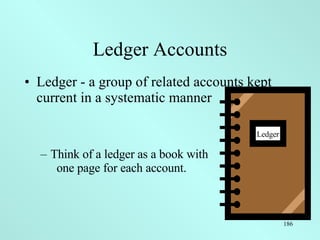
Ledger Accounts Ledger - a group of related accounts kept current in a systematic manner Think of a ledger as a book with  one page for each account. Ledger
Accts. Payable Ledger  Accts. Receivable Supplies Ledger  Cash
Accts. Payable Ledger  A B C D Customer Accounts Supplies Ledger  Cash Accts. Receivable
Ledger Supplies Accts. Payable Ledger  A B C D Customer Accounts A B C D Creditor Accounts Cash Accts. Receivable
Ledger Accounts A simplified version of a ledger account is called the T-account. They allow us to capture the essence of the accounting process without having to worry about too many details. The account is divided into two sides for recording increases and decreases in the accounts. Account Title Left Side Right Side
Debits and Credits Debit (dr.) - an entry or balance on the left side of an account Credit (cr.) - an entry or balance on the right side of an account Remember: Debit is  always  the left side! Credit is  always  the right side!
Post from the journal to the ledger.
Posting What is posting? It is the transfer of information from the journal to the appropriate accounts in the ledger.
POSTING TO THE LEDGER POSTING REFERS TO TRANSFERRING THE INFORMATION IN A JOURNAL ENTRY TO THE APPROPRIATE LEDGER ACCOUNT ENTER DATE ENTER AMOUNT IN PROPER DEBIT OR CREDIT COLUMN ENTER JOURNAL SOURCE INFO
Debit  Credit Proforma for Account Amt. L.f Particulars Date Amt. L.f Particulars Date
The Account Account Title Debit Credit LEFT SIDE
The Account Account Title Debit Credit RIGHT SIDE
Ledger Accounts Balance - difference between total left-side amounts and total right-side amounts at any particular time Assets have left-side balances. Increased by entries to the left side Decreased by entries to the right side Liabilities and Owners’ Equity have right-side balances. Decreased by entries to the left side Increased by entries to the right side
Details of Journals and Ledgers Date Particulars   Debit Credit April 2 Cash 30,000 Garge  Capital 30,000 (Received initial investment from owner) Journal Page 1
  Date   Ref.  Particulars  Amount  Date  Ref  Particulars  Amount  April 2   1  To G. Cap  30,000   Debit   Cash Account    Credit Insert the number of the journal page. Posting
L.F . Date Description Debit Credit 12/1 Prepaid Insurance   2,400   Cash   2,400 Journal Page 1 Recording and Posting an Entry 1. Analyze and record the transaction as shown. 2. Post the debit side of the transaction. 3. Post the credit side of the transaction.
L.f Date Description Debit Credit 12/1 Prepaid Insurance 15 2,400   Cash   2,400 Journal Ledger Prepaid Insurance Account  Dr.  Cr. Page 1 Recording and Posting an Entry 2400 1 To Cash 12/1 Amt. Fol. Particulars Date Amt. Fol. Particulars Date
Recording and Posting an Entry   Date Description L.f. Debit Credit 12/1 Prepaid Insurance 15 2,400   Cash 11 2,400 Journal Ledger  Page No.15 Prepaid insurance Account Dr.  Cr. Page 1 1 3 2 4 2400 1 To Cash 12/1 Amt. Fol. Particulars Date Amt. Fol. Particulars Date
TRIAL BALANCE
TRIAL BALANCE What is a Trial balance? It is an internal document. It is a listing of all the accounts with their related balances. It provide a check on accuracy by showing whether total debits equal total credits.
TRIAL BALANCE A listing of all accounts with balances at the end of the accounting period after all transactions have journalized and posted Purpose to determine that debits = credits to identify accounts to be adjusted
TRIAL BALANCE A listing of all accounts with balances at the end of the accounting period after all transactions have journalized and posted To determine that debits = credits
Preparing the Trial Balance The purposes of the trial balance: To help check on accuracy of posting by proving whether the total debits equal the total credits To establish a convenient summary of balances in all accounts for the preparation of formal financial statements
Preparing the Trial Balance The trial balance is usually prepared with the balance sheet accounts first, followed by the income statement accounts. An example of a  trial balance: Account  (Rs) Number Account Title   Debit   Credit 100 Cash   3,50,000  3,50,000 130 Merchandise inventory  150,000  150,000 202 Note payable   100,000  100,000 300 Paid-in capital   400,000  400,000   500,000 500,000   ================== ===================
Locating Trial Balance Errors Note that a trial balance may balance even when errors were made in recording or posting. A transaction may be recorded as different amounts in two different accounts. A transaction may be recorded in a wrong account. In both situations, the total debits will still equal total credits on the trial balance.   Dr. = Cr.
Correcting Errors Three Types of Errors Journal Entry Ledger Posting 1. incorrect   not posted
Correcting Errors Three Types of Errors Journal Entry Ledger Posting 1. incorrect   not posted 2. correct   incorrectly posted
Correcting Errors Three Types of Errors Journal Entry Ledger Posting 1. incorrect   not posted 2. correct   incorrectly posted incorrect
Locating Trial Balance Errors What if it doesn’t balance ? Is the addition correct? Are all accounts listed? Are the balances listed correctly? DEBITS  CREDITS
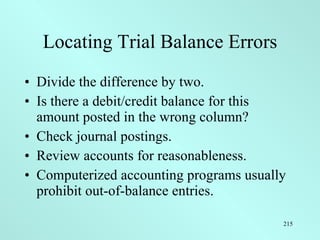
Locating Trial Balance Errors Divide the difference by two. Is there a debit/credit balance for this amount posted in the wrong column? Check journal postings. Review accounts for reasonableness. Computerized accounting programs usually prohibit out-of-balance entries.
Subsidiary Books Cash Accounts Payable Purchase  Book Ledger All subsidiary books  combined make up the ledger. Cash transactions liability accounts Credit purchases
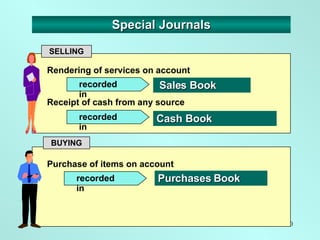
SELLING  BUYING  Special Journals
Rendering of services on account SELLING  Sales Book  BUYING  Special Journals recorded in
Rendering of services on account SELLING  Sales Book  Cash Book  Receipt of cash from any source BUYING  Special Journals recorded in recorded in
Rendering of services on account SELLING  Sales Book  Cash Book  Purchases Book  Receipt of cash from any source Purchase of items on account BUYING  Special Journals recorded in recorded in recorded in
Special Journals Rendering of services  or selling of product on account SELLING  Sales Book  Cash Book  Purchases Book Cash  Book Receipt of cash from any source Purchase of items on account Payment of cash for any purpose BUYING  recorded in recorded in recorded in recorded in
3/2 615 MyMusicClub.com    2,200 3/6 616 RapZone.com  1,750 3/18 617 Web Cantina 2,650 3/27 618 MyMusicClub.com   3,000   Totals 9,600     Sales Journal Invoice Date   No.   Particulars  Details  Amount Page 35 The Sales Journal All sales on credit  are recorded in this journal. Each sales invoice is listed in numerical order. This journal is often referred to as an invoice register.
3/3 Howard Supplies   600    3/7 Donnelly Supplies   420  3/19 Donnelly Supplies   1,450   3/27 Howard Supplies    960     Totals   3,430   Purchases Journal Page 11 The Purchases Journal All purchases on account are recorded in this journal.  Date  Particulars  Details  Amount
Cash journals   Single column Cash Book =  Simple cash Book Double column Cash Book =  Cash Book with bank column Triple column Cash Book =Cash Book with Bank & Discount Column Petty Cash Book = Record small cash payouts
The Financial Statements The financial statements are a picture of the company in financial terms. Each financial statement relates to a specific date or covers a particular period.
Information Reported on the Financial Statements 1. How well did the company perform (or operate) during the period? Revenues –  Direct Expenses Gross income (Gross loss) Trading Account Question Answer Financial Statement 1. How well did the company perform (or operate) during the period? Gross Profit –  Indirect Expenses Net income (Net loss) Profit and  Loss  Account
Information Reported on the Financial Statements 3. What is the company’s financial position at the end of the period? Assets = Liabilities + Owners’ equity Balance sheet Question Answer Financial Statement 4. How much cash did the company generate and spend during the period? Operating cash flows ± Investing cash flows ± Financing cash flows Increase or decrease in cash Statement of cash flows
Income Statement The  income statement,  reports the company’s revenues, expenses, and net income or net loss for the period.
Introduction to the Income Statement The  income statement  is a financial tool that provides information about a company’s past performance .
The Income Statement Revenues – Expenses = Net income (or Net loss)
Income Statement Format Sales revenues –  Cost of goods sold Gross profit Operating income Selling and administrative expenses – = Add: Other revenues and gains Less: Other expenses and losses
Income Statement Revenue  - the proceeds that come from sales to customers  Cost of Goods Sold  - an expense that reflects the cost of the product or good that generates revenue. . Gross Margin  - also called gross profit, this is revenue  minus  COGS Operating Expenses  - any expense that doesn't fit under COGS  such as administration and marketing expenses. Net Income before Interest and Tax  - net income before taking interest  and  income tax  expenses into account. Interest Expense  - the payments made on the company's  outstanding debt.  Income Tax Expense  - the amount payable to government. Net Income  - the final profit after deducting all expenses from revenue.  
The Income Statement can be divided into: Trading Account Profit and Loss Account
The Accounting Terms Revenues are inflows or other enhancements of assets to an entity. Revenues They result from delivering or producing goods, rendering services, or other activities that constitute the entity’s major or central operations.
The Accounting Terms Expenses are outflows or other using up of assets. Expenses They result from delivering or producing goods, rendering services, or other activities that constitute the entity’s major or central operations.
The Accounting Terms Gross profit (gross margin) - excess of sales revenue over the cost of inventory that was sold Operating expenses - a group of recurring expenses that pertain to a firm’s routine operations Operating income (operating profit) - gross profit less all operating expenses Other revenues and expenses - items not directly related to the main operations of a firm
The Accounting Terms Net income - the remainder after all expenses (including income taxes) have been deducted from revenue Often seen as the “bottom line” Net loss - the excess of expenses over revenues
The Income Statement DANIELS COMPANY Income Statement for the Year Ended June 30, 2002 Sales Rs98,600 Expenses:   Wages expense Rs45,800   Rent expense   12,000   Carriage   6,500   Depreciation expense   5,000   Total expenses   69,300 Net Income Rs29,300 ==============
Proforma for the Trading Account for the year ending on  31.12.2005
Sales Less: Returns  Closing stock Goods Lost by fire (Gross Loss c/d) Opening stock Purchases Less:- Returns :-Drawings Direct Expenses:- Carriage inward Wages Fuel & Power Manf. Expenses Coal, water & gas Foreman/Works Manager’s salary Royalty on manf.  Goods Gross profit c/d(bal) Amount Particulars Amount Particulars
Proforma for the Profit and Loss Account for the year ending on  31.12.2005
Profit and Loss Account for the period ending on -----Debit  Credit Gross Profit b/d Interest Received  Discount Received Comm. Received Net Loss c/d Gross loss b/d Selling & Dist Exp :- Advertisement Traveller’s Salary, exp. & commission Bad Debts Administration Expenses Rent, Rates & Taxes Office salaries Printing & Stationary Net Profit c/d (bal) Amount Particulars Amount Particulars
Introduction to the Balance Sheet  The  balance sheet  is the financial tool that focuses on the present condition of a business.
The Balance Sheet The Balance sheet shows the financial position of a company at a particular point in time. The balance sheet is also referred to as the statement of financial position or the statement of financial condition. The left side lists assets – the right side lists liabilities and owners’ equity
The Accounting Elements Probable future economic benefits obtained or controlled by a particular entity as a result of past transactions events. Assets
The Accounting Elements Probable future sacrifices of economic benefits arising from present obligations of a particular entity to transfer assets or provide services to other entities in the future as a result of past transactions or events. Liabilities
The Accounting Elements The residual interest in the assets of an entity that remains after deducting its liabilities. Equity Investment by owners Earned equity
Formats of Balance Sheets Balance sheet formats: Report format - a classified balance sheet with assets at the top and liabilities and equity below Account format - a classified balance sheet with assets at the left and liabilities and equity at the right Regardless of format, balance sheets always contain the same basic information.
Balance Sheet Transactions The balance sheet is affected by every  transaction that an entity encounters. Each transaction has counterbalancing  entries that keep total assets equal to  total liabilities and owners’ equity.
BALANCE SHEET RESOURCES AVAILABLE FOR USE BY THE FIRM (ENTITY) ASSETS - PROBABLE FUTURE ECONOMIC BENEFITS HOW RESOURCES ARE FINANCED LIABILITIES - DEBT OWED TO OTHERS OWNERS’ EQUITY - INVESTMENT BY OWNERS DIRECT INDIRECT
The Balance Sheet STEVENS COMPANY Balance Sheet  as on June 30, 2005 Liabilities   Assets Owner’s Equity Hamilton, capital Reserves Secured Loans Unsecured Loans Current liabilities: Wages payable  Tax payable Bills Payable  Bank balance  Cash balance Fixed Assets:   Land Plant   Equipment  Total Fixed Asset Current assets: Bills Receivable
PROFORMA BALANCE SHEET  LIABILITIES ASSETS SHARE CAPITAL Authorised Issued Subscribed Less:- Calls unpaid Add:- Forfeited shares RESERVES AND SURPLUS SECURED LOANS UNSECURED LOANS:   CURRENT LIABILITIES AND PROVISIONS: A. CURRENT LIABILITIES: a)        Acceptances. b)        Sundry Creditors c)        Subsidiary companies. d)        Advance Payments e)        Unclaimed dividends f)         Other liabilities (if any) g)        Interest accrued but not due on loans. B. PROVISIONS a)        Provision for taxation. b)        Proposed dividends. c)        For contingencies.     FIXED ASSETS a)        Land ,  b)    Buildings,  c)   Goodwill, d)   Plant and Machinery  e) Furniture and fittings  f)   Patents, trade marks and designs. INVESTMENTS: a) Investments in Government or Trust Securities, in shares, debentures or bonds, b)   Immovable Properties. CURRENT ASSETS, LOANS AND ADVANCES: (A) Current Assets: a)     Interest accrued on Investments. b)     Stores and Spare Parts,c)   Loose Tools d)    Stock in trade,  e)   Works in progress. f)    Sundry Debtors, g)   Cash balance on hand h)     Bank balances (B) LOANS AND ADVANCES: a)    Advances and loans to subsidiaries. b)    Bills of Exchange. c)     Advances recoverable in cash or in kind  MISCELLANEOUS EXPENDITURE: a)      Preliminary expenses. b)  Expenses including commission or brokerage on underwriting or subscription of shares or debentures. c)   Discount allowed on the issue of shares or debentures.  
The Balance Sheet Elements of the balance sheet: Assets - resources of the firm that are expected to increase or cause future cash flows (everything the firm owns) Liabilities - obligations of the firm to outsiders or claims against its assets by outsiders (debts of the firm) Owners’ Equity - the residual interest in, or remaining claims against, the firm’s assets after deducting liabilities (rights of the owners)
Classifying Assets and Liabilities Current assets Long-term assets Current liabilities Long-term liabilities
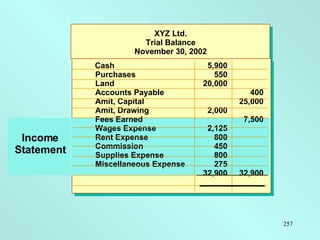
XYZ Ltd. Trial Balance November 30, 2002 Cash 5,900 Purchases 550 Land 20,000 Accounts Payable 400 Amit, Capital 25,000 Amit, Drawing 2,000 Fees Earned 7,500 Wages Expense 2,125 Rent Expense 800 Commission 450 Supplies Expense 800 Miscellaneous Expense 275 32,900 32,900
XYZ Ltd. Trial Balance November 30, 2002 Cash 5,900 Purchases 550 Land 20,000 Accounts Payable 400 Amit, Capital 25,000 Amit, Drawing 2,000 Fees Earned 7,500 Wages Expense 2,125 Rent Expense 800 Commission 450 Supplies Expense 800 Miscellaneous Expense 275 32,900 32,900 Balance Sheet
Income Statement XYZ Ltd. Trial Balance November 30, 2002 Cash 5,900 Purchases 550 Land 20,000 Accounts Payable 400 Amit, Capital 25,000 Amit, Drawing 2,000 Fees Earned 7,500 Wages Expense 2,125 Rent Expense 800 Commission 450 Supplies Expense 800 Miscellaneous Expense 275 32,900 32,900
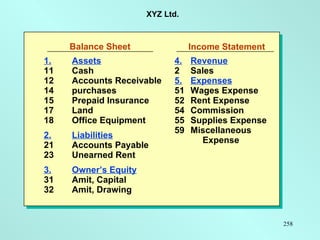
XYZ Ltd. Balance Sheet Income Statement 1. Assets 11 Cash 12 Accounts Receivable 14 purchases 15 Prepaid Insurance 17 Land 18 Office Equipment 2. Liabilities 21 Accounts Payable 23 Unearned Rent 3. Owner’s Equity 31 Amit, Capital 32 Amit, Drawing 4. Revenue Sales 5. Expenses 51 Wages Expense 52 Rent Expense 54 Commission 55 Supplies Expense 59 Miscellaneous  Expense
Summary Original  evidence records Accounting records Financial Statements Source documents Journals Ledger Trial  Balance Statement of  cash flows Balance Sheet Profit and Loss Statement Closing Entries

Financial Accounting

  • 1.
    Accounting and Financial Management
  • 2.
    Introduction to Accounting Accounting & Financial Management
  • 3.
    Accounting – AnInformation Process Users of Accounting Information GAAP The Accounting Equation Double Entry System Introduction to Accounting
  • 4.
    Accounting... is thelanguage of business.
  • 5.
    Accounting.. is aninformation system that... measures business activities, processes information, and... communicates financial information.
  • 6.
    Accounting – TheLanguage of Business Accounting is the information system that... measures business activities, processes data into reports, and communicates results to decision makers.
  • 7.
    - a processof identifying, recording, summarizing, and reporting economic information to decision makers in the form of financial statements. Accounting
  • 8.
    Definitions of Accounting“ The process of identifying, measuring, and communicating economic information to permit informed judgements and decisions by users of the information.” — American Accounting Association (AAA) “ A service activity whose function is to provide quantitative information, primarily financial in nature, about economic entities that is intended to be useful in making economic decisions.” — American Institute of Certified Public Accountants (AICPA)
  • 9.
    Primary Functions ofAccounting Recording data about business transactions - In the Egyptian era they used a quill pen to record the data and stored it on papyrus scrolls. Today we might use a bar code and scan data into a computer system and store it on a magnetic disk. Summarizing results of business activity into useful report- The balance sheet and income statement have been standard reports for many years. More recently we added a statement of cash flows. However, managers in today's environment demand more detailed reports like sales by district or sales by product type.
  • 10.
    Providing assurances thatthe business is operating as intended and that the assets of the organization are protected- All parties to a business event have looked to accountants to provide assurance that the transaction is properly handled, accurately recorded, and accurately reported. Throughout most of this century the assurance has been based on a system of internal controls and an audit of the published financial statements.
  • 11.
    Accounting as anAid to Decision Making Accounting helps in decision making by showing where and when money has been spent, by evaluating performance, and by showing the implications of choosing one plan instead of another. Fundamental relationships in the decision-making process: Event Accountant’s analysis and recording Financial statements Users
  • 12.
    Accounting — AnInformation Process Identification of Users
  • 13.
    User Information NeedsAccounting — An Information Process Identification of Users
  • 14.
    Identification of UsersUser Information Needs Accounting System Accounting — An Information Process
  • 15.
    Identification of UsersUser Information Needs Accounting System Economic Data and Activities Accounting — An Information Process
  • 16.
    Identification of UsersUser Information Needs Accounting System Economic Data and Activities Reports Accounting — An Information Process
  • 17.
    Identification of UsersUser Information Needs Accounting System Reports Economic Data and Activities Accounting — An Information Process User Decisions
  • 18.
    The Flow ofAccounting Information 1. Business transactions occur 3. People make decisions. 2. Businesses prepare reports to Show the results of their operations
  • 19.
    The Flow ofAccounting Information Accounting systems are designed to meet the needs of the decision makers who use the financial information. Every business maintains some type of accounting system. These accounting systems may be very complex or very simple, but the real value of any accounting system lies in the information that the system provides.
  • 20.
    Users of AccountingInformation Individuals Businesses Investors and creditors Government regulatory agencies Taxing authorities Nonprofit organizations
  • 21.
    investors creditors regulatorscustomers competitors EXTERNAL USERS Financial Accounting Users of Accounting Information
  • 22.
    owners managers employeesEXTERNAL USERS Financial Accounting investors creditors regulators customers competitors INTERNAL USERS Financial Accounting Users of Accounting Information
  • 23.
    Users of AccountingInformation External users make decisions about the entity. Internal users make decisions for the entity. Users of Accounting Information
  • 24.
    Financial Accounting Itsfocus is on reporting to external parties. It provides financial statements based on generally accepted accounting principles . It measures and records business transactions.
  • 25.
    Management Accounting Itmeasures and reports financial and nonfinancial information that helps managers make decisions to fulfill the goals of an organization.
  • 26.
    Cost Accounting Itprovides information for both management accounting and financial accounting. It measures and reports financial and nonfinancial data.
  • 27.
    Some Definitions toremember : Inventory - goods held by a firm for resale to customers Account payable - a liability that results from the purchase of goods or services on account Compound entry - a transaction that affects more than two accounts Creditor - one to whom money is owed Debtor - one who owes money
  • 28.
    Assets What isan asset? It is something a company owns which has future economic value. land building equipment goodwill
  • 29.
    Liability What isa liability? It is something a company owes. money service product
  • 30.
    Revenues What arerevenues? They are amounts received or to be received from customers for sales of products or services. sales performance of services rent interest
  • 31.
    What are Expenses?They are amounts that have been paid or will be paid later for costs that have been incurred to earn revenue. salaries and wages utilities supplies used advertising Expenses
  • 32.
    Owner’s Equity Whatis owner’s equity? It is what’s left of the assets after liabilities have been deducted. the same as net assets the owner’s claim on the entity’s assets
  • 33.
    Transactions that AffectOwner’s Equity OWNER’S EQUITY INCREASES OWNER’S EQUITY DECREASES Owner Investments in the Business Revenues Expenses Owner Withdrawals from the Business Owner’s Equity
  • 34.
    Effects of Transactionson Owner’s Equity OWNER’S EQUITY
  • 35.
    Effects of Transactionson Owner’s Equity decreased by OWNER’S EQUITY
  • 36.
    Effects of Transactionson Owner’s Equity Owner’s withdrawals Expenses decreased by OWNER’S EQUITY
  • 37.
    Effects of Transactionson Owner’s Equity increased by OWNER’S EQUITY
  • 38.
    Effects of Transactionson Owner’s Equity Owner’s investments Revenues increased by OWNER’S EQUITY
  • 39.
    Effects of Transactionson Owner’s Equity Owner’s withdrawals Expenses Owner’s investments Revenues decreased by increased by OWNER’S EQUITY
  • 40.
  • 41.
    The Accounting EquationEconomic Resources Claims to Economic Resources Assets = Liabilities + Owner’s Equity
  • 42.
    Resources The AccountingEquation What are an organization’s resources called?
  • 43.
    Assets Resources = Sources The Accounting Equation What are the sources of the assets? Resources used in the business
  • 44.
    Assets Liabilities Owner’sEquity Resources = Sources Resources used in the business Resources supplied by creditors and owners The Accounting Equation
  • 45.
    Accounting data isrepresented by the following relationship among the assets, liabilities and owners’ equity of a business: Assets = Liabilities + Owners’ Equity The equation must be in balance after every recorded transaction in the system. The Basic Accounting Equation
  • 46.
    a. Sachin depositsRS 25,000 in a bank account for ABC Ltd ASSETS = Business Transactions OWNER’S EQUITY LIABILITIES
  • 47.
    a. Sachin depositsRS 25,000 in a bank account for ABC Ltd. ASSETS = Business Transactions OWNER’S EQUITY Cash 25,000 LIABILITIES
  • 48.
    a. Sachin depositsRS 25,000 in a bank account for ABC Ltd. ASSETS = Business Transactions OWNER’S EQUITY Cash 25,000 LIABILITIES Sachin, Capital 25,000
  • 49.
    Business Transactions b. ABC Ltd. buys land for Rs 20,000. ASSETS = OWNER’S EQUITY LIABILITIES
  • 50.
    Business Transactions b.ABC Ltd. buys land for Rs 20,000. ASSETS = OWNER’S EQUITY LIABILITIES Cash (20,000)
  • 51.
    Business Transactions b.ABC Ltd buys land for RS 20,000. ASSETS = OWNER’S EQUITY LIABILITIES Cash (20,000) Land 20,000
  • 52.
    Business Transactions ASSETS= OWNER’S EQUITY LIABILITIES c. ABC Ltd buys goods for RS1,350, agreeing to pay the supplier in the near future.
  • 53.
    Business Transactions ASSETS= OWNER’S EQUITY LIABILITIES c. ABC Ltd buys goods for RS1,350, agreeing to pay the supplier in the near future. Accounts Payable 1,350 Purchases 1,350
  • 54.
    Business Transactions ASSETS= OWNER’S EQUITY LIABILITIES e. ABC Ltd paid: wages Rs 2,125; rent, Rs 800; utilities, Rs 450; and miscellaneous, Rs 275.
  • 55.
    Business Transactions ASSETS= OWNER’S EQUITY LIABILITIES Cash (3,650) e. ABC Ltd paid: wages Rs 2,125; rent, Rs 800; utilities, Rs 450; and miscellaneous, Rs 275.
  • 56.
    Business Transactions ASSETS= OWNER’S EQUITY LIABILITIES Cash (3,650) Expenses (3,650) e. ABC Ltd paid: wages Rs 2,125; rent, Rs 800; utilities, Rs 450; and miscellaneous, Rs 275.
  • 57.
    Business Transactions ASSETS= OWNER’S EQUITY LIABILITIES f. ABC Ltd pays Rs 950 to creditors on account.
  • 58.
    Business Transactions ASSETS= OWNER’S EQUITY LIABILITIES Cash (950) f. ABC Ltd pays Rs 950 to creditors on account.
  • 59.
    Business Transactions ASSETS= OWNER’S EQUITY LIABILITIES Cash (950) Accounts Payable (950) f. ABC Ltd pays Rs 950 to creditors on account.
  • 60.
    Business Transactions ASSETS= OWNER’S EQUITY LIABILITIES h. Sachin withdraws Rs 2,000 in cash.
  • 61.
    Business Transactions ASSETS= OWNER’S EQUITY LIABILITIES Cash (2,000) h. Sachin withdraws Rs 2,000 in cash.
  • 62.
    Business Transactions ASSETS= OWNER’S EQUITY LIABILITIES Cash (2,000) Sachin’s, Drawing (2,000) h. Sachin withdraws Rs 2,000 in cash.
  • 63.
    Transaction Summary ASSETS= OWNER’S EQUITY LIABILITIES Cash 6,700 Purchases 550 Land 20,000
  • 64.
    Transaction Summary ASSETS= OWNER’S EQUITY LIABILITIES Cash 6,700 Purchases 550 Land 20,000 Accts. Payable 400
  • 65.
    Transaction Summary ASSETS= OWNER’S EQUITY LIABILITIES Cash 6,700 Purchases 550 Land 20,000 Accts. Payable 400 Sachin, Capital 25,000 Sachin, Drawing (2,000) Fees Earned 7,500 Wages Expense (2,125) Rent Expense (800) Commission (450) Misc. Expense (275)
  • 66.
    Role of Accounting Good managers plan for the future. They develop a budget . A budget is a formal plan stated in monetary terms.
  • 67.
    Role of Accounting Accounting helps banks decide to whom they will lend money. Accounting provides information that helps investors pick stocks.
  • 68.
    Role of Accounting Budgeting Information systems design Cost accounting Internal auditing
  • 69.
    Role of Accounting Consulting Assurance services including auditing Tax accounting
  • 70.
    Accounting as anAid to Decision Making Accounting information is useful to anyone who makes decisions that have economic results. Owners want to know which employees are productive. investors want to know if a company is a good investment. Legislators want to know how a proposed law will affect budgets. Managers want to know if a new product will be profitable. Creditors want to know if they should extend credit, how much to extend, and for how long.
  • 71.
    ABUSIVE ACCOUNTING PRACTICESCREATIVE ACCOUNTING PRACTICES ENRON DEBTS NOT REPORTED RECOGNITION OF LOSSES WAS POSTPONED REPORT INCOME BEFORE BEING EARNED
  • 72.
  • 73.
    Financial Accounting Itsfocus is on reporting to external parties. It provides financial statements based on generally accepted accounting principles. It measures and records business transactions.
  • 74.
    Generally Accepted AccountingPrinciples What is the primary objective of financial Accounting and Reporting? To provide information useful for making investment and lending decisions
  • 75.
    Generally Accepted AccountingPrinciples and Basic Concepts If every accountant used his or her own rules for recording transactions, the financial statements would be useless in making comparisons. Therefore, accountants have agreed to apply a common set of measurement principles (a common language) to record information for financial statements. Otherwise, decision makers could not use or compare financial statements.
  • 76.
    Accounting: Principles andConcepts The rules that govern accounting are called GAAP (generally accepted accounting principles) . Accountants follow professional guidelines.
  • 77.
    Generally Accepted AccountingPrinciples and Basic Concepts Generally accepted accounting principles (GAAP) - a term that applies to the broad concepts or guidelines and detailed practices in accounting, including all the conventions, rules, and procedures that make up accepted accounting practice at a given time
  • 78.
    REGULATION OF THEACCOUNTING PROFESSION Securities And Exchange Commission (SEC) Financial Accounting Standards Board (FASB) American Institute Of Certified Public Accountants (AICPA)
  • 79.
    Standard Setting BodiesIn the United States, GAAP is set primarily by the private sector with government oversight. In many other countries, such as France, the government actually sets accounting standards.
  • 80.
    Standard Setting BodiesSecurities and Exchange Commission (SEC) - the agency designated by the U.S. Congress to hold the ultimate responsibility for authorizing GAAP for companies whose stock is held by the general investing public The SEC has informally delegated the power to make accounting rules to the FASB.
  • 81.
    Standard Setting BodiesFinancial Accounting Standards Board (FASB) - responsible for establishing GAAP in the United States; A private sector body consisting of seven full-time members and a large support staff
  • 82.
    Standard Setting BodiesInternational Accounting Standards Board (IASB) - an organization representing over 143 accountancy boards from 104 countries that is developing a common set of accounting standards to be used throughout the world
  • 83.
    Standard Setting BodiesInterest in harmonizing accounting standards around the world by eliminating differences in accounting principles has grown. Investors are committing more of their money worldwide. Many multinational companies voluntarily issue their financial statements in conformity with the IASB standards.
  • 84.
    IMPORTANT CONCEPTS ENTITYASSUMPTION GOING CONCERN ASSET VALUATION HISTORICAL COST MARKET VALUE LIABILITY RECOGNITION
  • 85.
    IMPORTANT CONCEPTS ACCOUNTINGPERIOD REVENUE RECOGNITION MATCHING EXPENSES TO REVENUES UNIT OF MEASUREMENT CONSERVATISM FULL DISCLOSURE
  • 86.
    Generally Accepted AccountingPrinciples and Basic Concepts The Entity Concept An accounting entity is an organization that stands apart from other organizations and individuals as a separate economic unit. The entity concept helps relate events to a clearly defined area of accountability.
  • 87.
    The Entity ConceptAn accounting entity is an organization that stands apart as a separate economic unit.
  • 88.
    The Entity ConceptExample Assume that John decides to open up a gas station and coffee shop. The gas station made Rs 250,000 in profits, while the coffee shop lost Rs 50,000.
  • 89.
    The Entity ConceptExample How much money did John make? At a first glance, we would assume that John made Rs 200,000. However, by applying the entity concept we realize that the gas station made Rs 250,000 while the coffee shop lost Rs 50,000.
  • 90.
    Generally Accepted AccountingPrinciples and Basic Concepts The Going Concern Concept The entity will continue to operate in the future.
  • 91.
    Generally Accepted AccountingPrinciples and Basic Concepts Going Concern Convention The assumption that in all ordinary situations an entity persists indefinitely This notion implies that a company’s existing resources will be used to fulfill the business needs of the company rather than be sold. If the continuity of an entity is in doubt, a liquidation approach to the balance sheet is taken, and the assets and liabilities are valued as if the entity were to be liquidated in the near future.
  • 92.
    Record fixed assetsat original cost and depreciate over a period of time. Take prepaid expenses as assets. Business is concerned with net income or earning capacity as compared to market values.
  • 93.
    Generally Accepted AccountingPrinciples and Basic Concepts Materiality Convention A financial statement item is material if its omission or misstatement would tend to mislead the reader of the financial statements under consideration Materiality often depends on the size of the organization – what is material to one company might not be material to another company.
  • 94.
    AAA defines “Anitem should be regarded as material if there is reason to believe that knowledge of it would influence the decision of informed investor” Disclose only material information. No overburdening with minute details Material information differs organization to organization year to year (change in depreciation method) Materiality may depend upon amount or may not be.
  • 95.
    Generally Accepted Accounting Principles and Basic Concepts Convention of Conservatism :- “ Anticipate no profits but provide for all possible losses” Policy of ‘caution’ & ‘playing safe’ Policy of safeguarding against possible losses in world of uncertainty
  • 96.
    Kobler defines :-‘ Conservatism’ as a guideline which chooses between acceptable accounting alternatives for recording events or transactions so that the least favorable immediate effect on assets , income and owner’s equity is reported. Example:- Making the provision for doubtful debts and discounts on debtors in anticipation of actual bad debts and discount
  • 97.
    Generally Accepted AccountingPrinciples and Basic Concepts Cost-Benefit Criterion A system should be changed when the expected additional benefits of the change exceed its expected additional costs The benefits of information should exceed the cost of providing that information. Benefits > Costs
  • 98.
    Generally Accepted AccountingPrinciples and Basic Concepts The Stable-Monetary-Unit Concept The purchasing power is stable.
  • 99.
    Generally Accepted AccountingPrinciples and Basic Concepts Stable Monetary Unit The monetary unit is the principle means for measuring assets and equities. It is the common denominator for quantifying the effects of transactions. A stable monetary unit is one that is not expected to significantly change in value over time.
  • 100.
    Generally Accepted AccountingPrinciples and Basic Concepts The Cost Principle Assets and services acquired should be recorded at their actual cost.
  • 101.
    Record assets atprice paid to acquire and take it as base for subsequent years. Makes financial statements more objective. Limitations Financial statements become irrelevant in case of inflation Remove cost of fixed assets by writing off their cost while asset may be in good condition Don’t show as asset for which no payment has been made for e.g knowledge ,skill of Human Resources.
  • 102.
    Cash Basis ofAccounting Accrual Basis of Accounting TWO METHODS Reporting Revenue and Expense Accrual Basis
  • 103.
    Revenue reported whencash is received Expense reported when cash is paid Does not properly match revenues and expenses Cash Basis of Accounting
  • 104.
    Revenue reported whenearned Expense reported when incurred Properly matches revenues and expenses in determining net income Requires adjusting entries at end of period It just sounds mean – it really isn’t Accrual Basis of Accounting
  • 105.
    ACCRUAL VS CASHACCOUNTING ACCRUAL ACCOUNTING - FOCUSES ON THE ECONOMIC IMPACT OF TRANSACTIONS FIRM MAXIMIZES ASSETS CASH ACCOUNTING - FOCUSES ON WHEN CASH IS RECEIVED AND PAID OUT FIRM MAXIMIZES CASH
  • 106.
    Illustration 1-14 FullDisclosure Principle
  • 107.
    Revenue Principle Whenis revenue recognized? When it is deemed earned. Recognition of revenue and cash receipts do not necessarily occur at the same time.
  • 108.
    Revenue Principle Therevenue principle governs two things: When to record revenue and… the amount of revenue to record.
  • 109.
    Revenue Principle Air& Sea Travel, Inc. Situation 1 No transaction has occurred. – Do Not Record Revenue March 12 I plan to have you make my travel arrangements. photos Disney World Situation 2 The client has taken a trip arranged by Air & Sea Travel. – Record Revenue Air & Sea Travel, Inc. April 2
  • 110.
    Recognition of RevenuesRecognition - a test to determine whether revenues should be recorded in the financial statements for a given period To be recognized, revenue must be: Earned - goods are delivered or a service is performed Realized - cash or a claim to cash (credit) is received in exchange for goods or services
  • 111.
    The Matching PrincipleWhat is the matching principle? It is the basis for recording expenses. Expenses are the costs of assets and the increase in liabilities incurred in the earning of revenues. Expenses are recognized when the benefit from the expense is received.
  • 112.
    The Matching PrincipleIt is the basis for recording expenses and includes two steps: Identify all the expenses incurred during the accounting period. Measure the expenses and match expenses against revenues earned.
  • 113.
    The Matching PrincipleRevenue – Expense = Net income
  • 114.
    The Matching PrincipleRevenue – Expense = (Net loss)
  • 115.
    Example MatchingExpenses with Revenues Revenues Rs 15,000 Cost of goods sold 8,000 Net income Rs 7,000 May
  • 116.
    Accounting Period conceptManagers adopt an artificial period of time to evaluate performance.
  • 117.
    Accounting Period conceptIt requires that accounting information be reported at regular intervals. Interacts with the revenue principle and the matching principle Requires that income be measured accurately each period
  • 118.
    Accounting Period concept The Time-Period Concept Businesses need regular progress reports, so accountants prepare financial statements for specific periods and at regular intervals . Monthly Quarterly
  • 119.
    Dual concept Accountinginformation is based on the double entry system . Under this system, the two-sided effect of a transaction is recorded in the appropriate accounts. The recording is done by means of a “debit-credit” convention (set of rules) applying to all accounts.
  • 120.
    The Accounting EquationAssets are the economic resources of a business that are expected to produce a benefit in the future. Liabilities are “outsider claims,” or economic obligations payable to outsiders. Owners’ equity represents the “ insider claims” of a business.
  • 121.
    The Reliability ConceptThe quality of information that assures decision makers that the information captures the conditions or events it purports to represent Reliable data are supported by convincing evidence that can be verified by independent parties. The impact of events should be measured in a systematic, reliable manner.
  • 122.
    The Reliability (Objectivity)concept Information must be reasonably accurate. Information must be free from bias. Information must report what actually happened. Individuals would arrive at similar conclusions using same data.
  • 123.
  • 124.
    Double-Entry Accounting “ Double-entry accounting is based on a simple concept: each party in a business transaction will receive something and give something in return. In bookkeeping terms, what is received is a debit and what is given is a credit. The T account is a representation of a scale or balance.” Scale or Balance Receive DEBIT Give CREDIT T account Left Side Receive DEBIT Right Side Give CREDIT Luca Pacioli Developer of Double-Entry Accounting
  • 125.
    The Double-Entry SystemOne debit One credit Each transaction is recorded with at least: Total debits must equal total credits. The Double Entry System
  • 126.
    The Double-Entry SystemEach transaction must still be analyzed to determine which accounts are involved, whether the accounts increase or decrease, and how much the balance will change. The Double Entry System
  • 127.
    The Double-Entry systemSome businesses enter into thousands of transactions daily or even hourly. Accountants must carefully keep track of and record these transactions in a systematic manner. Accountants use a double-entry accounting system in which at least two accounts are always affected by each transaction. The Double Entry System
  • 128.
    Classification of AccountsThere are some asset accounts? Cash Notes Receivable Accounts Receivable Prepaid Expenses Land Building Equipment
  • 129.
    Classification of AccountsThere are some liability accounts? Notes Payable Accounts Payable Accrued Liabilities (for expenses incurred but not paid) Long-term Liabilities (bonds)
  • 130.
    Classification of AccountsThere are some owner’s equity accounts? Capital or owner’s interest in the business Withdrawals Revenues Expenses
  • 131.
    Classification of AccountsReal Account = Debit –What comes in Credit- what goes out Personal Account = Debit –Receiver Credit - Giver Nominal Account =Debit –Expenses/Losses Credit- Incomes/Gains
  • 132.
    The Double-Entry systemThe system records the two-sided effect of transactions The Double Entry System Transaction Two-sided effect Bought furniture for cash Decrease in one asset Increase in another asset Took a loan in cash Increase in an asset Increase in a liability
  • 133.
    The Double EntrySystem Note that the accounting equation equality is maintained after recording each transaction.
  • 134.
    XYZ Ltd. ASole Proprietorship “ On November 1, 2002, A started a sole proprietorship called XYZ Ltd. The following double-entry transactions show how amounts received (debits) always equal amounts given (credits).”
  • 135.
    Amit deposits Rs25,000in a bank account for XYZ Ltd.. Business Transactions Journal give Credit XYZ Ltd (investee) Amit (investor) give Credit Entry A. Date Description Debit Credit 11/1 receive Debit
  • 136.
    Amit deposits Rs25,000in a bank account for XYZ Ltd.. Business Transactions l Journal give Credit XYZ Ltd.(investee) Cash Amit (investor) give Credit Entry A. Date Description Debit Credit 11/1 Cash 25,000 receive Debit
  • 137.
    Amit deposits Rs25,000 in a bank account for XYZ Ltd.. Business Transactions Journal Date Description Debit Credit 11/1 Cash 25,000 Amit, Capital 25,000 give Credit XYZ Ltd.(investee) Cash A promise to the owner Amit (investor) give Credit Entry A. receive Debit
  • 138.
    XYZ Ltd. buysland for Rs20,000. Business Transactions give Credit XYZ Ltd(buyer) Land Owner (seller) give Credit Entry B. Journal Date Description Debit Credit 11/5 receive Debit
  • 139.
    XYZ Ltd. buysland for Rs20,000. Business Transactions give Credit XYZ Ltd(buyer) Land Land Owner (seller) give Credit Entry B. General Journal Date Description Debit Credit 11/5 Land 20,000 receive Debit
  • 140.
    XYZ Ltd. buysland for Rs 20,000. Business Transactions give Credit XYZ Ltd(buyer) Land Cash Land Owner (seller) give Credit Entry B. Journal Date Description Debit Credit 11/5 Land 20,000 Cash 20,000 receive Debit
  • 141.
    XYZ Ltd. buyssupplies for Rs1,350, agreeing to pay in the near future. Business Transactions give Credit XYZ Ltd (buyer) Supplier (seller) give Credit Entry C. Journal Date Description Debit Credit 11/10 receive Debit
  • 142.
    XYZ Ltd. buysgoods for Rs1,350, agreeing to pay in the near future. Business Transactions give Credit XYZ Ltd. (buyer) Supplies Supplier (seller) give Credit Entry C. General Journal Date Description Debit Credit 11/10 Purchases 1,350 receive Debit
  • 143.
    XYZ Ltd. buysgoods for Rs1,350, agreeing to pay in the near future. Business Transactions give Credit XYZ Ltd. (buyer) Supplies Supplier (seller) give Credit Entry C. A promise to pay later Journal Date Description Debit Credit 11/10 purchases 1,350 Accounts Payable 1,350 receive Debit
  • 144.
    XYZ Ltd. earnsfees of Rs7,500, receiving cash. Business Transactions give Credit XYZ Ltd. (seller) Customer (buyer) give Credit Entry D. Journal Date Description Debit Credit 11/18 receive Debit
  • 145.
    XYZ Ltd. earnsfees of Rs7,500, receiving cash. Business Transactions give Credit XYZ Ltd. (seller) Cash Customer (buyer) give Credit Entry D. Journal Date Description Debit Credit 11/18 Cash 7,500 receive Debit
  • 146.
    XYZ Ltd. earnsfees of Rs7,500, receiving cash. Business Transactions give Credit XYZ Ltd. (seller) Cash Customer (buyer) give Credit Entry D. Services Journal Date Description Debit Credit 11/18 Cash 7,500 Fees Earned 7,500 receive Debit
  • 147.
    Date Description DebitCredit XYZ Ltd. paid: wages, Rs 2,125; rent, Rs 800; commissions, Rs450; and misc, Rs275. Business Transactions Journal give Credit XYZ Ltd. (buyer) Various suppliers give Credit Entry E. receive Debit
  • 148.
    Date Description DebitCredit 11/18 Wages Expense 2,125 Rent Expense 800 Commission 450 Misc. Expense 275 XYZ Ltd. paid: wages, Rs 2,125; rent, Rs 800; commissions, Rs450; and miscellaneous, Rs275. Business Transactions Journal give Credit XYZ Ltd. (buyer) Services, benefits Various suppliers give Credit Entry E. receive Debit
  • 149.
    Date Description DebitCredit 11/18 Wages Expense 2,125 Rent Expense 800 Commission 450 Misc. Expense 275 Cash 3,650 XYZ Ltd. paid: wages, Rs 2,125; rent, Rs 800; commissions, Rs 450; and misc Rs 275. Business Transactions Journal give Credit XYZ Ltd. (buyer) Services, benefits Various suppliers give Credit Entry E. Cash receive Debit
  • 150.
    XYZ Ltd. paysRs950 to creditors on account. Business Transactions give Credit XYZ Ltd. (payor) Supplier (payee) give Credit Entry F. Journal Date Description Debit Credit 11/30 receive Debit
  • 151.
    XYZ Ltd. paysRs950 to creditors on account. Business Transactions give Credit XYZ Ltd. (payor) Reduction in obligation Supplier (payee) give Credit Entry F. Journal Date Description Debit Credit 11/30 Accounts Payable 950 receive Debit
  • 152.
    XYZ Ltd. paysRs950 to creditors on account. Business Transactions give Credit XYZ Ltd. (payor) Reduction in obligation Supplier (payee) give Credit Entry F. Cash Journal Date Description Debit Credit 11/30 Accounts Payable 950 Cash 950 receive Debit
  • 153.
    Amit withdraws Rs 2,000 in cash. Business Transactions give Credit XYZ Ltd. (payor) Amit (payee) give Credit Entry H. Journal Date Description Debit Credit 11/30 receive Debit
  • 154.
    Amit withdraws Rs2,000 in cash. Business Transactions give Credit XYZ Ltd. (payor) Reduction in obligation Amit (payee) give Credit Entry H. Journal Date Description Debit Credit 11/30 Amit, Drawing 2,000 receive Debit
  • 155.
    Amit withdraws Rs2,000 in cash. Business Transactions give Credit XYZ Ltd. (payor) Reduction in obligation Amit (payee) give Credit Entry H. Cash Journal Date Description Debit Credit 11/30 Amit, Drawing 2,000 Cash 2,000 receive Debit
  • 156.
  • 157.
    1. Analyze thetransaction 2. Journalize the transaction 3. Post the transaction to accounts in ledger 4. Prepare the trial balance 5. Prepare financial statements The Accounting Cycle: Steps
  • 158.
    The Recording ProcessThe sequence of steps in recording transactions: Transactions Documentation Journal Financial Statements Trial Balance Ledger
  • 159.
    The Recording ProcessThe process starts with source documents, which are the supporting original records of any transaction. Examples are sales slips or invoices, check stubs, purchase orders, receiving reports, and cash receipt slips.
  • 160.
    The Recording ProcessIn the second step, an analysis of the transaction is placed in the book of original entry, which is a chronological record of how the transactions affect the balances of applicable accounts. The most common example is the general journal - a diary of all events (transactions) in an entity’s life.
  • 161.
    The Recording ProcessIn the third step, transactions are entered into the ledger. Remember that a transaction is not entered in just one place; it must be entered in each account that it affects. Depending on the nature of the organization, analysis of the transactions could occur continuously or periodically.
  • 162.
    The Recording ProcessThe fourth step includes the preparation of the trial balance, which is a simple listing of all accounts from the ledger with their balances. Aids in verifying accuracy and in preparing the financial statements Prepared periodically as necessary
  • 163.
    The Recording ProcessIn the final step, the financial statements are prepared. Financial statements may be prepared after each quarter of the year. the companies may prepare financial statements at various other intervals to meet the needs of their users. December 2002
  • 164.
    1. Transactions areanalyzed and recorded in journal. Documents Journal Journal, Ledger, Trial Balance
  • 165.
    1. Transactions areanalyzed and recorded in journal. Documents Journal 2. Transactions are posted from journal to ledger. Journal Ledger Journal, Ledger, Trial Balance
  • 166.
    1. Transactions areanalyzed and recorded in journal. Documents Journal 2. Transactions are posted from journal to ledger. Journal Ledger 3. Trial balance is prepared. Journal, Ledger, Trial Balance Trial Balance
  • 167.
    Manual Accounting Cycle1. Transactions are analyzed and recorded in journal. Documents Journal
  • 168.
    Manual Accounting Cycle1. Transactions are analyzed and recorded in journal. Documents Journal 2. Transactions are posted from journal to ledger. Journal Ledger
  • 169.
    Manual Accounting Cycle1. Transactions are analyzed and recorded in journal. Documents Journal 2. Transactions are posted from journal to ledger. Journal Ledger 3. Trial balance is prepared, Trial balance
  • 170.
    Manual Accounting Cycle1. Transactions are analyzed and recorded in journal. Documents Journal 2. Transactions are posted from journal to ledger. Journal Ledger 3. Trial balance is prepared, 4. Financial statements are prepared and distributed. Financial Statements IS SOE BS
  • 171.
    Computerized Accounting Cycle1. Transactions are analyzed and entered in the computer. Documents Computer
  • 172.
    Computerized Accounting Cycle1. Transactions are analyzed and entered in the computer. Documents Computer 2. Preliminary reports are analyzed, adjustments are prepared and entered in the computer. Computer Reports Computer
  • 173.
    Computerized Accounting Cycle1. Transactions are analyzed and entered in the computer. Documents Computer 2. Preliminary reports are analyzed, adjustments are prepared and entered in the computer. Computer Reports 3. Financial statements are printed and distributed. Computer
  • 174.
    Computerized Accounting Cycle1. Transactions are analyzed and entered in the computer. Documents Computer 2. Preliminary reports are analyzed, adjustments are prepared and entered in the computer. Computer Reports 3. Financial statements are printed and distributed. Computer 4. Reports are analyzed and interpreted for decision- making purposes. Financial Statements IS SOE BS SCF ?
  • 175.
  • 176.
    Journal What isa journal? It is a list in chronological order of all the transactions for a business. Identify transaction from source documents. Specify accounts affected. Apply debit/credit rules. Record transaction with description.
  • 177.
    Journal entry Journalentry - an analysis of the effects of a transaction on the accounts, usually accompanied by an explanation of the transaction This analysis identifies the accounts to be debited and credited.
  • 178.
    Journal entry Whatdoes a journal entry include? date of the transaction title of the account debited title of the account credited amount of the debit and credit description of the transaction (narration)
  • 179.
  • 180.
    Journalizing Journalizing– It is the process of entering transactions into the journal
  • 181.
    JOURNALIZING TRANSACTIONS THEJOURNAL IS A CHRONOLOGICAL LISTING OF TRANSACTIONS. ENTER DATE IN FIRST COLUMN IDENTIFY APPROPRIATE ACCOUNTS ENTER THE TITLE OF THE ACCOUNT DEBITED ENTER THE TITLE OF THE ACCOUNT TO BE CREDITED INSERT APPROPRIATE AMOUNTS IN DEBIT AND CREDIT COLUMN INSERT A BRIEF DESCRIPTION OF TRANSACTION
  • 182.
    Recording Transactions OnApril 2, Garge invested Rs 30,000 in Gay GillenTravel. What is the journal entry? Date Particulars Debit Credit April Rs 2 Cash Account Dr 30,000 To Garge Capital 30,000 (Received initial investment from owner)
  • 183.
    Types of journalentries: Types of journal entries: Simple entry - an entry for a transaction that affects only two accounts Compound entry - an entry for a transaction that affects more than two accounts Remember: whether the entry is simple or compound, the debits (left side) and credits (right side) must always equal.
  • 184.
  • 185.
    Ledger What isa ledger? It is a digest of all accounts utilized by an entity during an accounting period. Bound books Computer printout Cards Loose leaf pages
  • 186.
    Ledger Accounts Ledger- a group of related accounts kept current in a systematic manner Think of a ledger as a book with one page for each account. Ledger
  • 187.
    Accts. Payable Ledger Accts. Receivable Supplies Ledger Cash
  • 188.
    Accts. Payable Ledger A B C D Customer Accounts Supplies Ledger Cash Accts. Receivable
  • 189.
    Ledger Supplies Accts.Payable Ledger A B C D Customer Accounts A B C D Creditor Accounts Cash Accts. Receivable
  • 190.
    Ledger Accounts Asimplified version of a ledger account is called the T-account. They allow us to capture the essence of the accounting process without having to worry about too many details. The account is divided into two sides for recording increases and decreases in the accounts. Account Title Left Side Right Side
  • 191.
    Debits and CreditsDebit (dr.) - an entry or balance on the left side of an account Credit (cr.) - an entry or balance on the right side of an account Remember: Debit is always the left side! Credit is always the right side!
  • 192.
    Post from thejournal to the ledger.
  • 193.
    Posting What isposting? It is the transfer of information from the journal to the appropriate accounts in the ledger.
  • 194.
    POSTING TO THELEDGER POSTING REFERS TO TRANSFERRING THE INFORMATION IN A JOURNAL ENTRY TO THE APPROPRIATE LEDGER ACCOUNT ENTER DATE ENTER AMOUNT IN PROPER DEBIT OR CREDIT COLUMN ENTER JOURNAL SOURCE INFO
  • 195.
    Debit CreditProforma for Account Amt. L.f Particulars Date Amt. L.f Particulars Date
  • 196.
    The Account AccountTitle Debit Credit LEFT SIDE
  • 197.
    The Account AccountTitle Debit Credit RIGHT SIDE
  • 198.
    Ledger Accounts Balance- difference between total left-side amounts and total right-side amounts at any particular time Assets have left-side balances. Increased by entries to the left side Decreased by entries to the right side Liabilities and Owners’ Equity have right-side balances. Decreased by entries to the left side Increased by entries to the right side
  • 199.
    Details of Journalsand Ledgers Date Particulars Debit Credit April 2 Cash 30,000 Garge Capital 30,000 (Received initial investment from owner) Journal Page 1
  • 200.
    Date Ref. Particulars Amount Date Ref Particulars Amount April 2 1 To G. Cap 30,000 Debit Cash Account Credit Insert the number of the journal page. Posting
  • 201.
    L.F . DateDescription Debit Credit 12/1 Prepaid Insurance 2,400 Cash 2,400 Journal Page 1 Recording and Posting an Entry 1. Analyze and record the transaction as shown. 2. Post the debit side of the transaction. 3. Post the credit side of the transaction.
  • 202.
    L.f Date DescriptionDebit Credit 12/1 Prepaid Insurance 15 2,400 Cash 2,400 Journal Ledger Prepaid Insurance Account Dr. Cr. Page 1 Recording and Posting an Entry 2400 1 To Cash 12/1 Amt. Fol. Particulars Date Amt. Fol. Particulars Date
  • 203.
    Recording and Postingan Entry Date Description L.f. Debit Credit 12/1 Prepaid Insurance 15 2,400 Cash 11 2,400 Journal Ledger Page No.15 Prepaid insurance Account Dr. Cr. Page 1 1 3 2 4 2400 1 To Cash 12/1 Amt. Fol. Particulars Date Amt. Fol. Particulars Date
  • 204.
  • 205.
    TRIAL BALANCE Whatis a Trial balance? It is an internal document. It is a listing of all the accounts with their related balances. It provide a check on accuracy by showing whether total debits equal total credits.
  • 206.
    TRIAL BALANCE Alisting of all accounts with balances at the end of the accounting period after all transactions have journalized and posted Purpose to determine that debits = credits to identify accounts to be adjusted
  • 207.
    TRIAL BALANCE Alisting of all accounts with balances at the end of the accounting period after all transactions have journalized and posted To determine that debits = credits
  • 208.
    Preparing the TrialBalance The purposes of the trial balance: To help check on accuracy of posting by proving whether the total debits equal the total credits To establish a convenient summary of balances in all accounts for the preparation of formal financial statements
  • 209.
    Preparing the TrialBalance The trial balance is usually prepared with the balance sheet accounts first, followed by the income statement accounts. An example of a trial balance: Account (Rs) Number Account Title Debit Credit 100 Cash 3,50,000 3,50,000 130 Merchandise inventory 150,000 150,000 202 Note payable 100,000 100,000 300 Paid-in capital 400,000 400,000 500,000 500,000 ================== ===================
  • 210.
    Locating Trial BalanceErrors Note that a trial balance may balance even when errors were made in recording or posting. A transaction may be recorded as different amounts in two different accounts. A transaction may be recorded in a wrong account. In both situations, the total debits will still equal total credits on the trial balance. Dr. = Cr.
  • 211.
    Correcting Errors ThreeTypes of Errors Journal Entry Ledger Posting 1. incorrect not posted
  • 212.
    Correcting Errors ThreeTypes of Errors Journal Entry Ledger Posting 1. incorrect not posted 2. correct incorrectly posted
  • 213.
    Correcting Errors ThreeTypes of Errors Journal Entry Ledger Posting 1. incorrect not posted 2. correct incorrectly posted incorrect
  • 214.
    Locating Trial BalanceErrors What if it doesn’t balance ? Is the addition correct? Are all accounts listed? Are the balances listed correctly? DEBITS CREDITS
  • 215.
    Locating Trial BalanceErrors Divide the difference by two. Is there a debit/credit balance for this amount posted in the wrong column? Check journal postings. Review accounts for reasonableness. Computerized accounting programs usually prohibit out-of-balance entries.
  • 216.
    Subsidiary Books CashAccounts Payable Purchase Book Ledger All subsidiary books combined make up the ledger. Cash transactions liability accounts Credit purchases
  • 217.
    SELLING BUYING Special Journals
  • 218.
    Rendering of serviceson account SELLING Sales Book BUYING Special Journals recorded in
  • 219.
    Rendering of serviceson account SELLING Sales Book Cash Book Receipt of cash from any source BUYING Special Journals recorded in recorded in
  • 220.
    Rendering of serviceson account SELLING Sales Book Cash Book Purchases Book Receipt of cash from any source Purchase of items on account BUYING Special Journals recorded in recorded in recorded in
  • 221.
    Special Journals Renderingof services or selling of product on account SELLING Sales Book Cash Book Purchases Book Cash Book Receipt of cash from any source Purchase of items on account Payment of cash for any purpose BUYING recorded in recorded in recorded in recorded in
  • 222.
    3/2 615 MyMusicClub.com 2,200 3/6 616 RapZone.com 1,750 3/18 617 Web Cantina 2,650 3/27 618 MyMusicClub.com 3,000 Totals 9,600 Sales Journal Invoice Date No. Particulars Details Amount Page 35 The Sales Journal All sales on credit are recorded in this journal. Each sales invoice is listed in numerical order. This journal is often referred to as an invoice register.
  • 223.
    3/3 Howard Supplies 600 3/7 Donnelly Supplies 420 3/19 Donnelly Supplies 1,450 3/27 Howard Supplies 960 Totals 3,430 Purchases Journal Page 11 The Purchases Journal All purchases on account are recorded in this journal. Date Particulars Details Amount
  • 224.
    Cash journals Single column Cash Book = Simple cash Book Double column Cash Book = Cash Book with bank column Triple column Cash Book =Cash Book with Bank & Discount Column Petty Cash Book = Record small cash payouts
  • 225.
    The Financial StatementsThe financial statements are a picture of the company in financial terms. Each financial statement relates to a specific date or covers a particular period.
  • 226.
    Information Reported onthe Financial Statements 1. How well did the company perform (or operate) during the period? Revenues – Direct Expenses Gross income (Gross loss) Trading Account Question Answer Financial Statement 1. How well did the company perform (or operate) during the period? Gross Profit – Indirect Expenses Net income (Net loss) Profit and Loss Account
  • 227.
    Information Reported onthe Financial Statements 3. What is the company’s financial position at the end of the period? Assets = Liabilities + Owners’ equity Balance sheet Question Answer Financial Statement 4. How much cash did the company generate and spend during the period? Operating cash flows ± Investing cash flows ± Financing cash flows Increase or decrease in cash Statement of cash flows
  • 228.
    Income Statement The income statement, reports the company’s revenues, expenses, and net income or net loss for the period.
  • 229.
    Introduction to theIncome Statement The income statement is a financial tool that provides information about a company’s past performance .
  • 230.
    The Income StatementRevenues – Expenses = Net income (or Net loss)
  • 231.
    Income Statement FormatSales revenues – Cost of goods sold Gross profit Operating income Selling and administrative expenses – = Add: Other revenues and gains Less: Other expenses and losses
  • 232.
    Income Statement Revenue - the proceeds that come from sales to customers Cost of Goods Sold - an expense that reflects the cost of the product or good that generates revenue. . Gross Margin - also called gross profit, this is revenue minus COGS Operating Expenses - any expense that doesn't fit under COGS such as administration and marketing expenses. Net Income before Interest and Tax - net income before taking interest and income tax expenses into account. Interest Expense - the payments made on the company's outstanding debt. Income Tax Expense - the amount payable to government. Net Income - the final profit after deducting all expenses from revenue.  
  • 233.
    The Income Statementcan be divided into: Trading Account Profit and Loss Account
  • 234.
    The Accounting TermsRevenues are inflows or other enhancements of assets to an entity. Revenues They result from delivering or producing goods, rendering services, or other activities that constitute the entity’s major or central operations.
  • 235.
    The Accounting TermsExpenses are outflows or other using up of assets. Expenses They result from delivering or producing goods, rendering services, or other activities that constitute the entity’s major or central operations.
  • 236.
    The Accounting TermsGross profit (gross margin) - excess of sales revenue over the cost of inventory that was sold Operating expenses - a group of recurring expenses that pertain to a firm’s routine operations Operating income (operating profit) - gross profit less all operating expenses Other revenues and expenses - items not directly related to the main operations of a firm
  • 237.
    The Accounting TermsNet income - the remainder after all expenses (including income taxes) have been deducted from revenue Often seen as the “bottom line” Net loss - the excess of expenses over revenues
  • 238.
    The Income StatementDANIELS COMPANY Income Statement for the Year Ended June 30, 2002 Sales Rs98,600 Expenses: Wages expense Rs45,800 Rent expense 12,000 Carriage 6,500 Depreciation expense 5,000 Total expenses 69,300 Net Income Rs29,300 ==============
  • 239.
    Proforma for theTrading Account for the year ending on 31.12.2005
  • 240.
    Sales Less: Returns Closing stock Goods Lost by fire (Gross Loss c/d) Opening stock Purchases Less:- Returns :-Drawings Direct Expenses:- Carriage inward Wages Fuel & Power Manf. Expenses Coal, water & gas Foreman/Works Manager’s salary Royalty on manf. Goods Gross profit c/d(bal) Amount Particulars Amount Particulars
  • 241.
    Proforma for theProfit and Loss Account for the year ending on 31.12.2005
  • 242.
    Profit and LossAccount for the period ending on -----Debit Credit Gross Profit b/d Interest Received Discount Received Comm. Received Net Loss c/d Gross loss b/d Selling & Dist Exp :- Advertisement Traveller’s Salary, exp. & commission Bad Debts Administration Expenses Rent, Rates & Taxes Office salaries Printing & Stationary Net Profit c/d (bal) Amount Particulars Amount Particulars
  • 243.
    Introduction to theBalance Sheet The balance sheet is the financial tool that focuses on the present condition of a business.
  • 244.
    The Balance SheetThe Balance sheet shows the financial position of a company at a particular point in time. The balance sheet is also referred to as the statement of financial position or the statement of financial condition. The left side lists assets – the right side lists liabilities and owners’ equity
  • 245.
    The Accounting ElementsProbable future economic benefits obtained or controlled by a particular entity as a result of past transactions events. Assets
  • 246.
    The Accounting ElementsProbable future sacrifices of economic benefits arising from present obligations of a particular entity to transfer assets or provide services to other entities in the future as a result of past transactions or events. Liabilities
  • 247.
    The Accounting ElementsThe residual interest in the assets of an entity that remains after deducting its liabilities. Equity Investment by owners Earned equity
  • 248.
    Formats of BalanceSheets Balance sheet formats: Report format - a classified balance sheet with assets at the top and liabilities and equity below Account format - a classified balance sheet with assets at the left and liabilities and equity at the right Regardless of format, balance sheets always contain the same basic information.
  • 249.
    Balance Sheet TransactionsThe balance sheet is affected by every transaction that an entity encounters. Each transaction has counterbalancing entries that keep total assets equal to total liabilities and owners’ equity.
  • 250.
    BALANCE SHEET RESOURCESAVAILABLE FOR USE BY THE FIRM (ENTITY) ASSETS - PROBABLE FUTURE ECONOMIC BENEFITS HOW RESOURCES ARE FINANCED LIABILITIES - DEBT OWED TO OTHERS OWNERS’ EQUITY - INVESTMENT BY OWNERS DIRECT INDIRECT
  • 251.
    The Balance SheetSTEVENS COMPANY Balance Sheet as on June 30, 2005 Liabilities Assets Owner’s Equity Hamilton, capital Reserves Secured Loans Unsecured Loans Current liabilities: Wages payable Tax payable Bills Payable Bank balance Cash balance Fixed Assets: Land Plant Equipment Total Fixed Asset Current assets: Bills Receivable
  • 252.
    PROFORMA BALANCE SHEET LIABILITIES ASSETS SHARE CAPITAL Authorised Issued Subscribed Less:- Calls unpaid Add:- Forfeited shares RESERVES AND SURPLUS SECURED LOANS UNSECURED LOANS:   CURRENT LIABILITIES AND PROVISIONS: A. CURRENT LIABILITIES: a)        Acceptances. b)        Sundry Creditors c)        Subsidiary companies. d)        Advance Payments e)        Unclaimed dividends f)         Other liabilities (if any) g)        Interest accrued but not due on loans. B. PROVISIONS a)        Provision for taxation. b)        Proposed dividends. c)        For contingencies.     FIXED ASSETS a)        Land , b)    Buildings, c)   Goodwill, d)   Plant and Machinery e) Furniture and fittings f)  Patents, trade marks and designs. INVESTMENTS: a) Investments in Government or Trust Securities, in shares, debentures or bonds, b)   Immovable Properties. CURRENT ASSETS, LOANS AND ADVANCES: (A) Current Assets: a)     Interest accrued on Investments. b)     Stores and Spare Parts,c)   Loose Tools d)    Stock in trade, e)   Works in progress. f)    Sundry Debtors, g)   Cash balance on hand h)     Bank balances (B) LOANS AND ADVANCES: a)    Advances and loans to subsidiaries. b)    Bills of Exchange. c)     Advances recoverable in cash or in kind MISCELLANEOUS EXPENDITURE: a)      Preliminary expenses. b)  Expenses including commission or brokerage on underwriting or subscription of shares or debentures. c)   Discount allowed on the issue of shares or debentures.  
  • 253.
    The Balance SheetElements of the balance sheet: Assets - resources of the firm that are expected to increase or cause future cash flows (everything the firm owns) Liabilities - obligations of the firm to outsiders or claims against its assets by outsiders (debts of the firm) Owners’ Equity - the residual interest in, or remaining claims against, the firm’s assets after deducting liabilities (rights of the owners)
  • 254.
    Classifying Assets andLiabilities Current assets Long-term assets Current liabilities Long-term liabilities
  • 255.
    XYZ Ltd. TrialBalance November 30, 2002 Cash 5,900 Purchases 550 Land 20,000 Accounts Payable 400 Amit, Capital 25,000 Amit, Drawing 2,000 Fees Earned 7,500 Wages Expense 2,125 Rent Expense 800 Commission 450 Supplies Expense 800 Miscellaneous Expense 275 32,900 32,900
  • 256.
    XYZ Ltd. TrialBalance November 30, 2002 Cash 5,900 Purchases 550 Land 20,000 Accounts Payable 400 Amit, Capital 25,000 Amit, Drawing 2,000 Fees Earned 7,500 Wages Expense 2,125 Rent Expense 800 Commission 450 Supplies Expense 800 Miscellaneous Expense 275 32,900 32,900 Balance Sheet
  • 257.
    Income Statement XYZLtd. Trial Balance November 30, 2002 Cash 5,900 Purchases 550 Land 20,000 Accounts Payable 400 Amit, Capital 25,000 Amit, Drawing 2,000 Fees Earned 7,500 Wages Expense 2,125 Rent Expense 800 Commission 450 Supplies Expense 800 Miscellaneous Expense 275 32,900 32,900
  • 258.
    XYZ Ltd. BalanceSheet Income Statement 1. Assets 11 Cash 12 Accounts Receivable 14 purchases 15 Prepaid Insurance 17 Land 18 Office Equipment 2. Liabilities 21 Accounts Payable 23 Unearned Rent 3. Owner’s Equity 31 Amit, Capital 32 Amit, Drawing 4. Revenue Sales 5. Expenses 51 Wages Expense 52 Rent Expense 54 Commission 55 Supplies Expense 59 Miscellaneous Expense
  • 259.
    Summary Original evidence records Accounting records Financial Statements Source documents Journals Ledger Trial Balance Statement of cash flows Balance Sheet Profit and Loss Statement Closing Entries