FINANCIAL STATEMENT
ANALYSIS
By Dr. B. Krishna Reddy
Professor and
Head_SKIM
Financial Analysis
 Financial analysis is the process of
identifying the financial strengths and
weaknesses of the firm by property
establishing relationships between the
item of the balance sheet and the profit
and loss account.
 The term ‘financial analysis’ is also known as
‘analysis and interpretation of financial
statements’, refers to the process of determining
financial strengths and weaknesses of the firm
by establishing strategic relationship between
the items of the balance sheet, P&L A/c and
other operative data.
 Financial Statement Analysis means “Analysis,
comparisons and interpretation of Financial data
to achieve the desired result”
USERS OF FINANCIAL
ANALYSIS
 Trade creditors
 Suppliers of long-term debt
 Investors
 Management
Need for Financial Statements
 Profit and Loss Account & Balance Sheet
 To know financial conditions
 To know profitability Position
 To know Operating efficiency of the firm
Objectives of Financial Analysis
 Resources using most efficiently & effectively
 Honour its current obligations
 Debt servicing ability & fulfilment of long term
obligations
 Financial risk does the firm undertake
 Business Risk
 Earnings and stable and adequate
 Profit retention policy
 Dividend obligations
 Predicting growth rates of income, revenue and
Why Financial Statement
Analysis?
 Mere a glance of the financial accounts of a company
does not provide useful information simply because
they are raw in nature.
 The information provided in the financial statements is
not an end in itself as no meaningful conclusions can
be drawn from these statements alone.
 A proper analysis and interpretation of financial
statement can provide valuable insights into a firm’s
performance.
 It enables investors and creditors to:
 Evaluate past performance and financial position
 Predict future performance
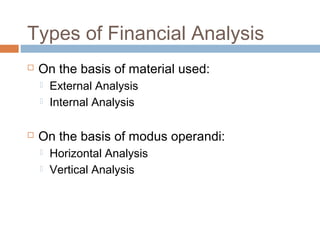
Types of Financial Analysis
 On the basis of material used:
 External Analysis
 Internal Analysis
 On the basis of modus operandi:
 Horizontal Analysis
 Vertical Analysis
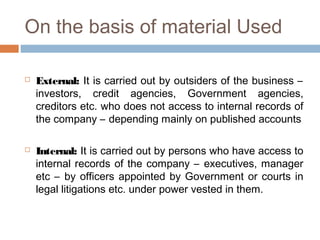
On the basis of material Used
 External: It is carried out by outsiders of the business –
investors, credit agencies, Government agencies,
creditors etc. who does not access to internal records of
the company – depending mainly on published accounts
 Internal: It is carried out by persons who have access to
internal records of the company – executives, manager
etc – by officers appointed by Government or courts in
legal litigations etc. under power vested in them.
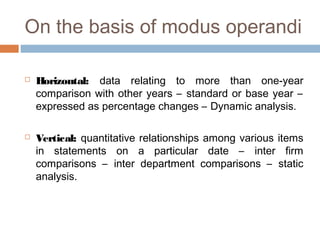
On the basis of modus operandi
 Horizontal: data relating to more than one-year
comparison with other years – standard or base year –
expressed as percentage changes – Dynamic analysis.
 Vertical: quantitative relationships among various items
in statements on a particular date – inter firm
comparisons – inter department comparisons – static
analysis.
20X2 20X1
Change
Amount Percentage
0
0
0 0 0
0
0 0 0
0
0 0 0
0
0 0 0
Selling and Administrative Expenses
Net Sales
Cost ofGoods Sold
Gross Profit
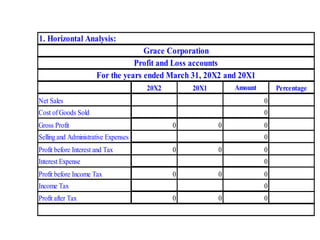
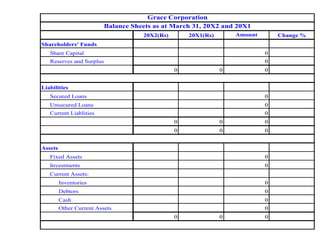
1. Horizontal Analysis:
Profit before Interest and Tax
Income Tax
Grace Corporation
Profit and Loss accounts
For the years ended March 31, 20X2 and 20X1
Interest Expense
Profit before Income Tax
Profit after Tax
20X2(Rs) 20X1(Rs) Amount Change %
0
0
0 0 0
0
0
0
0 0 0
0 0 0
0
0
0
0
0
0
0 0 0
Current Assets:
Assets
Cash
Inventories
Debtors
Other Current Assets
Grace Corporation
Fixed Assets
Investments
Current Liablities
Reserves and Surplus
Secured Loans
Unsecured Loans
Balance Sheets as at March 31, 20X2 and 20X1
Share Capital
Shareholders' Funds
Liabilities
20X2 (Rs) 20X1 (Rs) 20X2 (%) 20X1 (%)
0 0 0 0
0 0 0 0
0 0 0 0
0 0 0 0
Net Sales
Cost of Goods Sold
Gross Profit
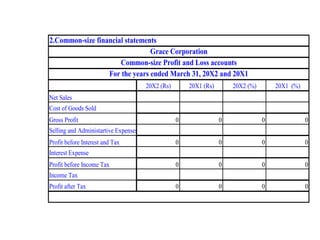
2.Common-size financial statements
Grace Corporation
Common-size Profit and Loss accounts
For the years ended March 31, 20X2 and 20X1
Selling and Administartive Expenses
Profit before Interest and Tax
Interest Expense
Profit before Income Tax
Income Tax
Profit after Tax
20X2(Rs) 20X1(Rs) 20X2 (%) 20X1(%)
0 0 0 0
0 0 0 0
0 0 0 0
0 0 0 0
0 0 0 0
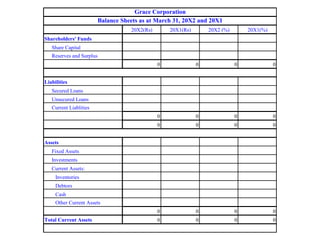
Balance Sheets as at March 31, 20X2 and 20X1
Grace Corporation
Liabilities
Share Capital
Reserves and Surplus
Shareholders' Funds
Inventories
Assets
Secured Loans
Unsecured Loans
Current Liablities
Total Current Assets
Debtors
Cash
Other Current Assets
Fixed Assets
Investments
Current Assets:
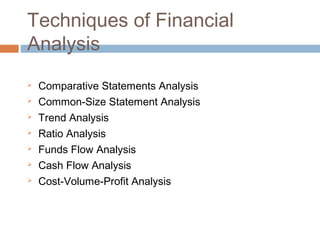
Techniques of Financial
Analysis
 Comparative Statements Analysis
 Common-Size Statement Analysis
 Trend Analysis
 Ratio Analysis
 Funds Flow Analysis
 Cash Flow Analysis
 Cost-Volume-Profit Analysis
Comparative Statement Analysis
 Comparative financial statements are useful in
analyzing the changes over time.
 They carry data relating to two or more years and
facilitate the comparison of an item with previous
years and even the future figures may be projected
using time series / regression analysis.
 The two comparative statements are:
1. Balance Sheet
2. Income Statement
Illustration
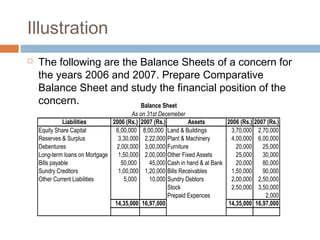
 The following are the Balance Sheets of a concern for
the years 2006 and 2007. Prepare Comparative
Balance Sheet and study the financial position of the
concern.
Liabilities 2006 (Rs.) 2007 (Rs.) Assets 2006 (Rs.) 2007 (Rs.)
Equity Share Capital 6,00,000 8,00,000 Land & Buildings 3,70,000 2,70,000
Reserves & Surplus 3,30,000 2,22,000 Plant & Machinery 4,00,000 6,00,000
Debentures 2,00l,000 3,00,000 Furniture 20,000 25,000
Long-term loans on Mortgage 1,50,000 2,00,000 Other Fixed Assets 25,000 30,000
Bills payable 50,000 45,000 Cash in hand & at Bank 20,000 80,000
Sundry Creditors 1,00,000 1,20,000 Bills Receivables 1,50,000 90,000
Other Current Liabilities 5,000 10,000 Sundry Debtors 2,00,000 2,50,000
Stock 2,50,000 3,50,000
Prepaid Expences 2,000
14,35,000 16,97,000 14,35,000 16,97,000
Balance Sheet
As on 31st Decemeber
Guidelines for interpretation of Comparative Balance
Sheet
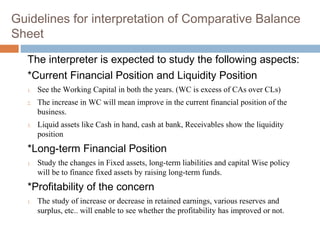
The interpreter is expected to study the following aspects:
*Current Financial Position and Liquidity Position
1. See the Working Capital in both the years. (WC is excess of CAs over CLs)
2. The increase in WC will mean improve in the current financial position of the
business.
3. Liquid assets like Cash in hand, cash at bank, Receivables show the liquidity
position
*Long-term Financial Position
1. Study the changes in Fixed assets, long-term liabilities and capital Wise policy
will be to finance fixed assets by raising long-term funds.
*Profitability of the concern
1. The study of increase or decrease in retained earnings, various reserves and
surplus, etc.. will enable to see whether the profitability has improved or not.
Increase/
Decrease
(Amount)
Rs
Increase/D
ecrease
(%)
2006 (Rs) 2007(Rs)
ASSETS
Current Assets:
Cash in hand & at Bank 20,000 80,000 60,000 300
Bills Receivables 1,50,000 90,000 -60,000 -40
Sundry Debtors 2,00,000 2,50,000 50,000 25
Stock 2,50,000 3,50,000 1,00,000 40
Prepaid Expences 2,000 2,000
Total Current Assets 6,20,000 7,72,000 1,52,000 24.52
Fixed Assets:
Land & Buildings 3,70,000 2,70,000 - 1,00,000 -27.03
Plant & Machinery 4,00,000 6,00,000 2,00,000 50
Furniture 20,000 25,000 5,000 25
Other Fixed Assets 25,000 30,000 5,000 20
Total Fixed Assets 8,15,000 9,25,000 1,10,000 13.49
Total Assets 14,35,000 16,97,000 2,62,000 18.26
LIABILITIES & CAPITAL
Current Liabilities:
Bills payable 50,000 45,000 -5,000 -10
Sundry Creditors 1,00,000 1,20,000 20,000 20
Other Current Liabilities 5,000 10,000 5,000 100
Total Current Liabilities 1,55,000 1,75,000 20,000 12.9
Debentures 2,00l,000 3,00,000 1,00,000 50
Long-term loans on Mortgage 1,50,000 2,00,000 50,000 33
Total Liabilities 5,05,000 6,75,000 1,70,000 33.66
Equity Share Capital 6,00,000 8,00,000 2,00,000 33
Reserves & Surplus 3,30,000 2,22,000 -1,08,000 -32.73
Total 14,35,000 16,97,000 2,62,000 18.26
Year ending 31 Dec.
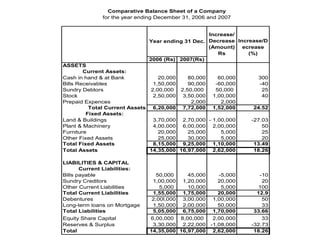
Comparative Balance Sheet of a Company
for the year ending December 31, 2006 and 2007
Illustration
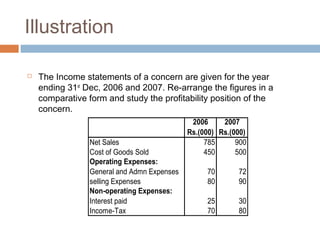
 The Income statements of a concern are given for the year
ending 31st
Dec, 2006 and 2007. Re-arrange the figures in a
comparative form and study the profitability position of the
concern.
2006
Rs.(000)
2007
Rs.(000)
Net Sales 785 900
Cost of Goods Sold 450 500
Operating Expenses:
General and Admn Expenses 70 72
selling Expenses 80 90
Non-operating Expenses:
Interest paid 25 30
Income-Tax 70 80
Common-Size Statement
Analysis
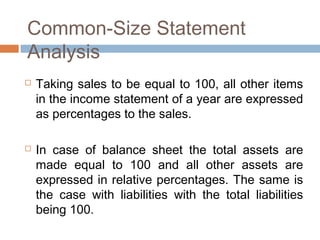
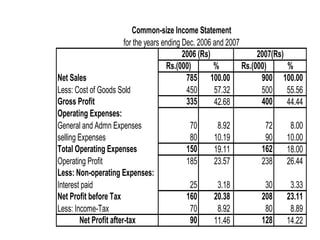
 Taking sales to be equal to 100, all other items
in the income statement of a year are expressed
as percentages to the sales.
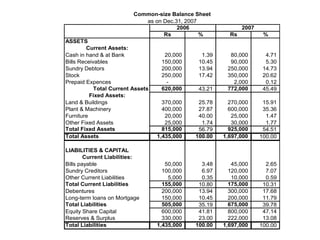
 In case of balance sheet the total assets are
made equal to 100 and all other assets are
expressed in relative percentages. The same is
the case with liabilities with the total liabilities
being 100.
Rs % Rs %
ASSETS
Current Assets:
Cash in hand & at Bank 20,000 1.39 80,000 4.71
Bills Receivables 150,000 10.45 90,000 5.30
Sundry Debtors 200,000 13.94 250,000 14.73
Stock 250,000 17.42 350,000 20.62
Prepaid Expences - 2,000 0.12
Total Current Assets 620,000 43.21 772,000 45.49
Fixed Assets:
Land & Buildings 370,000 25.78 270,000 15.91
Plant & Machinery 400,000 27.87 600,000 35.36
Furniture 20,000 40.00 25,000 1.47
Other Fixed Assets 25,000 1.74 30,000 1.77
Total Fixed Assets 815,000 56.79 925,000 54.51
Total Assets 1,435,000 100.00 1,697,000 100.00
LIABILITIES & CAPITAL
Current Liabilities:
Bills payable 50,000 3.48 45,000 2.65
Sundry Creditors 100,000 6.97 120,000 7.07
Other Current Liabilities 5,000 0.35 10,000 0.59
Total Current Liabilities 155,000 10.80 175,000 10.31
Debentures 200,000 13.94 300,000 17.68
Long-term loans on Mortgage 150,000 10.45 200,000 11.79
Total Liabilities 505,000 35.19 675,000 39.78
Equity Share Capital 600,000 41.81 800,000 47.14
Reserves & Surplus 330,000 23.00 222,000 13.08
Total Liabilities 1,435,000 100.00 1,697,000 100.00
2006 2007
Common-size Balance Sheet
as on Dec.31, 2007
Rs.(000) % Rs.(000) %
Net Sales 785 100.00 900 100.00
Less: Cost of Goods Sold 450 57.32 500 55.56
Gross Profit 335 42.68 400 44.44
Operating Expenses:
General and Admn Expenses 70 8.92 72 8.00
selling Expenses 80 10.19 90 10.00
Total Operating Expenses 150 19.11 162 18.00
Operating Profit 185 23.57 238 26.44
Less: Non-operating Expenses:
Interest paid 25 3.18 30 3.33
Net Profit before Tax 160 20.38 208 23.11
Less: Income-Tax 70 8.92 80 8.89
Net Profit after-tax 90 11.46 128 14.22
2006 (Rs) 2007(Rs)
Common-size Income Statement
for the years ending Dec. 2006 and 2007
Trend Analysis
 It determines the direction upwards or downwards.
 Under this analysis the values of an item in different
years is expressed in relation to the value in one
year called the base year.
 Taking the value of the item in the base year to be
equal to 100
 The values of the item in different years are
expressed as percentages to this value.
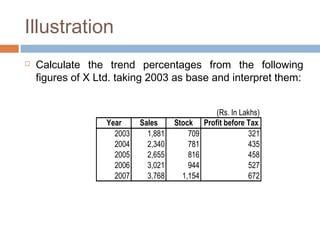
Illustration
 Calculate the trend percentages from the following
figures of X Ltd. taking 2003 as base and interpret them:
(Rs. In Lakhs)
Year Sales Stock Profit before Tax
2003 1,881 709 321
2004 2,340 781 435
2005 2,655 816 458
2006 3,021 944 527
2007 3,768 1,154 672
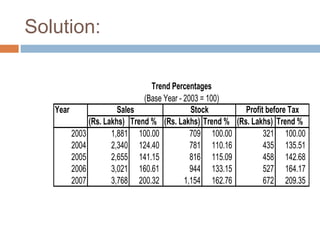
Solution:
Year
(Rs. Lakhs) Trend % (Rs. Lakhs) Trend % (Rs. Lakhs) Trend %
2003 1,881 100.00 709 100.00 321 100.00
2004 2,340 124.40 781 110.16 435 135.51
2005 2,655 141.15 816 115.09 458 142.68
2006 3,021 160.61 944 133.15 527 164.17
2007 3,768 200.32 1,154 162.76 672 209.35
Sales Stock Profit before Tax
Trend Percentages
(Base Year - 2003 = 100)
Ratio Analysis
 A ratio is an arithmetic relationship between two
figures.
 Financial ratio analysis is a study of ratios
between various items or group of items in
financial statements.
Types of Ratios
 Profitability Ratios
 Activity Ratios/ Turnover Ratios
 Solvency Ratios/Leverage Ratios
 Liquidity Ratios
Profitability Ratios
 Earning Per Share (EPS)
 Dividend Per Share (DPS)
 Payout Ratio
 Retention Ratio
 Return On Capital Employed (ROCE) / Return
on Investment (ROI)
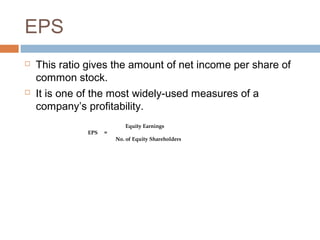
EPS
 This ratio gives the amount of net income per share of
common stock.
 It is one of the most widely-used measures of a
company’s profitability.
Equity Earnings
EPS =
No. of Equity Shareholders
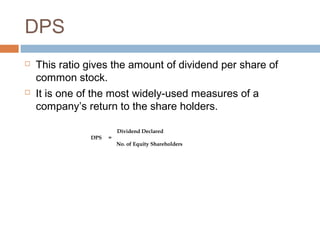
DPS
 This ratio gives the amount of dividend per share of
common stock.
 It is one of the most widely-used measures of a
company’s return to the share holders.
Dividend Declared
DPS =
No. of Equity Shareholders
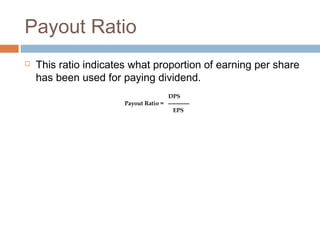
Payout Ratio
 This ratio indicates what proportion of earning per share
has been used for paying dividend.
DPS
Payout Ratio = -----------
EPS
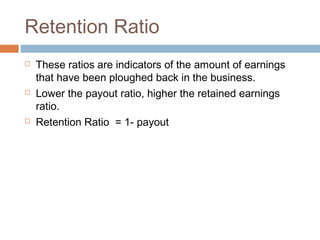
Retention Ratio
 These ratios are indicators of the amount of earnings
that have been ploughed back in the business.
 Lower the payout ratio, higher the retained earnings
ratio.
 Retention Ratio = 1- payout
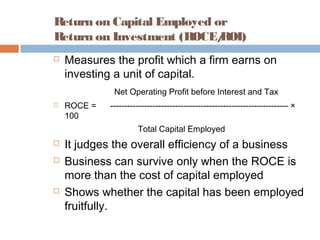
Return on Capital Employed or
Return on Investment (ROCE/ROI)
 Measures the profit which a firm earns on
investing a unit of capital.
Net Operating Profit before Interest and Tax
 ROCE = --------------------------------------------------------------- ×
100
Total Capital Employed
 It judges the overall efficiency of a business
 Business can survive only when the ROCE is
more than the cost of capital employed
 Shows whether the capital has been employed
fruitfully.

Financial statement analysis types & techniques

  • 1.
    FINANCIAL STATEMENT ANALYSIS By Dr.B. Krishna Reddy Professor and Head_SKIM
  • 2.
    Financial Analysis  Financialanalysis is the process of identifying the financial strengths and weaknesses of the firm by property establishing relationships between the item of the balance sheet and the profit and loss account.
  • 3.
     The term‘financial analysis’ is also known as ‘analysis and interpretation of financial statements’, refers to the process of determining financial strengths and weaknesses of the firm by establishing strategic relationship between the items of the balance sheet, P&L A/c and other operative data.  Financial Statement Analysis means “Analysis, comparisons and interpretation of Financial data to achieve the desired result”
  • 4.
    USERS OF FINANCIAL ANALYSIS Trade creditors  Suppliers of long-term debt  Investors  Management
  • 5.
    Need for FinancialStatements  Profit and Loss Account & Balance Sheet  To know financial conditions  To know profitability Position  To know Operating efficiency of the firm
  • 6.
    Objectives of FinancialAnalysis  Resources using most efficiently & effectively  Honour its current obligations  Debt servicing ability & fulfilment of long term obligations  Financial risk does the firm undertake  Business Risk  Earnings and stable and adequate  Profit retention policy  Dividend obligations  Predicting growth rates of income, revenue and
  • 7.
    Why Financial Statement Analysis? Mere a glance of the financial accounts of a company does not provide useful information simply because they are raw in nature.  The information provided in the financial statements is not an end in itself as no meaningful conclusions can be drawn from these statements alone.  A proper analysis and interpretation of financial statement can provide valuable insights into a firm’s performance.  It enables investors and creditors to:  Evaluate past performance and financial position  Predict future performance
  • 8.
    Types of FinancialAnalysis  On the basis of material used:  External Analysis  Internal Analysis  On the basis of modus operandi:  Horizontal Analysis  Vertical Analysis
  • 9.
    On the basisof material Used  External: It is carried out by outsiders of the business – investors, credit agencies, Government agencies, creditors etc. who does not access to internal records of the company – depending mainly on published accounts  Internal: It is carried out by persons who have access to internal records of the company – executives, manager etc – by officers appointed by Government or courts in legal litigations etc. under power vested in them.
  • 10.
    On the basisof modus operandi  Horizontal: data relating to more than one-year comparison with other years – standard or base year – expressed as percentage changes – Dynamic analysis.  Vertical: quantitative relationships among various items in statements on a particular date – inter firm comparisons – inter department comparisons – static analysis.
  • 11.
    20X2 20X1 Change Amount Percentage 0 0 00 0 0 0 0 0 0 0 0 0 0 0 0 0 Selling and Administrative Expenses Net Sales Cost ofGoods Sold Gross Profit 1. Horizontal Analysis: Profit before Interest and Tax Income Tax Grace Corporation Profit and Loss accounts For the years ended March 31, 20X2 and 20X1 Interest Expense Profit before Income Tax Profit after Tax
  • 12.
    20X2(Rs) 20X1(Rs) AmountChange % 0 0 0 0 0 0 0 0 0 0 0 0 0 0 0 0 0 0 0 0 0 0 0 Current Assets: Assets Cash Inventories Debtors Other Current Assets Grace Corporation Fixed Assets Investments Current Liablities Reserves and Surplus Secured Loans Unsecured Loans Balance Sheets as at March 31, 20X2 and 20X1 Share Capital Shareholders' Funds Liabilities
  • 13.
    20X2 (Rs) 20X1(Rs) 20X2 (%) 20X1 (%) 0 0 0 0 0 0 0 0 0 0 0 0 0 0 0 0 Net Sales Cost of Goods Sold Gross Profit 2.Common-size financial statements Grace Corporation Common-size Profit and Loss accounts For the years ended March 31, 20X2 and 20X1 Selling and Administartive Expenses Profit before Interest and Tax Interest Expense Profit before Income Tax Income Tax Profit after Tax
  • 14.
    20X2(Rs) 20X1(Rs) 20X2(%) 20X1(%) 0 0 0 0 0 0 0 0 0 0 0 0 0 0 0 0 0 0 0 0 Balance Sheets as at March 31, 20X2 and 20X1 Grace Corporation Liabilities Share Capital Reserves and Surplus Shareholders' Funds Inventories Assets Secured Loans Unsecured Loans Current Liablities Total Current Assets Debtors Cash Other Current Assets Fixed Assets Investments Current Assets:
  • 15.
    Techniques of Financial Analysis Comparative Statements Analysis  Common-Size Statement Analysis  Trend Analysis  Ratio Analysis  Funds Flow Analysis  Cash Flow Analysis  Cost-Volume-Profit Analysis
  • 16.
    Comparative Statement Analysis Comparative financial statements are useful in analyzing the changes over time.  They carry data relating to two or more years and facilitate the comparison of an item with previous years and even the future figures may be projected using time series / regression analysis.  The two comparative statements are: 1. Balance Sheet 2. Income Statement
  • 17.
    Illustration  The followingare the Balance Sheets of a concern for the years 2006 and 2007. Prepare Comparative Balance Sheet and study the financial position of the concern. Liabilities 2006 (Rs.) 2007 (Rs.) Assets 2006 (Rs.) 2007 (Rs.) Equity Share Capital 6,00,000 8,00,000 Land & Buildings 3,70,000 2,70,000 Reserves & Surplus 3,30,000 2,22,000 Plant & Machinery 4,00,000 6,00,000 Debentures 2,00l,000 3,00,000 Furniture 20,000 25,000 Long-term loans on Mortgage 1,50,000 2,00,000 Other Fixed Assets 25,000 30,000 Bills payable 50,000 45,000 Cash in hand & at Bank 20,000 80,000 Sundry Creditors 1,00,000 1,20,000 Bills Receivables 1,50,000 90,000 Other Current Liabilities 5,000 10,000 Sundry Debtors 2,00,000 2,50,000 Stock 2,50,000 3,50,000 Prepaid Expences 2,000 14,35,000 16,97,000 14,35,000 16,97,000 Balance Sheet As on 31st Decemeber
  • 18.
    Guidelines for interpretationof Comparative Balance Sheet The interpreter is expected to study the following aspects: *Current Financial Position and Liquidity Position 1. See the Working Capital in both the years. (WC is excess of CAs over CLs) 2. The increase in WC will mean improve in the current financial position of the business. 3. Liquid assets like Cash in hand, cash at bank, Receivables show the liquidity position *Long-term Financial Position 1. Study the changes in Fixed assets, long-term liabilities and capital Wise policy will be to finance fixed assets by raising long-term funds. *Profitability of the concern 1. The study of increase or decrease in retained earnings, various reserves and surplus, etc.. will enable to see whether the profitability has improved or not.
  • 19.
    Increase/ Decrease (Amount) Rs Increase/D ecrease (%) 2006 (Rs) 2007(Rs) ASSETS CurrentAssets: Cash in hand & at Bank 20,000 80,000 60,000 300 Bills Receivables 1,50,000 90,000 -60,000 -40 Sundry Debtors 2,00,000 2,50,000 50,000 25 Stock 2,50,000 3,50,000 1,00,000 40 Prepaid Expences 2,000 2,000 Total Current Assets 6,20,000 7,72,000 1,52,000 24.52 Fixed Assets: Land & Buildings 3,70,000 2,70,000 - 1,00,000 -27.03 Plant & Machinery 4,00,000 6,00,000 2,00,000 50 Furniture 20,000 25,000 5,000 25 Other Fixed Assets 25,000 30,000 5,000 20 Total Fixed Assets 8,15,000 9,25,000 1,10,000 13.49 Total Assets 14,35,000 16,97,000 2,62,000 18.26 LIABILITIES & CAPITAL Current Liabilities: Bills payable 50,000 45,000 -5,000 -10 Sundry Creditors 1,00,000 1,20,000 20,000 20 Other Current Liabilities 5,000 10,000 5,000 100 Total Current Liabilities 1,55,000 1,75,000 20,000 12.9 Debentures 2,00l,000 3,00,000 1,00,000 50 Long-term loans on Mortgage 1,50,000 2,00,000 50,000 33 Total Liabilities 5,05,000 6,75,000 1,70,000 33.66 Equity Share Capital 6,00,000 8,00,000 2,00,000 33 Reserves & Surplus 3,30,000 2,22,000 -1,08,000 -32.73 Total 14,35,000 16,97,000 2,62,000 18.26 Year ending 31 Dec. Comparative Balance Sheet of a Company for the year ending December 31, 2006 and 2007
  • 20.
    Illustration  The Incomestatements of a concern are given for the year ending 31st Dec, 2006 and 2007. Re-arrange the figures in a comparative form and study the profitability position of the concern. 2006 Rs.(000) 2007 Rs.(000) Net Sales 785 900 Cost of Goods Sold 450 500 Operating Expenses: General and Admn Expenses 70 72 selling Expenses 80 90 Non-operating Expenses: Interest paid 25 30 Income-Tax 70 80
  • 21.
    Common-Size Statement Analysis  Takingsales to be equal to 100, all other items in the income statement of a year are expressed as percentages to the sales.  In case of balance sheet the total assets are made equal to 100 and all other assets are expressed in relative percentages. The same is the case with liabilities with the total liabilities being 100.
  • 22.
    Rs % Rs% ASSETS Current Assets: Cash in hand & at Bank 20,000 1.39 80,000 4.71 Bills Receivables 150,000 10.45 90,000 5.30 Sundry Debtors 200,000 13.94 250,000 14.73 Stock 250,000 17.42 350,000 20.62 Prepaid Expences - 2,000 0.12 Total Current Assets 620,000 43.21 772,000 45.49 Fixed Assets: Land & Buildings 370,000 25.78 270,000 15.91 Plant & Machinery 400,000 27.87 600,000 35.36 Furniture 20,000 40.00 25,000 1.47 Other Fixed Assets 25,000 1.74 30,000 1.77 Total Fixed Assets 815,000 56.79 925,000 54.51 Total Assets 1,435,000 100.00 1,697,000 100.00 LIABILITIES & CAPITAL Current Liabilities: Bills payable 50,000 3.48 45,000 2.65 Sundry Creditors 100,000 6.97 120,000 7.07 Other Current Liabilities 5,000 0.35 10,000 0.59 Total Current Liabilities 155,000 10.80 175,000 10.31 Debentures 200,000 13.94 300,000 17.68 Long-term loans on Mortgage 150,000 10.45 200,000 11.79 Total Liabilities 505,000 35.19 675,000 39.78 Equity Share Capital 600,000 41.81 800,000 47.14 Reserves & Surplus 330,000 23.00 222,000 13.08 Total Liabilities 1,435,000 100.00 1,697,000 100.00 2006 2007 Common-size Balance Sheet as on Dec.31, 2007
  • 23.
    Rs.(000) % Rs.(000)% Net Sales 785 100.00 900 100.00 Less: Cost of Goods Sold 450 57.32 500 55.56 Gross Profit 335 42.68 400 44.44 Operating Expenses: General and Admn Expenses 70 8.92 72 8.00 selling Expenses 80 10.19 90 10.00 Total Operating Expenses 150 19.11 162 18.00 Operating Profit 185 23.57 238 26.44 Less: Non-operating Expenses: Interest paid 25 3.18 30 3.33 Net Profit before Tax 160 20.38 208 23.11 Less: Income-Tax 70 8.92 80 8.89 Net Profit after-tax 90 11.46 128 14.22 2006 (Rs) 2007(Rs) Common-size Income Statement for the years ending Dec. 2006 and 2007
  • 24.
    Trend Analysis  Itdetermines the direction upwards or downwards.  Under this analysis the values of an item in different years is expressed in relation to the value in one year called the base year.  Taking the value of the item in the base year to be equal to 100  The values of the item in different years are expressed as percentages to this value.
  • 25.
    Illustration  Calculate thetrend percentages from the following figures of X Ltd. taking 2003 as base and interpret them: (Rs. In Lakhs) Year Sales Stock Profit before Tax 2003 1,881 709 321 2004 2,340 781 435 2005 2,655 816 458 2006 3,021 944 527 2007 3,768 1,154 672
  • 26.
    Solution: Year (Rs. Lakhs) Trend% (Rs. Lakhs) Trend % (Rs. Lakhs) Trend % 2003 1,881 100.00 709 100.00 321 100.00 2004 2,340 124.40 781 110.16 435 135.51 2005 2,655 141.15 816 115.09 458 142.68 2006 3,021 160.61 944 133.15 527 164.17 2007 3,768 200.32 1,154 162.76 672 209.35 Sales Stock Profit before Tax Trend Percentages (Base Year - 2003 = 100)
  • 27.
    Ratio Analysis  Aratio is an arithmetic relationship between two figures.  Financial ratio analysis is a study of ratios between various items or group of items in financial statements.
  • 28.
    Types of Ratios Profitability Ratios  Activity Ratios/ Turnover Ratios  Solvency Ratios/Leverage Ratios  Liquidity Ratios
  • 29.
    Profitability Ratios  EarningPer Share (EPS)  Dividend Per Share (DPS)  Payout Ratio  Retention Ratio  Return On Capital Employed (ROCE) / Return on Investment (ROI)
  • 30.
    EPS  This ratiogives the amount of net income per share of common stock.  It is one of the most widely-used measures of a company’s profitability. Equity Earnings EPS = No. of Equity Shareholders
  • 31.
    DPS  This ratiogives the amount of dividend per share of common stock.  It is one of the most widely-used measures of a company’s return to the share holders. Dividend Declared DPS = No. of Equity Shareholders
  • 32.
    Payout Ratio  Thisratio indicates what proportion of earning per share has been used for paying dividend. DPS Payout Ratio = ----------- EPS
  • 33.
    Retention Ratio  Theseratios are indicators of the amount of earnings that have been ploughed back in the business.  Lower the payout ratio, higher the retained earnings ratio.  Retention Ratio = 1- payout
  • 34.
    Return on CapitalEmployed or Return on Investment (ROCE/ROI)  Measures the profit which a firm earns on investing a unit of capital. Net Operating Profit before Interest and Tax  ROCE = --------------------------------------------------------------- × 100 Total Capital Employed  It judges the overall efficiency of a business  Business can survive only when the ROCE is more than the cost of capital employed  Shows whether the capital has been employed fruitfully.