UndertheGuidanceof:Miss.AFREEN BANU M.B
Project Coordinator: Asst.prof.Mrs.RATNA
Professor &HOD:Prof. NITYANANDA D M
Presentation on Phase-2
Presented by
AFSANABANU KALAS 2GO20CS001
GOURAMMA C 2GO20CS011
PRAMODA S 2GO20CS030
SANA MUDGAL 2GO21CS414
 INTRODUCTION
 AIM & OBJECTIVES
 LITERATURE SURVEY
 EXISTING SYSTEM
 PROPOSED SYSTEM
 SYSTEM ANALYSIS
 SYSTEM IMPLEMENTATION
 ADVANTAGES
 APPLICATIONS
 SYSTEM REQUIREMENT SPECIFICATION
 CONCLUSION
 REFERENCES
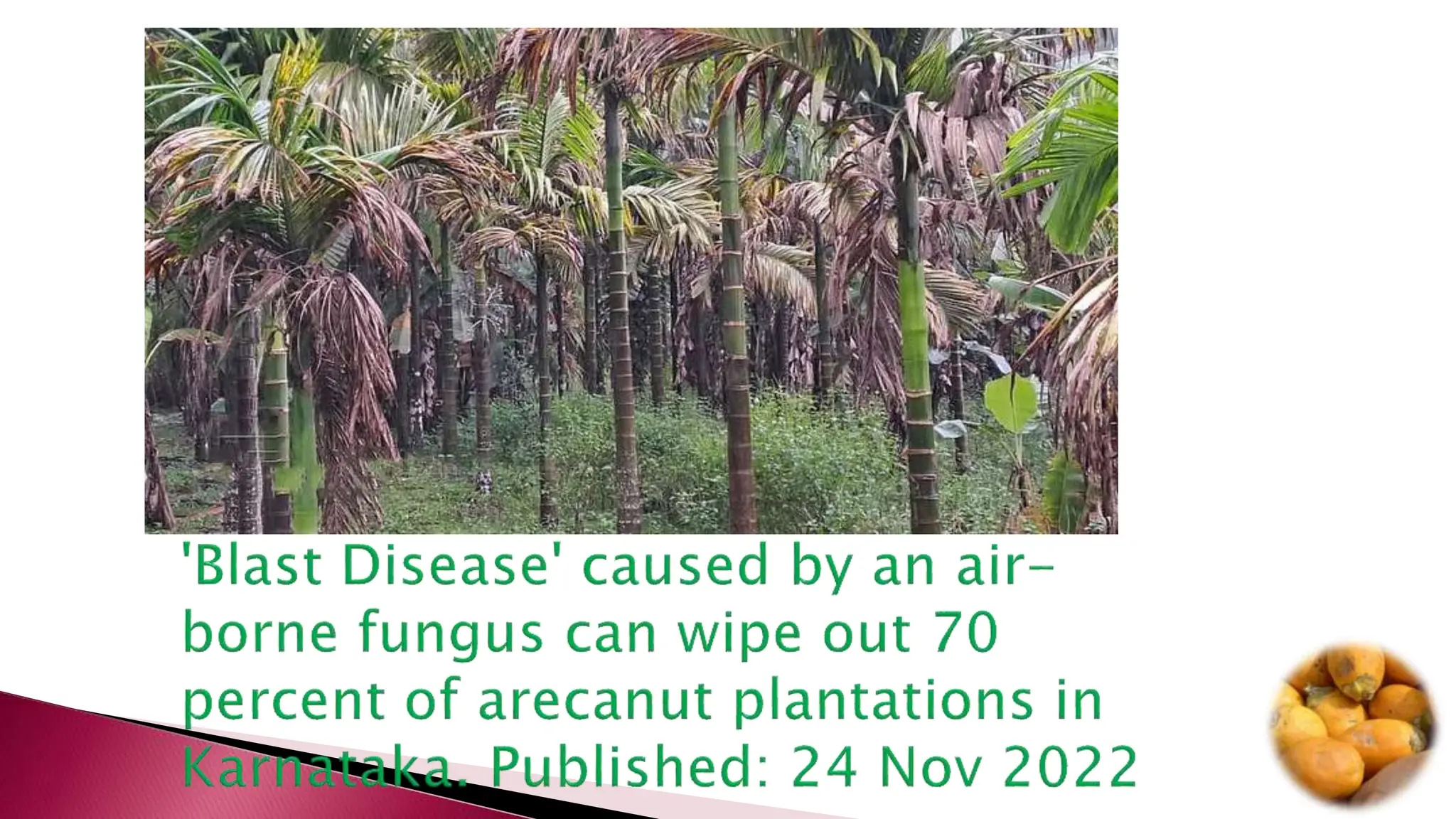
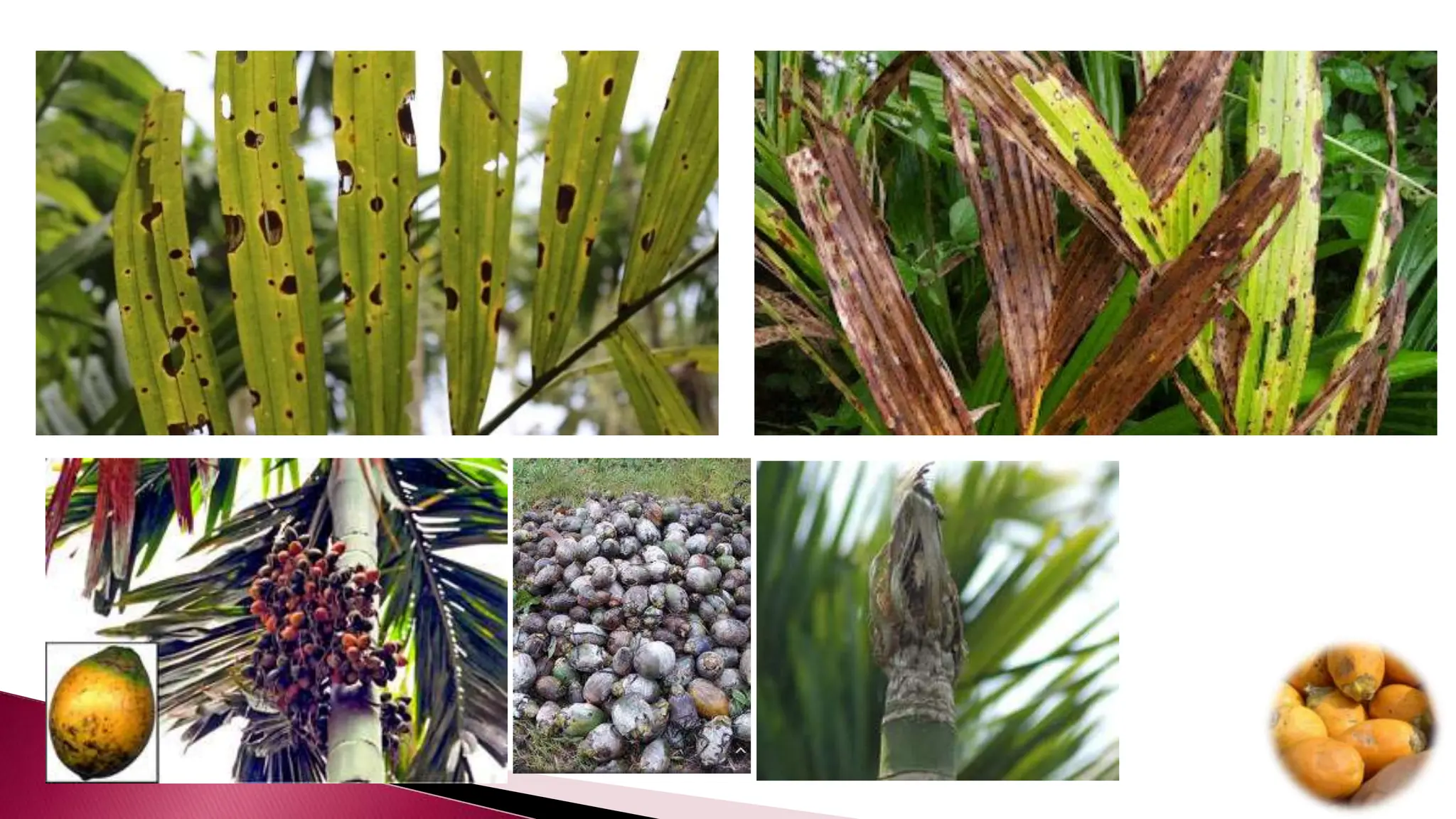
 Areca nut is an economically important crop in many tropical
regions .However , it is susceptible to various disease that
significantly reduce the yield and quality of nuts.
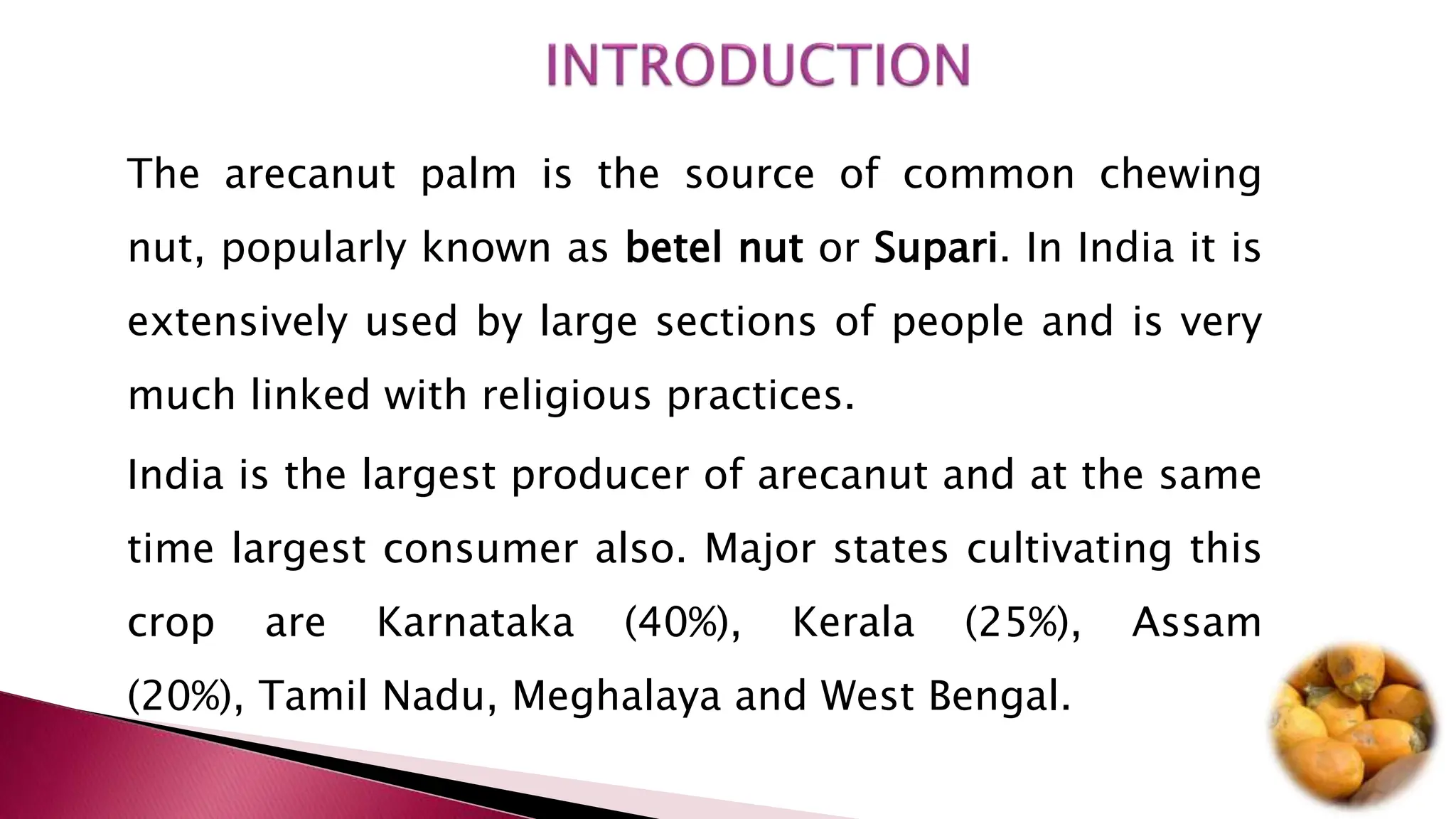
The arecanut palm is the source of common chewing
nut, popularly known as betel nut or Supari. In India it is
extensively used by large sections of people and is very
much linked with religious practices.
India is the largest producer of arecanut and at the same
time largest consumer also. Major states cultivating this
crop are Karnataka (40%), Kerala (25%), Assam
(20%), Tamil Nadu, Meghalaya and West Bengal.
Aim
The aim of the project is to detect the disease in arecanut fruit, Stem and leaves using Deep Learning
and Image processing techniques and finding the diseases.
Objectives
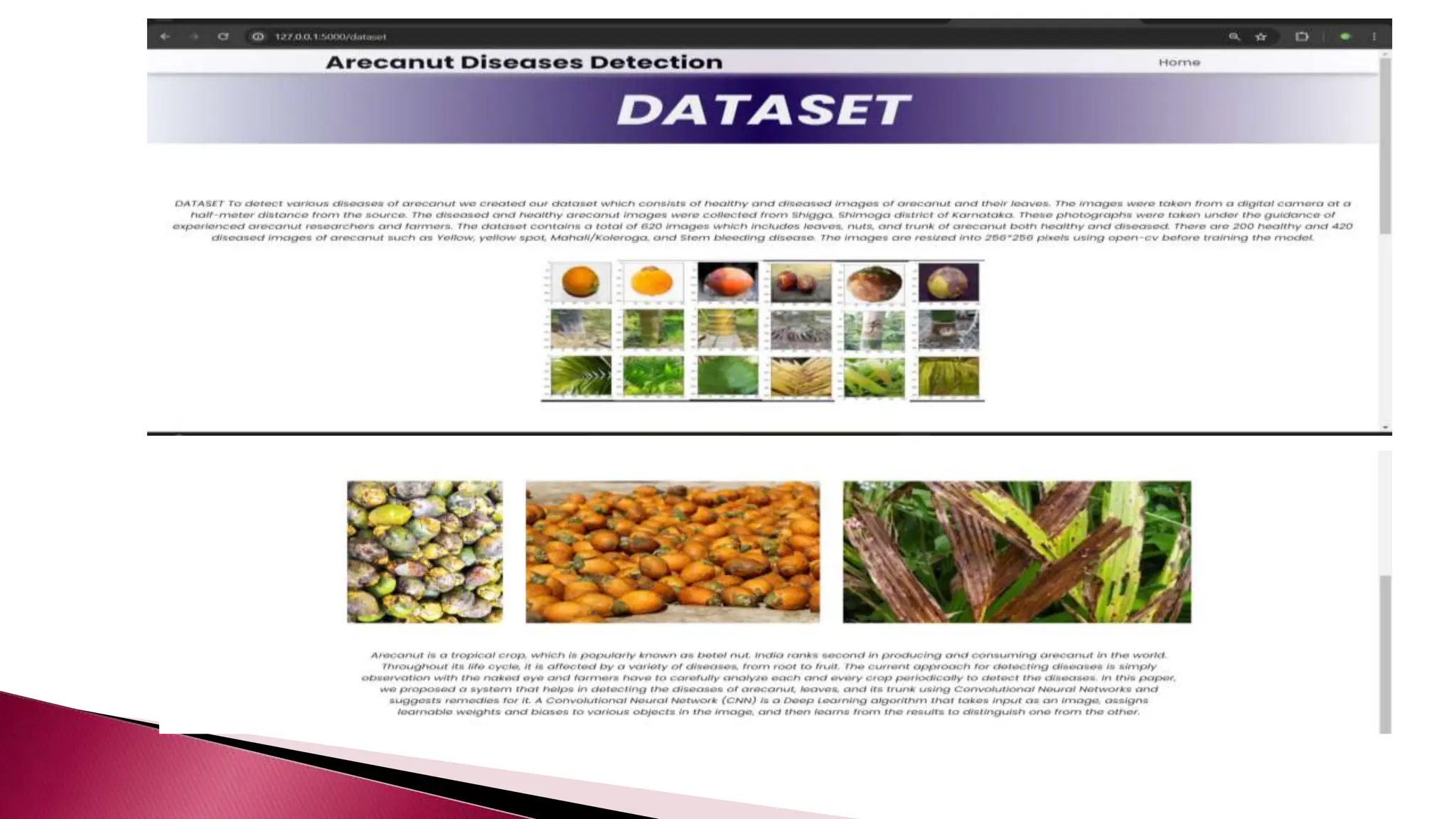
 To collect datasets that contain healthy and diseased images of arecanut and their leaves.
 Design and develop an algorithm for early detection of disease in arecanut that can avoid the
spreading of diseases.
 Develop a deep learning based algorithm like CNN, Rest Net, Efficient Net, that would suggest
solutions for the detected diseases.
 Developing a web application for early detection of disease, prediction and providing remedies to
the above solution.
 Visual Inspection: The traditional method involves manual examination
by agricultural experts or farmers to identify visual symptoms of diseases,
such as leaf discoloration, lesions, spots, or unusual patterns.
 Laboratory Techniques: These methods involve taking samples from
plants showing symptoms, culturing pathogens in a lab, and using
techniques like microscopy , PCR, ELISA, or DNA sequencing to identify
specific pathogens causing diseases.
 Image Processing: Utilizing cameras and image processing algorithms to
capture images of plants and then employing computer vision techniques,
machine learning, or deep learning to analyze these images for disease
symptoms. This method allows for automated and rapid analysis of large-
scale crops.
 Machine Learning: Creating machine learning platforms that integrate
various data sources to diagnose plant diseases.These systems
continuously learn and improve their accuracy over time.
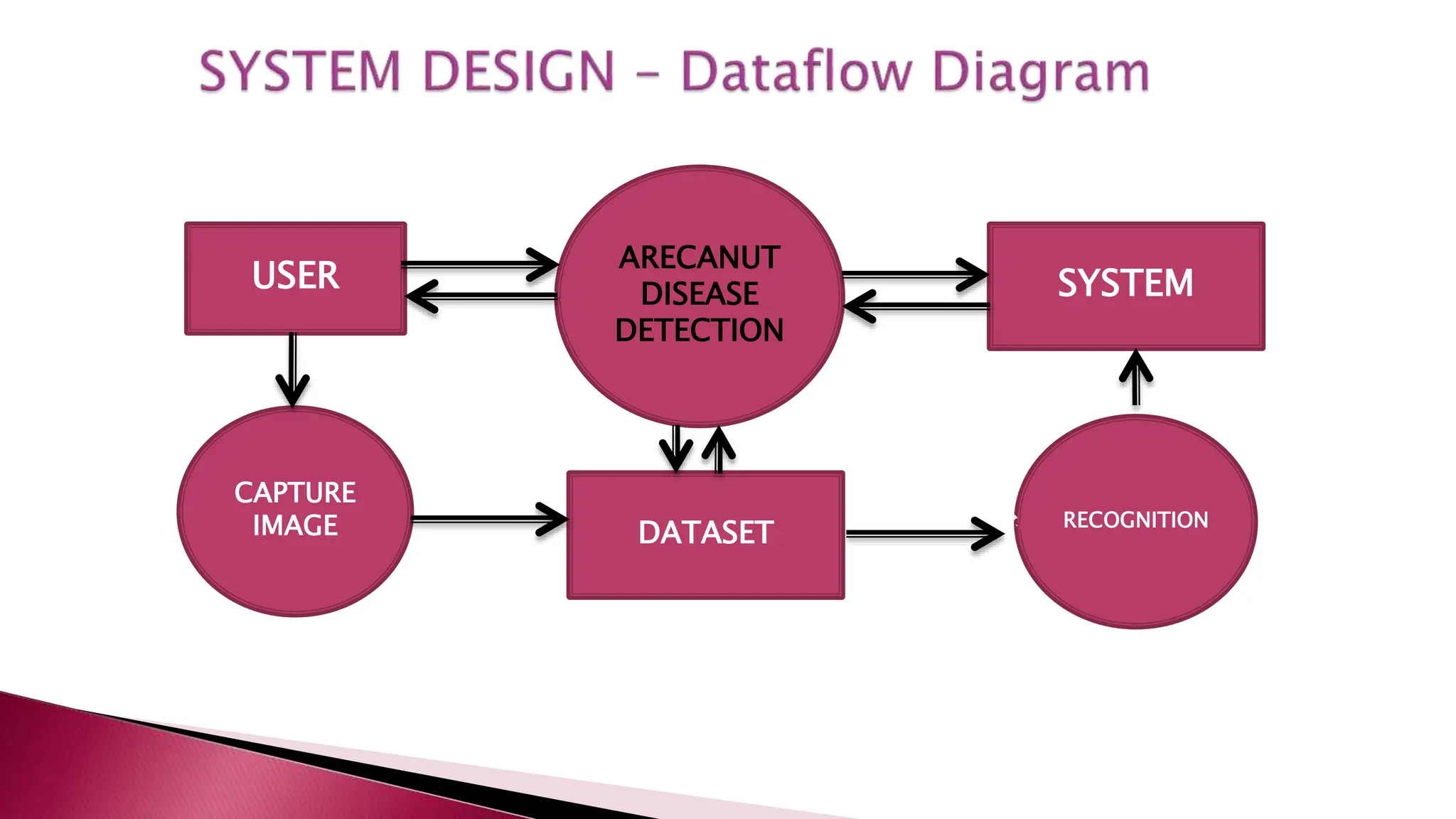
USER
CAPTURE
IMAGE
ARECANUT
DISEASE
DETECTION
DATASET
SYSTEM
RECOGNITION
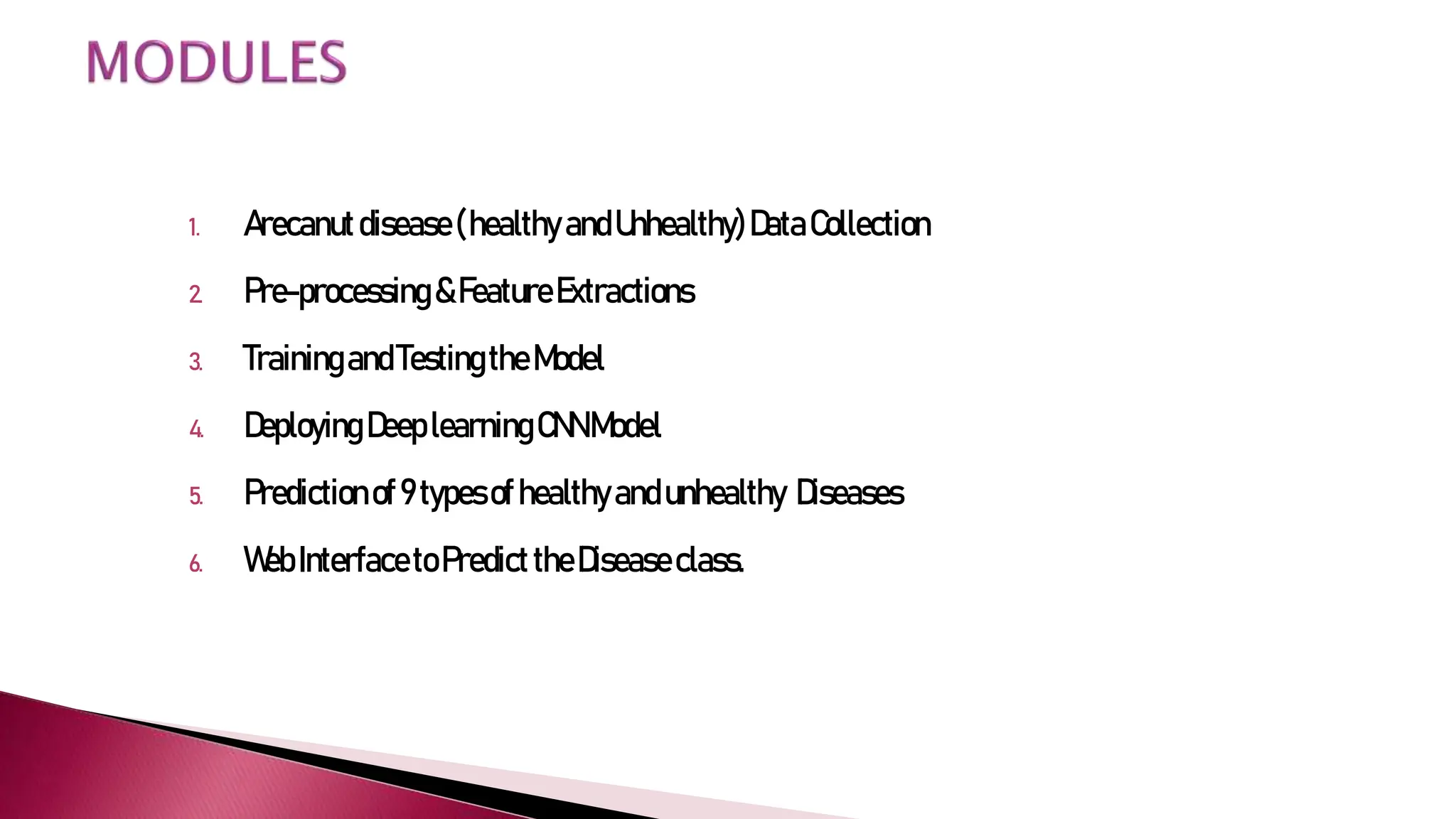
1. Arecanutdisease(healthyandUnhealthy)DataCollection
2. Pre-processing&FeatureExtractions
3. TrainingandTestingtheModel
4. DeployingDeeplearningCNNModel
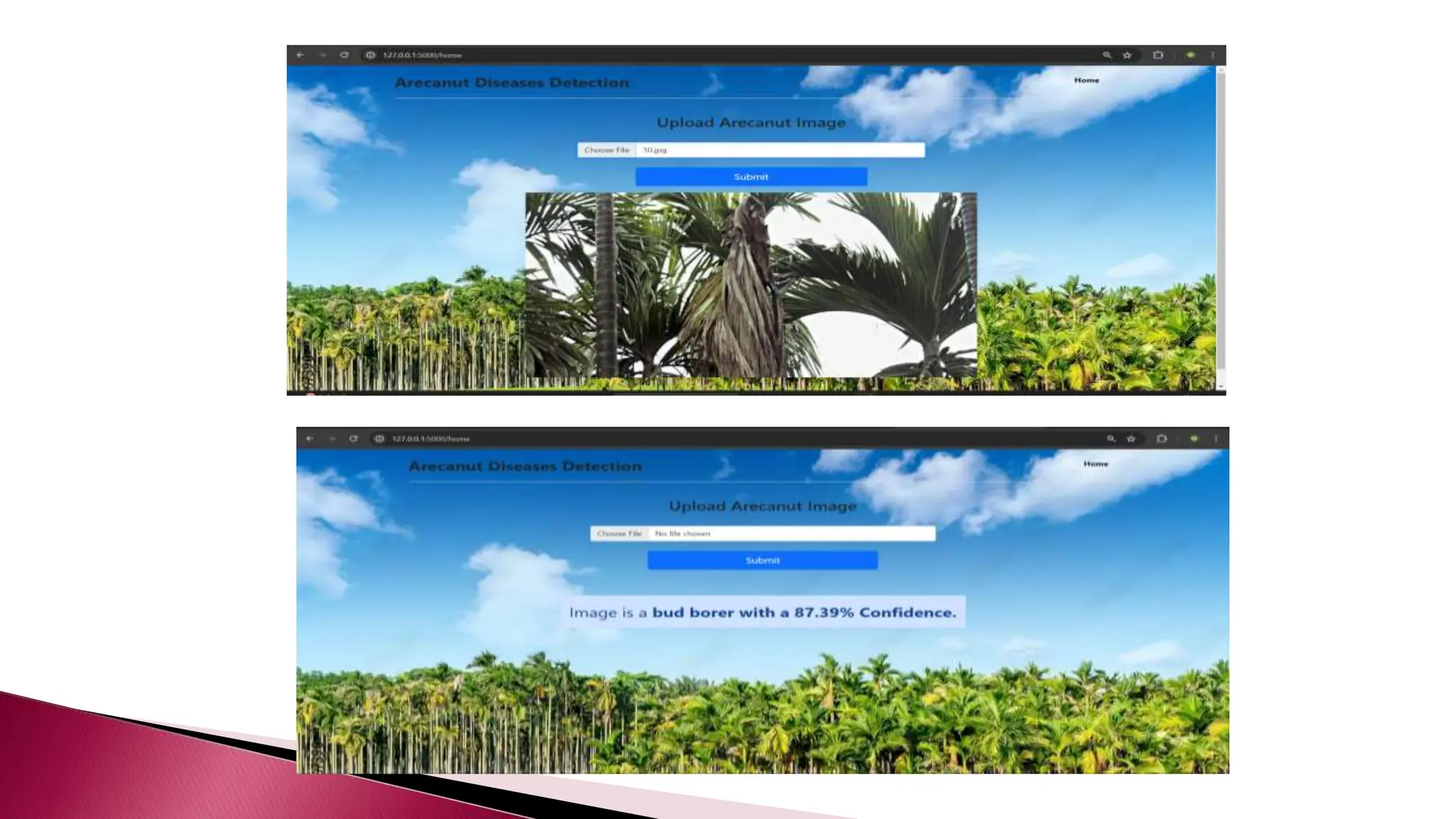
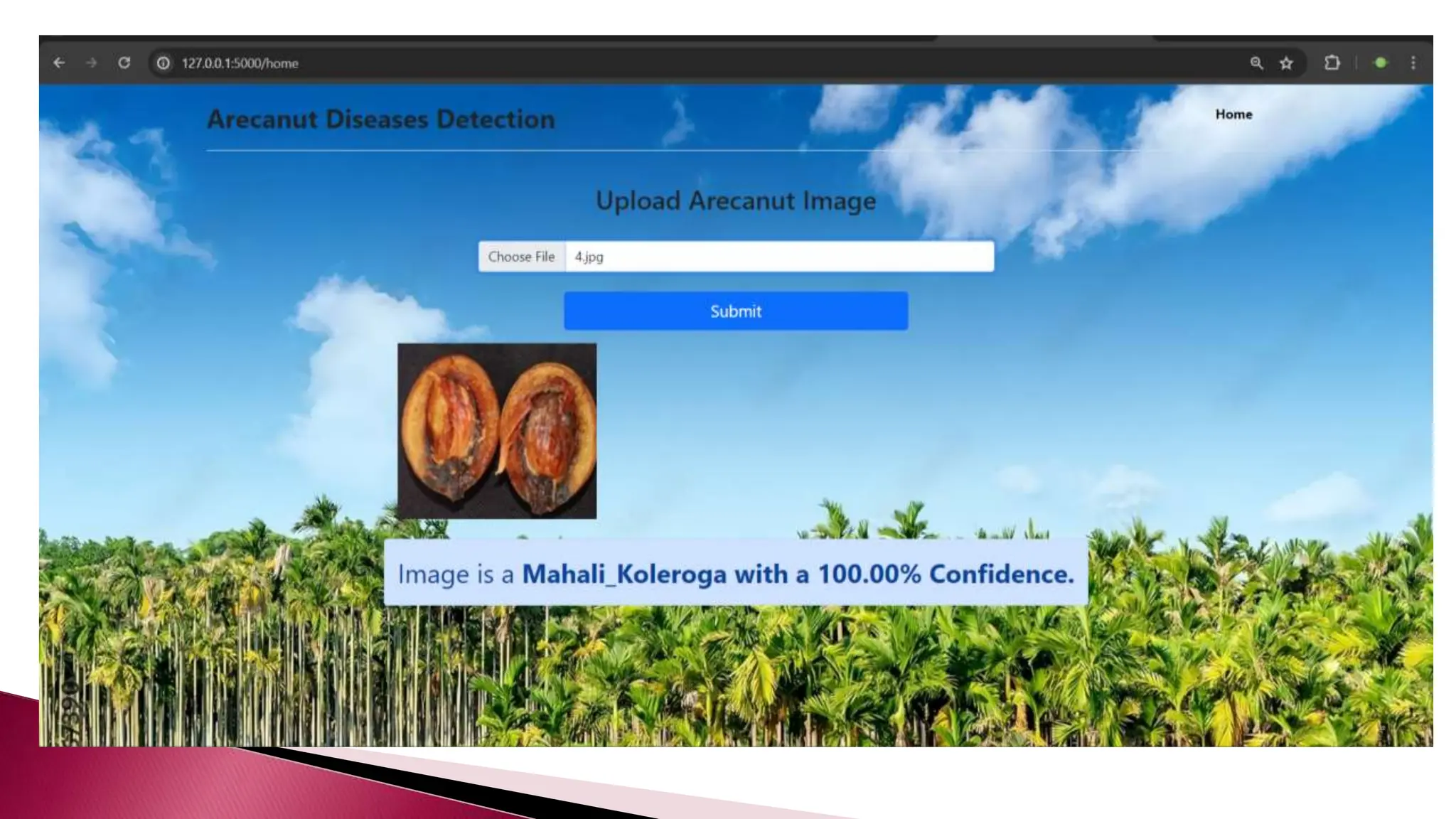
5. Predictionof9typesofhealthyandunhealthy Diseases
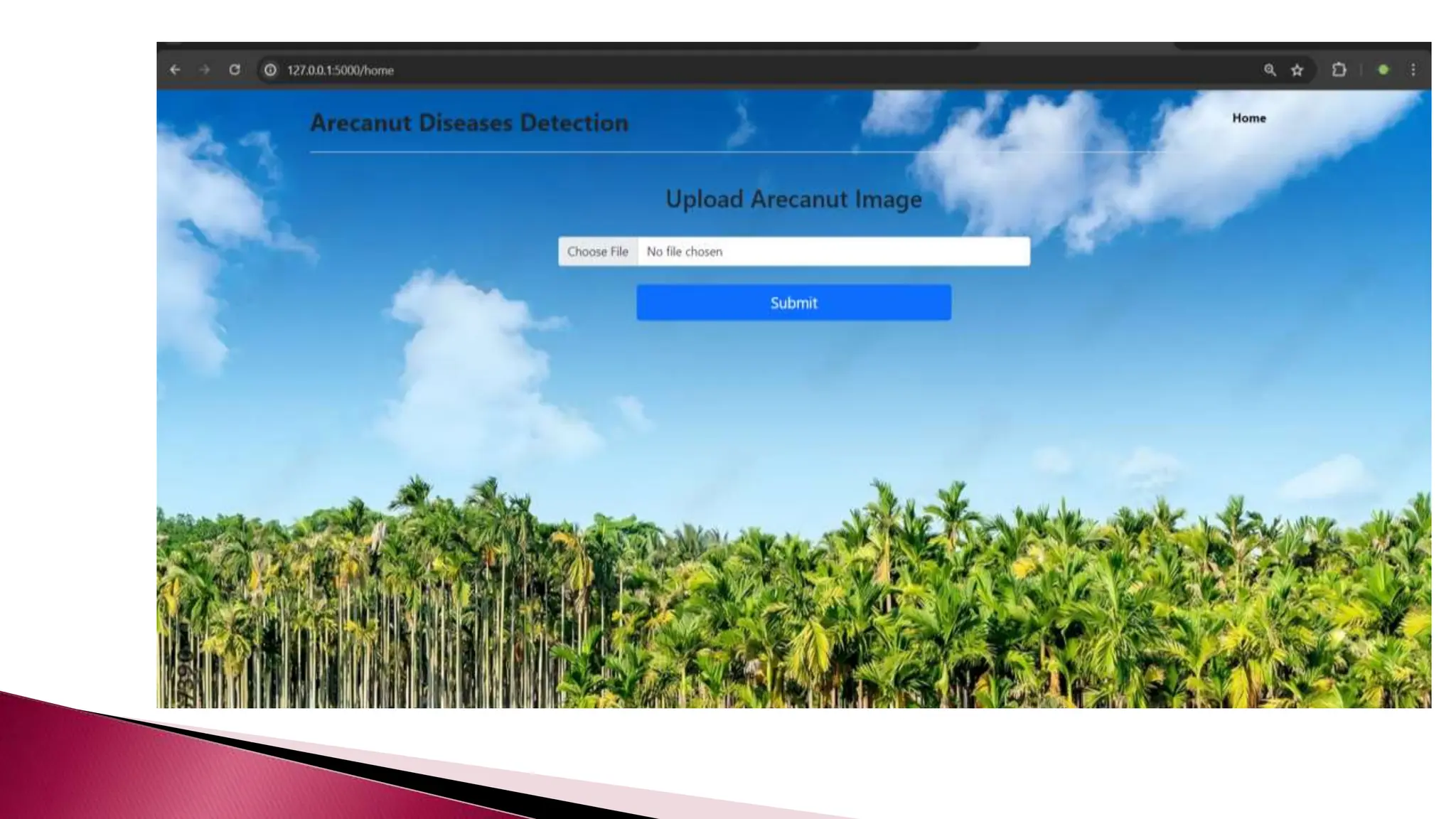
6. WebInterfacetoPredicttheDiseaseclass.
Importing the Package
Download the Dataset
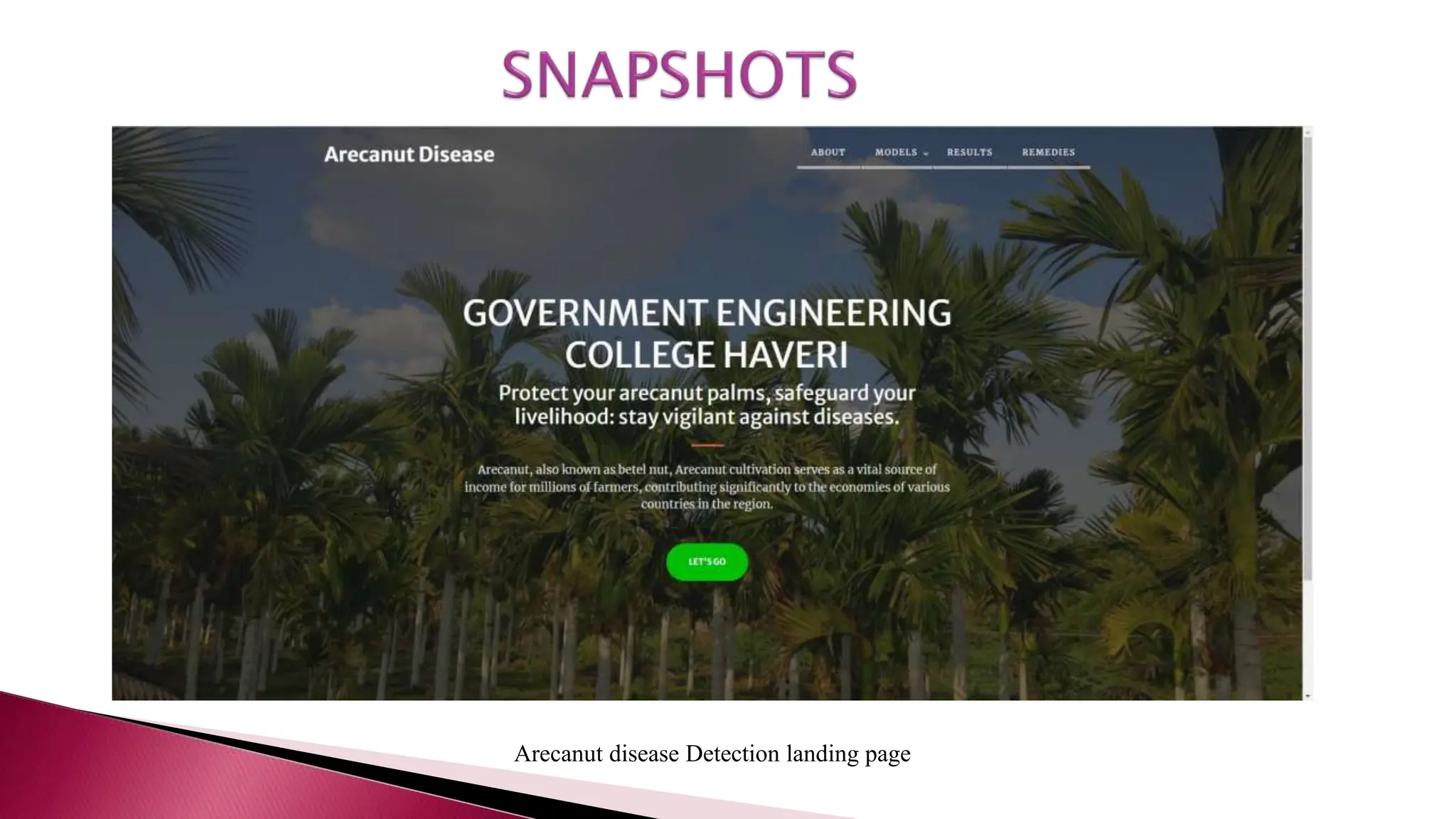
Arecanut disease Detection landing page
ADVANTAGES
Early Detection: Identifying diseases in their early stages allows for prompt action.
Preventative Measures: Early detection enables farmers to implement timely using specific
pesticides.
Reduced Crop Loss: By promptly diagnosing diseases, farmers can take appropriate steps.
Optimized Resource Use: Disease detection helps optimize resource utilization minimizing.
ADVANTAGES
APPLICATIONS
Areca nut disease detection has numerous applications across agriculture, environmental monitoring,
and research.
Early Disease Detection: Rapid identification of diseases allows for early intervention, preventing
widespread damage to crops. This early detection can help in the timely application of treatments or
management strategies.
Quarantine and Disease Control: Plant disease detection is crucial in quarantine procedures,
preventing the spread of diseases to new areas or regions.
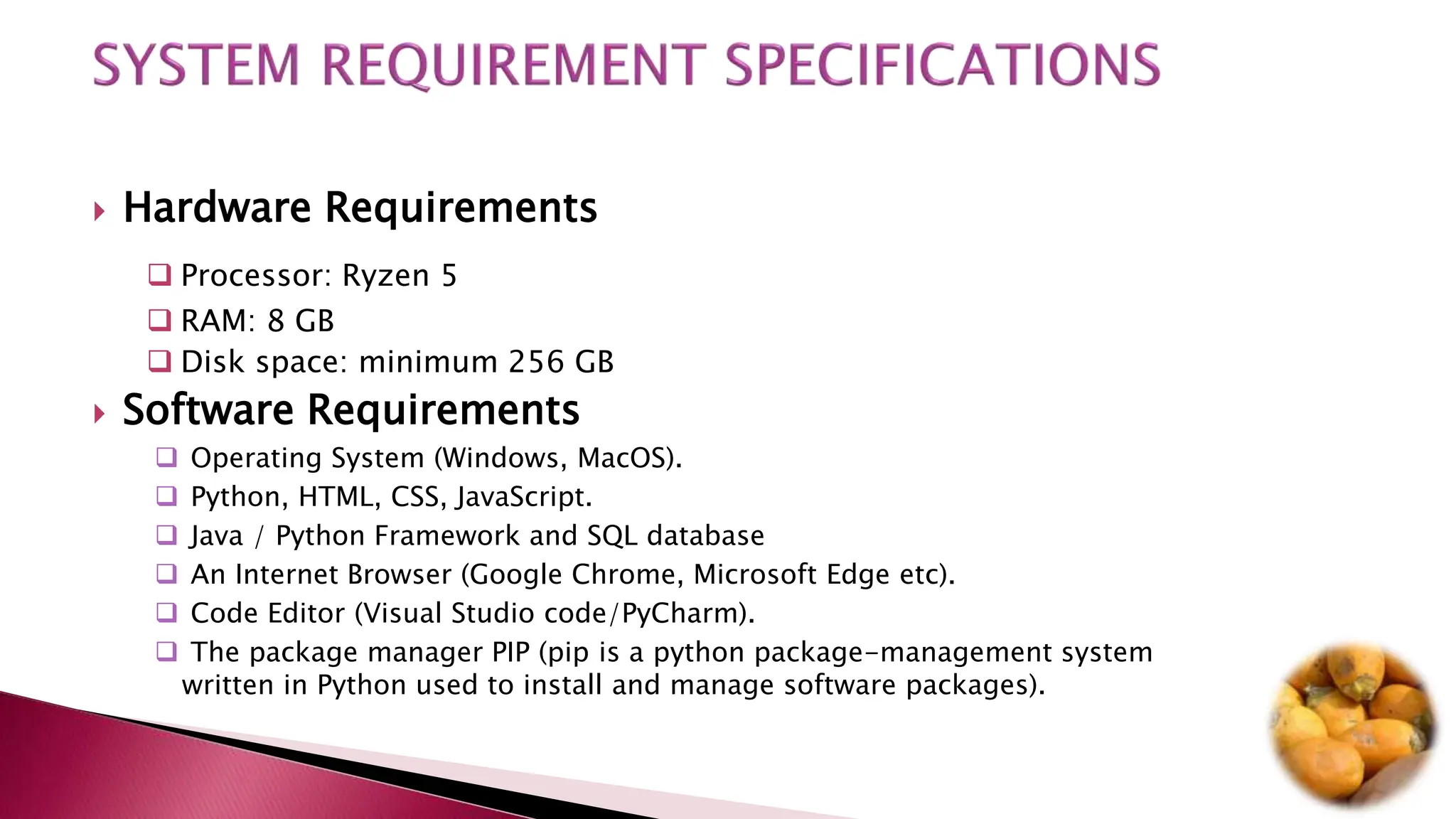
 Hardware Requirements
 Processor: Ryzen 5
 RAM: 8 GB
 Disk space: minimum 256 GB
 Software Requirements
 Operating System (Windows, MacOS).
 Python, HTML, CSS, JavaScript.
 Java / Python Framework and SQL database
 An Internet Browser (Google Chrome, Microsoft Edge etc).
 Code Editor (Visual Studio code/PyCharm).
 The package manager PIP (pip is a python package-management system
written in Python used to install and manage software packages).
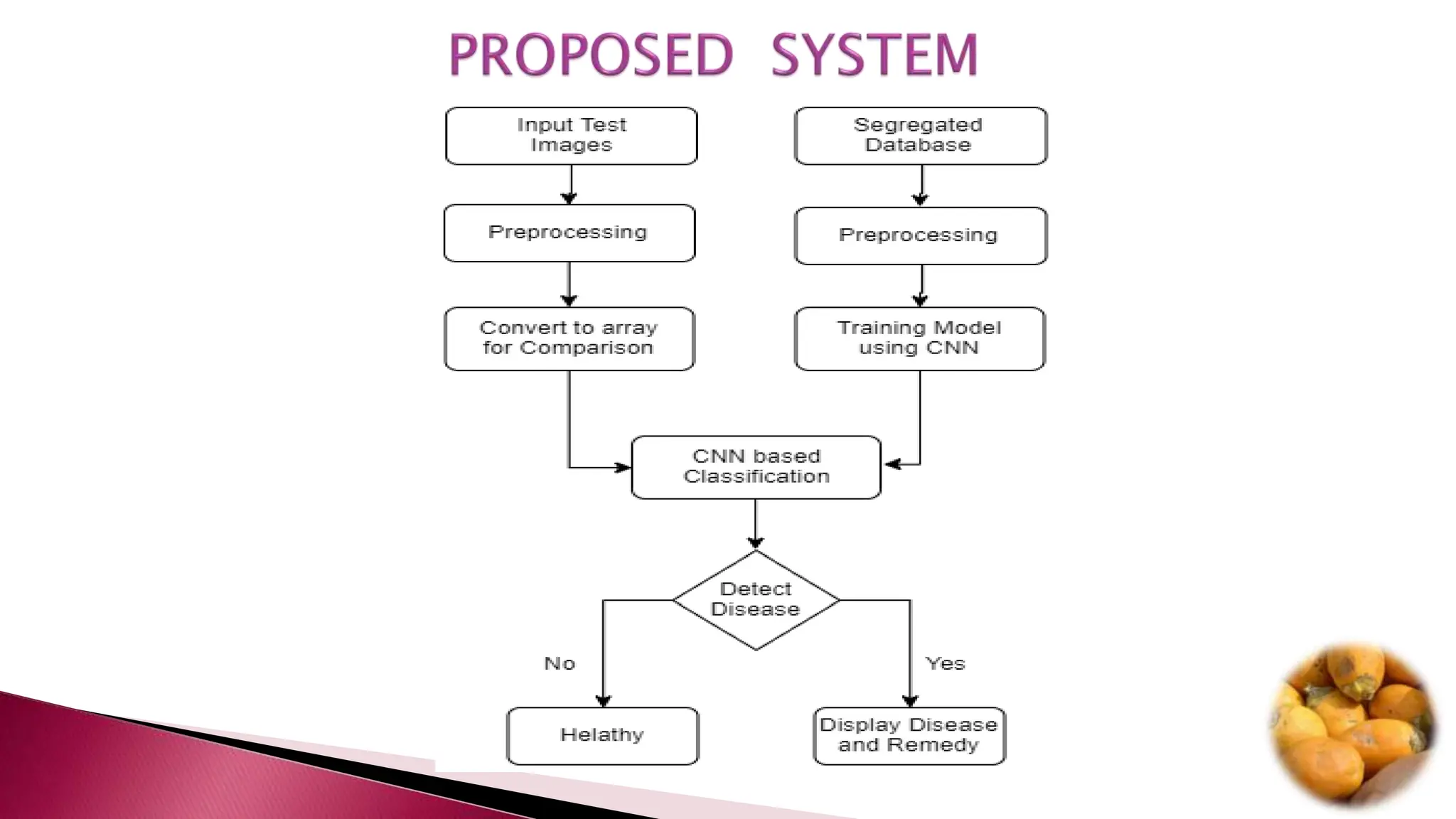
This project focuses on the detection of diseases in Arecanut, leaves, and trunk using Deep Neural
Networks. Experimentation is conducted using diseased and healthy arecanut image dataset of 620
images. The input image is first pre-processed, followed by feature extraction, training, and
classification. The proposed System detects diseases of arecanut such as Mahali, Stem bleeding, and
yellow leaf spot and provides remedies for the same. Depending on the quality of the input image and
the stage of the disease, the experimental results show varying levels of disease detection accuracy. In
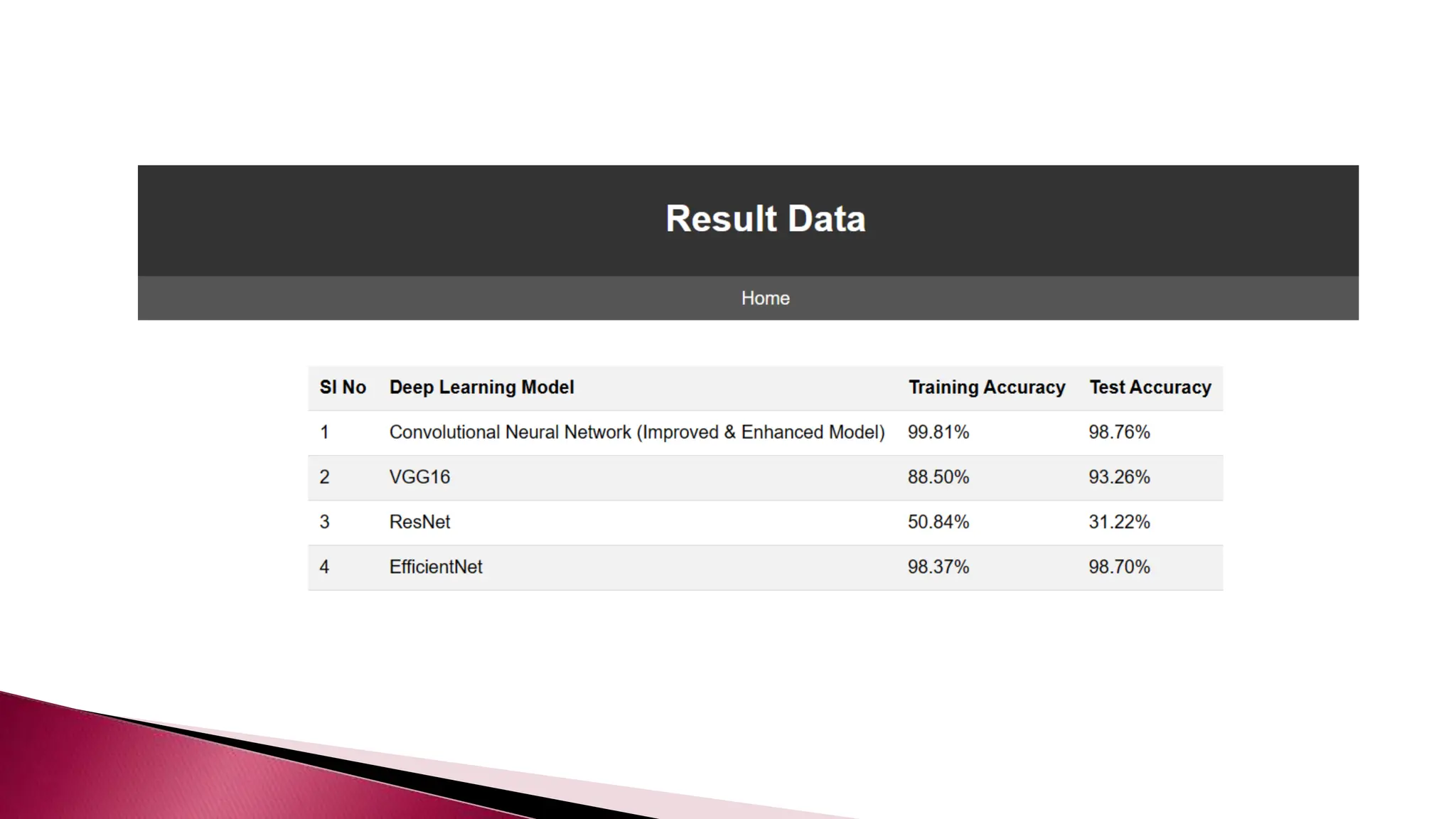
this project we used 4 deep learning models such as CNN, RestNet, EffecientNet and VGG16. Among
these algorithm CNN gives 98.76% and Efficient Net gives 98.70% Accuracy. As a result, this system
takes a step toward encouraging farmers to practice smart farming and allowing them to make better
yield decisions by enabling them to take all the necessary preventive and corrective action on their
arecanut crop with accuracy 98.76%. So, CNN model is used in final deployment of Web application
for finding prediction.
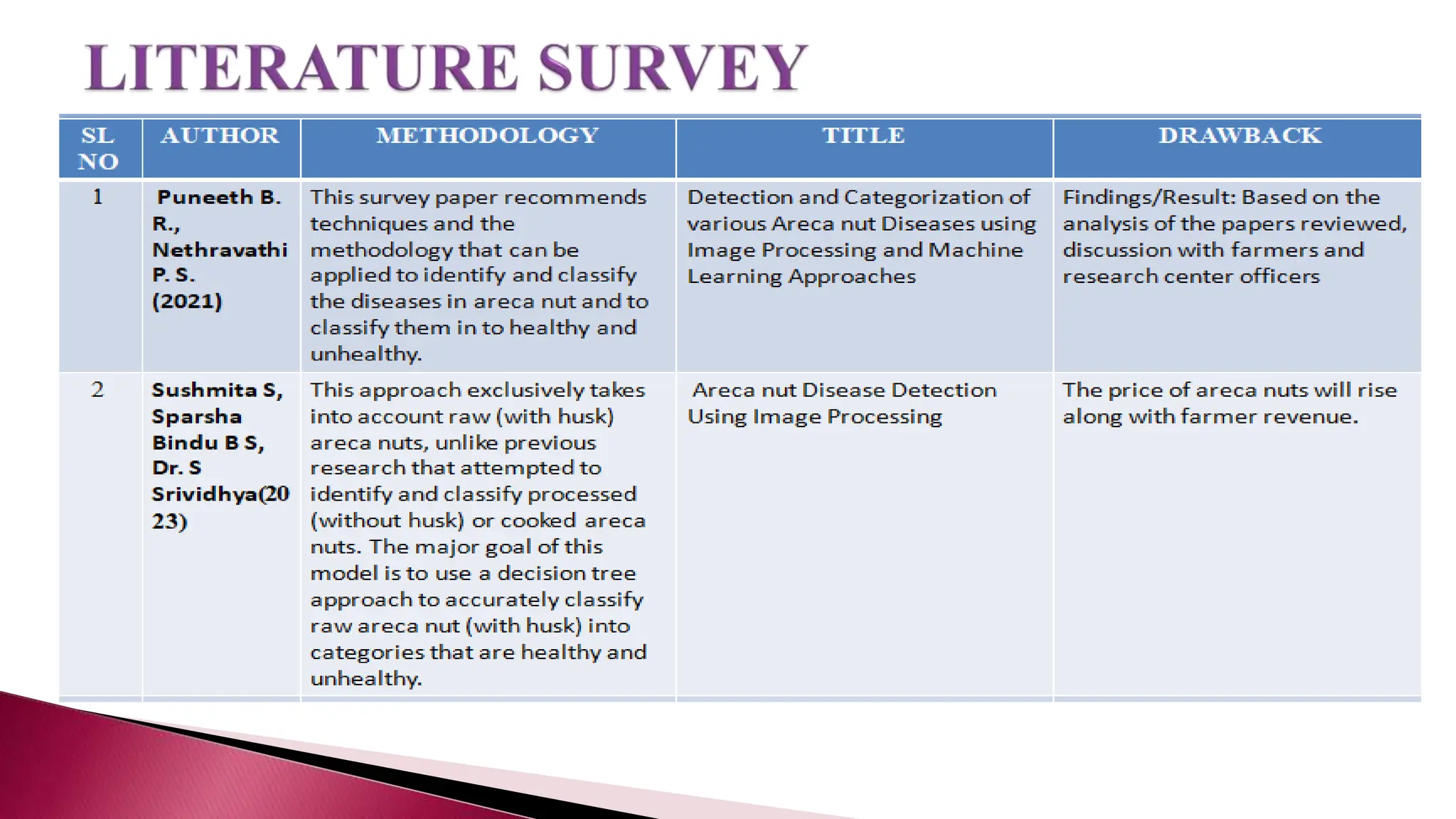
1. Dhanuja K C. Areca Nut Disease Detection using Image Processing Technology. International Journal of
Engineering Research 2020 V9. 10.17577/IJERTV9IS080352.
2. Mallaiah, Suresha & Danti, Ajit & Narasimhamurthy, S. Classification of Diseased Arecanut based on Texture
Features. International Journal of Computer Applications. 2014.
3. Manpreet Sandhu, Pratik Hadawale, Saumaan Momin, Prof. Ajitkumar Khachane. Plant Disease Detection using ML
and UAV. International Research Journal of Engineering and Technology 2020 V7.
4. Mr. Ashish Nage, Prof. V. R. Raut, Detection and Identification of Plant Leaf Diseases based on Python,
INTERNATIONAL JOURNAL OF ENGINEERING RESEARCH & TECHNOLOGY (IJERT),2019, Volume 08, Issue 05.
5. Anandhakrishnan MG Joel Hanson, Annette Joy, Jeri Francis, Plant Leaf Disease Detection using Deep Learning
and Convolutional Neural Network, International Journal of Engineering Science and Computing, Volume 7, Issue
No.3, March 2017
6. Manisha Bhange, H.A. Hingoliwala, Smart Farming: Pomegranate Disease Detection Using Image Processing,
Procedia Computer Science, Volume 58,2015, Pages 280-288, ISSN 1877-0509.
7. Swathy Ann Sam, Siya Elizebeth Varghese, Pooja Murali, Sonu Joseph John, Dr. Anju Pratap. Time saving malady
expert system in plant leaf using CNN, 2020, Volume 13, Issue No 3.
8. Detection and classification of areca nuts with machine vision Kuo-Yi Huang 2012
9. Classification of Diseased Areca nut based on Texture Features International Journal of Computer Applications
(0975 – 8887) Recent Advances in Information Technology, 2014
10. Segmentation and Classification of Raw Arecanuts Based on Three Sigma Control Limits December 2012.
FINAL_ ARECANUT_CNN_PPT  PHASE 2_of.pptx

FINAL_ ARECANUT_CNN_PPT PHASE 2_of.pptx

  • 1.
    UndertheGuidanceof:Miss.AFREEN BANU M.B ProjectCoordinator: Asst.prof.Mrs.RATNA Professor &HOD:Prof. NITYANANDA D M Presentation on Phase-2 Presented by AFSANABANU KALAS 2GO20CS001 GOURAMMA C 2GO20CS011 PRAMODA S 2GO20CS030 SANA MUDGAL 2GO21CS414
  • 2.
     INTRODUCTION  AIM& OBJECTIVES  LITERATURE SURVEY  EXISTING SYSTEM  PROPOSED SYSTEM  SYSTEM ANALYSIS  SYSTEM IMPLEMENTATION  ADVANTAGES  APPLICATIONS  SYSTEM REQUIREMENT SPECIFICATION  CONCLUSION  REFERENCES
  • 3.
     Areca nutis an economically important crop in many tropical regions .However , it is susceptible to various disease that significantly reduce the yield and quality of nuts.
  • 4.
    The arecanut palmis the source of common chewing nut, popularly known as betel nut or Supari. In India it is extensively used by large sections of people and is very much linked with religious practices. India is the largest producer of arecanut and at the same time largest consumer also. Major states cultivating this crop are Karnataka (40%), Kerala (25%), Assam (20%), Tamil Nadu, Meghalaya and West Bengal.
  • 7.
    Aim The aim ofthe project is to detect the disease in arecanut fruit, Stem and leaves using Deep Learning and Image processing techniques and finding the diseases. Objectives  To collect datasets that contain healthy and diseased images of arecanut and their leaves.  Design and develop an algorithm for early detection of disease in arecanut that can avoid the spreading of diseases.  Develop a deep learning based algorithm like CNN, Rest Net, Efficient Net, that would suggest solutions for the detected diseases.  Developing a web application for early detection of disease, prediction and providing remedies to the above solution.
  • 10.
     Visual Inspection:The traditional method involves manual examination by agricultural experts or farmers to identify visual symptoms of diseases, such as leaf discoloration, lesions, spots, or unusual patterns.  Laboratory Techniques: These methods involve taking samples from plants showing symptoms, culturing pathogens in a lab, and using techniques like microscopy , PCR, ELISA, or DNA sequencing to identify specific pathogens causing diseases.  Image Processing: Utilizing cameras and image processing algorithms to capture images of plants and then employing computer vision techniques, machine learning, or deep learning to analyze these images for disease symptoms. This method allows for automated and rapid analysis of large- scale crops.  Machine Learning: Creating machine learning platforms that integrate various data sources to diagnose plant diseases.These systems continuously learn and improve their accuracy over time.
  • 13.
  • 14.
    1. Arecanutdisease(healthyandUnhealthy)DataCollection 2. Pre-processing&FeatureExtractions 3.TrainingandTestingtheModel 4. DeployingDeeplearningCNNModel 5. Predictionof9typesofhealthyandunhealthy Diseases 6. WebInterfacetoPredicttheDiseaseclass.
  • 15.
  • 17.
  • 26.
    ADVANTAGES Early Detection: Identifyingdiseases in their early stages allows for prompt action. Preventative Measures: Early detection enables farmers to implement timely using specific pesticides. Reduced Crop Loss: By promptly diagnosing diseases, farmers can take appropriate steps. Optimized Resource Use: Disease detection helps optimize resource utilization minimizing. ADVANTAGES
  • 27.
    APPLICATIONS Areca nut diseasedetection has numerous applications across agriculture, environmental monitoring, and research. Early Disease Detection: Rapid identification of diseases allows for early intervention, preventing widespread damage to crops. This early detection can help in the timely application of treatments or management strategies. Quarantine and Disease Control: Plant disease detection is crucial in quarantine procedures, preventing the spread of diseases to new areas or regions.
  • 28.
     Hardware Requirements Processor: Ryzen 5  RAM: 8 GB  Disk space: minimum 256 GB  Software Requirements  Operating System (Windows, MacOS).  Python, HTML, CSS, JavaScript.  Java / Python Framework and SQL database  An Internet Browser (Google Chrome, Microsoft Edge etc).  Code Editor (Visual Studio code/PyCharm).  The package manager PIP (pip is a python package-management system written in Python used to install and manage software packages).
  • 29.
    This project focuseson the detection of diseases in Arecanut, leaves, and trunk using Deep Neural Networks. Experimentation is conducted using diseased and healthy arecanut image dataset of 620 images. The input image is first pre-processed, followed by feature extraction, training, and classification. The proposed System detects diseases of arecanut such as Mahali, Stem bleeding, and yellow leaf spot and provides remedies for the same. Depending on the quality of the input image and the stage of the disease, the experimental results show varying levels of disease detection accuracy. In this project we used 4 deep learning models such as CNN, RestNet, EffecientNet and VGG16. Among these algorithm CNN gives 98.76% and Efficient Net gives 98.70% Accuracy. As a result, this system takes a step toward encouraging farmers to practice smart farming and allowing them to make better yield decisions by enabling them to take all the necessary preventive and corrective action on their arecanut crop with accuracy 98.76%. So, CNN model is used in final deployment of Web application for finding prediction.
  • 30.
    1. Dhanuja KC. Areca Nut Disease Detection using Image Processing Technology. International Journal of Engineering Research 2020 V9. 10.17577/IJERTV9IS080352. 2. Mallaiah, Suresha & Danti, Ajit & Narasimhamurthy, S. Classification of Diseased Arecanut based on Texture Features. International Journal of Computer Applications. 2014. 3. Manpreet Sandhu, Pratik Hadawale, Saumaan Momin, Prof. Ajitkumar Khachane. Plant Disease Detection using ML and UAV. International Research Journal of Engineering and Technology 2020 V7. 4. Mr. Ashish Nage, Prof. V. R. Raut, Detection and Identification of Plant Leaf Diseases based on Python, INTERNATIONAL JOURNAL OF ENGINEERING RESEARCH & TECHNOLOGY (IJERT),2019, Volume 08, Issue 05. 5. Anandhakrishnan MG Joel Hanson, Annette Joy, Jeri Francis, Plant Leaf Disease Detection using Deep Learning and Convolutional Neural Network, International Journal of Engineering Science and Computing, Volume 7, Issue No.3, March 2017 6. Manisha Bhange, H.A. Hingoliwala, Smart Farming: Pomegranate Disease Detection Using Image Processing, Procedia Computer Science, Volume 58,2015, Pages 280-288, ISSN 1877-0509. 7. Swathy Ann Sam, Siya Elizebeth Varghese, Pooja Murali, Sonu Joseph John, Dr. Anju Pratap. Time saving malady expert system in plant leaf using CNN, 2020, Volume 13, Issue No 3. 8. Detection and classification of areca nuts with machine vision Kuo-Yi Huang 2012 9. Classification of Diseased Areca nut based on Texture Features International Journal of Computer Applications (0975 – 8887) Recent Advances in Information Technology, 2014 10. Segmentation and Classification of Raw Arecanuts Based on Three Sigma Control Limits December 2012.