Table of Contents
1. Accra Technical University Overview
2. Research
3. Industry Collaboration and Engagements
4. Sustainability
5. Accra Technical University Competitor Overview
6. Strategic Vision Alignment Report
7. Executive Summary
8. Introduction
9. Analysis of Key Vision Pillars
9.1 Impact-Oriented Research and Innovation
9.2 Industry and Community Engagement
9.3 Internationalisation and Visibility
9.4 Infrastructural Development
9.5 Quality and Motivated Human Resources
9.6 Effective Governance
9.7 Staff Welfare and Support Services
9.8 Prudent Financial Management
9.9 Enhanced Student Experience
9.10 Brand Development and Positioning
9.11 Gender Diversity and Inclusion
10. Conclusion
ACCRA TECHNICAL UNIVERSITY OVERVIEW
Established in 1949 as a Technical School, ATU became Accra Polytechnic in 1963
and later attained Technical University status in 2016. It has faculties in Engineering,
Applied Sciences, Built Environment, Business and Applied Arts. Programmes
offered include; HND, B- Tech, and post graduate courses.
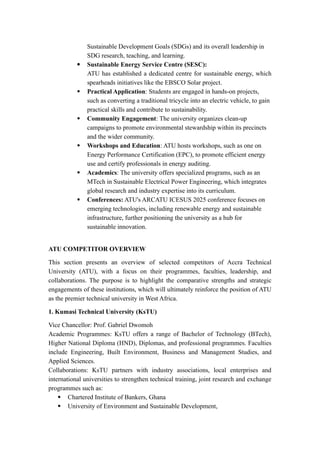
1. RESEARCH
 Africa Health Research and Innovation Project (AHRIP):
 A UK-funded initiative focused on developing and implementing
innovative solutions for Ghana's healthcare sector.
 Student Innovations: Recent projects from AHRIP include a smart
cooling system for vaccine transport, a diabetes management app, a
smart waste segregation bin, and a biometric health identification
system
 Applied Research and Innovation Fund (ARIF): An internal fund
established to support faculty members in pursuing applied research
and innovation across various fields.
 DRIPTT (Directorate of Research, Innovation, Planning, and
Technology Transfer):
A directorate that promotes impact-oriented research, strategic
partnerships with industry, and the dissemination of research finding.
2. INDUSTRY COLLABORATION & ENGAGEMENTS
 Npontu Technologies (July 2025): A strategic partnership providing
Computer Science and Technology students with vacation internships
and National Service placements, alongside collaborative research and
consultancy.
 Furnart Ghana Ltd (August 2025): A renewed agreement focusing
on practical training for Interior Design and Upholstery students,
promoting applied research and technology transfer in furniture and
design
 A-Tech Group Korea Incorporation: A collaboration that established
the university's drone technology centre, offering courses in drone
assembly, programming, and flight training.
 Design & Technology Institute (DTI) (May 2025): Through this
partnership, ATU has established the DTI-ATU Demonstration Centre
and Innovation & Incubation Hub to integrate theory with hands-on
experience and promote high standards of craftsmanship.
 Innovation, Career and Job Fair (July 2025): ATU organizes a job
fair that brings together companies such as Nestlé Ghana, Ghana
National Petroleum Commission, Stanbic Bank, and others to offer
students exposure and opportunities.
 Ennobled Foundation (September 2025): A partnership focused on
youth empowerment, mentorship, and skills development through
initiatives like establishing an Ennobled Foundation Club on campus.
3. SUSTAINABILITY
 EBSCO Solar Grant (2025): ATU received a significant global grant
to install solar panels on campus, a move expected to reduce its carbon
footprint and reinvest savings into educational services.
 Think Energy Awards (2024): The university received multiple
awards, including for its innovative energy curriculum based on the
Sustainable Development Goals (SDGs) and its overall leadership in
SDG research, teaching, and learning.
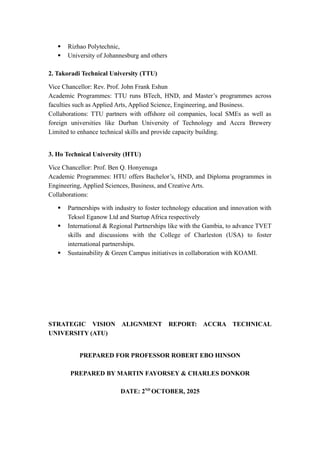
 Sustainable Energy Service Centre (SESC):
ATU has established a dedicated centre for sustainable energy, which
spearheads initiatives like the EBSCO Solar project.
 Practical Application: Students are engaged in hands-on projects,
such as converting a traditional tricycle into an electric vehicle, to gain
practical skills and contribute to sustainability.
 Community Engagement: The university organizes clean-up
campaigns to promote environmental stewardship within its precincts
and the wider community.
 Workshops and Education: ATU hosts workshops, such as one on
Energy Performance Certification (EPC), to promote efficient energy
use and certify professionals in energy auditing.
 Academics: The university offers specialized programs, such as an
MTech in Sustainable Electrical Power Engineering, which integrates
global research and industry expertise into its curriculum.
 Conferences: ATU's ARCATU ICESUS 2025 conference focuses on
emerging technologies, including renewable energy and sustainable
infrastructure, further positioning the university as a hub for
sustainable innovation.
ATU COMPETITOR OVERVIEW
This section presents an overview of selected competitors of Accra Technical
University (ATU), with a focus on their programmes, faculties, leadership, and
collaborations. The purpose is to highlight the comparative strengths and strategic
engagements of these institutions, which will ultimately reinforce the position of ATU
as the premier technical university in West Africa.
1. Kumasi Technical University (KsTU)
Vice Chancellor: Prof. Gabriel Dwomoh
Academic Programmes: KsTU offers a range of Bachelor of Technology (BTech),
Higher National Diploma (HND), Diplomas, and professional programmes. Faculties
include Engineering, Built Environment, Business and Management Studies, and
Applied Sciences.
Collaborations: KsTU partners with industry associations, local enterprises and
international universities to strengthen technical training, joint research and exchange
programmes such as:
 Chartered Institute of Bankers, Ghana
 University of Environment and Sustainable Development,
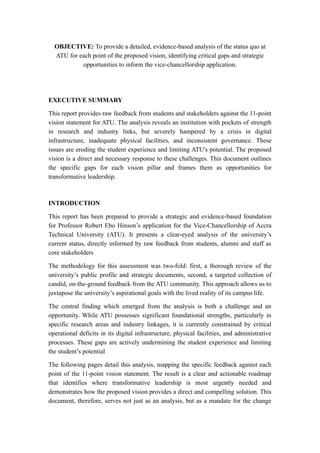
 Rizhao Polytechnic,
 University of Johannesburg and others
2. Takoradi Technical University (TTU)
Vice Chancellor: Rev. Prof. John Frank Eshun
Academic Programmes: TTU runs BTech, HND, and Master’s programmes across
faculties such as Applied Arts, Applied Science, Engineering, and Business.
Collaborations: TTU partners with offshore oil companies, local SMEs as well as
foreign universities like Durban University of Technology and Accra Brewery
Limited to enhance technical skills and provide capacity building.
3. Ho Technical University (HTU)
Vice Chancellor: Prof. Ben Q. Honyenuga
Academic Programmes: HTU offers Bachelor’s, HND, and Diploma programmes in
Engineering, Applied Sciences, Business, and Creative Arts.
Collaborations:
 Partnerships with industry to foster technology education and innovation with
Teksol Eganow Ltd and Startup Africa respectively
 International & Regional Partnerships like with the Gambia, to advance TVET
skills and discussions with the College of Charleston (USA) to foster
international partnerships.
 Sustainability & Green Campus initiatives in collaboration with KOAMI.
STRATEGIC VISION ALIGNMENT REPORT: ACCRA TECHNICAL
UNIVERSITY (ATU)
PREPARED FOR PROFESSOR ROBERT EBO HINSON
PREPARED BY MARTIN FAYORSEY & CHARLES DONKOR
DATE: 2ND
OCTOBER, 2025
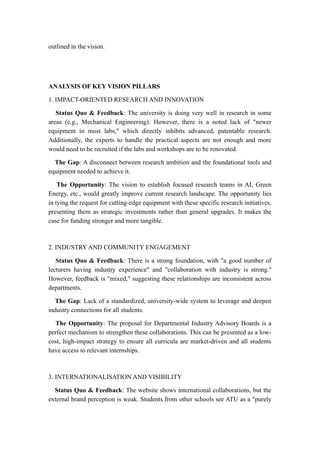
OBJECTIVE: To provide a detailed, evidence-based analysis of the status quo at
ATU for each point of the proposed vision, identifying critical gaps and strategic
opportunities to inform the vice-chancellorship application.
EXECUTIVE SUMMARY
This report provides raw feedback from students and stakeholders against the 11-point
vision statement for ATU. The analysis reveals an institution with pockets of strength
in research and industry links, but severely hampered by a crisis in digital
infrastructure, inadequate physical facilities, and inconsistent governance. These
issues are eroding the student experience and limiting ATU's potential. The proposed
vision is a direct and necessary response to these challenges. This document outlines
the specific gaps for each vision pillar and frames them as opportunities for
transformative leadership.
INTRODUCTION
This report has been prepared to provide a strategic and evidence-based foundation
for Professor Robert Ebo Hinson’s application for the Vice-Chancellorship of Accra
Technical University (ATU). It presents a clear-eyed analysis of the university’s
current status, directly informed by raw feedback from students, alumni and staff as
core stakeholders
The methodology for this assessment was two-fold: first, a thorough review of the
university’s public profile and strategic documents, second, a targeted collection of
candid, on-the-ground feedback from the ATU community. This approach allows us to
juxtapose the university’s aspirational goals with the lived reality of its campus life.
The central finding which emerged from the analysis is both a challenge and an
opportunity. While ATU possesses significant foundational strengths, particularly in
specific research areas and industry linkages, it is currently constrained by critical
operational deficits in its digital infrastructure, physical facilities, and administrative
processes. These gaps are actively undermining the student experience and limiting
the student’s potential
The following pages detail this analysis, mapping the specific feedback against each
point of the 11-point vision statement. The result is a clear and actionable roadmap
that identifies where transformative leadership is most urgently needed and
demonstrates how the proposed vision provides a direct and compelling solution. This
document, therefore, serves not just as an analysis, but as a mandate for the change
outlined in the vision.
ANALYSIS OF KEY VISION PILLARS
1. IMPACT-ORIENTED RESEARCH AND INNOVATION
Status Quo & Feedback: The university is doing very well in research in some
areas (e.g., Mechanical Engineering). However, there is a noted lack of "newer
equipment in most labs," which directly inhibits advanced, patentable research.
Additionally, the experts to handle the practical aspects are not enough and more
would need to be recruited if the labs and workshops are to be renovated.
The Gap: A disconnect between research ambition and the foundational tools and
equipment needed to achieve it.
The Opportunity: The vision to establish focused research teams in AI, Green
Energy, etc., would greatly improve current research landscape. The opportunity lies
in tying the request for cutting-edge equipment with these specific research initiatives,
presenting them as strategic investments rather than general upgrades. It makes the
case for funding stronger and more tangible.
2. INDUSTRY AND COMMUNITY ENGAGEMENT
Status Quo & Feedback: There is a strong foundation, with "a good number of
lecturers having industry experience" and "collaboration with industry is strong."
However, feedback is "mixed," suggesting these relationships are inconsistent across
departments.
The Gap: Lack of a standardized, university-wide system to leverage and deepen
industry connections for all students.
The Opportunity: The proposal for Departmental Industry Advisory Boards is a
perfect mechanism to strengthen these collaborations. This can be presented as a low-
cost, high-impact strategy to ensure all curricula are market-driven and all students
have access to relevant internships.
3. INTERNATIONALISATION AND VISIBILITY
Status Quo & Feedback: The website shows international collaborations, but the
external brand perception is weak. Students from other schools see ATU as a "purely
technical school" without high academic prestige.
The Gap: A significant gap between internal reality and external perception,
hindering international appeal.
The Opportunity: The vision for partnerships with Times Higher Education-ranked
institutions and a Bi-annual Africa Forum is key. Prof, you can position yourself as
the "Chief Brand Ambassador," using these platforms to aggressively market ATU's
existing research and industry collaboration strengths to a global audience, reshaping
its identity.
4. INFRASTRUCTURAL DEVELOPMENT
Status Quo & Feedback: This is a critical pain point for the Accra Campus.
Complaints:
 Classrooms are in "dire need of furniture"
 Workshops are too small to accommodate students
 “Two hostel facilities on campus are woefully inadequate”
 Lack of a proper recreational facility
 Archaic infrastructure, poor maintenance and "filthy toilets."
 The Mpehuasem campus, although not completed is larger and possesses
much more modern and state-of-the art facilities and equipment but is
sited too far and isolated from the main town.
The Gap: The physical environment is actively undermining the quality of
education and student morale.
The Opportunity: Public-private partnership strategy to deliver new recreational
facilities would be a game-changer. The Mpehuasem campus “smart-green campus”
vision with renewable energy systems would augment the campus’ contemporary
landscape. The vision must first address these basics on the Accra campus: The
refurbishment of workshops, classrooms, and sanitation facilities alongside high-tech
smart campus initiatives.
5. QUALITY AND MOTIVATED HUMAN RESOURCES
Status Quo & Feedback: There are "mixed feelings about lecturers." Specific
complaints include teaching that is "not in-depth/detailed," and that "some lecturers
miss class completely." Management of hostel facilities are said to be performing
abysmally.
The Gap: Inconsistent teaching quality and a lack of accountability mechanisms.
The Opportunity: The vision for a "comprehensive faculty and staff development
plan" and a “Leadership Academy” support for research is the solution. This can be
implemented as a "Teaching Excellence Framework" combining mandatory
pedagogical training, support for research, and robust performance appraisal linked to
the "Reward and Recognition Programme"
6. EFFECTIVE GOVERNANCE
Status Quo & Feedback: Feedback on this showed mixed feelings concerning
governance effectiveness. Students report "unresolved complaints" and feel their
voice, even through the SRC, doesn't influence decision making much.
The Gap: A perception of an administration which can do more
The Opportunity: The promise of "transparent, accountable, and digitized
governance" is a direct answer. A monthly "VC's Open Forum" with students and a
digitized tracking system for all student complaints, ensuring every query is
acknowledged and acted upon within a defined timeframe.
7. STAFF WELFARE AND SUPPORT SERVICES
Status Quo & Feedback: Limited feedback was provided on this point nevertheless
staff housing present on campus.
The Gap: An opportunity to define the narrative.
The Opportunity: Linking enhanced welfare directly to improved teaching and
research outcomes (Visions 1 & 5) creates a powerful narrative.
8. PRUDENT FINANCIAL MANAGEMENT
Status Quo & Feedback: Students note that the university seems to waste money
on maintenance and they would want revenue spent on improving facilities and
accommodation.
The Gap: A perception of poor fiscal management and a desire for more strategic
spending on core needs.
The Opportunity: The vision for "revenue diversification" through commercialized
services is crucial. Prof, you can champion "Student-Centered Budgeting," to create a
transparent link between new revenue streams (e.g., consultancy) and direct
investments in the student experience (e.g., better facilities).
9. ENHANCED STUDENT EXPERIENCE
Status Quo & Feedback: This is the most consolidated area of complaint. Key
issues include:
 Digital Failure: Bottlenecks in the “iCampus” portal, slow result publication -
months after examination, online exams minimal.
 Administrative Neglect: No admission status updates online, forcing
applicants to come to campus to follow up.
 Academic Issues: Dissatisfaction with handouts and an unpredictable
academic calendar. Main library doesn’t provide 24-hour access.
 Information dissemination: Official letterheads communicating major
announcements are not frequent or regular
 Unregulated campus access to “Tudu town boys”
The Gap: The entire student lifecycle, from admission to graduation, is affected by
poor service delivery.
The Opportunity: The Student Experience Charter is the masterstroke. A pledge to
guarantee specific service levels, e.g., "admission status updated online within 48
hours of a decision." will provide a measurable and powerful contract with students.
10. BRAND DEVELOPMENT AND POSITIONING
Status Quo & Feedback: Internally, the ATU brand is weakened by a perception
that its grading system "supports little effort."
The Gap: The internal academic culture is at odds with the vision of being a
"premier technical university."
The Opportunity: The vision for a "brand audit" should be used to rebrand
academic rigour internally. This involves enforcing standards, celebrating excellence,
and communicating that a degree from ATU is a mark of true quality, thereby
enhancing its external value.
11. GENDER DIVERSITY AND INCLUSION
Status Quo & Feedback: Students note that "females in STEM programs are few"
and that groups like "Women in Engineering... are not visible enough."
The Gap: A recognized lack of proactive effort to support and increase female
participation in technical fields.
The Opportunity: The specific, measurable targets in the vision (40%
representation, 15% enrolment increase) are a direct response. Prof, you can
immediately commit to launching a highly visible "Women in STEM Scholarship and
Mentorship Fund," positioning ATU as a leader in inclusion from day one.
CONCLUSION
The student and stakeholder feedback provides a clear and compelling mandate for
the transformational leadership outlined in the 11-point vision. ATU stands at a
crossroads, constrained by operational deficiencies but poised for exceptional growth.
The vision statement represents the story of a leader who can bridge this gap with
immediate action and a compelling future.
FINAL REPORT FOR CHARLES WORK DONE .docx

  • 1.
    Table of Contents 1.Accra Technical University Overview 2. Research 3. Industry Collaboration and Engagements 4. Sustainability 5. Accra Technical University Competitor Overview 6. Strategic Vision Alignment Report 7. Executive Summary 8. Introduction 9. Analysis of Key Vision Pillars 9.1 Impact-Oriented Research and Innovation 9.2 Industry and Community Engagement 9.3 Internationalisation and Visibility 9.4 Infrastructural Development 9.5 Quality and Motivated Human Resources 9.6 Effective Governance 9.7 Staff Welfare and Support Services 9.8 Prudent Financial Management 9.9 Enhanced Student Experience 9.10 Brand Development and Positioning 9.11 Gender Diversity and Inclusion 10. Conclusion ACCRA TECHNICAL UNIVERSITY OVERVIEW Established in 1949 as a Technical School, ATU became Accra Polytechnic in 1963 and later attained Technical University status in 2016. It has faculties in Engineering, Applied Sciences, Built Environment, Business and Applied Arts. Programmes offered include; HND, B- Tech, and post graduate courses. 1. RESEARCH  Africa Health Research and Innovation Project (AHRIP):  A UK-funded initiative focused on developing and implementing innovative solutions for Ghana's healthcare sector.  Student Innovations: Recent projects from AHRIP include a smart cooling system for vaccine transport, a diabetes management app, a smart waste segregation bin, and a biometric health identification system
  • 2.
     Applied Researchand Innovation Fund (ARIF): An internal fund established to support faculty members in pursuing applied research and innovation across various fields.  DRIPTT (Directorate of Research, Innovation, Planning, and Technology Transfer): A directorate that promotes impact-oriented research, strategic partnerships with industry, and the dissemination of research finding. 2. INDUSTRY COLLABORATION & ENGAGEMENTS  Npontu Technologies (July 2025): A strategic partnership providing Computer Science and Technology students with vacation internships and National Service placements, alongside collaborative research and consultancy.  Furnart Ghana Ltd (August 2025): A renewed agreement focusing on practical training for Interior Design and Upholstery students, promoting applied research and technology transfer in furniture and design  A-Tech Group Korea Incorporation: A collaboration that established the university's drone technology centre, offering courses in drone assembly, programming, and flight training.  Design & Technology Institute (DTI) (May 2025): Through this partnership, ATU has established the DTI-ATU Demonstration Centre and Innovation & Incubation Hub to integrate theory with hands-on experience and promote high standards of craftsmanship.  Innovation, Career and Job Fair (July 2025): ATU organizes a job fair that brings together companies such as Nestlé Ghana, Ghana National Petroleum Commission, Stanbic Bank, and others to offer students exposure and opportunities.  Ennobled Foundation (September 2025): A partnership focused on youth empowerment, mentorship, and skills development through initiatives like establishing an Ennobled Foundation Club on campus. 3. SUSTAINABILITY  EBSCO Solar Grant (2025): ATU received a significant global grant to install solar panels on campus, a move expected to reduce its carbon footprint and reinvest savings into educational services.  Think Energy Awards (2024): The university received multiple awards, including for its innovative energy curriculum based on the
  • 3.
    Sustainable Development Goals(SDGs) and its overall leadership in SDG research, teaching, and learning.  Sustainable Energy Service Centre (SESC): ATU has established a dedicated centre for sustainable energy, which spearheads initiatives like the EBSCO Solar project.  Practical Application: Students are engaged in hands-on projects, such as converting a traditional tricycle into an electric vehicle, to gain practical skills and contribute to sustainability.  Community Engagement: The university organizes clean-up campaigns to promote environmental stewardship within its precincts and the wider community.  Workshops and Education: ATU hosts workshops, such as one on Energy Performance Certification (EPC), to promote efficient energy use and certify professionals in energy auditing.  Academics: The university offers specialized programs, such as an MTech in Sustainable Electrical Power Engineering, which integrates global research and industry expertise into its curriculum.  Conferences: ATU's ARCATU ICESUS 2025 conference focuses on emerging technologies, including renewable energy and sustainable infrastructure, further positioning the university as a hub for sustainable innovation. ATU COMPETITOR OVERVIEW This section presents an overview of selected competitors of Accra Technical University (ATU), with a focus on their programmes, faculties, leadership, and collaborations. The purpose is to highlight the comparative strengths and strategic engagements of these institutions, which will ultimately reinforce the position of ATU as the premier technical university in West Africa. 1. Kumasi Technical University (KsTU) Vice Chancellor: Prof. Gabriel Dwomoh Academic Programmes: KsTU offers a range of Bachelor of Technology (BTech), Higher National Diploma (HND), Diplomas, and professional programmes. Faculties include Engineering, Built Environment, Business and Management Studies, and Applied Sciences. Collaborations: KsTU partners with industry associations, local enterprises and international universities to strengthen technical training, joint research and exchange programmes such as:  Chartered Institute of Bankers, Ghana  University of Environment and Sustainable Development,
  • 4.
     Rizhao Polytechnic, University of Johannesburg and others 2. Takoradi Technical University (TTU) Vice Chancellor: Rev. Prof. John Frank Eshun Academic Programmes: TTU runs BTech, HND, and Master’s programmes across faculties such as Applied Arts, Applied Science, Engineering, and Business. Collaborations: TTU partners with offshore oil companies, local SMEs as well as foreign universities like Durban University of Technology and Accra Brewery Limited to enhance technical skills and provide capacity building. 3. Ho Technical University (HTU) Vice Chancellor: Prof. Ben Q. Honyenuga Academic Programmes: HTU offers Bachelor’s, HND, and Diploma programmes in Engineering, Applied Sciences, Business, and Creative Arts. Collaborations:  Partnerships with industry to foster technology education and innovation with Teksol Eganow Ltd and Startup Africa respectively  International & Regional Partnerships like with the Gambia, to advance TVET skills and discussions with the College of Charleston (USA) to foster international partnerships.  Sustainability & Green Campus initiatives in collaboration with KOAMI. STRATEGIC VISION ALIGNMENT REPORT: ACCRA TECHNICAL UNIVERSITY (ATU) PREPARED FOR PROFESSOR ROBERT EBO HINSON PREPARED BY MARTIN FAYORSEY & CHARLES DONKOR DATE: 2ND OCTOBER, 2025
  • 5.
    OBJECTIVE: To providea detailed, evidence-based analysis of the status quo at ATU for each point of the proposed vision, identifying critical gaps and strategic opportunities to inform the vice-chancellorship application. EXECUTIVE SUMMARY This report provides raw feedback from students and stakeholders against the 11-point vision statement for ATU. The analysis reveals an institution with pockets of strength in research and industry links, but severely hampered by a crisis in digital infrastructure, inadequate physical facilities, and inconsistent governance. These issues are eroding the student experience and limiting ATU's potential. The proposed vision is a direct and necessary response to these challenges. This document outlines the specific gaps for each vision pillar and frames them as opportunities for transformative leadership. INTRODUCTION This report has been prepared to provide a strategic and evidence-based foundation for Professor Robert Ebo Hinson’s application for the Vice-Chancellorship of Accra Technical University (ATU). It presents a clear-eyed analysis of the university’s current status, directly informed by raw feedback from students, alumni and staff as core stakeholders The methodology for this assessment was two-fold: first, a thorough review of the university’s public profile and strategic documents, second, a targeted collection of candid, on-the-ground feedback from the ATU community. This approach allows us to juxtapose the university’s aspirational goals with the lived reality of its campus life. The central finding which emerged from the analysis is both a challenge and an opportunity. While ATU possesses significant foundational strengths, particularly in specific research areas and industry linkages, it is currently constrained by critical operational deficits in its digital infrastructure, physical facilities, and administrative processes. These gaps are actively undermining the student experience and limiting the student’s potential The following pages detail this analysis, mapping the specific feedback against each point of the 11-point vision statement. The result is a clear and actionable roadmap that identifies where transformative leadership is most urgently needed and demonstrates how the proposed vision provides a direct and compelling solution. This document, therefore, serves not just as an analysis, but as a mandate for the change
  • 6.
    outlined in thevision. ANALYSIS OF KEY VISION PILLARS 1. IMPACT-ORIENTED RESEARCH AND INNOVATION Status Quo & Feedback: The university is doing very well in research in some areas (e.g., Mechanical Engineering). However, there is a noted lack of "newer equipment in most labs," which directly inhibits advanced, patentable research. Additionally, the experts to handle the practical aspects are not enough and more would need to be recruited if the labs and workshops are to be renovated. The Gap: A disconnect between research ambition and the foundational tools and equipment needed to achieve it. The Opportunity: The vision to establish focused research teams in AI, Green Energy, etc., would greatly improve current research landscape. The opportunity lies in tying the request for cutting-edge equipment with these specific research initiatives, presenting them as strategic investments rather than general upgrades. It makes the case for funding stronger and more tangible. 2. INDUSTRY AND COMMUNITY ENGAGEMENT Status Quo & Feedback: There is a strong foundation, with "a good number of lecturers having industry experience" and "collaboration with industry is strong." However, feedback is "mixed," suggesting these relationships are inconsistent across departments. The Gap: Lack of a standardized, university-wide system to leverage and deepen industry connections for all students. The Opportunity: The proposal for Departmental Industry Advisory Boards is a perfect mechanism to strengthen these collaborations. This can be presented as a low- cost, high-impact strategy to ensure all curricula are market-driven and all students have access to relevant internships. 3. INTERNATIONALISATION AND VISIBILITY Status Quo & Feedback: The website shows international collaborations, but the external brand perception is weak. Students from other schools see ATU as a "purely
  • 7.
    technical school" withouthigh academic prestige. The Gap: A significant gap between internal reality and external perception, hindering international appeal. The Opportunity: The vision for partnerships with Times Higher Education-ranked institutions and a Bi-annual Africa Forum is key. Prof, you can position yourself as the "Chief Brand Ambassador," using these platforms to aggressively market ATU's existing research and industry collaboration strengths to a global audience, reshaping its identity. 4. INFRASTRUCTURAL DEVELOPMENT Status Quo & Feedback: This is a critical pain point for the Accra Campus. Complaints:  Classrooms are in "dire need of furniture"  Workshops are too small to accommodate students  “Two hostel facilities on campus are woefully inadequate”  Lack of a proper recreational facility  Archaic infrastructure, poor maintenance and "filthy toilets."  The Mpehuasem campus, although not completed is larger and possesses much more modern and state-of-the art facilities and equipment but is sited too far and isolated from the main town. The Gap: The physical environment is actively undermining the quality of education and student morale. The Opportunity: Public-private partnership strategy to deliver new recreational facilities would be a game-changer. The Mpehuasem campus “smart-green campus” vision with renewable energy systems would augment the campus’ contemporary landscape. The vision must first address these basics on the Accra campus: The refurbishment of workshops, classrooms, and sanitation facilities alongside high-tech smart campus initiatives. 5. QUALITY AND MOTIVATED HUMAN RESOURCES Status Quo & Feedback: There are "mixed feelings about lecturers." Specific complaints include teaching that is "not in-depth/detailed," and that "some lecturers miss class completely." Management of hostel facilities are said to be performing abysmally. The Gap: Inconsistent teaching quality and a lack of accountability mechanisms. The Opportunity: The vision for a "comprehensive faculty and staff development
  • 8.
    plan" and a“Leadership Academy” support for research is the solution. This can be implemented as a "Teaching Excellence Framework" combining mandatory pedagogical training, support for research, and robust performance appraisal linked to the "Reward and Recognition Programme" 6. EFFECTIVE GOVERNANCE Status Quo & Feedback: Feedback on this showed mixed feelings concerning governance effectiveness. Students report "unresolved complaints" and feel their voice, even through the SRC, doesn't influence decision making much. The Gap: A perception of an administration which can do more The Opportunity: The promise of "transparent, accountable, and digitized governance" is a direct answer. A monthly "VC's Open Forum" with students and a digitized tracking system for all student complaints, ensuring every query is acknowledged and acted upon within a defined timeframe. 7. STAFF WELFARE AND SUPPORT SERVICES Status Quo & Feedback: Limited feedback was provided on this point nevertheless staff housing present on campus. The Gap: An opportunity to define the narrative. The Opportunity: Linking enhanced welfare directly to improved teaching and research outcomes (Visions 1 & 5) creates a powerful narrative. 8. PRUDENT FINANCIAL MANAGEMENT Status Quo & Feedback: Students note that the university seems to waste money on maintenance and they would want revenue spent on improving facilities and accommodation. The Gap: A perception of poor fiscal management and a desire for more strategic spending on core needs. The Opportunity: The vision for "revenue diversification" through commercialized services is crucial. Prof, you can champion "Student-Centered Budgeting," to create a transparent link between new revenue streams (e.g., consultancy) and direct investments in the student experience (e.g., better facilities). 9. ENHANCED STUDENT EXPERIENCE
  • 9.
    Status Quo &Feedback: This is the most consolidated area of complaint. Key issues include:  Digital Failure: Bottlenecks in the “iCampus” portal, slow result publication - months after examination, online exams minimal.  Administrative Neglect: No admission status updates online, forcing applicants to come to campus to follow up.  Academic Issues: Dissatisfaction with handouts and an unpredictable academic calendar. Main library doesn’t provide 24-hour access.  Information dissemination: Official letterheads communicating major announcements are not frequent or regular  Unregulated campus access to “Tudu town boys” The Gap: The entire student lifecycle, from admission to graduation, is affected by poor service delivery. The Opportunity: The Student Experience Charter is the masterstroke. A pledge to guarantee specific service levels, e.g., "admission status updated online within 48 hours of a decision." will provide a measurable and powerful contract with students. 10. BRAND DEVELOPMENT AND POSITIONING Status Quo & Feedback: Internally, the ATU brand is weakened by a perception that its grading system "supports little effort." The Gap: The internal academic culture is at odds with the vision of being a "premier technical university." The Opportunity: The vision for a "brand audit" should be used to rebrand academic rigour internally. This involves enforcing standards, celebrating excellence, and communicating that a degree from ATU is a mark of true quality, thereby enhancing its external value. 11. GENDER DIVERSITY AND INCLUSION Status Quo & Feedback: Students note that "females in STEM programs are few" and that groups like "Women in Engineering... are not visible enough." The Gap: A recognized lack of proactive effort to support and increase female participation in technical fields. The Opportunity: The specific, measurable targets in the vision (40% representation, 15% enrolment increase) are a direct response. Prof, you can
  • 10.
    immediately commit tolaunching a highly visible "Women in STEM Scholarship and Mentorship Fund," positioning ATU as a leader in inclusion from day one. CONCLUSION The student and stakeholder feedback provides a clear and compelling mandate for the transformational leadership outlined in the 11-point vision. ATU stands at a crossroads, constrained by operational deficiencies but poised for exceptional growth. The vision statement represents the story of a leader who can bridge this gap with immediate action and a compelling future.