CE 402
MULTI - DISCIPLINARY
DESIGN PROJECT
GROUP H2
E/13/007 AHAMED, M.A.S.
E/13/156 JAYASHAN, T.D.P.
E/13/245 PADMASIRI, P.L.L.T.
E/13/393 WEERASINGHE, P.S.
SUPERVISED BY
PROF.K.P.P. PATHIRANA
DR.L.C. KURUKULASURIYA
DR.P.B.G. DISSANAYAKA
DR.R.M.L.D. RATHNAYAKA
PROPOSED VILLAGE FOR
DIFFERENTLY ABLED
CHILDREN AND ADULTS
CONTENT
1. INTRODUCTION
2. AIM
3. SCOPE
4. OBJECTIVES
5. METHODOLOGY
6. DATA COLLECTION
7. ALTERNATIVES & SELECTION CRITERIA
8. EIA
9. DESIGNS & CALCULATIONS
10. BOQ SUMMARY
INTRODUCTION
•Many people suffering mental illness are able to reside at
home either on their own or with family.
•This is not a realistic option for all.
•Villages for mentally disabled people is one option to that
problem
IMPORTANT CONSIDERATIONS WHEN PROPOSING
1. SAFETY OF LIVING PEOPLE
Ramps , handrails , sensing equipments , safety windows and doors
with special locks ,corridors , flooring , building services
2. SOCIAL BENEFITS
Education , Healthcare facilities , soft skills
3. ESSENTIAL NEEDS
Sanitation , water supply , electricity , waste disposal system
4. SPECIAL EQUIPMENTS
Beds, Chairs, Tables
Introduction continue………….
AIM
OUR AIM IS TO PROPOSE A VILLAGE
FOR DIFFERENTLY ABLED
CHILDREN AND ADULTS IN NEED OF
SPECIAL CARE.
SCOPE
DESIGN INDIVIDUAL UNITS SUCH THAT THEY
ARE SUITABLE TO 50 DEFERENTLY ABLED
PEOPLE
OBJECTIVES
To identify special facility needs of mentally disabled people
To find special design considerations to design each facilities for
mentally disabled people
 To find alternative site layouts
 To select best option among alternative layouts concerning
technical, social, environmental and economic feasibility.
 To prepare Detailed designs, Drawings, EIA and Visual displays.
Locating the suitable site for the village
Social survey of differently abled communities
Preparing alternative preliminary designs
Decide the optimized design for the village
Prepare EIA reports
Finalize the design
Prepare cost reports & Budgets
METHODOLOGY
DATA COLLECTION
Finding about
existing
facilities
Journals
Paper Articles
Reports
Research paper
Site visit
Hanthana
proposed
village
Survey
Blue rose
special school
&
Training
Centre
Design code
Euro code
BS code
SURVEY - BLUE ROSE SPECIAL SCHOOL
&
TRAINING CENTRE
45,000 Differently abled children and adults are in Central province.
Their IQ level < 80 %
They have categorized, Category Number of
students
Autism 17
Down’s Syndrome 18
Micro Cephalous 3
Noonan's
Syndrome
2
GDD + MR 19
• Projected Area:
170,813 Sq. m
• Coordinate:
( 7.247.9090 , 80.602.5850 )
SITE VISIT - HANTHANA
PROPOSED VILLAGE
ACCESS TO THE SITE
• Topography: Nearly flat
• Pine Forest area
• Access road up to the site
• Streams at the entrance
• High voltage transmission line near to the
site area
LAYOUT 1
Area -27873𝑚2
Perimeter -734m
ALTERNATIVES
Different layouts according to the topography
Area -40096𝑚2
Perimeter -1026m
LAYOUT 2
LAYOUT 3
Area -32528𝑚2
Perimeter -792m
SELECTING CRITERIA
• TECHNICAL FEASIBILITY
• ECONOMIC FEASIBILITY
• ENVIRONMENTAL FEASIBILITY
• SOCIAL FEASIBILITY
• QUALITATIVE FEASIBILITY
In here, the following technical factors were used in
the selection.
• DESIGN
• ARCHITECTURAL VIEW
• MATERIALS
TECHNICAL FEASIBILITY
1. COST FOR EXCAVATION AND EARTHWORKS
ECONOMIC FEASIBILITY
Alternative Cost / Rs
Layout 1 524,784
Layout 2 678,466
Layout 3
550,176
COST FACTOR =
1
TOTAL COST OF EACH OPTION
(
1
TOTAL COST OF EACH OPTION
)
Alternative Cost factor
Layout 1 0.36
Layout 2 0.29
Layout 3 0.35
1. DEFORESTING AREA
ENVIRONMENTAL FEASIBILITY
Alternative
Deforesting area /
(m2)
Layout 1 9950
Layout 2 9610
Layout 3 9643
AREA FACTOR =
𝟏
𝐃𝐄𝐅𝐎𝐑𝐄𝐒𝐓𝐈𝐍𝐆 𝐀𝐑𝐄𝐀 𝐎𝐅 𝐄𝐀𝐂𝐇 𝐎𝐏𝐓𝐈𝐎𝐍
(
𝟏
𝐃𝐄𝐅𝐎𝐑𝐄𝐒𝐓𝐈𝐍𝐆 𝐀𝐑𝐄𝐀 𝐎𝐅 𝐄𝐀𝐂𝐇 𝐎𝐏𝐓𝐈𝐎𝐍
)
Alternative Area factor
Layout 1 0.326
Layout 2 0.338
Layout 3 0.337
1. CONNECTIVITY BETWEEN EACH FACILITY
SOCIAL FEASIBILITY
DISTANCE FACTOR = 𝒊 𝐍𝐔𝐌𝐁𝐄𝐑 𝐎𝐅 𝐇𝐄𝐀𝐃𝐒/𝐃𝐈𝐒𝐓𝐀𝐍𝐂𝐄
𝒊=𝟏
𝒏 ( 𝒊 𝐍𝐔𝐌𝐁𝐄𝐑 𝐎𝐅 𝐇𝐄𝐀𝐃𝐒/𝐃𝐈𝐒𝐓𝐀𝐍𝐂𝐄)
Facility
Distance factor
Layout 1 Layout 2 Layout 3
Home unit 1 0.11 0.033 0.116
Home unit 2 0.05 0.029 0.084
Home unit 3 0.04 0.029 0.064
Home unit 4 0.034 0.027 0.062
Home unit 5 0.031 0.0263 0.044
Home unit 6 0.022 0.024 0.046
Home unit 7 0.019 0.024 0.041
Home unit 8 0.078 0.022 0.037
Home unit 9 0.059 0.022 0.032
Home unit 10 0.044 0.021 0.027
Canteen 1.82 2.465 2.250
Hostel 1 0.184 0.206 0.121
Hostel 2 0.146 0.115 0.097
Administration 1.176 0.115 0.161
Vocational 2.222 1.07 0.361
Educational 7.058 3.333 0.386
Playground 0.733 0.601 0.361
Gymnasium 0.339 0.542 0.317
Swimming Pool 0.283 0.442 0.245
Organic 0.238 0.328 0.299
Clinic 3.55 33.333 1.69
TOTAL 18.278 44.937 6.831
Alternative Distance factor
Layout 1 0.261
Layout 2 0.642
Layout 3 0.098
DISTANCE FACTOR = 𝒊 𝐍𝐔𝐌𝐁𝐄𝐑 𝐎𝐅 𝐇𝐄𝐀𝐃𝐒/𝐃𝐈𝐒𝐓𝐀𝐍𝐂𝐄
𝒊=𝟏
𝒏 ( 𝒊 𝐍𝐔𝐌𝐁𝐄𝐑 𝐎𝐅 𝐇𝐄𝐀𝐃𝐒/𝐃𝐈𝐒𝐓𝐀𝐍𝐂𝐄)
1. PLOT COVERAGE
QUALITATIVE FEASIBILITY
PLOT COVERAGE =
𝐴𝑟𝑒𝑎 𝑜𝑐𝑐𝑢𝑝𝑖𝑒𝑑 𝑏𝑦 𝐵𝑢𝑖𝑙𝑑𝑖𝑛𝑔𝑠
𝑇𝑜𝑡𝑎𝑙 𝑎𝑟𝑒𝑎 𝑜𝑓 𝑡ℎ𝑒 𝑙𝑎𝑛𝑑
X 100%
Alternative Plot coverage %
Layout 1 38.3
Layout 2 45.1
Layout 3 43.4
SENSITIVITYANALYSIS
• AHP model
Comparison matrix
Economical
Environmen
tal
Social Qualitative
Economical 1 5 3 7
Environmental 1/5 1 1/3 3
Social 1/3 3 1 5
Qualitative 1/7 1/3 1/5 1
Economical 55.79%
Environmental 12.18%
Social 26.33%
Qualitative 5.69%
Priorities of factors
Event Economical Environmental Social Qualitative
1 55.79 12.19 26.33 5.69
2 51.73 26.44 15.52 6.32
3 56.42 18.21 20.20 5.18
4 60.66 7.69 25.64 6.02
Average 56 16 22 6
0
5
10
15
20
25
30
35
40
45
50
55
60
65
70
2 3 4 5
PERCENTAGES
FEASIBILITIES
SENSITIVITY STUDY
EVENT 1 EVENT 2 EVENT 3 EVENT 4 AVERAGE
BEST ALTERNATIVE
Percentages
%
Alternative
1
Alternative
2
Alternative
3
Economical 56 0.360 0.290 0.350
Environmental
22 0.261 0.642 0.098
Social 16 0.326 0.338 0.337
Qualitative 6 0.351 0.310 0.336
Alternative 1 Alternative 2 Alternative 3
Economical 20.160 16.240 19.6
Environmental 5.742 14.124 2.156
Social 5.216 5.408 5.392
Qualitative 2.106 1.86 2.016
Total 33.224 37.632 29.16
Therefore, the best alternative is Alternative 2 with higher total value.
ARCHITECTURAL DRAWINGS
DETAILED DESIGN AND CALCULATIONS
• ROUTE PLANNING
• WATER SUPPLY NETWORK
• WASTE WATER DISPOSAL SYSTEM
• WATER TANK
 STRUCTURAL DESIGN
 FOUNDATION DESIGN
• ROOF TRUSS FOR HOSTEL
• RETAINING WALL
• STORM DRAINAGE AND CULVERT
• SWIMMING POOL
• PLAYGROUND
• ELECTRICAL INSTALLATION
Floor area of each units
FACILITY NUMBER OF UNITS FLOOR AREA/UNIT
Hostel 2 370
Individual home units 10 115
Cafeteria 1 450
Administration building 1 355
Education unit 1 795
Vocational training center & workshop 1 425
Playground 1 3000
Gymnasium 1 840
Swimming pool 1 350
Clinic 1 33
Car parks 2 800
Security 1 200
DESIGN FOR STORM WATER DRAINAGE
Vmax = 0.75 m/s
Q = 0.84 m3/s
Q = AV
0.84 = 0.75× 𝐴
A = 1.12 m2
V = R2/3 S1/2/n ; n = 0.012
s = 1/5000
0.75 = R2/3×(1/5000)1/2 / 0.012
R = 0.508 m
R = A/P
0.508 = 1.12/ (b+2h)
b+2h = 2.21
b+4b = 2.21
5b =2.21
b = 0.442
h = 0.884
h
b
t
DESIGN OF PRIMARY DISTRIBUTION
NETWORK
Total water requirement = 42000 l/day
Non-Revenue water (Assume 20 %) = 8400 l/day
Total water to be treated = 42000+8400 = 50400 l/day
Network Table – Nodes
Elevation Demand Residual H
Node ID m CMD m
Junc 1 112 20 26.94
Junc 2 110 3.98 25.33
Junc 3 110 5.93 24.09
Junc 4 113 2.4 35.39
Junc 6 108 3.5 37.67
Junc 7 102 1.8 35.98
Junc 8 113 1 33.86
Junc 9 103 2.4 33.52
Junc 10 103 4.6 32.96
Junc 11 106 5.46 30.61
Junc JU1 0 0 131.72
Junc JU2 0 0 150.76
Network Table - Links Loop 1 Loop 2
Link ID
Length Diameter Flow Velocity Unit Headloss Head loss Flow (CMS) h/q Head loss Flow h/q
m mm CMD m/s m/km
Pipe 1 56 18.75 23.58 0.99 64.52 3.61312 0.000273 13238.9
Pipe 2 27 18.75 19.6 0.82 45.81 1.23687 0.000227 5452.3
Pipe 4 88 12.5 5.46 0.51 30.95 2.7236 6.31944E-05 43098.7253
Pipe 5 49 12.5 4.81 0.45 24.44 1.19756 5.57E-05 21511.2 -1.19756 -5.56713E-05 21511.2649
Pipe 6 44 12.5 5.81 0.55 34.69 1.52636 6.72E-05 22698.3 -1.52636 -6.72454E-05 22698.3656
Pipe 9 74 12.5 2.57 0.24 7.65 0.5661 2.97E-05 19031.5
Pipe 10 131 12.5 -2.03 0.19 4.97 0.65107 -2.3E-05 -27710.5
Pipe 11 42 12.5 -7.49 0.71 55.59 2.33478 -8.7E-05 -26932.5
Pipe 12 46 25 51.07 1.2 66.47
Pipe PI1 14 12.5 13.67 1.29 169.3 2.3702 0.000158 14980.6
Pipe PI2 14 12.5 13.67 1.29 169.3 2.3702 0.000158 14980.6
Pipe PI4 167 12.5 6.77 0.64 46.05 7.69035 7.84E-05 98145.6
Pipe PI3 56 12.5 4.97 0.47 25.97 1.45432 5.75E-05 25282.3
Pump 3 #N/A #N/A 13.67 0 -19.04 8 0.000158 50563.2
Sum 33.01093 231241.8 -0.00032 87308.3557
𝐻𝑒𝑎𝑑 𝐿𝑜𝑠𝑠
𝐻𝑒𝑎𝑑 𝐿𝑜𝑠𝑠
𝐹𝑙𝑜𝑤
𝑚3
𝑠
=
0.0001427 -3.665E-09
NETWORK TABLE
In loop 1,
ℎ
ℎ/𝑞
= 0.14
𝑙
𝑠
< 1
𝑙
𝑠
In loop 2,
ℎ
ℎ/𝑞
= 3.67 × 10⁻⁶ 𝑙
𝑠
< 1
𝑙
𝑠
Both the loops satisfy the criterion.
Residual Heads in all the nodes are greater than 15 m.
Velocity in pipes are in the acceptable range. (0.5 m/s to 1.5
m/s)
Hence design acceptable.
Bottom level of the reservoir should be 142m.
A 40 Psi pump is used in this network in between Node JU1 and
JU2
Performance curve of the pump,
0
5
10
15
20
25
30
35
40
45
0 5 10 15 20
Head(m)
FLow (CMD)
Performance Curve
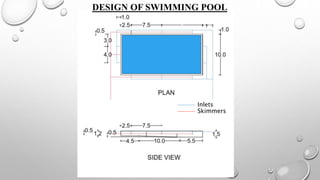
DESIGN OF SWIMMING POOL
Inlets
Skimmers
HYDRAULIC DESIGN
Main drain 1
Total length = 12.5+2.5+1
= 16 m
No. of L’ Bows = 2
No. of Valves = 1
Equivalent length = 16+2×
8.1
3.281
+ 1 ×
1.7
3.281
= 21.456 m
Head loss (William Hazen Formula) =
10.7
0.0754.87 × (
0.01104
150
)1.85
21456= 1.5599 m
Specimen calculation
Total head loss in main drains = 3.95 m
Similarly,
Total head loss in skimmer lines = 4.37 m
Total head loss in inlets lines = 9.954 m
Losses in the lines = 14.324 m
Filter Losses (when dirty) = 7.04 m
Heater losses = 4 m
Total dynamic Head = 25.36 m
= 83 ft
Flow rate = 175 GPM
Minimum Filter Area required = Design Flow/Filter flow rate
For Cartridge filter = 175 (GPM)/3 (GPM/Sqft)
= 58 Sqft
Main drain 2
No T’s = 2
No. of L’ Bows = 1
No. of Valves = 1
Length = 12.5
Total equivalent length = 32.83 m
Head loss = 2.387 m
STRUCTURAL DESIGN
Based on BS 8110, BS 8007, BD 28
Designed for minimum crack width o 0.2 mm
Structural Details
WASTE WATER DISPOSAL SYSTEM
WASTE WATER GENERATON
CALCULATIONS ARE DONE USING SLS 745 GUIDELINES
UNIT BLACK WATER( L/D) GRAY WATER (L/D)
TWO HOSTALS 3450 10350
TEN HOUSING UNITS 2000 6000
CANTEEN 1300 2400
LAUNDARY 500
SECURITY ROOM 120 80
OFFICES(VOCATIONAL,
EDUCATIONAL,ADMINI
STRATION)
3720 2480
UNITS BLACK WATER ( L/D) GRAY WATER (L/D)
CLINIC 300 200
SWIMMINGPOOL 1000 200
GYMNASIUM 1000 3000
ORGANIC AGRICULTURE 500 2500
SECURITY ROOM 120 80
NON RESIDENCE 500 500
TOTAL 13890 28210
TOTAL WASTE WATER GENERATION =42100 L/D
CALCULATIONS ARE DONE USING SLS 745 GUIDELINES
UNIT BLACK WATER( L/D) GRAY WATER (L/D)
TWO HOSTALS 28 X 50 + 41 X 50=3450 28 X 150 +41 X 150 =10850
TEN HOUSING UNITS 4 X 50 X 10=2000 4 X 150 X 10 = 6000
CANTEEN 6 X 50 + 100 X 10=1300 6 X 150 +100 X 15 =2400
LAUNDARY 10 X 20 + 20 X 20 =500
SECURITY ROOM 4 X 30 = 120 4 X 20 =80
OFFICES(VOCATIONA
L,EDUCATIONAL,AD
MINISTRATION)
4 X 30 + 60 X 30 + 60 X 30
=3720
4 X 20 + 60 X 20 + 60 X 20
=2480
UNITS BLACK WATER ( L/D) GRAY WATER (L/D)
CLINIC 10 X 30 =300 10 X 20=200
SWIMMINGPOOL 20 X 50 =1000 20 X 10=200
GYMNASIUM 20 X 50=1000 20 X 150 =3000
ORGANIC AGRICULTURE 500 2500
SECURITY ROOM 4 X 30=120 4 X 20=80
NON RESIDENCE 10 X 50=500 10 X 50=500
TOTAL 13890 28210
TOTAL WASTE WATER GENERATION =42100 L/D
SPECIMEN CALCULATIONS CONT…….
SPECIMEN CALCULATIONS FOR SEPTIC TANK DIMENSIONS
1) HOUSES
1.1) CONSIDER DISPOSAL UNIT 1
FACILITIES CONNECTED = 5 HOUSES
BLACK WATER GENERATION (ACCORDING TO SLS 745),
= 200 l/DAY
BLACK WATER = 200 l/DAY×5
= 1000 l/DAY
DESIGN OF SEPTIC TANK
TAKE HRT AS 3 DAYS
(DESIGN AS PER AS THE LECTURE NOTE OF ONSITE SEWAGE TREATMENT BY PROF. G. B. B.
HERATH,)
SEPTIC TANK VOLUME = 1×3=3 𝑚3
(1 𝑚3
< V<15 𝑚3
)
ASSUME L:W RATIO = 1:2
HEIGHT = 1 m
2W×W×1 = 3
W = 1.27 m (> 0.75m^3)
L = 2.4 m
H = 1 m (< 2.5 m)
SPECIMEN CALCULATIONS CONT…….
Septic
tank
Units
connected
a
(m)
b
(m)
c
(m)
d
(m)
e
(m)
f
(m)
g
(m)
h’
(m)
h
(m)
w
(m)
l
(m)
01 5-Houses 0.32 0.05 0.27 0.08 0.35 0.8 0.24 0.1 1 1.27 2.4
02 2-Houses 0.32 0.05 0.27 0.08 0.35 0.53 0.16 0.1 1 0.78 1.6
03 3-Houses 0.32 0.05 0.27 0.08 0.35 0.63 0.19 0.1 1 0.95 1.9
04
Administratio
n
Block+Medic
al Clinic
0.32 0.05 0.27 0.08 0.35 1.2 0.39 0.1 1 1.8 3.6
05
2-
0.32 0.05 0.27 0.08 0.35 1.46 0.44 0.15 1.5 2.2 4.4
Septic
tank
Units connected
a
(m)
b
(m)
c
(m)
d
(m)
e
(m)
f
(m)
g
(m)
h’
(m)
h
(m)
w
(m)
l
(m)
06
Vocation center
+Workshop
0.32 0.05 0.27 0.08 0.35 1.1 0.32 0.1 1 1.6 3.2
07
Swimming pool +
gym
0.32 0.05 0.27 0.08 0.35 1.13 0.34 0.1 1 1.7 3.4
08 public toilet 0.32 0.05 0.27 0.08 0.35 0.6 0.2 0.1 1 1 2
09
Organic
Agriculture
0.32 0.05 0.27 0.08 0.35 0.6 0.18 0.1 1 0.9 1.8
CROSS SECTION DETAILS OF SEPTIC TANK
Section view(X-X) End view
Plan View
SPECIMEN CALCULATIONS FOR INFILTRATION TRENCH
SPECIMEN CALCULATIONS FOR INFILTRATION TRENCHES
1) HOUSES
CONSIDER DISPOSAL UNIT 1
TOTAL WASTE WATER (BLACK WATER + GREY WATER) = (1000+3000) l/DAY
= 4000 l/DAY
(DESIGN AS PER AS THE LECTURE NOTE OF ONSITE SEWAGE TREATMENT BY PROF. G. B. B.
HERATH,)
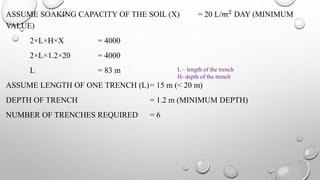
ASSUME SOAKING CAPACITY OF THE SOIL (X) = 20 L/𝑚2 DAY (MINIMUM
VALUE)
2×L×H×X = 4000
2×L×1.2×20 = 4000
L = 83 m
ASSUME LENGTH OF ONE TRENCH (L)= 15 m (< 20 m)
DEPTH OF TRENCH = 1.2 m (MINIMUM DEPTH)
NUMBER OF TRENCHES REQUIRED = 6
L – length of the trench
H- depth of the trench
Infiltration
trench
Total
length(m)
Length of
one
trench (m)
Width of
trench(m)
Depth of
trench(m)
No. of
Trenches
01 83 15 0.3 1.2 6
02 37.5 10 0.3 1.2 4
03 50 10 0.3 1.2 5
04 83 15 0.3 1.2 6
05 375 20 0.3 1.2 19
06 62.5 15 0.3 1.2 5
07 108.3 20 0.3 1.2 6
08 25 10 0.3 1.2 3
09 10.4 15 0.3 1.2 1
SPECIMEN CALCULATION OF DE-SLUDGE PERIOD OF
SEPTIC TANKS
THIS IS THE SPECIMEN CALCULATION FOR THE SEPTIC TANK OF FIVE
HOME UNITS
DAILY PER CAPITA SEPTAGE ACCUMULATION IS ASSUMED AS 40 l/YEAR.
DE SLUDGE FREQUENCY =
𝑣𝑜𝑙𝑢𝑚𝑒 𝑜𝑓 𝑡ℎ𝑒 𝑠𝑒𝑝𝑡𝑖𝑐 𝑡𝑎𝑛𝑘 𝑋
2
3
𝐷𝑎𝑖𝑙𝑦 𝑝𝑒𝑟 𝑐𝑎𝑝𝑖𝑡𝑎 𝑠𝑒𝑝𝑡𝑎𝑔𝑒 𝑎𝑐𝑐𝑢𝑚𝑢𝑙𝑎𝑡𝑖𝑜𝑛 𝑋 𝑛𝑢𝑚𝑏𝑒𝑟 𝑜𝑓 𝑝𝑒𝑜𝑝𝑙𝑒
=
3 𝑋
2
3
𝑋103
40 𝑋 5 𝑋 4
= 2.5 YEARS
Septic
tank
Units connected De sludge period (years)
01 5-Houses 2.5
02 2-Houses 2.5
03 3-Houses 2.5
04
Administration Block + Medical
Clinic
3.7
05 2- Hostel + Clinic 1.9
06 Vocational center +Workshop 3
07 Swimming pool + gym 5
08 public toilet 3.1
WATER TANK
WATER TANK STRUCTURAL DESIGN
DEMAND = 42.2𝑚3/DAY
ASSUME RETENTION TIME = 2 DAYS
CAPACITY OF THE TANK/𝑚3
= 42.2 × 2
= 84.4 𝑚3
FREE BOARD = 0.2m
DEPTH INCLUDING FREE BOARD = 3 m
EFFECTIVE DEPTH = 2.8 m
WALL THICKNESS = 0.2 m
LENGTH = 8 m
WIDTH = 4 m
LOADS AND MOMENTS ARE CALCULATED USING SAP 2000
MAXIMUM BENDING MOMENT CAUSING TENSION ON INNER FACE AT
BASE AT ULS = 4.6 kNm/m
MAXIMUM TENSION OCCURS AT WALL (T) = 109 kN/m
CORRESPONDING MOMENT (M) = 0.2 kNm/m
BASICALLY FOLLOWING CHECKS ARE DONE,
1. SHEAR CAPACITY CHECK (EN 1992-3: 2006,6.6N)
2. STEEL TO CONTROL THERMAL CRACKING (EN 1992-3: 2006, 3.2N)
FROM THAT CALCULATE THE MINIMUM STEEL REQUIREMENTS,
T20-@200c/c are provided as indicated in the drawing
• WATER TANK FOUNDATION DESIGN
• AXIAL LOAD AND MOMENTS ARE TAKEN FROM THE SAP ANALYSIS.
• DESIGN APPROACH 1 COMBINATION 1,
• 𝐴1 + 𝑀1 + 𝑅1
• 𝛾 𝐺,𝑑𝑠𝑏 = 1.35, 𝛾 𝑄,𝑑𝑠𝑏 = 1.5, 𝛾 𝐶/ = 1, 𝛾∅/ = 1, 𝛾 𝑅𝑉 = 1
• 𝐿𝑜𝑎𝑑 𝑓𝑟𝑜𝑚 𝑡ℎ𝑒 𝑠𝑢𝑝𝑒𝑟 𝑠𝑡𝑟𝑢𝑐𝑡𝑢𝑟𝑒 (𝐹) = 691.9 𝑘𝑁
• 𝑊𝑒𝑖𝑔ℎ𝑡 𝑜𝑓 𝑡ℎ𝑒 𝑠𝑜𝑖𝑙 𝑊𝑠,𝑘 = 1.0 × 1.0 × 1.0 × 20
• = 20𝑘𝑁
• 𝑊𝑒𝑖𝑔ℎ𝑡 𝑜𝑓 𝑡ℎ𝑒 𝐹𝑜𝑢𝑛𝑑𝑎𝑡𝑖𝑜𝑛 𝑊𝑓,𝑘 = 1.0 × 1.0 × 0.35 × 25
• = 8.75 𝑘𝑁
• 𝐷𝑒𝑠𝑖𝑔𝑛 𝑙𝑜𝑎𝑑 𝑓𝑜𝑟 𝑡ℎ𝑒 𝑓𝑜𝑢𝑛𝑑𝑎𝑡𝑖𝑜𝑛 𝐹𝑑 = 691.9 𝑘𝑁 + 1.35 20 + 8.75 𝑘𝑁
• = 730.7 𝑘𝑁
BEARING CAPACITY CALCULATION
𝑞 𝑢𝑙𝑡 = 𝐶𝑁𝑐 𝑆𝑐 𝑏𝑐 𝑖 𝑐 + 𝑞𝑁𝑞 𝑆 𝑞 𝑏 𝑞 𝑖 𝑞 + 0.5𝛾𝐵𝑁𝛾 𝑆 𝛾 𝑏 𝛾 𝑖 𝛾
OVER DESIGN FACTOR,
𝜏 =
𝑅 𝑑
𝐹𝑑
𝜏 = 1.83
𝐿 = 1.0𝑚, 𝐵 = 1.0𝑚, 𝑡 = 0.35𝑚
SETTLEMENT CHECK,
𝑆 𝑒= 𝐶1 𝐶2( 𝑞 − 𝑞)
0
𝑛
𝐼𝑧
𝐸𝑠
∆𝑧
𝑆 𝑒=22.67mm <50mm
SATISFY THE SETTLEMENT CHECK.
ROUTE PLANNING
B
D
E
F
L
M
C
A
I
H
K
G
J
Check for the slope of road sectors Section of the
road
Length along the road section
/(m)
Contour
difference/(m)
Slope
AB 96 3 1:32
BC 120 0.5 1:240
CD 92.5 1 1:92.5
DE 42 3.5 1:12
EF 40 2.5 1:16
EL 96 3 1:32
FG 32 0.5 1:64
FK 95 3.5 1:27
AG 48 0.5 1:96
AH 24 1 1:24
AI 43 2 1:21.5
IJ 50 1 1:50
JK 24 2 1:12
KL 84 0.5 1:168
LM 42 3 1:14
Maximum slope that can be maintained in the design = 1:10
Maximum slope from the all road sections = 1: 12 < 1:10
Therefore, the slope of access roads is okay.
3D LAYOUT MODEL
ENVIRONMENTAL IMPACT ASSESSMENT
WHAT IS AN EIA?
ENVIRONMENTAL IMPACT ASSESSMENT (EIA)
EVALUATION OF THE ENVIRONMENTAL IMPACTS
LIKELY TO RAISE FROM A MAJOR PROJECT
SIGNIFICANTLYAFFECTING THE ENVIRONMENT.
IDENTIFIED PROBLEMS AND PROPOSED MITIGATION MEASURES
DURING CONSTRUCTION
Action Impact Mitigation measures
Pollution due to noise and vibration
due to, Noise and vibration generated
by construction equipment
Disturbance to natural lives
Affect safety and health of workers and
immediate environment.
May affect the stability of earthworks.
Well planned working times.
Impose regulations to drivers and
machine operators
Proper maintenance of machinery
The generators and other heavy –duty
equipment should be insulated or placed
in enclosures to minimize ambient noise
levels.
Pollution of air and stream due to,
The construction activities
Construction machinery and trucks.
Discharge of construction and
machinery waste to the streams and
rivers
Generate hazardous exhaust fumes such
as carbon oxides (COx), Sulphur oxides
(SOx), and nitrogen oxides (NOx)
Increased dust and gas emission
Pollution of stream
Provide personal protective equipment
Regular and prompt maintenance of
construction machinery and equipment
Control over areas generating dust
particles
Control over discharge of construction
waste and machinery waste to stream.
Public health and safety
The construction activities
Construction equipment and
machinery
Accidents
Unsafe working conditions
Increased dust and gas emission
• Provide personal protective
equipment
• A readily available first aid kit.
• Educating regarding actions to be
taken during emergency situation
• Safety education and training
Soil erosion due to,
Removing forest vegetation
Excavation
Exposes the underlying material to
move dangers of degeneration by
erosion agents.
Loss of habitats of flora and fauna
• Avoid unnecessary movements of
soil materials from the site
• Soil conservation structures
• Controlled construction activities
depending on climate
• Provide with vegetation to manage
erosion
AFTER THE CONSTRUCTION OF THE PROJECT
Action Impact Mitigation measures
Pollution of stream due to waste
discharge by disposing waste and
hazardous materials
Threat to flora and fauna living in the
water
Pollution of stream water making it
unsuitable for agricultural uses
Introducing a proper solid waste
management system
Treating liquid waste properly
before they are discharged
Imposing strict rules and
regulations against disposal of
untreated waste
SUSTAINABLE ENERGY
• ENERGY GENERATION
• AVERAGE SOLAR IRRADIATION IN PERADENIYA AREA = 5KWH/ 𝑚2PER
DAY
• CAPACITY UTILIZATION FACTOR = 0.35
• ELECTRICITY GENERATION PER DAY = (A×5×0.35)
KWH/D
= 1.75 A KWH/D
• ELECTRICITY GENERATION PER MONTH = 1.75*A*30
KWH
= 52.5 A KWH
• NET AREA NEEDED A =
1600
52.5
= 30.5 𝑚2
SOLAR PANEL INSTALLATION
FROM THE REFERENCE OF SOLAR ELECTRICITY HANDBOOK 2017 EDITION,
MICHAEL BOXWELL.
Panel details are taken from the Green
light Solar Lanka (Pvt)Ltd.
Considering the sub activity,
Backfilling to trenches
with selected earth available at site
Activity
Unit Quantity Rate Cost
Backfilling to trenches with selected earth available at
site. cube 904.30 1025 926908
Backfilling to trenches with Imported Material
cube 284.00 1250 355000
Filling under floors including levelling, watering &
compacting in 1.5" layers with available and selected
earth at site cube 530.04 2050 1086572
Filling under floors including levelling, watering &
compacting in 1.5" layers with imported selected earth ,
gravel cube 247.35 2050 507067
Approved Soil Spread & Compacted in 150 to 225 mm
Thick Layers Using Machine Rammer at Narrow Places
(Loose Volume) cube 388.69 432 167915
Subtotal for Earthwork supports and filling
3043462
SPECIMEN CALCULATION
Consider activity No 2: Earth work supports and Filling over site to reduce levels
from 2016 BSR
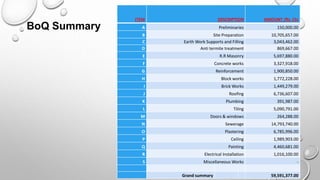
ITEM DESCRIPTION AMOUNT /Rs. Cts
A Preliminaries 150,000.00
B Site Preparation 10,705,657.00
C Earth Work Supports and Filling 3,043,462.00
D Anti termite treatment 869,667.00
E R.R Masonry 5,697,880.00
F Concrete works 3,327,918.00
G Reinforcement 1,900,850.00
H Block works 1,772,228.00
I Brick Works 1,449,279.00
J Roofing 6,736,607.00
K Plumbing 391,987.00
L Tiling 5,090,791.00
M Doors & windows 264,288.00
N Sewerage 14,793,740.00
O Plastering 6,785,996.00
P Ceiling 1,989,903.00
Q Painting 4,460,681.00
R Electrical Installation 1,016,100.00
S Miscellaneous Works -
Grand summary 59,591,377.00
BoQ Summary
THANK YOU!!!!

Final presentation

  • 1.
    CE 402 MULTI -DISCIPLINARY DESIGN PROJECT GROUP H2 E/13/007 AHAMED, M.A.S. E/13/156 JAYASHAN, T.D.P. E/13/245 PADMASIRI, P.L.L.T. E/13/393 WEERASINGHE, P.S. SUPERVISED BY PROF.K.P.P. PATHIRANA DR.L.C. KURUKULASURIYA DR.P.B.G. DISSANAYAKA DR.R.M.L.D. RATHNAYAKA
  • 2.
    PROPOSED VILLAGE FOR DIFFERENTLYABLED CHILDREN AND ADULTS
  • 3.
    CONTENT 1. INTRODUCTION 2. AIM 3.SCOPE 4. OBJECTIVES 5. METHODOLOGY 6. DATA COLLECTION 7. ALTERNATIVES & SELECTION CRITERIA 8. EIA 9. DESIGNS & CALCULATIONS 10. BOQ SUMMARY
  • 4.
    INTRODUCTION •Many people sufferingmental illness are able to reside at home either on their own or with family. •This is not a realistic option for all. •Villages for mentally disabled people is one option to that problem
  • 5.
    IMPORTANT CONSIDERATIONS WHENPROPOSING 1. SAFETY OF LIVING PEOPLE Ramps , handrails , sensing equipments , safety windows and doors with special locks ,corridors , flooring , building services 2. SOCIAL BENEFITS Education , Healthcare facilities , soft skills 3. ESSENTIAL NEEDS Sanitation , water supply , electricity , waste disposal system 4. SPECIAL EQUIPMENTS Beds, Chairs, Tables Introduction continue………….
  • 6.
    AIM OUR AIM ISTO PROPOSE A VILLAGE FOR DIFFERENTLY ABLED CHILDREN AND ADULTS IN NEED OF SPECIAL CARE.
  • 7.
    SCOPE DESIGN INDIVIDUAL UNITSSUCH THAT THEY ARE SUITABLE TO 50 DEFERENTLY ABLED PEOPLE
  • 8.
    OBJECTIVES To identify specialfacility needs of mentally disabled people To find special design considerations to design each facilities for mentally disabled people  To find alternative site layouts  To select best option among alternative layouts concerning technical, social, environmental and economic feasibility.  To prepare Detailed designs, Drawings, EIA and Visual displays.
  • 9.
    Locating the suitablesite for the village Social survey of differently abled communities Preparing alternative preliminary designs Decide the optimized design for the village Decide the optimized design for the village Prepare EIA reports Finalize the design Prepare cost reports & Budgets METHODOLOGY
  • 10.
    DATA COLLECTION Finding about existing facilities Journals PaperArticles Reports Research paper Site visit Hanthana proposed village Survey Blue rose special school & Training Centre Design code Euro code BS code
  • 11.
    SURVEY - BLUEROSE SPECIAL SCHOOL & TRAINING CENTRE 45,000 Differently abled children and adults are in Central province. Their IQ level < 80 % They have categorized, Category Number of students Autism 17 Down’s Syndrome 18 Micro Cephalous 3 Noonan's Syndrome 2 GDD + MR 19
  • 12.
    • Projected Area: 170,813Sq. m • Coordinate: ( 7.247.9090 , 80.602.5850 ) SITE VISIT - HANTHANA PROPOSED VILLAGE
  • 13.
  • 14.
    • Topography: Nearlyflat • Pine Forest area • Access road up to the site • Streams at the entrance • High voltage transmission line near to the site area
  • 15.
    LAYOUT 1 Area -27873𝑚2 Perimeter-734m ALTERNATIVES Different layouts according to the topography
  • 16.
  • 17.
  • 18.
    SELECTING CRITERIA • TECHNICALFEASIBILITY • ECONOMIC FEASIBILITY • ENVIRONMENTAL FEASIBILITY • SOCIAL FEASIBILITY • QUALITATIVE FEASIBILITY
  • 19.
    In here, thefollowing technical factors were used in the selection. • DESIGN • ARCHITECTURAL VIEW • MATERIALS TECHNICAL FEASIBILITY
  • 20.
    1. COST FOREXCAVATION AND EARTHWORKS ECONOMIC FEASIBILITY Alternative Cost / Rs Layout 1 524,784 Layout 2 678,466 Layout 3 550,176
  • 21.
    COST FACTOR = 1 TOTALCOST OF EACH OPTION ( 1 TOTAL COST OF EACH OPTION ) Alternative Cost factor Layout 1 0.36 Layout 2 0.29 Layout 3 0.35
  • 22.
    1. DEFORESTING AREA ENVIRONMENTALFEASIBILITY Alternative Deforesting area / (m2) Layout 1 9950 Layout 2 9610 Layout 3 9643
  • 23.
    AREA FACTOR = 𝟏 𝐃𝐄𝐅𝐎𝐑𝐄𝐒𝐓𝐈𝐍𝐆𝐀𝐑𝐄𝐀 𝐎𝐅 𝐄𝐀𝐂𝐇 𝐎𝐏𝐓𝐈𝐎𝐍 ( 𝟏 𝐃𝐄𝐅𝐎𝐑𝐄𝐒𝐓𝐈𝐍𝐆 𝐀𝐑𝐄𝐀 𝐎𝐅 𝐄𝐀𝐂𝐇 𝐎𝐏𝐓𝐈𝐎𝐍 ) Alternative Area factor Layout 1 0.326 Layout 2 0.338 Layout 3 0.337
  • 24.
    1. CONNECTIVITY BETWEENEACH FACILITY SOCIAL FEASIBILITY DISTANCE FACTOR = 𝒊 𝐍𝐔𝐌𝐁𝐄𝐑 𝐎𝐅 𝐇𝐄𝐀𝐃𝐒/𝐃𝐈𝐒𝐓𝐀𝐍𝐂𝐄 𝒊=𝟏 𝒏 ( 𝒊 𝐍𝐔𝐌𝐁𝐄𝐑 𝐎𝐅 𝐇𝐄𝐀𝐃𝐒/𝐃𝐈𝐒𝐓𝐀𝐍𝐂𝐄)
  • 25.
    Facility Distance factor Layout 1Layout 2 Layout 3 Home unit 1 0.11 0.033 0.116 Home unit 2 0.05 0.029 0.084 Home unit 3 0.04 0.029 0.064 Home unit 4 0.034 0.027 0.062 Home unit 5 0.031 0.0263 0.044 Home unit 6 0.022 0.024 0.046 Home unit 7 0.019 0.024 0.041 Home unit 8 0.078 0.022 0.037 Home unit 9 0.059 0.022 0.032 Home unit 10 0.044 0.021 0.027
  • 26.
    Canteen 1.82 2.4652.250 Hostel 1 0.184 0.206 0.121 Hostel 2 0.146 0.115 0.097 Administration 1.176 0.115 0.161 Vocational 2.222 1.07 0.361 Educational 7.058 3.333 0.386 Playground 0.733 0.601 0.361 Gymnasium 0.339 0.542 0.317 Swimming Pool 0.283 0.442 0.245 Organic 0.238 0.328 0.299 Clinic 3.55 33.333 1.69 TOTAL 18.278 44.937 6.831
  • 27.
    Alternative Distance factor Layout1 0.261 Layout 2 0.642 Layout 3 0.098 DISTANCE FACTOR = 𝒊 𝐍𝐔𝐌𝐁𝐄𝐑 𝐎𝐅 𝐇𝐄𝐀𝐃𝐒/𝐃𝐈𝐒𝐓𝐀𝐍𝐂𝐄 𝒊=𝟏 𝒏 ( 𝒊 𝐍𝐔𝐌𝐁𝐄𝐑 𝐎𝐅 𝐇𝐄𝐀𝐃𝐒/𝐃𝐈𝐒𝐓𝐀𝐍𝐂𝐄)
  • 28.
    1. PLOT COVERAGE QUALITATIVEFEASIBILITY PLOT COVERAGE = 𝐴𝑟𝑒𝑎 𝑜𝑐𝑐𝑢𝑝𝑖𝑒𝑑 𝑏𝑦 𝐵𝑢𝑖𝑙𝑑𝑖𝑛𝑔𝑠 𝑇𝑜𝑡𝑎𝑙 𝑎𝑟𝑒𝑎 𝑜𝑓 𝑡ℎ𝑒 𝑙𝑎𝑛𝑑 X 100% Alternative Plot coverage % Layout 1 38.3 Layout 2 45.1 Layout 3 43.4
  • 29.
    SENSITIVITYANALYSIS • AHP model Comparisonmatrix Economical Environmen tal Social Qualitative Economical 1 5 3 7 Environmental 1/5 1 1/3 3 Social 1/3 3 1 5 Qualitative 1/7 1/3 1/5 1
  • 30.
    Economical 55.79% Environmental 12.18% Social26.33% Qualitative 5.69% Priorities of factors
  • 31.
    Event Economical EnvironmentalSocial Qualitative 1 55.79 12.19 26.33 5.69 2 51.73 26.44 15.52 6.32 3 56.42 18.21 20.20 5.18 4 60.66 7.69 25.64 6.02 Average 56 16 22 6
  • 32.
    0 5 10 15 20 25 30 35 40 45 50 55 60 65 70 2 3 45 PERCENTAGES FEASIBILITIES SENSITIVITY STUDY EVENT 1 EVENT 2 EVENT 3 EVENT 4 AVERAGE
  • 33.
    BEST ALTERNATIVE Percentages % Alternative 1 Alternative 2 Alternative 3 Economical 560.360 0.290 0.350 Environmental 22 0.261 0.642 0.098 Social 16 0.326 0.338 0.337 Qualitative 6 0.351 0.310 0.336
  • 34.
    Alternative 1 Alternative2 Alternative 3 Economical 20.160 16.240 19.6 Environmental 5.742 14.124 2.156 Social 5.216 5.408 5.392 Qualitative 2.106 1.86 2.016 Total 33.224 37.632 29.16 Therefore, the best alternative is Alternative 2 with higher total value.
  • 35.
  • 45.
    DETAILED DESIGN ANDCALCULATIONS • ROUTE PLANNING • WATER SUPPLY NETWORK • WASTE WATER DISPOSAL SYSTEM • WATER TANK  STRUCTURAL DESIGN  FOUNDATION DESIGN • ROOF TRUSS FOR HOSTEL • RETAINING WALL • STORM DRAINAGE AND CULVERT • SWIMMING POOL • PLAYGROUND • ELECTRICAL INSTALLATION
  • 46.
    Floor area ofeach units FACILITY NUMBER OF UNITS FLOOR AREA/UNIT Hostel 2 370 Individual home units 10 115 Cafeteria 1 450 Administration building 1 355 Education unit 1 795 Vocational training center & workshop 1 425 Playground 1 3000 Gymnasium 1 840 Swimming pool 1 350 Clinic 1 33 Car parks 2 800 Security 1 200
  • 47.
    DESIGN FOR STORMWATER DRAINAGE Vmax = 0.75 m/s Q = 0.84 m3/s Q = AV 0.84 = 0.75× 𝐴 A = 1.12 m2 V = R2/3 S1/2/n ; n = 0.012 s = 1/5000 0.75 = R2/3×(1/5000)1/2 / 0.012 R = 0.508 m R = A/P 0.508 = 1.12/ (b+2h) b+2h = 2.21 b+4b = 2.21 5b =2.21 b = 0.442 h = 0.884 h b t
  • 48.
    DESIGN OF PRIMARYDISTRIBUTION NETWORK Total water requirement = 42000 l/day Non-Revenue water (Assume 20 %) = 8400 l/day Total water to be treated = 42000+8400 = 50400 l/day Network Table – Nodes Elevation Demand Residual H Node ID m CMD m Junc 1 112 20 26.94 Junc 2 110 3.98 25.33 Junc 3 110 5.93 24.09 Junc 4 113 2.4 35.39 Junc 6 108 3.5 37.67 Junc 7 102 1.8 35.98 Junc 8 113 1 33.86 Junc 9 103 2.4 33.52 Junc 10 103 4.6 32.96 Junc 11 106 5.46 30.61 Junc JU1 0 0 131.72 Junc JU2 0 0 150.76
  • 49.
    Network Table -Links Loop 1 Loop 2 Link ID Length Diameter Flow Velocity Unit Headloss Head loss Flow (CMS) h/q Head loss Flow h/q m mm CMD m/s m/km Pipe 1 56 18.75 23.58 0.99 64.52 3.61312 0.000273 13238.9 Pipe 2 27 18.75 19.6 0.82 45.81 1.23687 0.000227 5452.3 Pipe 4 88 12.5 5.46 0.51 30.95 2.7236 6.31944E-05 43098.7253 Pipe 5 49 12.5 4.81 0.45 24.44 1.19756 5.57E-05 21511.2 -1.19756 -5.56713E-05 21511.2649 Pipe 6 44 12.5 5.81 0.55 34.69 1.52636 6.72E-05 22698.3 -1.52636 -6.72454E-05 22698.3656 Pipe 9 74 12.5 2.57 0.24 7.65 0.5661 2.97E-05 19031.5 Pipe 10 131 12.5 -2.03 0.19 4.97 0.65107 -2.3E-05 -27710.5 Pipe 11 42 12.5 -7.49 0.71 55.59 2.33478 -8.7E-05 -26932.5 Pipe 12 46 25 51.07 1.2 66.47 Pipe PI1 14 12.5 13.67 1.29 169.3 2.3702 0.000158 14980.6 Pipe PI2 14 12.5 13.67 1.29 169.3 2.3702 0.000158 14980.6 Pipe PI4 167 12.5 6.77 0.64 46.05 7.69035 7.84E-05 98145.6 Pipe PI3 56 12.5 4.97 0.47 25.97 1.45432 5.75E-05 25282.3 Pump 3 #N/A #N/A 13.67 0 -19.04 8 0.000158 50563.2 Sum 33.01093 231241.8 -0.00032 87308.3557 𝐻𝑒𝑎𝑑 𝐿𝑜𝑠𝑠 𝐻𝑒𝑎𝑑 𝐿𝑜𝑠𝑠 𝐹𝑙𝑜𝑤 𝑚3 𝑠 = 0.0001427 -3.665E-09 NETWORK TABLE
  • 50.
    In loop 1, ℎ ℎ/𝑞 =0.14 𝑙 𝑠 < 1 𝑙 𝑠 In loop 2, ℎ ℎ/𝑞 = 3.67 × 10⁻⁶ 𝑙 𝑠 < 1 𝑙 𝑠 Both the loops satisfy the criterion. Residual Heads in all the nodes are greater than 15 m. Velocity in pipes are in the acceptable range. (0.5 m/s to 1.5 m/s) Hence design acceptable. Bottom level of the reservoir should be 142m. A 40 Psi pump is used in this network in between Node JU1 and JU2 Performance curve of the pump, 0 5 10 15 20 25 30 35 40 45 0 5 10 15 20 Head(m) FLow (CMD) Performance Curve
  • 51.
    DESIGN OF SWIMMINGPOOL Inlets Skimmers
  • 52.
    HYDRAULIC DESIGN Main drain1 Total length = 12.5+2.5+1 = 16 m No. of L’ Bows = 2 No. of Valves = 1 Equivalent length = 16+2× 8.1 3.281 + 1 × 1.7 3.281 = 21.456 m Head loss (William Hazen Formula) = 10.7 0.0754.87 × ( 0.01104 150 )1.85 21456= 1.5599 m Specimen calculation Total head loss in main drains = 3.95 m Similarly, Total head loss in skimmer lines = 4.37 m Total head loss in inlets lines = 9.954 m Losses in the lines = 14.324 m Filter Losses (when dirty) = 7.04 m Heater losses = 4 m Total dynamic Head = 25.36 m = 83 ft Flow rate = 175 GPM Minimum Filter Area required = Design Flow/Filter flow rate For Cartridge filter = 175 (GPM)/3 (GPM/Sqft) = 58 Sqft Main drain 2 No T’s = 2 No. of L’ Bows = 1 No. of Valves = 1 Length = 12.5 Total equivalent length = 32.83 m Head loss = 2.387 m
  • 53.
    STRUCTURAL DESIGN Based onBS 8110, BS 8007, BD 28 Designed for minimum crack width o 0.2 mm Structural Details
  • 54.
  • 55.
    WASTE WATER GENERATON CALCULATIONSARE DONE USING SLS 745 GUIDELINES UNIT BLACK WATER( L/D) GRAY WATER (L/D) TWO HOSTALS 3450 10350 TEN HOUSING UNITS 2000 6000 CANTEEN 1300 2400 LAUNDARY 500 SECURITY ROOM 120 80 OFFICES(VOCATIONAL, EDUCATIONAL,ADMINI STRATION) 3720 2480
  • 56.
    UNITS BLACK WATER( L/D) GRAY WATER (L/D) CLINIC 300 200 SWIMMINGPOOL 1000 200 GYMNASIUM 1000 3000 ORGANIC AGRICULTURE 500 2500 SECURITY ROOM 120 80 NON RESIDENCE 500 500 TOTAL 13890 28210 TOTAL WASTE WATER GENERATION =42100 L/D
  • 57.
    CALCULATIONS ARE DONEUSING SLS 745 GUIDELINES UNIT BLACK WATER( L/D) GRAY WATER (L/D) TWO HOSTALS 28 X 50 + 41 X 50=3450 28 X 150 +41 X 150 =10850 TEN HOUSING UNITS 4 X 50 X 10=2000 4 X 150 X 10 = 6000 CANTEEN 6 X 50 + 100 X 10=1300 6 X 150 +100 X 15 =2400 LAUNDARY 10 X 20 + 20 X 20 =500 SECURITY ROOM 4 X 30 = 120 4 X 20 =80 OFFICES(VOCATIONA L,EDUCATIONAL,AD MINISTRATION) 4 X 30 + 60 X 30 + 60 X 30 =3720 4 X 20 + 60 X 20 + 60 X 20 =2480
  • 58.
    UNITS BLACK WATER( L/D) GRAY WATER (L/D) CLINIC 10 X 30 =300 10 X 20=200 SWIMMINGPOOL 20 X 50 =1000 20 X 10=200 GYMNASIUM 20 X 50=1000 20 X 150 =3000 ORGANIC AGRICULTURE 500 2500 SECURITY ROOM 4 X 30=120 4 X 20=80 NON RESIDENCE 10 X 50=500 10 X 50=500 TOTAL 13890 28210 TOTAL WASTE WATER GENERATION =42100 L/D
  • 59.
    SPECIMEN CALCULATIONS CONT……. SPECIMENCALCULATIONS FOR SEPTIC TANK DIMENSIONS 1) HOUSES 1.1) CONSIDER DISPOSAL UNIT 1 FACILITIES CONNECTED = 5 HOUSES BLACK WATER GENERATION (ACCORDING TO SLS 745), = 200 l/DAY BLACK WATER = 200 l/DAY×5 = 1000 l/DAY DESIGN OF SEPTIC TANK TAKE HRT AS 3 DAYS (DESIGN AS PER AS THE LECTURE NOTE OF ONSITE SEWAGE TREATMENT BY PROF. G. B. B. HERATH,)
  • 60.
    SEPTIC TANK VOLUME= 1×3=3 𝑚3 (1 𝑚3 < V<15 𝑚3 ) ASSUME L:W RATIO = 1:2 HEIGHT = 1 m 2W×W×1 = 3 W = 1.27 m (> 0.75m^3) L = 2.4 m H = 1 m (< 2.5 m) SPECIMEN CALCULATIONS CONT…….
  • 61.
    Septic tank Units connected a (m) b (m) c (m) d (m) e (m) f (m) g (m) h’ (m) h (m) w (m) l (m) 01 5-Houses 0.320.05 0.27 0.08 0.35 0.8 0.24 0.1 1 1.27 2.4 02 2-Houses 0.32 0.05 0.27 0.08 0.35 0.53 0.16 0.1 1 0.78 1.6 03 3-Houses 0.32 0.05 0.27 0.08 0.35 0.63 0.19 0.1 1 0.95 1.9 04 Administratio n Block+Medic al Clinic 0.32 0.05 0.27 0.08 0.35 1.2 0.39 0.1 1 1.8 3.6 05 2- 0.32 0.05 0.27 0.08 0.35 1.46 0.44 0.15 1.5 2.2 4.4
  • 62.
    Septic tank Units connected a (m) b (m) c (m) d (m) e (m) f (m) g (m) h’ (m) h (m) w (m) l (m) 06 Vocation center +Workshop 0.320.05 0.27 0.08 0.35 1.1 0.32 0.1 1 1.6 3.2 07 Swimming pool + gym 0.32 0.05 0.27 0.08 0.35 1.13 0.34 0.1 1 1.7 3.4 08 public toilet 0.32 0.05 0.27 0.08 0.35 0.6 0.2 0.1 1 1 2 09 Organic Agriculture 0.32 0.05 0.27 0.08 0.35 0.6 0.18 0.1 1 0.9 1.8
  • 63.
    CROSS SECTION DETAILSOF SEPTIC TANK Section view(X-X) End view Plan View
  • 64.
    SPECIMEN CALCULATIONS FORINFILTRATION TRENCH SPECIMEN CALCULATIONS FOR INFILTRATION TRENCHES 1) HOUSES CONSIDER DISPOSAL UNIT 1 TOTAL WASTE WATER (BLACK WATER + GREY WATER) = (1000+3000) l/DAY = 4000 l/DAY (DESIGN AS PER AS THE LECTURE NOTE OF ONSITE SEWAGE TREATMENT BY PROF. G. B. B. HERATH,)
  • 65.
    ASSUME SOAKING CAPACITYOF THE SOIL (X) = 20 L/𝑚2 DAY (MINIMUM VALUE) 2×L×H×X = 4000 2×L×1.2×20 = 4000 L = 83 m ASSUME LENGTH OF ONE TRENCH (L)= 15 m (< 20 m) DEPTH OF TRENCH = 1.2 m (MINIMUM DEPTH) NUMBER OF TRENCHES REQUIRED = 6 L – length of the trench H- depth of the trench
  • 66.
    Infiltration trench Total length(m) Length of one trench (m) Widthof trench(m) Depth of trench(m) No. of Trenches 01 83 15 0.3 1.2 6 02 37.5 10 0.3 1.2 4 03 50 10 0.3 1.2 5 04 83 15 0.3 1.2 6 05 375 20 0.3 1.2 19 06 62.5 15 0.3 1.2 5 07 108.3 20 0.3 1.2 6 08 25 10 0.3 1.2 3 09 10.4 15 0.3 1.2 1
  • 67.
    SPECIMEN CALCULATION OFDE-SLUDGE PERIOD OF SEPTIC TANKS THIS IS THE SPECIMEN CALCULATION FOR THE SEPTIC TANK OF FIVE HOME UNITS DAILY PER CAPITA SEPTAGE ACCUMULATION IS ASSUMED AS 40 l/YEAR. DE SLUDGE FREQUENCY = 𝑣𝑜𝑙𝑢𝑚𝑒 𝑜𝑓 𝑡ℎ𝑒 𝑠𝑒𝑝𝑡𝑖𝑐 𝑡𝑎𝑛𝑘 𝑋 2 3 𝐷𝑎𝑖𝑙𝑦 𝑝𝑒𝑟 𝑐𝑎𝑝𝑖𝑡𝑎 𝑠𝑒𝑝𝑡𝑎𝑔𝑒 𝑎𝑐𝑐𝑢𝑚𝑢𝑙𝑎𝑡𝑖𝑜𝑛 𝑋 𝑛𝑢𝑚𝑏𝑒𝑟 𝑜𝑓 𝑝𝑒𝑜𝑝𝑙𝑒 = 3 𝑋 2 3 𝑋103 40 𝑋 5 𝑋 4 = 2.5 YEARS
  • 68.
    Septic tank Units connected Desludge period (years) 01 5-Houses 2.5 02 2-Houses 2.5 03 3-Houses 2.5 04 Administration Block + Medical Clinic 3.7 05 2- Hostel + Clinic 1.9 06 Vocational center +Workshop 3 07 Swimming pool + gym 5 08 public toilet 3.1
  • 69.
  • 70.
    WATER TANK STRUCTURALDESIGN DEMAND = 42.2𝑚3/DAY ASSUME RETENTION TIME = 2 DAYS CAPACITY OF THE TANK/𝑚3 = 42.2 × 2 = 84.4 𝑚3 FREE BOARD = 0.2m DEPTH INCLUDING FREE BOARD = 3 m EFFECTIVE DEPTH = 2.8 m WALL THICKNESS = 0.2 m LENGTH = 8 m WIDTH = 4 m
  • 71.
    LOADS AND MOMENTSARE CALCULATED USING SAP 2000 MAXIMUM BENDING MOMENT CAUSING TENSION ON INNER FACE AT BASE AT ULS = 4.6 kNm/m MAXIMUM TENSION OCCURS AT WALL (T) = 109 kN/m CORRESPONDING MOMENT (M) = 0.2 kNm/m BASICALLY FOLLOWING CHECKS ARE DONE, 1. SHEAR CAPACITY CHECK (EN 1992-3: 2006,6.6N) 2. STEEL TO CONTROL THERMAL CRACKING (EN 1992-3: 2006, 3.2N) FROM THAT CALCULATE THE MINIMUM STEEL REQUIREMENTS, T20-@200c/c are provided as indicated in the drawing
  • 72.
    • WATER TANKFOUNDATION DESIGN • AXIAL LOAD AND MOMENTS ARE TAKEN FROM THE SAP ANALYSIS. • DESIGN APPROACH 1 COMBINATION 1, • 𝐴1 + 𝑀1 + 𝑅1 • 𝛾 𝐺,𝑑𝑠𝑏 = 1.35, 𝛾 𝑄,𝑑𝑠𝑏 = 1.5, 𝛾 𝐶/ = 1, 𝛾∅/ = 1, 𝛾 𝑅𝑉 = 1 • 𝐿𝑜𝑎𝑑 𝑓𝑟𝑜𝑚 𝑡ℎ𝑒 𝑠𝑢𝑝𝑒𝑟 𝑠𝑡𝑟𝑢𝑐𝑡𝑢𝑟𝑒 (𝐹) = 691.9 𝑘𝑁 • 𝑊𝑒𝑖𝑔ℎ𝑡 𝑜𝑓 𝑡ℎ𝑒 𝑠𝑜𝑖𝑙 𝑊𝑠,𝑘 = 1.0 × 1.0 × 1.0 × 20 • = 20𝑘𝑁 • 𝑊𝑒𝑖𝑔ℎ𝑡 𝑜𝑓 𝑡ℎ𝑒 𝐹𝑜𝑢𝑛𝑑𝑎𝑡𝑖𝑜𝑛 𝑊𝑓,𝑘 = 1.0 × 1.0 × 0.35 × 25 • = 8.75 𝑘𝑁 • 𝐷𝑒𝑠𝑖𝑔𝑛 𝑙𝑜𝑎𝑑 𝑓𝑜𝑟 𝑡ℎ𝑒 𝑓𝑜𝑢𝑛𝑑𝑎𝑡𝑖𝑜𝑛 𝐹𝑑 = 691.9 𝑘𝑁 + 1.35 20 + 8.75 𝑘𝑁 • = 730.7 𝑘𝑁
  • 73.
    BEARING CAPACITY CALCULATION 𝑞𝑢𝑙𝑡 = 𝐶𝑁𝑐 𝑆𝑐 𝑏𝑐 𝑖 𝑐 + 𝑞𝑁𝑞 𝑆 𝑞 𝑏 𝑞 𝑖 𝑞 + 0.5𝛾𝐵𝑁𝛾 𝑆 𝛾 𝑏 𝛾 𝑖 𝛾 OVER DESIGN FACTOR, 𝜏 = 𝑅 𝑑 𝐹𝑑 𝜏 = 1.83 𝐿 = 1.0𝑚, 𝐵 = 1.0𝑚, 𝑡 = 0.35𝑚 SETTLEMENT CHECK, 𝑆 𝑒= 𝐶1 𝐶2( 𝑞 − 𝑞) 0 𝑛 𝐼𝑧 𝐸𝑠 ∆𝑧 𝑆 𝑒=22.67mm <50mm SATISFY THE SETTLEMENT CHECK.
  • 74.
    ROUTE PLANNING B D E F L M C A I H K G J Check forthe slope of road sectors Section of the road Length along the road section /(m) Contour difference/(m) Slope AB 96 3 1:32 BC 120 0.5 1:240 CD 92.5 1 1:92.5 DE 42 3.5 1:12 EF 40 2.5 1:16 EL 96 3 1:32 FG 32 0.5 1:64 FK 95 3.5 1:27 AG 48 0.5 1:96 AH 24 1 1:24 AI 43 2 1:21.5 IJ 50 1 1:50 JK 24 2 1:12 KL 84 0.5 1:168 LM 42 3 1:14 Maximum slope that can be maintained in the design = 1:10 Maximum slope from the all road sections = 1: 12 < 1:10 Therefore, the slope of access roads is okay.
  • 75.
  • 76.
    ENVIRONMENTAL IMPACT ASSESSMENT WHATIS AN EIA? ENVIRONMENTAL IMPACT ASSESSMENT (EIA) EVALUATION OF THE ENVIRONMENTAL IMPACTS LIKELY TO RAISE FROM A MAJOR PROJECT SIGNIFICANTLYAFFECTING THE ENVIRONMENT.
  • 77.
    IDENTIFIED PROBLEMS ANDPROPOSED MITIGATION MEASURES DURING CONSTRUCTION Action Impact Mitigation measures Pollution due to noise and vibration due to, Noise and vibration generated by construction equipment Disturbance to natural lives Affect safety and health of workers and immediate environment. May affect the stability of earthworks. Well planned working times. Impose regulations to drivers and machine operators Proper maintenance of machinery The generators and other heavy –duty equipment should be insulated or placed in enclosures to minimize ambient noise levels. Pollution of air and stream due to, The construction activities Construction machinery and trucks. Discharge of construction and machinery waste to the streams and rivers Generate hazardous exhaust fumes such as carbon oxides (COx), Sulphur oxides (SOx), and nitrogen oxides (NOx) Increased dust and gas emission Pollution of stream Provide personal protective equipment Regular and prompt maintenance of construction machinery and equipment Control over areas generating dust particles Control over discharge of construction waste and machinery waste to stream.
  • 78.
    Public health andsafety The construction activities Construction equipment and machinery Accidents Unsafe working conditions Increased dust and gas emission • Provide personal protective equipment • A readily available first aid kit. • Educating regarding actions to be taken during emergency situation • Safety education and training Soil erosion due to, Removing forest vegetation Excavation Exposes the underlying material to move dangers of degeneration by erosion agents. Loss of habitats of flora and fauna • Avoid unnecessary movements of soil materials from the site • Soil conservation structures • Controlled construction activities depending on climate • Provide with vegetation to manage erosion
  • 79.
    AFTER THE CONSTRUCTIONOF THE PROJECT Action Impact Mitigation measures Pollution of stream due to waste discharge by disposing waste and hazardous materials Threat to flora and fauna living in the water Pollution of stream water making it unsuitable for agricultural uses Introducing a proper solid waste management system Treating liquid waste properly before they are discharged Imposing strict rules and regulations against disposal of untreated waste
  • 80.
    SUSTAINABLE ENERGY • ENERGYGENERATION • AVERAGE SOLAR IRRADIATION IN PERADENIYA AREA = 5KWH/ 𝑚2PER DAY • CAPACITY UTILIZATION FACTOR = 0.35 • ELECTRICITY GENERATION PER DAY = (A×5×0.35) KWH/D = 1.75 A KWH/D • ELECTRICITY GENERATION PER MONTH = 1.75*A*30 KWH = 52.5 A KWH • NET AREA NEEDED A = 1600 52.5 = 30.5 𝑚2
  • 81.
    SOLAR PANEL INSTALLATION FROMTHE REFERENCE OF SOLAR ELECTRICITY HANDBOOK 2017 EDITION, MICHAEL BOXWELL. Panel details are taken from the Green light Solar Lanka (Pvt)Ltd.
  • 82.
    Considering the subactivity, Backfilling to trenches with selected earth available at site Activity Unit Quantity Rate Cost Backfilling to trenches with selected earth available at site. cube 904.30 1025 926908 Backfilling to trenches with Imported Material cube 284.00 1250 355000 Filling under floors including levelling, watering & compacting in 1.5" layers with available and selected earth at site cube 530.04 2050 1086572 Filling under floors including levelling, watering & compacting in 1.5" layers with imported selected earth , gravel cube 247.35 2050 507067 Approved Soil Spread & Compacted in 150 to 225 mm Thick Layers Using Machine Rammer at Narrow Places (Loose Volume) cube 388.69 432 167915 Subtotal for Earthwork supports and filling 3043462 SPECIMEN CALCULATION Consider activity No 2: Earth work supports and Filling over site to reduce levels from 2016 BSR
  • 83.
    ITEM DESCRIPTION AMOUNT/Rs. Cts A Preliminaries 150,000.00 B Site Preparation 10,705,657.00 C Earth Work Supports and Filling 3,043,462.00 D Anti termite treatment 869,667.00 E R.R Masonry 5,697,880.00 F Concrete works 3,327,918.00 G Reinforcement 1,900,850.00 H Block works 1,772,228.00 I Brick Works 1,449,279.00 J Roofing 6,736,607.00 K Plumbing 391,987.00 L Tiling 5,090,791.00 M Doors & windows 264,288.00 N Sewerage 14,793,740.00 O Plastering 6,785,996.00 P Ceiling 1,989,903.00 Q Painting 4,460,681.00 R Electrical Installation 1,016,100.00 S Miscellaneous Works - Grand summary 59,591,377.00 BoQ Summary
  • 84.