Practical Research 1
Senior High School Applied - Academic
Unit 1: Nature of Research
Lesson 1
Research and Its Importance
ENGAGE EXPLORE EXPLAIN EXTEND
EVALUAT
How are
human
innovations
made possible?
2
Learning
Objectives
ENGAGE EXPLORE EXPLAIN EXTEND
EVALUAT
At the end of the
lesson, you should
be able to do the
following:
3
● Define research and the
different types of research.
● Explain the academic and
practical importance of doing
research.
3
ENGAGE EXPLORE EXPLAIN EXTEND
EVALUAT 4
4
1.Why is research important?
1.How does research affect
your daily life?
ENGAGE EXPLORE EXPLAIN EXTEND
EVALUAT
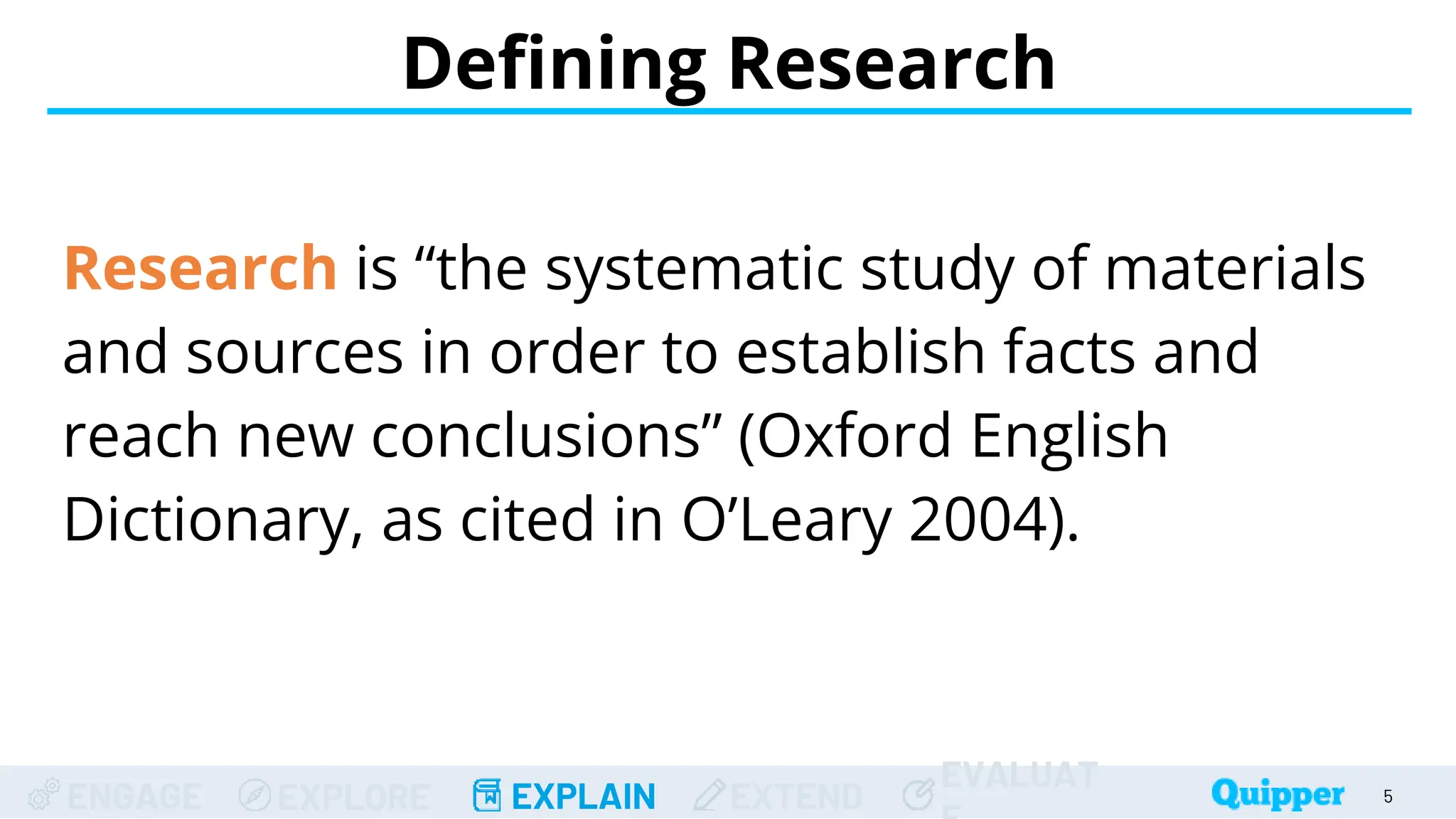
Defining Research
Research is “the systematic study of materials
and sources in order to establish facts and
reach new conclusions” (Oxford English
Dictionary, as cited in O’Leary 2004).
5
ENGAGE EXPLORE EXPLAIN EXTEND
EVALUAT
Defining
Research
6
Question
Everyday life
experiences
Individual
curiosities
Random
observations
Research begins with a question.
ENGAGE EXPLORE EXPLAIN EXTEND
EVALUAT
Defining Research
7
7
You do research when you gather information
to seek answers to your question.
Question Answer
ENGAGE EXPLORE EXPLAIN EXTEND
EVALUAT
Defining Research
8
8
Observation:
You have a hard time falling
asleep at night when you
drink a chocolate-flavored
drink before sleeping.
Question:
“Why do I have a hard time
falling asleep when I take a
chocolate-flavored drink at
night?”
Gathered information:
The list of ingredients of the
chocolate-flavored drink and
their uses
Answer:
Some of the ingredients in
the chocolate-flavored drink
are known to boost energy
levels.
ENGAGE EXPLORE EXPLAIN EXTEND
EVALUAT
Types of Research
Basic research
Purpose:
To gain broader
understanding of a
particular problem or
phenomenon
9
Applied research
Purpose:
To find solutions to
actual problems
ENGAGE EXPLORE EXPLAIN EXTEND
EVALUAT
Types of Research
Basic research
Outcome:
New ideas, concepts,
and/or theories that
broaden understanding
but may not be
applicable in real life
10
Applied research
Outcome:
New ideas and concepts
that have direct real-life
application
ENGAGE EXPLORE EXPLAIN EXTEND
EVALUAT
Basic research is
mostly theoretical
and is not directly
applicable to real-life
problems and
concerns.
11
ENGAGE EXPLORE EXPLAIN EXTEND
EVALUAT
Examples of Basic Research
12
● The role of the
government in providing
basic social services
● Therapeutic effects of
pet ownership
● Parenting styles across
different Asian cultures
ENGAGE EXPLORE EXPLAIN EXTEND
EVALUAT
Applied research
has obvious and
immediate
applications.
13
ENGAGE EXPLORE EXPLAIN EXTEND
EVALUAT
Examples of Applied Research
14
● The effectiveness of
vaccines in preventing
infectious diseases
● The effectiveness of
social media
advertisements in
increasing sales
Remember
15
Basic research produces
knowledge to understand the
world better. Applied research uses
this knowledge in the daily lives of
people.
ENGAGE EXPLORE EXPLAIN EXTEND
EVALUAT
Types of Research
16
16
Basic research and applied research are
related to each other.
Basic Research Applied Research
informs
can lead to more
ENGAGE EXPLORE EXPLAIN EXTEND
EVALUAT
Types of Research
17
17
Basic Research Applied Research
informs
can lead to more
Example: A study of chemical components (basic research) can lead to the
development of medicines based on this knowledge (applied research).
Further research on these products can lead back to basic research.
ENGAGE EXPLORE EXPLAIN EXTEND
EVALUAT
Importance
of Research
18
Doing research is important because…
● It helps us understand the world
better.
● It allows us to find answers to
problems.
● It enables us to evaluate our
answers to different problems.
19
How can I do basic or applied
research in my field of study?
ENGAGE EXPLORE EXPLAIN EXTEND
EVALUAT
Think of two researchable questions based
on everyday life experiences, encounters, or
observations. If you were to seek answers to
these questions, classify which type of
research is applicable (basic/applied).
Practice
20
ENGAGE EXPLORE EXPLAIN EXTEND
EVALUAT
ENGAGE EXPLORE EXPLAIN EXTEND
EVALUAT
This is the type of research that is most useful
for practical purposes.
Quick Check
21
21
21
21
21
ENGAGE EXPLORE EXPLAIN EXTEND
EVALUAT
ENGAGE EXPLORE EXPLAIN EXTEND
EVALUAT
This is the type of research that generates new
knowledge, ideas, concepts, or theories.
Quick Check
22
22
22
22
22
ENGAGE EXPLORE EXPLAIN EXTEND
EVALUAT
ENGAGE EXPLORE EXPLAIN EXTEND
EVALUAT
Classify this research topic as
basic or applied research:
A study on effective teaching methods
for children under 5 years old
Quick Check
23
23
23
23
23
Wrap Up
24
Research
is a systematic process of gathering
information to answer a question or
solve a problem.
Wrap Up
25
Bibliography
26
Booth, Wayne C., Gregory G. Colomb, and Joseph M. Williams. The Craft of Research, 3rd ed.
Chicago: The University of Chicago Press, 2008.
Neuman, W. Lawrence. Social Research Methods: Qualitative and Quantitative Approaches, 7th ed.
Essex: Pearson Education Limited, 2014.
O’Leary, Zina. The Essential Guide to Doing Research. London: SAGE Publications Ltd., 2004.
Schutt, Russell K. Investigating the Social World: The Process and Practice of Research, 9th ed.
California: SAGE Publications Inc., 2019.
Vanderstoep, Scott W., and Deirdre D. Johnston. Research Methods for Everyday Life: Blending
Qualitative and Quantitative Approaches. San Francisco: Jossey-Bass, 2009.

FINAL (PPT)_PR1 11_12 Q1 0101_UNIT 1_LESSON 1_Research and Its Importance (1).pptx

  • 1.
    Practical Research 1 SeniorHigh School Applied - Academic Unit 1: Nature of Research Lesson 1 Research and Its Importance
  • 2.
    ENGAGE EXPLORE EXPLAINEXTEND EVALUAT How are human innovations made possible? 2
  • 3.
    Learning Objectives ENGAGE EXPLORE EXPLAINEXTEND EVALUAT At the end of the lesson, you should be able to do the following: 3 ● Define research and the different types of research. ● Explain the academic and practical importance of doing research. 3
  • 4.
    ENGAGE EXPLORE EXPLAINEXTEND EVALUAT 4 4 1.Why is research important? 1.How does research affect your daily life?
  • 5.
    ENGAGE EXPLORE EXPLAINEXTEND EVALUAT Defining Research Research is “the systematic study of materials and sources in order to establish facts and reach new conclusions” (Oxford English Dictionary, as cited in O’Leary 2004). 5
  • 6.
    ENGAGE EXPLORE EXPLAINEXTEND EVALUAT Defining Research 6 Question Everyday life experiences Individual curiosities Random observations Research begins with a question.
  • 7.
    ENGAGE EXPLORE EXPLAINEXTEND EVALUAT Defining Research 7 7 You do research when you gather information to seek answers to your question. Question Answer
  • 8.
    ENGAGE EXPLORE EXPLAINEXTEND EVALUAT Defining Research 8 8 Observation: You have a hard time falling asleep at night when you drink a chocolate-flavored drink before sleeping. Question: “Why do I have a hard time falling asleep when I take a chocolate-flavored drink at night?” Gathered information: The list of ingredients of the chocolate-flavored drink and their uses Answer: Some of the ingredients in the chocolate-flavored drink are known to boost energy levels.
  • 9.
    ENGAGE EXPLORE EXPLAINEXTEND EVALUAT Types of Research Basic research Purpose: To gain broader understanding of a particular problem or phenomenon 9 Applied research Purpose: To find solutions to actual problems
  • 10.
    ENGAGE EXPLORE EXPLAINEXTEND EVALUAT Types of Research Basic research Outcome: New ideas, concepts, and/or theories that broaden understanding but may not be applicable in real life 10 Applied research Outcome: New ideas and concepts that have direct real-life application
  • 11.
    ENGAGE EXPLORE EXPLAINEXTEND EVALUAT Basic research is mostly theoretical and is not directly applicable to real-life problems and concerns. 11
  • 12.
    ENGAGE EXPLORE EXPLAINEXTEND EVALUAT Examples of Basic Research 12 ● The role of the government in providing basic social services ● Therapeutic effects of pet ownership ● Parenting styles across different Asian cultures
  • 13.
    ENGAGE EXPLORE EXPLAINEXTEND EVALUAT Applied research has obvious and immediate applications. 13
  • 14.
    ENGAGE EXPLORE EXPLAINEXTEND EVALUAT Examples of Applied Research 14 ● The effectiveness of vaccines in preventing infectious diseases ● The effectiveness of social media advertisements in increasing sales
  • 15.
    Remember 15 Basic research produces knowledgeto understand the world better. Applied research uses this knowledge in the daily lives of people.
  • 16.
    ENGAGE EXPLORE EXPLAINEXTEND EVALUAT Types of Research 16 16 Basic research and applied research are related to each other. Basic Research Applied Research informs can lead to more
  • 17.
    ENGAGE EXPLORE EXPLAINEXTEND EVALUAT Types of Research 17 17 Basic Research Applied Research informs can lead to more Example: A study of chemical components (basic research) can lead to the development of medicines based on this knowledge (applied research). Further research on these products can lead back to basic research.
  • 18.
    ENGAGE EXPLORE EXPLAINEXTEND EVALUAT Importance of Research 18 Doing research is important because… ● It helps us understand the world better. ● It allows us to find answers to problems. ● It enables us to evaluate our answers to different problems.
  • 19.
    19 How can Ido basic or applied research in my field of study?
  • 20.
    ENGAGE EXPLORE EXPLAINEXTEND EVALUAT Think of two researchable questions based on everyday life experiences, encounters, or observations. If you were to seek answers to these questions, classify which type of research is applicable (basic/applied). Practice 20
  • 21.
    ENGAGE EXPLORE EXPLAINEXTEND EVALUAT ENGAGE EXPLORE EXPLAIN EXTEND EVALUAT This is the type of research that is most useful for practical purposes. Quick Check 21 21 21 21 21
  • 22.
    ENGAGE EXPLORE EXPLAINEXTEND EVALUAT ENGAGE EXPLORE EXPLAIN EXTEND EVALUAT This is the type of research that generates new knowledge, ideas, concepts, or theories. Quick Check 22 22 22 22 22
  • 23.
    ENGAGE EXPLORE EXPLAINEXTEND EVALUAT ENGAGE EXPLORE EXPLAIN EXTEND EVALUAT Classify this research topic as basic or applied research: A study on effective teaching methods for children under 5 years old Quick Check 23 23 23 23 23
  • 24.
    Wrap Up 24 Research is asystematic process of gathering information to answer a question or solve a problem.
  • 25.
  • 26.
    Bibliography 26 Booth, Wayne C.,Gregory G. Colomb, and Joseph M. Williams. The Craft of Research, 3rd ed. Chicago: The University of Chicago Press, 2008. Neuman, W. Lawrence. Social Research Methods: Qualitative and Quantitative Approaches, 7th ed. Essex: Pearson Education Limited, 2014. O’Leary, Zina. The Essential Guide to Doing Research. London: SAGE Publications Ltd., 2004. Schutt, Russell K. Investigating the Social World: The Process and Practice of Research, 9th ed. California: SAGE Publications Inc., 2019. Vanderstoep, Scott W., and Deirdre D. Johnston. Research Methods for Everyday Life: Blending Qualitative and Quantitative Approaches. San Francisco: Jossey-Bass, 2009.

Editor's Notes

  • #2 GENERAL PARTS of this presentation: Engage- This is meant to capture the students’ attention, link their prior knowledge to the new topic, and set their expectations about the lesson. Explore- This is meant to elicit discussion, and encourage students to explore and derive ideas from questions, scenarios, activities, or discussions. Explain- This is meant for the teacher to use to synthesize students’ ideas from EXPLORE, and to emphasize on the key understanding needed for this lesson. Extend- This is an optional activity meant for guided practice. Evaluate- This is a quick check of students’ understanding of the lesson. Wrap Up- This is a reiteration of the key concepts of the lesson.
  • #21 Note to teacher: This can be a class activity or a take-home activity. Students may present their answers verbally or in written form.
  • #22 Answer: Applied research
  • #23 Answer: Basic research
  • #24 Answer: Applied research (the research problem has direct applications)