Panel Project
Nick Moger
Bradley Michael
Robin Cox
Scope and Objectives
• Design
• Optimization
• Practice
• Manufacturing
• Testing
Scope and Objectives
www.tomsplanner.com
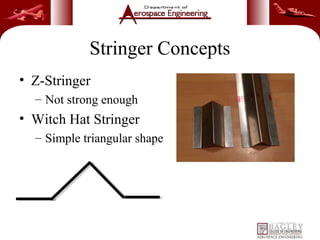
Stringer Concepts
• Z-Stringer
– Not strong enough
• Witch Hat Stringer
– Simple triangular shape
Failure Conditions
• Web bend angle
– Stress Cracks
• Area under hat
– Most exposed panel
Optimization
• Kept flanges constant
– Minimum 1.5x rivet diameter
• Agreed upon 90°web angle
– Easy to check
• Adjust height at expense of width
– Too high then too wide
Final Design
Flange end to Flange end = 2.3 inFlange end to Flange end = 2.3 in
Height = 0.64 inHeight = 0.64 inWeb Length = 0.9 inWeb Length = 0.9 in
Final Design
• Quantity - 5
• Rivet Spacing
– 23/32nds
in
– 18/32nds
in (from the top and bottom)
– Shop aid/jig for “perfect” rivets
• Stringer Spacing
– bs-s= 0.5 in
– bs-f = 5/32th
in
Predicted vs. Reality
• Original dimensions
-Fabrication not possible; stringers too wide
• Didn’t account for possible misalignments
Reasons For Discrepancy
• Coding
– Code was not perfect
• Manufacturing
– Stringers were not bent to exact measurements
• Plastering
– Our biggest problem!
Snap Crackle Pop
Failure Load (lbf) 18,301 19,635 17,731
Percentage Range
(%)
22.6 16.9 25.0
Lessons Learned
• Scheduling is important
• Measure twice, cut once
• Multiple ways to a solution
• Fear of the Unknown
• Daaaable Check! (Laugh if you get it)
Conclusion
Snap Crackle Pop
Percentage Range
(%)
16.8 10.7 19.4
• Design Successful!
Questions?

Final Panel Project Power Point

Editor's Notes

  • #8 Keeping Flange end to end width under 2.4 to accommodate for error in bending so to stay on panel