Baghdad university – College of science       Final exam                            Monday
    Deptartment of physics                        optics lab                        May 14, 2012

                                Note: Answer 10 questions only
                                            Group A
1. Draw the single – slit diffraction intensity distribution in term of the order “n” and the
   phase angle β? Can Heisenberg’s uncertainty principle be applied on a pencil? Why?
2. Determine the optical path shift in Michelson interferometer when a cell of length 2
   mm filled with a 1.13- refractive index gas is placed in light ray path to mirror m1.
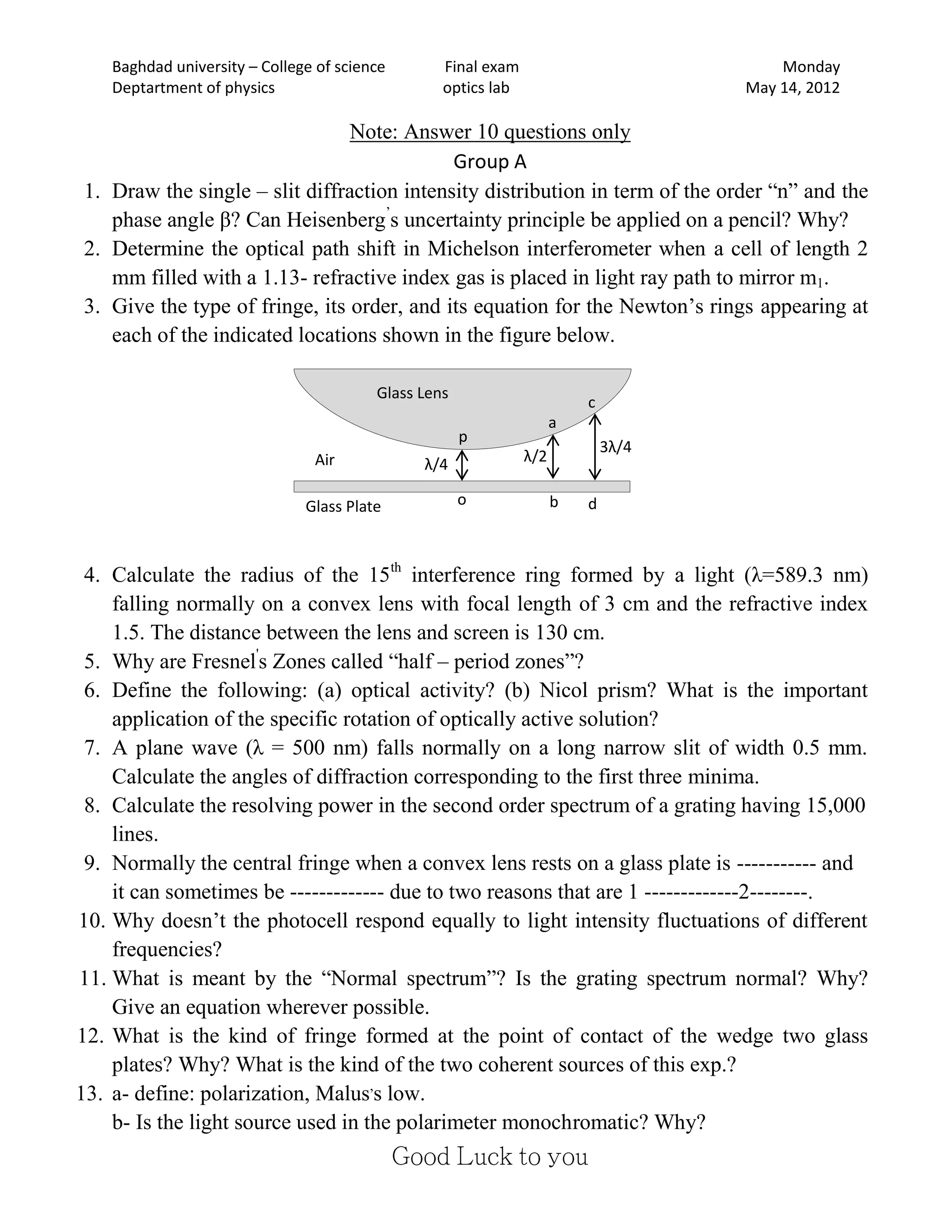
3. Give the type of fringe, its order, and its equation for the Newton’s rings appearing at
   each of the indicated locations shown in the figure below.

                                         Glass Lens
                                                                         c
                                                                     a
                                                      p
                                                                             3λ/4
                                Air            λ/4             λ/2

                               Glass Plate            o              b   d


 4. Calculate the radius of the 15th interference ring formed by a light (λ=589.3 nm)
    falling normally on a convex lens with focal length of 3 cm and the refractive index
    1.5. The distance between the lens and screen is 130 cm.
 5. Why are Fresnel's Zones called “half – period zones”?
 6. Define the following: (a) optical activity? (b) Nicol prism? What is the important
    application of the specific rotation of optically active solution?
 7. A plane wave (λ = 500 nm) falls normally on a long narrow slit of width 0.5 mm.
    Calculate the angles of diffraction corresponding to the first three minima.
 8. Calculate the resolving power in the second order spectrum of a grating having 15,000
    lines.
 9. Normally the central fringe when a convex lens rests on a glass plate is ----------- and
    it can sometimes be ------------- due to two reasons that are 1 -------------2--------.
10. Why doesn’t the photocell respond equally to light intensity fluctuations of different
    frequencies?
11. What is meant by the “Normal spectrum”? Is the grating spectrum normal? Why?
    Give an equation wherever possible.
12. What is the kind of fringe formed at the point of contact of the wedge two glass
    plates? Why? What is the kind of the two coherent sources of this exp.?
13. a- define: polarization, Malus,s low.
    b- Is the light source used in the polarimeter monochromatic? Why?

Final exam optics lab 2012 group a

  • 1.
    Baghdad university –College of science Final exam Monday Deptartment of physics optics lab May 14, 2012 Note: Answer 10 questions only Group A 1. Draw the single – slit diffraction intensity distribution in term of the order “n” and the phase angle β? Can Heisenberg’s uncertainty principle be applied on a pencil? Why? 2. Determine the optical path shift in Michelson interferometer when a cell of length 2 mm filled with a 1.13- refractive index gas is placed in light ray path to mirror m1. 3. Give the type of fringe, its order, and its equation for the Newton’s rings appearing at each of the indicated locations shown in the figure below. Glass Lens c a p 3λ/4 Air λ/4 λ/2 Glass Plate o b d 4. Calculate the radius of the 15th interference ring formed by a light (λ=589.3 nm) falling normally on a convex lens with focal length of 3 cm and the refractive index 1.5. The distance between the lens and screen is 130 cm. 5. Why are Fresnel's Zones called “half – period zones”? 6. Define the following: (a) optical activity? (b) Nicol prism? What is the important application of the specific rotation of optically active solution? 7. A plane wave (λ = 500 nm) falls normally on a long narrow slit of width 0.5 mm. Calculate the angles of diffraction corresponding to the first three minima. 8. Calculate the resolving power in the second order spectrum of a grating having 15,000 lines. 9. Normally the central fringe when a convex lens rests on a glass plate is ----------- and it can sometimes be ------------- due to two reasons that are 1 -------------2--------. 10. Why doesn’t the photocell respond equally to light intensity fluctuations of different frequencies? 11. What is meant by the “Normal spectrum”? Is the grating spectrum normal? Why? Give an equation wherever possible. 12. What is the kind of fringe formed at the point of contact of the wedge two glass plates? Why? What is the kind of the two coherent sources of this exp.? 13. a- define: polarization, Malus,s low. b- Is the light source used in the polarimeter monochromatic? Why?