Final Assignment
Written assignment
Activity brief
BDI223 – Digital Leadership
Online campus
Professor: Bruno Gama | [email protected]
Description Each student should select a company for the final
assignment and submit it to the professor by March 12th,
2021. Based on the selected company, students should use
the concepts learnt in the course to apply digital strategies to
detect new digital trends and to develop the roadway to a
digital business transformation. Students should use the
digital mastery framework presented in the Webinar of week 8
as the basis to classify the company and to articulate the
roadmap for digital transformation.
Suggested structure:
1. Cover Page
2. Table of Contents
3. Executive Summary
4. Market Analysis and Digital Trends
5. Value Proposition of the Products / Services
6. Roadmap for Digital Transformation
7. Recommendations
8. References
Format This activity must meet the following formatting
requirements:
• Font size 12
• 1.5 line spacing
• 2,500 words (+/- 10%)
• Harvard Referencing System
Goal(s) The goals of this summative assessment are to gauge
students' comprehension of the materials presented, to
assess the ability of the students to apply the concepts in a
real case and to evaluate students’ learnings throughout the
course.
Due date Date: Friday, 7 May 2021
Time: 14:00 CET
Weight towards final
grade
This activity has a weight of 60% towards the final grade.
Learning outcomes The learning outcomes are:
• apply digital strategies to detect new digital trends
and opportunities.
• develop a roadmap for digital business
transformation.
Assessment criteria Please refer to the rubrics below.
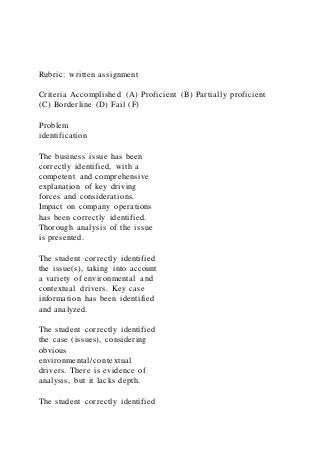
Rubric: written assignment
Criteria Accomplished (A) Proficient (B) Partially proficient
(C) Borderline (D) Fail (F)
Problem
identification
The business issue has been
correctly identified, with a
competent and comprehensive
explanation of key driving
forces and considerations.
Impact on company operations
has been correctly identified.
Thorough analysis of the issue
is presented.
The student correctly identified
the issue(s), taking into account
a variety of environmental and
contextual drivers. Key case
information has been identified
and analyzed.
The student correctly identified
the case (issues), considering
obvious
environmental/contextual
drivers. There is evidence of
analysis, but it lacks depth.
The student correctly identified
the issue(s) but analysis was
weak. An absence of context –
the work is basically descriptive
with little analysis.
The student failed to correctly
identify the issue(s); analysis
was incorrect or too superficial
to be of use; information was
misinterpreted.
Information
gathering
The student showed skill in
gathering information and
analyzing it for the purposes of
filling the information gaps
identified. Comprehensive and
relevant.
Relevant information gaps were
identified and additional
relevant information was found
to fill them. At least two different
types of sources were used.
The student demonstrates
coherent criteria for selecting
information but needs greater
depth.
The student correctly identified
at least one information gap
and found relevant information,
but which was limited in scope.
Some evidence of sound
criteria for selecting information
but not consistent throughout.
Needs expansion.
An information gap was
identified and the student found
additional information to fill it.
However, this was limited in
scope. Weak criteria for the
selection of necessary
information.
Information was taken at face
value with no questioning of its
relevance or value. Gaps in the
information were not identified
or were incorrect.
Conclusions The student evaluated,
analyzed, synthesized all
information provided to create a
perceptive set of conclusions to
support the decisions and
solutions.
The student evaluated,
analyzed and synthesized to
create a conclusion(s) which
support decisions and
solutions.
The student reached
conclusions, but they were
limited and provided minimal
direction for decision-making
and solutions.
The conclusion was reasonable
but lacked depth and would not
be a basis for suitable strategy
development.
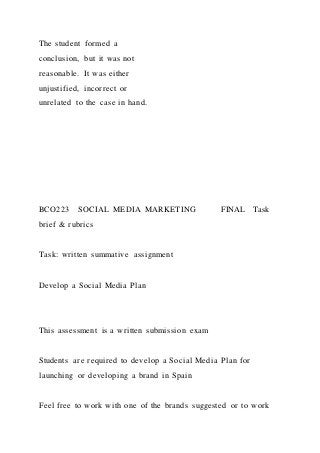
The student formed a
conclusion, but it was not
reasonable. It was either
unjustified, incorrect or
unrelated to the case in hand.
Solution
s The student used problem
solving techniques to make
thoughtful, justified decisions
about difficult and conflicting
issues. A realistic solution was
chosen which would provide
maximum benefit to the
company. Alternative solutions
were explored and ruled out.
The student used problem
solving techniques to make
appropriate decisions about
complex issues. Relevant
questions were asked and
answered. A realistic solution
was chosen. Alternatives were
identified, explored and ruled
out.
The student used problem-
solving techniques to make
appropriate decisions about
simpler issues. The solution
has limited benefit but does
show understanding of
implications of the decision.
Alternatives were mentioned
but not explored.
The student used problem
solving techniques to make
decisions about simpler issues
but disregarded more complex
issues. Implications of the
decision were not considered.
Alternatives were not offered.
The student formed a
conclusion, but it was not
reasonable. It was either
unjustified, incorrect or
unrelated to the case in hand.
BCO223 SOCIAL MEDIA MARKETING FINAL Task
brief & rubrics
Task: written summative assignment
Develop a Social Media Plan
This assessment is a written submission exam
Students are required to develop a Social Media Plan for
launching or developing a brand in Spain
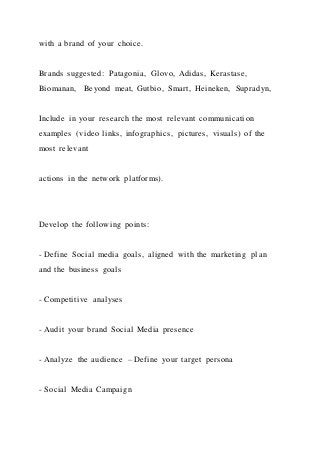
Feel free to work with one of the brands suggested or to work
with a brand of your choice.
Brands suggested: Patagonia, Glovo, Adidas, Kerastase,
Biomanan, Beyond meat, Gutbio, Smart, Heineken, Supradyn,
Include in your research the most relevant communication
examples (video links, infographics, pictures, visuals) of the
most relevant
actions in the network platforms).
Develop the following points:
- Define Social media goals, aligned with the marketing pl an
and the business goals
- Competitive analyses
- Audit your brand Social Media presence
- Analyze the audience – Define your target persona
- Social Media Campaign
o Define your Social media key priorities - Define specific
SMART goals and strategies
o Social media mix - Network channel (platforms) selection to
reach the Target Audience - define specific goals per network
o Define metrics per action/network
o Define relevant content (key messages aligned with your
objective, strategy and mission).
o Create an activity calendar
o Budget
The report should be in word document format and must be
uploaded to a Turnitin folder created on the course Moodle
platform.
Formalities:
o Word: Word count: 1500-2000 words.(include your research
and your findings)
o Cover, Table of Contents, References and Appendix are
excluded of the total word count.
o Font: Arial, size 11
o Text alignment: Justified
o The in-text References and the Bibliography have to be in
Harvard’s citation style.
Submission: Week (10) – Via Moodle (Turnitin). Submission
deadline Sunday 9th of May 2021 at 23:59 CEST
Weight: This task is a 60% of your total grade for this subject.
It assesses the following learning outcomes:
Outcome 1: Understanding Social media presence analysis
Outcome 2: Understanding customer research online
Outcome 3: Understanding social media planning dynamic
Outcome 4: Understanding social community zones
Rubrics
Exceptional 90-100 Good 80-89 Fair 70-79 Marginal fail 60-69
Knowledge &
Understanding
(15%)
Student demonstrates
excellent understanding of
key concepts and uses
vocabulary in an entirely
appropriate manner.
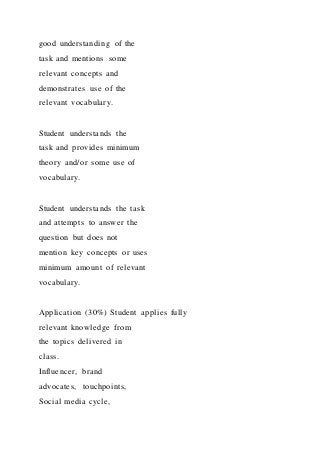
Student demonstrates
good understanding of the
task and mentions some
relevant concepts and
demonstrates use of the
relevant vocabulary.
Student understands the
task and provides minimum
theory and/or some use of
vocabulary.
Student understands the task
and attempts to answer the
question but does not
mention key concepts or uses
minimum amount of relevant
vocabulary.
Application (30%) Student applies fully
relevant knowledge from
the topics delivered in
class.
Influencer, brand
advocates, touchpoints,
Social media cycle,
permission and
interruption marketing,
curate content,
Social community zones,
Mobile marketing
Student applies mostly
relevant knowledge from
the topics delivered in
class.
Influencer, brand
advocates, touchpoints,
Social media cycle,
permission and
interruption marketing,
Social community zones,
Mobile marketing
Student applies some
relevant knowledge from
the topics delivered in
class. Misunderstanding
may be evident.
Influencer, brand
advocates, touchpoints,
Social media cycle,
permission and
interruption marketing,
Social community zones,
Mobile marketing
Student applies little relevant
knowledge from the topics
delivered in class.
Misunderstands are evident.
Influencer, brand advocates,
touchpoints, Social media
cycle, permission and
interruption marketing,
Social community zones,
Mobile marketing
Critical Thinking
(35%)
Student critically assesses
in excellent ways, drawing
outstanding conclusions
from relevant authors.
Student critically assesses
in good ways, drawing
conclusions from relevant
authors and references.
Student provides some
insights but stays on the
surface of the topic.
References may not be
relevant.
Student makes little or none
critical thinking insights, does
not quote appropriate
authors, and does not
provide valid sources.
Communication
(20%)
Student communicates
their ideas extremely
clearly and concisely,
respecting word count,
grammar and spellcheck
Student communicates
their ideas clearly and
concisely, respecting word
count, grammar and
spellcheck
Student communicates
their ideas with some
clarity and concision. It
may be slightly over or
under the wordcount limit.
Some misspelling errors
may be evident.
Student communicates their
ideas in a somewhat unclear
and unconcise way. Does not
reach or does exceed
wordcount excessively and
misspelling errors are
evident.
Final Assignment  Written assignment Activity brief

Final Assignment Written assignment Activity brief

  • 1.
    Final Assignment Written assignment Activitybrief BDI223 – Digital Leadership Online campus Professor: Bruno Gama | [email protected] Description Each student should select a company for the final assignment and submit it to the professor by March 12th, 2021. Based on the selected company, students should use the concepts learnt in the course to apply digital strategies to detect new digital trends and to develop the roadway to a digital business transformation. Students should use the digital mastery framework presented in the Webinar of week 8 as the basis to classify the company and to articulate the roadmap for digital transformation. Suggested structure: 1. Cover Page 2. Table of Contents 3. Executive Summary 4. Market Analysis and Digital Trends 5. Value Proposition of the Products / Services 6. Roadmap for Digital Transformation 7. Recommendations 8. References Format This activity must meet the following formatting
  • 2.
    requirements: • Font size12 • 1.5 line spacing • 2,500 words (+/- 10%) • Harvard Referencing System Goal(s) The goals of this summative assessment are to gauge students' comprehension of the materials presented, to assess the ability of the students to apply the concepts in a real case and to evaluate students’ learnings throughout the course. Due date Date: Friday, 7 May 2021 Time: 14:00 CET Weight towards final grade This activity has a weight of 60% towards the final grade. Learning outcomes The learning outcomes are: • apply digital strategies to detect new digital trends and opportunities. • develop a roadmap for digital business transformation. Assessment criteria Please refer to the rubrics below.
  • 3.
    Rubric: written assignment CriteriaAccomplished (A) Proficient (B) Partially proficient (C) Borderline (D) Fail (F) Problem identification The business issue has been correctly identified, with a competent and comprehensive explanation of key driving forces and considerations. Impact on company operations has been correctly identified. Thorough analysis of the issue is presented. The student correctly identified the issue(s), taking into account a variety of environmental and contextual drivers. Key case information has been identified and analyzed. The student correctly identified the case (issues), considering obvious environmental/contextual drivers. There is evidence of analysis, but it lacks depth. The student correctly identified
  • 4.
    the issue(s) butanalysis was weak. An absence of context – the work is basically descriptive with little analysis. The student failed to correctly identify the issue(s); analysis was incorrect or too superficial to be of use; information was misinterpreted. Information gathering The student showed skill in gathering information and analyzing it for the purposes of filling the information gaps identified. Comprehensive and relevant. Relevant information gaps were identified and additional relevant information was found to fill them. At least two different types of sources were used. The student demonstrates coherent criteria for selecting information but needs greater depth. The student correctly identified at least one information gap and found relevant information, but which was limited in scope. Some evidence of sound
  • 5.
    criteria for selectinginformation but not consistent throughout. Needs expansion. An information gap was identified and the student found additional information to fill it. However, this was limited in scope. Weak criteria for the selection of necessary information. Information was taken at face value with no questioning of its relevance or value. Gaps in the information were not identified or were incorrect. Conclusions The student evaluated, analyzed, synthesized all information provided to create a perceptive set of conclusions to support the decisions and solutions. The student evaluated, analyzed and synthesized to create a conclusion(s) which support decisions and solutions. The student reached conclusions, but they were limited and provided minimal direction for decision-making and solutions.
  • 6.
    The conclusion wasreasonable but lacked depth and would not be a basis for suitable strategy development. The student formed a conclusion, but it was not reasonable. It was either unjustified, incorrect or unrelated to the case in hand. Solution s The student used problem solving techniques to make thoughtful, justified decisions about difficult and conflicting issues. A realistic solution was chosen which would provide maximum benefit to the company. Alternative solutions were explored and ruled out. The student used problem solving techniques to make appropriate decisions about
  • 7.
    complex issues. Relevant questionswere asked and answered. A realistic solution was chosen. Alternatives were identified, explored and ruled out. The student used problem- solving techniques to make appropriate decisions about simpler issues. The solution has limited benefit but does show understanding of implications of the decision. Alternatives were mentioned but not explored. The student used problem solving techniques to make decisions about simpler issues but disregarded more complex issues. Implications of the decision were not considered. Alternatives were not offered.
  • 8.
    The student formeda conclusion, but it was not reasonable. It was either unjustified, incorrect or unrelated to the case in hand. BCO223 SOCIAL MEDIA MARKETING FINAL Task brief & rubrics Task: written summative assignment Develop a Social Media Plan This assessment is a written submission exam Students are required to develop a Social Media Plan for launching or developing a brand in Spain Feel free to work with one of the brands suggested or to work
  • 9.
    with a brandof your choice. Brands suggested: Patagonia, Glovo, Adidas, Kerastase, Biomanan, Beyond meat, Gutbio, Smart, Heineken, Supradyn, Include in your research the most relevant communication examples (video links, infographics, pictures, visuals) of the most relevant actions in the network platforms). Develop the following points: - Define Social media goals, aligned with the marketing pl an and the business goals - Competitive analyses - Audit your brand Social Media presence - Analyze the audience – Define your target persona - Social Media Campaign
  • 10.
    o Define yourSocial media key priorities - Define specific SMART goals and strategies o Social media mix - Network channel (platforms) selection to reach the Target Audience - define specific goals per network o Define metrics per action/network o Define relevant content (key messages aligned with your objective, strategy and mission). o Create an activity calendar o Budget The report should be in word document format and must be uploaded to a Turnitin folder created on the course Moodle platform.
  • 11.
    Formalities: o Word: Wordcount: 1500-2000 words.(include your research and your findings) o Cover, Table of Contents, References and Appendix are excluded of the total word count. o Font: Arial, size 11 o Text alignment: Justified o The in-text References and the Bibliography have to be in Harvard’s citation style. Submission: Week (10) – Via Moodle (Turnitin). Submission deadline Sunday 9th of May 2021 at 23:59 CEST Weight: This task is a 60% of your total grade for this subject. It assesses the following learning outcomes: Outcome 1: Understanding Social media presence analysis
  • 12.
    Outcome 2: Understandingcustomer research online Outcome 3: Understanding social media planning dynamic Outcome 4: Understanding social community zones Rubrics Exceptional 90-100 Good 80-89 Fair 70-79 Marginal fail 60-69 Knowledge & Understanding (15%) Student demonstrates excellent understanding of key concepts and uses vocabulary in an entirely appropriate manner. Student demonstrates
  • 13.
    good understanding ofthe task and mentions some relevant concepts and demonstrates use of the relevant vocabulary. Student understands the task and provides minimum theory and/or some use of vocabulary. Student understands the task and attempts to answer the question but does not mention key concepts or uses minimum amount of relevant vocabulary. Application (30%) Student applies fully relevant knowledge from the topics delivered in class. Influencer, brand advocates, touchpoints, Social media cycle,
  • 14.
    permission and interruption marketing, curatecontent, Social community zones, Mobile marketing Student applies mostly relevant knowledge from the topics delivered in class. Influencer, brand advocates, touchpoints, Social media cycle, permission and interruption marketing, Social community zones, Mobile marketing Student applies some relevant knowledge from the topics delivered in class. Misunderstanding may be evident. Influencer, brand advocates, touchpoints,
  • 15.
    Social media cycle, permissionand interruption marketing, Social community zones, Mobile marketing Student applies little relevant knowledge from the topics delivered in class. Misunderstands are evident. Influencer, brand advocates, touchpoints, Social media cycle, permission and interruption marketing, Social community zones, Mobile marketing Critical Thinking (35%) Student critically assesses in excellent ways, drawing outstanding conclusions from relevant authors.
  • 16.
    Student critically assesses ingood ways, drawing conclusions from relevant authors and references. Student provides some insights but stays on the surface of the topic. References may not be relevant. Student makes little or none critical thinking insights, does not quote appropriate authors, and does not provide valid sources. Communication (20%) Student communicates their ideas extremely clearly and concisely, respecting word count, grammar and spellcheck
  • 17.
    Student communicates their ideasclearly and concisely, respecting word count, grammar and spellcheck Student communicates their ideas with some clarity and concision. It may be slightly over or under the wordcount limit. Some misspelling errors may be evident. Student communicates their ideas in a somewhat unclear and unconcise way. Does not reach or does exceed wordcount excessively and misspelling errors are evident.