Now, for tomorrow
Contents
1. What is a Family Investment Company (FIC)?
2. Key Features
3. Typical Structures
4. Tax Traps
5. Use of Trusts
6. Planning for Existing Investment Companies
7. Future Changes
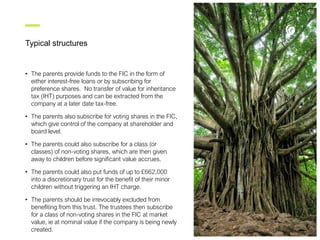
• A Family Investment Company
(FIC) is a bespoke vehicle which
can be used as an alternative to a
family trust.
• It is a private company whose
shareholders are family members.
• A FIC typically enables parents to
retain control over assets whilst
accumulating wealth in a tax
efficient manner and facilitating
future succession planning.
What is a family investment
company?
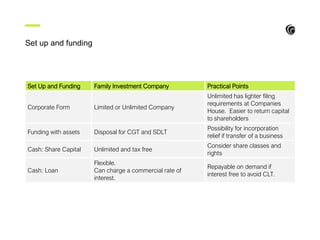
Set up and funding
Set Up and Funding Family Investment Company Practical Points
Corporate Form Limited or Unlimited Company
Unlimited has lighter filing
requirements at Companies
House. Easier to return capital
to shareholders
Funding with assets Disposal for CGT and SDLT
Possibility for incorporation
relief if transfer of a business
Cash: Share Capital Unlimited and tax free
Consider share classes and
rights
Cash: Loan
Flexible.
Can charge a commercial rate of
interest.
Repayable on demand if
interest free to avoid CLT.
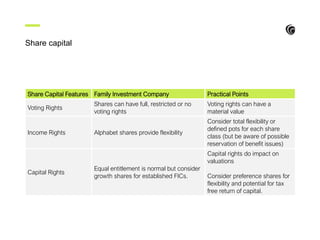
Share capital
Share Capital Features Family Investment Company Practical Points
Voting Rights
Shares can have full, restricted or no
voting rights
Voting rights can have a
material value
Income Rights Alphabet shares provide flexibility
Consider total flexibility or
defined pots for each share
class (but be aware of possible
reservation of benefit issues)
Capital Rights
Equal entitlement is normal but consider
growth shares for established FICs.
Capital rights do impact on
valuations
Consider preference shares for
flexibility and potential for tax
free return of capital.
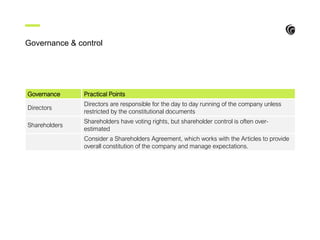
Governance & control
Governance Practical Points
Directors
Directors are responsible for the day to day running of the company unless
restricted by the constitutional documents
Shareholders
Shareholders have voting rights, but shareholder control is often over-
estimated
Consider a Shareholders Agreement, which works with the Articles to provide
overall constitution of the company and manage expectations.
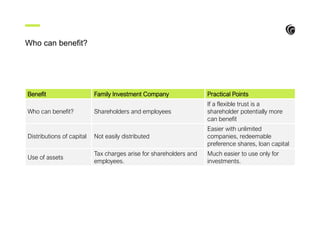
Who can benefit?
Benefit Family Investment Company Practical Points
Who can benefit? Shareholders and employees
If a flexible trust is a
shareholder potentially more
can benefit
Distributions of capital Not easily distributed
Easier with unlimited
companies, redeemable
preference shares, loan capital
Use of assets
Tax charges arise for shareholders and
employees.
Much easier to use only for
investments.
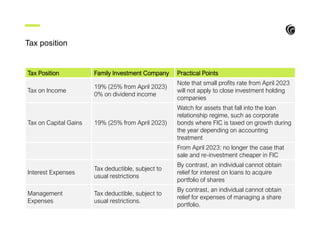
Tax position
Tax Position Family Investment Company Practical Points
Tax on Income
19% (25% from April 2023)
0% on dividend income
Note that small profits rate from April 2023
will not apply to close investment holding
companies
Tax on Capital Gains 19% (25% from April 2023)
Watch for assets that fall into the loan
relationship regime, such as corporate
bonds where FIC is taxed on growth during
the year depending on accounting
treatment
From April 2023: no longer the case that
sale and re-investment cheaper in FIC
Interest Expenses
Tax deductible, subject to
usual restrictions
By contrast, an individual cannot obtain
relief for interest on loans to acquire
portfolio of shares
Management
Expenses
Tax deductible, subject to
usual restrictions.
By contrast, an individual cannot obtain
relief for expenses of managing a share
portfolio.
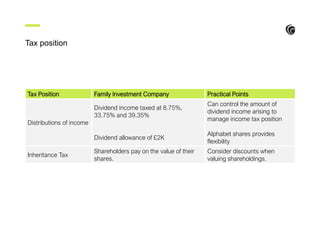
Tax position
Tax Position Family Investment Company Practical Points
Distributions of income
Dividend income taxed at 8.75%,
33.75% and 39.35%
Dividend allowance of £2K
Can control the amount of
dividend income arising to
manage income tax position
Alphabet shares provides
flexibility
Inheritance Tax
Shareholders pay on the value of their
shares.
Consider discounts when
valuing shareholdings.
Typical structures
• The parents provide funds to the FIC in the form of
either interest-free loans or by subscribing for
preference shares. No transfer of value for inheritance
tax (IHT) purposes and can be extracted from the
company at a later date tax-free.
• The parents also subscribe for voting shares in the FIC,
which give control of the company at shareholder and
board level.
• The parents could also subscribe for a class (or
classes) of non-voting shares, which are then given
away to children before significant value accrues.
• The parents could also put funds of up to £662,000
into a discretionary trust for the benefit of their minor
children without triggering an IHT charge.
• The parents should be irrevocably excluded from
benefiting from this trust. The trustees then subscribe
for a class of non-voting shares in the FIC at market
value, ie at nominal value if the company is being newly
created.
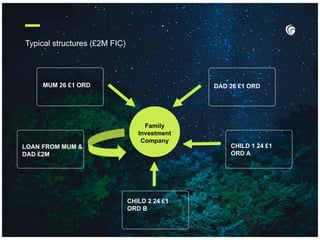
Typical structures (£2M FIC)
Family
Investment
Company
DAD 26 £1 ORD
CHILD 1 24 £1
ORD A
CHILD 2 24 £1
ORD B
LOAN FROM MUM &
DAD £2M
MUM 26 £1 ORD
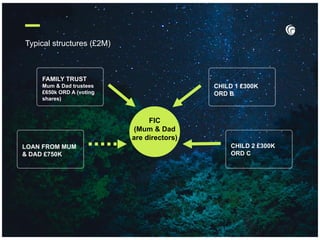
Typical structures (£2M)
FIC
(Mum & Dad
are directors)
CHILD 1 £300K
ORD B
CHILD 2 £300K
ORD C
LOAN FROM MUM
& DAD £750K
FAMILY TRUST
Mum & Dad trustees
£650k ORD A (voting
shares)
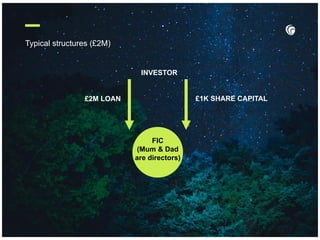
Typical structures (£2M)
FIC
(Mum & Dad
are directors)
£1K SHARE CAPITAL
£2M LOAN
INVESTOR
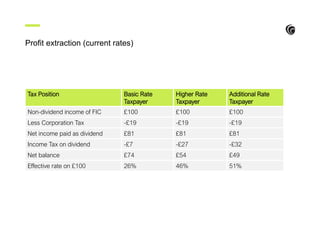
Profit extraction (current rates)
Tax Position Basic Rate
Taxpayer
Higher Rate
Taxpayer
Additional Rate
Taxpayer
Non-dividend income of FIC £100 £100 £100
Less Corporation Tax -£19 -£19 -£19
Net income paid as dividend £81 £81 £81
Income Tax on dividend -£7 -£27 -£32
Net balance £74 £54 £49
Effective rate on £100 26% 46% 51%
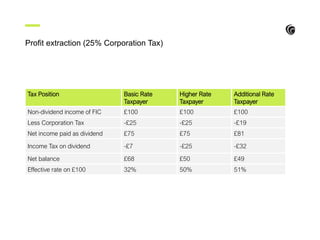
Profit extraction (25% Corporation Tax)
Tax Position Basic Rate
Taxpayer
Higher Rate
Taxpayer
Additional Rate
Taxpayer
Non-dividend income of FIC £100 £100 £100
Less Corporation Tax -£25 -£25 -£19
Net income paid as dividend £75 £75 £81
Income Tax on dividend -£7 -£25 -£32
Net balance £68 £50 £49
Effective rate on £100 32% 50% 51%
• Settlor retains an interest if “that
property or any related property is,
or will or may become, payable to
or applicable for the benefit of the
settlor or his spouse or civil
partner in any circumstances
whatsoever”.
• Wide definition of Settlement,
consider in particular:
• Spouse and minor children
• Funding arrangements
• Dividend waivers.
• Outright gifts to settlor’s spouse or
civil partner are excluded provided
it is not substantially a right to
income.
Tax Traps –
settlements legislation
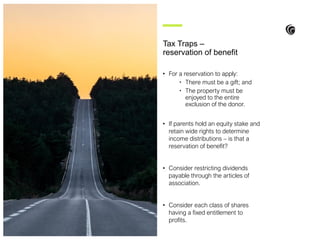
• For a reservation to apply:
• There must be a gift; and
• The property must be
enjoyed to the entire
exclusion of the donor.
• If parents hold an equity stake and
retain wide rights to determine
income distributions – is that a
reservation of benefit?
• Consider restricting dividends
payable through the articles of
association.
• Consider each class of shares
having a fixed entitlement to
profits.
Tax Traps –
reservation of benefit
Use of trusts
• Bare / Absolute Trust – Beneficiary has the right
to income and capital and may call for both to
be remitted into his own name. Beneficiary’s
asset and income for tax purposes. May be
used for holding minor children’s shares in FIC.
• Discretionary Trust – Flexible type of trust, which
gives trustees considerable powers over how
the trust assets are handled. The beneficiaries
do not have any automatic right to receive the
income and capital held in the trust. Provides
asset protection, control and flexibility.
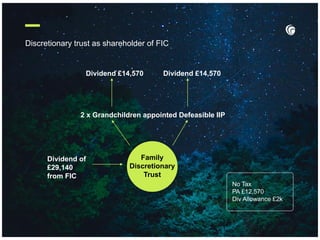
Discretionary trust as shareholder of FIC
Family
Discretionary
Trust
Dividend £14,570
2 x Grandchildren appointed Defeasible IIP
Dividend of
£29,140
from FIC
Dividend £14,570
No Tax
PA £12,570
Div Allowance £2k
• Growth share plan
• Current value of the business is
‘frozen’ into the existing shares
and new “growth shares” shares
are issued to capture any future
growth in value of the company.
• Growth shares can then be
passed into the ownership of other
family members or trusts to
remove the future value of these
shares from the existing
shareholders’ estates for IHT
purposes.
Planning for existing investment
companies
• Property investment company, 4 x
adult shareholders (two married
couples).
• Whole company value £11M.
• Hurdle value £12M.
• Growth shares value for CGT:
£1M.
• Direct gift = CGT at 20% and PET
for IHT.
Growth shares – an example
• What about a gift onto a Discretionary
Trust?
• CLT and value of transfer is calculated
on ‘Loss to donor’ principle.
• This means we compare full value of
company with value of retained ordinary
shares.
• Value of retained ordinary shares is the
expected return up to the value of the
hurdle, which depends on the rate of
return required for the level of risk and
the length of time before a sale or return
of capital.
• Low risk, so a factor of 3% and
timescale of 5-20 years was used.
• Transfer of value £600K (£150K each) –
CGT holdover relief, no IHT.
Growth shares – an example
• No IHT100 required due to value
of transfer below 80% of NRB.
• Voting rights not restricted but
number of shares meant that
Ordinary shares retained control.
• Future dividends for Ordinary
shares restricted to value of Hurdle
to avoid any suggestion of gift with
reservation.
Growth shares – an example:
further points
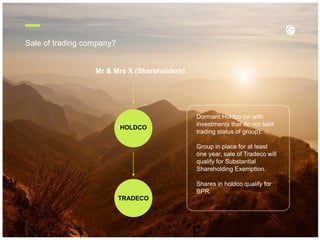
Sale of trading company?
Mr & Mrs X (Shareholders)
HOLDCO
TRADECO
Dormant Holdco (or with
investments that do not taint
trading status of group).
Group in place for at least
one year, sale of Tradeco will
qualify for Substantial
Shareholding Exemption.
Shares in holdco qualify for
BPR.
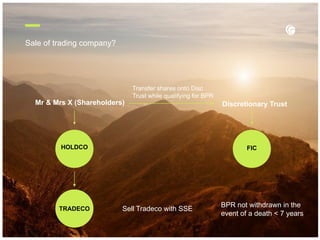
Sale of trading company?
Mr & Mrs X (Shareholders)
HOLDCO
TRADECO
Transfer shares onto Disc
Trust while qualifying for BPR
Discretionary Trust
FIC
Sell Tradeco with SSE
BPR not withdrawn in the
event of a death < 7 years
Making changes to your FIC
• Issuing new shares – market value.
• New loans.
• Gifting of shares – consider Family Trust.
• Changing share rights – be careful, possible
transfer of value.
• Demergers.
• Winding up.
Possible future changes –
taxing retained profits
• OTS report on capital gains tax in 2020
suggests taxing retained profits on winding up
or sale of a smaller owner managed company at
dividend rates or taxing them in the company at
enhanced Corporation Tax rates.
• Close company apportionment legislation –
abolished in 1989
• If no reasonable distribution policy, the
rules taxed retained profits
• Complex rules deemed a notional
dividend which was taxed accordingly to
prevent accumulation of profits.
Valuation and related property
• On death the value of FIC shares is in the
shareholder’s estate for IHT purposes.
• There is a valuation advantage gained for IHT
where all family members have a minority stake.
• Currently, the related property rules ensure
spouses interest considered. The shares are
valued based on aggregate holding.
• Could this be changed to include other family
members?
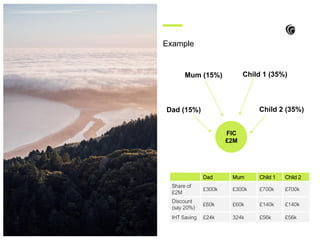
Example
FIC
£2M
Dad (15%)
Child 1 (35%)
Child 2 (35%)
Mum (15%)
Dad Mum Child 1 Child 2
Share of
£2M
£300k £300k £700k £700k
Discount
(say 20%)
£60k £60k £140k £140k
IHT Saving £24k 324k £56k £56k
• FICs are increasingly popular.
• Keep them simple.
• Change in corporation tax rate
makes them slightly less efficient.
• Possibility for future changes but
currently the estate planning
benefits remain.
Conclusion
Questions?
Contact details
James Kipping
Head of Private Client,
Tax Partner (MHA)
james.kipping@mhllp.co.uk
DRAFT
MHA trading as MHA is a member of MHA, an independent member of Baker Tilly International Ltd., the members of which are separate and independent legal entities. © 2021 MHA
Now, for tomorrow
mha-uk.co.uk
MHA-UK @MHA_UK

FICs-in-Tax-Estate-Planning_JK_27-July-22.pdf

  • 1.
  • 2.
    Contents 1. What isa Family Investment Company (FIC)? 2. Key Features 3. Typical Structures 4. Tax Traps 5. Use of Trusts 6. Planning for Existing Investment Companies 7. Future Changes
  • 3.
    • A FamilyInvestment Company (FIC) is a bespoke vehicle which can be used as an alternative to a family trust. • It is a private company whose shareholders are family members. • A FIC typically enables parents to retain control over assets whilst accumulating wealth in a tax efficient manner and facilitating future succession planning. What is a family investment company?
  • 4.
    Set up andfunding Set Up and Funding Family Investment Company Practical Points Corporate Form Limited or Unlimited Company Unlimited has lighter filing requirements at Companies House. Easier to return capital to shareholders Funding with assets Disposal for CGT and SDLT Possibility for incorporation relief if transfer of a business Cash: Share Capital Unlimited and tax free Consider share classes and rights Cash: Loan Flexible. Can charge a commercial rate of interest. Repayable on demand if interest free to avoid CLT.
  • 5.
    Share capital Share CapitalFeatures Family Investment Company Practical Points Voting Rights Shares can have full, restricted or no voting rights Voting rights can have a material value Income Rights Alphabet shares provide flexibility Consider total flexibility or defined pots for each share class (but be aware of possible reservation of benefit issues) Capital Rights Equal entitlement is normal but consider growth shares for established FICs. Capital rights do impact on valuations Consider preference shares for flexibility and potential for tax free return of capital.
  • 6.
    Governance & control GovernancePractical Points Directors Directors are responsible for the day to day running of the company unless restricted by the constitutional documents Shareholders Shareholders have voting rights, but shareholder control is often over- estimated Consider a Shareholders Agreement, which works with the Articles to provide overall constitution of the company and manage expectations.
  • 7.
    Who can benefit? BenefitFamily Investment Company Practical Points Who can benefit? Shareholders and employees If a flexible trust is a shareholder potentially more can benefit Distributions of capital Not easily distributed Easier with unlimited companies, redeemable preference shares, loan capital Use of assets Tax charges arise for shareholders and employees. Much easier to use only for investments.
  • 8.
    Tax position Tax PositionFamily Investment Company Practical Points Tax on Income 19% (25% from April 2023) 0% on dividend income Note that small profits rate from April 2023 will not apply to close investment holding companies Tax on Capital Gains 19% (25% from April 2023) Watch for assets that fall into the loan relationship regime, such as corporate bonds where FIC is taxed on growth during the year depending on accounting treatment From April 2023: no longer the case that sale and re-investment cheaper in FIC Interest Expenses Tax deductible, subject to usual restrictions By contrast, an individual cannot obtain relief for interest on loans to acquire portfolio of shares Management Expenses Tax deductible, subject to usual restrictions. By contrast, an individual cannot obtain relief for expenses of managing a share portfolio.
  • 9.
    Tax position Tax PositionFamily Investment Company Practical Points Distributions of income Dividend income taxed at 8.75%, 33.75% and 39.35% Dividend allowance of £2K Can control the amount of dividend income arising to manage income tax position Alphabet shares provides flexibility Inheritance Tax Shareholders pay on the value of their shares. Consider discounts when valuing shareholdings.
  • 10.
    Typical structures • Theparents provide funds to the FIC in the form of either interest-free loans or by subscribing for preference shares. No transfer of value for inheritance tax (IHT) purposes and can be extracted from the company at a later date tax-free. • The parents also subscribe for voting shares in the FIC, which give control of the company at shareholder and board level. • The parents could also subscribe for a class (or classes) of non-voting shares, which are then given away to children before significant value accrues. • The parents could also put funds of up to £662,000 into a discretionary trust for the benefit of their minor children without triggering an IHT charge. • The parents should be irrevocably excluded from benefiting from this trust. The trustees then subscribe for a class of non-voting shares in the FIC at market value, ie at nominal value if the company is being newly created.
  • 11.
    Typical structures (£2MFIC) Family Investment Company DAD 26 £1 ORD CHILD 1 24 £1 ORD A CHILD 2 24 £1 ORD B LOAN FROM MUM & DAD £2M MUM 26 £1 ORD
  • 12.
    Typical structures (£2M) FIC (Mum& Dad are directors) CHILD 1 £300K ORD B CHILD 2 £300K ORD C LOAN FROM MUM & DAD £750K FAMILY TRUST Mum & Dad trustees £650k ORD A (voting shares)
  • 13.
    Typical structures (£2M) FIC (Mum& Dad are directors) £1K SHARE CAPITAL £2M LOAN INVESTOR
  • 14.
    Profit extraction (currentrates) Tax Position Basic Rate Taxpayer Higher Rate Taxpayer Additional Rate Taxpayer Non-dividend income of FIC £100 £100 £100 Less Corporation Tax -£19 -£19 -£19 Net income paid as dividend £81 £81 £81 Income Tax on dividend -£7 -£27 -£32 Net balance £74 £54 £49 Effective rate on £100 26% 46% 51%
  • 15.
    Profit extraction (25%Corporation Tax) Tax Position Basic Rate Taxpayer Higher Rate Taxpayer Additional Rate Taxpayer Non-dividend income of FIC £100 £100 £100 Less Corporation Tax -£25 -£25 -£19 Net income paid as dividend £75 £75 £81 Income Tax on dividend -£7 -£25 -£32 Net balance £68 £50 £49 Effective rate on £100 32% 50% 51%
  • 16.
    • Settlor retainsan interest if “that property or any related property is, or will or may become, payable to or applicable for the benefit of the settlor or his spouse or civil partner in any circumstances whatsoever”. • Wide definition of Settlement, consider in particular: • Spouse and minor children • Funding arrangements • Dividend waivers. • Outright gifts to settlor’s spouse or civil partner are excluded provided it is not substantially a right to income. Tax Traps – settlements legislation
  • 17.
    • For areservation to apply: • There must be a gift; and • The property must be enjoyed to the entire exclusion of the donor. • If parents hold an equity stake and retain wide rights to determine income distributions – is that a reservation of benefit? • Consider restricting dividends payable through the articles of association. • Consider each class of shares having a fixed entitlement to profits. Tax Traps – reservation of benefit
  • 18.
    Use of trusts •Bare / Absolute Trust – Beneficiary has the right to income and capital and may call for both to be remitted into his own name. Beneficiary’s asset and income for tax purposes. May be used for holding minor children’s shares in FIC. • Discretionary Trust – Flexible type of trust, which gives trustees considerable powers over how the trust assets are handled. The beneficiaries do not have any automatic right to receive the income and capital held in the trust. Provides asset protection, control and flexibility.
  • 19.
    Discretionary trust asshareholder of FIC Family Discretionary Trust Dividend £14,570 2 x Grandchildren appointed Defeasible IIP Dividend of £29,140 from FIC Dividend £14,570 No Tax PA £12,570 Div Allowance £2k
  • 20.
    • Growth shareplan • Current value of the business is ‘frozen’ into the existing shares and new “growth shares” shares are issued to capture any future growth in value of the company. • Growth shares can then be passed into the ownership of other family members or trusts to remove the future value of these shares from the existing shareholders’ estates for IHT purposes. Planning for existing investment companies
  • 21.
    • Property investmentcompany, 4 x adult shareholders (two married couples). • Whole company value £11M. • Hurdle value £12M. • Growth shares value for CGT: £1M. • Direct gift = CGT at 20% and PET for IHT. Growth shares – an example
  • 22.
    • What abouta gift onto a Discretionary Trust? • CLT and value of transfer is calculated on ‘Loss to donor’ principle. • This means we compare full value of company with value of retained ordinary shares. • Value of retained ordinary shares is the expected return up to the value of the hurdle, which depends on the rate of return required for the level of risk and the length of time before a sale or return of capital. • Low risk, so a factor of 3% and timescale of 5-20 years was used. • Transfer of value £600K (£150K each) – CGT holdover relief, no IHT. Growth shares – an example
  • 23.
    • No IHT100required due to value of transfer below 80% of NRB. • Voting rights not restricted but number of shares meant that Ordinary shares retained control. • Future dividends for Ordinary shares restricted to value of Hurdle to avoid any suggestion of gift with reservation. Growth shares – an example: further points
  • 24.
    Sale of tradingcompany? Mr & Mrs X (Shareholders) HOLDCO TRADECO Dormant Holdco (or with investments that do not taint trading status of group). Group in place for at least one year, sale of Tradeco will qualify for Substantial Shareholding Exemption. Shares in holdco qualify for BPR.
  • 25.
    Sale of tradingcompany? Mr & Mrs X (Shareholders) HOLDCO TRADECO Transfer shares onto Disc Trust while qualifying for BPR Discretionary Trust FIC Sell Tradeco with SSE BPR not withdrawn in the event of a death < 7 years
  • 26.
    Making changes toyour FIC • Issuing new shares – market value. • New loans. • Gifting of shares – consider Family Trust. • Changing share rights – be careful, possible transfer of value. • Demergers. • Winding up.
  • 27.
    Possible future changes– taxing retained profits • OTS report on capital gains tax in 2020 suggests taxing retained profits on winding up or sale of a smaller owner managed company at dividend rates or taxing them in the company at enhanced Corporation Tax rates. • Close company apportionment legislation – abolished in 1989 • If no reasonable distribution policy, the rules taxed retained profits • Complex rules deemed a notional dividend which was taxed accordingly to prevent accumulation of profits.
  • 28.
    Valuation and relatedproperty • On death the value of FIC shares is in the shareholder’s estate for IHT purposes. • There is a valuation advantage gained for IHT where all family members have a minority stake. • Currently, the related property rules ensure spouses interest considered. The shares are valued based on aggregate holding. • Could this be changed to include other family members?
  • 29.
    Example FIC £2M Dad (15%) Child 1(35%) Child 2 (35%) Mum (15%) Dad Mum Child 1 Child 2 Share of £2M £300k £300k £700k £700k Discount (say 20%) £60k £60k £140k £140k IHT Saving £24k 324k £56k £56k
  • 30.
    • FICs areincreasingly popular. • Keep them simple. • Change in corporation tax rate makes them slightly less efficient. • Possibility for future changes but currently the estate planning benefits remain. Conclusion
  • 31.
  • 32.
    Contact details James Kipping Headof Private Client, Tax Partner (MHA) james.kipping@mhllp.co.uk
  • 33.
    DRAFT MHA trading asMHA is a member of MHA, an independent member of Baker Tilly International Ltd., the members of which are separate and independent legal entities. © 2021 MHA Now, for tomorrow mha-uk.co.uk MHA-UK @MHA_UK