FERPA
William Allan Kritsonis, PhD
Purpose of FERPA
• The Family Education Rights and Privacy Act of
  1974 (FERPA)

  – Ensures that parents have access to their
    children’s educational records

  – Protects the privacy rights of
    parents and children by limiting
    access to these records without
    parental consent.
04/01/13                                    2
What is FERPA
• A federal law that protects the privacy of student
  education records.
• Also known as the Buckley Amendment

• FERPA deals with:
  – Access to educational records
  – Parental right to inspect and review
    records
  – Amendment of records
  – Destruction of records

04/01/13                                   3
The Buckley Amendment
• This act is enforced to guarantee the
  rights of citizens, but especially to protect
  students in whom the federal government
  has made a significant investment.

• Toward these ends, the FERPA
  act mandates that schools must
  "annually" and "effectively" notify
  current students of their federally
  affirmed rights.

 04/01/13                                         4
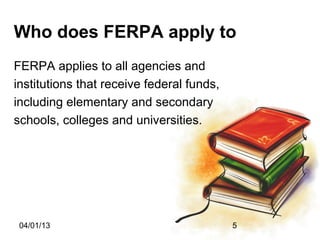
Who does FERPA apply to
FERPA applies to all agencies and
institutions that receive federal funds,
including elementary and secondary
schools, colleges and universities.


 04/01/13                                  5
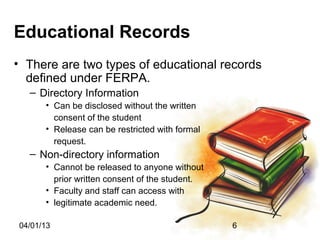
Educational Records
• There are two types of educational records
  defined under FERPA.
  – Directory Information
      • Can be disclosed without the written
        consent of the student
      • Release can be restricted with formal
        request.
  – Non-directory information
      • Cannot be released to anyone without
        prior written consent of the student.
      • Faculty and staff can access with
      • legitimate academic need.

04/01/13                                        6
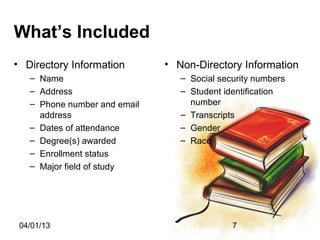
What’s Included
• Directory Information       • Non-Directory Information
   – Name                        – Social security numbers
   – Address                     – Student identification
   – Phone number and email        number
     address                     – Transcripts
   – Dates of attendance         – Gender
   – Degree(s) awarded           – Race
   – Enrollment status
   – Major field of study


 04/01/13                                    7
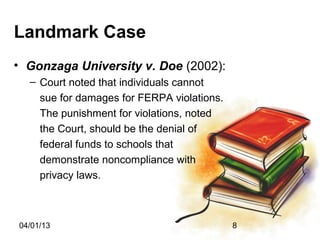
Landmark Case
• Gonzaga University v. Doe (2002):
  – Court noted that individuals cannot
    sue for damages for FERPA violations.
    The punishment for violations, noted
    the Court, should be the denial of
    federal funds to schools that
    demonstrate noncompliance with
    privacy laws.


04/01/13                                    8
Landmark Case
• Owasso Independent School District v. Falvo
  (2002):
  – Decision upheld the constitutionality
    of peer grading. Actions did not violate
    FERPA because student records
    were not being maintained by the
    peer graders.


04/01/13                                       9
Landmark Case
McGilvray v. Moses (1999):
  – This case involves a teacher who gave
    personally identifiable information to someone
    not employed by the district. The Texas
    Commissioner of Education noted
    that the list contained personally
    identifiable information and violated
    the students FERPA rights


04/01/13                                    10
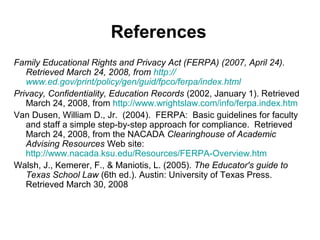
References
Family Educational Rights and Privacy Act (FERPA) (2007, April 24).
   Retrieved March 24, 2008, from http://
   www.ed.gov/print/policy/gen/guid/fpco/ferpa/index.html
Privacy, Confidentiality, Education Records (2002, January 1). Retrieved
   March 24, 2008, from http://www.wrightslaw.com/info/ferpa.index.htm
Van Dusen, William D., Jr. (2004). FERPA: Basic guidelines for faculty
   and staff a simple step-by-step approach for compliance. Retrieved
   March 24, 2008, from the NACADA Clearinghouse of Academic
   Advising Resources Web site:
   http://www.nacada.ksu.edu/Resources/FERPA-Overview.htm
Walsh, J., Kemerer, F., & Maniotis, L. (2005). The Educator's guide to
   Texas School Law (6th ed.). Austin: University of Texas Press.
   Retrieved March 30, 2008

Dr. William Allan Kritsonis - FERPA PPT.

  • 1.
  • 2.
    Purpose of FERPA •The Family Education Rights and Privacy Act of 1974 (FERPA) – Ensures that parents have access to their children’s educational records – Protects the privacy rights of parents and children by limiting access to these records without parental consent. 04/01/13 2
  • 3.
    What is FERPA •A federal law that protects the privacy of student education records. • Also known as the Buckley Amendment • FERPA deals with: – Access to educational records – Parental right to inspect and review records – Amendment of records – Destruction of records 04/01/13 3
  • 4.
    The Buckley Amendment •This act is enforced to guarantee the rights of citizens, but especially to protect students in whom the federal government has made a significant investment. • Toward these ends, the FERPA act mandates that schools must "annually" and "effectively" notify current students of their federally affirmed rights. 04/01/13 4
  • 5.
    Who does FERPAapply to FERPA applies to all agencies and institutions that receive federal funds, including elementary and secondary schools, colleges and universities. 04/01/13 5
  • 6.
    Educational Records • Thereare two types of educational records defined under FERPA. – Directory Information • Can be disclosed without the written consent of the student • Release can be restricted with formal request. – Non-directory information • Cannot be released to anyone without prior written consent of the student. • Faculty and staff can access with • legitimate academic need. 04/01/13 6
  • 7.
    What’s Included • DirectoryInformation • Non-Directory Information – Name – Social security numbers – Address – Student identification – Phone number and email number address – Transcripts – Dates of attendance – Gender – Degree(s) awarded – Race – Enrollment status – Major field of study 04/01/13 7
  • 8.
    Landmark Case • GonzagaUniversity v. Doe (2002): – Court noted that individuals cannot sue for damages for FERPA violations. The punishment for violations, noted the Court, should be the denial of federal funds to schools that demonstrate noncompliance with privacy laws. 04/01/13 8
  • 9.
    Landmark Case • OwassoIndependent School District v. Falvo (2002): – Decision upheld the constitutionality of peer grading. Actions did not violate FERPA because student records were not being maintained by the peer graders. 04/01/13 9
  • 10.
    Landmark Case McGilvray v.Moses (1999): – This case involves a teacher who gave personally identifiable information to someone not employed by the district. The Texas Commissioner of Education noted that the list contained personally identifiable information and violated the students FERPA rights 04/01/13 10
  • 11.
    References Family Educational Rightsand Privacy Act (FERPA) (2007, April 24). Retrieved March 24, 2008, from http:// www.ed.gov/print/policy/gen/guid/fpco/ferpa/index.html Privacy, Confidentiality, Education Records (2002, January 1). Retrieved March 24, 2008, from http://www.wrightslaw.com/info/ferpa.index.htm Van Dusen, William D., Jr. (2004). FERPA: Basic guidelines for faculty and staff a simple step-by-step approach for compliance. Retrieved March 24, 2008, from the NACADA Clearinghouse of Academic Advising Resources Web site: http://www.nacada.ksu.edu/Resources/FERPA-Overview.htm Walsh, J., Kemerer, F., & Maniotis, L. (2005). The Educator's guide to Texas School Law (6th ed.). Austin: University of Texas Press. Retrieved March 30, 2008