SONN
ET
a four-stanza, 14-linepoem.
1
2
derived from the Italian word
sonetto, meaning “a little sound
or song"
usually written in iambic
pentameter and with a strict
rhyme scheme.
3
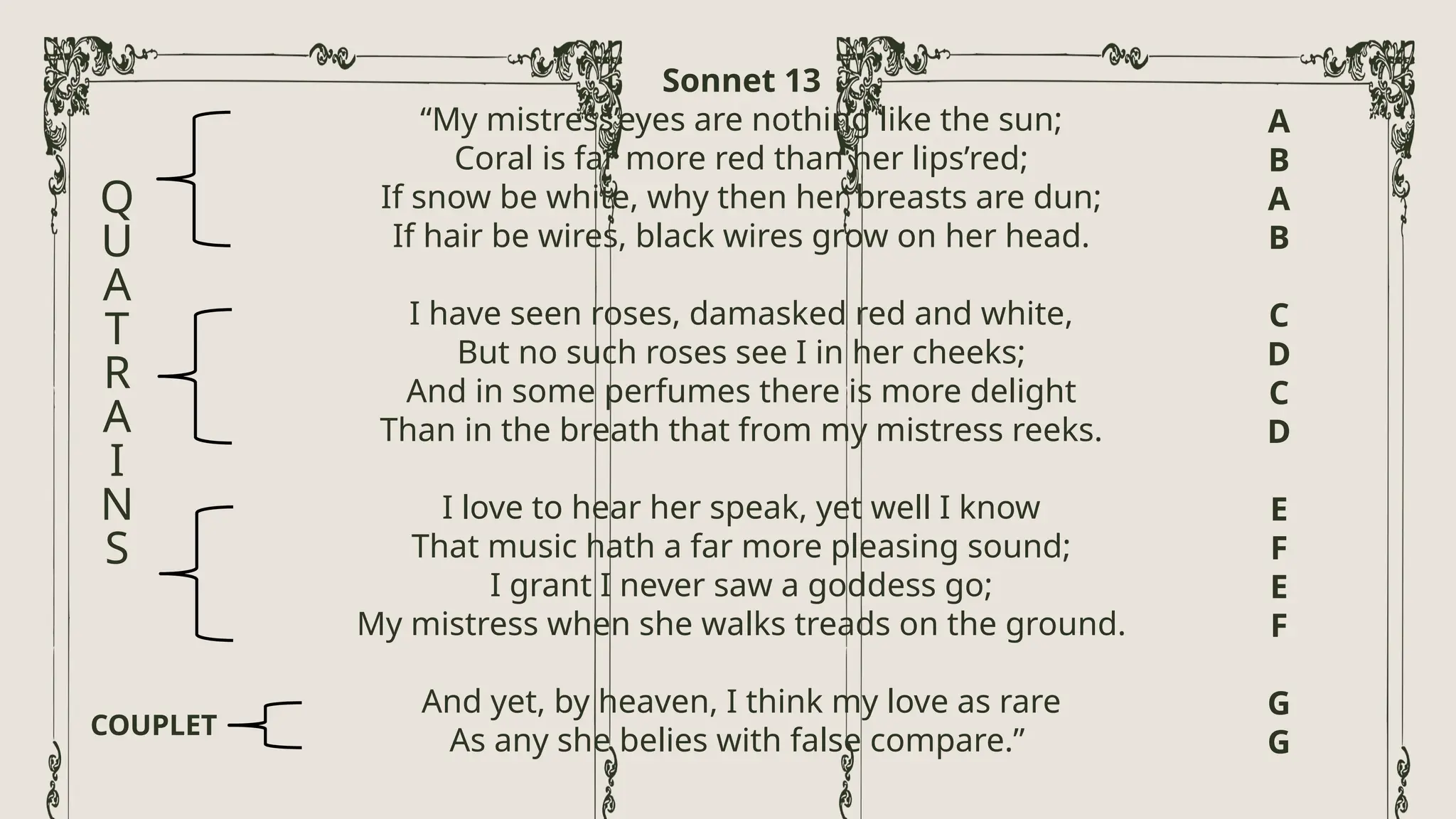
Sonnet 13
“My mistress’eyesare nothing like the sun;
Coral is far more red than her lips’red;
If snow be white, why then her breasts are dun;
If hair be wires, black wires grow on her head.
I have seen roses, damasked red and white,
But no such roses see I in her cheeks;
And in some perfumes there is more delight
Than in the breath that from my mistress reeks.
I love to hear her speak, yet well I know
That music hath a far more pleasing sound;
I grant I never saw a goddess go;
My mistress when she walks treads on the ground.
And yet, by heaven, I think my love as rare
As any she belies with false compare.”
S
H
A
K
E
S
P
E
A
R
E
A
N
P
E
T
A
R
C
H
A
N
Sonnet 13
“My mistress’eyesare nothing like the sun;
Coral is far more red than her lips’red;
If snow be white, why then her breasts are dun;
If hair be wires, black wires grow on her head.
I have seen roses, damasked red and white,
But no such roses see I in her cheeks;
And in some perfumes there is more delight
Than in the breath that from my mistress reeks.
I love to hear her speak, yet well I know
That music hath a far more pleasing sound;
I grant I never saw a goddess go;
My mistress when she walks treads on the ground.
And yet, by heaven, I think my love as rare
As any she belies with false compare.”
36.
Sonnet 13
“My mistress’eyesare nothing like the sun;
Coral is far more red than her lips’red;
If snow be white, why then her breasts are dun;
If hair be wires, black wires grow on her head.
I have seen roses, damasked red and white,
But no such roses see I in her cheeks;
And in some perfumes there is more delight
Than in the breath that from my mistress reeks.
I love to hear her speak, yet well I know
That music hath a far more pleasing sound;
I grant I never saw a goddess go;
My mistress when she walks treads on the ground.
And yet, by heaven, I think my love as rare
As any she belies with false compare.”
A
B
A
B
C
D
C
D
E
F
E
F
G
G
37.
STANZA
FORMS
• MONOSTICH –one line
• COUPLET – two lines
• TERCET – three lines
• QUATRAIN – four lines
• QUINTAIN – five lines
• SETSET – six lines
• SEPTET – seven lines
• OCTET – eight lines
• NONET/SPENSERIAN – nine lines
• DIZAIN – ten lines
38.
Sonnet 13
“My mistress’eyesare nothing like the sun;
Coral is far more red than her lips’red;
If snow be white, why then her breasts are dun;
If hair be wires, black wires grow on her head.
I have seen roses, damasked red and white,
But no such roses see I in her cheeks;
And in some perfumes there is more delight
Than in the breath that from my mistress reeks.
I love to hear her speak, yet well I know
That music hath a far more pleasing sound;
I grant I never saw a goddess go;
My mistress when she walks treads on the ground.
And yet, by heaven, I think my love as rare
As any she belies with false compare.”
A
B
A
B
C
D
C
D
E
F
E
F
G
G
Q
U
A
T
R
A
I
N
S
COUPLET
SHAKESPEA
REAN
SONNET
• Also calledItalian sonnet
• It has two stanzas: the octet and the
sestet.
• Have an ABBAABBA CDECDE or
ABBAABBA CDCDCD rhyme
scheme.
PETRARCH
AN
SONNET
• Have fourteen lines.
• Be written in iambic pentameter.
• Have an ABAB CDCD EFEF GG
rhyme scheme.
• Have three quatrains followed by a
couplet.
41.
LOVE’S UNYIELDING LIGHT
“Uponthe hills where golden sunrays gleam,
A lonely heart doth wander lost in time,
As echoes whisper love’s eternal rhyme,
A fleeting dream with a silver stream.
The roses bloom beneath the moon’s soft beam,
Yet sorrow weaves its tale in threads sublime,
For longing bells in mournful chime
Recall the love that once was but a dream.
Yet hope remains where gentle breezes sigh,
And morning’s glow ignites the darkened past,
The heart still yearns, though fate may turn away,
For love’s bright light will never fade nor die,
Like ocean waves that crash yet hold steadfast,
Its ember burns beyond the break of day.
A
B
B
A
A
B
B
A
C
D
E
C
D
E
U U U U U
/ / / / /
42.
DRAM
ATIC
POETR
Y
encompasses a highlyemotional story
that's written in verse and meant to be
recited.
1
2
This would include closet drama,
dramatic monologues, and rhyme verse.
It usually tells a story or refers to a
specific situation.
3
43.
My Last Duchess
That’smy last Duchess painted on the wall,
Looking as if she were alive. I call
That piece a wonder, now: Fra Pandolf’s hands
Worked busily a day, and there she stands.
She had
A heart—how shall I say?—too soon made glad,
Too easily impressed; she liked whate’er
She looked on, and her looks went everywhere.
Sir, ’twas all one! My favor at her breast,
The dropping of the daylight in the West,
The bough of cherries some officious fool
44.
My Last Duchess
“MyLast Duchess” is a dramatic monologue written by Victorian poet
Robert Browning in 1842. In the poem, the Duke of Ferrara uses a
painting of his former wife as a conversation piece. The Duke speaks
about his former wife's perceived inadequacies to a representative of
the family of his bride-to-be, revealing his obsession with controlling
others in the process. Browning uses this compelling psychological
portrait of a despicable character to critique the objectification of
women and abuses of power.
http://acip.sd79.bc.ca/vocab_sheets/short_story_terms.pdf
45.
VIGNE
TTE
is a Frenchword that means “little
vine.”
1
2
Hence, the derivation of this term is
that source of drawings.
The printers, during the nineteenth-
century, would decorate their title
pages with drawings of looping vines.
3
4
Contemporary ideas from the scenes
shown in television and film scripts
also have influenced vignettes.
46.
In Our Time(By Ernest Hemingway)
“Maera lay still, his head on his arms, his face in the sand. He felt
warm and sticky from the bleeding. Each time he felt the horn
coming. Sometimes the bull only bumped him with his head. Once
the horn went all the way through him and he felt it go into the
sand … Maera felt everything getting larger and larger and then
smaller and smaller. Then it got larger and larger and larger and
then smaller and smaller. Then everything commenced to run
faster and faster as when they speed up a cinematograph film.
Then he was dead.”
https://literarydevices.net/vignette/
47.
In this impressionisticsketch, the author gives an illustration
of the character Maera, who is a bullfighter that dies from
injuries inflicted by a bull.
48.
SHORT
STORIE
S
tend to beless complex than novels.
1
2
Usually, a short story will focus on
only one incident, has a single plot, a
single setting, a limited number of
characters, and covers a short period
of time.
Usually between 1,000 and 10,000
words
3
49.
"The Lottery"
Shirley Jackson(1948) (Horror/Dystopian)
In a small, seemingly peaceful town, the villagers gather for their
annual lottery, a long-standing tradition. However, as the event
unfolds, it becomes clear that the "winner" is not lucky at all. The
shocking twist ending reveals that the chosen person is stoned to
death by the townspeople, including their own family members, in
a brutal ritual sacrifice meant to ensure a good harvest. The story
critiques blind conformity and tradition.
50.
ELEMENTS OF A
SHORTSTORY
is a person, or
sometimes even an
animal, who takes
part in the action of a
short story or other
literary work.
is the time and place in
which it happens. Authors
often use descriptions of
landscape, scenery,
buildings, seasons or
weather to provide a
strong sense of setting.
is a series of events
and character actions
that relate to the
central conflict.
CHARACTER SETTING PLOT
51.
ELEMENTS OF A
SHORTSTORY
is a struggle between
two people or things in
a short story. The main
character is usually on
one side of the central
conflict.
is the central idea or
belief in a short story.
CONFLICT THEME
How can identifying
thekey features of a
literary form help us
understand the
author’s message?
What are some
unique benefits of
reading different
types of literature?
How do the forms we
studied differ in how
they create impact?
1 2 3
PROCESS
QUESTIONS
63.
PROCESS
QUESTIONS
If you wereto write a
short story about a
significant event in your
life, which literary form
would you choose?
4