Fazlur Rahman Khan (1929-1982) was a pioneering Bangladeshi-American structural engineer and architect, renowned for initiating tubular designs for skyscrapers and contributing significantly to modern structural engineering. He designed notable structures including the Willis Tower and the John Hancock Center and received numerous accolades for his work. Khan's legacy includes the establishment of awards in his honor, recognition by prominent figures, and an enduring influence on skyscraper design and construction.

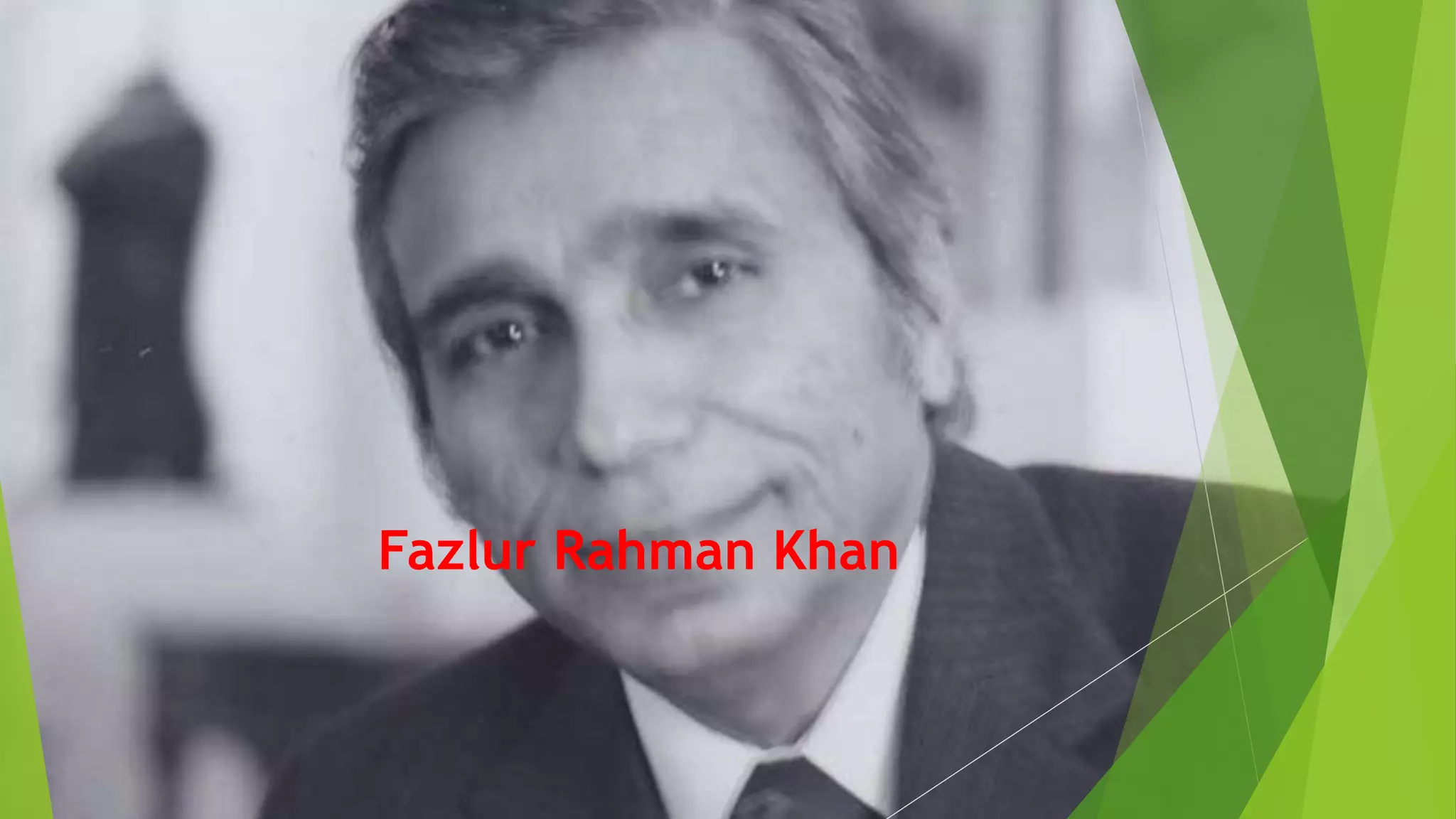
![ Fazlur Rahman Khan (Bengali: ফজলুর রহমান খান, Fozlur
Rôhman Khan)
(3 April 1929 – 27 March 1982) was a Bangladeshi-
American[2] structural engineer and architect, who
initiated important structural systems
for skyscrapers. Considered the "father of tubular
designs" for high-rises,[6] Khan was also a pioneer
in computer-aided design (CAD). He was the designer of
the Sears Tower, since renamed Willis Tower, the tallest
building in the world from 1973 until 1998, and the 100-
story John Hancock Center.](https://image.slidesharecdn.com/welcometeryt-200404110143/75/Fazlur-Rahman-Khan-3-2048.jpg)
![ Khan, more than any other individual, ushered in a renaissance in
skyscraper construction during the second half of the 20th
century.[7][8] He has been called the "Einstein of structural
engineering" and the "Greatest Structural Engineer of the 20th
Century" for his innovative use of structural systems that remain
fundamental to modern skyscraper design and
construction.[3][9] In his honor, the Council on Tall Buildings and
Urban Habitat established the Fazlur Khan Lifetime Achievement
Medal, as one of their CTBUH Skyscraper Awards.
Although best known for skyscrapers, Khan was also an active
designer of other kinds of structures, including the Hajj airport
terminal, the McMath–Pierce solar telescope, and several stadium
structures.[10][11]](https://image.slidesharecdn.com/welcometeryt-200404110143/75/Fazlur-Rahman-Khan-4-2048.jpg)
![ Biography[edit]
Fazlur Rahman Khan was born on 3 April 1929 in the Bengal Presidency of British India,
now Bangladesh.[12] He was brought up in the village of Bhandarikandii, in the Faridpur
District near Dhaka. His father Abdur Rahman Khan was a high school mathematics teacher
and textbook author. He eventually became the Director of Public Instruction in the region
of Bengal and after retirement served as Principal of Jagannath College, Dhaka.[12]
Khan attended Armanitola Government High School, in Dhaka. After that, he studied Civil
Engineering in Bengal Engineering and Science University, Shibpur (present day Indian
Institute of Engineering Science and Technology, Shibpur), Kolkata, India, and then received
his Bachelor of Civil Engineering degree from Ahsanullah Engineering College,
(now Bangladesh University of Engineering and Technology). He received a Fulbright
Scholarship and a government scholarship, which enabled him to travel to the United States
in 1952. There he studied at the University of Illinois at Urbana–Champaign. In three years
Khan earned two master's degrees – one in structural engineering and one in theoretical and
applied mechanics – and a PhD in structural engineering[13] with thesis titled Analytical
study of relations among various design criteria for rectangular prestressed concrete
beams.[14]
His hometown in Dhaka did not have any buildings taller than three stories. He also did not
see his first skyscraper in person until the age of 21 years old, and he had not stepped
inside a mid-rise building until he moved to the United States for graduate school. Despite](https://image.slidesharecdn.com/welcometeryt-200404110143/75/Fazlur-Rahman-Khan-5-2048.jpg)

![Buildings on which Khan was structural engineer include:
•McMath–Pierce solar telescope, Kitt Peak National Observatory, Arizona, 1962[54]
•DeWitt-Chestnut Apartments, Chicago, 1963
•Brunswick Building, Chicago, 1965
•John Hancock Center, Chicago, 1965–1969
•One Shell Square, New Orleans, Louisiana, 1972
•140 William Street (formerly BHP House), Melbourne, 1972
•Sears Tower, renamed Willis Tower, Chicago, 1970–1973
•First Wisconsin Center, renamed U.S. Bank Center, Milwaukee, 1973
•Hajj Terminal, King Abdulaziz International Airport, Jeddah, 1974–1980
•King Abdulaziz University, Jeddah, 1977–1978
•Hubert H. Humphrey Metrodome, Minneapolis, Minnesota, 1982
•One Magnificent Mile, Chicago, completed 1983
•Onterie Center, Chicago, completed 1986
•United States Air Force Academy, Colorado Springs, Colorado](https://image.slidesharecdn.com/welcometeryt-200404110143/75/Fazlur-Rahman-Khan-7-2048.jpg)
![ Among Khan's other accomplishments, he received the Wason Medal (1971) and Alfred Lindau Award (1973) from the American
Concrete Institute (ACI); the Thomas Middlebrooks Award (1972) and the Ernest Howard Award (1977) from ASCE; the
Kimbrough Medal (1973) from the American Institute of Steel Construction; the Oscar Faber medal (1973) from the Institution
of Structural Engineers, London; the International Award of Merit in Structural Engineering (1983) from the International
Association for Bridge and Structural Engineering IABSE; the AIA Institute Honor for Distinguished Achievement (1983) from the
American Institute of Architects; and the John Parmer Award (1987) from Structural Engineers Association of Illinois and
Illinois Engineering Hall of Fame from Illinois Engineering Council (2006).[55]
Khan was cited five times by Engineering News-Record as among those who served the best interests of the construction
industry, and in 1972 he was honoured with ENR's Man of the Year award. In 1973 he was elected to the National Academy of
Engineering. He received Honorary Doctorates from Northwestern University, Lehigh University, and the Swiss Federal
Institute of Technology Zürich (ETH Zurich).[5]
The Council on Tall Buildings and Urban Habitat named one of their CTBUH Skyscraper Awards the Fazlur Khan Lifetime
Achievement Medal after him,[45] and other awards have been established in his honour, along with a chair at Lehigh
University. Promoting educational activities and research, the Fazlur Rahman Khan Endowed Chair of Structural Engineering
and Architecture honours Khan's legacy of engineering advancement and architectural sensibility. Dan Frangopol is the first
holder of the chair.[56]
Khan was mentioned by president Obama in 2009 in his speech in Cairo, Egypt when he cited the achievements of America's
Muslim citizens.[57]
Khan was the subject of the Google Doodle on April 3, 2017, marking what would have been his 88th birthday.[58]](https://image.slidesharecdn.com/welcometeryt-200404110143/75/Fazlur-Rahman-Khan-8-2048.jpg)
![ Khan died of a heart attack on 27 March 1982 while on a trip in Jeddah, Saudi
Arabia, at the age of 52. He was a general partner in SOM. His body was
returned to the United States and was buried in Graceland Cemetery in
Chicago.[12]](https://image.slidesharecdn.com/welcometeryt-200404110143/75/Fazlur-Rahman-Khan-9-2048.jpg)


