Fayol’s Principles
• Henri Fayol, developed a set of 14 principles:
1. Division of work: allows for job specialization.
2. Authority and Responsibility:
3. Unity of Command: Employees should have only one
boss.
4. Line of Authority: a clear chain from top to bottom of
the firm.
5. Centralization: the degree to which authority rests at
the very top.
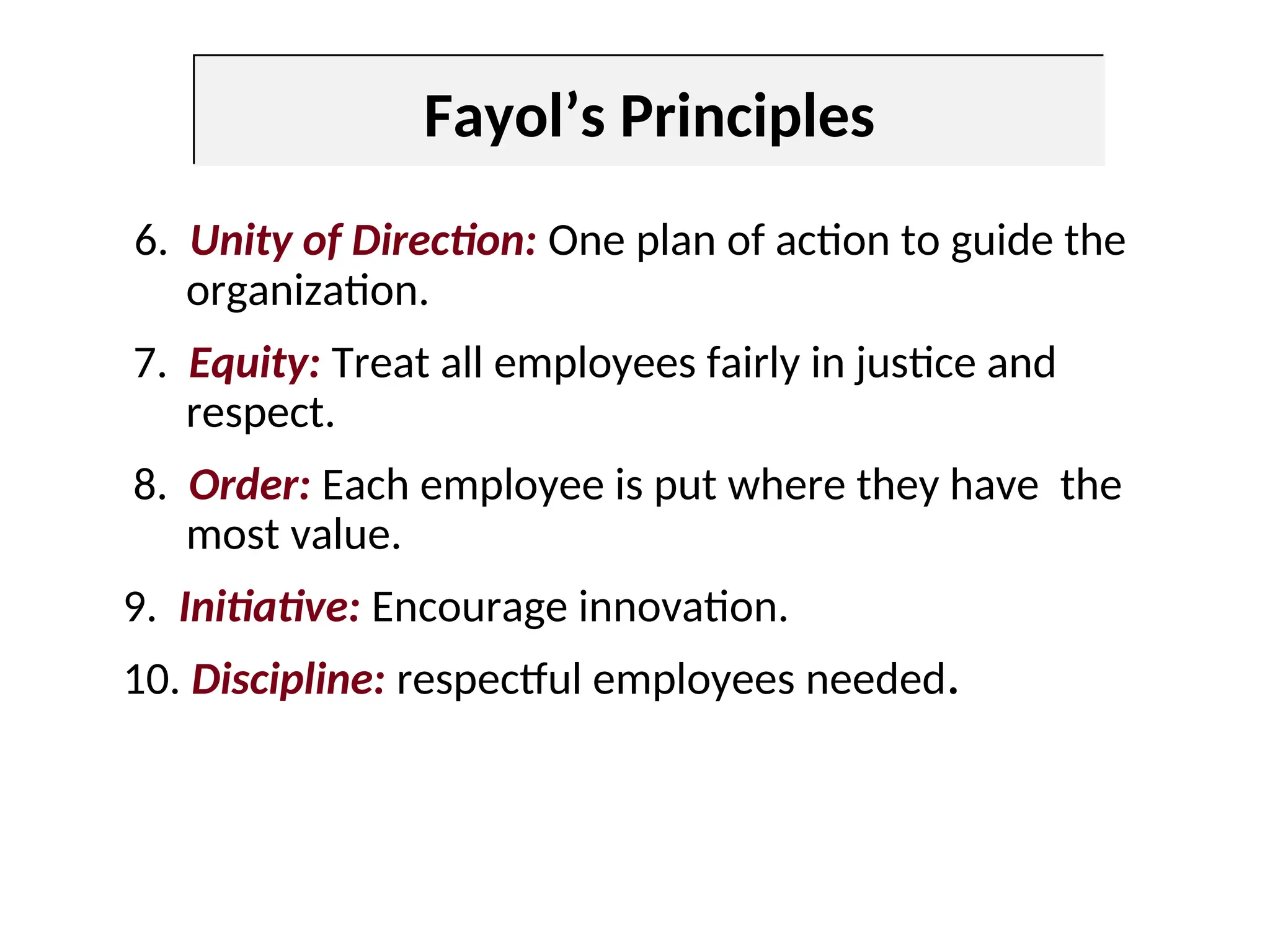
6. Unity of Direction: One plan of action to guide the
organization.
7. Equity: Treat all employees fairly in justice and
respect.
8. Order: Each employee is put where they have the
most value.
9. Initiative: Encourage innovation.
10. Discipline: respectful employees needed.
Fayol’s Principles
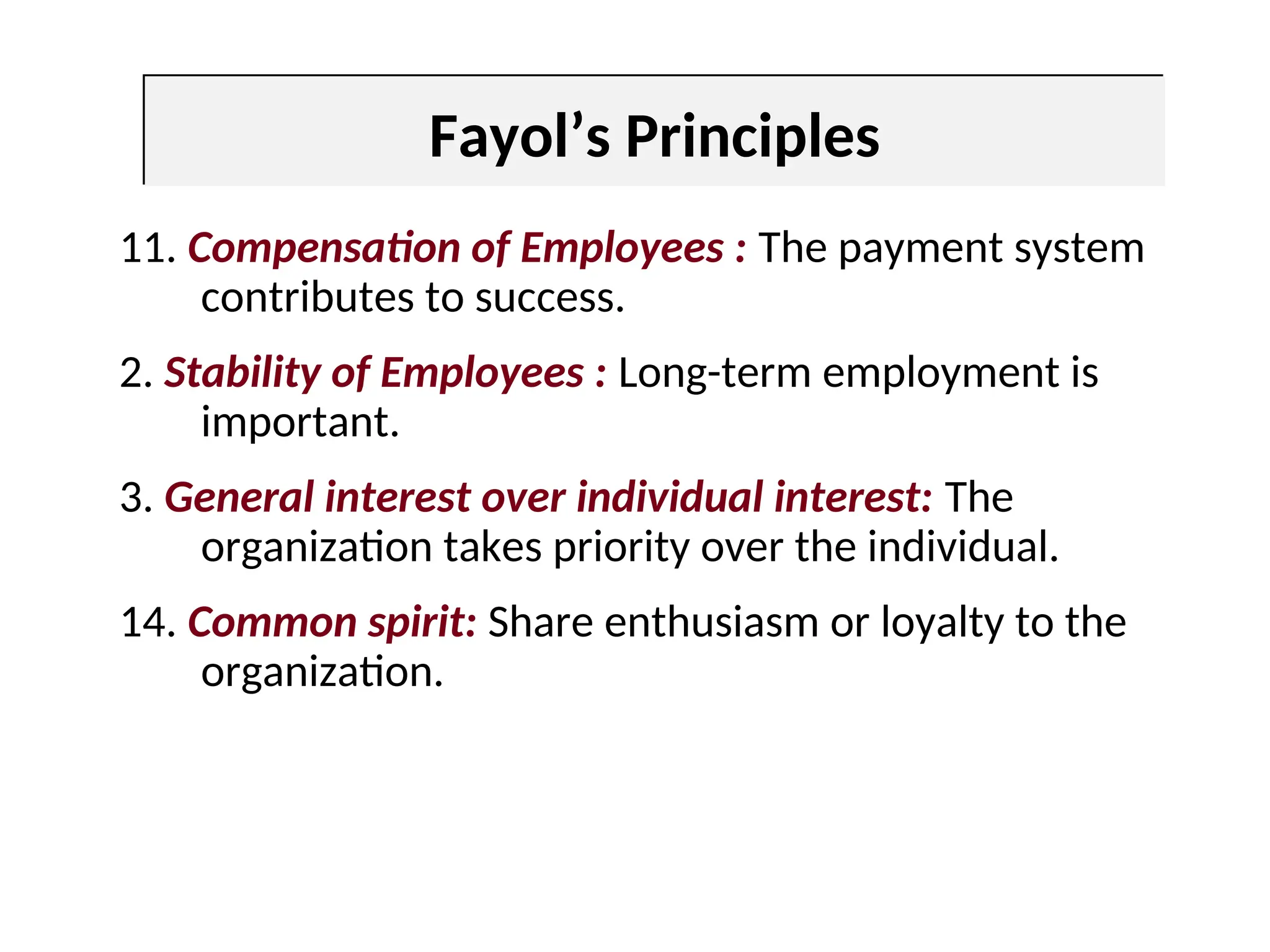
11. Compensation of Employees : The payment system
contributes to success.
2. Stability of Employees : Long-term employment is
important.
3. General interest over individual interest: The
organization takes priority over the individual.
14. Common spirit: Share enthusiasm or loyalty to the
organization.
Fayol’s Principles
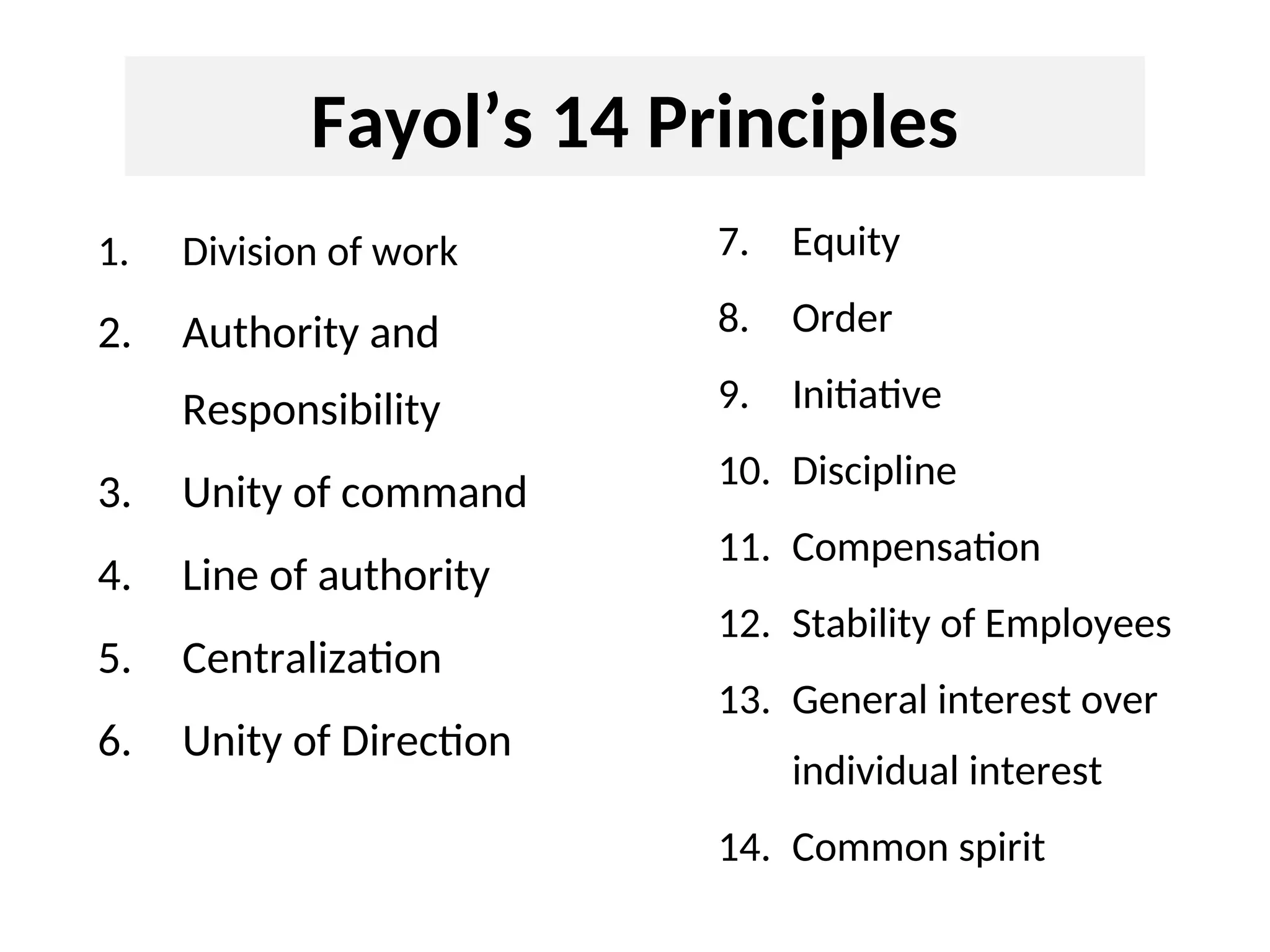
Fayol’s 14 Principles
1. Division of work
2. Authority and
Responsibility
3. Unity of command
4. Line of authority
5. Centralization
6. Unity of Direction
7. Equity
8. Order
9. Initiative
10. Discipline
11. Compensation
12. Stability of Employees
13. General interest over
individual interest
14. Common spirit
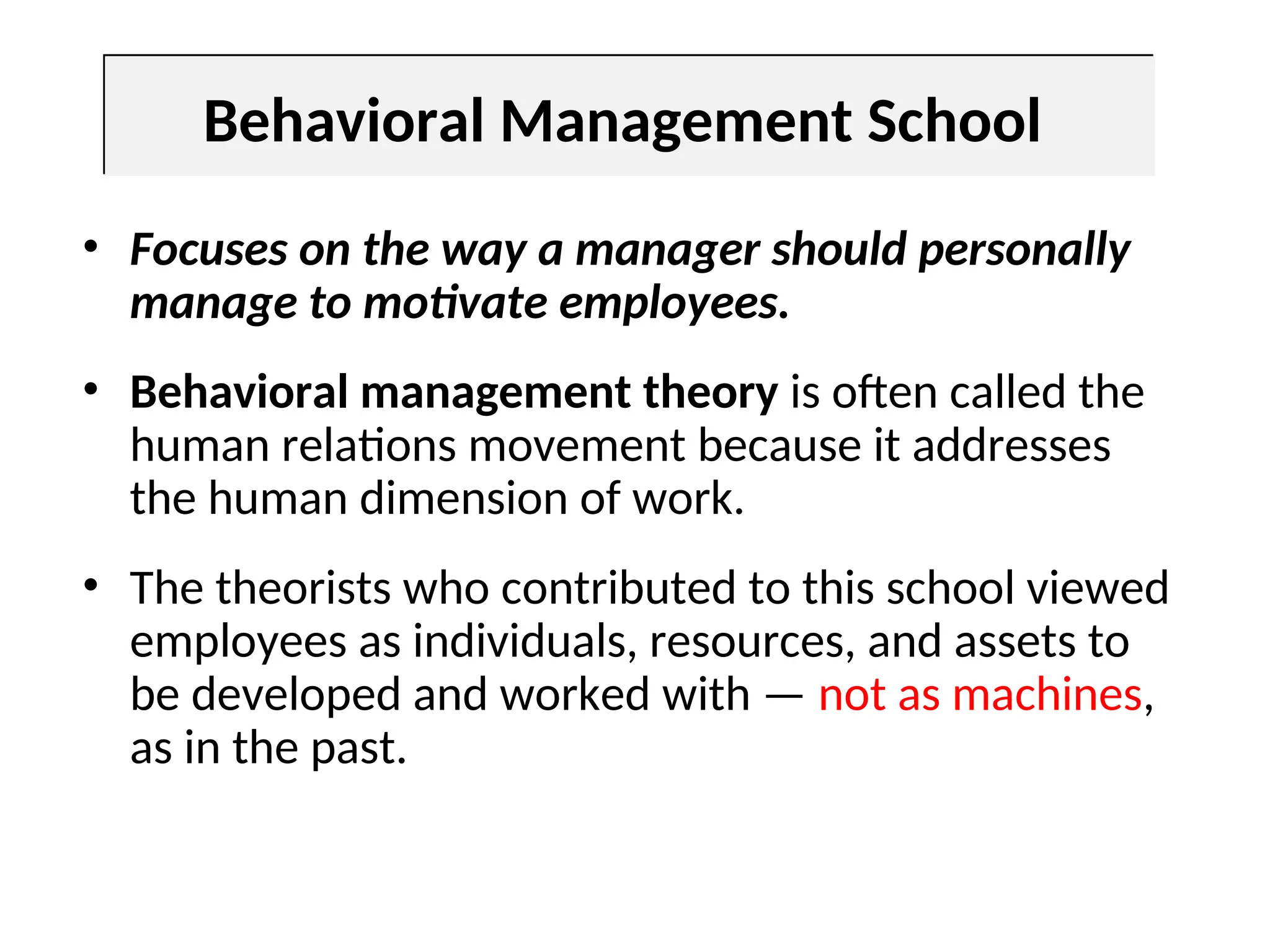
Behavioral Management School
• Focuses on the way a manager should personally
manage to motivate employees.
• Behavioral management theory is often called the
human relations movement because it addresses
the human dimension of work.
• The theorists who contributed to this school viewed
employees as individuals, resources, and assets to
be developed and worked with — not as machines,
as in the past.
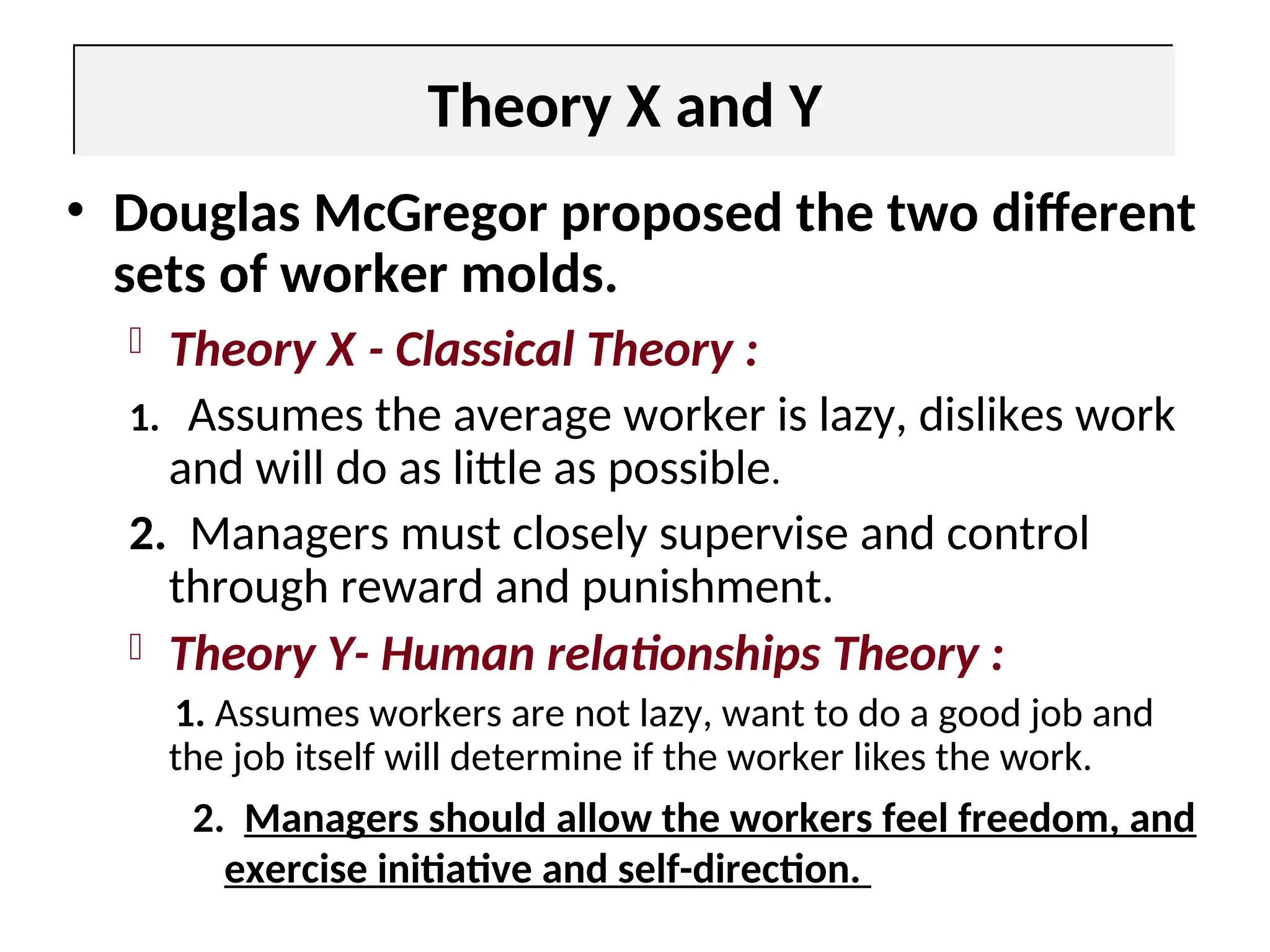
Theory X and Y
• Douglas McGregor proposed the two different
sets of worker molds.
 Theory X - Classical Theory :
1. Assumes the average worker is lazy, dislikes work
and will do as little as possible.
2. Managers must closely supervise and control
through reward and punishment.
 Theory Y- Human relationships Theory :
1. Assumes workers are not lazy, want to do a good job and
the job itself will determine if the worker likes the work.
2. Managers should allow the workers feel freedom, and
exercise initiative and self-direction.
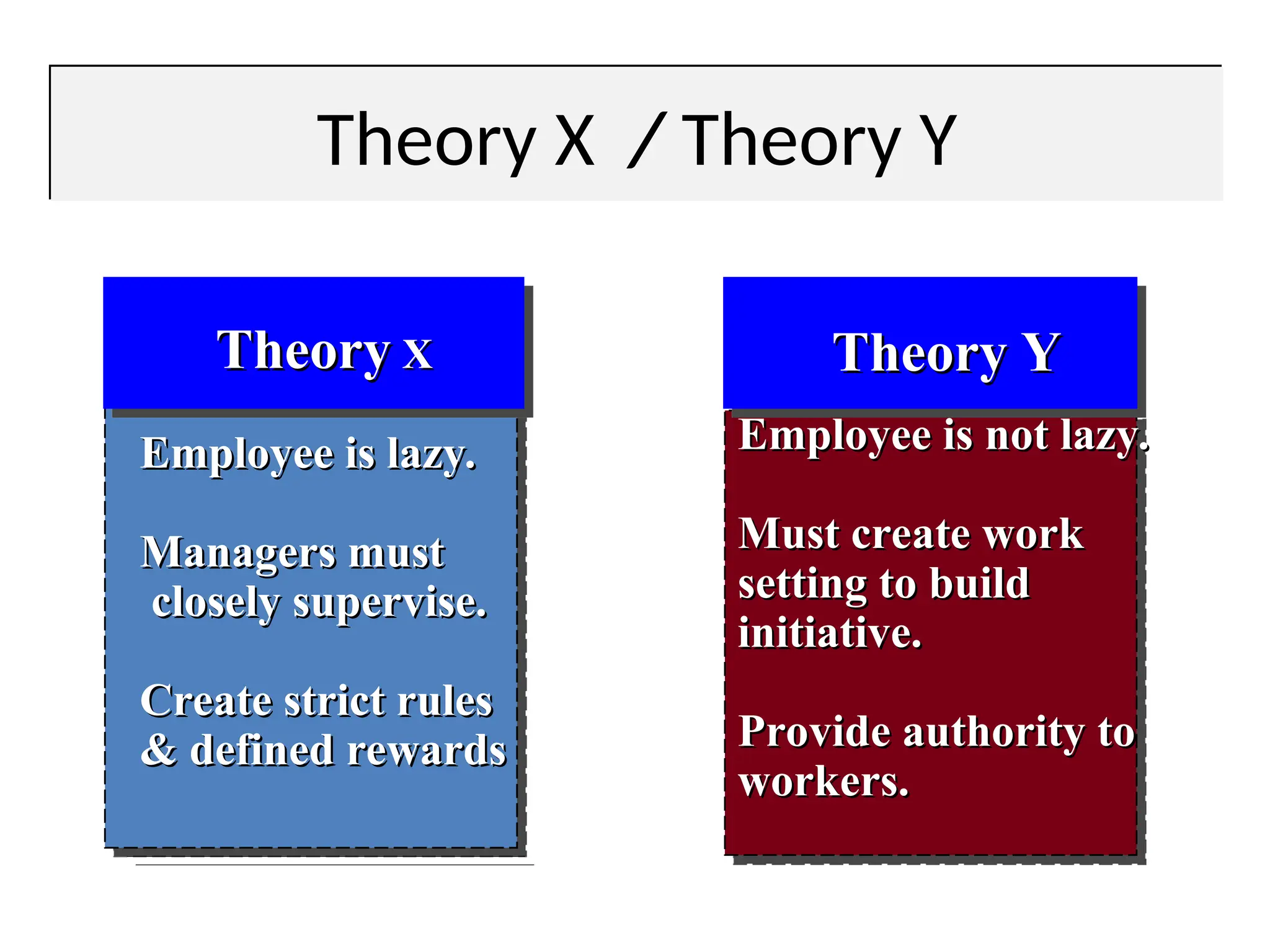
Theory X / Theory Y
Theory Y
Theory Y
Employee is not lazy.
Must create work
Must create work
setting to build
setting to build
initiative.
initiative.
Provide authority to
workers.
workers.
Theory
Theory X
X
Employee is lazy.
Employee is lazy.
Managers must
Managers must
closely supervise.
closely supervise.
Create strict rules
Create strict rules
& defined rewards
& defined rewards
Management Science Theory
• Quantitative management :
– uses mathematical techniques, like linear
programming, modeling, simulation and chaos
theory
• Operations management :
– provides managers a set of techniques they can
use to analyze any aspect of an organization’s
production system to increase efficiency
• Total quality management :
– focuses on analyzing an organization’s input,
conversion, and output activities to increase
product quality
• Management information systems :
– help managers design systems that provide
information that is vital for effective decision
making
Management Science Theory
The System Theory
• What’s the system approach?
• Two basic types of the system: closed and
open
 Closed systems are not influenced by and do
not interact with their environment.
 open system dynamically interacts with its
environment.
• An organization is an open system
An Organization Is an Open System
• An organization is a system that interacts with and
depends upon its environment.
Organization’s stakeholders: any group that is affected by
organizational decisions and policies. The manager’s job is
to coordinate all stakeholders to achieve the
organization’s goals.
• Organizational survival often depends on successful
interactions with the external environment.
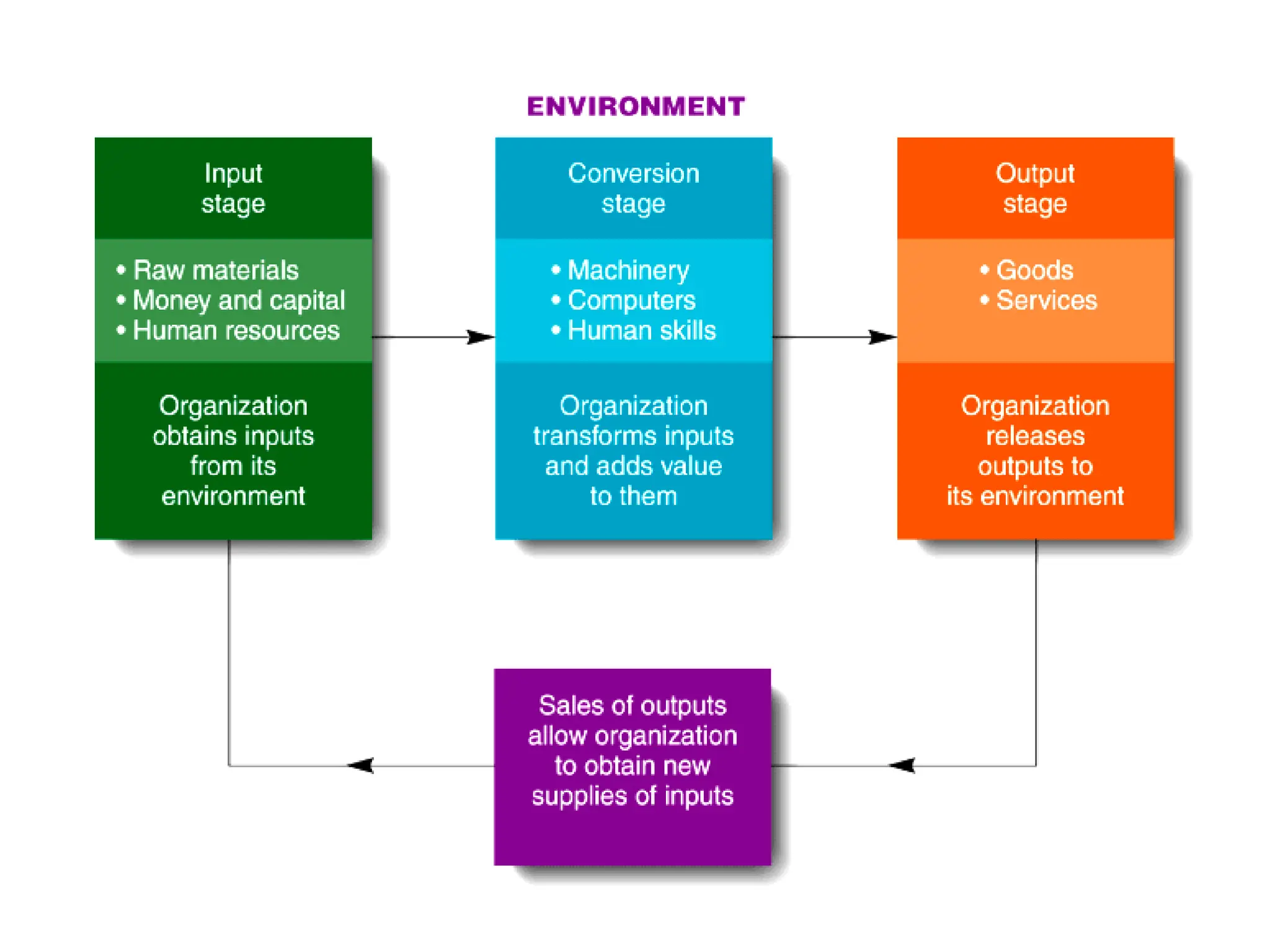
The Open-Systems View
– Inputs: the acquisition of external resources to
produce goods and services.
– Transformation: transforms the inputs into
outputs of finished goods and services.
– Output: the release of finished goods and
services to its external environment.
Maslow’s
Hierarchy-of-Needs Theory
• Abraham Maslow )1908-1970).
• Father of Humanistic Psychology.
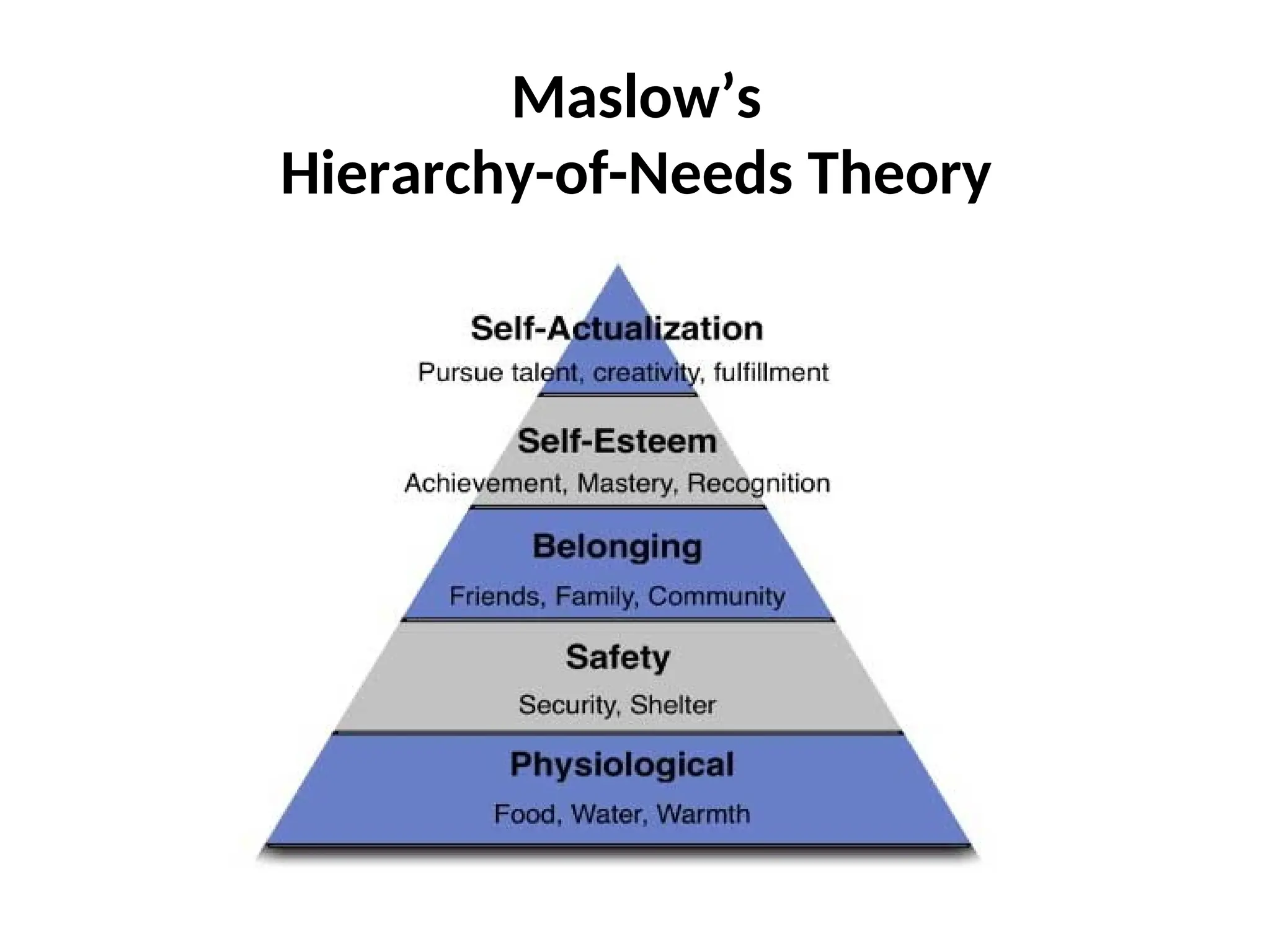
• Maslow's hierarchy of needs theory is a
motivational theory in psychology containing
a five level model of human needs, often
shown as hierarchical levels within a pyramid.
Maslow’s
Hierarchy-of-Needs Theory
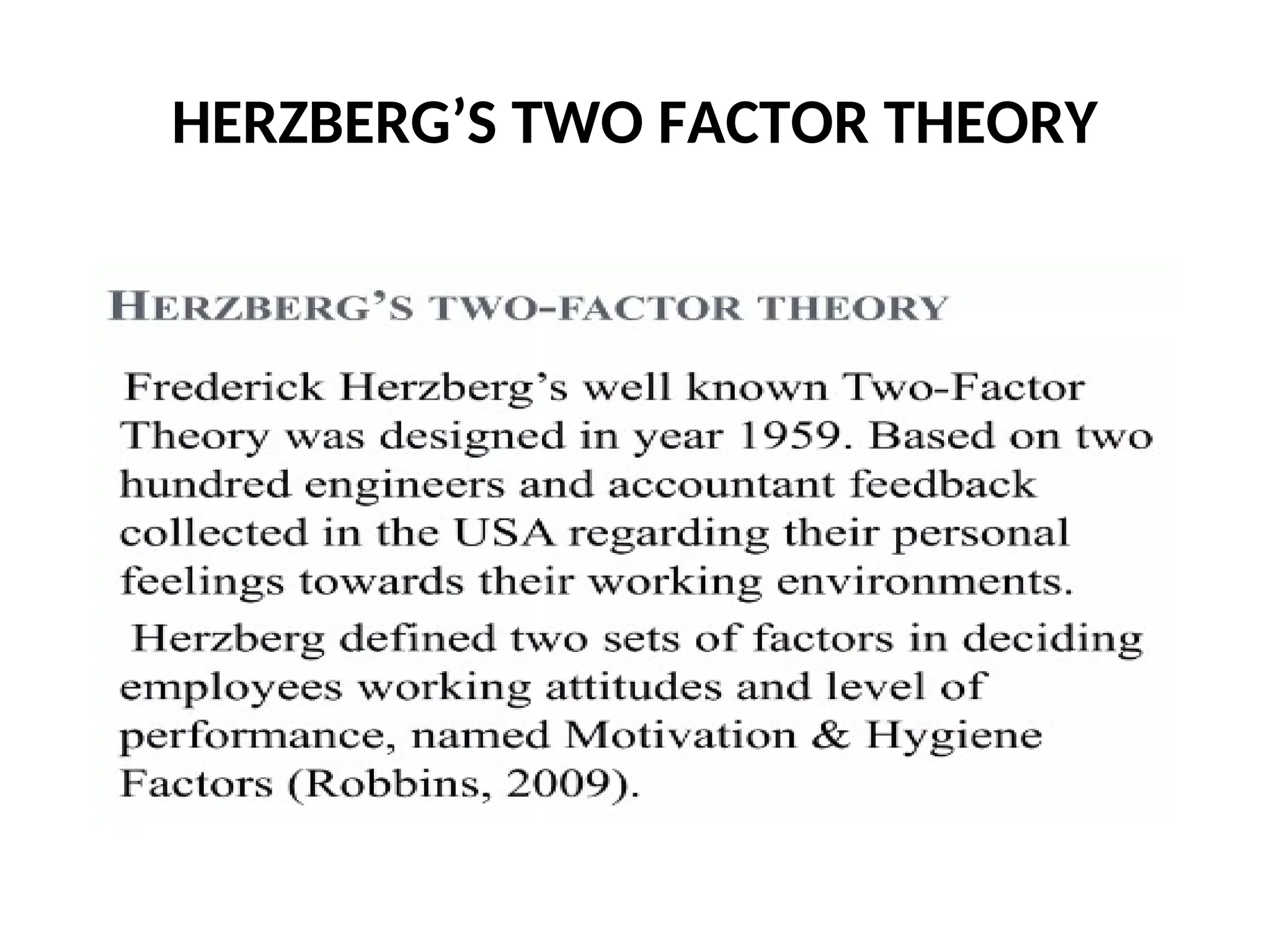
HERZBERG’S TWO FACTOR THEORY
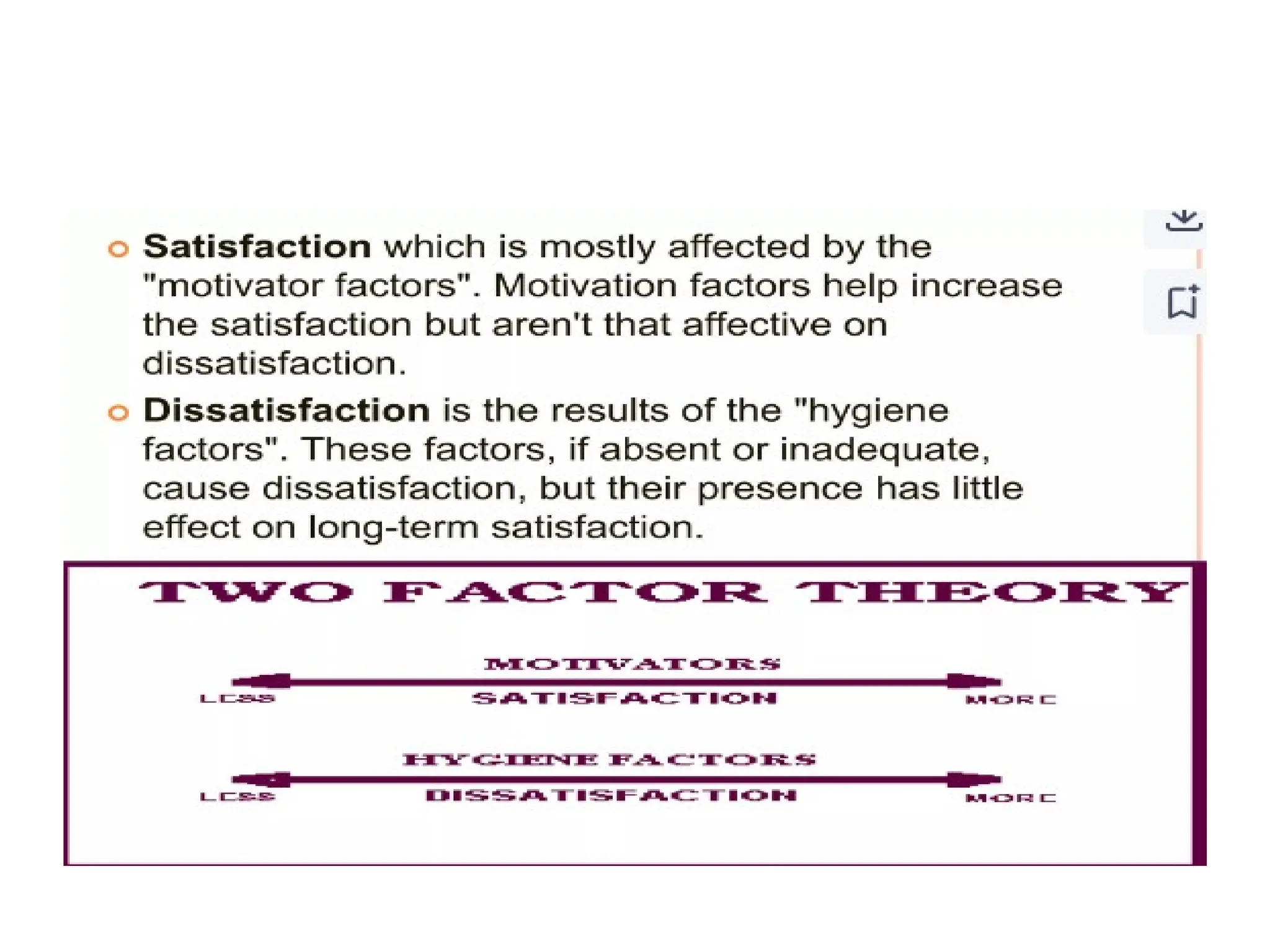
ABOUT TWO FACTORS THEORY
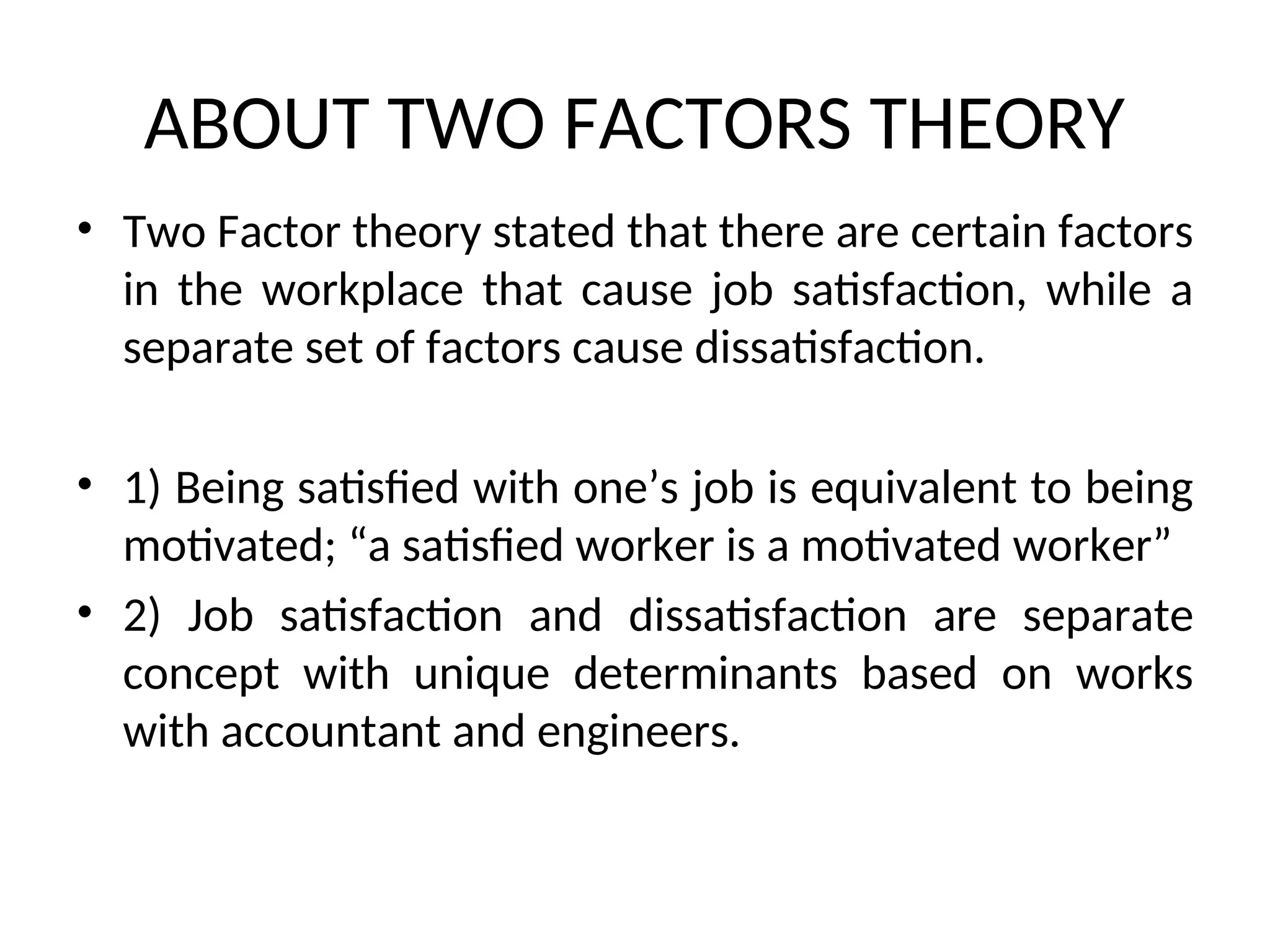
• Two Factor theory stated that there are certain factors
in the workplace that cause job satisfaction, while a
separate set of factors cause dissatisfaction.
• 1) Being satisfied with one’s job is equivalent to being
motivated; “a satisfied worker is a motivated worker”
• 2) Job satisfaction and dissatisfaction are separate
concept with unique determinants based on works
with accountant and engineers.
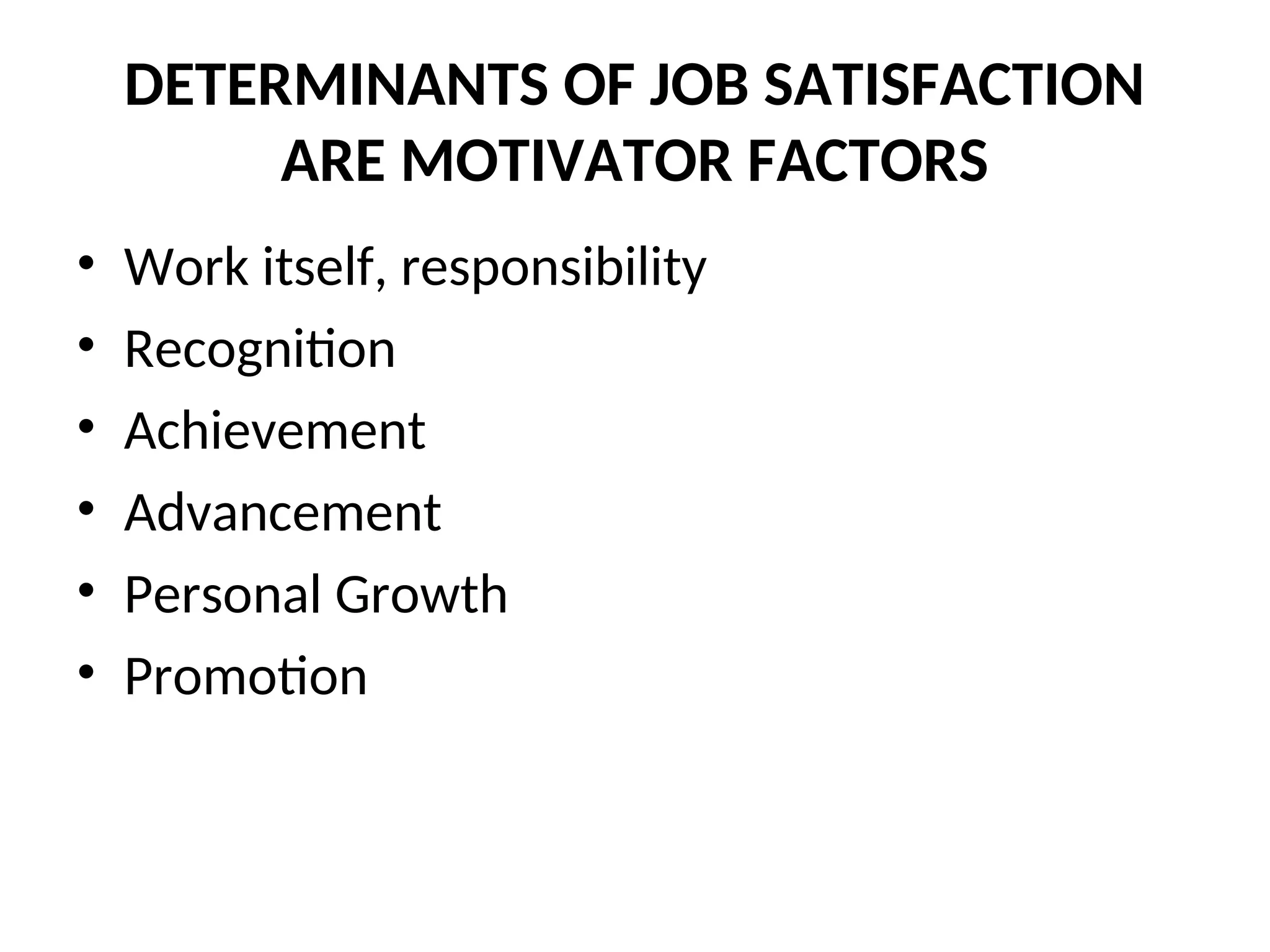
DETERMINANTS OF JOB SATISFACTION
ARE MOTIVATOR FACTORS
• Work itself, responsibility
• Recognition
• Achievement
• Advancement
• Personal Growth
• Promotion
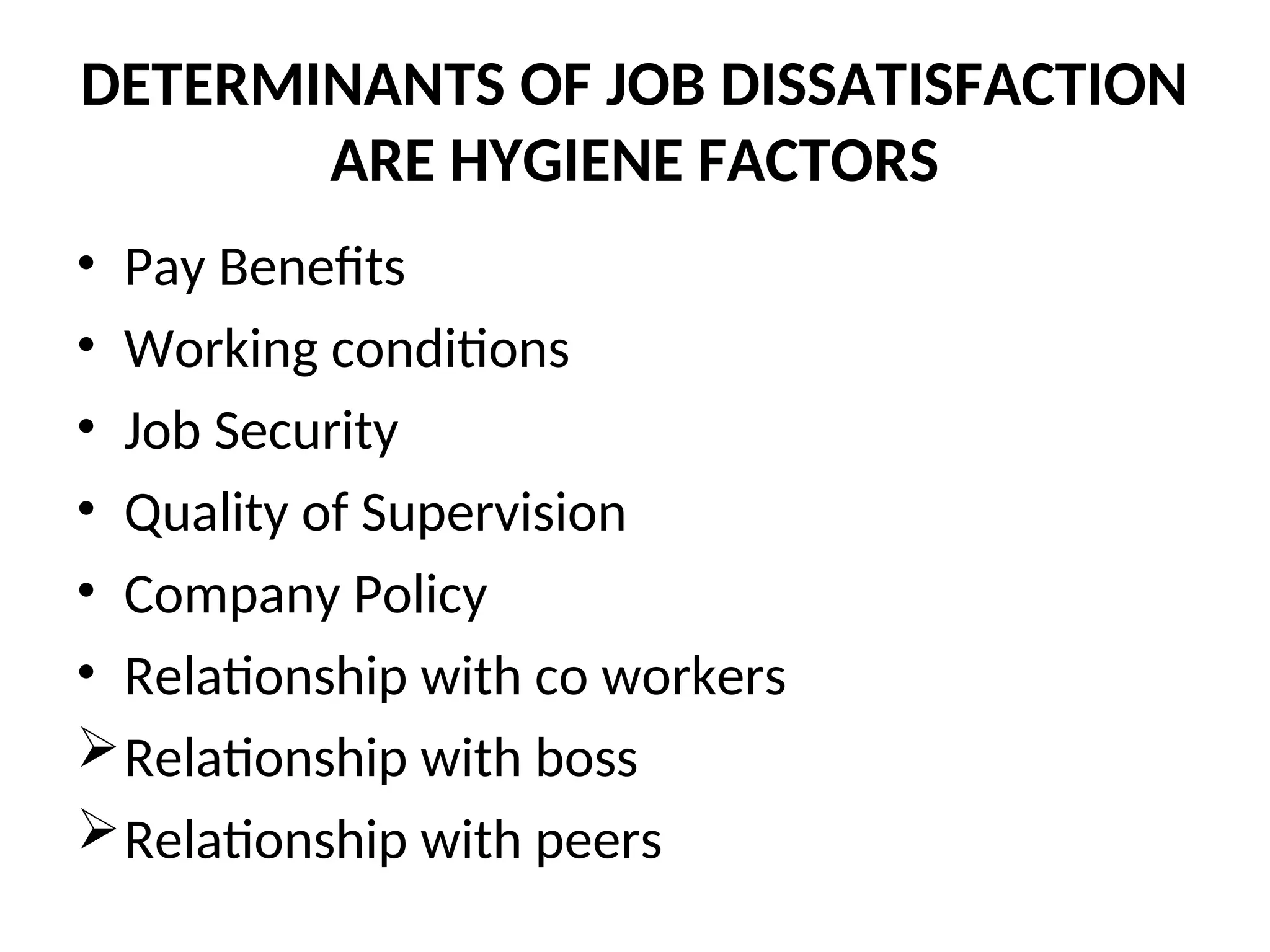
DETERMINANTS OF JOB DISSATISFACTION
ARE HYGIENE FACTORS
• Pay Benefits
• Working conditions
• Job Security
• Quality of Supervision
• Company Policy
• Relationship with co workers
Relationship with boss
Relationship with peers

Fayol.ppt management fayol 14 points prese

  • 1.
    Fayol’s Principles • HenriFayol, developed a set of 14 principles: 1. Division of work: allows for job specialization. 2. Authority and Responsibility: 3. Unity of Command: Employees should have only one boss. 4. Line of Authority: a clear chain from top to bottom of the firm. 5. Centralization: the degree to which authority rests at the very top.
  • 2.
    6. Unity ofDirection: One plan of action to guide the organization. 7. Equity: Treat all employees fairly in justice and respect. 8. Order: Each employee is put where they have the most value. 9. Initiative: Encourage innovation. 10. Discipline: respectful employees needed. Fayol’s Principles
  • 3.
    11. Compensation ofEmployees : The payment system contributes to success. 2. Stability of Employees : Long-term employment is important. 3. General interest over individual interest: The organization takes priority over the individual. 14. Common spirit: Share enthusiasm or loyalty to the organization. Fayol’s Principles
  • 4.
    Fayol’s 14 Principles 1.Division of work 2. Authority and Responsibility 3. Unity of command 4. Line of authority 5. Centralization 6. Unity of Direction 7. Equity 8. Order 9. Initiative 10. Discipline 11. Compensation 12. Stability of Employees 13. General interest over individual interest 14. Common spirit
  • 5.
    Behavioral Management School •Focuses on the way a manager should personally manage to motivate employees. • Behavioral management theory is often called the human relations movement because it addresses the human dimension of work. • The theorists who contributed to this school viewed employees as individuals, resources, and assets to be developed and worked with — not as machines, as in the past.
  • 6.
    Theory X andY • Douglas McGregor proposed the two different sets of worker molds.  Theory X - Classical Theory : 1. Assumes the average worker is lazy, dislikes work and will do as little as possible. 2. Managers must closely supervise and control through reward and punishment.  Theory Y- Human relationships Theory : 1. Assumes workers are not lazy, want to do a good job and the job itself will determine if the worker likes the work. 2. Managers should allow the workers feel freedom, and exercise initiative and self-direction.
  • 7.
    Theory X /Theory Y Theory Y Theory Y Employee is not lazy. Employee is not lazy. Must create work Must create work setting to build setting to build initiative. initiative. Provide authority to Provide authority to workers. workers. Theory Theory X X Employee is lazy. Employee is lazy. Managers must Managers must closely supervise. closely supervise. Create strict rules Create strict rules & defined rewards & defined rewards
  • 8.
    Management Science Theory •Quantitative management : – uses mathematical techniques, like linear programming, modeling, simulation and chaos theory • Operations management : – provides managers a set of techniques they can use to analyze any aspect of an organization’s production system to increase efficiency
  • 9.
    • Total qualitymanagement : – focuses on analyzing an organization’s input, conversion, and output activities to increase product quality • Management information systems : – help managers design systems that provide information that is vital for effective decision making Management Science Theory
  • 10.
    The System Theory •What’s the system approach? • Two basic types of the system: closed and open  Closed systems are not influenced by and do not interact with their environment.  open system dynamically interacts with its environment. • An organization is an open system
  • 11.
    An Organization Isan Open System • An organization is a system that interacts with and depends upon its environment. Organization’s stakeholders: any group that is affected by organizational decisions and policies. The manager’s job is to coordinate all stakeholders to achieve the organization’s goals. • Organizational survival often depends on successful interactions with the external environment.
  • 13.
    The Open-Systems View –Inputs: the acquisition of external resources to produce goods and services. – Transformation: transforms the inputs into outputs of finished goods and services. – Output: the release of finished goods and services to its external environment.
  • 14.
    Maslow’s Hierarchy-of-Needs Theory • AbrahamMaslow )1908-1970). • Father of Humanistic Psychology. • Maslow's hierarchy of needs theory is a motivational theory in psychology containing a five level model of human needs, often shown as hierarchical levels within a pyramid.
  • 15.
  • 16.
  • 17.
    ABOUT TWO FACTORSTHEORY • Two Factor theory stated that there are certain factors in the workplace that cause job satisfaction, while a separate set of factors cause dissatisfaction. • 1) Being satisfied with one’s job is equivalent to being motivated; “a satisfied worker is a motivated worker” • 2) Job satisfaction and dissatisfaction are separate concept with unique determinants based on works with accountant and engineers.
  • 19.
    DETERMINANTS OF JOBSATISFACTION ARE MOTIVATOR FACTORS • Work itself, responsibility • Recognition • Achievement • Advancement • Personal Growth • Promotion
  • 20.
    DETERMINANTS OF JOBDISSATISFACTION ARE HYGIENE FACTORS • Pay Benefits • Working conditions • Job Security • Quality of Supervision • Company Policy • Relationship with co workers Relationship with boss Relationship with peers