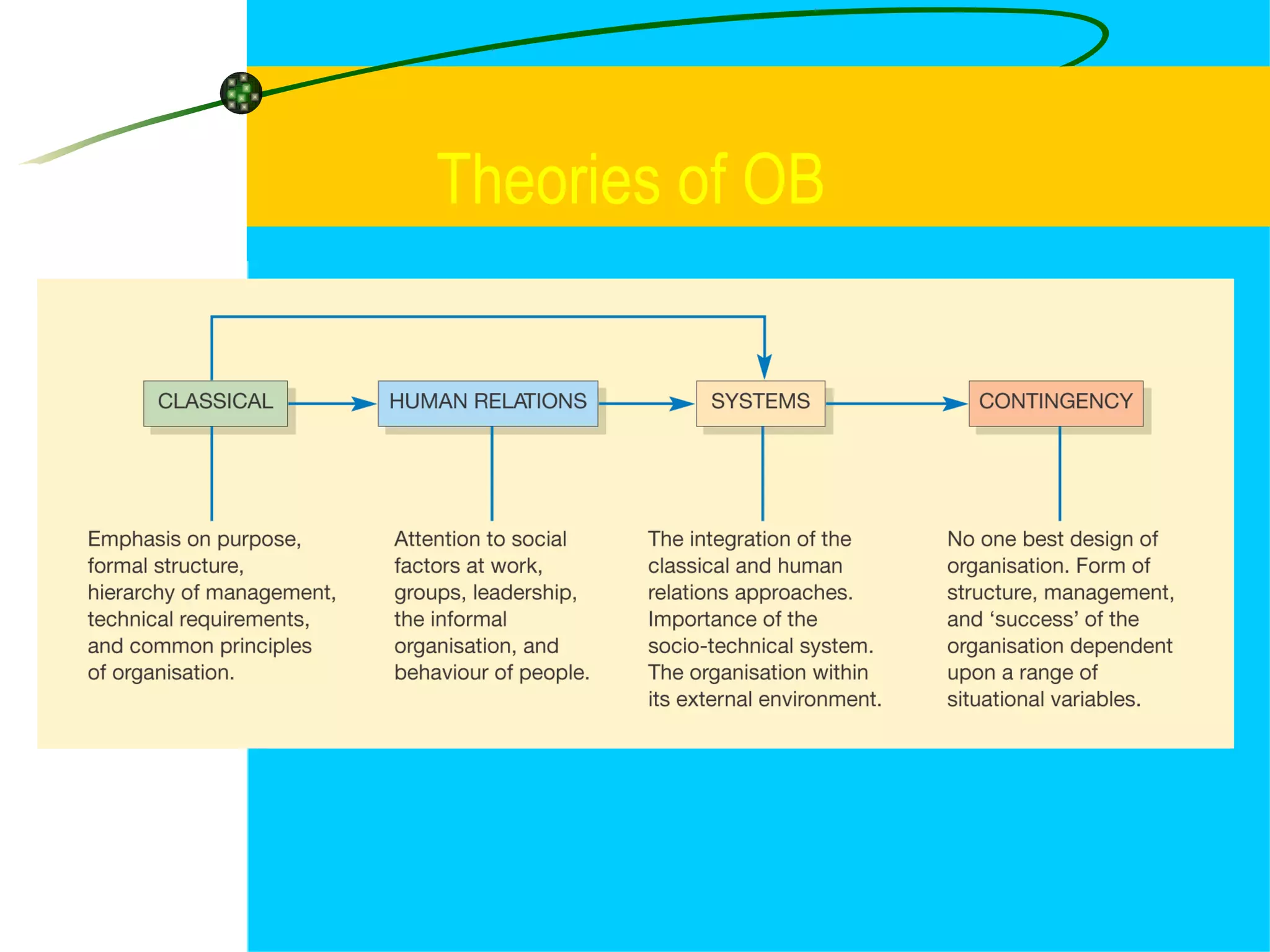
Theories of OB -Need for supervisors ( Shop Floor - Gang boss, Speed    boss, Inspector and Repair boss /  Planning Room  -    Route clerk, Time & Cost Clerk, Instruction Card    Clerk, Disciplinarian)
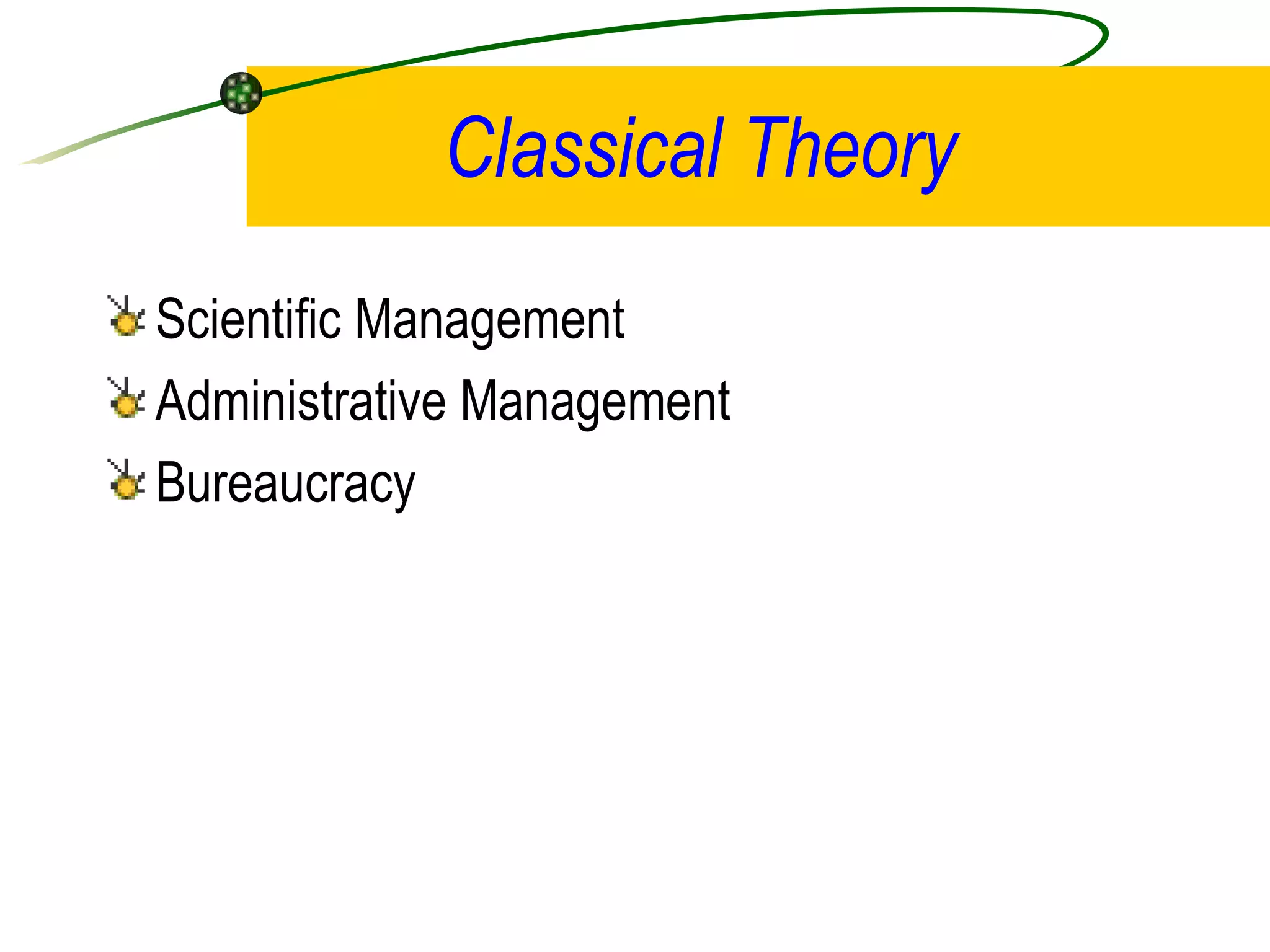
Classical Theory Scientific Management Administrative Management Bureaucracy
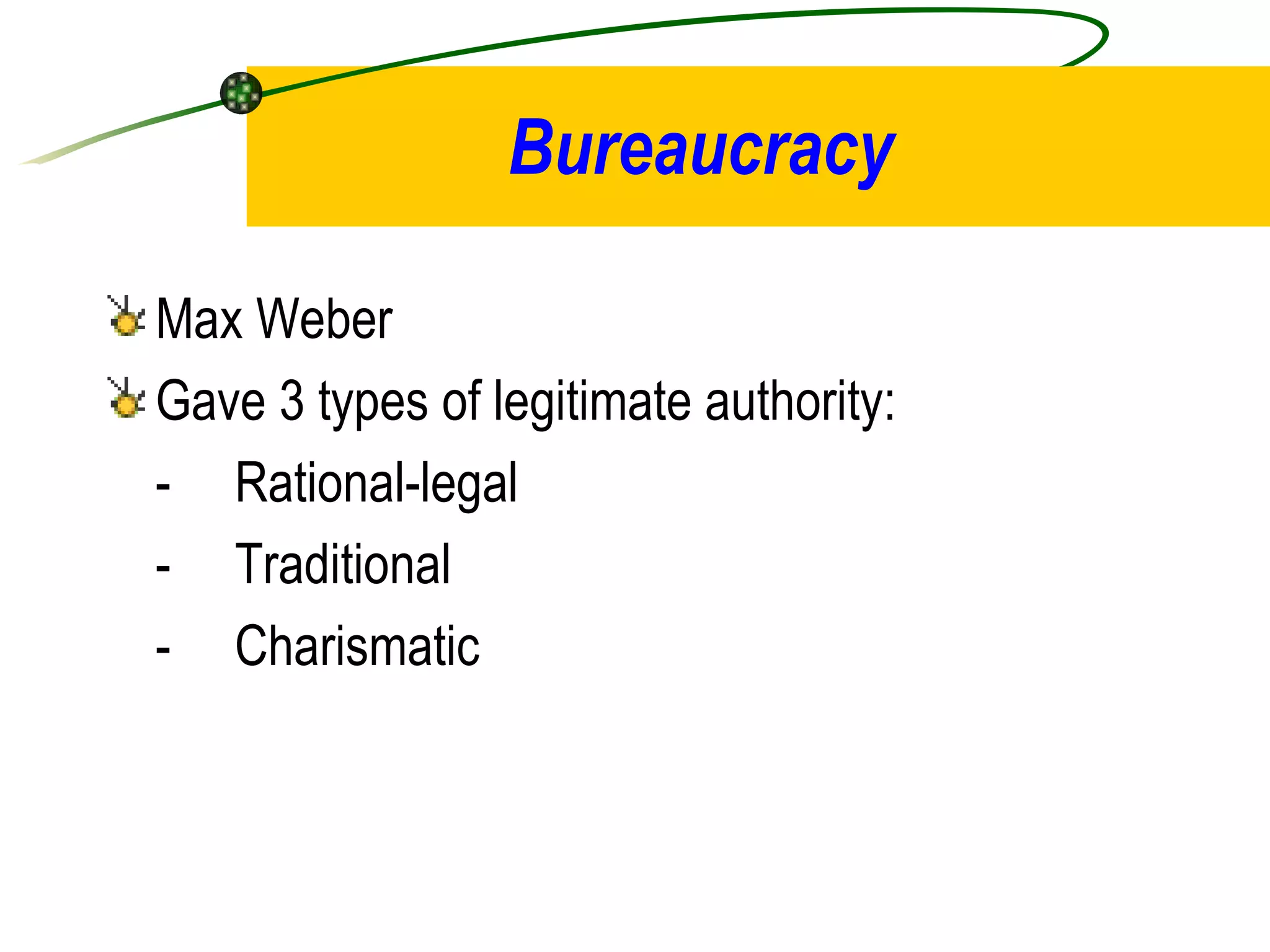
Bureaucracy Max Weber Gave 3 types of legitimate authority: - Rational-legal  - Traditional - Charismatic
Characteristics of Bureaucracy Division of work Hierarchy of Authority Rules and Regulations Impersonal conduct Staffing Technical competence Official Records
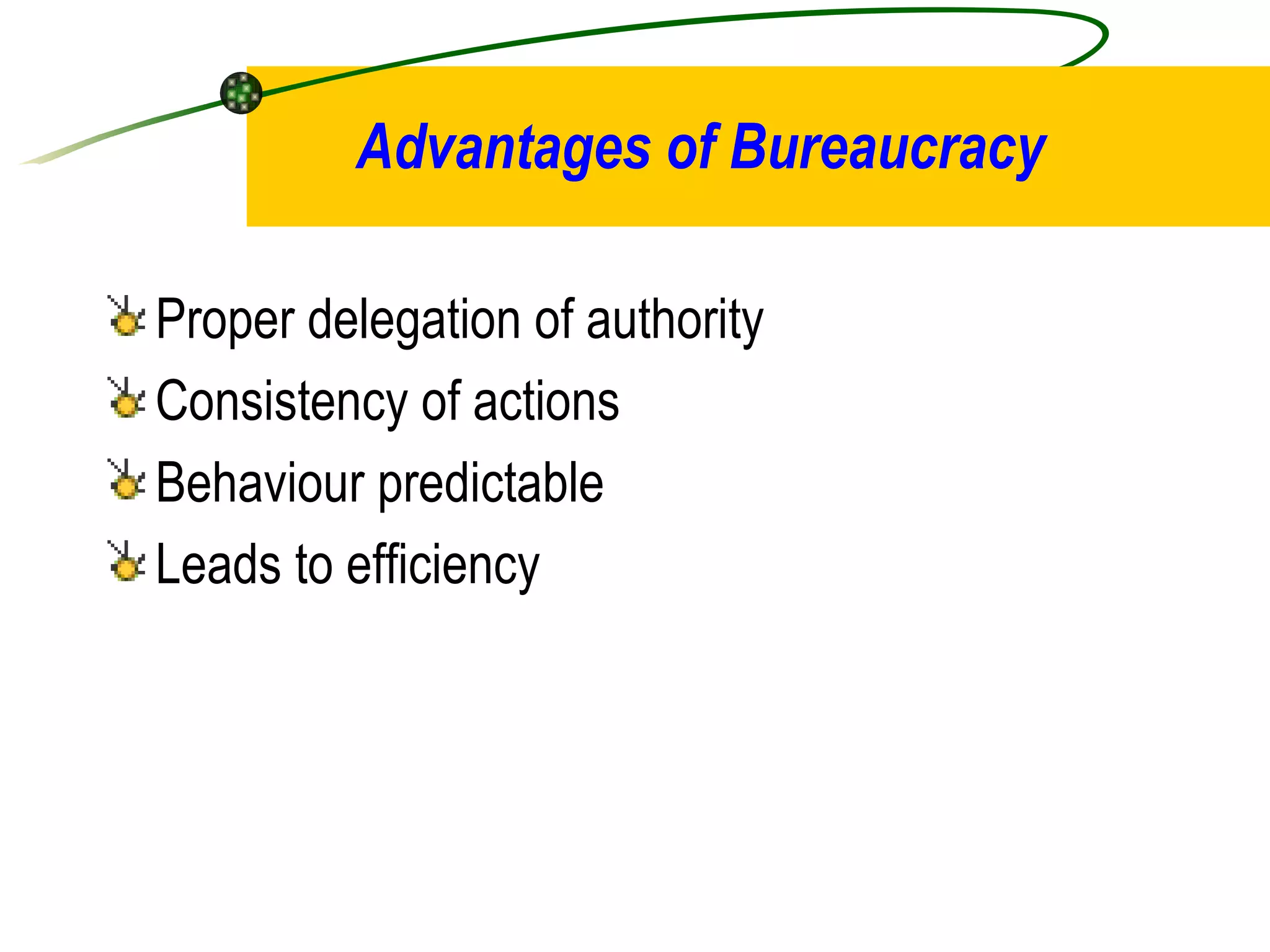
Advantages of Bureaucracy Proper delegation of authority Consistency of actions Behaviour predictable Leads to efficiency
Disadvantages of Bureaucracy No emphasis on individual goals Discourages innovation Structure is tall-communication problem No consideration for informal or inter-personal difficulties Not effective under dynamic environment
Scientific Management Frederick W. Taylor Principles of scientific management -  one best way to do each job. -  select the best individual for the position.  -  ensure that work be carried out in prescribed  fashion through training and by increasing  wages for those workers who follow current  procedures.  - equal division of work and responsibilities
Scientific  Management Mechanical - Time and Motion Studies - Differential piece rate system - Standardisation of tools, methods  and working    conditions  - Need for supervisors Shop Floor  – Inspector, Gang boss, Speed boss,   Repair boss Planning Room  – Route clerk, Time and cost clerk,    Instruction Card Clerk, Disciplinarian
Philosophical Attitudinal change on the part of management and workers - efforts for increase in production - spirit of mutual trust and confidence - developing scientific attitude towards  problems
Criticism of Scientific Management Confined mostly to production management Functional foremanship against unity of command
Administrative Management Theory Henri Fayol Father of general management 5 functions of management 14 principles of management - Division of work - Authority and Responsibility - Discipline - Espirit de corps
contd… Unity of command Unity of direction Subordination of individual to general interest Remuneration Centralization Scalar chain Order Equity Stability Initiative
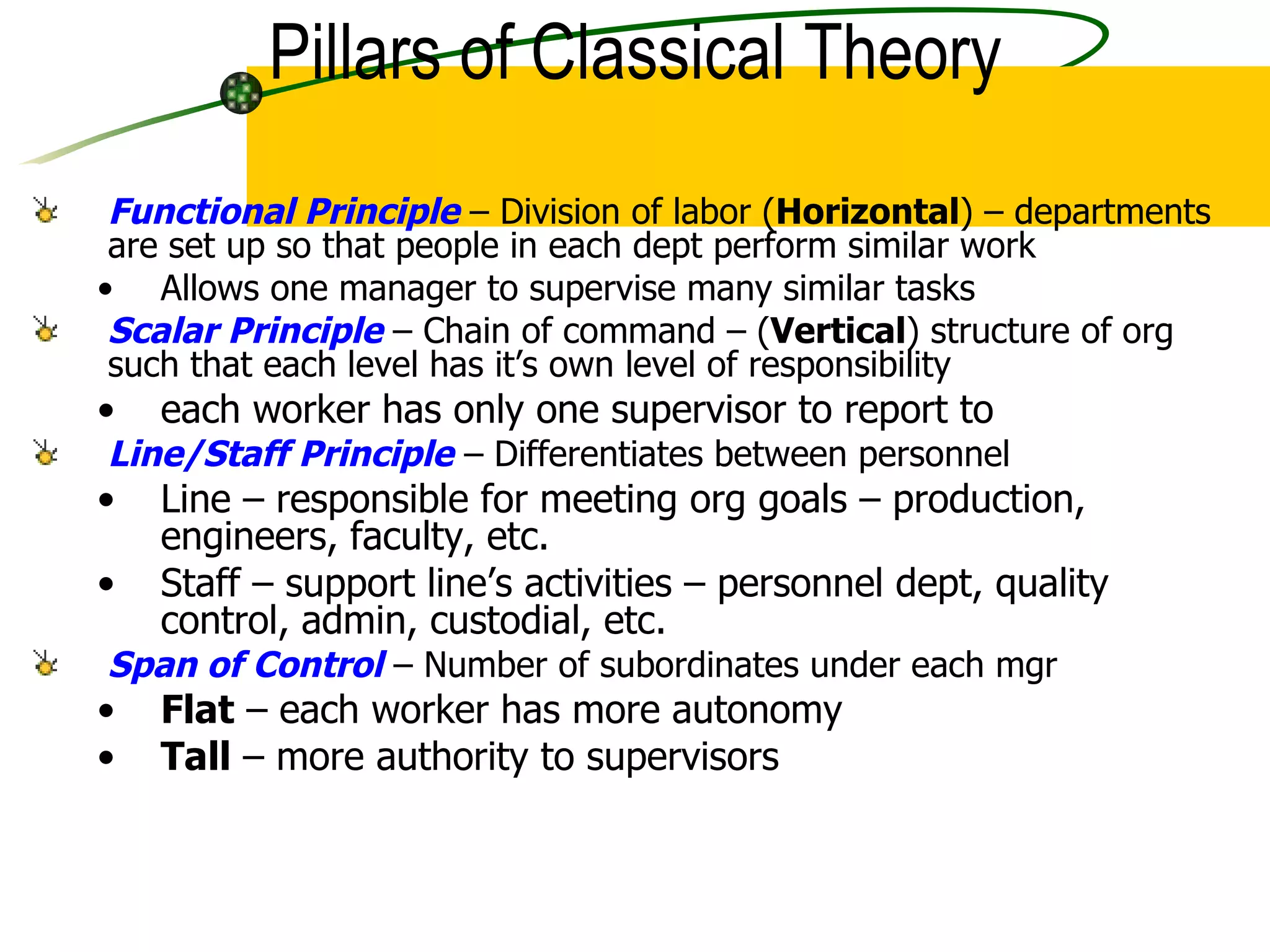
Functional Principle  – Division of labor ( Horizontal ) – departments are set up so that people in each dept perform similar work Allows one manager to supervise many similar tasks Scalar Principle  – Chain of command – ( Vertical ) structure of org such that each level has it’s own level of responsibility  each worker has only one supervisor to report to Line/Staff Principle  – Differentiates between personnel  Line – responsible for meeting org goals – production, engineers, faculty, etc. Staff – support line’s activities – personnel dept, quality control, admin, custodial, etc. Span of Control  – Number of subordinates under each mgr Flat  – each worker has more autonomy Tall  – more authority to supervisors Pillars of Classical Theory
Neo-Classical or Human Relations Approach Inspiration of Neo-classical theorists was Hawthorne studies by Elton Mayo Study to determine effect of illumination and other conditions on productivity - Illumination Experiment - Relay Assembly Room Experiment Shorter working hours, rest pauses, improved physical conditions,improved physical conditions,friendly and informal supervision
Contd… -  Bank Wiring Observation Room Experiment Group given room by themselves Records of 18 months kept prior to study were same No significant changes, observations were: Each individual restricting output Group had own unofficial standards of performance Individual output remained fairly constant
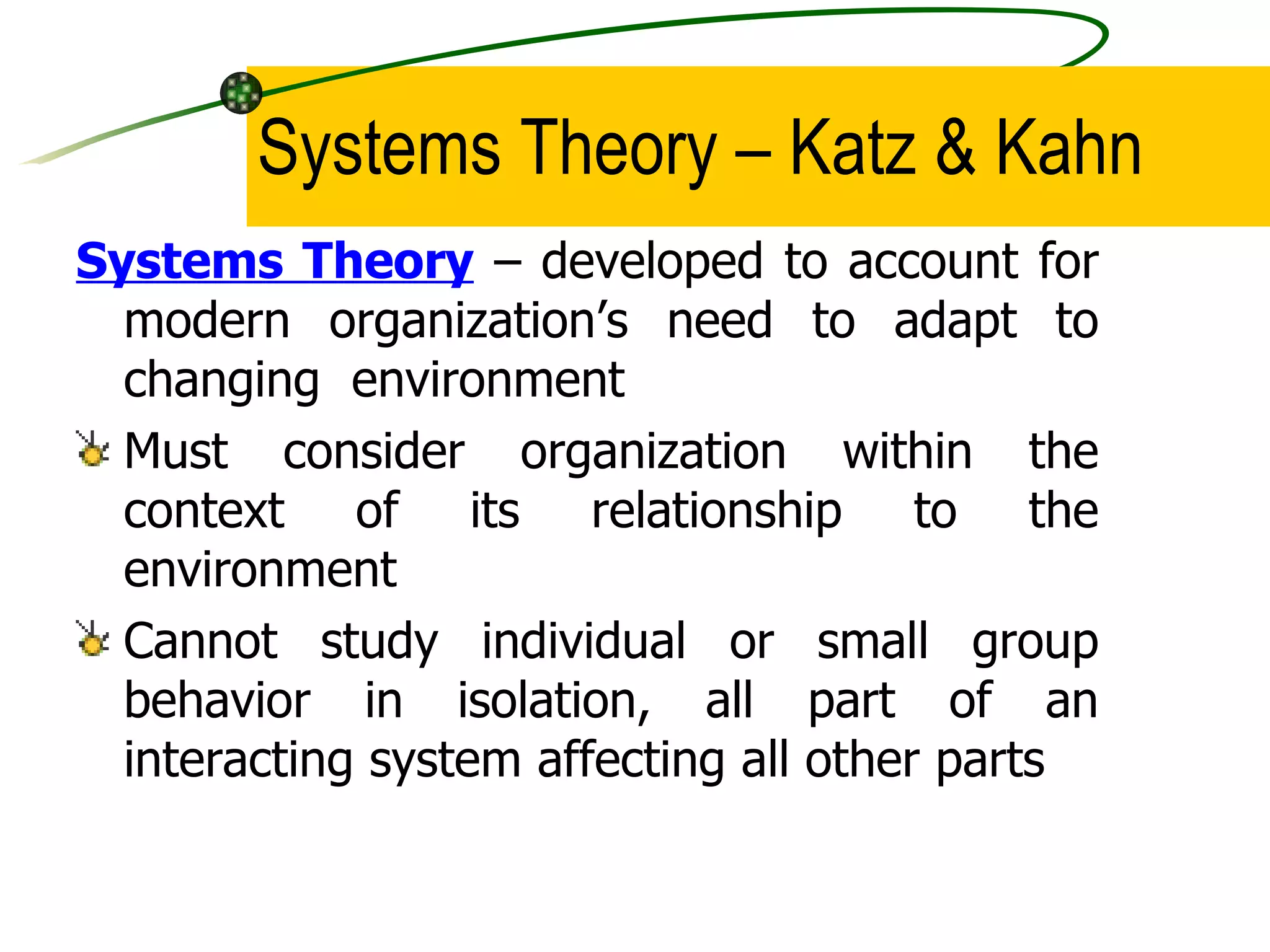
Systems Theory – Katz & Kahn Systems Theory  – developed to account for modern organization’s need to adapt to changing  environment  Must consider organization within the context of its relationship to the environment Cannot study individual or small group behavior in isolation, all part of an interacting system affecting all other parts
Systems Theory Model Input Resources Families Banks Environment Material suppliers Input Human Resources Financial Resources Physical Resources Materials Information Process Organizational Structure Admin Decision Making  Org policies, procedures Production process Org Climate Output Products/Services Satisfaction  Reputation Profit/loss Wages/Salaries Taxes Output Users Consumers Clients Government Non-consumers Feedback
Contingency  Approach Improvement over other approaches Managerial actions and organisational design appropriate to a given situation No one best approach – situation dependent Is an outgrowth of systems approach
McKinsey 7S Framework
7 S Strategy:  The direction and scope of the company over the long term. Structure:  The basic organization of the company, its departments, reporting lines, areas of expertise, and responsibility (and how they inter-relate). Systems:  Formal and informal procedures that govern everyday activity, covering everything from management information systems, through to the systems at the point of contact with the customer (retail systems, call centre systems, online systems, etc).
7 S Skills:  The capabilities and competencies that exist within the company.  Shared values:  The values and beliefs of the company. Ultimately they guide employees towards 'valued' behavior. Staff:  The company's people resources and how they are developed, trained, and motivated. Style:  The leadership approach of top management and the company's overall operating approach.

Session1 B

  • 1.
    Theories of OB-Need for supervisors ( Shop Floor - Gang boss, Speed boss, Inspector and Repair boss / Planning Room - Route clerk, Time & Cost Clerk, Instruction Card Clerk, Disciplinarian)
  • 2.
    Classical Theory ScientificManagement Administrative Management Bureaucracy
  • 3.
    Bureaucracy Max WeberGave 3 types of legitimate authority: - Rational-legal - Traditional - Charismatic
  • 4.
    Characteristics of BureaucracyDivision of work Hierarchy of Authority Rules and Regulations Impersonal conduct Staffing Technical competence Official Records
  • 5.
    Advantages of BureaucracyProper delegation of authority Consistency of actions Behaviour predictable Leads to efficiency
  • 6.
    Disadvantages of BureaucracyNo emphasis on individual goals Discourages innovation Structure is tall-communication problem No consideration for informal or inter-personal difficulties Not effective under dynamic environment
  • 7.
    Scientific Management FrederickW. Taylor Principles of scientific management - one best way to do each job. - select the best individual for the position. - ensure that work be carried out in prescribed fashion through training and by increasing wages for those workers who follow current procedures. - equal division of work and responsibilities
  • 8.
    Scientific ManagementMechanical - Time and Motion Studies - Differential piece rate system - Standardisation of tools, methods and working conditions - Need for supervisors Shop Floor – Inspector, Gang boss, Speed boss, Repair boss Planning Room – Route clerk, Time and cost clerk, Instruction Card Clerk, Disciplinarian
  • 9.
    Philosophical Attitudinal changeon the part of management and workers - efforts for increase in production - spirit of mutual trust and confidence - developing scientific attitude towards problems
  • 10.
    Criticism of ScientificManagement Confined mostly to production management Functional foremanship against unity of command
  • 11.
    Administrative Management TheoryHenri Fayol Father of general management 5 functions of management 14 principles of management - Division of work - Authority and Responsibility - Discipline - Espirit de corps
  • 12.
    contd… Unity ofcommand Unity of direction Subordination of individual to general interest Remuneration Centralization Scalar chain Order Equity Stability Initiative
  • 13.
    Functional Principle – Division of labor ( Horizontal ) – departments are set up so that people in each dept perform similar work Allows one manager to supervise many similar tasks Scalar Principle – Chain of command – ( Vertical ) structure of org such that each level has it’s own level of responsibility each worker has only one supervisor to report to Line/Staff Principle – Differentiates between personnel Line – responsible for meeting org goals – production, engineers, faculty, etc. Staff – support line’s activities – personnel dept, quality control, admin, custodial, etc. Span of Control – Number of subordinates under each mgr Flat – each worker has more autonomy Tall – more authority to supervisors Pillars of Classical Theory
  • 14.
    Neo-Classical or HumanRelations Approach Inspiration of Neo-classical theorists was Hawthorne studies by Elton Mayo Study to determine effect of illumination and other conditions on productivity - Illumination Experiment - Relay Assembly Room Experiment Shorter working hours, rest pauses, improved physical conditions,improved physical conditions,friendly and informal supervision
  • 15.
    Contd… - Bank Wiring Observation Room Experiment Group given room by themselves Records of 18 months kept prior to study were same No significant changes, observations were: Each individual restricting output Group had own unofficial standards of performance Individual output remained fairly constant
  • 16.
    Systems Theory –Katz & Kahn Systems Theory – developed to account for modern organization’s need to adapt to changing environment Must consider organization within the context of its relationship to the environment Cannot study individual or small group behavior in isolation, all part of an interacting system affecting all other parts
  • 17.
    Systems Theory ModelInput Resources Families Banks Environment Material suppliers Input Human Resources Financial Resources Physical Resources Materials Information Process Organizational Structure Admin Decision Making Org policies, procedures Production process Org Climate Output Products/Services Satisfaction Reputation Profit/loss Wages/Salaries Taxes Output Users Consumers Clients Government Non-consumers Feedback
  • 18.
    Contingency ApproachImprovement over other approaches Managerial actions and organisational design appropriate to a given situation No one best approach – situation dependent Is an outgrowth of systems approach
  • 19.
  • 20.
    7 S Strategy: The direction and scope of the company over the long term. Structure: The basic organization of the company, its departments, reporting lines, areas of expertise, and responsibility (and how they inter-relate). Systems: Formal and informal procedures that govern everyday activity, covering everything from management information systems, through to the systems at the point of contact with the customer (retail systems, call centre systems, online systems, etc).
  • 21.
    7 S Skills: The capabilities and competencies that exist within the company. Shared values: The values and beliefs of the company. Ultimately they guide employees towards 'valued' behavior. Staff: The company's people resources and how they are developed, trained, and motivated. Style: The leadership approach of top management and the company's overall operating approach.