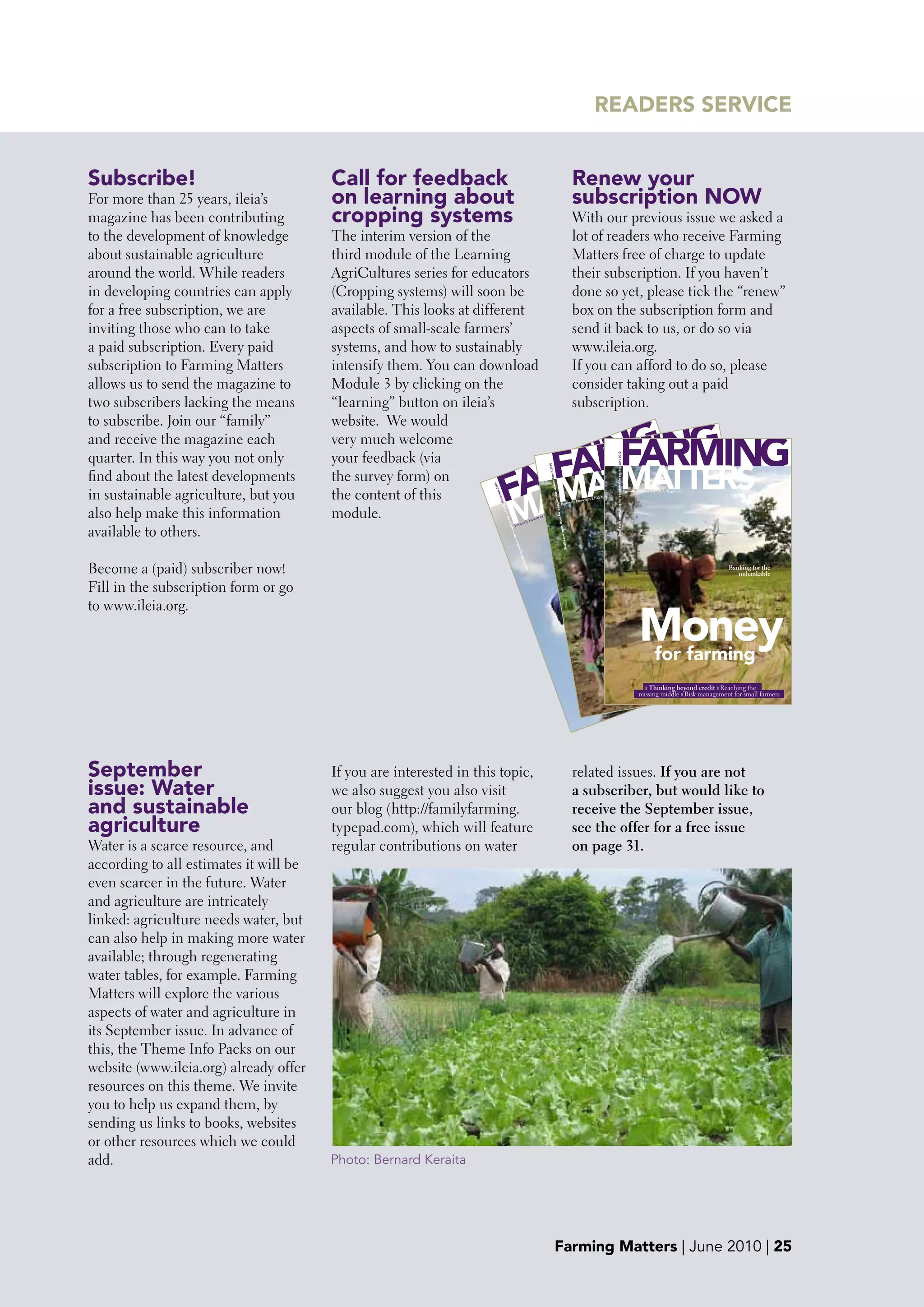
FARMING
Small-scale agriculture for a sustainable society June 2010 - 26.2


                                                MATTERS              Formerly known as LEISA Magazine


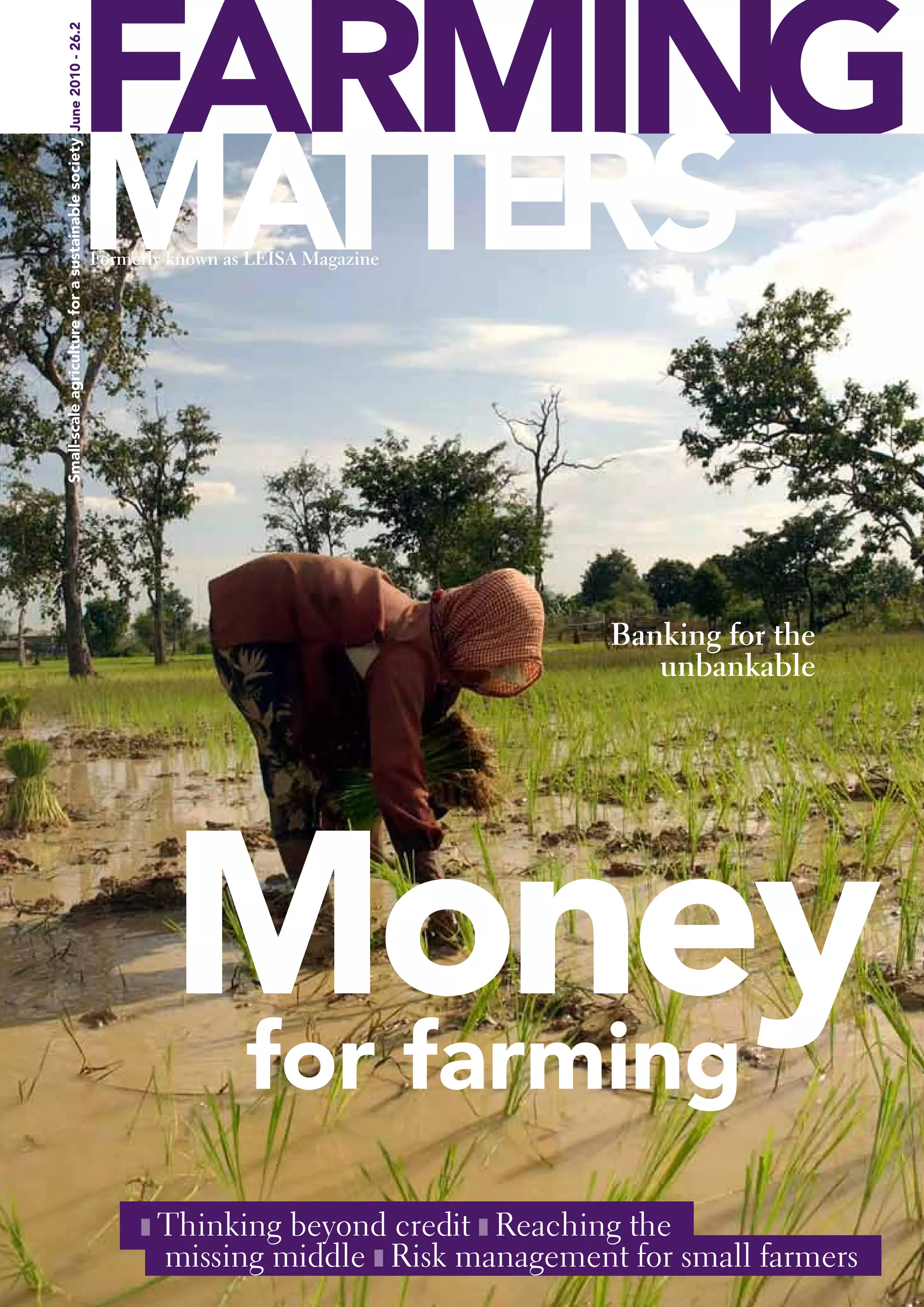
                                                                                                                 Banking for the
                                                                                                                    unbankable


                                                                             Money
                                                                             for farming
                                                                          ❚ Thinking  beyond credit ❚ ReachingMatters | March 2010 | 1
                                                                                                                  the
                                                                             missing middle ❚ Risk management for small farmers
                                                                                                          Farming
EDITORIAL


          Small farmers,
          big business

                                  T
                                                  hree hundred bright minds from business and industry,
                                                  science, governments, NGOs and farmers’ organisations,
                                                  recently met in Brussels at an international conference
                                                  called “The Art of Farming”. They explored the potential of
                                                  sustainable business models that include small-scale farmers.
                                                  Is this too good to be true? What lies behind this new interest
                                  in small farmers? And what are the potential problems and opportunities?
                                  There are two main reasons for the global agro-industry’s interest in small-
                                  scale farmers. First, there is increasing demand from consumers for fair and
                                  sustainable products. This has alerted the industry to the importance of
                                  managing reputation. A recent example is the consumer campaign that led
                                  Nestlé to decide not to use palm oil produced on plantations cleared from
                                  rainforests. Second, and more importantly, agro-industry is keenly aware
                                  of the looming dangers of climate change, which they recognise could
                                  endanger supplies of raw materials. They see the wisdom of diversifying
                                  supplies and spreading their risks. Together, these two factors are pushing
                                  the industry to explore the possibilities of doing more business with small-
                                  scale farmers. Yet this brings the complexity of having to deal with large
                                  numbers of people, who are considered to be risk averse. They realise that
                                  they cannot manage this challenge on their own and are looking to establish
                                  innovative partnerships with NGOs and farmers’ organisations who can help
                                  them explore this new territory.
                                  What might this mean for small farmers and the organisations that work
                                  with them? Is this going to be a win-win situation, as reports of some
                                  successful experiences suggest? Or will things be more complicated? Much
                                  will depend on the space these farmers get in these new partnerships. Will
                                  they be able to build on their own strategies towards risk diversification
                                  and maximising their options? Or will they be driven towards commodity
                                  production and become completely dependent on a single cash crop? While
                                  small-scale farmers need money, they also need to maintain a sustainable
                                  resource base. This is more than risk aversion: it is a very sensible strategy
                                  in a hostile environment. Many small-scale farmers are women. Yet the
                                  majority of speakers at the conference in Brussels were men. There is no
                                  easy match between the compelling financial logic of agro-industry and that
                                  of small-scale women farmers. Let us actively engage with agro-industry and
                                  farmers and try to make sense of it together.


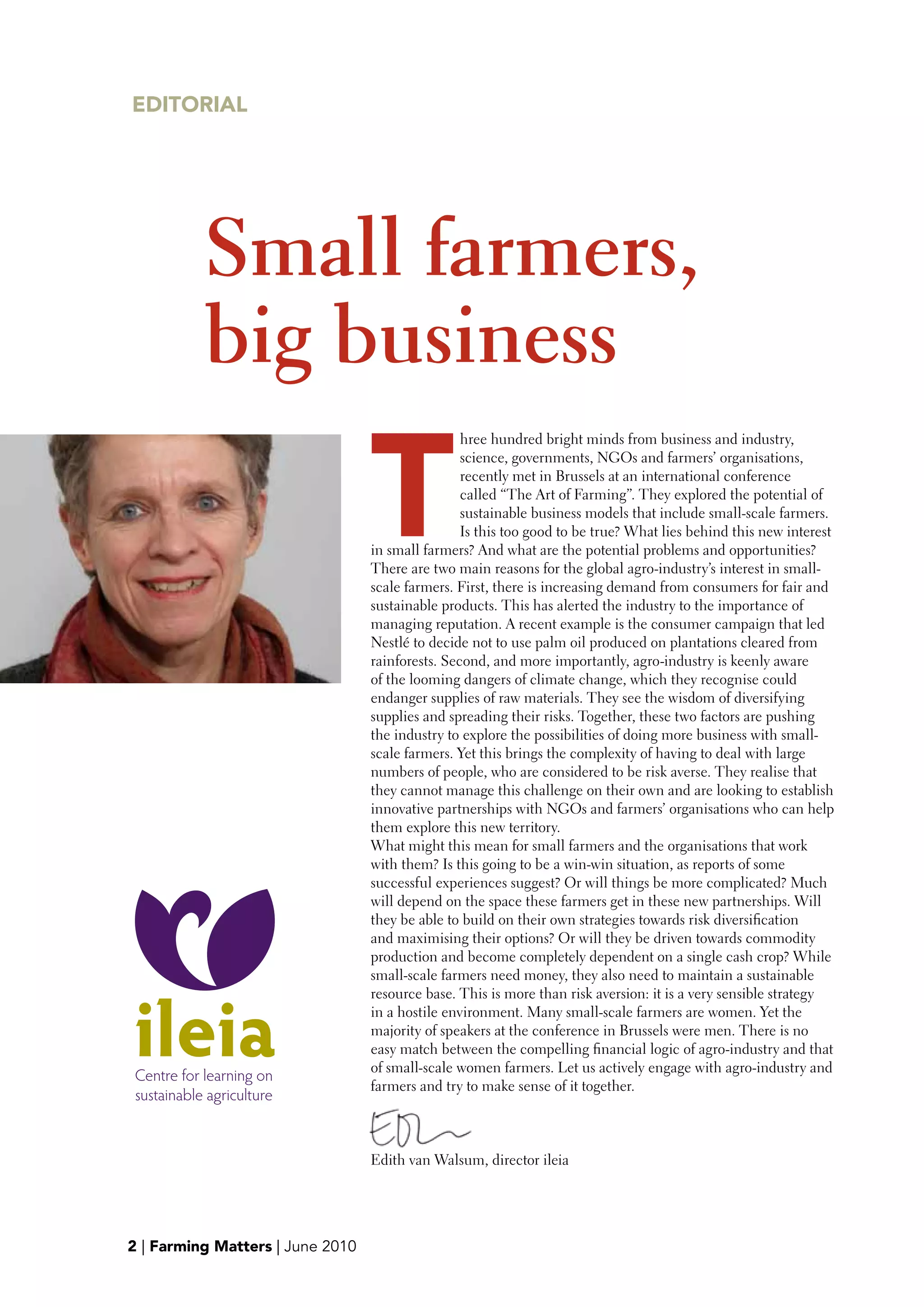
                                  Edith van Walsum, director ileia


3
2 | Farming Matters | June 2010
THE FUTURE OF FAMILY FARMING


                                                         The philosophy
                                                         of slow growth
L
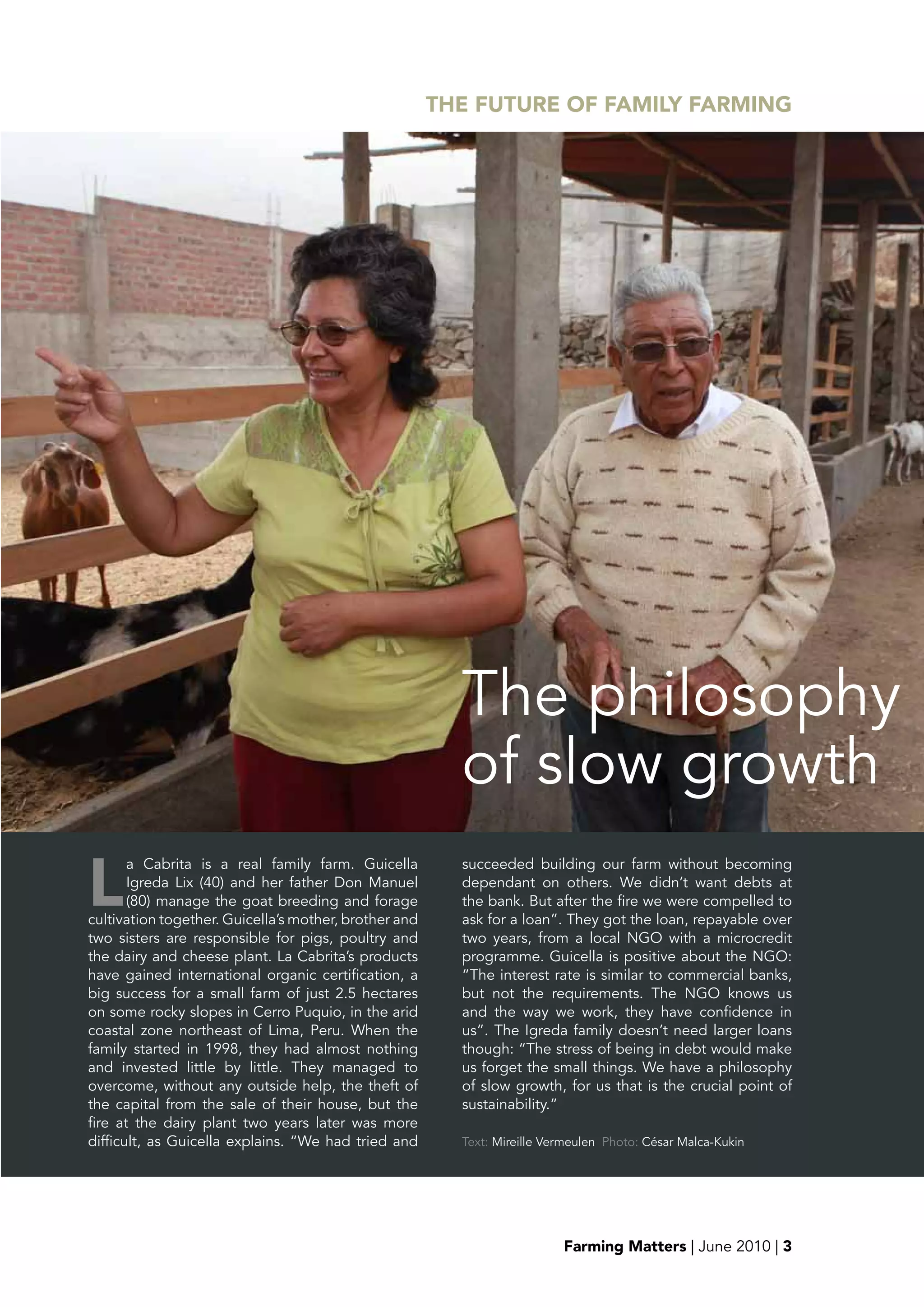
       a Cabrita is a real family farm. Guicella         succeeded building our farm without becoming
       Igreda Lix (40) and her father Don Manuel         dependant on others. We didn’t want debts at
       (80) manage the goat breeding and forage          the bank. But after the fire we were compelled to
cultivation together. Guicella’s mother, brother and     ask for a loan”. They got the loan, repayable over
two sisters are responsible for pigs, poultry and        two years, from a local NGO with a microcredit
the dairy and cheese plant. La Cabrita’s products        programme. Guicella is positive about the NGO:
have gained international organic certification, a       “The interest rate is similar to commercial banks,
big success for a small farm of just 2.5 hectares        but not the requirements. The NGO knows us
on some rocky slopes in Cerro Puquio, in the arid        and the way we work, they have confidence in
coastal zone northeast of Lima, Peru. When the           us”. The Igreda family doesn’t need larger loans
family started in 1998, they had almost nothing          though: “The stress of being in debt would make
and invested little by little. They managed to           us forget the small things. We have a philosophy
overcome, without any outside help, the theft of         of slow growth, for us that is the crucial point of
the capital from the sale of their house, but the        sustainability.”
fire at the dairy plant two years later was more
difficult, as Guicella explains. “We had tried and       Text: Mireille Vermeulen Photo: César Malca-Kukin


                                                                          Farming Matters | June 2010 | 3
CONTENTS


                    10
                                  Local resources: Great
                                  capital
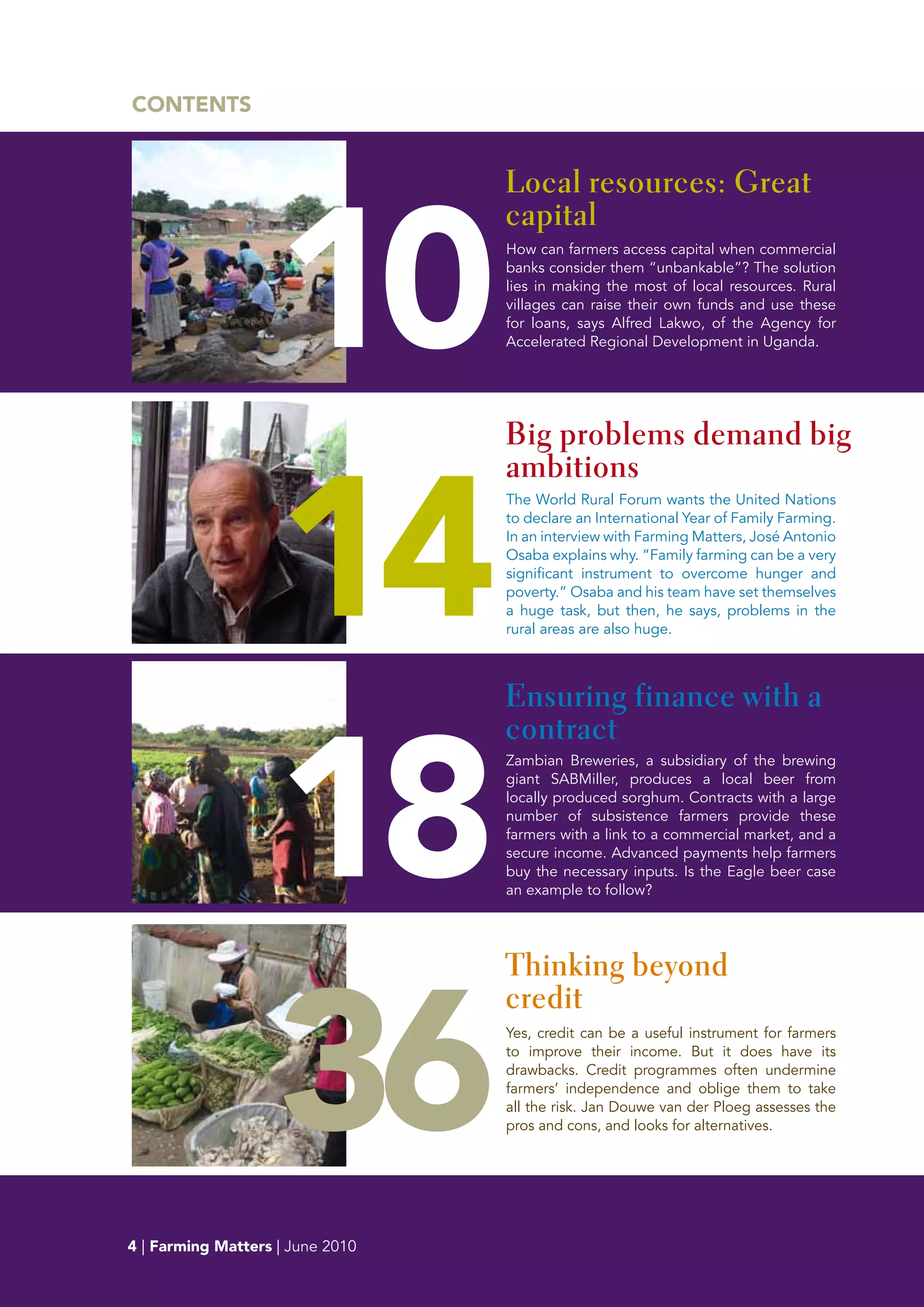
                                  How can farmers access capital when commercial
                                  banks consider them “unbankable”? The solution
                                  lies in making the most of local resources. Rural
                                  villages can raise their own funds and use these
                                  for loans, says Alfred Lakwo, of the Agency for
                                  Accelerated Regional Development in Uganda.


                                  Big problems demand big


                    14
                                  ambitions
                                  The World Rural Forum wants the United Nations
                                  to declare an International Year of Family Farming.
                                  In an interview with Farming Matters, José Antonio
                                  Osaba explains why. “Family farming can be a very
                                  significant instrument to overcome hunger and
                                  poverty.” Osaba and his team have set themselves
                                  a huge task, but then, he says, problems in the
                                  rural areas are also huge.


                                  Ensuring finance with a


                    18
                                  contract
                                  Zambian Breweries, a subsidiary of the brewing
                                  giant SABMiller, produces a local beer from
                                  locally produced sorghum. Contracts with a large
                                  number of subsistence farmers provide these
                                  farmers with a link to a commercial market, and a
                                  secure income. Advanced payments help farmers
                                  buy the necessary inputs. Is the Eagle beer case
                                  an example to follow?


                    36
                                  Thinking beyond
                                  credit
                                  Yes, credit can be a useful instrument for farmers
                                  to improve their income. But it does have its
                                  drawbacks. Credit programmes often undermine
                                  farmers’ independence and oblige them to take
                                  all the risk. Jan Douwe van der Ploeg assesses the
                                  pros and cons, and looks for alternatives.


5
4 | Farming Matters | June 2010
AND MORE

 MONEY:    2    Editorial: Small farmers, big business


bRIDGING
           3    The Future of Family Farming: The philosophy of slow
                growth


 THE GAp
           7    Our readers write
           8    Theme overview: Money for farming


bETwEEN
           21 Opinion: Land grabs and food aid do not help African
                farmers, says Rachel Zedeck


  SUppLY
           22 Making farmers bankable. A new approach to upscaling
                agricultural finance for the missing middle
           25 Readers’ service


    AND    26 Two views: Should farmers get paid for
                providing ecosystem services?


DEMAND     28 Trade finance. Money when it is needed
           32 Mind! New in print / Reading up on agricultural and rural
                finance
           34 Inspired by ... How reading a manual on documenting
                experiences led to a new lobbying tool
           35 Learning about ... Rural finance
           40 Locally rooted: Ideas and initiatives from the field
           42 Call for contributions
           43 Opinion: If biodiversity is so important, then why is there
                so much poverty in regions rich in biodiversity?
           44 How farmers can deal with disaster. Micro-insurance as a
                step towards financial inclusion
           46 Globally connected: What’s going on in the world with
                GMOs? Our partners report


           FARMING MATTERS informs readers about sustainable, small-scale farming.
           It offers discussions, background to the news, opinions, research findings,
           and practical examples of how sustainable, small-scale farming contributes to


     8
           providing food security, social justice, a healthy environment and development.
           Farming Matters is for policy makers, researchers, practitioners, educators,
           farmers, and everybody else interested in agriculture and development.
                            Farming Matters is published four times a year and has
                            subscribers in more than 150 countries. It is the global edition
                            of the worldwide AgriCultures Network, a network of eight
                            organisations, of which the other seven members publish
                            regional editions, in six languages. Together, the magazines
           This magazine
           is printed on    reach more than 50,000 subscribers. For more information, see
           recycled paper   www.agriculturesnetwork.org.


                                                 Farming Matters | June 2010 | 5
Advertisements


    7
    6 | Farming Matters | June 2010
OUR READERS wRITE

                     We welcome comments, ideas and suggestions.
            Send an e-mail to ileia@ileia.org or write to P.O. Box 2067,
                                 3800 CB Amersfoort, the Netherlands.


Livestock services:                     their own shops, so you end up             overview in your livestock issue. I
                                        spending the same amount as if you         raise 350 laying chickens. I practise
free or fee? (1)                        had gone to a private practitioner.        mixed farming whereby I grow
If livestock output is to be            I think the best way to go about it        bananas, maize and groundnuts.
improved, farmers should be             would be to train para-vets in every       I use poultry manure for the
provided with free or highly            locality, as some NGOs are doing.          bananas. I have four children. My
subsidised livestock services,          The para-vets should be provided           dream is to become a successful
especially when it comes to animal      with the most essential equipments         poultry farmer in the Kayunga
health because peasant farmers          and drugs. These people not only           district, in central Uganda. What
constitute the major producers of       get a job, they provide the services       I would like is to be linked up
food animals. And, in developing        near the people and at reasonable          with a successful poultry farmer
countries like Nigeria, they have       charges.                                   elsewhere, who can be my role
the following features: They are        Stephen Kimole, Institute for Organic      model and if possible can extend
into small-scale farming (livestock     Farming, Kenya, on our Open Forum          a helping hand in the extension of
and crop); they are low-income                                                     my poultry house project.
earners; they are concentrated in       Needed: a change in                        Richard Lubega, Uganda, through
rural and less-urban areas; they                                                   e-mail
have little or no access to modern      strategies
management techniques; they             Billions of dollars are spent
maintain their livestock mainly         every year on food aid. Yet there
                                                                                   Mistake
with forages, farm/domestic food        are still more than one billion            May I just make a minor correction
wastes and no or low external           people suffering from hunger,              to the article “Re-assessing the
inputs and no concentrates of           and children suffering from                fodder problem” in your previous
compounded rations; they rear           malnutrition. Investment in small-         issue: Stylosanthes hamata is not a
more, but with marginal outcome,        scale farming and combining                grass, it is a legume.
and they have scarce or no access to    traditional farming methods with           Oscar B. Posa, through e-mail
livestock service providers because     modern technologies adapted to
the majority of such providers          local conditions, would create             Keep it up
detest working in local/remote          possibilities for sufficient local food
communities.                            and fodder production that would           I find your magazine a very useful
Kazeem Akimboye, Department of          alleviate hunger. Offering families        source of ideas and information
Veterinary Public Health & Preventive   a small kitchen garden would               concerning my work with natural
Medicine, Nigeria, on our Open Forum    eliminate child malnutrition in the        resource management and rural
                                        shortest time. Return on investment        development within Zimbabwe
Livestock services:                     would be remarkably high. Why              and the surrounding areas. I look
                                        not change strategies in our world         forward to each new copy and
free or fee? (2)                        food programmes?                           my ambition one day is to be a
Currently this service is free in       Willem van Cotthem, Scientific             contributor. Keep up the good
Kenya but this has not helped poor      Consultant for Desertification and         work.
farmers. This is because the officers   Sustainable Development, Belgium, on       Robert Cunliffe, researcher, Zimbabwe,
sent by the government normally         our Open Forum                             through e-mail
set up their own shops where they
stock the necessary equipment and
drugs. When farmers go to them
                                        My dream
for assistance, they are told to buy    As a typical Ugandan poultry               For more letters,
the needed drugs and syringes from      farmer, I enjoyed the theme                see www.ileia.org


                                                                                  Farming Matters | June 2010 | 7
THEME OVERVIEw > MONEY FOR FARMING


benefits
        Everybody


             from financial products for small-scale farmers
Money for farming not only means access to credit, but also access to other financial
products and services. Small-scale farmers can also benefit from being able to insure
themselves against risk and being able to save. When it comes to money, there is a
gap between what small-scale farmers need and what they have access to. But this
gap can be overcome, as this issue shows.
Text: Petra Rooijakkers


T
                here is no farming without money. As        From microcredit to
                The Economist put it last May, “Few         microfinance If microcredit is not the
                farmers, big or small, are free of debt.”   obvious answer for small farmers, then what is? We
                Every farmer that wants to expand – or      asked Janiece Greene of Women’s World Banking
                even maintain – his or her business         about the role of women in finance and farming. She
                invariably needs cash. This issue could     highlighted the need for a broader look at small-
have focused solely on this problem: the need for           scale farmers’ needs: “Farmers need other financial
cash implies a need for credit, and as most small-          products besides access to credit. Being able to save
scale farmers need relatively small amounts of credit,      money, for example, can help a farm family meet
microcredit and its potential for helping farmers           with unexpected drawbacks.” According to her, the
grow would have become the point of departure.              “new frontier” in microfinance lies in providing
But microcredit is not always the solution farmers          possibilities for saving, especially in rural areas. This
are looking for, and they benefit from it less than         could be good news for women, as they often not
other sectors. Their need for credit may be relatively      only do the farming, but also the saving. “We need to
small, but it is still larger than that of the average      think less in terms of microfinance and more in terms
micro-entrepreneur. Farmers need access to credit           of financial inclusion.”
over a longer period of time as they have to wait           Financial inclusion – the delivery of banking services
until harvest time, or later, until they can pay back       at affordable costs to low income groups – means
a loan. In 2008 FARM, the Foundation for World              looking beyond credit. It also involves small-scale
Agriculture and Rural Life, held a conference on            farmers being able to insure themselves against
microcredit’s contribution to meeting the financial         climatic catastrophes. On page 44 of this issue
needs of agriculture. One of the conclusions was            Thomas Loster of the Munich Re Foundation shows
that, unlike micro-enterprises, agriculture cannot          how this kind of insurance can be made accessible to
sustain above market interest rates as the financial        small-scale farmers.
returns are not high enough. According to FARM,             Of course farmers still need credit and they have
“Microfinance has not been able to respond to more          difficulties getting it. Small-scale customers are not a
than a small fraction of the needs of agriculture           high priority for big financial institutions. In addition,
in developing countries for financial services.” In         farming is considered a risky trade, with many
India, for example, the total flow of microcredits in       uncertainties – which will only increase as the effects


                                                                                                                         >
2006-2007 was US$ 1.87 billion, of which just eight         of climate change make themselves felt. Add to this
percent went to agriculture.                                the financial crisis, which makes banks less inclined to


8 | Farming Matters | June 2010
lend money, even to businesses that are less risk prone,     Technology helps farmers Yet
and one can see that small-scale farmers have a tough        underneath all this it is undeniable that it is
time financing their operations. With climate change         expensive to provide financial services to small
threatening agricultural output, and a population            customers, in out-of-the-way areas with poor
estimated to grow by an extra 2.5 billion by 2050,           infrastructure. Technology is changing this.
even multinational food corporations are now looking         Brick and mortar structures are being replaced by
towards sustainable, small-scale farmers to ensure their     “branchless banking”, bringing financial products
supplies of raw materials. If small-scale farmers are to     and services within reach of people in the remotest
have a role in meeting the increasing demand for food,       of areas. The potential of branchless banking,
they should also be provided with the means to do so.        made possible by the mobile phone, cannot be
                                                             underestimated.
The less obvious solutions It is said                        Similarly, technology also plays a role in insurance.
that it is difficult for farmers to get credit because       For example the network of Safaricom, East Africa’s
farming is considered a high risk activity, but there are    biggest mobile-network operator, is being used by
different ways of assessing risk. In “Making farmers         insurance companies to collect premiums from


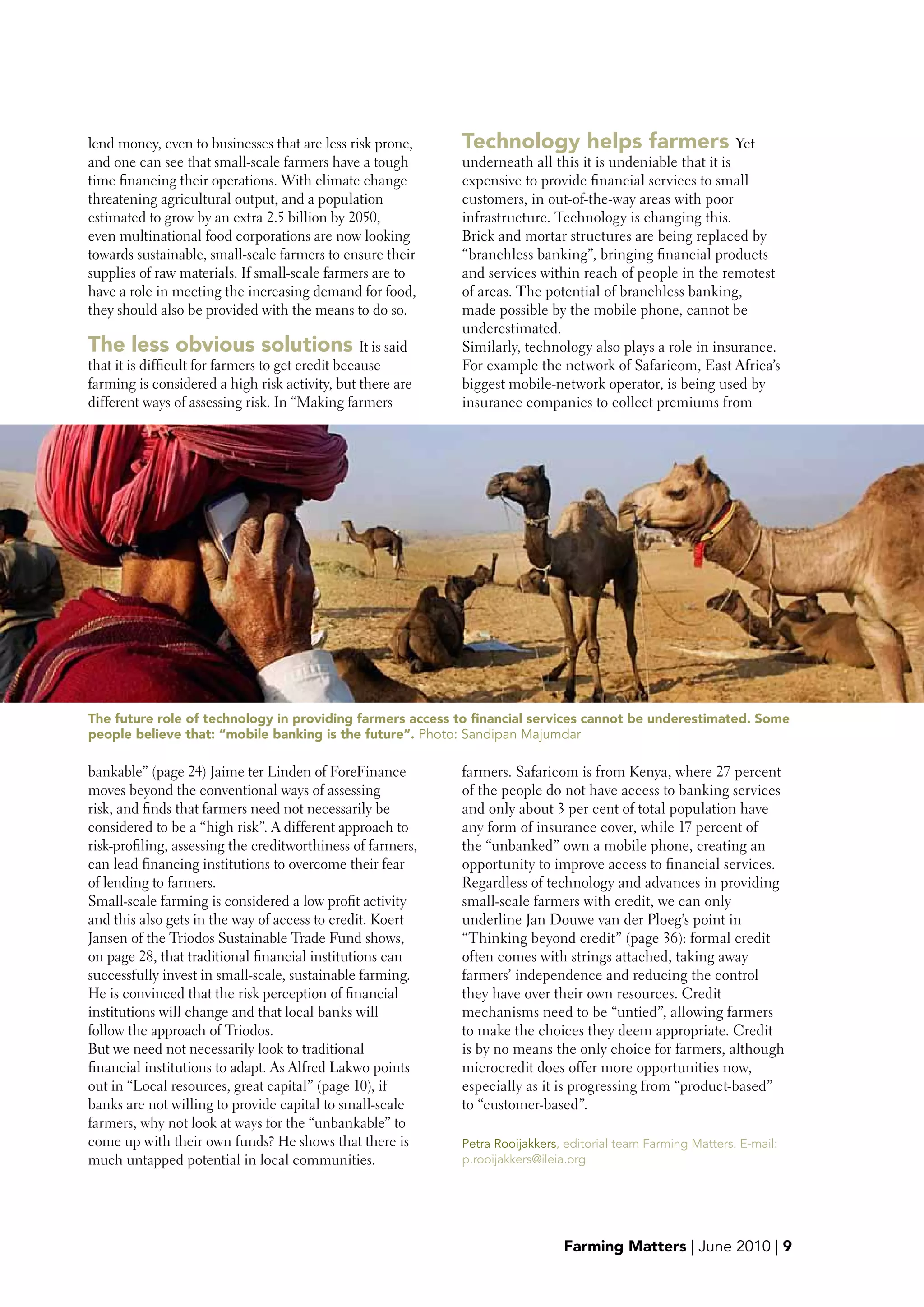
The future role of technology in providing farmers access to financial services cannot be underestimated. Some
people believe that: “mobile banking is the future”. Photo: Sandipan Majumdar

bankable” (page 24) Jaime ter Linden of ForeFinance          farmers. Safaricom is from Kenya, where 27 percent
moves beyond the conventional ways of assessing              of the people do not have access to banking services
risk, and finds that farmers need not necessarily be         and only about 3 per cent of total population have
considered to be a “high risk”. A different approach to      any form of insurance cover, while 17 percent of
risk-profiling, assessing the creditworthiness of farmers,   the “unbanked” own a mobile phone, creating an
can lead financing institutions to overcome their fear       opportunity to improve access to financial services.
of lending to farmers.                                       Regardless of technology and advances in providing
Small-scale farming is considered a low profit activity      small-scale farmers with credit, we can only
and this also gets in the way of access to credit. Koert     underline Jan Douwe van der Ploeg’s point in
Jansen of the Triodos Sustainable Trade Fund shows,          “Thinking beyond credit” (page 36): formal credit
on page 28, that traditional financial institutions can      often comes with strings attached, taking away
successfully invest in small-scale, sustainable farming.     farmers’ independence and reducing the control
He is convinced that the risk perception of financial        they have over their own resources. Credit
institutions will change and that local banks will           mechanisms need to be “untied”, allowing farmers
follow the approach of Triodos.                              to make the choices they deem appropriate. Credit
But we need not necessarily look to traditional              is by no means the only choice for farmers, although
financial institutions to adapt. As Alfred Lakwo points      microcredit does offer more opportunities now,
out in “Local resources, great capital” (page 10), if        especially as it is progressing from “product-based”
banks are not willing to provide capital to small-scale      to “customer-based”.
farmers, why not look at ways for the “unbankable” to
come up with their own funds? He shows that there is         Petra Rooijakkers, editorial team Farming Matters. E-mail:
much untapped potential in local communities.                p.rooijakkers@ileia.org


                                                                               Farming Matters | June 2010 | 9
MONEY FOR FARMING > SOURCING LOCAL CApITAL


   Great
                                   local resources:


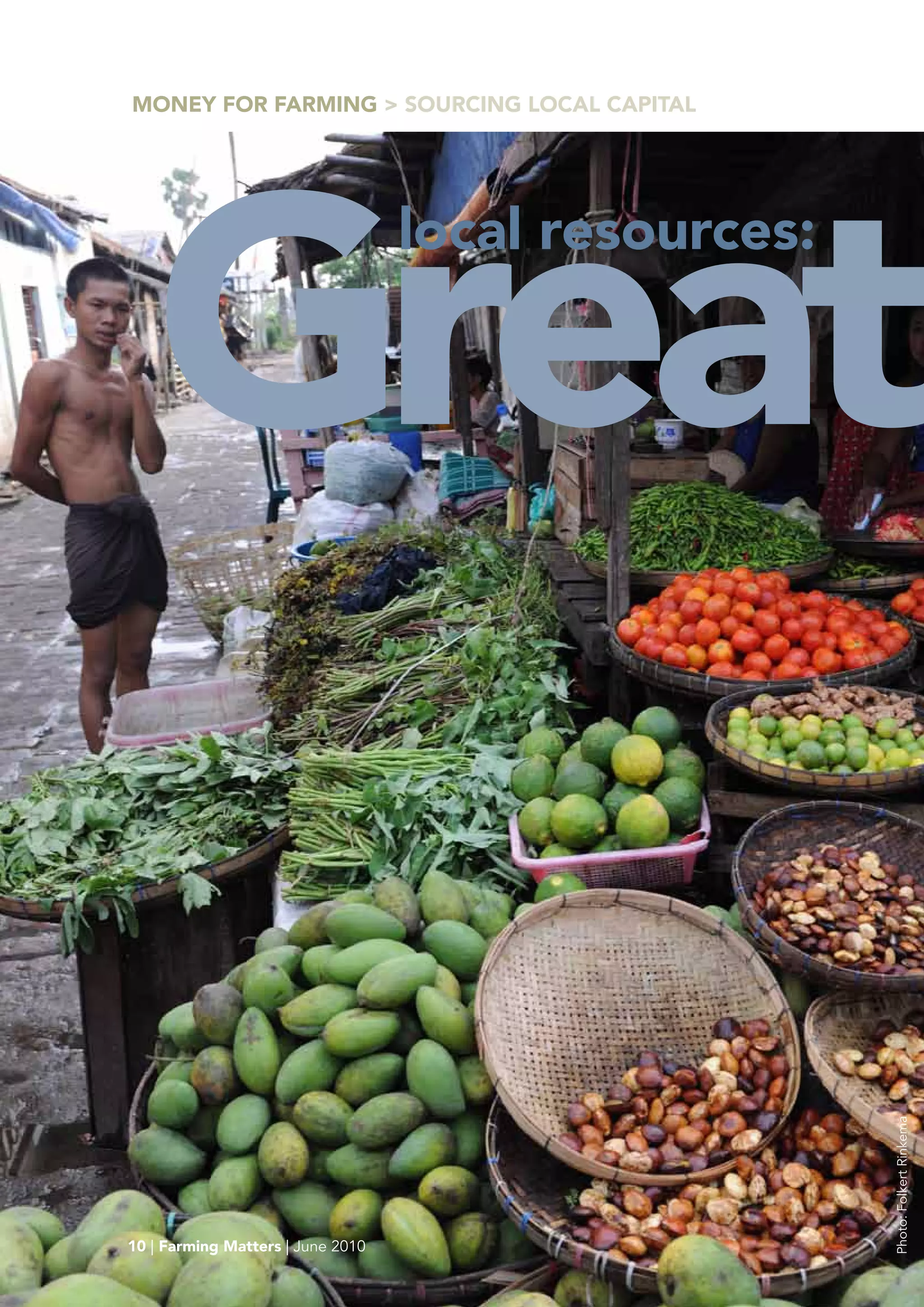
                                                      Photo: Folkert Rinkema


10 | Farming Matters | June 2010
t   capital
                                      The rural poor have no easy access to
                                      loans and grants from commercial banks
                                      or financial structures, because they lack
                                      collateral and modern business plans. But
                                      there is a lot of capital in rural areas that
                                      could be used to invest in farming. This is
                                      a case study of microfinance from Uganda.
                                      Text: Alfred Lakwo


    A
                        s in many other countries, small-        Do rural villages in isolated areas have the possibility
                        scale farmers in remote rural areas      of raising their own funds and using these funds for
                        in Uganda are hardly served by           loans? AFARD, the Agency for Accelerated Regional
                        banks or financial institutions,         Development found some positive answers to these
                        and are commonly described as            questions.
                        “unbankable”. The reasons given
    are that they are hard to reach (geographically),            Changing the financial
    that they have little or no collateral, and that they        landscape AFARD is a non-governmental
    are involved in rather risky activities. The advent of       organisation working in the West Nile Region
    microfinance has shown that lending money to small-          of Uganda, some 400 km north of the capital,
    scale entrepreneurs can have very positive results.          Kampala. Having worked for several years with local
    But most of these programmes focus on urban areas.           development projects, AFARD workers realised that
    Other alternatives, like the popular savings and credit      very few money lenders work in remote villages, and
    co-operatives (SACCOs), have equally excluded many           that rotational credit schemes involve only a small
    poor rural people as they do not have the money with         number of people. In most cases, microfinance
    which to buy shares and become part of such financial        institutions only provide “booster” instead of “start-up”
    programmes. In addition most of the government               loans, which is what poor people mostly need. And
    programmes which are specifically meant to help              because they lack collateral and business plans they
    small-scale farmers in remote areas are strongly             cannot access these loans from commercial banks.
    influenced by political and social connections – a           But farmers need capital: they need to buy seeds or
    kind of social capital that the majority lacks.              inputs, the average cost of which has been estimated
    But all villages have local resources, even if just a few.   as approximately 500,000 Ugandan shillings (circa
    Can a rural finance programme be based on them?              200 euros) per family per planting season. How to


                                                                                 Farming Matters | June 2010 | 11
close the gap between demand and supply?                     effectively, AFARD helped design a credit lending
AFARD thought of trying a collective approach for            policy. This was reviewed by all the association
all members of the community, not only those with            members and finally adopted as the internal working
established businesses. The optimal strategy had to          guidelines. These regulations covered issues such
be one that built on the existing solidarity between         as the approval of a loan, the loan period, interest
the poor (social capital) and on local possibilities         rates, repayment modes, the fines to be imposed
for raising funds – even if this would only result in a      for delayed repayment without acceptable reasons,
small loan portfolio. Such an approach would provide         loan rescheduling in cases of death or sickness of a
equitable local access and ownership of the loan funds,      household member, and the termination of access to
with all participants making an equal contribution and       loans for anyone declared a bad debtor.
receiving equal benefits.
During the first months of 2009, AFARD carried               New opportunities By the end of 2009,
out a brief study in three districts of the West Nile        AFARD was working with 46 village associations,
Region (Nebbi, Arua and Yumbe). The study focused            covering 4,271 households, all running their own
on the different strategies which the various village        Group Loan Schemes. These were circulating a total
associations already used to raise funds. Some               of 190 million shillings (about € 80,000) in the region,
farmers’ associations were raising funds by requesting       with more than 2,800 borrowers. Overall, in one
mandatory fees (membership fees, annual subscription         year of working with the groups, the total money lent
fees and monthly subscriptions), others through              reached a total of 384 million shillings.
regular sales of labour, or the sale of specific products    These loans provide a window of hope. Families
(like bricks and firewood). It was thus clear that many      are able to buy hand hoes, seeds or ingredients for
farmer associations did have ways of raising funds.          making organic pesticides, all of which are used to
These findings were shared among the groups, many            boost production. In only a few months, many families
of whom began to work out new ideas and went on to           increased the area with crops that sell well, such as
start, or further develop, their fundraising activities.     cassava. There has also been a significant change in
Naturally, there were many differences between these         the perception of farming, as Mrs. Betty, a member of


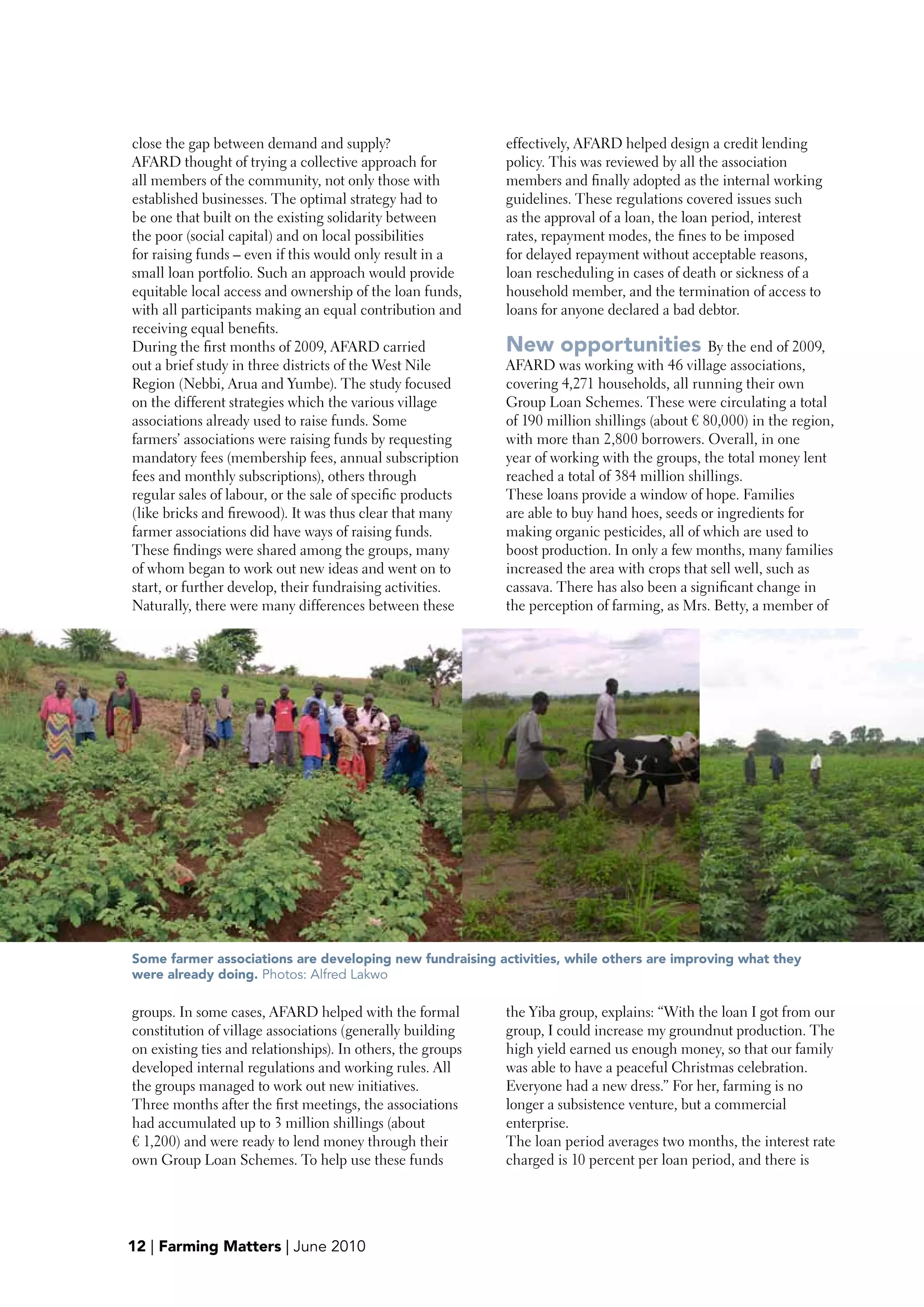
Some farmer associations are developing new fundraising activities, while others are improving what they
were already doing. Photos: Alfred Lakwo

groups. In some cases, AFARD helped with the formal          the Yiba group, explains: “With the loan I got from our
constitution of village associations (generally building     group, I could increase my groundnut production. The
on existing ties and relationships). In others, the groups   high yield earned us enough money, so that our family
developed internal regulations and working rules. All        was able to have a peaceful Christmas celebration.
the groups managed to work out new initiatives.              Everyone had a new dress.” For her, farming is no
Three months after the first meetings, the associations      longer a subsistence venture, but a commercial
had accumulated up to 3 million shillings (about             enterprise.
€ 1,200) and were ready to lend money through their          The loan period averages two months, the interest rate
own Group Loan Schemes. To help use these funds              charged is 10 percent per loan period, and there is


12 | Farming Matters | June 2010
a very high repayment rate (97 percent). While            to improve their farming practices and livelihoods.
this interest rate is high, compared to the rates         It enables poor farmers to set up small businesses
charged by formal microfinance institutions,              (of a size their local markets can handle) from which
members of the 46 groups insist that it is necessary      they can increase their incomes and even accumulate
in order to increase their loan portfolio. They also      assets (bicycles, cows or a radio). Access to credit has
continue with their diversified resource mobilisation     changed the way smallholder farmers see agriculture
strategies, such as membership fees. Likewise, many       and the strategies they follow – they are able to select
groups are now collectively investing in profitable       better varieties, plant early, and stick to sustainable
crops like Irish potatoes, and are cultivating larger     practices. While the results need to be measured
areas and aiming at local markets. Some have also         more clearly, there seems to be a preference for
taken on value-addition activities by processing maize    organic pesticides, better soil management and
into flour and de-husking rice for sale.                  conserving local biodiversity.
                                                          All this shows the huge and untapped (and often
Reaching “the unbankable”                                 ignored) potential that there is for small-scale
Tapping into local resources and providing loans with     farmers to raise funds locally. This is true
the funds is also having other knock-on results. Both     microfinancing from below: an effective alternative
men and women are now involved in new businesses.         to approaches that are based on the idea that poor
This is different to how it was before, when women        people know nothing about money or how to manage
mostly grew food crops and men “robbed” whatever          it. Well used, this approach can help build attitudes
extra money women raised themselves. Such a change        of self-reliance and develop sustainable farming
has been enabled by an increasing blurring of the         practices.
distinction between food and cash crops. Women
have entered the market economy, and now sell food        Alfred Lakwo is Programme Director at the Agency for
crops and keep their earnings. Household access to        Accelerated Regional Development (AFARD). E-mail:
                                                          alfred.lakwo@gmail.com, www.afard.net
credit has enhanced joint farm planning. Women
prefer to grow marketable crops that they can sell and
repay the loan. Women keep the rest of the money
they earn to meet home needs and to further improve
their farming activities.
Seeing that farming can be a profitable business
also makes many youngsters feel less attracted to the
cities. At the moment, youths constitute on average       Steps to establishing a
14 percent of the membership of all groups supported
by AFARD. Aware of unemployment and hardships             Group Loan Scheme
in urban areas, many youths have taken up farming
as a productive venture from which they can generate      Start by establishing a large group (more than 50
incomes, improve their livelihoods and gain social        members); focus on building leadership and on
status; something they had lacked for decades.            team work – but above all involve all members in
Access to credit and organisational strengthening         all the planning work.
of youth groups have played an important role in
realising this.                                           Consider what measures for mobilising resources
Another important aspect of the approach is the           are feasible and acceptable to the community.
“democratisation” of credit. All farmers who belong
to a group automatically qualify for a loan, given that   Ensure that all group members approve the use
all of them have made equal contributions to the loan     of the funds generated for loans, regardless of
fund. They all pay the same amount of membership          the size of these funds. Their use should coincide
and subscription fees and provide the same farm           with the process of setting up a transparent and
labour (except in the case of bad debtors, those who      fraud-free guideline and the establishment of a
twice fail to repay a loan without acceptable reasons).   loan committee that ensures compliance with the
And many associations are using part of their profits     guidelines.
(up to 7 percent) to support people living with AIDS
and orphans.                                              Make sure that regular supervision takes place,
                                                          ensuring that guidelines are followed, that accurate
A bottom up approach There is little                      and timely reports are provided to members, that
doubt that having money to invest plays a critical key    bad debtors are excluded, that all records are kept
in reducing poverty. Poor farmers need cash in order      and are accessible to members.


                                                                          Farming Matters | June 2010 | 13
INTERVIEw > JOSE ANTONIO OSAbA


             Our
ambition
matches the size
of the problem
The World Rural Forum is behind the campaign to
get the United Nations to declare an International
Year of Family Farming. This campaign is now
supported by more than 300 civil society
organisations from all over the world, and by the
Ministries of Agriculture in Pakistan, Switzerland,
Peru, El Salvador and Belize. Jose Antonio Osaba
is the co-ordinator of this campaign.
Interview: Jorge Charez-Tafur


15
14 | Farming Matters | June 2010
J
            osé Antonio Osaba was born in Cuba,          At the moment we are celebrating the year
            and has worked with several development      of biodiversity. Does declaring such a year
            organisations there, in France and in        really make a difference?
            Spain. For the last eight years he has       This is a key question. We feel that if the year is
            been working with the World Rural            declared from above, its impact won’t be so
            Forum, a non-profit organisation which       meaningful, or won’t go beyond some articles and
aims at building stronger linkages between all those     some references. But we are working with 300
working in rural areas.                                  organisations in 56 countries, and that makes a big
                                                         difference; so many rural organisations are getting
why start a campaign for an International                mobilised that the campaign now has a real social
Year of Family Farming?                                  dimension. And we aim at more than just having
If we look at the world’s agricultural sector, and       a year declared. Right now we are pushing for the
at the environment, we see two major options:            declaration of the year. Once that happens it will give
industrial agriculture, which nowadays employs           us the opportunity to discuss, to exchange opinions,
20 million people, or family farming, which if           and to organise dialogues and debates. That’s when
properly supported can support hundreds of               we’ll really be busy; one year will provide many
millions of women and men farmers. We believe            opportunities. Let us first get the year, and then we
that family farming, which is rooted in the strong       will try to push governments to implement better
links between a piece of land and the family that        policies. That’s where we will be very active, and that’s
owns and works it, can feed the world in a sus-          what’s going to make the difference.
tainable and ecological manner, and that it can be
a very significant instrument to overcome hunger         So at the end of the day you expect
and poverty. But most countries give less than seven     governments to implement better policies,
percent of their national budget to agriculture,         or policies that will better support small-
even those where up to 70 percent of the population      scale farmers. Is this needed everywhere? Is
lives in the rural areas. As a result, millions of       there an example to follow?
women and men smallholders are practically               Well, the situation is certainly not the same every-
abandoned. So one of the main aims of this               where, but as a rule, we see that very few countries
campaign is to promote national policies that will       have proper policies towards small-scale farmers
provide the necessary support and recognise that         and family farming. Even in Europe, in spite of the
rural development and agriculture are keys to            subsidies, farmers face many difficulties. But there
addressing the problems these countries face. At         are positive examples. There is the case of Malawi, a
the World Rural Forum we have been working with          very small country where policies to support farmers
regional issues, but a worldwide campaign fits our       have been introduced, and as result the country is
own identity better. As an international organisation    even exporting food. Malawi is showing the way,
we recognise that, all over the world, smallholders,     providing more attention and more resources. This
and family farming, are in trouble. We have 300          contrasts those countries which implemented the free-
organisations now supporting the campaign, which         trade policies, and which now have to import almost
shows we are on the right track.                         70 percent of the food they need. Not all countries
                                                         are doing so badly, but there are problems virtually
when do you expect that the year                         everywhere. There is a big controversy about the
will be proclaimed? which year will                      model of agriculture the world should follow and about
it be?                                                   the type of products are we getting. Should agriculture
Our aim is to try to get the declaration either at       become more and more business-oriented, or should
the end of 2010, or during 2011. This is something       it aim at feeding the world? The declaration of the
related to the way the UN and its General Assembly       year will be a great asset in this controversy. Nowadays
works, so we need to get the official support of many    there is much criticism of family farming, with people
governments. Once the UN declares the year, it will      saying that it belongs to the past. By declaring the year,
not be immediately implemented, as the UN then has       the UN will give legitimacy to family farming.
to ask a specialised agency like FAO to develop the
programme. So we think that the International Year       but we are supposed to get better policies
of Family Farming will be 2012, or perhaps 2013. We      and, as you say, there are very few
are working hard to get this approval. We have to be     examples to follow. How are we going to
confident, even though it is really a challenge. That    get there?
is why we rely on all our supporting organisations and   This is why it is important to be very active during
on their efforts.                                        the year. We are preparing a plan, based on the


                                                                         Farming Matters | June 2010 | 15
establishment of national committees. And in each          This is a serious challenge, but our starting point is
case, civil society is to push for more resources,         clear: we need food security. The first commitment
for improving roads, markets, access to irrigation         of a government should be to feed its own people. We
or inputs. We really have to look at many different        believe in national production and national markets.
aspects. The issues will not be the same in every          International markets get too much attention, while
country, although there are some issues which are          we think that national or regional markets should be
especially important and which all committees will         encouraged as a way of supporting rural areas and
consider. One of these issues is land. We have to get      tackling issues such as hunger and poverty.
clear laws respecting the right of farmers to own land.
Another issue is getting equal rights for men and          with so many platforms, or networks trying
women. These are two of the main aspects on which          to support family farmers, don’t you think
we will focus. We know it is going to be difficult         that there is some sort of duplication of
and we don’t pretend that we are going to solve all        efforts, or that you can be less efficient?


“Huge international conferences are fine, but our strategy is different.” Photo: WRF


problems forever, but we can make a difference by          We would like to be seen as an umbrella, under
working with the media, strengthening the links            which everybody can have some space. We are just
between urban and rural people, or by reaching out         establishing the instrument, or the mechanism that
to consumers’ associations. There’s a lot to be done,      will allow the most important issues to be at the
but we are motivated to do it.                             top of the international agenda. Of course, working
                                                           with 300 organisations can be difficult. But we are
Talking about consumers, many efforts                      in touch with them all the time, sharing documents,
aim to link family farmers with global                     sharing experiences and receiving suggestions. And
markets, but if we listen to the IAASTD                    we have established an intermediary level for every
report, for example, we should take a                      continent. We have just had a continental meeting
completely different approach. Isn’t there                 in Asia, with all the organisations supporting the
a contradiction?                                           campaign, and are planning similar meetings in


                               “by declaring the year, the
                                UN will give legitimacy to
                                          family farming”

16 | Farming Matters | June 2010
Africa, America and Europe. Every continental              information, proposals or ideas quite easily. Still, yes,
meeting is also an opportunity to get to know each         it is ambitious, but our ambition matches the size of
other, establish new links. Many organisations have        the problem. The problems in rural areas are huge, so
got in touch with each other through the campaign,         our ambition should also be huge. Our challenge is
so it is already serving as a meeting point.               to be effective, to be able to mobilise resources and to
                                                           be heard by the international organisations we are in
I ask you this because of what we saw                      touch with. But we are proud of the results so far. The
not so long ago in Copenhagen. Having                      meeting in Asia was a big success, and now we are
so many countries and organisations                        preparing the other ones. By the end of 2010, when
represented, with their own interests and                  the four continents are ready with the continental
agendas, led to a declaration that does                    meetings, we will set up the World Consultative
not say very much. Are you not afraid of                   Committee, which will help us guide all the activities
something similar?                                         to take place during the year.


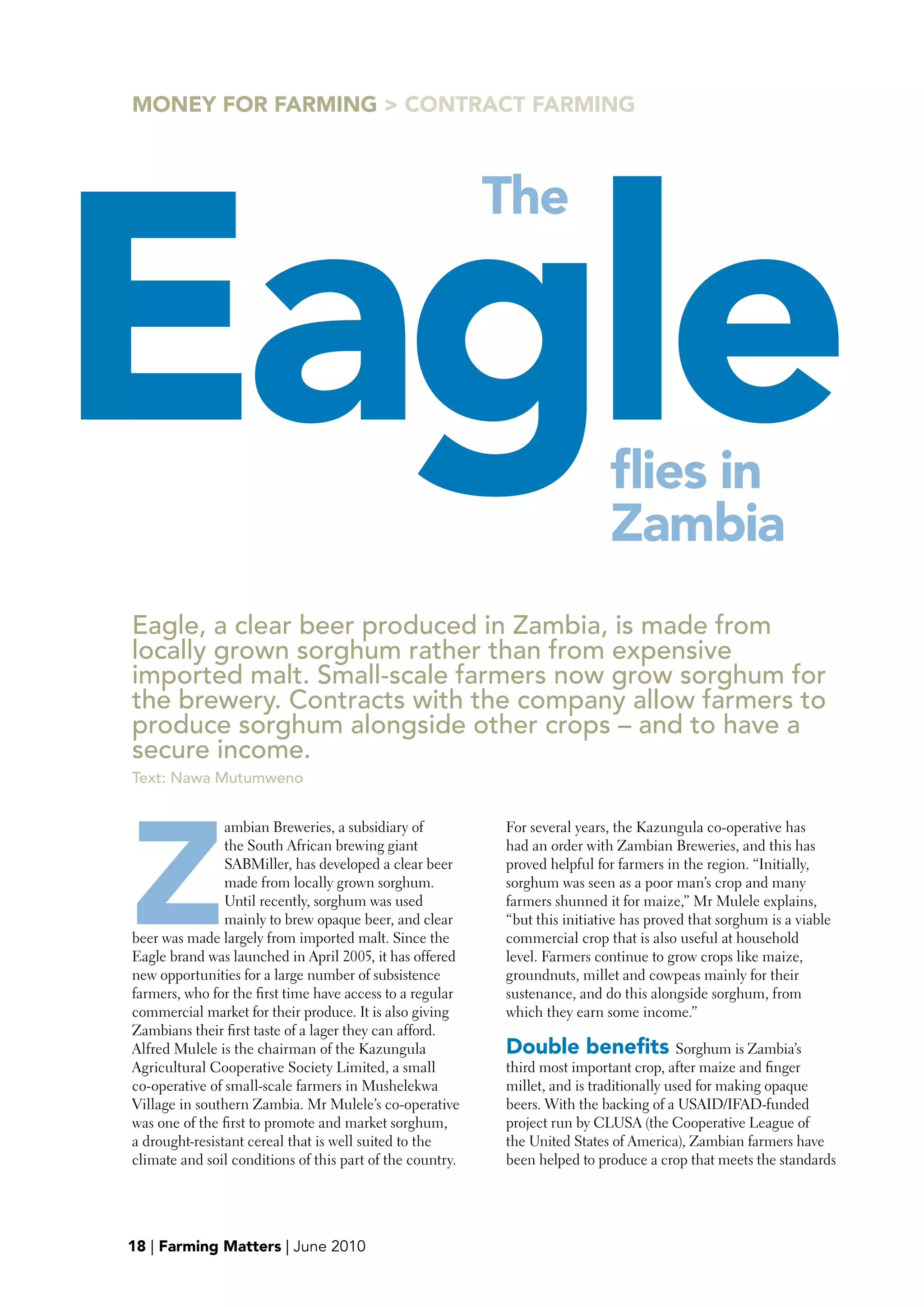
A regional meeting point: participants of the continental meeting held in Delhi. Photo: WRF


This has been seen many times. Three or four               So if the campaign is on track, and is going
days, with everybody there, all raising their issues,      on quite well, how can the readers of our
bringing their questions, but at the end you go            magazine contribute?
home with empty hands. We are not promoting a              The many good practices and experiences shared
particular event, we are promoting a full year. It is      in all issues of your magazine represent a very
not just one extraordinary meeting for one day in          significant contribution to family farming. But
Rome or Nairobi, but 365 days to promote farmers’          readers can also contribute in many ways. Their
issues, justice and better policies. Huge international    associations can join the campaign, they can also
conferences are fine, but our strategy is different.       send their articles, their experiences or their opinions
We are hoping for a full year, in which civil society      to us, and we can share them with all those involved
can work at the national level. Let us say that there      in this campaign. And once the year is proclaimed,
are 200 countries, so we have 200 opportunities,           or declared, they should join efforts with the
200 different situations. We are not talking about         organisations involved at a national level. These are
one global declaration, but rather helping national        all very ambitious efforts, so we would not just like
organisations to confront the challenges they face         people to say, “ok, go ahead”. We prefer them instead
and articulate their aspirations. These will differ        to say “ok, let us go ahead together”.
from Burkina Faso to El Salvador, from Thailand to
Canada, and Argentina to Mali. We are only co-             More information
ordinating the campaign.                                   Visit the site of the International Year of Family Farming
                                                           Campaign at www.familyfarmingcampaign.net. Readers
Is it not very ambitious?                                  are also invited to contact Jose Osaba and the World
Well, with e-mail and the Internet we can address          Rural Forum, and to share their opinions and ideas at
600 or 700 organisations in a few minutes, and share       wrfsecretary@ruralforum.net.


                                                                           Farming Matters | June 2010 | 17
MONEY FOR FARMING > CONTRACT FARMING


Eagle
                                                           The


                                                                             flies in
                                                                             Zambia
Eagle, a clear beer produced in Zambia, is made from
locally grown sorghum rather than from expensive
imported malt. Small-scale farmers now grow sorghum for
the brewery. Contracts with the company allow farmers to
produce sorghum alongside other crops – and to have a
secure income.
Text: Nawa Mutumweno


Z
                ambian Breweries, a subsidiary of          For several years, the Kazungula co-operative has
                the South African brewing giant            had an order with Zambian Breweries, and this has
                SABMiller, has developed a clear beer      proved helpful for farmers in the region. “Initially,
                made from locally grown sorghum.           sorghum was seen as a poor man’s crop and many
                Until recently, sorghum was used           farmers shunned it for maize,” Mr Mulele explains,
                mainly to brew opaque beer, and clear      “but this initiative has proved that sorghum is a viable
beer was made largely from imported malt. Since the        commercial crop that is also useful at household
Eagle brand was launched in April 2005, it has offered     level. Farmers continue to grow crops like maize,
new opportunities for a large number of subsistence        groundnuts, millet and cowpeas mainly for their
farmers, who for the first time have access to a regular   sustenance, and do this alongside sorghum, from
commercial market for their produce. It is also giving     which they earn some income.”
Zambians their first taste of a lager they can afford.
Alfred Mulele is the chairman of the Kazungula             Double benefits Sorghum is Zambia’s
Agricultural Cooperative Society Limited, a small          third most important crop, after maize and finger
co-operative of small-scale farmers in Mushelekwa          millet, and is traditionally used for making opaque
Village in southern Zambia. Mr Mulele’s co-operative       beers. With the backing of a USAID/IFAD-funded
was one of the first to promote and market sorghum,        project run by CLUSA (the Cooperative League of
a drought-resistant cereal that is well suited to the      the United States of America), Zambian farmers have
climate and soil conditions of this part of the country.   been helped to produce a crop that meets the standards


19
18 | Farming Matters | June 2010
set by the brewery. CLUSA provides farmers with loans       too: better crop yields, improved soil fertility, better
to procure inputs and implements, as well as giving         rainwater harvesting, nitrogen fixation, and fewer weed
professional and technical advice on how to meet the        problems. These benefits are not limited to sorghum:
quality standards required for beer production.             results of individual trials in Zambia have shown that
The main source of funds needed every farming               conservation farming by itself also increases maize
season come from the brewery itself, through the            yields by at least 75 percent, and those in cotton by 60
contract it has signed with the farmers. This contract      percent.
provides for a secure market and a fixed price, ensuring
a secure income. In most cases, the brewery provides        Increasing numbers The idea behind
advance payments, which are paid back after harvest.        the ambitious sorghum contract farming initiative was
This helps farmers acquire the necessary inputs (seeds,     to produce value-for-money beer for lower-income
fertilisers or pesticides), invest in their farms and       African consumers. At present, more than 4,500
also save money, without having to rely on informal         small-scale farmers in 14 districts are selling their
moneylenders. As part of the contract, farmers commit       sorghum directly to Zambian Breweries. Taking into
themselves to selling a certain quantity of sorghum         account the country’s extended family set-up, this


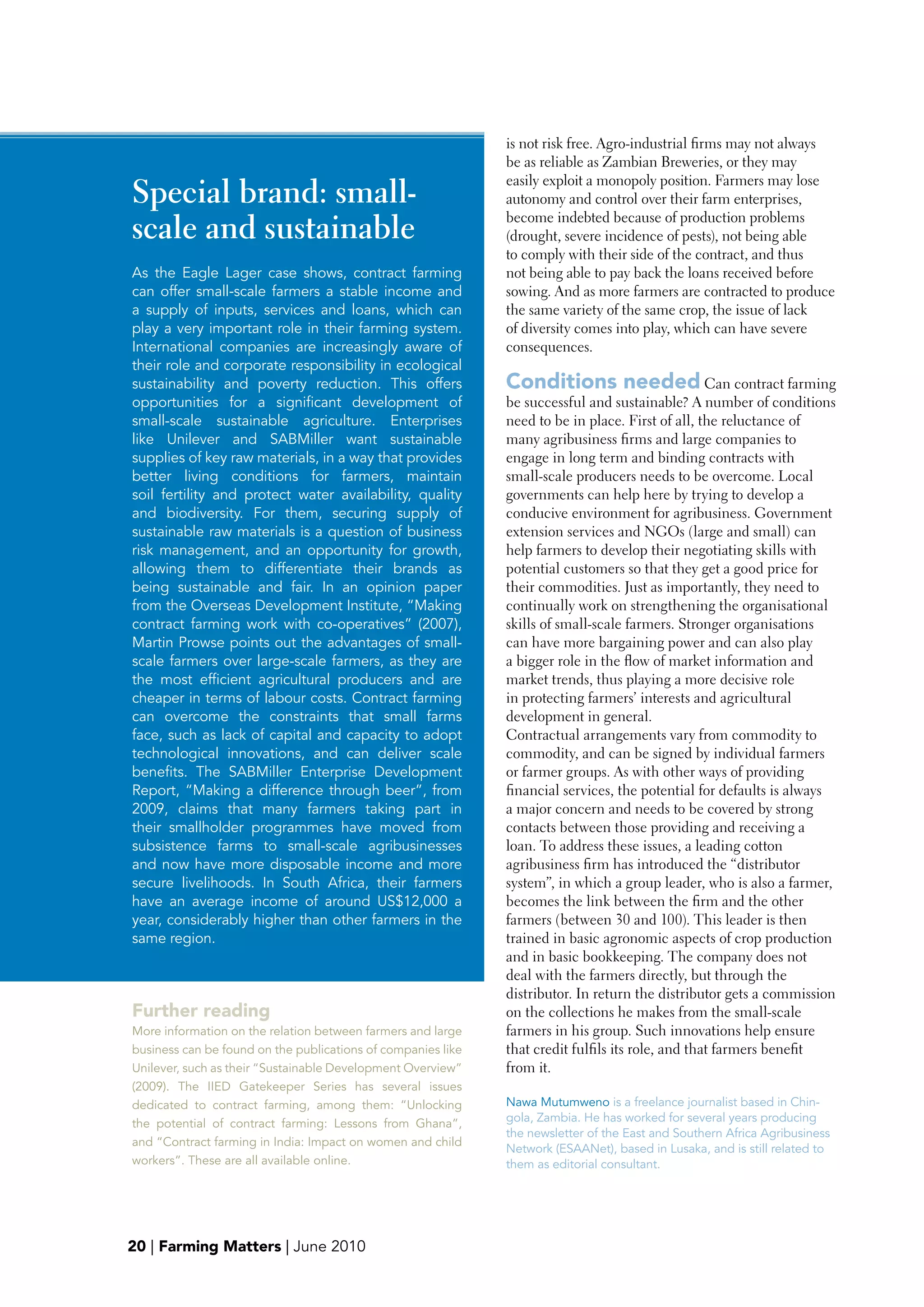
Stronger organisations have more bargaining power, helping secure a high and sustainable income.
Photo: Simon Mukwaya

to the brewery every year, and to ensuring a certain        means that at least 60,000 people benefit from this
quality.                                                    system. More than 500 hectares have been planted
The contracts have also proved to be positive in an         with top-grade sorghum, and the total yields exceed
agronomic and an ecological sense. Thanks to the            300 tonnes of grain, with a revenue of more than
standards set by the company, and to the advice that        216 million Zambian kwacha (approximately US$
they regularly provide, more and more farmers have          43,000). The Zambian government recently reduced
opted to employ conservation agriculture to produce         the excise duty on Eagle Lager from 35 to 30 percent,
sorghum. Their reasoning is simple: conservation            in order to encourage Zambian Breweries to continue
agriculture results in a more reliable output and in        engaging smallholders in this project. According to
higher yields. It is based on simple technologies,          the company, the reduction in taxes has helped them
requiring a minimum of equipment, and is easy to            to buy more sorghum from small-scale farmers (as well
implement with hand hoes or with oxen. One major            as increasing beer sales). SABMiller is encouraging
advantage of conservation farming is that when the          other farming communities to grow sorghum and sign
heavy rains start to fall, the farmers only need to plant   similar contracts, and is now trying a similar approach
the seeds, in comparison to the many tasks which            in Uganda, Zimbabwe, Tanzania and Mozambique.
conventional farmers need to carry out (combining           These figures, and the opinions of farmers like Mr
land preparation and sowing) which complicates and          Mulele, clearly show that contract farming offers many
delays the job when timing is critical. Farmers who         opportunities for small-scale farmers. This has also
adopt conservation farming experience other benefits        been seen with other crops. But the whole approach


                                                                           Farming Matters | June 2010 | 19
is not risk free. Agro-industrial firms may not always
                                                              be as reliable as Zambian Breweries, or they may
                                                              easily exploit a monopoly position. Farmers may lose
Special brand: small-                                         autonomy and control over their farm enterprises,

scale and sustainable                                         become indebted because of production problems
                                                              (drought, severe incidence of pests), not being able
                                                              to comply with their side of the contract, and thus
As the Eagle Lager case shows, contract farming               not being able to pay back the loans received before
can offer small-scale farmers a stable income and             sowing. And as more farmers are contracted to produce
a supply of inputs, services and loans, which can             the same variety of the same crop, the issue of lack
play a very important role in their farming system.           of diversity comes into play, which can have severe
International companies are increasingly aware of             consequences.
their role and corporate responsibility in ecological
sustainability and poverty reduction. This offers             Conditions needed Can contract farming
opportunities for a significant development of                be successful and sustainable? A number of conditions
small-scale sustainable agriculture. Enterprises              need to be in place. First of all, the reluctance of
like Unilever and SABMiller want sustainable                  many agribusiness firms and large companies to
supplies of key raw materials, in a way that provides         engage in long term and binding contracts with
better living conditions for farmers, maintain                small-scale producers needs to be overcome. Local
soil fertility and protect water availability, quality        governments can help here by trying to develop a
and biodiversity. For them, securing supply of                conducive environment for agribusiness. Government
sustainable raw materials is a question of business           extension services and NGOs (large and small) can
risk management, and an opportunity for growth,               help farmers to develop their negotiating skills with
allowing them to differentiate their brands as                potential customers so that they get a good price for
being sustainable and fair. In an opinion paper               their commodities. Just as importantly, they need to
from the Overseas Development Institute, “Making              continually work on strengthening the organisational
contract farming work with co-operatives” (2007),             skills of small-scale farmers. Stronger organisations
Martin Prowse points out the advantages of small-             can have more bargaining power and can also play
scale farmers over large-scale farmers, as they are           a bigger role in the flow of market information and
the most efficient agricultural producers and are             market trends, thus playing a more decisive role
cheaper in terms of labour costs. Contract farming            in protecting farmers’ interests and agricultural
can overcome the constraints that small farms                 development in general.
face, such as lack of capital and capacity to adopt           Contractual arrangements vary from commodity to
technological innovations, and can deliver scale              commodity, and can be signed by individual farmers
benefits. The SABMiller Enterprise Development                or farmer groups. As with other ways of providing
Report, “Making a difference through beer”, from              financial services, the potential for defaults is always
2009, claims that many farmers taking part in                 a major concern and needs to be covered by strong
their smallholder programmes have moved from                  contacts between those providing and receiving a
subsistence farms to small-scale agribusinesses               loan. To address these issues, a leading cotton
and now have more disposable income and more                  agribusiness firm has introduced the “distributor
secure livelihoods. In South Africa, their farmers            system”, in which a group leader, who is also a farmer,
have an average income of around US$12,000 a                  becomes the link between the firm and the other
year, considerably higher than other farmers in the           farmers (between 30 and 100). This leader is then
same region.                                                  trained in basic agronomic aspects of crop production
                                                              and in basic bookkeeping. The company does not
                                                              deal with the farmers directly, but through the
                                                              distributor. In return the distributor gets a commission
Further reading                                               on the collections he makes from the small-scale
More information on the relation between farmers and large    farmers in his group. Such innovations help ensure
business can be found on the publications of companies like   that credit fulfils its role, and that farmers benefit
Unilever, such as their “Sustainable Development Overview”    from it.
(2009). The IIED Gatekeeper Series has several issues
dedicated to contract farming, among them: “Unlocking         Nawa Mutumweno is a freelance journalist based in Chin-
the potential of contract farming: Lessons from Ghana”,       gola, Zambia. He has worked for several years producing
                                                              the newsletter of the East and Southern Africa Agribusiness
and “Contract farming in India: Impact on women and child
                                                              Network (ESAANet), based in Lusaka, and is still related to
workers”. These are all available online.                     them as editorial consultant.


20 | Farming Matters | June 2010
OpINION


M
           any countries are targets for expanding intensive
           agriculture. International agribusinesses, banking
           institutions, sovereign governments and wealthy
individuals are being attracted to buy up or lease cheap land,
where the use-rights are poorly defined. Countries ravaged by
conflict and sanctions are desperate to attract investment. Land
in these countries can often cost less than $1 per year per acre
to lease. While these investments appear to represent a win-win
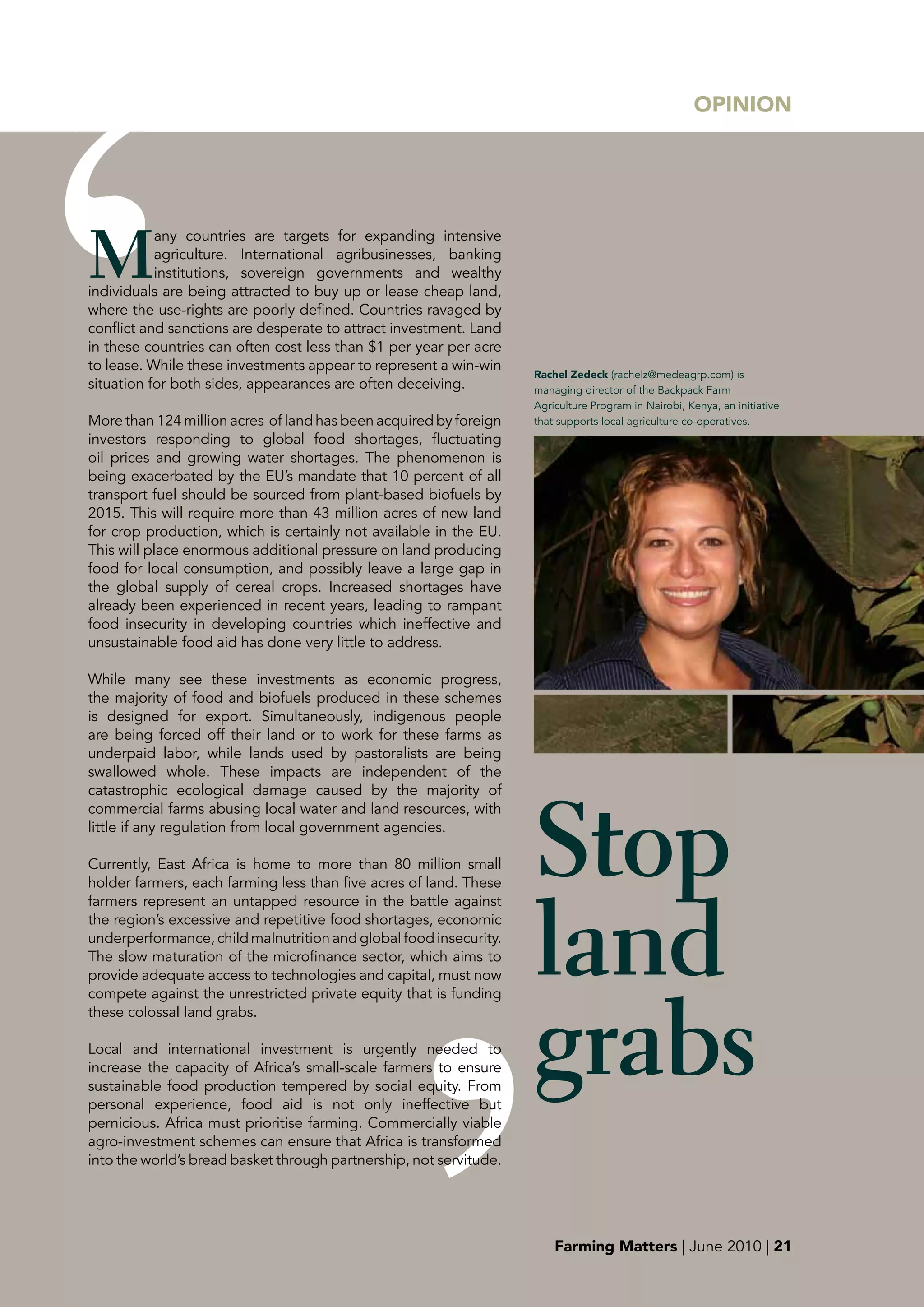
                                                                    Rachel Zedeck (rachelz@medeagrp.com) is
situation for both sides, appearances are often deceiving.          managing director of the Backpack Farm
                                                                    Agriculture Program in Nairobi, Kenya, an initiative
More than 124 million acres of land has been acquired by foreign    that supports local agriculture co-operatives.
investors responding to global food shortages, fluctuating
oil prices and growing water shortages. The phenomenon is
being exacerbated by the EU’s mandate that 10 percent of all
transport fuel should be sourced from plant-based biofuels by
2015. This will require more than 43 million acres of new land
for crop production, which is certainly not available in the EU.
This will place enormous additional pressure on land producing
food for local consumption, and possibly leave a large gap in
the global supply of cereal crops. Increased shortages have
already been experienced in recent years, leading to rampant
food insecurity in developing countries which ineffective and
unsustainable food aid has done very little to address.

While many see these investments as economic progress,
the majority of food and biofuels produced in these schemes
is designed for export. Simultaneously, indigenous people
are being forced off their land or to work for these farms as
underpaid labor, while lands used by pastoralists are being
swallowed whole. These impacts are independent of the


                                                                    Stop
catastrophic ecological damage caused by the majority of
commercial farms abusing local water and land resources, with
little if any regulation from local government agencies.

Currently, East Africa is home to more than 80 million small
holder farmers, each farming less than five acres of land. These


                                                                    land
farmers represent an untapped resource in the battle against
the region’s excessive and repetitive food shortages, economic
underperformance, child malnutrition and global food insecurity.
The slow maturation of the microfinance sector, which aims to
provide adequate access to technologies and capital, must now


                                                                    grabs
compete against the unrestricted private equity that is funding
these colossal land grabs.

Local and international investment is urgently needed to
increase the capacity of Africa’s small-scale farmers to ensure
sustainable food production tempered by social equity. From
personal experience, food aid is not only ineffective but
pernicious. Africa must prioritise farming. Commercially viable
agro-investment schemes can ensure that Africa is transformed
into the world’s bread basket through partnership, not servitude.


                                                                        Farming Matters | June 2010 | 21
MONEY FOR FARMING > RISK pROFILING


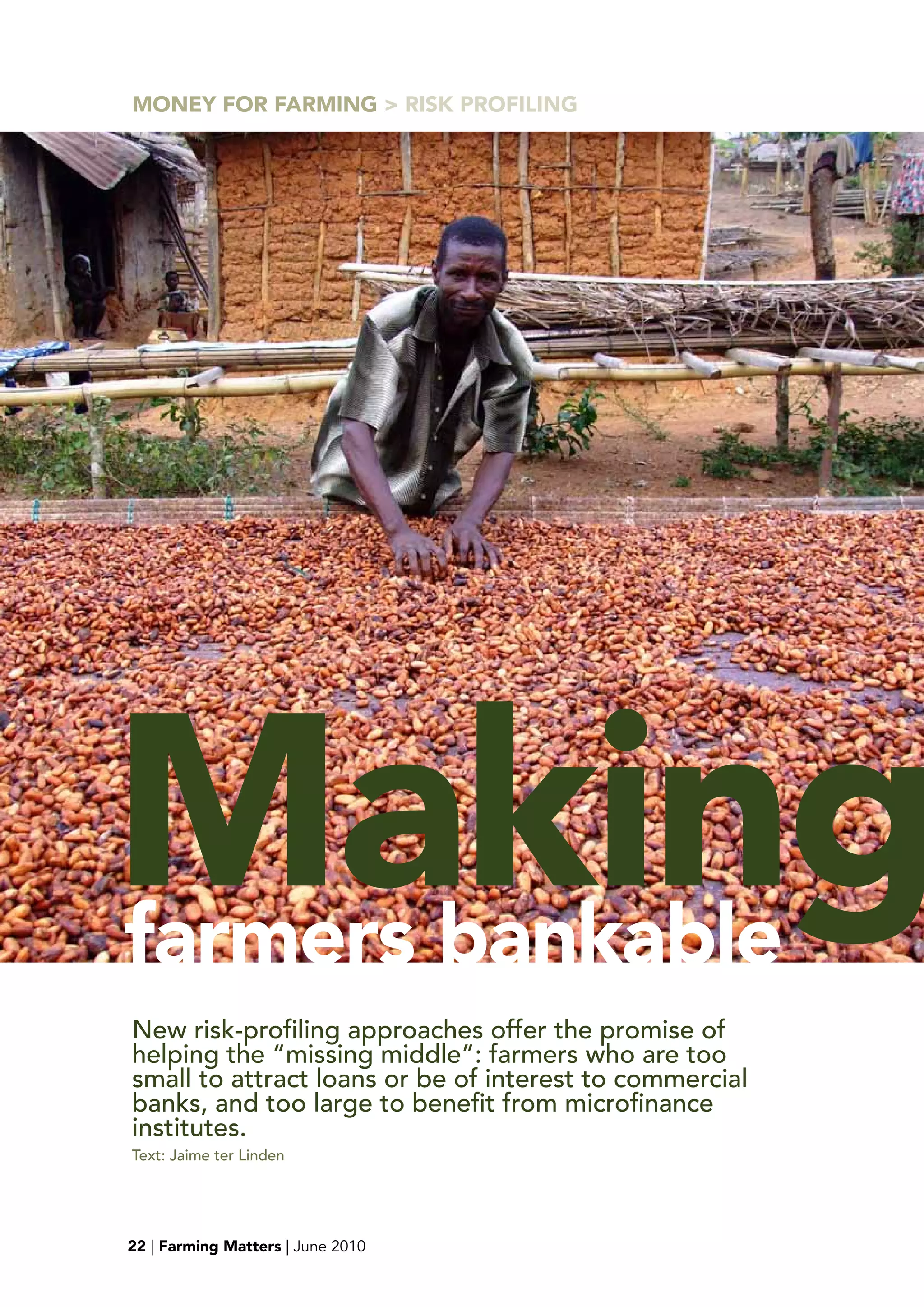
Making
farmers bankable
New risk-profiling approaches offer the promise of
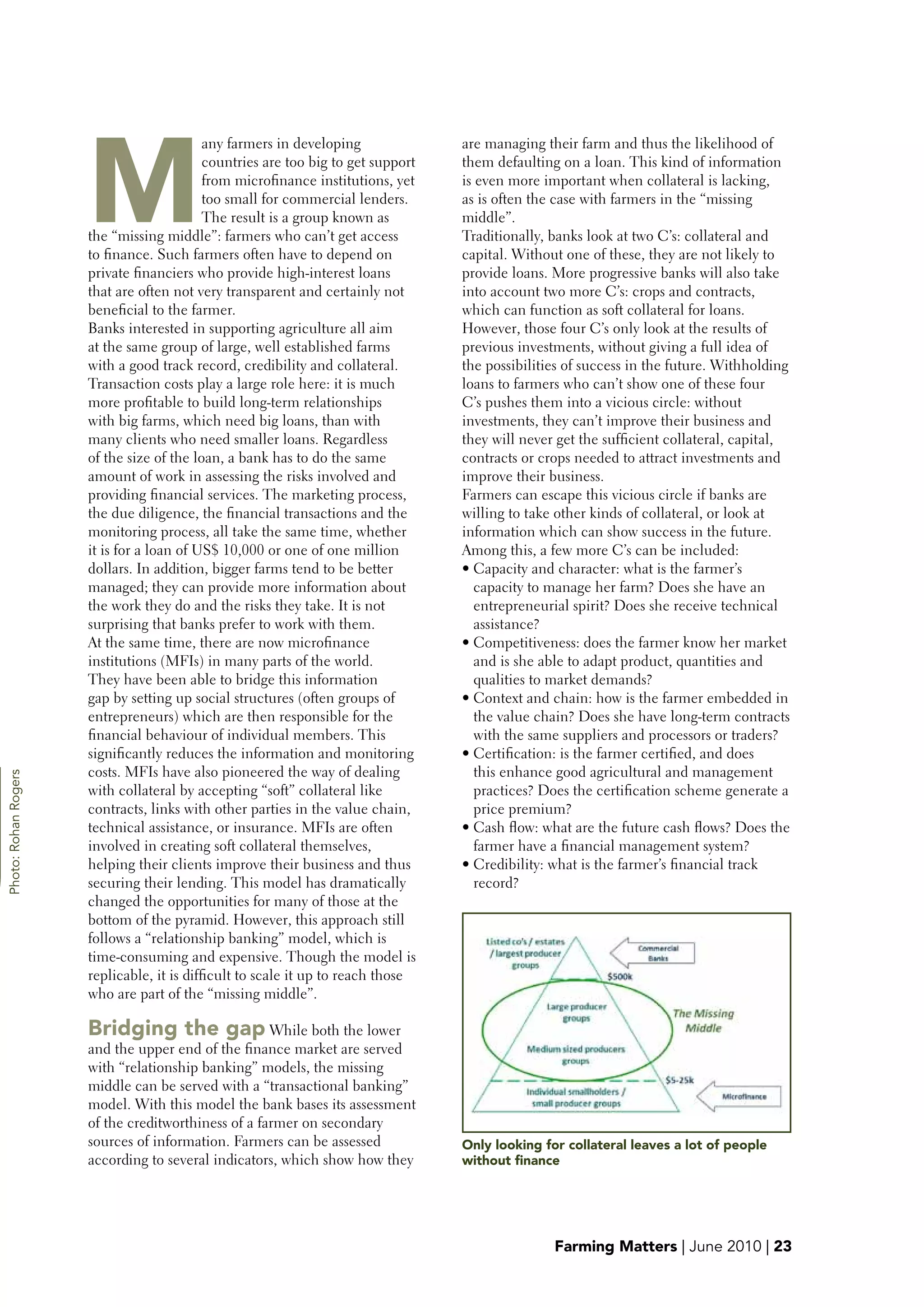
helping the “missing middle”: farmers who are too
small to attract loans or be of interest to commercial
banks, and too large to benefit from microfinance
institutes.
Text: Jaime ter Linden


22 | Farming Matters | June 2010
M
                                            any farmers in developing              are managing their farm and thus the likelihood of
                                            countries are too big to get support   them defaulting on a loan. This kind of information
                                            from microfinance institutions, yet    is even more important when collateral is lacking,
                                            too small for commercial lenders.      as is often the case with farmers in the “missing
                                            The result is a group known as         middle”.
                      the “missing middle”: farmers who can’t get access           Traditionally, banks look at two C’s: collateral and
                      to finance. Such farmers often have to depend on             capital. Without one of these, they are not likely to
                      private financiers who provide high-interest loans           provide loans. More progressive banks will also take
                      that are often not very transparent and certainly not        into account two more C’s: crops and contracts,
                      beneficial to the farmer.                                    which can function as soft collateral for loans.
                      Banks interested in supporting agriculture all aim           However, those four C’s only look at the results of
                      at the same group of large, well established farms           previous investments, without giving a full idea of
                      with a good track record, credibility and collateral.        the possibilities of success in the future. Withholding
                      Transaction costs play a large role here: it is much         loans to farmers who can’t show one of these four
                      more profitable to build long-term relationships             C’s pushes them into a vicious circle: without
                      with big farms, which need big loans, than with              investments, they can’t improve their business and
                      many clients who need smaller loans. Regardless              they will never get the sufficient collateral, capital,
                      of the size of the loan, a bank has to do the same           contracts or crops needed to attract investments and
                      amount of work in assessing the risks involved and           improve their business.
                      providing financial services. The marketing process,         Farmers can escape this vicious circle if banks are
                      the due diligence, the financial transactions and the        willing to take other kinds of collateral, or look at
                      monitoring process, all take the same time, whether          information which can show success in the future.
                      it is for a loan of US$ 10,000 or one of one million         Among this, a few more C’s can be included:
                      dollars. In addition, bigger farms tend to be better         • Capacity and character: what is the farmer’s
                      managed; they can provide more information about                capacity to manage her farm? Does she have an
                      the work they do and the risks they take. It is not             entrepreneurial spirit? Does she receive technical
                      surprising that banks prefer to work with them.                 assistance?
                      At the same time, there are now microfinance                 • Competitiveness: does the farmer know her market
                      institutions (MFIs) in many parts of the world.                 and is she able to adapt product, quantities and


g
                      They have been able to bridge this information                  qualities to market demands?
                      gap by setting up social structures (often groups of         • Context and chain: how is the farmer embedded in
                      entrepreneurs) which are then responsible for the               the value chain? Does she have long-term contracts
                      financial behaviour of individual members. This                 with the same suppliers and processors or traders?
                      significantly reduces the information and monitoring         • Certification: is the farmer certified, and does
                      costs. MFIs have also pioneered the way of dealing              this enhance good agricultural and management
Photo: Rohan Rogers


                      with collateral by accepting “soft” collateral like             practices? Does the certification scheme generate a
                      contracts, links with other parties in the value chain,         price premium?
                      technical assistance, or insurance. MFIs are often           • Cash flow: what are the future cash flows? Does the
                      involved in creating soft collateral themselves,                farmer have a financial management system?
                      helping their clients improve their business and thus        • Credibility: what is the farmer’s financial track
                      securing their lending. This model has dramatically             record?
                      changed the opportunities for many of those at the
                      bottom of the pyramid. However, this approach still
                      follows a “relationship banking” model, which is
                      time-consuming and expensive. Though the model is
                      replicable, it is difficult to scale it up to reach those
                      who are part of the “missing middle”.

                      bridging the gap While both the lower
                      and the upper end of the finance market are served
                      with “relationship banking” models, the missing
                      middle can be served with a “transactional banking”
                      model. With this model the bank bases its assessment
                      of the creditworthiness of a farmer on secondary
                      sources of information. Farmers can be assessed              Only looking for collateral leaves a lot of people
                      according to several indicators, which show how they         without finance


                                                                                                  Farming Matters | June 2010 | 23
By scoring a farmer on the basis of these additional       extensive experience with the farmer and can provide
factors, banks can get a more comprehensive insight,       additional information. When a profile is made,
and this can serve as the necessary input for their own    it also generates insights of what has to be done to
due diligence process.                                     make the farmer(s) more bankable. This information
                                                           can be delivered to those providing training or
putting it into practice ForeFinance                       extension.
is a company that makes profiles of farmers based on       The relevant importance of these indicators varies
the C’s mentioned above. This assessment is done           between sectors and regions. Among Kenyan coffee
at a group level, for several reasons. First, working      farmers, for example, governance and credibility
with co-operatives (or other groups) can be more           are two very important factors, as coffee co-operatives
cost effective. Moreover, a group provides some of         have a history of bad governance and debt for-
the essential “soft” collateral: adequate governance       giveness. The variables are weighted before they are
and management structures, links with the value            put into a model which gives a producer group a
chain, certification, financial management or links        credit rating from A to D. This serves as an input
with technical assistance. ForeFinance has started         for the bank’s due diligence, which then allows the
business in Kenya, and aims to roll out this concept       bank to concentrate on analysing systematic risks
throughout Africa, Latin America and Asia.                 (see box).
The profiling process starts with a request from
a group. A third party audit is conducted, which           pieces of the puzzle Certification
generates a profile of the group. This profile is stored   schemes (in for example coffee, tea and cacao)
in a database, which is accessible to banks. On the        have helped make whole sectors more transparent,
basis of this profile and their own due diligence, a       efficient and sustainable, and have brought clear
bank can decide to provide a loan which, together          benefits to farmers. Although our work does not
with the repayment details, is recorded in the             intend to be a certification scheme, we think it can
database. The link with those who provide technical        lead to the same dynamics and benefits.
assistance is very important, as they often have           Of course, our methodology is only a small part of
                                                           the puzzle which has to be in place to overcome
                                                           the financing gap. Change has to come from
                                                           different sources. Governments can help create a
Systematic risks                                           stable context for agriculture. They are responsible
                                                           for providing the necessary infrastructure (roads,
                                                           telecommunications) and can regulate and prevent
In agricultural finance, banks often consider the          market distortions. Non-governmental organisations
systematic risks to be the most important ones.            have played, and continue to play, an important role
These are the risks that are inherent to a whole           in training and extension activities.
sector and/or a whole region, such as weather risks,       However, the major drivers of change have to
biological risks or price risks. If drought, flooding      come from the agricultural and financial sectors
or a pest outbreak hits a region, it will affect most      themselves. While the model can be a driver
of the farmers. If prices are going down, all the          in making farmers more “bankable”, it is clear
farmers will be paid less for their products. One          that banks have to become more farmer-friendly.
of the core strategies of a bank is to diversify their     They need encouragement and support in this.
investments, in order to reduce these risks. (This         Encouragement can come from a first-loss structure,
is another reason why banks prefer to stay out of          which can compensate banks in case of defaults.
agricultural finance, as the sector is replete with        A fund to subsidise the initial profiling of farmers
systematic risks.)                                         also seems necessary. Both schemes are currently
Due to their nature, systematic risks are difficult        being set up by the independent consultancy firm
for individual farmers to manage. However, there           Agri Finance Program Management & Consultancy.
are risk management strategies which can – at              These schemes are expected to help this model
least – mitigate against their effect. Drought can         spread, helping more and more farmers get access
be managed or mitigated by crop diversification            to credit – and with it, get higher yields.
(not all crops are equally sensitive), irrigation or
insurance. Price risks can be managed by storage           Jaime ter Linden is program manager at ForeFinance.
facilities (helping farmers wait for better prices).       He has worked in the financial sector for many
                                                           years as an analyst and portfolio manager. E-mail:
Putting these strategies into practice is a clear          jaime.ter.linden@forefinance.nl. For more information
indicator of good management and reduces                   about ForeFinance, see www.newforesight.nl/page/
systematic risk.                                           forefinance.


24 | Farming Matters | June 2010
READERS SERVICE


Subscribe!                              Call for feedback                                                                                                                                                                            Renew your
For more than 25 years, ileia’s         on learning about                                                                                                                                                                            subscription NOw
magazine has been contributing          cropping systems                                                                                                                                                                             With our previous issue we asked a
to the development of knowledge         The interim version of the                                                                                                                                                                   lot of readers who receive Farming
about sustainable agriculture           third module of the Learning                                                                                                                                                                 Matters free of charge to update
around the world. While readers         AgriCultures series for educators                                                                                                                                                            their subscription. If you haven’t
in developing countries can apply       (Cropping systems) will soon be                                                                                                                                                              done so yet, please tick the “renew”
for a free subscription, we are         available. This looks at different                                                                                                                                                           box on the subscription form and
inviting those who can to take          aspects of small-scale farmers’                                                                                                                                                              send it back to us, or do so via
a paid subscription. Every paid         systems, and how to sustainably                                                                                                                                                              www.ileia.org.
subscription to Farming Matters         intensify them. You can download                                                                                                                                                             If you can afford to do so, please
allows us to send the magazine to       Module 3 by clicking on the                                                                                                                                                                  consider taking out a paid
two subscribers lacking the means       “learning” button on ileia’s                                                                                                                                                                 subscription.
to subscribe. Join our “family”         website. We would

                                                                                                                                                      INGNG
                                                                                                                                                       MI
                                                                                                                                                    ARFARMING
and receive the magazine each           very much welcome
quarter. In this way you not only       your feedback (via
                                                                                                                                                   F ERMATTERS
                                                                                                                                                    M TSERS
                                                                                                                                                FAR TA T

                                                                                                                                                                                                                                                                         Small-scale agriculture for a sustainable society June 2010
                                                                                                                                                                                               0      201
find about the latest developments      the survey form) on
                                                                                                                                                   M
                                                                                                                                                                                                March
                                                                                                                                                  AT
                                                                                                                                                                                                    e society
                                                                                                                                 G DOWN

                                                                                                                                      09
                                                                                                                           CUTTIN
in sustainable agriculture, but you     the content of this                                    THE SO
                                                                                                            UTH IS
                                                                                                                                      r 20
                                                                                                                                          mbe
                                                                                                                                                                                                                                                                  Magazine
                                                                                                                                                                                                                                                                                                                                       Formerly known as LEISA Magazine


                                                                                                                                                          M
                                                                                                                                                                                                                 tainabl
                                                                                 TH IN                                                                                                                                                              as LEISA
                                                                                                                                           Dece
                                                                 LE     > GROW                                                                                                                                                       known
                                                           ARTIC                                                                                                                                                      Formerly


                                                                                                                                                                                                        for a sus
also help make this information         module.
                                                                                                                                                  y
                                                                                                                                                                                                                            e
                                                                                                                                                                                                                       azin
                                                                                                                                             ciet

                                                                                                                                                                                                  A         Mag
                                                                                                                                                  e so

                                                                                                                                                                                             LEIS
                                                                                                                                                                                      n as
                                                                                                        WN
                                                                                                                                                   nabl


                                                                                                                                                                                                                  iculture
                                                                                                    DO                                                                            know
                                                                                                                                                                       erly
                                                                                          ING

available to others.
                                                                                                                                                      stai


                                                                                                                                                             Form
                                                                                  UTT
                                                                              IS C
                                                                                                                                                         a su


                                                                                                                                                                                                                      cale agr
                                                                         TH
                                                                      OU
                                                                                                                                                          for


                                                                    S
                                                                THE
                                                                                                                                                             ture


                                                                                                                                                                                                                           Small-s
                                                         H IN
                                                      WT
                                                                                                                                                                      ul


                                                   GRO
                                                                                                                                                                agric


                                        ART
                                           ICL
                                              E>
                                                                                                                                                                                                                                                                                                                                                                          nefits of
                                                                                                                                                                                                                                                                                                                                                                    The be livestock
                                                                                                                                                                    le
                                                                                                                                                                      l-sca


Become a (paid) subscriber now!
                                                                                                                                                                           Smal


                                                                                                                                                                                                                                                                                                                                                                                       Banking for the
                                                                                                                                                                                                                                                                                                                                                                                          unbankable

Fill in the subscription form or go
                                                                                                                                                                                                                                                                                                                                                                  r
to www.ileia.org.
                                                                                                                                                                                                                                                                                                                                                             up fo
                                                                                                                                                                                                                                                                                                                                                            Going
                                                                                                                                                                                                                                                        S
                                                                                                                                                                                                                                                              g
                                                                                                                                                                                                                                                         calinfor farmings                                           aini s
                                                                                                                                                                                                                                                                                                                           ng                  Money
                                                                                                                                                                                                                                                                                                                                               more
                                                                                                                                                                                                                                                                  animal
                                                                                                                                                                                                                                                                    and
                                                                                                                                                                                                                                                                                                                 sust the gain
                                                                                                                                                                                                                                                                                                                  st
                                                                                                                                                                                                                                                                                                          ienti
                                                                                                                                                                                                                                                                                                      e sc
                                                                                                                                                                                                                                                                                                g th r 2009 | 1
                                                                                                                                                                                                                                                                                  g        ucin
                                                                                                                                                                                                                                                                               minn > Sed ters | Decem             rights
                                                                                                                                                                                                                                                                                                       be
                                                                                                                                                                                                                                                                             r
                                                                                                                                                                                                                                                                      ily fa ree                          and rch | 1
                                                                                                                                                                                                                                                                                                                                                                                                         36


                                                                                                                                                                                                                                                                                                   fogodtters | Mapa2010 ralism
                                                                                                                                                                                                                                                                                                                                                                                                      12:
                                                                                                                                                                                                                                                                                                                                                                                                9 14:
                                                                                                                                                                                                                                                                                           Mat
                                                                                                                                                                                                                                                                f faml gets g e ScFarm tter on mincredit r Reaching the
                                                                                                                                                                                                                                                                                                                      sto
                                                                                                                                                                                                                                                                                                                                                                                             200
                                                                                                                                                                                                                                                                                       ing                                                                                             07-12-
                                                                                                                                                                                                                                                                                                       Ma fo
                                                                                                                                                                                                                                                           re o     e                hu        Polic s ❚
                                                                                                                                                                                                                                                                            ❚ Thinking beyond ie
                                                                                                                                                                                                                                                                               D               Far

                                                                                                                                                                                                                                                       futu he Sa❚h livier otic poultry Risk management for |small farmers
                                                                                                                                                                                                                                                                    O missing middle ❚ ❚
                                                                                                                                                                                                                                                    The > T
                                                                                                                                                                                                                                                                                                                Farming Matters March 2010 | 1                                                                           09:55:54


                                                                                                                                                                                                                                                               ❚ Loca
                                                                                                                                                                                                                                                                        l vs ex                                                                                                                             08-03-2010


                                                                                                                                                                                                                                                         indd 1
                                                                                                                                                                                                                                                FM1_2010.
                                                                                                                          2010
                                                                                                                  March
                                                                                                        tters |
                                                                                            ming Ma                                                                                                                                               d 1
                                                                                     1 | Far                                                                                                                                              009
                                                                                                                                                                                                                                             .ind
                                                                                                                                                                                                                                     FM1_2


September
                                                                                                                            09
                                                                                                                      r 20
                                                                                                                  embe


                                        If you are interested in this topic,                                                                                                                                                         related issues. If you are not
                                                                                                            Dec
                                                                                                     rs |
                                                                                                 atte
                                                                                               gM
                                                                                        rmin
                                                                                1 | Fa


issue: water                            we also suggest you also visit                                                                                                                                                               a subscriber, but would like to
and sustainable                         our blog (http://familyfarming.                                                                                                                                                              receive the September issue,
agriculture                             typepad.com), which will feature                                                                                                                                                             see the offer for a free issue
Water is a scarce resource, and         regular contributions on water                                                                                                                                                               on page 31.
according to all estimates it will be
even scarcer in the future. Water
and agriculture are intricately
linked: agriculture needs water, but
can also help in making more water
available; through regenerating
water tables, for example. Farming
Matters will explore the various
aspects of water and agriculture in
its September issue. In advance of
this, the Theme Info Packs on our
website (www.ileia.org) already offer
resources on this theme. We invite
you to help us expand them, by
sending us links to books, websites
or other resources which we could
add.                                    Photo: Bernard Keraita


                                                                                                                                                                                                        Farming Matters | June 2010 | 25
TwO VIEwS


           Should farmers get
            paid for providing
           ecosystem services?
                                       suggest that farmers in developing     through sustainable agricultural
                                       countries are against ecosystem        practices such as organic farming,
                                       services in Western countries          agro-forestry, the production
                                       as this is an unfair form of           of renewable energies (such as
                                       competition. This could not be         biogas) and sustainable livestock
                                       farther from the truth. Farmers’       management. Similarly, farming


F
        armers’ fields make up 40      organisations in developing            can play a role in maintaining
        percent of the earth’s land    countries want their governments       water quality through watershed
        mass and thus play a key       to establish similar programmes        management. There are numerous
role in conserving the world’s         in their own countries. They want      concrete examples.
biodiversity. Farmers work hard        their governments to devote at least   Such sustainable practices that
with limited resources to feed a       10 percent of national expenditures    benefit society as a whole come at
growing world population. The          to agriculture, as they promised in    a cost that is not always
FAO says biodiversity is our best      2003 when they signed the Maputo       compensated by direct benefits.
ally in the fight against hunger and   Declaration. To date, only eight       Farmers’ organisations have to
that farmers are the first line of     countries in Africa have made good     work hard to get the entire
defence in conserving biodiversity.    progress towards this target. So       international community to
Yet this must also be a shared         long as ecosystem service payments     acknowledge this potential and
responsibility, and governments        are not coupled to specific            the efforts required. Farmers can
have to play a supporting role by      commodities, they are not trade        provide ecosystem services if
encouraging the development of         distorting.                            they are provided with adequate
farmer-driven local programmes,        Farming has an enormous                incentives and the resources to do
putting mechanisms in place            potential for mitigating against       so. That is why IFAP encourages
to provide ecosystem services.         climate change through carbon          co-ordinated global policies, for
For example, in most developed         sequestration. According to the        more widespread programmes
countries farmers are paid to          Intergovernmental Panel on             that support farmers in providing
establish biodiversity corridors.      Climate Change, agriculture´s          ecosystem services.
There is a need to establish           sequestration potential largely
similar mechanisms in developing       exceeds the emissions coming           Neil Sorensen, Communications
countries, adapted to the specific     from farming, and 70 percent of        Coordinator, International Fede-
characteristics of each location.      this mitigation potential can be       ration of Agricultural Producers
Some fringe farmers’ groups            realised in developing countries       (IFAP), neil.sorensen@ifap.org.


                                                 “Farmers need incentives to
                                                      conserve biodiversity”
26 | Farming Matters | June 2010
The International Year of Biodiversity gives us a good
opportunity look at agriculture’s relation with biodiversity.
One proposed mechanism to stimulate environmentally
friendly farming is PES, or Payments for Environmental
Services. Can PES help conserve biodiversity? How can
such a mechanism be implemented? Join the debate at
www.ileia.org g Open Forum.


                                         to be made over the extent to              imaginable. Governments could
                                         which agriculture should focus on          reduce agricultural subsidies that
                                         productivity for direct use, in order      have negative consequences for
                                         to prevent private benefits prevailing     agro-biodiversity, or include agro-
                                         over public interest, and public           biodiversity within biodiversity
                                         services being lost.                       conservation programmes; while


T
        he vast socio-economic           Society cannot expect farmers to           consumers could buy niche market
        and cultural diversity of        maintain that diversity if doing           products, effectively becoming
        farming communities has          so is against their direct interests.      service purchasers.
created an enormous diversity of         Governments need to provide                Reward mechanisms might be
crop varieties and livestock breeds.     enabling policies and incentives to        individual or community-based,
Traditional farming is a form of in      promote conservation. Dryland and          in the form of money, recognition,
situ conservation that complements       mountain farmers, as well as hobby         training, or infrastructure. They
ex situ conservation in gene banks       farmers, prefer local crop varieties       could, for example, support
and zoos and botanical gardens.          and livestock breeds, and in so            traditional knowledge systems. As
Over the last century, farmers have      doing safeguard public good values.        poorer farmers are less likely to
increased their grip on agricultural     In humid and temperate areas,              convert away from traditional
systems, moving from diverse agro-       farmers are more likely to abandon         systems, PACS schemes will tend to
ecosystems to specialised agro-          traditional varieties and breeds, and      support equity and poverty
industry by using external (often        they need support to keep them.            alleviation goals. Their impact is still
subsidised) inputs and high yielding     This brings us to a financing              unknown, as is its influence on
varieties. Monocultures yield more       mechanism, a form of PES to                local communities. Bioversity
“direct use” products and are more       maintain diversity in varieties and        International is currently carrying
profitable, which makes them             breeds: Payment for Agrobiodiversity       out a series of case studies in India,
attractive from a private perspective.   Conservation Services, or PACS.            Peru and Bolivia to evaluate these
Yet, specialised agriculture             The first question is: who will “buy”      impacts, help develop effective
yields less services with a “public      PACS? It is difficult to identify          instruments and suggest supportive
use” value, like water and soil          the equivalents of “downstream”            policy measures.
conservation, and “future option”        users of PES who will be willing
values, such as biodiversity. This       to compensate “upstream” farmers           Adam Drucker, senior econo-
should concern society as a whole,       and carbon emission buyers.                mist, Bioversity International,
and clear social choices need            Other payment mechanisms are               a.drucker@cgiar.org


“Society cannot expect farmers to maintain
diversity if doing so is against their direct interests”
                                                                                  Farming Matters | June 2010 | 27
MONEY FOR FARMING > VALUE CHAIN FINANCE


 Trade
Finance
Money when it is needed

28 | Farming Matters | June 2010
Finance is a key for maintaining committed trading
                      relationships. Value Chain Finance helps farmers’
                     organisations bridge the “payment gap” between
                                                    harvest and export.
                                                                                                 Text: Koert Jansen


    R
                     ecent and expected future growth          land and buildings. Farmer co-operatives generally
                     rates for both the organic and fair       do not have enough assets to raise the finance they
                     trade markets reflect a growing           need, especially during the cash-intensive harvest
                     consumer awareness of global              season. Value Chain Finance differs from traditional
                     trade issues and a wish to consume        agricultural lending: instead of relying on hard
                     sustainably, along ethical and            collateral, it relies on strong and committed value
    environmental lines. In both Europe and the United         chains. Sales contracts with solid and reputed buyers
    States, market demand exceeds supply for many              are actually more valuable than the expected sale
    products, such as sugar, coffee and cocoa, and there       value of a building. When the sales revenues from
    is growing demand for imports of these products            such contracts are flowing into accounts held by the
    from Latin America, Asia and Africa. However, not          bank financing the co-operative, this adds another
    all suppliers/farmers in these regions are able to fully   level of security. Over the past ten years, this type
    grasp these market opportunities, in particular due to     of lending has been successfully pioneered by a few
    lack of access to (trade) finance.                         national and international financial institutions.
                                                               Triodos Bank, together with Root Capita and Shared
    Long-term partnerships                                     Interest, has been among the leading pioneers in
    To tackle these challenges farmers need the support        this field. The evidence shows that Value Chain
    of committed buyers. Buyers in the organic and fair        Financing can be done at an acceptable level of
    trade markets are, generally, committed to enter into      risk. The average annual loss rate on Triodos’ trade
    a long-term and sustainable trading partnership with       finance portfolio over the last five years was less than
    local companies.                                           one percent. The few other players in this field have


e
    The single most important precondition for building        similar experiences.
    this partnership is timely payment to the farmers,
    upon delivery of their produce. This means that            Trade finance: How it works
    farmers don’t experience (often lengthy) delays            To illustrate how trade finance works, let’s go to the
    in receiving payments. While Fair Trade and/or             Meatu district in the northwest of Tanzania, the
    organic systems generally pay higher prices, farmers’      country’s main cotton-growing region. In this district
    co-operatives generally lack the cash needed to            2,000 cotton growers cultivate 11,000 hectares of
    bridge the period between sourcing the harvest and         certified organic cotton, producing around 8,000 tons
    receiving payment from their buyers, and cannot            of seed cotton a year for BioRe Tanzania, Africa’s
    immediately pay farmers from their own resources.          leading exporter of organically certified cotton lint.
    This is where the need for pre-finance arises, which       This chain is co-ordinated by Remei AG, a Swiss firm
    is a key instrument for building sustainable trading       that produces and markets organically grown textiles.
    partnerships.                                              The garments are sold in supermarkets and fashion
    In most developing countries, agricultural lending is      outlets in Switzerland and other European countries.
    perceived as high risk and the banking system tends        The cotton farmers have very little capital. Cotton
    to avoid it. Where agricultural lending does exist,        is their only cash crop, so they urgently need money
    banks often require excessive hard collateral such as      when it is harvested. If BioRe doesn’t pay in cash, the


    For farmers like this one in burkina Faso, cotton is often the only source of income, so they urgently need
    money once it is harvested. Cotton buyers need a ready amount of cash to pay these farmers, but banks are
    reluctant to provide them with loans, and therefore make a lot of demands. Simpler lending mechanisms would
    make their lives – and that of farmers – much easier. Photo: Mans Lanting


                                                                               Farming Matters | June 2010 | 29
dollars). These factors mean that many banks are
                                                          reluctant to provide loans to cotton exporters. Swiss
                                                          Remei AG made contact with Triodos Sustainable
                                                          Trade Fund, one of the special purpose funds of
                                                          Triodos Bank, the leading values-driven bank in
                                                          Europe. This fund offers simple and straightforward
                                                          trade finance loans. Triodos Sustainable Trade Fund
                                                          agreed to pre-finance up to 60 percent of the contract
                                                          between BioRe Tanzania and Remei AG. The start
                                                          of the loan period commences with the start of the
                                                          cotton harvesting season and can continue until the
                                                          last shipment of cotton has left Dar-es-Salam harbour.
                                                          A central element of the loan is that all payments
                                                          on the contract go through a Triodos Bank account
                                                          in the Netherlands, and Triodos Sustainable Trade
                                                          Fund withholds part of each payment until the loan is
                                                          paid off. This continues throughout the sales period,
                                                          so that the loan is fully repaid by the time all the
                                                          cotton has been sold. Triodos’ willingness to finance
                                                          this organic cotton chain is based on the strong
                                                          relationship that exists between Remei AG and BioRe
                                                          Tanzania. This, in turn, is based on proven up and
                                                          down stream relationships: between BioRe Tanzania,
                                                          the ginnery and the farmers of Meatu district, and
                                                          between Swiss Remei AG, the firms that spin the
                                                          yarn and turn it into cloth, and the retailers. The only
                                                          document underpinning the loan is the sales contract
The potential of microfinance is becoming more and        between BioRe Tanzania and Remei AG, specifying
more evident. Photo: Folkert Rinkema                      the amount and price of lint to be sold. Triodos’
                                                          loan is not based on securities, but on trust that the
farmers might sell their crop to other buyers – even if   cotton lint will be produced and sold, and that it will
at a lower price. In 2008, BioRe Tanzania needed          generate sufficient profit to repay the loan. In financial
US$ 3.5 million in cash to pay its contract farmers.      jargon, the loan is based on cash flow projections,
BioRe Tanzania requested loans from several               rather than securities from assets. The repayment
Tanzanian banks, but they required mounds of              agreement confirms the partnership between three
documents, safeguards such as the firm’s office and       mutually dependent organisations, which provides the
training centre as collateral, and personal guarantees    basis for successful export financing.
from the managers of BioRe Tanzania and Remei AG.
Many banks see that exporting cotton is a risky           promising market
business, with several factors affecting an exporter’s    The question arises: why are only a few international
capacity to repay a bank loan, including climate (risk    players prepared to take up this role as financier?
of drought), price fluctuations on the world market,      What about local banks? A parallel can be drawn
and also currency risks (BioRe Tanzania buys seed         with the development of the microfinance sector.
cotton in Tanzanian shillings and sells lint in US        Triodos started financing microfinance institutions


Triodos Sustainable Trade Fund – Who is it for?
Triodos Sustainable Trade Fund lends to agricultural exporter organisations working with smallholder farmers
located in Africa, Latin America or (Central) Asia. Organisations need to be dedicated to organic production
and/or Fair Trade principles. Furthermore, they need to be financially and commercially sustainable, have
access to export markets for commodities or related products, and a minimum annual turnover of € 400,000.
For more information go to: www.triodos.com/sustainabletrade, or email sustainabletrade@triodos.nl.


30 | Farming Matters | June 2010
in developing countries in 1994 when it launched
two specialised microfinance funds. At that time
                                                                  GET A FREE ISSUE OF
Triodos was one of the few players in the world to
offer this type of investment service. The number of


                                                                  FARMING
international investors has since increased rapidly –
especially in recent years as an increasing number
of microfinance institutions have become financially


                                                                  MATTERS
sustainable. The most important development,
however, has been that mainstream local banks
have learned to appreciate the microfinance sector
as a promising market with large business potential
and acceptable risk levels. In most developing
countries, the sector is now recognised as having the             Farming Matters, the global
                                                                                                                                          FARMING


                                                                                                       Small-scale agriculture for a sustainable society June 2010
potential to uplift the socio-economic development                magazine on small-scale
of hundreds of thousands or millions of individuals.              agriculture for a sustainable                                                   MATTERS            Formerly known as LEISA Magazine


Some microfinance institutions conduct a significant              society, offers innovative
part of their activities in rural areas, which means              alternatives to production
that farmers can benefit from the financial services,             oriented farming. Farming                                                                                                                       Banking for the

ranging from credit facilities and savings accounts               Matters is about farming
                                                                                                                                                                                                                     unbankable


to payment services and micro-insurance. In many                  practices that consider
countries, microfinance institutions have a special
status and are supervised by the central banks.
                                                                  people, planet and profit.
                                                                  The magazine offers back-
                                                                                                                                                                             Money
                                                                                                                                                                             for farming
Triodos is convinced that Value Chain Finance can                 ground, debate, opinions
go through the same development phases as the                     and interviews.                                                                                              ❚ Thinking beyond credit ❚ Reaching the
                                                                                                                                                                             missing middle ❚ Risk management for |small farmers
                                                                                                                                                                                                         Farming Matters March 2010 | 1


microfinance sector. A very important key factor in
this is the further professionalisation of suppliers              Farming Matters has subscribers in 152
(including farmers’ co-operatives) in developing                  countries. Find out why. Get yourself a free
countries. Currently, not all suppliers are able to               copy, or surprise someone with a free copy.
fully grasp the market opportunity due to a lack of               Fill in the form and send it back to us.
management capacity, commercial skills and the
ability to meet end buyers’ quality requirements. Very                                                                                                                                                                
often they have no solid financial reporting system.
With substantial further professionalisation at the               ❚ Please send me a free issue of Farming
bottom of agricultural value chains, Triodos expects                Matters. I have provided my name and
that more financial institutions will start providing               address below.
Value Chain Finance, especially in commodities                    ❚ I would like you to give a free issue of Farming
like coffee and cotton. Their risk perception will                  Matters to someone else. I have provided
change as they become aware that providing finance                  their contact details below.
to organisations without fixed assets can still be pretty
good business.
                                                                   Name
Over the last seven to eight years, Triodos has had
a loan loss of less than one percent, calculated over
                                                                   Street/p.O. box
disbursements per year. That is far less than what
many would expect. We think, and hope, that this                   postal code and town
will encourage other players in the financial sector to
follow suit.                                                       Country

Koert Jansen is Fund Manager at the Triodos Sustainable
                                                                   E-mail (optional)
Trade Fund, e-mail: koert.jansen@triodos.nl


Further reading                                                   Send this form to: ileia, P.O. Box 2067, 3800 CB
The case of the Meatu district is described in more detail        Amersfoort, the Netherlands. You can also send an
in “Value Chain Finance: Beyond microfinance for rural            e-mail to subscriptions@ileia.org. Make sure you
entrepreneurs”, a publication from the Royal Tropical             mention “free issue” in the subject line, and that
Institute (www.kit.nl) and the International Institute of Rural   you give us your full contact details.
Reconstruction (www.iirr.org).


                                                                                Farming Matters | June 2010 | 31
MIND! > NEw IN pRINT
                       Adding value to livestock diversity: Marketing to promote
                       local breeds and improve livelihoods
                       Evelyn Mathias (ed.), 2010. Lpp and LIFE Network / FAO, 142 pages.

                       Many livestock breeds found all over the world, such as Bactrian camels in
                       Mongolia, or Umzimvubu goats in South Africa, are specifically adapted to local
                       conditions. They survive under harsh weather conditions, are better able to resist
                       diseases or to reproduce when food is scarce. But in spite of these advantages
                       these local breeds are at risk of extinction as a result of an increasing preference
                       for “modern” breeds. Finding niche markets for their products may be one way
                       to avoid this fate. This book looks in detail at these two cases, together with six
                       others, identifying the main advantages and challenges of niche markets.

                       Land grab? The race for the world’s farmland
                       Michael Kugelman and Susan L. Levenstein (eds.), 2009. woodrow wilson International
                       Center for Scholars, 123 pages.

                       The lease of large areas of land in poor countries is very much in the news today.
                       This process, however, is not really new: in Latin America in the 19th century
                       the same processes led to the emergence of the original “banana republics” –
                       with very negative social and environmental results. As the contributors to this
                       publication show, the consequences today may be even bigger. This collection of
                       essays looks at the implications of these new deals in terms of food security and
                       poverty alleviation (especially when small-scale farmers and the rural population
                       have no voice in the deals), and at the pros and cons of a suggested code of
                       conduct for all parties covering issues such as local land tenure and uses.

                       Realising REDD+: National strategy and policy options
                       Arild Angelsen (ed.), 2009. Center for International Forestry Research, CIFOR, 390 pages.

                       Deforestation and changes in land use account for up to 20 percent of all greenhouse
                       gas emissions. The idea of “rewarding” governments, companies, forest owners
                       and users in the south for keeping and maintaining their forests would seem a
                       logical step for any post-Kyoto agreement. Current discussions now focus on
                       REDD+, a strategy that considers forest management and different approaches to
                       enhance forest carbon stocks, which it is hoped might prove effective. But many
                       details remain. Who owns the forests? And what institutions are required in order
                       to make this work? This book aims at helping those interested in making such a
                       system operational: looking at the “institutional architecture” which is needed
                       and at policies and how these, via incentives or regulations, could help increase
                       forest conservation.

                       Entering the organic market: A practical guide for
                       farmers’ organisations
                       Freek Jan Koekoek, Marg Leijdens and Gerbert Rieks, 2010. Agrodok 48, Agromisa, 88 pages.

                       In spite of the world’s economic crisis, global demand for organic products has
                       continued to grow during the last two years. More and more organic farmers
                       are benefiting from selling their products in international markets and many
                       more are expected to join them. This is an easy-to-read and complete guide for
                       those interested in exporting organic products. It draws on the experience of the
                       EPOPA programme, which ran from 1997 to 2008 and benefited more than one
                       hundred thousand farmers from Uganda and Tanzania. The booklet first gives an
                       overview of the organic market and the importance of the certification process.
                       This is followed by describing the steps involved in making a business strategy: a
                       feasibility study, risk analysis, marketing, planning and evaluations.


32 | Farming Matters | June 2010
Fair miles: Recharting the food miles map
                         Kelly Rae Chi, James MacGregor and Richard King, 2010. big ideas in development series,
                         IIED, 44 pages.

                         In this short, concise and beautifully presented booklet, IIED and Oxfam GB
                         look at “food miles”, a much discussed concept in recent years. The constant
                         increase in food trade between developed and developing countries is often
                         seen as an important source of greenhouse gases and as contributing to
                         climate change. The authors dispel this perception somewhat, showing that
                         transportation is only responsible for 10 percent of all emissions associated with
                         the UK’s food chains. It also argues against the idea that locally produced foods
                         are necessarily better in terms of global warming, since they often require more
                         energy to grow. Equally, the term “local” can be misleading, if most inputs come
                         from developing countries.

                         Trade, climate change and sustainable development:
                         Key issues for small states, least developed countries and
                         vulnerable economies
                         Moustapha Kamal Gueye et al. (eds.), 2009. Commonwealth Secretariat, 180 pages.

                         Some argue that increasing international trade can help to mitigate the effects
                         of climate change. But is this true for the least developed countries? Or are
                         these countries facing additional difficulties as a result of actions being taken
                         against climate change? Although this book was finished before the Copenhagen
                         conference at the end of last year, it addresses these questions in detail, looking
                         at the opportunities and the main challenges which these countries face (and
                         at the difficulty with issues such as “food miles”, which could easily become a
                         hidden trade barrier). The different chapters cover issues such as energy efficiency
                         and competitiveness in the global markets, showing the importance of resilience
                         and diversification in all economic sectors – including agriculture.


More on agricultural and rural finance
A lot of interesting information     sized enterprises, and of the
on this issue is found online.       challenges in supporting them.
Among these, readers can             Although a few years old, two
visit the sites of Microfinance      IFAD publications are also
Focus, the Rural Finance             very relevant: “Managing risks
Network,     the    Microfinance     and designing products for
Gateway, the Finance Alliance        agricultural microfinance” and
for Sustainable Trade, and of the    “Emerging lessons in agricultural
Rural Finance Learning Centre.       microfinance”.  A very complete
These websites include articles,     (and recent) publication is              the role of microfinance in
documents, general information       “Expanding the frontier in               fostering adaptation to climate
and also news items. The list        rural microfinance”, edited by           change” (Agrawala Shardul
of documents which can be            Maria Pagura (Practical Action           and Maëlis Carraro, OECD,
downloaded includes “The             and FAO). Drawing on 12 case             2010), and “Gender and rural
missing middle in agricultural       studies, it gives a very complete        microfinance” (Linda Mayoux
finance” (Alan Doran, Ntongi         overview, showing the many               and Maria Hartl, 2009). Finally,
McFadyen, and Robert Vogel,          different strategies followed            readers may also be interested in
Oxfam, 2009). This presents          in the field. More specific              visiting the sites of microfinance
a thorough analysis of the           documents include “Value chain           organisations like Oikocredit,
needs of small- and medium-          finance” (KIT, 2010), “Assessing         Triodos or the Grameen Bank.


                                                                          Farming Matters | June 2010 | 33
INSpIRED bY


Documentation and
organisational scaling up
Wirsiy Eric Fondzenyuy works for CENDEP, the Centre for Nursery
Development and Eru Propagation, in Cameroon. At the end of last year he
contacted ileia, wanting to share the results of their documentation efforts.
This is part of their story.


C
             ENDEP was set up in 1999 as a farmer         nised meetings with all our stakeholders and collected
             group, with the mission of assisting         a lot of information. We used different indicators for
             and training farmers in the sustainable      our analysis, such as access to financial resources
             production and marketing of Non Timber       or the interest of participants, and also carried out a
Forest Products. We work in the Northwest and             SWOT analysis. Some aspects of the process were not
Southwest regions of Cameroon, focusing partly, but       easy, but we were soon able to draft a first document
not exclusively, on the domestication of eru (Gnetum      in which we identified some of the factors that have
spp.), a forest vegetable with high economic and social   contributed to the success of our project, and also the
importance, and on developing a value chain for it.       main difficulties we experienced. We feel it reflects
                                                          what we have learned about our work.
                                                          This was our first attempt in documenting our project
                                                          experiences. We started it because we wanted to
                                                          make our work visible. As part of our “organisational
                                                          scaling up” (as mentioned in the first issue of Farming
                                                          Matters) we wanted to increase the capacity of our staff
                                                          in documentation (learning by doing) without having
                                                          to interrupt our activities in the field. We were also
                                                          hoping to get advice from an organisation like ileia.
                                                          Finally we thought this could arouse interest from
                                                          donors to support the further implementation of our
                                                          project. So we are now using the results of this work as
                                                          a fundraising tool.
                                                          We strongly believe that it is useless to document an
                                                          experience if the final product will stay on the shelves
                                                          or in computers in an office. We therefore plan to
                                                          share the final result with the organisations that we
                                                          collaborate with in the field, as well as with other
Photo: CENDEP                                             individuals and institutions who show interest in our
                                                          work. This is an important lobbying tool for us and we
A short documentation process                             are planning to make good use of it.
A couple of years ago we received the manual
“Learning from experience” from ileia, together with      Wirsiy Eric Fondzenyuy (wirsiyef@yahoo.com), Monitoring
LEISA Magazine (as Farming Matters was then cal-          and Evaluation Officer, CENDEP. P.O. Box 742, Limbe,
                                                          Cameroon. More information can be found on CENDEP’s
led). Interested in sharing the lessons we had learned    website (www.cendep.org) and also on the documentation
from our work, we used this booklet to develop a set      section of our site, where we have included two full PDF
of guidelines for a documentation process and began       articles showing the work of CENDEP and the process they
documenting our work in September 2009. We orga-          have gone through.


34 | Farming Matters | June 2010
LEARNING AbOUT


                                                           Rural Finance
                                                           What exactly is microfinance and how
                                                           does it work? How can you make a
                                                           budget and why is it important to
                                                           save? How can you set up a farmers’
                                                           cooperative, village bank or self-help
                                                           group? The Rural Finance Learning
                                                           Centre helps you to find answers to
                                                           these questions.
                                                           Text: Mundie Salm Illustration: Fred Geven


A
“           lot of valuable training materials about       limits of microfinance in meeting the needs of the
            rural finance are already out there, so        poorest, and other specific social concerns.
            instead of re-inventing the wheel, we bring    The site is user friendly and most of its resources are
            together resources from around the world       free and easily downloadable. Many materials are
into one site,” explains Ake Olofsson, Rural Finance       available in English, Spanish and French. For those
Officer at the FAO. Olofsson is also one of the editors    with weaker Internet connections, most pages are
of the Rural Finance Learning Centre (RFLC)                also viewable in a low bandwidth format. However,
website. Going beyond simply offering publications,        some resources, such as the online lessons need a fast
the RFLC gives people direct access to practical tools     connection to work properly. Also, the videos can be
to learn and teach about finance issues. It includes       viewed with one kind of media player only.
downloadable modules to help trainers give short           Some of these problems will be solved in the near
courses, as well as self-study and online interactive      future as the site is about to be updated. And for those
lessons on topics relating to microfinance, agricultural   without internet access “we have been thinking of
finance, savings and enterprise development. Videos        making a CD-ROM available”, says Ake Olofsson. ❚
with examples from developing countries help bring
the issues alive. Other tools include handouts and
presentations, as well as ideas for group games to
learn about accounting or setting up a business in a
rural setting. According to Olofsson, “it is not easy
to find good material and we rely on outside people,
including subscribers to the site, to suggest resources.
Where needed, we improve their format and fill in the      Rural Finance Learning Centre
gaps with new material.”                                   The Rural Finance Learning Centre can be found
The site is a learning resource and can always benefit     at www.ruralfinance.org, or contacted via e-mail:
from more feedback and discussion, something that          rflc@fao.org. The RFLC is a joint initiative of
Olofsson welcomes. While the RFLC is set up to             the Food and Agriculture Organization of the
encourage the provision of better financial services       United Nations (FAO), the International Fund for
it does give a balanced view, providing access to          Agricultural Development (IFAD), the World Bank
publications and lessons that look critically at the       and the German Technical Cooperation (GTZ).


                                                                         Farming Matters | March 2010 | 35
                                                                          Farming Matters | June
MONEY FOR FARMING > CREDIT AND AUTONOMY


beyond
    Thinking


                                   credit


36 | Farming Matters | June 2010
Credit is often seen as an indispensable vehicle for the
    poor to get out of poverty, or as the tool that allows
    farmers to get access to new technologies, to increase
    productivity and their incomes. But many existing credit
    programmes often undermine farmers’ independence,
    tie them into dependency relationships, and oblige them
    to take all the risk. There are better ways to help farmers
    build their own resource base and independence.
    Text and photos: Jan Douwe van der Ploeg


    T
                   he need for credit plays a key role in        to the material resources, but also to social resources,
                   many sad realities. Take for example          the labour force within the family (and/or the wider
                   Peru, where many smallholder                  community), to networks and knowledge. It also
                   households are never far from hunger          applies to working capital.
                   despite having fields laying idle which       The resource base available to farmers is the result of
                   could well be worked, providing food          previous cycles. It has been created through the sturdy
    and additional income to the family. What is lacking         work and the dedication of the farming family. As the
    is the money to provide seeds and fertiliser, hire a         outcome of their own labour it represents autonomy
    donkey or tractor to prepare the land and pay for the        (or independence, as farmers themselves often say).
    irrigation water. No hay medios, as they say in Peru.        It avoids the need to enter into dependency relations
    “We don’t have the means.” Credit really does seem to        with others. The means needed to produce are at
    be part of the way out of such a situation, even though      hand. Slicher van Bath, the great agrarian historian,
    the combination of credit, highly volatile markets and       referred to this as “farmer’s freedom”. He argued


d
    a risky climate has ruined many farmers before. Many         that this was a double freedom. First, it is freedom
    farmers have had to sell their resources to pay back         from dependency and associated exploitation. There
    previous loans and have outstanding debts that they          is no need to rent land from a big landowner and
    cannot repay. For them credit is unobtainable as the         no need to get a loan from a local lender requiring
    banks consider them to be delinquents.                       high interest payment. But there is also freedom to
    Here we have one of the rural development dramas in          farm in a way that corresponds with the interests
    a nutshell: credit got people into trouble, yet it is what   and prospects of the farming family. Others cannot
    they need to get out of trouble and they cannot obtain       prescribe how the farmer should operate. Farmers
    it anymore.                                                  themselves design the way they want to farm and to
                                                                 develop their farms. “Freedom from” and “freedom
    Autonomy and freedom Farming                                 to” are indispensable ingredients of a prosperous
    always requires a multi-facetted resource base.              farming sector.
    Alongside land, water, animals, seed, fertiliser, labour,    The history of farming can be seen as a struggle
    knowledge, buildings, instruments and networks,              for autonomy, a struggle that occurs within single
    farmers need working capital. Often, this working            farms, but also takes place at the level of farming
    capital comes from the savings created during                communities and farmers’ movements. Many
    previous cycles of production. In fact, farming is           co-operatives have grown out of such movements,
    not only about using these resources in order to             including credit and savings co-operatives set up to
    produce. It is as much about the reproduction and            address the credit issue.
    development of this resource base. During the process
    of production, the resources are reproduced. Heifers         Dependency and survival The
    are bred to be at least as productive as the cows            historically created and autonomous resource base
    they are replacing. The fertility of the soil needs to       is being threatened in many parts of the world. The
    be maintained – and preferably improved. When                squeeze on agriculture (increasing costs together
    harvesting potatoes, the seeds for next year need to be      with stagnating or even decreasing output prices), the
    selected and put aside. All these resources carry the        urban bias in state policies and technological models
    promise for good and hopefully better harvests in the        that imply many external inputs, have all contributed
    future. This process of reproduction not only applies        to eroding the self-governed resource base. Where


                                                                                Farming Matters | June 2010 | 37
“Credit often closely ties farming
 practices to the agro-industrial logic
 and the needs of the agro-industry”

once autonomy was central, there is now a wide            autonomy and dependency. In some countries farmers
and dense network of dependency relations on the          and their institutions have far more autonomy over
input-side of the farm. These add to the dependency       their resources. In many other countries, poor market
relations on the output-side of the farming. Very         conditions and adverse rural and agrarian policies
often, the former are considerably tightening the         have impoverished farmers and eroded their resource
latter. Dependency on the capital market is a typical     base. Despite this, some farms have been able to
example. Credit obtained from banks often links           maintain – or to reconstruct – a strong resource base,
farms closely to agro-industrial groups. Agricultural     often by minimising the use of external inputs and
co-operatives and individual smallholders in Peru,        avoiding high financial burdens. The relevance of
for instance, received loans from the Banco Agrario       this strategy of “farming economically” becomes
in the form of “permissions for withdrawal” which         more evident in times of crisis, as these relatively
they could only use at the large agro-commercial          autonomous farms are better placed to survive the
companies to access prescribed seeds and agro-            difficult times.
chemicals. There was no possibility to use the credit
in an alternative way for, say, cattle or fruit trees.    Alternative mechanisms But what
These loans came with strings that specified which        is to be done when, for whatever reason, farm
crops had to be grown, in what way and, especially,       households get into trouble? Let us first scrutinise
to whom they had to be sold. Thus, the credit             the different mechanisms that might be employed.
mechanism closely tied farmers to the logic and           At the level of the single farm there is a wide array of
needs of agro-industry. Through such tied credit the      potential solutions. Informal credit (often between
“freedom to” is nearly completely lost.                   different farmers, where one of them contributes
There are considerable differences between farms,         land and labour and the other the required capital),
regions and countries in the balance between              saving groups (such as tontines in several African


“Autonomous” farms are far better placed to cope with difficult times


38 | Farming Matters | June 2010
countries) and social networks (for mutual help)            now increasingly linked to local small-scale farmers.
are the first category. Co-operation and an equal           At least 30 percent of the food purchased for these
distribution of risks are important features of             schemes has to be acquired locally from small-scale
these strategies. This is in stark contrast with the        producers. This provides an enormous stimulus for
unequal risk distribution entailed in formal credit.        farmers. Access to this newly created “market” means
Secondly, there are mechanisms like multiple job            that they can considerably improve their livelihoods
holding (very important in Chinese agriculture), and        and build savings that subsequently help to improve
temporary transnational migration (very important           their farming. The supply of school meals, rather than
in considerable parts of Latin America and Eastern          relying on supermarkets and/or large corporate farms,
Europe, but also, not that long ago, in countries like      has been linked into an attractive and highly effective
Portugal). These mechanisms allow farmers to earn           programme to strengthen the resource base of small-
an income that they subsequently invest in their            scale farmers.
agricultural activities. In this way farmers construct
their own working capital. Thirdly, there are new           The agenda An autonomous base of self-
mechanisms based upon creating new economic                 controlled resources is essential for agricultural
activities within the farm (such as on-farm processing,     growth and the emancipation of the peasantry.
direct marketing, agro-tourism, energy production,          However, the creation (or recovery) of such an
etc.) that can generate a considerable cash-flow and        autonomous resource base is hardly possible through


All over the world, farmers are showing that there are alternative mechanisms to a tied credit

reduce the need for credit. The problem, though, is         existing formal credit mechanisms. Of course, credit
that considerable working capital is often needed to        can be helpful, but only under some conditions. First,
start up such new activities. But sometimes a step-by-      it needs to be part of a wider programme that aims at
step development is possible.                               strengthening the resource base of farms. Second, it
At the regional level, social movements may help            needs to be untied so as to allow farmers to use it in
considerably. The agro-ecological movement in Latin         the way they deem appropriate. Thirdly, the implied
America for example, helps farmers to change to farm        risk needs to be equally shared. Reviews of successful
practices that require far less external inputs, and this   experiments may well reveal additional criteria. Just as
may help to reduce dependency on capital markets.           farmers design ways of farming that carry the promise
The same movements may also help to change rural            of progress, new credit mechanisms that can help
and agrarian policies. The delivery of microcredit is       them are crucial.
another example – it is especially relevant for rural
women and the very poor.                                    Jan Douwe van der Ploeg is professor of rural sociology at
National policies that favour agriculture can also          Wageningen University, the Netherlands. His latest book,
                                                            “New peasantries: Struggles for autonomy and sustaina-
considerably help to strengthen the autonomous              bility in an era of empire and globalization” (Earthscan,
resource base of farms. Often these policies are            London, 2009), has been translated into Spanish, Portugue-
far more effective. Brazil’s recent experiences are         se, Italian and Chinese. Jan Douwe van der Ploeg can be
exemplary. The programmes for public procurement            contacted at jandouwe.vanderploeg@wur.nl. He also has
(that includes the distribution of school meals) are        his own website: www.jandouwevanderploeg.com.


                                                                            Farming Matters | June 2010 | 39
LOCALLY ROOTED > IDEAS AND INITIATIVES FROM THE FIELD


Many farmers, in the same way as the organisations that
support them, are trying out innovative ways to secure
the financial recources they need. These are only a few


                          Malawi
examples of the many interesting ideas and practices
seen in the field.


Better decision-making processes

R
           e-investment in the farm is a critical issue for                                           approach is to
           the sustainability of any farming enterprise                                               work with local
           and for the enhancement of rural livelihoods.                                              organisations,
           Farmers usually keep seeds of grains,                                                      helping them
legumes and cereals from their harvest for planting,                                                  access and


                                                                                               Photo: Mariam Mapila
or they sell their labour during the planting season in                                               generate market
order to get paid with seeds which they can then plant.                                               information
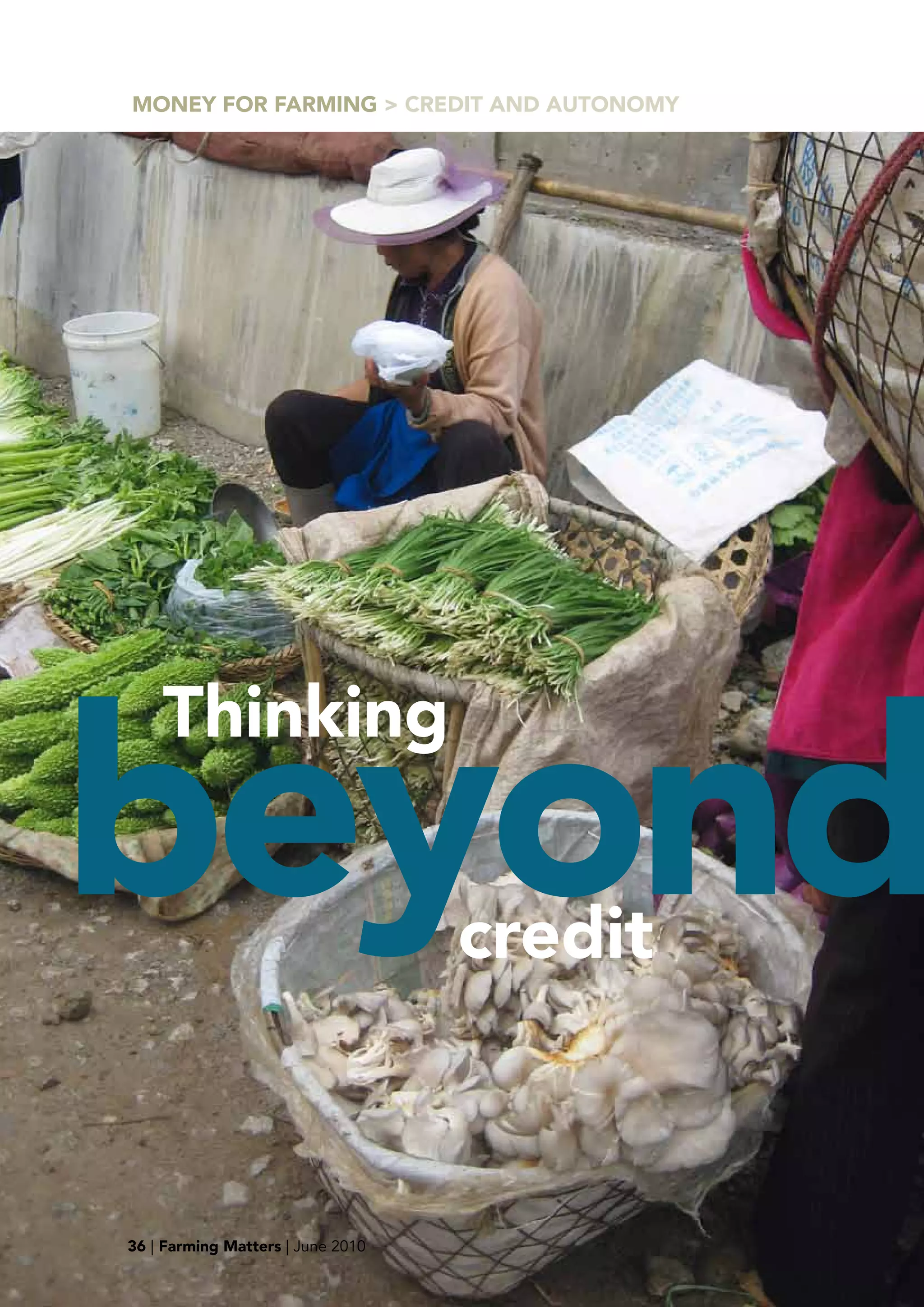
These efforts complement the formal or informal credit                                                which farmers
options which are sometimes available. But in villages                                                can then use.
like Katundulu, in Malawi, only nine percent of all                                                   Better decision
households have access to credit. In contrast, many                                                   making patterns
more receive coupons for subsidised fertilizer from the                                               lead to better
government. In some cases these credits are sold and          businesses. This, in turn, can lead to more credit
the money then used for other needs. The Enabling             options.
Rural Innovation (ERI) programme, supported by the            want to know more? write to Mariam A.T.J. Mapila, at
International Center for Tropical Agriculture, aims           the Department of Agricultural Economics, Extension
to help farmers make better decisions, and thus make          and Rural Development, University of pretoria, South


  Nigeria
better use of the limited credit available to them. Their     Africa. E-mail: maleytata@yahoo.com


More options through a strong organisation

H
             ow to help farmers get credit without            succeeded in securing loans from NACRDB, the
             actually providing it? The PROSAB                Nigerian Agricultural Cooperative and Rural
             project (Promoting Sustainable                   Development Bank. Others developed a system to
             Agriculture in Borno State) in Nigeria,          provide financial resources using the savings of their
implemented by the International Institute of Tropical        members (following the examples of savings and credit
Agriculture, focuses on the important role which              co-operatives from many countries). Members of these
Community Based Organisations (CBOs) can play.                organisations were also encouraged to work together
CBOs are formal, legal entities, rooted or based in a         – for example, by jointly buying inputs, or by making
specific community. This project has trained farmers          these available to others, with interest. Nowadays,
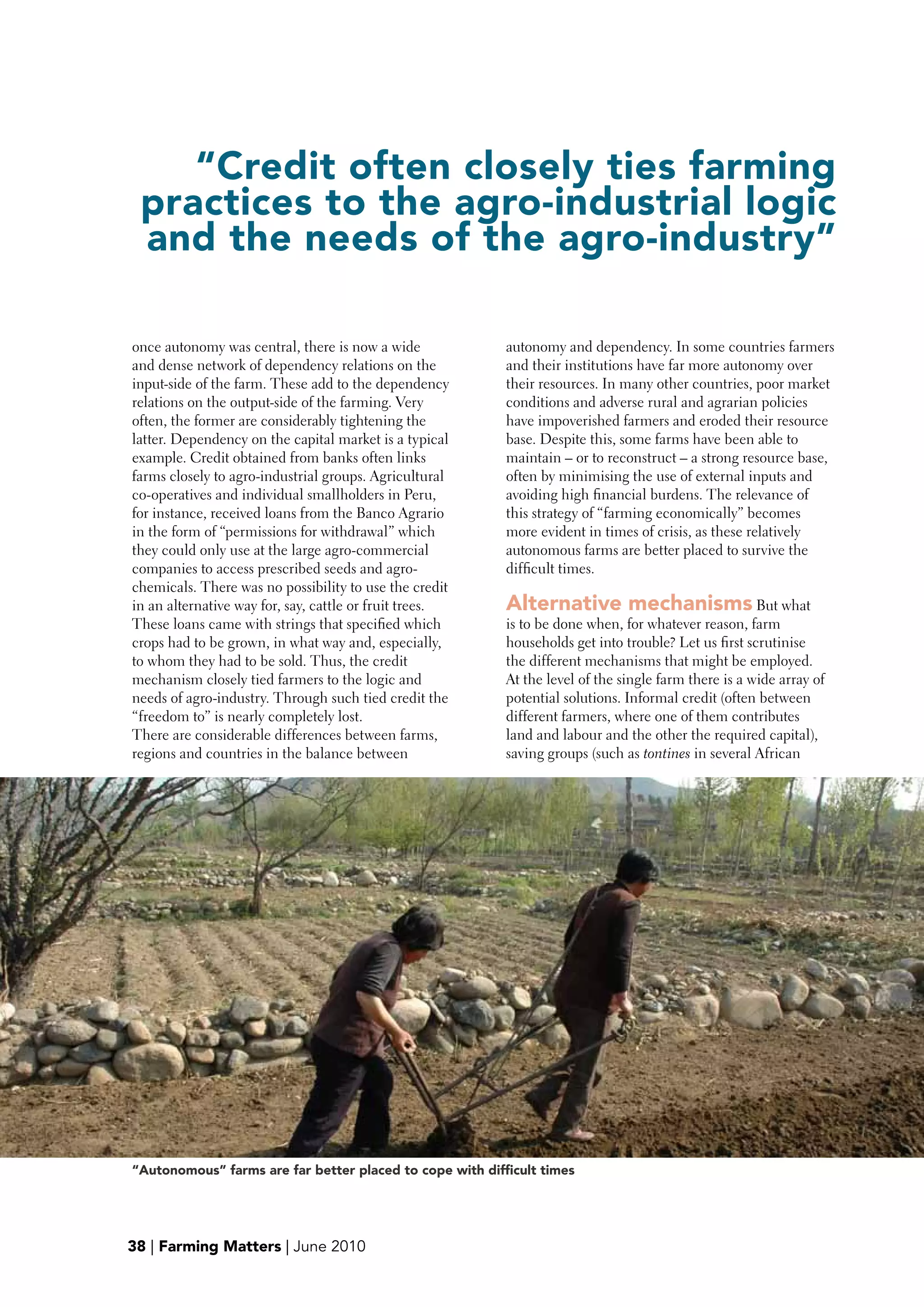
in 30 communities in Borno State on how to form               farmers in Borno not only show a strong savings
and register a CBO, and assisted them in the process          culture (even providing part of their harvests in order
of doing so. Over                                             to secure future credits); their organisations also give
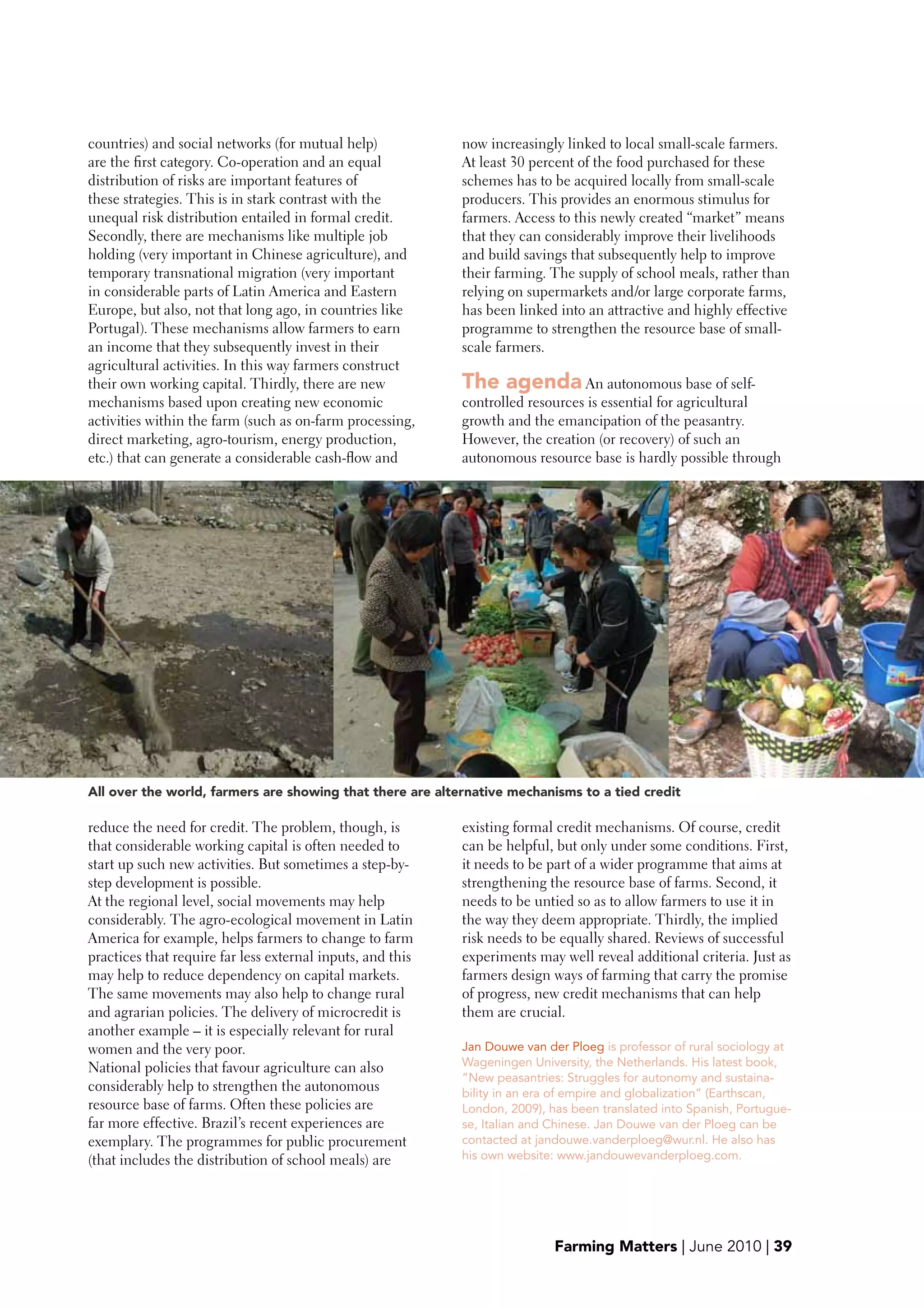
200 CBOs were                                                 them a stronger bargaining power.
formed during the                                             want to know more? write to Kolawole Ogundari,
project’s six years                                           formerly at the pROSAb project, IITA, Ibadan, Nigeria.
life span. Many                                               E-mail: kolawole.ogundari@agr.uni-goettingen.de


                                  Photo: Muideen Salawu
England
Diversification into tourism

b
           eechenhill Farm is a 37 ha organic dairy
           farm in the Peak District National Park, in
           the centre of England. Together with her
           family, Sue Prince has lived and worked
there for 25 years. Although they have access to banks
and mortgage corporations, their main source of


                                                                                                                      Photos: Sue Prince
finance comes from their own tourism business. At
first they used a small bank loan to build two bed-and-
breakfast rooms. Having repaid the loan, they used
the profit from the B&B to convert an old stable into a
romantic cottage for two. Later they converted the old
milking barn into a cottage with wheelchair access.
As a result, many tourists are able to stay at the farm,
and enjoy the peace and the excellent local food. The        like building a house for our daughter and son-in-law.
income from this small business supports the farm            And we haven’t had to change anything here to please
and helps Sue and her family to continually improve          the tourists: they come to stay because they want to
the quality of the accommodation and services they           see how we live and work.”
provide. “Once we started the tourism business,              More information? please write to Sue prince by
alongside the farm, we didn’t need to borrow any             sending an e-mail to the editors, Farming Matters, at
more money – except to finance large developments            ileia@ileia.org.


Brazil
Broad-based revolving funds

T
         he north-eastern region of Brazil has an
         arid environment. For many decades, the
         authorities’ response to the difficulties
         faced by farmers was to build large scale
                                                             a revolving fund. Farmers who receive a loan pay
                                                             it back either in money or in kind, and this is
                                                             then “transferred” to another family. After several
                                                             years, CAATINGA no longer works directly with
infrastructure, such as dams and reservoirs, which           families, but with local farmers’ associations. This
were seen as promoting agriculture. But this                 change has helped them become more efficient and
hardly benefited small-scale farmers. Since 1987,            has led to greater involvement of the population.
                                   CAATINGA, a               The associations determine the interest rate and
                                   local NGO, has            assess grant applications. Working through farmer
                                   been promoting the        associations has helped CAATINGA reach a
                                   dissemination and         much broader audience. At the moment, they are
                                   replication of locally    directly working with 39 associations in the state
                                   specific solutions –      of Pernambuco, and the fund that serves these
                             Photo: Sofia Naranjo


                                   in particular those       associations now totals more than 700,000 reais
                                   which make the best       (or US$ 400,000).
                                   of the little available   want to know more? please write to burguivol Alves
                                   water. As part of         de Souza (burguivol@caatinga.org.br) or to Giovanne
                                   their approach            Henrique Satiro Xenofonte (giovanne@caatinga.org.br),
                                   they established          at CAATINGA


                                                                            Farming Matters | June 2010 | 41
CALL FOR CONTRIbUTIONS


partnerships for learning
                                                       organisations, traders, multinationals and banks.
                                                       In one way or another, their involvement shapes
                                                       the decisions that farmers take. To what extent
                                                       do these different stakeholders work together?
                                                       And, does this increase learning?
                                                       The hunger experienced by many people in the
                                                       world, and the likelihood that their numbers
                                                       are bound to increase further due to climate
                                                       change, gives a sense of urgency to the need
                                                       to involve different voices in developing a more
                                                       sustainable approach to farming. The December
                                                       issue of Farming Matters will focus on how all
                                                       these different stakeholders are learning to work
                                                       together to make agriculture more sustainable,
                                                       by developing new ideas and solutions or
                                                       disseminating them. We want to explore how
                                                       different stakeholders deal with difficulties,
                                                       which might be related to a lack of funds or
                                                       power issues, and whether by working together
                                                       they are able to find solutions which lead to
Photo: Joshua Spetter                                  better farm practices.

Farmers learn continuously; they carry out             We welcome your suggestions for articles,
experiments and regularly develop new ways of          articles themselves, photographs, contacts of
farming. In many cases, they are supported by          people you think have expertise in this area or
projects or programmes that seek to enhance            ideas for topics you feel we need to address.
this learning. But farmers and extensionists are       Please write to Jorge Chavez-Tafur, editor,
not the only players in the field. Researchers and     (j.chavez-tafur@ileia.org) before August 15th,
policy makers also play a key role, as do farmers’     2010.


On our websiteg
Olivier De Schutter, special rapporteur on the right   states, among other things, that large agribusiness
to food for the United Nations, has presented          corporations exercise a disproportionate influence
a review on the progress made by a number of           on governments. To view De Schutter’s review,
countries in implementing the human right to food      his other reports, and the interview with Farming
at national level. The review highlights concrete      Matters, visit our website, www.ileia.org. It keeps
examples of initiatives recently taken by countries    you updated on events, vacancies and the latest
such as South Africa, Brazil, Mozambique, India        publications, such as the recently published
or Nepal.                                              report “(Mis)investment in agriculture”, by the
The March issue of Farming Matters featured an         Oakland Institute, on the role of the World Bank in
interview with Olivier De Schutter, in which he        facilitating land grabs.


42 | Farming Matters | June 2010
OpINION


T
       wenty years of Earth Summits and numerous dialogues
       of the Convention on Biological Diversity have done
       little to improve the situation of local communities
that depend upon natural resources, or of the disadvantaged
people living in abject poverty in biodiversity-rich regions. In
                                                                   professor Anil Gupta teaches innovation
1990 I wrote a paper, “Why does poverty persist in regions
                                                                   management at the Indian Institute of Management
of high biodiversity?” Since then much more evidence has           in Ahmedabad. He is the founder of the Honey
emerged to show that the regions with the most malnourished        Bee Network (www.sristi.org), which collects and
children almost completely overlap with the biodiversity-rich      disseminates traditional knowledge and helps
regions. How can we justify the billions of dollars that have      facilitate grassroots innovation.
been spent on inter-governmental panels with practically no
change in the rights of, and opportunities for, these people?
National governments and civil society must bear some
responsibility for this situation and for changing it. I propose
a few policy changes to make a small dent on the situation.

Every scholar, company or state agency collecting knowledge
and/or resources from a local region must be obliged to share
the findings, and the use they have put that knowledge to,
with the local knowledge and resource providers. The default
condition must be an acknowledgement of every substantive
personal communication used in publications and/or product or
service development. To date there has not been a very good
record of benefit-sharing. Most companies using resources
from tribal regions share hardly any benefit with the tribal
communities, either in terms of knowledge, monetary or other
material benefits, capacity building, etc.

An internationally co-ordinated research programme must
be mounted to add value to local brews, local grains and
other foods, many of which can provide a valuable source of
nutraceuticals. Such an investment would pay for itself very
quickly, and would have a strong poverty reducing effect. For


                                                                   From
instance, opuntia fruit provides a wonderful purple dye and a
single cup of a drink based on it can provide half of the daily
iron requirement of a person. The cactus from which this fruit
comes is collected by the very poorest people because of the
discomfort in harvesting the fruits. The genebanks worldwide
lack such information.


                                                                   rhetoric
We can all monitor our consumption patterns and identify the
scope for using products and services provided by disadvantaged
people in high risk environments. This is the only way we can
connect our lives to theirs in a positive manner. Without doing
so, peace and sustainability are out of question. The increasing


                                                                   to reality
recourse to violence by disaffected tribal people should make
us realize the urgency of the current situation. Can the UN
and other bodies not regularly disseminate precise indicators
and information about how consumption in everyday life can be
switched so that it supports biodiversity conservation?


                                                                      Farming Matters | June 2010 | 43
MONEY FOR FARMING > MICRO-INSURANCE


                    deal
Helping                                           farmers


                      with disaster
Farmers need more than loans to sustain their business.
Micro-insurance can help farmers avoid falling into poverty
traps because of disasters.
Text and photo: Thomas Loster


w
                 hen farmers in, for example, Africa           triggers the insurance mechanism, before nature
                 experience a severe drought that kills        takes its toll. Money flows immediately, allowing
                 livestock, and harms family members,          farmers to cope much better with the situation –
                 they are often left with no livestock         before the drought creates tremendous problems. The
and no yield. In the most extreme cases this may               money allows them to buy food or grains; families
trigger (international) aid programmes. However,               can survive, livestock can be better protected. This
the processes of risk and loss assessment are often            particular scheme in Ethiopia covered a few hundred
cumbersome and bureaucratic, involving a lot of                thousand farmers, the sum insured was US$ 7 million.
paperwork and data processing. It can take many                This is the advantage of micro-insurance in a nutshell.
months, sometimes more than a year, before any                 Normally, when disasters occur, money may flow, but
compensation makes its way to the farmers to enable            only after a long and complex assessment. Micro-
them to rebuild their lives. In many cases, it arrives         insurance, in this case index insurance (insurance
too late.                                                      based on an external indicator, like weather patterns,
In 2006 the World Food Program piloted a pioneering            which triggers a payment to all insured clients), can
insurance scheme in Ethiopia to enable farmers to              work even before a disaster strikes.
insure themselves against heavy drought. The scheme
takes the most severe drought years of the past as a           Obstacles and promising
baseline. If indicators show a historically extreme            concepts In many countries in South America,
drought is coming, money is immediately paid out,              Asia and Africa, micro-insurance products are difficult
before the crisis arises and there is a shortfall in yields.   to establish for want of suitable or reliable data. It is
This is not a difficult assessment to make; it just            also difficult to win people’s trust and understanding
involves looking at weather data. In Ethiopia the rains        for insurance schemes when they have not previously
between March and October are the trigger period.              had experience with financial services. It is very
If there is no rain in early in the year, then it is clear     difficult to explain that their premium payments are
that there will be not enough yields in autumn. This           not savings.


44 | Farming Matters | June 2010
countries. Droughts are among the most destructive
Thankfully, there are now plans to remove such             natural catastrophes, laying waste to entire regions.
obstacles. Apart from the programme in Ethiopia,           Year after year, millions are affected by this scourge,
in recent years a number of new micro-insurance            which if it does not destroy lives can destroy the will
solutions have been devised to cover the risks of poor     to live. Countries with poor harvests, or where they
crop and livestock farmers in Asia and Africa.             frequently fail completely, will face even bigger risks
India, for example, has micro-insurance programmes         in future.
under which farmers can insure their livestock.            The African continent is particularly drought prone.
This provides a way of mitigating losses caused by         In Ethiopia alone, droughts caused hundreds of
catastrophic events. In Mongolia, where livestock          thousands of deaths in the 1970s and 1980s, when
farming is of major importance, livestock farmers          millions were subjected to extensive periods of
have been able to cover themselves against adverse         drought. Sudan, Malawi, Chad and Mozambique
weather conditions since 2006. Premiums are low,           also struggle with extremely arid conditions. United
and the scheme has been subsidised by the state            Nations scientists believe that climate change will
and the World Bank. The scheme is doing fine               further aggravate these climatic extremes, and that


Even if gradually, micro-insurance programmes are helping reduce vulnerability

and developing. In the same way, tobacco and               the number of people on the world’s poorest continent
peanut farmers in Malawi have been able to insure          affeted by drought could soon exceed the 200 million
themselves against lack of rainfall since 2006.            mark.
Microloans for failed harvests are insured in this         Micro-insurance is but one adaptation strategy, and
way, so that people can cope better when there is a        index products can provide an appropriate approach
drought.                                                   for working with poor communities. In the long term
These examples are early promising solutions.              it could even open up future markets to the insurance
However, it is vitally important that the scope of these   industry, as well as offering farmers security and new
insurance products extends over several years (which       opportunities.
implies building long term relationships), that the
                                                           Thomas Loster (tloster@munichre-foundation.org) is an
products are tailored to the needs of the people, and      insurance expert specialising in climate change and natural
that there is a sufficiently broad geographical spread,    disaster. He is a geographer and chairman of the Munich
so that the micro-insurance providers can deal with        Re Foundation.
the costs and financial risks of such programmes.
                                                           More Information
Micro-insurance and climate                                News and information about micro-insurance can be
change Micro-insurance is especially relevant              found online at www.microinsurancenetwork.org and also
when considering the effects of climate change.            at www.microinsurance.org. An international conference
More irregular precipitation, more flash floods, more      on micro-insurance, hosted by the Munich Re Foundation
extreme droughts; all increase risks in the agricultural   and the Micro-insurance Network, will take place in Manila,
sector and affect farmers, particularly in developing      Philippines, from 9 to 11 November 2010.


                                                                           Farming Matters | June 2010 | 45
GLObALLY CONNECTED > NEwS FROM THE AGRICULTURES NETwORK


In the International Year of Biodiversity                                    AS-PTA, says Gabriel: “Until now,
                                                                             I haven’t seen one GMO crop that
one can’t avoid the issue of genetically                                     has something to offer to farmers or
modified organisms (GMOs). What’s                                            consumers. Every seed is patented
going on in the world with GMOs? Our                                         and this takes away the right of
                                                                             farmers to save their own seeds.
partners report.                                                             We are talking about the future of
                                                                             farming and the future of food.”
                                                                             AS-PTA is supporting actions by
                                    campaign against GMOs. AS-               farmers to protect their seeds and
                                    PTA is currently engaged in a            crops. Locally, they try and track
                                    lawsuit, trying to stop GM maize         contamination. “We have meetings
                                    from being grown in Brazil. “GM          with local farmers’ organisations,
                                    maize was introduced in Brazil in        where we discuss local seeds and
Photo: Gabriel Bianconi


                                    2008. Until then, GM crops were          biodiversity. There is a quick test
                                    mostly soy varieties – some 50 to 55     to check for contamination. We
                                    percent of soybeans grown in Brazil,     take this test to meetings where
                                    amounting to some 10 million             farmers exchange seeds. In this
                                    hectares, were transgenic. These         way, they learn about the issue and
                                    seeds got mixed with conventional        can safely exchange their seeds,
                                    ones and contaminated the crops of       without having to fear the spread of
                                    conventional and organic farmers.        contaminated seeds.”
                                    With maize the situation is even         The challenge for AS-PTA
Gabriel bianconi                    worse, since cross pollination           lies in showing the courts that
Fernandes, brazil:                  occurs when the pollen is carried,       contamination is an issue that poses
“we are involved in                 sometimes hundreds of metres, by         a real threat to farmers. For more
a court case trying                 the wind.”                               information on GM crops in Brazil,
to stop GM maize”                   Farmers are concerned, as “trans-        and on the court case, see
Gabriel Bianconi Fernandes works    genic maize cannot co-exist with         www.aspta.org.br.
for AS-PTA, the Brazilian partner   regular maize. Once a seed is
of the AgriCultures Network (and    contaminated, it will start displaying   K.V.S. prasad, India:
publisher of Agriculturas). He is   GMO characteristics. Official            “privately funded
an agronomist. He is also one       regulations require a distance of        research is a big
of the country’s leading experts    a mere 20 metres of isolation, so        problem”Last October in
on GMOs and is involved in the      contamination is a real threat.”         India, the Minister of Environment
co-ordination of the national       GMO crops are not an option for          and Forests was asked to approve a


47
46 | Farming Matters | June 2010
term effects on health and the                         some openness to GMOs and to
                                            environment? And to what extent                        agro-business multinationals. At
                                            will it encourage monopolies?                          the same time, we are very weak
                                            People felt the whole process was                      in monitoring and evaluating the
                                            not given time to mature. It became                    introduction of such species.
                                            clear, also from views expressed by                    The role of governments is
                                            distinguished scientists like Dr. M                    fundamental: they have the
                                            S Swaminathan and Dr. Pushpa                           responsibility to inform actors
                                            Bhargava, that research should                         and protect national resources.
                                            be more extensive, and above all,                      But on the pretext of modernising
                                            independent and publicly funded                        agriculture they are supporting
       Greenpeace volunteers, Mumbai        “We need more public investment                        controversial technologies and
                                            in research. GM crops should not                       choosing to ignore warnings
recommendation from the Genetic             be the preferred option in providing                   from civil society and farmers’
Engineering Approvals Committee             food security”.                                        organisations.”
to start large scale cultivation of         The Minister has recently issued                       Information on critical issues
Bt brinjal, a genetically modified          a moratorium until there is                            like GMOs is crucial, says Awa.
eggplant resistant to the shoot             more understanding about the                           There is a right to information,
borer. Although India already               consequences of Bt brinjal, and no                     which needs to be repackaged
has GM cotton, the committee’s              specific time frame has been fixed                     so that it is accessible to farmers.
recommendation was controversial.           for reaching a decision.                               “There is a large role for magazines
K.V.S. Prasad, chief editor of LEISA                                                               like ours, because at the moment,
India, the Indian edition of the            Awa Faly ba Mbow,                                      the information is one-sided.”
AgriCultures Network, explains              Senegal: “The role
why. “This time it was a food               of governments is
crop that was involved. Brinjal is          crucial” Awa Faly Ba Mbow,
widely consumed as a vegetable in           editor of Agridape, the West
India, so this directly concerned           African edition of the AgriCultures
people’s health.” The Minister              Network, has no doubts that GMOs
turned the question of whether              are an issue. “There certainly is Bt
to start producing Bt brinjal into          cotton and Bt maize in the region.


                                                                                                                                        Photo: Stephen Yafa
a public debate and harvested               In Mali, Burkina Faso and Senegal
a lot of views from scientists,             there is a certain ambiguity:
state governments, NGOs and                 biosecurity laws exist to regulate
consumers. People started to realise        the use of GMOs and governments
there are still many unknowns               see GMOs as a potential solution
about Bt brinjal. What are the long         to food crisis. These laws show


COLOpHON
Farming Matters              Address                           euros, individuals 25 euros.       Design & layout            The editors have taken
Small-scale agriculture      P.O. Box 2067, 3800 CB,           Please see page 25.                Frivista, Amersfoort,      every care to ensure that the
for a sustainable society    Amersfoort, the Netherlands                                          the Netherlands            contents of this magazine
                                                               The AgriCultures                                              are as accurate as possible.
Farming Matters is           Visitors address                  Network                            printing                   The authors have ultimate
published quarterly by       Zuidsingel 16,                    ileia is a member of the           Koninklijke BDU Grafisch   responsibility, however, for the
ileia                        3811 HA Amersfoort,               AgriCultures Network;              Bedrijf B.V., Barneveld,   content of individual articles.
                             Tel: +31 (0)33 467 38 70,         eight organisations that           the Netherlands.
                             Fax: +31 (0)33 463 24 10          provide information on                                        Volume 26.2
                             E-mail: ileia@ileia.org           small-scale, sustainable           Funding                    ISSN: 1569-8424
                                                               agriculture worldwide, and         The ileia programme is
                             Editorial team                    that publish: LEISA Revista        funded by Sida and DGIS.   ileia uses the Attribution-
                             This issue has been compiled      de Agroecología (Latin                                        Noncommercial-Share
                             by: Jorge Chavez-Tafur, Petra     America), LEISA India (in          Cover photo                Alike 3.0 Unported Creative
                             Rooijakkers, Mundie Salm,         English), Majalah Petani           Folkert Rinkema            Commons Licence.
                             Frank van Schoubroeck,            (Indonesia), Agridape                                         For details please see
                             Mireille Vermeulen and Edith      (West Africa, in French),                                     www.creativecommons.org.
                             van Walsum.                       Agriculturas, Experiências
                                                               em Agroecologia (Brazil),
                             Subscriptions                                 (China), and Kilimo
                             Subscription rate for one year    Endelevu Africa (East Africa,
                             (four issues): organisations 45   in English).
                                                                                                 Farming Matters | June 2010 | 47
ARTICLE > GROwTH IN THE SOUTH IS CUTTING DOwN


“wE CREATED MICROCREDIT TO
 FIGHT THE LOAN SHARKS; wE
 DIDN’T CREATE MICROCREDIT TO
 ENCOURAGE NEw LOAN SHARKS”
Muhammad Yunus, developer of the concept of microcredit, on the increasing emergence of commercial microcredit lenders,
some of which charge interest rates as high as 100 percent. The New York Times, “Banks making big profits from tiny loans”,
April 2010.


                                                                                                     “Farmers
     “YUNUS TALKS AbOUT MICROFINANCE AS
   A SOCIAL bUSINESS. wE FEEL THAT IN FACT                                                            need risk
  YOU HAVE TO STRUCTURE THINGS IN A FOR-
   pROFIT wAY, YOU HAVE TO pAY INVESTORS                                                         management
HIGH DIVIDENDS, bECAUSE OTHERwISE THERE
  IS NO wAY YOU ARE GOING TO ACCESS THE                                                        tools. They are
          CApITAL THAT pOOR pEOpLE NEED”
          Vikram Akula, founder of SKS Microfinance, India’s fastest growing                   not going to be
           microfinance institution. http://microfinanceafrica.net, May 2010.
                                                                                                    innovative
                                                                                                 if there is no
      “Credit by itself cannot support rural                                                        safety net”
      agricultural development. Putting in place                                                                           Neil Sorensen of
                                                                                                                        IFAP (International

      shared risk mechanisms and diversifying loan                                                                Federation of Agricultural
                                                                                                                          Producers), at the
      portfolios are some of the conditions that                                                                      conference “The Art
                                                                                                                               of Farming”,
      encourage better developed and more viable                                                                       May 2010, Brussels.

      finance in the agriculture sector”
      FARM Foundation (Foundation for World Agriculture and Rural Life) held a conference on agriculture and
      microfinance in 2007. This is quite a while ago, but the papers on the conference provide lots of useful input
      from people worldwide. They can be accessed at www.fondation-farm.org. This particular quote is from Alou
      Sidibe of Kafo Jiginew, a federation of credit unions in Mali.


      “THE FUTURE OF FINANCIAL INCLUSION LIES
             IN MICROFINANCE bEYOND CREDIT”
    Jim Roth of LeapFrog Investments, the world’s first microinsurance fund, on the importance of providing people in developing countries with
                           financial products and services beyond microcredit, such as savings and insurance, on www.vccircle.com, April 2010.


                    Farming Matters is published by ileia, the Centre for learning on sustainable agriculture. ileia is
                    a member of the AgriCultures Network; eight organisations that provide information on small-
                    scale, sustainable agriculture worldwide. www.ileia.org

Farming matters

  • 1.
    FARMING Small-scale agriculture fora sustainable society June 2010 - 26.2 MATTERS Formerly known as LEISA Magazine Banking for the unbankable Money for farming ❚ Thinking beyond credit ❚ ReachingMatters | March 2010 | 1 the missing middle ❚ Risk management for small farmers Farming
  • 2.
    EDITORIAL Small farmers, big business T hree hundred bright minds from business and industry, science, governments, NGOs and farmers’ organisations, recently met in Brussels at an international conference called “The Art of Farming”. They explored the potential of sustainable business models that include small-scale farmers. Is this too good to be true? What lies behind this new interest in small farmers? And what are the potential problems and opportunities? There are two main reasons for the global agro-industry’s interest in small- scale farmers. First, there is increasing demand from consumers for fair and sustainable products. This has alerted the industry to the importance of managing reputation. A recent example is the consumer campaign that led Nestlé to decide not to use palm oil produced on plantations cleared from rainforests. Second, and more importantly, agro-industry is keenly aware of the looming dangers of climate change, which they recognise could endanger supplies of raw materials. They see the wisdom of diversifying supplies and spreading their risks. Together, these two factors are pushing the industry to explore the possibilities of doing more business with small- scale farmers. Yet this brings the complexity of having to deal with large numbers of people, who are considered to be risk averse. They realise that they cannot manage this challenge on their own and are looking to establish innovative partnerships with NGOs and farmers’ organisations who can help them explore this new territory. What might this mean for small farmers and the organisations that work with them? Is this going to be a win-win situation, as reports of some successful experiences suggest? Or will things be more complicated? Much will depend on the space these farmers get in these new partnerships. Will they be able to build on their own strategies towards risk diversification and maximising their options? Or will they be driven towards commodity production and become completely dependent on a single cash crop? While small-scale farmers need money, they also need to maintain a sustainable resource base. This is more than risk aversion: it is a very sensible strategy in a hostile environment. Many small-scale farmers are women. Yet the majority of speakers at the conference in Brussels were men. There is no easy match between the compelling financial logic of agro-industry and that of small-scale women farmers. Let us actively engage with agro-industry and farmers and try to make sense of it together. Edith van Walsum, director ileia 3 2 | Farming Matters | June 2010
  • 3.
    THE FUTURE OFFAMILY FARMING The philosophy of slow growth L a Cabrita is a real family farm. Guicella succeeded building our farm without becoming Igreda Lix (40) and her father Don Manuel dependant on others. We didn’t want debts at (80) manage the goat breeding and forage the bank. But after the fire we were compelled to cultivation together. Guicella’s mother, brother and ask for a loan”. They got the loan, repayable over two sisters are responsible for pigs, poultry and two years, from a local NGO with a microcredit the dairy and cheese plant. La Cabrita’s products programme. Guicella is positive about the NGO: have gained international organic certification, a “The interest rate is similar to commercial banks, big success for a small farm of just 2.5 hectares but not the requirements. The NGO knows us on some rocky slopes in Cerro Puquio, in the arid and the way we work, they have confidence in coastal zone northeast of Lima, Peru. When the us”. The Igreda family doesn’t need larger loans family started in 1998, they had almost nothing though: “The stress of being in debt would make and invested little by little. They managed to us forget the small things. We have a philosophy overcome, without any outside help, the theft of of slow growth, for us that is the crucial point of the capital from the sale of their house, but the sustainability.” fire at the dairy plant two years later was more difficult, as Guicella explains. “We had tried and Text: Mireille Vermeulen Photo: César Malca-Kukin Farming Matters | June 2010 | 3
  • 4.
    CONTENTS 10 Local resources: Great capital How can farmers access capital when commercial banks consider them “unbankable”? The solution lies in making the most of local resources. Rural villages can raise their own funds and use these for loans, says Alfred Lakwo, of the Agency for Accelerated Regional Development in Uganda. Big problems demand big 14 ambitions The World Rural Forum wants the United Nations to declare an International Year of Family Farming. In an interview with Farming Matters, José Antonio Osaba explains why. “Family farming can be a very significant instrument to overcome hunger and poverty.” Osaba and his team have set themselves a huge task, but then, he says, problems in the rural areas are also huge. Ensuring finance with a 18 contract Zambian Breweries, a subsidiary of the brewing giant SABMiller, produces a local beer from locally produced sorghum. Contracts with a large number of subsistence farmers provide these farmers with a link to a commercial market, and a secure income. Advanced payments help farmers buy the necessary inputs. Is the Eagle beer case an example to follow? 36 Thinking beyond credit Yes, credit can be a useful instrument for farmers to improve their income. But it does have its drawbacks. Credit programmes often undermine farmers’ independence and oblige them to take all the risk. Jan Douwe van der Ploeg assesses the pros and cons, and looks for alternatives. 5 4 | Farming Matters | June 2010
  • 5.
    AND MORE MONEY: 2 Editorial: Small farmers, big business bRIDGING 3 The Future of Family Farming: The philosophy of slow growth THE GAp 7 Our readers write 8 Theme overview: Money for farming bETwEEN 21 Opinion: Land grabs and food aid do not help African farmers, says Rachel Zedeck SUppLY 22 Making farmers bankable. A new approach to upscaling agricultural finance for the missing middle 25 Readers’ service AND 26 Two views: Should farmers get paid for providing ecosystem services? DEMAND 28 Trade finance. Money when it is needed 32 Mind! New in print / Reading up on agricultural and rural finance 34 Inspired by ... How reading a manual on documenting experiences led to a new lobbying tool 35 Learning about ... Rural finance 40 Locally rooted: Ideas and initiatives from the field 42 Call for contributions 43 Opinion: If biodiversity is so important, then why is there so much poverty in regions rich in biodiversity? 44 How farmers can deal with disaster. Micro-insurance as a step towards financial inclusion 46 Globally connected: What’s going on in the world with GMOs? Our partners report FARMING MATTERS informs readers about sustainable, small-scale farming. It offers discussions, background to the news, opinions, research findings, and practical examples of how sustainable, small-scale farming contributes to 8 providing food security, social justice, a healthy environment and development. Farming Matters is for policy makers, researchers, practitioners, educators, farmers, and everybody else interested in agriculture and development. Farming Matters is published four times a year and has subscribers in more than 150 countries. It is the global edition of the worldwide AgriCultures Network, a network of eight organisations, of which the other seven members publish regional editions, in six languages. Together, the magazines This magazine is printed on reach more than 50,000 subscribers. For more information, see recycled paper www.agriculturesnetwork.org. Farming Matters | June 2010 | 5
  • 6.
    Advertisements 7 6 | Farming Matters | June 2010
  • 7.
    OUR READERS wRITE We welcome comments, ideas and suggestions. Send an e-mail to ileia@ileia.org or write to P.O. Box 2067, 3800 CB Amersfoort, the Netherlands. Livestock services: their own shops, so you end up overview in your livestock issue. I spending the same amount as if you raise 350 laying chickens. I practise free or fee? (1) had gone to a private practitioner. mixed farming whereby I grow If livestock output is to be I think the best way to go about it bananas, maize and groundnuts. improved, farmers should be would be to train para-vets in every I use poultry manure for the provided with free or highly locality, as some NGOs are doing. bananas. I have four children. My subsidised livestock services, The para-vets should be provided dream is to become a successful especially when it comes to animal with the most essential equipments poultry farmer in the Kayunga health because peasant farmers and drugs. These people not only district, in central Uganda. What constitute the major producers of get a job, they provide the services I would like is to be linked up food animals. And, in developing near the people and at reasonable with a successful poultry farmer countries like Nigeria, they have charges. elsewhere, who can be my role the following features: They are Stephen Kimole, Institute for Organic model and if possible can extend into small-scale farming (livestock Farming, Kenya, on our Open Forum a helping hand in the extension of and crop); they are low-income my poultry house project. earners; they are concentrated in Needed: a change in Richard Lubega, Uganda, through rural and less-urban areas; they e-mail have little or no access to modern strategies management techniques; they Billions of dollars are spent maintain their livestock mainly every year on food aid. Yet there Mistake with forages, farm/domestic food are still more than one billion May I just make a minor correction wastes and no or low external people suffering from hunger, to the article “Re-assessing the inputs and no concentrates of and children suffering from fodder problem” in your previous compounded rations; they rear malnutrition. Investment in small- issue: Stylosanthes hamata is not a more, but with marginal outcome, scale farming and combining grass, it is a legume. and they have scarce or no access to traditional farming methods with Oscar B. Posa, through e-mail livestock service providers because modern technologies adapted to the majority of such providers local conditions, would create Keep it up detest working in local/remote possibilities for sufficient local food communities. and fodder production that would I find your magazine a very useful Kazeem Akimboye, Department of alleviate hunger. Offering families source of ideas and information Veterinary Public Health & Preventive a small kitchen garden would concerning my work with natural Medicine, Nigeria, on our Open Forum eliminate child malnutrition in the resource management and rural shortest time. Return on investment development within Zimbabwe Livestock services: would be remarkably high. Why and the surrounding areas. I look not change strategies in our world forward to each new copy and free or fee? (2) food programmes? my ambition one day is to be a Currently this service is free in Willem van Cotthem, Scientific contributor. Keep up the good Kenya but this has not helped poor Consultant for Desertification and work. farmers. This is because the officers Sustainable Development, Belgium, on Robert Cunliffe, researcher, Zimbabwe, sent by the government normally our Open Forum through e-mail set up their own shops where they stock the necessary equipment and drugs. When farmers go to them My dream for assistance, they are told to buy As a typical Ugandan poultry For more letters, the needed drugs and syringes from farmer, I enjoyed the theme see www.ileia.org Farming Matters | June 2010 | 7
  • 8.
    THEME OVERVIEw >MONEY FOR FARMING benefits Everybody from financial products for small-scale farmers Money for farming not only means access to credit, but also access to other financial products and services. Small-scale farmers can also benefit from being able to insure themselves against risk and being able to save. When it comes to money, there is a gap between what small-scale farmers need and what they have access to. But this gap can be overcome, as this issue shows. Text: Petra Rooijakkers T here is no farming without money. As From microcredit to The Economist put it last May, “Few microfinance If microcredit is not the farmers, big or small, are free of debt.” obvious answer for small farmers, then what is? We Every farmer that wants to expand – or asked Janiece Greene of Women’s World Banking even maintain – his or her business about the role of women in finance and farming. She invariably needs cash. This issue could highlighted the need for a broader look at small- have focused solely on this problem: the need for scale farmers’ needs: “Farmers need other financial cash implies a need for credit, and as most small- products besides access to credit. Being able to save scale farmers need relatively small amounts of credit, money, for example, can help a farm family meet microcredit and its potential for helping farmers with unexpected drawbacks.” According to her, the grow would have become the point of departure. “new frontier” in microfinance lies in providing But microcredit is not always the solution farmers possibilities for saving, especially in rural areas. This are looking for, and they benefit from it less than could be good news for women, as they often not other sectors. Their need for credit may be relatively only do the farming, but also the saving. “We need to small, but it is still larger than that of the average think less in terms of microfinance and more in terms micro-entrepreneur. Farmers need access to credit of financial inclusion.” over a longer period of time as they have to wait Financial inclusion – the delivery of banking services until harvest time, or later, until they can pay back at affordable costs to low income groups – means a loan. In 2008 FARM, the Foundation for World looking beyond credit. It also involves small-scale Agriculture and Rural Life, held a conference on farmers being able to insure themselves against microcredit’s contribution to meeting the financial climatic catastrophes. On page 44 of this issue needs of agriculture. One of the conclusions was Thomas Loster of the Munich Re Foundation shows that, unlike micro-enterprises, agriculture cannot how this kind of insurance can be made accessible to sustain above market interest rates as the financial small-scale farmers. returns are not high enough. According to FARM, Of course farmers still need credit and they have “Microfinance has not been able to respond to more difficulties getting it. Small-scale customers are not a than a small fraction of the needs of agriculture high priority for big financial institutions. In addition, in developing countries for financial services.” In farming is considered a risky trade, with many India, for example, the total flow of microcredits in uncertainties – which will only increase as the effects > 2006-2007 was US$ 1.87 billion, of which just eight of climate change make themselves felt. Add to this percent went to agriculture. the financial crisis, which makes banks less inclined to 8 | Farming Matters | June 2010
  • 9.
    lend money, evento businesses that are less risk prone, Technology helps farmers Yet and one can see that small-scale farmers have a tough underneath all this it is undeniable that it is time financing their operations. With climate change expensive to provide financial services to small threatening agricultural output, and a population customers, in out-of-the-way areas with poor estimated to grow by an extra 2.5 billion by 2050, infrastructure. Technology is changing this. even multinational food corporations are now looking Brick and mortar structures are being replaced by towards sustainable, small-scale farmers to ensure their “branchless banking”, bringing financial products supplies of raw materials. If small-scale farmers are to and services within reach of people in the remotest have a role in meeting the increasing demand for food, of areas. The potential of branchless banking, they should also be provided with the means to do so. made possible by the mobile phone, cannot be underestimated. The less obvious solutions It is said Similarly, technology also plays a role in insurance. that it is difficult for farmers to get credit because For example the network of Safaricom, East Africa’s farming is considered a high risk activity, but there are biggest mobile-network operator, is being used by different ways of assessing risk. In “Making farmers insurance companies to collect premiums from The future role of technology in providing farmers access to financial services cannot be underestimated. Some people believe that: “mobile banking is the future”. Photo: Sandipan Majumdar bankable” (page 24) Jaime ter Linden of ForeFinance farmers. Safaricom is from Kenya, where 27 percent moves beyond the conventional ways of assessing of the people do not have access to banking services risk, and finds that farmers need not necessarily be and only about 3 per cent of total population have considered to be a “high risk”. A different approach to any form of insurance cover, while 17 percent of risk-profiling, assessing the creditworthiness of farmers, the “unbanked” own a mobile phone, creating an can lead financing institutions to overcome their fear opportunity to improve access to financial services. of lending to farmers. Regardless of technology and advances in providing Small-scale farming is considered a low profit activity small-scale farmers with credit, we can only and this also gets in the way of access to credit. Koert underline Jan Douwe van der Ploeg’s point in Jansen of the Triodos Sustainable Trade Fund shows, “Thinking beyond credit” (page 36): formal credit on page 28, that traditional financial institutions can often comes with strings attached, taking away successfully invest in small-scale, sustainable farming. farmers’ independence and reducing the control He is convinced that the risk perception of financial they have over their own resources. Credit institutions will change and that local banks will mechanisms need to be “untied”, allowing farmers follow the approach of Triodos. to make the choices they deem appropriate. Credit But we need not necessarily look to traditional is by no means the only choice for farmers, although financial institutions to adapt. As Alfred Lakwo points microcredit does offer more opportunities now, out in “Local resources, great capital” (page 10), if especially as it is progressing from “product-based” banks are not willing to provide capital to small-scale to “customer-based”. farmers, why not look at ways for the “unbankable” to come up with their own funds? He shows that there is Petra Rooijakkers, editorial team Farming Matters. E-mail: much untapped potential in local communities. p.rooijakkers@ileia.org Farming Matters | June 2010 | 9
  • 10.
    MONEY FOR FARMING> SOURCING LOCAL CApITAL Great local resources: Photo: Folkert Rinkema 10 | Farming Matters | June 2010
  • 11.
    t capital The rural poor have no easy access to loans and grants from commercial banks or financial structures, because they lack collateral and modern business plans. But there is a lot of capital in rural areas that could be used to invest in farming. This is a case study of microfinance from Uganda. Text: Alfred Lakwo A s in many other countries, small- Do rural villages in isolated areas have the possibility scale farmers in remote rural areas of raising their own funds and using these funds for in Uganda are hardly served by loans? AFARD, the Agency for Accelerated Regional banks or financial institutions, Development found some positive answers to these and are commonly described as questions. “unbankable”. The reasons given are that they are hard to reach (geographically), Changing the financial that they have little or no collateral, and that they landscape AFARD is a non-governmental are involved in rather risky activities. The advent of organisation working in the West Nile Region microfinance has shown that lending money to small- of Uganda, some 400 km north of the capital, scale entrepreneurs can have very positive results. Kampala. Having worked for several years with local But most of these programmes focus on urban areas. development projects, AFARD workers realised that Other alternatives, like the popular savings and credit very few money lenders work in remote villages, and co-operatives (SACCOs), have equally excluded many that rotational credit schemes involve only a small poor rural people as they do not have the money with number of people. In most cases, microfinance which to buy shares and become part of such financial institutions only provide “booster” instead of “start-up” programmes. In addition most of the government loans, which is what poor people mostly need. And programmes which are specifically meant to help because they lack collateral and business plans they small-scale farmers in remote areas are strongly cannot access these loans from commercial banks. influenced by political and social connections – a But farmers need capital: they need to buy seeds or kind of social capital that the majority lacks. inputs, the average cost of which has been estimated But all villages have local resources, even if just a few. as approximately 500,000 Ugandan shillings (circa Can a rural finance programme be based on them? 200 euros) per family per planting season. How to Farming Matters | June 2010 | 11
  • 12.
    close the gapbetween demand and supply? effectively, AFARD helped design a credit lending AFARD thought of trying a collective approach for policy. This was reviewed by all the association all members of the community, not only those with members and finally adopted as the internal working established businesses. The optimal strategy had to guidelines. These regulations covered issues such be one that built on the existing solidarity between as the approval of a loan, the loan period, interest the poor (social capital) and on local possibilities rates, repayment modes, the fines to be imposed for raising funds – even if this would only result in a for delayed repayment without acceptable reasons, small loan portfolio. Such an approach would provide loan rescheduling in cases of death or sickness of a equitable local access and ownership of the loan funds, household member, and the termination of access to with all participants making an equal contribution and loans for anyone declared a bad debtor. receiving equal benefits. During the first months of 2009, AFARD carried New opportunities By the end of 2009, out a brief study in three districts of the West Nile AFARD was working with 46 village associations, Region (Nebbi, Arua and Yumbe). The study focused covering 4,271 households, all running their own on the different strategies which the various village Group Loan Schemes. These were circulating a total associations already used to raise funds. Some of 190 million shillings (about € 80,000) in the region, farmers’ associations were raising funds by requesting with more than 2,800 borrowers. Overall, in one mandatory fees (membership fees, annual subscription year of working with the groups, the total money lent fees and monthly subscriptions), others through reached a total of 384 million shillings. regular sales of labour, or the sale of specific products These loans provide a window of hope. Families (like bricks and firewood). It was thus clear that many are able to buy hand hoes, seeds or ingredients for farmer associations did have ways of raising funds. making organic pesticides, all of which are used to These findings were shared among the groups, many boost production. In only a few months, many families of whom began to work out new ideas and went on to increased the area with crops that sell well, such as start, or further develop, their fundraising activities. cassava. There has also been a significant change in Naturally, there were many differences between these the perception of farming, as Mrs. Betty, a member of Some farmer associations are developing new fundraising activities, while others are improving what they were already doing. Photos: Alfred Lakwo groups. In some cases, AFARD helped with the formal the Yiba group, explains: “With the loan I got from our constitution of village associations (generally building group, I could increase my groundnut production. The on existing ties and relationships). In others, the groups high yield earned us enough money, so that our family developed internal regulations and working rules. All was able to have a peaceful Christmas celebration. the groups managed to work out new initiatives. Everyone had a new dress.” For her, farming is no Three months after the first meetings, the associations longer a subsistence venture, but a commercial had accumulated up to 3 million shillings (about enterprise. € 1,200) and were ready to lend money through their The loan period averages two months, the interest rate own Group Loan Schemes. To help use these funds charged is 10 percent per loan period, and there is 12 | Farming Matters | June 2010
  • 13.
    a very highrepayment rate (97 percent). While to improve their farming practices and livelihoods. this interest rate is high, compared to the rates It enables poor farmers to set up small businesses charged by formal microfinance institutions, (of a size their local markets can handle) from which members of the 46 groups insist that it is necessary they can increase their incomes and even accumulate in order to increase their loan portfolio. They also assets (bicycles, cows or a radio). Access to credit has continue with their diversified resource mobilisation changed the way smallholder farmers see agriculture strategies, such as membership fees. Likewise, many and the strategies they follow – they are able to select groups are now collectively investing in profitable better varieties, plant early, and stick to sustainable crops like Irish potatoes, and are cultivating larger practices. While the results need to be measured areas and aiming at local markets. Some have also more clearly, there seems to be a preference for taken on value-addition activities by processing maize organic pesticides, better soil management and into flour and de-husking rice for sale. conserving local biodiversity. All this shows the huge and untapped (and often Reaching “the unbankable” ignored) potential that there is for small-scale Tapping into local resources and providing loans with farmers to raise funds locally. This is true the funds is also having other knock-on results. Both microfinancing from below: an effective alternative men and women are now involved in new businesses. to approaches that are based on the idea that poor This is different to how it was before, when women people know nothing about money or how to manage mostly grew food crops and men “robbed” whatever it. Well used, this approach can help build attitudes extra money women raised themselves. Such a change of self-reliance and develop sustainable farming has been enabled by an increasing blurring of the practices. distinction between food and cash crops. Women have entered the market economy, and now sell food Alfred Lakwo is Programme Director at the Agency for crops and keep their earnings. Household access to Accelerated Regional Development (AFARD). E-mail: alfred.lakwo@gmail.com, www.afard.net credit has enhanced joint farm planning. Women prefer to grow marketable crops that they can sell and repay the loan. Women keep the rest of the money they earn to meet home needs and to further improve their farming activities. Seeing that farming can be a profitable business also makes many youngsters feel less attracted to the cities. At the moment, youths constitute on average Steps to establishing a 14 percent of the membership of all groups supported by AFARD. Aware of unemployment and hardships Group Loan Scheme in urban areas, many youths have taken up farming as a productive venture from which they can generate Start by establishing a large group (more than 50 incomes, improve their livelihoods and gain social members); focus on building leadership and on status; something they had lacked for decades. team work – but above all involve all members in Access to credit and organisational strengthening all the planning work. of youth groups have played an important role in realising this. Consider what measures for mobilising resources Another important aspect of the approach is the are feasible and acceptable to the community. “democratisation” of credit. All farmers who belong to a group automatically qualify for a loan, given that Ensure that all group members approve the use all of them have made equal contributions to the loan of the funds generated for loans, regardless of fund. They all pay the same amount of membership the size of these funds. Their use should coincide and subscription fees and provide the same farm with the process of setting up a transparent and labour (except in the case of bad debtors, those who fraud-free guideline and the establishment of a twice fail to repay a loan without acceptable reasons). loan committee that ensures compliance with the And many associations are using part of their profits guidelines. (up to 7 percent) to support people living with AIDS and orphans. Make sure that regular supervision takes place, ensuring that guidelines are followed, that accurate A bottom up approach There is little and timely reports are provided to members, that doubt that having money to invest plays a critical key bad debtors are excluded, that all records are kept in reducing poverty. Poor farmers need cash in order and are accessible to members. Farming Matters | June 2010 | 13
  • 14.
    INTERVIEw > JOSEANTONIO OSAbA Our ambition matches the size of the problem The World Rural Forum is behind the campaign to get the United Nations to declare an International Year of Family Farming. This campaign is now supported by more than 300 civil society organisations from all over the world, and by the Ministries of Agriculture in Pakistan, Switzerland, Peru, El Salvador and Belize. Jose Antonio Osaba is the co-ordinator of this campaign. Interview: Jorge Charez-Tafur 15 14 | Farming Matters | June 2010
  • 15.
    J osé Antonio Osaba was born in Cuba, At the moment we are celebrating the year and has worked with several development of biodiversity. Does declaring such a year organisations there, in France and in really make a difference? Spain. For the last eight years he has This is a key question. We feel that if the year is been working with the World Rural declared from above, its impact won’t be so Forum, a non-profit organisation which meaningful, or won’t go beyond some articles and aims at building stronger linkages between all those some references. But we are working with 300 working in rural areas. organisations in 56 countries, and that makes a big difference; so many rural organisations are getting why start a campaign for an International mobilised that the campaign now has a real social Year of Family Farming? dimension. And we aim at more than just having If we look at the world’s agricultural sector, and a year declared. Right now we are pushing for the at the environment, we see two major options: declaration of the year. Once that happens it will give industrial agriculture, which nowadays employs us the opportunity to discuss, to exchange opinions, 20 million people, or family farming, which if and to organise dialogues and debates. That’s when properly supported can support hundreds of we’ll really be busy; one year will provide many millions of women and men farmers. We believe opportunities. Let us first get the year, and then we that family farming, which is rooted in the strong will try to push governments to implement better links between a piece of land and the family that policies. That’s where we will be very active, and that’s owns and works it, can feed the world in a sus- what’s going to make the difference. tainable and ecological manner, and that it can be a very significant instrument to overcome hunger So at the end of the day you expect and poverty. But most countries give less than seven governments to implement better policies, percent of their national budget to agriculture, or policies that will better support small- even those where up to 70 percent of the population scale farmers. Is this needed everywhere? Is lives in the rural areas. As a result, millions of there an example to follow? women and men smallholders are practically Well, the situation is certainly not the same every- abandoned. So one of the main aims of this where, but as a rule, we see that very few countries campaign is to promote national policies that will have proper policies towards small-scale farmers provide the necessary support and recognise that and family farming. Even in Europe, in spite of the rural development and agriculture are keys to subsidies, farmers face many difficulties. But there addressing the problems these countries face. At are positive examples. There is the case of Malawi, a the World Rural Forum we have been working with very small country where policies to support farmers regional issues, but a worldwide campaign fits our have been introduced, and as result the country is own identity better. As an international organisation even exporting food. Malawi is showing the way, we recognise that, all over the world, smallholders, providing more attention and more resources. This and family farming, are in trouble. We have 300 contrasts those countries which implemented the free- organisations now supporting the campaign, which trade policies, and which now have to import almost shows we are on the right track. 70 percent of the food they need. Not all countries are doing so badly, but there are problems virtually when do you expect that the year everywhere. There is a big controversy about the will be proclaimed? which year will model of agriculture the world should follow and about it be? the type of products are we getting. Should agriculture Our aim is to try to get the declaration either at become more and more business-oriented, or should the end of 2010, or during 2011. This is something it aim at feeding the world? The declaration of the related to the way the UN and its General Assembly year will be a great asset in this controversy. Nowadays works, so we need to get the official support of many there is much criticism of family farming, with people governments. Once the UN declares the year, it will saying that it belongs to the past. By declaring the year, not be immediately implemented, as the UN then has the UN will give legitimacy to family farming. to ask a specialised agency like FAO to develop the programme. So we think that the International Year but we are supposed to get better policies of Family Farming will be 2012, or perhaps 2013. We and, as you say, there are very few are working hard to get this approval. We have to be examples to follow. How are we going to confident, even though it is really a challenge. That get there? is why we rely on all our supporting organisations and This is why it is important to be very active during on their efforts. the year. We are preparing a plan, based on the Farming Matters | June 2010 | 15
  • 16.
    establishment of nationalcommittees. And in each This is a serious challenge, but our starting point is case, civil society is to push for more resources, clear: we need food security. The first commitment for improving roads, markets, access to irrigation of a government should be to feed its own people. We or inputs. We really have to look at many different believe in national production and national markets. aspects. The issues will not be the same in every International markets get too much attention, while country, although there are some issues which are we think that national or regional markets should be especially important and which all committees will encouraged as a way of supporting rural areas and consider. One of these issues is land. We have to get tackling issues such as hunger and poverty. clear laws respecting the right of farmers to own land. Another issue is getting equal rights for men and with so many platforms, or networks trying women. These are two of the main aspects on which to support family farmers, don’t you think we will focus. We know it is going to be difficult that there is some sort of duplication of and we don’t pretend that we are going to solve all efforts, or that you can be less efficient? “Huge international conferences are fine, but our strategy is different.” Photo: WRF problems forever, but we can make a difference by We would like to be seen as an umbrella, under working with the media, strengthening the links which everybody can have some space. We are just between urban and rural people, or by reaching out establishing the instrument, or the mechanism that to consumers’ associations. There’s a lot to be done, will allow the most important issues to be at the but we are motivated to do it. top of the international agenda. Of course, working with 300 organisations can be difficult. But we are Talking about consumers, many efforts in touch with them all the time, sharing documents, aim to link family farmers with global sharing experiences and receiving suggestions. And markets, but if we listen to the IAASTD we have established an intermediary level for every report, for example, we should take a continent. We have just had a continental meeting completely different approach. Isn’t there in Asia, with all the organisations supporting the a contradiction? campaign, and are planning similar meetings in “by declaring the year, the UN will give legitimacy to family farming” 16 | Farming Matters | June 2010
  • 17.
    Africa, America andEurope. Every continental information, proposals or ideas quite easily. Still, yes, meeting is also an opportunity to get to know each it is ambitious, but our ambition matches the size of other, establish new links. Many organisations have the problem. The problems in rural areas are huge, so got in touch with each other through the campaign, our ambition should also be huge. Our challenge is so it is already serving as a meeting point. to be effective, to be able to mobilise resources and to be heard by the international organisations we are in I ask you this because of what we saw touch with. But we are proud of the results so far. The not so long ago in Copenhagen. Having meeting in Asia was a big success, and now we are so many countries and organisations preparing the other ones. By the end of 2010, when represented, with their own interests and the four continents are ready with the continental agendas, led to a declaration that does meetings, we will set up the World Consultative not say very much. Are you not afraid of Committee, which will help us guide all the activities something similar? to take place during the year. A regional meeting point: participants of the continental meeting held in Delhi. Photo: WRF This has been seen many times. Three or four So if the campaign is on track, and is going days, with everybody there, all raising their issues, on quite well, how can the readers of our bringing their questions, but at the end you go magazine contribute? home with empty hands. We are not promoting a The many good practices and experiences shared particular event, we are promoting a full year. It is in all issues of your magazine represent a very not just one extraordinary meeting for one day in significant contribution to family farming. But Rome or Nairobi, but 365 days to promote farmers’ readers can also contribute in many ways. Their issues, justice and better policies. Huge international associations can join the campaign, they can also conferences are fine, but our strategy is different. send their articles, their experiences or their opinions We are hoping for a full year, in which civil society to us, and we can share them with all those involved can work at the national level. Let us say that there in this campaign. And once the year is proclaimed, are 200 countries, so we have 200 opportunities, or declared, they should join efforts with the 200 different situations. We are not talking about organisations involved at a national level. These are one global declaration, but rather helping national all very ambitious efforts, so we would not just like organisations to confront the challenges they face people to say, “ok, go ahead”. We prefer them instead and articulate their aspirations. These will differ to say “ok, let us go ahead together”. from Burkina Faso to El Salvador, from Thailand to Canada, and Argentina to Mali. We are only co- More information ordinating the campaign. Visit the site of the International Year of Family Farming Campaign at www.familyfarmingcampaign.net. Readers Is it not very ambitious? are also invited to contact Jose Osaba and the World Well, with e-mail and the Internet we can address Rural Forum, and to share their opinions and ideas at 600 or 700 organisations in a few minutes, and share wrfsecretary@ruralforum.net. Farming Matters | June 2010 | 17
  • 18.
    MONEY FOR FARMING> CONTRACT FARMING Eagle The flies in Zambia Eagle, a clear beer produced in Zambia, is made from locally grown sorghum rather than from expensive imported malt. Small-scale farmers now grow sorghum for the brewery. Contracts with the company allow farmers to produce sorghum alongside other crops – and to have a secure income. Text: Nawa Mutumweno Z ambian Breweries, a subsidiary of For several years, the Kazungula co-operative has the South African brewing giant had an order with Zambian Breweries, and this has SABMiller, has developed a clear beer proved helpful for farmers in the region. “Initially, made from locally grown sorghum. sorghum was seen as a poor man’s crop and many Until recently, sorghum was used farmers shunned it for maize,” Mr Mulele explains, mainly to brew opaque beer, and clear “but this initiative has proved that sorghum is a viable beer was made largely from imported malt. Since the commercial crop that is also useful at household Eagle brand was launched in April 2005, it has offered level. Farmers continue to grow crops like maize, new opportunities for a large number of subsistence groundnuts, millet and cowpeas mainly for their farmers, who for the first time have access to a regular sustenance, and do this alongside sorghum, from commercial market for their produce. It is also giving which they earn some income.” Zambians their first taste of a lager they can afford. Alfred Mulele is the chairman of the Kazungula Double benefits Sorghum is Zambia’s Agricultural Cooperative Society Limited, a small third most important crop, after maize and finger co-operative of small-scale farmers in Mushelekwa millet, and is traditionally used for making opaque Village in southern Zambia. Mr Mulele’s co-operative beers. With the backing of a USAID/IFAD-funded was one of the first to promote and market sorghum, project run by CLUSA (the Cooperative League of a drought-resistant cereal that is well suited to the the United States of America), Zambian farmers have climate and soil conditions of this part of the country. been helped to produce a crop that meets the standards 19 18 | Farming Matters | June 2010
  • 19.
    set by thebrewery. CLUSA provides farmers with loans too: better crop yields, improved soil fertility, better to procure inputs and implements, as well as giving rainwater harvesting, nitrogen fixation, and fewer weed professional and technical advice on how to meet the problems. These benefits are not limited to sorghum: quality standards required for beer production. results of individual trials in Zambia have shown that The main source of funds needed every farming conservation farming by itself also increases maize season come from the brewery itself, through the yields by at least 75 percent, and those in cotton by 60 contract it has signed with the farmers. This contract percent. provides for a secure market and a fixed price, ensuring a secure income. In most cases, the brewery provides Increasing numbers The idea behind advance payments, which are paid back after harvest. the ambitious sorghum contract farming initiative was This helps farmers acquire the necessary inputs (seeds, to produce value-for-money beer for lower-income fertilisers or pesticides), invest in their farms and African consumers. At present, more than 4,500 also save money, without having to rely on informal small-scale farmers in 14 districts are selling their moneylenders. As part of the contract, farmers commit sorghum directly to Zambian Breweries. Taking into themselves to selling a certain quantity of sorghum account the country’s extended family set-up, this Stronger organisations have more bargaining power, helping secure a high and sustainable income. Photo: Simon Mukwaya to the brewery every year, and to ensuring a certain means that at least 60,000 people benefit from this quality. system. More than 500 hectares have been planted The contracts have also proved to be positive in an with top-grade sorghum, and the total yields exceed agronomic and an ecological sense. Thanks to the 300 tonnes of grain, with a revenue of more than standards set by the company, and to the advice that 216 million Zambian kwacha (approximately US$ they regularly provide, more and more farmers have 43,000). The Zambian government recently reduced opted to employ conservation agriculture to produce the excise duty on Eagle Lager from 35 to 30 percent, sorghum. Their reasoning is simple: conservation in order to encourage Zambian Breweries to continue agriculture results in a more reliable output and in engaging smallholders in this project. According to higher yields. It is based on simple technologies, the company, the reduction in taxes has helped them requiring a minimum of equipment, and is easy to to buy more sorghum from small-scale farmers (as well implement with hand hoes or with oxen. One major as increasing beer sales). SABMiller is encouraging advantage of conservation farming is that when the other farming communities to grow sorghum and sign heavy rains start to fall, the farmers only need to plant similar contracts, and is now trying a similar approach the seeds, in comparison to the many tasks which in Uganda, Zimbabwe, Tanzania and Mozambique. conventional farmers need to carry out (combining These figures, and the opinions of farmers like Mr land preparation and sowing) which complicates and Mulele, clearly show that contract farming offers many delays the job when timing is critical. Farmers who opportunities for small-scale farmers. This has also adopt conservation farming experience other benefits been seen with other crops. But the whole approach Farming Matters | June 2010 | 19
  • 20.
    is not riskfree. Agro-industrial firms may not always be as reliable as Zambian Breweries, or they may easily exploit a monopoly position. Farmers may lose Special brand: small- autonomy and control over their farm enterprises, scale and sustainable become indebted because of production problems (drought, severe incidence of pests), not being able to comply with their side of the contract, and thus As the Eagle Lager case shows, contract farming not being able to pay back the loans received before can offer small-scale farmers a stable income and sowing. And as more farmers are contracted to produce a supply of inputs, services and loans, which can the same variety of the same crop, the issue of lack play a very important role in their farming system. of diversity comes into play, which can have severe International companies are increasingly aware of consequences. their role and corporate responsibility in ecological sustainability and poverty reduction. This offers Conditions needed Can contract farming opportunities for a significant development of be successful and sustainable? A number of conditions small-scale sustainable agriculture. Enterprises need to be in place. First of all, the reluctance of like Unilever and SABMiller want sustainable many agribusiness firms and large companies to supplies of key raw materials, in a way that provides engage in long term and binding contracts with better living conditions for farmers, maintain small-scale producers needs to be overcome. Local soil fertility and protect water availability, quality governments can help here by trying to develop a and biodiversity. For them, securing supply of conducive environment for agribusiness. Government sustainable raw materials is a question of business extension services and NGOs (large and small) can risk management, and an opportunity for growth, help farmers to develop their negotiating skills with allowing them to differentiate their brands as potential customers so that they get a good price for being sustainable and fair. In an opinion paper their commodities. Just as importantly, they need to from the Overseas Development Institute, “Making continually work on strengthening the organisational contract farming work with co-operatives” (2007), skills of small-scale farmers. Stronger organisations Martin Prowse points out the advantages of small- can have more bargaining power and can also play scale farmers over large-scale farmers, as they are a bigger role in the flow of market information and the most efficient agricultural producers and are market trends, thus playing a more decisive role cheaper in terms of labour costs. Contract farming in protecting farmers’ interests and agricultural can overcome the constraints that small farms development in general. face, such as lack of capital and capacity to adopt Contractual arrangements vary from commodity to technological innovations, and can deliver scale commodity, and can be signed by individual farmers benefits. The SABMiller Enterprise Development or farmer groups. As with other ways of providing Report, “Making a difference through beer”, from financial services, the potential for defaults is always 2009, claims that many farmers taking part in a major concern and needs to be covered by strong their smallholder programmes have moved from contacts between those providing and receiving a subsistence farms to small-scale agribusinesses loan. To address these issues, a leading cotton and now have more disposable income and more agribusiness firm has introduced the “distributor secure livelihoods. In South Africa, their farmers system”, in which a group leader, who is also a farmer, have an average income of around US$12,000 a becomes the link between the firm and the other year, considerably higher than other farmers in the farmers (between 30 and 100). This leader is then same region. trained in basic agronomic aspects of crop production and in basic bookkeeping. The company does not deal with the farmers directly, but through the distributor. In return the distributor gets a commission Further reading on the collections he makes from the small-scale More information on the relation between farmers and large farmers in his group. Such innovations help ensure business can be found on the publications of companies like that credit fulfils its role, and that farmers benefit Unilever, such as their “Sustainable Development Overview” from it. (2009). The IIED Gatekeeper Series has several issues dedicated to contract farming, among them: “Unlocking Nawa Mutumweno is a freelance journalist based in Chin- the potential of contract farming: Lessons from Ghana”, gola, Zambia. He has worked for several years producing the newsletter of the East and Southern Africa Agribusiness and “Contract farming in India: Impact on women and child Network (ESAANet), based in Lusaka, and is still related to workers”. These are all available online. them as editorial consultant. 20 | Farming Matters | June 2010
  • 21.
    OpINION M any countries are targets for expanding intensive agriculture. International agribusinesses, banking institutions, sovereign governments and wealthy individuals are being attracted to buy up or lease cheap land, where the use-rights are poorly defined. Countries ravaged by conflict and sanctions are desperate to attract investment. Land in these countries can often cost less than $1 per year per acre to lease. While these investments appear to represent a win-win Rachel Zedeck (rachelz@medeagrp.com) is situation for both sides, appearances are often deceiving. managing director of the Backpack Farm Agriculture Program in Nairobi, Kenya, an initiative More than 124 million acres of land has been acquired by foreign that supports local agriculture co-operatives. investors responding to global food shortages, fluctuating oil prices and growing water shortages. The phenomenon is being exacerbated by the EU’s mandate that 10 percent of all transport fuel should be sourced from plant-based biofuels by 2015. This will require more than 43 million acres of new land for crop production, which is certainly not available in the EU. This will place enormous additional pressure on land producing food for local consumption, and possibly leave a large gap in the global supply of cereal crops. Increased shortages have already been experienced in recent years, leading to rampant food insecurity in developing countries which ineffective and unsustainable food aid has done very little to address. While many see these investments as economic progress, the majority of food and biofuels produced in these schemes is designed for export. Simultaneously, indigenous people are being forced off their land or to work for these farms as underpaid labor, while lands used by pastoralists are being swallowed whole. These impacts are independent of the Stop catastrophic ecological damage caused by the majority of commercial farms abusing local water and land resources, with little if any regulation from local government agencies. Currently, East Africa is home to more than 80 million small holder farmers, each farming less than five acres of land. These land farmers represent an untapped resource in the battle against the region’s excessive and repetitive food shortages, economic underperformance, child malnutrition and global food insecurity. The slow maturation of the microfinance sector, which aims to provide adequate access to technologies and capital, must now grabs compete against the unrestricted private equity that is funding these colossal land grabs. Local and international investment is urgently needed to increase the capacity of Africa’s small-scale farmers to ensure sustainable food production tempered by social equity. From personal experience, food aid is not only ineffective but pernicious. Africa must prioritise farming. Commercially viable agro-investment schemes can ensure that Africa is transformed into the world’s bread basket through partnership, not servitude. Farming Matters | June 2010 | 21
  • 22.
    MONEY FOR FARMING> RISK pROFILING Making farmers bankable New risk-profiling approaches offer the promise of helping the “missing middle”: farmers who are too small to attract loans or be of interest to commercial banks, and too large to benefit from microfinance institutes. Text: Jaime ter Linden 22 | Farming Matters | June 2010
  • 23.
    M any farmers in developing are managing their farm and thus the likelihood of countries are too big to get support them defaulting on a loan. This kind of information from microfinance institutions, yet is even more important when collateral is lacking, too small for commercial lenders. as is often the case with farmers in the “missing The result is a group known as middle”. the “missing middle”: farmers who can’t get access Traditionally, banks look at two C’s: collateral and to finance. Such farmers often have to depend on capital. Without one of these, they are not likely to private financiers who provide high-interest loans provide loans. More progressive banks will also take that are often not very transparent and certainly not into account two more C’s: crops and contracts, beneficial to the farmer. which can function as soft collateral for loans. Banks interested in supporting agriculture all aim However, those four C’s only look at the results of at the same group of large, well established farms previous investments, without giving a full idea of with a good track record, credibility and collateral. the possibilities of success in the future. Withholding Transaction costs play a large role here: it is much loans to farmers who can’t show one of these four more profitable to build long-term relationships C’s pushes them into a vicious circle: without with big farms, which need big loans, than with investments, they can’t improve their business and many clients who need smaller loans. Regardless they will never get the sufficient collateral, capital, of the size of the loan, a bank has to do the same contracts or crops needed to attract investments and amount of work in assessing the risks involved and improve their business. providing financial services. The marketing process, Farmers can escape this vicious circle if banks are the due diligence, the financial transactions and the willing to take other kinds of collateral, or look at monitoring process, all take the same time, whether information which can show success in the future. it is for a loan of US$ 10,000 or one of one million Among this, a few more C’s can be included: dollars. In addition, bigger farms tend to be better • Capacity and character: what is the farmer’s managed; they can provide more information about capacity to manage her farm? Does she have an the work they do and the risks they take. It is not entrepreneurial spirit? Does she receive technical surprising that banks prefer to work with them. assistance? At the same time, there are now microfinance • Competitiveness: does the farmer know her market institutions (MFIs) in many parts of the world. and is she able to adapt product, quantities and g They have been able to bridge this information qualities to market demands? gap by setting up social structures (often groups of • Context and chain: how is the farmer embedded in entrepreneurs) which are then responsible for the the value chain? Does she have long-term contracts financial behaviour of individual members. This with the same suppliers and processors or traders? significantly reduces the information and monitoring • Certification: is the farmer certified, and does costs. MFIs have also pioneered the way of dealing this enhance good agricultural and management Photo: Rohan Rogers with collateral by accepting “soft” collateral like practices? Does the certification scheme generate a contracts, links with other parties in the value chain, price premium? technical assistance, or insurance. MFIs are often • Cash flow: what are the future cash flows? Does the involved in creating soft collateral themselves, farmer have a financial management system? helping their clients improve their business and thus • Credibility: what is the farmer’s financial track securing their lending. This model has dramatically record? changed the opportunities for many of those at the bottom of the pyramid. However, this approach still follows a “relationship banking” model, which is time-consuming and expensive. Though the model is replicable, it is difficult to scale it up to reach those who are part of the “missing middle”. bridging the gap While both the lower and the upper end of the finance market are served with “relationship banking” models, the missing middle can be served with a “transactional banking” model. With this model the bank bases its assessment of the creditworthiness of a farmer on secondary sources of information. Farmers can be assessed Only looking for collateral leaves a lot of people according to several indicators, which show how they without finance Farming Matters | June 2010 | 23
  • 24.
    By scoring afarmer on the basis of these additional extensive experience with the farmer and can provide factors, banks can get a more comprehensive insight, additional information. When a profile is made, and this can serve as the necessary input for their own it also generates insights of what has to be done to due diligence process. make the farmer(s) more bankable. This information can be delivered to those providing training or putting it into practice ForeFinance extension. is a company that makes profiles of farmers based on The relevant importance of these indicators varies the C’s mentioned above. This assessment is done between sectors and regions. Among Kenyan coffee at a group level, for several reasons. First, working farmers, for example, governance and credibility with co-operatives (or other groups) can be more are two very important factors, as coffee co-operatives cost effective. Moreover, a group provides some of have a history of bad governance and debt for- the essential “soft” collateral: adequate governance giveness. The variables are weighted before they are and management structures, links with the value put into a model which gives a producer group a chain, certification, financial management or links credit rating from A to D. This serves as an input with technical assistance. ForeFinance has started for the bank’s due diligence, which then allows the business in Kenya, and aims to roll out this concept bank to concentrate on analysing systematic risks throughout Africa, Latin America and Asia. (see box). The profiling process starts with a request from a group. A third party audit is conducted, which pieces of the puzzle Certification generates a profile of the group. This profile is stored schemes (in for example coffee, tea and cacao) in a database, which is accessible to banks. On the have helped make whole sectors more transparent, basis of this profile and their own due diligence, a efficient and sustainable, and have brought clear bank can decide to provide a loan which, together benefits to farmers. Although our work does not with the repayment details, is recorded in the intend to be a certification scheme, we think it can database. The link with those who provide technical lead to the same dynamics and benefits. assistance is very important, as they often have Of course, our methodology is only a small part of the puzzle which has to be in place to overcome the financing gap. Change has to come from different sources. Governments can help create a Systematic risks stable context for agriculture. They are responsible for providing the necessary infrastructure (roads, telecommunications) and can regulate and prevent In agricultural finance, banks often consider the market distortions. Non-governmental organisations systematic risks to be the most important ones. have played, and continue to play, an important role These are the risks that are inherent to a whole in training and extension activities. sector and/or a whole region, such as weather risks, However, the major drivers of change have to biological risks or price risks. If drought, flooding come from the agricultural and financial sectors or a pest outbreak hits a region, it will affect most themselves. While the model can be a driver of the farmers. If prices are going down, all the in making farmers more “bankable”, it is clear farmers will be paid less for their products. One that banks have to become more farmer-friendly. of the core strategies of a bank is to diversify their They need encouragement and support in this. investments, in order to reduce these risks. (This Encouragement can come from a first-loss structure, is another reason why banks prefer to stay out of which can compensate banks in case of defaults. agricultural finance, as the sector is replete with A fund to subsidise the initial profiling of farmers systematic risks.) also seems necessary. Both schemes are currently Due to their nature, systematic risks are difficult being set up by the independent consultancy firm for individual farmers to manage. However, there Agri Finance Program Management & Consultancy. are risk management strategies which can – at These schemes are expected to help this model least – mitigate against their effect. Drought can spread, helping more and more farmers get access be managed or mitigated by crop diversification to credit – and with it, get higher yields. (not all crops are equally sensitive), irrigation or insurance. Price risks can be managed by storage Jaime ter Linden is program manager at ForeFinance. facilities (helping farmers wait for better prices). He has worked in the financial sector for many years as an analyst and portfolio manager. E-mail: Putting these strategies into practice is a clear jaime.ter.linden@forefinance.nl. For more information indicator of good management and reduces about ForeFinance, see www.newforesight.nl/page/ systematic risk. forefinance. 24 | Farming Matters | June 2010
  • 25.
    READERS SERVICE Subscribe! Call for feedback Renew your For more than 25 years, ileia’s on learning about subscription NOw magazine has been contributing cropping systems With our previous issue we asked a to the development of knowledge The interim version of the lot of readers who receive Farming about sustainable agriculture third module of the Learning Matters free of charge to update around the world. While readers AgriCultures series for educators their subscription. If you haven’t in developing countries can apply (Cropping systems) will soon be done so yet, please tick the “renew” for a free subscription, we are available. This looks at different box on the subscription form and inviting those who can to take aspects of small-scale farmers’ send it back to us, or do so via a paid subscription. Every paid systems, and how to sustainably www.ileia.org. subscription to Farming Matters intensify them. You can download If you can afford to do so, please allows us to send the magazine to Module 3 by clicking on the consider taking out a paid two subscribers lacking the means “learning” button on ileia’s subscription. to subscribe. Join our “family” website. We would INGNG MI ARFARMING and receive the magazine each very much welcome quarter. In this way you not only your feedback (via F ERMATTERS M TSERS FAR TA T Small-scale agriculture for a sustainable society June 2010 0 201 find about the latest developments the survey form) on M March AT e society G DOWN 09 CUTTIN in sustainable agriculture, but you the content of this THE SO UTH IS r 20 mbe Magazine Formerly known as LEISA Magazine M tainabl TH IN as LEISA Dece LE > GROW known ARTIC Formerly for a sus also help make this information module. y e azin ciet A Mag e so LEIS n as WN nabl iculture DO know erly ING available to others. stai Form UTT IS C a su cale agr TH OU for S THE ture Small-s H IN WT ul GRO agric ART ICL E> nefits of The be livestock le l-sca Become a (paid) subscriber now! Smal Banking for the unbankable Fill in the subscription form or go r to www.ileia.org. up fo Going S g calinfor farmings aini s ng Money more animal and sust the gain st ienti e sc g th r 2009 | 1 g ucin minn > Sed ters | Decem rights be r ily fa ree and rch | 1 36 fogodtters | Mapa2010 ralism 12: 9 14: Mat f faml gets g e ScFarm tter on mincredit r Reaching the sto 200 ing 07-12- Ma fo re o e hu Polic s ❚ ❚ Thinking beyond ie D Far futu he Sa❚h livier otic poultry Risk management for |small farmers O missing middle ❚ ❚ The > T Farming Matters March 2010 | 1 09:55:54 ❚ Loca l vs ex 08-03-2010 indd 1 FM1_2010. 2010 March tters | ming Ma d 1 1 | Far 009 .ind FM1_2 September 09 r 20 embe If you are interested in this topic, related issues. If you are not Dec rs | atte gM rmin 1 | Fa issue: water we also suggest you also visit a subscriber, but would like to and sustainable our blog (http://familyfarming. receive the September issue, agriculture typepad.com), which will feature see the offer for a free issue Water is a scarce resource, and regular contributions on water on page 31. according to all estimates it will be even scarcer in the future. Water and agriculture are intricately linked: agriculture needs water, but can also help in making more water available; through regenerating water tables, for example. Farming Matters will explore the various aspects of water and agriculture in its September issue. In advance of this, the Theme Info Packs on our website (www.ileia.org) already offer resources on this theme. We invite you to help us expand them, by sending us links to books, websites or other resources which we could add. Photo: Bernard Keraita Farming Matters | June 2010 | 25
  • 26.
    TwO VIEwS Should farmers get paid for providing ecosystem services? suggest that farmers in developing through sustainable agricultural countries are against ecosystem practices such as organic farming, services in Western countries agro-forestry, the production as this is an unfair form of of renewable energies (such as competition. This could not be biogas) and sustainable livestock farther from the truth. Farmers’ management. Similarly, farming F armers’ fields make up 40 organisations in developing can play a role in maintaining percent of the earth’s land countries want their governments water quality through watershed mass and thus play a key to establish similar programmes management. There are numerous role in conserving the world’s in their own countries. They want concrete examples. biodiversity. Farmers work hard their governments to devote at least Such sustainable practices that with limited resources to feed a 10 percent of national expenditures benefit society as a whole come at growing world population. The to agriculture, as they promised in a cost that is not always FAO says biodiversity is our best 2003 when they signed the Maputo compensated by direct benefits. ally in the fight against hunger and Declaration. To date, only eight Farmers’ organisations have to that farmers are the first line of countries in Africa have made good work hard to get the entire defence in conserving biodiversity. progress towards this target. So international community to Yet this must also be a shared long as ecosystem service payments acknowledge this potential and responsibility, and governments are not coupled to specific the efforts required. Farmers can have to play a supporting role by commodities, they are not trade provide ecosystem services if encouraging the development of distorting. they are provided with adequate farmer-driven local programmes, Farming has an enormous incentives and the resources to do putting mechanisms in place potential for mitigating against so. That is why IFAP encourages to provide ecosystem services. climate change through carbon co-ordinated global policies, for For example, in most developed sequestration. According to the more widespread programmes countries farmers are paid to Intergovernmental Panel on that support farmers in providing establish biodiversity corridors. Climate Change, agriculture´s ecosystem services. There is a need to establish sequestration potential largely similar mechanisms in developing exceeds the emissions coming Neil Sorensen, Communications countries, adapted to the specific from farming, and 70 percent of Coordinator, International Fede- characteristics of each location. this mitigation potential can be ration of Agricultural Producers Some fringe farmers’ groups realised in developing countries (IFAP), neil.sorensen@ifap.org. “Farmers need incentives to conserve biodiversity” 26 | Farming Matters | June 2010
  • 27.
    The International Yearof Biodiversity gives us a good opportunity look at agriculture’s relation with biodiversity. One proposed mechanism to stimulate environmentally friendly farming is PES, or Payments for Environmental Services. Can PES help conserve biodiversity? How can such a mechanism be implemented? Join the debate at www.ileia.org g Open Forum. to be made over the extent to imaginable. Governments could which agriculture should focus on reduce agricultural subsidies that productivity for direct use, in order have negative consequences for to prevent private benefits prevailing agro-biodiversity, or include agro- over public interest, and public biodiversity within biodiversity services being lost. conservation programmes; while T he vast socio-economic Society cannot expect farmers to consumers could buy niche market and cultural diversity of maintain that diversity if doing products, effectively becoming farming communities has so is against their direct interests. service purchasers. created an enormous diversity of Governments need to provide Reward mechanisms might be crop varieties and livestock breeds. enabling policies and incentives to individual or community-based, Traditional farming is a form of in promote conservation. Dryland and in the form of money, recognition, situ conservation that complements mountain farmers, as well as hobby training, or infrastructure. They ex situ conservation in gene banks farmers, prefer local crop varieties could, for example, support and zoos and botanical gardens. and livestock breeds, and in so traditional knowledge systems. As Over the last century, farmers have doing safeguard public good values. poorer farmers are less likely to increased their grip on agricultural In humid and temperate areas, convert away from traditional systems, moving from diverse agro- farmers are more likely to abandon systems, PACS schemes will tend to ecosystems to specialised agro- traditional varieties and breeds, and support equity and poverty industry by using external (often they need support to keep them. alleviation goals. Their impact is still subsidised) inputs and high yielding This brings us to a financing unknown, as is its influence on varieties. Monocultures yield more mechanism, a form of PES to local communities. Bioversity “direct use” products and are more maintain diversity in varieties and International is currently carrying profitable, which makes them breeds: Payment for Agrobiodiversity out a series of case studies in India, attractive from a private perspective. Conservation Services, or PACS. Peru and Bolivia to evaluate these Yet, specialised agriculture The first question is: who will “buy” impacts, help develop effective yields less services with a “public PACS? It is difficult to identify instruments and suggest supportive use” value, like water and soil the equivalents of “downstream” policy measures. conservation, and “future option” users of PES who will be willing values, such as biodiversity. This to compensate “upstream” farmers Adam Drucker, senior econo- should concern society as a whole, and carbon emission buyers. mist, Bioversity International, and clear social choices need Other payment mechanisms are a.drucker@cgiar.org “Society cannot expect farmers to maintain diversity if doing so is against their direct interests” Farming Matters | June 2010 | 27
  • 28.
    MONEY FOR FARMING> VALUE CHAIN FINANCE Trade Finance Money when it is needed 28 | Farming Matters | June 2010
  • 29.
    Finance is akey for maintaining committed trading relationships. Value Chain Finance helps farmers’ organisations bridge the “payment gap” between harvest and export. Text: Koert Jansen R ecent and expected future growth land and buildings. Farmer co-operatives generally rates for both the organic and fair do not have enough assets to raise the finance they trade markets reflect a growing need, especially during the cash-intensive harvest consumer awareness of global season. Value Chain Finance differs from traditional trade issues and a wish to consume agricultural lending: instead of relying on hard sustainably, along ethical and collateral, it relies on strong and committed value environmental lines. In both Europe and the United chains. Sales contracts with solid and reputed buyers States, market demand exceeds supply for many are actually more valuable than the expected sale products, such as sugar, coffee and cocoa, and there value of a building. When the sales revenues from is growing demand for imports of these products such contracts are flowing into accounts held by the from Latin America, Asia and Africa. However, not bank financing the co-operative, this adds another all suppliers/farmers in these regions are able to fully level of security. Over the past ten years, this type grasp these market opportunities, in particular due to of lending has been successfully pioneered by a few lack of access to (trade) finance. national and international financial institutions. Triodos Bank, together with Root Capita and Shared Long-term partnerships Interest, has been among the leading pioneers in To tackle these challenges farmers need the support this field. The evidence shows that Value Chain of committed buyers. Buyers in the organic and fair Financing can be done at an acceptable level of trade markets are, generally, committed to enter into risk. The average annual loss rate on Triodos’ trade a long-term and sustainable trading partnership with finance portfolio over the last five years was less than local companies. one percent. The few other players in this field have e The single most important precondition for building similar experiences. this partnership is timely payment to the farmers, upon delivery of their produce. This means that Trade finance: How it works farmers don’t experience (often lengthy) delays To illustrate how trade finance works, let’s go to the in receiving payments. While Fair Trade and/or Meatu district in the northwest of Tanzania, the organic systems generally pay higher prices, farmers’ country’s main cotton-growing region. In this district co-operatives generally lack the cash needed to 2,000 cotton growers cultivate 11,000 hectares of bridge the period between sourcing the harvest and certified organic cotton, producing around 8,000 tons receiving payment from their buyers, and cannot of seed cotton a year for BioRe Tanzania, Africa’s immediately pay farmers from their own resources. leading exporter of organically certified cotton lint. This is where the need for pre-finance arises, which This chain is co-ordinated by Remei AG, a Swiss firm is a key instrument for building sustainable trading that produces and markets organically grown textiles. partnerships. The garments are sold in supermarkets and fashion In most developing countries, agricultural lending is outlets in Switzerland and other European countries. perceived as high risk and the banking system tends The cotton farmers have very little capital. Cotton to avoid it. Where agricultural lending does exist, is their only cash crop, so they urgently need money banks often require excessive hard collateral such as when it is harvested. If BioRe doesn’t pay in cash, the For farmers like this one in burkina Faso, cotton is often the only source of income, so they urgently need money once it is harvested. Cotton buyers need a ready amount of cash to pay these farmers, but banks are reluctant to provide them with loans, and therefore make a lot of demands. Simpler lending mechanisms would make their lives – and that of farmers – much easier. Photo: Mans Lanting Farming Matters | June 2010 | 29
  • 30.
    dollars). These factorsmean that many banks are reluctant to provide loans to cotton exporters. Swiss Remei AG made contact with Triodos Sustainable Trade Fund, one of the special purpose funds of Triodos Bank, the leading values-driven bank in Europe. This fund offers simple and straightforward trade finance loans. Triodos Sustainable Trade Fund agreed to pre-finance up to 60 percent of the contract between BioRe Tanzania and Remei AG. The start of the loan period commences with the start of the cotton harvesting season and can continue until the last shipment of cotton has left Dar-es-Salam harbour. A central element of the loan is that all payments on the contract go through a Triodos Bank account in the Netherlands, and Triodos Sustainable Trade Fund withholds part of each payment until the loan is paid off. This continues throughout the sales period, so that the loan is fully repaid by the time all the cotton has been sold. Triodos’ willingness to finance this organic cotton chain is based on the strong relationship that exists between Remei AG and BioRe Tanzania. This, in turn, is based on proven up and down stream relationships: between BioRe Tanzania, the ginnery and the farmers of Meatu district, and between Swiss Remei AG, the firms that spin the yarn and turn it into cloth, and the retailers. The only document underpinning the loan is the sales contract The potential of microfinance is becoming more and between BioRe Tanzania and Remei AG, specifying more evident. Photo: Folkert Rinkema the amount and price of lint to be sold. Triodos’ loan is not based on securities, but on trust that the farmers might sell their crop to other buyers – even if cotton lint will be produced and sold, and that it will at a lower price. In 2008, BioRe Tanzania needed generate sufficient profit to repay the loan. In financial US$ 3.5 million in cash to pay its contract farmers. jargon, the loan is based on cash flow projections, BioRe Tanzania requested loans from several rather than securities from assets. The repayment Tanzanian banks, but they required mounds of agreement confirms the partnership between three documents, safeguards such as the firm’s office and mutually dependent organisations, which provides the training centre as collateral, and personal guarantees basis for successful export financing. from the managers of BioRe Tanzania and Remei AG. Many banks see that exporting cotton is a risky promising market business, with several factors affecting an exporter’s The question arises: why are only a few international capacity to repay a bank loan, including climate (risk players prepared to take up this role as financier? of drought), price fluctuations on the world market, What about local banks? A parallel can be drawn and also currency risks (BioRe Tanzania buys seed with the development of the microfinance sector. cotton in Tanzanian shillings and sells lint in US Triodos started financing microfinance institutions Triodos Sustainable Trade Fund – Who is it for? Triodos Sustainable Trade Fund lends to agricultural exporter organisations working with smallholder farmers located in Africa, Latin America or (Central) Asia. Organisations need to be dedicated to organic production and/or Fair Trade principles. Furthermore, they need to be financially and commercially sustainable, have access to export markets for commodities or related products, and a minimum annual turnover of € 400,000. For more information go to: www.triodos.com/sustainabletrade, or email sustainabletrade@triodos.nl. 30 | Farming Matters | June 2010
  • 31.
    in developing countriesin 1994 when it launched two specialised microfinance funds. At that time GET A FREE ISSUE OF Triodos was one of the few players in the world to offer this type of investment service. The number of FARMING international investors has since increased rapidly – especially in recent years as an increasing number of microfinance institutions have become financially MATTERS sustainable. The most important development, however, has been that mainstream local banks have learned to appreciate the microfinance sector as a promising market with large business potential and acceptable risk levels. In most developing countries, the sector is now recognised as having the Farming Matters, the global FARMING Small-scale agriculture for a sustainable society June 2010 potential to uplift the socio-economic development magazine on small-scale of hundreds of thousands or millions of individuals. agriculture for a sustainable MATTERS Formerly known as LEISA Magazine Some microfinance institutions conduct a significant society, offers innovative part of their activities in rural areas, which means alternatives to production that farmers can benefit from the financial services, oriented farming. Farming Banking for the ranging from credit facilities and savings accounts Matters is about farming unbankable to payment services and micro-insurance. In many practices that consider countries, microfinance institutions have a special status and are supervised by the central banks. people, planet and profit. The magazine offers back- Money for farming Triodos is convinced that Value Chain Finance can ground, debate, opinions go through the same development phases as the and interviews. ❚ Thinking beyond credit ❚ Reaching the missing middle ❚ Risk management for |small farmers Farming Matters March 2010 | 1 microfinance sector. A very important key factor in this is the further professionalisation of suppliers Farming Matters has subscribers in 152 (including farmers’ co-operatives) in developing countries. Find out why. Get yourself a free countries. Currently, not all suppliers are able to copy, or surprise someone with a free copy. fully grasp the market opportunity due to a lack of Fill in the form and send it back to us. management capacity, commercial skills and the ability to meet end buyers’ quality requirements. Very  often they have no solid financial reporting system. With substantial further professionalisation at the ❚ Please send me a free issue of Farming bottom of agricultural value chains, Triodos expects Matters. I have provided my name and that more financial institutions will start providing address below. Value Chain Finance, especially in commodities ❚ I would like you to give a free issue of Farming like coffee and cotton. Their risk perception will Matters to someone else. I have provided change as they become aware that providing finance their contact details below. to organisations without fixed assets can still be pretty good business. Name Over the last seven to eight years, Triodos has had a loan loss of less than one percent, calculated over Street/p.O. box disbursements per year. That is far less than what many would expect. We think, and hope, that this postal code and town will encourage other players in the financial sector to follow suit. Country Koert Jansen is Fund Manager at the Triodos Sustainable E-mail (optional) Trade Fund, e-mail: koert.jansen@triodos.nl Further reading Send this form to: ileia, P.O. Box 2067, 3800 CB The case of the Meatu district is described in more detail Amersfoort, the Netherlands. You can also send an in “Value Chain Finance: Beyond microfinance for rural e-mail to subscriptions@ileia.org. Make sure you entrepreneurs”, a publication from the Royal Tropical mention “free issue” in the subject line, and that Institute (www.kit.nl) and the International Institute of Rural you give us your full contact details. Reconstruction (www.iirr.org). Farming Matters | June 2010 | 31
  • 32.
    MIND! > NEwIN pRINT Adding value to livestock diversity: Marketing to promote local breeds and improve livelihoods Evelyn Mathias (ed.), 2010. Lpp and LIFE Network / FAO, 142 pages. Many livestock breeds found all over the world, such as Bactrian camels in Mongolia, or Umzimvubu goats in South Africa, are specifically adapted to local conditions. They survive under harsh weather conditions, are better able to resist diseases or to reproduce when food is scarce. But in spite of these advantages these local breeds are at risk of extinction as a result of an increasing preference for “modern” breeds. Finding niche markets for their products may be one way to avoid this fate. This book looks in detail at these two cases, together with six others, identifying the main advantages and challenges of niche markets. Land grab? The race for the world’s farmland Michael Kugelman and Susan L. Levenstein (eds.), 2009. woodrow wilson International Center for Scholars, 123 pages. The lease of large areas of land in poor countries is very much in the news today. This process, however, is not really new: in Latin America in the 19th century the same processes led to the emergence of the original “banana republics” – with very negative social and environmental results. As the contributors to this publication show, the consequences today may be even bigger. This collection of essays looks at the implications of these new deals in terms of food security and poverty alleviation (especially when small-scale farmers and the rural population have no voice in the deals), and at the pros and cons of a suggested code of conduct for all parties covering issues such as local land tenure and uses. Realising REDD+: National strategy and policy options Arild Angelsen (ed.), 2009. Center for International Forestry Research, CIFOR, 390 pages. Deforestation and changes in land use account for up to 20 percent of all greenhouse gas emissions. The idea of “rewarding” governments, companies, forest owners and users in the south for keeping and maintaining their forests would seem a logical step for any post-Kyoto agreement. Current discussions now focus on REDD+, a strategy that considers forest management and different approaches to enhance forest carbon stocks, which it is hoped might prove effective. But many details remain. Who owns the forests? And what institutions are required in order to make this work? This book aims at helping those interested in making such a system operational: looking at the “institutional architecture” which is needed and at policies and how these, via incentives or regulations, could help increase forest conservation. Entering the organic market: A practical guide for farmers’ organisations Freek Jan Koekoek, Marg Leijdens and Gerbert Rieks, 2010. Agrodok 48, Agromisa, 88 pages. In spite of the world’s economic crisis, global demand for organic products has continued to grow during the last two years. More and more organic farmers are benefiting from selling their products in international markets and many more are expected to join them. This is an easy-to-read and complete guide for those interested in exporting organic products. It draws on the experience of the EPOPA programme, which ran from 1997 to 2008 and benefited more than one hundred thousand farmers from Uganda and Tanzania. The booklet first gives an overview of the organic market and the importance of the certification process. This is followed by describing the steps involved in making a business strategy: a feasibility study, risk analysis, marketing, planning and evaluations. 32 | Farming Matters | June 2010
  • 33.
    Fair miles: Rechartingthe food miles map Kelly Rae Chi, James MacGregor and Richard King, 2010. big ideas in development series, IIED, 44 pages. In this short, concise and beautifully presented booklet, IIED and Oxfam GB look at “food miles”, a much discussed concept in recent years. The constant increase in food trade between developed and developing countries is often seen as an important source of greenhouse gases and as contributing to climate change. The authors dispel this perception somewhat, showing that transportation is only responsible for 10 percent of all emissions associated with the UK’s food chains. It also argues against the idea that locally produced foods are necessarily better in terms of global warming, since they often require more energy to grow. Equally, the term “local” can be misleading, if most inputs come from developing countries. Trade, climate change and sustainable development: Key issues for small states, least developed countries and vulnerable economies Moustapha Kamal Gueye et al. (eds.), 2009. Commonwealth Secretariat, 180 pages. Some argue that increasing international trade can help to mitigate the effects of climate change. But is this true for the least developed countries? Or are these countries facing additional difficulties as a result of actions being taken against climate change? Although this book was finished before the Copenhagen conference at the end of last year, it addresses these questions in detail, looking at the opportunities and the main challenges which these countries face (and at the difficulty with issues such as “food miles”, which could easily become a hidden trade barrier). The different chapters cover issues such as energy efficiency and competitiveness in the global markets, showing the importance of resilience and diversification in all economic sectors – including agriculture. More on agricultural and rural finance A lot of interesting information sized enterprises, and of the on this issue is found online. challenges in supporting them. Among these, readers can Although a few years old, two visit the sites of Microfinance IFAD publications are also Focus, the Rural Finance very relevant: “Managing risks Network, the Microfinance and designing products for Gateway, the Finance Alliance agricultural microfinance” and for Sustainable Trade, and of the “Emerging lessons in agricultural Rural Finance Learning Centre. microfinance”.  A very complete These websites include articles, (and recent) publication is the role of microfinance in documents, general information “Expanding the frontier in fostering adaptation to climate and also news items. The list rural microfinance”, edited by change” (Agrawala Shardul of documents which can be Maria Pagura (Practical Action and Maëlis Carraro, OECD, downloaded includes “The and FAO). Drawing on 12 case 2010), and “Gender and rural missing middle in agricultural studies, it gives a very complete microfinance” (Linda Mayoux finance” (Alan Doran, Ntongi overview, showing the many and Maria Hartl, 2009). Finally, McFadyen, and Robert Vogel, different strategies followed readers may also be interested in Oxfam, 2009). This presents in the field. More specific visiting the sites of microfinance a thorough analysis of the documents include “Value chain organisations like Oikocredit, needs of small- and medium- finance” (KIT, 2010), “Assessing Triodos or the Grameen Bank. Farming Matters | June 2010 | 33
  • 34.
    INSpIRED bY Documentation and organisationalscaling up Wirsiy Eric Fondzenyuy works for CENDEP, the Centre for Nursery Development and Eru Propagation, in Cameroon. At the end of last year he contacted ileia, wanting to share the results of their documentation efforts. This is part of their story. C ENDEP was set up in 1999 as a farmer nised meetings with all our stakeholders and collected group, with the mission of assisting a lot of information. We used different indicators for and training farmers in the sustainable our analysis, such as access to financial resources production and marketing of Non Timber or the interest of participants, and also carried out a Forest Products. We work in the Northwest and SWOT analysis. Some aspects of the process were not Southwest regions of Cameroon, focusing partly, but easy, but we were soon able to draft a first document not exclusively, on the domestication of eru (Gnetum in which we identified some of the factors that have spp.), a forest vegetable with high economic and social contributed to the success of our project, and also the importance, and on developing a value chain for it. main difficulties we experienced. We feel it reflects what we have learned about our work. This was our first attempt in documenting our project experiences. We started it because we wanted to make our work visible. As part of our “organisational scaling up” (as mentioned in the first issue of Farming Matters) we wanted to increase the capacity of our staff in documentation (learning by doing) without having to interrupt our activities in the field. We were also hoping to get advice from an organisation like ileia. Finally we thought this could arouse interest from donors to support the further implementation of our project. So we are now using the results of this work as a fundraising tool. We strongly believe that it is useless to document an experience if the final product will stay on the shelves or in computers in an office. We therefore plan to share the final result with the organisations that we collaborate with in the field, as well as with other Photo: CENDEP individuals and institutions who show interest in our work. This is an important lobbying tool for us and we A short documentation process are planning to make good use of it. A couple of years ago we received the manual “Learning from experience” from ileia, together with Wirsiy Eric Fondzenyuy (wirsiyef@yahoo.com), Monitoring LEISA Magazine (as Farming Matters was then cal- and Evaluation Officer, CENDEP. P.O. Box 742, Limbe, Cameroon. More information can be found on CENDEP’s led). Interested in sharing the lessons we had learned website (www.cendep.org) and also on the documentation from our work, we used this booklet to develop a set section of our site, where we have included two full PDF of guidelines for a documentation process and began articles showing the work of CENDEP and the process they documenting our work in September 2009. We orga- have gone through. 34 | Farming Matters | June 2010
  • 35.
    LEARNING AbOUT Rural Finance What exactly is microfinance and how does it work? How can you make a budget and why is it important to save? How can you set up a farmers’ cooperative, village bank or self-help group? The Rural Finance Learning Centre helps you to find answers to these questions. Text: Mundie Salm Illustration: Fred Geven A “ lot of valuable training materials about limits of microfinance in meeting the needs of the rural finance are already out there, so poorest, and other specific social concerns. instead of re-inventing the wheel, we bring The site is user friendly and most of its resources are together resources from around the world free and easily downloadable. Many materials are into one site,” explains Ake Olofsson, Rural Finance available in English, Spanish and French. For those Officer at the FAO. Olofsson is also one of the editors with weaker Internet connections, most pages are of the Rural Finance Learning Centre (RFLC) also viewable in a low bandwidth format. However, website. Going beyond simply offering publications, some resources, such as the online lessons need a fast the RFLC gives people direct access to practical tools connection to work properly. Also, the videos can be to learn and teach about finance issues. It includes viewed with one kind of media player only. downloadable modules to help trainers give short Some of these problems will be solved in the near courses, as well as self-study and online interactive future as the site is about to be updated. And for those lessons on topics relating to microfinance, agricultural without internet access “we have been thinking of finance, savings and enterprise development. Videos making a CD-ROM available”, says Ake Olofsson. ❚ with examples from developing countries help bring the issues alive. Other tools include handouts and presentations, as well as ideas for group games to learn about accounting or setting up a business in a rural setting. According to Olofsson, “it is not easy to find good material and we rely on outside people, including subscribers to the site, to suggest resources. Where needed, we improve their format and fill in the Rural Finance Learning Centre gaps with new material.” The Rural Finance Learning Centre can be found The site is a learning resource and can always benefit at www.ruralfinance.org, or contacted via e-mail: from more feedback and discussion, something that rflc@fao.org. The RFLC is a joint initiative of Olofsson welcomes. While the RFLC is set up to the Food and Agriculture Organization of the encourage the provision of better financial services United Nations (FAO), the International Fund for it does give a balanced view, providing access to Agricultural Development (IFAD), the World Bank publications and lessons that look critically at the and the German Technical Cooperation (GTZ). Farming Matters | March 2010 | 35 Farming Matters | June
  • 36.
    MONEY FOR FARMING> CREDIT AND AUTONOMY beyond Thinking credit 36 | Farming Matters | June 2010
  • 37.
    Credit is oftenseen as an indispensable vehicle for the poor to get out of poverty, or as the tool that allows farmers to get access to new technologies, to increase productivity and their incomes. But many existing credit programmes often undermine farmers’ independence, tie them into dependency relationships, and oblige them to take all the risk. There are better ways to help farmers build their own resource base and independence. Text and photos: Jan Douwe van der Ploeg T he need for credit plays a key role in to the material resources, but also to social resources, many sad realities. Take for example the labour force within the family (and/or the wider Peru, where many smallholder community), to networks and knowledge. It also households are never far from hunger applies to working capital. despite having fields laying idle which The resource base available to farmers is the result of could well be worked, providing food previous cycles. It has been created through the sturdy and additional income to the family. What is lacking work and the dedication of the farming family. As the is the money to provide seeds and fertiliser, hire a outcome of their own labour it represents autonomy donkey or tractor to prepare the land and pay for the (or independence, as farmers themselves often say). irrigation water. No hay medios, as they say in Peru. It avoids the need to enter into dependency relations “We don’t have the means.” Credit really does seem to with others. The means needed to produce are at be part of the way out of such a situation, even though hand. Slicher van Bath, the great agrarian historian, the combination of credit, highly volatile markets and referred to this as “farmer’s freedom”. He argued d a risky climate has ruined many farmers before. Many that this was a double freedom. First, it is freedom farmers have had to sell their resources to pay back from dependency and associated exploitation. There previous loans and have outstanding debts that they is no need to rent land from a big landowner and cannot repay. For them credit is unobtainable as the no need to get a loan from a local lender requiring banks consider them to be delinquents. high interest payment. But there is also freedom to Here we have one of the rural development dramas in farm in a way that corresponds with the interests a nutshell: credit got people into trouble, yet it is what and prospects of the farming family. Others cannot they need to get out of trouble and they cannot obtain prescribe how the farmer should operate. Farmers it anymore. themselves design the way they want to farm and to develop their farms. “Freedom from” and “freedom Autonomy and freedom Farming to” are indispensable ingredients of a prosperous always requires a multi-facetted resource base. farming sector. Alongside land, water, animals, seed, fertiliser, labour, The history of farming can be seen as a struggle knowledge, buildings, instruments and networks, for autonomy, a struggle that occurs within single farmers need working capital. Often, this working farms, but also takes place at the level of farming capital comes from the savings created during communities and farmers’ movements. Many previous cycles of production. In fact, farming is co-operatives have grown out of such movements, not only about using these resources in order to including credit and savings co-operatives set up to produce. It is as much about the reproduction and address the credit issue. development of this resource base. During the process of production, the resources are reproduced. Heifers Dependency and survival The are bred to be at least as productive as the cows historically created and autonomous resource base they are replacing. The fertility of the soil needs to is being threatened in many parts of the world. The be maintained – and preferably improved. When squeeze on agriculture (increasing costs together harvesting potatoes, the seeds for next year need to be with stagnating or even decreasing output prices), the selected and put aside. All these resources carry the urban bias in state policies and technological models promise for good and hopefully better harvests in the that imply many external inputs, have all contributed future. This process of reproduction not only applies to eroding the self-governed resource base. Where Farming Matters | June 2010 | 37
  • 38.
    “Credit often closelyties farming practices to the agro-industrial logic and the needs of the agro-industry” once autonomy was central, there is now a wide autonomy and dependency. In some countries farmers and dense network of dependency relations on the and their institutions have far more autonomy over input-side of the farm. These add to the dependency their resources. In many other countries, poor market relations on the output-side of the farming. Very conditions and adverse rural and agrarian policies often, the former are considerably tightening the have impoverished farmers and eroded their resource latter. Dependency on the capital market is a typical base. Despite this, some farms have been able to example. Credit obtained from banks often links maintain – or to reconstruct – a strong resource base, farms closely to agro-industrial groups. Agricultural often by minimising the use of external inputs and co-operatives and individual smallholders in Peru, avoiding high financial burdens. The relevance of for instance, received loans from the Banco Agrario this strategy of “farming economically” becomes in the form of “permissions for withdrawal” which more evident in times of crisis, as these relatively they could only use at the large agro-commercial autonomous farms are better placed to survive the companies to access prescribed seeds and agro- difficult times. chemicals. There was no possibility to use the credit in an alternative way for, say, cattle or fruit trees. Alternative mechanisms But what These loans came with strings that specified which is to be done when, for whatever reason, farm crops had to be grown, in what way and, especially, households get into trouble? Let us first scrutinise to whom they had to be sold. Thus, the credit the different mechanisms that might be employed. mechanism closely tied farmers to the logic and At the level of the single farm there is a wide array of needs of agro-industry. Through such tied credit the potential solutions. Informal credit (often between “freedom to” is nearly completely lost. different farmers, where one of them contributes There are considerable differences between farms, land and labour and the other the required capital), regions and countries in the balance between saving groups (such as tontines in several African “Autonomous” farms are far better placed to cope with difficult times 38 | Farming Matters | June 2010
  • 39.
    countries) and socialnetworks (for mutual help) now increasingly linked to local small-scale farmers. are the first category. Co-operation and an equal At least 30 percent of the food purchased for these distribution of risks are important features of schemes has to be acquired locally from small-scale these strategies. This is in stark contrast with the producers. This provides an enormous stimulus for unequal risk distribution entailed in formal credit. farmers. Access to this newly created “market” means Secondly, there are mechanisms like multiple job that they can considerably improve their livelihoods holding (very important in Chinese agriculture), and and build savings that subsequently help to improve temporary transnational migration (very important their farming. The supply of school meals, rather than in considerable parts of Latin America and Eastern relying on supermarkets and/or large corporate farms, Europe, but also, not that long ago, in countries like has been linked into an attractive and highly effective Portugal). These mechanisms allow farmers to earn programme to strengthen the resource base of small- an income that they subsequently invest in their scale farmers. agricultural activities. In this way farmers construct their own working capital. Thirdly, there are new The agenda An autonomous base of self- mechanisms based upon creating new economic controlled resources is essential for agricultural activities within the farm (such as on-farm processing, growth and the emancipation of the peasantry. direct marketing, agro-tourism, energy production, However, the creation (or recovery) of such an etc.) that can generate a considerable cash-flow and autonomous resource base is hardly possible through All over the world, farmers are showing that there are alternative mechanisms to a tied credit reduce the need for credit. The problem, though, is existing formal credit mechanisms. Of course, credit that considerable working capital is often needed to can be helpful, but only under some conditions. First, start up such new activities. But sometimes a step-by- it needs to be part of a wider programme that aims at step development is possible. strengthening the resource base of farms. Second, it At the regional level, social movements may help needs to be untied so as to allow farmers to use it in considerably. The agro-ecological movement in Latin the way they deem appropriate. Thirdly, the implied America for example, helps farmers to change to farm risk needs to be equally shared. Reviews of successful practices that require far less external inputs, and this experiments may well reveal additional criteria. Just as may help to reduce dependency on capital markets. farmers design ways of farming that carry the promise The same movements may also help to change rural of progress, new credit mechanisms that can help and agrarian policies. The delivery of microcredit is them are crucial. another example – it is especially relevant for rural women and the very poor. Jan Douwe van der Ploeg is professor of rural sociology at National policies that favour agriculture can also Wageningen University, the Netherlands. His latest book, “New peasantries: Struggles for autonomy and sustaina- considerably help to strengthen the autonomous bility in an era of empire and globalization” (Earthscan, resource base of farms. Often these policies are London, 2009), has been translated into Spanish, Portugue- far more effective. Brazil’s recent experiences are se, Italian and Chinese. Jan Douwe van der Ploeg can be exemplary. The programmes for public procurement contacted at jandouwe.vanderploeg@wur.nl. He also has (that includes the distribution of school meals) are his own website: www.jandouwevanderploeg.com. Farming Matters | June 2010 | 39
  • 40.
    LOCALLY ROOTED >IDEAS AND INITIATIVES FROM THE FIELD Many farmers, in the same way as the organisations that support them, are trying out innovative ways to secure the financial recources they need. These are only a few Malawi examples of the many interesting ideas and practices seen in the field. Better decision-making processes R e-investment in the farm is a critical issue for approach is to the sustainability of any farming enterprise work with local and for the enhancement of rural livelihoods. organisations, Farmers usually keep seeds of grains, helping them legumes and cereals from their harvest for planting, access and Photo: Mariam Mapila or they sell their labour during the planting season in generate market order to get paid with seeds which they can then plant. information These efforts complement the formal or informal credit which farmers options which are sometimes available. But in villages can then use. like Katundulu, in Malawi, only nine percent of all Better decision households have access to credit. In contrast, many making patterns more receive coupons for subsidised fertilizer from the lead to better government. In some cases these credits are sold and businesses. This, in turn, can lead to more credit the money then used for other needs. The Enabling options. Rural Innovation (ERI) programme, supported by the want to know more? write to Mariam A.T.J. Mapila, at International Center for Tropical Agriculture, aims the Department of Agricultural Economics, Extension to help farmers make better decisions, and thus make and Rural Development, University of pretoria, South Nigeria better use of the limited credit available to them. Their Africa. E-mail: maleytata@yahoo.com More options through a strong organisation H ow to help farmers get credit without succeeded in securing loans from NACRDB, the actually providing it? The PROSAB Nigerian Agricultural Cooperative and Rural project (Promoting Sustainable Development Bank. Others developed a system to Agriculture in Borno State) in Nigeria, provide financial resources using the savings of their implemented by the International Institute of Tropical members (following the examples of savings and credit Agriculture, focuses on the important role which co-operatives from many countries). Members of these Community Based Organisations (CBOs) can play. organisations were also encouraged to work together CBOs are formal, legal entities, rooted or based in a – for example, by jointly buying inputs, or by making specific community. This project has trained farmers these available to others, with interest. Nowadays, in 30 communities in Borno State on how to form farmers in Borno not only show a strong savings and register a CBO, and assisted them in the process culture (even providing part of their harvests in order of doing so. Over to secure future credits); their organisations also give 200 CBOs were them a stronger bargaining power. formed during the want to know more? write to Kolawole Ogundari, project’s six years formerly at the pROSAb project, IITA, Ibadan, Nigeria. life span. Many E-mail: kolawole.ogundari@agr.uni-goettingen.de Photo: Muideen Salawu
  • 41.
    England Diversification into tourism b eechenhill Farm is a 37 ha organic dairy farm in the Peak District National Park, in the centre of England. Together with her family, Sue Prince has lived and worked there for 25 years. Although they have access to banks and mortgage corporations, their main source of Photos: Sue Prince finance comes from their own tourism business. At first they used a small bank loan to build two bed-and- breakfast rooms. Having repaid the loan, they used the profit from the B&B to convert an old stable into a romantic cottage for two. Later they converted the old milking barn into a cottage with wheelchair access. As a result, many tourists are able to stay at the farm, and enjoy the peace and the excellent local food. The like building a house for our daughter and son-in-law. income from this small business supports the farm And we haven’t had to change anything here to please and helps Sue and her family to continually improve the tourists: they come to stay because they want to the quality of the accommodation and services they see how we live and work.” provide. “Once we started the tourism business, More information? please write to Sue prince by alongside the farm, we didn’t need to borrow any sending an e-mail to the editors, Farming Matters, at more money – except to finance large developments ileia@ileia.org. Brazil Broad-based revolving funds T he north-eastern region of Brazil has an arid environment. For many decades, the authorities’ response to the difficulties faced by farmers was to build large scale a revolving fund. Farmers who receive a loan pay it back either in money or in kind, and this is then “transferred” to another family. After several years, CAATINGA no longer works directly with infrastructure, such as dams and reservoirs, which families, but with local farmers’ associations. This were seen as promoting agriculture. But this change has helped them become more efficient and hardly benefited small-scale farmers. Since 1987, has led to greater involvement of the population. CAATINGA, a The associations determine the interest rate and local NGO, has assess grant applications. Working through farmer been promoting the associations has helped CAATINGA reach a dissemination and much broader audience. At the moment, they are replication of locally directly working with 39 associations in the state specific solutions – of Pernambuco, and the fund that serves these Photo: Sofia Naranjo in particular those associations now totals more than 700,000 reais which make the best (or US$ 400,000). of the little available want to know more? please write to burguivol Alves water. As part of de Souza (burguivol@caatinga.org.br) or to Giovanne their approach Henrique Satiro Xenofonte (giovanne@caatinga.org.br), they established at CAATINGA Farming Matters | June 2010 | 41
  • 42.
    CALL FOR CONTRIbUTIONS partnershipsfor learning organisations, traders, multinationals and banks. In one way or another, their involvement shapes the decisions that farmers take. To what extent do these different stakeholders work together? And, does this increase learning? The hunger experienced by many people in the world, and the likelihood that their numbers are bound to increase further due to climate change, gives a sense of urgency to the need to involve different voices in developing a more sustainable approach to farming. The December issue of Farming Matters will focus on how all these different stakeholders are learning to work together to make agriculture more sustainable, by developing new ideas and solutions or disseminating them. We want to explore how different stakeholders deal with difficulties, which might be related to a lack of funds or power issues, and whether by working together they are able to find solutions which lead to Photo: Joshua Spetter better farm practices. Farmers learn continuously; they carry out We welcome your suggestions for articles, experiments and regularly develop new ways of articles themselves, photographs, contacts of farming. In many cases, they are supported by people you think have expertise in this area or projects or programmes that seek to enhance ideas for topics you feel we need to address. this learning. But farmers and extensionists are Please write to Jorge Chavez-Tafur, editor, not the only players in the field. Researchers and (j.chavez-tafur@ileia.org) before August 15th, policy makers also play a key role, as do farmers’ 2010. On our websiteg Olivier De Schutter, special rapporteur on the right states, among other things, that large agribusiness to food for the United Nations, has presented corporations exercise a disproportionate influence a review on the progress made by a number of on governments. To view De Schutter’s review, countries in implementing the human right to food his other reports, and the interview with Farming at national level. The review highlights concrete Matters, visit our website, www.ileia.org. It keeps examples of initiatives recently taken by countries you updated on events, vacancies and the latest such as South Africa, Brazil, Mozambique, India publications, such as the recently published or Nepal. report “(Mis)investment in agriculture”, by the The March issue of Farming Matters featured an Oakland Institute, on the role of the World Bank in interview with Olivier De Schutter, in which he facilitating land grabs. 42 | Farming Matters | June 2010
  • 43.
    OpINION T wenty years of Earth Summits and numerous dialogues of the Convention on Biological Diversity have done little to improve the situation of local communities that depend upon natural resources, or of the disadvantaged people living in abject poverty in biodiversity-rich regions. In professor Anil Gupta teaches innovation 1990 I wrote a paper, “Why does poverty persist in regions management at the Indian Institute of Management of high biodiversity?” Since then much more evidence has in Ahmedabad. He is the founder of the Honey emerged to show that the regions with the most malnourished Bee Network (www.sristi.org), which collects and children almost completely overlap with the biodiversity-rich disseminates traditional knowledge and helps regions. How can we justify the billions of dollars that have facilitate grassroots innovation. been spent on inter-governmental panels with practically no change in the rights of, and opportunities for, these people? National governments and civil society must bear some responsibility for this situation and for changing it. I propose a few policy changes to make a small dent on the situation. Every scholar, company or state agency collecting knowledge and/or resources from a local region must be obliged to share the findings, and the use they have put that knowledge to, with the local knowledge and resource providers. The default condition must be an acknowledgement of every substantive personal communication used in publications and/or product or service development. To date there has not been a very good record of benefit-sharing. Most companies using resources from tribal regions share hardly any benefit with the tribal communities, either in terms of knowledge, monetary or other material benefits, capacity building, etc. An internationally co-ordinated research programme must be mounted to add value to local brews, local grains and other foods, many of which can provide a valuable source of nutraceuticals. Such an investment would pay for itself very quickly, and would have a strong poverty reducing effect. For From instance, opuntia fruit provides a wonderful purple dye and a single cup of a drink based on it can provide half of the daily iron requirement of a person. The cactus from which this fruit comes is collected by the very poorest people because of the discomfort in harvesting the fruits. The genebanks worldwide lack such information. rhetoric We can all monitor our consumption patterns and identify the scope for using products and services provided by disadvantaged people in high risk environments. This is the only way we can connect our lives to theirs in a positive manner. Without doing so, peace and sustainability are out of question. The increasing to reality recourse to violence by disaffected tribal people should make us realize the urgency of the current situation. Can the UN and other bodies not regularly disseminate precise indicators and information about how consumption in everyday life can be switched so that it supports biodiversity conservation? Farming Matters | June 2010 | 43
  • 44.
    MONEY FOR FARMING> MICRO-INSURANCE deal Helping farmers with disaster Farmers need more than loans to sustain their business. Micro-insurance can help farmers avoid falling into poverty traps because of disasters. Text and photo: Thomas Loster w hen farmers in, for example, Africa triggers the insurance mechanism, before nature experience a severe drought that kills takes its toll. Money flows immediately, allowing livestock, and harms family members, farmers to cope much better with the situation – they are often left with no livestock before the drought creates tremendous problems. The and no yield. In the most extreme cases this may money allows them to buy food or grains; families trigger (international) aid programmes. However, can survive, livestock can be better protected. This the processes of risk and loss assessment are often particular scheme in Ethiopia covered a few hundred cumbersome and bureaucratic, involving a lot of thousand farmers, the sum insured was US$ 7 million. paperwork and data processing. It can take many This is the advantage of micro-insurance in a nutshell. months, sometimes more than a year, before any Normally, when disasters occur, money may flow, but compensation makes its way to the farmers to enable only after a long and complex assessment. Micro- them to rebuild their lives. In many cases, it arrives insurance, in this case index insurance (insurance too late. based on an external indicator, like weather patterns, In 2006 the World Food Program piloted a pioneering which triggers a payment to all insured clients), can insurance scheme in Ethiopia to enable farmers to work even before a disaster strikes. insure themselves against heavy drought. The scheme takes the most severe drought years of the past as a Obstacles and promising baseline. If indicators show a historically extreme concepts In many countries in South America, drought is coming, money is immediately paid out, Asia and Africa, micro-insurance products are difficult before the crisis arises and there is a shortfall in yields. to establish for want of suitable or reliable data. It is This is not a difficult assessment to make; it just also difficult to win people’s trust and understanding involves looking at weather data. In Ethiopia the rains for insurance schemes when they have not previously between March and October are the trigger period. had experience with financial services. It is very If there is no rain in early in the year, then it is clear difficult to explain that their premium payments are that there will be not enough yields in autumn. This not savings. 44 | Farming Matters | June 2010
  • 45.
    countries. Droughts areamong the most destructive Thankfully, there are now plans to remove such natural catastrophes, laying waste to entire regions. obstacles. Apart from the programme in Ethiopia, Year after year, millions are affected by this scourge, in recent years a number of new micro-insurance which if it does not destroy lives can destroy the will solutions have been devised to cover the risks of poor to live. Countries with poor harvests, or where they crop and livestock farmers in Asia and Africa. frequently fail completely, will face even bigger risks India, for example, has micro-insurance programmes in future. under which farmers can insure their livestock. The African continent is particularly drought prone. This provides a way of mitigating losses caused by In Ethiopia alone, droughts caused hundreds of catastrophic events. In Mongolia, where livestock thousands of deaths in the 1970s and 1980s, when farming is of major importance, livestock farmers millions were subjected to extensive periods of have been able to cover themselves against adverse drought. Sudan, Malawi, Chad and Mozambique weather conditions since 2006. Premiums are low, also struggle with extremely arid conditions. United and the scheme has been subsidised by the state Nations scientists believe that climate change will and the World Bank. The scheme is doing fine further aggravate these climatic extremes, and that Even if gradually, micro-insurance programmes are helping reduce vulnerability and developing. In the same way, tobacco and the number of people on the world’s poorest continent peanut farmers in Malawi have been able to insure affeted by drought could soon exceed the 200 million themselves against lack of rainfall since 2006. mark. Microloans for failed harvests are insured in this Micro-insurance is but one adaptation strategy, and way, so that people can cope better when there is a index products can provide an appropriate approach drought. for working with poor communities. In the long term These examples are early promising solutions. it could even open up future markets to the insurance However, it is vitally important that the scope of these industry, as well as offering farmers security and new insurance products extends over several years (which opportunities. implies building long term relationships), that the Thomas Loster (tloster@munichre-foundation.org) is an products are tailored to the needs of the people, and insurance expert specialising in climate change and natural that there is a sufficiently broad geographical spread, disaster. He is a geographer and chairman of the Munich so that the micro-insurance providers can deal with Re Foundation. the costs and financial risks of such programmes. More Information Micro-insurance and climate News and information about micro-insurance can be change Micro-insurance is especially relevant found online at www.microinsurancenetwork.org and also when considering the effects of climate change. at www.microinsurance.org. An international conference More irregular precipitation, more flash floods, more on micro-insurance, hosted by the Munich Re Foundation extreme droughts; all increase risks in the agricultural and the Micro-insurance Network, will take place in Manila, sector and affect farmers, particularly in developing Philippines, from 9 to 11 November 2010. Farming Matters | June 2010 | 45
  • 46.
    GLObALLY CONNECTED >NEwS FROM THE AGRICULTURES NETwORK In the International Year of Biodiversity AS-PTA, says Gabriel: “Until now, I haven’t seen one GMO crop that one can’t avoid the issue of genetically has something to offer to farmers or modified organisms (GMOs). What’s consumers. Every seed is patented going on in the world with GMOs? Our and this takes away the right of farmers to save their own seeds. partners report. We are talking about the future of farming and the future of food.” AS-PTA is supporting actions by campaign against GMOs. AS- farmers to protect their seeds and PTA is currently engaged in a crops. Locally, they try and track lawsuit, trying to stop GM maize contamination. “We have meetings from being grown in Brazil. “GM with local farmers’ organisations, maize was introduced in Brazil in where we discuss local seeds and Photo: Gabriel Bianconi 2008. Until then, GM crops were biodiversity. There is a quick test mostly soy varieties – some 50 to 55 to check for contamination. We percent of soybeans grown in Brazil, take this test to meetings where amounting to some 10 million farmers exchange seeds. In this hectares, were transgenic. These way, they learn about the issue and seeds got mixed with conventional can safely exchange their seeds, ones and contaminated the crops of without having to fear the spread of conventional and organic farmers. contaminated seeds.” With maize the situation is even The challenge for AS-PTA Gabriel bianconi worse, since cross pollination lies in showing the courts that Fernandes, brazil: occurs when the pollen is carried, contamination is an issue that poses “we are involved in sometimes hundreds of metres, by a real threat to farmers. For more a court case trying the wind.” information on GM crops in Brazil, to stop GM maize” Farmers are concerned, as “trans- and on the court case, see Gabriel Bianconi Fernandes works genic maize cannot co-exist with www.aspta.org.br. for AS-PTA, the Brazilian partner regular maize. Once a seed is of the AgriCultures Network (and contaminated, it will start displaying K.V.S. prasad, India: publisher of Agriculturas). He is GMO characteristics. Official “privately funded an agronomist. He is also one regulations require a distance of research is a big of the country’s leading experts a mere 20 metres of isolation, so problem”Last October in on GMOs and is involved in the contamination is a real threat.” India, the Minister of Environment co-ordination of the national GMO crops are not an option for and Forests was asked to approve a 47 46 | Farming Matters | June 2010
  • 47.
    term effects onhealth and the some openness to GMOs and to environment? And to what extent agro-business multinationals. At will it encourage monopolies? the same time, we are very weak People felt the whole process was in monitoring and evaluating the not given time to mature. It became introduction of such species. clear, also from views expressed by The role of governments is distinguished scientists like Dr. M fundamental: they have the S Swaminathan and Dr. Pushpa responsibility to inform actors Bhargava, that research should and protect national resources. be more extensive, and above all, But on the pretext of modernising independent and publicly funded agriculture they are supporting Greenpeace volunteers, Mumbai “We need more public investment controversial technologies and in research. GM crops should not choosing to ignore warnings recommendation from the Genetic be the preferred option in providing from civil society and farmers’ Engineering Approvals Committee food security”. organisations.” to start large scale cultivation of The Minister has recently issued Information on critical issues Bt brinjal, a genetically modified a moratorium until there is like GMOs is crucial, says Awa. eggplant resistant to the shoot more understanding about the There is a right to information, borer. Although India already consequences of Bt brinjal, and no which needs to be repackaged has GM cotton, the committee’s specific time frame has been fixed so that it is accessible to farmers. recommendation was controversial. for reaching a decision. “There is a large role for magazines K.V.S. Prasad, chief editor of LEISA like ours, because at the moment, India, the Indian edition of the Awa Faly ba Mbow, the information is one-sided.” AgriCultures Network, explains Senegal: “The role why. “This time it was a food of governments is crop that was involved. Brinjal is crucial” Awa Faly Ba Mbow, widely consumed as a vegetable in editor of Agridape, the West India, so this directly concerned African edition of the AgriCultures people’s health.” The Minister Network, has no doubts that GMOs turned the question of whether are an issue. “There certainly is Bt to start producing Bt brinjal into cotton and Bt maize in the region. Photo: Stephen Yafa a public debate and harvested In Mali, Burkina Faso and Senegal a lot of views from scientists, there is a certain ambiguity: state governments, NGOs and biosecurity laws exist to regulate consumers. People started to realise the use of GMOs and governments there are still many unknowns see GMOs as a potential solution about Bt brinjal. What are the long to food crisis. These laws show COLOpHON Farming Matters Address euros, individuals 25 euros. Design & layout The editors have taken Small-scale agriculture P.O. Box 2067, 3800 CB, Please see page 25. Frivista, Amersfoort, every care to ensure that the for a sustainable society Amersfoort, the Netherlands the Netherlands contents of this magazine The AgriCultures are as accurate as possible. Farming Matters is Visitors address Network printing The authors have ultimate published quarterly by Zuidsingel 16, ileia is a member of the Koninklijke BDU Grafisch responsibility, however, for the ileia 3811 HA Amersfoort, AgriCultures Network; Bedrijf B.V., Barneveld, content of individual articles. Tel: +31 (0)33 467 38 70, eight organisations that the Netherlands. Fax: +31 (0)33 463 24 10 provide information on Volume 26.2 E-mail: ileia@ileia.org small-scale, sustainable Funding ISSN: 1569-8424 agriculture worldwide, and The ileia programme is Editorial team that publish: LEISA Revista funded by Sida and DGIS. ileia uses the Attribution- This issue has been compiled de Agroecología (Latin Noncommercial-Share by: Jorge Chavez-Tafur, Petra America), LEISA India (in Cover photo Alike 3.0 Unported Creative Rooijakkers, Mundie Salm, English), Majalah Petani Folkert Rinkema Commons Licence. Frank van Schoubroeck, (Indonesia), Agridape For details please see Mireille Vermeulen and Edith (West Africa, in French), www.creativecommons.org. van Walsum. Agriculturas, Experiências em Agroecologia (Brazil), Subscriptions (China), and Kilimo Subscription rate for one year Endelevu Africa (East Africa, (four issues): organisations 45 in English). Farming Matters | June 2010 | 47
  • 48.
    ARTICLE > GROwTHIN THE SOUTH IS CUTTING DOwN “wE CREATED MICROCREDIT TO FIGHT THE LOAN SHARKS; wE DIDN’T CREATE MICROCREDIT TO ENCOURAGE NEw LOAN SHARKS” Muhammad Yunus, developer of the concept of microcredit, on the increasing emergence of commercial microcredit lenders, some of which charge interest rates as high as 100 percent. The New York Times, “Banks making big profits from tiny loans”, April 2010. “Farmers “YUNUS TALKS AbOUT MICROFINANCE AS A SOCIAL bUSINESS. wE FEEL THAT IN FACT need risk YOU HAVE TO STRUCTURE THINGS IN A FOR- pROFIT wAY, YOU HAVE TO pAY INVESTORS management HIGH DIVIDENDS, bECAUSE OTHERwISE THERE IS NO wAY YOU ARE GOING TO ACCESS THE tools. They are CApITAL THAT pOOR pEOpLE NEED” Vikram Akula, founder of SKS Microfinance, India’s fastest growing not going to be microfinance institution. http://microfinanceafrica.net, May 2010. innovative if there is no “Credit by itself cannot support rural safety net” agricultural development. Putting in place Neil Sorensen of IFAP (International shared risk mechanisms and diversifying loan Federation of Agricultural Producers), at the portfolios are some of the conditions that conference “The Art of Farming”, encourage better developed and more viable May 2010, Brussels. finance in the agriculture sector” FARM Foundation (Foundation for World Agriculture and Rural Life) held a conference on agriculture and microfinance in 2007. This is quite a while ago, but the papers on the conference provide lots of useful input from people worldwide. They can be accessed at www.fondation-farm.org. This particular quote is from Alou Sidibe of Kafo Jiginew, a federation of credit unions in Mali. “THE FUTURE OF FINANCIAL INCLUSION LIES IN MICROFINANCE bEYOND CREDIT” Jim Roth of LeapFrog Investments, the world’s first microinsurance fund, on the importance of providing people in developing countries with financial products and services beyond microcredit, such as savings and insurance, on www.vccircle.com, April 2010. Farming Matters is published by ileia, the Centre for learning on sustainable agriculture. ileia is a member of the AgriCultures Network; eight organisations that provide information on small- scale, sustainable agriculture worldwide. www.ileia.org