Extreme Impact Investing
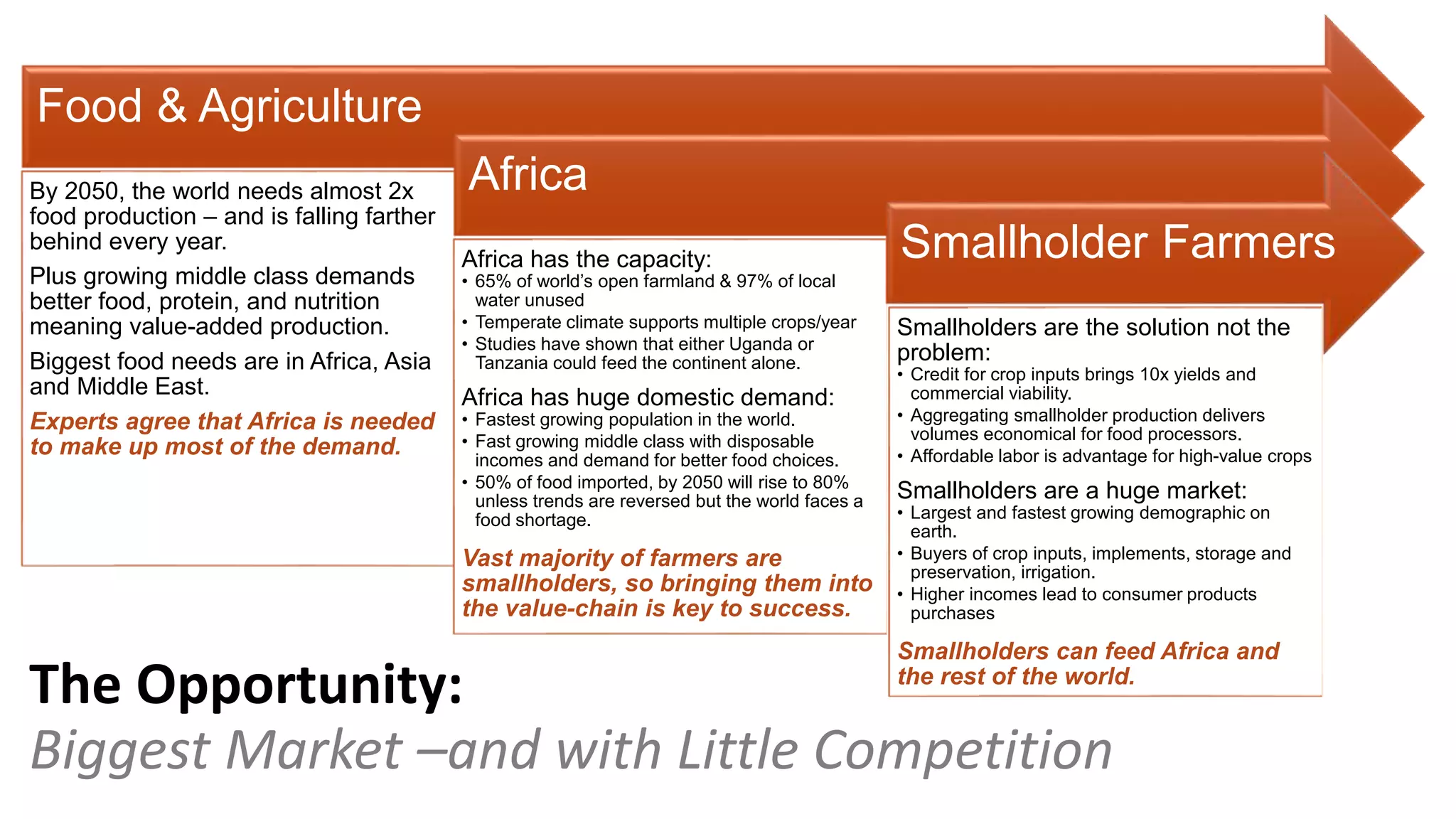
Food & Agriculture
By 2050, the world needs almost 2x
food production – and is falling farther
behind every year.
Plus growing middle class demands
better food, protein, and nutrition
meaning value-added production.
Biggest food needs are in Africa, Asia
and Middle East.
Experts agree that Africa is needed
to make up most of the demand.
Africa
Africa has the capacity:
• 65% of world’s open farmland & 97% of local
water unused
• Temperate climate supports multiple crops/year
• Studies have shown that either Uganda or
Tanzania could feed the continent alone.
Africa has huge domestic demand:
• Fastest growing population in the world.
• Fast growing middle class with disposable
incomes and demand for better food choices.
• 50% of food imported, by 2050 will rise to 80%
unless trends are reversed but the world faces a
food shortage.
Vast majority of farmers are
smallholders, so bringing them into
the value-chain is key to success.
Smallholder Farmers
Smallholders are the solution not the
problem:
• Credit for crop inputs brings 10x yields and
commercial viability.
• Aggregating smallholder production delivers
volumes economical for food processors.
• Affordable labor is advantage for high-value crops
Smallholders are a huge market:
• Largest and fastest growing demographic on
earth.
• Buyers of crop inputs, implements, storage and
preservation, irrigation.
• Higher incomes lead to consumer products
purchases
Smallholders can feed Africa and
the rest of the world.
The Opportunity:
Biggest Market –and with Little Competition
Subsistence
Farming & Food, Rough
Statistics for Most
African Nations
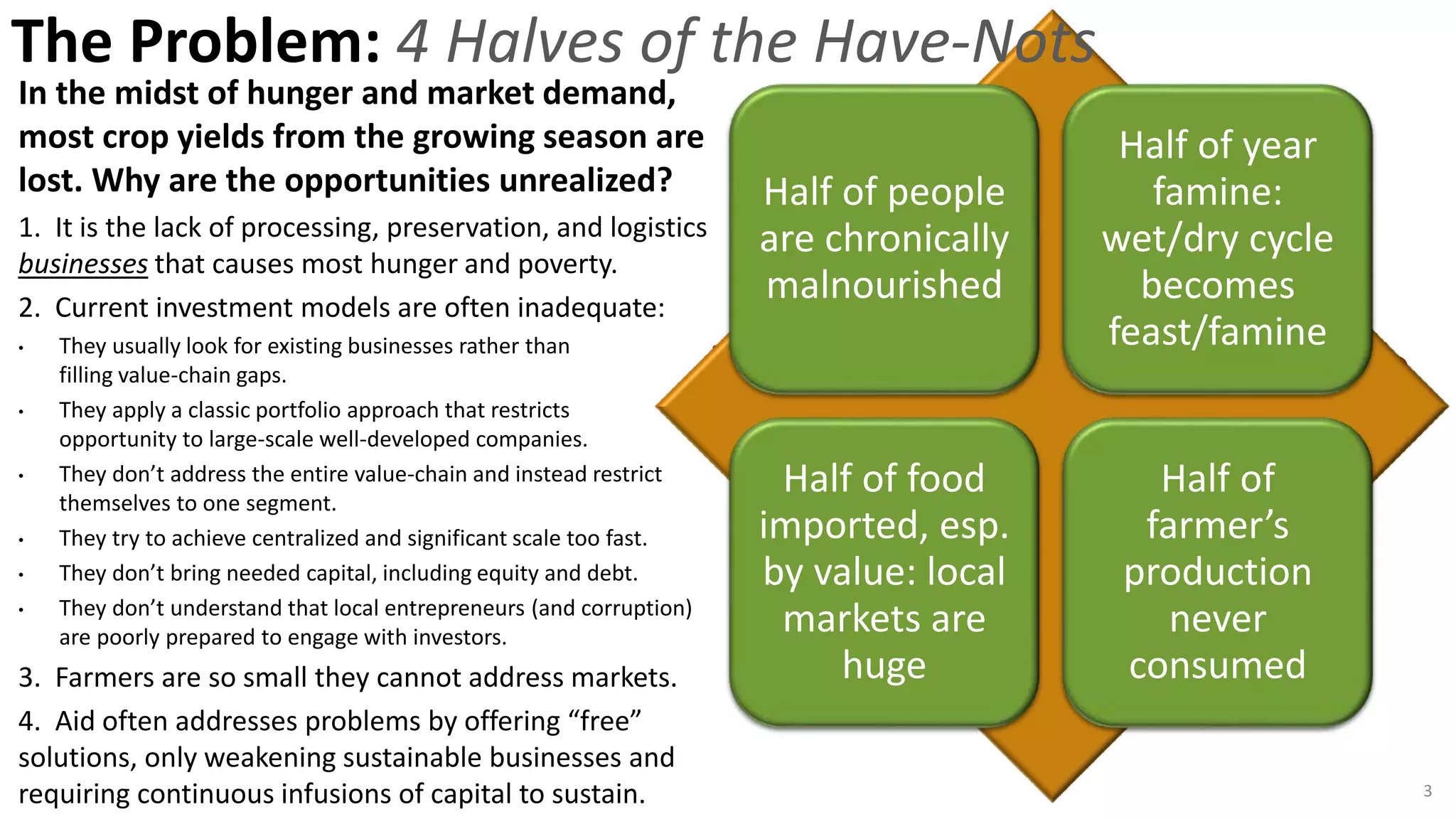
Half of people
are chronically
malnourished
Half of year
famine:
wet/dry cycle
becomes
feast/famine
Half of food
imported, esp.
by value: local
markets are
huge
Half of
farmer’s
production
never
consumed
3
The Problem: 4 Halves of the Have-Nots
In the midst of hunger and market demand,
most crop yields from the growing season are
lost. Why are the opportunities unrealized?
1. It is the lack of processing, preservation, and logistics
businesses that causes most hunger and poverty.
2. Current investment models are often inadequate:
• They usually look for existing businesses rather than
filling value-chain gaps.
• They apply a classic portfolio approach that restricts
opportunity to large-scale well-developed companies.
• They don’t address the entire value-chain and instead restrict
themselves to one segment.
• They try to achieve centralized and significant scale too fast.
• They don’t bring needed capital, including equity and debt.
• They don’t understand that local entrepreneurs (and corruption)
are poorly prepared to engage with investors.
3. Farmers are so small they cannot address markets.
4. Aid often addresses problems by offering “free”
solutions, only weakening sustainable businesses and
requiring continuous infusions of capital to sustain.
Farming for profit with
new agronomy practices
Credit ratings identify
starting group in village
Repayment of loans
(usually larger than
microcredit)
Accountability to coop,
banks and outsiders
Bank accounts and
payments not in cash
Work as group especially
selling jointly rather than
opportunistically
Expand credit with larger
loans & build a credit
history with a few years
success
See link between hard
work and profit
End of deep poverty and
thus start a shift in
mindset
Achieve standard terms
from commercial banks
Offer multiyear loan
terms for equipment
Manage large yields,
complex agronomy and/
or special handling
Market awareness
Divide land for food and
cash crops
Reliable contract growing
Sustainability, food safety,
and traceability standards
engaged
Farmers
Achieving
Investability
Fully
Commercial
Farmer
Over $5000 / yr
cash income
4. Expand
production
Enter middle class
3. Introduce high
value crop (fresh or
dried fruits and
vegetables, ancient
grains, herbs, spices)
Become a certified
Sunborn farmer
2. Expand first
crop to max scale
for single family
with hoe (2-5 acres)
Incomes of $500-
$1000
1. Learn to grow
familiar crop
successfully at
small scale
Yields jump 8 fold or
more
Subsistence
Farmer
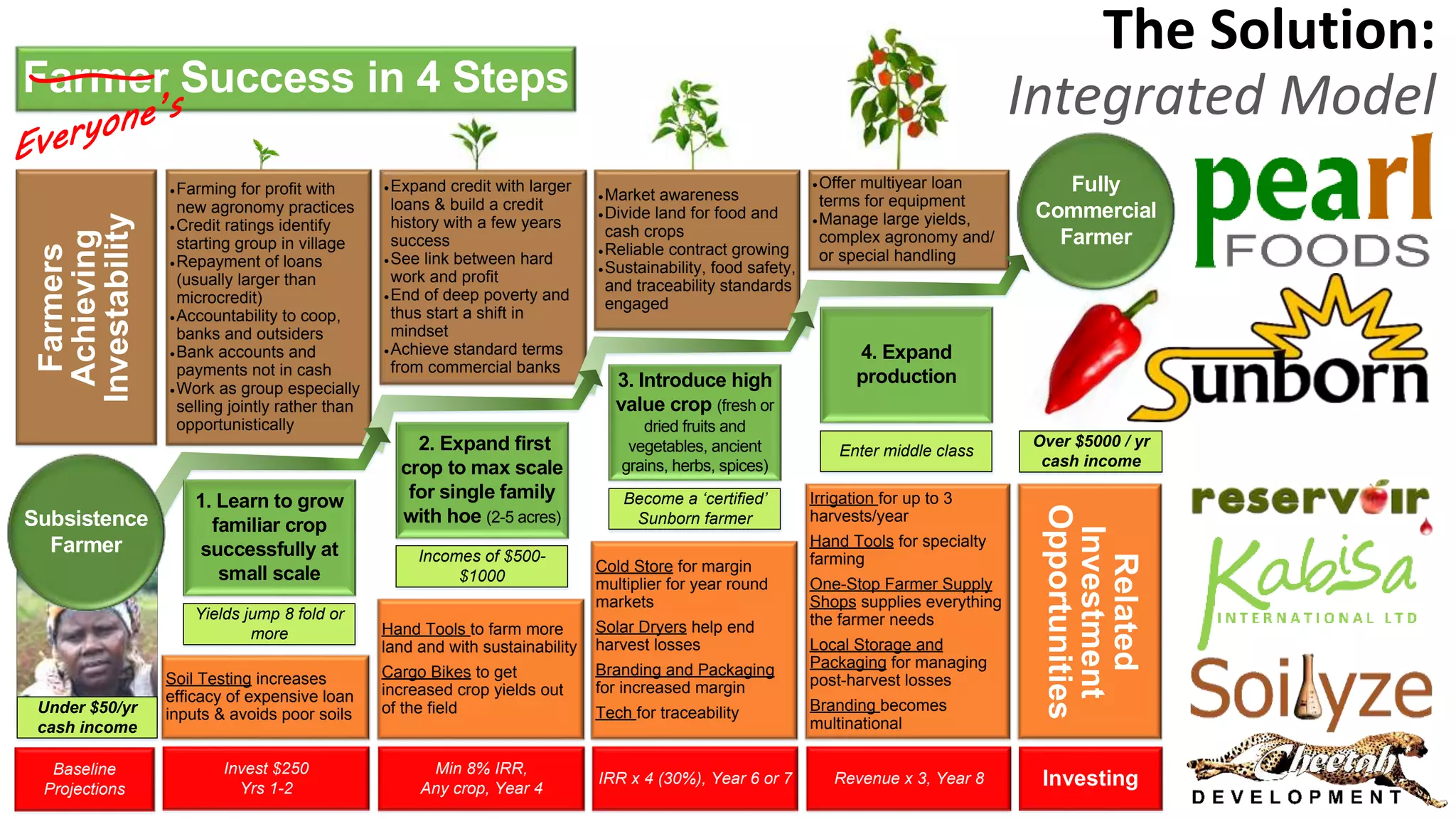
Farmer Success in 4 Steps
Under $50/yr
cash income
Irrigation for up to 3
harvests/year
Hand Tools for specialty
farming
One-Stop Farmer Supply
Shops supplies everything
the farmer needs
Local Storage and
Packaging for managing
post-harvest losses
Branding becomes
multinational
Cold Store for margin
multiplier for year round
markets
Solar Dryers help end
harvest losses
Branding and Packaging
for increased margin
Tech for traceability
Hand Tools to farm more
land and with sustainability
Cargo Bikes to get
increased crop yields out
of the field
Soil Testing increases
efficacy of expensive loan
inputs & avoids poor soils
Related
Investment
Opportunities
Invest $250
Yrs 1-2
Min 8% IRR,
Any crop, Year 4
IRR x 4 (30%), Year 6 or 7 Revenue x 3, Year 8
Baseline
Projections
Investing
The Solution:
Integrated Model
Linking Poverty
To Opportunity
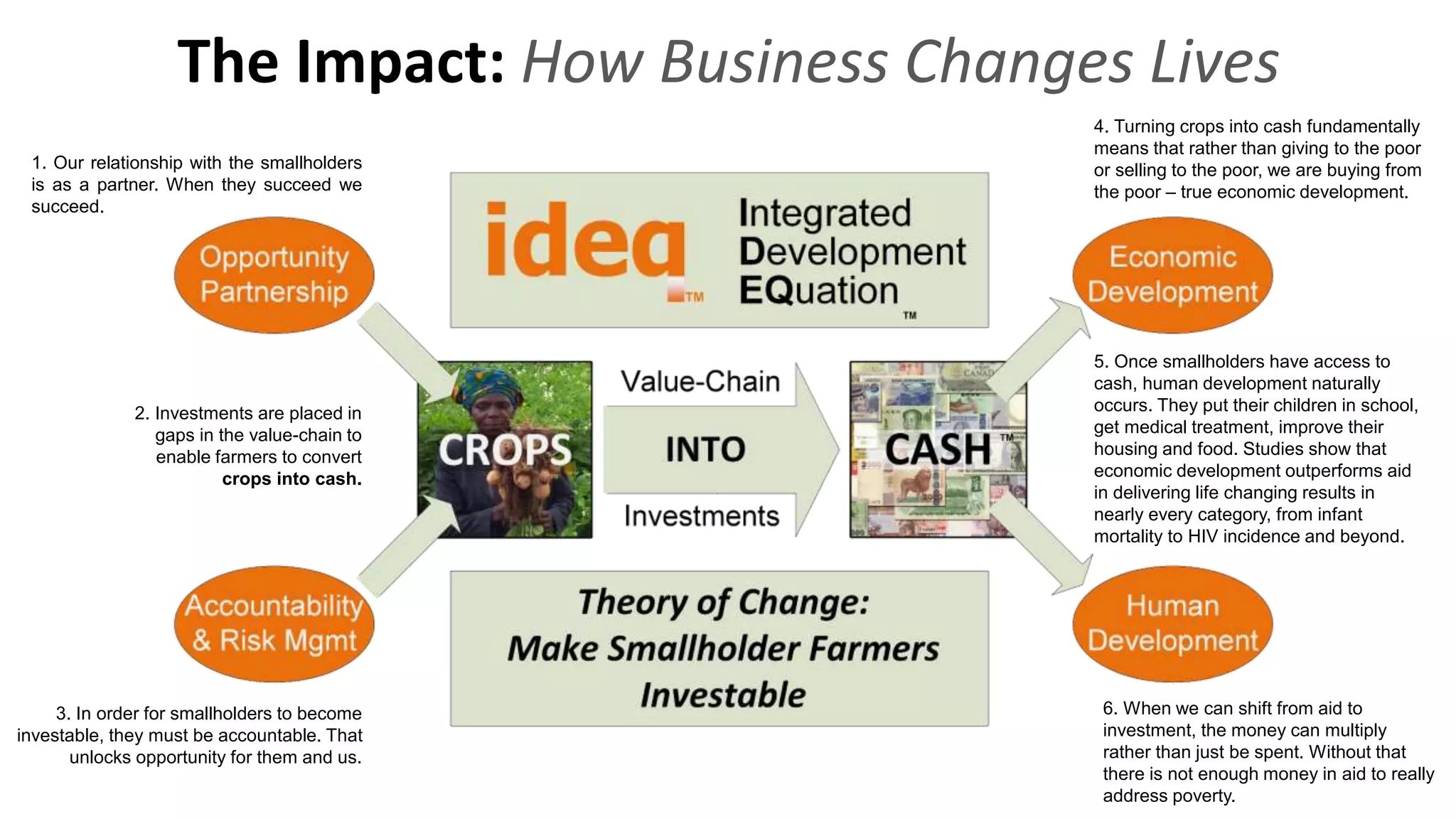
The Impact: How Business Changes Lives
2. Investments are placed in
gaps in the value-chain to
enable farmers to convert
crops into cash.
3. In order for smallholders to become
investable, they must be accountable. That
unlocks opportunity for them and us.
5. Once smallholders have access to
cash, human development naturally
occurs. They put their children in school,
get medical treatment, improve their
housing and food. Studies show that
economic development outperforms aid
in delivering life changing results in
nearly every category, from infant
mortality to HIV incidence and beyond.
1. Our relationship with the smallholders
is as a partner. When they succeed we
succeed.
6. When we can shift from aid to
investment, the money can multiply
rather than just be spent. Without that
there is not enough money in aid to really
address poverty.
4. Turning crops into cash fundamentally
means that rather than giving to the poor
or selling to the poor, we are buying from
the poor – true economic development.
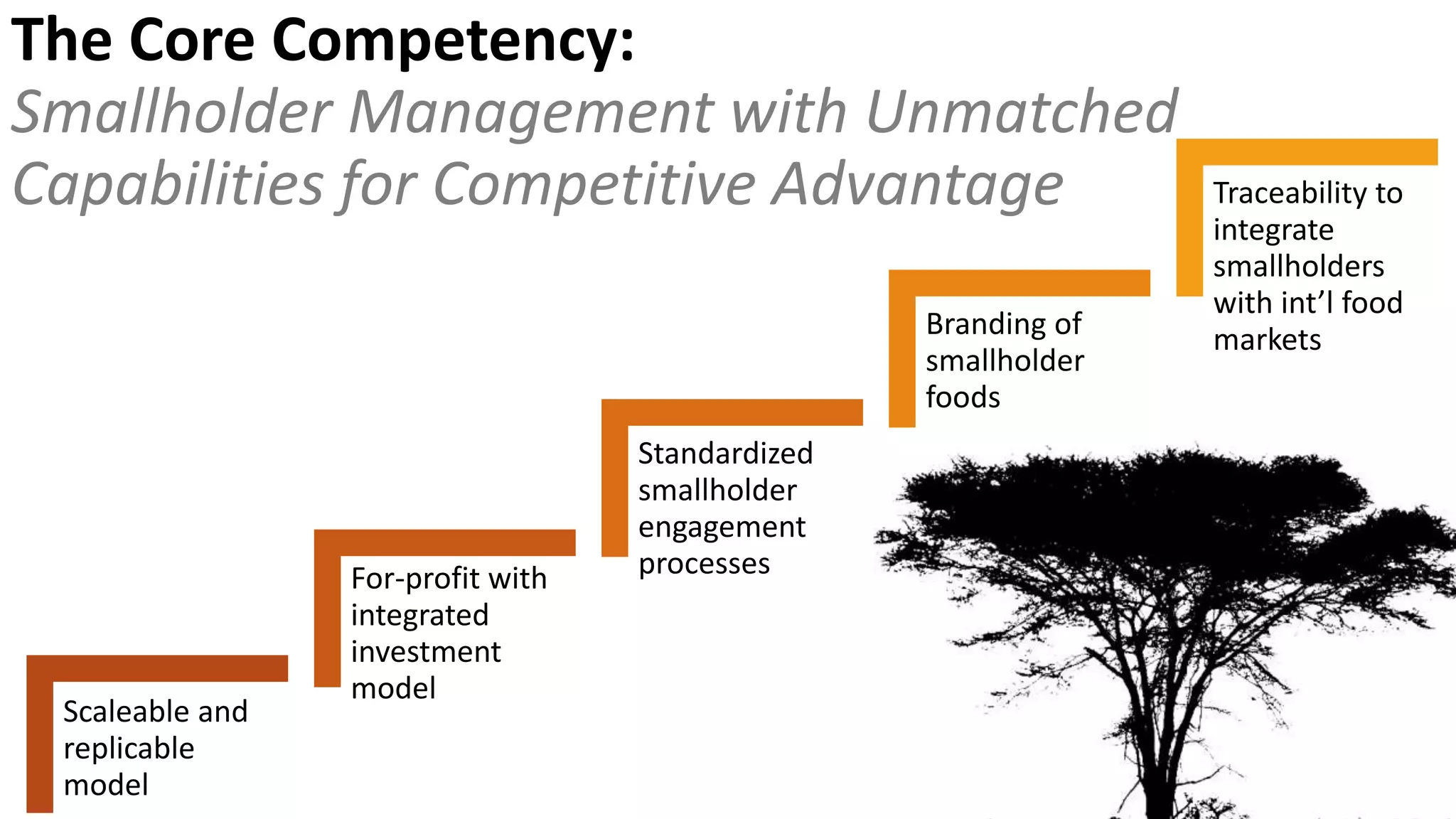
Scaleable and
replicable
model
For-profit with
integrated
investment
model
Standardized
smallholder
engagement
processes
Branding of
smallholder
foods
Traceability to
integrate
smallholders
with int’l food
markets
The Core Competency:
Smallholder Management with Unmatched
Capabilities for Competitive Advantage
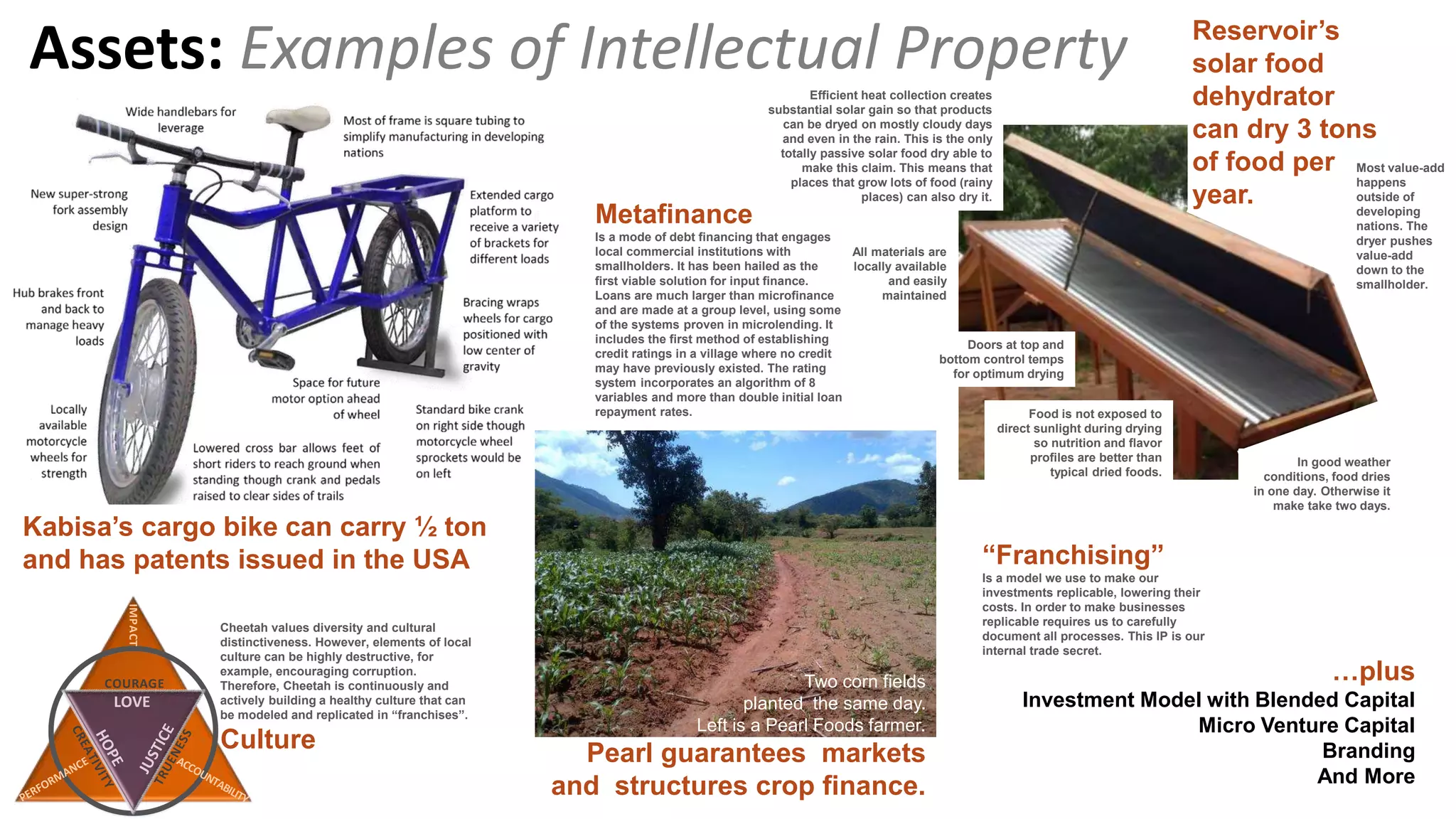
Assets: Examples of Intellectual Property
Two corn fields
planted the same day.
Left is a Pearl Foods farmer.
Pearl guarantees markets
and structures crop finance.
Kabisa’s cargo bike can carry ½ ton
and has patents issued in the USA
Reservoir’s
solar food
dehydrator
can dry 3 tons
of food per
year.
All materials are
locally available
and easily
maintained
Doors at top and
bottom control temps
for optimum drying
Efficient heat collection creates
substantial solar gain so that products
can be dryed on mostly cloudy days
and even in the rain. This is the only
totally passive solar food dry able to
make this claim. This means that
places that grow lots of food (rainy
places) can also dry it.
Food is not exposed to
direct sunlight during drying
so nutrition and flavor
profiles are better than
typical dried foods.
In good weather
conditions, food dries
in one day. Otherwise it
make take two days.
Most value-add
happens
outside of
developing
nations. The
dryer pushes
value-add
down to the
smallholder.
Metafinance
Is a mode of debt financing that engages
local commercial institutions with
smallholders. It has been hailed as the
first viable solution for input finance.
Loans are much larger than microfinance
and are made at a group level, using some
of the systems proven in microlending. It
includes the first method of establishing
credit ratings in a village where no credit
may have previously existed. The rating
system incorporates an algorithm of 8
variables and more than double initial loan
repayment rates.
“Franchising”
Is a model we use to make our
investments replicable, lowering their
costs. In order to make businesses
replicable requires us to carefully
document all processes. This IP is our
internal trade secret.
…plus
Investment Model with Blended Capital
Micro Venture Capital
Branding
And More
Cheetah values diversity and cultural
distinctiveness. However, elements of local
culture can be highly destructive, for
example, encouraging corruption.
Therefore, Cheetah is continuously and
actively building a healthy culture that can
be modeled and replicated in “franchises”.
Culture
LOVE
COURAGE
IMPACT
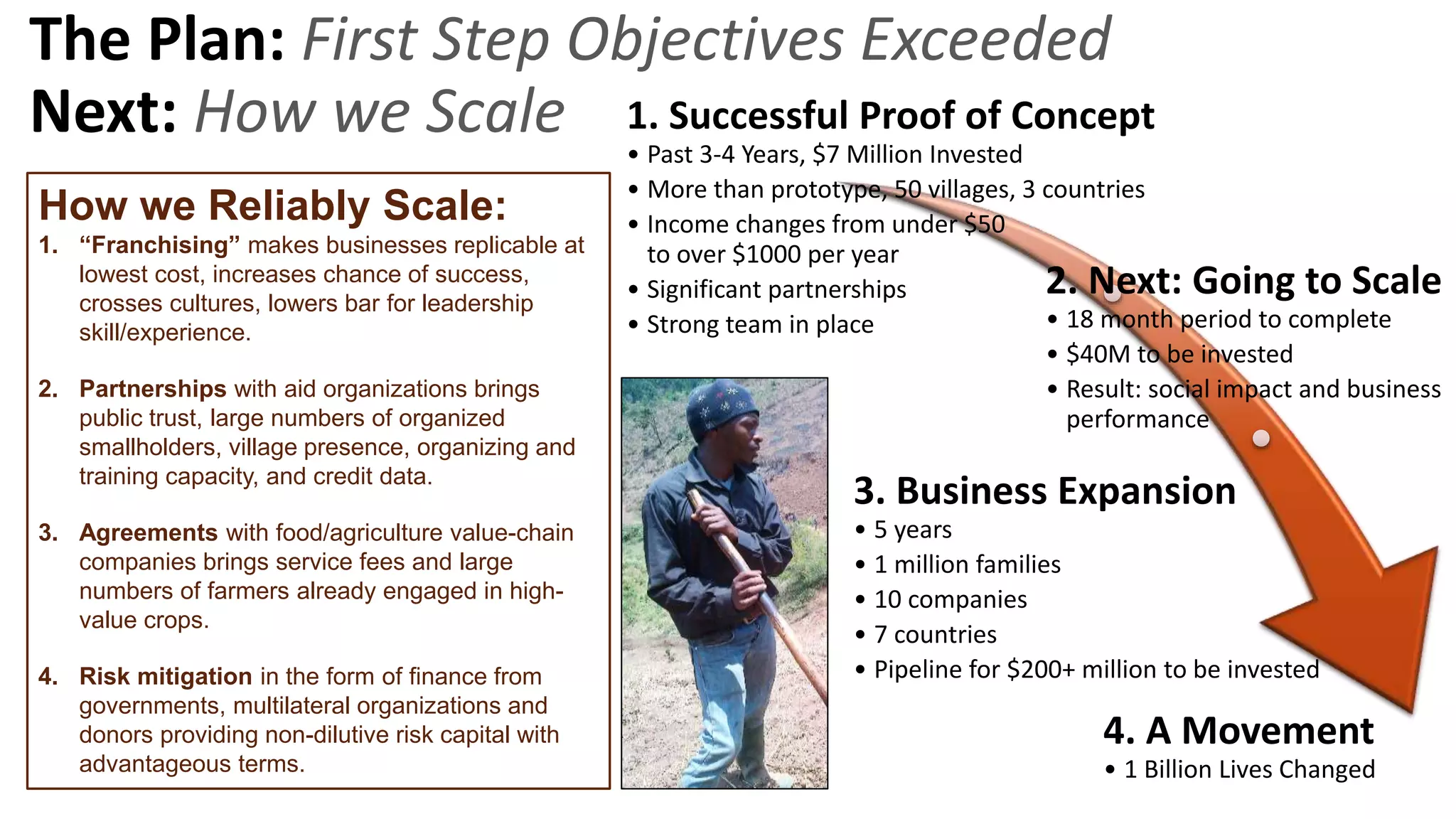
The Plan: First Step Objectives Exceeded
Next: How we Scale 1. Successful Proof of Concept
• Past 3-4 Years, $7 Million Invested
• More than prototype, 50 villages, 3 countries
• Income changes from under $50
to over $1000 per year
• Significant partnerships
• Strong team in place
2. Next: Going to Scale
• 18 month period to complete
• $40M to be invested
• Result: social impact and business
performance
3. Business Expansion
• 5 years
• 1 million families
• 10 companies
• 7 countries
• Pipeline for $200+ million to be invested
4. A Movement
• 1 Billion Lives Changed
How we Reliably Scale:
1. “Franchising” makes businesses replicable at
lowest cost, increases chance of success,
crosses cultures, lowers bar for leadership
skill/experience.
2. Partnerships with aid organizations brings
public trust, large numbers of organized
smallholders, village presence, organizing and
training capacity, and credit data.
3. Agreements with food/agriculture value-chain
companies brings service fees and large
numbers of farmers already engaged in high-
value crops.
4. Risk mitigation in the form of finance from
governments, multilateral organizations and
donors providing non-dilutive risk capital with
advantageous terms.
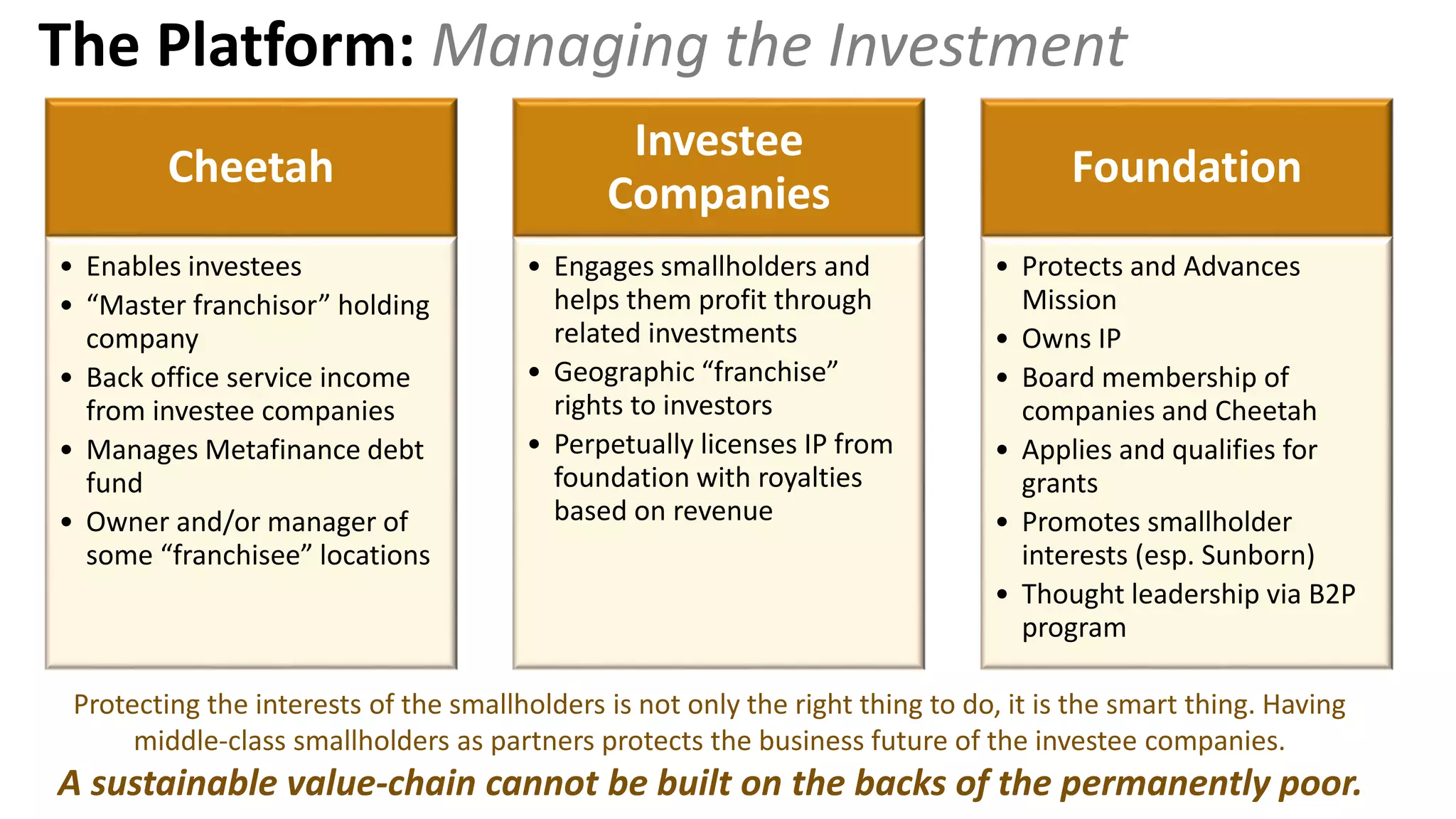
The Platform: Managing the Investment
Protecting the interests of the smallholders is not only the right thing to do, it is the smart thing. Having
middle-class smallholders as partners protects the business future of the investee companies.
A sustainable value-chain cannot be built on the backs of the permanently poor.
Cheetah
• Enables investees
• “Master franchisor” holding
company
• Back office service income
from investee companies
• Manages Metafinance debt
fund
• Owner and/or manager of
some “franchisee” locations
Investee
Companies
• Engages smallholders and
helps them profit through
related investments
• Geographic “franchise”
rights to investors
• Perpetually licenses IP from
foundation with royalties
based on revenue
Foundation
• Protects and Advances
Mission
• Owns IP
• Board membership of
companies and Cheetah
• Applies and qualifies for
grants
• Promotes smallholder
interests (esp. Sunborn)
• Thought leadership via B2P
program
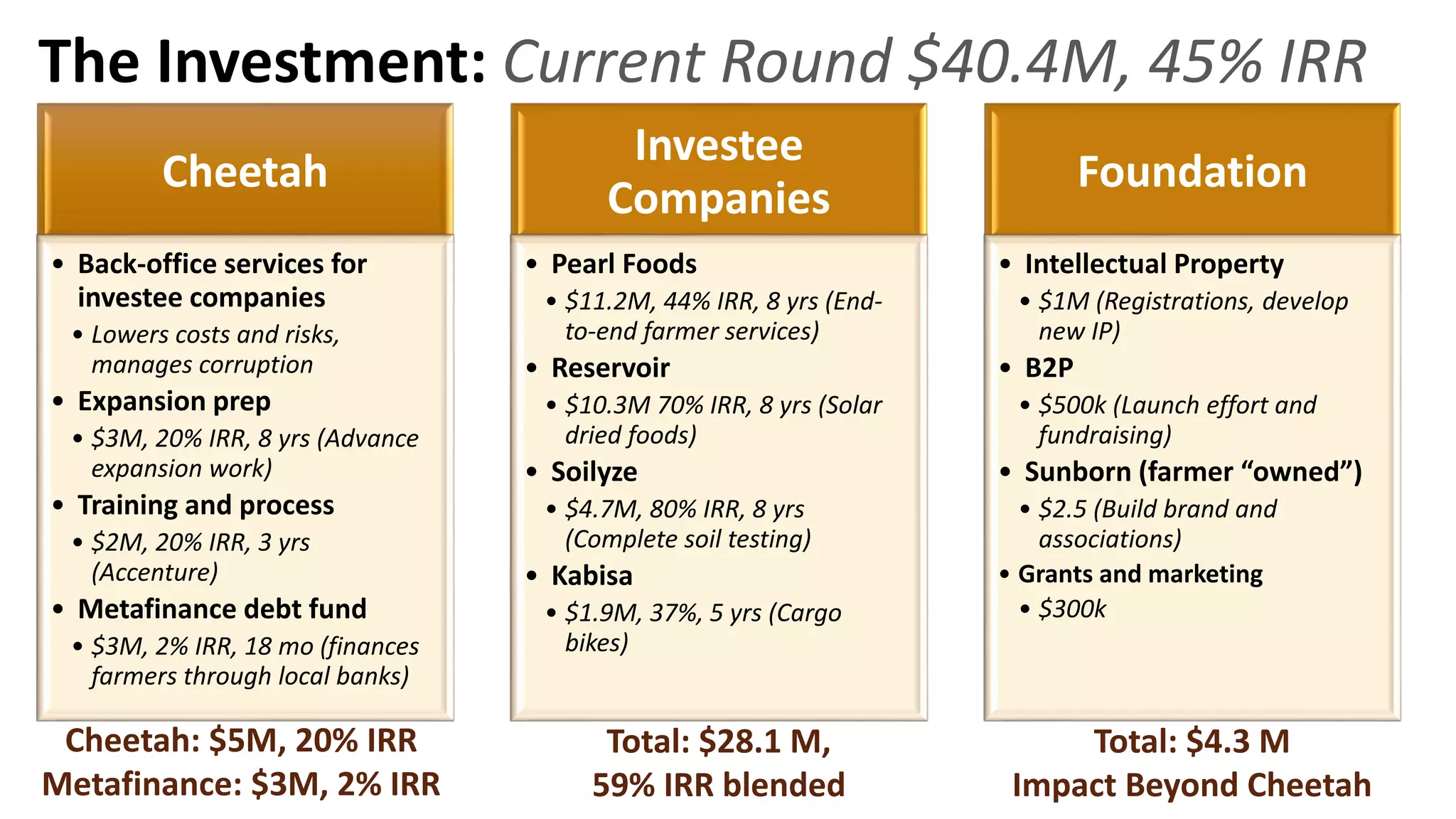
Cheetah
• Back-office services for
investee companies
• Lowers costs and risks,
manages corruption
• Expansion prep
• $3M, 20% IRR, 8 yrs (Advance
expansion work)
• Training and process
• $2M, 20% IRR, 3 yrs
(Accenture)
• Metafinance debt fund
• $3M, 2% IRR, 18 mo (finances
farmers through local banks)
Investee
Companies
• Pearl Foods
• $11.2M, 44% IRR, 8 yrs (End-
to-end farmer services)
• Reservoir
• $10.3M 70% IRR, 8 yrs (Solar
dried foods)
• Soilyze
• $4.7M, 80% IRR, 8 yrs
(Complete soil testing)
• Kabisa
• $1.9M, 37%, 5 yrs (Cargo
bikes)
Foundation
• Intellectual Property
• $1M (Registrations, develop
new IP)
• B2P
• $500k (Launch effort and
fundraising)
• Sunborn (farmer “owned”)
• $2.5 (Build brand and
associations)
• Grants and marketing
• $300k
The Investment: Current Round $40.4M, 45% IRR
Cheetah: $5M, 20% IRR
Metafinance: $3M, 2% IRR
Total: $28.1 M,
59% IRR blended
Total: $4.3 M
Impact Beyond Cheetah
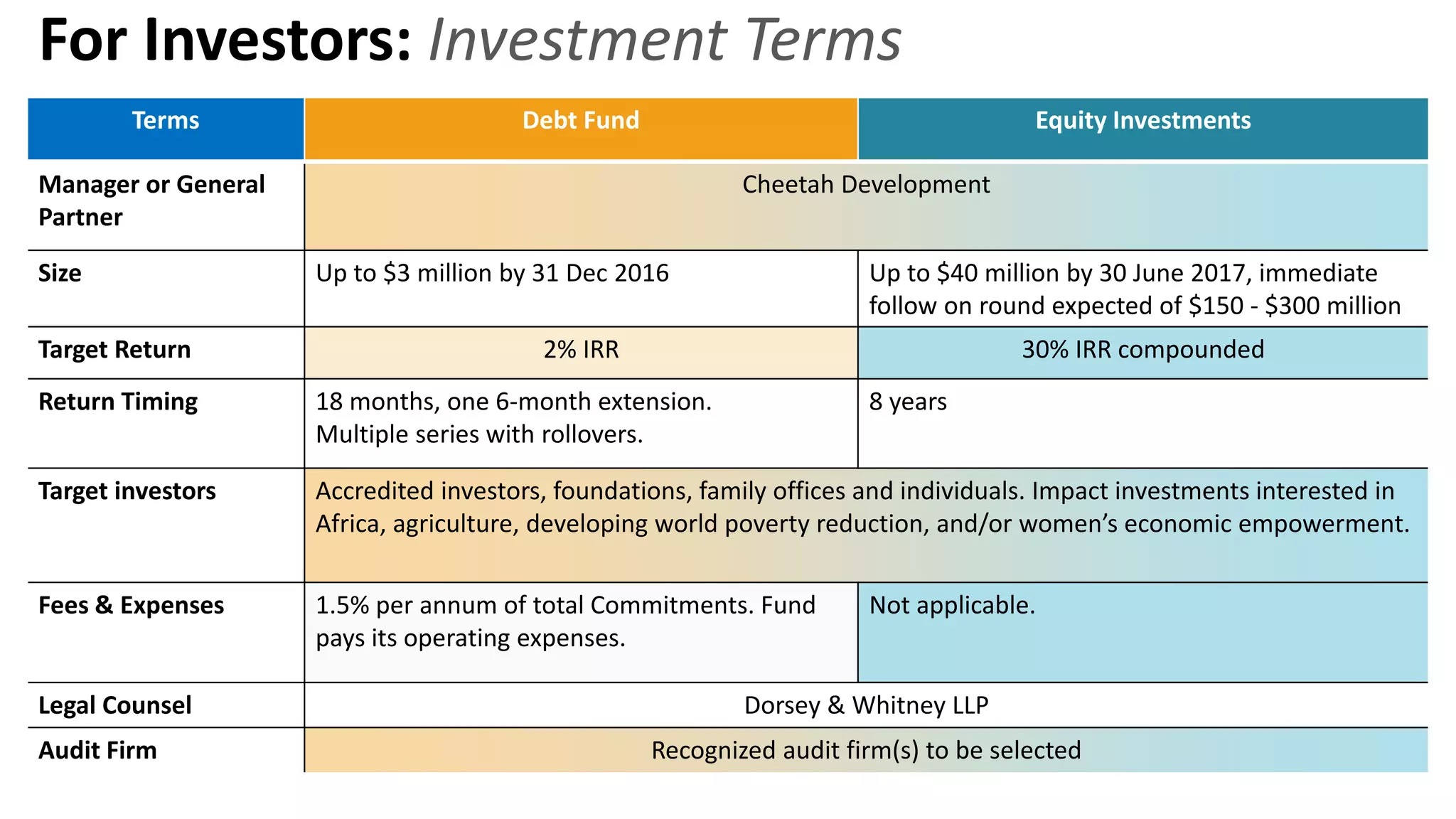
Terms Debt Fund Equity Investments
Manager or General
Partner
Cheetah Development
Size Up to $3 million by 31 Dec 2016 Up to $40 million by 30 June 2017, immediate
follow on round expected of $150 - $300 million
Target Return 2% IRR 30% IRR compounded
Return Timing 18 months, one 6-month extension.
Multiple series with rollovers.
8 years
Target investors Accredited investors, foundations, family offices and individuals. Impact investments interested in
Africa, agriculture, developing world poverty reduction, and/or women’s economic empowerment.
Fees & Expenses 1.5% per annum of total Commitments. Fund
pays its operating expenses.
Not applicable.
Legal Counsel Dorsey & Whitney LLP
Audit Firm Recognized audit firm(s) to be selected
For Investors: Investment Terms
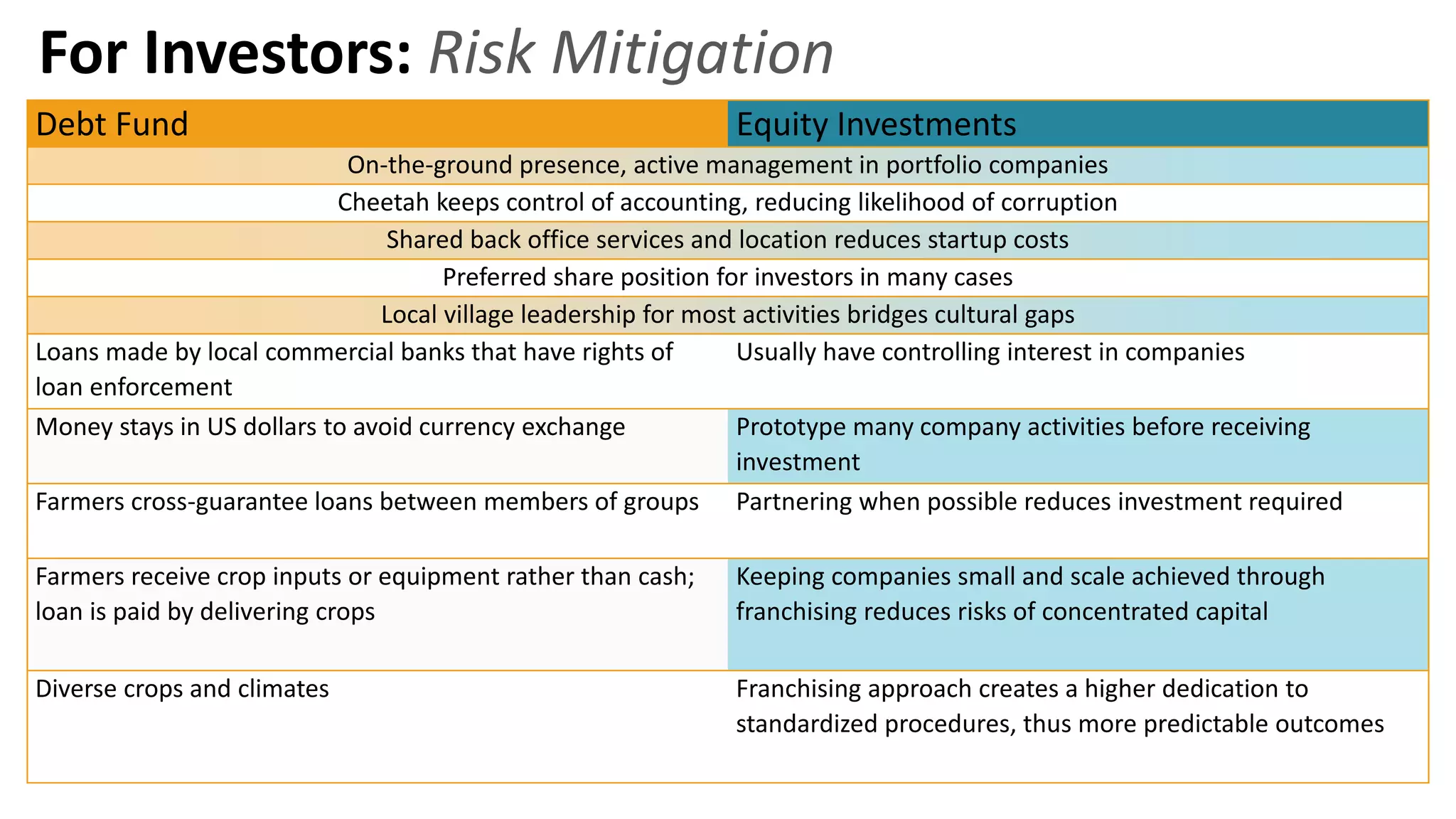
For Investors: Risk Mitigation
Debt Fund Equity Investments
On-the-ground presence, active management in portfolio companies
Cheetah keeps control of accounting, reducing likelihood of corruption
Shared back office services and location reduces startup costs
Preferred share position for investors in many cases
Local village leadership for most activities bridges cultural gaps
Loans made by local commercial banks that have rights of
loan enforcement
Usually have controlling interest in companies
Money stays in US dollars to avoid currency exchange Prototype many company activities before receiving
investment
Farmers cross-guarantee loans between members of groups Partnering when possible reduces investment required
Farmers receive crop inputs or equipment rather than cash;
loan is paid by delivering crops
Keeping companies small and scale achieved through
franchising reduces risks of concentrated capital
Diverse crops and climates Franchising approach creates a higher dedication to
standardized procedures, thus more predictable outcomes
Ready to
run with the
Cheetahs?
www.CheetahDevelopment.org
Securities Disclaimer
This document is for informational purposes only
and does not constitute an offer or solicitation to
sell shares or securities in the Company or any
related or associated company. Any such offer or
solicitation will be made only by means of the
Company's confidential Offering Memorandum
and in accordance with the terms of all applicable
securities and other laws. None of the information
or analyses presented are intended to form the
basis for any investment decision, and no specific
recommendations are intended. Accordingly this
document does not constitute investment advice
or counsel or solicitation for investment in any
security. This document does not constitute or
form part of, and should not be construed as, any
offer for sale or subscription of, or any invitation
to offer to buy or subscribe for, any securities, nor
should it or any part of it form the basis of, or be
relied on in any connection with, any contract or
commitment whatsoever. The Company expressly
disclaims any and all responsibility for any direct
or consequential loss or damage of any kind
whatsoever arising directly or indirectly from: (i)
reliance on any information contained herein, (ii)
any error, omission or inaccuracy in any such
information or (iii) any action resulting therefrom.

Cheetah Development Investor Summary FINAL

  • 1.
  • 2.
    Food & Agriculture By2050, the world needs almost 2x food production – and is falling farther behind every year. Plus growing middle class demands better food, protein, and nutrition meaning value-added production. Biggest food needs are in Africa, Asia and Middle East. Experts agree that Africa is needed to make up most of the demand. Africa Africa has the capacity: • 65% of world’s open farmland & 97% of local water unused • Temperate climate supports multiple crops/year • Studies have shown that either Uganda or Tanzania could feed the continent alone. Africa has huge domestic demand: • Fastest growing population in the world. • Fast growing middle class with disposable incomes and demand for better food choices. • 50% of food imported, by 2050 will rise to 80% unless trends are reversed but the world faces a food shortage. Vast majority of farmers are smallholders, so bringing them into the value-chain is key to success. Smallholder Farmers Smallholders are the solution not the problem: • Credit for crop inputs brings 10x yields and commercial viability. • Aggregating smallholder production delivers volumes economical for food processors. • Affordable labor is advantage for high-value crops Smallholders are a huge market: • Largest and fastest growing demographic on earth. • Buyers of crop inputs, implements, storage and preservation, irrigation. • Higher incomes lead to consumer products purchases Smallholders can feed Africa and the rest of the world. The Opportunity: Biggest Market –and with Little Competition
  • 3.
    Subsistence Farming & Food,Rough Statistics for Most African Nations Half of people are chronically malnourished Half of year famine: wet/dry cycle becomes feast/famine Half of food imported, esp. by value: local markets are huge Half of farmer’s production never consumed 3 The Problem: 4 Halves of the Have-Nots In the midst of hunger and market demand, most crop yields from the growing season are lost. Why are the opportunities unrealized? 1. It is the lack of processing, preservation, and logistics businesses that causes most hunger and poverty. 2. Current investment models are often inadequate: • They usually look for existing businesses rather than filling value-chain gaps. • They apply a classic portfolio approach that restricts opportunity to large-scale well-developed companies. • They don’t address the entire value-chain and instead restrict themselves to one segment. • They try to achieve centralized and significant scale too fast. • They don’t bring needed capital, including equity and debt. • They don’t understand that local entrepreneurs (and corruption) are poorly prepared to engage with investors. 3. Farmers are so small they cannot address markets. 4. Aid often addresses problems by offering “free” solutions, only weakening sustainable businesses and requiring continuous infusions of capital to sustain.
  • 4.
    Farming for profitwith new agronomy practices Credit ratings identify starting group in village Repayment of loans (usually larger than microcredit) Accountability to coop, banks and outsiders Bank accounts and payments not in cash Work as group especially selling jointly rather than opportunistically Expand credit with larger loans & build a credit history with a few years success See link between hard work and profit End of deep poverty and thus start a shift in mindset Achieve standard terms from commercial banks Offer multiyear loan terms for equipment Manage large yields, complex agronomy and/ or special handling Market awareness Divide land for food and cash crops Reliable contract growing Sustainability, food safety, and traceability standards engaged Farmers Achieving Investability Fully Commercial Farmer Over $5000 / yr cash income 4. Expand production Enter middle class 3. Introduce high value crop (fresh or dried fruits and vegetables, ancient grains, herbs, spices) Become a certified Sunborn farmer 2. Expand first crop to max scale for single family with hoe (2-5 acres) Incomes of $500- $1000 1. Learn to grow familiar crop successfully at small scale Yields jump 8 fold or more Subsistence Farmer Farmer Success in 4 Steps Under $50/yr cash income Irrigation for up to 3 harvests/year Hand Tools for specialty farming One-Stop Farmer Supply Shops supplies everything the farmer needs Local Storage and Packaging for managing post-harvest losses Branding becomes multinational Cold Store for margin multiplier for year round markets Solar Dryers help end harvest losses Branding and Packaging for increased margin Tech for traceability Hand Tools to farm more land and with sustainability Cargo Bikes to get increased crop yields out of the field Soil Testing increases efficacy of expensive loan inputs & avoids poor soils Related Investment Opportunities Invest $250 Yrs 1-2 Min 8% IRR, Any crop, Year 4 IRR x 4 (30%), Year 6 or 7 Revenue x 3, Year 8 Baseline Projections Investing The Solution: Integrated Model
  • 5.
    Linking Poverty To Opportunity TheImpact: How Business Changes Lives 2. Investments are placed in gaps in the value-chain to enable farmers to convert crops into cash. 3. In order for smallholders to become investable, they must be accountable. That unlocks opportunity for them and us. 5. Once smallholders have access to cash, human development naturally occurs. They put their children in school, get medical treatment, improve their housing and food. Studies show that economic development outperforms aid in delivering life changing results in nearly every category, from infant mortality to HIV incidence and beyond. 1. Our relationship with the smallholders is as a partner. When they succeed we succeed. 6. When we can shift from aid to investment, the money can multiply rather than just be spent. Without that there is not enough money in aid to really address poverty. 4. Turning crops into cash fundamentally means that rather than giving to the poor or selling to the poor, we are buying from the poor – true economic development.
  • 6.
    Scaleable and replicable model For-profit with integrated investment model Standardized smallholder engagement processes Brandingof smallholder foods Traceability to integrate smallholders with int’l food markets The Core Competency: Smallholder Management with Unmatched Capabilities for Competitive Advantage
  • 7.
    Assets: Examples ofIntellectual Property Two corn fields planted the same day. Left is a Pearl Foods farmer. Pearl guarantees markets and structures crop finance. Kabisa’s cargo bike can carry ½ ton and has patents issued in the USA Reservoir’s solar food dehydrator can dry 3 tons of food per year. All materials are locally available and easily maintained Doors at top and bottom control temps for optimum drying Efficient heat collection creates substantial solar gain so that products can be dryed on mostly cloudy days and even in the rain. This is the only totally passive solar food dry able to make this claim. This means that places that grow lots of food (rainy places) can also dry it. Food is not exposed to direct sunlight during drying so nutrition and flavor profiles are better than typical dried foods. In good weather conditions, food dries in one day. Otherwise it make take two days. Most value-add happens outside of developing nations. The dryer pushes value-add down to the smallholder. Metafinance Is a mode of debt financing that engages local commercial institutions with smallholders. It has been hailed as the first viable solution for input finance. Loans are much larger than microfinance and are made at a group level, using some of the systems proven in microlending. It includes the first method of establishing credit ratings in a village where no credit may have previously existed. The rating system incorporates an algorithm of 8 variables and more than double initial loan repayment rates. “Franchising” Is a model we use to make our investments replicable, lowering their costs. In order to make businesses replicable requires us to carefully document all processes. This IP is our internal trade secret. …plus Investment Model with Blended Capital Micro Venture Capital Branding And More Cheetah values diversity and cultural distinctiveness. However, elements of local culture can be highly destructive, for example, encouraging corruption. Therefore, Cheetah is continuously and actively building a healthy culture that can be modeled and replicated in “franchises”. Culture LOVE COURAGE IMPACT
  • 8.
    The Plan: FirstStep Objectives Exceeded Next: How we Scale 1. Successful Proof of Concept • Past 3-4 Years, $7 Million Invested • More than prototype, 50 villages, 3 countries • Income changes from under $50 to over $1000 per year • Significant partnerships • Strong team in place 2. Next: Going to Scale • 18 month period to complete • $40M to be invested • Result: social impact and business performance 3. Business Expansion • 5 years • 1 million families • 10 companies • 7 countries • Pipeline for $200+ million to be invested 4. A Movement • 1 Billion Lives Changed How we Reliably Scale: 1. “Franchising” makes businesses replicable at lowest cost, increases chance of success, crosses cultures, lowers bar for leadership skill/experience. 2. Partnerships with aid organizations brings public trust, large numbers of organized smallholders, village presence, organizing and training capacity, and credit data. 3. Agreements with food/agriculture value-chain companies brings service fees and large numbers of farmers already engaged in high- value crops. 4. Risk mitigation in the form of finance from governments, multilateral organizations and donors providing non-dilutive risk capital with advantageous terms.
  • 9.
    The Platform: Managingthe Investment Protecting the interests of the smallholders is not only the right thing to do, it is the smart thing. Having middle-class smallholders as partners protects the business future of the investee companies. A sustainable value-chain cannot be built on the backs of the permanently poor. Cheetah • Enables investees • “Master franchisor” holding company • Back office service income from investee companies • Manages Metafinance debt fund • Owner and/or manager of some “franchisee” locations Investee Companies • Engages smallholders and helps them profit through related investments • Geographic “franchise” rights to investors • Perpetually licenses IP from foundation with royalties based on revenue Foundation • Protects and Advances Mission • Owns IP • Board membership of companies and Cheetah • Applies and qualifies for grants • Promotes smallholder interests (esp. Sunborn) • Thought leadership via B2P program
  • 10.
    Cheetah • Back-office servicesfor investee companies • Lowers costs and risks, manages corruption • Expansion prep • $3M, 20% IRR, 8 yrs (Advance expansion work) • Training and process • $2M, 20% IRR, 3 yrs (Accenture) • Metafinance debt fund • $3M, 2% IRR, 18 mo (finances farmers through local banks) Investee Companies • Pearl Foods • $11.2M, 44% IRR, 8 yrs (End- to-end farmer services) • Reservoir • $10.3M 70% IRR, 8 yrs (Solar dried foods) • Soilyze • $4.7M, 80% IRR, 8 yrs (Complete soil testing) • Kabisa • $1.9M, 37%, 5 yrs (Cargo bikes) Foundation • Intellectual Property • $1M (Registrations, develop new IP) • B2P • $500k (Launch effort and fundraising) • Sunborn (farmer “owned”) • $2.5 (Build brand and associations) • Grants and marketing • $300k The Investment: Current Round $40.4M, 45% IRR Cheetah: $5M, 20% IRR Metafinance: $3M, 2% IRR Total: $28.1 M, 59% IRR blended Total: $4.3 M Impact Beyond Cheetah
  • 11.
    Terms Debt FundEquity Investments Manager or General Partner Cheetah Development Size Up to $3 million by 31 Dec 2016 Up to $40 million by 30 June 2017, immediate follow on round expected of $150 - $300 million Target Return 2% IRR 30% IRR compounded Return Timing 18 months, one 6-month extension. Multiple series with rollovers. 8 years Target investors Accredited investors, foundations, family offices and individuals. Impact investments interested in Africa, agriculture, developing world poverty reduction, and/or women’s economic empowerment. Fees & Expenses 1.5% per annum of total Commitments. Fund pays its operating expenses. Not applicable. Legal Counsel Dorsey & Whitney LLP Audit Firm Recognized audit firm(s) to be selected For Investors: Investment Terms
  • 12.
    For Investors: RiskMitigation Debt Fund Equity Investments On-the-ground presence, active management in portfolio companies Cheetah keeps control of accounting, reducing likelihood of corruption Shared back office services and location reduces startup costs Preferred share position for investors in many cases Local village leadership for most activities bridges cultural gaps Loans made by local commercial banks that have rights of loan enforcement Usually have controlling interest in companies Money stays in US dollars to avoid currency exchange Prototype many company activities before receiving investment Farmers cross-guarantee loans between members of groups Partnering when possible reduces investment required Farmers receive crop inputs or equipment rather than cash; loan is paid by delivering crops Keeping companies small and scale achieved through franchising reduces risks of concentrated capital Diverse crops and climates Franchising approach creates a higher dedication to standardized procedures, thus more predictable outcomes
  • 13.
    Ready to run withthe Cheetahs? www.CheetahDevelopment.org Securities Disclaimer This document is for informational purposes only and does not constitute an offer or solicitation to sell shares or securities in the Company or any related or associated company. Any such offer or solicitation will be made only by means of the Company's confidential Offering Memorandum and in accordance with the terms of all applicable securities and other laws. None of the information or analyses presented are intended to form the basis for any investment decision, and no specific recommendations are intended. Accordingly this document does not constitute investment advice or counsel or solicitation for investment in any security. This document does not constitute or form part of, and should not be construed as, any offer for sale or subscription of, or any invitation to offer to buy or subscribe for, any securities, nor should it or any part of it form the basis of, or be relied on in any connection with, any contract or commitment whatsoever. The Company expressly disclaims any and all responsibility for any direct or consequential loss or damage of any kind whatsoever arising directly or indirectly from: (i) reliance on any information contained herein, (ii) any error, omission or inaccuracy in any such information or (iii) any action resulting therefrom.

Editor's Notes

  • #4 These numbers are approximate. Depending on the nation or district within, these numbers go up or down. Nevertheless, they represent a fair approximation of the typical life of subsistence agriculture.