Facilitated Knowledge Harvesting Overview Kate Pugh  Nancy Dixon Align Consulting  Common Knowledge Associates [email_address] . mit . edu   [email_address] .org   617-967-3910    202-277-5839  Align Consulting
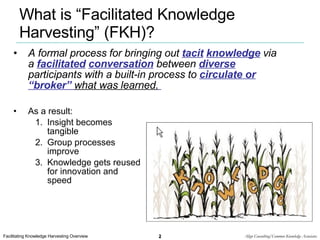
What is “Facilitated Knowledge Harvesting” (FKH)? A formal process for bringing out  tacit   knowledge  via a  facilitated   conversation  between  diverse  participants with a built-in process to  circulate or “broker”  what was learned.   As a result:  Insight becomes  tangible Group processes  improve Knowledge gets reused for innovation and  speed
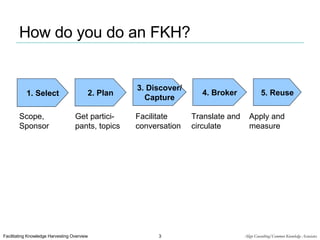
How do you do an FKH?  1. Select 2. Plan 3. Discover/ Capture 4. Broker 5. Reuse Apply and measure  Translate and circulate Facilitate conversation Get partici-pants, topics Scope, Sponsor
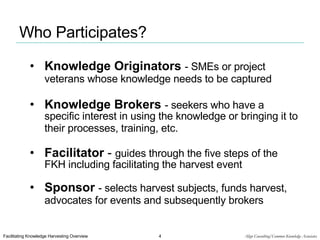
Who Participates? Knowledge Originators   - SMEs or project veterans whose knowledge needs to be captured Knowledge Brokers  - seekers who have a specific interest in using the knowledge or bringing it to their processes, training, etc.   Facilitator  -  guides through the five steps of the FKH including facilitating the harvest event  Sponsor   - selects harvest subjects, funds harvest, advocates for events and subsequently brokers
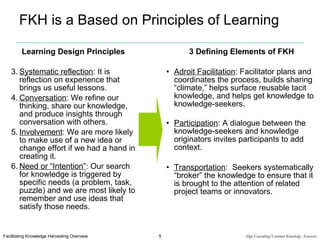
FKH is a Based on Principles of Learning Learning Design Principles Systematic reflection : It is reflection on experience that brings us useful lessons.  Conversation : We refine our thinking, share our knowledge, and produce insights through conversation with others. Involvement : We are more likely to make use of a new idea or change effort if we had a hand in creating it. Need or “Intention” : Our search for knowledge is triggered by specific needs (a problem, task, puzzle) and we are most likely to remember and use ideas that satisfy those needs. 3 Defining Elements of FKH Adroit Facilitation : Facilitator plans and coordinates the process, builds sharing “climate,” helps surface reusable tacit knowledge, and helps get knowledge to knowledge-seekers. Participation : A dialogue between the knowledge-seekers and knowledge originators invites participants to add context.  Transportation :  Seekers systematically “broker” the knowledge to ensure that it is brought to the attention of related project teams or innovators.
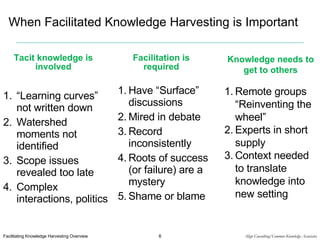
When Facilitated Knowledge Harvesting is Important Tacit knowledge is involved “ Learning curves” not written down Watershed moments not identified Scope issues revealed too late Complex interactions, politics Facilitation is required Have “Surface” discussions  Mired in debate  Record inconsistently Roots of success (or failure) are a mystery  Shame or blame Remote groups “Reinventing the wheel” Experts in short supply Context needed to translate knowledge into new setting Knowledge needs to get to others
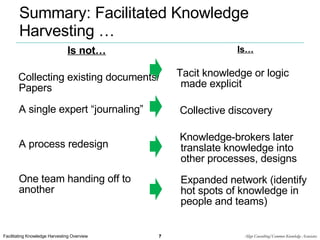
Summary: Facilitated Knowledge Harvesting … Is… Tacit knowledge or logic made explicit Collective discovery Knowledge-brokers later translate knowledge into other processes, designs Expanded network (identify hot spots of knowledge in people and teams) Is not… Collecting existing documents/Papers A single expert “journaling” A process redesign One team handing off to another
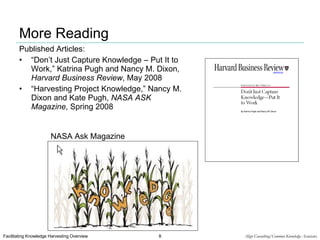
More Reading Published Articles: “ Don’t Just Capture Knowledge – Put It to Work,” Katrina Pugh and Nancy M. Dixon,  Harvard Business Review , May 2008  “ Harvesting Project Knowledge,” Nancy M. Dixon and Kate Pugh,  NASA ASK Magazine , Spring 2008  NASA Ask Magazine

Faciliated Knowledge Harvesting

  • 1.
    Facilitated Knowledge HarvestingOverview Kate Pugh Nancy Dixon Align Consulting Common Knowledge Associates [email_address] . mit . edu [email_address] .org 617-967-3910 202-277-5839 Align Consulting
  • 2.
    What is “FacilitatedKnowledge Harvesting” (FKH)? A formal process for bringing out tacit knowledge via a facilitated conversation between diverse participants with a built-in process to circulate or “broker” what was learned. As a result: Insight becomes tangible Group processes improve Knowledge gets reused for innovation and speed
  • 3.
    How do youdo an FKH? 1. Select 2. Plan 3. Discover/ Capture 4. Broker 5. Reuse Apply and measure Translate and circulate Facilitate conversation Get partici-pants, topics Scope, Sponsor
  • 4.
    Who Participates? KnowledgeOriginators - SMEs or project veterans whose knowledge needs to be captured Knowledge Brokers - seekers who have a specific interest in using the knowledge or bringing it to their processes, training, etc. Facilitator - guides through the five steps of the FKH including facilitating the harvest event Sponsor - selects harvest subjects, funds harvest, advocates for events and subsequently brokers
  • 5.
    FKH is aBased on Principles of Learning Learning Design Principles Systematic reflection : It is reflection on experience that brings us useful lessons. Conversation : We refine our thinking, share our knowledge, and produce insights through conversation with others. Involvement : We are more likely to make use of a new idea or change effort if we had a hand in creating it. Need or “Intention” : Our search for knowledge is triggered by specific needs (a problem, task, puzzle) and we are most likely to remember and use ideas that satisfy those needs. 3 Defining Elements of FKH Adroit Facilitation : Facilitator plans and coordinates the process, builds sharing “climate,” helps surface reusable tacit knowledge, and helps get knowledge to knowledge-seekers. Participation : A dialogue between the knowledge-seekers and knowledge originators invites participants to add context. Transportation : Seekers systematically “broker” the knowledge to ensure that it is brought to the attention of related project teams or innovators.
  • 6.
    When Facilitated KnowledgeHarvesting is Important Tacit knowledge is involved “ Learning curves” not written down Watershed moments not identified Scope issues revealed too late Complex interactions, politics Facilitation is required Have “Surface” discussions Mired in debate Record inconsistently Roots of success (or failure) are a mystery Shame or blame Remote groups “Reinventing the wheel” Experts in short supply Context needed to translate knowledge into new setting Knowledge needs to get to others
  • 7.
    Summary: Facilitated KnowledgeHarvesting … Is… Tacit knowledge or logic made explicit Collective discovery Knowledge-brokers later translate knowledge into other processes, designs Expanded network (identify hot spots of knowledge in people and teams) Is not… Collecting existing documents/Papers A single expert “journaling” A process redesign One team handing off to another
  • 8.
    More Reading PublishedArticles: “ Don’t Just Capture Knowledge – Put It to Work,” Katrina Pugh and Nancy M. Dixon, Harvard Business Review , May 2008 “ Harvesting Project Knowledge,” Nancy M. Dixon and Kate Pugh, NASA ASK Magazine , Spring 2008 NASA Ask Magazine