Summary
Regulators and standard setters discussed a wide range of current financial reporting topics
and emerging issues last week at the annual AICPA Conference on Current SEC and PCAOB
Developments (Conference) in Washington, D.C.
The speakers and panelists included representatives of the Securities and Exchange Commission
(SEC or Commission), the Financial Accounting Standards Board (FASB or Board), the
International Accounting Standards Board (IASB) and the Public Company Accounting Oversight
Board (PCAOB) who shared their views on various accounting, financial reporting and auditing
issues. On many topics, they said they are committed to engaging with stakeholders in the
financial reporting system.
Highlights included:
New accounting standards —The SEC staff said that audit committees can contribute to an
effective implementation of the major new accounting standards on revenue recognition, leases
and credit losses by setting an appropriate tone at the top and understanding management’s
response to any concerns raised by the auditor.
The SEC staff also described consultations related to the new accounting standards and said it
will respect reasonable judgments issuers make in applying the new standards, including when
it reviews their fillings after they adopt the new revenue standard. The staff also reminded
registrants of the importance of providing robust transition disclosures about the anticipated
effects of new accounting standards, as required by Staff Accounting Bulletin (SAB) Topic 11.M.
The staff also stressed that registrants need to perform a robust risk assessment in connection
with implementing the new standards and make appropriate changes to internal control over
financial reporting (ICFR) to address the new risks.
10 December 2017
2017 AICPA Conference on
Current SEC and PCAOB
Developments
Compendium of significant accounting
and reporting issues
In this issue:
2017 AICPA Conference on Current
SEC and PCAOB Developments ........... 1
Summary................................................. 1
Aconversation with SEC Chairman Clayton
and SEC Chief Accountant Bricker............. 2
Remarks by Russell Golden, Chairman
of the FASB ............................................ 3
Remarks by James Doty, Chairman
of the PCAOB ......................................... 4
Accounting and disclosure matters......... 5
New accounting standards...................... 5
Other reporting considerations............. 10
Technology and innovation................... 10
ICFR, audit standards and
independence matters........................... 11
Internal control over financial reporting... 11
PCAOB audit standards ........................ 12
Independence matters.......................... 12
SEC and accounting standard-setting
update ...................................................13
Disclosure improvement initiatives ....... 13
Division of Corporation Finance
process matters.................................... 14
International matters ............................ 16
International collaboration.................... 16
Foreign private issuers and cross-
border reporting challenges.................. 16
SEC enforcement and PCAOB
inspection matters................................. 17
Remarks of SEC enforcement staff....... 17
PCAOB inspections............................... 18
Appendix — Conference speeches ......... 19
EY AccountingLink | ey.com/us/accountinglink
2 | Compendium of significant accounting and reporting issues 10 December 2017
US tax reform — The SEC staff acknowledged the potential operational and accounting
challenges companies could face if US tax reform is enacted before the end of the year. While
stressing the importance of timely financial reporting, the SEC staff said it will consider the
need for any action on its part. The staff also reminded companies about disclosing any material
effects of tax reform in Management’s Discussion and Analysis (MD&A) regardless of the
enactment date.
Technology and innovation — The SEC staff said that its 2011 disclosure guidance on
cybersecurity is still relevant and discussed updates being considered that would address
disclosure controls and procedures companies need to make sure that the appropriate people
in the company are informed about cyber incidents on a timely basis and can address any
disclosure implications. The staff also said it would consider the adequacy of cybersecurity
disclosures in its filing reviews.
SEC Chairman Jay Clayton and the SEC staff emphasized that a digital token representing a
claim against an entity arising from the use of distributed ledger technology may be a security
that, absent an exemption from registration, would require registration with the SEC and
financial reporting by the issuer under US securities laws. The SEC staff said current accounting
standards should apply to digital tokens and currencies.
Capital formation — The SEC staff continued to encourage companies to take advantage of the
ability to request relief from certain financial statement requirements under Rule 3-13 of
Regulation S-X and shared examples of the fresh approach it has taken to reviewing these
requests (including accelerating processing times). The staff also provided guidance for companies
seeking to go public that may use the expanded non-public review process and omit interim
financial information that would not be required in the public filing. The staff also provided an
update on its disclosure effectiveness initiative and discussed areas of potential change.
Auditor’s reporting model — Both the SEC and the PCAOB staffs encouraged auditors to
discuss potential critical audit matters (CAMs) with the audit committee and management and
consider a “dry run” of an expanded auditor’s report before it becomes mandatory, beginning
in 2019. PCAOB Chairman James Doty said that requiring auditors to include more information
in audit reports, including a discussion of CAMs and disclosure of audit firm tenure, will enhance
their relevance and credibility.
A conversation with SEC Chairman Clayton and SEC Chief Accountant Bricker
SEC Chairman Jay Clayton and SEC Chief Accountant Wes Bricker shared their views on the
new accounting standards, the role of the auditor and what audit committees should be doing,
among other topics.
Chairman Clayton reaffirmed that the Commission will continue to focus on its mission of
protecting investors, especially retail investors whom he refers to as “Mr. and Ms. 401(k).”
While he acknowledged the benefits to the US economy from the growth of the private capital
markets, he said that the ability of retail investors to invest in the growth of the country is
effectively limited to investing in the public capital markets.
Chairman Clayton underscored that the portion of US investor capital invested in foreign private
issuers that prepare financial statements under IFRS is growing. Because of this, the SEC has a
vested interest in robust and consistently applied IFRS, he said. US and international standard
setters should continue discussing ways to reduce differences in accounting standards and
disclosures, Mr. Clayton observed. Mr. Bricker added that the focus should not necessarily be
on a single standard setter or set of accounting standards, but rather on good communication
and collaboration between FASB and IASB to share experiences for their mutual benefit.
EY AccountingLink | ey.com/us/accountinglink
3 | Compendium of significant accounting and reporting issues 10 December 2017
Chairman Clayton called audited financial statements “the bedrock of our disclosure system”
and securities regulation. Mr. Bricker noted the work of auditors is critical in protecting investors
and helping registrants and audit committees fulfill their respective duties. He referred to a
survey by the Center for Audit Quality that put investor confidence in audited financial
statements at 85% and confidence in auditors at 78%. He believes those results and the
declining number of financial statement restatements over the last few years reflect the high
quality of audit work.
Chairman Clayton noted that the SEC commissioners are currently conducting searches for
new PCAOB members, including a new chairman to succeed James Doty. In conducting the
search, the SEC is considering the critical role of the PCAOB as it relates to leadership in
establishing high-quality auditing standards in the US and promoting similar efforts around
the world by collaborating with international auditing standard setters.
Chairman Clayton praised the Sarbanes-Oxley Act of 2002 (SOX) for strengthening audit
committees and their relationship with auditors to the benefit of US capital markets, and he
said the benefits of SOX far outweigh the compliance costs. He said audit committees should
focus over the next year on CAMs, the implementation of the new accounting standards and
cybersecurity. Chairman Clayton encouraged audit committees to ask their auditors to do a
“dry run” of the expanded auditor’s report and the related CAMs before they are filed publicly.
Over the next few years, Mr. Bricker said the SEC staff will focus on registrants’ implementation
of the major new standards on revenue, leases and credit losses. In his view, audit committee
members can bring value to their boards by leveraging their understanding of the business in
overseeing management’s application of the new accounting standards.
Mr. Bricker said the new accounting standards will help investors. For example, he pointed to
the comprehensive disclosure package required by the new revenue standard that he expects
will provide investors with a better understanding of how management enters into contracts
and how the obligations to perform elements of those contracts are fulfilled.
Mr. Bricker also stressed the importance of transition disclosures registrants are required to
make about the anticipated effects of adopting new accounting standards. He said these
disclosures, which are required by SAB Topic 11.M in periods prior to adoption, help investors
understand the implications of the standards and prepare them to react to the changes.
Remarks by Russell Golden, Chairman of the FASB
FASB Chairman Russell Golden said the FASB’s focus is on continuous improvement in both
US GAAP and its standard-setting process.
Implementation of new standard
After completing major standard-setting projects on revenue recognition, leases, credit losses
and hedging over the past few years, Mr. Golden said the FASB is now primarily focused on
helping stakeholders understand and implement the new standards. “We’ve made more
resources available and stand ready to address your questions as they arise,” he said.
Mr. Golden stressed the importance of engaging with stakeholders throughout the standard-
setting process, including during the implementation phase. He pointed to the new leases
standard as an example of how the FASB has attempted to address stakeholder concerns about
transition by proposing more practical expedients, on which it is currently seeking comments.
Mr. Golden also pointed to the FASB’s discussions with a diverse group of stakeholders to
develop the new hedging standard, which he said will increase transparency while reducing
the costs and complexity of applying hedge accounting. “The process was a model for how
Audit committees
should focus over
the next year on
critical audit
matters, the
implementation of
new accounting
standards and
cybersecurity.
EY AccountingLink | ey.com/us/accountinglink
4 | Compendium of significant accounting and reporting issues 10 December 2017
those views help us better understand the costs and benefits of our decisions,” he said, noting
that both companies and investors are pleased with the new hedging standard. He added that
the FASB will continue to hold public board meetings to discuss implementation issues related
to all of its new standards, as necessary.
Other standard setting
Mr. Golden said one of the FASB’s priorities in 2018 is to complete its project on long-duration
insurance contracts by issuing a final standard that will make targeted improvements to the
existing accounting model for such contracts. Mr. Golden said he also expects the FASB to make
progress on other projects, including its disclosure framework and conceptual framework projects.
Technical agenda
Mr. Golden said the FASB received valuable stakeholder feedback on its Invitation to
Comment on future agenda priorities. Through the agenda consultation process, the Board
decided to add the following projects to its agenda:
• Distinguishing liabilities and equity
• Disaggregated performance reporting
• Segment reporting (to address the aggregation criteria)
Mr. Golden noted that the FASB chose not to add many potential projects to its agenda in an
effort to appropriately prioritize the time and resources of all stakeholders and focus on
topics that realistically could be addressed successfully through its standard setting.
Remarks by James Doty, Chairman of the PCAOB
Mr. Doty called the external audit the “linchpin of trust that holds our system of public market
capital formation together” and highlighted the important role the PCAOB has played in
promoting investor trust and the independence of the auditing profession. Looking ahead, he
said the profession needs to be agile and adaptable to investor needs, especially as the pace
of change increases.
“The profession now has the challenge and the opportunity to make innovation and competition
serve trust,” he said. He added that the future of the mandatory audit depends on whether
auditors can use data technology to audit more effectively and whether global firms can
compete on audit quality, among other things.
Mr. Doty highlighted standards the PCAOB has adopted recently that require auditors to
disclose information about audit participants and enhance the auditor’s report. He noted that
investors now have access to information about the partner who leads the audit as well as the
international scope of many audits, including how much work is conducted by audit firms
other than the firm that issues the auditor’s report. This increase in transparency is intended
to improve the credibility and relevance of the audit, and it provides a powerful incentive for
audit firms to organize audits in a manner that they are proud to publicly disclose, he said.
Mr. Doty said the PCAOB is requiring enhancements to the auditor’s report in response to
investor demand for more information about the judgments most critical to the audit. Starting
with reports on 2017 financial statements for calendar-year companies, auditors will disclose
their tenure as auditor, change the organization of their reports and include language clarifying
the auditor’s role. In the most significant change, auditors will be required to discuss CAMs in
their auditor’s reports, beginning in 2019. Mr. Doty said the staggered effective dates for
adding CAMs to auditor’s reports will allow the PCAOB to monitor early implementation and
develop additional guidance and tools as needed. He also noted that the PCAOB plans to
perform a robust post-implementation review of the standard’s economic impact.
EY AccountingLink | ey.com/us/accountinglink
5 | Compendium of significant accounting and reporting issues 10 December 2017
Accounting and disclosure matters
New accounting standards
General observations by SEC staff
Sagar Teotia, Deputy Chief Accountant in the SEC’s Office of the Chief Accountant (OCA), said
audit committees can contribute to an effective implementation of the major new accounting
standards on revenue, leases and credit losses by setting an appropriate tone at the top and
understanding management’s response to any concerns raised by the auditor. He observed
that transition disclosures about the anticipated effects of new accounting standards required
by SAB Topic 11.M provide important information to investors, and registrants should disclose
the status of their implementation efforts. If an entity is behind schedule, the audit committee
should hold management accountable for successfully executing its implementation plan.
He also emphasized that while the new disclosures required by the standards will provide
investors with useful information, preparing them could require significant effort. Therefore,
he said companies should make assembling the information needed to comply with the new
disclosure requirements a priority.
Finally, Mr. Teotia shared the OCA staff’s approach to consultations with issuers related to the
new standards. He emphasized that the standards require companies to develop and apply
significant judgment and that such judgments, if reasonable, have been and will continue to
be respected by the staff.
General observations by FASB staff
FASB Technical Director Sue Cosper provided an overview of the FASB’s activities related to
the implementation of the new accounting standards on revenue recognition, leases and
credit losses, as well as an update on projects on the FASB’s technical and research agendas.
Ms. Cosper said the FASB is focused on supporting entities through their adoption of the new
accounting standards. The FASB has devoted staff to help stakeholders understand its intent with
respect to the new accounting standards and provide clarifications to these standards as needed.
Ms. Cosper highlighted the numerous resources available on the FASB Implementation Web Portal,
including Transition Resource Group (TRG) materials, FASB discussion materials, educational
resources (e.g., webcasts, podcasts) and a link to the FASB’s technical inquiry service.
Revenue recognition
Barry Kanczuker, Associate Chief Accountant in OCA, and Joseph R. Epstein, Professional
Accounting Fellow in OCA, discussed recent consultations related to the new revenue standard.
Accounting for pre-production arrangements
Entities often need to perform pre-production activities before delivering any units under a
production contract, and a customer may agree to provide cash consideration in contemplation
of those activities as an up-front payment. Mr. Epstein explained that as registrants determine
the accounting for pre-production arrangements under Accounting Standards Codification
(ASC) 606, Revenue from Contracts with Customers, the assessment should be based on the
entity’s facts and circumstances.
Mr. Epstein said registrants that currently consider pre-production to be a service deliverable
under ASC 605, Revenue Recognition, should evaluate whether pre-production activities are a
performance obligation under ASC 606. This evaluation may result in a registrant that previously
concluded that pre-production activities were a service deliverable under ASC 605 concluding
that these activities are not a performance obligation under ASC 606. Mr. Epstein indicated
that it would be appropriate to apply the transition provisions of ASC 606 to these situations.
The SEC staff
said reasonable
judgments made
by registrants in
applying the new
accounting standards
will continue to
be respected.
Ernst & Young LLP (EY)
resources
• Financial reporting
developments, Revenue
from contracts with
customers (ASC 606)
(SCORE No. BB3043)
• To the Point, Update on
accounting for pre-production
and tooling activities and
costs under ASC 606
(SCORE No. 04663-171US)
EY AccountingLink | ey.com/us/accountinglink
6 | Compendium of significant accounting and reporting issues 10 December 2017
Mr. Epstein noted that other registrants have historically considered their pre-production
activities to be non-revenue arrangements. He said OCA would not object to registrants
continuing to apply their historical, non-revenue models. Mr. Epstein encouraged registrants
that previously applied a non-revenue model to pre-production activities and are considering
applying a revenue model under ASC 606, or making changes to their historical non-revenue
model, to consult with OCA.
How we see it
Mr. Epstein’s comments are consistent with the views we described in our To the Point
publication, Update on accounting for pre-production and tooling activities and costs under
ASC 606, in August 2017.
Identifying performance obligations
Mr. Epstein said OCA objected in a consultation to a registrant’s conclusion that goods or
services in its arrangement were not separately identifiable. Therefore, the staff concluded
the goods or services should not be combined into a single performance obligation. He explained
that when identifying performance obligations and whether promised goods or services are
highly interdependent or highly interrelated, registrants should not merely evaluate whether
one item, by its nature, depends on the other. Instead, he said, registrants need to consider
whether those goods or services significantly affect each other (i.e., whether there is a two-
way dependency between the goods or services in the arrangement).
How we see it
We believe the identification of performance obligations and especially the assessment of
whether goods or services are highly interdependent or highly interrelated requires significant
judgment and will continue to be an area of focus for entities and their stakeholders.
Principal versus agent considerations
Under the new revenue standard, an entity is a principal and therefore records revenue on a
gross basis if it controls a specified good or service before transferring that good or service to
the customer. An entity is an agent and records revenue as the net amount it retains for its
agency services if its role is to arrange for another entity to provide the goods or services.
Mr. Kanczuker said there have been frequent consultations with OCA regarding the determination
of whether an entity is a principal or an agent under ASC 606. He said this area of accounting
can be especially challenging in certain industries where there are often multiple parties involved
in providing the good or service, and the transactions sometimes take place in the blink of an
eye (e.g., digital advertising). These arrangements can make it difficult to determine whether
the entity established control of the good or service before it was transferred to the customer.
He said that, while ASC 606 provides indicators to support an entity’s assessment of whether
it controls a specified good or service before it is transferred to the customer, these indicators
should not be considered a checklist of criteria. Mr. Kanczuker said that indicators may be more
or less relevant to the overall assessment of control, depending on the nature of the specified
good or service and the terms and conditions of the contract. He stated the determination of
the relevance of an indicator will require judgment.
EY AccountingLink | ey.com/us/accountinglink
7 | Compendium of significant accounting and reporting issues 10 December 2017
Finally, Mr. Kanczuker said that “an area of significant judgment does not mean that the
standard permits optionality. In order to make these reasonable judgments, I believe that
registrants need to roll up their sleeves to understand the nuances of the transactions and
faithfully apply the Topic 606 model to their specific set of facts and circumstances.”
Shipping and handling costs
Under ASC 606, if the shipping and handling activities are performed before the customer
obtains control of the good, a registrant accounts for the shipping and handling as activities to
fulfill the promise to transfer the good. If shipping and handling are performed after a
customer obtains control of the good, an entity may either account for shipping and handling
as a promised service to the customer or elect to account for shipping and handling as
activities to fulfill the promise to transfer the good. However, the new revenue standard does
not include any guidance that addresses the classification of shipping and handling expenses.
Given the absence of classification guidance in ASC 606, Mr. Kanczuker said an entity will need
to apply judgment in determining the appropriate classification of expenses for shipping and
handling activities it accounts for as activities to fulfill the promise to transfer the good. He
said that the OCA staff would not object to the classification of these expenses in costs of sales.
He said OCA also would not object to an entity continuing to apply its previous policy regarding
classification of these expenses, which may be outside of costs of sales. Mr. Kanczuker said a
registrant that classifies significant shipping and handling costs outside of costs of sales should
consider disclosing the amount of such costs and the line item or items on the income statement
that include them, in a manner similar to the disclosures required under current US GAAP.
How we see it
We believe entities generally will be able to support classifying these costs in the same
manner that they do today, using the same rationale they used for their accounting policy
under legacy GAAP.
FASB’s implementation update
To date, the FASB has received more than 100 submissions on issues related to the
application of the new revenue standard. The TRG for Revenue Recognition discussed many
of the issues that had broad applicability, and remaining issues were addressed by the FASB
staff as technical inquiries. Ms. Cosper noted that none of the TRG issues remain open, and
technical inquiry volume has started to wane as the effective date for public business entities
(PBEs) draws near. However, she anticipates additional technical inquiry submissions later in
2018 as the effective date of the standard for non-PBEs approaches.
Ms. Cosper said issues related to identifying performance obligations and determining the
transaction price were the top two categories of implementation inquiries. With respect to
identifying performance obligations, Ms. Cosper highlighted questions related to the following
types of arrangements: (1) franchising arrangements, including whether the franchisor’s initial
franchise fee comprises more than one performance obligation, and (2) licensing arrangements
where technical support or updates required to be provided by the licensor need to be assessed to
determine whether they represent separate performance obligations. In both cases, Ms. Cosper
noted that the evaluation of performance obligations requires reasonable judgment and depends
on the facts and circumstances.
EY AccountingLink | ey.com/us/accountinglink
8 | Compendium of significant accounting and reporting issues 10 December 2017
Leases
Implementation
Representatives from both the SEC and FASB staffs emphasized the importance of thoughtful
planning for and timely implementation of the new leases standard, ASC 842, Leases. They
cautioned companies not to underestimate the level of effort required to plan for and implement
the standard, including any necessary changes to ICFR.
Representatives from two companies cited data collection and identifying appropriate resources
as significant challenges in implementing ASC 842. Those individuals also cited the lack of
available information technology (IT) solutions as a major challenge to their implementation.
Mr. Teotia advised companies not to delay commencing implementation efforts due to a
perceived lack of available IT solutions. Mr. Teotia said companies should begin identifying the
population of relevant contracts and evaluating whether those contracts are or contain a lease.
Transition issues
Mike Berrigan, a Professional Accounting Fellow in OCA, discussed two transition issues
related to the new leases standard.
The first related to whether a lessee should include the portion of the fixed gross rental payments
that represent executory costs (e.g., maintenance, taxes, insurance) in the measurement of
the initial lease liability recognized in transition to ASC 842 for an arrangement historically
accounted for as an operating lease. The transition guidance in ASC 842 requires a lessee to
initially measure the lease liability using the remaining minimum rental payments as defined
under ASC 840. However, ASC 840 does not specify whether executory costs should be included
in minimum rental payments. As a result, diversity in practice exists.
For purposes of establishing the initial lease liability in transition, Mr. Berrigan said the staff
would not object to registrants consistently applying their historical accounting policy on
including executory costs in minimum rental payments.
The second issue related to the incremental borrowing rate a lessee should apply when
measuring the initial lease liability in transition. The transition guidance in ASC 842 states
that a lessee should measure the lease liability using the discount rate established at the later
of the beginning of the earliest period presented in the financial statements or the lease
commencement date. However, ASC 842 does not specify whether the incremental borrowing
rate used should be based on the original lease term or the remaining lease term.
Mr. Berrigan said the staff would not object to the consistent application of either a rate based
on the original lease term or a rate based on the remaining lease term.
Recent developments
Ms. Cosper said the FASB staff has received a number of questions related to the new leases
standard that have focused on scoping, transition and lessee and lessor accounting, and the
FASB is addressing several of those questions through amendments to the standard. For
example, the FASB decided to finalize the practical expedient it proposed to allow a company
to not apply ASC 842 to certain land easements that existed or expired before the effective
date of the standard. The Board also recently voted to propose practical expedients that
would permit a company to elect not to apply ASC 842 in the comparative periods presented
and to allow lessors to combine lease and non-lease components when the pattern of
recognition is the same. In order to use the practical expedient, the lease must also continue
to be classified as an operating lease even with the components combined.
Companies should
not underestimate
the level of effort
required to plan for
and implement the
new leases standard.
EY AccountingLink | ey.com/us/accountinglink
9 | Compendium of significant accounting and reporting issues 10 December 2017
Credit losses
Robert Sledge, a Professional Accounting Fellow in OCA, shared observations from consultations
on issues related to the new credit losses standard.
The first observation related to financial assets that are collateral dependent. Like current US
GAAP, the new credit losses standard requires entities to measure credit losses for collateral-
dependent financial assets for which foreclosure is probable based on the collateral’s fair value.
However, for collateral-dependent financial assets for which foreclosure is not probable, entities
can choose to apply a practical expedient to measure expected credit losses based on the
collateral’s fair value rather than the general expected credit losses approach.
Mr. Sledge discussed a consultation related to a portfolio of consumer loans for which
foreclosure was deemed not probable, even though the registrant had received notice of the
borrowers’ bankruptcies. The registrant anticipated that it wouldn’t elect to apply the practical
expedient and would instead apply the general expected credit losses approach to that loan
portfolio. The staff did not object to the registrant’s conclusion to apply the general expected
credit losses approach by incorporating all relevant information about expectations of future
cash flows (e.g., payment history of similar loans, delinquency status), instead of determining
the allowance for credit losses based on the collateral’s fair value.
Mr. Sledge also discussed recent consultations that dealt with the scope of the purchased
credit impaired (PCI) model under current US GAAP and the purchased credit deteriorated
(PCD) model under the new credit losses standard. Mr. Sledge noted that under current
GAAP, the staff has not objected to the application of the PCI model by analogy in certain
cases (e.g., when loan receivables are acquired at a discount attributable, at least in part, to
credit quality). However, in those consultations, the staff did not address whether it would
object to application of the PCI model by analogy in other circumstances.
One consultation involved defaulted, unsecured receivables that were acquired at a significant
discount. The registrant had concluded that the transfer of those unsecured receivables did
not qualify for sale accounting under ASC 860, Transfers and Servicing, and therefore accounted
for the transaction as the origination of new loans collateralized by the impaired receivables.
In this case, the staff objected to applying the PCI model by analogy because the staff believed
that the guidance for originated loans in ASC 310-10 and ASC 310-20 applied.1
In another consultation, a registrant asked whether consumer installment loans purchased
immediately after they were originated by a retailer in connection with the sale of goods
would qualify for PCD accounting under the new credit losses standard. The staff objected to
this view, noting that there was no credit deterioration associated with the loans at the date
of initial recognition, particularly since the loans were purchased shortly after origination.
The staff also concluded that application of the PCD model would not be appropriate for loans
made to retailers that are collateralized by consumer installment loans made by the retailers
in connection with the sale of goods because the loans are originated, not purchased.
Ms. Cosper emphasized that the new credit losses standard has broad applicability beyond
financial institutions, noting that it will affect any entity with receivables or held-to-maturity
securities.2
She briefly discussed the credit losses TRG meetings that have been held to date
and said the TRG’s work before the FASB issued the standard was critical in helping make sure
the standard was operational. Ms. Cosper indicated that she anticipates the TRG to meet in
2018 to discuss existing and new issues that arise.
EY resources
• Technical Line, A closer
look at the new credit
impairment standard
(SCORE No. 03320-161US)
• Technical Line, How the
new credit impairment
standard will affect entities
outside the financial
services industry
(SCORE No. 01245-171US)
• To the Point, FASB TRG for
credit losses discusses
implementation issues
(SCORE No. 03877-171US)
EY AccountingLink | ey.com/us/accountinglink
10 | Compendium of significant accounting and reporting issues 10 December 2017
Hedging
Ms. Cosper provided a brief overview of the targeted amendments the FASB made to the hedging
standard to enable entities to more clearly portray in their financial statements the economics of
their risk management activities and to simplify certain aspects of hedge accounting. She said the
feedback on the new guidance has been very positive, and many entities have indicated plans
to adopt the standard early. Given the interest in early adoption, she indicated that the FASB
has already received a number of implementation questions, many of which relate to hedging
contractually specified components in nonfinancial items and the application of the last of layer
method. The last of layer method is a new approach for hedging prepayable assets in a closed
portfolio or beneficial interests secured by prepayable financial instruments.
Other reporting considerations
Financial reporting implications of tax reform
Mr. Teotia said the SEC staff has been considering the financial reporting implications of the
tax reform proposals Congress is considering. He acknowledged that any changes in tax law
could create significant accounting consequences and encouraged companies to bring their
questions to the staff.
If tax reform is enacted before the end of the year, companies will need to account for the
change in tax law in the period of enactment (i.e., in the fourth quarter for calendar year-end
companies). Mr. Teotia said the SEC staff is mindful of the challenges companies will face to
incorporate the effects of tax reform by their financial reporting deadlines, and the SEC staff
will consider the need for action on its part. However, he also emphasized the need to timely
report meaningful information to investors.
On a separate panel, Bill Hinman, Director in the SEC’s Division of Corporation Finance (DCF),
suggested that companies consider disclosing the effects of tax reform in MD&A if the effects
are material. For example, Mr. Hinman said a company may consider disclosing the resulting
change in the value of its deferred tax assets.
Ms. Cosper said the FASB has a team of staff members dedicated to tax reform. She does not
believe changes to the accounting guidance in ASC 740, Income Taxes, would be necessary if
tax reform legislation is enacted; however, the FASB staff is continuing to monitor developments.
She added that the FASB will not discuss its ongoing project on income tax disclosures until
after any tax legislation is enacted.
How we see it
Companies should develop a formal plan across their finance and tax departments to
determine the effects of the proposed tax law, including the impacts to the financial
statements. They should also consider whether they need to make changes to their
systems, processes and internal control over financial reporting.
Technology and innovation
Cybersecurity
Mr. Hinman discussed cybersecurity disclosures and said that the staff guidance, CF Disclosure
guidance: Topic No. 2 — Cybersecurity, issued in 2011, which clarified how Regulation S-K
disclosure requirements apply to cybersecurity risks and incidents that could have a material
effect on a registrant, works “fairly well” and is “still very sound.” However, he said the staff is
thinking about how to refresh the guidance “to underscore its importance,” including elevating
it to the Commission level. Mr. Hinman did not say when any refreshed guidance would be issued.
EY resources
• To the Point, Companies
should start planning for
potential tax reform now
(SCORE No. 06604-171US)
The SEC staff is
mindful of the
compressed
deadlines in which
companies may
need to account for
the complex impacts
of tax reform.
EY resources
• SEC Reporting Update,
Spotlight on cybersecurity
disclosures
(SCORE No. 06544-171US)
EY AccountingLink | ey.com/us/accountinglink
11 | Compendium of significant accounting and reporting issues 10 December 2017
Mr. Hinman said the updated guidance would clarify that cybersecurity risks are in the scope
of registrants’ disclosure controls and procedures so registrants need to make sure that the
appropriate people are informed about breaches on a timely basis to address any disclosure
implications. He said the updated guidance would remind registrants to administer their insider
trading policies when material information about cyber incidents has not yet been disclosed.
Mr. Hinman also said that, while registrants need to cooperate with law enforcement
investigations of breaches, the existence of such an investigation should not delay registrants
from disclosing appropriate information about a material cyber incident.
How we see it
The SEC staff said it will increase its scrutiny of cybersecurity disclosures in its comment letter
process. We therefore recommend that registrants take a fresh look at their cybersecurity
disclosures under the current SEC staff guidance.
Distributed ledger technologies and digital tokens
Chairman Clayton said virtual currencies such as digital coins (e.g., Bitcoin) and digital tokens
representing claims against entities arising from the use of distributed ledger technology are
the opposite ends of the “digital currency spectrum.”
In his view, a digital token represents a security because “asking people for their money (and
using it) in a commercial endeavor with the prospect of increasing the value” of that digital
token meets the definition of a security. He said the “long-standing body of law” on securities
should apply to such transactions.3
Mr. Bricker said that, absent an exemption from registration,
distributed ledger entries that meet the definition of securities need to be registered with the
SEC and their issuers need to include the required disclosures, including financial disclosures.
Julie Erhardt, Deputy Chief Accountant in OCA, noted that innovation in commerce often raises
accounting and auditing questions and expressed confidence that the current accounting
guidance could be applied to digital currencies. She encouraged accountants to focus on
these issues.
The FASB’s Ms. Cosper said accounting for digital currencies is not currently on the FASB’s
agenda. However, the FASB staff is performing research on the subject and plans to propose
that the FASB consider adding a related project in the future.
ICFR, audit standards and independence matters
Internal control over financial reporting
The SEC staff discussed the importance of making sure a company has effective ICFR when it
implements new accounting standards (e.g., revenue, leases, current expected credit losses).
Marc Panucci, Deputy Chief Accountant for Professional Practice in OCA, noted that preparers
and auditors should have a robust discussion up front about the importance of ICFR in the
transition to major new accounting standards, which require more estimates and judgments
than legacy GAAP. The SEC staff noted the company’s control environment should provide for
the development and application of reasonable judgments in applying the new standards.
Michal Dusza, a Professional Accounting Fellow in OCA, noted that ICFR is more than a
compliance exercise and emphasized the importance of the entity’s risk assessment process.
He acknowledged that identifying the relevant risks of material misstatement related to new
accounting standards may not be an easy task, but when it is done well, this exercise will
provide the appropriate foundation to support an effective and efficient ICFR process.
EY AccountingLink | ey.com/us/accountinglink
12 | Compendium of significant accounting and reporting issues 10 December 2017
How we see it
When they adopt the new accounting standards, companies should evaluate whether they
have made any material changes to their ICFR and make appropriate disclosures as required
by Item 308(c) of Regulation S-K.
PCAOB audit standards
Jeanette Franzel, a member of the PCAOB, said the PCAOB has made significant progress in
enhancing its standard-setting process by increasing its use of multi-disciplinary teams and
developing a research agenda to identify emerging issues that might benefit from additional
guidance or PCAOB standards, among other things. The use of data and technology tools in the
audit was a frequent topic of discussion during the Conference. The PCAOB has this item on its
agenda and plans to create a task force of its Standing Advisory Group to further its research.
PCAOB Chief Auditor Martin Baumann highlighted the new PCAOB auditing standards aimed
at improving transparency by requiring auditors to identify audit participants and include
more information in the auditor’s report. Mr. Baumann provided an overview of the new report
requirements, noting that all changes, except for the requirement to describe CAMs, are
required for audits of fiscal years ending on or after 15 December 2017. The later effective
dates for CAMs were intended to give accounting firms, companies and audit committees
more time to implement the requirements, and the staggered effective dates can help auditors
of smaller companies learn from the experience of their larger peers. Mr. Baumann is hopeful
that auditors, audit committees and management will use the additional time to discuss matters
that might be reported as CAMs before the requirements become effective.
Mr. Panucci emphasized that each stakeholder has a role to play in the implementation of
changes to the auditor’s report. Mr. Panucci encouraged audit firms to provide enough
guidance to help audit teams comply with the CAM requirements but allow for flexibility so
that the communication of CAMs can be tailored to the audit and not become boilerplate.
Mr. Baumann also noted that the PCAOB staff recently issued an audit practice alert to help
auditors address the implementation of the new revenue standard. The practice alert highlights
the importance of considering whether there are new or different fraud risks related to revenue
recognition, given the increase in management judgments and estimates under the new standard.
How we see it
The new revenue standard creates new risks that entities and auditors will need to
appropriately consider. For instance, we expect there will be new risks related to contract
initiation and financial statement disclosures, even when there is no change in the timing
or measurement of revenue. All entities and audit teams will need to reassess risks and
update their documentation accordingly. In addition, new accounting estimates and judgments
that entities will make under the standard may create new opportunities for fraud.
Independence matters
Mr. Panucci reminded auditors, audit committees and preparers of their shared responsibility
for independence and the importance of having the right policies in place to maintain
independence. He encouraged companies and their auditors to define a framework to guide
the procedures performed by the audit firm so it’s clear what the auditor can and cannot do,
especially when it comes to services related to the new accounting standards. Management,
the audit committee and the auditor should all have a good understanding of this framework
to mitigate the risk that the auditor might inadvertently expand the scope of its services and
perform an impermissible service.
PCAOB and SEC
officials expect
auditors to discuss
critical audit matters
that are tailored to
the audit and not
just use boilerplate
language.
EY AccountingLink | ey.com/us/accountinglink
13 | Compendium of significant accounting and reporting issues 10 December 2017
Given the upcoming accounting changes requiring retrospective revisions, Mr. Panucci reminded
audit committee to be mindful of independence as it relates to the predecessor auditor when
there has been a change in audit firms. Audit committees should determine which firm will
audit the retrospective adjustments required to recast the prior years’ financial statements
upon adoption of the standards and ensure the predecessor retains its independence after the
change if they will be engaged to audit those adjustments.
Mr. Panucci also indicated that companies and their auditors should have a process in place to
identify and maintain an up-to-date list of affiliates of the audit client. Mr. Panucci observed
that in private equity situations it is a best practice for management of the private equity firm
to assist with identifying affiliates of the audit client. Finally, Mr. Panucci said that the SEC
staff is currently working on making recommendations to the Commission regarding potential
amendments to the “Loan Rule.”4
SEC and accounting standard-setting update
Disclosure improvement initiatives
SEC disclosure effectiveness initiative and rulemaking
Mr. Hinman emphasized the importance of the SEC’s disclosure effectiveness initiative to the
objectives of the SEC’s capital formation agenda to reduce the regulatory burden on
registrants and make it easier for companies to access public capital markets.
Mr. Hinman discussed the SEC’s recent proposal to simplify and modernize certain disclosure
requirements of Regulation S-K,as required by the Fixing America’s Surface Transportation
Act.5
Mr. Hinman said that the proposal, among other changes, would revise the requirements
for MD&A to give registrants more flexibility regarding the extent the earliest of the three
annual periods should be discussed in the current annual report when it was discussed in the
previous annual report. This proposal is intended to streamline annual reports and encourage
companies to take a fresh look at their MD&A each year.
Mr. Hinman also said the SEC staff is considering recommending that the SEC propose changes
to the requirements under Rules 3-05 and 3-10 of Regulation S-X in response to its prior
Request for Comment on the Effectiveness of Financial Disclosures about Entities Other than
the Registrant. Mark Kronforst, Chief Accountant in DCF, said the SEC may decrease the
number of periods for which acquiree financial information must be presented under Rule 3-05.
He further suggested that pro forma financial information for significant acquired businesses
could be more useful to investors in certain circumstances if the criteria for pro forma adjustments
were less rigid. Mr. Hinman signaled that the SEC may eliminate the condensed consolidating
footnote information under Rule 3-10, which he called burdensome and costly and which he
noted has adversely affected the number of registered guaranteed debt offerings.
Mr. Hinman also said the SEC staff is drafting final amendments for the SEC to consider that
would eliminate outdated and redundant disclosure requirements, as the SEC previously
proposed.6
Mr. Hinman also indicated that the SEC has projects to update the disclosure
requirements for mining and bank holding companies.
FASB’s disclosure framework project
Marc Siegel, a member of the FASB, discussed the FASB’s disclosure framework project aimed
at improving the effectiveness of disclosures in the notes to the financial statements. The FASB
is currently testing the framework it developed for the board’s decision process as part of its
proposals to change the disclosure requirements for fair value measurements, inventory,
pension benefit plans and income taxes, Mr. Siegel said.
EY resources
• To the Point, SEC proposes
modernizing and simplifying
certain Regulation S-K
disclosure requirements
(SCORE No. 05841-171US)
EY AccountingLink | ey.com/us/accountinglink
14 | Compendium of significant accounting and reporting issues 10 December 2017
The FASB has also proposed a decision process for entities that would promote discretion in
applying materiality when determining whether to make a disclosure. The FASB is also
considering including the definition of materiality in the Accounting Standards Codification
rather than in the FASB Concept Statements, which are non-authoritative.
Trends in voluntary disclosure improvements
Many companies have voluntarily improved their disclosures in SEC filings and other
communications, according to panelists who discussed financial reporting. The panelists
observed that companies have most frequently targeted their MD&A and their description of
business and risk factors by providing their disclosures in plain English, eliminating repetition
by using cross-references, ordering disclosures based on materiality and eliminating
immaterial disclosures. A preparer panelist observed that her company’s initiatives improved
the quality of its disclosures and provided efficiencies in its external communications process.
Karen Garnett, Associate Director in DCF, encouraged companies to take steps to voluntarily
improve their disclosures and said the staff is willing to discuss proposed revisions with
companies on a pre-filing basis.
Division of Corporation Finance process matters
Seeking waivers or financial reporting alternatives under Rule 3-13 of Regulation S-X
SEC staff in DCF spoke about enhancements to their protocol for reviewing requests for
financial statement waivers and relief under Rule 3-13 of Regulation S-X. The staff encouraged
registrants with simple fact patterns to contact the staff members listed in the introductory
section of the DCF Financial Reporting Manual if they would like input on what to include prior
to submitting a formal request. Registrants with more complex fact patterns should submit a
preclearance or waiver letter succinctly outlining the fact pattern, proposed reporting or waiver
request and their consideration of why the request would be consistent with protecting investors
and providing them with material information. In some cases, the staff may contact the company
to request more information before responding. DCF has undertaken to expedite responses to
Rule 3-13 waiver and preclearance requests.
How we see it
We have observed recently that registrants’ requests under Rule 3-13 have been resolved
within a week and sometimes within a day. As a result, companies should not consider time
constraints as an obstacle to requesting a waiver or accommodation from the SEC staff.
Craig Olinger, Deputy Chief Accountant in DCF, provided examples of common requests under
Rule 3-13 for waivers of other entity financial statements or financial information that the
SEC staff has viewed favorably.
When the result of the income test to evaluate the significance of an acquired business is
significantly higher than the asset and investment test, the staff may consider other
indicators of the relative size of the acquisition to the registrant such as the proportionate
share of the acquiree’s revenue or key operating or financial metrics compared to those of the
registrant. Income significance tests can be disproportionately higher than the asset and
investment test, for instance, when the registrant’s pre-tax income is near break-even.
Mr. Olinger said that the staff historically has accepted a combination of pre-acquisition and
post-acquisition audited periods in registration statements to satisfy the required periods
under Rule 3-05 of Regulation S-X. The staff recognizes that this sometimes requires odd,
non-comparable pre-acquisition stub periods that don’t provide investors with meaningful
EY resources
• EY and Financial Executive
Research Foundation
publication, Disclosure
effectiveness in action:
Companies make great strides
(SCORE No. 03004-161US)
‘We are open for
business.’
— Mark Kronforst,
Chief Accountant in DCF
EY AccountingLink | ey.com/us/accountinglink
15 | Compendium of significant accounting and reporting issues 10 December 2017
information about operations and trends of the acquired business. As a result, the staff is now
placing greater weight on the post-acquisition period included in consolidated operating
results and considers that period in assessing the significance of the acquiree to the registrant
and may waive pre-acquisition financial statements in certain cases.
Further, the staff recognizes that the utility of full GAAP financial statements for a carve out
may also be limited when it is a predecessor. For instance, in an initial public offering (IPO)
registration statement where the predecessor entity represents only a portion of the former
seller’s business, preparing full carve-out financial statements may be challenging and
predecessor financial statements are often not comparable with the successor for various
reasons (e.g., different financing and overhead structure). Therefore, the staff may be more
inclined to accept abbreviated statements for a predecessor that is a carve out.
While the staff encouraged registrants to submit Rule 3-13 requests as early as possible before
the deadline for filing financial statements of significant acquirees and equity method investees,
the staff emphasized that registrants need to have “concrete” facts when they request relief.
Observations on the expanded non-public review program
In an effort to facilitate capital formation, the SEC staff has begun accepting draft registration
statements for non-public review and comment in the following cases:
• Non-emerging growth company IPO registration statements under the 1933 Act
• Initial registrations under Section 12(b) of the Exchange Act
• Registration of follow-on offerings within the first year as an SEC reporting company
Since July 2017, when the SEC staff expanded its non-public registration statement review
program to the categories above, more than a dozen issuers have taken advantage of the
program for their IPO registration statements and more than two dozen for their follow-on
offerings within their first 12 months as a public company.
Cicely LaMothe, Associate Director in DCF, reminded participants about the guidance the SEC
staff issued earlier in 2017 that allows all issuers to exclude from their draft registration
statements interim financial statements that they don’t reasonably expect to be required at
the time the registration statement will be filed. This is a significant reduction in compliance
costs for companies eligible for the non-public review process.
Ms. LaMothe advised companies using this process to include a cover letter describing the
anticipated timing of their public filing and effective date and what additional financial
statements will be included in the “filed” registration statement. She also recommended that
the cover letter describe any significant transactions that would have been reflected in the
omitted interim financial statements and will be disclosed when subsequent interim or
additional annual financial statements are filed, the anticipated accounting treatment and the
anticipated disclosures (to the extent known). This will help expedite the filing process
because waiting to disclose significant events or transactions until the public filing without
notifying the staff in advance could cause delays if the staff has significant comments.
How we see it
Companies may also mitigate the risk of delays in the filing process due to the staff’s
review of significant new transactions by voluntarily providing current-year interim
information, without comparative prior-year interim information, in their draft submissions.
EY AccountingLink | ey.com/us/accountinglink
16 | Compendium of significant accounting and reporting issues 10 December 2017
Non-GAAP financial measures and key operating metrics
Kyle Moffatt, Associate Director in DCF, and Mr. Kronforst said the staff is generally pleased
with how companies have reacted to the updated guidance the staff issued in 2016 on the use
of non-GAAP financial measures and with the related comment letter process that followed.
However, Mr. Moffatt said the staff is still concerned about companies labeling non-GAAP
measures with titles that are very similar to GAAP measures, such as “operating earnings” or
“operating income,” which the staff has frequently observed in the insurance industry. He said
registrants should be mindful that these labels may violate Item 10(e) of Regulation S-K and
should rename those measures using terms such as “adjusted operating income,” for example.
Mr. Moffatt also said the SEC staff is now focusing on the disclosure of key operating metrics.
In particular, the SEC staff wants companies to better explain how these metrics relate to and
explain the results of operations and trends.
International matters
International collaboration
Many speakers at the Conference, including Messrs. Clayton and Bricker, discussed the need
for collaboration and coordination between US and international standard setters.
Sue Lloyd, Vice Chair of the IASB, discussed how the IASB and the FASB worked together
very closely on the major new accounting standards on revenue and leases and how, while the
Boards “have not always ended up with identical standards, (they) have moved in the same
direction”. She said the new revenue standards in US GAAP and IFRS are “virtually identical,”
meaning that the main performance metric in financial statements should be “comparable
around the world.” She added that the IASB would always consider the ideas of other standard
setters and support effective communication.
While the IASB is now focusing on supporting the implementation of its new standards
including IFRS 9, Financial Instruments and IFRS 17, Insurance Contracts, Ms. Lloyd said that
the IASB’s medium-term projects are encouraging and enabling the use of financial statements
as a means of communication rather than a compliance exercise. To that end, the IASB has
started the Primary Financial Statement Project to improve performance reporting by deciding
which performance metrics should be allowed on the face of the financial statements. The IASB
is also continuing its effort to improve the effectiveness of disclosures with a recent publication
on the application of the concept of materiality in preparing financial statements.
Foreign private issuers and cross-border reporting challenges
Mr. Olinger said that, as of 31 December 2016, about 60% of the 900 foreign private issuers
(FPIs) registered with the SEC prepared their financial statements in accordance with IFRS as
issued by the IASB and about 40% prepared their financial statements in accordance with US
GAAP. Very few FPIs prepared financial statements in accordance with home-country GAAP
reconciled to US GAAP.
Mr. Olinger said FPIs can use the SEC’s expanded nonpublic registration statement review
process. He added that FPIs may omit from their draft registration statements interim financial
information if that information is going to be replaced with financial information for a more
recent period upon the public filing even if such interim financial information has already been
published in their home jurisdiction.
The SEC staff is
now focusing its
attention on key
operating metrics
and wants companies
to better explain
how these metrics
are reflective of the
results of operations
and trends.
EY AccountingLink | ey.com/us/accountinglink
17 | Compendium of significant accounting and reporting issues 10 December 2017
Mr. Olinger said that the staff’s comments to companies reporting under IFRS are similar to
those it issues to companies reporting under US GAAP, except that FPIs generally receive
fewer comments on non-GAAP measures because of exemptions from Regulation G that apply
to non-GAAP measures included in certain home country communications. However, he
cautioned that the SEC staff may increase its focus in comment letter reviews on subtotals
presented on the face of the income statement to make sure FPIs comply with the general
guidance in International Accounting Standard 1, Presentation of Financial Statements, and
are not inappropriately disclosing non-GAAP measures. We note that, for FPIs reporting under
IFRS, a non-GAAP measure is one that doesn’t comply with IFRS.
SEC enforcement and PCAOB inspection matters
Remarks of SEC enforcement staff
Stephanie Avakian, Co-Director of the SEC’s Division of Enforcement, and Michael Maloney,
Chief Accountant in the Division of Enforcement, discussed the SEC’s enforcement actions
over the past fiscal year. Ms. Avakian reported that in the fiscal year ended 30 September
2017 the SEC filed 754 cases, obtained judgments and orders for more than $3.7 billion of
disgorgement and penalties and returned more than $1 billion to harmed investors through
fair funds and other distribution mechanisms. These enforcement actions involved the full
spectrum of the federal securities laws. Ms. Avakian outlined the Division of Enforcement’s
five core principles:
• Focus on Main Street investors
• Focus on individual accountability
• Keep pace with technological change
• Impose sanctions that most effectively further enforcement goals
• Continually reassess the allocation of Division of Enforcement resources
Mr. Maloney observed that the number and nature of accounting and auditing enforcement
cases did not significantly change from the previous fiscal year. He said that these cases were
primarily related to allegations of recording fictitious revenues based on falsified records or
treating consigned inventory as a sale, inappropriate acceleration of revenue in software
arrangements, improper capitalization of expenditures, understatement of expenses and
accrued liabilities, and overstatement of asset valuations.
Mr. Maloney also said that the SEC has brought an increasing number of enforcement actions
against auditors for violations of Rules 2-01(b) and (c) of Regulation S-X related to independence.
He described cases where audit firms failed to comply with SEC independence requirements
when converting their audit from AICPA GAAS to PCAOB standards in conjunction with a
company’s initial public offering and one case where the auditor failed to comply with Rule 2-06
by retaining audit documentation for less than seven years. Other audit failures and sanctions
stemmed from the failure to respond to numerous fraud indicators, overreliance on management
representations and failure to obtain adequate audit evidence about oil and gas reserves and
receivables from sales of significant assets and businesses, among other things.
Further, Mr. Maloney said that the level of enforcement activity he expects related to ASC 606
is uncertain. He stressed the importance of effective controls over revenue disclosures and
revenue-related key operating metrics presented outside of the financial statements. He noted
a recent enforcement case in which a registrant overstated a revenue-related operating metric
in MD&A.
EY AccountingLink | ey.com/us/accountinglink
18 | Compendium of significant accounting and reporting issues 10 December 2017
PCAOB inspections
Helen Munter, Director of Registration and Inspections at the PCAOB, said she believes audit
quality has been moving in the right direction and emphasized the importance for a firm to
have a strong quality control system as the foundation for quality audits. Ms. Munter noted
that the PCAOB will continue to evaluate a firm’s quality control system, particularly to help
better understand why there are still high rates of findings in certain areas. When operating
effectively, the system of quality control should prevent problems from occurring, she noted.
Ms. Munter said there were some improvements in inspection findings related to ICFR and
estimates in the 2017 inspection cycle. Ms. Franzel also noted that firms have been getting
better at addressing project management and staffing issues to support a high-quality audit.
Ms. Munter cited continued challenges related to defining risks of material misstatement that
are specific and relevant to the audit so appropriate detailed audit procedures can be
executed to respond to the risks identified. She encouraged continuous evaluations of risk at
the engagement level to respond to rapidly changing environments and the effects of new
accounting standards. Ms. Franzel reiterated the importance of taking a fresh look at risks in
the coming year.
Ms. Munter said the PCAOB’s 2018 inspections and activities will likely focus on:
• Evaluation of the firms’ systems of quality control
• Implementation of new accounting standards, with a particular focus on audits of issuers
that early adopted the revenue standard
• Compliance with new requirements for the auditor’s report and evaluating firms’
processes to prepare for the incorporation of CAMs
• Cybersecurity as it relates to audit firms’ protection of confidential client information and
the issuer’s internal control environment
• Software audit tools and the controls executed by firms to develop and deploy those tools
• Audit work performed outside of the US
Endnotes
_______________________
1
ASC 810, Receivables.
2
The accounting for available-for-sale debt securities is also affected by the new credit losses standard.
3
Recent SEC staff enforcement actions and investigations focusing on cryptocurrencies and initial coin offerings:
• December 2017 asset freeze on an initial coin offering (https://www.sec.gov/news/press-release/2017-219).
• September 2017 investigation against Maksim Zaslavskiy and his companies (https://www.sec.gov/news/press-
release/2017-185-0).
• July 2017 investigative report on sales of digital assets using distributed ledger technology or blockchain
(https://www.sec.gov/news/press-release/2017-131) among others.
4
Regulation S-X Rule 2-01(c)(1)(ii)(A).
5
FAST Act Modernization and Simplification of Regulation S-K (Release No. 33-10425).
6
Disclosure Update and Simplification (Release No. 33-10110).
Audit quality has
been moving in the
right direction, and
audit firms should
place an emphasis
on a strong quality
control system.
EY| Assurance| Tax | Transactions | Advisory
© 2017 Ernst & Young LLP.
All Rights Reserved.
SCORE No. 06875-171US
ey.com/us/accountinglink
About EY
EY is a global leader in assurance, tax, transaction and advisory services. The insights and quality services we deliver help build trust and confidence in the
capital markets and in economies the world over. We develop outstanding leaders who team to deliver on our promises to all of our stakeholders. In so doing,
we play a critical role in building a better working world for our people, for our clients and for our communities.
EY refers to the global organization, and may refer to one or more, of the member firms of Ernst & Young Global Limited, each of which is a separate legal
entity. Ernst & Young Global Limited, a UK company limited by guarantee, does not provide services to clients. For more information about our organization,
please visit ey.com.
Ernst & Young LLP is a client-serving member firm of Ernst & Young Global Limited operating in the US.
Thismaterialhas beenpreparedforgeneralinformational purposesonlyandisnotintendedtobe relieduponas accounting,tax,orotherprofessionaladvice.Please refertoyouradvisorsforspecificadvice.
EY AccountingLink | ey.com/us/accountinglink
19 | Compendium of significant accounting and reporting issues 10 December 2017
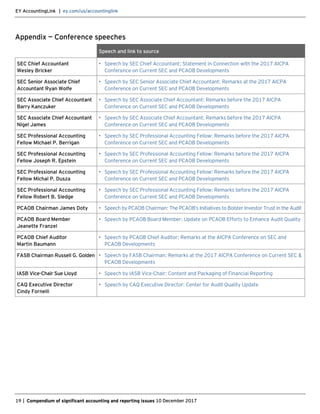
Appendix — Conference speeches
Speech and link to source
SEC Chief Accountant
Wesley Bricker
• Speech by SEC Chief Accountant: Statement in Connection with the 2017 AICPA
Conference on Current SEC and PCAOB Developments
SEC Senior Associate Chief
Accountant Ryan Wolfe
• Speech by SEC Senior Associate Chief Accountant: Remarks at the 2017 AICPA
Conference on Current SEC and PCAOB Developments
SEC Associate Chief Accountant
Barry Kanczuker
• Speech by SEC Associate Chief Accountant: Remarks before the 2017 AICPA
Conference on Current SEC and PCAOB Developments
SEC Associate Chief Accountant
Nigel James
• Speech by SEC Associate Chief Accountant: Remarks before the 2017 AICPA
Conference on Current SEC and PCAOB Developments
SEC Professional Accounting
Fellow Michael P. Berrigan
• Speech by SEC Professional Accounting Fellow: Remarks before the 2017 AICPA
Conference on Current SEC and PCAOB Developments
SEC Professional Accounting
Fellow Joseph R. Epstein
• Speech by SEC Professional Accounting Fellow: Remarks before the 2017 AICPA
Conference on Current SEC and PCAOB Developments
SEC Professional Accounting
Fellow Michal P. Dusza
• Speech by SEC Professional Accounting Fellow: Remarks before the 2017 AICPA
Conference on Current SEC and PCAOB Developments
SEC Professional Accounting
Fellow Robert B. Sledge
• Speech by SEC Professional Accounting Fellow: Remarks before the 2017 AICPA
Conference on Current SEC and PCAOB Developments
PCAOB Chairman James Doty • Speech by PCAOB Chairman: The PCAOB’s Initiatives to Bolster Investor Trust in the Audit
PCAOB Board Member
Jeanette Franzel
• Speech by PCAOB Board Member: Update on PCAOB Efforts to Enhance Audit Quality
PCAOB Chief Auditor
Martin Baumann
• Speech by PCAOB Chief Auditor: Remarks at the AICPA Conference on SEC and
PCAOB Developments
FASB Chairman Russell G. Golden • Speech by FASB Chairman: Remarks at the 2017 AICPA Conference on Current SEC &
PCAOB Developments
IASB Vice-Chair Sue Lloyd • Speech by IASB Vice-Chair: Content and Packaging of Financial Reporting
CAQ Executive Director
Cindy Fornelli
• Speech by CAQ Executive Director: Center for Audit Quality Update

EY's Compendium - 2017 AICPA Conference on Current SEC and PCAOB Developments

  • 1.
    Summary Regulators and standardsetters discussed a wide range of current financial reporting topics and emerging issues last week at the annual AICPA Conference on Current SEC and PCAOB Developments (Conference) in Washington, D.C. The speakers and panelists included representatives of the Securities and Exchange Commission (SEC or Commission), the Financial Accounting Standards Board (FASB or Board), the International Accounting Standards Board (IASB) and the Public Company Accounting Oversight Board (PCAOB) who shared their views on various accounting, financial reporting and auditing issues. On many topics, they said they are committed to engaging with stakeholders in the financial reporting system. Highlights included: New accounting standards —The SEC staff said that audit committees can contribute to an effective implementation of the major new accounting standards on revenue recognition, leases and credit losses by setting an appropriate tone at the top and understanding management’s response to any concerns raised by the auditor. The SEC staff also described consultations related to the new accounting standards and said it will respect reasonable judgments issuers make in applying the new standards, including when it reviews their fillings after they adopt the new revenue standard. The staff also reminded registrants of the importance of providing robust transition disclosures about the anticipated effects of new accounting standards, as required by Staff Accounting Bulletin (SAB) Topic 11.M. The staff also stressed that registrants need to perform a robust risk assessment in connection with implementing the new standards and make appropriate changes to internal control over financial reporting (ICFR) to address the new risks. 10 December 2017 2017 AICPA Conference on Current SEC and PCAOB Developments Compendium of significant accounting and reporting issues In this issue: 2017 AICPA Conference on Current SEC and PCAOB Developments ........... 1 Summary................................................. 1 Aconversation with SEC Chairman Clayton and SEC Chief Accountant Bricker............. 2 Remarks by Russell Golden, Chairman of the FASB ............................................ 3 Remarks by James Doty, Chairman of the PCAOB ......................................... 4 Accounting and disclosure matters......... 5 New accounting standards...................... 5 Other reporting considerations............. 10 Technology and innovation................... 10 ICFR, audit standards and independence matters........................... 11 Internal control over financial reporting... 11 PCAOB audit standards ........................ 12 Independence matters.......................... 12 SEC and accounting standard-setting update ...................................................13 Disclosure improvement initiatives ....... 13 Division of Corporation Finance process matters.................................... 14 International matters ............................ 16 International collaboration.................... 16 Foreign private issuers and cross- border reporting challenges.................. 16 SEC enforcement and PCAOB inspection matters................................. 17 Remarks of SEC enforcement staff....... 17 PCAOB inspections............................... 18 Appendix — Conference speeches ......... 19
  • 2.
    EY AccountingLink |ey.com/us/accountinglink 2 | Compendium of significant accounting and reporting issues 10 December 2017 US tax reform — The SEC staff acknowledged the potential operational and accounting challenges companies could face if US tax reform is enacted before the end of the year. While stressing the importance of timely financial reporting, the SEC staff said it will consider the need for any action on its part. The staff also reminded companies about disclosing any material effects of tax reform in Management’s Discussion and Analysis (MD&A) regardless of the enactment date. Technology and innovation — The SEC staff said that its 2011 disclosure guidance on cybersecurity is still relevant and discussed updates being considered that would address disclosure controls and procedures companies need to make sure that the appropriate people in the company are informed about cyber incidents on a timely basis and can address any disclosure implications. The staff also said it would consider the adequacy of cybersecurity disclosures in its filing reviews. SEC Chairman Jay Clayton and the SEC staff emphasized that a digital token representing a claim against an entity arising from the use of distributed ledger technology may be a security that, absent an exemption from registration, would require registration with the SEC and financial reporting by the issuer under US securities laws. The SEC staff said current accounting standards should apply to digital tokens and currencies. Capital formation — The SEC staff continued to encourage companies to take advantage of the ability to request relief from certain financial statement requirements under Rule 3-13 of Regulation S-X and shared examples of the fresh approach it has taken to reviewing these requests (including accelerating processing times). The staff also provided guidance for companies seeking to go public that may use the expanded non-public review process and omit interim financial information that would not be required in the public filing. The staff also provided an update on its disclosure effectiveness initiative and discussed areas of potential change. Auditor’s reporting model — Both the SEC and the PCAOB staffs encouraged auditors to discuss potential critical audit matters (CAMs) with the audit committee and management and consider a “dry run” of an expanded auditor’s report before it becomes mandatory, beginning in 2019. PCAOB Chairman James Doty said that requiring auditors to include more information in audit reports, including a discussion of CAMs and disclosure of audit firm tenure, will enhance their relevance and credibility. A conversation with SEC Chairman Clayton and SEC Chief Accountant Bricker SEC Chairman Jay Clayton and SEC Chief Accountant Wes Bricker shared their views on the new accounting standards, the role of the auditor and what audit committees should be doing, among other topics. Chairman Clayton reaffirmed that the Commission will continue to focus on its mission of protecting investors, especially retail investors whom he refers to as “Mr. and Ms. 401(k).” While he acknowledged the benefits to the US economy from the growth of the private capital markets, he said that the ability of retail investors to invest in the growth of the country is effectively limited to investing in the public capital markets. Chairman Clayton underscored that the portion of US investor capital invested in foreign private issuers that prepare financial statements under IFRS is growing. Because of this, the SEC has a vested interest in robust and consistently applied IFRS, he said. US and international standard setters should continue discussing ways to reduce differences in accounting standards and disclosures, Mr. Clayton observed. Mr. Bricker added that the focus should not necessarily be on a single standard setter or set of accounting standards, but rather on good communication and collaboration between FASB and IASB to share experiences for their mutual benefit.
  • 3.
    EY AccountingLink |ey.com/us/accountinglink 3 | Compendium of significant accounting and reporting issues 10 December 2017 Chairman Clayton called audited financial statements “the bedrock of our disclosure system” and securities regulation. Mr. Bricker noted the work of auditors is critical in protecting investors and helping registrants and audit committees fulfill their respective duties. He referred to a survey by the Center for Audit Quality that put investor confidence in audited financial statements at 85% and confidence in auditors at 78%. He believes those results and the declining number of financial statement restatements over the last few years reflect the high quality of audit work. Chairman Clayton noted that the SEC commissioners are currently conducting searches for new PCAOB members, including a new chairman to succeed James Doty. In conducting the search, the SEC is considering the critical role of the PCAOB as it relates to leadership in establishing high-quality auditing standards in the US and promoting similar efforts around the world by collaborating with international auditing standard setters. Chairman Clayton praised the Sarbanes-Oxley Act of 2002 (SOX) for strengthening audit committees and their relationship with auditors to the benefit of US capital markets, and he said the benefits of SOX far outweigh the compliance costs. He said audit committees should focus over the next year on CAMs, the implementation of the new accounting standards and cybersecurity. Chairman Clayton encouraged audit committees to ask their auditors to do a “dry run” of the expanded auditor’s report and the related CAMs before they are filed publicly. Over the next few years, Mr. Bricker said the SEC staff will focus on registrants’ implementation of the major new standards on revenue, leases and credit losses. In his view, audit committee members can bring value to their boards by leveraging their understanding of the business in overseeing management’s application of the new accounting standards. Mr. Bricker said the new accounting standards will help investors. For example, he pointed to the comprehensive disclosure package required by the new revenue standard that he expects will provide investors with a better understanding of how management enters into contracts and how the obligations to perform elements of those contracts are fulfilled. Mr. Bricker also stressed the importance of transition disclosures registrants are required to make about the anticipated effects of adopting new accounting standards. He said these disclosures, which are required by SAB Topic 11.M in periods prior to adoption, help investors understand the implications of the standards and prepare them to react to the changes. Remarks by Russell Golden, Chairman of the FASB FASB Chairman Russell Golden said the FASB’s focus is on continuous improvement in both US GAAP and its standard-setting process. Implementation of new standard After completing major standard-setting projects on revenue recognition, leases, credit losses and hedging over the past few years, Mr. Golden said the FASB is now primarily focused on helping stakeholders understand and implement the new standards. “We’ve made more resources available and stand ready to address your questions as they arise,” he said. Mr. Golden stressed the importance of engaging with stakeholders throughout the standard- setting process, including during the implementation phase. He pointed to the new leases standard as an example of how the FASB has attempted to address stakeholder concerns about transition by proposing more practical expedients, on which it is currently seeking comments. Mr. Golden also pointed to the FASB’s discussions with a diverse group of stakeholders to develop the new hedging standard, which he said will increase transparency while reducing the costs and complexity of applying hedge accounting. “The process was a model for how Audit committees should focus over the next year on critical audit matters, the implementation of new accounting standards and cybersecurity.
  • 4.
    EY AccountingLink |ey.com/us/accountinglink 4 | Compendium of significant accounting and reporting issues 10 December 2017 those views help us better understand the costs and benefits of our decisions,” he said, noting that both companies and investors are pleased with the new hedging standard. He added that the FASB will continue to hold public board meetings to discuss implementation issues related to all of its new standards, as necessary. Other standard setting Mr. Golden said one of the FASB’s priorities in 2018 is to complete its project on long-duration insurance contracts by issuing a final standard that will make targeted improvements to the existing accounting model for such contracts. Mr. Golden said he also expects the FASB to make progress on other projects, including its disclosure framework and conceptual framework projects. Technical agenda Mr. Golden said the FASB received valuable stakeholder feedback on its Invitation to Comment on future agenda priorities. Through the agenda consultation process, the Board decided to add the following projects to its agenda: • Distinguishing liabilities and equity • Disaggregated performance reporting • Segment reporting (to address the aggregation criteria) Mr. Golden noted that the FASB chose not to add many potential projects to its agenda in an effort to appropriately prioritize the time and resources of all stakeholders and focus on topics that realistically could be addressed successfully through its standard setting. Remarks by James Doty, Chairman of the PCAOB Mr. Doty called the external audit the “linchpin of trust that holds our system of public market capital formation together” and highlighted the important role the PCAOB has played in promoting investor trust and the independence of the auditing profession. Looking ahead, he said the profession needs to be agile and adaptable to investor needs, especially as the pace of change increases. “The profession now has the challenge and the opportunity to make innovation and competition serve trust,” he said. He added that the future of the mandatory audit depends on whether auditors can use data technology to audit more effectively and whether global firms can compete on audit quality, among other things. Mr. Doty highlighted standards the PCAOB has adopted recently that require auditors to disclose information about audit participants and enhance the auditor’s report. He noted that investors now have access to information about the partner who leads the audit as well as the international scope of many audits, including how much work is conducted by audit firms other than the firm that issues the auditor’s report. This increase in transparency is intended to improve the credibility and relevance of the audit, and it provides a powerful incentive for audit firms to organize audits in a manner that they are proud to publicly disclose, he said. Mr. Doty said the PCAOB is requiring enhancements to the auditor’s report in response to investor demand for more information about the judgments most critical to the audit. Starting with reports on 2017 financial statements for calendar-year companies, auditors will disclose their tenure as auditor, change the organization of their reports and include language clarifying the auditor’s role. In the most significant change, auditors will be required to discuss CAMs in their auditor’s reports, beginning in 2019. Mr. Doty said the staggered effective dates for adding CAMs to auditor’s reports will allow the PCAOB to monitor early implementation and develop additional guidance and tools as needed. He also noted that the PCAOB plans to perform a robust post-implementation review of the standard’s economic impact.
  • 5.
    EY AccountingLink |ey.com/us/accountinglink 5 | Compendium of significant accounting and reporting issues 10 December 2017 Accounting and disclosure matters New accounting standards General observations by SEC staff Sagar Teotia, Deputy Chief Accountant in the SEC’s Office of the Chief Accountant (OCA), said audit committees can contribute to an effective implementation of the major new accounting standards on revenue, leases and credit losses by setting an appropriate tone at the top and understanding management’s response to any concerns raised by the auditor. He observed that transition disclosures about the anticipated effects of new accounting standards required by SAB Topic 11.M provide important information to investors, and registrants should disclose the status of their implementation efforts. If an entity is behind schedule, the audit committee should hold management accountable for successfully executing its implementation plan. He also emphasized that while the new disclosures required by the standards will provide investors with useful information, preparing them could require significant effort. Therefore, he said companies should make assembling the information needed to comply with the new disclosure requirements a priority. Finally, Mr. Teotia shared the OCA staff’s approach to consultations with issuers related to the new standards. He emphasized that the standards require companies to develop and apply significant judgment and that such judgments, if reasonable, have been and will continue to be respected by the staff. General observations by FASB staff FASB Technical Director Sue Cosper provided an overview of the FASB’s activities related to the implementation of the new accounting standards on revenue recognition, leases and credit losses, as well as an update on projects on the FASB’s technical and research agendas. Ms. Cosper said the FASB is focused on supporting entities through their adoption of the new accounting standards. The FASB has devoted staff to help stakeholders understand its intent with respect to the new accounting standards and provide clarifications to these standards as needed. Ms. Cosper highlighted the numerous resources available on the FASB Implementation Web Portal, including Transition Resource Group (TRG) materials, FASB discussion materials, educational resources (e.g., webcasts, podcasts) and a link to the FASB’s technical inquiry service. Revenue recognition Barry Kanczuker, Associate Chief Accountant in OCA, and Joseph R. Epstein, Professional Accounting Fellow in OCA, discussed recent consultations related to the new revenue standard. Accounting for pre-production arrangements Entities often need to perform pre-production activities before delivering any units under a production contract, and a customer may agree to provide cash consideration in contemplation of those activities as an up-front payment. Mr. Epstein explained that as registrants determine the accounting for pre-production arrangements under Accounting Standards Codification (ASC) 606, Revenue from Contracts with Customers, the assessment should be based on the entity’s facts and circumstances. Mr. Epstein said registrants that currently consider pre-production to be a service deliverable under ASC 605, Revenue Recognition, should evaluate whether pre-production activities are a performance obligation under ASC 606. This evaluation may result in a registrant that previously concluded that pre-production activities were a service deliverable under ASC 605 concluding that these activities are not a performance obligation under ASC 606. Mr. Epstein indicated that it would be appropriate to apply the transition provisions of ASC 606 to these situations. The SEC staff said reasonable judgments made by registrants in applying the new accounting standards will continue to be respected. Ernst & Young LLP (EY) resources • Financial reporting developments, Revenue from contracts with customers (ASC 606) (SCORE No. BB3043) • To the Point, Update on accounting for pre-production and tooling activities and costs under ASC 606 (SCORE No. 04663-171US)
  • 6.
    EY AccountingLink |ey.com/us/accountinglink 6 | Compendium of significant accounting and reporting issues 10 December 2017 Mr. Epstein noted that other registrants have historically considered their pre-production activities to be non-revenue arrangements. He said OCA would not object to registrants continuing to apply their historical, non-revenue models. Mr. Epstein encouraged registrants that previously applied a non-revenue model to pre-production activities and are considering applying a revenue model under ASC 606, or making changes to their historical non-revenue model, to consult with OCA. How we see it Mr. Epstein’s comments are consistent with the views we described in our To the Point publication, Update on accounting for pre-production and tooling activities and costs under ASC 606, in August 2017. Identifying performance obligations Mr. Epstein said OCA objected in a consultation to a registrant’s conclusion that goods or services in its arrangement were not separately identifiable. Therefore, the staff concluded the goods or services should not be combined into a single performance obligation. He explained that when identifying performance obligations and whether promised goods or services are highly interdependent or highly interrelated, registrants should not merely evaluate whether one item, by its nature, depends on the other. Instead, he said, registrants need to consider whether those goods or services significantly affect each other (i.e., whether there is a two- way dependency between the goods or services in the arrangement). How we see it We believe the identification of performance obligations and especially the assessment of whether goods or services are highly interdependent or highly interrelated requires significant judgment and will continue to be an area of focus for entities and their stakeholders. Principal versus agent considerations Under the new revenue standard, an entity is a principal and therefore records revenue on a gross basis if it controls a specified good or service before transferring that good or service to the customer. An entity is an agent and records revenue as the net amount it retains for its agency services if its role is to arrange for another entity to provide the goods or services. Mr. Kanczuker said there have been frequent consultations with OCA regarding the determination of whether an entity is a principal or an agent under ASC 606. He said this area of accounting can be especially challenging in certain industries where there are often multiple parties involved in providing the good or service, and the transactions sometimes take place in the blink of an eye (e.g., digital advertising). These arrangements can make it difficult to determine whether the entity established control of the good or service before it was transferred to the customer. He said that, while ASC 606 provides indicators to support an entity’s assessment of whether it controls a specified good or service before it is transferred to the customer, these indicators should not be considered a checklist of criteria. Mr. Kanczuker said that indicators may be more or less relevant to the overall assessment of control, depending on the nature of the specified good or service and the terms and conditions of the contract. He stated the determination of the relevance of an indicator will require judgment.
  • 7.
    EY AccountingLink |ey.com/us/accountinglink 7 | Compendium of significant accounting and reporting issues 10 December 2017 Finally, Mr. Kanczuker said that “an area of significant judgment does not mean that the standard permits optionality. In order to make these reasonable judgments, I believe that registrants need to roll up their sleeves to understand the nuances of the transactions and faithfully apply the Topic 606 model to their specific set of facts and circumstances.” Shipping and handling costs Under ASC 606, if the shipping and handling activities are performed before the customer obtains control of the good, a registrant accounts for the shipping and handling as activities to fulfill the promise to transfer the good. If shipping and handling are performed after a customer obtains control of the good, an entity may either account for shipping and handling as a promised service to the customer or elect to account for shipping and handling as activities to fulfill the promise to transfer the good. However, the new revenue standard does not include any guidance that addresses the classification of shipping and handling expenses. Given the absence of classification guidance in ASC 606, Mr. Kanczuker said an entity will need to apply judgment in determining the appropriate classification of expenses for shipping and handling activities it accounts for as activities to fulfill the promise to transfer the good. He said that the OCA staff would not object to the classification of these expenses in costs of sales. He said OCA also would not object to an entity continuing to apply its previous policy regarding classification of these expenses, which may be outside of costs of sales. Mr. Kanczuker said a registrant that classifies significant shipping and handling costs outside of costs of sales should consider disclosing the amount of such costs and the line item or items on the income statement that include them, in a manner similar to the disclosures required under current US GAAP. How we see it We believe entities generally will be able to support classifying these costs in the same manner that they do today, using the same rationale they used for their accounting policy under legacy GAAP. FASB’s implementation update To date, the FASB has received more than 100 submissions on issues related to the application of the new revenue standard. The TRG for Revenue Recognition discussed many of the issues that had broad applicability, and remaining issues were addressed by the FASB staff as technical inquiries. Ms. Cosper noted that none of the TRG issues remain open, and technical inquiry volume has started to wane as the effective date for public business entities (PBEs) draws near. However, she anticipates additional technical inquiry submissions later in 2018 as the effective date of the standard for non-PBEs approaches. Ms. Cosper said issues related to identifying performance obligations and determining the transaction price were the top two categories of implementation inquiries. With respect to identifying performance obligations, Ms. Cosper highlighted questions related to the following types of arrangements: (1) franchising arrangements, including whether the franchisor’s initial franchise fee comprises more than one performance obligation, and (2) licensing arrangements where technical support or updates required to be provided by the licensor need to be assessed to determine whether they represent separate performance obligations. In both cases, Ms. Cosper noted that the evaluation of performance obligations requires reasonable judgment and depends on the facts and circumstances.
  • 8.
    EY AccountingLink |ey.com/us/accountinglink 8 | Compendium of significant accounting and reporting issues 10 December 2017 Leases Implementation Representatives from both the SEC and FASB staffs emphasized the importance of thoughtful planning for and timely implementation of the new leases standard, ASC 842, Leases. They cautioned companies not to underestimate the level of effort required to plan for and implement the standard, including any necessary changes to ICFR. Representatives from two companies cited data collection and identifying appropriate resources as significant challenges in implementing ASC 842. Those individuals also cited the lack of available information technology (IT) solutions as a major challenge to their implementation. Mr. Teotia advised companies not to delay commencing implementation efforts due to a perceived lack of available IT solutions. Mr. Teotia said companies should begin identifying the population of relevant contracts and evaluating whether those contracts are or contain a lease. Transition issues Mike Berrigan, a Professional Accounting Fellow in OCA, discussed two transition issues related to the new leases standard. The first related to whether a lessee should include the portion of the fixed gross rental payments that represent executory costs (e.g., maintenance, taxes, insurance) in the measurement of the initial lease liability recognized in transition to ASC 842 for an arrangement historically accounted for as an operating lease. The transition guidance in ASC 842 requires a lessee to initially measure the lease liability using the remaining minimum rental payments as defined under ASC 840. However, ASC 840 does not specify whether executory costs should be included in minimum rental payments. As a result, diversity in practice exists. For purposes of establishing the initial lease liability in transition, Mr. Berrigan said the staff would not object to registrants consistently applying their historical accounting policy on including executory costs in minimum rental payments. The second issue related to the incremental borrowing rate a lessee should apply when measuring the initial lease liability in transition. The transition guidance in ASC 842 states that a lessee should measure the lease liability using the discount rate established at the later of the beginning of the earliest period presented in the financial statements or the lease commencement date. However, ASC 842 does not specify whether the incremental borrowing rate used should be based on the original lease term or the remaining lease term. Mr. Berrigan said the staff would not object to the consistent application of either a rate based on the original lease term or a rate based on the remaining lease term. Recent developments Ms. Cosper said the FASB staff has received a number of questions related to the new leases standard that have focused on scoping, transition and lessee and lessor accounting, and the FASB is addressing several of those questions through amendments to the standard. For example, the FASB decided to finalize the practical expedient it proposed to allow a company to not apply ASC 842 to certain land easements that existed or expired before the effective date of the standard. The Board also recently voted to propose practical expedients that would permit a company to elect not to apply ASC 842 in the comparative periods presented and to allow lessors to combine lease and non-lease components when the pattern of recognition is the same. In order to use the practical expedient, the lease must also continue to be classified as an operating lease even with the components combined. Companies should not underestimate the level of effort required to plan for and implement the new leases standard.
  • 9.
    EY AccountingLink |ey.com/us/accountinglink 9 | Compendium of significant accounting and reporting issues 10 December 2017 Credit losses Robert Sledge, a Professional Accounting Fellow in OCA, shared observations from consultations on issues related to the new credit losses standard. The first observation related to financial assets that are collateral dependent. Like current US GAAP, the new credit losses standard requires entities to measure credit losses for collateral- dependent financial assets for which foreclosure is probable based on the collateral’s fair value. However, for collateral-dependent financial assets for which foreclosure is not probable, entities can choose to apply a practical expedient to measure expected credit losses based on the collateral’s fair value rather than the general expected credit losses approach. Mr. Sledge discussed a consultation related to a portfolio of consumer loans for which foreclosure was deemed not probable, even though the registrant had received notice of the borrowers’ bankruptcies. The registrant anticipated that it wouldn’t elect to apply the practical expedient and would instead apply the general expected credit losses approach to that loan portfolio. The staff did not object to the registrant’s conclusion to apply the general expected credit losses approach by incorporating all relevant information about expectations of future cash flows (e.g., payment history of similar loans, delinquency status), instead of determining the allowance for credit losses based on the collateral’s fair value. Mr. Sledge also discussed recent consultations that dealt with the scope of the purchased credit impaired (PCI) model under current US GAAP and the purchased credit deteriorated (PCD) model under the new credit losses standard. Mr. Sledge noted that under current GAAP, the staff has not objected to the application of the PCI model by analogy in certain cases (e.g., when loan receivables are acquired at a discount attributable, at least in part, to credit quality). However, in those consultations, the staff did not address whether it would object to application of the PCI model by analogy in other circumstances. One consultation involved defaulted, unsecured receivables that were acquired at a significant discount. The registrant had concluded that the transfer of those unsecured receivables did not qualify for sale accounting under ASC 860, Transfers and Servicing, and therefore accounted for the transaction as the origination of new loans collateralized by the impaired receivables. In this case, the staff objected to applying the PCI model by analogy because the staff believed that the guidance for originated loans in ASC 310-10 and ASC 310-20 applied.1 In another consultation, a registrant asked whether consumer installment loans purchased immediately after they were originated by a retailer in connection with the sale of goods would qualify for PCD accounting under the new credit losses standard. The staff objected to this view, noting that there was no credit deterioration associated with the loans at the date of initial recognition, particularly since the loans were purchased shortly after origination. The staff also concluded that application of the PCD model would not be appropriate for loans made to retailers that are collateralized by consumer installment loans made by the retailers in connection with the sale of goods because the loans are originated, not purchased. Ms. Cosper emphasized that the new credit losses standard has broad applicability beyond financial institutions, noting that it will affect any entity with receivables or held-to-maturity securities.2 She briefly discussed the credit losses TRG meetings that have been held to date and said the TRG’s work before the FASB issued the standard was critical in helping make sure the standard was operational. Ms. Cosper indicated that she anticipates the TRG to meet in 2018 to discuss existing and new issues that arise. EY resources • Technical Line, A closer look at the new credit impairment standard (SCORE No. 03320-161US) • Technical Line, How the new credit impairment standard will affect entities outside the financial services industry (SCORE No. 01245-171US) • To the Point, FASB TRG for credit losses discusses implementation issues (SCORE No. 03877-171US)
  • 10.
    EY AccountingLink |ey.com/us/accountinglink 10 | Compendium of significant accounting and reporting issues 10 December 2017 Hedging Ms. Cosper provided a brief overview of the targeted amendments the FASB made to the hedging standard to enable entities to more clearly portray in their financial statements the economics of their risk management activities and to simplify certain aspects of hedge accounting. She said the feedback on the new guidance has been very positive, and many entities have indicated plans to adopt the standard early. Given the interest in early adoption, she indicated that the FASB has already received a number of implementation questions, many of which relate to hedging contractually specified components in nonfinancial items and the application of the last of layer method. The last of layer method is a new approach for hedging prepayable assets in a closed portfolio or beneficial interests secured by prepayable financial instruments. Other reporting considerations Financial reporting implications of tax reform Mr. Teotia said the SEC staff has been considering the financial reporting implications of the tax reform proposals Congress is considering. He acknowledged that any changes in tax law could create significant accounting consequences and encouraged companies to bring their questions to the staff. If tax reform is enacted before the end of the year, companies will need to account for the change in tax law in the period of enactment (i.e., in the fourth quarter for calendar year-end companies). Mr. Teotia said the SEC staff is mindful of the challenges companies will face to incorporate the effects of tax reform by their financial reporting deadlines, and the SEC staff will consider the need for action on its part. However, he also emphasized the need to timely report meaningful information to investors. On a separate panel, Bill Hinman, Director in the SEC’s Division of Corporation Finance (DCF), suggested that companies consider disclosing the effects of tax reform in MD&A if the effects are material. For example, Mr. Hinman said a company may consider disclosing the resulting change in the value of its deferred tax assets. Ms. Cosper said the FASB has a team of staff members dedicated to tax reform. She does not believe changes to the accounting guidance in ASC 740, Income Taxes, would be necessary if tax reform legislation is enacted; however, the FASB staff is continuing to monitor developments. She added that the FASB will not discuss its ongoing project on income tax disclosures until after any tax legislation is enacted. How we see it Companies should develop a formal plan across their finance and tax departments to determine the effects of the proposed tax law, including the impacts to the financial statements. They should also consider whether they need to make changes to their systems, processes and internal control over financial reporting. Technology and innovation Cybersecurity Mr. Hinman discussed cybersecurity disclosures and said that the staff guidance, CF Disclosure guidance: Topic No. 2 — Cybersecurity, issued in 2011, which clarified how Regulation S-K disclosure requirements apply to cybersecurity risks and incidents that could have a material effect on a registrant, works “fairly well” and is “still very sound.” However, he said the staff is thinking about how to refresh the guidance “to underscore its importance,” including elevating it to the Commission level. Mr. Hinman did not say when any refreshed guidance would be issued. EY resources • To the Point, Companies should start planning for potential tax reform now (SCORE No. 06604-171US) The SEC staff is mindful of the compressed deadlines in which companies may need to account for the complex impacts of tax reform. EY resources • SEC Reporting Update, Spotlight on cybersecurity disclosures (SCORE No. 06544-171US)
  • 11.
    EY AccountingLink |ey.com/us/accountinglink 11 | Compendium of significant accounting and reporting issues 10 December 2017 Mr. Hinman said the updated guidance would clarify that cybersecurity risks are in the scope of registrants’ disclosure controls and procedures so registrants need to make sure that the appropriate people are informed about breaches on a timely basis to address any disclosure implications. He said the updated guidance would remind registrants to administer their insider trading policies when material information about cyber incidents has not yet been disclosed. Mr. Hinman also said that, while registrants need to cooperate with law enforcement investigations of breaches, the existence of such an investigation should not delay registrants from disclosing appropriate information about a material cyber incident. How we see it The SEC staff said it will increase its scrutiny of cybersecurity disclosures in its comment letter process. We therefore recommend that registrants take a fresh look at their cybersecurity disclosures under the current SEC staff guidance. Distributed ledger technologies and digital tokens Chairman Clayton said virtual currencies such as digital coins (e.g., Bitcoin) and digital tokens representing claims against entities arising from the use of distributed ledger technology are the opposite ends of the “digital currency spectrum.” In his view, a digital token represents a security because “asking people for their money (and using it) in a commercial endeavor with the prospect of increasing the value” of that digital token meets the definition of a security. He said the “long-standing body of law” on securities should apply to such transactions.3 Mr. Bricker said that, absent an exemption from registration, distributed ledger entries that meet the definition of securities need to be registered with the SEC and their issuers need to include the required disclosures, including financial disclosures. Julie Erhardt, Deputy Chief Accountant in OCA, noted that innovation in commerce often raises accounting and auditing questions and expressed confidence that the current accounting guidance could be applied to digital currencies. She encouraged accountants to focus on these issues. The FASB’s Ms. Cosper said accounting for digital currencies is not currently on the FASB’s agenda. However, the FASB staff is performing research on the subject and plans to propose that the FASB consider adding a related project in the future. ICFR, audit standards and independence matters Internal control over financial reporting The SEC staff discussed the importance of making sure a company has effective ICFR when it implements new accounting standards (e.g., revenue, leases, current expected credit losses). Marc Panucci, Deputy Chief Accountant for Professional Practice in OCA, noted that preparers and auditors should have a robust discussion up front about the importance of ICFR in the transition to major new accounting standards, which require more estimates and judgments than legacy GAAP. The SEC staff noted the company’s control environment should provide for the development and application of reasonable judgments in applying the new standards. Michal Dusza, a Professional Accounting Fellow in OCA, noted that ICFR is more than a compliance exercise and emphasized the importance of the entity’s risk assessment process. He acknowledged that identifying the relevant risks of material misstatement related to new accounting standards may not be an easy task, but when it is done well, this exercise will provide the appropriate foundation to support an effective and efficient ICFR process.
  • 12.
    EY AccountingLink |ey.com/us/accountinglink 12 | Compendium of significant accounting and reporting issues 10 December 2017 How we see it When they adopt the new accounting standards, companies should evaluate whether they have made any material changes to their ICFR and make appropriate disclosures as required by Item 308(c) of Regulation S-K. PCAOB audit standards Jeanette Franzel, a member of the PCAOB, said the PCAOB has made significant progress in enhancing its standard-setting process by increasing its use of multi-disciplinary teams and developing a research agenda to identify emerging issues that might benefit from additional guidance or PCAOB standards, among other things. The use of data and technology tools in the audit was a frequent topic of discussion during the Conference. The PCAOB has this item on its agenda and plans to create a task force of its Standing Advisory Group to further its research. PCAOB Chief Auditor Martin Baumann highlighted the new PCAOB auditing standards aimed at improving transparency by requiring auditors to identify audit participants and include more information in the auditor’s report. Mr. Baumann provided an overview of the new report requirements, noting that all changes, except for the requirement to describe CAMs, are required for audits of fiscal years ending on or after 15 December 2017. The later effective dates for CAMs were intended to give accounting firms, companies and audit committees more time to implement the requirements, and the staggered effective dates can help auditors of smaller companies learn from the experience of their larger peers. Mr. Baumann is hopeful that auditors, audit committees and management will use the additional time to discuss matters that might be reported as CAMs before the requirements become effective. Mr. Panucci emphasized that each stakeholder has a role to play in the implementation of changes to the auditor’s report. Mr. Panucci encouraged audit firms to provide enough guidance to help audit teams comply with the CAM requirements but allow for flexibility so that the communication of CAMs can be tailored to the audit and not become boilerplate. Mr. Baumann also noted that the PCAOB staff recently issued an audit practice alert to help auditors address the implementation of the new revenue standard. The practice alert highlights the importance of considering whether there are new or different fraud risks related to revenue recognition, given the increase in management judgments and estimates under the new standard. How we see it The new revenue standard creates new risks that entities and auditors will need to appropriately consider. For instance, we expect there will be new risks related to contract initiation and financial statement disclosures, even when there is no change in the timing or measurement of revenue. All entities and audit teams will need to reassess risks and update their documentation accordingly. In addition, new accounting estimates and judgments that entities will make under the standard may create new opportunities for fraud. Independence matters Mr. Panucci reminded auditors, audit committees and preparers of their shared responsibility for independence and the importance of having the right policies in place to maintain independence. He encouraged companies and their auditors to define a framework to guide the procedures performed by the audit firm so it’s clear what the auditor can and cannot do, especially when it comes to services related to the new accounting standards. Management, the audit committee and the auditor should all have a good understanding of this framework to mitigate the risk that the auditor might inadvertently expand the scope of its services and perform an impermissible service. PCAOB and SEC officials expect auditors to discuss critical audit matters that are tailored to the audit and not just use boilerplate language.
  • 13.
    EY AccountingLink |ey.com/us/accountinglink 13 | Compendium of significant accounting and reporting issues 10 December 2017 Given the upcoming accounting changes requiring retrospective revisions, Mr. Panucci reminded audit committee to be mindful of independence as it relates to the predecessor auditor when there has been a change in audit firms. Audit committees should determine which firm will audit the retrospective adjustments required to recast the prior years’ financial statements upon adoption of the standards and ensure the predecessor retains its independence after the change if they will be engaged to audit those adjustments. Mr. Panucci also indicated that companies and their auditors should have a process in place to identify and maintain an up-to-date list of affiliates of the audit client. Mr. Panucci observed that in private equity situations it is a best practice for management of the private equity firm to assist with identifying affiliates of the audit client. Finally, Mr. Panucci said that the SEC staff is currently working on making recommendations to the Commission regarding potential amendments to the “Loan Rule.”4 SEC and accounting standard-setting update Disclosure improvement initiatives SEC disclosure effectiveness initiative and rulemaking Mr. Hinman emphasized the importance of the SEC’s disclosure effectiveness initiative to the objectives of the SEC’s capital formation agenda to reduce the regulatory burden on registrants and make it easier for companies to access public capital markets. Mr. Hinman discussed the SEC’s recent proposal to simplify and modernize certain disclosure requirements of Regulation S-K,as required by the Fixing America’s Surface Transportation Act.5 Mr. Hinman said that the proposal, among other changes, would revise the requirements for MD&A to give registrants more flexibility regarding the extent the earliest of the three annual periods should be discussed in the current annual report when it was discussed in the previous annual report. This proposal is intended to streamline annual reports and encourage companies to take a fresh look at their MD&A each year. Mr. Hinman also said the SEC staff is considering recommending that the SEC propose changes to the requirements under Rules 3-05 and 3-10 of Regulation S-X in response to its prior Request for Comment on the Effectiveness of Financial Disclosures about Entities Other than the Registrant. Mark Kronforst, Chief Accountant in DCF, said the SEC may decrease the number of periods for which acquiree financial information must be presented under Rule 3-05. He further suggested that pro forma financial information for significant acquired businesses could be more useful to investors in certain circumstances if the criteria for pro forma adjustments were less rigid. Mr. Hinman signaled that the SEC may eliminate the condensed consolidating footnote information under Rule 3-10, which he called burdensome and costly and which he noted has adversely affected the number of registered guaranteed debt offerings. Mr. Hinman also said the SEC staff is drafting final amendments for the SEC to consider that would eliminate outdated and redundant disclosure requirements, as the SEC previously proposed.6 Mr. Hinman also indicated that the SEC has projects to update the disclosure requirements for mining and bank holding companies. FASB’s disclosure framework project Marc Siegel, a member of the FASB, discussed the FASB’s disclosure framework project aimed at improving the effectiveness of disclosures in the notes to the financial statements. The FASB is currently testing the framework it developed for the board’s decision process as part of its proposals to change the disclosure requirements for fair value measurements, inventory, pension benefit plans and income taxes, Mr. Siegel said. EY resources • To the Point, SEC proposes modernizing and simplifying certain Regulation S-K disclosure requirements (SCORE No. 05841-171US)
  • 14.
    EY AccountingLink |ey.com/us/accountinglink 14 | Compendium of significant accounting and reporting issues 10 December 2017 The FASB has also proposed a decision process for entities that would promote discretion in applying materiality when determining whether to make a disclosure. The FASB is also considering including the definition of materiality in the Accounting Standards Codification rather than in the FASB Concept Statements, which are non-authoritative. Trends in voluntary disclosure improvements Many companies have voluntarily improved their disclosures in SEC filings and other communications, according to panelists who discussed financial reporting. The panelists observed that companies have most frequently targeted their MD&A and their description of business and risk factors by providing their disclosures in plain English, eliminating repetition by using cross-references, ordering disclosures based on materiality and eliminating immaterial disclosures. A preparer panelist observed that her company’s initiatives improved the quality of its disclosures and provided efficiencies in its external communications process. Karen Garnett, Associate Director in DCF, encouraged companies to take steps to voluntarily improve their disclosures and said the staff is willing to discuss proposed revisions with companies on a pre-filing basis. Division of Corporation Finance process matters Seeking waivers or financial reporting alternatives under Rule 3-13 of Regulation S-X SEC staff in DCF spoke about enhancements to their protocol for reviewing requests for financial statement waivers and relief under Rule 3-13 of Regulation S-X. The staff encouraged registrants with simple fact patterns to contact the staff members listed in the introductory section of the DCF Financial Reporting Manual if they would like input on what to include prior to submitting a formal request. Registrants with more complex fact patterns should submit a preclearance or waiver letter succinctly outlining the fact pattern, proposed reporting or waiver request and their consideration of why the request would be consistent with protecting investors and providing them with material information. In some cases, the staff may contact the company to request more information before responding. DCF has undertaken to expedite responses to Rule 3-13 waiver and preclearance requests. How we see it We have observed recently that registrants’ requests under Rule 3-13 have been resolved within a week and sometimes within a day. As a result, companies should not consider time constraints as an obstacle to requesting a waiver or accommodation from the SEC staff. Craig Olinger, Deputy Chief Accountant in DCF, provided examples of common requests under Rule 3-13 for waivers of other entity financial statements or financial information that the SEC staff has viewed favorably. When the result of the income test to evaluate the significance of an acquired business is significantly higher than the asset and investment test, the staff may consider other indicators of the relative size of the acquisition to the registrant such as the proportionate share of the acquiree’s revenue or key operating or financial metrics compared to those of the registrant. Income significance tests can be disproportionately higher than the asset and investment test, for instance, when the registrant’s pre-tax income is near break-even. Mr. Olinger said that the staff historically has accepted a combination of pre-acquisition and post-acquisition audited periods in registration statements to satisfy the required periods under Rule 3-05 of Regulation S-X. The staff recognizes that this sometimes requires odd, non-comparable pre-acquisition stub periods that don’t provide investors with meaningful EY resources • EY and Financial Executive Research Foundation publication, Disclosure effectiveness in action: Companies make great strides (SCORE No. 03004-161US) ‘We are open for business.’ — Mark Kronforst, Chief Accountant in DCF
  • 15.
    EY AccountingLink |ey.com/us/accountinglink 15 | Compendium of significant accounting and reporting issues 10 December 2017 information about operations and trends of the acquired business. As a result, the staff is now placing greater weight on the post-acquisition period included in consolidated operating results and considers that period in assessing the significance of the acquiree to the registrant and may waive pre-acquisition financial statements in certain cases. Further, the staff recognizes that the utility of full GAAP financial statements for a carve out may also be limited when it is a predecessor. For instance, in an initial public offering (IPO) registration statement where the predecessor entity represents only a portion of the former seller’s business, preparing full carve-out financial statements may be challenging and predecessor financial statements are often not comparable with the successor for various reasons (e.g., different financing and overhead structure). Therefore, the staff may be more inclined to accept abbreviated statements for a predecessor that is a carve out. While the staff encouraged registrants to submit Rule 3-13 requests as early as possible before the deadline for filing financial statements of significant acquirees and equity method investees, the staff emphasized that registrants need to have “concrete” facts when they request relief. Observations on the expanded non-public review program In an effort to facilitate capital formation, the SEC staff has begun accepting draft registration statements for non-public review and comment in the following cases: • Non-emerging growth company IPO registration statements under the 1933 Act • Initial registrations under Section 12(b) of the Exchange Act • Registration of follow-on offerings within the first year as an SEC reporting company Since July 2017, when the SEC staff expanded its non-public registration statement review program to the categories above, more than a dozen issuers have taken advantage of the program for their IPO registration statements and more than two dozen for their follow-on offerings within their first 12 months as a public company. Cicely LaMothe, Associate Director in DCF, reminded participants about the guidance the SEC staff issued earlier in 2017 that allows all issuers to exclude from their draft registration statements interim financial statements that they don’t reasonably expect to be required at the time the registration statement will be filed. This is a significant reduction in compliance costs for companies eligible for the non-public review process. Ms. LaMothe advised companies using this process to include a cover letter describing the anticipated timing of their public filing and effective date and what additional financial statements will be included in the “filed” registration statement. She also recommended that the cover letter describe any significant transactions that would have been reflected in the omitted interim financial statements and will be disclosed when subsequent interim or additional annual financial statements are filed, the anticipated accounting treatment and the anticipated disclosures (to the extent known). This will help expedite the filing process because waiting to disclose significant events or transactions until the public filing without notifying the staff in advance could cause delays if the staff has significant comments. How we see it Companies may also mitigate the risk of delays in the filing process due to the staff’s review of significant new transactions by voluntarily providing current-year interim information, without comparative prior-year interim information, in their draft submissions.
  • 16.
    EY AccountingLink |ey.com/us/accountinglink 16 | Compendium of significant accounting and reporting issues 10 December 2017 Non-GAAP financial measures and key operating metrics Kyle Moffatt, Associate Director in DCF, and Mr. Kronforst said the staff is generally pleased with how companies have reacted to the updated guidance the staff issued in 2016 on the use of non-GAAP financial measures and with the related comment letter process that followed. However, Mr. Moffatt said the staff is still concerned about companies labeling non-GAAP measures with titles that are very similar to GAAP measures, such as “operating earnings” or “operating income,” which the staff has frequently observed in the insurance industry. He said registrants should be mindful that these labels may violate Item 10(e) of Regulation S-K and should rename those measures using terms such as “adjusted operating income,” for example. Mr. Moffatt also said the SEC staff is now focusing on the disclosure of key operating metrics. In particular, the SEC staff wants companies to better explain how these metrics relate to and explain the results of operations and trends. International matters International collaboration Many speakers at the Conference, including Messrs. Clayton and Bricker, discussed the need for collaboration and coordination between US and international standard setters. Sue Lloyd, Vice Chair of the IASB, discussed how the IASB and the FASB worked together very closely on the major new accounting standards on revenue and leases and how, while the Boards “have not always ended up with identical standards, (they) have moved in the same direction”. She said the new revenue standards in US GAAP and IFRS are “virtually identical,” meaning that the main performance metric in financial statements should be “comparable around the world.” She added that the IASB would always consider the ideas of other standard setters and support effective communication. While the IASB is now focusing on supporting the implementation of its new standards including IFRS 9, Financial Instruments and IFRS 17, Insurance Contracts, Ms. Lloyd said that the IASB’s medium-term projects are encouraging and enabling the use of financial statements as a means of communication rather than a compliance exercise. To that end, the IASB has started the Primary Financial Statement Project to improve performance reporting by deciding which performance metrics should be allowed on the face of the financial statements. The IASB is also continuing its effort to improve the effectiveness of disclosures with a recent publication on the application of the concept of materiality in preparing financial statements. Foreign private issuers and cross-border reporting challenges Mr. Olinger said that, as of 31 December 2016, about 60% of the 900 foreign private issuers (FPIs) registered with the SEC prepared their financial statements in accordance with IFRS as issued by the IASB and about 40% prepared their financial statements in accordance with US GAAP. Very few FPIs prepared financial statements in accordance with home-country GAAP reconciled to US GAAP. Mr. Olinger said FPIs can use the SEC’s expanded nonpublic registration statement review process. He added that FPIs may omit from their draft registration statements interim financial information if that information is going to be replaced with financial information for a more recent period upon the public filing even if such interim financial information has already been published in their home jurisdiction. The SEC staff is now focusing its attention on key operating metrics and wants companies to better explain how these metrics are reflective of the results of operations and trends.
  • 17.
    EY AccountingLink |ey.com/us/accountinglink 17 | Compendium of significant accounting and reporting issues 10 December 2017 Mr. Olinger said that the staff’s comments to companies reporting under IFRS are similar to those it issues to companies reporting under US GAAP, except that FPIs generally receive fewer comments on non-GAAP measures because of exemptions from Regulation G that apply to non-GAAP measures included in certain home country communications. However, he cautioned that the SEC staff may increase its focus in comment letter reviews on subtotals presented on the face of the income statement to make sure FPIs comply with the general guidance in International Accounting Standard 1, Presentation of Financial Statements, and are not inappropriately disclosing non-GAAP measures. We note that, for FPIs reporting under IFRS, a non-GAAP measure is one that doesn’t comply with IFRS. SEC enforcement and PCAOB inspection matters Remarks of SEC enforcement staff Stephanie Avakian, Co-Director of the SEC’s Division of Enforcement, and Michael Maloney, Chief Accountant in the Division of Enforcement, discussed the SEC’s enforcement actions over the past fiscal year. Ms. Avakian reported that in the fiscal year ended 30 September 2017 the SEC filed 754 cases, obtained judgments and orders for more than $3.7 billion of disgorgement and penalties and returned more than $1 billion to harmed investors through fair funds and other distribution mechanisms. These enforcement actions involved the full spectrum of the federal securities laws. Ms. Avakian outlined the Division of Enforcement’s five core principles: • Focus on Main Street investors • Focus on individual accountability • Keep pace with technological change • Impose sanctions that most effectively further enforcement goals • Continually reassess the allocation of Division of Enforcement resources Mr. Maloney observed that the number and nature of accounting and auditing enforcement cases did not significantly change from the previous fiscal year. He said that these cases were primarily related to allegations of recording fictitious revenues based on falsified records or treating consigned inventory as a sale, inappropriate acceleration of revenue in software arrangements, improper capitalization of expenditures, understatement of expenses and accrued liabilities, and overstatement of asset valuations. Mr. Maloney also said that the SEC has brought an increasing number of enforcement actions against auditors for violations of Rules 2-01(b) and (c) of Regulation S-X related to independence. He described cases where audit firms failed to comply with SEC independence requirements when converting their audit from AICPA GAAS to PCAOB standards in conjunction with a company’s initial public offering and one case where the auditor failed to comply with Rule 2-06 by retaining audit documentation for less than seven years. Other audit failures and sanctions stemmed from the failure to respond to numerous fraud indicators, overreliance on management representations and failure to obtain adequate audit evidence about oil and gas reserves and receivables from sales of significant assets and businesses, among other things. Further, Mr. Maloney said that the level of enforcement activity he expects related to ASC 606 is uncertain. He stressed the importance of effective controls over revenue disclosures and revenue-related key operating metrics presented outside of the financial statements. He noted a recent enforcement case in which a registrant overstated a revenue-related operating metric in MD&A.
  • 18.
    EY AccountingLink |ey.com/us/accountinglink 18 | Compendium of significant accounting and reporting issues 10 December 2017 PCAOB inspections Helen Munter, Director of Registration and Inspections at the PCAOB, said she believes audit quality has been moving in the right direction and emphasized the importance for a firm to have a strong quality control system as the foundation for quality audits. Ms. Munter noted that the PCAOB will continue to evaluate a firm’s quality control system, particularly to help better understand why there are still high rates of findings in certain areas. When operating effectively, the system of quality control should prevent problems from occurring, she noted. Ms. Munter said there were some improvements in inspection findings related to ICFR and estimates in the 2017 inspection cycle. Ms. Franzel also noted that firms have been getting better at addressing project management and staffing issues to support a high-quality audit. Ms. Munter cited continued challenges related to defining risks of material misstatement that are specific and relevant to the audit so appropriate detailed audit procedures can be executed to respond to the risks identified. She encouraged continuous evaluations of risk at the engagement level to respond to rapidly changing environments and the effects of new accounting standards. Ms. Franzel reiterated the importance of taking a fresh look at risks in the coming year. Ms. Munter said the PCAOB’s 2018 inspections and activities will likely focus on: • Evaluation of the firms’ systems of quality control • Implementation of new accounting standards, with a particular focus on audits of issuers that early adopted the revenue standard • Compliance with new requirements for the auditor’s report and evaluating firms’ processes to prepare for the incorporation of CAMs • Cybersecurity as it relates to audit firms’ protection of confidential client information and the issuer’s internal control environment • Software audit tools and the controls executed by firms to develop and deploy those tools • Audit work performed outside of the US Endnotes _______________________ 1 ASC 810, Receivables. 2 The accounting for available-for-sale debt securities is also affected by the new credit losses standard. 3 Recent SEC staff enforcement actions and investigations focusing on cryptocurrencies and initial coin offerings: • December 2017 asset freeze on an initial coin offering (https://www.sec.gov/news/press-release/2017-219). • September 2017 investigation against Maksim Zaslavskiy and his companies (https://www.sec.gov/news/press- release/2017-185-0). • July 2017 investigative report on sales of digital assets using distributed ledger technology or blockchain (https://www.sec.gov/news/press-release/2017-131) among others. 4 Regulation S-X Rule 2-01(c)(1)(ii)(A). 5 FAST Act Modernization and Simplification of Regulation S-K (Release No. 33-10425). 6 Disclosure Update and Simplification (Release No. 33-10110). Audit quality has been moving in the right direction, and audit firms should place an emphasis on a strong quality control system. EY| Assurance| Tax | Transactions | Advisory © 2017 Ernst & Young LLP. All Rights Reserved. SCORE No. 06875-171US ey.com/us/accountinglink About EY EY is a global leader in assurance, tax, transaction and advisory services. The insights and quality services we deliver help build trust and confidence in the capital markets and in economies the world over. We develop outstanding leaders who team to deliver on our promises to all of our stakeholders. In so doing, we play a critical role in building a better working world for our people, for our clients and for our communities. EY refers to the global organization, and may refer to one or more, of the member firms of Ernst & Young Global Limited, each of which is a separate legal entity. Ernst & Young Global Limited, a UK company limited by guarantee, does not provide services to clients. For more information about our organization, please visit ey.com. Ernst & Young LLP is a client-serving member firm of Ernst & Young Global Limited operating in the US. Thismaterialhas beenpreparedforgeneralinformational purposesonlyandisnotintendedtobe relieduponas accounting,tax,orotherprofessionaladvice.Please refertoyouradvisorsforspecificadvice.
  • 19.
    EY AccountingLink |ey.com/us/accountinglink 19 | Compendium of significant accounting and reporting issues 10 December 2017 Appendix — Conference speeches Speech and link to source SEC Chief Accountant Wesley Bricker • Speech by SEC Chief Accountant: Statement in Connection with the 2017 AICPA Conference on Current SEC and PCAOB Developments SEC Senior Associate Chief Accountant Ryan Wolfe • Speech by SEC Senior Associate Chief Accountant: Remarks at the 2017 AICPA Conference on Current SEC and PCAOB Developments SEC Associate Chief Accountant Barry Kanczuker • Speech by SEC Associate Chief Accountant: Remarks before the 2017 AICPA Conference on Current SEC and PCAOB Developments SEC Associate Chief Accountant Nigel James • Speech by SEC Associate Chief Accountant: Remarks before the 2017 AICPA Conference on Current SEC and PCAOB Developments SEC Professional Accounting Fellow Michael P. Berrigan • Speech by SEC Professional Accounting Fellow: Remarks before the 2017 AICPA Conference on Current SEC and PCAOB Developments SEC Professional Accounting Fellow Joseph R. Epstein • Speech by SEC Professional Accounting Fellow: Remarks before the 2017 AICPA Conference on Current SEC and PCAOB Developments SEC Professional Accounting Fellow Michal P. Dusza • Speech by SEC Professional Accounting Fellow: Remarks before the 2017 AICPA Conference on Current SEC and PCAOB Developments SEC Professional Accounting Fellow Robert B. Sledge • Speech by SEC Professional Accounting Fellow: Remarks before the 2017 AICPA Conference on Current SEC and PCAOB Developments PCAOB Chairman James Doty • Speech by PCAOB Chairman: The PCAOB’s Initiatives to Bolster Investor Trust in the Audit PCAOB Board Member Jeanette Franzel • Speech by PCAOB Board Member: Update on PCAOB Efforts to Enhance Audit Quality PCAOB Chief Auditor Martin Baumann • Speech by PCAOB Chief Auditor: Remarks at the AICPA Conference on SEC and PCAOB Developments FASB Chairman Russell G. Golden • Speech by FASB Chairman: Remarks at the 2017 AICPA Conference on Current SEC & PCAOB Developments IASB Vice-Chair Sue Lloyd • Speech by IASB Vice-Chair: Content and Packaging of Financial Reporting CAQ Executive Director Cindy Fornelli • Speech by CAQ Executive Director: Center for Audit Quality Update