EXPRESSIONISM, SURREALISM & POST
MODERNISM IN EUROPEAN PLAYWRIGHTS
INTRODUCTION
 An attempt to get into the depth of the
expressionism surrealism and post
modernism.
 to study about the European
playwrights who used “isms” in their
plays
EUROPEAN DRAMA
Origin and development in the ancient Greece and Rome,
flourishing during the renaissance.
Later developments: realistic and contemporary trends
such as theatre of absurd, epic theatre, expressionist
drama, non realism, post modernism.
1.Unique subject matter like the romanticism of the poor
2.The strict depiction of real life
3.The use of symbols imageries metaphors.
E.g.: Henri’k Ibsen- Ghosts, Bertolt Porecht- the good
woman of Szechuan, Samuel Bekket- waiting for Godot,
Jean Genet – The Balcony
EXPRESSIONISM
Modernist movement – initially in poetry and painting
Originated in Germany- Beginning of the 20th century
Typical trait:- to distort physical reality
To present the world solely from a subjective perspective
 A rebellion against a. realism b. naturalism
 Influencing practitioners: - Bertolt Brecht& Erwin
Piscator
 Made way to epic theatre
 Eg: Drums in the night by Bertolt Brecht
 1st expressionist play : “The son” by Walter Hasen Clever
published in 1914
MAIN CHARACTERISTICS
Extreme simplification of characters
Choral effects
Declamatory dialouge
Heightened intensity
Aims of expressionist play
To shock the audience
Make the audience focus on themselves
Drama within the confines of beginning, middle, end
pattern
 reveal the inner consciousness of characters
To increase the emotional impact
ATMOSPHERE
1. Dreamlike and surreal
2. Night marish
3. Appeal to the audience emotions
4. Closely linked to play’s theme or message
STAGE CRAFT
1. Lighting was often stark illuminating the key
areas of the stage space
2. Deliberate use of shadow
3. Only those settings essential to the play’s theme
were used
4. Sets were deliberately distorted, shapes and
signs were unusual sharp and angular
5. Sets were often distorted by brighter colours
6. Props were normally symbolic
7. Use of masks
PLOT
a) Content concerned with industrialisation,
war, dreams of the subconscious
b) Message at the centre of the plot
c) The message was often told from the view
point of the dreamer or hero(protagonist)
d) Taboo topics such as incest and particide
became thje subject of several expressionist
plays
STRUCTURE
 Episodic
Self contained, loosely connected scenes
Disjointed
Short, static scenes , not casually linked
Use of still images
Antithesis of the well made play
Shift away from realism
CHARACTERS
• Stereotypes
• Caricatures
• Mostly lacked individuality eg: the woman,
nameless one, the worker
• Represented a social group
• Characters as symbols
• Impersonnal
• Inner psychological reality of characters was
revealed( through scenic designs)
DIALOGUE
• Truncated(short)
• Clipped
• Fragmented
• Telegraphic speech patterns juxtaposed with long monologues
• Rapid , breathless speech
• Poetric and lyrical
• Mix of prose and verse
• Speech consisting of a small number of words/ phrases
• Dialogue disconnected with actor’s movement and structure
• Unusually long pauses and silence
• Distinct lack of interpersonal communication between
characters
MOVEMENT
 Stylized
 Rhythmical
 Mechanical
 Robotic
 Urgent
 Energetic
ACTING STYLE
 Overacting
 Ecstatic style of acting
 Intense
 Violent
 Expressing tormented emotions
 Mixture of presentational and
representational
EXAMPLES OF EXPRESSIONIST PLAYS
• THE CABINET OF DR. CALIAGRI(1920)
DIRECTED BY ROBERT WEINE
• METROPOLIS (1927) DIRECTED BY FRITZ LANG
• THE GOLEM (1920) DIRECTED BY CARL BOESE
SURREALISM
Art form
Cultural movement
Founded in paris
Developed in europe
Uses dream imagery
Uses symbols
Uses collage
Primary goal:- to overcome societal traditions
Keywords:- liberation and exploration
1st manifesto of surrealism :-written by Andre
Breton in 1924
Spoke about “revolution of the self”
TERM
Derived from the french drama of the french
poet civillaume appllinaire “Les Mamelles
de Tiresias”( the breasts of tiresias)1917
Influenced by the psycho analytical work
 Flourished between world war I and world
war II
Coming mainly from the communist party
 to rebel the bourgeois society
Cont.
 The main figures were Giergio de chirico,
Man Ray Rene Magritte, Salvadore Dali e.g. :- Rene
Magritte’s painting ‘the son of the mon’ 1964
 According to Andre Breton it means a means of
reuniting conscious and subconscious realms of
experience
 Main topics a radical ideological change institutional
criticism(politics, religion , military)
 In 1929 Breton published his second surrealistic
manifesto
CHARACTERISTICS
• PLAY WITH TIME
• PLAY WITH LIFE AND DEATH- WITH THE
POSSIBLE AND IMPOSSIBLE
• JUMPING BETWEEN REALITY AND FICTION
• IMAGINATION OF THE IMPOSSIBLE
• FREE ASSOCIATION OF THE WORDS
• STRANGE SYNTAX AND APPARENT LEXICAL
INCOHHERENCE
EXAMPLES OF SURREALISTIC
EUROPEAN DRAMAS
 SALVADOR DALE
 ANDRE BRETON
 RENE MAGRITTE
 SAMUEL BECKET
 BERTOLT BRECHT
 EUGENE LONESCO
 JEAN GEMET
 AUGUST STRINDBERG
SALVADORE DALI
• ARTIST
• PROMINENT
SPANISH
SURREALIST
ANDRE BRETON
• FRENCH WRITER, POET
• KNOWN AS THE
FOUNDER OF
SURREALISM
• FIRST SURREALIST
MANIFESTO 1924
RENE MAGRITTE
• BELGIAN SURREALIST
ARTIST
• WELL KNOWN FOR HIS
WITTY AND THOUGHT
PROVOKING IMAGES.
E.G:- THE SON OF MAN ,
THE LOVERS, THE FALSE
MIRROR
SAMUEL BECKET
• IRRISH AVANT –
GAVDE NOVELIST
PLAYWRIGHT
THATHRE
DIRECTOR, POET
• LIVED IN PARIS
• WROTE IN BOTH
ENGLISH AND
FRENCH
• WATING FOR
GODOT-1953
BERTOLT BRECHT
• EUGEN BERTHOLD
FRIEDRICH BREEHT
• GERMAN POET
PLAYWRIGHT
THEATRE DIRECTOR
FREDRICO GARCIA LORCA
• POET PLAYWRIGHT
• BEST KNOWN FOR HIS
POETRY COLLECTION
• GYPSY BALLADS(1928)
• POET IN NEW YORK(1930)
• THE PUBLIC (1930)
• WHEN FIVE YEARS
PASS(1931)
• SURREALISTIC FILM – TRIP
TO THE MOON(1929)
IVAN GOLL(1891-1950)
• POET AND PLAYWRIGHT
• WROTE SURREALISTIC
OPERA IN
COLLABORATION WITH
KURT WEILL” EOYAL
PALACE”
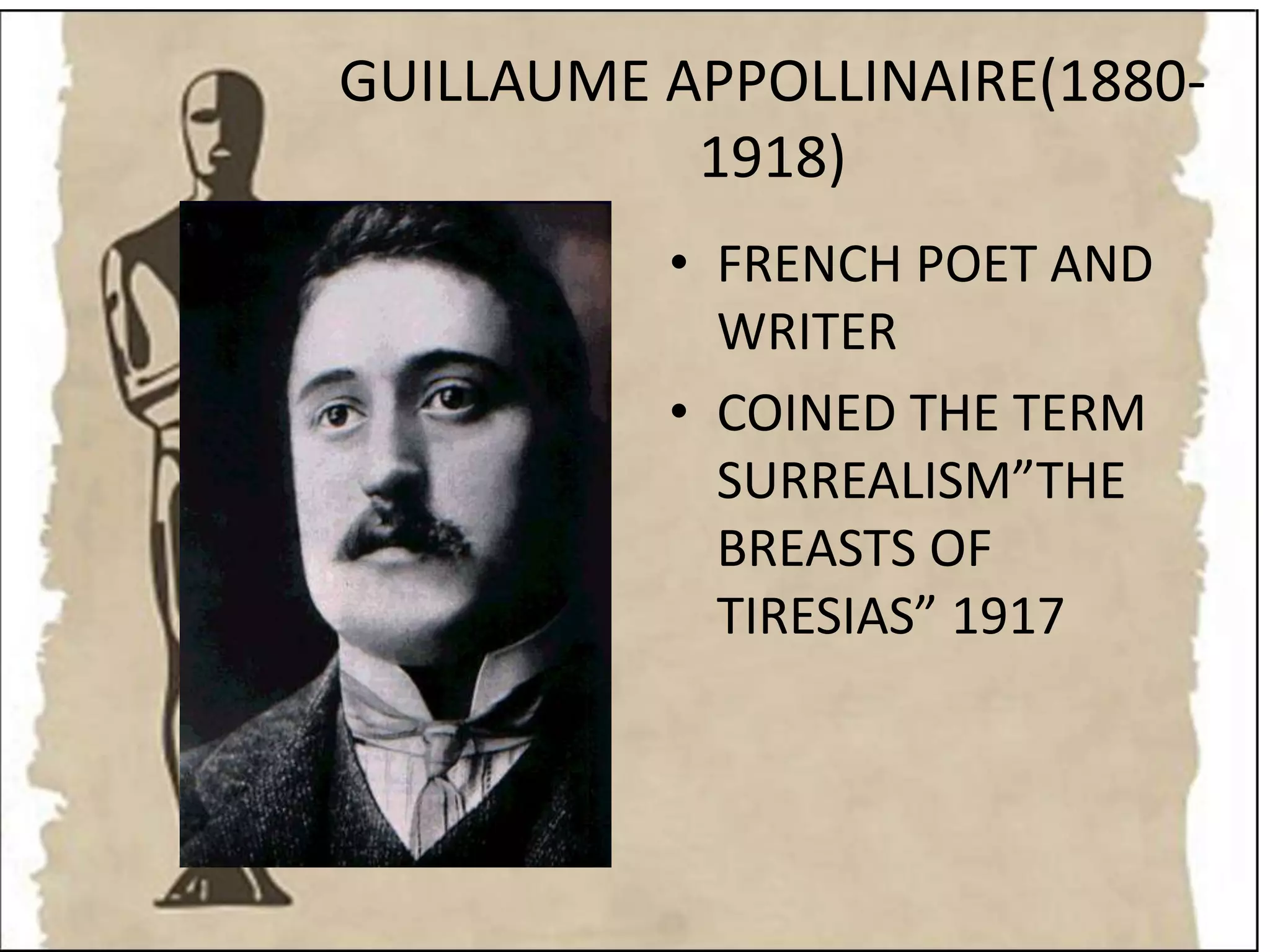
GUILLAUME APPOLLINAIRE(1880-
1918)
• FRENCH POET AND
WRITER
• COINED THE TERM
SURREALISM”THE
BREASTS OF
TIRESIAS” 1917
Post modernism
• Broadmovement developed in the mid to late 20
century
• Reaction or response to modernism
• Believes that their is no absolute truth and truth
is relative
Modernism
Text to present a fragment view of human
subjectivity and history
Lamenting on fragmentation
• Postmodernism:-Doesn’t lament on
theIdea of fragmentation
• Modernism:-places faith in the ideas
values beliefs culture and norms of the
west
• Postmortemism:-reject western values
and beliefs
• Modernism:- Attempts to reveal
profound through the of experience and
life
postmoderist theatre emerged as a
reaction against modern theatre
Characteristics of postmodernism
• Intellectualality: poet John Donne
once wrote that “no mass is an
island” for them no text is an island
• Metafiction
• Pastiche
• Maximalism
• Irony
• Hyperreality
• Paranoia
• Fragmentation
Postmodernism.
1. Dialogue is meaningless
and no communication is
prioritised
2. unclear settings and
passage of time
3.Disregard accepted norms
of seeing
4. Rejoice in pessimission
5. Directors are universal and
serves no specific background
6. Celebrate the chaotic a life
and frie life of society
odernism
1. dialogue has a motive and
understanding
2. Comprehensive setting and
passage of time
3. Rational in placing thoughts
4. Pathos for pessimission
5. Characters represent a
particular class or
background
6. Rebuking the chaotic life or
society
7. Sense of fragmentation
decentredself multiple or
conflicting identity
8. Usually subjective rhetorical
and relative
9. Reject all forms; self
contradictory sometimes
10. Subverted order loss of
centralised control
11. Attention to play of
surfaces -the signifiers
12.Hyper reality or more
powerful than real
7. Sense of unification
Centred self Unified identity
8. Truth as objective
9. Reject the romantic visions
of harmony and mirror
realism
10. Hierarchy order
centralised control
11. Faith in meaning, value-
the signified
12. Faith in real authenticity
of Origins
Examples of post modern dramas
Heiner Muller(1977)-Hamlet
machine,German playwright and theatre
director
Romeo Castellueci(2007) Hey Girl, Italian
director
Conclusion
We cannot make it a study of
European playwrights as it is
vast topic.But I tried my best
to explore through this
simple seminar on European
drama and theatre.
EXPRESSIONISM, SURREALISM & POST MODERNISM IN EUROPEAN PLAYWRIGHTS

EXPRESSIONISM, SURREALISM & POST MODERNISM IN EUROPEAN PLAYWRIGHTS

  • 2.
    EXPRESSIONISM, SURREALISM &POST MODERNISM IN EUROPEAN PLAYWRIGHTS
  • 3.
    INTRODUCTION  An attemptto get into the depth of the expressionism surrealism and post modernism.  to study about the European playwrights who used “isms” in their plays
  • 4.
    EUROPEAN DRAMA Origin anddevelopment in the ancient Greece and Rome, flourishing during the renaissance. Later developments: realistic and contemporary trends such as theatre of absurd, epic theatre, expressionist drama, non realism, post modernism. 1.Unique subject matter like the romanticism of the poor 2.The strict depiction of real life 3.The use of symbols imageries metaphors. E.g.: Henri’k Ibsen- Ghosts, Bertolt Porecht- the good woman of Szechuan, Samuel Bekket- waiting for Godot, Jean Genet – The Balcony
  • 5.
    EXPRESSIONISM Modernist movement –initially in poetry and painting Originated in Germany- Beginning of the 20th century Typical trait:- to distort physical reality To present the world solely from a subjective perspective  A rebellion against a. realism b. naturalism  Influencing practitioners: - Bertolt Brecht& Erwin Piscator  Made way to epic theatre  Eg: Drums in the night by Bertolt Brecht  1st expressionist play : “The son” by Walter Hasen Clever published in 1914
  • 6.
    MAIN CHARACTERISTICS Extreme simplificationof characters Choral effects Declamatory dialouge Heightened intensity Aims of expressionist play To shock the audience Make the audience focus on themselves Drama within the confines of beginning, middle, end pattern  reveal the inner consciousness of characters To increase the emotional impact
  • 7.
    ATMOSPHERE 1. Dreamlike andsurreal 2. Night marish 3. Appeal to the audience emotions 4. Closely linked to play’s theme or message
  • 8.
    STAGE CRAFT 1. Lightingwas often stark illuminating the key areas of the stage space 2. Deliberate use of shadow 3. Only those settings essential to the play’s theme were used 4. Sets were deliberately distorted, shapes and signs were unusual sharp and angular 5. Sets were often distorted by brighter colours 6. Props were normally symbolic 7. Use of masks
  • 9.
    PLOT a) Content concernedwith industrialisation, war, dreams of the subconscious b) Message at the centre of the plot c) The message was often told from the view point of the dreamer or hero(protagonist) d) Taboo topics such as incest and particide became thje subject of several expressionist plays
  • 10.
    STRUCTURE  Episodic Self contained,loosely connected scenes Disjointed Short, static scenes , not casually linked Use of still images Antithesis of the well made play Shift away from realism
  • 11.
    CHARACTERS • Stereotypes • Caricatures •Mostly lacked individuality eg: the woman, nameless one, the worker • Represented a social group • Characters as symbols • Impersonnal • Inner psychological reality of characters was revealed( through scenic designs)
  • 12.
    DIALOGUE • Truncated(short) • Clipped •Fragmented • Telegraphic speech patterns juxtaposed with long monologues • Rapid , breathless speech • Poetric and lyrical • Mix of prose and verse • Speech consisting of a small number of words/ phrases • Dialogue disconnected with actor’s movement and structure • Unusually long pauses and silence • Distinct lack of interpersonal communication between characters
  • 13.
    MOVEMENT  Stylized  Rhythmical Mechanical  Robotic  Urgent  Energetic
  • 14.
    ACTING STYLE  Overacting Ecstatic style of acting  Intense  Violent  Expressing tormented emotions  Mixture of presentational and representational
  • 15.
    EXAMPLES OF EXPRESSIONISTPLAYS • THE CABINET OF DR. CALIAGRI(1920) DIRECTED BY ROBERT WEINE • METROPOLIS (1927) DIRECTED BY FRITZ LANG • THE GOLEM (1920) DIRECTED BY CARL BOESE
  • 16.
    SURREALISM Art form Cultural movement Foundedin paris Developed in europe Uses dream imagery Uses symbols Uses collage Primary goal:- to overcome societal traditions Keywords:- liberation and exploration 1st manifesto of surrealism :-written by Andre Breton in 1924 Spoke about “revolution of the self”
  • 17.
    TERM Derived from thefrench drama of the french poet civillaume appllinaire “Les Mamelles de Tiresias”( the breasts of tiresias)1917 Influenced by the psycho analytical work  Flourished between world war I and world war II Coming mainly from the communist party  to rebel the bourgeois society
  • 18.
    Cont.  The mainfigures were Giergio de chirico, Man Ray Rene Magritte, Salvadore Dali e.g. :- Rene Magritte’s painting ‘the son of the mon’ 1964  According to Andre Breton it means a means of reuniting conscious and subconscious realms of experience  Main topics a radical ideological change institutional criticism(politics, religion , military)  In 1929 Breton published his second surrealistic manifesto
  • 19.
    CHARACTERISTICS • PLAY WITHTIME • PLAY WITH LIFE AND DEATH- WITH THE POSSIBLE AND IMPOSSIBLE • JUMPING BETWEEN REALITY AND FICTION • IMAGINATION OF THE IMPOSSIBLE • FREE ASSOCIATION OF THE WORDS • STRANGE SYNTAX AND APPARENT LEXICAL INCOHHERENCE
  • 20.
    EXAMPLES OF SURREALISTIC EUROPEANDRAMAS  SALVADOR DALE  ANDRE BRETON  RENE MAGRITTE  SAMUEL BECKET  BERTOLT BRECHT  EUGENE LONESCO  JEAN GEMET  AUGUST STRINDBERG
  • 21.
    SALVADORE DALI • ARTIST •PROMINENT SPANISH SURREALIST
  • 22.
    ANDRE BRETON • FRENCHWRITER, POET • KNOWN AS THE FOUNDER OF SURREALISM • FIRST SURREALIST MANIFESTO 1924
  • 23.
    RENE MAGRITTE • BELGIANSURREALIST ARTIST • WELL KNOWN FOR HIS WITTY AND THOUGHT PROVOKING IMAGES. E.G:- THE SON OF MAN , THE LOVERS, THE FALSE MIRROR
  • 24.
    SAMUEL BECKET • IRRISHAVANT – GAVDE NOVELIST PLAYWRIGHT THATHRE DIRECTOR, POET • LIVED IN PARIS • WROTE IN BOTH ENGLISH AND FRENCH • WATING FOR GODOT-1953
  • 25.
    BERTOLT BRECHT • EUGENBERTHOLD FRIEDRICH BREEHT • GERMAN POET PLAYWRIGHT THEATRE DIRECTOR
  • 26.
    FREDRICO GARCIA LORCA •POET PLAYWRIGHT • BEST KNOWN FOR HIS POETRY COLLECTION • GYPSY BALLADS(1928) • POET IN NEW YORK(1930) • THE PUBLIC (1930) • WHEN FIVE YEARS PASS(1931) • SURREALISTIC FILM – TRIP TO THE MOON(1929)
  • 27.
    IVAN GOLL(1891-1950) • POETAND PLAYWRIGHT • WROTE SURREALISTIC OPERA IN COLLABORATION WITH KURT WEILL” EOYAL PALACE”
  • 28.
    GUILLAUME APPOLLINAIRE(1880- 1918) • FRENCHPOET AND WRITER • COINED THE TERM SURREALISM”THE BREASTS OF TIRESIAS” 1917
  • 29.
    Post modernism • Broadmovementdeveloped in the mid to late 20 century • Reaction or response to modernism • Believes that their is no absolute truth and truth is relative Modernism Text to present a fragment view of human subjectivity and history Lamenting on fragmentation
  • 30.
    • Postmodernism:-Doesn’t lamenton theIdea of fragmentation • Modernism:-places faith in the ideas values beliefs culture and norms of the west • Postmortemism:-reject western values and beliefs • Modernism:- Attempts to reveal profound through the of experience and life postmoderist theatre emerged as a reaction against modern theatre
  • 31.
    Characteristics of postmodernism •Intellectualality: poet John Donne once wrote that “no mass is an island” for them no text is an island • Metafiction • Pastiche • Maximalism • Irony • Hyperreality • Paranoia • Fragmentation
  • 32.
    Postmodernism. 1. Dialogue ismeaningless and no communication is prioritised 2. unclear settings and passage of time 3.Disregard accepted norms of seeing 4. Rejoice in pessimission 5. Directors are universal and serves no specific background 6. Celebrate the chaotic a life and frie life of society odernism 1. dialogue has a motive and understanding 2. Comprehensive setting and passage of time 3. Rational in placing thoughts 4. Pathos for pessimission 5. Characters represent a particular class or background 6. Rebuking the chaotic life or society
  • 33.
    7. Sense offragmentation decentredself multiple or conflicting identity 8. Usually subjective rhetorical and relative 9. Reject all forms; self contradictory sometimes 10. Subverted order loss of centralised control 11. Attention to play of surfaces -the signifiers 12.Hyper reality or more powerful than real 7. Sense of unification Centred self Unified identity 8. Truth as objective 9. Reject the romantic visions of harmony and mirror realism 10. Hierarchy order centralised control 11. Faith in meaning, value- the signified 12. Faith in real authenticity of Origins
  • 34.
    Examples of postmodern dramas Heiner Muller(1977)-Hamlet machine,German playwright and theatre director Romeo Castellueci(2007) Hey Girl, Italian director
  • 35.
    Conclusion We cannot makeit a study of European playwrights as it is vast topic.But I tried my best to explore through this simple seminar on European drama and theatre.

Editor's Notes

  • #6 Expressionism is the use of distortion and exaggeration by the expressionist to exemplify an event
  • #17 Andre Breton defined surrealism