Expressing
Preferences: A
Closer Look
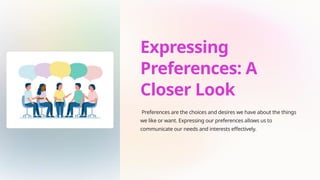
Preferences are the choices and desires we have about the things
we like or want. Expressing our preferences allows us to
communicate our needs and interests effectively.
The Meaning of Preferences
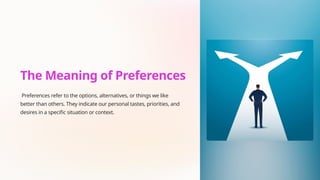
Preferences refer to the options, alternatives, or things we like
better than others. They indicate our personal tastes, priorities, and
desires in a specific situation or context.
Expressions of Preferences
1 Like
I like chocolate ice cream more
than vanilla.
2 Prefer
I prefer going to the movies over
staying home.
3 Would rather
I would rather take a walk than
go to the gym.
4 Would prefer
I would prefer to have a window
seat on the plane.
Common Structures of Preferences
Subject + Verb
I like pizza.
She prefers the blue shirt.
Subject + Verb + Object
I prefer chocolate ice cream.
They would rather watch a movie.
Subject + Verb +
Preposition + Object
I would prefer to have the window seat.
She had better go with the red dress.
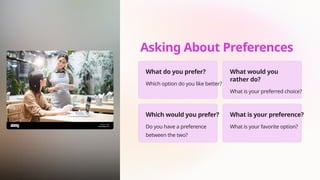
Asking About Preferences
What do you prefer?
Which option do you like better?
What would you
rather do?
What is your preferred choice?
Which would you prefer?
Do you have a preference
between the two?
What is your preference?
What is your favorite option?
Expressing Preferences
I like...
This is my favorite option.
I prefer...
I think this is the better choice.
I would rather...
I would choose this over the other.
Common Preference Verbs
Like
To have a fondness for something.
Prefer
To like one thing better than another.
Choose
To select one option over another.
Favor
To have a special liking for something.
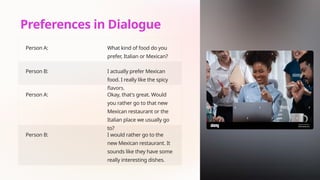
Preferences in Dialogue
Person A: What kind of food do you
prefer, Italian or Mexican?
Person B: I actually prefer Mexican
food. I really like the spicy
flavors.
Person A: Okay, that's great. Would
you rather go to that new
Mexican restaurant or the
Italian place we usually go
to?
Person B: I would rather go to the
new Mexican restaurant. It
sounds like they have some
really interesting dishes.

Expressing-Preferences-A-Closer-Look.pptx

  • 1.
    Expressing Preferences: A Closer Look Preferencesare the choices and desires we have about the things we like or want. Expressing our preferences allows us to communicate our needs and interests effectively.
  • 2.
    The Meaning ofPreferences Preferences refer to the options, alternatives, or things we like better than others. They indicate our personal tastes, priorities, and desires in a specific situation or context.
  • 3.
    Expressions of Preferences 1Like I like chocolate ice cream more than vanilla. 2 Prefer I prefer going to the movies over staying home. 3 Would rather I would rather take a walk than go to the gym. 4 Would prefer I would prefer to have a window seat on the plane.
  • 4.
    Common Structures ofPreferences Subject + Verb I like pizza. She prefers the blue shirt. Subject + Verb + Object I prefer chocolate ice cream. They would rather watch a movie. Subject + Verb + Preposition + Object I would prefer to have the window seat. She had better go with the red dress.
  • 5.
    Asking About Preferences Whatdo you prefer? Which option do you like better? What would you rather do? What is your preferred choice? Which would you prefer? Do you have a preference between the two? What is your preference? What is your favorite option?
  • 6.
    Expressing Preferences I like... Thisis my favorite option. I prefer... I think this is the better choice. I would rather... I would choose this over the other.
  • 7.
    Common Preference Verbs Like Tohave a fondness for something. Prefer To like one thing better than another. Choose To select one option over another. Favor To have a special liking for something.
  • 8.
    Preferences in Dialogue PersonA: What kind of food do you prefer, Italian or Mexican? Person B: I actually prefer Mexican food. I really like the spicy flavors. Person A: Okay, that's great. Would you rather go to that new Mexican restaurant or the Italian place we usually go to? Person B: I would rather go to the new Mexican restaurant. It sounds like they have some really interesting dishes.