THE LEGAL ASPECTS OF
EXPORT CONTRACTS
Presented by the NEPC Legal Unit
WHAT IS AN EXPORT CONTRACT?
• An Export Contract is a consensus document
between two parties who intend to go into export
trade.
• It is also known as a Sales Contract.
HOW DO I GET AN EXPORT CONTRACT?
• Offer
• Acceptance
• Consideration
• Legal Relations
WHAT IS THE OBJECTIVE OF AN EXPORT
CONTRACT?
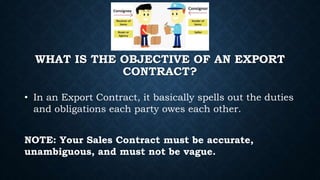
• In an Export Contract, it basically spells out the duties
and obligations each party owes each other.
NOTE: Your Sales Contract must be accurate,
unambiguous, and must not be vague.
WHAT LAW APPLIES TO INTERNATIONAL
CONTRACTS?
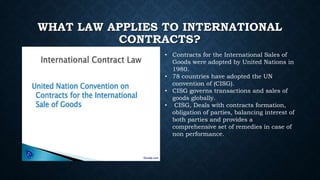
• Contracts for the International Sales of
Goods were adopted by United Nations in
1980.
• 78 countries have adopted the UN
convention of (CISG).
• CISG governs transactions and sales of
goods globally.
• CISG, Deals with contracts formation,
obligation of parties, balancing interest of
both parties and provides a
comprehensive set of remedies in case of
non performance.
IS NIGERIA A CONTRACTING STATE?
• Unfortunately, Nigeria has not adopted the United Nations convention on
Contracts for International Sales of Goods (CISG).
• However, CISG applies in lieu of the applicable domestic law, regardless of
whether the State of the Forum is or not the contracting State.
CIRCUMSTANCES / INSTANCES THAT VITIATES A
CONTRACT
✓Non performance of the buyer to pay the price at the agreed
time
✓Non performance of the seller to deliver at the agreed time
✓Lack of conformity
WHAT ARE THE CLAUSES OBTAINABLE
IN AN EXPORT CONTRACTS?
✓NAME
✓PRODUCT STANDARD/
SPECIFICATION
✓QUANTITY
✓INSPECTION
✓TOTAL VALUE
✓TERMS OF DELIVERY
✓PACKAGING
✓TERMS OF PAYMENT
✓LICENSING AND PERMITS
✓INSURANCE
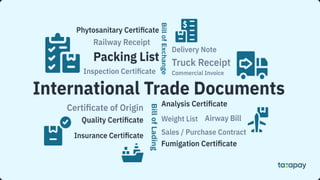
✓DOCUMENTS REQUIRED
✓DELAY IN DELIVERY
✓FORCE MAJEURE
✓APPLICABLE LAW
✓ARBITRATION
✓SIGNATURE
INCOTERMS
What are INCOTERMS?
-INCOTERMS – International Commercial Terms
-Published by the International Chamber Of Commerce
• INCOTERMS are a ICC set of rules and guidelines that help facilitate
international and domestic trade. They spell out the liability,
responsibility of parties to a contract as related to cost, risk and tariffs in
the movement of goods.
• They define the different delivery points (11 INCOTERMS Rules) where the
cost and risk is transferred from seller to buyer.
CATEGORIZATION OF INCOTERMS
• Based on contractual obligations, INCOTERMS can be divided into four categories E,
F, C and D
• Category E – Departure, which contain EXW (Ex Works)
• Category F – Main Carriage Unpaid
• FCA - (free Carrier)
• FAS - (Free Alongside Ship)
• FOB - (Free on Board)
CATEGORIZATION OF INCOTERMS : CONTD.
• Category C – Main Carriage Paid
• CPT (Carriage paid to)
• CIP (Cost And Insurance Paid To)
• CFR (Cost and Freight)
• CIF (Cost Insurance and Freight)
• Category D - Arrivals
• DAP (Delivered at Place)
• DDP (Delivered Duty Paid)
• DPU (Delivered at Place Unloaded)
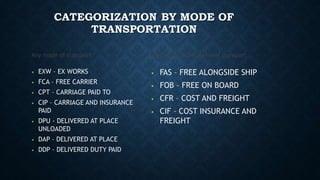
Any mode of transport
• EXW – EX WORKS
• FCA – FREE CARRIER
• CPT – CARRIAGE PAID TO
• CIP – CARRIAGE AND INSURANCE
PAID
• DPU - DELIVERED AT PLACE
UNLOADED
• DAP – DELIVERED AT PLACE
• DDP – DELIVERED DUTY PAID
Sea and inland water way transport
• FAS – FREE ALONGSIDE SHIP
• FOB – FREE ON BOARD
• CFR – COST AND FREIGHT
• CIF – COST INSURANCE AND
FREIGHT
CATEGORIZATION BY MODE OF
TRANSPORTATION
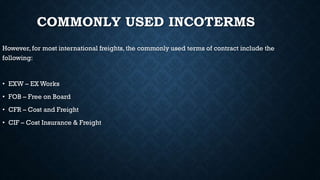
COMMONLY USED INCOTERMS
However, for most international freights, the commonly used terms of contract include the
following:
• EXW – EX Works
• FOB – Free on Board
• CFR – Cost and Freight
• CIF – Cost Insurance & Freight
EXPORTER
KANO NIGERIA
TRANSPORT CUSTOMS APAPA PORT
MUMBAI PORT CUSTOMS TRANSPORT
seller
seller
seller
Buyer
Buyer
Buyer
Cost
Risk
Insurance
EXPORTCOUNTRY CARRIAGE IMPORT DESTINATION COUNTRY
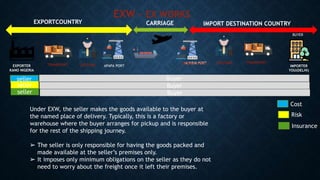
Under EXW, the seller makes the goods available to the buyer at
the named place of delivery. Typically, this is a factory or
warehouse where the buyer arranges for pickup and is responsible
for the rest of the shipping journey.
➢ The seller is only responsible for having the goods packed and
made available at the seller’s premises only.
➢ It imposes only minimum obligations on the seller as they do not
need to worry about the freight once it left their premises.
IMPORTER
YOU(DELHI)
BUYER
MUMBAI PORT
EXW - EX WORKS
IMPORTER
YOU(DELHI)
BUYER
EXPORTER
KANO NIGERIA
SELLER
TRANSPORT CUSTOMS APAPA PORT
MUMBAI PORT CUSTOMS TRANSPORT
EXPORT COUNTRY CARRIAGE IMPORT DESTINATION COUNTRY
seller Buyer
seller Buyer
seller Buyer
Cost
Risk
Insurance
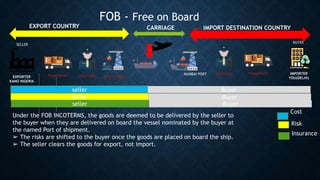
Under the FOB INCOTERMS, the goods are deemed to be delivered by the seller to
the buyer when they are delivered on board the vessel nominated by the buyer at
the named Port of shipment.
➢ The risks are shifted to the buyer once the goods are placed on board the ship.
➢ The seller clears the goods for export, not import.
FOB - Free on Board
IMPORTER
YOU(DELHI)
BUYER
EXPORTER
KANO NIGERIA
SELLER
TRANSPORT CUSTOMS APAPA PORT
MUMBAI PORT CUSTOMS TRANSPORT
EXPORT COUNTRY CARRIAGE IMPORT DESTINATION COUNTRY
Cost
Risk
Insurance
seller Buyer
seller Buyer
seller Buyer
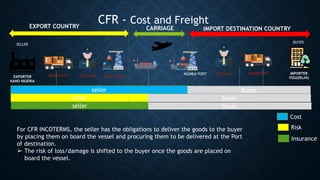
For CFR INCOTERMS, the seller has the obligations to deliver the goods to the buyer
by placing them on board the vessel and procuring them to be delivered at the Port
of destination.
➢ The risk of loss/damage is shifted to the buyer once the goods are placed on
board the vessel.
CFR - Cost and Freight
IMPORTER
YOU(DELHI)
BUYER
EXPORTER
KANO NIGERIA
SELLER
TRANSPORT CUSTOMS APAPA PORT
MUMBAI PORT CUSTOMS TRANSPORT
EXPORT COUNTRY CARRIAGE IMPORT DESTINATION COUNTRY
Cost
Risk
Insurance
seller Buyer
seller Buyer
seller Buyer
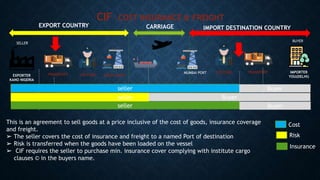
This is an agreement to sell goods at a price inclusive of the cost of goods, insurance coverage
and freight.
➢ The seller covers the cost of insurance and freight to a named Port of destination
➢ Risk is transferred when the goods have been loaded on the vessel
➢ CIF requires the seller to purchase min. insurance cover complying with institute cargo
clauses © in the buyers name.
CIF - COST INSURANCE & FREIGHT
HOW TO CHOOSE THE RIGHT INCOTERMS
• 1.The regulations of the buyer's country.
• 2. Standard practice
• 3.The agreed mode of transportation
• 4. Customer Service: one should use a competitive term which is suitable for buyer and
seller and not only important for one party to get, maybe an advantage from that.
Export-Contract-Presentation.pdfbNNnannsnansnsm

Export-Contract-Presentation.pdfbNNnannsnansnsm

  • 1.
    THE LEGAL ASPECTSOF EXPORT CONTRACTS Presented by the NEPC Legal Unit
  • 2.
    WHAT IS ANEXPORT CONTRACT? • An Export Contract is a consensus document between two parties who intend to go into export trade. • It is also known as a Sales Contract.
  • 3.
    HOW DO IGET AN EXPORT CONTRACT? • Offer • Acceptance • Consideration • Legal Relations
  • 4.
    WHAT IS THEOBJECTIVE OF AN EXPORT CONTRACT? • In an Export Contract, it basically spells out the duties and obligations each party owes each other. NOTE: Your Sales Contract must be accurate, unambiguous, and must not be vague.
  • 5.
    WHAT LAW APPLIESTO INTERNATIONAL CONTRACTS? • Contracts for the International Sales of Goods were adopted by United Nations in 1980. • 78 countries have adopted the UN convention of (CISG). • CISG governs transactions and sales of goods globally. • CISG, Deals with contracts formation, obligation of parties, balancing interest of both parties and provides a comprehensive set of remedies in case of non performance.
  • 6.
    IS NIGERIA ACONTRACTING STATE? • Unfortunately, Nigeria has not adopted the United Nations convention on Contracts for International Sales of Goods (CISG). • However, CISG applies in lieu of the applicable domestic law, regardless of whether the State of the Forum is or not the contracting State.
  • 8.
    CIRCUMSTANCES / INSTANCESTHAT VITIATES A CONTRACT ✓Non performance of the buyer to pay the price at the agreed time ✓Non performance of the seller to deliver at the agreed time ✓Lack of conformity
  • 9.
    WHAT ARE THECLAUSES OBTAINABLE IN AN EXPORT CONTRACTS? ✓NAME ✓PRODUCT STANDARD/ SPECIFICATION ✓QUANTITY ✓INSPECTION ✓TOTAL VALUE ✓TERMS OF DELIVERY ✓PACKAGING ✓TERMS OF PAYMENT ✓LICENSING AND PERMITS ✓INSURANCE ✓DOCUMENTS REQUIRED ✓DELAY IN DELIVERY ✓FORCE MAJEURE ✓APPLICABLE LAW ✓ARBITRATION ✓SIGNATURE
  • 10.
    INCOTERMS What are INCOTERMS? -INCOTERMS– International Commercial Terms -Published by the International Chamber Of Commerce • INCOTERMS are a ICC set of rules and guidelines that help facilitate international and domestic trade. They spell out the liability, responsibility of parties to a contract as related to cost, risk and tariffs in the movement of goods. • They define the different delivery points (11 INCOTERMS Rules) where the cost and risk is transferred from seller to buyer.
  • 11.
    CATEGORIZATION OF INCOTERMS •Based on contractual obligations, INCOTERMS can be divided into four categories E, F, C and D • Category E – Departure, which contain EXW (Ex Works) • Category F – Main Carriage Unpaid • FCA - (free Carrier) • FAS - (Free Alongside Ship) • FOB - (Free on Board)
  • 12.
    CATEGORIZATION OF INCOTERMS: CONTD. • Category C – Main Carriage Paid • CPT (Carriage paid to) • CIP (Cost And Insurance Paid To) • CFR (Cost and Freight) • CIF (Cost Insurance and Freight) • Category D - Arrivals • DAP (Delivered at Place) • DDP (Delivered Duty Paid) • DPU (Delivered at Place Unloaded)
  • 13.
    Any mode oftransport • EXW – EX WORKS • FCA – FREE CARRIER • CPT – CARRIAGE PAID TO • CIP – CARRIAGE AND INSURANCE PAID • DPU - DELIVERED AT PLACE UNLOADED • DAP – DELIVERED AT PLACE • DDP – DELIVERED DUTY PAID Sea and inland water way transport • FAS – FREE ALONGSIDE SHIP • FOB – FREE ON BOARD • CFR – COST AND FREIGHT • CIF – COST INSURANCE AND FREIGHT CATEGORIZATION BY MODE OF TRANSPORTATION
  • 14.
    COMMONLY USED INCOTERMS However,for most international freights, the commonly used terms of contract include the following: • EXW – EX Works • FOB – Free on Board • CFR – Cost and Freight • CIF – Cost Insurance & Freight
  • 15.
    EXPORTER KANO NIGERIA TRANSPORT CUSTOMSAPAPA PORT MUMBAI PORT CUSTOMS TRANSPORT seller seller seller Buyer Buyer Buyer Cost Risk Insurance EXPORTCOUNTRY CARRIAGE IMPORT DESTINATION COUNTRY Under EXW, the seller makes the goods available to the buyer at the named place of delivery. Typically, this is a factory or warehouse where the buyer arranges for pickup and is responsible for the rest of the shipping journey. ➢ The seller is only responsible for having the goods packed and made available at the seller’s premises only. ➢ It imposes only minimum obligations on the seller as they do not need to worry about the freight once it left their premises. IMPORTER YOU(DELHI) BUYER MUMBAI PORT EXW - EX WORKS
  • 16.
    IMPORTER YOU(DELHI) BUYER EXPORTER KANO NIGERIA SELLER TRANSPORT CUSTOMSAPAPA PORT MUMBAI PORT CUSTOMS TRANSPORT EXPORT COUNTRY CARRIAGE IMPORT DESTINATION COUNTRY seller Buyer seller Buyer seller Buyer Cost Risk Insurance Under the FOB INCOTERMS, the goods are deemed to be delivered by the seller to the buyer when they are delivered on board the vessel nominated by the buyer at the named Port of shipment. ➢ The risks are shifted to the buyer once the goods are placed on board the ship. ➢ The seller clears the goods for export, not import. FOB - Free on Board
  • 17.
    IMPORTER YOU(DELHI) BUYER EXPORTER KANO NIGERIA SELLER TRANSPORT CUSTOMSAPAPA PORT MUMBAI PORT CUSTOMS TRANSPORT EXPORT COUNTRY CARRIAGE IMPORT DESTINATION COUNTRY Cost Risk Insurance seller Buyer seller Buyer seller Buyer For CFR INCOTERMS, the seller has the obligations to deliver the goods to the buyer by placing them on board the vessel and procuring them to be delivered at the Port of destination. ➢ The risk of loss/damage is shifted to the buyer once the goods are placed on board the vessel. CFR - Cost and Freight
  • 18.
    IMPORTER YOU(DELHI) BUYER EXPORTER KANO NIGERIA SELLER TRANSPORT CUSTOMSAPAPA PORT MUMBAI PORT CUSTOMS TRANSPORT EXPORT COUNTRY CARRIAGE IMPORT DESTINATION COUNTRY Cost Risk Insurance seller Buyer seller Buyer seller Buyer This is an agreement to sell goods at a price inclusive of the cost of goods, insurance coverage and freight. ➢ The seller covers the cost of insurance and freight to a named Port of destination ➢ Risk is transferred when the goods have been loaded on the vessel ➢ CIF requires the seller to purchase min. insurance cover complying with institute cargo clauses © in the buyers name. CIF - COST INSURANCE & FREIGHT
  • 19.
    HOW TO CHOOSETHE RIGHT INCOTERMS • 1.The regulations of the buyer's country. • 2. Standard practice • 3.The agreed mode of transportation • 4. Customer Service: one should use a competitive term which is suitable for buyer and seller and not only important for one party to get, maybe an advantage from that.