EXPLORING THE IMPACT AND
EVOLUTION OF ADVANCED
ANALYTICS TOOLS
Tools
An Academic presentation by
Dr. Nancy Agnes, Head, Technical Operations, Statswork
Group www.statswork.com
Email: info@statswork.com
Introduction: Why do we need advanced data
analytics tools?
Did you know that each human being on Earth generates
approximately 1.8 MB of data every second? With data increasing at
a faster pace every day, it’s no wonder that some experts predict a
data apocalypse is on the horizon. Data is an essential unit of
construction for any organization, serving as a driving force for
growth and success. However, as data grows, it’s becoming harder
to manage and work using traditional database management
systems. That’s where advanced data analytics tools come in. Big
data analytics can help organizations handle large amounts of data
more efficiently, providing acuities that can help drive decision-
making. As data continues to be treated as an asset, it’s essential to
stay up to date on the latest trends in data analytics tools. In this
blog, we’ll investigate some of the latest trends in data analytics
tools for 2024.
Revolutionizing Industries: The Advantage
of Advanced Analytics tools in Modern
Technology
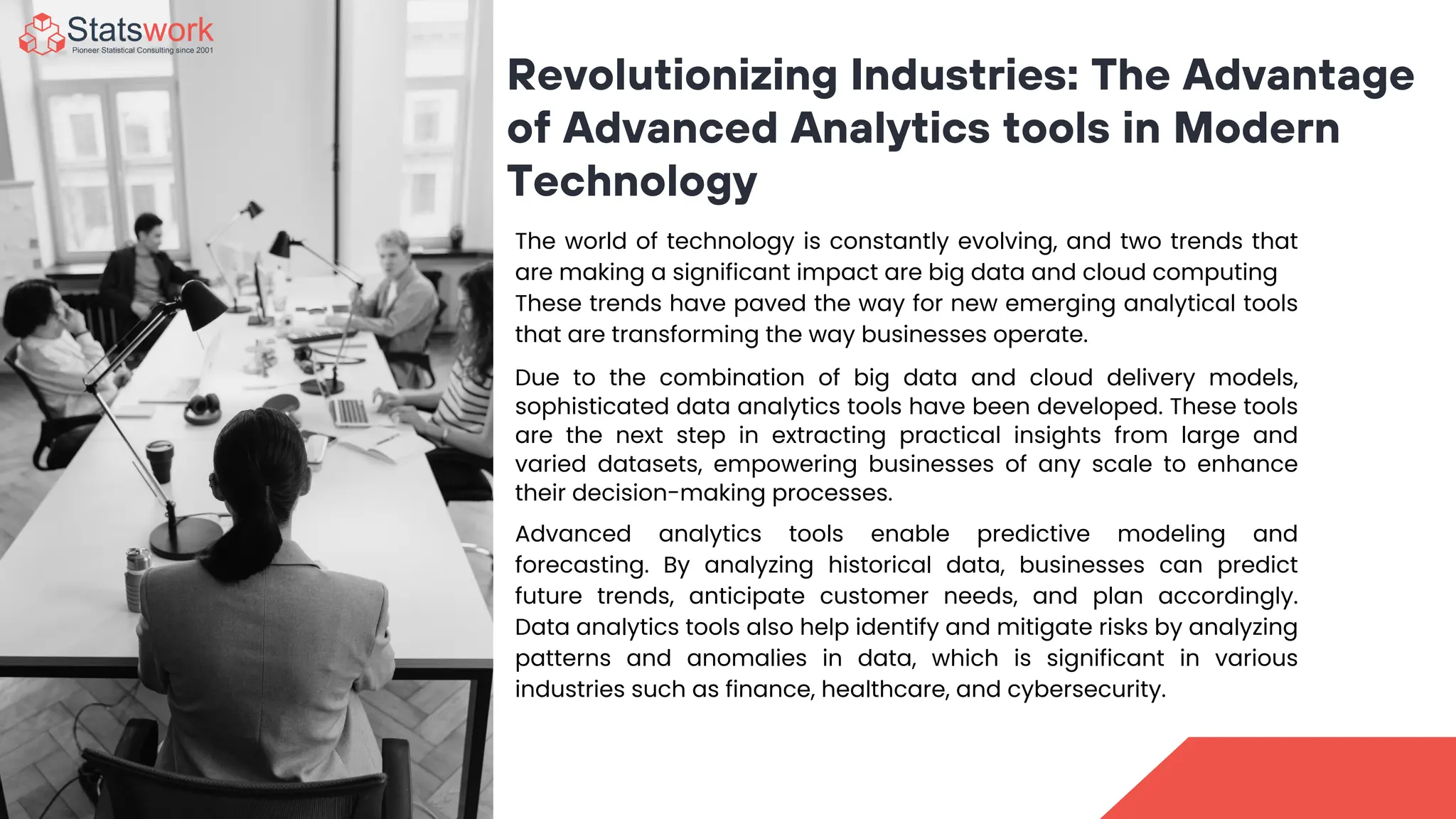
The world of technology is constantly evolving, and two trends that
are making a significant impact are big data and cloud computing
These trends have paved the way for new emerging analytical tools
that are transforming the way businesses operate.
Due to the combination of big data and cloud delivery models,
sophisticated data analytics tools have been developed. These tools
are the next step in extracting practical insights from large and
varied datasets, empowering businesses of any scale to enhance
their decision-making processes.
Advanced analytics tools enable predictive modeling and
forecasting. By analyzing historical data, businesses can predict
future trends, anticipate customer needs, and plan accordingly.
Data analytics tools also help identify and mitigate risks by analyzing
patterns and anomalies in data, which is significant in various
industries such as finance, healthcare, and cybersecurity.
Choosing the right statistical analytics tool is extremely important for companies looking to
maximize the potential of their data in today’s data-focused era. The following are the top
five data analytics tools anticipated to be the most influential in the year 2024:
2024’s Data Dynamo: Top 5 Data Analytics Tools
Tableau
1.
Overview: Tableau is a leading visual analytics platform with a user-friendly
interface for interactive data visualization.
Key Features: Offers strong and reliable dashboards, along with real-time data
analytics and a wide range of connectivity options for your data.
Advantages: Simplified data exploration, wide community support, and
seamless integration capabilities.
2.Power BI
Overview: Microsoft’s Power BI offers a comprehensive suite of analytics tools. It
seamlessly integrates with the Microsoft ecosystem and empowers users
with robust data analysis and visualization.
Key Features: Advanced analytics, AI-driven insights, and cloud-based
collaboration.
Advantages: Seamless integration with Excel, scalable solutions for
enterprises, and a user-friendly interface.
3.Google Analytics 4
Overview: Google Analytics 4 offers predictive analytics for customer
behavior insights across platforms.
Key Features: Cross-platform tracking, enhanced AI-powered insights, and
privacy-centric features.
Advantages: Integration with Google’s marketing suite, advanced
predictive capabilities, and granular user-centric data.
Data cleaning, transformation, and analysis through Python
programming.
4.Python Pandas
Overview: Python’s open-source library, Pandas, provides versatile data
manipulation and analysis capabilities, making it a popular choice for
data scientists.
Key Features:
Advantages: Versatility in handling diverse datasets, extensive data
manipulation tools, and strong community support
5.IBM Watson
Overview: IBM Watson provides businesses with advanced AI-driven
analytics and machine learning tools for complex data analysis.
Key Features: Natural Language Processing (NLP), predictive analytics, and
AI-powered decision-making.
Advantages: Trailblazing AI functionalities, industry-specific solutions, and
robust security measures.
Back to Agenda
How to choose the right data analytics
tools for your specific need?
It can take time to choose the appropriate tool with numerous
options available. Consider the following while preferring
appropriate data analytics tools.
Defining your objectives and data analytics goals is important to determine suitable tools for your
organization’s needs.
Analyze the volume, variety, and velocity of your data to determine the right tools for handling
structured, unstructured, or streaming data.
Consider the tool’s usability and align the interface with the team’s expertise while assessing it.
Ensure scalability and integration to allow the tool to grow with your business and mix well with your
existing tech stack.
Prioritize tools that provide specific functionalities you require, such as data visualization, predictive
analytics, machine learning capabilities, or real-time processing.
Comprehend the pricing structure and consider expenses associated with implementation, training, and
support.
Verify security and compliance requirements, especially if the tool deals with sensitive or regulated data.
Utilize free trials or demos to assess the suitability of a tool for your requirements.
Back to Agenda
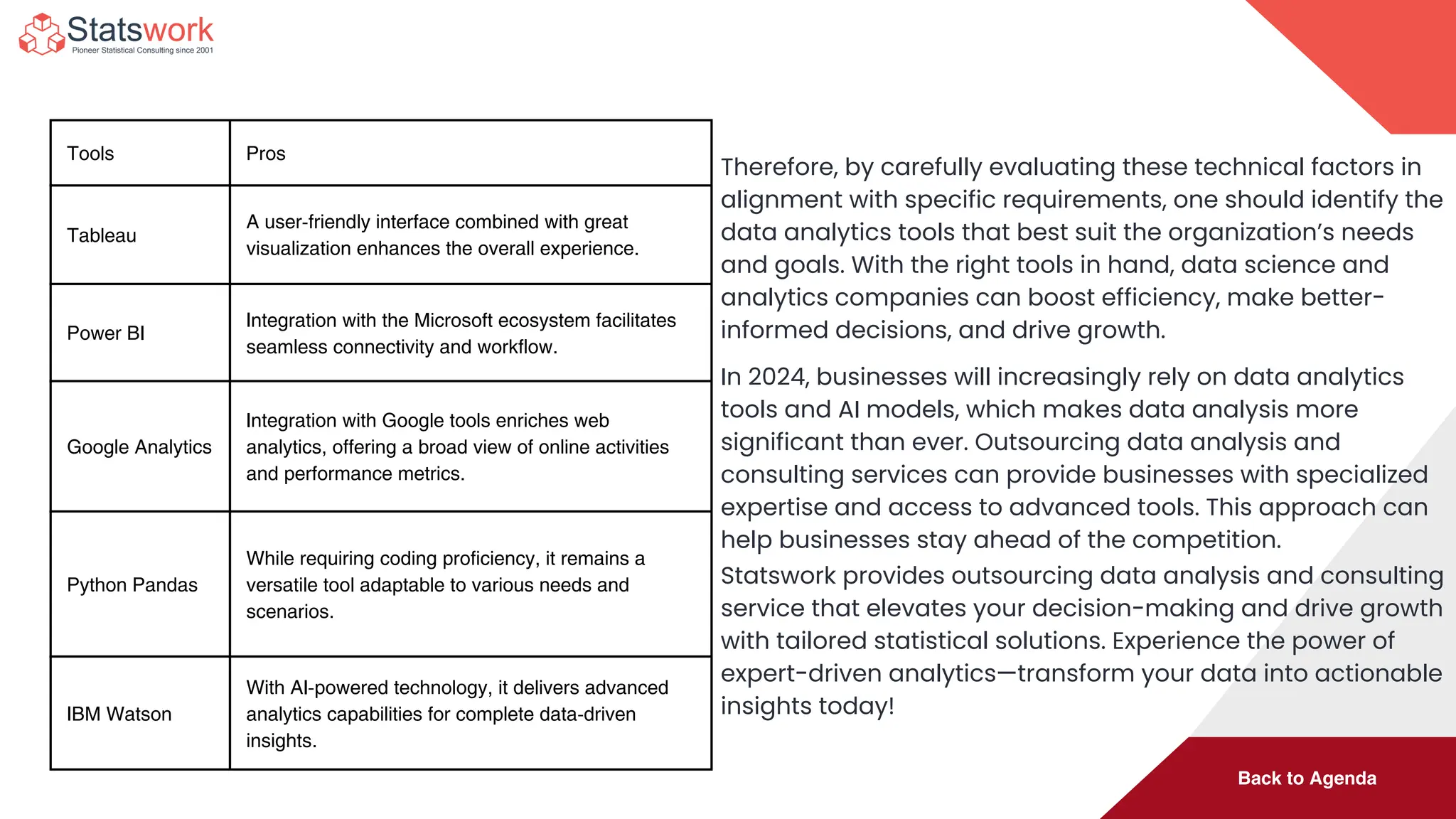
Tools Pros
Tableau
A user-friendly interface combined with great
visualization enhances the overall experience.
Power BI
Integration with the Microsoft ecosystem facilitates
seamless connectivity and workflow.
Google Analytics
Integration with Google tools enriches web
analytics, offering a broad view of online activities
and performance metrics.
Python Pandas
While requiring coding proficiency, it remains a
versatile tool adaptable to various needs and
scenarios.
IBM Watson
With AI-powered technology, it delivers advanced
analytics capabilities for complete data-driven
insights.
Therefore, by carefully evaluating these technical factors in
alignment with specific requirements, one should identify the
data analytics tools that best suit the organization’s needs
and goals. With the right tools in hand, data science and
analytics companies can boost efficiency, make better-
informed decisions, and drive growth.
In 2024, businesses will increasingly rely on data analytics
tools and AI models, which makes data analysis more
significant than ever. Outsourcing data analysis and
consulting services can provide businesses with specialized
expertise and access to advanced tools. This approach can
help businesses stay ahead of the competition.
Statswork provides outsourcing data analysis and consulting
service that elevates your decision-making and drive growth
with tailored statistical solutions. Experience the power of
expert-driven analytics—transform your data into actionable
insights today!
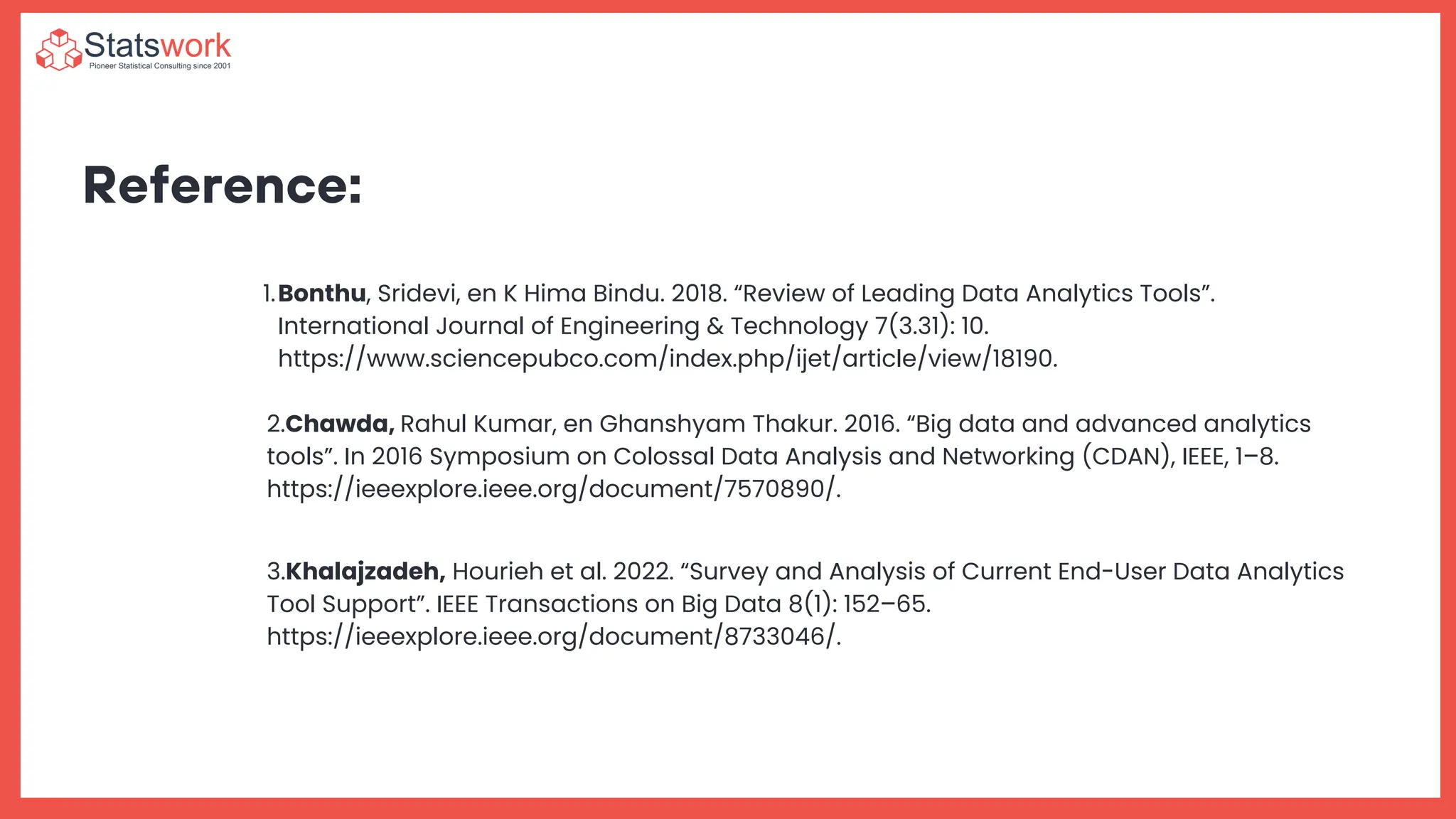
Reference:
Bonthu, Sridevi, en K Hima Bindu. 2018. “Review of Leading Data Analytics Tools”.
International Journal of Engineering & Technology 7(3.31): 10.
https://www.sciencepubco.com/index.php/ijet/article/view/18190.
1.
2.Chawda, Rahul Kumar, en Ghanshyam Thakur. 2016. “Big data and advanced analytics
tools”. In 2016 Symposium on Colossal Data Analysis and Networking (CDAN), IEEE, 1–8.
https://ieeexplore.ieee.org/document/7570890/.
3.Khalajzadeh, Hourieh et al. 2022. “Survey and Analysis of Current End-User Data Analytics
Tool Support”. IEEE Transactions on Big Data 8(1): 152–65.
https://ieeexplore.ieee.org/document/8733046/.
Contact Us
+44-1143520021
UNITED KINGDOM
+91-4448137070
EMAIL
INDIA
info@statswork.com

Exploring the impact and evolution of Advanced Analytics Tools.pdf

  • 1.
    EXPLORING THE IMPACTAND EVOLUTION OF ADVANCED ANALYTICS TOOLS Tools An Academic presentation by Dr. Nancy Agnes, Head, Technical Operations, Statswork Group www.statswork.com Email: info@statswork.com
  • 2.
    Introduction: Why dowe need advanced data analytics tools? Did you know that each human being on Earth generates approximately 1.8 MB of data every second? With data increasing at a faster pace every day, it’s no wonder that some experts predict a data apocalypse is on the horizon. Data is an essential unit of construction for any organization, serving as a driving force for growth and success. However, as data grows, it’s becoming harder to manage and work using traditional database management systems. That’s where advanced data analytics tools come in. Big data analytics can help organizations handle large amounts of data more efficiently, providing acuities that can help drive decision- making. As data continues to be treated as an asset, it’s essential to stay up to date on the latest trends in data analytics tools. In this blog, we’ll investigate some of the latest trends in data analytics tools for 2024.
  • 3.
    Revolutionizing Industries: TheAdvantage of Advanced Analytics tools in Modern Technology The world of technology is constantly evolving, and two trends that are making a significant impact are big data and cloud computing These trends have paved the way for new emerging analytical tools that are transforming the way businesses operate. Due to the combination of big data and cloud delivery models, sophisticated data analytics tools have been developed. These tools are the next step in extracting practical insights from large and varied datasets, empowering businesses of any scale to enhance their decision-making processes. Advanced analytics tools enable predictive modeling and forecasting. By analyzing historical data, businesses can predict future trends, anticipate customer needs, and plan accordingly. Data analytics tools also help identify and mitigate risks by analyzing patterns and anomalies in data, which is significant in various industries such as finance, healthcare, and cybersecurity.
  • 4.
    Choosing the rightstatistical analytics tool is extremely important for companies looking to maximize the potential of their data in today’s data-focused era. The following are the top five data analytics tools anticipated to be the most influential in the year 2024: 2024’s Data Dynamo: Top 5 Data Analytics Tools Tableau 1. Overview: Tableau is a leading visual analytics platform with a user-friendly interface for interactive data visualization. Key Features: Offers strong and reliable dashboards, along with real-time data analytics and a wide range of connectivity options for your data. Advantages: Simplified data exploration, wide community support, and seamless integration capabilities.
  • 5.
    2.Power BI Overview: Microsoft’sPower BI offers a comprehensive suite of analytics tools. It seamlessly integrates with the Microsoft ecosystem and empowers users with robust data analysis and visualization. Key Features: Advanced analytics, AI-driven insights, and cloud-based collaboration. Advantages: Seamless integration with Excel, scalable solutions for enterprises, and a user-friendly interface. 3.Google Analytics 4 Overview: Google Analytics 4 offers predictive analytics for customer behavior insights across platforms. Key Features: Cross-platform tracking, enhanced AI-powered insights, and privacy-centric features. Advantages: Integration with Google’s marketing suite, advanced predictive capabilities, and granular user-centric data.
  • 6.
    Data cleaning, transformation,and analysis through Python programming. 4.Python Pandas Overview: Python’s open-source library, Pandas, provides versatile data manipulation and analysis capabilities, making it a popular choice for data scientists. Key Features: Advantages: Versatility in handling diverse datasets, extensive data manipulation tools, and strong community support 5.IBM Watson Overview: IBM Watson provides businesses with advanced AI-driven analytics and machine learning tools for complex data analysis. Key Features: Natural Language Processing (NLP), predictive analytics, and AI-powered decision-making. Advantages: Trailblazing AI functionalities, industry-specific solutions, and robust security measures.
  • 8.
    Back to Agenda Howto choose the right data analytics tools for your specific need? It can take time to choose the appropriate tool with numerous options available. Consider the following while preferring appropriate data analytics tools. Defining your objectives and data analytics goals is important to determine suitable tools for your organization’s needs. Analyze the volume, variety, and velocity of your data to determine the right tools for handling structured, unstructured, or streaming data. Consider the tool’s usability and align the interface with the team’s expertise while assessing it. Ensure scalability and integration to allow the tool to grow with your business and mix well with your existing tech stack. Prioritize tools that provide specific functionalities you require, such as data visualization, predictive analytics, machine learning capabilities, or real-time processing. Comprehend the pricing structure and consider expenses associated with implementation, training, and support. Verify security and compliance requirements, especially if the tool deals with sensitive or regulated data. Utilize free trials or demos to assess the suitability of a tool for your requirements.
  • 9.
    Back to Agenda ToolsPros Tableau A user-friendly interface combined with great visualization enhances the overall experience. Power BI Integration with the Microsoft ecosystem facilitates seamless connectivity and workflow. Google Analytics Integration with Google tools enriches web analytics, offering a broad view of online activities and performance metrics. Python Pandas While requiring coding proficiency, it remains a versatile tool adaptable to various needs and scenarios. IBM Watson With AI-powered technology, it delivers advanced analytics capabilities for complete data-driven insights. Therefore, by carefully evaluating these technical factors in alignment with specific requirements, one should identify the data analytics tools that best suit the organization’s needs and goals. With the right tools in hand, data science and analytics companies can boost efficiency, make better- informed decisions, and drive growth. In 2024, businesses will increasingly rely on data analytics tools and AI models, which makes data analysis more significant than ever. Outsourcing data analysis and consulting services can provide businesses with specialized expertise and access to advanced tools. This approach can help businesses stay ahead of the competition. Statswork provides outsourcing data analysis and consulting service that elevates your decision-making and drive growth with tailored statistical solutions. Experience the power of expert-driven analytics—transform your data into actionable insights today!
  • 10.
    Reference: Bonthu, Sridevi, enK Hima Bindu. 2018. “Review of Leading Data Analytics Tools”. International Journal of Engineering & Technology 7(3.31): 10. https://www.sciencepubco.com/index.php/ijet/article/view/18190. 1. 2.Chawda, Rahul Kumar, en Ghanshyam Thakur. 2016. “Big data and advanced analytics tools”. In 2016 Symposium on Colossal Data Analysis and Networking (CDAN), IEEE, 1–8. https://ieeexplore.ieee.org/document/7570890/. 3.Khalajzadeh, Hourieh et al. 2022. “Survey and Analysis of Current End-User Data Analytics Tool Support”. IEEE Transactions on Big Data 8(1): 152–65. https://ieeexplore.ieee.org/document/8733046/.
  • 11.