EXPERIMENTAL 
BIOLOGY
WHAT IS STARCH? 
• Starch is a white, amorphous substance, 
tasteless, insoluble in cold water and ethanol. 
• Starch is a reserve material of the plant, is 
mainly in the seeds. 
• Starch as a reserve material is also stored in the 
fruit and storage organs. 
• Starch is used in the textile, cosmetic, 
pharmaceutical, spirits.
DETECTION OF STARCH 
DIFFERENT PRODUCTS 
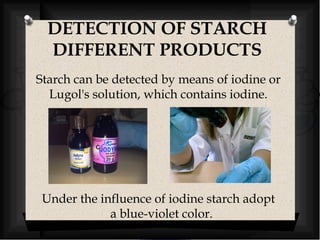
Starch can be detected by means of iodine or 
Lugol's solution, which contains iodine. 
Under the influence of iodine starch adopt 
a blue-violet color. 
c
THE FIRST EXPERIMENT
RESULTS 
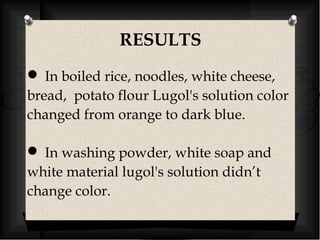
 In boiled rice, noodles, white cheese, 
bread, potato flour Lugol's solution color 
changed from orange to dark blue. 
 In washing powder, white soap and 
white material lugol's solution didn’t 
change color.
CONCLUSIONS 
 There is starch in boiled rice, noodles, 
white cheese, bread, flour. . 
 There is no starch in washing powder, 
white soap and white material.
WHAT IS PROTEIN? 
• Proteins are macromolecules are composed of amino 
acids. 
• Proteins are the basic building blocks of all tissues of the 
human body, and many compounds such as 
enzymes, hormones, antibodies. 
• Proteins regulate metabolism and many body functions, 
ensuring correct the condition and functioning of our 
body.
DETECTION OF PROTEIN 
1) biuret reaction – a food product is treated 
by mixture VI cupric sulfate and potassium 
hydroxide in the presence of proteins which 
are stained purple; reakcja ta służy do 
wykrywania wiązań peptydowych 
2) reakcja ksantoproteinowa - polega na 
działaniu na produkt stężonym kwasem 
azotowym (V); reakcja ta znajduje 
zastosowanie przy wykrywaniu białek 
posiadających pierścienie aromatyczne
THE SECOND EXPERIMENT
RESULTS 
In biuret reaction tested product changed its 
colour from blue on purple.
CONCLUSIONS 
There are some proteins in eggs.
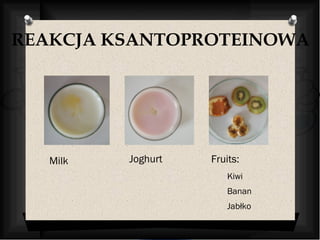
REAKCJA KSANTOPROTEINOWA 
Fruits: 
Kiwi 
Banan 
Jabłko 
Milk Joghurt
RESULTS 
W reakcji z kwasem azotowym (V): 
- mleko i jogurt przybrały żółtą barwę 
- kiwi, banan oraz jabłko nie zmieniły koloru
CONCLUSIONS 
1. W nabiale zidentyfikowano białka o 
budowie aromatycznej. 
2. Owoce nie zawierają białek lub ich wykrycie 
tą metodą jest niemożliwe, np. ze względu na 
niską czułość metody lub brak białek 
zawierających pierścienie aromatyczne.
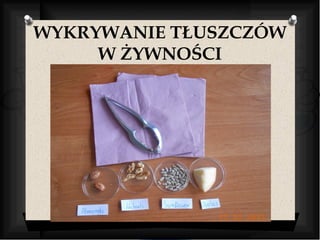
WYKRYWANIE TŁUSZCZÓW 
W ŻYWNOŚCI
METHOD 
1.Rozetrzeć badany produkt w 
papierowej serwetce. 
2.Obejrzeć serwetkę, trzymając ja pod 
światło. Jeśli zostały na niej tłuste 
plamy, oznacza to, że pokarm 
zawiera tłuszcz.
MATERIAL 
Almonds 
Walnut 
Sunflower 
Apple
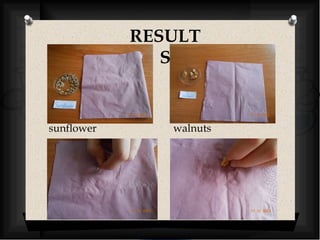
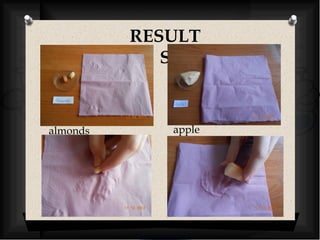
RESULT 
S 
sunflower walnuts
RESULT 
S 
almonds apple
RESULTS AND CONCLUSIONS 
 Z nasion słonecznika powstała 
największa tłusta plama na serwetce, co 
sugeruje największą ilość tłuszczy w tym 
produkcie. 
 Jabłko zrobiło mokrą plamę na 
serwetce a nie tłustą, co świadczy, że tą 
techniką tłuszczy nie wykryto.
Experiments on starch protein and fat 2

  • 1.
  • 3.
    WHAT IS STARCH? • Starch is a white, amorphous substance, tasteless, insoluble in cold water and ethanol. • Starch is a reserve material of the plant, is mainly in the seeds. • Starch as a reserve material is also stored in the fruit and storage organs. • Starch is used in the textile, cosmetic, pharmaceutical, spirits.
  • 4.
    DETECTION OF STARCH DIFFERENT PRODUCTS Starch can be detected by means of iodine or Lugol's solution, which contains iodine. Under the influence of iodine starch adopt a blue-violet color. c
  • 5.
  • 6.
    RESULTS  Inboiled rice, noodles, white cheese, bread, potato flour Lugol's solution color changed from orange to dark blue.  In washing powder, white soap and white material lugol's solution didn’t change color.
  • 7.
    CONCLUSIONS  Thereis starch in boiled rice, noodles, white cheese, bread, flour. .  There is no starch in washing powder, white soap and white material.
  • 9.
    WHAT IS PROTEIN? • Proteins are macromolecules are composed of amino acids. • Proteins are the basic building blocks of all tissues of the human body, and many compounds such as enzymes, hormones, antibodies. • Proteins regulate metabolism and many body functions, ensuring correct the condition and functioning of our body.
  • 10.
    DETECTION OF PROTEIN 1) biuret reaction – a food product is treated by mixture VI cupric sulfate and potassium hydroxide in the presence of proteins which are stained purple; reakcja ta służy do wykrywania wiązań peptydowych 2) reakcja ksantoproteinowa - polega na działaniu na produkt stężonym kwasem azotowym (V); reakcja ta znajduje zastosowanie przy wykrywaniu białek posiadających pierścienie aromatyczne
  • 11.
  • 12.
    RESULTS In biuretreaction tested product changed its colour from blue on purple.
  • 13.
    CONCLUSIONS There aresome proteins in eggs.
  • 14.
    REAKCJA KSANTOPROTEINOWA Fruits: Kiwi Banan Jabłko Milk Joghurt
  • 15.
    RESULTS W reakcjiz kwasem azotowym (V): - mleko i jogurt przybrały żółtą barwę - kiwi, banan oraz jabłko nie zmieniły koloru
  • 16.
    CONCLUSIONS 1. Wnabiale zidentyfikowano białka o budowie aromatycznej. 2. Owoce nie zawierają białek lub ich wykrycie tą metodą jest niemożliwe, np. ze względu na niską czułość metody lub brak białek zawierających pierścienie aromatyczne.
  • 18.
  • 19.
    METHOD 1.Rozetrzeć badanyprodukt w papierowej serwetce. 2.Obejrzeć serwetkę, trzymając ja pod światło. Jeśli zostały na niej tłuste plamy, oznacza to, że pokarm zawiera tłuszcz.
  • 20.
    MATERIAL Almonds Walnut Sunflower Apple
  • 21.
  • 22.
  • 23.
    RESULTS AND CONCLUSIONS  Z nasion słonecznika powstała największa tłusta plama na serwetce, co sugeruje największą ilość tłuszczy w tym produkcie.  Jabłko zrobiło mokrą plamę na serwetce a nie tłustą, co świadczy, że tą techniką tłuszczy nie wykryto.