





Experimental Studies
BY
DR MUHAMMAD TAUSEEF JAVED
CONSULTANT MINISTRY OF HEALTH
MAKKAH
&
IPH LAHORE
Types of Experimental Studies
• Multiple experimental groups
• Blinds
 single, double, triple
Public Health & Clinical
Objectives
• Modify natural history of disease and
express disease prognosis
Prevent or delay death or disability
Improve health of patient or population
• Need to use best preventive or
therapeutic measures
Randomized trials are ideal design to
evaluate effectiveness and side effects
of new forms of intervention
Historical Perspectives
• Sir Francis Galton (1883) - ruminated
over the influence of prayer
• Joyce and Welldon (1965) found no
benefit of prayer
• R. C. Byrd (1988) - suggested
positive benefits
• Washington Post Parade article
(2003) - also suggested positive
benefits
Recent Perspectives
• Effect of:
coffee on CHD
carotene on cancers
hormonal therapy on breast cancer
drug-lowering cholesterol on CHD
Randomized Trials
• Historically, were done accidentally,
in other words, “unplanned trials”
Ambroise Pare (1510 - 1590) discovered
new treatment for war wounds when
original therapy was unavailable
James Lind (1747) studying scurvy
• Subjects assigned to groups using a
non-biased procedure
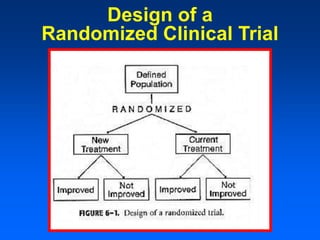
Design of a
Randomized Clinical Trial
Selection of Subjects
• Well-designed
• Eliminate subjectivity
• Promote reliability
Replicable, as with laboratory
experiments
Accurate
Selection of Subjects:
Studies without Comparison
• Question: If we administer a drug
and the patient improves, can we
attribute the improvement to the
administration of that drug?
• Answer: Results can always be
improved by omitting controls.
- Prof. Hugo Muensch
Harvard University
Selection of Subjects:
Studies with Comparison
• Historical controls (comparison group
from past)
Data must be abstracted from records not
kept for research purposes
Differences may be due to quality of the data
May not be able to substantiate differences
Can be useful for drugs developed against
fatal diseases
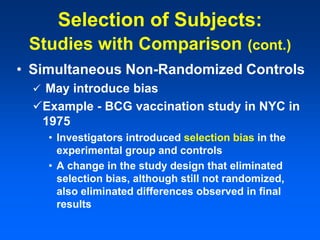
• Simultaneous Non-Randomized Controls
 May introduce bias
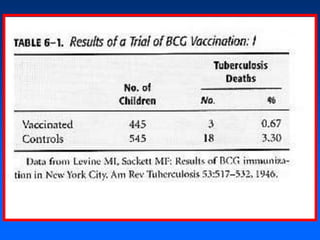
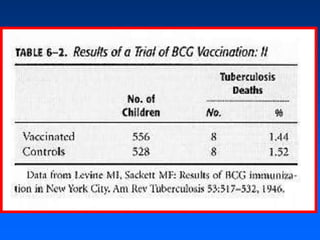
Example - BCG vaccination study in NYC in
1975
• Investigators introduced selection bias in the
experimental group and controls
• A change in the study design that eliminated
selection bias, although still not randomized,
also eliminated differences observed in final
results
Selection of Subjects:
Studies with Comparison (cont.)
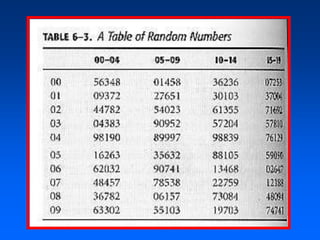
• Best approach
• Uses tables of random numbers
• Must still eliminate physician bias
• Can achieve non-predictability
Selection of Subjects (cont.):
Randomization
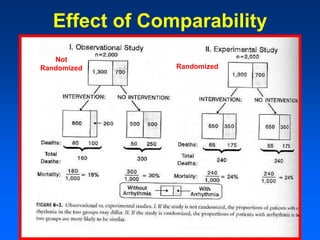
Effect of Comparability
Not
Randomized Randomized
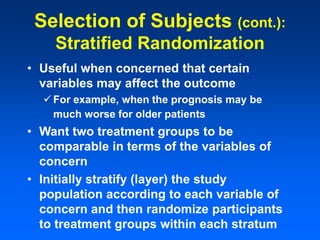
Selection of Subjects (cont.):
Stratified Randomization
• Useful when concerned that certain
variables may affect the outcome
 For example, when the prognosis may be
much worse for older patients
• Want two treatment groups to be
comparable in terms of the variables of
concern
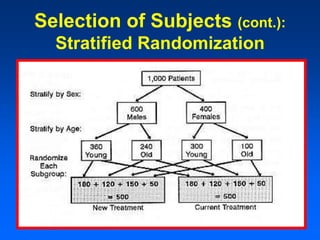
• Initially stratify (layer) the study
population according to each variable of
concern and then randomize participants
to treatment groups within each stratum
Selection of Subjects (cont.):
Stratified Randomization
Data Collection on Subjects:
Potential Variables
• Treatment:
 that was assigned
 that was received
• Outcome
 Explicit criteria required
 Comparable measurements required
• Prognostic Profile at Entry
 If risk factors for a bad outcome are known,
assure that treatment groups are reasonably
similar for these factors
 Data for prognostic factors obtained upon
enrollment in study
• Masking (Blinding)
Data Collection on Subjects (cont.):
Masking (Blinding)
• Attempt to eliminate biases & preconceptions
• Single-blind
 Subject masking
 Use of placebo
• Double-blind
 Subject masking and researcher masking
• Data collectors and data analysts
• Triple-blind
 Subject masking, researcher masking and study
sponsor masking

Experimental Studies

  • 1.
    Experimental Studies BY DR MUHAMMADTAUSEEF JAVED CONSULTANT MINISTRY OF HEALTH MAKKAH & IPH LAHORE
  • 2.
    Types of ExperimentalStudies • Multiple experimental groups • Blinds  single, double, triple
  • 3.
    Public Health &Clinical Objectives • Modify natural history of disease and express disease prognosis Prevent or delay death or disability Improve health of patient or population • Need to use best preventive or therapeutic measures Randomized trials are ideal design to evaluate effectiveness and side effects of new forms of intervention
  • 4.
    Historical Perspectives • SirFrancis Galton (1883) - ruminated over the influence of prayer • Joyce and Welldon (1965) found no benefit of prayer • R. C. Byrd (1988) - suggested positive benefits • Washington Post Parade article (2003) - also suggested positive benefits
  • 6.
    Recent Perspectives • Effectof: coffee on CHD carotene on cancers hormonal therapy on breast cancer drug-lowering cholesterol on CHD
  • 7.
    Randomized Trials • Historically,were done accidentally, in other words, “unplanned trials” Ambroise Pare (1510 - 1590) discovered new treatment for war wounds when original therapy was unavailable James Lind (1747) studying scurvy • Subjects assigned to groups using a non-biased procedure
  • 8.
    Design of a RandomizedClinical Trial
  • 9.
    Selection of Subjects •Well-designed • Eliminate subjectivity • Promote reliability Replicable, as with laboratory experiments Accurate
  • 10.
    Selection of Subjects: Studieswithout Comparison • Question: If we administer a drug and the patient improves, can we attribute the improvement to the administration of that drug? • Answer: Results can always be improved by omitting controls. - Prof. Hugo Muensch Harvard University
  • 11.
    Selection of Subjects: Studieswith Comparison • Historical controls (comparison group from past) Data must be abstracted from records not kept for research purposes Differences may be due to quality of the data May not be able to substantiate differences Can be useful for drugs developed against fatal diseases
  • 12.
    • Simultaneous Non-RandomizedControls  May introduce bias Example - BCG vaccination study in NYC in 1975 • Investigators introduced selection bias in the experimental group and controls • A change in the study design that eliminated selection bias, although still not randomized, also eliminated differences observed in final results Selection of Subjects: Studies with Comparison (cont.)
  • 15.
    • Best approach •Uses tables of random numbers • Must still eliminate physician bias • Can achieve non-predictability Selection of Subjects (cont.): Randomization
  • 17.
  • 18.
    Selection of Subjects(cont.): Stratified Randomization • Useful when concerned that certain variables may affect the outcome  For example, when the prognosis may be much worse for older patients • Want two treatment groups to be comparable in terms of the variables of concern • Initially stratify (layer) the study population according to each variable of concern and then randomize participants to treatment groups within each stratum
  • 19.
    Selection of Subjects(cont.): Stratified Randomization
  • 20.
    Data Collection onSubjects: Potential Variables • Treatment:  that was assigned  that was received • Outcome  Explicit criteria required  Comparable measurements required • Prognostic Profile at Entry  If risk factors for a bad outcome are known, assure that treatment groups are reasonably similar for these factors  Data for prognostic factors obtained upon enrollment in study • Masking (Blinding)
  • 21.
    Data Collection onSubjects (cont.): Masking (Blinding) • Attempt to eliminate biases & preconceptions • Single-blind  Subject masking  Use of placebo • Double-blind  Subject masking and researcher masking • Data collectors and data analysts • Triple-blind  Subject masking, researcher masking and study sponsor masking