CARBOHYDRATES
Carbohydrates
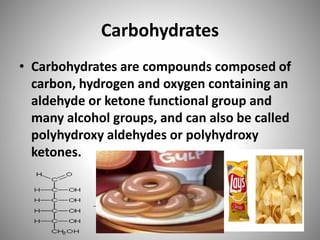
• Carbohydrates are compounds composed of
carbon, hydrogen and oxygen containing an
aldehyde or ketone functional group and
many alcohol groups, and can also be called
polyhydroxy aldehydes or polyhydroxy
ketones.
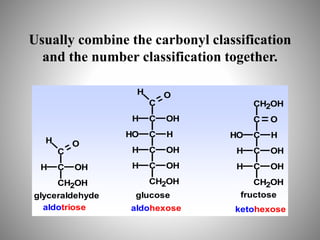
Usually combine the carbonyl classification
and the number classification together.
C
O
H
C OH
H
CH2OH
glyceraldehyde
aldotriose
C
O
H
C OH
H
C H
HO
C OH
H
C OH
H
CH2OH
CH2OH
C O
C H
HO
C OH
H
C OH
H
CH2OH
glucose fructose
aldohexose ketohexose
Background
• A carbohydrate is an organic compound with
the general formula Cn(H2O)n, that is, consists
only of carbon, hydrogen and oxygen, with the
last two in the 2:1 atom ratio.
• Carbohydrates make up the bulk of organic
substances on earth and perform numerous
roles in living systems.
• The carbohydrates (saccharides) are divided into
three categories:
• Monosaccharides, disaccharides, and
polysaccharides.
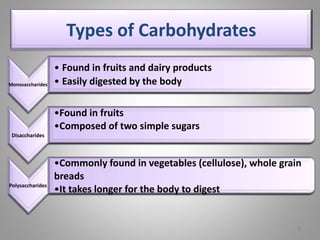
Types of Carbohydrates
Monosaccharides
• Found in fruits and dairy products
• Easily digested by the body
Disaccharides
•Found in fruits
•Composed of two simple sugars
Polysaccharides
•Commonly found in vegetables (cellulose), whole grain
breads
•It takes longer for the body to digest
5
General Test
for
Carbohydrates
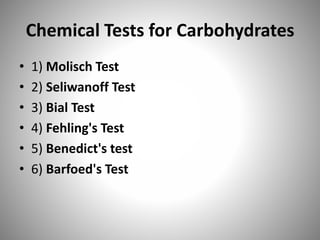
Chemical Tests for Carbohydrates
• 1) Molisch Test
• 2) Seliwanoff Test
• 3) Bial Test
• 4) Fehling's Test
• 5) Benedict's test
• 6) Barfoed's Test
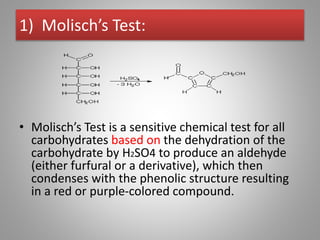
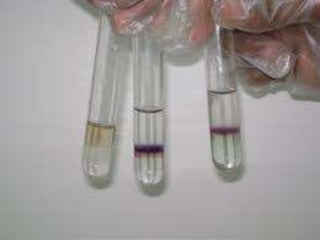
1) Molisch’s Test:
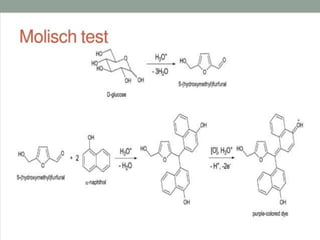
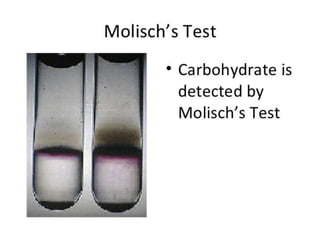
• Molisch’s Test is a sensitive chemical test for all
carbohydrates based on the dehydration of the
carbohydrate by H2SO4 to produce an aldehyde
(either furfural or a derivative), which then
condenses with the phenolic structure resulting
in a red or purple-colored compound.
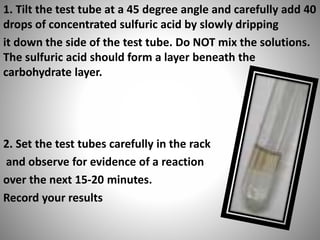
1. Tilt the test tube at a 45 degree angle and carefully add 40
drops of concentrated sulfuric acid by slowly dripping
it down the side of the test tube. Do NOT mix the solutions.
The sulfuric acid should form a layer beneath the
carbohydrate layer.
2. Set the test tubes carefully in the rack
and observe for evidence of a reaction
over the next 15-20 minutes.
Record your results
Thank you
Exp. 1 Molisch Test
• It is the general test for all carbohydrates.
• Monosaccharides give a rapid positive test.
Disaccharides and polysaccharides react
slower.
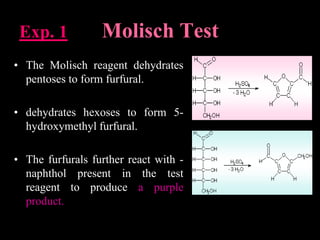
Exp. 1 Molisch Test
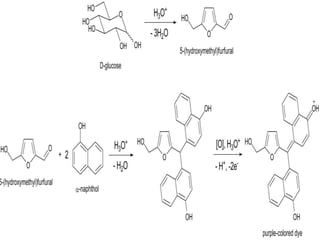
• The Molisch reagent dehydrates
pentoses to form furfural.
• dehydrates hexoses to form 5-
hydroxymethyl furfural.
• The furfurals further react with -
naphthol present in the test
reagent to produce a purple
product.
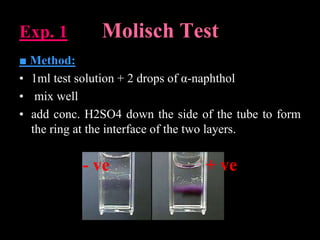
Exp. 1 Molisch Test
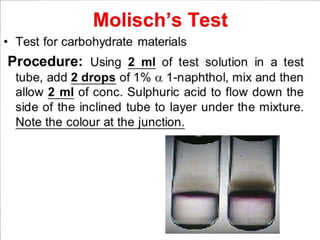
■ Method:
• 1ml test solution + 2 drops of α-naphthol
• mix well
• add conc. H2SO4 down the side of the tube to form
the ring at the interface of the two layers.
- ve + ve
exp.9.molisch test.pptx

exp.9.molisch test.pptx

  • 1.
  • 2.
    Carbohydrates • Carbohydrates arecompounds composed of carbon, hydrogen and oxygen containing an aldehyde or ketone functional group and many alcohol groups, and can also be called polyhydroxy aldehydes or polyhydroxy ketones.
  • 3.
    Usually combine thecarbonyl classification and the number classification together. C O H C OH H CH2OH glyceraldehyde aldotriose C O H C OH H C H HO C OH H C OH H CH2OH CH2OH C O C H HO C OH H C OH H CH2OH glucose fructose aldohexose ketohexose
  • 4.
    Background • A carbohydrateis an organic compound with the general formula Cn(H2O)n, that is, consists only of carbon, hydrogen and oxygen, with the last two in the 2:1 atom ratio. • Carbohydrates make up the bulk of organic substances on earth and perform numerous roles in living systems. • The carbohydrates (saccharides) are divided into three categories: • Monosaccharides, disaccharides, and polysaccharides.
  • 5.
    Types of Carbohydrates Monosaccharides •Found in fruits and dairy products • Easily digested by the body Disaccharides •Found in fruits •Composed of two simple sugars Polysaccharides •Commonly found in vegetables (cellulose), whole grain breads •It takes longer for the body to digest 5
  • 6.
  • 7.
    Chemical Tests forCarbohydrates • 1) Molisch Test • 2) Seliwanoff Test • 3) Bial Test • 4) Fehling's Test • 5) Benedict's test • 6) Barfoed's Test
  • 8.
    1) Molisch’s Test: •Molisch’s Test is a sensitive chemical test for all carbohydrates based on the dehydration of the carbohydrate by H2SO4 to produce an aldehyde (either furfural or a derivative), which then condenses with the phenolic structure resulting in a red or purple-colored compound.
  • 12.
    1. Tilt thetest tube at a 45 degree angle and carefully add 40 drops of concentrated sulfuric acid by slowly dripping it down the side of the test tube. Do NOT mix the solutions. The sulfuric acid should form a layer beneath the carbohydrate layer. 2. Set the test tubes carefully in the rack and observe for evidence of a reaction over the next 15-20 minutes. Record your results
  • 14.
  • 15.
    Exp. 1 MolischTest • It is the general test for all carbohydrates. • Monosaccharides give a rapid positive test. Disaccharides and polysaccharides react slower.
  • 16.
    Exp. 1 MolischTest • The Molisch reagent dehydrates pentoses to form furfural. • dehydrates hexoses to form 5- hydroxymethyl furfural. • The furfurals further react with - naphthol present in the test reagent to produce a purple product.
  • 17.
    Exp. 1 MolischTest ■ Method: • 1ml test solution + 2 drops of α-naphthol • mix well • add conc. H2SO4 down the side of the tube to form the ring at the interface of the two layers. - ve + ve