1
Exit Exam Preparation
Platform
Documentation
2
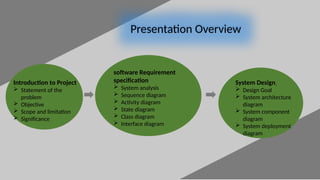
Presentation Overview
Introduction to Project
 Statement of the
problem
 Objective
 Scope and limitation
 Significance
software Requirement
specification
 System analysis
 Sequence diagram
 Activity diagram
 State diagram
 Class diagram
 Interface diagram
System Design
 Design Goal
 System architecture
diagram
 System component
diagram
 System deployment
diagram
3
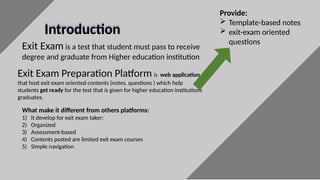
Introduction
Exit Exam is a test that student must pass to receive
degree and graduate from Higher education institution
Exit Exam Preparation Platform is web application
that host exit exam oriented contents (notes, questions ) which help
students get ready for the test that is given for higher education institutions
graduates.
Provide:
 Template-based notes
 exit-exam oriented
questions
What make it different from others platforms:
1) It develop for exit exam taker:
2) Organized
3) Assessment-based
4) Contents posted are limited exit exam courses
5) Simple navigation
4
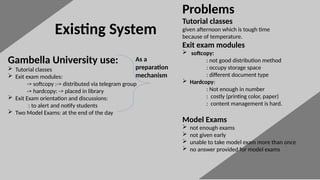
Existing System
Gambella University use:
 Tutorial classes
 Exit exam modules:
-> softcopy :-> distributed via telegram group
-> hardcopy: -> placed in library
 Exit Exam orientation and discussions:
: to alert and notify students
 Two Model Exams: at the end of the day
As a
preparation
mechanism
Tutorial classes
given afternoon which is tough time
because of temperature.
Exit exam modules
 softcopy:
: not good distribution method
: occupy storage space
: different document type
 Hardcopy:
: Not enough in number
: costly (printing color, paper)
: content management is hard.
Model Exams
 not enough exams
 not given early
 unable to take model exam more than once
 no answer provided for model exams
Problems
5
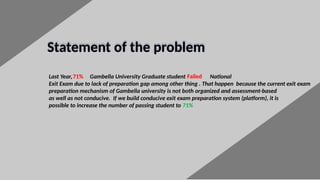
Statement of the problem
Last Year, Gambella University Graduate student National
Exit Exam due to lack of preparation gap among other thing . That happen because the current exit exam
preparation mechanism of Gambella university is not both organized and assessment-based
as well as not conducive. If we build conducive exit exam preparation system (platform), it is
possible to increase the number of passing student to 71%
71% Failed
6
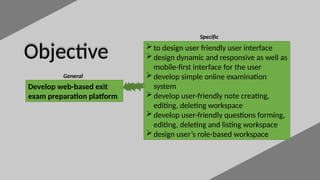
Objective to design user friendly user interface
design dynamic and responsive as well as
mobile-first interface for the user
develop simple online examination
system
develop user-friendly note creating,
editing, deleting workspace
develop user-friendly questions forming,
editing, deleting and listing workspace
design user’s role-based workspace
Specific
Develop web-based exit
exam preparation platform
General
7
Scope
Limitation
 User can view their profile
 Registration for using the platform
 Design note preparation, edition, deletion workspace
 Develop course-level and chapter-level exams preparation,
edition, deletion workspace
 Develop online examination system
 Design course progression indicator mechanism
 Administrator control the system
 The proposed system cannot be
accessed with local language
 pop up questions to help student
focus on what they are reading on.
8
 Help graduate taking exams again and again until they become
confident.
 It alarms Ministry of higher Education (MoH) to set up National
level standard Exit Exam preparation system
 Provide flexibility during exit exam preparation process
 Help Instructor to prepare and modify exit-exam oriented notes
and questions easily
 Help university to spend less on exit exam preparation process
 Help the university in monitoring graduate student preparation
status
 Help the Graduate students to familiarize themselves with
online examination system’s
 Increase the number of passing Graduate students
Significance
9
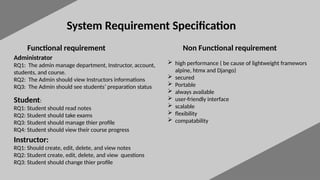
System Requirement Specification
Functional requirement Non Functional requirement
Administrator
RQ1: The admin manage department, Instructor, account,
students, and course.
RQ2: The Admin should view Instructors informations
RQ3: The Admin should see students’ preparation status
Student:
RQ1: Student should read notes
RQ2: Student should take exams
RQ3: Student should manage thier profile
RQ4: Student should view their course progress
Instructor:
RQ1: Should create, edit, delete, and view notes
RQ2: Student create, edit, delete, and view questions
RQ3: Student should change thier profile
 high performance ( be cause of lightweight framewors
alpine, htmx and Django)
 secured
 Portable
 always available
 user-friendly interface
 scalable
 flexibility
 compatability
10
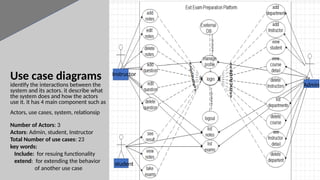
Use case diagrams
identify the interactions between the
system and its actors. it describe what
the system does and how the actors
use it. it has 4 main component such as
Actors, use cases, system, relationsip
Number of Actors: 3
Actors: Admin, student, Instructor
Total Number of use cases: 23
key words:
Include: for resuing functionality
extend: for extending the behavior
of another use case
Instructor
student
Admin
11
use case description
written description of how users would
perform tasks on the system
Use case name add notes
Actors Instructors
Description Instructors can create notes
Pre-condition The Instructor has to login as Instructor and should be in
Instructor dashboard
Flow of Even 1) the system shows list of courses
2) the Instructor select a course
3) the system shows course’s detail
4) the Instructor click create notes button
5) the system provides create notes forms
6) the Instructor fill the form details and save
Alternatives 2a) the instructor clicks create note
3b) the Instructor select course
4) the system provides note form
5) the Instructor fill the form
6) the Instructor save the data
Post condition The system includes new notes of particular course
the system redirects the Instructor to notes’ detail
Exception 6a) the instructor clicks cancel button: the system will not
save the data
12
add note sequence diagram
Sequence diagram
shows the sequence of
messages passed between
objects
13
Activity diagram of take exams
Activity diagram
show the flow of one
activity to another in
system
14
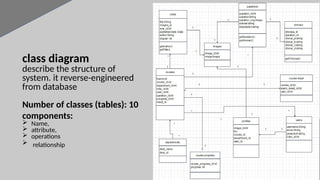
class diagram
describe the structure of
system. it reverse-engineered
from database
Number of classes (tables): 10
components:
 Name,
 attribute,
 operations
 relationship
15
System Design
System design Approach
 we used object-oriented approach for reusability purpose
System Development Model
 iterative software development life cycle
Proposed system
16
System Architecture
The Proposed system follow MVC
architecture
 The Model is the information that the platform will
be working with
 View is the presentation of the Model on the
platform
 Controller is the code that connects the View and
Model together.
17
media
files
Deployment diagram
visualize the hardware devices thier
communication as wel as placement
of software files in hardware
Hardwares
 client -> make request
 webserver
-> provide response
-> store EEPP
 database server
-> process queryies
-> store EEPP DB tables
18
media
files
Component diagram
depicts how components are
wired together to form larger
components
19
media
files
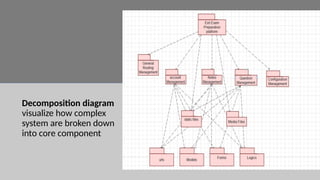
Decomposition diagram
visualize how complex
system are broken down
into core component
20
Conclusion
Exit Exam preparation platform (EEPP) is a web-based application
build for Exit Exam taker to get ready themselves for National Exit
Exam.
Recommendation
This proposed system can be used by all university of Ethiopia with
some customizations. we recommends coming computer science
student to modifiy this system to address the limitations.
21
Thank you

exit exam preparation platform presentation.pptx

  • 1.
  • 2.
    2 Presentation Overview Introduction toProject  Statement of the problem  Objective  Scope and limitation  Significance software Requirement specification  System analysis  Sequence diagram  Activity diagram  State diagram  Class diagram  Interface diagram System Design  Design Goal  System architecture diagram  System component diagram  System deployment diagram
  • 3.
    3 Introduction Exit Exam isa test that student must pass to receive degree and graduate from Higher education institution Exit Exam Preparation Platform is web application that host exit exam oriented contents (notes, questions ) which help students get ready for the test that is given for higher education institutions graduates. Provide:  Template-based notes  exit-exam oriented questions What make it different from others platforms: 1) It develop for exit exam taker: 2) Organized 3) Assessment-based 4) Contents posted are limited exit exam courses 5) Simple navigation
  • 4.
    4 Existing System Gambella Universityuse:  Tutorial classes  Exit exam modules: -> softcopy :-> distributed via telegram group -> hardcopy: -> placed in library  Exit Exam orientation and discussions: : to alert and notify students  Two Model Exams: at the end of the day As a preparation mechanism Tutorial classes given afternoon which is tough time because of temperature. Exit exam modules  softcopy: : not good distribution method : occupy storage space : different document type  Hardcopy: : Not enough in number : costly (printing color, paper) : content management is hard. Model Exams  not enough exams  not given early  unable to take model exam more than once  no answer provided for model exams Problems
  • 5.
    5 Statement of theproblem Last Year, Gambella University Graduate student National Exit Exam due to lack of preparation gap among other thing . That happen because the current exit exam preparation mechanism of Gambella university is not both organized and assessment-based as well as not conducive. If we build conducive exit exam preparation system (platform), it is possible to increase the number of passing student to 71% 71% Failed
  • 6.
    6 Objective to designuser friendly user interface design dynamic and responsive as well as mobile-first interface for the user develop simple online examination system develop user-friendly note creating, editing, deleting workspace develop user-friendly questions forming, editing, deleting and listing workspace design user’s role-based workspace Specific Develop web-based exit exam preparation platform General
  • 7.
    7 Scope Limitation  User canview their profile  Registration for using the platform  Design note preparation, edition, deletion workspace  Develop course-level and chapter-level exams preparation, edition, deletion workspace  Develop online examination system  Design course progression indicator mechanism  Administrator control the system  The proposed system cannot be accessed with local language  pop up questions to help student focus on what they are reading on.
  • 8.
    8  Help graduatetaking exams again and again until they become confident.  It alarms Ministry of higher Education (MoH) to set up National level standard Exit Exam preparation system  Provide flexibility during exit exam preparation process  Help Instructor to prepare and modify exit-exam oriented notes and questions easily  Help university to spend less on exit exam preparation process  Help the university in monitoring graduate student preparation status  Help the Graduate students to familiarize themselves with online examination system’s  Increase the number of passing Graduate students Significance
  • 9.
    9 System Requirement Specification Functionalrequirement Non Functional requirement Administrator RQ1: The admin manage department, Instructor, account, students, and course. RQ2: The Admin should view Instructors informations RQ3: The Admin should see students’ preparation status Student: RQ1: Student should read notes RQ2: Student should take exams RQ3: Student should manage thier profile RQ4: Student should view their course progress Instructor: RQ1: Should create, edit, delete, and view notes RQ2: Student create, edit, delete, and view questions RQ3: Student should change thier profile  high performance ( be cause of lightweight framewors alpine, htmx and Django)  secured  Portable  always available  user-friendly interface  scalable  flexibility  compatability
  • 10.
    10 Use case diagrams identifythe interactions between the system and its actors. it describe what the system does and how the actors use it. it has 4 main component such as Actors, use cases, system, relationsip Number of Actors: 3 Actors: Admin, student, Instructor Total Number of use cases: 23 key words: Include: for resuing functionality extend: for extending the behavior of another use case Instructor student Admin
  • 11.
    11 use case description writtendescription of how users would perform tasks on the system Use case name add notes Actors Instructors Description Instructors can create notes Pre-condition The Instructor has to login as Instructor and should be in Instructor dashboard Flow of Even 1) the system shows list of courses 2) the Instructor select a course 3) the system shows course’s detail 4) the Instructor click create notes button 5) the system provides create notes forms 6) the Instructor fill the form details and save Alternatives 2a) the instructor clicks create note 3b) the Instructor select course 4) the system provides note form 5) the Instructor fill the form 6) the Instructor save the data Post condition The system includes new notes of particular course the system redirects the Instructor to notes’ detail Exception 6a) the instructor clicks cancel button: the system will not save the data
  • 12.
    12 add note sequencediagram Sequence diagram shows the sequence of messages passed between objects
  • 13.
    13 Activity diagram oftake exams Activity diagram show the flow of one activity to another in system
  • 14.
    14 class diagram describe thestructure of system. it reverse-engineered from database Number of classes (tables): 10 components:  Name,  attribute,  operations  relationship
  • 15.
    15 System Design System designApproach  we used object-oriented approach for reusability purpose System Development Model  iterative software development life cycle Proposed system
  • 16.
    16 System Architecture The Proposedsystem follow MVC architecture  The Model is the information that the platform will be working with  View is the presentation of the Model on the platform  Controller is the code that connects the View and Model together.
  • 17.
    17 media files Deployment diagram visualize thehardware devices thier communication as wel as placement of software files in hardware Hardwares  client -> make request  webserver -> provide response -> store EEPP  database server -> process queryies -> store EEPP DB tables
  • 18.
    18 media files Component diagram depicts howcomponents are wired together to form larger components
  • 19.
    19 media files Decomposition diagram visualize howcomplex system are broken down into core component
  • 20.
    20 Conclusion Exit Exam preparationplatform (EEPP) is a web-based application build for Exit Exam taker to get ready themselves for National Exit Exam. Recommendation This proposed system can be used by all university of Ethiopia with some customizations. we recommends coming computer science student to modifiy this system to address the limitations.
  • 21.