Report Section Page Reference to Project Report
INTRODUCTION 2
The Executive Summary provides an overview of the findings of a report Worcester County
Food Bank Donor Story Bank Project Report.
The Worcester County Food Bank (WCFB) is the largest anti-hunger organization in Worcester County.
During its 34 years of operation, the goal of alleviating hunger has widened and evolved. Initially, the
primary role was to warehouse and distribute food. However,over the years, the mission has broadened to
include collaboration with partner agencies to better distribute food and provide resources to previous
under served populations. Most recently, the food bank has added an additional focus of advocating for
improved access to healthy food for everyone. This expanded mission of advocacy includes leading and
educating the community which better addresses the immediate problem and the root cause of hunger in
Worcester County.
With over 40,000 donors in their database and 14,000 active donors, WCFB is committed to
strengthening its relationship with financial donors. With this goal in mind the Donor Communication
Story Banking Project was established to collect and analyze donor communication preferences. The
information gathered will assist the communication and development team to create more effective
materials thereby sustaining the current financial donor relationships and improving the outreach to future
financial donors.
This comprehensive project report is divided into the following sections. The page references provided in
this Executive Summary correspond to the specific, detailed information contained in the project report.
Executive Summary
Worcester County Food Bank Donor Story Bank Project Report
Worcester County Food Bank
Shrewsbury, Massachusetts
Prepared by Susan M. Halpin M.Ed.
TemporaryDevelopment & Communications Associate
February 2016
3
Report Section Page Reference to Project Report
OBJECTIVES 2
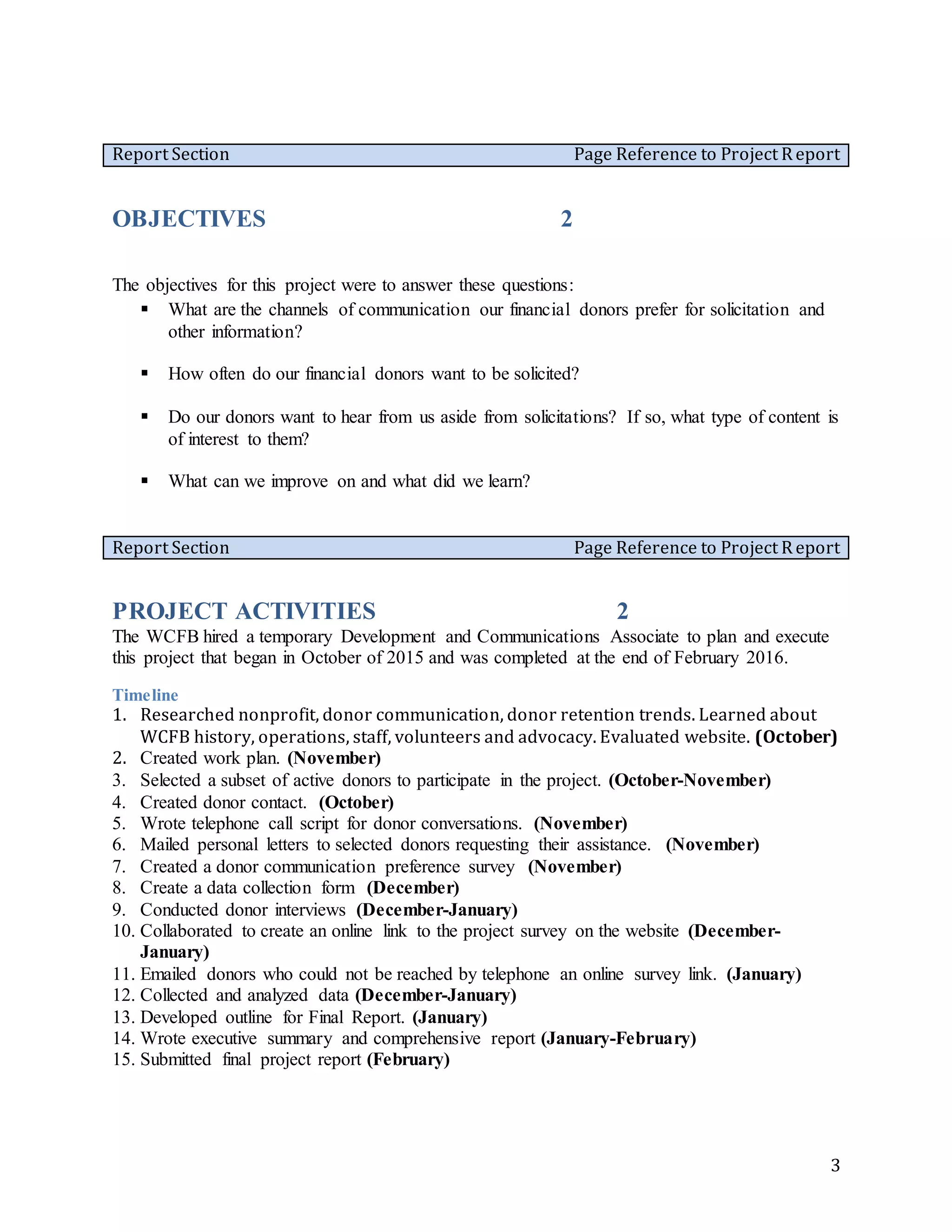
The objectives for this project were to answer these questions:
 What are the channels of communication our financial donors prefer for solicitation and
other information?
 How often do our financial donors want to be solicited?
 Do our donors want to hear from us aside from solicitations? If so, what type of content is
of interest to them?
 What can we improve on and what did we learn?
Report Section Page Reference to Project Report
PROJECT ACTIVITIES 2
The WCFB hired a temporary Development and Communications Associate to plan and execute
this project that began in October of 2015 and was completed at the end of February 2016.
Timeline
1. Researched nonprofit, donor communication, donor retention trends. Learned about
WCFB history, operations, staff, volunteers and advocacy. Evaluated website. (October)
2. Created work plan. (November)
3. Selected a subset of active donors to participate in the project. (October-November)
4. Created donor contact. (October)
5. Wrote telephone call script for donor conversations. (November)
6. Mailed personal letters to selected donors requesting their assistance. (November)
7. Created a donor communication preference survey (November)
8. Create a data collection form (December)
9. Conducted donor interviews (December-January)
10. Collaborated to create an online link to the project survey on the website (December-
January)
11. Emailed donors who could not be reached by telephone an online survey link. (January)
12. Collected and analyzed data (December-January)
13. Developed outline for Final Report. (January)
14. Wrote executive summary and comprehensive report (January-February)
15. Submitted final project report (February)
4
Report Section Page Reference to Project Report
KEY FINDINGS 6
 Personalized notes were sent to randomly selected donors requesting their
assistance. Therefore, when contacted by telephone, donors had knowledge of the
project and many participated.
 Interviewed thirteen donors. Eight were women and five were men. Conversations lasted
from five to sixty five minutes. Most donors were happy to assist.
 Participants represented seven towns in Worcester County and one from outside
Worcester county.
 Half of the respondents shared that an important factor in their initial decision to donate
was that local people were being served.
 Many donors first learned about the WCFB through church.
 A significant number of donors did not know how well WCFB explains how their
donation was exactly spent.
 Most respondents prefer to hear about fundraising campaigns through a note or letter
delivered by postal mail and not by phone.
 The majority of respondents would like to be asked for a donation two times or less in a
year. Many felt they were asked too often.
 Most had not visited the foodbank.org website.
 The majority of donors want to receive information through the postal mail in addition to
solicitations. The donors are interested in who we serve, our advocacy work, and
specifics of how funds are used.
 A very small percentage of respondents have FaceBook and Twitter accounts.
 Overall the respondents are very pleased with their relationship with the WCFB and the
communication they receive. Some improvements respondents suggested: more local
media coverage, more presence in the local community showcasing the WCFB
accomplishments, less fundraising solicitations, and less thank you notes.
5
Report Section Page Reference to Project Report
CHALLENGES AND LESSONS LEARNED 7
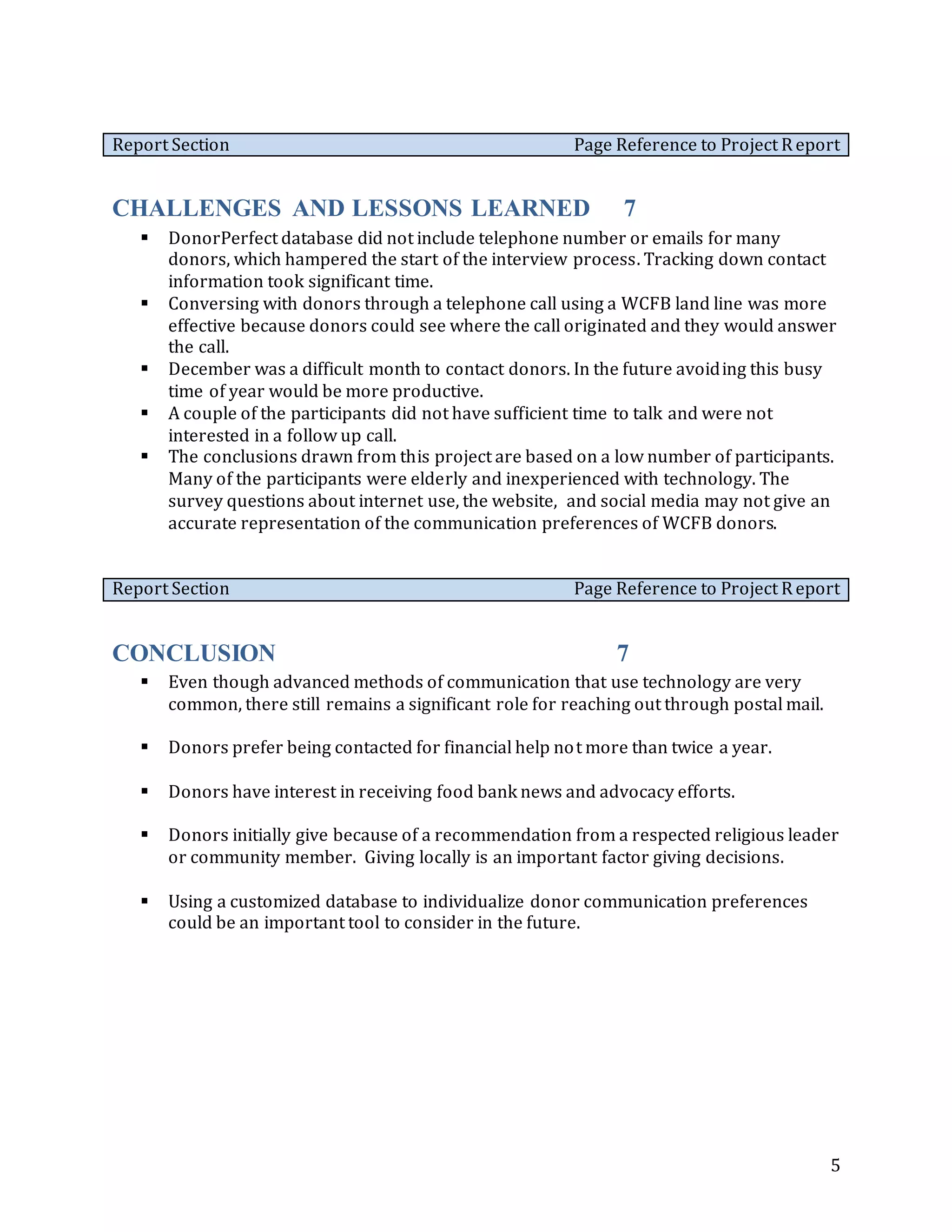
 DonorPerfect database did not include telephone number or emails for many
donors, which hampered the start of the interview process. Tracking down contact
information took significant time.
 Conversing with donors through a telephone call using a WCFB land line was more
effective because donors could see where the call originated and they would answer
the call.
 December was a difficult month to contact donors. In the future avoiding this busy
time of year would be more productive.
 A couple of the participants did not have sufficient time to talk and were not
interested in a follow up call.
 The conclusions drawn from this project are based on a low number of participants.
Many of the participants were elderly and inexperienced with technology. The
survey questions about internet use, the website, and social media may not give an
accurate representation of the communication preferences of WCFB donors.
Report Section Page Reference to Project Report
CONCLUSION 7
 Even though advanced methods of communication that use technology are very
common, there still remains a significant role for reaching out through postal mail.
 Donors prefer being contacted for financial help not more than twice a year.
 Donors have interest in receiving food bank news and advocacy efforts.
 Donors initially give because of a recommendation from a respected religious leader
or community member. Giving locally is an important factor giving decisions.
 Using a customized database to individualize donor communication preferences
could be an important tool to consider in the future.

EXECUTIVE SUMMARY Story Bank Project Report 2.24.16

  • 1.
    Report Section PageReference to Project Report INTRODUCTION 2 The Executive Summary provides an overview of the findings of a report Worcester County Food Bank Donor Story Bank Project Report. The Worcester County Food Bank (WCFB) is the largest anti-hunger organization in Worcester County. During its 34 years of operation, the goal of alleviating hunger has widened and evolved. Initially, the primary role was to warehouse and distribute food. However,over the years, the mission has broadened to include collaboration with partner agencies to better distribute food and provide resources to previous under served populations. Most recently, the food bank has added an additional focus of advocating for improved access to healthy food for everyone. This expanded mission of advocacy includes leading and educating the community which better addresses the immediate problem and the root cause of hunger in Worcester County. With over 40,000 donors in their database and 14,000 active donors, WCFB is committed to strengthening its relationship with financial donors. With this goal in mind the Donor Communication Story Banking Project was established to collect and analyze donor communication preferences. The information gathered will assist the communication and development team to create more effective materials thereby sustaining the current financial donor relationships and improving the outreach to future financial donors. This comprehensive project report is divided into the following sections. The page references provided in this Executive Summary correspond to the specific, detailed information contained in the project report. Executive Summary Worcester County Food Bank Donor Story Bank Project Report Worcester County Food Bank Shrewsbury, Massachusetts Prepared by Susan M. Halpin M.Ed. TemporaryDevelopment & Communications Associate February 2016
  • 2.
    3 Report Section PageReference to Project Report OBJECTIVES 2 The objectives for this project were to answer these questions:  What are the channels of communication our financial donors prefer for solicitation and other information?  How often do our financial donors want to be solicited?  Do our donors want to hear from us aside from solicitations? If so, what type of content is of interest to them?  What can we improve on and what did we learn? Report Section Page Reference to Project Report PROJECT ACTIVITIES 2 The WCFB hired a temporary Development and Communications Associate to plan and execute this project that began in October of 2015 and was completed at the end of February 2016. Timeline 1. Researched nonprofit, donor communication, donor retention trends. Learned about WCFB history, operations, staff, volunteers and advocacy. Evaluated website. (October) 2. Created work plan. (November) 3. Selected a subset of active donors to participate in the project. (October-November) 4. Created donor contact. (October) 5. Wrote telephone call script for donor conversations. (November) 6. Mailed personal letters to selected donors requesting their assistance. (November) 7. Created a donor communication preference survey (November) 8. Create a data collection form (December) 9. Conducted donor interviews (December-January) 10. Collaborated to create an online link to the project survey on the website (December- January) 11. Emailed donors who could not be reached by telephone an online survey link. (January) 12. Collected and analyzed data (December-January) 13. Developed outline for Final Report. (January) 14. Wrote executive summary and comprehensive report (January-February) 15. Submitted final project report (February)
  • 3.
    4 Report Section PageReference to Project Report KEY FINDINGS 6  Personalized notes were sent to randomly selected donors requesting their assistance. Therefore, when contacted by telephone, donors had knowledge of the project and many participated.  Interviewed thirteen donors. Eight were women and five were men. Conversations lasted from five to sixty five minutes. Most donors were happy to assist.  Participants represented seven towns in Worcester County and one from outside Worcester county.  Half of the respondents shared that an important factor in their initial decision to donate was that local people were being served.  Many donors first learned about the WCFB through church.  A significant number of donors did not know how well WCFB explains how their donation was exactly spent.  Most respondents prefer to hear about fundraising campaigns through a note or letter delivered by postal mail and not by phone.  The majority of respondents would like to be asked for a donation two times or less in a year. Many felt they were asked too often.  Most had not visited the foodbank.org website.  The majority of donors want to receive information through the postal mail in addition to solicitations. The donors are interested in who we serve, our advocacy work, and specifics of how funds are used.  A very small percentage of respondents have FaceBook and Twitter accounts.  Overall the respondents are very pleased with their relationship with the WCFB and the communication they receive. Some improvements respondents suggested: more local media coverage, more presence in the local community showcasing the WCFB accomplishments, less fundraising solicitations, and less thank you notes.
  • 4.
    5 Report Section PageReference to Project Report CHALLENGES AND LESSONS LEARNED 7  DonorPerfect database did not include telephone number or emails for many donors, which hampered the start of the interview process. Tracking down contact information took significant time.  Conversing with donors through a telephone call using a WCFB land line was more effective because donors could see where the call originated and they would answer the call.  December was a difficult month to contact donors. In the future avoiding this busy time of year would be more productive.  A couple of the participants did not have sufficient time to talk and were not interested in a follow up call.  The conclusions drawn from this project are based on a low number of participants. Many of the participants were elderly and inexperienced with technology. The survey questions about internet use, the website, and social media may not give an accurate representation of the communication preferences of WCFB donors. Report Section Page Reference to Project Report CONCLUSION 7  Even though advanced methods of communication that use technology are very common, there still remains a significant role for reaching out through postal mail.  Donors prefer being contacted for financial help not more than twice a year.  Donors have interest in receiving food bank news and advocacy efforts.  Donors initially give because of a recommendation from a respected religious leader or community member. Giving locally is an important factor giving decisions.  Using a customized database to individualize donor communication preferences could be an important tool to consider in the future.