Exception Handling
What is exception ?
● An exception is an event that occurs during the
execution of a program that disrupts the
normal flow of instructions.
● Anything that occurs in an unexpected way is
called as exception
Error
● These are not exceptions at all, but problems
that arise beyond the control of the user or the
programmer.
● Errors are typically ignored in your code
because you can rarely do anything about an
error.
Difference between Error and
Exception
● An Error "indicates serious problems that a
reasonable application should not try to catch.”
● An Exception "indicates conditions that a
reasonable application might want to catch."
Why exception occurs
An exception can occur for many different
reasons, including the following:
● A user has entered invalid data.
● A file that needs to be opened cannot be
found.
● A network connection has been lost in the
middle of communications or the JVM has run
out of memory.
●
Types of Exceptions
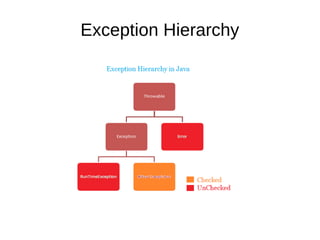
● Checked exceptions
● Runtime exceptions
Checked Exception
● A checked exception is an exception that is
typically a user error or a problem that cannot
be foreseen by the programmer.
● For example, if a file is to be opened, but the
file cannot be found, an exception occurs.
These exceptions cannot simply be ignored at
the time of compilation.
Runtime Exception
● A runtime exception is an exception that
occurs that probably could have been avoided
by the programmer.
● As opposed to checked exceptions, runtime
exceptions are ignored at the time of
compilation.
Categories of exception
●
In Java, it is possible to define two catergories of Exceptions and Errors.
● JVM Exceptions: - These are exceptions/errors that are exclusively or
logically thrown by the JVM.
●
Examples : NullPointerException, ArrayIndexOutOfBoundsException,
ClassCastException,
● Programmatic exceptions: - These exceptions are thrown explicitly by
the application or the API programmers
●
Examples: IllegalArgumentException, IllegalStateException.
Advantages of exception handling
● Separating Error-Handling Code from
"Regular" Code
● Grouping and Differentiating Error Types
Keywords to handle exceptions
Exception Handling contains 5 keywords
● 1. try
● 2. catch
● 3. finally
● 4. throws
● 5. throw
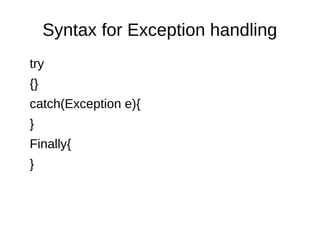
Syntax for Exception handling
try
{}
catch(Exception e){
}
Finally{
}
Purpose of try, catch and finally
● The try block identifies a block of code in which an
exception can occur.
● The catch block identifies a block of code, known as an
exception handler, that can handle a particular type of
exception.
● The finally block identifies a block of code that is
guaranteed to execute, and is the right place to close
files, recover resources, and otherwise clean up after the
code enclosed in the try block.
●
Exception Hierarchy
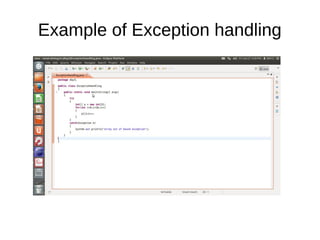
Example of Exception handling
Sample output

Exception handling

  • 1.
  • 2.
    What is exception? ● An exception is an event that occurs during the execution of a program that disrupts the normal flow of instructions. ● Anything that occurs in an unexpected way is called as exception
  • 3.
    Error ● These arenot exceptions at all, but problems that arise beyond the control of the user or the programmer. ● Errors are typically ignored in your code because you can rarely do anything about an error.
  • 4.
    Difference between Errorand Exception ● An Error "indicates serious problems that a reasonable application should not try to catch.” ● An Exception "indicates conditions that a reasonable application might want to catch."
  • 5.
    Why exception occurs Anexception can occur for many different reasons, including the following: ● A user has entered invalid data. ● A file that needs to be opened cannot be found. ● A network connection has been lost in the middle of communications or the JVM has run out of memory. ●
  • 6.
    Types of Exceptions ●Checked exceptions ● Runtime exceptions
  • 7.
    Checked Exception ● Achecked exception is an exception that is typically a user error or a problem that cannot be foreseen by the programmer. ● For example, if a file is to be opened, but the file cannot be found, an exception occurs. These exceptions cannot simply be ignored at the time of compilation.
  • 8.
    Runtime Exception ● Aruntime exception is an exception that occurs that probably could have been avoided by the programmer. ● As opposed to checked exceptions, runtime exceptions are ignored at the time of compilation.
  • 9.
    Categories of exception ● InJava, it is possible to define two catergories of Exceptions and Errors. ● JVM Exceptions: - These are exceptions/errors that are exclusively or logically thrown by the JVM. ● Examples : NullPointerException, ArrayIndexOutOfBoundsException, ClassCastException, ● Programmatic exceptions: - These exceptions are thrown explicitly by the application or the API programmers ● Examples: IllegalArgumentException, IllegalStateException.
  • 10.
    Advantages of exceptionhandling ● Separating Error-Handling Code from "Regular" Code ● Grouping and Differentiating Error Types
  • 11.
    Keywords to handleexceptions Exception Handling contains 5 keywords ● 1. try ● 2. catch ● 3. finally ● 4. throws ● 5. throw
  • 12.
    Syntax for Exceptionhandling try {} catch(Exception e){ } Finally{ }
  • 13.
    Purpose of try,catch and finally ● The try block identifies a block of code in which an exception can occur. ● The catch block identifies a block of code, known as an exception handler, that can handle a particular type of exception. ● The finally block identifies a block of code that is guaranteed to execute, and is the right place to close files, recover resources, and otherwise clean up after the code enclosed in the try block. ●
  • 14.
  • 15.
  • 16.