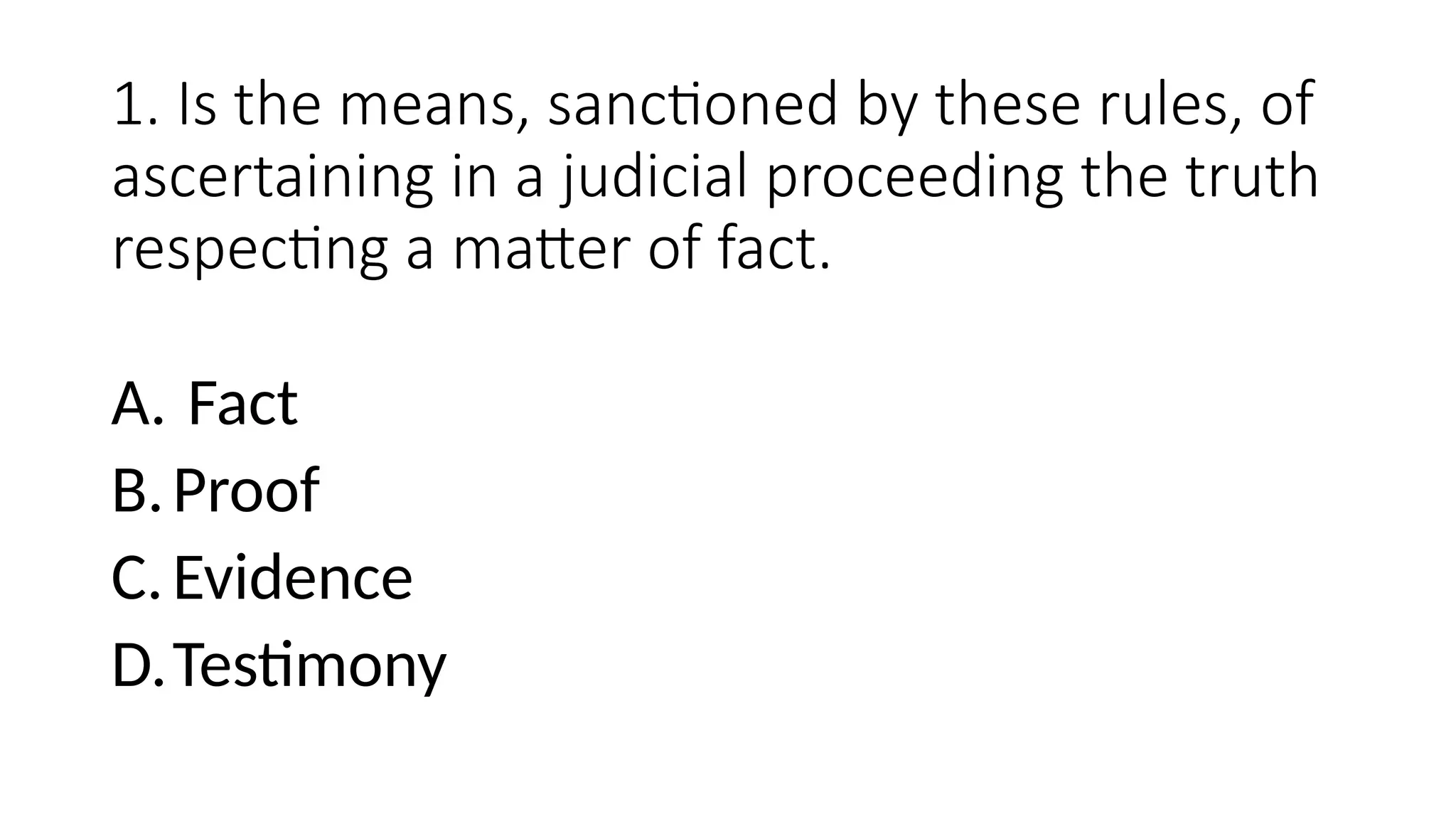
1. Is the means, sanctioned by these rules, of
ascertaining in a judicial proceeding the truth
respecting a matter of fact.
A. Fact
B.Proof
C.Evidence
D.Testimony
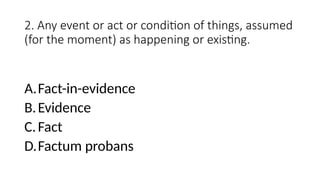
2. Any event or act or condition of things, assumed
(for the moment) as happening or existing.
A.Fact-in-evidence
B.Evidence
C.Fact
D.Factum probans
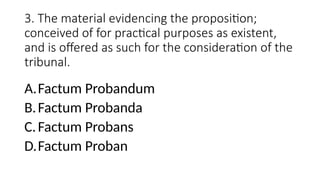
3. The material evidencing the proposition;
conceived of for practical purposes as existent,
and is offered as such for the consideration of the
tribunal.
A.Factum Probandum
B.Factum Probanda
C.Factum Probans
D.Factum Proban
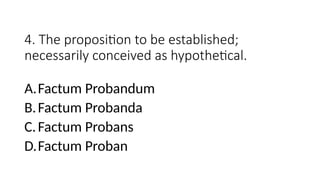
4. The proposition to be established;
necessarily conceived as hypothetical.
A.Factum Probandum
B.Factum Probanda
C.Factum Probans
D.Factum Proban
5. The proof of facts from which, taken
collectively, the existence of the particular
fact in dispute may be inferred as a necessary
or probable consequence.
A.Direct Evidence
B.Secondary Evidence
C.Tertiary Evidence
D.Circumstantial Evidence
6. That which is necessarily inferior to primary
evidence and shows on its face that better
evidence exists (example: copy of the original
contract).
A. Direct Evidence
B. Secondary Evidence
C. Tertiary Evidence
D. Circumstantial Evidence
7. That which proves the fact in dispute
without the aid of any inference or
presumption.
A.Direct Evidence
B.Secondary Evidence
C.Tertiary Evidence
D.Circumstantial Evidence
8. That which affords the greatest certainty
of the fact in question (example: the original
contract).
A.Great Evidence
B.Secondary Evidence
C.Tertiary Evidence
D.Primary Evidence or Best Evidence
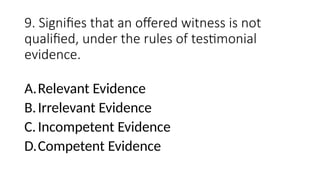
9. Signifies that an offered witness is not
qualified, under the rules of testimonial
evidence.
A.Relevant Evidence
B.Irrelevant Evidence
C.Incompetent Evidence
D.Competent Evidence
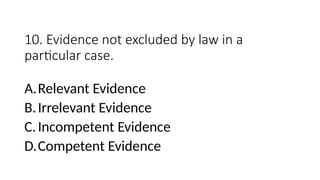
10. Evidence not excluded by law in a
particular case.
A.Relevant Evidence
B.Irrelevant Evidence
C.Incompetent Evidence
D.Competent Evidence
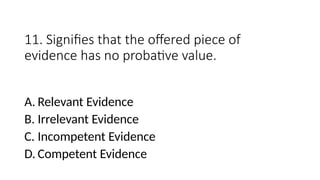
11. Signifies that the offered piece of
evidence has no probative value.
A. Relevant Evidence
B. Irrelevant Evidence
C. Incompetent Evidence
D. Competent Evidence
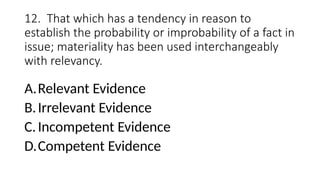
12. That which has a tendency in reason to
establish the probability or improbability of a fact in
issue; materiality has been used interchangeably
with relevancy.
A.Relevant Evidence
B.Irrelevant Evidence
C.Incompetent Evidence
D.Competent Evidence
13. That which is addressed to the sense of
the tribunal, as where objects are presented
for the inspection of the court.
A.Real Evidence
B.Unreal Evidence
C.True Evidence
D.Sensational Evidence
14. The testimony of one possessing in regard
to a particular subject or department of
human activity, knowledge not usually
acquired by other persons.
A. Professional Evidence
B. Expert Evidence
C. Expert or Professional Evidence
D. None of the Above
15. Additional evidence of a different kind
and character, tending to prove the same
point.
A. Cumulative Evidence
B. Conclusive Evidence
C. Corroborative Evidence
D. Prima Facie Evidence
1. The rules on evidence must be liberally
construed so as not to frustrate substantial
justice.
2. The rules of evidence shall be the same in
all courts and in all trials and hearings, except
as otherwise provided by law or these rules.
3. Any evidence inadmissible according to the
laws in force at the time the action accrued,
but admissible according to laws in force at
the time of the trial, is not receivable.
4. The rules on evidence cannot be waived.
When an otherwise objectionable evidence is
not objected, the evidence becomes
admissible because of waiver.
5. To admit evidence and not to believe it are
not incompatible with each other.
6. The admissibility of evidence should not be
equated with the weight of the evidence.
7. Evidence must have such a relation to the
fact in issue as to induce belief in its existence
or non-existence.
8. Evidence on collateral matters shall be
allowed, except when it tends in any
reasonable degree to establish the probability
or improbability of the fact in issue.
9. Evidence on the credibility of witness, or
the lack of it, is always irrelevant.
10. A court shall take judicial notice, without
the introduction of evidence, of the existence
and territorial extent of states, their political
history, forms of government and symbols of
nationality.
11. A court cannot take judicial notice,
without the introduction of evidence, of the
measure of time, and the geographical
divisions.
12. The mere personal knowledge of the
judge is not the judicial knowledge of the
court, and he is not authorized to make his
individual knowledge of a fact, not generally
or professionally known, as the basis of his
action.
13. It is well-settled in our jurisdiction that
our courts cannot take judicial notice of
foreign laws. Like any other facts, they must
be alleged and proved.
14. During the trial, the court, on its own
initiative, or on request of a party, may
announce its intention to take judicial notice
of any matter and allow the parties to be
heard thereon.
15. Municipal Trial Courts (MTC) should take
judicial notice of municipal ordinances in
force in the municipality in which they sit.
Exam prelim1sffsdfvcxvdsfsdcsdvfsdfsdfsdf.pptx

Exam prelim1sffsdfvcxvdsfsdcsdvfsdfsdfsdf.pptx

  • 1.
    1. Is themeans, sanctioned by these rules, of ascertaining in a judicial proceeding the truth respecting a matter of fact. A. Fact B.Proof C.Evidence D.Testimony
  • 2.
    2. Any eventor act or condition of things, assumed (for the moment) as happening or existing. A.Fact-in-evidence B.Evidence C.Fact D.Factum probans
  • 3.
    3. The materialevidencing the proposition; conceived of for practical purposes as existent, and is offered as such for the consideration of the tribunal. A.Factum Probandum B.Factum Probanda C.Factum Probans D.Factum Proban
  • 4.
    4. The propositionto be established; necessarily conceived as hypothetical. A.Factum Probandum B.Factum Probanda C.Factum Probans D.Factum Proban
  • 5.
    5. The proofof facts from which, taken collectively, the existence of the particular fact in dispute may be inferred as a necessary or probable consequence. A.Direct Evidence B.Secondary Evidence C.Tertiary Evidence D.Circumstantial Evidence
  • 6.
    6. That whichis necessarily inferior to primary evidence and shows on its face that better evidence exists (example: copy of the original contract). A. Direct Evidence B. Secondary Evidence C. Tertiary Evidence D. Circumstantial Evidence
  • 7.
    7. That whichproves the fact in dispute without the aid of any inference or presumption. A.Direct Evidence B.Secondary Evidence C.Tertiary Evidence D.Circumstantial Evidence
  • 8.
    8. That whichaffords the greatest certainty of the fact in question (example: the original contract). A.Great Evidence B.Secondary Evidence C.Tertiary Evidence D.Primary Evidence or Best Evidence
  • 9.
    9. Signifies thatan offered witness is not qualified, under the rules of testimonial evidence. A.Relevant Evidence B.Irrelevant Evidence C.Incompetent Evidence D.Competent Evidence
  • 10.
    10. Evidence notexcluded by law in a particular case. A.Relevant Evidence B.Irrelevant Evidence C.Incompetent Evidence D.Competent Evidence
  • 11.
    11. Signifies thatthe offered piece of evidence has no probative value. A. Relevant Evidence B. Irrelevant Evidence C. Incompetent Evidence D. Competent Evidence
  • 12.
    12. That whichhas a tendency in reason to establish the probability or improbability of a fact in issue; materiality has been used interchangeably with relevancy. A.Relevant Evidence B.Irrelevant Evidence C.Incompetent Evidence D.Competent Evidence
  • 13.
    13. That whichis addressed to the sense of the tribunal, as where objects are presented for the inspection of the court. A.Real Evidence B.Unreal Evidence C.True Evidence D.Sensational Evidence
  • 14.
    14. The testimonyof one possessing in regard to a particular subject or department of human activity, knowledge not usually acquired by other persons. A. Professional Evidence B. Expert Evidence C. Expert or Professional Evidence D. None of the Above
  • 15.
    15. Additional evidenceof a different kind and character, tending to prove the same point. A. Cumulative Evidence B. Conclusive Evidence C. Corroborative Evidence D. Prima Facie Evidence
  • 16.
    1. The ruleson evidence must be liberally construed so as not to frustrate substantial justice.
  • 17.
    2. The rulesof evidence shall be the same in all courts and in all trials and hearings, except as otherwise provided by law or these rules.
  • 18.
    3. Any evidenceinadmissible according to the laws in force at the time the action accrued, but admissible according to laws in force at the time of the trial, is not receivable.
  • 19.
    4. The ruleson evidence cannot be waived. When an otherwise objectionable evidence is not objected, the evidence becomes admissible because of waiver.
  • 20.
    5. To admitevidence and not to believe it are not incompatible with each other.
  • 21.
    6. The admissibilityof evidence should not be equated with the weight of the evidence.
  • 22.
    7. Evidence musthave such a relation to the fact in issue as to induce belief in its existence or non-existence.
  • 23.
    8. Evidence oncollateral matters shall be allowed, except when it tends in any reasonable degree to establish the probability or improbability of the fact in issue.
  • 24.
    9. Evidence onthe credibility of witness, or the lack of it, is always irrelevant.
  • 25.
    10. A courtshall take judicial notice, without the introduction of evidence, of the existence and territorial extent of states, their political history, forms of government and symbols of nationality.
  • 26.
    11. A courtcannot take judicial notice, without the introduction of evidence, of the measure of time, and the geographical divisions.
  • 27.
    12. The merepersonal knowledge of the judge is not the judicial knowledge of the court, and he is not authorized to make his individual knowledge of a fact, not generally or professionally known, as the basis of his action.
  • 28.
    13. It iswell-settled in our jurisdiction that our courts cannot take judicial notice of foreign laws. Like any other facts, they must be alleged and proved.
  • 29.
    14. During thetrial, the court, on its own initiative, or on request of a party, may announce its intention to take judicial notice of any matter and allow the parties to be heard thereon.
  • 30.
    15. Municipal TrialCourts (MTC) should take judicial notice of municipal ordinances in force in the municipality in which they sit.