Evolution of Intel Microprocessors
(Consumer Grade)
Mr. Ohol Mandar Jayant.
(Cell - +91-8793571023 Email – oholmandar@gmail.com)
 Introduction
The Microprocessoris the heart of any computer system. A microprocessoris a
computer processorwhich incorporates the functions of a computer's central
processing unit (CPU) on a single integrated circuit (IC), or at most a few
integrated circuits. The microprocessoris a multipurpose, clock driven, register-
based, digital integrated circuit which accepts binary data as input, processes it
according to instructions stored in its memory, and provides results as output.
Microprocessorscontain both combinational logic and sequential digital logic.
Microprocessorsoperate on numbers and symbols represented in the binary
numeral system.
A minimal hypothetical microprocessormight only include an arithmetic logic unit
(ALU) and a control logic section. The ALU performs operations such as addition,
subtraction, and operations such as AND or OR. Each operation of the ALU sets
one or more flags in a status register, which indicate the results of the last
operation (zero value, negative number, overflow, or others). The control logic
retrieves instruction codes from memory and initiates the sequence of operations
required for the ALU to carry out the instruction. A single operation codemight
affect many individual data paths, registers, and other elements of the processor.
As integrated circuit technology advanced, it was feasible to manufacture more and
more complex processors ona single chip. The size of data objects became larger;
allowing more transistors on a chip allowed word sizes to increase from 4- and 8-
bit words up to today's 64-bit words.
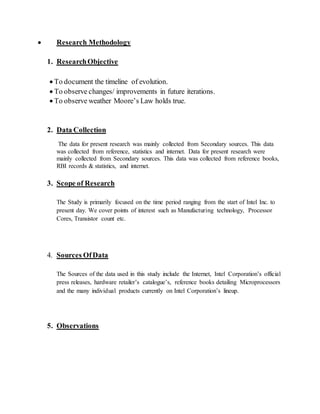
 Research Methodology
1. ResearchObjective
 To document the timeline of evolution.
 To observe changes/ improvements in future iterations.
 To observe weather Moore’s Law holds true.
2. Data Collection
The data for present research was mainly collected from Secondary sources. This data
was collected from reference, statistics and internet. Data for present research were
mainly collected from Secondary sources. This data was collected from reference books,
RBI records & statistics, and internet.
3. Scope of Research
The Study is primarily focused on the time period ranging from the start of Intel Inc. to
present day. We cover points of interest such as Manufacturing technology, Processor
Cores, Transistor count etc.
4. Sources OfData
The Sources of the data used in this study include the Internet, Intel Corporation’s official
press releases, hardware retailer’s catalogue’s, reference books detailing Microprocessors
and the many individual products currently on Intel Corporation’s lineup.
5. Observations
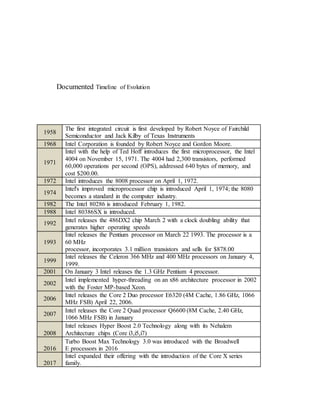
Documented Timeline of Evolution
1958
The first integrated circuit is first developed by Robert Noyce of Fairchild
Semiconductor and Jack Kilby of Texas Instruments
1968 Intel Corporation is founded by Robert Noyce and Gordon Moore.
1971
Intel with the help of Ted Hoff introduces the first microprocessor, the Intel
4004 on November 15, 1971. The 4004 had 2,300 transistors, performed
60,000 operations per second (OPS), addressed 640 bytes of memory, and
cost $200.00.
1972 Intel introduces the 8008 processor on April 1, 1972.
1974
Intel's improved microprocessor chip is introduced April 1, 1974; the 8080
becomes a standard in the computer industry.
1982 The Intel 80286 is introduced February 1, 1982.
1988 Intel 80386SX is introduced.
1992
Intel releases the 486DX2 chip March 2 with a clock doubling ability that
generates higher operating speeds
1993
Intel releases the Pentium processor on March 22 1993. The processor is a
60 MHz
processor, incorporates 3.1 million transistors and sells for $878.00
1999
Intel releases the Celeron 366 MHz and 400 MHz processors on January 4,
1999.
2001 On January 3 Intel releases the 1.3 GHz Pentium 4 processor.
2002
Intel implemented hyper-threading on an x86 architecture processor in 2002
with the Foster MP-based Xeon.
2006
Intel releases the Core 2 Duo processor E6320 (4M Cache, 1.86 GHz, 1066
MHz FSB) April 22, 2006.
2007
Intel releases the Core 2 Quad processor Q6600 (8M Cache, 2.40 GHz,
1066 MHz FSB) in January
2008
Intel releases Hyper Boost 2.0 Technology along with its Nehalem
Architecture chips (Core i3,i5,i7)
2016
Turbo Boost Max Technology 3.0 was introduced with the Broadwell
E processors in 2016
2017
Intel expanded their offering with the introduction of the Core X series
family.
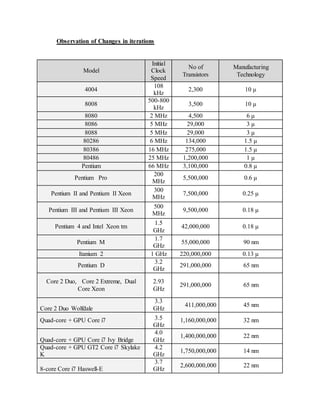
Observation of Changes in iterations
Model
Initial
Clock
Speed
No of
Transistors
Manufacturing
Technology
4004
108
kHz
2,300 10 μ
8008
500-800
kHz
3,500 10 μ
8080 2 MHz 4,500 6 μ
8086 5 MHz 29,000 3 μ
8088 5 MHz 29,000 3 μ
80286 6 MHz 134,000 1.5 μ
80386 16 MHz 275,000 1.5 μ
80486 25 MHz 1,200,000 1 μ
Pentium 66 MHz 3,100,000 0.8 μ
Pentium Pro
200
MHz
5,500,000 0.6 μ
Pentium II and Pentium II Xeon
300
MHz
7,500,000 0.25 μ
Pentium III and Pentium III Xeon
500
MHz
9,500,000 0.18 μ
Pentium 4 and Intel Xeon tm
1.5
GHz
42,000,000 0.18 μ
Pentium M
1.7
GHz
55,000,000 90 nm
Itanium 2 1 GHz 220,000,000 0.13 μ
Pentium D
3.2
GHz
291,000,000 65 nm
Core 2 Duo, Core 2 Extreme, Dual
Core Xeon
2.93
GHz
291,000,000 65 nm
Core 2 Duo Wolfdale
3.3
GHz
411,000,000 45 nm
Quad-core + GPU Core i7 3.5
GHz
1,160,000,000 32 nm
Quad-core + GPU Core i7 Ivy Bridge
4.0
GHz
1,400,000,000 22 nm
Quad-core + GPU GT2 Core i7 Skylake
K
4.2
GHz
1,750,000,000 14 nm
8-core Core i7 Haswell-E
3.7
GHz
2,600,000,000 22 nm
6. Findings
 Increase in base clock frequency :
As newer iteration of processors were being manufactured the demand for
computing power/ capability was also increasing to supplement this each iteration
started sporting higher Base Clock frequency. During the first 20-30 years the
increase in Clock frequencies was almost in an exponential pattern. I.e. starting
with 108 KHz in 1971 to 300 KHz in 1972, going on to 2MHz in 1982, further
improving to 60 MHz in 1992 leading to 1.5 GHz (1500 MHz) in 2001. Only
when the Clock frequency reached into the GHz range did the exponential rise
slow down. The primary cause for this was the emergence of Multi-core
processors which could handle more workload.
 Increase in Transistor Count :
The increase in transistor count is a true exponential growth line .Since Intel
Corporation’s first processor 4004 in 1971 which had about 2,300 transistors on
board , the future iterations almost doubled the Transistor Count they had. Such as
4500 in Intel 8080 in 1974, the 8086 with 29,000 transistors in 1978, the 80286
with 134,000 transistors in 1982, the 80386 with 275,000 transistors in 1985. The
21’s Century Intel family sported 42,000,000 transistors in 2000, 112,000,000
transistors in Pentium 4 Prescott 2M in 2004, the Itanium 2 with 220,000,000
transistors in 2002. Leading up to the 8-core Xeon Nehalem & Core i7 Family
with 2,600,000,000 and 2,300,000,000 in 2014.
 Emergence of Multi Core Processors
With the launch of Intel’s Dual Core Pentium D in 2005 the Microprocessor
market changed drastically this caused what is today referred to as Core Wars in
Computer Culture. It is essentially a race between Microprocessor manufacturers
to make the Microprocessor with the most number of Cores.
 Moore’s Law :
Moore's law refers to the observation that the number of transistors in a dense
integrated circuit doubles approximately every two years. Moore's law is an
observation or projection and not a physical or natural law. The observation is
named after Gordon Moore, the co-founder of Fairchild Semiconductor and
Intel, whose 1965 paper described a doubling every year in the number of
components per integrated circuit, and projected this rate of growth would
continue for at least another decade. In 1975, looking forward to the next
decade, he revised the forecast to doubling every two years. The period is
often quoted as 18 months because of Intel executive David House, who
predicted that chip performance would double every 18 months (being a
combination of the effect of more transistors and the transistors being faster).
7. Conclusion
Since it’s founding in 1968 Intel Corporation has been a leading force in the
Microprocessor industry. Intel has been setting the standards for Microprocessors since
1974 when Intel 8080 was considered to be as tandar in the compurting industry. In the
Intel 80xx Series we saw that the processing base Clock frequency moved from
KiloHertz to MegaHertz, also this was supplemented by the increrase in the number of
transistors on board increasing and the manufacturing process improving leading to
smaller sizes.The Intel 80286/386/486 Series upped the Base clock frequency and
transistor count while improving manufacturing process by bringing size to 1 micrometer.
The 80486DX2 came with the ability to improve it’s performance from stated standard to
higher. With the launch of Pentium 4 series Intel moved from it’s Base Clock Frequency
from the MegaHertz range to the GigaHertz range all the while increasing the transistor
count reaching 42 milliion and manufacturing processes improving to a tenth’s of a
micrometer (0.18 μ). With the advent of Pentium D series Intel moved the transistor
count to the hundred million count(291,000,000) while increasing clock frequecy to a
staggering 3GHz range and improvments in manufacturing processes leading to size
being upgraded to Nanometeres (nm) also giving rise to the method of using multi core
CPU’s. With Intel’s Launch of Core ‘ i ’ Series the Manufacturing process had further
improved and lead to 14nm process being used which was and still is the leading process
till date. With the launch of Core i series began the cultural phenomenom known as core
wars this was a competition between manufacturers to make a Microprocessor with the
most number of cores possible. As of 2017 Intel’s flagship i9 – 7980XE sports 18 cores
with 36 threads running simultaneously with a base frequency of 2.6 GHz and Max
frequency of 4.2 GHz (4.40 with Intel Turbo Boost Max 3.0) for a price tag of $ 1,999.
The future as they say is clear , it involves increase in Clock Frequencies , Number of
Cores, Transistor Count and Improvements in manufacturing processes to reduce size.
 References
i. https://ipfs.io/ipfs/QmXoypizjW3WknFiJnKLwHCnL72vedxjQkDDP1mXWo6u
co/wiki/Transistor_count.html
ii. https://en.wikipedia.org/wiki/Moore%27s_law
iii. https://ark.intel.com/products/126699/Intel-Core-i9-7980XE-X-series-Processor-
24_75M-Cache-up-to-4_20-GHz
iv. https://ark.intel.com/products/126699/Intel-Core-i9-7980XE-X-series-Processor-
24_75M-Cache-up-to-4_20-GHz
v. https://ark.intel.com/products/126699/Intel-Core-i9-7980XE-X-series-Processor-
24_75M-Cache-up-to-4_20-GHz
vi. https://www.computerhope.com/history/processor.htm
vii. https://www.pcmag.com/article2/0,2817,1151181,00.asp
viii. https://www.pcmag.com/article2/0,2817,1151181,00.asp
ix. http://www.tomsitpro.com/print/intel-processor-history,picturestory-32.html
x. http://www.tomshardware.com/picturestory/710-history-of-intel-cpus.html#s29
xi. https://www.slideshare.net/sandesh267/evolution-of-processor-intel-amd-
processors-4004-to-pentium-i3-i7-celeron
xii.

Evolution of Intel Microprocessors (Consumer Grade)

  • 1.
    Evolution of IntelMicroprocessors (Consumer Grade) Mr. Ohol Mandar Jayant. (Cell - +91-8793571023 Email – oholmandar@gmail.com)  Introduction The Microprocessoris the heart of any computer system. A microprocessoris a computer processorwhich incorporates the functions of a computer's central processing unit (CPU) on a single integrated circuit (IC), or at most a few integrated circuits. The microprocessoris a multipurpose, clock driven, register- based, digital integrated circuit which accepts binary data as input, processes it according to instructions stored in its memory, and provides results as output. Microprocessorscontain both combinational logic and sequential digital logic. Microprocessorsoperate on numbers and symbols represented in the binary numeral system. A minimal hypothetical microprocessormight only include an arithmetic logic unit (ALU) and a control logic section. The ALU performs operations such as addition, subtraction, and operations such as AND or OR. Each operation of the ALU sets one or more flags in a status register, which indicate the results of the last operation (zero value, negative number, overflow, or others). The control logic retrieves instruction codes from memory and initiates the sequence of operations required for the ALU to carry out the instruction. A single operation codemight affect many individual data paths, registers, and other elements of the processor. As integrated circuit technology advanced, it was feasible to manufacture more and more complex processors ona single chip. The size of data objects became larger; allowing more transistors on a chip allowed word sizes to increase from 4- and 8- bit words up to today's 64-bit words.
  • 2.
     Research Methodology 1.ResearchObjective  To document the timeline of evolution.  To observe changes/ improvements in future iterations.  To observe weather Moore’s Law holds true. 2. Data Collection The data for present research was mainly collected from Secondary sources. This data was collected from reference, statistics and internet. Data for present research were mainly collected from Secondary sources. This data was collected from reference books, RBI records & statistics, and internet. 3. Scope of Research The Study is primarily focused on the time period ranging from the start of Intel Inc. to present day. We cover points of interest such as Manufacturing technology, Processor Cores, Transistor count etc. 4. Sources OfData The Sources of the data used in this study include the Internet, Intel Corporation’s official press releases, hardware retailer’s catalogue’s, reference books detailing Microprocessors and the many individual products currently on Intel Corporation’s lineup. 5. Observations
  • 3.
    Documented Timeline ofEvolution 1958 The first integrated circuit is first developed by Robert Noyce of Fairchild Semiconductor and Jack Kilby of Texas Instruments 1968 Intel Corporation is founded by Robert Noyce and Gordon Moore. 1971 Intel with the help of Ted Hoff introduces the first microprocessor, the Intel 4004 on November 15, 1971. The 4004 had 2,300 transistors, performed 60,000 operations per second (OPS), addressed 640 bytes of memory, and cost $200.00. 1972 Intel introduces the 8008 processor on April 1, 1972. 1974 Intel's improved microprocessor chip is introduced April 1, 1974; the 8080 becomes a standard in the computer industry. 1982 The Intel 80286 is introduced February 1, 1982. 1988 Intel 80386SX is introduced. 1992 Intel releases the 486DX2 chip March 2 with a clock doubling ability that generates higher operating speeds 1993 Intel releases the Pentium processor on March 22 1993. The processor is a 60 MHz processor, incorporates 3.1 million transistors and sells for $878.00 1999 Intel releases the Celeron 366 MHz and 400 MHz processors on January 4, 1999. 2001 On January 3 Intel releases the 1.3 GHz Pentium 4 processor. 2002 Intel implemented hyper-threading on an x86 architecture processor in 2002 with the Foster MP-based Xeon. 2006 Intel releases the Core 2 Duo processor E6320 (4M Cache, 1.86 GHz, 1066 MHz FSB) April 22, 2006. 2007 Intel releases the Core 2 Quad processor Q6600 (8M Cache, 2.40 GHz, 1066 MHz FSB) in January 2008 Intel releases Hyper Boost 2.0 Technology along with its Nehalem Architecture chips (Core i3,i5,i7) 2016 Turbo Boost Max Technology 3.0 was introduced with the Broadwell E processors in 2016 2017 Intel expanded their offering with the introduction of the Core X series family.
  • 4.
    Observation of Changesin iterations Model Initial Clock Speed No of Transistors Manufacturing Technology 4004 108 kHz 2,300 10 μ 8008 500-800 kHz 3,500 10 μ 8080 2 MHz 4,500 6 μ 8086 5 MHz 29,000 3 μ 8088 5 MHz 29,000 3 μ 80286 6 MHz 134,000 1.5 μ 80386 16 MHz 275,000 1.5 μ 80486 25 MHz 1,200,000 1 μ Pentium 66 MHz 3,100,000 0.8 μ Pentium Pro 200 MHz 5,500,000 0.6 μ Pentium II and Pentium II Xeon 300 MHz 7,500,000 0.25 μ Pentium III and Pentium III Xeon 500 MHz 9,500,000 0.18 μ Pentium 4 and Intel Xeon tm 1.5 GHz 42,000,000 0.18 μ Pentium M 1.7 GHz 55,000,000 90 nm Itanium 2 1 GHz 220,000,000 0.13 μ Pentium D 3.2 GHz 291,000,000 65 nm Core 2 Duo, Core 2 Extreme, Dual Core Xeon 2.93 GHz 291,000,000 65 nm Core 2 Duo Wolfdale 3.3 GHz 411,000,000 45 nm Quad-core + GPU Core i7 3.5 GHz 1,160,000,000 32 nm Quad-core + GPU Core i7 Ivy Bridge 4.0 GHz 1,400,000,000 22 nm Quad-core + GPU GT2 Core i7 Skylake K 4.2 GHz 1,750,000,000 14 nm 8-core Core i7 Haswell-E 3.7 GHz 2,600,000,000 22 nm
  • 5.
    6. Findings  Increasein base clock frequency : As newer iteration of processors were being manufactured the demand for computing power/ capability was also increasing to supplement this each iteration started sporting higher Base Clock frequency. During the first 20-30 years the increase in Clock frequencies was almost in an exponential pattern. I.e. starting with 108 KHz in 1971 to 300 KHz in 1972, going on to 2MHz in 1982, further improving to 60 MHz in 1992 leading to 1.5 GHz (1500 MHz) in 2001. Only when the Clock frequency reached into the GHz range did the exponential rise slow down. The primary cause for this was the emergence of Multi-core processors which could handle more workload.  Increase in Transistor Count : The increase in transistor count is a true exponential growth line .Since Intel Corporation’s first processor 4004 in 1971 which had about 2,300 transistors on board , the future iterations almost doubled the Transistor Count they had. Such as 4500 in Intel 8080 in 1974, the 8086 with 29,000 transistors in 1978, the 80286 with 134,000 transistors in 1982, the 80386 with 275,000 transistors in 1985. The 21’s Century Intel family sported 42,000,000 transistors in 2000, 112,000,000 transistors in Pentium 4 Prescott 2M in 2004, the Itanium 2 with 220,000,000 transistors in 2002. Leading up to the 8-core Xeon Nehalem & Core i7 Family with 2,600,000,000 and 2,300,000,000 in 2014.  Emergence of Multi Core Processors With the launch of Intel’s Dual Core Pentium D in 2005 the Microprocessor market changed drastically this caused what is today referred to as Core Wars in Computer Culture. It is essentially a race between Microprocessor manufacturers to make the Microprocessor with the most number of Cores.
  • 6.
     Moore’s Law: Moore's law refers to the observation that the number of transistors in a dense integrated circuit doubles approximately every two years. Moore's law is an observation or projection and not a physical or natural law. The observation is named after Gordon Moore, the co-founder of Fairchild Semiconductor and Intel, whose 1965 paper described a doubling every year in the number of components per integrated circuit, and projected this rate of growth would continue for at least another decade. In 1975, looking forward to the next decade, he revised the forecast to doubling every two years. The period is often quoted as 18 months because of Intel executive David House, who predicted that chip performance would double every 18 months (being a combination of the effect of more transistors and the transistors being faster).
  • 7.
    7. Conclusion Since it’sfounding in 1968 Intel Corporation has been a leading force in the Microprocessor industry. Intel has been setting the standards for Microprocessors since 1974 when Intel 8080 was considered to be as tandar in the compurting industry. In the Intel 80xx Series we saw that the processing base Clock frequency moved from KiloHertz to MegaHertz, also this was supplemented by the increrase in the number of transistors on board increasing and the manufacturing process improving leading to smaller sizes.The Intel 80286/386/486 Series upped the Base clock frequency and transistor count while improving manufacturing process by bringing size to 1 micrometer. The 80486DX2 came with the ability to improve it’s performance from stated standard to higher. With the launch of Pentium 4 series Intel moved from it’s Base Clock Frequency from the MegaHertz range to the GigaHertz range all the while increasing the transistor count reaching 42 milliion and manufacturing processes improving to a tenth’s of a micrometer (0.18 μ). With the advent of Pentium D series Intel moved the transistor count to the hundred million count(291,000,000) while increasing clock frequecy to a staggering 3GHz range and improvments in manufacturing processes leading to size being upgraded to Nanometeres (nm) also giving rise to the method of using multi core CPU’s. With Intel’s Launch of Core ‘ i ’ Series the Manufacturing process had further improved and lead to 14nm process being used which was and still is the leading process till date. With the launch of Core i series began the cultural phenomenom known as core wars this was a competition between manufacturers to make a Microprocessor with the most number of cores possible. As of 2017 Intel’s flagship i9 – 7980XE sports 18 cores with 36 threads running simultaneously with a base frequency of 2.6 GHz and Max frequency of 4.2 GHz (4.40 with Intel Turbo Boost Max 3.0) for a price tag of $ 1,999. The future as they say is clear , it involves increase in Clock Frequencies , Number of Cores, Transistor Count and Improvements in manufacturing processes to reduce size.
  • 8.
     References i. https://ipfs.io/ipfs/QmXoypizjW3WknFiJnKLwHCnL72vedxjQkDDP1mXWo6u co/wiki/Transistor_count.html ii.https://en.wikipedia.org/wiki/Moore%27s_law iii. https://ark.intel.com/products/126699/Intel-Core-i9-7980XE-X-series-Processor- 24_75M-Cache-up-to-4_20-GHz iv. https://ark.intel.com/products/126699/Intel-Core-i9-7980XE-X-series-Processor- 24_75M-Cache-up-to-4_20-GHz v. https://ark.intel.com/products/126699/Intel-Core-i9-7980XE-X-series-Processor- 24_75M-Cache-up-to-4_20-GHz vi. https://www.computerhope.com/history/processor.htm vii. https://www.pcmag.com/article2/0,2817,1151181,00.asp viii. https://www.pcmag.com/article2/0,2817,1151181,00.asp ix. http://www.tomsitpro.com/print/intel-processor-history,picturestory-32.html x. http://www.tomshardware.com/picturestory/710-history-of-intel-cpus.html#s29 xi. https://www.slideshare.net/sandesh267/evolution-of-processor-intel-amd- processors-4004-to-pentium-i3-i7-celeron xii.