Ar. Abhishek Shrivastava
β€’The history of architecture is about as long as the history of humanity
itself, The exact origin of architecture could be said to date to the Neolithic period,
around 10 000 BC, or simply when people stopped living in caves and started
handling the way they want their houses to look and feel like.
β€’ Architecture has proven to be many things – comfy, elegant, modern, brutal,
indexical, vernacular – and yet, one of its most interesting aspects is its capacity
to reflect the spirit of time, in a way that might be even more substantial than
how we see it happen with art..
β€’Just looking at the buildings made in different places at a different moment in
time would help us understand the evolution of architecture and our past
without using any words.
INTRODUCTION
Architecture in Prehistoric Times / Stone age
- humans constructed earthen mounds, stone circles, megaliths, and
structures
- includes monumental structures such as Stonehenge, cliff dwellings in
the Americas, and thatch and mud structures.
Stonehenge Sinagua cliff dwelling (Montezuma
Castle), Arizona
considered to be the typological predecessors of the
β€œreal” pyramids. As the structure was stepped and
successively receding toward the sky, the ziggurat (or
the step pyramid) was often interpreted as a link
between the earth and the sky, the way our ancestors
saw it.
Kheops Pyramid in Giza, Egypt, 2580–2560 BC
The excellence of Egyptians in engineering gave them
the ability to build bigger tombs for their kings. The
Egyptian pyramids, tombs and palaces still stand as
monuments to mankind’s creativity
Ziggurat of Ur in Iraq
Early architecture had two main functions: (1) to
consolidate security and power; (2) to please the
Gods. The richer the society, the more important
these functions became
Classical
850 BC to 476 AD
- the rise of ancient Greece until the fall of the
Roman empire
- great buildings were constructed according to
precise rules
- The Classical Orders, which defined column
styles and entablature designs, continue to
influence building design in modern times.
Eglise de la Madeleine – Roman Catholic Church
The most important architectural feature which
highlights this style is the column placed on the
faΓ§ade. The identifiable features of classical
aesthetic include symmetry, proportion, rational
order, the relationship of individual parts to the whole
and calm logic.
Vitruvius was the one to introduce the three different
Classical orders Doric, Ionic, and Corinthian
The Parthenon and the Golden Ratio
Roman aqueduct at Pont du Gard,
The Colosseum
Pantheon, Rome
527 to 565 AD.
- the capital of the Roman empire moved
to Byzantium (now called Istanbul) in
330 AD
- Roman architecture evolved into a
graceful, classically-inspired style
- used brick instead of stone, domed
roofs, elaborate mosaics, and classical
forms
- Emperor Justinian (527 AD to 565 AD)
led the way.
Hagia Sophia – Museum in Istanbul
Romanesque Architecture
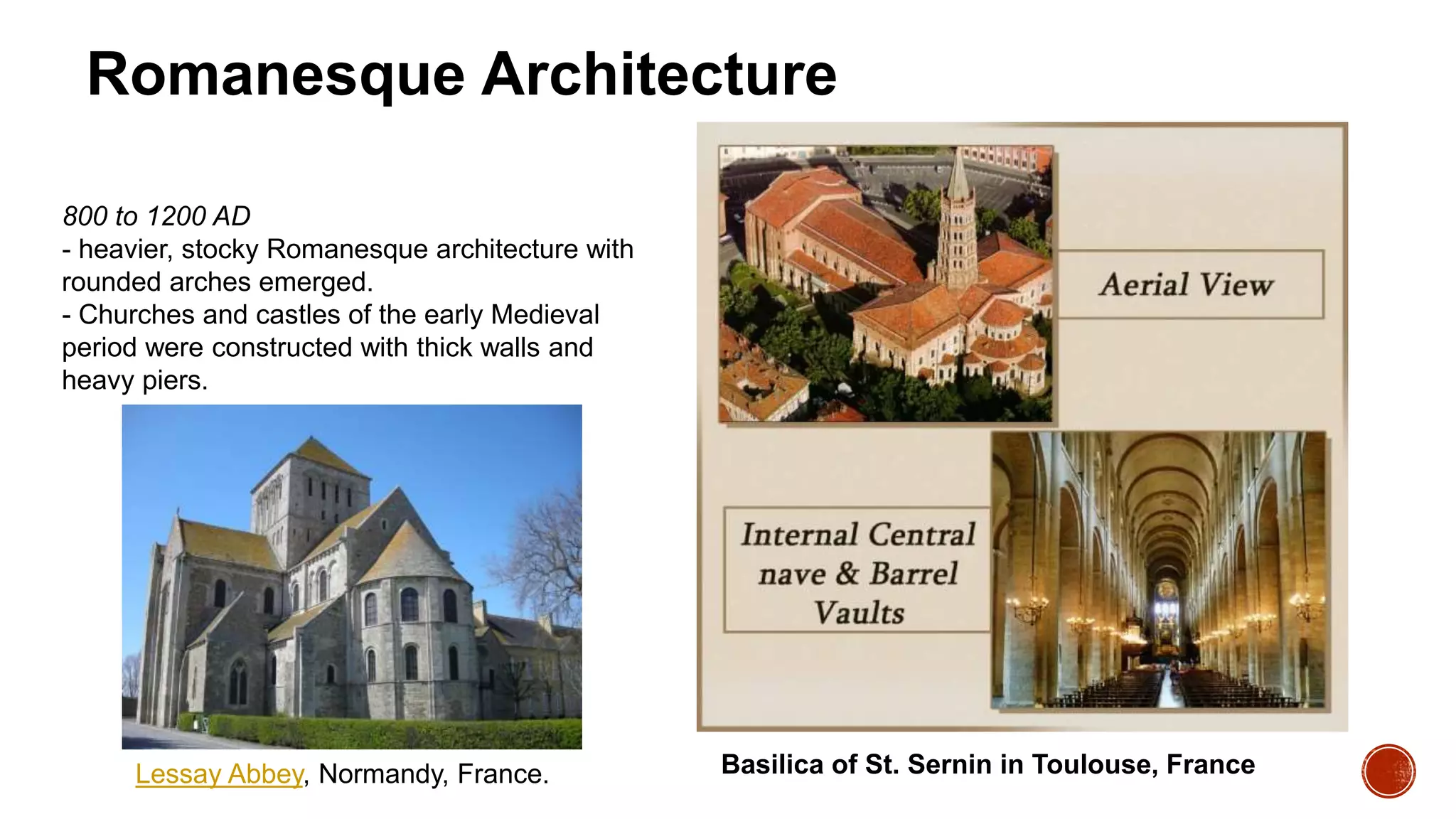
800 to 1200 AD
- heavier, stocky Romanesque architecture with
rounded arches emerged.
- Churches and castles of the early Medieval
period were constructed with thick walls and
heavy piers.
Basilica of St. Sernin in Toulouse, France
Lessay Abbey, Normandy, France.
1100 to 1450 AD
- Pointed arches, ribbed vaulting, flying buttresses, and
other innovations led to taller, more graceful architecture.
- Gothic ideas gave rise to magnificent cathedrals like
Chartres and Notre Dame.
Notre Dame Cathedral in Paris, France
Flying buttress
1400 to 1600 AD
- return to classical ideas ushered an "age of
awakening" in Italy, France, and England.
- Long after the Renaissance era ended,
architects in the Western world found
inspiration in the beautifully proportioned
architecture of the period.
St. Peter’s Basilica in Rome
The Palazzo Farnese in Rome
1600 to 1830 AD
- the Baroque style is reflected in opulent and dramatic
churches with irregular shapes and extravagant
ornamentation. Baroque is characterized primarily by its
opulence, whether it be in rich ornamentation or liberal
use of gold. Other elements frequently used were
twisted columns and forced perspective.
Italian Baroque Architecture (St. Peter’s Square, Vatican)
Church of San Carlo alle Quattro Fontane by Francesco
Borromini, 1646; the characteristic oval dome
St. Charles
Church,
Vienna
The Industrial revolution and the Great Exhibition in Britain
The Industrial revolution took place from the 18th to
19th century. It was a time where everything was once
a time of rural spaces and agriculture. In this time, the
world continued to develop towards becoming industrial
and urban. There were major changes in manufacturing
and transportation which changed the era from
agriculturally based to a strong technological change.
Crystal Palace,
Hyde Park,
London ,1851
1800 to 1900 AD
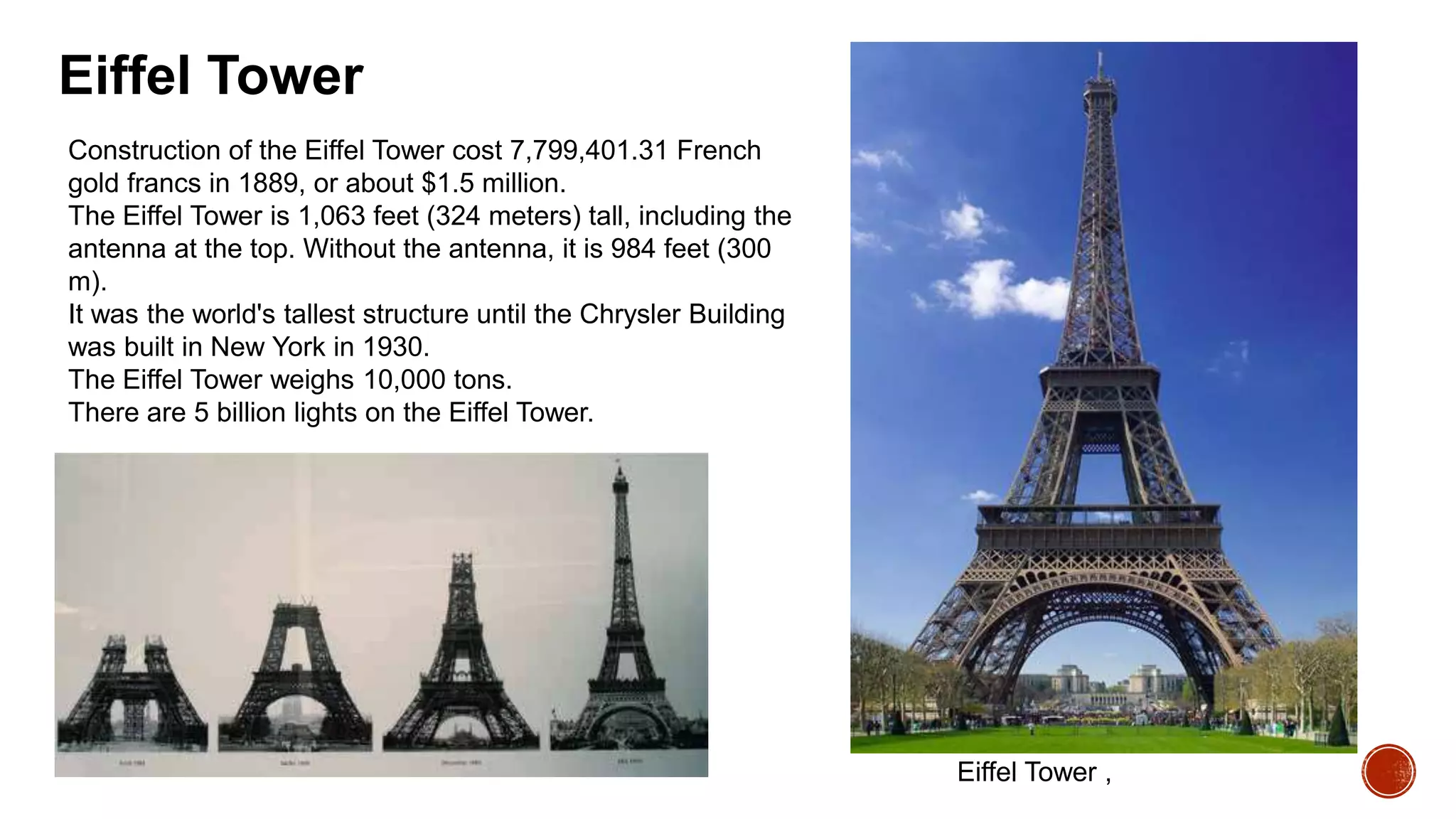
Eiffel Tower
Construction of the Eiffel Tower cost 7,799,401.31 French
gold francs in 1889, or about $1.5 million.
The Eiffel Tower is 1,063 feet (324 meters) tall, including the
antenna at the top. Without the antenna, it is 984 feet (300
m).
It was the world's tallest structure until the Chrysler Building
was built in New York in 1930.
The Eiffel Tower weighs 10,000 tons.
There are 5 billion lights on the Eiffel Tower.
Eiffel Tower ,
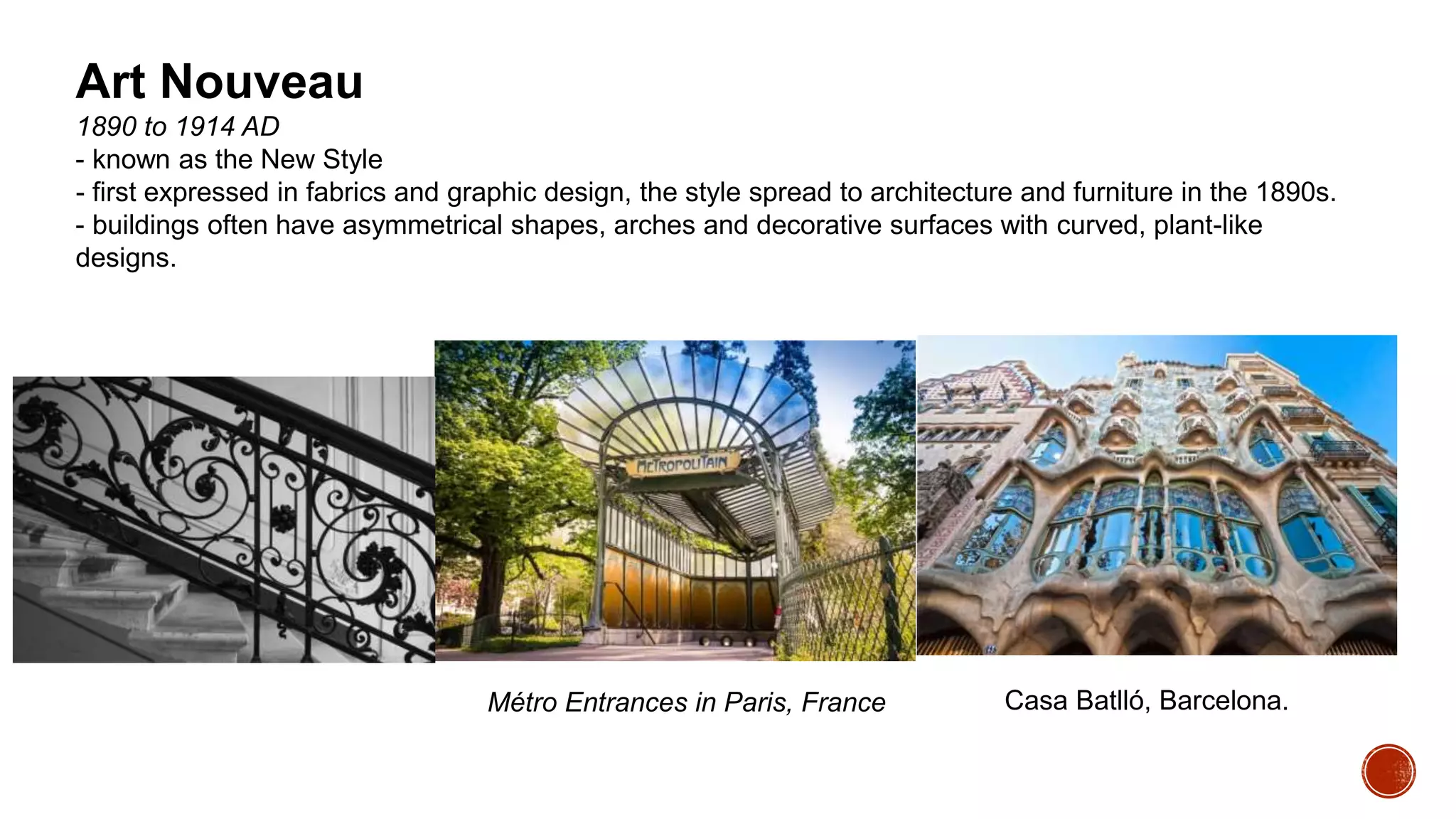
Art Nouveau
1890 to 1914 AD
- known as the New Style
- first expressed in fabrics and graphic design, the style spread to architecture and furniture in the 1890s.
- buildings often have asymmetrical shapes, arches and decorative surfaces with curved, plant-like
designs.
Casa BatllΓ³, Barcelona.
MΓ©tro Entrances in Paris, France
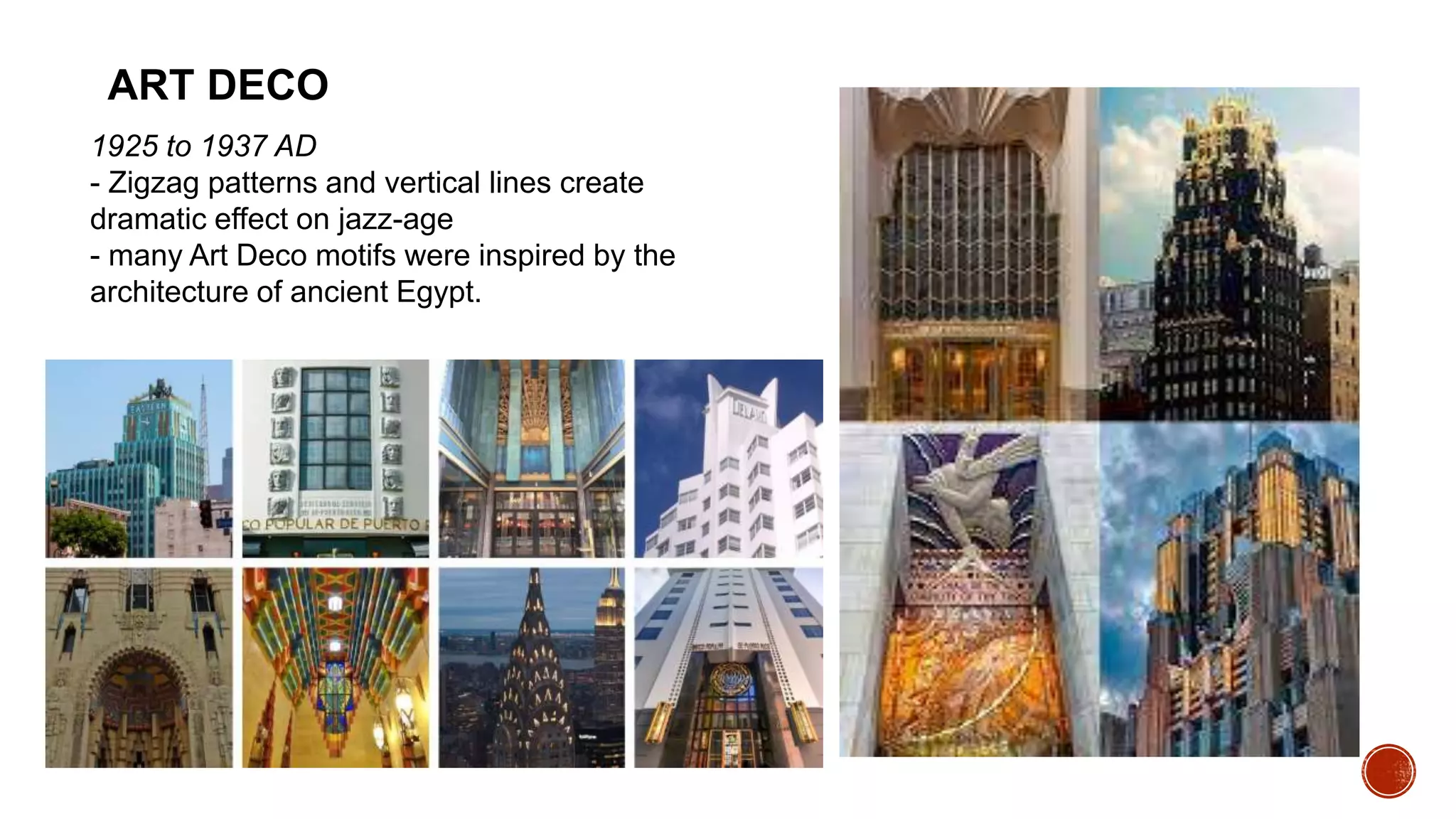
1925 to 1937 AD
- Zigzag patterns and vertical lines create
dramatic effect on jazz-age
- many Art Deco motifs were inspired by the
architecture of ancient Egypt.
ART DECO
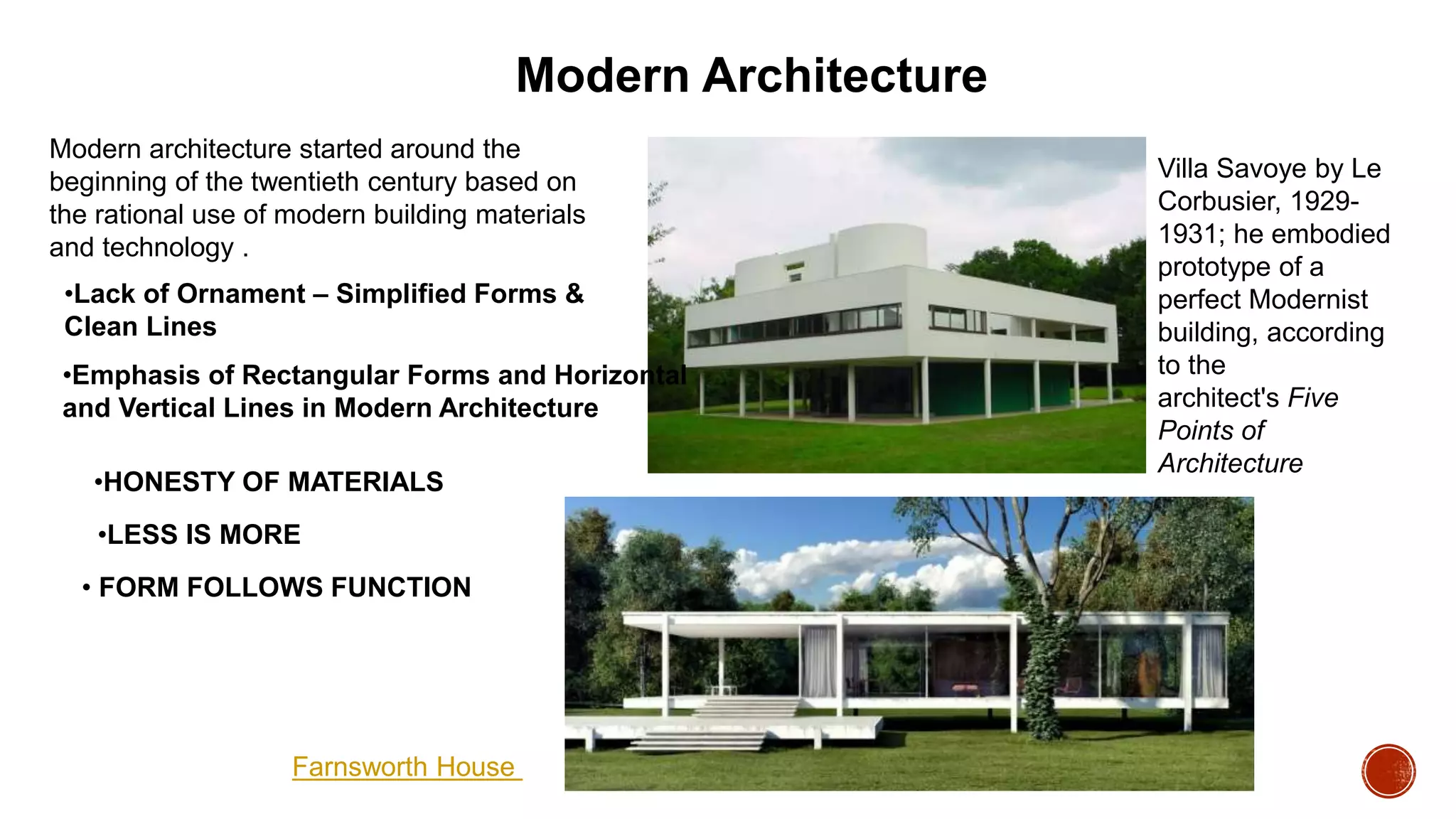
Modern Architecture
Modern architecture started around the
beginning of the twentieth century based on
the rational use of modern building materials
and technology .
β€’Lack of Ornament – Simplified Forms &
Clean Lines
β€’Emphasis of Rectangular Forms and Horizontal
and Vertical Lines in Modern Architecture
β€’HONESTY OF MATERIALS
β€’LESS IS MORE
β€’ FORM FOLLOWS FUNCTION
Villa Savoye by Le
Corbusier, 1929-
1931; he embodied
prototype of a
perfect Modernist
building, according
to the
architect's Five
Points of
Architecture
Farnsworth House
IIT, Crown Hall | Chicago, IL | Mies van der Rohe
Seagram Building
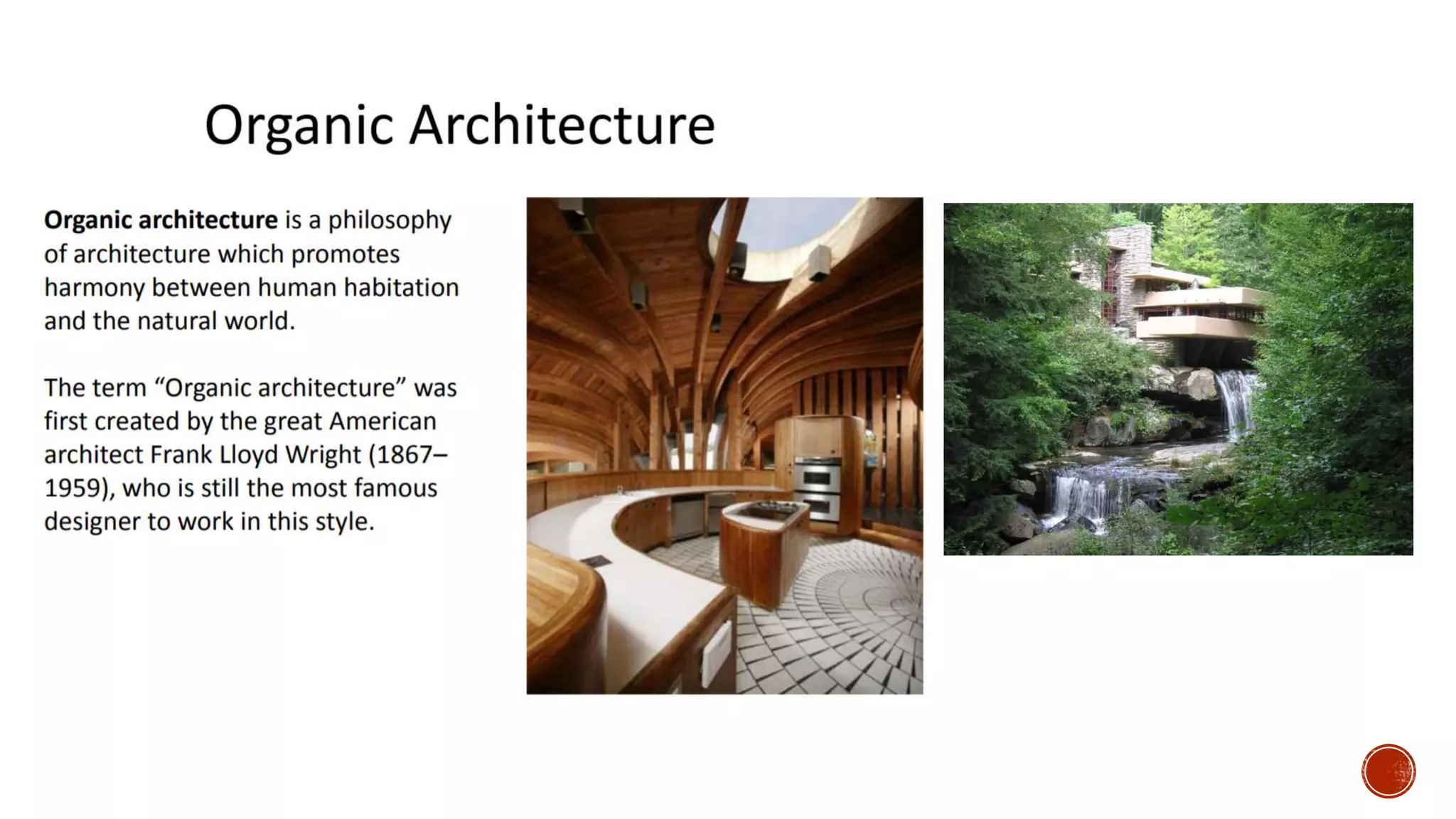
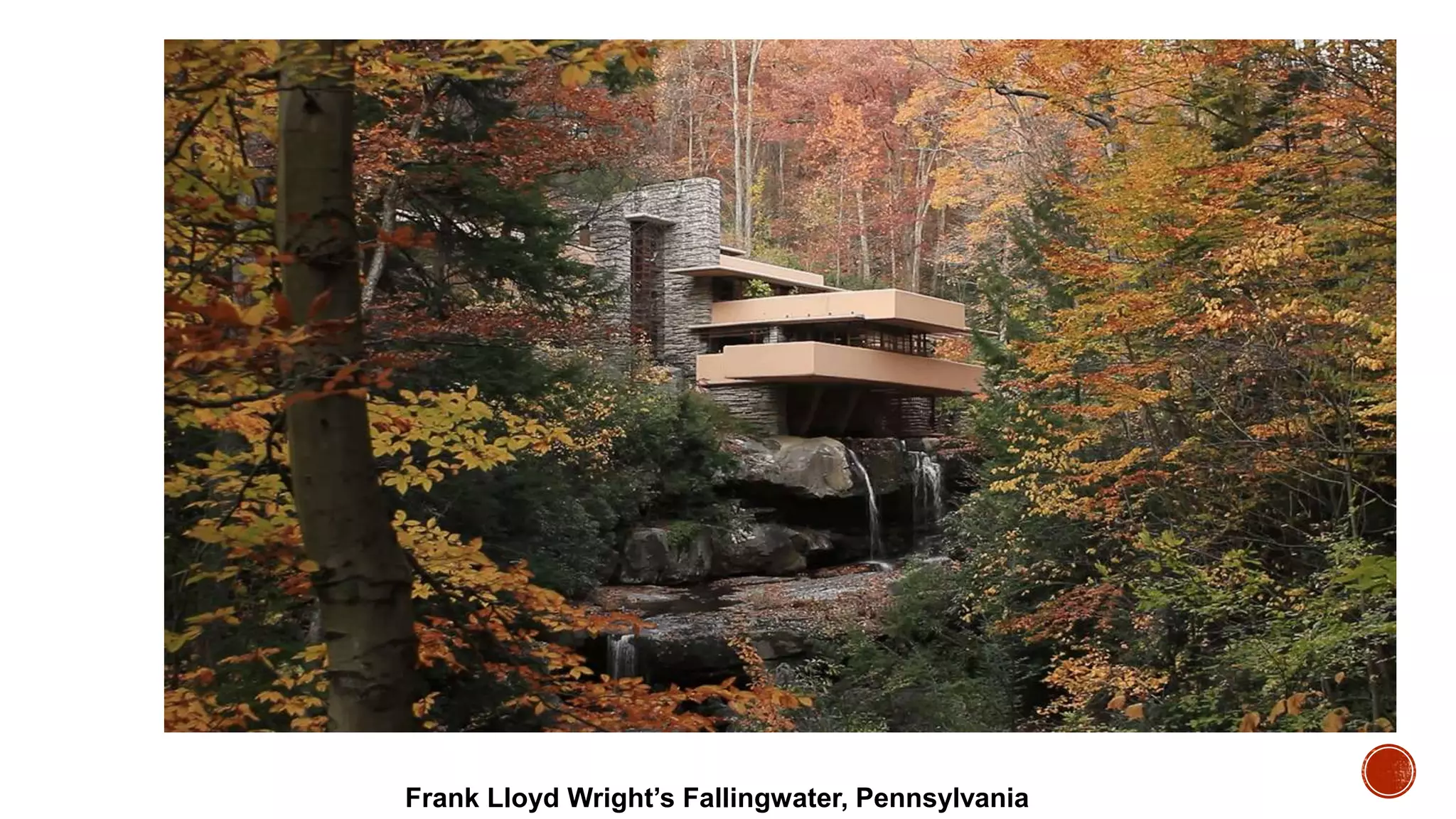
Frank Lloyd Wright’s Fallingwater, Pennsylvania
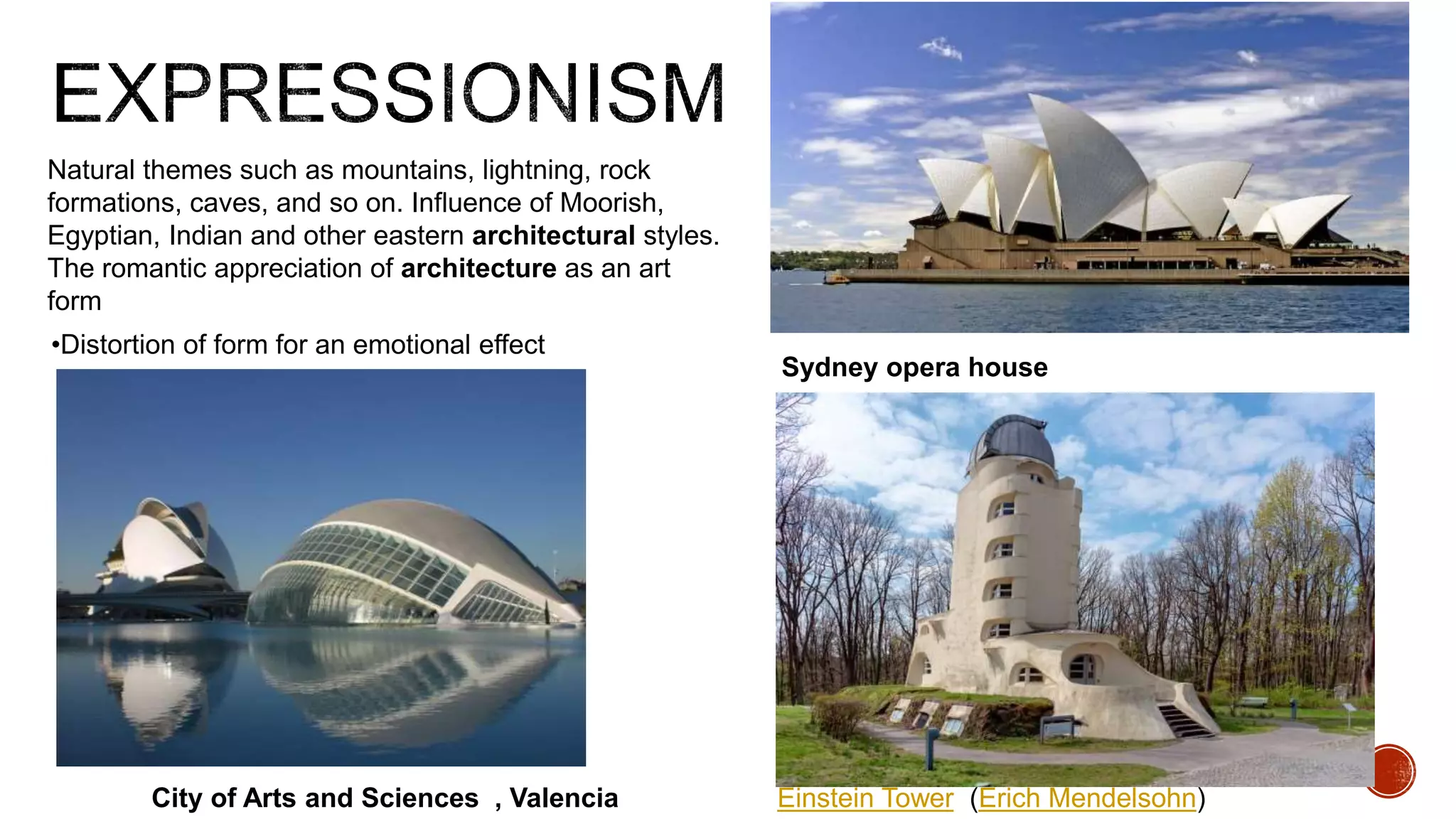
Natural themes such as mountains, lightning, rock
formations, caves, and so on. Influence of Moorish,
Egyptian, Indian and other eastern architectural styles.
The romantic appreciation of architecture as an art
form
β€’Distortion of form for an emotional effect
Einstein Tower (Erich Mendelsohn)
City of Arts and Sciences , Valencia
Sydney opera house
Postmodernism in Architecture -
1972 to Present.
- reaction against the Modernist approaches gave rise to new buildings that
re-invented historical details and familiar motifs.
- ideas that date back to classical and ancient times.
Less is a Bore
The Portland Building
AT&T Building
Team Disney Building
Chiat/Day
Building
DECONSTRUCTION
Heydar Aliyev Centre Guggenheim Museum Royal Ontario Museum, Toronto
Deconstructivism is a movement of
postmodern architecture which appeared
in the 1980s. It gives the impression of the
fragmentation of the constructed building,
commonly characterised by an absence of
obvious harmony, continuity, or symmetry.
Vitra Design
Museum
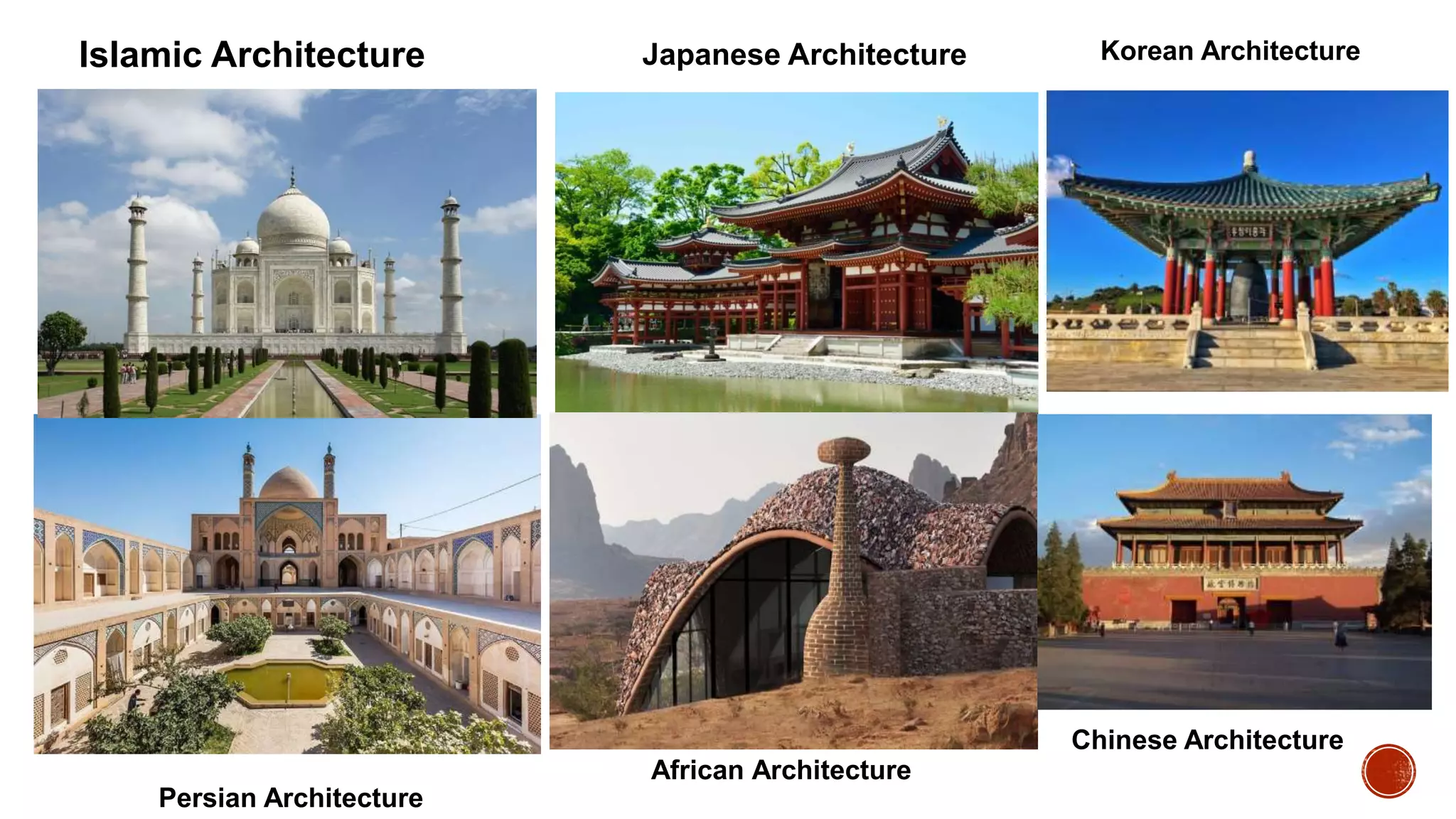
Islamic Architecture Japanese Architecture
Persian Architecture
African Architecture
Korean Architecture
Chinese Architecture
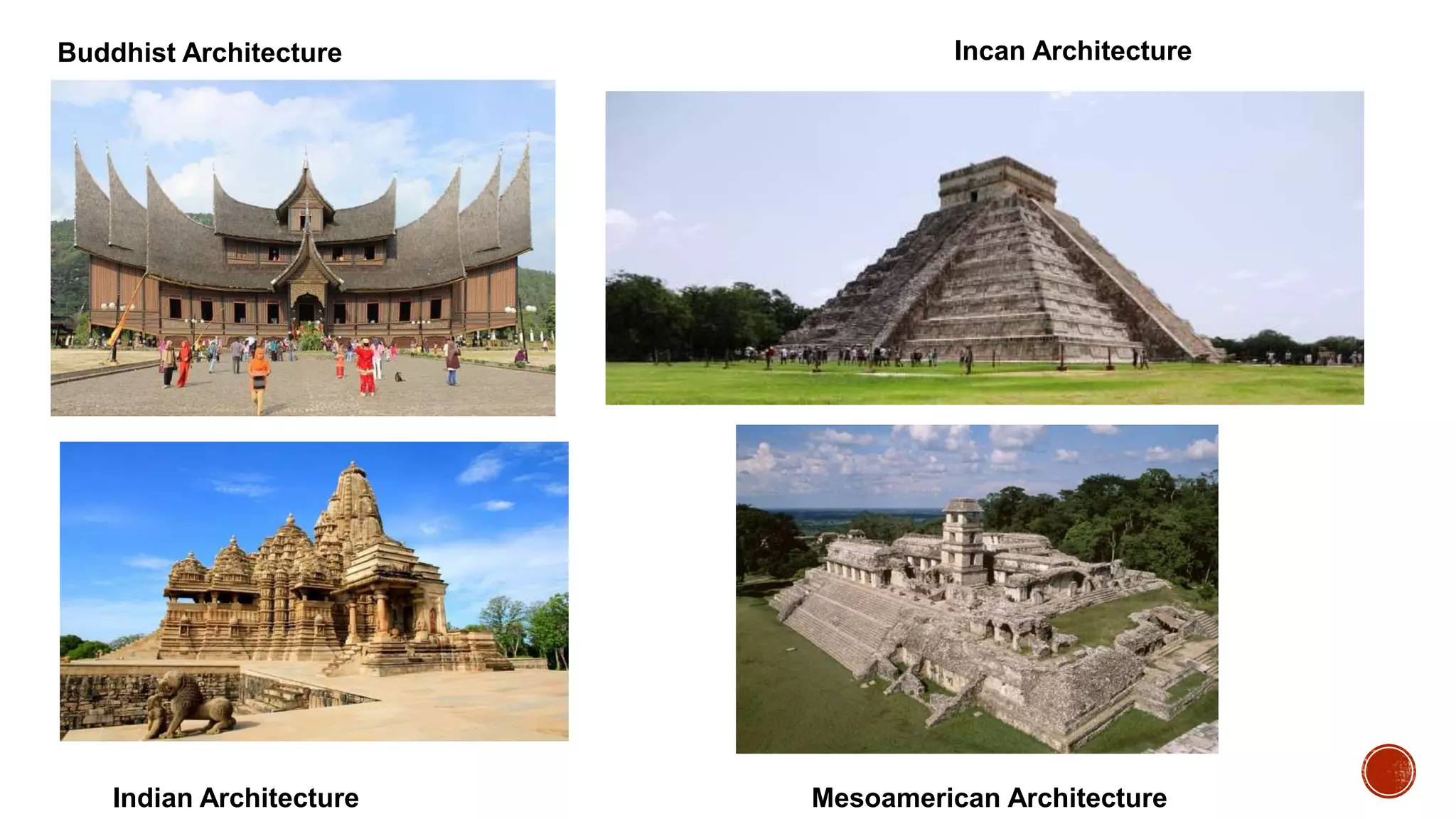
Buddhist Architecture Incan Architecture
Indian Architecture Mesoamerican Architecture
WORKSHOP
β€’To Create a A4 size travel related poster promoting architecture /tourism of any particular
city/country. .
β€’The poster will highlight any iconic building / architectural style or element related to a particular
city paying tribute to the architect/architecture of that city .
β€’The poster should have a short slogan /text for promoting tourism .
β€’You can use any color medium/sketch ( pastel,
water color , poster colors , etc ) to present your
idea .
β€’Submission should be in PDF format ( less
than 30 MB)
THANKS
As an architect you design for the
present, with an awareness of the past,
for a future which is essentially
unknown.” – Norman Foster

evolution of building design.pptx

  • 1.
  • 2.
    β€’The history ofarchitecture is about as long as the history of humanity itself, The exact origin of architecture could be said to date to the Neolithic period, around 10 000 BC, or simply when people stopped living in caves and started handling the way they want their houses to look and feel like. β€’ Architecture has proven to be many things – comfy, elegant, modern, brutal, indexical, vernacular – and yet, one of its most interesting aspects is its capacity to reflect the spirit of time, in a way that might be even more substantial than how we see it happen with art.. β€’Just looking at the buildings made in different places at a different moment in time would help us understand the evolution of architecture and our past without using any words. INTRODUCTION
  • 5.
    Architecture in PrehistoricTimes / Stone age - humans constructed earthen mounds, stone circles, megaliths, and structures - includes monumental structures such as Stonehenge, cliff dwellings in the Americas, and thatch and mud structures. Stonehenge Sinagua cliff dwelling (Montezuma Castle), Arizona
  • 6.
    considered to bethe typological predecessors of the β€œreal” pyramids. As the structure was stepped and successively receding toward the sky, the ziggurat (or the step pyramid) was often interpreted as a link between the earth and the sky, the way our ancestors saw it. Kheops Pyramid in Giza, Egypt, 2580–2560 BC The excellence of Egyptians in engineering gave them the ability to build bigger tombs for their kings. The Egyptian pyramids, tombs and palaces still stand as monuments to mankind’s creativity Ziggurat of Ur in Iraq Early architecture had two main functions: (1) to consolidate security and power; (2) to please the Gods. The richer the society, the more important these functions became
  • 7.
    Classical 850 BC to476 AD - the rise of ancient Greece until the fall of the Roman empire - great buildings were constructed according to precise rules - The Classical Orders, which defined column styles and entablature designs, continue to influence building design in modern times. Eglise de la Madeleine – Roman Catholic Church The most important architectural feature which highlights this style is the column placed on the faΓ§ade. The identifiable features of classical aesthetic include symmetry, proportion, rational order, the relationship of individual parts to the whole and calm logic. Vitruvius was the one to introduce the three different Classical orders Doric, Ionic, and Corinthian The Parthenon and the Golden Ratio
  • 8.
    Roman aqueduct atPont du Gard, The Colosseum Pantheon, Rome
  • 9.
    527 to 565AD. - the capital of the Roman empire moved to Byzantium (now called Istanbul) in 330 AD - Roman architecture evolved into a graceful, classically-inspired style - used brick instead of stone, domed roofs, elaborate mosaics, and classical forms - Emperor Justinian (527 AD to 565 AD) led the way. Hagia Sophia – Museum in Istanbul
  • 10.
    Romanesque Architecture 800 to1200 AD - heavier, stocky Romanesque architecture with rounded arches emerged. - Churches and castles of the early Medieval period were constructed with thick walls and heavy piers. Basilica of St. Sernin in Toulouse, France Lessay Abbey, Normandy, France.
  • 11.
    1100 to 1450AD - Pointed arches, ribbed vaulting, flying buttresses, and other innovations led to taller, more graceful architecture. - Gothic ideas gave rise to magnificent cathedrals like Chartres and Notre Dame. Notre Dame Cathedral in Paris, France Flying buttress
  • 12.
    1400 to 1600AD - return to classical ideas ushered an "age of awakening" in Italy, France, and England. - Long after the Renaissance era ended, architects in the Western world found inspiration in the beautifully proportioned architecture of the period. St. Peter’s Basilica in Rome The Palazzo Farnese in Rome
  • 13.
    1600 to 1830AD - the Baroque style is reflected in opulent and dramatic churches with irregular shapes and extravagant ornamentation. Baroque is characterized primarily by its opulence, whether it be in rich ornamentation or liberal use of gold. Other elements frequently used were twisted columns and forced perspective. Italian Baroque Architecture (St. Peter’s Square, Vatican) Church of San Carlo alle Quattro Fontane by Francesco Borromini, 1646; the characteristic oval dome St. Charles Church, Vienna
  • 14.
    The Industrial revolutionand the Great Exhibition in Britain The Industrial revolution took place from the 18th to 19th century. It was a time where everything was once a time of rural spaces and agriculture. In this time, the world continued to develop towards becoming industrial and urban. There were major changes in manufacturing and transportation which changed the era from agriculturally based to a strong technological change. Crystal Palace, Hyde Park, London ,1851 1800 to 1900 AD
  • 15.
    Eiffel Tower Construction ofthe Eiffel Tower cost 7,799,401.31 French gold francs in 1889, or about $1.5 million. The Eiffel Tower is 1,063 feet (324 meters) tall, including the antenna at the top. Without the antenna, it is 984 feet (300 m). It was the world's tallest structure until the Chrysler Building was built in New York in 1930. The Eiffel Tower weighs 10,000 tons. There are 5 billion lights on the Eiffel Tower. Eiffel Tower ,
  • 16.
    Art Nouveau 1890 to1914 AD - known as the New Style - first expressed in fabrics and graphic design, the style spread to architecture and furniture in the 1890s. - buildings often have asymmetrical shapes, arches and decorative surfaces with curved, plant-like designs. Casa BatllΓ³, Barcelona. MΓ©tro Entrances in Paris, France
  • 17.
    1925 to 1937AD - Zigzag patterns and vertical lines create dramatic effect on jazz-age - many Art Deco motifs were inspired by the architecture of ancient Egypt. ART DECO
  • 18.
    Modern Architecture Modern architecturestarted around the beginning of the twentieth century based on the rational use of modern building materials and technology . β€’Lack of Ornament – Simplified Forms & Clean Lines β€’Emphasis of Rectangular Forms and Horizontal and Vertical Lines in Modern Architecture β€’HONESTY OF MATERIALS β€’LESS IS MORE β€’ FORM FOLLOWS FUNCTION Villa Savoye by Le Corbusier, 1929- 1931; he embodied prototype of a perfect Modernist building, according to the architect's Five Points of Architecture Farnsworth House
  • 19.
    IIT, Crown Hall| Chicago, IL | Mies van der Rohe Seagram Building
  • 21.
    Frank Lloyd Wright’sFallingwater, Pennsylvania
  • 22.
    Natural themes suchas mountains, lightning, rock formations, caves, and so on. Influence of Moorish, Egyptian, Indian and other eastern architectural styles. The romantic appreciation of architecture as an art form β€’Distortion of form for an emotional effect Einstein Tower (Erich Mendelsohn) City of Arts and Sciences , Valencia Sydney opera house
  • 23.
    Postmodernism in Architecture- 1972 to Present. - reaction against the Modernist approaches gave rise to new buildings that re-invented historical details and familiar motifs. - ideas that date back to classical and ancient times. Less is a Bore The Portland Building AT&T Building Team Disney Building Chiat/Day Building
  • 24.
    DECONSTRUCTION Heydar Aliyev CentreGuggenheim Museum Royal Ontario Museum, Toronto Deconstructivism is a movement of postmodern architecture which appeared in the 1980s. It gives the impression of the fragmentation of the constructed building, commonly characterised by an absence of obvious harmony, continuity, or symmetry. Vitra Design Museum
  • 25.
    Islamic Architecture JapaneseArchitecture Persian Architecture African Architecture Korean Architecture Chinese Architecture
  • 26.
    Buddhist Architecture IncanArchitecture Indian Architecture Mesoamerican Architecture
  • 28.
    WORKSHOP β€’To Create aA4 size travel related poster promoting architecture /tourism of any particular city/country. . β€’The poster will highlight any iconic building / architectural style or element related to a particular city paying tribute to the architect/architecture of that city . β€’The poster should have a short slogan /text for promoting tourism . β€’You can use any color medium/sketch ( pastel, water color , poster colors , etc ) to present your idea . β€’Submission should be in PDF format ( less than 30 MB)
  • 29.
    THANKS As an architectyou design for the present, with an awareness of the past, for a future which is essentially unknown.” – Norman Foster