Everything you need to know about
Real Time Testing
Introduction
Effective real time testing is a pivotal component within the Software
Development Life Cycle, dedicated to scrutinizing the reliability and
functionality of software applications in real-world scenarios. This practice
entails the simulation of authentic environments to assess the software's
performance under diverse load conditions, making it a critical element in
contemporary software testing.
In the rapidly evolving landscape of the software industry, organizations
grapple with the challenges of maintaining the brisk pace of application
development and release. Amidst this hustle, the meticulous testing of
application quality, performance, and functionality emerges as a paramount
phase, ensuring the fulfillment of end-user requirements. The expansive realm
of software testing encompasses various stages, ranging from functional to
non-functional testing, tailored to the unique demands of each software
application.
This blog delves into the intricacies of real-time software testing, elucidating
its significance in diverse techniques and providing a practical demonstration
leveraging the HeadSpin platform. Through this exploration, we aim to shed
light on the symbiotic relationship between real-world conditions and system
performance, equipping manual testers, test engineers, and automation
engineers with invaluable insights to enhance testing strategies effectively.
Understanding Real Time Testing: What
is it?
Real time testing is a critical process involving validating software
applications in a live environment, aiming to minimize the risk of deployment
failures. It is a dynamic procedure where the software is actively monitored
during execution. This form of testing employs automated, manual, and
exploratory techniques, leveraging specific tools and methodologies to
simulate real-world conditions like network latency, high traffic, and system
crashes.
Real-time testing involves evaluating a software application's capability to
handle unexpected events in live environments. This includes testing the
software's responsiveness to external stimuli from various sources such as
the network, user interface, or connected systems. The overarching goal is to
ensure the software functions optimally and consistently, even under
high-volume data or network congestion. Testing real-time projects is a
proactive measure to guarantee the seamless performance of software
applications in real-world scenarios.
Significance of Real Time Testing
Real-time testing holds paramount importance as it offers valuable insights
into the dynamic performance of applications. Assessing how software
functions in unpredictable scenarios guarantees the capability to manage
sudden spikes in user activity, unexpected user interactions, and fluctuations
in network conditions. This proactive testing approach serves as a safeguard,
preventing downtime, data loss, and adverse user experiences, thereby
preserving a company's reputation.
Where to Conduct Real-Time Testing
Real-time testing can be executed on a local machine or in the cloud,
presenting distinct advantages and drawbacks.
Local machine testing provides heightened control over the testing
environment, allowing teams to tailor infrastructure and tools for faster testing
cycles, minimizing network latency. However, it necessitates more resources
to scale up for extensive scenarios.
On the other hand, cloud-based testing offers virtually limitless resources and
scalability without hardware constraints. This approach is cost-effective, as
teams only pay for the resources they utilize. The choice between local and
cloud testing depends on project-specific requirements, considering cost,
control, and scalability factors.
Cloud technology has revolutionized real-time testing, providing enhanced
flexibility compared to traditional methods. Cloud platforms furnish
customizable infrastructure and tools that can swiftly adapt to varying
application loads. Particularly beneficial for resource-intensive real-time
testing, the pay-per-use model ensures cost-effectiveness.
Cloud-based testing is particularly effective for web and mobile application
testing, eliminating the need for local test infrastructure while offering
unlimited resources on demand.
What are the Advantages of Real Time
Testing?
Ensuring functionality in a real user environment is paramount in software
application development. Real time testing enables developers and testers to
swiftly identify and address issues before the application hits the market.
Real-time testing significantly reduces the time needed to test and deploy
features or functions. This agility empowers organizations to release software
applications faster, maintaining competitiveness in the market.
Key benefits of testing in real time include:
● Meeting end-user expectations for quick and accurate software
application responses.
● Minimizing software application downtime by preemptively
identifying and resolving bugs.
● Optimizing performance by pinpointing areas for improvement under
real-world conditions, leading to faster and more efficient
applications.
● Facilitating easy access and testing of visual components,
uncovering User Interface (UI) and User Experience (UX) issues.
● Allowing for exploratory and ad hoc testing, enabling the exploration
of different scenarios and inputs.
● Providing a profound level of analysis and verification, distinguishing
between reported bugs and issues requiring attention.
Real-Time Testing Categories
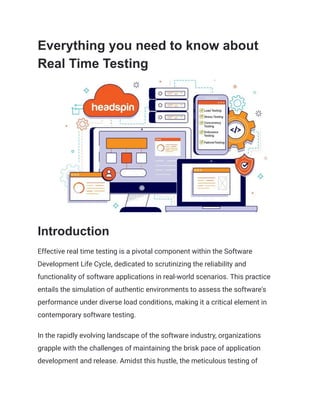
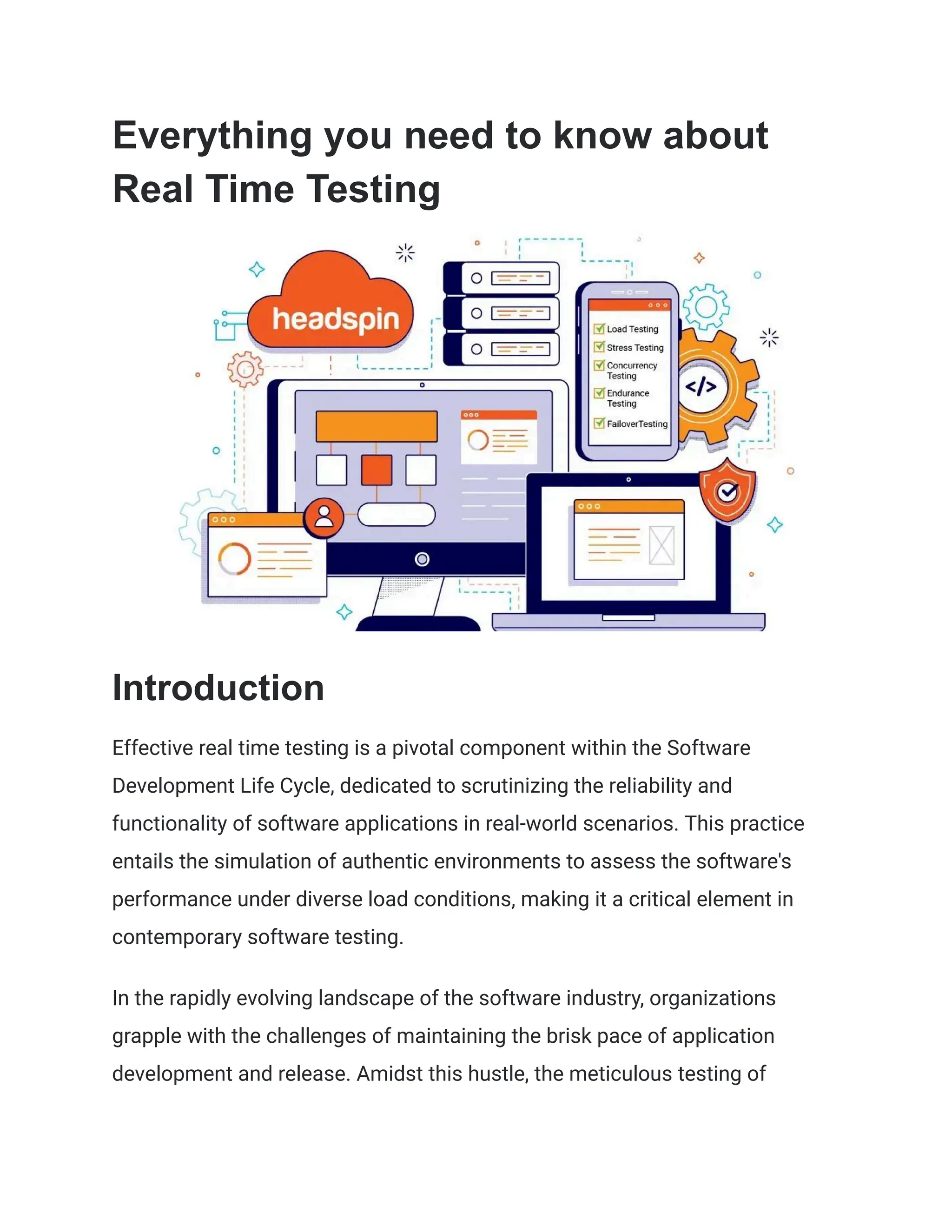
1. Load Testing:
● Objective: Evaluate the application's performance under anticipated
and peak loads.
2. Stress Testing:
● Objective: Assess the system's stability and responsiveness in
extreme conditions.
3. Concurrency Testing:
● Objective: Examine the application's capability to handle multiple
simultaneous user interactions.
4. Endurance Testing:
● Objective: Validate the application's sustained performance over
extended periods.
5. Failover Testing:
● Objective: Verify the application's seamless transition to backup
systems during failures.
These distinct types of real-time testing serve specialized roles in scrutinizing
various facets of software application performance, ensuring resilience and
dependability in dynamic scenarios.
Different Stages of Real Time Testing
Real-Time testing is an essential component of the Software Development
Life Cycle, guaranteeing the creation of reliable, high-performance software
applications that cater to end-user needs. The testing process unfolds across
five pivotal levels, forming the bedrock assessment of the entire software
application:
1. Component Level:
● Individual software components undergo real time testing, evaluating
their responsiveness and accuracy in live conditions. This level yields
insights into component reliability, contributing to an overall robust
system.
2. Integration Level:
● Focus: Real-time testing explores how different components interact,
ensuring synchronization and cohesive operation. Identifying
potential bottlenecks or breakdowns at this level provides proper
interaction between components.
3. System Level:
● Focus: The collective performance of the entire system is assessed
under dynamic circumstances. This level provides a comprehensive
view of the application's functioning, pinpointing potential issues in
real time usage and contributing to a resilient and high-performing
software product.
What are the Key Metrics of Real Time
Testing?
Real-time testing encompasses key metrics providing valuable insights into
software application performance. Let's delve into these metrics' significance:
1. Response Time:
● Significance: Measures how promptly an application responds to user
actions. A shorter response time signifies higher efficiency and user
satisfaction, while a prolonged response may signal underlying
performance issues.
2. Throughput:
● Significance: Evaluate the application's capacity to handle multiple
transactions simultaneously, reflecting scalability and
responsiveness. Monitoring throughput ensures the application can
meet user demands without performance degradation during peak
usage.
3. Error Rate:
● Significance: Measures the frequency of errors encountered during
testing, providing insight into the application's stability and reliability
under real-time conditions. A lower error rate signifies improved
system performance and a smoother user experience.
4. Resource Utilization:
● Significance: Assesses how efficiently the system uses CPU, memory,
and bandwidth resources. Monitoring resource utilization aids in
identifying inefficiencies and optimizing application performance for
cost-effective operations.
Navigating Real-Time Testing Challenges
Real-time testing introduces unique challenges that require careful
consideration from developers and testers. A thorough understanding and
effective management of these challenges are vital for ensuring the accuracy
of real-time testing. Here are key hurdles that require attention:
1. Security:
● Challenge: Testing real-time software involves handling sensitive data
that must be shielded from unauthorized access or breaches.
● Solution: Robust encryption and stringent access controls are
imperative to safeguard data integrity.
2. Scalability:
● Challenge: Real-time applications must adeptly handle escalating
user traffic and data volumes without compromising performance.
● Solution: Navigating scalability challenges demands meticulous
attention during testing, given the complexity of traditional
applications.
3. Network Latency and Connectivity Issues:
● Challenge: Real-time communication across multiple devices or
systems makes applications vulnerable to malfunctions or failures
due to network delays or interruptions.
● Solution: Establishing resilient mechanisms to address latency and
connectivity issues is critical for sustaining application reliability.
4. Compatibility:
● Challenge: Ensuring compatibility across diverse platforms, devices,
and operating systems is pivotal for the success of real-time
applications.
● Solution: Overcoming compatibility challenges requires
comprehensive testing across varied environments to ensure a
seamless user experience.
In the realm of real-time testing, the delivery of immediate and precise
feedback is paramount. Testing processes must exhibit speed, efficiency, and
freedom from delays or performance issues to meet the demand for
instantaneous user feedback.
Effective Practices in Real-Time Testing
Real-time testing, a pivotal process, involves assessing software applications
in real world scenarios to pre-emptively identify potential issues during actual
usage. This method is indispensable for ensuring the reliability and quality of
software applications, enabling developers and testers to rectify problems
before impacting end-users. To achieve optimal results in real-time testing,
adherence to certain best practices is crucial:
1. Identifying Critical Scenarios:
● Prioritize understanding user behavior and design test cases around
critical scenarios that align with actual usage. Focusing on these
scenarios ensures relevant and targeted testing of the most crucial
aspects of the application.
2. Continuous Testing Throughout Development:
● Initiate continuous testing early in development to detect and
address issues or bugs promptly. This proactive approach minimizes
the impact of potential problems, reducing overall time and cost in
the testing phase.
3. Test Automation for Efficiency:
● Leverage test automation to reduce errors and enhance efficiency by
automating repetitive tasks. This allows resources to be redirected to
more critical testing aspects. Integrating testing into the development
process ensures early issue detection, meets standards and
decreases time and cost in comprehensive quality assurance.
4. Establishing Clear Metrics:
● Define clear metrics to measure success and identify areas for
improvement. These metrics evaluate the effectiveness of tests in
achieving desired outcomes and contribute to delivering high-quality
software applications.
Elevating Real-time Testing with
HeadSpin's Global Device Infrastructure
HeadSpin's extensive global device infrastructure redefines cloud-based app
testing, offering a game-changing solution for mobile app development. The
global device infrastructure ensures access to a diverse array of real devices,
enhancing precision and reliability in testing.
● Real Device Inventory:
● Extensive collection for thorough app evaluations, ensuring
compatibility and optimal performance across devices.
● Global Reach:
● Positioned in 90+ locations, allowing assessment of app
performance across diverse markets and regional variations.
● AI-Powered Insights:
● 130+ KPIs and customized analytics offer actionable insights, driving
data-driven decisions for enhanced testing.
● Performance Optimization:
● Comprehensive monitoring and analytics enable precise
measurement, identification, and proactive optimization of
performance bottlenecks.
● Integration with Appium:
● Seamless integration with Appium for flexible test automation on real
devices, reducing test execution time and fostering agile testing
processes.
Summing Up
Real-time testing is a pivotal process, ensuring the resilience and
dependability of software applications within dynamic environments. By
replicating real-world scenarios, developers proactively address issues,
safeguarding end-user experiences.
HeadSpin emerges as an exemplary tool, automating real time testing and
elevating user experiences. Integrating effective strategies, meticulous metric
monitoring and adherence to best practices contribute to the success of real
time testing, ensuring the seamless delivery of applications.
Explore how HeadSpin's robust testing capabilities guarantee optimal
performance across diverse devices and browsers, reinforcing its role as a
reliable testing solution.
This article was originally published on:
https://www.headspin.io/blog/your-complete-guide-to-real-time-testing-best-pra
ctices

Everything you need to know about Real Time Testing.pdf

  • 1.
    Everything you needto know about Real Time Testing Introduction Effective real time testing is a pivotal component within the Software Development Life Cycle, dedicated to scrutinizing the reliability and functionality of software applications in real-world scenarios. This practice entails the simulation of authentic environments to assess the software's performance under diverse load conditions, making it a critical element in contemporary software testing. In the rapidly evolving landscape of the software industry, organizations grapple with the challenges of maintaining the brisk pace of application development and release. Amidst this hustle, the meticulous testing of
  • 2.
    application quality, performance,and functionality emerges as a paramount phase, ensuring the fulfillment of end-user requirements. The expansive realm of software testing encompasses various stages, ranging from functional to non-functional testing, tailored to the unique demands of each software application. This blog delves into the intricacies of real-time software testing, elucidating its significance in diverse techniques and providing a practical demonstration leveraging the HeadSpin platform. Through this exploration, we aim to shed light on the symbiotic relationship between real-world conditions and system performance, equipping manual testers, test engineers, and automation engineers with invaluable insights to enhance testing strategies effectively. Understanding Real Time Testing: What is it? Real time testing is a critical process involving validating software applications in a live environment, aiming to minimize the risk of deployment failures. It is a dynamic procedure where the software is actively monitored during execution. This form of testing employs automated, manual, and exploratory techniques, leveraging specific tools and methodologies to simulate real-world conditions like network latency, high traffic, and system crashes. Real-time testing involves evaluating a software application's capability to handle unexpected events in live environments. This includes testing the software's responsiveness to external stimuli from various sources such as
  • 3.
    the network, userinterface, or connected systems. The overarching goal is to ensure the software functions optimally and consistently, even under high-volume data or network congestion. Testing real-time projects is a proactive measure to guarantee the seamless performance of software applications in real-world scenarios. Significance of Real Time Testing Real-time testing holds paramount importance as it offers valuable insights into the dynamic performance of applications. Assessing how software functions in unpredictable scenarios guarantees the capability to manage sudden spikes in user activity, unexpected user interactions, and fluctuations in network conditions. This proactive testing approach serves as a safeguard, preventing downtime, data loss, and adverse user experiences, thereby preserving a company's reputation. Where to Conduct Real-Time Testing Real-time testing can be executed on a local machine or in the cloud, presenting distinct advantages and drawbacks. Local machine testing provides heightened control over the testing environment, allowing teams to tailor infrastructure and tools for faster testing cycles, minimizing network latency. However, it necessitates more resources to scale up for extensive scenarios. On the other hand, cloud-based testing offers virtually limitless resources and scalability without hardware constraints. This approach is cost-effective, as
  • 4.
    teams only payfor the resources they utilize. The choice between local and cloud testing depends on project-specific requirements, considering cost, control, and scalability factors. Cloud technology has revolutionized real-time testing, providing enhanced flexibility compared to traditional methods. Cloud platforms furnish customizable infrastructure and tools that can swiftly adapt to varying application loads. Particularly beneficial for resource-intensive real-time testing, the pay-per-use model ensures cost-effectiveness. Cloud-based testing is particularly effective for web and mobile application testing, eliminating the need for local test infrastructure while offering unlimited resources on demand. What are the Advantages of Real Time Testing? Ensuring functionality in a real user environment is paramount in software application development. Real time testing enables developers and testers to swiftly identify and address issues before the application hits the market. Real-time testing significantly reduces the time needed to test and deploy features or functions. This agility empowers organizations to release software applications faster, maintaining competitiveness in the market. Key benefits of testing in real time include: ● Meeting end-user expectations for quick and accurate software application responses.
  • 5.
    ● Minimizing softwareapplication downtime by preemptively identifying and resolving bugs. ● Optimizing performance by pinpointing areas for improvement under real-world conditions, leading to faster and more efficient applications. ● Facilitating easy access and testing of visual components, uncovering User Interface (UI) and User Experience (UX) issues. ● Allowing for exploratory and ad hoc testing, enabling the exploration of different scenarios and inputs. ● Providing a profound level of analysis and verification, distinguishing between reported bugs and issues requiring attention. Real-Time Testing Categories 1. Load Testing: ● Objective: Evaluate the application's performance under anticipated and peak loads. 2. Stress Testing: ● Objective: Assess the system's stability and responsiveness in extreme conditions. 3. Concurrency Testing: ● Objective: Examine the application's capability to handle multiple simultaneous user interactions.
  • 6.
    4. Endurance Testing: ●Objective: Validate the application's sustained performance over extended periods. 5. Failover Testing: ● Objective: Verify the application's seamless transition to backup systems during failures. These distinct types of real-time testing serve specialized roles in scrutinizing various facets of software application performance, ensuring resilience and dependability in dynamic scenarios. Different Stages of Real Time Testing Real-Time testing is an essential component of the Software Development Life Cycle, guaranteeing the creation of reliable, high-performance software applications that cater to end-user needs. The testing process unfolds across five pivotal levels, forming the bedrock assessment of the entire software application: 1. Component Level: ● Individual software components undergo real time testing, evaluating their responsiveness and accuracy in live conditions. This level yields insights into component reliability, contributing to an overall robust system.
  • 7.
    2. Integration Level: ●Focus: Real-time testing explores how different components interact, ensuring synchronization and cohesive operation. Identifying potential bottlenecks or breakdowns at this level provides proper interaction between components. 3. System Level: ● Focus: The collective performance of the entire system is assessed under dynamic circumstances. This level provides a comprehensive view of the application's functioning, pinpointing potential issues in real time usage and contributing to a resilient and high-performing software product. What are the Key Metrics of Real Time Testing? Real-time testing encompasses key metrics providing valuable insights into software application performance. Let's delve into these metrics' significance: 1. Response Time: ● Significance: Measures how promptly an application responds to user actions. A shorter response time signifies higher efficiency and user satisfaction, while a prolonged response may signal underlying performance issues.
  • 8.
    2. Throughput: ● Significance:Evaluate the application's capacity to handle multiple transactions simultaneously, reflecting scalability and responsiveness. Monitoring throughput ensures the application can meet user demands without performance degradation during peak usage. 3. Error Rate: ● Significance: Measures the frequency of errors encountered during testing, providing insight into the application's stability and reliability under real-time conditions. A lower error rate signifies improved system performance and a smoother user experience. 4. Resource Utilization: ● Significance: Assesses how efficiently the system uses CPU, memory, and bandwidth resources. Monitoring resource utilization aids in identifying inefficiencies and optimizing application performance for cost-effective operations. Navigating Real-Time Testing Challenges Real-time testing introduces unique challenges that require careful consideration from developers and testers. A thorough understanding and effective management of these challenges are vital for ensuring the accuracy of real-time testing. Here are key hurdles that require attention:
  • 9.
    1. Security: ● Challenge:Testing real-time software involves handling sensitive data that must be shielded from unauthorized access or breaches. ● Solution: Robust encryption and stringent access controls are imperative to safeguard data integrity. 2. Scalability: ● Challenge: Real-time applications must adeptly handle escalating user traffic and data volumes without compromising performance. ● Solution: Navigating scalability challenges demands meticulous attention during testing, given the complexity of traditional applications. 3. Network Latency and Connectivity Issues: ● Challenge: Real-time communication across multiple devices or systems makes applications vulnerable to malfunctions or failures due to network delays or interruptions. ● Solution: Establishing resilient mechanisms to address latency and connectivity issues is critical for sustaining application reliability. 4. Compatibility: ● Challenge: Ensuring compatibility across diverse platforms, devices, and operating systems is pivotal for the success of real-time applications.
  • 10.
    ● Solution: Overcomingcompatibility challenges requires comprehensive testing across varied environments to ensure a seamless user experience. In the realm of real-time testing, the delivery of immediate and precise feedback is paramount. Testing processes must exhibit speed, efficiency, and freedom from delays or performance issues to meet the demand for instantaneous user feedback. Effective Practices in Real-Time Testing Real-time testing, a pivotal process, involves assessing software applications in real world scenarios to pre-emptively identify potential issues during actual usage. This method is indispensable for ensuring the reliability and quality of software applications, enabling developers and testers to rectify problems before impacting end-users. To achieve optimal results in real-time testing, adherence to certain best practices is crucial: 1. Identifying Critical Scenarios: ● Prioritize understanding user behavior and design test cases around critical scenarios that align with actual usage. Focusing on these scenarios ensures relevant and targeted testing of the most crucial aspects of the application. 2. Continuous Testing Throughout Development:
  • 11.
    ● Initiate continuoustesting early in development to detect and address issues or bugs promptly. This proactive approach minimizes the impact of potential problems, reducing overall time and cost in the testing phase. 3. Test Automation for Efficiency: ● Leverage test automation to reduce errors and enhance efficiency by automating repetitive tasks. This allows resources to be redirected to more critical testing aspects. Integrating testing into the development process ensures early issue detection, meets standards and decreases time and cost in comprehensive quality assurance. 4. Establishing Clear Metrics: ● Define clear metrics to measure success and identify areas for improvement. These metrics evaluate the effectiveness of tests in achieving desired outcomes and contribute to delivering high-quality software applications. Elevating Real-time Testing with HeadSpin's Global Device Infrastructure HeadSpin's extensive global device infrastructure redefines cloud-based app testing, offering a game-changing solution for mobile app development. The global device infrastructure ensures access to a diverse array of real devices, enhancing precision and reliability in testing.
  • 12.
    ● Real DeviceInventory: ● Extensive collection for thorough app evaluations, ensuring compatibility and optimal performance across devices. ● Global Reach: ● Positioned in 90+ locations, allowing assessment of app performance across diverse markets and regional variations. ● AI-Powered Insights: ● 130+ KPIs and customized analytics offer actionable insights, driving data-driven decisions for enhanced testing. ● Performance Optimization: ● Comprehensive monitoring and analytics enable precise measurement, identification, and proactive optimization of performance bottlenecks. ● Integration with Appium: ● Seamless integration with Appium for flexible test automation on real devices, reducing test execution time and fostering agile testing processes. Summing Up
  • 13.
    Real-time testing isa pivotal process, ensuring the resilience and dependability of software applications within dynamic environments. By replicating real-world scenarios, developers proactively address issues, safeguarding end-user experiences. HeadSpin emerges as an exemplary tool, automating real time testing and elevating user experiences. Integrating effective strategies, meticulous metric monitoring and adherence to best practices contribute to the success of real time testing, ensuring the seamless delivery of applications. Explore how HeadSpin's robust testing capabilities guarantee optimal performance across diverse devices and browsers, reinforcing its role as a reliable testing solution. This article was originally published on: https://www.headspin.io/blog/your-complete-guide-to-real-time-testing-best-pra ctices