Q1. In what way does your media
product use, develop or challenge
forms and conventions of real media
products?
Jack Baird
Relationship Between Music and
Visuals (and “Thought Beats”)
One of the conventions of music videos, according to Andrew Goodwin, is the use of
thought beats. Thought beats are the manner in which editing is done, to match up
the beats of the song with the visual elements on screen in terms of mood and style.
One of the ways we tried to satisfy this convention, was by using a series of jump cuts
when the protagonists are setting up their dance mats. We used the jump cuts to act
an ellipsis of time so the narrative could progress quickly to their actual dancing. By
synchronising this ellipsis of time with the beats of the song track it helps match the
mood of the sound track with our music video. It creates a fast paced video which
goes with the fast paced tempo of the song. Furthermore, it gives the impression that
the visual and audio are linked; if we did not choreograph the music beats with the
visuals it would create a dissonance between them which could be off putting for the
viewer.
Relationship Between Music and Visuals (and
“Thought Beats”) Continued…
We also had a montage sequence near the end of the music video. We put this in
during the bridge of the song. Although this point in the track is relatively slow, it
comes just before the fast paced chorus. By using the montage, it would intensify
and increase the pace in anticipation of the chorus.
A series of shots used in the
montage sequence
Relationship Between Lyrics and
Visuals
The lyrics of the music track are about somebody in a relationship who breaks up
with a woman and he is “begging” for forgiveness and for her to come back to him.
However, we wanted to change the storyline to our own, in order to widen the
meaning. Goodwin refers to this feature as
“amplifying” the meaning. Therefore, we
ensured that there was still a link between the
lyrics and visuals, by focusing on the word
“begging”, but taking a more literal
interpretation of the word. We made our video
quite literally about two homeless people who
have to dance for money (a form of begging).
Goodwin also states that music videos can
“contradict” the lyrics, so we applied this
convention to the narrative structure in order
to provide a sharper meaning to our meaning.
In the original song, there is no progression of
plot as it simply circulates around the same idea of the relationship. However, we
introduce a resolution to our narrative as the beggars end up with a dance crew in a
professional studio.
Everybody Hurts by REM – similarly
contradicted the lyrics of their song in their
music video, showing people coming together
when the song is about loneliness.
Star Image …
Goodwin says the purpose of the star image is to “satisfy the demand of the
record label.” We knew that this was important part of the branding and
promotional purpose to advocate the performers themselves. Therefore, we
also used a performance element in combination with the narrative. We used
medium and close up shots of two actors lip syncing whilst facing the camera.
For this element of the music
video we used a green screen to
change the background so that the
performers were in front of
swirling graphic visualisations that
looked similar to fireworks. We did
this in order to emphasise their
star image and imply their image is
explosive to produce a striking
impression of the artists.
… Star Image …
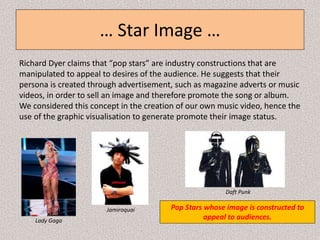
Richard Dyer claims that “pop stars” are industry constructions that are
manipulated to appeal to desires of the audience. He suggests that their
persona is created through advertisement, such as magazine adverts or music
videos, in order to sell an image and therefore promote the song or album.
We considered this concept in the creation of our own music video, hence the
use of the graphic visualisation to generate promote their image status.
Pop Stars whose image is constructed to
appeal to audiences.Lady Gaga
Jamiroquai
Daft Punk
… Star Image
In terms of Hip Hop and RnB, however, I felt that Dyer’s theory was only partially true, as a
lot of the image and promotion of urban artists comes from their real life background (for
example, 50 cent actually produced a true to life film called “Get Rich or Die Tryin’ ” about
his lifestyle, background and choices).
Being aware that this was important in the music video production of an RnB track, we
wanted to find a balance between the two ideas of a constructed star versus a real person.
We did this by dressing our performers in suits, which was intended to construct an image
of someone who is smart, intelligent, competent and earning a good living. We could see
the value of this convention helping to promote sales, so we did not want to abandon it
completely. However, we also wanted them to
seem like real life people, so we kept the
construction element subtle, adapting their suits
in a casual manner. We also had the main singer,
Joel, put a Afro comb in his hair to make him
seem more like a normal person from an urban
background.
Voyeurism
Voyeurism is one of the conventions of music videos that we wanted to
challenge. Often the people, particularly women, as depicted as sexual objects
that are just there to be looked at. Broadly speaking, we did not feel that this
representation was acceptable or appropriate, and felt that the music industry
should not be promoting such levels of sexism. We
understood that there is a promotional purpose behind
the voyeuristic elements, but believed that it could also
create a bad image, especially as we were focusing on
providing a significant social message in our video (to
be determined and aspire to do well in life). If we had
conformed to the stereotype and sexualisation of
either men or women, then it would have undermined
the style and mood of our production. Instead, we
focused on trying to represent an image that was
serious and business-like (hence the suits), and avoided
voyeuristic elements as far as we could.
“Cookie Dance” by Chip Cookie is an
example of a music video where there
is an overt emphasis on the female
figure.
Genre Conventions
Hip Hop and RnB
Another concept that Goodwin focused on was that music videos have particular
styles according to their genre: they all have conventions that are particularly
associated with that category of music. “Aspiration” is a theme that is
conventionally found in hip-hop and RnB music videos and songs. As our music
track is a combination of these two genres, we decided that this would form and
important part of the whole piece. The Music video is largely about the rise and
success of two characters from an impoverished background.
Our central protagonists go on a typical “rags to riches” journey, where
they start off dancing in a poor environment, but achieve their dreams and
end up with a dance crew in a studio
Genre – Hip Hop and RnB
Another convention of Hip Hop and RnB, is that the artist is often portrayed with
expensive trappings and there is a strong element of materialism, such as fast cars
or jewellery. However, we wanted to challenge this convention by making the
aspirational goals of the individuals less materialistic based, and instead focusing
on internal and self-development (i.e. they go from having to beg and dance on the
street, to dancing in a professional studio). We felt that this would convey a
stronger message as it is shows they have achieved a realistic goal in their life.
Poster of 50 Cents, with a
heavy focus on his chains
and jewellery
Homeless people in our music video in
their new dancing environment – less
focus on material success, and more on
personal development.

Evaluation Question 1

  • 1.
    Q1. In whatway does your media product use, develop or challenge forms and conventions of real media products? Jack Baird
  • 2.
    Relationship Between Musicand Visuals (and “Thought Beats”) One of the conventions of music videos, according to Andrew Goodwin, is the use of thought beats. Thought beats are the manner in which editing is done, to match up the beats of the song with the visual elements on screen in terms of mood and style. One of the ways we tried to satisfy this convention, was by using a series of jump cuts when the protagonists are setting up their dance mats. We used the jump cuts to act an ellipsis of time so the narrative could progress quickly to their actual dancing. By synchronising this ellipsis of time with the beats of the song track it helps match the mood of the sound track with our music video. It creates a fast paced video which goes with the fast paced tempo of the song. Furthermore, it gives the impression that the visual and audio are linked; if we did not choreograph the music beats with the visuals it would create a dissonance between them which could be off putting for the viewer.
  • 3.
    Relationship Between Musicand Visuals (and “Thought Beats”) Continued… We also had a montage sequence near the end of the music video. We put this in during the bridge of the song. Although this point in the track is relatively slow, it comes just before the fast paced chorus. By using the montage, it would intensify and increase the pace in anticipation of the chorus. A series of shots used in the montage sequence
  • 4.
    Relationship Between Lyricsand Visuals The lyrics of the music track are about somebody in a relationship who breaks up with a woman and he is “begging” for forgiveness and for her to come back to him. However, we wanted to change the storyline to our own, in order to widen the meaning. Goodwin refers to this feature as “amplifying” the meaning. Therefore, we ensured that there was still a link between the lyrics and visuals, by focusing on the word “begging”, but taking a more literal interpretation of the word. We made our video quite literally about two homeless people who have to dance for money (a form of begging). Goodwin also states that music videos can “contradict” the lyrics, so we applied this convention to the narrative structure in order to provide a sharper meaning to our meaning. In the original song, there is no progression of plot as it simply circulates around the same idea of the relationship. However, we introduce a resolution to our narrative as the beggars end up with a dance crew in a professional studio. Everybody Hurts by REM – similarly contradicted the lyrics of their song in their music video, showing people coming together when the song is about loneliness.
  • 5.
    Star Image … Goodwinsays the purpose of the star image is to “satisfy the demand of the record label.” We knew that this was important part of the branding and promotional purpose to advocate the performers themselves. Therefore, we also used a performance element in combination with the narrative. We used medium and close up shots of two actors lip syncing whilst facing the camera. For this element of the music video we used a green screen to change the background so that the performers were in front of swirling graphic visualisations that looked similar to fireworks. We did this in order to emphasise their star image and imply their image is explosive to produce a striking impression of the artists.
  • 6.
    … Star Image… Richard Dyer claims that “pop stars” are industry constructions that are manipulated to appeal to desires of the audience. He suggests that their persona is created through advertisement, such as magazine adverts or music videos, in order to sell an image and therefore promote the song or album. We considered this concept in the creation of our own music video, hence the use of the graphic visualisation to generate promote their image status. Pop Stars whose image is constructed to appeal to audiences.Lady Gaga Jamiroquai Daft Punk
  • 7.
    … Star Image Interms of Hip Hop and RnB, however, I felt that Dyer’s theory was only partially true, as a lot of the image and promotion of urban artists comes from their real life background (for example, 50 cent actually produced a true to life film called “Get Rich or Die Tryin’ ” about his lifestyle, background and choices). Being aware that this was important in the music video production of an RnB track, we wanted to find a balance between the two ideas of a constructed star versus a real person. We did this by dressing our performers in suits, which was intended to construct an image of someone who is smart, intelligent, competent and earning a good living. We could see the value of this convention helping to promote sales, so we did not want to abandon it completely. However, we also wanted them to seem like real life people, so we kept the construction element subtle, adapting their suits in a casual manner. We also had the main singer, Joel, put a Afro comb in his hair to make him seem more like a normal person from an urban background.
  • 8.
    Voyeurism Voyeurism is oneof the conventions of music videos that we wanted to challenge. Often the people, particularly women, as depicted as sexual objects that are just there to be looked at. Broadly speaking, we did not feel that this representation was acceptable or appropriate, and felt that the music industry should not be promoting such levels of sexism. We understood that there is a promotional purpose behind the voyeuristic elements, but believed that it could also create a bad image, especially as we were focusing on providing a significant social message in our video (to be determined and aspire to do well in life). If we had conformed to the stereotype and sexualisation of either men or women, then it would have undermined the style and mood of our production. Instead, we focused on trying to represent an image that was serious and business-like (hence the suits), and avoided voyeuristic elements as far as we could. “Cookie Dance” by Chip Cookie is an example of a music video where there is an overt emphasis on the female figure.
  • 9.
    Genre Conventions Hip Hopand RnB Another concept that Goodwin focused on was that music videos have particular styles according to their genre: they all have conventions that are particularly associated with that category of music. “Aspiration” is a theme that is conventionally found in hip-hop and RnB music videos and songs. As our music track is a combination of these two genres, we decided that this would form and important part of the whole piece. The Music video is largely about the rise and success of two characters from an impoverished background. Our central protagonists go on a typical “rags to riches” journey, where they start off dancing in a poor environment, but achieve their dreams and end up with a dance crew in a studio
  • 10.
    Genre – HipHop and RnB Another convention of Hip Hop and RnB, is that the artist is often portrayed with expensive trappings and there is a strong element of materialism, such as fast cars or jewellery. However, we wanted to challenge this convention by making the aspirational goals of the individuals less materialistic based, and instead focusing on internal and self-development (i.e. they go from having to beg and dance on the street, to dancing in a professional studio). We felt that this would convey a stronger message as it is shows they have achieved a realistic goal in their life. Poster of 50 Cents, with a heavy focus on his chains and jewellery Homeless people in our music video in their new dancing environment – less focus on material success, and more on personal development.