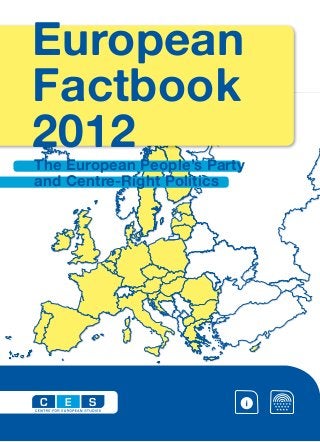
European
Factbook
2012The European People’s Party
and Centre-Right Politics
C SE
EUROPEAN FACTBOOK 2012
The European People’s Party
and Centre-Right Politics
“The European Factbook, now in its fifth year, is the consolidated
annual publication with all relevant data and documentation
about the European People’s Party (EPP), the largest EU-level
party which represents the political family of the centre-right.
The 2012 edition includes the latest updates and information from
both European level and national level politics. The EPP is currently
the leading Europarty in the three main EU institutions: the Euro-
pean Council with 16 out of 27 heads of state and government,
the European Commission with 13 out of 27 members, and the
European Parliament with 271 out of 754 MEPs.
Apart from the structure of the EPP and its role in the EU institutions,
the European Factbook includes information about EPP member-
parties in EU and non-EU countries, EPP parliamentary groups in the
Council of Europe, the OSCE and NATO, EPP member associations,
as well as information about EPP’s think-tank the Centre for European
Studies (CES) and its member foundations.
Finally, the European Factbook provides readers with a set of
important supplementary documents including the EU Regulation
that governs political parties at European level and the ‘Giannakou
Report’.”
Kostas Sasmatzoglou, Editor-in-Chief
ISSN 2031-0196
C SE
www.thinkingeurope.eu
EUROPEAN FACTBOOK 2012
The European People’s Party and Centre-Right Politics
Editor-in-Chief:
Kostas Sasmatzoglou
Assistant Editors:
Bernada Cunj, Pavlína Heymans-Špačková, Óscar Sánchez Benítez
Additional Research and Editing:
Lisa Dutton, Brenda Furniere, Sara Pini, Panos Tasiopoulos
Cover, Type & Design:
Andreas Neuhaus
Printed in Germany by Druckhaus Süd
Brussels, April 2012
Centre for European Studies
Rue du Commerce 20
Brussels, B-1000
The Centre for European Studies (CES) is the political foundation of the European People’s Party
(EPP), dedicated to the promotion of Christian democrat, conservative and like-minded political
values. For more information please visit:
www.thinkingeurope.eu
ISSN 2031-0196
	 	 This publication is funded by the European Parliament
		 © 2012 Centre for European Studies
The European Parliament and the publishers assume no responsibility for the data and/or
opinions in this publication and any use that may be made of the information therein.
Table of Contents
SECTION 1 | THE EUROPEAN PEOPLE’S PARTY
Introduction - the EPP today	 							 03
History											 06
Chronology 										 07
EPP Structure - Presidency, Political Assembly and Congress			 13
Who is Who in the EPP									 13
								
EPP Working Groups									 15
	 · European Policy
	 · Economic and Social Policy
	 · EPP Membership	
	 · Ad Hoc | Common Agriculture Policy
	 · Ad Hoc | Climate Change
	 · Campaign Managers Meeting
EPP in the European Council - EPP Summit			 	 		 15
	 · President of the European Council
	 · EU Heads of State and Government
	 · Non-EU Heads of State and Government
EPP in the Council of the EU - EPP Ministerial Meetings				 16
	 · Economic and Financial Affairs	
	 · Home Affairs
	 · Justice
	 · Foreign Affairs							
	 · Environment
	 · Agriculture
	 · Energy
	 · Defense
	 · Employment
	 · Industry
	 · Transport
	 · General Affairs
EPP in the European Commission							 19
	 · President of the European Commission
	 · Vice-Presidents of the European Commission
	 · Members
EPP in the European Parliament						 	 20	
	 · Vice-Presidents of the European Parliament
	 · Quaestors of the European Parliament	
	 · Presidency of the EPP Group				
	 · Secretary General
	 · Heads of national delegations	
	 · Coordinators in the parliamentary committees				
	 · Members									
												
EPP in the Committee of the Regions							 32
	 · The Presidency							
	 · The Bureau	
	 · 1st CoR Vice President
	 · Presidents of CoR Commissions	
	 · CoR Bureau Members
	 · List of Representatives	
EPP in the Council of Europe								 39
	 · List of Representatives								
	
EPP in the Organisation for Security and Co-operation in Europe 			 47
	 · OSCE-PA Vice-Presidents
	 · OSCE-PA Committee Officers
	 · List of Representatives	
EPP in the North Atlantic Treaty Organisation		 			 54
	 · Bureau of the Assembly		
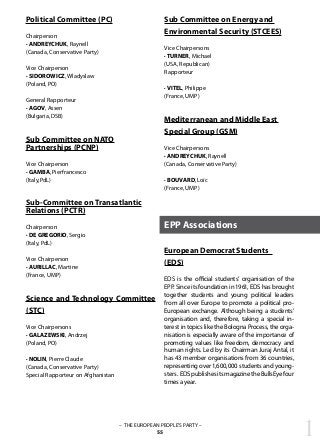
	 · Committees and Subcommittees
EPP Associations									 55
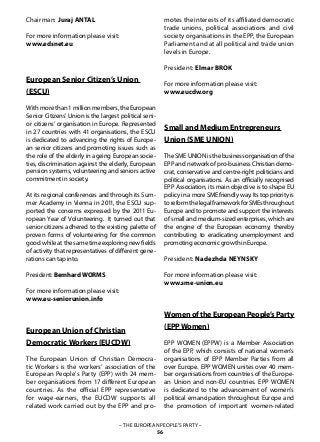
	 · European Democrat Students (EDS)
	 · European Senior Citizen’s Union (ESCU)
	 · European Union of Christian Democratic Workers (EUCDW)
	 · Small and Medium Entrepreneurs Union (SME UNION)						
	 · Women of the European People’s Party (EPP Women)						
	 · Youth of the European People’s Party (YEPP)
SECTION 2a | EU COUNTRIES
European Union									 60
	 · European People’s Party | EPP
Austria											 62
	 · Österreichische Volkspartei | ÖVP
Belgium										 64
	 · Christen-Democratisch en Vlaams | CD&V
	 · Centre Démocrate Humaniste | cdH
Bulgaria										 68
	 · Graždani za Evropeĭsko Razvitie na Bălgarija | GERB
	 · Săjuz Na Demokratičnite Sili | UDF
	 · Demokrati za Silna Bălgarija | DSB
	 · Demokratičeska Partija | DP
	 · Zemedelski Naroden Sajuz | ZNS
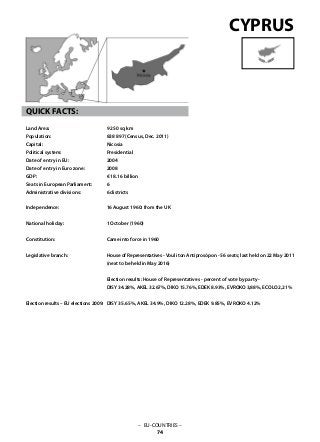
Cyprus											 74
	 · Dimokratikos Synagermos | DISY
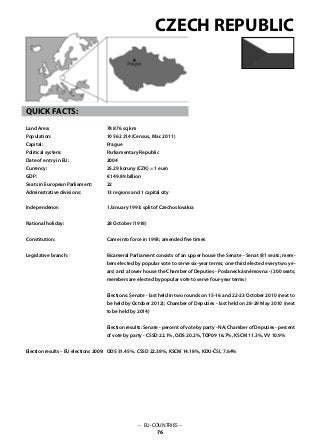
Czech Republic									 76
	 · TOP 09
	 · Křesťanská a Demokratická Unie – Československá Strana Lidová | KDU-ČSL
Denmark 										 80
	 · Det Konservative Folkeparti | DKF
	 · Kristendemokraterne | KD
Estonia 										 84
	 · Isamaa ja Res Publica Liit | IRL
Finland 										 86
	 · Kansallinen Kokoomus | KOK
	 · Kristillisdemokraatit | KD
France 											 90
	 · Union pour un Mouvement Populaire | UMP
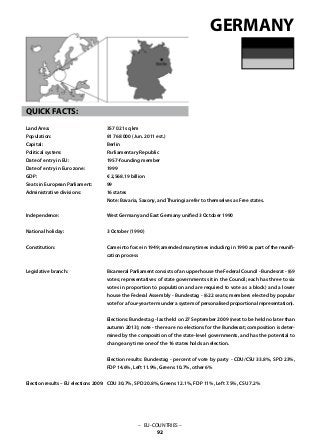
Germany 										 92
	 · Christlich Demokratische Union | CDU
	 · Christlich-Soziale Union in Bayern | CSU
Greece 										 96
	 · Nea Demokratia | ND
Hungary 										 98
	 · Fidesz- Magyar Polgári Szövetség | FIDESZ
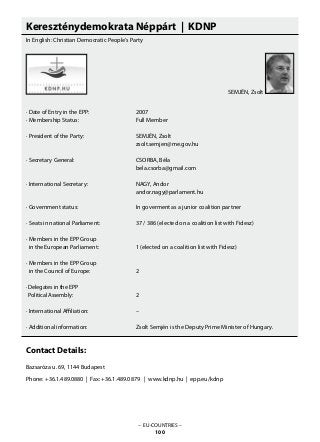
	 · Kereszténydemokrata Néppárt | KDNP
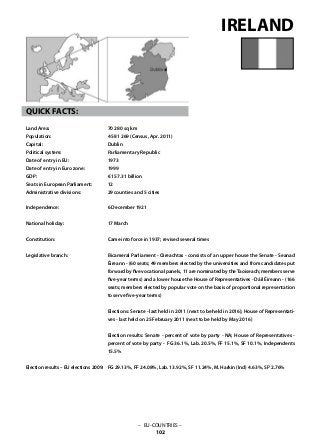
Ireland 										 102
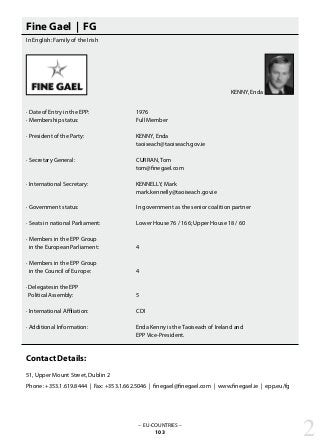
	 · Fine Gael | FG
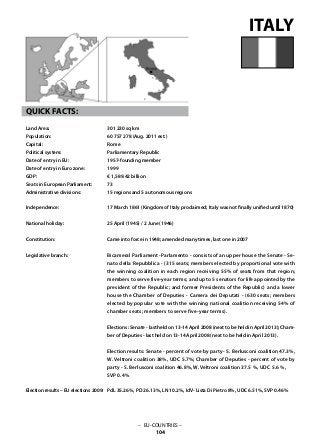
Italy 											 104
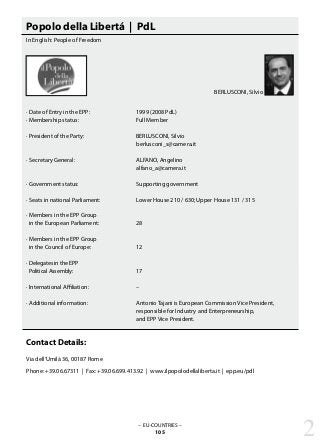
	 · Il Popolo della Libertà | PdL
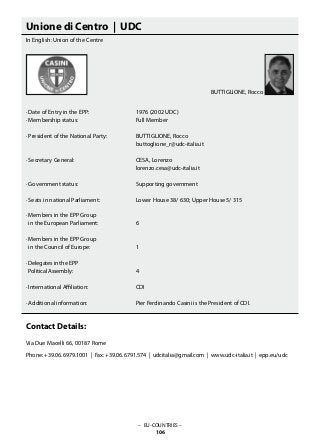
	 · Unione di Centro | UDC
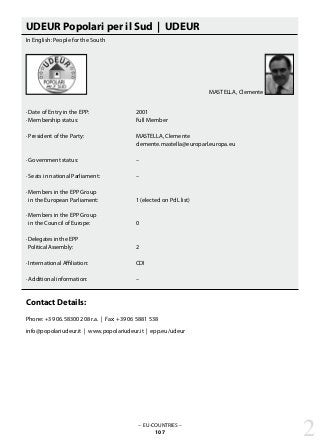
	 · UDEUR Popolari per il Sud | UDEUR
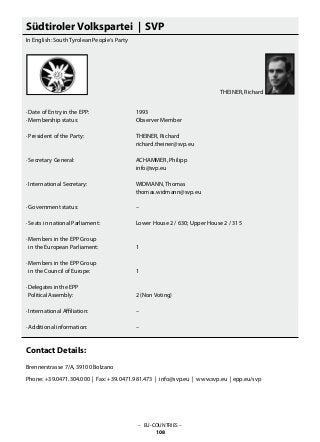
	 · Südtiroler Volkspartei | SVP
Latvia 											 110
	 · Vienotība | V
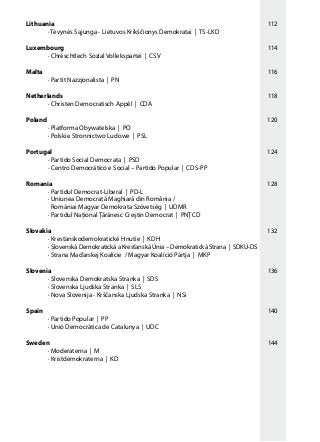
Lithuania 										 112
	 · Tėvynės Sąjunga - Lietuvos Krikščionys Demokratai | TS-LKD
	
Luxembourg 										 114
	 · Chrëschtlech Sozial Vollekspartei | CSV
Malta 											 116
	 · Partit Nazzjonalista | PN
Netherlands 										 118
	 · Christen Democratisch Appèl | CDA
Poland 									 120
	 · Platforma Obywatelska | PO
	 · Polskie Stronnictwo Ludowe | PSL
Portugal 									 124
	 · Partido Social Democrata | PSD
	 · Centro Democrático e Social – Partido Popular | CDS-PP
Romania 									 128
	 · Partidul Democrat-Liberal | PD-L
	 · Uniunea Democrată Maghiară din România /
	 Romániai Magyar Demokrata Szövetség | UDMR
	 · Partidul Naţional Ţărănesc Creştin Democrat | PNŢCD	
Slovakia 									 132
	 · Kresťanskodemokratické Hnutie | KDH
	 · Slovenská Demokratická a Kresťanská Únia – Demokratická Strana | SDKÚ-DS
	 · Strana Maďarskej Koalície / Magyar Koalíció Pártja | MKP
Slovenia 										 136
	 · Slovenska Demokratska Stranka | SDS
	 · Slovenska Ljudska Stranka | SLS
	 · Nova Slovenija - Krščanska Ljudska Stranka | NSi
Spain 											 140
	 · Partido Popular | PP
	 · Unió Democràtica de Catalunya | UDC
Sweden 										 144
	 · Moderaterna | M
	 · Kristdemokraterna | KD
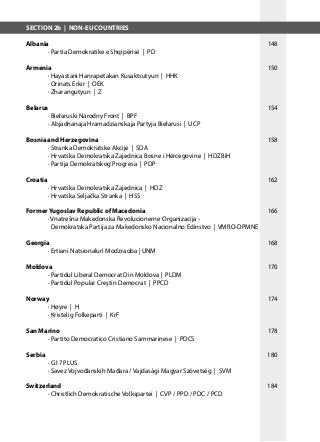
SECTION 2b | NON-EU COUNTRIES
Albania 										 148
	 · Partia Demokratike e Shqipërisë | PD
Armenia										 150
	 · Hayastani Hanrapetakan Kusaktsutyun | HHK
	 · Orinats Erkir | OEK
	 · Zharangutyun | Z
Belarus 										 154
	 · Biełaruski Narodny Front | BPF
	 · Abjadnanaja Hramadzianskaja Partyja Biełarusi | UCP
Bosnia and Herzegovina 								 158
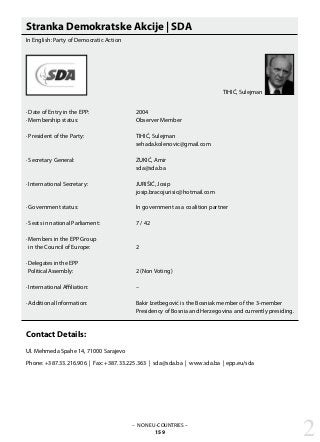
	 · Stranka Demokratske Akcije | SDA
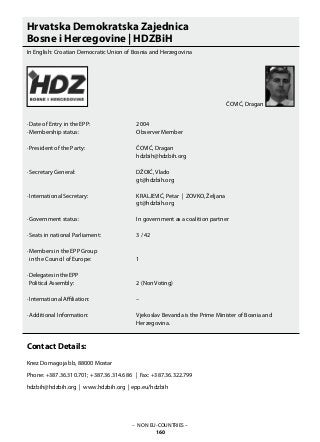
	 · Hrvatska Demokratska Zajednica Bosne i Hercegovine | HDZBiH
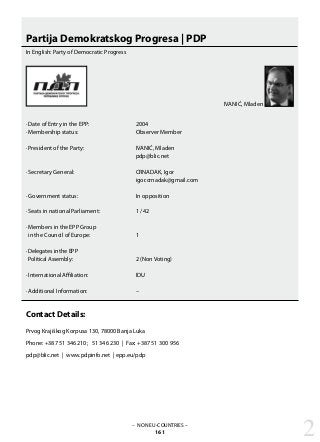
	 · Partija Demokratskog Progresa | PDP
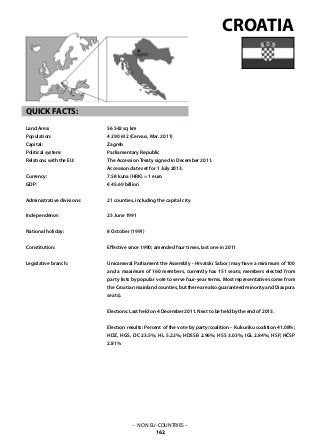
Croatia 										 162
	 · Hrvatska Demokratska Zajednica | HDZ
	 · Hrvatska Seljačka Stranka | HSS
Former Yugoslav Republic of Macedonia	 					 166
	 · Vnatrešna Makedonska Revolucionerne Organizacija -
	 Demokratska Partija za Makedonsko Nacionalno Edinstvo | VMRO-DPMNE
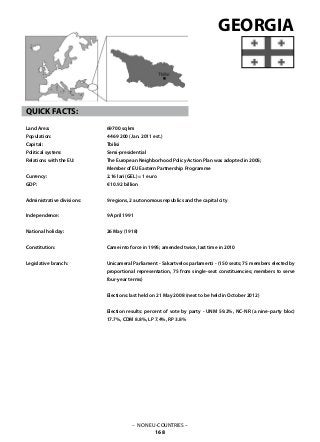
Georgia										 168
	 · Ertiani Natsionaluri Modzraoba | UNM						
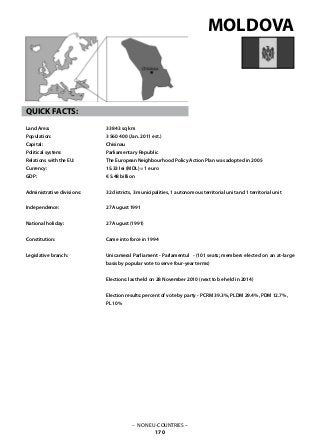
Moldova 										 170
	 · Partidul Liberal Democrat Din Moldova | PLDM
	 · Partidul Popular Creştin Democrat | PPCD					
Norway 										 174
	 · Høyre | H										
	 · Kristelig Folkeparti | KrF
San Marino 										 178
	 · Partito Democratico Cristiano Sammarinese | PDCS
Serbia 										 180
	 · G17 PLUS
	 · Savez Vojvođanskih Mađara / Vajdasági Magyar Szövetség | SVM
Switzerland 									 184
	 · Christlich Demokratische Volkspartei | CVP / PPD / PDC / PCD
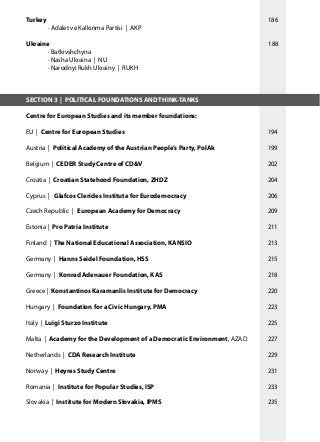
Turkey 										 186
	 · Adalet ve Kalkınma Partisi | AKP
Ukraine 										 188
	 · Batkivshchyna
	 · Nasha Ukraïna | NU
	 · Narodnyi Rukh Ukraïny | RUKH
SECTION 3 | POLITICAL FOUNDATIONS AND THINK-TANKS
Centre for European Studies and its member foundations:				
EU | Centre for European Studies							 194
Austria | Political Academy of the Austrian People’s Party, PolAk 			 199
Belgium | CEDER Study Centre of CD&V 						 202		
Croatia | Croatian Statehood Foundation, ZHDZ 					 204
Cyprus | Glafcos Clerides Institute for Eurodemocracy 				 206
Czech Republic | European Academy for Democracy 				 209
Estonia | Pro Patria Institute	 			 				 211
Finland | The National Educational Association, KANSIO 				 213
Germany | Hanns Seidel Foundation, HSS 						 215
Germany | Konrad Adenauer Foundation, KAS					 218
Greece | Konstantinos Karamanlis Institute for Democracy				 220	
Hungary | Foundation for a Civic Hungary, PMA					 223		
				
Italy | Luigi Sturzo Institute					 			 225
Malta | Academy for the Development of a Democratic Environment, AZAD	 227	
Netherlands | CDA Research Institute							 229
Norway | Høyres Study Centre							 231	
Romania | Institute for Popular Studies, ISP						 233
Slovakia | Institute for Modern Slovakia, IPMS					 235
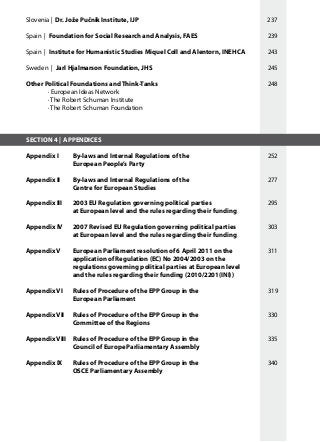
Slovenia | Dr. Jože Pučnik Institute, IJP					 237
Spain | Foundation for Social Research and Analysis, FAES				 239
Spain | Institute for Humanistic Studies Miquel Coll and Alentorn, INEHCA		 243		
Sweden | Jarl Hjalmarson Foundation, JHS						 245
Other Political Foundations and Think-Tanks						 248	
	 · European Ideas Network
	 · The Robert Schuman Institute
	 · The Robert Schuman Foundation
SECTION 4 | APPENDICES
Appendix I 	 By-laws and Internal Regulations of the 				 252
	 	 European People’s Party								
Appendix II 	 By-laws and Internal Regulations of the				 277
		 Centre for European Studies						
Appendix III 	 2003 EU Regulation governing political parties 			 295
		 at European level and the rules regarding their funding				
Appendix IV 	 2007 Revised EU Regulation governing political parties 		 303
		 at European level and the rules regarding their funding				
Appendix V 	 European Parliament resolution of 6 April 2011 on the 		 311
		 application of Regulation (EC) No 2004/2003 on the
		 regulations governing political parties at European level
		 and the rules regarding their funding (2010/2201(INI))			
Appendix VI	 Rules of Procedure of the EPP Group in the 			 319
		 European Parliament	
Appendix VII 	 Rules of Procedure of the EPP Group in the		 		 330
		 Committee of the Regions								
		
Appendix VIII	 Rules of Procedure of the EPP Group in the 				 335
		 Council of Europe Parliamentary Assembly						
		
Appendix IX 	 Rules of Procedure of the EPP Group in the				 340
		 OSCE Parliamentary Assembly
– THE EUROPEAN PEOPLE’S PARTY –
01
SectionTHE EUROPEAN PEOPLE’S PARTY
1,
– THE EUROPEAN PEOPLE’S PARTY –
02
1– THE EUROPEAN PEOPLE’S PARTY –
03
The EPP today
The European People’s Party (EPP) is the political family of the
centre-right, whose roots run deep in the history and civilisation
of the European continent and has pioneered the European pro-
ject from its inception. Tracing back its roots to Europe’s Found-
ing Fathers – Robert SCHUMAN, Alcide DE GASPERI, and Konrad
ADENAUER - the EPP is committed to a strong Europe, based on a
federal model that relies on the principle of subsidiarity.
Founded in 1976, the EPP is a party of values, based on the Chris-
tian view of mankind and the Christian democratic concept of so-
ciety. The EPP strives for a democratic, transparent and efficient
Europe that is close to its citizens. Through the promotion of the
social market economy, the EPP aspires to achieve a prosperous
Europe. The EPP is the largest political party in Europe with 74
member-parties from 40 countries, 23 heads of state and govern-
ment (16 EU and 7 non-EU), 13 European Commissioners, and the
largest group in the European Parliament with 271 members.
The EPP leads the European Commission with José Manuel BAR-
ROSO and the European Council with Herman VAN ROMPUY, who
was re-elected on 1st March 2012 for another 2½ year mandate.
The EPP is governed under the 2003 “EU Regulation on political
parties at European level and the rules regarding their funding“. In
late 2007, this Regulation was revised in order to allow European
level political parties to campaign for the European Parliament
elections. As a result of this mandate, the EPP conducted – in close
cooperation with its national member-parties - its first European-
wide campaign for the June 2009 elections and reinforced its
leading position in the European Parliament.
On16th-18thOctober2012,attheinvitationoftheDemocraticLibe-
ral Party (PD-L) and the Democratic Union of Hungarians in Romania
(UDMR) as well as Romanian President Traian BĂSESCU, the EPP will
hold its XXI Congress in Bucharest, Romania.The Congress will renew
the party‘s Basic Programme and will elect its leadership.
– THE EUROPEAN PEOPLE’S PARTY –
04
1– THE EUROPEAN PEOPLE’S PARTY –
05
– THE EUROPEAN PEOPLE’S PARTY –
06
Political formations of the centre-right can
be traced back to the early 1920s. Unlike the
case of the Socialists, Christian Democratic and
Conservative pan-European cooperation was
the child of national parties and derived from
a federal tradition.
The experiences of the First World War and the
threat of fascism led to the conviction among
leaders that overcoming nationalism was a
precondition for preserving peace. The first
attempt at cooperation between like-minded
Christian Democrats was made in 1926, when
the International Secretariat of Democratic Par-
ties of Christian Inspiration (Secrétariat interna-
tional des partis démocratiques d’inspiration
chrétienne, SIPDIC) was founded.
However, fascism increased tensions between
European governments, and the spirit of re-
venge and the dictators’obsession with power
all eventually brought to an end cooperation
among the Christian Democratic parties and
led finally to the outbreak of the Second World
War.
The lessons and experiences of cooperation
between 1925 and 1939 were key when lea-
ders of the re-established or newly founded
Christian Democratic parties in Europe formed
the Nouvelles équipes internationales (NEI) in
1946. The ecumenical elements were decisive:
reconstruction and reconciliation were born
amidst the ruins of the nation states, as was the
vision of a united continent in the future.
Christian Democratic parties were banned in
Central and Eastern Europe once communist
rule was imposed. In July 1950, the exiled re-
presentatives of these parties established the
Christian Democratic Union of Central Europe
(CDUCE). Their political, journalistic and lob-
bying activity was focused mainly on fighting
Communism, attacking the Soviet Union and
eventually liberating and democratising their
countries. Moreover, political refugees in Latin
EPP History
America contributed to the establishment of
the intercontinental network.
From the middle of the 1950s onwards the NEI
lost its relevance. With the European Coal and
Steel Community and the establishment of the
European Economic Community (EEC), practi-
cal cooperation among Christian democrats
gradually shifted in favour of the framework
presented by the Common Assembly and the
European Parliament. The organisation revi-
talised itself by changing its name to the Eu-
ropean Union of Christian Democrats (EUCD)
and revising the key aims of the organisation.
The EUCD forged a closer relationship with the
parliamentary group of European Christian
Democrats and national member parties, and
steadily grew more ambitious in its vision for
Europe.
With the decision to organise direct elections
for the European Parliament in 1979, the need
for a truly European party became evident. The
formal establishment of the European People’s
Party (EPP) took place in 1976 in Luxembourg,
with member parties from the following EEC
countries: Belgium, France, Germany, Ireland,
Italy, Luxembourg and the Netherlands. The
platform was the result of considerable con-
sensus and expressed a common intention to
promote integration in the context of the Euro-
pean Community, leading to a political union
equipped with federal and democratic institu-
tions.
Once the EPP was founded, pressure to estab-
lish formal links between Christian Democratic
and Conservative forces was exerted by EUCD
parties in countries that were not European
Community members. Yet the EPP’s strong in-
sistence on the federal model of European in-
tegration led to the formation of the European
Democratic Union (EDU), a broader pan-Euro-
pean organisation. Thus, three parallel political
organisations of Christian Democrats and Con-
servatives were now in place.
However, the EPP soon politically outweighed
the EUCD, and the members who also belon-
ged to the EPP concentrated more and more
1– THE EUROPEAN PEOPLE’S PARTY –
07
on the work of the latter organisation. The
issue of merging the two organisations re-
surfaced when Spain and Portugal joined the
European Community in 1986, but the revo-
lutionary events which took place in Moscow
and in other Eastern European capitals delayed
the idea of a “big” EPP.  Moreover, the EUCD’s
loose framework was better suited to deal
with totalitarianism in Eastern Europe; in fact,
the organisation played an important role in
supporting democratic activism and shaping
the political landscape in the post-communist
countries.
The political upheavals in 1989 meant that
previous positions taken by the EPP had to be
rethought and reformulated. The international
context had been altered with the fall of the
Berlin Wall and the end of the ideological con-
flict between East and West. And it was clear
that the population of the German Democratic
Republic wanted unification with the Federal
Republic, as well as democracy. At the same
time public opinion had shifted: the change
enshrined in the Maastricht Treaty meant a po-
litical redefinition of Europe.
In April 1991, party and government leaders of
the EPP decided that, while the Party would be
open to the British and Nordic Conservative par-
ties, Christian Democracy would be preserved
as the cornerstone of EPP identity. The EPP nee-
ded to integrate like-minded forces in order to
achieve the majority needed to make its policies
a reality. Although Greece’s Nea Demokratia had
already been admitted in 1983, in the early 1990s
like-minded parties from Spain and the Nordic
countries were included under the committed
leadership of EPP PresidentWilfried Martens.
With the prospect of Central and Eastern Eu-
ropean countries joining the European Union
(EU), the previous arguments for preserving
the EUCD membership lost relevance – this
led to the merger of the EUCD with the EPP in
1999. And since the EPP had accepted most Eu-
ropean Conservative parties from the EU and
beyond, the EDU also lost relevance, leading to
its merger with the EPP in 2002. The enlarge-
ment of the EPP reflected that of the EU itself;
the inclusion of centre-right parties from acces-
sion countries in Central and Eastern Europe pro-
ved to be particularly successful. The new mem-
bers brought an additional political dimension to
the EPP and consolidated it as the pre-eminent
European force of the centre-right.
Chronology
1925 – 1975
1925 First international congress of Christian
(Catholic) people’s parties (December, Paris).
It was agreed to hold further meetings and
to establish the “Secrétariat international des
partis démocratiques d‘inspiration chrétienne”
(SIPDIC) in Paris; the Secretariat continued to
exist until 1939. Parties from Belgium, Germa-
ny, Italy, France, the Netherlands, Luxembourg,
Austria, Switzerland, Czechoslovakia, Hungary,
Spain, Portugal and Lithuania were involved in
its activities.
1946 Following the Second World War, coope-
ration between political parties at a European
level was renewed. An initiative by the Swiss
Christian Democrats led to the establishment of
the“Nouvelles équipes internationales”(NEI).
1947 Constituent Congress of the NEI in
Chaudfontaine (Belgium). The NEI pledged to
cooperate actively in the reshaping of Europe
at state, social and economic levels for peace-
ful coexistence and respect for human rights,
liberty and social progress.
1948 As an active element of the European
movement, the NEI participated in the pre-
parations for the organisation of the famous
“Congress of Europe”in The Hague.
1953 The Christian Democrat members of par-
liament of the six member states founded the
first European Group of Christian Democrats
within the parliamentary assembly of the Euro-
pean Coal and Steel Community.
– THE EUROPEAN PEOPLE’S PARTY –
08
1965 The NEI became the European Union of
Christian Democrats (EUCD). Mariano Rumor
(DC) was elected President. Leo Tindemans
(CVP) was appointed Secretary-General.
1970 Establishment of a permanent confe-
rence within the EUCD of the Presidents and
Secretaries-General of the Christian Democra-
tic Parties of the Member States of the Euro-
pean Communities.
1972 Establishment of the “Political Commit-
tee” of the Christian Democratic Parties of the
European Community with the aim of impro-
ving the coordination of European policy and
cooperation.
1973–1974 Change of leadership in the EUCD:
Kai-Uwe von Hassel (CDU) appointed President
and Arnaldo Forlani (DC) Secretary General.
1975 Establishment of a “European Party”
working group with the task of drawing up a
draft Statute for a European union of parties.
Wilfried Martens, Chairman of the CVP, and
Hans-August Lücker, Chairman of the Christian
Democratic Group in the European Parliament
were appointed as rapporteurs.
1976 – 2003
1976 The “Political Committee” unanimously
approved the statutes of the European People’s
Party (EPP) on 8 July in Luxembourg. Leo Tin-
demans was elected President of the EPP. The
following parties were the founding members:
CDU and CSU (Germany), PSC and CVP (Bel-
gium), CDS (France), Fine Gael (Ireland), DC
(Italy), CSV (Luxembourg), KPV, CHU, and ARP
(Netherlands).
1978 Congress I in Brussels adopted the politi-
cal programme of the EPP.
1979 Congress II decided on the electoral plat-
form for the first direct elections to the Euro-
pean Parliament. The EPP won 107 of the 419
seats in the elections.
1980 Congress III of the EPP in Cologne.
1981 As a result of the accession of Greece to
the European Community, the number of seats
in the European Parliament increased to 434.
The EPP Group’s share was 109 seats.
1982 Following the elections in Greece in June
1982, the number of MEPs in the EPP increased
to 117. Congress IV of the EPP in Paris.
1983 Merger of the EUCD Secretariat (hitherto
in Rome) and the EPP Secretariat in Brussels.
Thomas Jansen appointed Secretary-General
of the EPP and EUCD. Greece’s Nea Demokratia
joins the EPP.
1984 Congress V of the EPP in Rome adopted
an action programme for the second electoral
term of the European Parliament. The EPP won
110 seats at the second direct elections to the
European Parliament.
1985 Piet Bukman (CDA) elected President.
Thomas Jansen elected Secretary-General.
1986 Congress VI of the EPP at The Hague. As
a result of the accession of Spain and Portugal,
the number of seats in the European Parlia-
ment increased to a total of 518.The Portugue-
se CDS, the Spanish PDP (later renamed De-
mocracia Cristiana), the Catalan UDC and the
Basque PNV join the EPP. The size of the EPP
Group increases by nine MEPs to 119.
1987 Jacques Santer elected President. Tho-
mas Jansen re-elected Secretary General for a
second term.
1988 EPP Congress VII in Luxembourg. Adoption
of the working programme“On the People’s Side”.
1989 After the third direct election for the Eu-
ropean Parliament of June, the Spanish MEPs
of the Partido Popular join the EPP Group.
1990 Wilfried Martens elected President. Tho-
mas Jansen re-elected Secretary-General for a
third term. EPP CongressVIII in Dublin: adoption
of the EPP programme for the European Union.
1– THE EUROPEAN PEOPLE’S PARTY –
09
1991The Spanish Partido Popular joins the EPP.
Christian Democrat parties from Austria (ÖVP),
Sweden (KDS) and Malta (PN) are admitted as
associate members of the EPP.
1992 The British and Danish Conservative
MEPs (together with some French UDF MEPs)
join the EPP Group as allied members, bringing
the total to 162 Members. The EPP Basic Pro-
gramme is adopted at the EPP Congress IX in
Athens.
1993 Nordic conservative parties are admitted
to the EPP as permanent observers. The CDS
of Portugal was expelled. Wilfried Martens re-
elected President. Thomas Jansen re-elected
Secretary-General for a fourth term. The EPP
Congress X meeting in Brussels adopts the Ac-
tion Programme“Europe 2000 – Unity in diver-
sity” for the fourth parliamentary term of the
European Parliament.
1994 Following the establishment of the Com-
mittee of the Regions (CoR) as a new consul-
tative body of the European Union, the EPP
Group was formed in the CoR with approxi-
mately 85 Members under the chairmanship of
Jos Chabert, (CVP-B). The Christlichdemokrati-
sche Volkspartei (CVP) of Switzerland and the
Democratic Rally (DISY) of Cyprus are admit-
ted to the EPP as associate members. The EPP
member-parties win 125 seats in the fourth
European elections of June. The incorporation
of like-minded MEPs (British and Danish con-
servatives and French liberals) bring the total
number of EPP MEPs to 157. Klaus Welle elec-
ted Secretary-General of the EPP.
1995 The MEPs of the Kristdemokratiska Sam-
hällspartiet and Moderata Samling (Sweden),
Kansallinen Kokoomus (Finland) and the Ös-
terreichische Volkspartei (Austria) join the EPP
Group. Kansallinen Kokoomus (Finland), Mo-
derata Samlingspartiet and Kristdemokratiska
Samhällspartiet (Sweden), Det Konservative
Folkeparti (Denmark) and the Österreichische
Volkspartei (Austria) become full members of
the EPP. Høyre (Norway) accorded associate
member status. Centro Cristiano Democratico
(CCD) and Cristiani Democratici Uniti (CDU) be-
come full members of the EPP. Congress XI in
Madrid “EPP- Force of the Union”. Wilfried Mar-
tens re-elected President, Klaus Welle elected
Secretary-General. Foundation of the European
Senior Citizens Union (ESCU).
1996 Foundation of the Small and Medium
Enterprises Union of the EPP or SME-Union.
In February seven parties in the prospective
member-countries in Central and Eastern Eu-
rope are candidates for EPP observer status:
KDU/ČSL and ODS (Czech Republic), KDH and
MKDM (Slovakia), KDNP and MDF (Hungary),
PNŢCD (Romania).
1997 EPP Congress XII in Toulouse –“We are all
Part of One World”. EPP‘s youth organisation,
YEPP, established.
1999 Congress XIII in Brussels – 1999–2004 Ac-
tion Programme – “On the Way to the Twenty-
First Century”. The congress re-elects President
Wilfried Martens for another term and elects
Alejandro Agag as Secretary-General, succee-
ding Klaus Welle who, in turn, is appointed
Secretary-General of the EPP-ED Group in the
European Parliament. Merger of the EUCD in
the EPP formally concluded – EPP recognised
as a regional organisation of the Christian De-
mocrat International (CDI).
2000 EPP associate member status awarded
to Tautas Partija (Latvia), SMK-MKP (Slovakia),
US (Czech Republic), FKGP and FIDESZ – MPP
(Hungary). Merger of the Secretariat of the Eu-
ropean Democrat Union (EDU, until then in Vi-
enna) with the EPP Secretariat in Brussels.
2001 EPP Congress XIV in Berlin. Basic docu-
ment approved:“A Union ofValues”. EPP associ-
ate member status awarded to MDF, Hungary.
Full member status awarded to UDEUR, Italy
and RPR, France.
2002 Political Bureau accepted, by acclama-
tion, a proposal to replace Secretary-General
Alejandro Agag by Antonio López Istúriz. EPP
Convention Group established, following an
initiative by President Martens. EPP associate
member status awarded to EVP (Switzerland)
– THE EUROPEAN PEOPLE’S PARTY –
10
and KDH (Slovakia). EPP observer member
status awarded to SDKU of (Slovakia). Octo-
ber: Congress XV in Estoril, Portugal. Congress
approves “A Constitution for a Strong Europe”.
Merger of the EDU in the EPP formally concluded.
2003 – 2012
2003 In November, the EPP, as well as other Eu-
ropean level parties, receive formal recogniti-
on by the European institutions, following the
approval of “EU Regulation governing political
parties at European level and the rules regar-
ding their funding”.
2004 XVI Congress in Brussels where the “Ac-
tion Programme 2004–2009”for the June 2004
elections is approved. Following the accession
of ten new EU Member States, all EPP associate
member-parties from these countries become
full members. In the first European elections,
the EPP is victorious.The EPP-ED Group is, once
again, the largest in the European Parliament
with 268 MEPs. As a result of this victory, the
EPP succeeds in the nomination of José Manu-
el Barroso by the European Council as the new
President of the European Commission. HDZ
of Croatia upgraded from observer to associa-
te member. Observer membership granted to
three Bosnian parties: the PDP, the SDA, and
the HDZBiH.
2005 Observer membership granted to the
Turkish AK Party, and to Ukraine’s“Our Ukraine”
bloc. EPP President Wilfried Martens receives
from the former German Chancellor Helmut
Kohl the “Helmut-Kohl-Ehrennadel in Gold” di-
stinction (Helmut-Kohl-honorary golden need-
le) for his exceptional services to Europe. EPP
launches its academic journal European View.
Observer membership is granted to PD Romania.
2006 XVII Congress in Rome on 30th and 31st
March – EPP adopts manifesto “The Citizens
and Europe: Clear Priorities for a Better Europe”.
PresidentWilfried Martens and Secretary Gene-
ral Antonio López Istúriz are re-elected. In Sep-
tember, the EPP moved to its new headquar-
ters, which better suited the Party’s needs and
objectives. US Senator John McCain addresses
EPP event in Brussels on transatlantic relations.
Two Belarusian parties are granted observer
membership – the Belarusan Popular Front
and the United Civil Party. Romanian PD is up-
graded from observer to associate member.
2007 With the accession of Romania and Bul-
garia, the respective parties are upgraded
to full member status: PD, RMDSZ and PNŢCD
(Romania) and DSB, UDF, BANU-PU and DP
(Bulgaria). The Hungarian KDNP becomes a full
member, and the VMRO-DPMNE from the For-
mer Yugoslav Republic of Macedonia (FYROM),
becomes an observer. HSS of Croatia upgraded
from observer to associate member. Amend-
ment of the “EU Regulation governing political
parties at European level and the rules regar-
ding their funding”, mandates the EPP and all
European parties to campaign for the European
elections. It also allows the creation of political
foundations linked to political parties. The Cen-
tre for European Studies (CES) established as the
official think-tank/foundation of the EPP.
2008 GERB, Bulgaria becomes a full member,
Batkivshchyna, Ukraine becomes an observer
member. EPP recognised as a regional union
by the International Democrat Union (IDU).
UNM Georgia accepted as observer member.
2009 XVIII Congress in Warsaw adopted the
Manifesto “Strong for the People“. EPP emer-
ged as the strongest political party after the
European Parliament Elections. José Manu-
el Barroso is re-elected for a second term as
Commission President. CDS-PP Portugal and
PdL Italy became full members. MDF Hungary
membership suspended. XIX Congress in Bonn
approved the document “The Social Market
Economy in a globalised world“ and re-elected
Wilfried Martens as President and Antonio Ló-
pez-Istúriz as Secretary General.
2010 On 1st January former Belgian Prime Mi-
nister and EPP candidate, HermanVan Rompuy,
becomes the first President of the European
Council. Civic Union of Latvia is granted full
membership. VMRO-DPMNE upgraded to
associate member.
1– THE EUROPEAN PEOPLE’S PARTY –
11
EPP Presidents
· TINDEMANS, Leo	 1976-1985
· BUCKMAN, Piet 	 1985-1987
· SANTER, Jacques	 1987-1990
· MARTENS, Wilfried 	 1990-
Honorary Presidents
· NIINISTÖ, Sauli
· TINDEMANS, Leo
EPP Congresses
1978 Congress I held in Brussels adopted the
EPP’s political program.
1979 Congress II also in Brussels, decided the
electoral platform for the first direct elections
to the European Parliament.
1980 Congress III in Cologne discussed the
overall theme “The Christian democrats in the
Eighties – Securing Freedom and Peace Com-
pleting Europe”.
1982 Congress IV took place in Paris under the
slogan “Preserve Peace – Create Peace – Unite
Europe”.
1984 Congress V in Rome formulated the EPP
Action Program
1986 Congress VI in the Hague focused on
Economic Development and Environmental
Problems.
1988 Congress VII in Luxembourg prepared
for another European Election and approved
the document“On the Side of the Citizens”.
1990 CongressVIII in Dublin faced a new poli-
tical landscape and published“A Federal Cons-
titution for the European Union”.
1992CongressIXinAthensdiscussed,drafted,
and approved the EPP“Basic Programme“.
1993 Congress X was held in Brussels and ad-
opted the action program,“Europe 2000: Unity
in Diversity”.
1995 Congress XI in Madrid was hosted under
the thematic slogan“EPP- Force of the Union“.
1997 Congress XII in Toulouse approved the
document“We are all Part of One World“.
1999 Congress XIII in Brussels outlined its new
vision for Europe,“On the Way to the 21st Cen-
tury“. EUCD formally merged with EPP.
2001 Congress XIV in Berlin revisited its roots,
and adopted the working document “A Union
of Values“.
2002 Congress XV in Estoril prepared for the
Constitution process, and declared that EU
needed “A Constitution for a Strong Europe“.
EDU fomally merged with EPP.
2011 In February, TOP09 party from the
Czech Republic granted full membership
andMoldova’sPLDMpartygrantedobserver
membership. In April, Marietta Giannakou’s
Report on improving the legal status of EU-
level political parties, approved in the Eu-
ropean Parliament. On the sidelines of the
June EPP Summit, the EPP hosted a special
event to celebrate its 35th anniversary. The
XX Congress in Marseille approved the do-
cument “Moving Europe Forward“.
2012 On 4th February the EPP Honorary Presi-
dent, Sauli Niinistö, is elected President of Fin-
land. In February three Armenian parties, the
Republican Party, Rule of Law and Heritage are
granted observer member status. On March 1st
Herman Van Rompuy was re-elected President
of the European Council for another 2.5 year
mandate. On 16th -18th October 2012 the EPP
will hold its XXI Congress in Bucharest, Roma-
nia.
2004 Congress XVI in Brussels where the main
objective was to prepare for the European Elec-
tions. The“Action Program 2004-2009“ was ap-
proved.
2006 Congress XVII in Rome approved the
“Rome Manifesto”document.
2009 Congress XVIII in Warsaw approved the
“Strong for the People“ EPP Election Manifesto.
2009 Congress XIX in Bonn approved the do-
cument “The Social Market Economy in a Glo-
balised World“.
2011CongressXX in Marseille approved the
document “Moving Europe Forward“.
2012 Congress XXI to be held in Bucharest,
Romania on 16th-18th October.
– THE EUROPEAN PEOPLE’S PARTY –
12
EPP Structure
Presidency, Political Assembly
and Congress
The EPP is led by President Wilfried MARTENS,
former Prime Minister of Belgium, the Secre-
tary General, 10 Vice Presidents and the Trea-
surer. The Secretary General Antonio LÓPEZ-
ISTÚRIZ runs the day to day operations of the
Party.
The EPP has three levels of decision-making:
Presidency, Political Assembly and Congress.
EPP heads of state and government can give
policy recommendations at the level of the EPP
Summit, whereas EPPWorking Groups perform
preparatory political work.
The Presidency decides on the general politi-
cal guidelines and presides over the Political
Assembly. The Presidency is composed of the
President, the Secretary General, 10 Vice-Presi-
dents, and the Treasurer. The Chairman of the
EPP Group in the European Parliament is ex
officio Vice President of the EPP. Currently, the
Presidents of the European Commission and
European Council are also ex officio members
of the EPP Presidency.
The Political Assembly defines the political
positions of the Party between Congresses,
decides on membership applications and fi-
nal political guidelines. The Political Assembly
also decides on the budget and safeguards the
political presence of the EPP between the Con-
gress meetings. The Political Assembly is com-
posed of the designated delegates of the EPP
member-parties, associated member-parties,
parliamentary groups and member-associa-
tions of the EPP.
The number of delegates for each party is linked
to the election result in the last European elec-
tions so that parties are weighted according to
their strength. This allows for taking decisions
by majority. The Political Assembly meets three
to four times a year. The Political Assembly defi-
nes the mandate of the Working Groups which
prepare the Party’s policy documents and re-
commendations. All member-parties and asso-
ciated member-parties and members of the EPP
Group in the European Parliament can partici-
pate in the Working Groups.
The Congress is the highest decision-making
body of the Party. It is composed of delegates
from EPP member-parties, associate member-
parties, member associations, and parliamen-
tary groups. The EPP Congress meets at least
once every three years. It elects the EPP Presiden-
cy and decides on the main policy documents,
electoral programmes and hosts the EPP heads
of state and government and party leaders.
For more information on the EPP, please visit:
www.epp.eu
EPP PRESIDENCY
President
· MARTENS, Wilfried
Secretary General
· LÓPEZ-ISTÚRIZ, Antonio
Vice Presidents
· BARNIER, Michel
· DAVID, Mário
· HINTZE, Peter
· JELEVA, Rumiana
· KATAINEN, Jyrki
· KENNY, Enda
· ORBÁN, Viktor
· SARYUSZ-WOLSKI, Jacek
· TAJANI, Antonio
· WORTMANN-KOOL, Corien
· BARROSO, José Manuel (e.o.)
· VAN ROMPUY, Herman (e.o.)
· DAUL, Joseph (e.o.)
Who is Who in the EPP
1– THE EUROPEAN PEOPLE’S PARTY –
13
– THE EUROPEAN PEOPLE’S PARTY –
14
EPP SECRETARIAT
Secretary General
· LÓPEZ-ISTÚRIZ, Antonio
alopez@epp.eu
Deputies Secretary General
· KREMER, Christian
ckremer@epp.eu
· VANDEPUTTE, Luc
lvandeputte@epp.eu
Spokesman
· SASMATZOGLOU, Kostas
spokesman@epp.eu
Secretary of External Relations
· BRIEC, Nicolas
nbriec@epp.eu
Officials and Personnel
· FURNIERE, Brenda
Head of the President‘s Office,
bfurniere@epp.eu
· FARRIS, Emanuala
Senior Political Adviser,
efarris@epp.eu
· JIMENEZ, Javier
Senior Press and Communication Officer,
jjimenez@epp.eu
· DURSIN, Mélanie
Political Adviser,
mdursin@epp.eu
· FOMENCHENKO, Galina
Political Adviser,
gfomenchenko@epp.eu
· MAGAZ, Juan
Political Adviser,
jmagaz@epp.eu
· PRAINSACK, Ines
Political Adviser,
iprainsack@epp.eu
· MURESAN, Siegfried
Political Adviser,
smuresan@epp.eu
· MILHEIRO, Karine
Press and Communication Officer,
kmilheiro@epp.eu
· DE ANTA, Beatriz
Assistant to the Secretary General
Antonio López-Istúriz,
bdeanta@epp.eu
· HELBIG, Christopher
Assistant to Deputy Secretary General
Christian Kremer,
chelbig@epp.eu
· LAMAL, Daphné
Assistant to Deputy Secretary General
Luc Vandeputte,
dlamal@epp.eu
· HEYMANS-ŠPAČKOVÁ, Pavlína
Assistant to the Spokesman
Kostas Sasmatzoglou,
pheymans@epp.eu
· ZALUTSKAJA, Julia
Assistant to the Secretary of External Relations
Nicolas Briec,
jzalutskaja@epp.eu
· TORRES, Yelba
Working Groups and Ministerial Meetings,
ytorres@epp.eu
Treasurer
· FRIEDRICH, Ingo
1– THE EUROPEAN PEOPLE’S PARTY –
15
· DUTTON, Lisa
Assistant to the President‘s Office
ldutton@epp.eu
· PAEME, Sophie
General Administration and Logistics,
spaeme@epp.eu
· VOLCKAERT, Guy
Manager of Informatics & Internet,
gvolckaert@epp.eu
Working Groups are the backbone of the EPP’s
political work, where high-profile representati-
vesfromtheEPPmember-partiesdevelopcom-
mon positions and strategies on major policy
areas and submit specific recommendations to
the Political Assembly for final approval. AWor-
king Group can be given a specific mandate for
preparatory work for EPP Summits and the EPP
Congress. Working Groups are also responsible
for organising conferences, roundtable discus-
sions and other events.
European Policy
Chaired by the EPP President Wilfried MARTENS
togetherwithEPPVicePresidentPeterHINTZE,the
Working Group has the task of preparing the EPP’s
mostvitalpolicypapersandCongressdocuments.
Economic and Social Policy
The working group, co-chaired by Gunnar
HÖKMARK and Rumiana JELEVA, EPP Vice-
President, is focused on responding to the cur-
rent economic and financial crisis, the Lisbon
process, demographic issues, and research and
development.
EPP Membership
Chaired by Corien WORTMANN-KOOL, EPP
Vice President, this Working Group is respon-
sible for promoting, facilitating and incorpo-
rating new EPP members, associate members,
and observers throughout the continent.When
a party is accepted into the EPP, its elected re-
presentatives automatically join the EPP Group
in the European Parliament, and all other EPP
Groups in other institutional and organisatio-
nal formations.
Ad hoc Working Groups
1) Common Agricultural Policy
2) Climate Change
Campaign Managers Meeting
The EPP organises meetings twice a year with
the campaign managers of member-parties
to review national and regional election cam-
paigns and in order to exchange experiences,
develop different strategies and analyse com-
munication tactics.
At the Summit of the EPP, heads of state and
government, party leaders in coalition govern-
ments and in opposition, the EPP Presidency
and the Presidents of the European Council and
Commission, meet regularly prior to the Euro-
pean Council Summit. These important sessions
offer EPP leaders - in an informal and confidential
setting - the opportunity to air differences and
seek consensus within the EPP family in an effort
to formulate common positions at the European
Council.
The EPP has 16 out of the 27 heads of state and
governmentintheEuropeanCouncilaswellasse-
ven non-EU heads of state and government that
participate as guests at the enlaged EPP Summit.
It also has seven heads of state and government
who originate from EPP member-parties and do
not normally take part in the European Council:
EPP Working Groups
EPP in the European Council
– EPP Summit
– THE EUROPEAN PEOPLE’S PARTY –
16
AníbalCAVACOSILVA(Portugal,PSD),Bronislaw
KOMOROWSKI (Poland, PO), Sauli NIINISTÖ
(Finland, KOK), Rosen PLEVNELIEV (Bulgaria,
GERB), and François FILLON (France, UMP). On
the 19th November 2009 the European Council
decided unanimously to appoint the then Bel-
gian Prime Minister Herman VAN ROMPUY as
the first ever President of the European Coun-
cil. He was re-elected on 1st March 2012.
President of the European Council
· VAN ROMPUY, Herman | Belgium, CD&V
EU Heads of State and Government
· BĂSESCU, Traian | Romania, PD-L
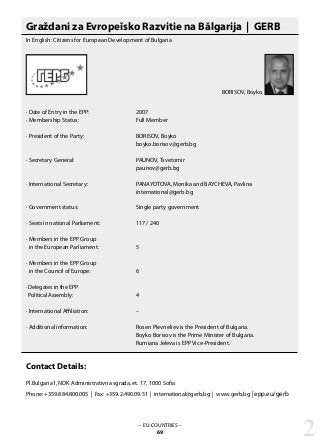
· BORISOV, Boyko | Bulgaria, GERB
· DOMBROVSKIS, Valdis | Latvia, JL
· GONZI, Lawrence | Malta, PN
· JANŠA, Janez | Slovenia, SDS
· JUNCKER, Jean-Claude | Luxembourg, CSV
· KATAINEN, Jyrki | Finland, KOK
· KENNY, Enda | Ireland, FG
· KUBILIUS, Andrius | Lithuania, TS-LKD
· MERKEL, Angela | Germany, CDU
· ORBÁN, Viktor | Hungary, FIDESZ
· PASSOS COELHO, Pedro | Portugal, PSD
· RAJOY, Mariano | Spain, PP
· REINFELDT, Fredrik | Sweden, M
· SARKOZY, Nicolas | France, UMP
· TUSK, Donald | Poland, PO
Non-EUHeadsof StateandGovernment
· BERISHA, Sali | Albania, DP
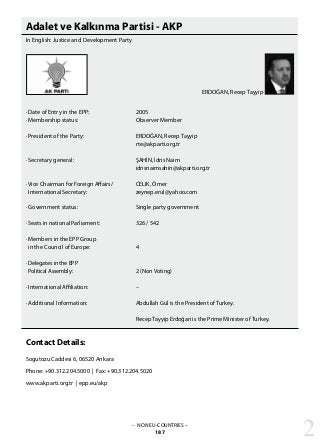
· ERDOĞAN, Recep Tayyip | Turkey, AKP
· IZETBEGOVIĆ, Bakir | Bosnia and Herzegovina, SDA
· FILAT, Vlad | Moldova, PLDM
· GRUEVSKI, Nikola | Former Yugoslav Republic
		 of Macedonia ,VMRO-DPMNE
· SAAKASHVILI, Mikheil | Georgia, UNM
· SARGSYAN, Serzh | Armenia, HHK
The European People’s Party organises and
coordinates a total of twelve Ministerial
meetings ahead of the Council meetings
from its Brussels headquarters.
The EPP Ministerial meetings underpin the
horizontal activity of the Party with all the
main EU institutions including the Council
of the EU.
Economic and Financial Affairs
Since February 2008, this political coordina-
tion meeting has quickly become a valuable
discussion forum for our EPP Ministers, es-
pecially in view of the difficult decisions that
were needed in the Eurozone member coun-
tries in the aftermath of the financial crisis.
Under the leadership of Christine LAGARDE
(France), Jyrki KATAINEN (Finland), and
Giulio TREMONTI (Italy) to begin with, and
subsequently under the guidance of Luc
FRIEDEN (Luxemburg) and Anders BORG
(Sweden), the ministers discussed measures
to safeguard financial stability in the Euro
area, the future of the European Stability
Mechanism (ESM), the legislative package
on strengthened economic governance (“six
pack”), the fiscal compact and possible Tre-
aty changes to strengthen the Stability and
Growth Pact.
Home Affairs
The EPP Ministerial Meetings on Home Affairs
are chaired by the German Minister of Inte-
rior Hans-Peter FRIEDRICH and Manfred
WEBER, MEP. In September 2011 the Ministers
adopted the EPP position on Cyber Security
and, furthermore, prepared the resolution on
“Immigration and Integration”, which was ad-
opted at the EPP Congress in Marseille in De-
cember 2011. In addition, the Arab Spring and
EPP in the Council of the EU
– EPP Ministerial Meetings
1– THE EUROPEAN PEOPLE’S PARTY –
17
related migration flows, as well as the Schen-
genenlargementtoBulgariaandRomania,were
high on the agenda during these meetings.
Justice
The EPP Justice Ministers Meetings were or-
ganised for the first time in spring 2011. These
meetings were chaired by the Vice President
oftheEuropeanCommission, VivianeREDING
and Angelino ALFANO from Italy, followed
later by Beatrice ASK from Sweden. During
these meetings the Ministers adopted posi-
tions on European Contract Law, Data Protec-
tion, Collective Redress and EU Criminal Law.
The focus was on “justice for growth” in order
to abolish barriers and to achieve the full po-
tential of the internal market.
Foreign Affairs
EPP Foreign Ministers convene on a regular
basis and discuss issues such as the Western
Balkans, the Eastern Partnership, Mediter-
ranean Union, Middle East, Iran and Afgha-
nistan. In 2011, under the co-chairmanships
of Elmar BROK and Franco FRATTINI, the
EPP organised two seminars in Sarajevo (17th
March) and in Bordeaux (30th October – 1st
September) with its Foreign Ministers and
with the participation of EPP and like-minded
non-EU Foreign Ministers. A position paper
on EU-Russia relations was approved by the
EPP Foreign Ministers and introduced to the
EPP Political Assembly with the aim of contri-
buting to a new and enhanced strategic part-
nership between the EU and Russia.
Environment
The EPP Environment Ministers Meeting is
chaired by the Irish Minister Phil HOGAN. The
focus of these meetings in 2011 was on the Glo-
bal Climate Change negotiations, which took
place in December in Durban, South Africa.
Other important topics were the EU Biodiversity
Strategy, the EU Roadmap to a low carbon eco-
nomy by 2050 and the water policy for the EU.
Agriculture
The EPP Agriculture Ministers Meeting is
chaired by Niki BERLAKOVICH, the Austrian
Minister of Agriculture and Forestry, Environ-
ment and Water Management. During the
course of the year the Agriculture Ministers
had a very dynamic and constructive debate
on the future of the Common Agriculture Po-
licy. EU Commissioner for Agriculture, Dacian
CIOLOŞ, actively participated in the discus-
sions and during the October 2011 meeting
presented new proposals to the Ministers on
the CAP reform, which dominated the agenda
at the end of 2011 and will remain the main
topic for 2012.
Energy
The EPP Energy Ministers Meeting is chaired
by EPP Vice President and MEP, Jacek
SARYUSZ-WOLSKI. In September 2011, EU
Commissioner Günther OETTINGER, who
actively participates in the EPP meetings,
launched new initiatives on the external ener-
gy policy as well as on infrastructure. During
the meeting on 23rd November, EU Commis-
sioner Janusz LEWANDOWSKI was invited
as the special guest and informed Ministers
about the financing of the EU’s energy infra-
structure.
Defense
The EPP Defence Ministers’ Meetings, chaired
by Belgian Minister of Defence Pieter DE
CREM and launched in 2009, continued suc-
cessfully in 2011 (23rd May in Brussels and
22nd September in Wrocław, Poland). On the
one hand, the meetings were important as a
useful forum to discuss the EU’s engagement
in Libya. Whilst on the other hand, the Mini-
sters were able to use the meetings to concen-
trate on pooling and sharing expertise in the
field of military capabilities as well as CSDP
– THE EUROPEAN PEOPLE’S PARTY –
18
Operations (i.e. EUNAVFOR Atalanta, EUFOR
Althea in BiH).
Employment
As a natural reaction to the economic and so-
cial effects of the financial crisis in Europe, the
Ministers of Employment and Social Affairs of
the EPP member parties started to meet in
March 2010, under the chairmanship of Enda
KENNY (Ireland) and Maurizio SACCONI (Ita-
ly). During 2011, as unemployment levels in
Europe continued to rise in many countries,
the EPP Ministers focused their discussions
on the EU2020 Strategy for growth and em-
ployment, on the preparations of the social
agenda of the G-20, and on the Working Time
Directive and the European Globalisation Ad-
justment Fund. In September 2011, Xavier
BERTRAND (France) took over leadership and
during the French G-20 Presidency organised
a meeting with EPP and like-minded Emplo-
yment Ministers in Paris. Moreover, the EPP
Employment Ministers drafted a resolution on
“Job Creation: A Priority for Growth Policies”,
which was approved in Marseille during the
EPP Political Assembly (7th-8th December). In
early 2012, Ursula von der LEYEN (Germany)
agreed to co-chair the EPP Employment Mini-
sters‘ group.
Industry
Under the continued chairmanship of Antonio
TAJANI, Vice President of the European Com-
mission and the EPP, the Ministers worked to
find common solutions on topics such as the
current competitiveness levels of industrial
output across the EU and how to increase it.
Furthermore, they focused on the mid-term
review of the Small Business Act in order to
improve conditions for the small and medium
enterprises in Europe. Finally, they also had
extensive exchanges of views on the Annual
Growth Survey and the Europe 2020 Strategy,
assessing the contribution of the industrial
sector to the EU Semester.
Transport
2011 was a particularly important year to dis-
cuss the state-of-play of the transport sector
in Europe. Under the chairmanship of Anca
BOAGIU (Romania), many issues were ana-
lysed and discussed, such as the revision of
the TEN-T policies (financing and methodo-
logy), the establishment of a truly European
maritime Safety Agency and the Commission
White Paper on the future of the EU transport
policy until 2020. Finally, the issue of public-
private partnerships (PPPs) was debated ex-
tensively by the EPP Transport Ministers, resul-
ting in the drafting of a resolution on how to
improve access to financing for PPP projects
in the transport sector. In November 2011, the
EPP Political Assembly adopted the PPP reso-
lution. Finally, in 2012, Alexandru NAZARE
(Romania) took over the leadership of this Mi-
nisterial group.
General Affairs
The EPP General Affairs Ministers’ meeting is
co-chaired by Lucinda CREIGHTON, Minister
of State for European Affairs and TD (Ireland),
and Jacek SARYUSZ-WOLSKI, EPP Vice Presi-
dent and MEP (Poland). This Ministerial mee-
ting provides a platform for EPP Ministers to
discuss upfront the issues on the EU General
Affairs Council, formulate priorities and deve-
lop an EPP common approach. 13 European
and Foreign Affairs Ministers met for the first
time in February 2012 and discussed a series
of measures that will enable economic growth
and jobs’ creation.
1– THE EUROPEAN PEOPLE’S PARTY –
19
President
· BARROSO, José Manuel | Portugal, PSD
jose-manuel.barroso@ec.europa.eu
Vice Presidents
· REDING, Viviane | Luxembourg, CSV
Justice, Fundamental Rights and Citizenship
viviane.reding@ec.europa.eu
· TAJANI, Antonio | Italy, PdL
Industry and Entrepreneurship
antonio.tajani@ec.europa.eu
Members
	
· BARNIER, Michel | France, UMP
Internal Market and Services
michel.barnier@ec.europa.eu
The European People’s Party has always played
an important role in the European Commission,
the executive arm of the EU that implements
the Union‘s policies. With José Manuel BAR-
ROSO – a long-standing leader of the EPP fa-
mily – at the helm, the Barroso II Commission
brings vitality and dynamism to EU policy ma-
king.
The Commission has a total of 13 Members that
are affiliated to the EPP. The EPP Commissioners
meet on an ad hoc basis in the Party headquar-
ters and many Commissioners participate regu-
larly in the EPP Ministerial meetings. President
José Manuel BARROSO, an ex officio member
of the EPP Presidency, also participates at the
EPP Summit meetings.
EPP in the European
Commission
· CIOLOŞ, Dacian | Romania
Agriculture and Rural Development
dacian.ciolos@ec.europa.eu
· DALLI, John | Malta, PN
Health and Consumer Policy
john.dalli@ec.europa.eu
· HAHN, Johannes | Austria, ÖVP
Regional Policy
johannes.hahn@ec.europa.eu
· HEDEGAARD, Connie | Denmark, DKF
Climate Action
connie.hedegaard@ec.europa.eu
· GEORGIEVA, Kristalina | Bulgaria
International Cooperation, Humanitarian Aid
and Crisis Response
kristalina.georgieva@ec.europa.eu
· LEWANDOWSKI, Janusz | Poland, PO
Budget and Financial Programming
janusz.lewandowski@ec.europa.eu
· OETTINGER, Günther | Germany, CDU
Energy
gunther.oettinger@ec.europa.eu
· PIEBALGS, Andris | Latvia
Development
andris.piebalgs@ec.europa.eu
· ŠEMETA, Algirdas | Lithuania, TS-LKD
Taxation and Customs Union, Audit and Anti-Fraud
algirdas.semeta@ec.europa.eu
For more information on the European Com-
mission, please visit: www.ec.europa.eu
– THE EUROPEAN PEOPLE’S PARTY –
20
The EPP Group has been the largest political
group in the European Parliament since July
1999. 271 Members of the European Parliament
(MEPs) sit in the EPP Group, representing some
36 per cent of the total. The Group is led by
French politician Joseph DAUL who is ex officio
member of the EPP Presidency and participa-
tes regularly at the EPP Summit meetings. The
Group strives to advance the goal of a more
competitive and democratic Europe, closer to
its citizens and to resist the political priorities of
the left.
Originally founded in June 1953 as the Chris-
tian Democrat Group in the embryonic Com-
mon Assembly of the European Coal and Steel
Community (comprised of nominated mem-
bers of national parliaments), the EPP Group
has been involved at every stage in the history
of the European Union, from its earliest begin-
nings until the present.
As the largest political group in the European
Parliament, the EPP Group is in a stronger po-
sition than any other to set that body‘s political
agenda and to win its most critical votes. In see-
king to maximise its influence, the EPP Group
has been able to draw on the fact that the Eu-
ropean Parliament has become increasingly
influential within the European Union. In July
2009 the European Parliament overwhelmingly
elected as its President the former Polish Prime
Minister and EPP candidate Jerzy Buzek for a
2½ year term. He completed his term in Janu-
ary 2012.
Vice-Presidents of the EP
· VIDAL-QUADRAS, Alejo
alejo.vidal-quadras@europarl.europa.eu
· PAPASTAMKOS, Georgios
georgios.papastamkos@europarl.europa.eu
EPP in the
European Parliament
· ANGELILLI, Roberta
roberta.angelilli@europarl.europa.eu
· KARAS, Othmar
othmar.karas@europarl.europa.eu
· WIELAND, Rainer
rainer.wieland@europarl.europa.eu
· PROTASIEWICZ, Jacek
jacek.protasiewicz@europarl.europa.eu
· SURJÁN, László
laszlo.surjan@europarl.europa.eu
Quaestors of the EP
· LULLING, Astrid
astrid.lulling@europarl.europa.eu
· HIGGINS, Jim
jim.higgins@europarl.europa.eu
Presidency of the EPP Group
Chairman:
· DAUL, Joseph
joseph.daul@europarl.europa.eu
Vice-Chairmen:
· BONSIGNORE, Vito
vito.bonsignore@europarl.europa.eu
· HÖKMARK, Gunnar
gunnar.hokmark@europarl.europa.eu
· KASOULIDES, Ioannis
ioannis.kasoulides@europarl.europa.eu
· MARINESCU, Marian-Jean
marian-jean.marinescu@europarl.europa.eu
· MAYOR OREJA, Jaime
jaime.mayororeja@europarl.europa.eu
· OLBRYCHT, Jan
jan.olbrycht@europarl.europa.eu
1– THE EUROPEAN PEOPLE’S PARTY –
21
· RANGEL, Paulo
paulo.rangel@europarl.europa.eu
· SZÁJER, József
jozsef.szajer@europarl.europa.eu
· WEBER, Manfred
manfred.weber@europarl.europa.eu
· WORTMANN-KOOL, Corien
corien.wortmann@europarl.europa.eu
Secretary General
The staff of the EPP Group is led by Secretary General
· Martin KAMP.
martin.kamp@europarl.europa.eu
For more information on the EPP Group in the
European Parliament, please visit:
www.eppgroup.eu
Heads of national delegations
GERMANY (42 Members)
· REUL, Herbert
herbert.reul@europarl.europa.eu
· FERBER, Markus
markus.ferber@europarl.europa.eu
ITALY (35 Members)
· MAURO, Mario
mario.mauro@europarl.europa.eu
· GARGANI, Giuseppe
giuseppe.gragani@europarl.europa.eu
FRANCE (30 Members)
· AUDY, Jean-Pierre
jean-pierre.audy@europarl.europa.eu
POLAND (29 Members)
· SARYUSZ-WOLSKI, Jacek
jacek.saryusz-wolski@europarl.europa.eu
SPAIN (25 Members)
· MAYOR OREJA, Jaime
jaime.mayororeja@europarl.europa.eu
HUNGARY (14 Members)
· GYÜRK, András
andras.gjurk@europarl.europa.eu
ROMANIA (14 Members)
· STOLOJAN, Theodor Dimitru
theodordimitru.stolojan@europarl.europa.eu
PORTUGAL (10 Members)
· RANGEL, Paulo
paulo.rangel@europarl.europa.eu
· MELO, Nuno
nuno.melo@europarl.europa.eu
BULGARIA (7 Members)
· KOVATCHEV, Andrey
andrey.kovatchev@europarl.europa.eu
GREECE (7 Members)
· GIANNAKOU, Marietta
marietta.giannakou@europarl.europa.eu
AUSTRIA (6 Members)
· KARAS, Othmar
othmar.karas@europarl.europa.eu
– THE EUROPEAN PEOPLE’S PARTY –
22
SLOVAKIA (6 Members)
· ZÁBORSKÁ, Anna
anna.zaborska@europarl.europa.eu
BELGIUM (5 Members)
· THYSSEN, Marianne
marianne.thyssen@europarl.europa.eu
NETHERLANDS (5 Members)
· VAN DE CAMP, Wim
wim.vandecamp@europarl.europa.eu
SWEDEN (5 Members)
· HÖKMARK, Gunnar
gunnar.hokmark@europarl.europa.eu
IRELAND (4 Members)
· MITCHELL, Gay
gay.mitchell@europarl.europa.eu
FINLAND (4 Members)
· KORHOLA, Eija-Riitta
eija-riitta.korhola@europarl.europa.eu
LITHUANIA (4 Members)
· LANDSBERGIS, Vytautas
vytautas.landsbergis@europarl.europa.eu
LATVIA (4 Members)
· KARIŅŠ, Arturs Krišjānis
krisjanis.karins@europarl.europa.eu
SLOVENIA (4 Members)
· ZVER, Milan
milan.zver@europarl.europa.eu
LUXEMBOURG (3 Members)
· ENGEL, Frank
frank.engel@europarl.europa.eu
CZECH REPUBLIC (2 Members)
· ROITHOVÁ, Zuzana
zuzana.roithova@europarl.europa.eu
CYPRUS (2 Members)
· KASOULIDES, Ioannis
ioannis.kasoulides@europarl.europa.eu
MALTA (2 Members)
· BUSUTTIL, Simon
simon.busuttil@europarl.europa.eu
DENMARK (1 Member)
· BENDTSEN, Bendt
bendt.bendtsen@europarl.europa.eu
ESTONIA (1 Member)
· KELAM, Tunne
tunne.kelam@europarl.europa.eu
1– THE EUROPEAN PEOPLE’S PARTY –
23
EPP Group coordinators
in the parliamentary committees
· SALAFRANCA, José Ignacio
Committee on Foreign Affairs
· TŐKÉS, László / · VAIDERE, Inese
Subcommittee on Human Rights
· GAHLER, Michael
Subcommittee on Security and Defence
· MITCHELL, Gay / · KACZMAREK, Filip
Committee on Development
· CASPARY, Daniel
Committee on International Trade
· GARRIGA-POLLEDO, Salvador
Committee on Budgets
· GRÄSSLE, Ingeborg
Committee on Budgetary Control
· GAUZÈS, Jean-Paul
Committee on Economic and Monetary Affairs
· ŐRY, Csaba
Committee on Employment and Social Affairs
· LIESE, Peter / · SEEBER, Richard
Committee on the Environment, Public Health
and Food Safety
· del CASTILLO VERA, Pilar
Committee on Industry, Research and Energy
· SCHWAB, Andreas
Committee on Internal Market and Consumer
Protection
· GROSCH, Mathieu
Committee on Transport and Tourism
· VAN NISTELROOIJ, Lambert
Committee on Regional Development
· DESS, Albert
CommitteeonAgricultureandRuralDevelopment
· ANTINORO, Antonello
Committee on Fisheries
· SCURRIA, Marco
Committee on Culture and Education
· ZWIEFKA, Tadeusz
Committee on Legal Affairs
· BUSUTTIL, Simon
Committee on Civil Liberties, Justice and Home
Affairs
· TRZASKOWSKI, Rafał
Committee on Constitutional Affairs
· NEDELCHEVA, Mariya
Committee onWomen‘s Rights and Gender
Equality
· JAHR, Peter
Committee on Petitions
Members
AUSTRIA
· BECKER, Heinz K.
heinz.becker@europarl.europa.eu
· KARAS, Othmar
othmar.karas@europarl.europa.eu
· KÖSTINGER, Elisabeth
elisabeth.koestinger@europarl.europa.eu
· PIRKER, Hubert
hubert.pirker@europarl.europa.eu
· RÜBIG, Paul
paul.ruebig@europarl.europa.eu
· SEEBER, Richard
richard.seeber@europarl.europa.eu
– THE EUROPEAN PEOPLE’S PARTY –
24
BELGIUM
· BELET, Ivo
ivo.belet@europarl.europa.eu
· DEHAENE, Jean-Luc	
jean-luc.dehaene@europarl.europa.eu
· DELVAUX, Anne	
anne.delvaux@europarl.europa.eu
· GROSCH, Mathieu	
mathieu.grosch@europarl.europa.eu
· THYSSEN, Marianne
marianne.thyssen@europarl.europa.eu
BULGARIA
· IVANOVA, Iliana
iliana.ivanova@europarl.europa.eu
· KOVATCHEV, Andrey
andrey.kovatchev@europarl.europa.eu
· MALINOV, Svetoslav Hristov
svetoslav.malinov@europarl.europa.eu
· NEDELCHEVA, Mariya
mariya.nedelcheva@europarl.europa.eu
· NEYNSKY, Nadezhda
Nadezhda.Neynsky@europarl.europa.eu
· STOYANOV, Emil
emilstefanov.stoyanov@europarl.europa.eu
· URUTCHEV, Vladimir
vladimir.urutchev@europarl.europa.eu
CYPRUS
· KASOULIDES, Ioannis
ioannis.kasoulides@europarl.europa.eu
· THEOCHAROUS, Eleni
eleni.theocharous@europarl.europa.eu
CZECH REPUBLIC
· BŘEZINA, Jan	
jan.brezina@europarl.europa.eu
· ROITHOVÁ, Zuzana
zuzana.roithova@europarl.europa.eu
DENMARK
· BENDTSEN, Bendt	
bendt.bendtsen@europarl.europa.eu
ESTONIA
· KELAM, Tunne
tunne.kelam@europarl.europa.eu
FINLAND
· ESSAYAH, Sari
sari.essayah@europarl.europa.eu
· KORHOLA, Eija-Riitta
eija-riitta.korhola@europarl.europa.eu
· PIETIKÄINEN, Sirpa
sirpa.pietikainen@europarl.europa.eu
· SARVAMAA, Petri
petri.sarvamaa@europarl.europa.eu
FRANCE
· ABAD,	Damien	
damien.abad@europarl.europa.eu
· AUCONIE - BRIARD, Sophie
sophie.auconie@europarl.europa.eu
· AUDY, Jean-Pierre
jean-pierre.audy@europarl.europa.eu
· BOULLAND, Philippe	
philippe.boulland@europarl.europa.eu
1– THE EUROPEAN PEOPLE’S PARTY –
25
· CADEC, Alain
alain.cadec@europarl.europa.eu
· CAVADA, Jean-Marie	
jean-marie.cavada@europarl.europa.eu
· DANJEAN, Arnaud	
arnaud.danjean@europarl.europa.eu
· DANTIN, Michel	
michel.dantin@europarl.europa.eu
· DATI, Rachida
rachida.dati@europarl.europa.eu
· DAUL, Joseph	
joseph.daul@europarl.europa.eu
· DE VEYRAC, Christine
christine.deveyrac@europarl.europa.eu
· FRANCO, Gaston	
gaston.franco@europarl.europa.eu
· GALLO, Marielle
marielle.gallo@europarl.europa.eu
· GAUZÈS, Jean-Paul
jean-paul.gauzes@europarl.europa.eu
· GROSSETÊTE, Françoise
francoise.grossetete@europarl.europa.eu
· HORTEFEUX, Brice
brice.hortefeux@europarl.europa.eu
· JUVIN, Philippe
philippe.juvin@europarl.europa.eu
· LAMASSOURE, Alain
alain.lamassoure@europarl.europa.eu
· LE BRUN, Agnès
agnes.lebrun@europarl.europa.eu
· LE GRIP, Constance
constance.legrip@europarl.europa.eu
· MATHIEU, Véronique
veronique.mathieu@europarl.europa.eu
· MORIN-CHARTIER, Elisabeth
elisabeth.morinchartier@europarl.europa.eu
· PONGA, Maurice
maurice.ponga@europarl.europa.eu
· PROUST, Franck
franck.proust@europarl.europa.eu
· RIQUET, Dominique
dominique.riquet@europarl.europa.eu
· ROATTA, Jean
jean.roatta@europarl.europa.eu
· SAÏFI, Tokia
tokia.saifi@europarl.europa.eu
· SANCHEZ-SCHMID, Marie-Thérèse
marie-therese.sanchez-schmid@europarl.europa.eu
· STRIFFLER, Michèle
michele.striffler@europarl.europa.eu
· VLASTO, Dominique
dominique.vlasto@europarl.europa.eu
GERMANY
· BALZ, Burkhard	
burkhard.balz@europarl.europa.eu
· BÖGE, Reimer	
reimer.boege@europarl.europa.eu
· BROK, Elmar	
elmar.brok@europarl.europa.eu
· CASPARY, Daniel
daniel.caspary@europarl.europa.eu
· COLLIN-LANGEN, Birgit
birgit.collin-langen@europarl.europa.eu
· DESS, Albert
albert.dess@europarl.europa.eu
· EHLER, Christian	
christian.ehler@europarl.europa.eu
– THE EUROPEAN PEOPLE’S PARTY –
26
· FERBER, Markus
markus.ferber@europarl.europa.eu
· FLORENZ, Karl-Heinz	
karl-heinz.florenz@europarl.europa.eu
· GAHLER, Michael
michael.gahler@europarl.europa.eu
· GRÄSSLE, Ingeborg	
ingeborg.graessle@europarl.europa.eu
· HOHLMEIER, Monika
monika.hohlmeier@europarl.europa.eu
· JAHR, Peter
peter.jahr@europarl.europa.eu
· JEGGLE, Elisabeth
elisabeth.jeggle@europarl.europa.eu
· KASTLER, Martin
martin.kastler@europarl.europa.eu
· KLASS, Christa
christa.klass@europarl.europa.eu
· KOCH, Dieter-Lebrecht
dieter-lebrecht.koch@europarl.europa.eu
· KUHN, Werner
werner.kuhn@europarl.europa.eu
· LANGEN, Werner
werner.langen@europarl.europa.eu
· LEHNE, Klaus-Heiner
klaus-heiner.lehne@europarl.europa.eu
· LIESE, Peter
peter.liese@europarl.europa.eu
· MANN, Thomas
thomas.mann@europarl.europa.eu
· MAYER, Hans-Peter
hans-peter.mayer@europarl.europa.eu
· NIEBLER, Angelika
angelika.niebler@europarl.europa.eu
· PACK, Doris
doris.pack@europarl.europa.eu
· PIEPER, Markus
markus.pieper@europarl.europa.eu
· PÖTTERING, Hans-Gert
hans-gert.poettering@europarl.europa.eu
· POSSELT, Bernd
bernd.posselt@europarl.europa.eu
· QUISTHOUDT-ROWOHL, Godelieve
godelieve.quisthoudt-rowohl@europarl.europa.eu
· REUL, Herbert
herbert.reul@europarl.europa.eu
· SCHNELLHARDT, Horst
a.schumann@schnellhardt-europa.de
· SCHNIEBER-JASTRAM, Birgit
birgit.schnieber-jastram@europarl.europa.eu
· SCHWAB, Andreas
andreas.schwab@europarl.europa.eu
· SOMMER, Renate
renate.sommer@europarl.europa.eu
· ULMER, Thomas
thomas.ulmer@europarl.europa.eu
· VERHEYEN, Sabine
sabine.verheyen@europarl.europa.eu
· VOSS, Axel
axel.voss@europarl.europa.eu
· WEBER, Manfred
manfred.weber@europarl.europa.eu
· WEISGERBER, Anja
anja.weisgerber@europarl.europa.eu
· WIELAND, Rainer
rainer.wieland@europarl.europa.eu
· WINKLER, Hermann
hermann.winkler@europarl.europa.eu
1– THE EUROPEAN PEOPLE’S PARTY –
27
· ZELLER, Joachim
joachim.zeller@europarl.europa.eu
GREECE
· GIANNAKOU, Marietta
marietta.giannakou@europarl.europa.eu
· KOUMOUTSAKOS, Georgios
georgios.koumoutsakos@europarl.europa.eu
· KRATSA-TSAGAROPOULOU, Rodi
rodi.kratsa-tsagaropoulou@europarl.europa.eu
· PAPANIKOLAOU, Georgios
georgios.papanikolaou@europarl.europa.eu
· PAPASTAMKOS, Georgios
georgios.papastamkos@europarl.europa.eu
· POUPAKIS, Konstantinos
konstantinos.poupakis@europarl.europa.eu
· TSOUKALAS, Ioannis A.
ioannis.tsoukalas@europarl.europa.eu
HUNGARY
· ÁDER, János	
janos.ader@europarl.europa.eu
· BAGÓ, Zoltán
zoltan.bago@europarl.europa.eu
· DEUTSCH, Tamás
tamas.deutsch@europarl.europa.eu
· GÁL, Kinga	
kinga.gal@europarl.europa.eu
· GÁLL-PELCZ, Ildikó	
ildiko.gall-pelcz@europarl.europa.eu
· GLATTFELDER, Béla
bela.glattfelder@europarl.europa.eu
· GYÜRK, András
andras.gyurk@europarl.europa.eu
· HANKISS, Ágnes	
agnes.hankiss@europarl.europa.eu
· JÁRÓKA, Lívia
livia.jaroka@europarl.europa.eu
· KÓSA, Ádám
adam.kosa@europarl.europa.eu
· ŐRY, Csaba
csaba.ory@europarl.europa.eu
· SCHÖPFLIN, György
gyorgy.schopflin@europarl.europa.eu
· SURJÁN, László
laszlo.surjan@europarl.europa.eu
· SZÁJER, József
jozsef.szajer@europarl.europa.eu
IRELAND
· HIGGINS, Jim
jim.higgins@europarl.europa.eu
· KELLY, Seán
sean.kelly@europarl.europa.eu
· McGUINNESS, Mairead
mairead.mcguinness@europarl.europa.eu
· MITCHELL, Gay
gay.mitchell@europarl.europa.eu
ITALY
· ALBERTINI, Gabriele
gabriele.albertini@europarl.europa.eu
· ANGELILLI, Roberta	
roberta.angelilli@europarl.europa.eu
· ANTINORO, Antonello	
antonello.antinoro@europarl.europa.eu
· ANTONIOZZI, Alfredo
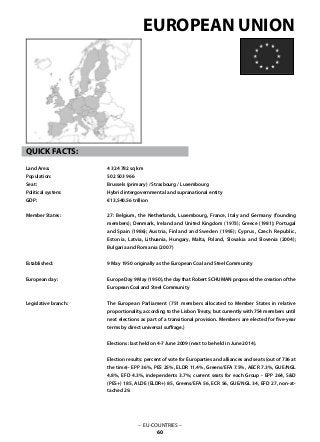
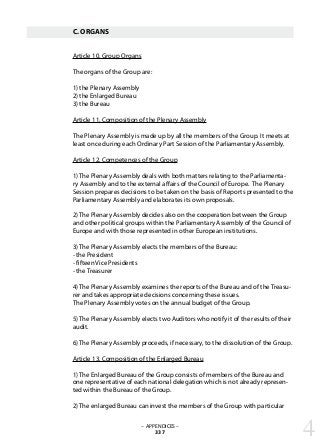
alfredo.antoniozzi@europarl.europa.eu
– THE EUROPEAN PEOPLE’S PARTY –
28
· BALDASSARRE, Raffaele	
raffaele.baldassarre@europarl.europa.eu
· BARTOLOZZI, Paolo	
paolo.bartolozzi@europarl.europa.eu
· BERLATO, Sergio
sergio.berlato@europarl.europa.eu
· BONSIGNORE, Vito	
vito.bonsignore@europarl.europa.eu
· CANCIAN, Antonio
antonio.cancian@europarl.europa.eu
· CASINI, Carlo	
carlo.casini@europarl.europa.eu
· COMI, Lara	
lara.comi@europarl.europa.eu
· DE MITA, Luigi Ciriaco	
luigiciriaco.demita@europarl.europa.eu
· DORFMANN, Herbert
herbert.dorfmann@europarl.europa.eu
· FIDANZA, Carlo
carlo.fidanza@europarl.europa.eu
· GARDINI, Elisabetta
elisabetta.gardini@europarl.europa.eu
· GARGANI, Giuseppe
giuseppe.gargani@europarl.europa.eu
· IACOLINO, Salvatore
salvatore.iacolino@europarl.europa.eu
· LA VIA, Giovanni
giovanni.lavia@europarl.europa.eu
· MASTELLA, Clemente
clemente.mastella@europarl.europa.eu
· MATERA, Barbara
barbara.matera@europarl.europa.eu
· MAURO, Mario
mario.mauro@europarl.europa.eu
· MAZZONI, Erminia
erminia.mazzoni@europarl.europa.eu
· MOTTI, Tiziano
tiziano.motti@europarl.europa.eu
· MUSCARDINI, Cristiana
cristiana.muscardini@europarl.europa.eu
· PALLONE, Alfredo
alfredo.pallone@europarl.europa.eu
· PATRICIELLO, Aldo
aldo.patriciello@europarl.europa.eu
· RIVELLINI, Crescenzio
crescenzio.rivellini@europarl.europa.eu
· RONZULLI, Licia
licia.ronzulli@europarl.europa.eu
· SALATTO, Potito
potito.salatto@europarl.europa.eu
· SARTORI, Amalia
amalia.sartori@europarl.europa.eu
· SCURRIA, Marco
marco.scurria@europarl.europa.eu
· SILVESTRIS, Sergio Paolo Francesco
sergio.silvestris@europarl.europa.eu
· TATARELLA, Salvatore
salvatore.tatarella@europarl.europa.eu
·TREMATERRA, Gino
gino.trematerra@europarl.europa.eu
· ZANICCHI, Iva
iva.zanicchi@europarl.europa.eu
LATVIA
· KALNIETE, Sandra
sandra.kalniete@europarl.europa.eu
· KARIŅŠ, Arturs Krišjānis
krisjanis.karins@europarl.europa.eu
1– THE EUROPEAN PEOPLE’S PARTY –
29
· ŠADURSKIS, Kārlis
karlis.sadurskis@europarl.europa.eu
· VAIDERE, Inese
inese.vaidere@europarl.europa.eu
LITHUANIA
· ANDRIKIENĖ, Laima Liucija	
laimaliucija.andrikiene@europarl.europa.eu
· LANDSBERGIS, Vytautas
vytautas.landsbergis@europarl.europa.eu
· MORKŪNAITĖ-MIKULĖNIENĖ, Radvilė
radvile.morkunaite-mikuleniene@europarl.europa.eu
· SAUDARGAS, Algirdas
algirdas.saudargas@europarl.europa.eu
LUXEMBOURG
· BACH, Georges	
georges.bach@europarl.europa.eu
· ENGEL, Frank	
frank.engel@europarl.europa.eu
· LULLING, Astrid
astrid.lulling@europarl.europa.eu
MALTA
· BUSUTTIL, Simon
simon.busuttil@europarl.europa.eu
· CASA, David	
david.casa@europarl.europa.eu
NETHERLANDS
· van de CAMP, Wim
wim.vandecamp@europarl.europa.eu
· de LANGE, Esther	
esther.delange@europarl.europa.eu
· van NISTELROOIJ, Lambert
lambert.vannistelrooij@europarl.europa.eu
· OOMEN-RUIJTEN, Ria
ria.oomen-ruijten@europarl.europa.eu
· WORTMANN-KOOL, Corien
corien.wortmann@europarl.europa.eu
POLAND
· BORYS, Piotr	
piotr.borys@europarl.europa.eu
· BRATKOWSKI, Arkadiusz Tomasz	
arkadiusztomasz.bratkowski@europarl.europa.eu
· BUZEK, Jerzy	
jerzy.buzek@europarl.europa.eu
· GRZYB, Andrzej
andrzej.grzyb@europarl.europa.eu
· HANDZLIK, Małgorzata
malgorzata.handzlik@europarl.europa.eu
· HIBNER, Jolanta Emilia
jolantaemilia.hibner@europarl.europa.eu
· HÜBNER, Danuta Maria
danuta.huebner@europarl.europa.eu
· JAZŁOWIECKA, Danuta
danuta.jazlowiecka@europarl.europa.eu
· JĘDRZEJEWSKA, Sidonia Elżbieta
sidonia.jedrzejewska@europarl.europa.eu
· KACZMAREK, Filip
filip.kaczmarek@europarl.europa.eu
· KALINOWSKI, Jarosław
jarosaw.kalinowski@europarl.europa.eu
· KOLARSKA-BOBIŃSKA, Lena
lena.kolarska-bobinska@europarl.europa.eu
· KOZŁOWSKI, Jan
jan.kozlowski@europarl.europa.eu
– THE EUROPEAN PEOPLE’S PARTY –
30
· LISEK, Krzysztof
krzysztof.lisek@europarl.europa.eu
· ŁUKACIJEWSKA, Elżbieta Katarzyna	
elzbietakatarzyna.lukacijewska@europarl.europa.eu
· MARCINKIEWICZ, Bogdan Kazimierz
bogdan.marcinkiewicz@europarl.europa.eu
· NITRAS, Sławomir Witold
slawomir.nitras@europarl.europa.eu
· OLBRYCHT, Jan
jan.olbrycht@europarl.europa.eu
· PROTASIEWICZ, Jacek
jacek.protasiewicz@europarl.europa.eu
· SARYUSZ-WOLSKI, Jacek
jacek.saryusz-wolski@europarl.europa.eu
· SIEKIERSKI, Czesław Adam
czeslaw.siekierski@europarl.europa.eu
· SKRZYDLEWSKA, Joanna Katarzyna
joanna.skrzydlewska@europarl.europa.eu
· SONIK, Bogusław
boguslaw.sonik@europarl.europa.eu
· THUN UND HOHENSTEIN, Róża, Gräfin von
roza.thun@europarl.europa.eu
· TRZASKOWSKI, Rafał
rafal.trzaskowski@europarl.europa.eu
· WAŁĘSA, Jarosław Leszek
jaroslaw.walesa@europarl.europa.eu
· ZALEWSKI, Paweł
pavel.zalewski@europarl.europa.eu
· ZASADA, Artur
artur.zasada@europarl.europa.eu
· ZWIEFKA, Tadeusz
tadeusz.zwiefka@europarl.europa.eu
PORTUGAL
· BASTOS, Regina	
regina.bastos@europarl.europa.eu
· CARVALHO, Maria Da Graça
mariadagraca.carvalho@europarl.europa.eu
· COELHO, Carlos	
carlos.coelho@europarl.europa.eu
· DAVID, Mário
mario.david@europarl.europa.eu
· FEIO, Diogo
diogo.feio@europarl.europa.eu
· FERNANDES, José Manuel
josemanuel.fernandes@europarl.europa.eu
· MELO, Nuno
nuno.melo@europarl.europa.eu
· PATRÃO NEVES, Maria do Céu
mariadoceu.patraoneves@europarl.europa.eu
· RANGEL, Paulo
paulo.rangel@europarl.europa.eu
· TEIXEIRA, Nuno
nuno.teixeira@europarl.europa.eu
ROMANIA
· ANTONESCU, Elena Oana	
elenaoana.antonescu@europarl.europa.eu
· BĂSESCU, Elena	
elena.basescu@europarl.europa.eu
· BODU, Sebastian Valentin	
sebastianvalentin.bodu@europarl.europa.eu
· LUHAN, Petru Constantin
petru.luhan@europarl.europa.eu
· MACOVEI, Monica Luisa
monica.macovei@europarl.europa.eu
1– THE EUROPEAN PEOPLE’S PARTY –
31
· MARINESCU, Marian-Jean
marian-jean.marinescu@europarl.europa.eu
· MATULA, Iosif
iosif.matula@europarl.europa.eu
· NICULESCU, Rareş-Lucian
rares-lucian.niculescu@europarl.europa.eu
· PREDA, Cristian Dan
cristiandan.preda@europarl.europa.eu
· SÓGOR, Csaba
csaba.sogor@europarl.europa.eu
· STOLOJAN, Theodor Dumitru
theodordumitru.stolojan@europarl.europa.eu
· TŐKÉS, László
laszlo.tokes@europarl.europa.eu
· UNGUREANU, Traian
traian.ungureanu@europarl.europa.eu
· WINKLER, Iuliu	
iuliu.winkler@europarl.europa.eu
SLOVAKIA
· BAUER, Edit
edit.bauer@europarl.europa.eu
· KUKAN, Eduard
eduard.kukan@europarl.europa.eu
· MÉSZÁROS, Alajos
alajos.meszaros@europarl.europa.eu
· MIKOLÁŠIK, Miroslav
miroslav.mikolasik@europarl.europa.eu
· ŠŤASTNÝ, Peter
peter.stastny@europarl.europa.eu
· ZÁBORSKÁ, Anna
anna.zaborska@europarl.europa.eu
SLOVENIA
· JORDAN CIZELJ, Romana	
romana.jordancizelj@europarl.europa.eu
· MAZEJ KUKOVIČ, Zofija
zofija.mazejkukovic@europarl.europa.eu
· PETERLE, Alojz
alojz.peterle@europarl.europa.eu
· ZVER, Milan
milan.zver@europarl.europa.eu
SPAIN
· ARIAS ECHEVERRÍA, Pablo
pablo.ariasecheverria@europarl.europa.eu
· AYUSO GONZALEZ, Pilar
pilar.ayuso@europarl.europa.eu
· del CASTILLO VERA, Pilar	
pilar.delcastillo@europarl.europa.eu
· DÍAZ DE MERA GARCÍA CONSUEGRA, Agustín	
agustin.diazdemera@europarl.europa.eu
· CORREA ZAMORA, María Auxiliadora
mariaauxiliadora.correazamora@europarl.europa.eu
· ESTARÀS FERRAGUT, Rosa
rosa.estaras@europarl.europa.eu
· FISAS AYXELA, Santiago
santiago.fisasayxela@europarl.europa.eu
· FRAGA ESTÉVEZ, Carmen	
carmen.fragaestevez@europarl.europa.eu
· GARRIGA POLLEDO, Salvador	
salvador.garrigapolledo@europarl.europa.eu
· de GRANDES PASCUAL, Luis
luis.degrandespascual@europarl.europa.eu
· GUTIÉRREZ CORTINES, Cristina
cristina.gutierrez-cortines@europarl.europa.eu
– THE EUROPEAN PEOPLE’S PARTY –
32
· HERRANZ GARCÍA, Esther
esther.herranzgarcia@europarl.europa.eu
· ITURGAIZ ANGULO, Carlos José
carlos.iturgaizangulo@europarl.europa.eu
· JIMÉNEZ-BECERRIL BARRIO, Teresa
teresa.jimenez-becerril@europarl.europa.eu
· LOPE FONTAGNÉ, Veronica
veronica.lopefontagne@europarl.europa.eu
· LÓPEZ-ISTÚRIZ WHITE, Antonio
antonio.lopezisturiz@europarl.europa.eu
· MATO ADROVER, Gabriel	
gabriel.mato@europarl.europa.eu
· MAYOR OREJA, Jaime
jaime.mayororeja@europarl.europa.eu
· MILLÁN MON, Francisco
francisco.millanmon@europarl.europa.eu
· NARANJO ESCOBAR, Juan Andrés
juan.naranjoescobar@europarl.europa.eu
· ORTIZ VILELLA, Eva
eva.ortizvilella@europarl.europa.eu
· SALAFRANCA SÁNCHEZ-NEYRA, José Ignacio
joseignacio.salafranca@europarl.europa.eu
· SEDÓ i ALABART, Salvador
salvador.sedo@europarl.europa.eu
· VIDAL-QUADRAS, Alejo
alejo.vidal-quadras@europarl.europa.eu
· ZALBA BIDEGAIN, Pablo
pablo.zalbabidegain@europarl.europa.eu
SWEDEN
· CORAZZA BILDT, Anna Maria
annamaria.corazzabildt@europarl.europa.eu
· FJELLNER, Christofer
christofer.fjellner@europarl.europa.eu
EPP in the Committee
of the Regions
· HÖKMARK, Gunnar
gunnar.hokmark@europarl.europa.eu
· IBRIŠAGIĆ, Anna	
anna.ibrisagic@europarl.europa.eu
· SVENSSON, Alf
alf.svensson@europarl.europa.eu
The Committee of the Regions (CoR) is the poli-
tical assembly that provides local and regional
authorities with a voice at the heart of the Eu-
ropean Union. The EPP Group, led by President
Michael SCHNEIDER, is a leading political pil-
lar in the CoR, making it the driving force for
strengthening and increasing the role and in-
fluence of local and regional authorities in the
EU decision-making process.
The EPP Group in the CoR cooperates closely
with the European Commission by organising
high level meetings with Commissioners on to-
pical EU issues such as energy policy, the new
transport policy and the future EU maritime
policy. On the other hand, the EPP Group in the
CoR has continued to strengthen its cooperati-
on with the European Parliament and most no-
tably with the Committee for Regional Affairs
for the promotion of local and regional interests
in Europe.
The Presidency
The Presidency is made up of the President and
Vice-Presidents. It‘s responible for the imple-
mentation of the duties designated by the
Group Bureau, it represents the Group inside
and outside the CoR, it supports the President
on Group matters, and in the event of an emer-
gency, it is responsible for taking decisions
on behalf of the competent bodies. Currently,
the Presidency is composed of the following
1– THE EUROPEAN PEOPLE’S PARTY –
33
Members:
· SCHNEIDER, Michael
State Secretary - Representative of the land Saxony
Anhalt to the Federal Government
michael.schneider@lv.stk.sachsen-anhalt.de
· LEBRUN, Michel
Member of the Regional Parliament of Wallonia
mlebrun@skynet.be
· HANNIFFY, Constance
Member of Offaly County Council, Midland and
West Regional Authority
connieh@iol.ie
· KNAPE, Anders
Councillor of Karlstad Municipality
anders.knape@skl.se
· LOUCAIDES, Eleni
Town Councillor of Lefkosia
eloucaidou@logosnet.cy.net
· OSTAFICIUC, Constantin
President, Department Council of Timisoara
constantin.ostaficiuc@cjtimis.ro
· PELLA, Roberto
HeadofJointGroupCouncilloroftheValdengoComune
robertopella@libero.it
· SCHAUSBERGER, Franz
Delegate of the Region of Salzburg
schausberger@salzburg.gv.at
· WOZNIAK, Marek
Marshall of the Wielkpolskie Region
marszalek@umww.pl
The Bureau
The Group Bureau is responsible for preparing
Group decisions on all political, administrative
and financial matters and it monitors their im-
plementation, together with the work of the
Secretariat. It meets prior to each of the CoR‘s
ordinary bureau meetings. It is comprised of:
· the Group President
· thenine GroupVice-Presidents,oneofwhom
acts as treasurer
· the CoR President, first Vice-President of the
CoR, and CoR Bureau members, Presidents
of Commissions and/or the heads of national
delegations, as long as they are Group Members
For more information on the EPP Group in
the Committee of the Regions, please visit:
www.cor.europa.eu/eppweb
1st CoR Vice President
· VALCÁRCEL SISO, Ramón Luis (PP-Spain)
President of the Autonomous Community of Murcia
Presidents of CoR Commissions
· ABRAMAVIČIUS, Arnoldas (TS-LKD-Lithuania)
Mayor of Zarasai district municipality
Chairman of the ECOS Commission
· KALOGEROPOULOS, Dimitros (ND-Greece)
Municipial Councillor of Egaleo
Chairman of the NAT Commission
· VAN DEN BRANDE, Luc (CD&V-Belgium)
Chairman of the Flemish-European Liaison Agency
Chairman of the CIVEX Commission
CoR Bureau Members
· ABRAMAVIČIUS, Arnoldas (TS-LKD-Lithuania)
Mayor of Zarasai district municipality
· BELICA, Milan (IND-Slovak Republic)
President of the Nitra self-governing Region
· BLANC, Jacques (UMP-France)
Mayor of Canourgue
· CAPPELLACCI, Ugo (PdL-Italy)
President of the Region Sardinia
· CASTIGLIONE, Giuseppe (PdL-Italy)
President of the Province of Catania
– THE EUROPEAN PEOPLE’S PARTY –
34
· GÉMESI, Györgi (MDF-Hungary)
Mayor of Gödöllo
· HAIJANEN, Pauliina (KOK-Finland)
Member of the Executive Board of Laitila City Council
· HANNIFFY, Constance (FG-Ireland)
OffalyCountyCouncilandMidlandRegionalAuthority
· HERRERA CAMPO, Juan Vicente (PP-Spain)
President of the Region Castilla y Leon
· JAHN, Helmut Max (CDU-Germany)
District Executive of the Hohenlohe District Assembly
· JARDIM, Alberto João (PSD-Portugal)
President of the Regional Government of Madeira
· JOSTMEIER, Werner Heinrich (CDU-Germany)
Member of the NRW State Assembly
· KALOGEROPOULOS, Dimitros (ND-Greece)
Municipial Councillor of Egaleo
· KISSIOV, Vladimir (UDF-Bulgaria)
Municipal Councilor of Sofia Municipality
· KNAPE, Anders (M-Sweden)
Member of Karlstad Municipal Council
· LÍNEK, Roman (KDU-ČSL-Czech Rep.)
Deputy President of Pardubice Region
· MONAGO TERRAZA, José Antonio (PP-Spain)
President of the Junta of Extremadura
· MÜÜRSEPP, Kurmet (IRL-Estonia)
Member of Antsla Rural Municipality Council
· ORAVEC, Ján (Slovakia)
Major of the city of Štúrovo
· OSTAFICIUC, Constantin (PD-L-Romania)
President of Timiş County Council
· POULSEN, Søren Pape (KDF-Denmark)
Mayor of Viborg Municipality
· SCHNEIDER, Michael (CDU-Germany)
State Secretary - Representative of the land Saxony
Anhalt to the Federal Government
· STRUZIK, Adam (PSL-Poland)
Marshall of the Mazowsze Region
· VAN DE DONK W.B.H.J., Wim (CDA-Netherlands)
Her Majesty‘s Governor in the Province of Noord-
Brabant
· VAN DEN BRANDE, Luc (CD&V-Belgium)
Chairman of the Flemish-European Liason Agency
· VAN STAA, Herwig (ÖVP-Austria)
President of the Tirol Regional Assembly
· WOŹNIAK, Marek (PO-Poland)
Marshall of the Wielkpolskie Region
· ŽAGAR, Ivan (SLS-Slovenia)
Mayor of Slovenska Bistrica
List of Representatives
AUSTRIA
· BUCHMANN, Christian
christian.buchmann@stmk.gv.at
· LINHART, Markus
buergermeister@bregenz.at
· MOHR, Erwin
erwin.mohr@wolfurt.at
· PRÖLL, Erwin
landeshauptmann.proell@noel.gv.at
· PÜHRINGER, Josef
lh.puehringer@ooe.gv.at
· SCHAUSBERGER, Franz
schausberger@salzburg.gv.at
· VAN STAA, Herwig
lh.vanstaa@tirol.gv.at
1– THE EUROPEAN PEOPLE’S PARTY –
35
· WALLNER, Markus
markus.wallner@vorarlberg.at
BELGIUM
· CHABERT, Josef
joschabert@skynet.be
· LEBRUN, Michel
mlebrun@skynet.be
· SAUWENS, Johan
johan.sauwens@bilzen.be
· VAN DEN BRANDE, Luc
luc.vandenbrande@pandora.be
BULGARIA
· KISSIOV, Vladimir
vkissiov@sofia.bg
· NIKOLOVA, Detelina
dobrich@dobrich.org
· SLAVOV, Georgi Ivanov
kmet@obshtinayambol.org
· ZHIVKOV, Zlatko
montana@net-surf.net
CYPRUS
· KATTIRTZIS, Christodoulos
cuc@cytanet.com.cy
· LOUCAIDES, Eleni
eloucaides@logosnet.cy.net
CZECH REPUBLIC
· BENEŠĺK, Ondřej
starosda@strani.cz
· LÍNEK, Roman Ing.
roman.linek@pardubickykraj.cz
DENMARK
· POULSEN, Søren Pape
pape@viborg.dk
ESTONIA
· KALLASVEE, Teet
teet@tennis.ee
· MÜÜRSEPP, Kurmet
kurmetster@gmail.com
FINLAND
· HAIJANEN, Pauliina
pauliina@haijanen.fi
· HERTELL, Sipra
sirpa.hertell@vihreat.fi
· MARKKULA, Markku
markku.markkula@aautouniversity.fi
FRANCE
· BLANC, Jacques
jacques.blanc21@wanadoo.fr
· BOEGLIN, Danièle
daniele.boeglin@cg10.fr
· BOURG-BROC, Bruno
cabinet.mairie@chalons-en-champagne.net
· COMMEINHES, Françoise
f.commeinhes@ville-sete.fr
· HUGON, Pierre
cabinet@cg48.fr
GERMANY
· HERBST, Niclas
niclas.herbst@cdu.ltsh.de
– THE EUROPEAN PEOPLE’S PARTY –
36
· JAHN, Helmut Max
helmut.m.jahn@hohenlohekreis.de
· JOSTMEIER, Werner Heinrich
jostmeier@landtag.nrw.de
· KARTMANN, Norbert
adr@ltg.hessen.de
· KROGMANN, Martina Dr.
martina.krogmann@stk.niedersachsen.de
· KUDER, Uta-Maria
doris.junewitz@stk.mv-regierung.de
· LEHMANN, Heinz
heinz.lehmann@slt.sachsen.de
· MAURUS, Heinz
heinz.maurus@stk.landsh.de
· MÜLLER, Emilia
adr@stk.bayern.de
· MÜLLER, Peter
c.geib@eu.saarland.de
· REINHART, Wolfgang
nicola.schelling@stm.bwl.de
· ROTH, Petra
petra.roth@stadt-frankfurt.de
· SCHNEIDER, Michael
michael.schneider@lv.stk.sachsen-anhalt.de
· VOGEL, Hans-Josef
buergermeister@arnsberg.de
GREECE
· KALOGEROPOULOS, Dimitrios
dimitroskalogeropoulos@yahoo.com
· KOTRONIAS, Georgios
grdrh@lamia-city.gr
· PSOMIADIS, Panayotis
grper@pmk.gov.gr
· ZAFIROPOULOS, Grigorios
info@gzafiropoulos.gr
HUNGARY
· BÓKA, István
polgarmester@balatonfured.com
· GÉMESI, Gyorgy
gemesi@godollo.hu
· KISS, Attila
polgarmester@hajduboszormeny.hu
· KOVÁCS, Sándor
jnszm.elnok@jnszm.hu
· MANNINGER, Jenő
elnok@nydrft.hu
· NAGY, Sándor
polgarmester@kistelek.hu
· RIBÁNYI, József
polgarmester@tamasi.hu
IRELAND
· BREEN, Gerry
gerry.breen@dublincity.ie
· HANNIFFY, Constance
connieh@iol.ie
· SHEAHAN, John
jsheahan@limerickcoco.ie
ITALY
· CAPPELLACCI, Ugo
presidenza@regione.sardegna.it
· CASTIGLIONE, Giuseppe
g.delvecchio@upi-tecla.eu
· COPPOLA, Maria Luisa
ass.bilancio@regione.veneto.it
1– THE EUROPEAN PEOPLE’S PARTY –
37
· CHIODI, Giovanni
giovanni.chiodi@regione.abruzzo.it
· DURNWALDER, Luis
Presidente@provincia.bz.it
· PELLA, Roberto
robertopella@libero.it
· POLVERINI, Renata
segretariaparticolare@regione.lazio.it
· RUOCCO, Roberto
ruocco2010@katamail.com
· SCOPELLITI, Giuseppe
am.comito@regcal.it
· VENTRE, Riccardo
riccardoventre@gmail.com
· VITAGLIANO, Gianfranco
vitagliano@regione.molise.it
LATVIA
· RASSA, Indra
i.rassa@saldus.lv
LITHUANIA
· ABRAMAVIČIUS, Arnoldas
meras@zarasai.lt
· KUPČINSKAS, Andrius
andrius.kupcinskas@kaunas.lt
LUXEMBOURG
· ROTH, Gilles
groth@chd.lu
MALTA
· AZZOPARDI, Samuel
samuel.azzopardi@gmail.com
· MIFSUD, Malcolm
mmifsud@mifsudadvocates.com.mt
NETHERLANDS
· JANSSEN J.F.M., Hans
hans.janssen@oisterwijk.nl
· LAMERS, Cor
secretariaatbestuur@houten.nl
· MAIJ W.H., Hester
wh.maij@overijssel.nl
· ROMBOUTS, Anton
dinl@s.hertogenbosch.nl
· VAN DE DONK W.B.H.J., Wim
hdmug@brabant.nl
POLAND
· ADAMOWICZ, Pawel
prezydent@gdansk.gda.pl
· GEBLEWICZ, Olgierd
marszalek@wzp.pl
· HETMAN, Krzysztof
marszalek@lubelskie.pl
· JARUBAS, Adam Sebastian
marszalek@sejmik.kielce.pl
· JAWORSKI, Lech
ljaworski@warszawa.um.gov.pl
· PROTAS, Jacek
marszalek@wzp.pl
· SEBESTA, Józef
marszalek@umwo.opole.pl
· SOWA, Marek
msow@malopolska.mw.gov.pl
· STEPIEŃ, Witold
marszalek@lodzkie.pl
– THE EUROPEAN PEOPLE’S PARTY –
38
· STRUK, Mieczysław
m.struk@woj-pomorskie.pl
· STRUZIK, Adam
a.struzik@mazovia.pl
· TRUSKOLASKI, Tadeusz
prezydent@um.bialystok.pl
· WĘGRZYN, Ludwik Kajetan
starosta.kbc@powiatypolskie.pl
· WOŹNIAK, Marek
marszalek@umww.pl
PORTUGAL
· CORREIA MACARIO, José
presidente@cm-tavira.pt
· FREXES, Manuel Joaquim
manuelfrexes@netvisao.pt
· JARDIM, Alberto João
gabimprensa.presidencia@gov-madeira.pt
· PINTO, Carlos Alberto
info@cm-covillia.pt
· RIO DA SILVIA, Rui Fernando
dmri@cm-porto.pt
· RUAS CARVALHO, Fernando
presidencia@cm-viseu.pt
ROMANIA
· ARNĂUTU, Decebal
primar@primariatgneam.ro
· DIACONU IONITA, Veronica
primar@gorgota.ro
· FALCĂ, Gheorghe
gfalca@yahoo.com
· LOKODI, Edita Emoke
lokodi@cjmures.ro
· OSTAFICIUC, Constantin
constantin.ostaficiuc@cjtimis.ro
SLOVAKIA
· BELICA, Milan
predseda@unsk.sk
· FREŠO, Pavol
bratislavskykraj@region-bsk.sk
· ORAVEC, Ján
primator@sturovo.sk
· ZACHARIAŠ, István
Zacharias.istvan@moldava.sk
SLOVENIA
· ROKAVEC, Franci
franci.rokavec@litijo.si
· SMRDELJ, Robert
zupan@pivka.si
· ŽAGAR, Ivan
ivan.zagar@slov-bistrica.si
SPAIN
· AGUIRRE GIL DE BIEDMA, Esperanza
mj.moreno@madrid.org
· BARBERÁ NOLLA, Rita
alcaldia@ayto-valencia.es
· BARCINA ANGULO, María Yolanda
secretarias.presidenta@navarra.es
· BAUZA DÍAZ, José Ramón
president@caib.es
· DE COSPEDAL GARCÍA, María Dolores
marivi.alonso@jccm.es
· DIEGO PALACIOS, Juan Ignacio
ceballos_lo@cantabria.es
1– THE EUROPEAN PEOPLE’S PARTY –
39
· FABRA PART, Alberto
silvestre_mis@gva.es
· HERRERA CAMPO, Juan Vicente
hersagma@jcyl.es
· MONAGO TERRAZA, José Antonio
secretaria.presidente@juntaex.es
· NÚÑEZ FEIJOÓ, Alberto
ravial@fundaciongaliciaeuropa.eu
· RUDI ÚBEDA, Luisa Fernanda
presidenta@aragon.es
· SANZ ALONSO, Pedro
presidente@larioja.org
·VALCÁRCEL SISO, Ramon Luis
presidente@carm.es
SWEDEN
· DRENJANIN, Jelena
jelena.drenjanin@moderat.se
· KNAPE, Anders
Anders.Knape@skl.se
· LINDQUIST, Paul
paul.lindquist@lidingo.se
· SEGERSTEN LARSSON, Catarina
catarina.segersten.larsson@moderat.se
The EPP is committed to its involvement in the
Council of Europe, an organisation that pro-
motes the principles of the rule of law and on
the values of human rights and fundamental
freedoms.
Through their actions within the Council of
Europe and in their national parliaments,
more than 200 members of the Group of the
European People’s Party (EPP/CD Group) have
committed themselves to consolidating and
stabilising freedom and democracy, human
rights, peace, prosperity, solidarity and social
cohesion throughout the European continent
and in the wider world. The members of the
EPP/CD Group defend freedom of expression
and information, as well as freedom of move-
ment of ideas and of religious tolerance. Mo-
reover, the EPP/CD Group works to promote
respect for the principle of subsidiary and lo-
cal autonomy, as well as the defense of nati-
onal, social and other minorities. The EPP/CD
Group is led by Chairman Luca VOLONTÈ.
On 23rd January 2012 Jean-Claude MIGNON
(UMP, France) , Vice-President of the EPP/CD
Group was elected President of the Parliamen-
tary Assembly of the Council of Europe. Presi-
dent Mignon will serve a two-year mandate.
For more information please visit:
www.epp-cd.eu
List of Representatives
ALBANIA
· PERNASKA, Lajla
lajla@parlament.al
EPP in the Council
of Europe
– THE EUROPEAN PEOPLE’S PARTY –
40
· RUSMALI, Ilirjan
ilir_rusmali@yahoo.com
· TRASHANI, Arenca
atrashani@parlement.al
ARMENIA
· POSTANJYAN, Zaruhi
postanjyan@mail.ru
AUSTRIA
· DONABAUER, Karl
karl.donabauer@parlament.gv.at
· HAKL, Karin	
karin.hakl@parlament.gv.at
· MAYER, Edgar
edgar.mayer@parlament.gv.at
· NEUGEBAUER, Fritz 	
fritz.neugebauer@goed.at
AZERBAIJAN
· RZAYEV, Rovshan
international@meclis.gov.ase
· SULEYMANOV, Elkhan
international@meclis.gov.ase
BELGIUM
· FRANSSEN, Cindy
cfranssen@senaat.cdenv.be
· VERCAMER, Stefaan
stefaan.vercamer@dekamer.be
BULGARIA
· DIMITROV, Kirtcho
K_dimitrov@mail.bg
· GROZDANOVA, Dzhema
J_Grozdanova@abv.bg
· IVANOV, Stanislav
stanislav.ivanov@parliament.bg
· KOLEVA, Yuliana
yuliana.koleva@parliament.bg
· MINCHEV, Krasimir
minchev@triada.bg
· NENKOV, Aleksandar
al_nenkov@gerb.bg
· PETROV, Petar
peter.m.petrov@gmail.com
· TOSHEV, Latchezar
latchezar.toshev@gmail.com
BOSNIA AND HERZEGOVINA
· DERVOZ, Ismeta
ismeta.dervoz@parlament.ba
· IVANIĆ, Mladen
mladen.ivanic@parlament.ba
· KAPETANOVIĆ, Nermina
nermina.kapetanovic@parlament.ba
· KRIŠTO, Borjana
borjana.kristo@parlament.ba
· ŠEPIĆ, Senad
senad.sepic@parlament.ba
CROATIA	
· KALMETA, Božidar
bozidar.kalmeta@sabor.hr
· MATUŠIĆ, Frano
frano.matusic@sabor.hr
· MILOŠEVIĆ, Domagoj Ivan
n/a
1– THE EUROPEAN PEOPLE’S PARTY –
41
CYPRUS
· KYRIAKIDOU, Stella
skyriakidou@parliament.cy
CZECH REPUBLIC
· KOSTŘICA, Rom
kostricar@psp.cz
· KUBATA, Václav
kubatav@psp.cz
DENMARK
· MØLLER, Per Stig
per.stig.moller@ft.dk
ESTONIA
· HERKEL, Andres
andres.herkel@riigikogu.ee
FINLAND
· PELKONEN, Jaana
jaana.pelkonen@parliament.fi
· SASI, Kimmo
kimmo.sasi@eduskunta.fi
· VIROLAINEN, Anne-Mari
anne-mari.virolainen@parliament.fi
FRANCE
· BLUM, Roland
rblum@assemblee-nationale.fr
· BOCKEL, Jean Marie
jm.bockel@senat.fr
· COLOMBIER, Georges
gcolombier@assemblee-nationale.fr
· COUSIN, Alain
cousin.alain@wanadoo.fr
· FOURNIER, Bernard
b.fournier@senat.fr
· GROSSKOST, Arlette
depute.grosskost@wanadoo.fr
· HOSTALIER, Françoise	
francoise.hostalier@wanadoo.fr
· JACQUAT, Denis
djacquat@wanadoo.fr
· LEGENDRE, Jacques
jacques.legendre@wanadoo.fr
· LORRAIN, Jean Louis
jl.lorrain@senat.fr
· MARIN, Christine
chris-marin@orange.fr
	
· MARLAND-MILITELLO, Muriel
mmarland@assemblee-nationale.fr
· MIGNON, Jean-Claude
jcmignon@assemblee-nationale.fr
· NACHBAR, Phillippe
p.nachbar@senat.fr
· POZZO DI BORGO, Yves
y.pozzodiborgo@senat.fr
· REISS, Frédéric
reiss.depute@wanadoo.fr
· ROCHEBLOINE, Françoise
frochebloine@assemblee-nationale.fr
· SALLES, Rudi
rsalles@assemblee-nationale.fr
· SCHNEIDER, André
aschneider@assemblee-nationale.fr
ZIMMERMANN, Marie-Jo
mjzimmermann@assemblee-nationale.fr
– THE EUROPEAN PEOPLE’S PARTY –
42
FORMER YUGOSLAV
REPUBLIC OF MACEDONIA
· ALIU, Imen	
n/a
· NIKOLOSKI, Aleksandar	
alaksandarnikoloski@yahoo.com
· SPASENOVSKI, Alexandar
n/a
GEORGIA
· DARCHIASHVILI, David 	
ddarchiashvili@parliament.ge
· GABASHVILI, Giorgi
gokagaba@hotmail.com
· KANDELAKI, Giuiorgui
gkandelaki@parliament.ge
· MACHAVARIANI, Mikheil
mmachav@parliament.ge
· TARGAMADZÉ, Giorgi
g.tagamadze@parliament.ge
· TSISKARISHVILI, Petré
p.tsiskarishvili@parliament.ge
GERMANY
· CONNEMANN,	 Gitta
gitta.connemann@bundestag.de
· FEIST, Thomas
thomas.feist@bundestag.de
· FISCHER, Axel E.
axel.fischer@bundestag.de
· FRANKENHAUSER, Herbert
herbert.frankenhauser@bundestag.de
· FRITZ,	 Erich Georg
erich.fritz@bundestag.de
· GLOS, Michael
michael.glos@bundestag.de
· HENNRICH, Michael
michael.hennrich@bundestag.de
· HÖRSTER, Joachim
joachim.hoerster@bundestag.de
· HÜBINGER, Anette
anette.huebinger@bundestag.de
· RÖRING, Johannes
johannes.roering@bundestag.de
· SIEBERT, Bernd
bernd.siebert@bundestag.de
· STRENZ, Karin
karin.strenz@bundestag.de
· WADEPHUL, Johann
johann.wadepuhl@bundestag.de
· WELLMANN, Karl-Georg
karl-georg.wellmann@bundestag.de
GREECE
· DENDIAS, Nikolaos
dendias@otenet.gr
· MEIMARAKIS, Evangelos
meimarak@otenet.gr
· PAPADIMITRIOU, Elsa
elsapapademitriou@parliament.gr
· TZAVARAS, Konstantinos
n/a
· VARVITSIOTIS,	 Miltiadis
miltiadis@mvarvitsiotis.gr
HUNGARY
· BRAUN, Márton
marton.braun@parlament.hu;
1– THE EUROPEAN PEOPLE’S PARTY –
43
· ÉKES, József
jozsef.ekes@parlament.hu
· GRUBER, Attila	
attila.gruber@parlament.hu
· HOPPÁL, Péter
peter.hoppal@parlament.hu
· KALMÁR, Ferenc
ferenc.kalmar@parlament.hu
· KOSZORÜS, László
laszlo.koszorus@parlament.hu
· MIHALOVICS, Péter
peter.mihalovics@parlament.hu
· NAGY, Gábor Tamás
gabor.nagy@parlament.hu
· SZÉKYNÉ SZTRÉMI, Melinda
szekyne@parlament.hu
· VEJKEY, Imre
imre.vejkey@parlament.hu
IRELAND
· CLUNE, Deirdre
deirdre.clune@oireachtas.ie
· FLANAGAN, Terence
terence.flanagan@oireachtas.ie
· O‘REILLY, Joseph
joe.oreilly@oireachtas.ie
· PHELAN, John Paul
john-paul.phelan@oireachtas.ie
ITALY
· BERGAMINI, Deborah	
deborah.bergamini@gmail.com
· BOCCHINO, Italo	
bocchino_i@camera.it
· CIARRAPICCO, Giuseppe	
giuseppe.ciarrapicco@senato.it
· COMMERCIO, Roberto Mario Sergio	
commercio_r@camera.it
· DELL‘UTRI, Marcello
m.dellutri@senato.it
· FARINA, Renato	
farina_renato@camera.it
· MALGIERI, Gennaro	
malgieri_g@camera.it
· NESSA, Pasquale	
pasquale.nessa@senato.it
· NIRENSTEIN, Fiamma
nirenstein_f@camera.it
· SANTINI, Giacomo
giacomo.santini@senato.it
· SARO, Giuseppe | ITALY
giuseppe.saro@senato.it
· TOFANI, Oreste	
oreste.tofani@senato.it
· VITALI, Luigi
vitali_l@camera.it
· VOLONTÈ, Luca Giuseppe
volonte_l@camera.it
· ZELLER, Karl	
zeller_k@camero.it
LATVIA
· ČIGĀNE, Lolita
lolita.cigane@saeima.lv
· LĪBIŊA-EGNERE, Inese
inese.libina-egnere@saeima.lv
– THE EUROPEAN PEOPLE’S PARTY –
44
LIECHTENSTEIN
· FROMMELT, Doris
doris.frommelt@landtag.li
· NEGELE, Gebhard
gebine@powersurf.li
· SCHÄDLER, Leander
leander.schaedler@landtag.li
· WOHLWEND, Renate
renate.wohlwend@treudrwo.li
LITHUANIA
· VAREIKIS, Egidijus
egvare@lrs.lt
· ZINGERIS, Emanuelis
emanuelis.zingeris@lrs.lt
LUXEMBOURG
· BODEN, Fernand
fboden@chd.lu
· HAUPERT, Norbert
nhaupert@chd.lu
· SPAUTZ, Marc
mspautz@chd.lu
MALTA
· AGIUS, Francis
francis.agius@gov.mt
· DEBONO, Giovanna
giovanna.debono@gov.mt
· FALZON, Joseph
joseph.falzon@gov.mt
· FENECH ADAMI, Joseph
bfc@wddonet.net.mt
MOLDOVA
· GHILETCHI, Valeriu
valeriuga@yahoo.com
· PALIHOVICI, Liliana
liliana.palihovici@parlament.md
MONACO
· GARDETTO, Jean-Charles
gardetto.lawoffice@wanadoo.fr
· MANZONE-SAQUET, Nicole	
nicole.manzone-saquet@consiel-national.mc
· NOUVION, Laurent
n/a
NETHERLANDS
· FRANKEN, Hans	
h.franken@eerstekamer.nl
· OMTZIGT, Pieter
p.omtzigt@tweedekamer.nl
NORWAY
· GRAHAM, Sylvi
sylvi.graham@stortinget.no
· SCHOU, Ingjerd
ingjerd.schou@stortinget.no
POLAND
· GÓRCZYŃSKI, Jarosław
jaroslaw.gorczynski@sejm.pl
· HALICKI, Andrzej
andrzej.halicki@sejm.pl
· HUSKOWSKI, Stanisław
stanislaw.huskowski@platforma.org
1– THE EUROPEAN PEOPLE’S PARTY –
45
· KAZMIERCZAK, Jan
jan.kazmierczak@polsl.pl
· KLICH, Bogdan
n/a
· KRZAKALA, Marek	
n/a
· MARCZULAJTIS-WALCZAK, Jagna	
jagna.marczulajtis-walczak@sejm.pl
· NYKIEL, Miroslawa
mnykiel@promarket.biz
· OLSZEWSKI, Pawel	
pavel.olszewski@sejm.pl
· ORZECHOWSKI, Maciej	
maciej.orzechowski@sejm.pl	
· RADZISZEWSKA, Elzbieta	
elzbieta.radziszewska@sejm.pl
· ROTNICKA, Jadwiga
biuro@jadwigarotnicka.pl
· WACH, Piotr
wach@po.opole.pl
PORTUGAL
· BARATA LOPES, Joana
jrlopes@psd.parlamento.pt
· CORREIA, Telmo
correia@cds.parlamento.pt
· COSTA NEVES, Carlos
ccostaneves@psd.parlamento.pt
· GONÇALVES, Carlos Alberto
carlosgoncalves@psd.parlamento.pt
· LEITE RAMOS, Luís
lramos@psd.parlamento.pt
· MEIRINHO, Manuel
meirinho@ psd.parlamento.pt
· MENDES BOTA, José
mendesbota@psd.parlamento.pt
· MOTA AMARAL, João Bosco
mota.amaral@ar.parlamento.pt
ROMANIA
· ANGHEL, Florin Serghei
pace@cdep.ro
· BADEA, Viorel Riceard
viorel.badea@senat.ro
· BLAGA, Iosif Veniamin
pace@cdep.ro
· ĈALIAN, Petru
petru-calian@yahoo.com
· FRUNDA, György
gyorgy.frunda@senat.ro
· IGAŞ, Traian Constantin
igasconstantin@yahoo.com
· KELEMEN, Atilla Bela
equi-can@cdep.ro
· PREDA, Cezar-Florin
pace@cdep.ro
· STAVROSITU, Maria
maria.stavrositu@cdep.ro
· STOICA, Mihaela
mihaelastoica@yahoo.com
SAN MARINO
· OTTAVIANI, Nadia
n/a
SERBIA
· ALEGRUDIĆ, Miloš
alegrudic@yahoo.com
– THE EUROPEAN PEOPLE’S PARTY –
46
· GRUJIĆ, Mladen
mladen@lilly.rs
· IVANJI, Željko
g17+sekretar@parlament.gov.rs
· KOVÁCS, Elvira
elvira_kovac@yahoo.com
SLOVAKIA
· FRONC, Martin
martin.fronc@nrsr.sk
· KUBOVIČ, Pavol
Pavol.kubovic@nrsr.sk
· ROSOVÁ, Tatiana 	
Tatiana.rosova@nrsr.sk
SLOVENIA
· PRESEČNIK, Jakob
jakob.presecnik@dz-rs.si
SPAIN	
· AGRAMUNT FONT DE MORA, Pedro
pedro.agramunt@senado.es
· BARREIRO FERNÁNDEZ, José Manuel
jmanuel.barreiro@senado.es
· BENEYTO PÉREZ, José María
jose.beneyto@congreso.es
· CONDE BAJÉN, Agustin
augustin.conde@congreso.es
· MORENO-BUSTOS, Ramón
ramon.moreno@congreso.es
· MUÑOZ ALONSO LEDÓ, Alejandro
alejandro.munoz-alonso@senado.es
· PARERA, Eva
eva.parera@senado.es
· PINTADO BARBANOJ, Angel
angel.pintado@senado.es
· PUCHE RODRÍGUEZ-ACOSTA, Gabino
gabino.puche@congreso.es
· QUINTANILLA BARBA, María del Carmen
carmen.quintanilla@congreso.es
· SALAS MACHUCA, Rafael Javier
rjavier.salas@senado.es
· SANÍN NARANJO, Luz Elena
luzelena.sanin@senado.es
· SORAVILLA, Roberto
roberto.soravilla@congreso.es
· VERA PRÓ, Juan Carlos
juan.vera@congreso.es
SWITZERLAND
· PFISTER, Gerhard
gerhard.pfister@parl.ch
· SCHNEIDER-SCHNEITER, Elisabeth
elisabeth.schneider@parl.ch
· SCHWALLER, Urs
urs.schwaller@parl.ch
SWEDEN
· CEDERBRATT, Mikael
mikael.cederbratt@riksdagen.se
· JOHANSSON, Mats
mats-johansson@riksdagen.se
· OSKARSSON, Mikael
mikael.oskarsson@riksdagen.se
· POURBAIX-LUNDIN de, Marietta
marietta.de.pourbaix-lundin@riksdagen.se
1– THE EUROPEAN PEOPLE’S PARTY –
47
EPP in the OSCE
· ZVARYCH, Roman
n/a
The "EPP and like-minded Group" in the OSCE-
PA is the most active political Group of the
OSCE. The Group meets on a regular basis and
promotes the EPP positions at levels of the
decision-making process. The members of the
EPP Group also participate in election monito-
ring missions of the OSCE and are committed
in promoting democratic values and practices.
The Group is chaired by Walburga HABSBURG
DOUGLAS (Sweden).
The Group Presidency includes the following
Vice Presidents:
Consiglio DI NINO (Canada), Vilija Aleknaitė
ABRAMIKIENĖ (Lithuania), Laura ALLEGRINI
(Italy) and George TSERETELI (Georgia).
For more information please contact:
Email: osce@epp.eu Twitter: @JuanEPP
OSCE-PA Vice-Presidents:
· BILORUS, Oleh (Ukraine)
· GARDETTO, Jean-Charles (Monaco)
· GROSSRUCK, Wolfgang (Austria)
· HABSBURG DOUGLAS, Walburga (Sweden)
· MIGLIORI, Riccardo (Italy)
OSCE-PA Committee Officers:
First General Committee on Political Affairs
and Security:
· WELLMANN, Karl-Georg (Germany), Chair
· ABRAMIKIENĖ, Vilija Aleknaitė (Lithuania),
Rapporteur
TURKEY
· DIȘLI, Șaban
saban.disli@tbmm.gov.tr
· ERKAL KARA, Tülin
tulin.erkalkara@tbmm.gov.tr
· KAYATÜRK, Burhan
burhan6677@hotmail.com
· TEKELIOĞLOU, Mehmet
mehmet.tekelioglou@tbmm.gov.tr
UKRAINE
· BILOZIR, Oksana
info@bilozir.com
· BONDARENKO, Olena
bondarenko.f.olena@rada.gov.ua
· FELDMAN, Oleksandr
feldman.oleksandr@rada.gov.ua
· HERASYM’YUK, Olha	
herasymiuk.olha@rada.gov.ua
· JEMILIEV, Mustafa
dzhemiliev.mustafa@rada.gov.ua
· PYLYPENKO, Volodymyr	
pylypenko.volodymyr@rada.gov.ua
· PYSAREKO, Valeriy
pysarenko.valerii@rada.gov.ua
· SOBOLEV, Serhiy
sobolev.serhii@rada.gov.ua; ref.ord@com.ua
·SUSLOV, Yevgeniy
suslov.yevhenii@rada.gov.ua
· VETVYTSKYI, Dmytro
vetvytskyi.dmytro@rada.gov.ua
· ZHEVAHO, Kostiantyn
Zhevago.Kostiantyn@rada.gov.ua
Second General Committee on Economic
Affairs, Science, Technology and Environment:
· SHEVCHUK, Serhiy (Ukraine), Rapporteur
Third General Committee on Democracy, Hu-
man Rights and Humanitarian Questions:
• CÖRÜZ, Çoskun (The Netherlands), Rapporteur
List of Representatives
AUSTRIA (Full Members)
· GROSSRUCK, Wolfgang
wolfgang.grossruck@ooe-oevp.or.at
BELGIUM (Full Members)
· LANJRI, Nahima
nahima.lanjri@dekamer.be
· WATERSCHOOT, Kristof
kristof.waterschoot@dekamer.be
BULGARIA (Full Members)
· AVRAMOV, Dimitar
dimitar.avramov@parliament.bg
· BOGOMILOV IVANOV, Lachezar
lachezarbogomilov@parliament.bg
· FIDOSOVA, Iskra
fidosova@gbg.bg
· TANCHEV, Svetlin
s.tanchev@parliament.bg
· TSIPOV, Krasimir
krasimir.tsipov@parliament.bg
CYPRUS (Full Members)
· STYLIANIDES, Christos
cstylianides@parliament.cy
CZECH REP. (Full Members)
· SARAPATKA, Borivoj
sarapatkab@psp.cz
DENMARK (Full Members)
· BARFOED, Lars
lars.barfoed@ft.dk
· ESPERSEN, Lene
lene.espersen@ft.dk
ESTONIA (Full Members)
· JUKU-KALLE, Raid
juku-kalle.raid@riigikogu.ee
· INDREK, Raudne
indrek.raudne@riigikogu.ee
FINLAND (Full Members)
· KANERVA, Ilkka
ikka.kanerva@parliament.fi
· KAUMA, Pia
pia@piakauma.fi
· ORPO, Petteri
petteri.orpo@parliament.fi
FRANCE (Full Members)
· BLUM, Roland
rblum@assemblee-nationale.fr
· PINTAT, Xavier
x.pintat@senat.fr
· PLAGNOL, Henri
hplagnol@assemblee-nationale.fr
· RAOULT, Eric
ericraoult2007@yahoo.fr
– THE EUROPEAN PEOPLE’S PARTY –
48
· VOISIN, Michel
mvoisin@assemblee-nationale.fr
GERMANY (Full Members)
· ALOIS, Karl
karl.alois@bundestag.de
· GRUND, Manfred
manfred.grund@bundestag.de
· HOERSTER, Joachim
joachim.hoerster@bundestag.de
· KLIMKE, Jürgen
juergen.klimke@bundestag.de
· MISSFELDER, Philipp
philipp.missfelder@bundestag.de
· PFEIFFER, Sibylle
sybille.pfeiffer@bundestag.de
· SCHIPANSKI, Tankred
tankred.schipanski@bundestag.de
· SILBERHORN, Thomas
thomas.silberhorn@bundestag.de
· WANDERWITZ, Marco
marco.wanderwitz@bundestag.de
· WELLMANN, Karl-Georg
karl-georg.wellman@bundestag.de
GREECE (Full Members)
· LYKOURENTZOS, Andreas
lykouren@otenet.gr
HUNGARY (Full Members, Like Minded)
· GYOPAROS, Alpar
gyoparos.alpar@fidesz.hu
· NAGY, Andor
andor.nagy@parlament.hu
1– THE EUROPEAN PEOPLE’S PARTY –
49
IRELAND (Full Members)
· HUMPHREYS, Heather
heather.humphreys@oir.ie
· MURPHY, Eoghan
eoghan.murphy@oir.ie
ITALY (Full Members)
· ALLEGRINI, Laura
lauraallegrini@gmail.com
· BARBIERI, Emerenzio
barbieri_e@camera.it
· BATTAGLIA, Antonio
battaglia_a@senato.it
· COMPAGNA, Luigi
luigi.compagna@senato.it
· MANTINI, Pierluigi
mantini_p@camera.it
· MIGLIORI, Riccardo
migliori_r@camera.it
· PICCHI, Guglielmo
picchi_g@camera.it
LITHUANIA (Full Members)
· ABRAMIKIENĖ, Villija Aleknaitė
vilija.abramikiene@lrs.lt
LUXEMBOURG (Full Members)
· MOSAR, Laurent
lmosar@chd.lu
· ROTH, Gilles
groth@chd.lu
· WEYDERT, Raymond
rweydert@chd.lu
– THE EUROPEAN PEOPLE’S PARTY –
50
MALTA (Full Members)
· AZZOPARDI, Frederick
frederick.azzopardi@gov.mt
· DEGUARA, Louis
louis.deguara@gov.mt
NETHERLANDS (Full Members)
· ÇÖRÜZ, Çoskun
c.coruz@tweedekamer.nl
· FERRIER, Katheleen
k.ferrier@tweedenkamer.nl
POLAND (Full Members)
· BORYS-DAMIECKA, Barbara
biuro@biurosenatorskie.pl
· FABISIAK, Joanna
joanna.fabisiak@sejm.pl
· GRAD, Mariusz
mariusz.grad@sejm.gov.pl
· GRZESZCZAK, Eugeniusz
eugeniusz.grzeszczak@sejm.pl
· KLEINA, Kazimierez
kazimierez.kleina@sejm.pl
· LENZ, Tomasz
tomasz.lenz@sejm.pl
· OSWIECIMSKI, Konstanty
konstantyoswiecimski.@sejm.pl
PORTUGAL (Full Members)
· CAEIRO, Teresa
tcaeiro@cds.parlamento.pt
· CAMPOS FERREIRA, Luis
luiscf@psd.parlamento.pt
· SANTOS, Miguel
msantos@psd.parlamento.pt
· SENA, Nilza
nsena@psd.parlamento.pt
· SILVA, Adão
adaosilva@psd.parlamento.pt
ROMANIA (Full Members)
· IGAS, Traian Constantin
igasconstantin@yahoo.com
· MOVILA, Petru
petrumovilais@yahoo.com
· RADULESCU, Cristian
cradulescu@senat.ru
· VISAN, Gelu
gelu.visan@cdep.ro
SLOVAKIA (Full Members)
· MURANSKY, Peter
peter_muranski@nrsr.sk
· TKACOVA, Jarmila
jarmila_tkacova@nrsr.sk
SLOVENIA (Full Members)
· MARINIC, Branko
branko.marinic@dz-rs.si
· ZERJAV, Radovan
radovan.zerjav@dz-rs.si
SPAIN (Full Members)
· POSADA MORENO, Jesus
jesus.posada@diputado.congreso.es
· BURGOS, Tomas
tomas.burgos@senado.es
1– THE EUROPEAN PEOPLE’S PARTY –
51
· SANZ, Antolin
antolin.sanz@senado.es
SWEDEN (Full Members)
· BLIX, Gustav
gustav.blix@riksdagen.se
· CEDERFELT, Margareta
margareta.cederfelt@riksdagen.se
· ENOCHSON, Annelie
annelie.enochson@riksdagen.se
· FORSELL, Johan
johan.forsell@riksdagen.se
· HABSBURG DOUGLAS, Walburga
walburga.habsburg.douglas@riksdagen.se
· HOLM, Christian
christian.holm@riksdagen.se
ALBANIA (Observer Members)
· BUMCI, Aldo
abumci@parlament.al
· DODA, Mesila
mesilad@hotmail.com
BOSNIA AND HERZEGOVINA (Ass.Members)
· ČOVIĆ, Dragan
dragan.covic@parlament.ba
CROATIA (Associated Members)
· MATUŠIĆ, Frano
frano.matusic@sabor.hr
· ZUBOVIĆ, Mario
mario.zubovic@sabor.hr
FORMER YUGOSLAV REPUBLIC
OF MACEDONIA (Associate Members)
· GJORCEV, Vladimir
vgjorcev@yahoo.com
· STEVANANDZIJA, Dimitar
d.stevanandzija@sobranie.mk
GEORGIA (Observer Members)
· BAKRADZE, David
n/a
· TSERETELI, George
tsereteli@parliament.ge
· BALAVADZE, Vakhtang
n/a
· KANDELAKI, George
n/a
· MINAHVILI, Akaki
n/a
MOLDOVA (Observer Members)
· BUTMALAI, Ion
ion.butmalai@parlament.md
· FURDUI, Simion
simion.furdui@parlament.md
NORWAY (Associated/Observer Members)
· BEKKEVOLD, Geir Joergen
geir-jorgen.bekkevold@strontinget.no
· GITMARK, Peter Skovholt
peter.gitmark@strontinget.no
· HELLELAND, Trond
trond.helleland@strontinget.no
– THE EUROPEAN PEOPLE’S PARTY –
52
SAN MARINO (Observer Members)
· MINA, Oscar
omina@alice.sm
SERBIA (Associated Members)
· GRUBJEŠIĆ, Suzana
suzana.grubjesic@g17plus.rs
SWITZERLAND (Associated Members)
· BUECHLER, Jakob
buechler@linth.net
· NIEDERBERGER, Paul
paul.niederberger@parl.ch
TURKEY (Observer Members)
· ACBA, Sait
sait.acba@tbmm.gov.tr
· AÇIKGÖZ, Ruhi
ruhi.acikgoz@tbmm.gov.tr
· AYALAN, Sükrü
sukru.ayalan@tbmm.gov.tr
· BOSTANCI, Mehmet Naci
mehmetnaci.bostanci@tbmm.gov.tr
· ONEM, Abdulkadir Emin
emin.onem@tbmm.gov.tr
UKRAINE (Observer Members)
· BILORUS, Oleh
bilorus.oleh@rada.gov.ua
· BIRYUK, Lev
lev.biryuk@rada.gov.ua
· BONDARENKO, Volodymyr
volodymyr.bondarenko@rada.gov.ua
· GASIUK, Petro
hasiuk.petro@rada.gov.uk
· OROBETS, Lesia
orobets.lesia@rada.gov.ua
· PINCHUK, Andriy
pinchuk.andrii@rada.gov.ua
· SHEVCHUK, Serhiy
shevchuk.serhii@rada.gov.ua
· ZHEBRIVSKYI, Pavlo
zhebrivskyi.pavlo@rada.gov.ua
· ZUBOV, Valentyn
valentyn.zubov@rada.gov.ua
ARMENIA (Like Minded)
· DAVTYAN, Artak
adavtyan@parliament.am
· HARUTYUNYAN, Khachik
khachik.harutyunyan@parliament.am
AZERBAIJAN (Like Minded)
· ASLANOVA, Rabiyyat
international@meclis.gov.az
· IBRAHIMOV, Eldar R.
international@meclis.gov.az
· MURADOVA, Bahar A.
international@meclis.gov.az
· VALIYEV, Agalar
azeragrartikinti@mail.ru
CANADA (Like Minded)
· ALLISON, Dean
dean.allison@sen.parl.gc.ca
· DI NINO, Consiglio
dininc@sen.parl.gc.ca
1– THE EUROPEAN PEOPLE’S PARTY –
53
· TILSON, David
david.tilson@parl.gc.ca
ICELAND (Like Minded)
· BLÖNDAL, Pétur H.
petur@althingi.is
· HERBERTSSON, Tryggvi
tryggviih@althingi.is
LIECHTENSTEIN (Like Minded)
· KINDLE-KÜHNIS, Marion
marion.kindle-kuehnis@landtag.li
· KRANZ, Werner
werner.kranz@landtag.li
MONACO (Like Minded)
· BOCCONE-PAGES, Brigitte
brigitte.boccone-pages@conseil-national.mc
· GARDETTO, Jean-Charles
jean-charles.gardetto@conseil-national.mc
· MANZONE-SAQUET, Nicole
nicole.manzone-saquet@conseil-national.mc
· POYARD-VATRICAN, Anne
anne.poyard-vatrican@conseil-national.mc
· ROSE, Guillaume
guillaume.rose@conseil-national.mc
UNITED KINGDOM (Like Minded)
· BOTTOMLEY, Peter
bottomleyp@parliament.uk
· BOWNESS, Peter
bownessp@parliament.uk
· CROUCH, Tracey
tracey.crouch.mp@parliament.uk
· DE BOIS, Nick
nick.debois.mp@parliament.uk
· DIXON, 3RD BARON GLENTORAN, Robin
glentoranr@parliament.uk
· GUMMER, Ben
ben.gummer.mp@parliament.uk
· REEVELL, Simon
simon.reevell.mp@parliament.uk
· STEWART, Bob
bob.stewart.mp@parliament.uk
· STEWART, Rory
rory.stewart.mp@parliament.uk
USA (Like Minded)
· ADERHOLT, Robert
http://aderholt.house.gov
· AYOTTE, Kelly
http://ayotte.senate.gov
· BURGESS, Michael
http://burgess.house.gov
· CHAMBLISS, Saxby
http://chambliss.senat.gov
· GINGREY, Phil
http://gingrey.house.gov
· PITTS, Joseph
http://house.gov/pitts/
· RUBIO, Marco
http://rubio.senate.gov/public/
· SMITH, Christopher
http://chrissmith.house.gov/
· WICKER, Roger F.
http://wicker.senate.gov/public/
– THE EUROPEAN PEOPLE’S PARTY –
54
Following the by-laws of the Party, the EPP is
also present in the NATO Parliamentary As-
sembly (NATO-PA) and forms the “EPP and
Associated Members” Group. It is an active
political Group, which is led by German CDU
politician Karl A. LAMERS, who is also the
current President of the NATO-PA.
For more information please contact:
Email: nato@epp.eu Twitter: @JuanEPP
Bureau of the Assembly
President
· LAMERS, Karl A.
(Germany, CDU)	
Vice President	
· ZAKRZEWSKA, Jadwiga
(Poland, PO)			
Treasurer
· NOLIN, Pierre Claude
(Canada, Conservative Party)
	
Committees and Subcommittees
	
Committee on the Civil Dimension
of Security (CDS)				
					
Chairperson
· EMERSON, Jo Ann
(USA, Republican)
Vice Chairperson
· GARRIAUD-MAYLAM, Joëlle
(France, UMP)
General Rapporteur
· JOPLING, Michael
(United Kingdom, Conservative)			
EPP in the NATO
Sub Committee on Democratic
Governance (CDSDG)
Chairperson
· ORMEL, Hendrik Jan
(Netherlands, CDA)			
		
Rapporteur
· MALAN, Lucio
(Italy, PdL)	
		
Defence and Security Committee
(DSC)
Vice Chairpersons
· SHIMKUS, John
(USA, Republican)
Sub Committee on Future Security
and Defence Capabilities (DSCFC)
Rapporteur
· KNOPS, Raymond
(Netherlands, CDA)
Economics and Security Committee
(ESC)
Vice Chairpersons
· REITZER, Jean-Luc
(France, UMP)		
Sub-Committee on Transatlantic
Economic Relations (ESCTER)
Chairperson
· BENOIT, Leon (Canada, Conservative Party)
Vice Chairpersons
· BOOZMAN, John
(USA, Republican)
· BOTTOMLEY, Peter
(United Kingdom, Conservative)
1– THE EUROPEAN PEOPLE’S PARTY –
55
Political Committee (PC)
Chairperson
· ANDREYCHUK, Raynell
(Canada, Conservative Party)		
Vice Chairperson
· SIDOROWICZ, Wladyslaw
(Poland, PO)			
General Rapporteur
· AGOV, Assen
(Bulgaria, DSB)	
		
Sub Committee on NATO
Partnerships (PCNP)
Vice Chairperson
· GAMBA, Pierfrancesco
(Italy,PdL)			
			
Sub-Committee on Transatlantic
Relations (PCTR)
Chairperson
· DE GREGORIO, Sergio
(Italy, PdL)
		
Vice Chairperson
· AURILLAC, Martine
(France, UMP)	
Science and Technology Committee
(STC)
Vice Chairpersons
· GALAZEWSKI, Andrzej
(Poland, PO)	
		
· NOLIN, Pierre Claude
(Canada, Conservative Party)			
Special Rapporteur on Afghanistan
	 		
Sub Committee on Energy and
Environmental Security (STCEES)
Vice Chairpersons
· TURNER, Michael
(USA, Republican)			
Rapporteur
· VITEL, Philippe
(France, UMP)	 	
	
Mediterranean and Middle East
Special Group (GSM)
		
Vice Chairpersons	
· ANDREYCHUK, Raynell
(Canada, Conservative Party)		
			
· BOUVARD, Loïc
(France, UMP)	
European Democrat Students
(EDS)
EDS is the official students’ organisation of the
EPP. Since its foundation in 1961, EDS has brought
together students and young political leaders
from all over Europe to promote a political pro-
European exchange. Although being a students’
organisation and, therefore, taking a special in-
terest in topics like the Bologna Process, the orga-
nisation is especially aware of the importance of
promoting values like freedom, democracy and
human rights. Led by its Chairman Juraj Antal, it
has 43 member organisations from 36 countries,
representing over 1,600,000 students and young-
sters. EDSpublishesitsmagazinetheBullsEyefour
times a year.
EPP Associations
– THE EUROPEAN PEOPLE’S PARTY –
56
Chairman: Juraj ANTAL
For more information please visit:
www.edsnet.eu
European Senior Citizen’s Union
(ESCU)
Withmorethan1millionmembers,theEuropean
Senior Citizens’ Union is the largest political seni-
or citizens’ organisation in Europe. Represented
in 27 countries with 41 organisations, the ESCU
is dedicated to advancing the rights of Europe-
an senior citizens and promoting issues such as
the role of the elderly in ageing European socie-
ties, discrimination against the elderly, European
pension systems, volunteering and seniors active
commitment in society.
At its regional conferences and through its Sum-
mer Academy in Vienna in 2011, the ESCU sup-
ported the concerns expressed by the 2011 Eu-
ropean Year of Volunteering. It turned out that
senior citizens adhered to the existing palette of
proven forms of volunteering for the common
goodwhileatthesametimeexploringnewfields
of activity that representatives of different gene-
rations can tap into.
President: Bernhard WORMS
For more information please visit:
www.eu-seniorunion.info
European Union of Christian
Democratic Workers(EUCDW)
The European Union of Christian Democra-
tic Workers is the workers’ association of the
European People’s Party (EPP) with 24 mem-
ber organisations from 17 different European
countries. As the official EPP representative
for wage-earners, the EUCDW supports all
related work carried out by the EPP and pro-
motes the interests of its affiliated democratic
trade unions, political associations and civil
society organisations in the EPP, the European
Parliament and at all political and trade union
levels in Europe.
President: Elmar BROK
For more information please visit:
www.eucdw.org
Small and Medium Entrepreneurs
Union (SME UNION)
TheSMEUNIONisthebusinessorganisationofthe
EPP and network of pro-business Christian demo-
crat, conservative and centre-right politicians and
political organisations. As an officially recognised
EPP Association, its main objective is to shape EU
policyinamoreSMEfriendlyway.Itstoppriorityis
toreformthelegalframeworkforSMEsthroughout
Europe and to promote and support the interests
of small and medium-sized enterprises, which are
the engine of the European economy; thereby
contributing to eradicating unemployment and
promoting economic growth in Europe.
President: Nadezhda NEYNSKY
For more information please visit:
www.sme-union.eu
WomenoftheEuropeanPeople’sParty
(EPPWomen)
EPP WOMEN (EPPW) is a Member Association
of the EPP, which consists of national women’s
organisations of EPP Member Parties from all
over Europe. EPP WOMEN unites over 40 mem-
ber organisations from countries of the Europe-
an Union and non-EU countries. EPP WOMEN
is dedicated to the advancement of women’s
political emancipation throughout Europe and
the promotion of important women-related
1– THE EUROPEAN PEOPLE’S PARTY –
57
issues. Most recently EPP WOMEN addressed is-
sues such as gender justice, trafficking, equality
between women and men, and women in
conflict zones and newly developing demo-
cracies.
President: Doris PACK
For more information please visit:
www.epp-women.org
Youth of the European People’s Party
(YEPP)
Bringing together more than 50 centre-
right youth political organisations from 38
countries all over Europe, YEPP is the big-
gest political organisation for the Europe-
an centre-right youth. It constitutes a ge-
nuine meeting point for those committed
to European integration and sharing our
values: the rule of law, freedom, human dignity,
preserving our traditions and the rejection of
any kind of extremism.
President: Csaba DÖMÖTÖR
For more information please visit:
www.youthepp.eu
58
2,SectionEU and NON-EU COUNTRIES
– EU-COUNTRIES –
59
4 324 782 sq km
502 503 966		
Brussels (primary) / Strasbourg / Luxembourg
Hybrid intergovernmental and supranational entity
€13,540.56 trillion
27: Belgium, the Netherlands, Luxembourg, France, Italy and Germany (founding
members); Denmark, Ireland and United Kingdom (1973); Greece (1981); Portugal
and Spain (1986); Austria, Finland and Sweden (1995); Cyprus, Czech Republic,
Estonia, Latvia, Lithuania, Hungary, Malta, Poland, Slovakia and Slovenia (2004);
Bulgaria and Romania (2007)
9 May 1950 originally as the European Coal and Steel Community
Europe Day 9 May (1950), the day that Robert SCHUMAN proposed the creation of the
European Coal and Steel Community
The European Parliament (751 members allocated to Member States in relative
proportionality, according to the Lisbon Treaty, but currently with 754 members until
next elections as part of a transitional provision. Members are elected for five-year
terms by direct universal suffrage.)
Elections: last held on 4-7 June 2009 (next to be held in June 2014).
Election results: percent of vote for Europarties and alliances and seats (out of 736 at
the time)- EPP 36%, PES 25%, ELDR 11.4%, Greens/EFA 7.5%, AECR 7.3%, GUE/NGL
4.8%, EFD 4.3%, independents 3.7%; current seats for each Group - EPP 264, S&D
(PES+) 185, ALDE (ELDR+) 85, Greens/EFA 56, ECR 56, GUE/NGL 34, EFD 27, non-at-
tached 29.
EUROPEAN UNION
– EU-COUNTRIES –
60
QUICK FACTS:
Land Area: 	
Population: 	
Seat: 			
Political system: 		
GDP: 			
Member States:
Established: 	
European day:			
			
Legislative branch:
European People’s Party | EPP
· Founding date:	 			 8 July 1976
· President of the Party: 			 MARTENS, Wilfried | president@epp.eu
· Secretary General: 			 LÓPEZ-ISTÚRIZ, Antonio | alopez@epp.eu
· Vice-Presidents: 				 BARNIER, Michel; DÁVID, Mario; HINTZE, Peter;
					 JELEVA, Rumiana; KATAINEN, Jyrki; KENNY, Enda;
					 ORBÁN, Viktor; SARYUSZ-WOLSKI, Jacek; 				
					 TAJANI, Antonio; WORTMANN-KOOL, Corien;
					 BARROSO, José Manuel (e.o.);
					 VAN ROMPUY, Herman (e.o.); DAUL, Joseph (e.o.);
					 FRIEDRICH, Ingo (Treasurer)
· Deputy Secretaries General: 		 KREMER, Christian; VANDEPUTTE, Luc
					 ckremer@epp.eu; lvandeputte@epp.eu
· Spokesman:		 		 SASMATZOGLOU, Kostas | spokesman@epp.eu
· Secretary of External Relations:		 BRIEC, Nicolas | nbriec@epp.eu
· EPP Members in the European Commission:		 13 / 27
· EPP Members in the European Council:			 16 / 27
· EPP Group Members in the European Parliament: 		 271 / 754
· EPP Group Members in the Committee of the Regions:	 130 / 344
· EPP Group Members in the Council of Europe: 		 212 			
· EPP Group Members in the OSCE:				 151
· International Affiliation:			 Centrist Democrat International, Internation Democrat Union	
		 	
Contact Details:
Rue du Commerce 10 | B-1000 Brussels
Phone: +32-2-285 4140 | Fax: +32-2-285 4141 | info@epp.eu | epp.eu
facebook.epp.eu | twitter.epp.eu | flickr.epp.eu | youtube.epp.eu | linkedin.epp.eu | myepp.eu | myepp.tv
MARTENS, Wilfried
2– EU-COUNTRIES –
61
QUICK FACTS:
Land Area: 	
Population: 	
Capital: 			
Political system: 		
Date of entry in EU: 	
Date of entry in Euro Zone: 	
GDP: 			
Seats in European Parliament:
Administrative divisions: 	
Independence: 			
National holiday: 	
Constitution: 			
Legislative branch: 			
Election results – EU elections 2009:
82 444 sq km
8 419 776 (Jul. 2011 est.)		
Vienna
Parliamentary Republic
1995
1999
€ 300.86 billion (2010 est.)
19
9 states
12 November 1918 (republic proclaimed)
26 October (1955)
Came into force in 1920; revised in 1929; abolished in 1934; reinstated in 1945
Bicameral Parliament, consists of an upper house, the Federal Council – Bundesrat
- (variable membership, currently 62 seats; members chosen by state parliaments
with each state receiving 3 to 12 members in proportion to its population; members
serve five- or six-year terms) and a lower house, the National Council - Nationalrat -
(183 seats; members elected by direct popular vote to serve five-year terms).
Elections: National Council - last held on 28 September 2008 (next to be held by
September 2013).
Election results: National Council - percent of vote by party - SPÖ 29.3%, ÖVP 26%,
FPÖ 17.5%, BZÖ 10.7%, Greens 10.4%, other 6.1%.
ÖVP 29.98%, SPÖ 23.74%, Independent list Dr. Martin 17,67%, FPÖ 12,71%,
Greens 9,93%, BZÖ 4.58%
AUSTRIA
– EU-COUNTRIES –
62
Österreichische Volkspartei | ÖVP
In English: Austrian People‘s Party
· Date of Entry in the EPP: 			 1991
· Membership Status: 			 Full Member
· President of the Party: 			 SPINDELEGGER, Michael
					 michael.spindelegger@oevp.at
· Secretary General: 			 RAUCH, Hannes
					 hannes.rauch@oevp.at
· International Secretary: 			 VOLLER, Patrick
					 patrick.voller@oevp.at
· Government status: 			 In government as a junior coalition partner
· Seats in national Parliament: 		 Lower House: 51/183; Upper House: 28/62
· Members in the EPP Group
in the European Parliament: 		 6
· Members in the EPP Group
in the Council of Europe: 		 4
· Delegates in the EPP
Political Assembly: 			 7
· International Affiliation: 			 IDU
· Additional information: 			 Michael Spindelegger is Vice-Chancellor and
					 Minister of Foreign Affairs of Austria.
					 Johannes Hahn is the European Commissioner for
					 Regional Policy.
Contact Details:
Lichtenfelsgasse 7, 1010 Wien
Phone: +43.1.401.260 | Fax: + 43.1.401.26109 | email@oevp.at | www.oevp.at | epp.eu/oevp
SPINDELEGGER, Michael
– EU-COUNTRIES –
63 2
QUICK FACTS:
Land Area: 	
Population: 	
Capital: 			
Political system: 		
Date of entry in EU: 	
Date of entry in Euro zone: 	
GDP: 			
Seats in European Parliament:
Administrative divisions: 	
Independence: 			
National holiday: 	
Constitution: 			
Legislative branch: 			
Election results – EU elections 2009:
BELGIUM
30 278 sq km
10 951 665 (2011 est.)
Brussels
Parliamentary Monarchy
1957-founding member
1999
€ 374.44 billion
22
3 regions and 3 linguistic communities | note: as a result of the 1993 constitutional revision
thatfurthereddevolutionintoafederalstate,therearenowthreelevelsofgovernment(fede-
ral,regional,andlinguisticcommunity)withacomplexdivisionofresponsibilities;thisreality
leavessixgovernments,eachwithitsownlegislativeassembly.
21 July 1831 (King LEOPOLD I ascended to the throne)
21 July (1831)
Came into force in 1831; revised in 1993 to create a federal state; amended several
times
Bicameral Parliament consists of an upper house the Senate - Senaat / Senat - (71 seats;
40 members directly elected by popular vote, 31 indirectly elected; members serve four-
yearterms)andalowerhousetheChamberofDeputies-KamervanVolksvertegenwoor-
digers / Chambre des Representants - (150 seats; members directly elected by popular
vote on the basis of proportional representation to serve four-year terms).
Elections: last held on 13 June 2010 (next to be held no later than June 2014).
Election results: Chamber of Deputies - percent of vote by party - N-VA 17.4%, PS 13.7%,
CD&V 10.9%, MR 9.3%, sp.a 9.2%, OpenVLD 8.6%,VB 7.8%, cdH 5.5%, Ecolo 4.8%, Groen!
4.4%,other8.4%.
Senate-percentofvotebyparty-N-VA19.6%, PS13.6%,CD&V10%,sp.a9.5%,MR9.3%,
OpenVLD8.2%,VB7.6%,Ecolo5.5%,cdH5.1%Groen!3.9%,other7.7%;
CD&V 14.43%, Open VLD 12,75%, PS 10.88%, VB 9.85%, MR 9.74%, ECOLO 8.55%, sp.a
8.21%, N-VA 6.13%, cdH 4.99%, Groen! 4.9%, LDD 4.51%, CSP 0.19%.
– EU-COUNTRIES –
64
– EU-COUNTRIES –
65 2
Christen-Democratisch en Vlaams | CD&V
In English: Christian-Democratic and Flemish
· Date of Entry in the EPP: 			 1976 (2001 CD&V)
· Membership status: 			 Full Member
· President of the Party: 			 BEKE, Wouter
					 voorzitter@cdenv.be
· Secretary General: 			 CARDOEN, Jonathan
					 jcardoen@cdenv.be
· International Secretary:			 VAN ROMPUY, Peter
					 pvanrompuy@cdenv.be
· Government status: 			 In government as junior coalition partner
· Seats in national Parliament: 		 Lower House 17 / 150; Upper House 4 / 71
· Members in the EPP Group
in the European Parliament:		 3
· Members in the EPP Group
in the Council of Europe: 		 2
· Delegates in the EPP
Political Assembly:			 7
· International Affiliation: 			 CDI
· Additional information: 			 Herman Van Rompuy is the President of the European Council.
					 Steven Vanackere is Deputy Prime Minister and Minister of
					 Finance and Sustainable Development, in charge of the
					 Public Service.
					 Wilfried Martens is EPP President.
Contact Details:
Wetstraat 89, 1040 Brussels
Phone: +32.2.238.38.11 | Fax: +32.2.230.43.60, +32.2.238.01.29 | info@cdenv.be | www.cdenv.be | epp.eu/cdenv
BEKE, Wouter
Centre Démocrate Humaniste | cdH
In English: Humanist Democratic Centre
· Date of Entry in the EPP: 			 1976 (2002 cdH)
· Membership status: 			 Full Member
· President of the Party: 			 LUTGEN, Benoît
					 presidence@lecdh.be
· Secretary General: 			 PONCIN, Eric
					 poncin@lecdh.be
· International Secretary: 			 DALLEMAGNE, Georges
					 dallemagne@lecdh.be
· Government status: 			 In government as junior coalition partner
· Seats in national Parliament: 		 Lower House 8 /150; Upper House 4 / 71
· Members in the EPP Group
in the European Parliament: 		 2
· Members in the EPP Group
in the Council of Europe: 		 0
· Delegates in the EPP
Political Assembly: 			 2
· International Affiliation: 			 CDI
· Additional Information: 			 Joëlle Milquet is Deputy Prime Minister and Minister of
					 Employment and Equal Opportunities of Belgium.
Contact Details:
Rue des Deux Eglises 41, 1040 Brussels
Phone: +32.2.238.0111 | Fax: +32.2.238.0129 | info@lecdh.be | www.lecdh.be | epp.eu/cdh
– EU-COUNTRIES –
66
LUTGEN, Benoît
– EU-COUNTRIES –
67 2
– EU-COUNTRIES –
68
110 910 sq km
7 364 570 (Census, Feb. 2011)
Sofia
Parliamentary Republic
2007
1.96 Bulgarian leva (BGN) = 1 Euro
€ 38.37 billion (2010 est.)
18
28 provinces
3 March 1878: from the Ottoman Empire
3 March (1878)
Effective since 1991
Unicameral Parliament, the National Assembly - Narodno Sabranie (240 seats; mem-
bers elected by popular vote to serve four-year terms).
Elections: last held on 5 July 2009 (next to be held in mid-2013)
Election results: percent of vote by party - GERB 39.7%, BSP 17.7%, MRF 14.4%,
ATAKA 9.4%, Blue Coalition (UDF, DSB) 6.8%, RZS 4.1%, other 7.9%.
GERB 24.36%, BSP 18.5%, DPS 14.14%, ATAKA 11.96%, NDSV 7.96%,
UDF-DSB 7.95%
BULGARIA
QUICK FACTS:
Land Area: 	
Population: 	
Capital: 			
Political system: 		
Date of entry in EU: 	
Currency:	
GDP: 			
Seats in European Parliament:
Administrative divisions: 	
Independence: 		
National holiday: 	
Constitution: 			
Legislative branch: 			
Election results – EU elections 2009:
Graždani za Evropeĭsko Razvitie na Bălgarija | GERB
In English: Citizens for European Development of Bulgaria
· Date of Entry in the EPP: 			 2007
· Membership Status: 			 Full Member
· President of the Party: 			 BORISOV, Boyko
					 boyko.borisov@gerb.bg
· Secretary General:	 		 PAUNOV, Tsvetomir
					 paunov@gerb.bg
· International Secretary: 			 PANAYOTOVA, Monika and BAYCHEVA, Pavlina
	 				 international@gerb.bg
· Government status: 			 Single party government
· Seats in national Parliament: 		 117 / 240
· Members in the EPP Group
in the European Parliament: 		 5
· Members in the EPP Group
in the Council of Europe: 		 6
· Delegates in the EPP
Political Assembly: 			 4
· International Affiliation: 			 –
· Additional information: 			 Rosen Plevneliev is the President of Bulgaria.
					 Boyko Borisov is the Prime Minister of Bulgaria.
					 Rumiana Jeleva is EPP Vice-President.
Contact Details:
Pl.Bulgaria1, NDK Administrativna sgrada, et. 17, 1000 Sofia
Phone: +359.884.800.005 | Fax: +359.2.490.09.51 | international@gerb.bg | www.gerb.bg | epp.eu/gerb
– EU-COUNTRIES –
69 2
BORISOV, Boyko
Săjuz Na Demokratičnite Sili | UDF
In English: Union of Democratic Forces
· Date of Entry in the EPP: 			 1998
· Membership Status: 			 Full Member
· President of the Party: 			 DIMITROV, Martin
					 m.dimitrov@sds.bg
	
· Secretary General: 			 IVANOV, Dimitar
					 dimitar@sds.bg
					
· International Secretary: 			 HRISTOVA, Antoaneta
					 ahristova@sds.bg
· Government status:			 In opposition
· Seats in national Parliament: 		 Seats elected in the political block ”The Blue Coalition“
					 10 / 240
· Members in the EPP Group
in the European Parliament: 		 1
· Members in the EPP Group
in the Council of Europe: 		 2
· Delegates in the EPP
Political Assembly: 			 2
· International Affiliation: 			 CDI, IDU
· Additional information: 			 –
Contact Details:
134 Rakovski Street, 1000 Sofia
Phone: +359.2.9306.100 | Fax: +359.2.9809.777 | www.sds.bg | epp.eu/udf
– EU-COUNTRIES –
70
DIMITROV, Martin
Demokrati za Silna Bălgarija | DSB
In English: Democrats for a Strong Bulgaria
· Date of Entry in the EPP: 			 2006
· Membership Status: 			 Full Member
· President of the Party: 			 KOSTOV, Ivan
					 ikostov@dsb.bg
· Secretary General: 			 DOBREVA, Svetla
					 sdobreva@dsb.bg
· International Secretary: 			 MAVROV, Borislav
					 bmavrov@dsb.bg
· Government status: 			 In opposition
· Seats in national Parliament: 		 Seats elected in the political block ”The Blue Coalition“
					 5 / 240
· Members in the EPP Group
in the European Parliament: 		 1
· Members in the EPP Group
in the Council of Europe: 		 0
· Delegates in the EPP
Political Assembly: 			 2
· International Affiliation: 			 –
· Additional information: 			 –
Contact Details:
18 Vitosha Blvd. (Karnigradska Str. Entrance), 1000 Sofia
Phone: +359.2.400.9921 | Fax: +359.2.980.5334 | dsb@dsb.bg | www.dsb.bg | epp.eu/dsb
– EU-COUNTRIES –
71 2
KOSTOV, Ivan
Demokratičeska Partija | DP
In English: Democratic Party
· Date of Entry in the EPP: 			 1998
· Membership Status: 			 Full Member
· President of the Party: 			 PRAMATARSKI, Alexander
					 a.pramatarski@parti.eu
· Secretary General: 			 IVANOVA, Lili
					 liliivanova@abz.bg
· International Secretary:			 GENCHEV, Demitrov
· Government status: 			 –
· Seats in national Parliament: 		 0 / 240
· Members in the EPP Group
in the European Parliament: 		 0
· Members in the EPP Group
in the Council of Europe: 		 0
· Delegates in the EPP
Political Assembly: 			 2
· International Affiliation: 			 CDI
· Additional information: 			 –
Contact Details:
61 Hristo Botev Bld, 1113 Sofia
Phone: +359.2.930.8030 | Fax: +359.2.930.8031 | www.demparty.eu | epp.eu/dp
– EU-COUNTRIES –
72
PRAMATARSKI, Alexander
Zemedelski Naroden Sajuz | ZNS
In English: Agrarian People‘s Union
· Date of Entry in the EPP: 			 1998
· Membership Status: 			 Full Member
· President of the Party: 			 LITCHEV, Stefan
					 stefan_litchev@abz.bg
· Secretary General: 			 GENCHEV, Hranimir
					 hranimir.genchev@abz.bg
· International Secretary: 			 IONTCHEV, Roumen
					 r.iontchev@gmail.com
· Government status: 			 –
· Seats in national Parliament: 		 0 / 240
· Members in the EPP Group
in the European Parliament: 		 0
· Members in the EPP Group
in the Council of Europe: 		 0
· Delegates in the EPP
Political Assembly: 			 2
· International Affiliation: 			 CDI
· Additional information: 			 –
Contact Details:
Nikola Vapcarov 23, 1000 Sofia
Phone: +359.2.987.0577 | Fax: +359.2.987.0577 | office@zns.bg | www.zns.bg | epp.eu/zns
– EU-COUNTRIES –
73 2
LITCHEV, Stefan
– EU-COUNTRIES –
74
9 250 sq km
838 897 (Census, Dec. 2011)
Nicosia
Presidential
2004
2008
€ 18.16 billion
6
6 districts
16 August 1960: from the UK
1 October (1960)
Came into force in 1960
House of Representatives - Vouli ton Antiprosópon - 56 seats; last held on 22 May 2011
(next to be held in May 2016)
Election results: House of Representatives - percent of vote by party -
DISY 34.28%, AKEL 32.67%, DIKO 15.76%, EDEK 8.93%, EVROKO 3,88%, ECOLO 2,21%
DISY 35.65%, AKEL 34.9%, DIKO 12.28%, EDEK 9.85%, EVROKO 4.12%
CYPRUS
QUICK FACTS:
Land Area: 	
Population: 	
Capital: 			
Political system: 		
Date of entry in EU: 	
Date of entry in Euro zone: 	
GDP: 			
Seats in European Parliament:
Administrative divisions: 	
Independence: 			
National holiday: 	
Constitution: 			
Legislative branch: 			
Election results – EU elections 2009:
Dimokratikos Synagermos | DISY
In English: Democratic Rally
· Date of Entry in the EPP: 			 1994
· Membership status: 			 Full Member
· President of the Party: 			 ANASTASIADES, Nicos
					 proedros@disy.org.cy
· Secretary General: 			 ANTONIOU, Panayiotis
					 epikinonia@disy.org.cy
· International Secretary: 			 SINKA, Alexandros
					 a.sinka@btinternet.com
· Government status: 			 In opposition
· Seats in national Parliament: 		 20 / 56
· Members in the EPP Group
in the European Parliament: 		 2
· Members in the EPP Group
in the Council of Europe: 		 1
· Delegates in the EPP
Political Assembly: 			 4
· International Affiliation: 			 CDI, IDU
· Additional Information: 			 –
Contact Details:
Pindarou 25, P.O. Box 25305, 1308 Nicosia
Phone: +357.22.883.000, +357.22.883.171 | Fax: +357.22.753.821
disy@disy.org.cy; epikinonia@disy.org.cy | www.disy.org.cy | epp.eu/disy
– EU-COUNTRIES –
75 2
ANASTASIADES, Nicos
– EU-COUNTRIES –
76
QUICK FACTS:
Land Area: 	
Population: 	
Capital: 			
Political system: 		
Date of entry in EU: 	
Currency: 	
GDP: 			
Seats in European Parliament:
Administrative divisions: 	
Independence: 			
National holiday: 	
Constitution: 			
Legislative branch: 			
Election results – EU elections 2009:
78 876 sq km
10 562 214 (Census, Mar. 2011)
Prague
Parliamentary Republic
2004
25.29 koruny (CZK) = 1 euro
€ 149.89 billion
22
13 regions and 1 capital city
1 January 1993: split of Czechoslovakia
28 October (1918)
Came into force in 1993; amended five times
Bicameral Parliament consists of an upper house the Senate - Senat (81 seats; mem-
bers elected by popular vote to serve six-year terms; one-third elected every two ye-
ars) and a lower house the Chamber of Deputies - Poslanecká sněmovna - (200 seats;
members are elected by popular vote to serve four-year terms)
Elections: Senate - last held in two rounds on 15-16 and 22-23 October 2010 (next to
be held by October 2012); Chamber of Deputies - last held on 28-29 May 2010 (next
to be held by 2014)
Election results: Senate - percent of vote by party - NA; Chamber of Deputies - percent
of vote by party - CSSD 22.1%, ODS 20.2%, TOP09 16.7%, KSCM 11.3%, VV 10.9%
ODS 31.45%, CSSD 22.38%, KSCM 14.18%, KDU-ČSL 7.64%
CZECH REPUBLIC
TOP 09
In English: TOP 09
· Date of Entry in the EPP: 			 2011
· Membership Status: 			 Full Member
· President of the Party:	 		 SCHWARZENBERG, Karel
					 schwarzenberg@top09.cz
· Secretary General: 			 SEVERA, Pavel
					 pavel.severa@top09.cz
· International Secretary: 			 ŽENÍŠEK, Marek
					 international@top09.cz
· Government status: 			 In government as a junior coalition partner
· Seats in national Parliament: 		 Lower House 41 / 200; Upper House 5 / 81
· Members in the EPP Group
in the European Parliament: 		 0
· Members in the EPP Group
in the Council of Europe: 		 2
· Delegates in the EPP
Political Assembly: 			 2
· International Affiliation: 			 –
· Additional Information:			 Karel Schwarzenberg is Deputy Prime Minister and
					 Minister of Foreign Affairs of the Czech Republic.
Contact Details:
Michnův Palác, budova č.2 | Újezd 450/40 | 11800 Prague 1 - Malá Strana
Phone: +420.255.790.914 | Fax: +420.255.790.899 | info@top09.cz | www.top09.cz
en.top09.cz | epp.eu/top09
– EU-COUNTRIES –
77 2
SCHWARZENBERG, Karel
Křesťanská a Demokratická Unie – Československá
Strana Lidová | KDU-ČSL
In English: The Christian and Democratic Union-Czechoslovak People’s Party
· Date of Entry in the EPP: 			 1996
· Membership Status: 			 Full Member
· President of the Party: 			 BĚLOBRÁDEK, Pavel
					 predseda@kdu.cz
· Secretary General: 			 HOŘAVA, Pavel
					 gs@kdu.cz
· International Secretary: 			 ČIŽINSKÝ, Jan
					 cizinsky@kdu.cz
· Government status: 			 –
· Seats in national Parliament: 		 Lower House 0 / 200; Upper House 6 / 81
· Members in the EPP Group
in the European Parliament: 		 2
· Members in the EPP Group
in the Council of Europe: 		 0
· Delegates in the EPP
Political Assembly: 			 3
· International Affiliation: 			 CDI
· Additional Information:			 –
Contact Details:
Karlovo náměstí 5, 12801 Prague 2
Phone: +420.226.205.340 | Fax: +420.226.205.100 | inter@kdu.cz | www.kdu.cz | epp.eu/kdu
BĚLOBRÁDEK, Pavel
– EU-COUNTRIES –
78
– EU-COUNTRIES –
79 2
– EU-COUNTRIES –
80
43 094 sq km
5 579 204 (Oct. 2011 est.)
Copenhagen
Parliamentary Monarchy
1973
7.43 kroner (DKK) = 1 euro
€ 247.76 billion
13
5 regions. Besides the self-governing territories of Greenland and the Faroe Islands,
which hold different status towards the EU.
First organised as a unified state in 10th century; in 1849 became a constitutional
monarchy
None designated; Constitution Day, 5 June (1849) is generally viewed as the National
Day
Came into force in 1849; amended four times, last time in 1953
Unicameral Parliament, the People‘s Assembly - Folketing - (179 seats, including 2
from Greenland and 2 from the Faroe Islands; members elected by popular vote on
the basis of proportional representation to serve four-year terms)
Elections: Last held on 15 September 2011. (Next to be held in September 2015 the
latest)
Election results: Percent of vote by party –Venstre 26,7%; SD 24,8%; DF 12,3%; Radikale
Venstre 9,5%; SF 9,2%; Enhl 6,7%; Ny Alliance 5,0%; DKF 4,9%
SD 21,5%; Venstre 20,2%; SF 15,9%; DF 15,3%; DKF 12,7%; N 7,2%
DENMARK
QUICK FACTS:
Land Area: 	
Population: 	
Capital: 			
Political system: 		
Date of entry in EU: 	
Currency:
GDP: 			
Seats in European Parliament:
Administrative divisions: 	
Independence: 			
National holiday: 	
Constitution: 			
Legislative branch: 			
Election results – EU elections 2009:
Det Konservative Folkeparti | DKF
In English: Conservative People‘s Party
· Date of Entry in the EPP: 			 1993
· Membership status: 			 Full Member
· President of the Party: 			 BARFOED, Lars
· Secretary General: 			 DAHL, Martin
					 md@konservative.dk
· International Secretary: 			 RUGE-ANDERSEN, Ida
					 kfidra@ft.dk
· Government status: 			 In opposition
· Seats in national Parliament: 		 8 / 179
· Members in the EPP Group
in the European Parliament: 		 1
· Members in the EPP Group
in the Council of Europe: 		 1
· Delegates in the EPP
Political Assembly: 			 4
· International Affiliation: 			 IDU
· Additional Information: 			 Connie Hedegaard is the European Commissioner for
					 Climate Action.
Contact Details:
Christiansborg, 1240 Copenhagen K
Phone: +45.33.374.344 | Fax: +45.33.374.310
info@konservative.dk | www.konservative.dk | epp.eu/dkf
– EU-COUNTRIES –
81 2
BARFOED, Lars
Kristendemokraterne | KD
In English: Christian Democrats
· Date of Entry in the EPP: 			 1993
· Membership status: 			 Full Member
· President of the Party: 			 JØRGENSEN, Per Ørum
					 per@kd.dk
· Secretary General: 			 HANSEN, Bent
					 bent.hansen@kd.dk
· International Secretary: 			 GRENOV, Stig
					 stig.grenov@mail.tele.dk
· Government status: 			 In opposition
· Seats in national Parliament: 		 0 / 179
· Members in the EPP Group
in the European Parliament: 		 0
· Members in the EPP Group
in the Council of Europe: 		 0
· Delegates in the EPP
Political Assembly: 			 2
· International Affiliation: 			 CDI
· Additional Information: 			 –
Contact Details:
Skindergade dale, 24/1, 1159 Copenhagen
Phone: +45.33.277.810 | kd@kd.dk | www.kd.dk | epp.eu/kd-dk
– EU-COUNTRIES –
82
JØRGENSEN, Per Ørum
– EU-COUNTRIES –
83 2
– EU-COUNTRIES –
84
45 226 sq km
1 340 194 (Jan. 2011 est.)
Tallinn
Parliamentary Republic
2004
2011
€ 15.95 billion
6
15 counties
24 February 1918 (independence from Soviet Russia); 20 August 1991 (independence
from Soviet Union)
24 February (1918)
Came into force in 1992
Unicameral Parliament – Riigikogu – (101 seats; members elected by popular vote to
serve four-year terms)
Elections: last held on 6 March 2011 (next to be held in March 2015)
Election results: percent of vote by party - ER 28.6%, KE 23.3%, IRL 20.5%, SDE 17.1%
KE 26.07%, I. Tarand (Ind) 25.81%, ER 15.34%, IRL 12.21%, SDE 8.7%
ESTONIA
QUICK FACTS:
Land Area: 	
Population: 	
Capital: 			
Political system: 		
Date of entry in EU: 	
Date of entry in the Euro zone:
GDP: 			
Seats in European Parliament:
Administrative divisions: 	
Independence: 			
National holiday: 	
Constitution: 			
Legislative branch: 			
Election results – EU elections 2009:
Isamaa ja Res Publica Liit | IRL
In English: Pro Patria and Res Publica Union
· Date of Entry in the EPP: 			 2004
· Membership status: 			 Full Member
· President of the Party: 			 REINSALU, Urmas
					 urmas.reinsalu@ riigikogu.ee
· Secretary General: 			 SIBUL, Priit
					 priit.sibul@riigikogu.ee
· International Secretary: 			 TEEÄÄR, Berit
					 berit.teeaar@irl.ee
· Government status: 			 In government as a junior coalition partner
· Seats in national Parliament: 		 23 / 101
· Members in the EPP Group
in the European Parliament: 		 1
· Members in the EPP Group
in the Council of Europe: 		 1
· Delegates in the EPP
Political Assembly: 			 3
· International Affiliation: 			 IDU
· Additional Information: 			 –
Contact Details:
Paldiski mnt. 13, 10137 Tallin
Phones: +372.624.0400 , +372.555.146.00 | Fax: +372.669.1071 | info@irl.ee | www.irl.ee | epp.eu/irl
– EU-COUNTRIES –
85 2
REINSALU, Urmas
– EU-COUNTRIES –
86
338 145 sq km
5 404 100 (Feb. 2012 est.)
Helsinki
Parliamentary Republic
1995
1999
€ 191.49 billion
13
18 regions. (+ Åland)
6 December 1917
6 December (1917)
Effective since 2000
Unicameral Parliament - Eduskunta - (200 seats; members elected by popular vote
on a proportional basis to serve four-year terms)
Elections: last held on 17 April 2011 (next to be held by April 2015)
Election results: percent of vote by party - KOK 20.4%, SDP 19.1%, True Finns 19.0%,
KESK 15.8%, VAS 8.1%, VIHR 7.2%, SFP 4.3%, KD 4.0%, + Åland 1 representative
KOK 23.2%, KESK 19%, SDP 17.5%, KD-PS 14%, VIHR 12.4%, SFP (RKP) 6.1%
FINLAND
QUICK FACTS:
Land Area: 	
Population: 	
Capital: 			
Political system:
Date of entry in EU: 	
Date of entry in Euro zone: 	
GDP: 			
Seats in European Parliament:
Administrative divisions: 	
Independence: 			
National holiday: 	
Constitution: 			
Legislative branch: 			
Election results – EU elections 2009:
Kansallinen Kokoomus | KOK
In English: The National Coalition Party
· Date of Entry in the EPP: 			 1995
· Membership Status: 			 Full Member
· President of the Party: 			 KATAINEN, Jyrki
					 jyrki.katainen@kokoomus.fi
· Secretary General: 			 TUJUNEN, Taru
					 taru.tajunen@kokoomus.fi
· International Secretary: 			 RAJALA, Pasi
					 pasi.rajala@kokoomus.fi
· Government status: 			 In government as the senior coalition partner
· Seats in national Parliament: 		 44 / 200
· Members in the EPP Group
in the European Parliament: 		 3
· Members in the EPP Group
in the Council of Europe: 		 3
· Delegates in the EPP
Political Assembly: 			 4
· International Affiliation: 			 IDU
· Additional information: 			 Sauli Niinistö is the President of Finland.
					 Jyrki Katainen is the Prime Minister of Finland
					 and EPP Vice President.
Contact Details:
Kansallinen Kokoomus, Kansakoulukuja 3a, Fin-00100 Helsinki
Phone: +358.207.488.488 | Fax: +358.207.488.505 | info@kokoomus.fi | www.kokoomus.fi
epp.eu/kokoomus
– EU-COUNTRIES –
87 2
KATAINEN, Jyrki
Kristillisdemokraatit | KD
In English: Christian Democrats
· Date of Entry in the EPP: 			 2001
· Membership Status: 			 Observer Member
· President of the Party: 			 RÄSÄNEN, Päivi
					 paivi.rasanen@kd.fi
· Secretary General: 			 MAANSELKÄ, Asmo
					 asmo.maanselka@kd.fi
· International Secretary: 			 ÖSTMAN, Peter
					 peter.ostman@kd.fi
· Government status: 			 In government as a junior coalition partner
· Seats in national Parliament: 		 6 / 200
· Members in the EPP Group
in the European Parliament: 		 1
· Members in the EPP Group
in the Council of Europe: 		 0
· Delegates in the EPP
Political Assembly: 			 2 (Non-voting)
· International Affiliation: 			 –
· Additional information:			 Päivi Räsänen is the Minister of Interior of Finland.
Contact Details:
Karjalankatu 2C7 krs, 00520 Helsinki
Phone: +358.9.3488.2200 | Fax: +358.9.3488.2228 | kd@kd.fi | www.kd.fi | epp.eu/kd-fi
– EU-COUNTRIES –
88
RÄSÄNEN, Päivi
– EU-COUNTRIES –
89 2
– EU-COUNTRIES –
90
643 427 sq kms
65 350 000 (Jan. 2012 est.)
Paris
Semi-presidential
1957-founding member
1999
€ 1,987.58 billion
74
22 metropolitan regions and 5 overseas regions for a total of 27. Besides there are
several territories and collectivities with different status.
486 (Frankish tribes unified); 843 (Western Francia established from the division of
the Carolingian Empire); 5 October 1958 Fifth Republic constitution
14 July (1790)
Came into force in 1958; amended several times
Bicameral Parliament – Parlement – consists of an upper house, the Senate – Senat
(348 members indirectly elected by an electoral college to serve six-year terms; one
half elected every three years); and a lower house, the National Assembly – Assemb-
lée nationale – 577 members elected by popular vote under a single-member majori-
ty system to serve five-year terms
Elections: Senate – last held on 25 September 2011 for half of the seats.
Next to be held in September 2014.
National Assembly – last held on 10 and 17 June 2007.
Next to be held on 10 and 17 June 2012.
Election results: Senate - percent of vote by party - NA; National Assembly - percent of
vote by party - UMP 46.4%, PS 42.2%
UMP 27.8%, PS 16.48%, Europe ecologie 16.28%, MoDem 8.4%, FN 6.3%, FG 6%,
NPA 4.9%, Libertas (MPF-CPTN) 4.6%
FRANCE
QUICK FACTS:
Land Area: 	
Population: 	
Capital: 			
Political system: 		
Date of entry in EU: 	
Date of entry in Euro zone: 	
GDP: 			
Seats in European Parliament:
Administrative divisions: 	
Independence: 			
National holiday: 	
Constitution: 			
Legislative branch: 			
Election results – EU elections 2009:
Union pour un Mouvement Populaire | UMP
In English: Union for a Popular Movement
· Date of Entry in the EPP: 			 1999 (2002 UMP)
· Membership Status: 			 Full Member
· Secretary General:	 		 COPÉ, Jean-François
					
					
· Secretary for Foreign Affairs:	 	 MARIANI, Thierry
					 tmariani@u-m-p.org
· Government status: 		 	 Single party government
· Seats in national Parliament:	 	 Lower House 305 / 577, Upper House 132 / 343
· Members in the EPP Group
in the European Parliament: 		 24 (plus 6 allied members elected on UMP list)
· Members in the EPP Group
in the Council of Europe: 		 16
· Delegates in the EPP
Political Assembly: 			 16
· International Affiliation: 			 CDI, IDU
· Additional information: 			 Nicolas Sarkozy is the President of France.
					 François Fillon is the Prime Minister of France.
					 Michel Barnier is the European Commissioner for
					 Internal Market and Services, and EPP Vice President.
					 Joseph Daul is the Chairman of the EPP Group
					 in the European Parliament.
Contact Details:
238, rue de Vaugirard, 75015 Paris | Phone: +33.1.40.766.000 | Fax: +33.1.49.556.406
ump@u-m-p.org | www.lemouvementpopulaire.fr | epp.eu/ump
– EU-COUNTRIES –
91 2
COPÉ, Jean-François
– EU-COUNTRIES –
92
357 021 sq km
81 768 000 (Jun. 2011 est.)
Berlin
Parliamentary Republic
1957-founding member
1999
€ 2,568.19 billion
99
16 states
Note: Bavaria, Saxony, and Thuringia refer to themselves as Free states.
West Germany and East Germany unified 3 October 1990
3 October (1990)
Came into force in 1949; amended many times including in 1990 as part of the reunifi-
cation process
Bicameral Parliament consists of an upper house the Federal Council - Bundesrat - (69
votes; representatives of state governments sit in the Council; each has three to six
votes in proportion to population and are required to vote as a block) and a lower
house the Federal Assembly - Bundestag - (622 seats; members elected by popular
vote for a four-year term under a system of personalised proportional representation).
Elections: Bundestag - last held on 27 September 2009 (next to be held no later than
autumn 2013); note - there are no elections for the Bundesrat; composition is deter-
mined by the composition of the state-level governments, and has the potential to
change any time one of the 16 states holds an election.
Election results: Bundestag - percent of vote by party - CDU/CSU 33.8%, SPD 23%,
FDP 14.6%, Left 11.9%, Greens 10.7%, other 6%
CDU 30.7%, SPD 20.8%, Greens 12.1%, FDP 11%, Left 7.5%, CSU 7.2%
GERMANY
QUICK FACTS:
Land Area: 	
Population: 	
Capital: 			
Political system: 		
Date of entry in EU: 	
Date of entry in Euro zone: 	
GDP: 			
Seats in European Parliament:
Administrative divisions: 	
Independence: 			
National holiday: 	
Constitution: 		
Legislative branch: 			
Election results – EU elections 2009:
Christlich Demokratische Union | CDU
In English: Christian Democratic Union
· Date of Entry in the EPP: 			 1976
· Membership Status: 			 Full Member
· President of the Party: 			 MERKEL, Angela
					 angela.merkel@cdu.de
· Secretary General: 			 GRÖHE, Hermann
					 hermann.groehe@cdu.de
· International Secretary: 			 WENGER, Bertil
					 bab@cdu.de
· Government status: 			 In government as the senior coalition partner
· Seats in national Parliament: 		 193 / 620
· Members in the EPP Group
in the European Parliament: 		 34
· Members in the EPP Group
in the Council of Europe: 		 12
· Delegates in the EPP
Political Assembly: 			 19
· International Affiliation: 			 CDI, IDU
· Additional information: 			 Angela Merkel is the Chancellor of Germany.
					 Günther Oettinger is the European Commissioner for Energy.
					 Peter Hintze is EPP Vice President.		
Contact Details:
Klingelhöferstrasse 8, 10785 Berlin | Phone: +49.30.220.700 | Fax: +49.30.220.70.111
Bureau of Foreign Relations Tel: +49-30-220-70-160 | bab@cdu.de | www.cdu.de | epp.eu/cdu
– EU-COUNTRIES –
93 2
MERKEL, Angela
Christlich-Soziale Union in Bayern | CSU
In English: Christian-Social Union of Bavaria
· Date of Entry in the EPP: 			 1976
· Membership Status: 			 Full Member
· President of the Party: 			 SEEHOFER, Horst
					 horst.seehofer@csu-bayern.de
· Secretary General: 			 DOBRINDT, Alexander
					 alexander.dobrindt@csu-bayern.de
· International Secretary: 			 LUTHER, Susanne
					 susanne.luther@csu.de
· Government status:			 In federal government as a coalition partner
					 In government in Bavaria
· Seats in national Parliament: 		 44 / 620
· Seats in Bavarian Parliament: 		 92 / 187
· Members in the EPP Group
in the European Parliament: 		 8
· Members in the EPP Group
in the Council of Europe: 		 2
· Delegates in the EPP
Political Assembly: 			 8
· International Affiliation: 			 IDU
· Additional information: 			 Horst Seehofer is the Minister-President of Bavaria.
					 Ingo Friedrich is EPP Treasurer.
										
Contact Details:
Nymphenburger Str. 64, 80335 Munich
Phone: +49.89.1243.0 | Fax: +49.89.1243.299 | landesleitung@csu-bayern.de | www.csu.de | epp.eu/csu
– EU-COUNTRIES –
94
SEEHOFER, Horst
– EU-COUNTRIES –
95 2
– EU-COUNTRIES –
96
131.940 sq km
10 787 690 (Census, Jun. 2011)
Athens
Parliamentary Republic
1981
2001
€ 220.85 billion
22
7 decentralised administrations besides the self-governing territory of Mount Athos
25 March 1821
25 March (1821)
Came into force in 1975; revised three times, last time in 2008
Unicameral Parliament - Vouli ton Ellinon - (300 seats; members elected by direct
popular vote to serve four-year terms)
Elections: Last held on 4 October 2009. Snap elections expected by May 2012.
Election results: percent of vote by party - PASOK 43.9%, ND 33.5%, KKE 7.5%,
LAOS 5.6%, SYRIZA 4.6%, other 4.9%
PASOK 36.65%, ND 32.29%, KKE 8.35%, LAOS 7.15%, SYRIZA 4.7%
GREECE
QUICK FACTS:
Land Area: 	
Population: 	
Capital: 			
Political system: 		
Date of entry in EU: 	
Date of entry in Euro zone: 	
GDP: 			
Seats in European Parliament:
Administrative divisions: 	
Independence: 			
National holiday: 	
Constitution: 			
Legislative branch: 		
Election results – EU elections 2009:
Nea Demokratia | ND
In English: New Democracy
· Date of Entry in the EPP: 			 1983
· Membership status: 			 Full Member
· President of the Party:	 		 SAMARAS, Antonis
	 				 proedros@nd.gr
· Secretary of the Central Committee: 	 LYKOYRENTZOS, Andreas
					 lykouren@otenet.gr
· International Secretary: 			 PAPASTAVROU, Stavros
					 ir@nd.gr
· Government status: 			 Junior partner in transition government
· Seats in national Parliament: 		 67 / 300
· Members in the EPP Group
in the European Parliament: 		 7
· Members in the EPP Group
in the Council of Europe: 		 4
· Delegates in the EPP
Political Assembly: 			 7
· International Affiliation: 			 CDI, IDU
· Additional Information:			 Stavros Dimas is Minister of Foreign Affairs.		
Contact Details:
Leoforos Syngrou 340, Kallithea 17673
Phone: +30.210.944.4000 | Fax: +30.210.723.6017 | ir@nd.gr | www.nd.gr | epp.eu/nd
– EU-COUNTRIES –
97 2
SAMARAS, Antonis
– EU-COUNTRIES –
98
89 608 sq km
9 985 722 (Jan. 2011 est.)
Budapest
Parliamentary Republic
2004
293.69 forint (HUF) = 1 euro
€ 96.39 billion
22
19 counties, 23 urban counties and 1 capital city
25 December 1000 (crowning of King STEPHEN I, traditional founding date)
20 August / 15 March (1848) / 23 October (1956)
Effective since 2012
Unicameral Parliament the National Assembly - Országgyűlés (386 seats; members
elected by popular vote under a system of proportional and direct representation to
serve four-year terms)
Elections: last held on 11 and 25 April 2010 (next to be held in April 2014)
Election results: percent of vote by party - FIDESZ-KDNP 52.7%, MSZP 19.3%,
JOBBIK 16.67%, LMP 7.47%
FIDESZ-KDNP 56.36%, MSZP 17.37%, JOBBIK 14.77%, MDF 5.31%
HUNGARY
QUICK FACTS:
Land Area: 	
Population: 	
Capital: 			
Political system: 		
Date of entry in EU: 	
Currency: 	
GDP: 			
Seats in European Parliament:
Administrative divisions: 	
Independence: 			
National holiday: 	
Constitution: 			
Legislative branch: 			
Election results – EU elections 2009:
Fidesz- Magyar Polgári Szövetség | FIDESZ
In English: Fidesz-Hungarian Civic Union
· Date of Entry in the EPP: 			 1996
· Membership status: 			 Full Member
· President of the Party: 			 ORBÁN, Viktor
					 orbanviktor@orbanviktor.hu
· Secretary General: 			 KUBATOV, Gabor 							
					 fidesz@fidesz.hu
· International Secretary: 			 PERENYI, Zsigmond
					 zsigmond.perenyi@parlament.hu
· Government status: 			 In government as the senior coalition partner
· Seats in the national Parliament: 		 226 / 386
· Members in the EPP Group
in the European Parliament: 		 13
· Members in the EPP Group
in the Council of Europe: 		 7
· Delegates in the EPP
Political Assembly: 			 10
· International Affiliation: 			 CDI, IDU
· Additional information: 			 Viktor Orbán is the Prime Minister of Hungary and
					 EPP Vice-President.
Contact Details:
28 Lendvay St. | 1062 Budapest
Phone: +36.1.555.2000 | Fax: +36.1.555.2001 | fidesz@fidesz.hu | www.fidesz.hu | epp.eu/fidesz
– EU-COUNTRIES –
99 2
ORBÁN, Viktor
Kereszténydemokrata Néppárt | KDNP
In English: Christian Democratic People’s Party
· Date of Entry in the EPP: 			 2007
· Membership Status: 			 Full Member
· President of the Party: 			 SEMJÉN, Zsolt
					 zsolt.semjen@me.gov.hu
· Secretary General: 			 CSORBA, Béla
					 bela.csorba@gmail.com
· International Secretary: 			 NAGY, Andor
					 andor.nagy@parlament.hu
			
· Government status: 			 In goverment as a junior coalition partner
· Seats in national Parliament: 		 37 / 386 (elected on a coalition list with Fidesz)
· Members in the EPP Group
in the European Parliament: 		 1 (elected on a coalition list with Fidesz)
· Members in the EPP Group
in the Council of Europe: 		 2
· Delegates in the EPP
Political Assembly: 			 2
· International Affiliation: 			 –
· Additional information: 			 Zsolt Semjén is the Deputy Prime Minister of Hungary.
Contact Details:
Bazsaróza u. 69, 1144 Budapest
Phone: +36.1.489.0880 | Fax: +36.1.489.0879 | www.kdnp.hu | epp.eu/kdnp
– EU-COUNTRIES –
100
SEMJÉN, Zsolt
– EU-COUNTRIES –
101 2
– EU-COUNTRIES –
102
70 280 sq km
4 581 269 (Census, Apr. 2011)
Dublin
Parliamentary Republic
1973
1999
€ 157.31 billion
12
29 counties and 5 cities
6 December 1921
17 March
Came into force in 1937; revised several times
Bicameral Parliament - Oireachtas - consists of an upper house the Senate - Seanad
Éireann - (60 seats; 49 members elected by the universities and from candidates put
forward by five vocational panels, 11 are nominated by theTaoiseach; members serve
five-year terms) and a lower house the House of Representatives - Dáil Éireann - (166
seats; members elected by popular vote on the basis of proportional representation
to serve five-year terms)
Elections: Senate - last held in 2011 (next to be held in 2016); House of Representati-
ves - last held on 25 February 2011 (next to be held by May 2016)
Election results: Senate - percent of vote by party - NA; House of Representatives -
percent of vote by party - FG 36.1%, Lab. 20.5%, FF 15.1%, SF 10.1%, Independents
15.5%
FG 29.13%, FF 24.08%, Lab. 13.92%, SF 11.24%, M. Harkin (Ind) 4.63%, SP 2.76%
IRELAND
QUICK FACTS:
Land Area: 	
Population: 	
Capital: 			
Political system: 		
Date of entry in EU: 	
Date of entry in Euro zone: 	
GDP: 			
Seats in European Parliament:
Administrative divisions: 	
Independence: 			
National holiday: 	
Constitution: 			
Legislative branch: 			
Election results – EU elections 2009:
– EU-COUNTRIES –
103
Fine Gael | FG
In English: Family of the Irish
· Date of Entry in the EPP: 			 1976
· Membership status: 			 Full Member
· President of the Party: 			 KENNY, Enda
					 taoiseach@taoiseach.gov.ie
· Secretary General: 			 CURRAN, Tom
					 tom@finegael.com
· International Secretary: 			 KENNELLY, Mark
					 mark.kennelly@taoiseach.gov.ie
· Government status: 			 In government as the senior coalition partner
· Seats in national Parliament: 		 Lower House 76 / 166; Upper House 18 / 60
· Members in the EPP Group
in the European Parliament: 		 4
· Members in the EPP Group
in the Council of Europe: 		 4
· Delegates in the EPP
Political Assembly: 			 5
· International Affiliation: 			 CDI
· Additional Information: 			 Enda Kenny is the Taoiseach of Ireland and
					 EPP Vice-President.
Contact Details:
51, Upper Mount Street, Dublin 2
Phone: +353.1.619.8444 | Fax: +353.1.662.5046 | finegael@finegael.com | www.finegael.ie | epp.eu/fg
2
KENNY, Enda
– EU-COUNTRIES –
104
301 230 sq km
60 757 278 (Aug. 2011 est.)
Rome
Parliamentary Republic
1957-founding member
1999
€ 1,589.42 billion
73
15 regions and 5 autonomous regions
17 March 1861 (Kingdom of Italy proclaimed; Italy was not finally unified until 1870)
25 April (1945) / 2 June (1946)
Came into force in 1948; amended many times, last one in 2007
Bicameral Parliament -Parlamento - consists of an upper house the Senate - Se-
nato della Repubblica - (315 seats; members elected by proportional vote with
the winning coalition in each region receiving 55% of seats from that region;
members to serve five-year terms; and up to 5 senators for life appointed by the
president of the Republic; and former Presidents of the Republic) and a lower
house the Chamber of Deputies - Camera dei Deputati - (630 seats; members
elected by popular vote with the winning national coalition receiving 54% of
chamber seats; members to serve five-year terms).
Elections: Senate - last held on 13-14 April 2008 (next to be held in April 2013); Cham-
ber of Deputies - last held on 13-14 April 2008 (next to be held in April 2013).
Election results: Senate - percent of vote by party - S. Berlusconi coalition 47.3%,
W. Veltroni coalition 38%, UDC 5.7%; Chamber of Deputies - percent of vote by
party - S. Berlusconi coalition 46.8%, W. Veltroni coalition 37.5 %, UDC 5.6 %,
SVP 0.4%
PdL 35.26%, PD 26.13%, LN 10.2%, IdV- Lista Di Pietro 8%, UDC 6.51%, SVP 0.46%
ITALY
QUICK FACTS:
Land Area: 	
Population: 	
Capital: 			
Political system: 		
Date of entry in EU: 	
Date of entry in Euro zone: 	
GDP: 			
Seats in European Parliament:
Administrative divisions: 	
Independence: 		
National holiday: 	
Constitution: 			
Legislative branch: 			
Election results – EU elections 2009:
– EU-COUNTRIES –
105
Popolo della Libertá | PdL
In English: People of Freedom
· Date of Entry in the EPP: 			 1999 (2008 PdL)
· Membership status: 			 Full Member
· President of the Party: 			 BERLUSCONI, Silvio
					 berlusconi_s@camera.it
· Secretary General:	 		 ALFANO, Angelino
					 alfano_a@camera.it
· Government status: 			 Supporting government
· Seats in national Parliament: 		 Lower House 210 / 630; Upper House 131 / 315
· Members in the EPP Group
in the European Parliament: 		 28
· Members in the EPP Group
in the Council of Europe: 		 12
· Delegates in the EPP
Political Assembly: 			 17
· International Affiliation: 			 –
· Additional information: 			 Antonio Tajani is European Commission Vice President, 		
					 responsible for Industry and Enterpreneurship,
					 and EPP Vice President.
Contact Details:
Via dell‘Umilà 36, 00187 Rome
Phone: +39.06.67311 | Fax: +39.06.699.413.92 | www.ilpopolodellaliberta.it | epp.eu/pdl
2
BERLUSCONI, Silvio
Unione di Centro | UDC
In English: Union of the Centre
· Date of Entry in the EPP: 			 1976 (2002 UDC)
· Membership status: 			 Full Member
· President of the National Party: 		 BUTTIGLIONE, Rocco
					 buttoglione_r@udc-italia.it
· Secretary General: 			 CESA, Lorenzo
					 lorenzo.cesa@udc-italia.it
· Government status: 			 Supporting government
· Seats in national Parliament: 		 Lower House 38/ 630; Upper House 5/ 315
· Members in the EPP Group
in the European Parliament: 		 6
· Members in the EPP Group
in the Council of Europe: 		 1
· Delegates in the EPP
Political Assembly: 			 4
· International Affiliation: 			 CDI
· Additional information: 			 Pier Ferdinando Casini is the President of CDI.
Contact Details:
Via Due Macelli 66, 00187 Rome
Phone: +39.06.6979.1001 | Fax: +39.06.6791.574 | udcitalia@gmail.com | www.udc-italia.it | epp.eu/udc
– EU-COUNTRIES –
106
BUTTIGLIONE, Rocco
– EU-COUNTRIES –
107
UDEUR Popolari per il Sud | UDEUR
In English: People for the South
· Date of Entry in the EPP: 			 2001
· Membership status: 			 Full Member
· President of the Party: 			 MASTELLA, Clemente
					 clemente.mastella@europarl.europa.eu
· Government status: 			 –
· Seats in national Parliament: 		 –
· Members in the EPP Group
in the European Parliament: 		 1 (elected on PdL list)
· Members in the EPP Group
in the Council of Europe: 		 0
· Delegates in the EPP
Political Assembly: 			 2
· International Affiliation: 			 CDI
· Additional information: 			 –
Contact Details:
Phone: +39 06.58300 208 r.a. | Fax: +39 06 5881 538
info@popolariudeur.it | www.popolariudeur.it | epp.eu/udeur
2
MASTELLA, Clemente
Südtiroler Volkspartei | SVP
In English: South Tyrolean People‘s Party
· Date of Entry in the EPP: 			 1993
· Membership status: 			 Observer Member
· President of the Party: 			 THEINER, Richard
					 richard.theiner@svp.eu
· Secretary General: 			 ACHAMMER, Philipp
					 info@svp.eu
· International Secretary:			 WIDMANN, Thomas
					 thomas.widmann@svp.eu
· Government status: 			 –
· Seats in national Parliament: 		 Lower House 2 / 630; Upper House 2 / 315
· Members in the EPP Group
in the European Parliament: 		 1
· Members in the EPP Group
in the Council of Europe: 		 1
· Delegates in the EPP
Political Assembly: 			 2 (Non Voting)
· International Affiliation:			 –
· Additional information: 			 –
Contact Details:
Brennerstrasse 7/A, 39100 Bolzano
Phone: +39.0471.304.000 | Fax: +39.0471.981.473 | info@svp.eu | www.svp.eu | epp.eu/svp
– EU-COUNTRIES –
108
THEINER, Richard
– EU-COUNTRIES –
109 2
– EU-COUNTRIES –
110
64 589 sq km
2 067 887 (Census, Mar. 2011)
Riga
Parliamentary Republic
2004
0.70 lati (LVL) = 1 euro
€ 19.47 billion
9
110 municipalities and 9 republican cities
18 November 1918 (independent from Soviet Russia); 21 August 1991
(independence from the Soviet Union)
18 November (1918)
Came into force in 1922; abolished only de facto in 1934; reinforced in 1993; amen-
ded in several occasions, last time in 2009
Unicameral Parliament - Saeima - (100 seats; members elected by proportional re-
presentation from party lists by popular vote to serve four-year terms)
Elections: Last held on 17 September 2011. Next to be held on 2015 the latest.
Election results: Percent of vote by party/coalition – SC 28,4%; ZRP 20,8%;Vienotība
18,8%; LNNK 13,9%; ZSS 12,2%; LPP/LC 2,41%
PS 24.32%, SC 19.57%, PCTVL 9.66%, LPP/LC 7.49%, TB/LNKK 7.45%, JL 6.66%
LATVIA
QUICK FACTS:
Land Area: 	
Population: 	
Capital: 			
Political system: 		
Date of entry in EU: 	
Currency: 	
GDP: 			
Seats in European Parliament:
Administrative divisions: 	
Independence: 		
National holiday: 	
Constitution: 			
Legislative branch: 			
Election results – EU elections 2009:
ĀBOLTIŅA, Solvita
Vienotība | V
In English: Unity
· Date of Entry in the EPP: 			 2003 / March 2011
· Membership Status: 			 Full Member
· President of the Party: 			 ĀBOLTIŅA, Solvita
					 solvita.aboltina@saeima.lv
· Secretary General: 			 KAMPARS, Artis
					 artis.kampars@vienotiba.lv
· International Secretary: 			 KRISTOVSKIS, Ģirts Valdis
					 girts.kristovskis@vienotiba.lv
· Government status: 			 In government as the senior coalition partner
· Seats in national Parliament: 		 20 / 100
· Members in the EPP Group
in the European Parliament: 		 4
· Members in the EPP Group
in the Council of Europe: 		 1
· Delegates in the EPP
Political Assembly: 			 5
· International Affiliation: 			 –
· Additional information: 			 Valdis Dombrovskis is the Prime Minister of Latvia.
Contact Details:
Blvd. Meierovica 12, 1050 Riga
Phone: +371.67.205.472 | Fax: +371.67.205.473 | birojs@vienotiba.lv | sekretare@vienotiba.lv
www.vienotiba.lv | epp.eu/v
– EU-COUNTRIES –
111 2
– EU-COUNTRIES –
112
65 200 sq km
3 199 300 (Jan. 2012 est.)
Vilnius
Parliamentary Republic
2004
3.45 litai (LTL) = 1 euro
€ 30.58 billion
12
10 counties
16 February 1918 (independence from Soviet Russia);
6 September 1991 (independence from the Soviet Union)
16 February (1918)
Effective since 1992; amended in 2004
UnicameralParliament–Seimas–(141seats;71memberselectedbypluralityinsingle-
member constituencies and 70 elected by proportional representation; members to
serve four-year terms)
Elections: last held on 12 and 26 October 2008 (next to be held in October 2012)
Election results: percent of vote by party - TS-LKD 19.7%, TPP 15.1%, TT 12.7%,
LSDP 11.7%, KDP+J 9%, LRLS 5.7%, LCS 5.3%, LLRA 4.8%, LVLS 3.7%, NS 3.6%,
other 8.7%
TS-LKD 26.86%, LSDP 18.61%, TT 12.22%, DP 8.79%, LLRA (AWPL) 8.42%,
LRLS 7.36%
LITHUANIA
QUICK FACTS:
Land Area: 	
Population: 	
Capital: 			
Political system: 		
Date of entry in EU: 	
Currency: 	
GDP: 			
Seats in European Parliament:
Administrative divisions: 	
Independence: 			
National holiday: 	
Constitution: 			
Legislative branch: 			
Election results – EU elections 2009:
– EU-COUNTRIES –
113 2
Tėvynės Sąjunga – Lietuvos Krikščionys Demokratai |
TS-LKD
In English: Homeland Union - Lithuanian Christian Democrats
· Date of Entry in the EPP: 			 1996
· Membership status: 			 Full Member
· President of the Party: 			 KUBILIUS, Andrius
					 andrius.kubilius@lrs.lt
· Secretary General: 			 ALEKNA, Raimundas
					 r.alekna@tsajunga.lt
· International Secretary: 			 UZDILAITE, Giedre
					 giedre.uzdilaite@europarl.europa.eu
· Government status: 			 In government as the senior coalition partner
· Seats in the Parliament: 			 46 / 141
· Members in the EPP Group
in the European Parliament: 		 4
· Members in the EPP Group
in the Council of Europe: 		 2
· Delegates in the EPP
Political Assembly: 			 5
· International Affiliation: 			 IDU
· Additional information: 			 Andrius Kubilius is the Prime Minister of Lithuania.
					 Algirdas Šemeta is the European Commissioner for
					 Taxation and Customs Union, Audit and Anti-Fraud.
Contact Details:
L.Stuokos-Gucevičiaus Str. 11, 01122, Vilnius
Phone: +370.5.212.1657 | Fax: +370.5.278.4722 | sekretoriatas@tsajunga.lt | www.tsajunga.lt | epp.eu/ts-lkd
KUBILIUS, Andrius
– EU-COUNTRIES –
114
2 586 sq km
511 840 (Jan. 2011 est.)
Luxembourg
Parliamentary Monarchy
1957-founding member
1999
€ 44.54 billion
6
3 districts
1839
23 June
Came into force 1868; amended many times
Unicameral Parliament, the Chamber of Deputies – Chambre des députés / Abgeord-
netenkammer – (60 members elected by popular vote under proportional represen-
tation to serve five year terms)
Elections: last held on 7 June 2009 (next to be held by June 2014)
Election results: percent of vote by party - CSV 38%, LSAP 21.6%, DP 15%, Green Party
11.7%, ADR 8.1%, The Left 3.3%, other 2.3%
note: there is also a Council of State that serves as an advisory body to the Chamber
of Deputies; the Council of State has 21 members appointed by the Grand Duke on
the advice of the prime minister
CSV 31.33%, LSAP 19.42%, DP 18.71%, Green Party 16.84%, ADR 7.37%
LUXEMBOURG
QUICK FACTS:
Land Area: 	
Population: 	
Capital: 			
Political system: 		
Date of entry in EU: 	
Date of entry in Euro zone: 	
GDP: 			
Seats in European Parliament:
Administrative divisions: 	
Independence: 		
National holiday: 	
Constitution: 			
Legislative branch: 			
Election results – EU elections 2009:
– EU-COUNTRIES –
115
Chrëschtlech Sozial Vollekspartei | CSV
In English: Christian Social People‘s Party
· Date of Entry in the EPP: 			 1976
· Membership Status: 			 Full Member
· President of the Party: 			 WOLTER, Michel | csv@csv.lu
· Secretary General: 			 ZEIMET, Laurent | csv@csv.lu
· International Secretary: 			 ENGEL, Frank | frank.engel@europarl.europa.eu
· Government status: 			 In government as the senior coalition partner
· Seats in national Parliament: 		 26 / 60
· Members in the EPP Group
in the European Parliament: 		 3
· Members in the EPP Group
in the Council of Europe: 		 3
· Delegates in the EPP
Political Assembly: 			 6
· International Affiliation: 			 CDI
· Additional information: 			 Jean-Claude Juncker is the Prime Minister of Luxembourg
					 and President of the Euro Group.
					 Viviane Reding is Vice-President of the European 			
			 		 Commission responsible for Justice, Fundamental Rights
					 and Citizenship.
Contact Details:
4, rue de l‘Eau, P.B. 826 L-2018, 1449 Luxembourg
Phone: +352.225.73.11 | Fax: +352.472.716 | csv@csv.lu | www.csv.lu | epp.eu/csv
2
WOLTER, Michel
– EU-COUNTRIES –
116
316 sq km
417 617 (Jan. 2011 est.)
Valletta
Parliamentary Republic
2004
2008
€ 6.60 billion
6
68 local councils
21 September 1964
21 September (1964) / 13 December (1974)
Came into force in 1964; amended several times
Unicameral Parliament the House of Representatives - Kamra tad-Deputati - (nor-
mally 65 seats; members are elected by popular vote on the basis of proportional
representation to serve five-year terms; note - the Parliament elected in 2008 is com-
posed of 69 seats; when the political party winning the plurality of votes does not
win a majority of seats, the constitution provides that a sufficient number of seats
will be added to Parliament to ensure that the party that won the elections has a
majority in Parliament)
Elections: last held on 8 March 2008 (next to be held by March 2013)
Election results: percent of vote by party - PN 49.3%, PL 48.8%, other 1.9%
PL (MLP) 54.77%, PN 40.49%
MALTA
QUICK FACTS:
Land Area: 	
Population: 	
Capital: 			
Political system: 		
Date of entry in EU: 	
Date of entry in Euro zone: 	
GDP: 			
Seats in European Parliament:
Administrative divisions: 	
Independence: 			
National holiday: 	
Constitution: 			
Legislative branch: 			
Election results – EU elections 2009:
– EU-COUNTRIES –
117
Partit Nazzjonalista | PN
In English: Nationalist Party
· Date of Entry in the EPP: 			 2004
· Membership status: 			 Full Member
· President of the Party: 			 GONZI, Lawrence | lgonzi@pn.org.mt
· Secretary General: 			 BORG OLIVIER, Paul | pborgolivier@pn.org.mt
· International Secretary: 			 BONELLO, John | jbonello@pn.org.mt
· Government status: 			 Single party government
· Seats in national Parliament: 		 35 / 69
· Members in the EPP Group
in the European Parliament: 		 2
· Members in the EPP Group
in the Council of Europe: 		 4
· Delegates in the EPP
Political Assembly:		 	 4
· International Affiliation: 			 CDI, IDU
· Additional Information: 	 		 Lawrence Gonzi is the Prime Minister of Malta.
					
					 John Dalli is the European Commissioner for Health
					 and Consumer Policy.
Contact Details:
Triq Herbert Ganado, Pieta‘ PTA 1450
Phone: +356.2124.3641 | Fax: +356.2124.3640 | communications@pn.org.mt | www.pn.org.mt | epp.eu/pn
2
GONZI, Lawrence
– EU-COUNTRIES –
118
41 526 sq km
16 727 255 (Nov. 2011 est.)
Amsterdam
Parliamentary Monarchy
1957-founding member
1999
€ 607.46 billion
26
12 provinces
23 January 1579 (the northern provinces of the Low Countries conclude the Union of
Utrecht breaking with Spain; on 26 July 1581 they formally declared their indepen-
dence with an Act of Abjuration)
30 April
Came into force in 1815; important revisions in 1843 and 1983; amended in other
occcasions
Bicameral Parliament the Staten Generaal consists of an upper house the Eerste Ka-
mer (75 seats; members indirectly elected by the country‘s 12 provincial councils to
serve four-year terms) and a lower house the Tweede Kamer (150 seats; members
elected by popular vote to serve four-year terms)
Elections: Eerste Kamer - last held 23 May 2011 (next to be held in May 2015);Tweede
Kamer - last held 9 June 2010 (next to be held by June 2015)
Election results: Eerste Kamer - percent of vote by party – NA;Tweede Kamer - percent
of vote by party - VVD 20.5%, PvdA 19.6%, PVV, 15.4%, CDA 13.6%, SP 9.8%,
D66 6.9%, GL 6.7%, CU 3.2, other 4.3%.
CDA 20.05%, PVV 16.97%, PvdA 12.05%, VVD 11.39%, D66 11.32%,
GroenLinks 8.87%, SP 7.1%, ChristenUnie-SGP 6.82%, PvdD 3.46%
NETHERLANDS
QUICK FACTS:
Land Area: 	
Population: 	
Capital: 			
Political system: 		
Date of entry in EU: 	
Date of entry in Euro zone: 	
GDP: 			
Seats in European Parliament:
Administrative divisions: 	
Independence: 			
National holiday: 	
Constitution: 			
Legislative branch: 			
Election results – EU elections 2009:
– EU-COUNTRIES –
119
Christen Democratisch Appèl | CDA
In English: Christian Democratic Appeal
· Date of Entry in the EPP: 			 1976
· Membership status: 			 Full Member
· President of the Party: 			 PEETOOM, Ruth
· Secretary General: 			 VAN GEEL, Pieter
					 pietervangeel@vangeelconsultancy.eu
· International Secretary: 			 POT, Bronne
					 pot@cda.nl
· Government status: 			 In government as a junior coalition partner
· Seats in national Parliament: 		 Lower House 21 / 150 ; Upper House 11 / 75
· Members in the EPP Group
in the European Parliament: 		 5
· Members in the EPP Group
in the Council of Europe: 		 2
· Delegates in the EPP
Political Assembly: 			 5
· International Affiliation: 			 CDI
· Additional Information: 			 Maxime Verhagen is Deputy Prime Minister and
					 Minister of Economic Affairs, Agriculture and Innovation
					 of the Netherlands.
					 Corien Wortmann-Kool is EPP Vice President.
Contact Details:
Buitenom 18, Postbus 30453, 2500 GL The Hague
Phone: +31.70.3424.888 | Fax: +31.70.3643.417 | leden@cda.nl | www.cda.nl | epp.eu/cda
2
PEETOOM, Ruth
– EU-COUNTRIES –
120
312 685 sq km
38 200 037 (Jan. 2011 est.)
Warsaw
Parliamentary Republic
2004
4.23 złoty (PLN) = 1 euro
€ 353.83 billion
51
16 provinces
11 November 1918 (republic proclaimed)
3 May (1791)
Effective since 1997
Bicameral Parliament consists of an upper house, the Senate – Senat - (100 seats;
members elected by a majority vote on a provincial basis to serve four-year terms),
and a lower house, the Sejm (460 seats; members elected under a complex system
of proportional representation to serve four-year terms); the designation of National
Assembly - Zgromadzenie Narodowe - is only used on those rare occasions when the
two houses meet jointly.
Elections: Last held on 9 October 2011. Next to be held by 2015 the latest.
Election results: Percent of vote by party –PO 39,2%; PiS 29,3%; RP 10%; PSL 8,4%;
SLD 8,2%
PO 44.43%, PiS 27.4%, SLD-UP 12.34%, PSL 7.01%
POLAND
QUICK FACTS:
Land Area: 	
Population: 	
Capital: 			
Political system: 		
Date of entry in EU: 	
Currency: 	
GDP: 			
Seats in European Parliament:
Administrative divisions: 	
Independence: 			
National holiday: 	
Constitution: 			
Legislative branch: 			
Election results – EU elections 2009:
– EU-COUNTRIES –
121
Platforma Obywatelska | PO
In English: Civic Platform
· Date of Entry in the EPP: 			 2003
· Membership status: 			 Full Member
· President of the Party: 			 TUSK, Donald
					 dtusk@platforma.org
· Secretary General: 			 WYROBIEC, Andrzej
					 andrzej.wyrobiec@platforma.org
· International Secretary: 			 SARYUSZ-WOLSKI, Jacek
					 jacek.saryusz-wolski@europarl.europa.eu
· Government status: 			 In government as the senior coalition partner
· Seats in national Parliament: 		 Lower House 207 / 460; Upper House 63 / 100
· Members in the EPP Group
in the European Parliament:		 25
· Members in the EPP Group
in the Council of Europe: 		 12
· Delegates in the EPP
Political Assembly: 			 15
· International Affiliation: 			 –
· Additional Information: 			 Bronisław Komorowski is the President of Poland.
					 Donald Tusk is the Prime Minister of Poland.
					 Janusz Lewandowski is the European Commissioner
					 for Budget and Financial Programming. 			
					 Jacek Saryusz-Wolski is EPP Vice President.
Contact Details:
ul. Andersa 21, 00-159 Warsaw | Phone: +48.22.635.7879 | Fax: +48.22.635.7641
foreigndesk@platforma.org | www.platforma.org | epp.eu/po
2
TUSK, Donald
Polskie Stronnictwo Ludowe | PSL
In English: Polish People‘s Party
· Date of Entry in the EPP: 			 2004
· Membership status: 			 Full Member
· President of the Party: 			 PAWLAK, Waldemar
					 biuronkw@psl.org.pl
· Secretary Office Director: 		 KOSINIAK-KAMYSZ, Władysław
					 wkosiniakkamysz@gmail.com
· International Secretary:			 JARECKA-GOMEZ, Joanna
					 joanna.jarecka@europarl.europa.eu
· Government status: 			 In government as a junior coalition partner
· Seats in national Parliament:		 Lower House 28 / 460; Upper House 2 / 100
· Members in the EPP Group
in the European Parliament: 		 4
· Members in the EPP Group
in the Council of Europe: 		 1
· Delegates in the EPP
Political Assembly:			 3
· International Affiliation: 			 –
· Additional Information: 			 Waldemar Pawlak is the Deputy Prime Minister and
					 Minister of Economy of Poland.
Contact Details:
ul. Kopernika 36/40, 00-924 Warsaw
Phone: +48.22.620.6020 | Fax: +48.22.654.3583 | biuronkw@psl.org.pl | www.psl.pl | epp.eu/psl
– EU-COUNTRIES –
122
PAWLAK, Waldemar
– EU-COUNTRIES –
123 2
– EU-COUNTRIES –
124
92 391 sq km
10 561 614 (Census, Mar. 2011)
Lisbon
Parliamentary Republic
1986
1999
€ 171.22 billion
22
18 districts and 2 autonomous regions
1143 (Kingdom of Portugal recognised); 5 October 1910 (republic proclaimed)
10 June (1580)
Came into force in 1976; revised in 1982 and 1989
Unicameral Parliament the Assembly of the Republic - Assembleia da República - (230
seats; members elected by popular vote to serve four-year terms)
Elections: last held on 5 June 2011 (next to be held in fall 2015)
Election results: percent of vote by party - PSD 38.6%, PS 28%, CDS-PP 11.7%, PCP-
PEV 7.9%, BE 5.2%
PSD 31.71%, PS 26.53%, BE 10.72%, CDU (PCP-PEV) 10.64%, CDS-PP 8.26%
PORTUGAL
QUICK FACTS:
Land Area: 	
Population: 	
Capital: 			
Political system: 		
Date of entry in EU: 	
Date of entry in Euro zone: 	
GDP: 			
Seats in European Parliament:
Administrative divisions: 	
Independence: 			
National holiday: 	
Constitution: 			
Legislative branch: 		
Election results – EU elections 2009:
Partido Social Democrata | PSD
In English: Social Democratic Party
· Date of Entry in the EPP: 			 1996
· Membership status: 			 Full Member
· President of the Party: 			 PASSOS COELHO, Pedro | presidente@psd.pt
· Secretary General: 			 MATOS ROSA, José | secretariogeral@psd.pt
· International Secretary: 			 BRAGA DE MACEDO, Jorge | international@psd.pt
· Government status: 			 In government as the senior coalition partner
· Seats in national Parliament: 		 108 / 230
· Members in the EPP Group
in the European Parliament: 		 8
· Members in the EPP Group
in the Council of Europe: 		 7
· Delegates in the EPP
Political Assembly: 			 8
· International Affiliation: 			 CDI
· Additional Information: 			 Aníbal Cavaco Silva is the President of Portugal.	
			
					 Pedro Passos Coelho is the Prime Minister of Portugal.
					 José Manuel Durão Barroso is the President of the
					 European Commission.
					 Mário David is EPP Vice President.
Contact Details:
9 Rue de São Caetano, 1249-089 Lisbon
Phone: +351.213.918.500 | Fax: +351.213.976.967 | psd@psd.pt | www.psd.pt | epp.eu/psd
– EU-COUNTRIES –
125 2
PASSOS COELHO, Pedro
Centro Democrático e Social - Partido Popular | CDS-PP
In English: Democratic and Social Centre - People‘s Party
· Date of entry in the EPP:			 2009
· Membership status:			 Full Member
· President of the Party:			 PORTAS, Paulo
					 presidencia@cds.pt
· Secretary General:			 MONTEIRO, António Carlos
					 secretaria-geral@cds.pt
· International Secretary:			 QUEIRO, Luis
					 lqueiro@netcabo.pt
· Government status:			 In government as the junior coalition partner
· Seats in national Parliament:		 24/226
· Members in the EPP Group
in the European Parliament:		 2
· Members in the EPP Group
in the Council of Europe:			 1
· Delegates in the EPP
Political Assembly: 			 3
· International Affiliation:			 IDU
· Additional Information: 			 Paulo Portas is the Minister of State, Minister for Foreign Affairs
					 of Portugal.
Contact Details:
Largo Adelino Amaro da Costa 5, 1149-063 Lisbon
Phone: +351.218.814.700 | Fax: +351.218.860.454 | cds-pp@cds.pt | www.cds.pt | epp.eu/cds
– EU-COUNTRIES –
126
PORTAS, Paulo
– EU-COUNTRIES –
127 2
– EU-COUNTRIES –
128
237 500 sq km
19 042 936 (Census, Oct. 2011)
Bucharest
Semi-presidential
2007
4.35 lei (RON) = 1 euro
€ 124.83 billion
33
41 counties and 1 municipality
9 May 1877
1 December (1918)
Came into force in 1991; revised in 2003
Bicameral Parliament - Parlamentul României - consists of an upper house the Sena-
te - Senatul - (137 seats; members elected by popular vote in a mixed electoral sys-
tem to serve four-year terms) and a lower house the Chamber of Deputies - Camera
Deputaţilor (334 seats; members elected by popular vote in a mixed electoral system
to serve four-year terms)
Elections: Senate - last held on 30 November 2008 (next expected to be held in No-
vember 2012); Chamber of Deputies - last held on 30 November 2008 (next expected
to be held in November 2012)
Election results: Senate - percent of vote by alliance/party - PSD-PC 34.2%,
PD-L 33.6%, PNL 18.7%, RMDSZ 6.4%, other 7.1%; Chamber of Deputies - percent of
vote by alliance/party - PSD-PC 33.1%, PD-L 32.4%, PNL 18.6%, RMDSZ 6.2%, ethnic
minorities 3.6%, other 6.1%
PSD-PC 31.07%, PD-L 29.71%, PNL 14.52%, RMDSZ 8.92%, PRM 8.65%,
Băsescu E. 4.22%
ROMANIA
QUICK FACTS:
Land Area: 	
Population: 	
Capital: 			
Political system: 		
Date of entry in EU: 	
Currency: 	
GDP: 			
Seats in European Parliament:
Administrative divisions: 	
Independence: 			
National holiday: 	
Constitution: 			
Legislative branch: 			
Election results – EU elections 2009:
– EU-COUNTRIES –
129
Partidul Democrat - Liberal | PD-L
In English: Democratic Liberal Party
· Date of Entry in the EPP: 			 2005
· Membership status: 			 Full Member
· President of the Party: 			 BOC, Emil
					 cabinetpresedinte@pd.ro
· Secretary General: 			 OLTEAN, Ioan
					 sg@pd.ro
· Government status: 			 In government as the senior coalition partner
· Seats in national Parliament: 		 Lower House 115 / 332; Upper House 51 / 137
· Members in the EPP Group
in the European Parliament: 		 11
· Members in the EPP Group
in the Council of Europe: 		 8
· Delegates in the EPP
Political Assembly:			 9
· International Affiliation: 			 CDI
· Additional Information: 			 Traian Băsescu is the President of Romania.
Contact Details:
Modrogan nr. 1, 011825 Bucharest Sector 1
Phone: +40.21.230.37.01 | Fax: +40.21.230.16.25; +40.21.230.22.62 | www.pdl.org.ro | epp.eu/pd-l
2
BOC, Emil
Uniunea Democrată Maghiară din România /
Romániai Magyar Demokrata Szövetség | UDMR
In English: Democratic Alliance of Hungarians in Romania
· Date of Entry in the EPP: 			 1998
· Membership status: 			 Full Member
· President of the Party: 			 KELEMEN, Hunor
					 international@rmdsz.ro
· Secretary General: 			 KOVÁCS, Péter
					 international@rmdsz.ro
· International Secretary: 			 VINCZE, Lorant
					 vincze@rmdsz.ro ; internationalsecretary@rmdsz.ro
· Government status: 			 In government as a junior coalition partner
· Seats in national Parliament: 		 Lower House 20 / 332; Upper House 8 / 137
· Members in the EPP Group
in the European Parliament: 		 3
· Members in the EPP Group
in the Council of Europe: 		 2
· Delegates in the EPP
Political Assembly: 			 3
· International Affiliation: 			 CDI
· Additional Information: 			 Bela Markó is the Deputy Prime Minister of Romania.
					 Hunor Kelemen is the Minister of Culture of Romania.
Contact Details:
Alexander Pushkin 5, sect. 1, 011995 Bucharest
Phone/Fax: +40.21.314.6849, +40.21.314.4583, +40.21.314.4356
international@rmdsz.ro | www.rmdsz.ro | epp.eu/udmr
– EU-COUNTRIES –
130
KELEMEN, Hunor
– EU-COUNTRIES –
131
Partidul Naţional Ţărănesc Creştin Democrat | PNŢCD
In English: Christian-Democratic National Peasants‘ Party
· Date of Entry in the EPP: 			 1996
· Membership status: 			 Full Member
· President of the Party: 			 to be determined
· Secretary General: 			 to be determined
					
· International Secretary: 			 to be determined
· Government status: 			 –
· Seats in national Parliament: 		 Lower House 1 / 332; Upper House 0 / 137
· Members in the EPP Group
in the European Parliament: 		 0
· Members in the EPP Group
in the Council of Europe: 		 0
· Delegates in the EPP
Political Assembly:			 2
· International Affiliation: 			 CDI
· Additional Information: 			 –
Contact Details:
Bd. Carol I nr 24, s2, 7000 Bucharest
Phone: +40.21.264.1460 | Fax: +40.21.312.3436 | www.pntcd.ro | epp.eu/pntcd
2
– EU-COUNTRIES –
132
48 845 sq km
5 445 324 (Sep. 2011 est)
Bratislava
Parliamentary Republic
2004
2009
€ 68.82 billion
13
8 regions
1 January 1993 (Czechoslovakia split into the Czech Republic and Slovakia)
1 September (1993)
Came into force in 1992 (some parts in 1993); amended five times, last one in 2004
Unicameral Parliament the National Council of the Slovak Republic - Národná rada
Slovenskej republiky - (150 seats; members elected on the basis of proportional
representation to serve four-year terms)
Elections: Last held on 10 March 2012.
Election results: percent of vote by party - Smer-SD 44.4%, KDH 8.8%, OĽaNO 8,5%,
Most-Híd 6.8%, SDKÚ-DS 6.1%, SaS 5.8%
Smer 32.02%, SDKÚ-DS 16.99%, SMK-MPK 11.34%, KDH 10.87%, LS-HZDS 8.98%,
SNS 5.56%, SAS 4.72%
SLOVAKIA
QUICK FACTS:
Land Area: 	
Population: 	
Capital: 			
Political system: 		
Date of entry in EU: 	
Date of entry in Euro zone: 	
GDP: 			
Seats in European Parliament:
Administrative divisions: 	
Independence: 			
National holiday: 	
Constitution: 			
Legislative branch: 		
Election results – EU elections 2009:
– EU-COUNTRIES –
133
Kresťanskodemokratické Hnutie | KDH
In English: Christian Democratic Movement
· Date of Entry in the EPP: 			 2002
· Membership status: 			 Full Member
· President of the Party: 			 FIGEL‘, Ján
					 predseda@kdh.sk
· Secretary General: 			 MUCHA, Emil
					 tajomnik@kdh.sk
· International Secretary: 			 KOSSEY, Pavol
					 international@kdh.sk
· Government status: 			 In opposition
· Seats in national Parliament: 		 16 / 150
· Members in the EPP Group
in the European Parliament: 		 2
· Members in the EPP Group
in the Council of Europe: 		 1
· Delegates in the EPP
Political Assembly: 			 3
· International Affiliation: 			 CDI
· Additional Information: 			 –
Contact Details:
Bajkalska‘ 25, 82101 Bratislava
Phone: +421.2.5057.4001 | Fax: +421.2.5057.4048 | international@kdh.sk | www.kdh.sk | epp.eu/kdh
2
FIGEL‘, Ján
Slovenská Demokratická a Kresťanská Únia –
Demokratická Strana | SDKÚ-DS
In English: Slovak Democratic and Christian Union - Democratic Party
· Date of Entry in the EPP: 			 2003
· Membership status: 			 Full Member
· President of the Party: 			 DZURINDA, Mikuláš
					
· Secretary General: 			 HUDEC, Štefan
					 stefan.hudec@sdkuonline.sk
· International Secretary: 			 NADASSKA, Lubica
					 lubica.nadasska@sdkuonline.sk
· Government status: 			 In opposition
· Seats in national Parliament: 		 11 / 150
· Members in the EPP Group
in the European Parliament: 		 2
· Members in the EPP Group
in the Council of Europe: 		 2
· Delegates in the EPP
Political Assembly: 			 2
· International Affiliation: 			 CDI
· Additional Information: 			 –
		
Contact Details:
Ružinovská 28, 82735 Bratislava
Phone: +421.2.4341.4102 (-05) | Fax: +421.2.4341.4106 | www.sdku-ds.sk | epp.eu/sdku
– EU-COUNTRIES –
134
DZURINDA, Mikuláš
– EU-COUNTRIES –
135
Strana Maďarskej Koalície / Magyar Koalíció Pártja |
SMK-MKP
In English: Party of Hungarian Coalition
· Date of Entry in the EPP: 			 2000
· Membership status: 			 Full Member
· President of the Party: 			 BERÉNYI, József
					 jozsef_berenyi@nrsr.sk
· Secretary General: 			 PECZÁR, Károly
					 smk@smk.sk
· International Secretary: 			 LANCZ, Attila
					 lanczati@gmail.com
· Government status: 			 –
· Seats in national Parliament: 		 0 / 150
· Members in the EPP Group
in the European Parliament: 		 2
· Members in the EPP Group
in the Council of Europe: 		 0
· Delegates in the EPP
Political Assembly: 			 2
· International Affiliation: 			 CDI
· Additional Information: 			 –
Contact Details:
Čajakova 8, 81105 Bratislava
Phone: +421.2.524.95164 | Fax: +421.2.524.95264 | smk@smk.sk | www.mkp.sk | epp.eu/mkp
2
BERÉNYI, József
– EU-COUNTRIES –
136
20 273 sq km
2 056 270 (Feb. 2011 est.)
Ljubljana
Parliamentary Republic
2004
2007
€ 37.11 billion
8
211 municipalities of which 11 have urban status
25 June 1991
25 June (1991)
Came into force in 1991; amended four times, last one in 2004
Bicameral Parliament consists of an upper house the National Council - Državni Svet -
(40 seats; members indirectly elected by an electoral college to serve five-year terms;
note - this is primarily an advisory body with limited legislative powers; it may pro-
pose laws, ask to review any National Assembly decision, and call national referenda)
and a lower house the National Assembly - Državni Zbor (90 members; 88 elected on a
proportional basis and two for national minorities; members serve four-year terms)
Elections: Last held on 4 December 2011. Next to be held by December 2015.
Election results: Percent of vote by party –ZJL-PS 28,51%; SDS 26,19%; SD 10,52%;
LGV 8,37%; DeSUS 6,97%; SLS 6,83%; NSi 4,88%
SDS 26.92%, SD 18.45%, N.Si 16.33%, LDS 11.52%
SLOVENIA
QUICK FACTS:
Land Area: 	
Population: 	
Capital: 			
Political system: 		
Date of entry in EU: 	
Date of entry in Euro zone: 	
GDP: 			
Seats in European Parliament:
Administrative divisions: 	
Independence: 			
National holiday: 	
Constitution: 			
Legislative branch: 			
Election results – EU elections 2009:
– EU-COUNTRIES –
137
Slovenska Demokratska Stranka | SDS
In English: Slovenian Democratic Party
· Date of Entry in the EPP: 			 2001
· Membership status: 			 Full Member
· President of the Party: 			 JANŠA, Janez
					 janez.jansa@sds.si
· Secretary General: 			 BAH-ŽIBERT, Anja
					 anja.bah.zibert@sds.si
· International Secretary: 			 DRAKSLER, Kaja
					 kaja.draksler@sds.si
· Government status: 			 In government as the senior coalition partner
· Seats in national Parliament: 		 26 / 90
· Members in the EPP Group
in the European Parliament: 		 3
· Members in the EPP Group
in the Council of Europe: 		 1
· Delegates in the EPP
Political Assembly:		 	 3
· International Affiliation: 			 CDI, IDU
· Additional Information: 			 Janez Janša is the Prime Minister of Slovenia.
Contact Details:
Trstenjakova 8, 1000 Ljubljana
Phone: +386.1.4345.450 | Fax: +386.1.4345.452 | tajnistvo@sds.si | www.sds.si | epp.eu/sds
2
JANŠA, Janez
Slovenska Ljudska Stranka | SLS
In English: Slovenian People‘s Party
· Date of Entry in the EPP: 			 2001
· Membership status: 			 Full Member
· President of the Party: 			 ŽERJAV, Radovan
					 radovan.zerjav@sls.si
					
· Executive Officer: 			 JAGODIČ, Mateja
					 mateja.jagodic@sls.si
· International Secretary:			 KLASINC, Peter Pavel
					 international.office@sls.si
· Government status: 			 In government as a junior coalition partner
· Seats in national Parliament: 		 6 / 90
· Members in the EPP Group
in the European Parliament: 		 0
· Members in the EPP Group
in the Council of Europe: 		 1
· Delegates in the EPP
Political Assembly:			 2
· International Affiliation: 			 –
· Additional Information:			 Radovan Žerjav is a Deputy Prime Minister and Minister of
					 Economic Development and Technology.
Contact Details:
Beethovnova 4, 1000 Ljubljana
Phone: +386.1.241.8820 | Fax: +386.1.251.1741 | tajnistvo@sls.si | www.sls.si | epp.eu/sls
– EU-COUNTRIES –
138
ŽERJAV, Radovan
– EU-COUNTRIES –
139
Nova Slovenija - Krščanska Ljudska Stranka | NSi
In English: New Slovenia – Christian People‘s Party
· Date of Entry in the EPP: 			 2001
· Membership status: 			 Full Member
· President of the Party: 			 NOVAK, Ljudmila
					 ljudmila.novak@nsi.si
· Secretary General: 			 ILC, Robert
					 robert.ilc@nsi.si
· International Secretary: 			 LONGAR, Matjaž
					 matjaz.longar@nsi.si
· Government status:	 		 In government as a junior coalition partner
· Seats in national Parliament: 		 4 / 90
· Members in the EPP Group
in the European Parliament: 		 1
· Members in the EPP Group
in the Council of Europe:	 		 0
· Delegates in the EPP
Political Assembly:			 2
· International Affiliation: 			 CDI
· Additional Information:			 Ljudmila Novak is a Deputy Prime Minister of Slovenia.
Contact Details:
Cankarjeva cesta 11, 1000 Ljubljana
Phone: +386.1.241.6650 | Fax: +386.1.241.6670 | tajnistvo@nsi.si | www.nsi.si | epp.eu/nsi
2
NOVAK, Ljudmila
– EU-COUNTRIES –
140
504 782 sq km
46 196 278 (Jan. 2011 est.)
Madrid
Parliamentary Monarchy
1986
2002
€ 1,087.46 billion
54
17 autonomous communities and 2 autonomous cities
1492; the unification of several kingdoms is traditionally considered the forging of
present-day Spain
12 October (1492)
Came into force in 1978; reformed twice, last time in 2011
Bicameral Parliament the General Courts - Las Cortes Generales- consists of an upper
house the Senate - Senado - (264 seats as of 2008; 208 members directly elected by
popular vote and the other 56 - as of 2008 - appointed by the regional legislatures;
members to serve four-year terms) and a lower house the Congress of Deputies - Con-
greso de los Diputados - (350 seats; each of the 50 electoral provinces fills a minimum
of two seats and the North African enclaves of Ceuta and Melilla fill one seat each
with members serving a four-year term; the other 248 members are determined by
proportional representation based on popular vote on block lists who serve four-year
terms).
Elections: Last held on 20 November 2011. Next to be held by November 2015
the latest.
Election results: Congress of Deputies – percent of vote by party –PP 44,63%; PSOE
28,76%; IU 6,92%; UPyD 4,70%; CiU (UDC is part of coalition) 4,17%
PP 42.23%, PSOE 38,51%, CpE 5.12%, IU-ICV-EUIA-Ba 3.73%, UPyD 2.87%, EdP-V 2.5%
SPAIN
QUICK FACTS:
Land Area: 	
Population: 	
Capital: 			
Political system: 		
Date of entry in EU: 	
Date of entry in Euro zone: 	
GDP: 			
Seats in European Parliament:
Administrative divisions: 	
Independence: 			
National holiday: 	
Constitution: 			
Legislative branch: 			
Election results – EU elections 2009:
– EU-COUNTRIES –
141
Partido Popular | PP
In English: People’s Party
· Date of Entry in the EPP: 			 1991
· Membership status: 			 Full Member
· President of the Party: 			 RAJOY, Mariano
					 presidencia@pp.es
· Secretary General: 			 de COSPEDAL GARCÍA, María Dolores 			
· International Secretary:	 		 GARCÍA-HERNÁNDEZ, José Ramón
					 internacionalpp@pp.es
· Government status: 			 Single party government
· Seats in national Parliament: 		 Lower House 186 / 350 ; Upper House 136 / 208
· Members in the EPP Group
in the European Parliament: 		 24
· Members in the EPP Group
in the Council of Europe: 		 13
· Delegates in the EPP
Political Assembly: 			 15
· International Affiliation: 			 CDI, IDU
· Additional Information: 			 Mariano Rajoy is the Prime Minister of Spain.
					 Antonio López-Istúriz is EPP Secretary General.
Contact Details:
Calle Genova 13, 28004 Madrid
Phone: +34.91.557.7329 | Fax: +34.91.308.7017 | internacionalpp@pp.es | www.pp.es | epp.eu/pp
2
RAJOY, Mariano
Unió Democràtica de Catalunya | UDC
In English: Democratic Union of Catalonia
· Date of Entry in the EPP: 			 1986
· Membership status: 			 Full Member
· President of the Party: 			 DURAN i LLEIDA, Josep A.
					 duran-lleida@unio.cat
· Secretary General: 			 PELEGRI, Josep Maria
					 jmp@unio.cat
· International Secretary: 			 SEDO i ALABART, Salvador
					 ssedo@unio.cat
· Government status: 			 –
· Seats in national Parliament: 		 Lower House 6 / 350; Senate 3 / 264
· Members in the EPP Group
in the European Parliament: 		 1
· Members in the EPP Group
in the Council of Europe: 		 1
· Delegates in the EPP
Political Assembly: 			 2
· International Affiliation: 			 CDI
· Additional Information:			 –
Contact Details:
C/Napoles 35-39, Local, 08018 Barcelona
Phone: +34.93.240.2200 | Fax: +34.93.240.2206 | www.unio.org | epp.eu/unio
– EU-COUNTRIES –
142
DURAN i LLEIDA, Josep A.
– EU-COUNTRIES –
143 2
– EU-COUNTRIES –
144
449 964 sq km
9 475 954 (Oct. 2011 est.)
Stockholm
Parliamentary Monarchy
1995
8.80 kronor (SEK) = 1 euro
€ 404.46 billion
20
21 counties
6 June 1523
6 June (1523)
Effective since 1975
Unicameral Parliament - Riksdag - (349 seats; members are elected by popular vote
on a proportional representation basis to serve four-year terms).
Elections: last held on 19 September 2010 (next to be held in September 2014).
Election results: percent of vote by party - Social Democrats (S) 30.7%, Moderates (M)
30.1%, Greens 7.3%, Liberal People‘s Party (FP)7.1%, Center Party (C) 6.6%, Sweden
Democrats 5.7%, Christian Democrats (KD) 5.6%, Left Party 5.6%
S 24.41%, M 18.83%, FP 13.58%, MP 11.02%, PP 7.13%, V 5.66%, C 5.47%, KD 4.68%
SWEDEN
QUICK FACTS:
Land Area: 	
Population: 	
Capital: 			
Political system: 		
Date of entry in EU: 	
Currency: 	
GDP: 			
Seats in European Parliament:
Administrative divisions: 	
Independence: 			
National holiday: 	
Constitution: 			
Legislative branch: 	
Election results – EU elections 2009:
Moderaterna | M
In English: Moderate Party
· Date of Entry in the EPP: 			 1995
· Membership status: 			 Full Member
· President of the Party: 			 REINFELDT, Fredrik
					 fredrik.reinfeldt@moderat.se
· Secretary General: 			 ARKELSTEN, Sofia
					 sofia.arkelsten@moderat.se
· International Secretary: 			 GUSTAVSSON, Eva
					 eva.gustavsson@moderat.se
· Government status: 			 In government as the senior coalition partner
· Seats in national Parliament: 		 107 / 349
· Members in the EPP Group
in the European Parliament: 		 4
· Members in the EPP Group
in the Council of Europe: 		 3
· Delegates in the EPP
Political Assembly: 			 4
· International Affiliation: 			 IDU
· Additional Information: 			 Fredrik Reinfeldt is the Prime Minister of Sweden.
Contact Details:
Box 2080, 10312 Stockholm
Phone: +46.8.676.8000 | Fax: +46.8.676.8086 | info@moderat.se | www.moderat.se | epp.eu/mod
– EU-COUNTRIES –
145 2
REINFELDT, Fredrik
– EU-COUNTRIES –
146
Kristdemokraterna | KD
In English: Christian Democrats
· Date of Entry in the EPP: 		 1995
· Membership status: 			 Full Member
· President of the Party: 			 HÄGGLUND, Göran
					 goran.hagglund@kristdemokraterna.se
· Secretary General: 			 JOHANSSON ANKARBERG, Acko
					 acko@kristdemokraterna.se
· International Secretary: 			 DAMM, Sofia
					 sofia.damm@kristdemokraterna.se
· Government status: 			 In government as a junior coalition partner
· Seats in national Parliament: 		 19 / 349
· Members in the EPP Group
in the European Parliament: 		 1
· Members in the EPP Group
in the Council of Europe: 		 1
· Delegates in the EPP
Political Assembly: 			 2
· International Affiliation: 			 CDI
· Additional Information: 			 Göran Hägglund is the Minister of Health and Social Affairs
					 of Sweden.
Contact Details:
Box 2373, 10318 Stockholm
Phone: +46.8.723.2500 | Fax: +46.8.723.2510
info@kristdemokraterna.se | www.kristdemokraterna.se | epp,eu/kd-se
HÄGGLUND, Göran
– EU-COUNTRIES –
147 2
– NON EU-COUNTRIES –
148
28 758 sq km
2 831 741 (Census, Oct. 2011)
Tirana
Parliamentary Republic
Albania signed a Stabilisation and Association Agreement (SAA) with the EU in 2006
Albania has submitted the application for candidate status to the EU in 2009.
137.54 lekë (ALL) = 1 euro
€ 9.61 billion
12 counties
28 November 1912
28 November (1912)
Came into force in 1998
Unicameral Parliament the Assembly - Kuvendi i Shqipërisë (140 seats; 100 members
elected by direct popular vote and 40 by proportional vote to serve four-year terms).
Elections: last held on 28 June 2009 (next to be held by 2013).
Election results: percent of vote by party - PD 46.92%, PS 45.34%, LSI 5.56%
ALBANIA
QUICK FACTS:
Land Area: 	
Population: 	
Capital: 			
Political system: 		
Relations with the EU:
	
Currency:	
GDP: 			
Administrative divisions: 	
Independence: 			
National holiday: 	
Constitution: 			
Legislative branch:
– NON EU-COUNTRIES –
149
Partia Demokratike e Shqipërisë | PD
In English: Democratic Party of Albania
· Date of Entry in the EPP: 			 2003
· Membership status: 			 Observer Member
· President of the Party: 			 BERISHA, Sali
					 profsberisha@albaniaonline.net
· Secretary General:	 		 BODE, Ridvan
· International Secretary: 			 BOGDANI, Gerti
					 gbogdani@gmail.com
· Government status: 			 In government as the senior coalition partner
· Seats in national Parliament: 		 70 / 140
· Members in the EPP Group
in the Council of Europe: 		 3
· Delegates in the EPP
Political Assembly: 			 2 (Non Voting)
· International Affiliation: 			 CDI, IDU
· Additional Information: 			 Bamir Myrteza Topi is the President of Albania.
					 Sali Berisha is the Prime Minister of Albania.
					
					
Contact Details:
Rr. Punëtorët e Rilindjes Nr. 1 Tiranë, 1001
Phone: +355.4.228.091 | Fax: +355.4.223.525 | www.pd.al | epp.eu/pd
2
BERISHA, Sali
– NON EU-COUNTRIES –
150
29 743 sq km
3 266 300 (Oct. 2011 est)
Yerevan
Presidential Republic
ENP Action Plan signed in 2006
505.36 dram (AMD) = 1 euro
€ 7.68 billion
10 provinces and 1 special administrative division: the capital Yerevan.
21 September 1991
28 August 1918
Effective since 1995; amended in 2005
National Assembly – Azgayin Zhoghov – Consists of 131 members elected for four-
year terms: 56 elected in single-seats constituencies and 75 under proportional
representation.
Elections: Last held on 27 May 2007. Next to be held on 6 May 2012.
Election results: Percent of vote by party –HHK 33,91%; BHK 15,13%; ARF 13,16%;
OEK 7,05%; Zharangutyun 6%
ARMENIA
QUICK FACTS:
Land Area: 	
Population: 	
Capital: 			
Political system: 		
Relations with the EU:
	
Currency:	
GDP: 			
Administrative divisions: 	
Independence: 			
National holiday: 	
Constitution: 			
Legislative branch:
– NON EU-COUNTRIES –
151
Hayastani Hanrapetakan Kusaktsuyun | HHK
In English: Republican Party of Armenia
· Date of Entry in the EPP: 			 2012
· Membership status: 			 Observer Member
· President of the Party: 			 SARGSYAN, Serzh
					 ssargsyan@hhk.am
· Secretary General:	 		 –
· International Secretary: 			 ASHOTYAN, Armen
					 ashotyan@gmail.com
· Government status: 			 In government as the senior coalition partner
· Seats in national Parliament: 		 63 / 131
· Members in the EPP Group
in the Council of Europe: 		 (Number TBC after elections in May 2012)
· Delegates in the EPP
Political Assembly: 			 2 (Non Voting)
· International Affiliation: 			 –
· Additional Information: 			 Serzh Sargsyan is the President of Armenia.
					 Tigran Sargsyan is the Prime Minister of Armenia.
					
					
Contact Details:
Melik-Adamyan Str. 2, Yerevan
Phone: +374.10.580.031 ; +374.10.564.297 | Fax: +374.10.581.259
info@hhk.am | www.hhk.am | epp.eu/hhk
2
SARGSYAN, Serzh
– NON EU-COUNTRIES –
152
Orinats Erkir | OEK
In English: Rule of Law
· Date of Entry in the EPP: 			 2012
· Membership status: 			 Observer Member
· President of the Party: 			 BAGHDASARYAN, Artur
					 info@oek.am
· Secretary General:	 		 GHUKASYAN, Artur
					 info@oek.am
· International Secretary: 			 SHAHGELDYAN, Mher
					 mher.shahgeldyan@yahoo.com
· Government status: 			 In government as a junior coalition partner
· Seats in national Parliament: 		 7 / 131
· Members in the EPP Group
in the Council of Europe: 		 (Number TBC after elections in May 2012)
· Delegates in the EPP
Political Assembly: 			 2 (Non Voting)
· International Affiliation: 			 CDI
· Additional Information: 			 –
					
					
Contact Details:
Abovyan Str. 43, Yerevan
Phone: +374.10.569.969 | Fax: +374.10.569.969
info@oek.am | www.oek.am | epp.eu/oek
BAGHDASARYAN, Artur
– NON EU-COUNTRIES –
153
Zharangutyun | Z
In English: Heritage
· Date of Entry in the EPP: 			 2012
· Membership status: 			 Observer Member
· President of the Party: 			 HOVANNISIAN, Raffi K.
					 raffi.k.hovannisian@acnis.an
· Secretary General:	 		 HAKOBYAN, Ruben
					 ruben@heritage.am
· International Secretary: 			 SAFARYAN, Styopa
					 ssafaryan@parliamant.am ; stiopasafaryan@yahoo.com
· Government status: 			 In opposition
· Seats in national Parliament: 		 7 / 131
· Members in the EPP Group
in the Council of Europe: 		 1
· Delegates in the EPP
Political Assembly: 			 2 (Non Voting)
· International Affiliation: 			 –
· Additional Information: 			 –
					
					
Contact Details:
Moscovian Str. 31, Yerevan
Phone: +374.10.536.913 | Fax: +374.10.532.697
office@heritage.am | www.heritage.am | epp.eu/z
2
HOVANNISIAN, Raffi K.
– NON EU-COUNTRIES –
154
207 600 sq km
9 466 000 (Dec. 2011 est)
Minsk
Authoritarianism
–
10,940.10 rubles (BYR) = 1 euro
€ 22.38 billion
6 provinces and the capital city
25 August 1991
3 July (1944)
Came into force in 1994; amended twice, last time in 2004
Bicameral Parliament the National Assembly - Natsionalnoye Sobraniye - consists of
an upper house the Council of the Republic - Sovet Respubliki - (64 seats; 56 mem-
bers elected by regional and Minsk city councils and 8 members appointed by the
president, to serve four-year terms) and a lower house the Chamber of Representa-
tives - Palata Predstaviteley - (110 seats; members elected by popular vote to serve
four-year terms).
Elections: Next to be held in September 2012
Election results: Sovet Respubliki - percent of vote by party - NA; Palata Predstaviteley
- percent of vote by party - NA
BELARUS
QUICK FACTS:
Land Area: 	
Population: 	
Capital: 			
Political system: 		
Relations with the EU: 	
Currency:	
GDP: 			
Administrative divisions: 	
Independence: 			
National holiday: 	
Constitution: 			
Legislative branch:
– NON EU-COUNTRIES –
155
Biełaruski Narodny Front | BPF
In English: Belarusan Popular Front
· Date of Entry in the EPP: 			 2006
· Membership status: 			 Observer Member
· Chairman of the Party: 			 YANUKEVICH, Aleksey
					 yanukevich@yahoo.com
· Secretary General: 			 LALKOU, Igar
					 lalkou@gmail.com
· International Secretary/
1st Deputy Chairman: 			 MARKOUSKAJA, Kaciaryna
					 katjona@gmail.com
· Government status: 			 In opposition
· Seats in national Parliament: 		 0 / 110
· Members in the EPP Group
in the Council of Europe: 		 –
· Delegates in the EPP
Political Assembly: 			 2 (Non Voting)
· International Affiliation: 			 CDI, IDU
· Additional Information: 			 –
Contact Details:
Krapotkina 93a, 220005 Minsk
Phone: +375.17.213.3008 | Fax: +375.17.213.3008 | narodny@narodny.org
www.narodny.org | epp.eu/bnf
2
YANUKEVITCH, Aleksey
Abjadnanaja Hramadzianskaja Partyja Biełarusi | UCP
In English: United Civil Party of Belarus
· Date of Entry in the EPP: 			 2006
· Membership status: 			 Observer Member
· President of the Party: 			 LEBEDKO Anatoly
					 ucpb@ucpb.org
· Secretary General: 			 MARGOLIN, Lev
					 ucpb@ucpb.org
· International Secretary: 			 LAVRENTIEV, Yury
		 			 lavrentiev.yury@ucpb.org			
· Government status: 			 In opposition
· Seats in national Parliament: 		 0 / 110
· Members in the EPP Group
in the Council of Europe: 		 –
· Delegates in the EPP
Political Assembly:			 2 (Non Voting)
· International Affiliation: 			 IDU
· Additional Information: 			 –
Contact Details:
V.Khoruzhey 22 – 1701, 220123 Minsk
Phone: +375.17.289.5009 | Fax: +375.17.289.5009
ucpb@ucpb.org | www.ucpb.org | epp.eu/ucp
– NON EU-COUNTRIES –
156
LEBEDKO Anatoly
– NON EU-COUNTRIES –
157 2
– NON EU-COUNTRIES –
158
51 129 sq km
3 839 737 (Jun. 2011 est)
Sarajevo
Parliamentary Republic
Bosnia and Herzegovina signed a Stabilisation and Association Agreement (SAA)
with the EU in June 2008
1.96 marks (BAM) = 1 euro
€ 12.95 billion
2 first-order administrative divisions – entities – and 1 internationally supervised district
1 March 1992
25 November (1943)
The Dayton Peace Accords, signed on 14 December 1995 in Paris, included a constitu-
tion; note - each of the entities also has its own constitution.
Bicameral Parliament the Assembly - Skupština consists of an upper house the House
of Peoples - Dom Naroda - (15 seats, 5 Bosniak, 5 Croat, 5 Serb; members elected by
the Bosniak/Croat Federation‘s House of Representatives and the Republika Srpska‘s
National Assembly to serve four-year terms); and a lower house the state-level House
of Representatives - Predstavnički Dom (42 seats, 28 seats allocated for the Federati-
on of Bosnia and Herzegovina and 14 seats for the Republika Srpska; members elec-
ted by popular vote on the basis of proportional representation to serve four-year
terms); note - Bosnia and Herzegovina‘s election law specifies four-year terms for the
state and entity legislatures
Elections: Parliamentary elections last held on 3 October 2010 (next to be held by
October 2014)
Election results: House of Peoples - percent of vote by party/coalition - NA;
Predstavnički Dom - percent of vote by party/coalition – SDP 20%, SNSD 19.5%, SDA
15.1%, SDS 9.7%, SBB 9.2%, HDZBIH 8%, SBIH 6.1%, HDZ1990 3.5%, NS 3%, PDP
2,8%, DNS 2.1%, DNZ 1%
BOSNIA AND HERZEGOVINA
QUICK FACTS:
Land Area: 	
Population: 	
Capital: 			
Political system: 		
Relations with the EU:
	
Currency:	
GDP: 			
Administrative divisions: 	
Independence: 			
National holiday: 	
Constitution: 			
Legislative branch:
Stranka Demokratske Akcije | SDA
In English: Party of Democratic Action
· Date of Entry in the EPP: 			 2004
· Membership status: 			 Observer Member
· President of the Party: 			 TIHIĆ, Sulejman
					 sehada.kolenovic@gmail.com
· Secretary General: 			 ZUKIĆ, Amir
					 sda@sda.ba
· International Secretary: 			 JURIŠIĆ, Josip
					 josip.bracojurisic@hotmail.com
· Government status: 			 In government as a coalition partner
· Seats in national Parliament: 		 7 / 42
· Members in the EPP Group
in the Council of Europe: 		 2
· Delegates in the EPP
Political Assembly: 			 2 (Non Voting)
· International Affiliation: 			 –
· Additional Information: 			 Bakir Izetbegović is the Bosniak member of the 3-member
					 Presidency of Bosnia and Herzegovina and currently presiding.
Contact Details:
Ul. Mehmeda Spahe 14, 71000 Sarajevo
Phone: +387.33.216.906 | Fax: +387.33.225.363 | sda@sda.ba | www.sda.ba | epp.eu/sda
– NON EU-COUNTRIES –
159 2
TIHIĆ, Sulejman
– NON EU-COUNTRIES –
160
Hrvatska Demokratska Zajednica
Bosne i Hercegovine | HDZBiH
In English: Croatian Democratic Union of Bosnia and Herzegovina
· Date of Entry in the EPP: 			 2004
· Membership status: 			 Observer Member
· President of the Party: 			 ČOVIĆ, Dragan
					 hdzbih@hdzbih.org
· Secretary General:			 DŽOIĆ, Vlado
					 gt@hdzbih.org
· International Secretary: 			 KRALJEVIĆ, Petar | ZOVKO, Željana
					 gt@hdzbih.org
· Government status: 			 In government as a coalition partner
· Seats in national Parliament: 		 3 / 42
· Members in the EPP Group
in the Council of Europe: 		 1
· Delegates in the EPP
Political Assembly: 			 2 (Non Voting)
· International Affiliation: 			 –
· Additional Information:			 Vjekoslav Bevanda is the Prime Minister of Bosnia and
					 Herzegovina.
Contact Details:
Knez Domagoja bb, 88000 Mostar
Phone: +387.36.310.701; +387.36.314.686 | Fax: +387.36.322.799
hdzbih@hdzbih.org | www.hdzbih.org | epp.eu/hdzbih
ČOVIĆ, Dragan
Partija Demokratskog Progresa | PDP
In English: Party of Democratic Progress
· Date of Entry in the EPP: 			 2004
· Membership status: 			 Observer Member
· President of the Party: 			 IVANIĆ, Mladen
					 pdp@blic.net
· Secretary General: 			 CRNADAK, Igor
					 igor.crnadak@gmail.com
· Government status: 			 In opposition
· Seats in national Parliament: 		 1 / 42
· Members in the EPP Group
in the Council of Europe: 		 1
· Delegates in the EPP
Political Assembly: 			 2 (Non Voting)
· International Affiliation: 			 IDU
· Additional Information: 			 –
Contact Details:
Prvog Krajiškog Korpusa 130, 78000 Banja Luka
Phone: +387 51 346 210; 51 346 230 | Fax: +387 51 300 956
pdp@blic.net | www.pdpinfo.net | epp.eu/pdp
– NON EU-COUNTRIES –
161 2
IVANIĆ, Mladen
– NON EU-COUNTRIES –
162
56 542 sq km
4 290 612 (Census, Mar. 2011)
Zagreb
Parliamentary Republic
The Accession Treaty signed in December 2011.
Accession date set for 1 July 2013.
7.58 kuna (HRK) = 1 euro
€ 45.69 billion
21 counties, including the capital city
25 June 1991
8 October (1991)
Effective since 1990; amended four times, last one in 2011
Unicameral Parliament the Assembly - Hrvatski Sabor (may have a minimum of 100
and a maximum of 160 members, currently has 151 seats; members elected from
party lists by popular vote to serve four-year terms. Most representatives come from
the Croatian mainland counties, but there are also guaranteed minority and Diaspora
seats).
Elections: Last held on 4 December 2011. Next to be held by the end of 2015.
Election results: Percent of the vote by party/coalition – Kukuriku coalition 41.08%;
HDZ, HGS, DC 23.5%; HL 5.22%; HDSSB 2.96%; HSS 3.03%; IGL 2.84%; HSP, HČSP
2.81%
CROATIA
QUICK FACTS:
Land Area: 	
Population: 	
Capital: 			
Political system: 		
Relations with the EU:
	
Currency:	
GDP: 			
Administrative divisions: 	
Independence: 		
National holiday: 	
Constitution: 			
Legislative branch:
Hrvatska Demokratska Zajednica | HDZ
In English: Croatian Democratic Union
· Date of Entry in the EPP: 			 2002
· Membership status: 			 Associate Member
· President of the Party: 			 KOSOR, Jadranka
					 ured-predsjednice@hdz.hr
· Secretary General: 			 BAČIĆ, Branko
					 glavni-tajnik@hdz.hr
· International Secretary: 			 STIER, Davor
					 davor.stier@hdz.hr
· Government status: 			 In opposition
· Seats in national Parliament: 		 47 / 151
· Members in the EPP Group
in the Council of Europe: 		 4
· Delegates in the EPP
Political Assembly:			 2
· International Affiliation: 			 CDI, IDU
· Additional Information: 			 –
Contact Details:
Trg žrtava fašizma 4, 10000 Zagreb
Phone: +385.1.4553.000 | Fax: +385.1.4614.555 | hdz@hdz.hr | www.hdz.hr | epp.eu/hdz
– NON EU-COUNTRIES –
163 2
KOSOR, Jadranka
– NON EU-COUNTRIES –
164
Hrvatska Seljačka Stranka | HSS
In English: Croatian Peasant Party
· Date of Entry in the EPP: 			 2002
· Membership status: 			 Associate Member
· President of the Party: 			 HRG, Branko
					 hss@hss.hr
· Secretary General: 			 ĆORIĆ, Ilija
					 ilija@hss.hr
· International Secretary: 			 TILL, Darko
					 darko.till@hss.hr
· Government status: 			 In opposition
· Seats in national Parliament: 		 1 / 151
· Members in the EPP Group
in the Council of Europe: 		 1
· Delegates in the EPP
Political Assembly: 			 1
· International Affiliation:			 –
· Additional Information:			 –
Contact Details:
Ulica kralja Zvonimira 17, 10000 Zagreb
Phone: +385.1.4553.624;-627 | Fax: +385.1.4553.631 | hss@hss.hr | www.hss.hr | epp.eu/hss
HRG, Branko
2– NON EU-COUNTRIES –
165
– NON EU-COUNTRIES –
166
25 333 sq km
2 057 284 (Jan. 2011 est.)
Skopje
Parliamentary Republic
Candidate since 2005
61.50 denari (MKD) = 1 euro
€ 7.66 billion
84 municipalities
8 September 1991
2 August (1903)
Effective since 17 November 1991; amended many times, last one in 2001
Unicameral Parliament, the Assembly - Sobranie - (123 seats; members elected by
popular vote from party lists based on the percentage of the overall vote the parties
gain in each of seven electoral districts; members serve four-year terms)
Elections: last held on 5 June 2011 (next to be held by July 2015)
Election results: percent of vote by party - VMRO-DPMNE-led block 39%, SDSM-led
block 32.8%, BDI/DUI 10.2%, PDSh/DPA 5.9%, RDK 2.7%
FORMER YUGOSLAV REPUBLIC
OF MACEDONIA
QUICK FACTS:
Land Area: 	
Population: 	
Capital: 			
Political system: 		
Relations with the EU: 	
Currency:	
GDP: 			
Administrative divisions: 	
Independence: 			
National holiday: 	
Constitution: 		
Legislative branch:
– NON EU-COUNTRIES –
167
Vnatrešna Makedonska Revolucionerne Organizacija-
Demokratska Partija za Makedonsko Nacionalno
Edinstvo | VMRO-DPMNE
In English: ”Internal Macedonian Revolutionary Organisation – Democratic Party for Macedonian
National Unity“
· Date of Entry in the EPP: 			 2007
· Membership status: 			 Associate Member
· President of the Party: 			 GRUEVSKI, Nikola
					 cabinet@primeminister.gov.mk
· Secretary General: 			 BOŽINOVSKI, Kiril
					 kiril.bozinovski@gs.gov.mk
· International Secretary: 			 GJORČEV, Vladimir | RUNČEVA, Hristina				
					 vgjorcev@yahoo.com | runceva@gmail.com
· Government status: 			 In government as the senior coalition partner
· Seats in national Parliament: 		 54 / 120
· Members in the EPP Group
in the Council of Europe: 		 2
· Delegates in the EPP
Political Assembly: 			 2
· International Affiliation: 			 IDU
· Additional Information: 			 Gjorge Ivanov is the President of the
					 Former Yugoslav Republic of Macedonia.		
					 Nikola Gruevski is the Prime Minister of the
					 Former Yugoslav Republic of Macedonia.
Contact Details:
ul. Makedonija 17a, 1000 Skopje
Phone: + 389.2.3215.550 | Fax: +389.2.3290.663 | www.vmro-dpmne.org.mk | epp.eu/vmro-dpmne
2
GRUEVSKI, Nikola
69700 sq km
4 469 200 (Jan. 2011 est.)
Tbilisi
Semi-presidential
The European Neighborhood Policy Action Plan was adopted in 2005;
Member of EU Eastern Partnership Programme
2.16 lari (GEL) = 1 euro
€ 10.92 billion
9 regions, 2 autonomous republics and the capital city
9 April 1991
26 May (1918)
Came into force in 1995; amended twice, last time in 2010
Unicameral Parliament - Sakartvelos parlamenti - (150 seats; 75 members elected by
proportional representation, 75 from single-seat constituencies; members to serve
four-year terms)
Elections: last held on 21 May 2008 (next to be held in October 2012)
Election results: percent of vote by party - UNM 59.2%, NC-NR (a nine-party bloc)
17.7%, CDM 8.8%, LP 7.4%, RP 3.8%
GEORGIA
QUICK FACTS:
Land Area: 	
Population: 	
Capital: 			
Political system: 		
Relations with the EU:
	
Currency:	
GDP: 			
Administrative divisions: 	
Independence: 			
National holiday: 	
Constitution: 			
Legislative branch: 			
– NON EU-COUNTRIES –
168
SAAKASHVILI, Mikheil
– NON EU-COUNTRIES –
169 2
Ertiani Natsionaluri Modzraoba | UNM
In English: United National Movement
· Date of Entry in the EPP: 			 2008
· Membership status: 			 Observer Member
· President of the Party: 			 SAAKASHVILI, Mikheil
					 international@unm.ge
· Secretary General: 			 MACHAVARIANI, Mikheil
					 international@unm.ge
· International Secretary: 			 KAVTARADZE, Irakli
					 i_kavtaradze@parliament.ge
· Government status: 			 Single party government
· Seats in national Parliament: 		 118 / 150
· Members in the EPP Group
in the Council of Europe: 		 5
· Delegates in the EPP
Political Assembly:			 2 (Non Voting)
· International Affiliation: 			 IDU
· Additional Information: 			 Mikheil Saakashvili is the President of Georgia.
Contact Details:
45a, Kakheti Highway, 0151 Tbilisi
Phone: +995.32.292.3084 | Fax: +995.32.292.3091
international@unm.ge | www.unm.ge | epp.eu/unm
– NON EU-COUNTRIES –
170
33 843 sq km
3 560 400 (Jan. 2011 est.)
Chisinau
Parliamentary Republic
The European Neighbourhood Policy Action Plan was adopted in 2005
15.33 lei (MDL) = 1 euro
€ 5.48 billion
32 districts, 3 municipalities, 1 autonomous territorial unit and 1 territorial unit
27 August 1991
27 August (1991)
Came into force in 1994
Unicameral Parliament - Parlamentul - (101 seats; members elected on an at-large
basis by popular vote to serve four-year terms)
Elections: last held on 28 November 2010 (next to be held in 2014)
Election results: percent of vote by party - PCRM 39.3%, PLDM 29.4%, PDM 12.7%,
PL 10%
MOLDOVA
QUICK FACTS:
Land Area: 	
Population: 	
Capital: 			
Political system: 		
Relations with the EU: 	
Currency:	
GDP: 			
Administrative divisions: 	
Independence: 			
National holiday: 	
Constitution: 			
Legislative branch:
– NON EU-COUNTRIES –
171 2
Partidul Liberal Democrat Din Moldova | PLDM
In English: Liberal Democratic Party of Moldova
· Date of Entry in the EPP: 			 2011
· Membership status: 			 Observer Member
· President of the Party: 			 FILAT, Vlad
					 vlad.filat@gmail.com
· Secretary General: 			 ROSCA, Victor
					 secretar.general.pldm@gmail.com
· International Secretary:			 CHIRILA, Victor
					 victor.chirila@yahoo.com
· Government status: 			 In government as the senior coalition partner
· Seats in national Parliament: 		 31 / 101
· Members in the EPP Group
in the Council of Europe: 		 2
· Delegates in the EPP
Political Assembly: 			 2 (Non Voting)
· International Affiliation: 			 –
· Additional Information: 			 Vlad Filat is the Prime Minister of Moldova.
Contact Details:
Str. Bucuresti 88, MD-2012 Chisinau
Phone: +373.22.815.154 | Fax: +373.22.815.163
info@pldm.md | www.pldm.md | epp.eu/pldm
FILAT, Vlad
Partidul Popular Creştin Democrat | PPCD
In English: Christian Democratic People‘s Party
· Date of Entry in the EPP: 			 2005
· Membership status: 			 Observer Member
· President of the Party: 			 CIOBANU, Victor
					 ciobanu@ppcd.md
· Secretary General: 			 TURCANU, Dinu
					 turcanu@ppcd.md
· International Secretary: 			 CATISEV, Elena
					 international@ppcd.md
· Government status: 			 –
· Seats in national Parliament: 		 0 / 101
· Members in the EPP Group
in the Council of Europe: 		 0
· Delegates in the EPP
Political Assembly: 			 2 (Non Voting)
· International Affiliation: 			 CDI
· Additional Information: 			 –
Contact Details:
Str. Nicolae Iorga 5, 2009 Chisinau
Phone: +373.22.238.666, +373.22.234.480 | Fax: +373.22.234.480
magic@ppcd.md | www.ppcd.md | epp.eu/ppcd
– NON EU-COUNTRIES –
172
CIOBANU, Victor
– NON EU-COUNTRIES –
173 2
– NON EU-COUNTRIES –
174
323 802 sq km
4 992 300 (Feb. 2012 est)
Oslo
Parliamentary Monarchy
EEA Agreement entered into force in 1994 in addition to various bilateral agreements;
Member of the Schengen Area
7.55 kroner (NOK) = 1 euro
€ 351.07 billion
19 counties
7 June 1905
17 May (1814)
Effective since 1814; amended several times
Modified unicameral Parliament - Storting - (169 seats; members elected by popular
vote by proportional representation to serve four-year terms)
Elections: last held on 14 September 2009 (next to be held in September 2013)
Election results: percent of vote by party - DNA 35.4%, FrP 22.9%, H 17.2%, SV 6.2%,
Sp 6.2%, KrF 5.5%, V 3.9%, other 2.7%; seats by party - DNA 64, FrP 41, H 30, SV 11,
Sp 11, KrF 10, V 2
Note: for certain purposes, the parliament divides itself into two chambers and elects
one-fourth of its membership in the Lagting and three-fourths of its membership in
the Odelsting
NORWAY
QUICK FACTS:
Land Area: 	
Population: 	
Capital: 			
Political system: 		
Relations with the EU: 	
Currency:	
GDP: 			
Administrative divisions: 	
Independence: 			
National holiday: 	
Constitution: 			
Legislative branch:
– NON EU-COUNTRIES –
175
Høyre | H
In English: Conservative Party
· Date of Entry in the EPP: 			 1995
· Membership status: 			 Associate Member
· President of the Party: 			 SOLBERG, Erna
					 erna.solberg@hoyre.no
· Secretary General: 			 RYSSDAL, Lars Arne
					 lar@hoyre.no	
· International Secretary: 			 BERGESEN, Tord
					 tord.bergesen@stortinget.no	
· Government status: 			 In opposition
· Seats in national Parliament: 		 30 / 169
· Members in the EPP Group
in the Council of Europe: 		 2
· Delegates in the EPP
Political Assembly:			 2
· International Affiliation: 			 IDU
· Additional Information:			 –
Contact Details:
Stortingsgt. 20, Pb. 1536 Vika, 0117 Oslo
Phone: +47.22.829.000 | Fax: +47.22.829.080 | politikk@hoyre.no | www.hoyre.no | epp.eu/hoyre
2
SOLBERG, Erna
Kristelig Folkeparti | KrF
In English: Christian Democratic Party
· Date of Entry in the EPP: 			 1999
· Membership status: 			 Observer Member
· President of the Party: 			 HAREIDE, Knut Arild
					 krf@krf.no
· Secretary General: 			 JAHR, Knut H.
					 knut.h.jahr@krf.no
· International Secretary: 			 LØLAND, Andreas
					 andreas.loland@krf.no
· Government status: 			 In opposition
· Seats in national Parliament: 		 10 / 169
· Members in the EPP Group
in the Council of Europe: 		 –
· Delegates in the EPP
Political Assembly: 			 2 (Non Voting)
· International Affiliation: 			 CDI
· Additional Information: 			 –
Contact Details:
Slottsgate 18-20, 0154 Oslo ; Postal address: Postboks 478 Sentrum, 0105 Oslo
Phone: +47.23.102.800 | Fax: +47.23.102.810 | krf@krf.no | www.krf.no | epp.eu/krf
– NON EU-COUNTRIES –
176
HAREIDE, Knut Arild
– NON EU-COUNTRIES –
177 2
– NON EU-COUNTRIES –
178
61.2 sq km
32 166 (Nov. 2011 est.)
San Marino
Parliamentary Republic
The establishment of official relations between the Republic of San Marino and the
European Community dates back to February 1983.
1999
€ 0.79 Billion (2010 est.)
9 municipalities
3 September (301)
Founding of the Republic, 3 September (301)
Composed of two documents: the Statutes of 1600 and the Declaration of Citizen
Rights of 1974; the latest amended in 2002
Unicameral Parliament the Grand and General Council - Consiglio Grande e Generale
(60 seats; members elected by popular vote to serve five-year terms)
Elections: last held on 9 November 2008 (next to be held by June 2013)
Election results: percent of vote by party - Pact for San Marino coalition 54.2%: PDCS
31.9%, AP 11.5%, Freedom List 6.3%, SMUM 4.2%; Reforms and Freedom coalition
45.8%, PSD 32%, United Left 8.6%, DC 4.9%
SAN MARINO
QUICK FACTS:
Land Area: 	
Population: 	
Capital: 			
Political system: 		
Relations with the EU:
	
Date of entry in the euro zone:
GDP: 			
Administrative divisions: 	
Independence: 			
National holiday: 	
Constitution: 			
Legislative branch:
Partito Democratico Cristiano Sammarinese | PDCS
In English: Sammarinese Christian Democratic Party
· Date of Entry in the EPP: 			 1993
· Membership status: 			 Observer Member
· President of the Party: 			 LONFERNINI, Teodoro
					 pdcs@omniway.sm
· Secretary General:			 GATTI, Marco
					 pdcs@omniway.sm
· International Secretary: 			 TERENZI, Gian Franco
					 pdcs@omniway.sm
· Government status: 			 In government as the senior coalition partner
· Seats in national Parliament: 		 Seats elected in coalition Patto per San Marino: 16 / 60
· Members in the EPP Group
in the Council of Europe: 		 1
· Delegates in the EPP
Political Assembly: 			 2 (Non Voting)
· International Affiliation: 			 CDI
· Additional Information: 			 Gabriele Gatti is Captain Regent
Contact Details:
Via delle Scalette n.6, 47890 Città di San Marino
Phone: +378.0549.991.193 | Fax: +378.0549.992.694
pdcs@omniway.sm | info@ pdcs.sm | www.pdcs.sm | epp.eu/pdcs
– NON EU-COUNTRIES –
179 2
LONFERNINI, Teodoro
– NON EU-COUNTRIES –
180
88 361 sq km
7 120 666 (Census, Oct. 2011)
Belgrade
Parliamentary Republic
EU candidate since March 2012
106.95 dinara (RSD) = 1 euro
€ 31.41 billion
150 municipalities, 24 cities and two autonomous provinces, one of which (Kosovo)
unilaterally declared independence in 2008. The legitimacy of this process remains
disputed.
13 July 1878
15 February (1835)
Came into force in 2006
Unicameral Parliament the National Assembly – Narodna Skupština Republike Srbije
- (250 seats; deputies elected according to party lists to serve four-year terms)
Elections: last held on 11 May 2008 (next to be held by May 2012)
Election results: percent of vote by party - For a European Serbia coalition 38.4%,
SRS 29.5%, DSS-NS 11.6%, SPS-led coalition 7.6%, LPD 5.2%, other 7.7%
SERBIA
QUICK FACTS:
Land Area: 	
Population: 	
Capital: 			
Political system: 		
Relations with the EU:
	
Currency:	
GDP: 			
Administrative divisions: 	
Independence: 			
National holiday: 	
Constitution: 			
Legislative branch:
G17 PLUS
· Date of Entry in the EPP: 			 2003
· Membership status: 			 Associate Member
· President of the Party: 			 DINKIĆ, Mlađan
					 office@g17plus.rs
· Executive Director: 			 BAJČETA, Bojan
					 bojan.bajceta@g17plus.rs
· International Secretary: 			 GRUBJEŠIĆ, Suzana
					 suzana.grubjesic@g17plus.rs
· Government status: 			 In government as a junior coalition partner
· Seats in national Parliament: 		 23 / 250
· Members in the EPP Group
in the Council of Europe: 		 1
· Delegates in the EPP
Political Assembly: 			 2
· International Affiliation: 			 IDU
· Additional Information: 			 Verica Kalanović is Deputy Prime Minister of Serbia.
Contact Details:
Trg Republike 5/IV, 11000 Belgrade
Phone: +381.11.3210.355 | Fax: +381.11.3284.054 | office@g17plus.rs | www.g17plus.rs | epp.eu/g17plus
– NON EU-COUNTRIES –
181 2
DINKIĆ, Mlađan
– NON EU-COUNTRIES –
182
Savez Vojvođanskih Mađara / Vajdasági Magyar
Szövetség | SVM
In English: Alliance of Hungarians in Vojvodina
· Date of Entry in the EPP: 			 2007	
· Membership status: 			 Observer Member
· President of the Party: 			 PÁSZTOR, István
					 paszto@tippnet.rs
· Secretary General: 			 PÁL, Károly
					 office@vmsz.org.rs
					
· International secretary: 			 DÉVAVÁRI, Zoltán
					 office@vmsz.org.rs
· Government status: 			 In opposition
· Seats in national Parliament: 		 4 / 250
· Members of the EPP Group
in the Council of Europe: 		 1
· Delegates in the EPP
Political Assembly: 			 2 (Non Voting)
· International affiliation:			 –
· Additional Information: 			 –
Contact Details:
Age Mamužića 11/1, 24000 Subotica
Phone / Fax: + 381.24.553.801 | office@vmsz.org.rs | www.vmsz.org.rs | epp.eu/svm
PÁSZTOR, István
– NON EU-COUNTRIES –
183 2
– NON EU-COUNTRIES –
184
41 290 sq km
7 866 500 (Jan. 2011 est.)
Bern
Parliamentary Republic
The EC-Switzerland Agreement of 1972 and 16 additional agreements form the basis
of the bilateral relations; Member of the Schengen Area
1.21 francs (CHF) = 1 euro
€ 468.78 billion
26 cantons
note: 6 of the cantons are styled half cantons because they elect only one member to
the Council of States and, in popular referendums where a majority of popular votes
and a majority of cantonal votes are required, these six cantons only have a half vote
1 August 1291
1 August (1291)
Came into force in 2000
Bicameral Federal Assembly - Bundesversammlung / L‘Assemblée fédérale / Assemb-
lea Federale consists of an upper house the Council of States - Ständerat / Le Conseil
des États / Consiglio degli Stati (46 seats; membership consists of 2 representatives
from each canton and 1 from each half canton; members to serve four-year terms)
and a lower house the National Council - Nationalrat / Conseil National / Consiglio
Nazionale (200 seats; members elected by popular vote on the basis of proportional
representation to serve four-year terms)
Elections: Council of States – Last held between October, November and December
of 2011 (each canton determines when the next election will be held); National Coun-
cil – Last held on 23 October 2011. Next to be held by October 2015
Election results: Council of States – percent of vote by party – NA; National Council – per-
cent of vote by party – Swiss People’s Party (SVP/UDC) 26,6%; Social Democratic Party
(SPS/PSS) 18,7%; The Liberals (FDP/PLR) 15,1%; Christian Democratic People’s Party
(CVP/PDC) 12,3%; Grenn Party (GPS/PES) 8,4%; Green Liberal Party (GLP/PVL) 5,4%; Con-
servative Democratic Party (BDP/PBD) 5,4%; Evangelical People’s Party (EVP/PEV) 2,0%
SWITZERLAND
QUICK FACTS:
Land Area: 	
Population: 	
Capital: 			
Political system: 		
Relations with the EU: 	
Currency:	
GDP: 			
Administrative divisions: 	
Independence: 			
National holiday: 	
Constitution: 			
Legislative branch:
Christlich Demokratische Volkspartei | CVP/PDC/PPD/PCD
In English: Christian Democratic People‘s Party
· Date of Entry in the EPP: 			 1994
· Membership status: 			 Associate Member
· President of the Party: 			 DARBELLAY, Christophe
					 christophe.darbellay@parl.ch
· Secretary General:	 		 FREY, Tim
					 frey@cvp.ch
· International Secretary:			 EIGENMANN, Sibyl
	 				 eigenmann@cvp.ch
· Government status: 			 In government as a coalition partner
· Seats in national Parliament: 		 Lower House 31 / 200; Upper House 13 / 46
· Members in the EPP Group
in the Council of Europe: 		 3
· Delegates in the EPP
Political Assembly:			 2
· International Affiliation: 			 CDI
· Additional Information:			 Doris Leuthard is a Member of the Federal Council of Switzerland.
Contact Details:
Klaraweg 6, Postfach 5835, 3001 Bern
Phone: +41.31.357.3333 | Fax: +41.31.352.2430
info@cvp.ch | www.cvp.ch | epp.eu/cvp
– NON EU-COUNTRIES –
185 2
DARBELLAY, Christophe
– NON EU-COUNTRIES –
186
780 580 sq km
73 722 988 (Dec. 2011 est)
Ankara
Parliamentary Republic
EU candidate since 1999 - started accession negotiations in 2005.
2.31 lira (TRY)=1Euro
€ 543.12 billion
81 provinces
29 October 1923
29 October (1923)
Effective since 1982; amended in several occasions, last time in 2010
Unicameral Parliament the Grand National Assembly of Turkey - Türkiye Büyük Millet
Meclisi - (550 seats; members elected by popular vote to serve four-year terms)
Elections: last held on 12 June 2011(next to be held by July 2015)
Election results: percent of vote by party - AKP 49.9%, CHP 25.9%, MHP 13%,
BDP 6.7%
TURKEY
QUICK FACTS:
Land Area: 	
Population: 	
Capital: 			
Political system: 		
Relations with the EU: 	
Currency:	
GDP: 			
Administrative divisions: 	
Independence: 			
National holiday: 	
Constitution: 			
Legislative branch:
Adalet ve Kalkınma Partisi - AKP
In English: Justice and Development Party
· Date of Entry in the EPP: 			 2005
· Membership status: 			 Observer Member
· President of the Party: 			 ERDOĞAN, Recep Tayyip
					 rte@akparti.org.tr
· Secretary general: 			 ŞAHİN, İdris Naim
					 idrisnaimsahin@akparti.org.tr
· Vice Chairman for Foreign Affairs/ 	 CELIK, Ömer
International Secretary:			 zeynep.erul@yahoo.com
· Government status: 			 Single party government
· Seats in national Parliament: 		 326 / 542
· Members in the EPP Group
in the Council of Europe: 		 4
· Delegates in the EPP
Political Assembly: 			 2 (Non Voting)
· International Affiliation: 			 –
· Additional Information: 			 Abdullah Gül is the President of Turkey.
					 Recep Tayyip Erdoğan is the Prime Minister of Turkey.
Contact Details:
Sogutozu Caddesi 6, 06520 Ankara
Phone: +90.312.204.5000 | Fax: +90.312.204.5020
www.akparti.org.tr | epp.eu/akp
– NON EU-COUNTRIES –
187 2
ERDOĞAN, Recep Tayyip
– NON EU-COUNTRIES –
188
603 700 sq km
45 655 163 (Nov. 2011 est.)
Kyiv
Semi-presidential
Signed the European Neighbourhood Action Plan in 2005.
10.43 hryven (UAH) = 1 euro
€ 124.35 billion
24 provinces (oblasti), 1 autonomous republic and 2 municipalities with oblast status
24 August 1991
24 August (1991)
Came into force in 1996; amendments adopted in 2004 overturned by the Constitu-
tional Court in 2010
Unicameral Parliament, the Supreme Council - Verkhovna Rada - (450 seats; mem-
bers allocated on a proportional basis to those parties that gain 3% or more of the
national electoral vote; members to serve five-year terms)
Elections: Last held on 30 September 2007. Next to be held on 28 October 2012.
Election results: percent of vote by party/bloc - Party of Regions 34.4%, Bloc Yulia
Tymoshenko 30.7%, Our Ukraine-People‘s Self Defense 14.2%, CPU 5.4%, Lytvyn Bloc
4%, other parties 11.3%
UKRAINE
QUICK FACTS:
Land Area: 	
Population: 	
Capital: 			
Political system: 		
Relations with the EU: 	
Currency:	
GDP: 			
Administrative divisions: 	
Independence: 			
National holiday: 	
Constitution: 			
Legislative branch:
Batkivshchyna
In English: Fatherland Party
· Date of Entry in the EPP: 			 2008
· Membership status: 			 Observer Member
· President of the Party: 			 TYMOSHENKO, Yulia
· Secretary General: 			 TURCHYNOV, Oleksandr
· International Secretary: 			 NEMYRIA, Hryhoriy
	 				 h.nemyria@byut.com.ua
· Government status: 			 In opposition
· Seats in national Parliament:		 Seats elected in the political block ”Yulia Tymoshenko“ 		
					 106 / 450
· Members in the EPP Group
in the Council of Europe: 		 8
· Delegates in the EPP
Political Assembly: 			 2 (Non Voting)
· International Affiliation: 			 –
· Additional Information: 			 –		
Contact Details:
Turivska Str.15 , 04080 Kyiv, Ukraine
Phone: +380.44.393.2052/53 | Fax: +380.44.393.3561
nlysova@byut.com.ua | y.dudchak@byut.com.ua
www.byut.com.ua | www.tymoshenko.ua | epp.eu/batkivshchyna
– NON EU-COUNTRIES –
189 2
TYMOSHENKO, Yulia
– NON EU-COUNTRIES –
190
Nasha Ukraïna | NU
In English: Our Ukraine
· Date of Entry in the EPP: 			 2005
· Membership status: 			 Observer Member
· President of the Party: 			 NALYVAICHENKO, Valentyn
					 nvo@nasha-ukraina.org
· Secretary General: 			 BONDARCHUK, Sergiy
· Government status: 			 In opposition
· Seats in national Parliament: 		 11 / 450
· Members in the EPP Group
in the Council of Europe: 		 2
· Delegates in the EPP
Political Assembly: 			 2 (Non Voting)
· International Affiliation: 			 –
· Additional Information: 			 –
Contact Details:
Spaska Str. 37, 04070 Kyiv
Phone: +380.44.590.5730 | Fax: +380.44.590.5701
press@nasha-ukraina.org | www.razom.org.ua | epp.eu/nsnu
NALYVAICHENKO, Valentyn
Narodnyi Rukh Ukraïny | RUKH
In English: People‘s Movement of Ukraine
· Date of Entry in the EPP: 			 2005
· Membership status: 			 Observer Member
· President of the Party: 			 TARASYUK, Borys
					 reception@nru.org.ua
· Secretary General: 			 SUSHKO, Roman
					 rs@nru.org.ua
· International Secretary: 			 GRINEVYCH, Maria
					 mariartym@gmail.com
· Government status: 			 In opposition
· Seats in national Parliament: 		 3 / 450
· Members in the EPP Group
in the Council of Europe: 		 –
· Delegates in the EPP
Political Assembly: 			 2 (Non Voting)
· International Affiliation: 			 –
· Additional Information: 			 –
Contact Details:
O. Honchara Str. 33, 01034 Kyiv
Phone: +380.44.246.4767 | Fax: +380.44.531.3042 | info@nru.org.ua | www.nru.org.ua | epp.eu/nru
– NON EU-COUNTRIES –
191 2
TARASYUK, Borys
192
3,SectionPOLITICAL FOUNDATIONS AND THINK-TANKS
– POLITICAL FOUNDATIONS AND THINK-TANKS –
193
CENTRE FOR EUROPEAN STUDIES
· Country: 		 EU (registered in Belgium)
· President:		 Wilfried Martens
· Director: 		 Tomi Huhtanen
· Year of establishment: 	2007
· Party affiliation: 	 EPP
Contact Details:
20, rue du commerce, 1000 Brussels 
Phone: +32.2.300.80.04 | Fax : +32.2.300.80.11 | info@thinkingeurope.eu |  www.thinkingeurope.eu 
Director:
Tomi Huhtanen
th@thinkingeurope.eu
Research Team:
Roland Freudenstein
Deputy Director, Head of Research
rf@thinkingeurope.eu
Stefaan De Corte
Senior Research Officer
sdc@thinkingeurope.eu
Vít Novotný
Research Officer
vn@thinkingeurope.eu
Ingrid Habets
Research Officer
ih@thinkingeurope.eu
Communication Team:
José Luis Fontalba
Communication and Marketing Manager
jlf@thinkingeurope.eu
Ioana Lung
Communication and Marketing Officer
il@thinkingeurope.eu
Project Team:
Panos Tasiopoulos
Project Manager
pt@thinkingeurope.eu
Sara Pini
Project Officer
spi@thinkingeurope.eu
Administration:
Bernada Cunj
Administrator
bc@thinkingeurope.eu
Diana Wasilewska
Administrator
dw@thinkingeurope.eu
– POLITICAL FOUNDATIONS AND THINK-TANKS –
194
3– POLITICAL FOUNDATIONS AND THINK-TANKS –
195
The Executive Board of the Centre for Euro-
pean Studies is composed of a maximum of
eight members - including the President and
the Secretary-Treasurer - elected by the Gene-
ral Assembly.The Executive Board manages the
Centre, has all the competences which are not
attributed to the General Assembly and has to
convene at least twice a year.
President:
Wilfried Martens
Secretary Treasurer:
Antonio López-Istúriz
Members:
Joseph Daul
Olof Ehrenkrona
Raymond H.J.M. Gradus
György Granasztói
Hans-Gert Pöttering
Yannis Valinakis
Permanent Guest:
Werner Fasslabend
Executive Board
tre are individuals and political foundations/
think-tanks, and can number between three
and seventy. Currently the Centre has ordinary
members, made up of individuals and found-
ations/think-tanks. Individuals are accepted as
ordinary members by a simple majority vote in
the General Assembly, after recommendation
of the EPP Presidency to the Executive Board.
These individuals represent the interests of the
EPP and its member-parties. In order for a po-
litical foundation/think-tank to become an or-
dinary member of the Centre, it must be reco-
gnized by its respective EPP member party and
be engaged in promoting political information
and debate and facilitating EU integration. Ad-
ditionally, the Centre can accept supporting
members as non-voting members. All mem-
bers have to be committed to supporting the
objectives and aims of the Centre.
Individual Members:
Kristóf Altusz
Timothy Beyer Helm
João Marques de Almeida
Jacob Lund Nielsen
Baron Charles Ferdinand Nothomb
Miguel Papi-Boucher
Nicolas Pascual de la Parte
Kostas Sasmatzoglou
Filippo Terruso
Marianne Thyssen
Antti Timonen
General Assembly
The General Assembly is composed of all the
ordinary members of the Centre. Every new or-
dinary member has the right to vote (one vote
per member). The President of the Centre can
invite guests as observers at the General As-
semblymeeting.OrdinarymembersoftheCen-
– POLITICAL FOUNDATIONS AND THINK-TANKS –
196
Members:
Werner Fasslabend, Chairman
Konstantina Botsiou
Bruno Aguilera Barchet
John Bruton
Olof Ehrenkrona
Jos J.A.M. van Gennip
Risto Harisalo
Mart Laar
Žiga Turk
Paweł Śpiewak
Academic Council
In order to increase the academic scope of the
Centre for European Studies and oversee the
scientific standards of the research and studies,
the Executive Board can nominate esteemed
academics and researchers as members of the
Academic Council. Overseeing the scientific
standards of the research and studies of the
Academic Council will specifically include:
Foundations
·
·
·
·
·
·
enhancing the standing and the academic cre-
dibilityoftheCentreforEuropeanStudiesinaca-
demic sphere
contributing expertise, advice and ideas to en-
sure the Centre is always pursuing cutting-edge
research
proposing new and innovative research projects
to the Centre
implementing the highest standard of peer re-
view for the research of the Centre
ensuring that all documents are technically cor-
rectandconformtoconventionsofstructureand
referencing
active involvement and participation in research
projects and the communication of their results
Political Academy of the ÖVP / Austria
		
CEDER Study Centre of CD&V / Belgium 		
				
Croatian Statehood Foundation / Croatia 		
			
Glafcos Clerides Institute for Eurodemocracy /
Cyprus 			
European Academy for Democracy / Czech Rep.
Pro Patria Training Centre / Estonia			
			
The National Educational Association / Finland 		
		
Hanns Seidel Foundation / Germany 			
			
Konrad Adenauer Foundation / Germany		
				
Konstantinos Karamanlis Institute for Democracy /
Greece		
Foundation for a Civic Hungary	/ Hungary		
Institute Luigi Sturzo / Italy
			
Academy for the Development of a Democratic
Environment / Malta	
CDA Research Institute / Netherlands 	
Høyres Study Centre / Norway 		
Institute for Popular Studies / Romania
	
Institute for Modern Slovakia / Slovakia
	
Dr. Jože Pučnik Institute / Slovenia
Foundation for Social Research and Analysis /
Spain 			
Institute for Humanistic Studies Miquel Coll
and Alentorn / Spain
Jarl Hjalmarson Foundation / Sweden
The CES was established in 2007 as the political foundation of the EPP. Like
other European political foundations, the CES is governed by the Regulation
1524/2007 of the European Parliament and of the Council amending Regulation
2004/2003 on the regulations governing political parties at European level and
the rules regarding their funding. Following this Regulation, the CES underpins
and complements the objectives of the EPP by performing the following tasks:
- observing, analysing and contributing to the debate on European public
policy issues and on the process of European integration,
- developing activities linked to European public policy issues, such as organi-
sing and supporting seminars, training, conferences and studies on such
issues between relevant stakeholders, including youth organisations and
other representatives of civil society, and
- serving as a framework for national political foundations, academics, and
other relevant actors to work together at European level.
At the beginning of 2012, the CES had 21 member foundations from 19 coun-
tries and 15 individual members. Each CES member foundation or think-tank is
officially recognised by an EPP member party.
The CES embodies a pan-European mindset, promoting Christian Democrat, con-
servative and like-minded political values. It facilitates cooperation between EPP
member parties and associations.The CES contributes to the updating of the EPP
political platform and to other policy documents of the EPP. It hosts discussions
and seminars at EPP congresses.
The CES contributes to formulating EU and national public policies. Through its
papers, conferences, authors’ dinners and website, the CES offers a platform for
discussion among experts, politicians, policymakers and the European public.
The CES also organises seminars on EU policies and on the process of European
integration.TheannualEconomicIdeasForumhostspoliticians,policymakersand
experts and provides a focus for debates on current economic issues. The 2012
Economic Ideas Forum took place in Dublin.
The CES engages in training.The CES Academy for young centre-right leaders was
launched in March 2012.
At the beginning of 2012, the CES launched Springeneration.eu, an online platform
which aims to elicit views of young people from North Africa and the Middle East
on what Europeans should do to build positive partnerships with Arab Countries.
In 2011, CES supported over 60 common projects with its member founda-
tions; the events dealt with a wide variety of topics and were different in size
and scope, but all successfully contributed to enriching EU policy discussions
across Europe and beyond.
· History:
· Activities:
3– POLITICAL FOUNDATIONS AND THINK-TANKS –
197
The CES creates a wide range of publications. Research papers and policy briefs
are produced within six clusters:
• party structures and EU institutions,
• economic and social policies,
• EU foreign policy,
• environment and energy,
• values and religion, and
• new societal challenges (including population ageing, immigration and
integration, and the Internet and politics).
In 2012, there are two ‘horizontal themes’ that are emphasised in CES research
activities:
• the campaign strategy for the European Parliament election in 2014, and
• the implications of the Arab Spring for Europe and the EPP.
Recent CES research papers and policy briefs include:
• B. Aguilera-Barchet,‘A Higher Education for theTwenty-first Century: European
and US approaches‘ (2012)
• V. Novotný, ‘Immigration and Integration in the European Union‘ (2012)
• H. Geeroms, W. Moesen and S. De Corte, ‘The European Union at a Crossroads:
An Action Plan (2011)
• F. Hartleb, ‘After their Establishment: Right-wing Populist Parties in Europe‘ (2011)
• J. Jamet, W. Mussler and S. De Corte, ‘EU Economic Governance: The French
and German Views‘ (2011)
• F. Hartleb,‘The New Euroscepticism‘ (2011)
• W. Phares, L. Vidino and A. Hamzawy, ‘Political Islam in Europe and the
Mediterranean: Three Contributions’(2011).
At the beginning of 2012, the CES published, in cooperation with its member
foundations, a book Opening the Door? Immigration and Integration in the Euro-
peanUnion. This in-depth study of immigration and integration policies covers
thirteen EU countries and one region, as well as the EU itself. It offers policy
recommendations for the EU and its Member States.
The biannual European View is an intellectual platform for politicians, opinion
makers and academics. It tackles contemporary themes of European politics,
focusing on one specific theme in each issue. What makes the European View
unique is its hybrid nature: it involves academics, experts, as well as high level
politicians and decision makers. The topic of the first 2012 issue is ‘What kind
of Union’, focusing on contemporary economic affairs.
Finally, the electronic CES Flash consists of briefs analysing the political, economic
and social developments in Europe from the centre-right perspective.
· Publications:
– POLITICAL FOUNDATIONS AND THINK-TANKS –
198
· History:
CES Member Foundation:
Politische Akademie der ÖVP
In English: Political Academy of the Austrian People’s Party, PolAk
· Country:		 AUSTRIA
· Chair:			 Werner Fasslabend
· Executive Director: 	 Dietmar Halper	
· Year of establishment:	1972
· EPP m/p affiliation: 	 ÖVP
Contact Details:
Tivoligasse 73, 1120 Vienna
Phone: +43.1.814.200 | akademie@polak.at | www.polak.at
The Politische Akademie (Political Academy of the Austrian People‘s Party)
in the Viennese district of Meidling consists of three buildings: the historical
Springer- Schlößl, built in the 19th century, the half-timbered house which
now accommodates the Julius Raab-Stiftung, and the hotel, built in 1975. The
Springer-Schlößl (which was named after Baron Springer) is now a training
and research centre for the Austrian People‘s Party (ÖVP). Five modern class-
rooms are located on the ground floor. The offices of the Political Academy are
housed on the first floor. The archive of the Karl von Vogelsang-Institut and a
large research library are situated in the basement.
With the ”Anschluß“ in 1938 began a period of misfortune for the Springer-
Schlößl until in 1953 the whole estate was given back to the original owners.
Since that time, the local ÖVP has been organising events and seminars. In
1975, the Political Academy was founded. In only 90 days the building was re-
constructed, and the Politische Akademie started its work on 11 October 1975,
in the rooms of the Springer-Schlößl. In the spring of 1977, the new hotel buil-
ding was opened.
3– POLITICAL FOUNDATIONS AND THINK-TANKS –
199
– POLITICAL FOUNDATIONS AND THINK-TANKS –
200
· Publications:
· Activities:
The Political Academy is the leading conservative think tank in Austria.The Aca-
demy tries to define, through a theoretical approach, what neo-conservative
policies stand for. A wide field of macroeconomic and philosophical topics are
discussed on an academic level. Empirical political studies support the efficien-
cy of everyday party politics. Hence, the Political Academy is developing tools
to improve the impact of political campaigns. Through concrete project work,
the Academy puts its concepts into practice. Within the field of international
activities, the European Union and the countries of Southeastern Europe are
main focus of the Political Academy.
The Political Academy is an institution of political education and research. It
applies itself to political and strategic research and project work. Training and
the further education of trainers as well as coaching are as much a part of the
activities of the Political Academy as is the extensive supply of information,
which it offers concerning current political events. In addition to this, the Aca-
demy also provides for the training and further education of political represen-
tatives, MPs, functionaries and party workers.
The Political Academy is committed to fulfilling the role of a meeting place and
discourse medium for both national and international experts and represen-
tatives from various fields of policy-making, politics, science and research and
diplomacy. A dense programme of activities such as panel discussions, work
shops, conferences and public lectures as well as regular publications is aimed
at informing and involving the public.
· Woschnagg, Gregor / Mück, Werner / Payrleitner, Alfred (Hg.)
Hinter den Kulissen der EU
Österreichs EU-Vorsitz und die Zukunft Europas
· Karner, Stefan / Duffek, Karl (Hg.)
Widerstand in Österreich 1938 – 1945
· Burkert-Dottolo, Günther/ Moser, Christian Sebastian (Hg.)
Stichwortgeber für die Politik
Band I
· Danich, Peter/ Moser, Christian Sebastian (Hg.)
Stichwortgeber für die Politik
Band II
· Burkert-Dottolo, Günther R. und Moser, Christian Sebastian (Hrsg.)
Zukunftsmodell Liberalkonservativ
Perspektiven für die ÖVP
(Reihe: Aktuelle Fragen der Politik)
3– POLITICAL FOUNDATIONS AND THINK-TANKS –
201
· Moser, Christian Sebastian / Freudenstein, Roland
Konservative Korrekturen
The Political Academy also publishes many reports & analyses including:
· The US Primary Elections
· Reader: Social Fairness
· Reader: Kosovo
· Reader: Internet & Politics
· Reader: Compassionate Conservatism
· The Benes-Decrees
· Reader: Freedom & Security
· Fasslabend, Werner / Pröll, Josef
The European People‘s Party: Success and Future Challenges
With Portraits of Selected Countries
· Khol, Andreas / Ofner, Günther / Karner, Stefan / Halper, Dietmar:
Österreichisches Jahrbuch für Politik 2011
– POLITICAL FOUNDATIONS AND THINK-TANKS –
202
· History:
CES Member Foundation:
CEDER Studiecentrum CD&V
In English: CEDER Study Centre of CD&V
· Country: 			 BELGIUM
· Director: 			 Niko Gobbin
· Year of establishment: 		 2001
· EPP m/p affiliation: 		 CD&V
		
Contact Details:
Wetstraat 89 | 1040 Brussel
Phone: +32 (0)2 238 38 87 | Fax: +32 (0)2 238 38 80 | ceder@cdenv.be | ceder.cdenv.be
CEDER was established in 2001. It is the Flemish heir of the former national
party study centre CEPESS.
Governmental Negotiations:
Jan – Mar 2008: Negotiations for the new federal government under the
leadership of CD&V Prime Minister Yves Leterme;
2008: Negotiations at the Federal and Regional level (‘Gemeenschapsdialoog’)
for state reform;
June 2009: Negotiations for the establishment of a new Flemish government
under the leadership of CD&V Minister-President Kris Peeters.
June 2010 – December 2011: Negotiations for the new federal government
(Di Rupo I) and the 6th institutional reform of Belgium.
· Activities:
3– POLITICAL FOUNDATIONS AND THINK-TANKS –
203
Party Congress‘Ready for the world’on different globalisation themes:
Preparation in different CEDER working groups of an ideological party congress
on globalisation‘Ready for the world’with a focus on five themes: migration and
education, accessibility of energy, poverty with focus on single families, flexicuri-
ty on the labour market and quality work in international cooperation;
Public Events:
	
Ceder dialogues (2011-2012)
· “New Industrial Policy” – Flemish Minister-President Kris Peeters and
Caroline Ven (head of the employers federation VKW)
· “The (future) role of musea within the cultural policy” – Flemish Minister of
Culture Joke Schauvliege and Jan Hoet (founder of the City Museum for
Contemporary Art in Ghent)
· “How can municipalities deal with crime?” – Former Minister of Justice
Stefaan De Clerck and Tom Meeuws (head of“Living Together”, Antwerp)
“Applied Christian Democracy: the Rhineland Model“
(publication in partnership with CES)
“The catholic church: Present and future” (Welke kerk? Vandaag en morgen, Da-
vidsfonds publishing) book published by CEDER collaborator Jürgen Mette-
penningen
“Public finances in Europe anno 2010” chapter by CEDER collaborator Niko
Gobbin in“Glocal policy in Europe”(Glokaal Beleid in Europa, Acco publishing
– ed. Marc De Clercq)
Belgian chapter in “Opening the door” (publication of CES) by CEDER collabora-
tor Paolo De Francesco
· Publications:
– POLITICAL FOUNDATIONS AND THINK-TANKS –
204
CES Member Foundation:
Zaklada Hrvatskog Državnog Zavjeta
In English: Croatian Statehood Foundation, ZHDZ
· Country:		 CROATIA
· Chairman:	 	 Srećko Prusina
· Year of establishment:	1995
· EPP m/p affiliation: 	 HDZ
Contact Details:
Gundulićeva 21a, 10000 Zagreb
Phone: +385.1.4854.555 | Fax: +385.1.4854.439
zaklada.hdz@zg.t-com.hr | srecko.prusina@zhdz.hr | www.zhdz.hr
The Croatian Statehood Foundation was established in October 1995, and it
started operating in April 1996. As such, it is the first political foundation of
this type in Croatia. The Foundation’s Trustee is the Croatian Democratic Uni-
on, and the Trustee is represented by the Central Committee of the Croatian
Democratic Union. The Croatian Statehood Foundation has its registered head
office in Zagreb, and it is administered, based on the Trustee’s decision, by the
Foundation Board and the Chairman of the Foundation Management Board.
The Foundation’s Chairman of the Management Board, according to a decision
made by the Founder on 16 May 2006, is Srećko Pusina.
The Foundation’s mission is to become a centre of excellence for political edu-
cation and political consultation, operating on the basis of Christian demo-
cratic principles. Since the political doctrine of Christian democracy largely
centres on Christian social teaching, the Foundation‘s principles focus on the
individual and the dignity of all individuals. With reference to Christian social
teaching, the fundamental values of the Croatian Statehood Foundation rest
· History:
· Activities:
3– POLITICAL FOUNDATIONS AND THINK-TANKS –
205
on social justice for the political community, which ultimately exists on behalf
of the greater good, so the Foundation’s core task is to engender political edu-
cation with a commitment to peace, freedom and justice both at home and
abroad.
The Foundation’s objective is to contribute to strengthening political culture,
the culture of dialogue, and to support the development and enhancement of
democratic society and the rule of law, and a socially-conscious market econo-
my so that democracy may be reinforced, since democracy underpins human
dignity and freedom.
The Foundation works towards the achievement of its objectives by organis-
ing seminars, round table lectures and conferences. In this regard, the Foun-
dation has held seminars dealing with political communication, EU accession
and a number of economic themes. The Foundation also dedicates particular
attention to the youth, and their role in Croatia’s future.
· Bemporad, Jack, Shevack, Michael, Our era: Historical and new era of Christian
– Jewish mutual understanding, 1999
· Milardović, dr. Anđelko, Overview of the political and state work activity of
Franjo Tuđman 1989 – 1999, 2000
· Soave, Antonio J., My beloved Croatia: a moment in the life of Franjo Tuđman
and the country he helped to establish, 2002
· Milardović, dr. Anđelko, Franjo Tuđman – speeches and lectures
1998 – 1999, 2007
· CES / ZHDZ: Croatia in the European Union, Brussels 2009
· Publications:
· History:
· Activities:
– POLITICAL FOUNDATIONS AND THINK-TANKS –
206
CES Member Foundation:
Institouto Evrodimokratias Glafcos Clerides
In English: Glafcos Clerides Institute for Eurodemocracy
· Country: 			 CYPRUS
· President: 			 Katherine Clerides
· Vice President: 		 Chrysostomos Sofianos
· Year of establishment: 		 1999
· EPP m/p affiliation: 		 DISY
Contact Details:
5 Ioannis Clerides str., 1070 Nicosia
Phone +357.22.883.133 | Fax +357.22.752.751 | insteurodemocracy@cytanet.com.cy
The Institute for Eurodemocracy was established in 1999 as the official poli-
tical foundation of the Democratic Rally Party of Cyprus. It serves as a think
tank and centre for social, economic and political research. The Institute for
Eurodemocracy has its registered head office in Nicosia.
The Institute also supports the work of the‘Middle East Observatory’, an EPP-
sponsored initiative hosted by the Democratic Rally, inaugurated by EPP Pre-
sident Wilfried Martens in Nicosia in July 2007.
It aims to encourage discussion on developments of the European Union and
the international sphere by hosting a number of conferences, seminars and
lectures in association with similar institutions, particularly within the Euro-
pean Union. Notable activities include:
”Privatisation of Public Service Industries“. Keynote speaker:
Kostas Karamanlis, President New Democracy party, Greece. (1999)
”New Prospects and Challenges for the European Union“.
Keynote speaker: EU Commissioner Hans van den Broek.
(2001)
”Path to the Future: Prospects and Challenges“.
Keynote speaker: Shimon Peres, Foreign Minister of Israel.
(2001)
Since 2002, the Institute has opted to organise smaller-sized seminars and
roundtable discussions on a wide-range of policy-oriented topics.
Open Discussion on ”The European Union after the Lisbon Treaty“.
Speaker: Dora Bakoyannis, Foreign Minister of Greece
(06.2008)
Open Discussion on ”Transatlantic Relations in the age of Obama“.
(11.2008)
Series of 4 Round Table Discussions on ”Turkey in the 21st Century: Prospects
and Challenges“.
Topics covered: EU- Turkish Relations, the democratisation process, Kemalism,
Islam and democracy, and Turkish Foreign policy under Davutoglu.
(2008-2009)
Public Debate on ”The European Parliament and the importance of the June
'09 Elections“.
(11.2009)
Presentation of the book“I struggle, I overcome”by Wilfried Martens, President
of the EPP
(05.2010).
Training courses for members of Democratic Rally in EPP Philosophy and Eu-
ropean Union Political, Social, Economic policies organized by the Institute
for Eurodemocracy Glafcos Clerides, the Centre for European Studies and the
School for Political Education of Democratic Rally
(02. – 05.2010)
Seminar on‘ Rethinking Democracy, Justice and Education in the Age of
Obama’
(06.2009)
International Seminar‘From conflict to partnership, The environment of
reconstruction’
(10.2010).
3– POLITICAL FOUNDATIONS AND THINK-TANKS –
207
Discussion on‘Building the foundation for the a peaceful future:
A review of truth and reconciliation in peace process’
(11.2010).
Lecture on‘The course of International Negotiations on Climate Change’
(11.2010).
Conference on‘The International Migration System: Challenges and
Opportunities’
(Migration Policy Institute, 03.2011).
International workshop‘Cyprus: Bridging the Divide, EU Foreign policy,
conflict Resolution and negotiation skills’
(04.2011).
Co-organised with CES and YEPP a Summer School Session on‘Common
Foreign and Security Policy’
(07.2011).
‘Building the Future of Cyprus, a multi stakeholder strategic planning form’
(02-03.12.2011).
– POLITICAL FOUNDATIONS AND THINK-TANKS –
208
– POLITICAL FOUNDATIONS AND THINK-TANKS –
209
CES Member Foundation:
Evropská Akademie pro Democracii
In English: European Academy for Democracy
· Country:		 CZECH REPUBLIC
· President: 		 Jan Kasal
· Director:		 Jaroslav Hulák
· Year of establishment: 	1991
· EPP m/p affiliation: 	 KDU-ČSL
Contact Details:
Karlovo nám. 5 | 128 00 Praha 2
Tel. +420.724.138.914 | akademie@ead.cz | www.ead.cz
The European Academy for Democracy is a non-profit civic association. Esta-
blished in 1991, the European Academy for Democracy has been promoting
centre-right and Christian Democratic values, and working toward improving
relations between countries and nations of Europe.
The European Academy for Democracy organises seminars on political and
cultural topics and provides consultancy services to regional and local govern-
ments in the Czech Republic. It provides courses and workshops for politicians
and civil servants from municipal and regional governments, MPs and sena-
tors, leaders of the Christian and Democratic Union – Czechoslovak People’s
Party (KDU-ČSL) as well as new KDU-ČSL members. Some educational activi-
ties are organised in collaboration with theYoung Christian Democrats, the As-
sociation of KDU-ČSL Women, and the Association of Christian Seniors. Since
2010, educational activities have been organised under the title Christian De-
mocratic Academy’(Lidovecká akademie), a project approved by the KDU-ČSL
Congress and Board. Some recent workshop topics include: ethics and socie-
· History:
· Activities:
3
– POLITICAL FOUNDATIONS AND THINK-TANKS –
210
· Publications:
ty, media literacy, the pension reform, the economic and social reforms in the
Czech Republic and the social teaching of the Church, and the social market
economy. Educational activities for the wider public are organised under the
title ‘Evening dialogues’; leading politicians, Church leaders, theologians and
scientists are invited as speakers. Overall, the educational activities attract
some 1,000 participants a year.
The European Academy for Democracy closely cooperates with partners in
Austria, Germany and Slovakia. In addition to its membership in the CES, the
European Academy for Democracy is a member of the European Network of
Political Foundations (ENoP).
Until 2009: Obzory (Horizonts) magazine that covered political and cultural
topics from the Christian Democratic and conservative viewpoints.
2007: M. Pehr et al., Cestami křesťanské politiky: Biografický slovník k dějinám
křesťanských stran v českých zemích [Christian Politics: A Biographical Dictio-
nary for the History of Christian Parties in the Czech Lands] (Praha: Evropská
akademie pro demokracii a Nakladatelství Akropolis, 2007).
– POLITICAL FOUNDATIONS AND THINK-TANKS –
211
CES Member Foundation:
Pro Patria Koolituskeskus
In English: Pro Patria Institute
· Country:		 ESTONIA
· Executive Director: 	 Kaja Villem
· Year of establishment: 	1995
· EPP m/p affiliation: 	 IRL
Contact Details:
Kivisilla 4-9 | 10145 Tallinn, Estonia
Tel. +372.773.42.01 | Mobile: +372.534.589.01 | Fax +372.773.42.07 | kaja.villem@irl.ee
Pro Patria Koolituskeskus was established in 1995 as a non-profit voluntary
organisation which provides right of centre political, economic and general
cultural education. Pro Patria Koolituskeskus is the only organisation attached
to Pro Patria and Res Publica Union that provides political education for party
members, and organises conferences and seminars for the wider public with
an aim to promote the political programme of the party.
The activities of Pro Patria Institute include conferences, training programmes,
as well as publications of an educational and political nature.
Conferences and training programmes:
For the wider public - To promote right of centre political ideas and support
the party programme; on general political topics: social, economic, educatio-
nal, environmental policies, as well as foreign and security policy, etc.
For the members of local governments - to provide them with knowledge and
skills.
· History:
· Activities:
3
– POLITICAL FOUNDATIONS AND THINK-TANKS –
212
· Publications:
For party members - to provide them with political knowledge and skills, team
building training, etc.
For election candidates - to provide them with political knowledge as well as
skills like debating, public performance, etc.
Practical handbooks:
Public relations (1997)
Christian Democracy and local politics (1999)
How to survive in daily political life (2001)
A Christian democratic party in action (2001)
Books about ideology:
Soft-spoken inspiration (2004)
Education freedom (2005)
The Many Faces of Conservatism. The essence, history and future of the conservative
thought (2011)
– POLITICAL FOUNDATIONS AND THINK-TANKS –
213
CES Member Foundation:
Kansallinen Sivistysliitto
In English: The National Educational Association, KANSIO
· Country:		 FINLAND
· Chair:			 Taru Tujunen
· Executive Director: 	 Markku Pyykkölä
	
· Year of establishment:	1980
· EPP m/p affiliation: 	 KOK
Contact Details:
Kansakoulukuja 3.2.krs., 00100 Helsinki
Phone +358.500.442.761 | markku.pyykkola@kansio.fi | hakime.arat@kansio.fi | www.kansio.fi
The National Educational Association is a non-profit association under Finnish
law and is a separate legal entity from the National Coalition Party. KANSIO was
founded in 1980 and has operated actively ever since. KANSIO consists of over
100 associations which all belong to the consortium of the National Coalition
Party (e.g. associations for women, students, youth, senior citizens and all the
regional associations of the National Coalition Party).
Training:
Based on annually planned trainings and events, KANSIO provides indepen-
dently or jointly with its member associations short- and long-term educa-
tional programmes as well as cultural events. Even year-long training modu-
les are tailored to the main target groups including local politicians, election
candidates, persons interested in EU politics, individuals interested in political
ideology, the members of the political party or member associations respon-
sible for leading local associations.
· History:
· Activities:
3
– POLITICAL FOUNDATIONS AND THINK-TANKS –
214
The main themes of the short-term courses are training in information tech-
nology, communications and presentation skills. The yearly number of partici-
pants in the training is approximately 57,000.
Research:
KANSIO is also responsible for organising the research activities of the party.
The yearly research programme includes a member satisfaction survey, indivi-
dual research studies ordered by the member associations and a joint research
of the five largest parties on government success, image of the party leaders
and demographics of support for different political parties.
At present the think tank activities are organised under the marketing name
of the Hope of FinlandThinkTank.The allocation of state funds to the research
and publishing activities, which are at the same time close to the parties and
beneficial for the government’s decision-making, will continue at least during
the present government’s term of office until 2012.
Consultancy:
KANSIO facilitates various development processes for the member associa-
tions. Typical processes deal with staff training needs identification, planning
of staff training and assisting in strategic planning processes.
KANSIO publishes annually two to four research reports and several other
leaflets e.g. for election campaigns.
· Publications:
CES Member Foundation:
Hanns-Seidel-Stiftung
In English: Hanns Seidel Foundation
· Country:		 GERMANY
· Chairman: 		 Prof. Dr. h. c. mult. Hans Zehetmair, Former Minister of State
· Chief Executive Officer:	 Dr. Peter Witterauf
· Year of establishment:	1967
· EPP m/p affiliation: 	 CSU
Contact Details:
Hanns-Seidel-Stiftung, Lazarettstraße 33, 80636 Munich
Phone: +49.89.1258.0 | Fax: +49.89.1258.356 | info@hss.de | www.hss.de
– POLITICAL FOUNDATIONS AND THINK-TANKS –
215
The Hanns Seidel Foundation was founded in Munich in 1967. It is named af-
ter Dr. Hanns Seidel (12 October 1901 – 5 August 1961), Minister President of
Bavaria from 1957 to 1960 and Party Chairman of the Christian Social Union of
Bavaria (CSU) from 1955 to 1961.
Mission and Scope of Activities
The Hanns Seidel Foundation has been committed to its fundamental philo-
sophy of ”serving democracy, peace and development“ since 1967. It fulfils its
mission in a true Christian spirit in currently more than 60 countries worldwide.
Altogether 273 employees work for the Hanns Seidel Foundation in Germany
and abroad. They are spread out over the Headquarters in Munich, about 90
joint development projects, the Banz Monastery and Wildbad Kreuth Training
Centres, the Munich Conference Centre, the Berlin Office and Liaison Bureaus
in Brussels, Moscow, and Washington.
· History:
· Activities:
3
– POLITICAL FOUNDATIONS AND THINK-TANKS –
216
The Hanns Seidel Foundation is a registered association dedicated exclusively
and directly to public interests. The mission and commitment of the associa-
tion are:
to promote democratic and civic education of the German population on the
basis of Christian values,
to promote education, popular and vocational training including the support
of students in particular by giving individuals with appropriate talents and
character values access to scientific and research training,
to promote science, in particular by conducting scientific studies and re-
search,
to promote an international spirit and communication among nations as well
as the unification of Europe, in particular by inviting foreign groups and sup-
porting travel abroad,
to promote cultural interests, in particular by supporting the maintenance of
works of culture and supporting the preservation of monuments,
to promote foreign aid and development.
The various objectives are implemented by:
The Academy for Politics and Current Affairs offers practice-oriented politi-
cal advisory services. Fundamental data and information for political decisions
are compiled on a scientific basis, just as the Academy organises conferences
and publishes various studies, reports and other informative material.
The Institute for Political Education promotes democratic and civic educa-
tion among broad groups of the population. Its primary objective is to enhan-
ce the political involvement of citizens.
The Institute for Scholarship Programmes promotes the further education
of scholars. Other activities are media politics and the promotion of young
journalists. Its primary mission is to offer young, university and college gradu-
ates specific support and promotion.
The Institute for International Cooperation promotes international coope-
ration in development projects, focusing on vocational training, the strengthe-
ning of administrative systems, consultation and advice for parties and govern-
ments, improvement of the infrastructure etc.
•
•
•
•
•
•
– POLITICAL FOUNDATIONS AND THINK-TANKS –
217
The Office for Foreign Relations cultivates long-standing contacts with po-
litical friends of the Hanns Seidel Foundation around the world and carefully
assesses potential new partners. The work of the Office concentrates mainly
on the analysis of European and extra-European political party landscapes, in
particular upon Christian-Democratic and Conservative parties.
The Liaison Bureaus in Washington, Brussels, Moscow/International Confe-
rences have the task of promoting the understanding of nations and European
unification through international debates and conferences.
Publications & Archives
The journal PolitischeStudien(Political Studies) is being published as a bi-month-
ly periodical producing numerous documents relating to the activities and re-
search interests. Further pubishing projects are the series ”Statements and Ma-
terials on Contemporary History“, ”Current Analyses“ and ”Reports and Studies“.
The Archives for Christian-Social Politics are responsible for collecting and pre-
serving material of the Christian Social Union regarding organizational and ad-
ministrative structures, leading party figures, elected officials and parliamentary
groups.
· Publications:
3
– POLITICAL FOUNDATIONS AND THINK-TANKS –
218
CES Member Foundation:
Konrad Adenauer Stiftung
In English: Konrad Adenauer Foundation, KAS
· Country:		 GERMANY
· Chair:			 Dr. Hans-Gert Pöttering, MEP
· Secretary General:	 Michael Thielen
· Year of establishment:	1952 (renamed in 1964)
· EPP m/p affiliation: 	 CDU
Contact Details:
Klingelhöferstraße 23, 10785 Berlin
Phone: +49.30.269.960 | zentrale-berlin@kas.de | www.kas.de
Konrad Adenauer and his principles form the guidelines, the basis of the mis-
sion and engagement of KAS. The Foundation took on the name of the first
Federal Chancellor in 1964. It was originally established in 1955 as the Society
for Christian-Democratic Civic Education.
The Konrad Adenauer Foundation is a political foundation with a strong pre-
sence throughout Germany thanks to two conference centres and 16 regio-
nal offices. The foreign offices oversee 200 programmes in 100 countries. The
headquarters are Sankt Augustin near Bonn and Berlin.
Through civic education programmes both at home and abroad the Konrad
Adenauer Foundation promotes freedom, peace and justice. The Foundation‘s
most important goals are strengthening democracy, furthering European uni-
fication, improving transatlantic relations and deepening development coope-
ration. KAS develops practical, solution-oriented concepts to address current
issues in the fields of domestic policy, social policy, economic policy
· History:
· Activities:
– POLITICAL FOUNDATIONS AND THINK-TANKS –
219
and foreign policy. The academy, located in Berlin, is a forum for dialogue on
issues crucial for the future – from politics and the economy to religion, society
and science.
Conferences and events bring together people who “have something to say”.
In Germany alone, KAS offers more than 2,500 events each year, which attract
over 145,000 participants.
The Foundation provides moral and material support to intellectually talented
young people from Germany and abroad, during their undergraduate and gra-
duate studies. KAS stays in close contact with more than 10,000 alumni.
Exhibitions, readings and awards are also distinctive elements of the
Foundation‘s work. It promotes young artists and awards every year the pres-
tigious Literature Prize. The Foundation also supports young journalists with
specific programmes. Since 1980, KAS awards an annual prize for excellent
local journalism. The Social Market Economy Prize has recognised since 2002
distinguished personalities who have particularly supported and encouraged
the development of the Social Market Economy. For the past eight years, the
Denkt@g competition has awarded an annual prize to websites where young
people confront issues surrounding the Nazi dictatorship and the Holocaust,
as well as right-wing extremism, xenophobia, intolerance and violence.
The Archive of Christian Democratic Politics researches and explores the his-
tory of Christian democracy in Germany and Europe. Users have access to a
comprehensive body of documents, state-of-the-art media and a specialised
library with about 176,000 volumes of books on history and politics.
· Publications:
3
– POLITICAL FOUNDATIONS AND THINK-TANKS –
220
CES Member Foundation:
Institouto Dimokratias Konstantinos Karamanlis
In English: Konstantinos Karamanlis Institute for Democracy
· Country:		 GREECE
· Chair: 			 Evangelos Meimarakis
· Director:		 Mariana Pirgioti
· Year of establishment:	1998
· EPP m/p affiliation:	 ND
Contact Details:
18 Rigillis Street | 106 74 Athens
Phone: +30.210.725.7495 | Fax: +30.210.725.7510
info@idkaramanlis.gr | www.idkaramanlis.gr
Goal and Objectives
A non-profit organization, the Konstantinos Karamanlis Institute for Democra-
cy was established in Athens in January 1998. Its mission is to promote demo-
cracy, a balanced mix of economic development and social cohesion, good
governance and European integration through policy proposals that are based
on the study of political, economic and social issues. The Institute’s activities
include research projects, publications, public events, education and training
about a wide range of issues: state and society, economy and development,
education science and culture, politics and ideology.
International Cooperation
The Institute participates in all major networks of like-minded European and
international political foundations. It is a founding member of the Centre for
· History:
· Activities:
– POLITICAL FOUNDATIONS AND THINK-TANKS –
221
· Publications:
European Studies, the official think-tank of the EPP, and active member of the
European Ideas Network, which formulates policy positions on European issu-
es for the EPP. Furthermore, the Institute participates in the European Network
of Political Foundations that aims to promote democracy and development in
third countries. On a bilateral basis, the Institute cooperates with several inter-
national organizations for conferences, policy seminars and research projects.
Policy Studies
The Institute engages in systematic policy-oriented research covering the are-
as of foreign and defence policy, energy, environment, economy, education
and culture. Policy proposals and position papers are prepared by academics
and technical experts, who also participate in round-table discussions and
conferences.
Political Analysis
The Institute conducts comprehensive research and surveys on social, electo-
ral and political issues as a tool for monitoring ideological trends and propo-
sing new policies. It also develops communication strategies and techniques,
and produces relevant material.
Political Academy
The Political Academy was established in 2002. Since then it has provided poli-
tical training to over 300 policy-makers, journalists, professionals and members
of youth organizations, from all regions of Greece. The seminars of the Political
Academy are instructed by prominent political analysts and academics.
Publications focus on policies and ideas that shape the domestic and interna-
tional political agenda. They include:
· The quarterly journal“Liberal Emphasis”, presenting political views and
documentation on current political events.
· The“Monograph Series”, fostering original academic research in political
science and political philosophy, economics, history, international affairs,
law, environment, and culture.
· The“Working Papers on Politics and Economics”, featuring policy papers
and edited volumes.
· The“Working Papers Series”, offering edited conferences proceedings.
· The“Special Collection Series”, sponsoring extensive works of political
documentation.
– POLITICAL FOUNDATIONS AND THINK-TANKS –
222
· The e-journal“e-LOGOS”, presenting different viewpoints on current issues
of political interest.
· “The Konstantinos Karamanlis Institute for Democracy Series on European
and International Affairs”(published by Springer), analyzing contemporary
international politics.
· “The Konstantinos Karamanlis Institute for Democracy Yearbook Series”
(published by Springer), presenting selected political and scholarly analyses.
· History:
CES Member Foundation:
Polgári Magyarországért Alapítvány
In English: Foundation for a Civic Hungary, PMA
· Country:		 HUNGARY
· President:		 Zoltán Balog
· Year of establishment:	2003
· EPP m/p affiliation: 	 FIDESZ
Contact Details:
Address: 1013 Budapest, Pauler u. 11, Hungary
Phone: +36.1.391.4880 | Fax: +36.1.391.4889 | alapitvany@szpma.hu | www.szpma.hu
By Act XLVII of 2003, the National Assembly authorised the parliamentary par-
ties to establish foundations for the purposes of disseminating knowledge,
supporting research and initiating educational projects that help their acti-
vities. Accordingly, Fidesz established the Foundation for a Civic Hungary in
November 2003, which defines itself as follows:
”The moral basis of our Union is constituted by the perceptions and recogni-
tions arising from the fallibility of human nature. We profess that there exists
a moral order that is above human will. The truth is cognisable and can be tur-
ned into the starting point of public activity. Following decades of dehumani-
sing events in the 20th century leading to moral uncertainty, we are inevitably
in need of spiritual and intellectual renewal.“
Equally important is to educate representatives of parties representing a
centre-right, Christian, patriotic set of values, the strengthening of their back-
ground institutions, as well as providing them with the knowledge and skills
necessary to meet the challenges of the 21st century. Ever wider publicity is
necessary for ideas and public behaviour based on Christian humanity, the de-
mocracy of free citizens and a social market economy.
– POLITICAL FOUNDATIONS AND THINK-TANKS –
223 3
– POLITICAL FOUNDATIONS AND THINK-TANKS –
224
· Activities:
· Publications:
The Foundation launches and supports research projects focusing on the
development of Hungarian social and locality structure and issues central to
the European integration of Hungary. It is also the Foundation‘s objective to
collect and gather existing information in this domain. Also, the Foundation
intends to process findings and research results so that they enhance the qua-
lity of the work done by Fidesz - Hungarian Civic Union and its parliamentary
group.
Furthermore the Foundation for Civic Hungary undertakes the following:
· Collection and compilation of documents related to the history and the ori-
gins of Fidesz - Hungarian Civic Union and the Hungarian centre-right for the
archives and for academic research purposes;
· Organising and supporting the education of citizens who express a need for
information and training;
· Supporting talent by promoting the education of Hungarian youth in Hun-
gary and in the neighbouring countries.
The Foundation‘s objective is to increase the coherence of those professing
centre right values, so that they pursue their tasks in a coordinated and profes-
sionally well-founded manner. To this end the Foundation supports research
projects, publications and dialogues which enhance the authentic, effective
and professional representation of Civic Hungary‘s interests. This is in an effort
to introduce to Hungary the mindset of European and Euro-Atlantic Christian
democrats, conservatives and peoples parties and construct relationships with
like-minded organisations and professional workshops. The Foundation also
initiated dialogue and cooperation with representatives of the foundations as-
sisting other political parties.
· History:
CES Member Foundation:
Istituto Luigi Sturzo
In English: Luigi Sturzo Institute
· Country:		 ITALY
· President:		 Roberto Mazzotta
· Secretary General:	 Flavia Piccoli Nardelli
· Year of establishment:	1951
· EPP m/p affiliation: 	 UDC
Contact Details:
Via delle Coppelle 35, 00186 Rome
Phone: +39.06. 68.40.421 | infopoint@sturzo.it | www.sturzo.it
The Luigi Sturzo Institute, established in 1951, is a cultural foundation based
in Rome. The Institute is located in Palazzo Baldassini, edifice built by the ar-
chitect Antonio da Sangallo between 1515 and 1518. Fresco paintings, by
Raffaello’s school artists, cover the ceilings and walls of the inside rooms. The
Institute is committed to the preservation and valorisation of cultural heritage,
and carries out training activities and research in historical, sociological, poli-
tical and economic fields. The Institute collaborates with many national and
international institutions.
The Library is specialized in social sciences, modern and contemporary history
focusing mainly on political history and sociological philosophy, and on the his-
tory of political parties. It is continuously updated with the most recent Italian
and foreign publications and holds about 130,000 volumes.The Journals section
includes about 600 journals focused on sociological matters, although historical
and political journals are also present. The Library of the Luigi Sturzo institute
has been a member of the National Librarian Service since 1990. Lately the Lib-
rary published the Luigi Sturzo’s Opera Omnia on the web.
– POLITICAL FOUNDATIONS AND THINK-TANKS –
225 3
· Activities:
The HistoricalArchiveArea holds over 10.000envelopes of documents, which
have been recognised by the State to be of considerable historical interest. It
specialises in retrieval and awareness-raising initiatives, studies and publica-
tions, concerning sources for the history of the Catholic movement carried out
by researchers and intellectuals. The Archive holds writings and documents
that are indispensable to better appreciate the history of Italy and of the Ca-
tholic movements from the crisis of the Liberal State up to the coming of Fas-
cism. Moreover it holds documents related to the lives of anti-fascist exiles,
the establishment of the Republic and the promulgation of the Constitutional
Charter. More specifically, it holds writings and papers by Luigi Sturzo, Gio-
vanni Gronchi, Filippo Meda, Flaminio Piccoli, Mario Scelba, Piero Malvestiti,
Giuseppe Spataro, Maria Eletta Martini, Tina Anselmi, Giulio Andreotti and, fur-
thermore the Democrazia Cristiana records. In addition the Historical Archive
holds iconographic, photographic and audio-visual materials representing an
innovative methodology for historical research: one hundred thousand pictu-
res coming from Il Popolo, the Democrazia Cristiana’s newspaper, published
from 1943 to 2004; one thousand and five hundred propaganda posters and
three hundred propaganda films produced by Democrazia Cristiana’s cinema
office, from 1944 to 1975.
The Research and Studies Area designs projects in social science topics. The
investigation method is related to the social structures and political institu-
tions knowledge. The study of social sciences is relevant to the understanding
of Italy’s political, social and economic situation. The main research guidelines
concern Italian history between XIX and XX century (mostly oriented to the
Italian monarchy, post-unification and republican age, to the history of the Ca-
tholic Church, to the history of national and European public institutions, to
globalisation processes, to cultural, social and economic changes).
The Training Area develops integrated training systems distinguished by a
territorial and sectorial character. The cultural and heritage field is the primary
area of interest (systems of life long learning for employees of cultural organi-
zations and courses to promote young people’s employability). The Training
Area carries out training activities oriented at improving the cultural heritage
accessibility and fruition; it designs research projects detecting new professio-
nal profile skills needed in the labour market; it manages projects concerning
the definition of credits calculating systems and outlines training programmes.
The Digital Laboratory focuses its activity on innovative digital technologies
applied on bibliographic and archival research. The laboratory’s activities star-
ted on 2005 and developed new methods of digital cataloguing to preserve
iconographic, photographic and audio-visual materials.The records, uploaded
on digital databases, are accessible on-line. A recent acquisition of audiovi-
sual and photograph materials encouraged training programmes to enhance
the competences in the management of non-traditional resources extensively
used, at present, in the historical, sociological, political and cultural research.
– POLITICAL FOUNDATIONS AND THINK-TANKS –
226
CES Member Foundation:
Akkademja ghall-Izvilupp ta’Ambjent Demokratiku
In English: Academy for the Development of a Democratic Environment, AZAD
· Country:		 MALTA
· Chair:			 Simon Busuttil
· Year of establishment:	1976
· EPP m/p affiliation:	 PN
Contact Details:
Casa Pererra 224, Republic Street, Valletta
Phone: +356.21.247.515; +356.21.234.884 | Fax: +356.21.220.496
info@azad-malta.com | admin@azad-malta.com
· History:
AZAD (Foundation for the development of a democratic environment) was es-
tablished in 1976, at a time when democracy in Malta was approaching the
brink. AZAD was founded as an academy with the aim of being an autono-
mous think-tank and centre of adult education, inspired by Christian Democrat
principles. In Malta it took a lead in promoting the ideal of European integrati-
on, a dialogue society and the rights of future generations. The Academy and
its associates have wide interests but AZAD is currently focused on Euro- Medi-
terranean issues and maritime affairs.
Among its past chairmen and board members, there feature four future Pre-
sidents of the Republic, a future prime minister and two future ministers of
foreign affairs, a future Speaker of the House of Representatives and a future
judge on the European Court of Human Rights. AZAD is a member of the fol-
lowing organizations and networks: European Centre for Workers’ Questions
(EZA), European Network of Political Foundations (ENOP, founding member),
the European Ideas Network and EPP‘s Centre for European Studies.
– POLITICAL FOUNDATIONS AND THINK-TANKS –
227 3
– POLITICAL FOUNDATIONS AND THINK-TANKS –
228
As a think tank, AZAD organizes policy roundtable discussions with Maltese
and international leaders in the public and private sector, and public lectures,
debates and discussions.
As a centre for adult education, AZAD organizes some 20-25 courses per year,
embracing a variety of subjects to do with politics, culture and civilization, and
personal skills. AZAD sees these courses as preparing for, and contributing to,
a globalised, multicultural society of life-long learning. As a cultural centre,
AZAD’s activities have had a very popular following over the years since its
inception. It’s most notable success in recent years has been the establishment
of a festival of satire as an annual event that plays to full houses.
Cooperation:
In the past, AZAD organised several initiatives together with renouned politi-
cal foundations in Europe. Amongst there, there were: Karamanlis Institute
for Democracy, Foundation Pour l’Innovation Politique, the Konrad Adenauer
Stiftung, the Hanns Seidel Stiftung, FAES, EZA and the Centre for European
Studies (CES).
Today:
AZAD is today a fully fledged Christian Democrat think-tank, which was rein-
stituted as a foundation after Nationalist Party leader Lawrence Gonzi signed
the new statute.
In a symbolic ceremony, a public deed established AZAD – the centre for po-
litical studies - as a foundation at law. The ceremony took place at the newly
refurbished premises at Casa Pereira in Republic Street, Valletta.
Board of Directors:
MEP Simon Busuttil is the President of AZAD whereas the board is composed
of Pierre Attard; Noel Buttigieg Scicluna (who serves as Executive Director);
Richard Cachia Caruana; Alan Camilleri; Gordon Cordina; Alan Deidun; Ann
Fenech; Josef Lauri; Alex Perici Calascione; RoseMarie Privitelli; Anika Psaila
Savona; Franco Valletta and David Zahra. Max Ganado serves as an external
consultant to the board.
· Activities:
CES Member Foundation:
Wetenschappelijk Instituut voor het CDA
In English: CDA Research Institute
· Country:		 NETHERLANDS
· President: 		 Drs. Th.J.F.M. Bovens
· Year of establishment:	1981
· EPP m/p affiliation: 	 CDA
Contact Details:
Buitenom 18 | Postbus 30453, 2500 GL Den Haag
Phone: +31.70.342.4872 | Fax: +31.70.392.6004 | wi@cda.nl | www.wi.cda.nl
The Research Institute for CDA was founded in 1977, as a result of the merger
of the Catholic KVP, the Protestant CHU and the Reformed ARP into the Chris-
tian Democratic Party CDA.
Former Dutch Prime Minister Jan Peter Balkenende started his career at the
Research Institute. Former Minister Ab Klink was the director of the Research
Institute before he accepted his post as Minister of Health, Welfare and Sport
in 2007. Since 1 January 2008 Raymond Gradus has been the head of the Re-
search Institute.
The Institute‘s goal is to conduct scientific research for the CDA based on the
foundations of the CDA and its program of principles. The Institute gives do-
cumented advice about the out-lines of policy, either by its own initiative or
upon request of the CDA and/or its members in representative bodies.
· History:
· Activities:
– POLITICAL FOUNDATIONS AND THINK-TANKS –
229 3
– POLITICAL FOUNDATIONS AND THINK-TANKS –
230
· Publications:
· “Reforms to Limit Increases in Health Care Expenditures. With Special Attention
to the Netherlands.” | March 2012
· “Health Care Reforms in an Ageing European Society. With a focus on the
Netherlands.” | January 2011
· “Flat but fair. A Proposal for a socially conscious Flat Rate Tax.” | June 2009
· “Crossing bridges. Democratization in the Middle East and a Christian
Democratic Approach.” | September 2008
· “Man, where are you?. An exploration of the Christian Democratic portrayal of
mankind.” | June 2008
CES Member Foundation:
Aftenskolen Høyres Studieforbund
In English: Høyres Study Centre
· Country:		 NORWAY
· Chairperson:		 Kari-Lise Holmberg	
· General Manager:	 Birgitte Helena Johnsen
		 		
· Year of establishment:	1952
· EPP m/p affiliation: 	 Høyre
Contact Details:
Stortingsgt 20, Postboks 1536 Vika, 0117 Oslo
Phone: +47.22.829.171 | Fax: +47.22.290.88
aftenskolen@aftenskolen.no | brigitte.h.johnsen@aftenskolen.no | www.aftenskolen.no
Established in 1952, Høyres Studieforbund is an educational centre owned by
Høyre but which operates as an independent organisation.
The HS central office is located in Oslo. The office consists of 2 employees that
coordinate and lead work all over the country.
HS has seven regional offices located in:
· Drammen og omegn
· Kristiansand og omegn
· Oslo og Bærum
· Ringerike
· Sandefjord og Tønsberg
· Stavanger og omegn
· Trondheim
· History:
– POLITICAL FOUNDATIONS AND THINK-TANKS –
231 3
– POLITICAL FOUNDATIONS AND THINK-TANKS –
232
Every year the HS organises about 21,000 hours of educational training, in dif-
ferent topics. This includes 950 different classes with about 7,500 participants
and 350 different teachers.
Besides educational training the HS is also involved in democracy projects and
North/South related information campaigns. This includes:
· Annual election monotoring
· Seminars about human rights, free trade and development, which involve
about 1,000 participants.
· Information campaigns related to development
· Support to magazines (Xtra, Minerva, Muligheter together about 250,000
copies per year) and web pages that focuses on North/South related issues
· HIV/AIDS information
· Activities:
– POLITICAL FOUNDATIONS AND THINK-TANKS –
233
CES Member Foundation:
Institutul de Studii Populare
In English: Institute for Popular Studies, ISP
· Country:		 ROMANIA
· Director: 		 Cristina Trailă
· Year of establishment: 	2008
· EPP m/p affiliation: 	 PD-L
Contact Details:
Str. Alecu Russo nr. 13-19 | Ap. 3, Sector 2, Bukaresti
Phone: +40 31 1076645 | Fax: +40 21 6191989
office@isp.org.ro | www.isp.org.ro
Institute for Popular Studies is the foundation of the Democrat-Liberal Party
(PD-L) in Romania, a think tank that focuses on the doctrine and political iden-
tity of PD-L. ISP’s mission is to contribute to the consolidation of democratic
values in Romania and in the region. ISP aims to participate in the develop-
ment and the promotion of the popular doctrine in Romania and to formulate
and recommend public policies necessary for an efficient centre-right govern-
ment.
The activities of the ISP include organizing debates, conferences, training acti-
vities, preparing publications etc.
ISP organises a number of events on subjects such as the state reform, chan-
ging of the Constitution, reform of the social system, or public policies such as
Ordoliberalism and social market economy or migration issues.
· History:
· Activities:
3
– POLITICAL FOUNDATIONS AND THINK-TANKS –
234
In 2011 ISP organized:
· In many regions of Romania a series of debates about values and political
principles of the centre-right,
· Training for young politicians: Efficient Local Administration at European
Level (in cooperation with CES and Konrad Adenauer Foundation),
· Several public debates with experts from Government and Presidency 	
on institutional reform of the state (in cooperation with Hanns Seidel
Foundation), with the participation of the President of Romania and the
Prime Minister of Romania,
· A working-group on social market economy which produced a manifesto
for the reform of the Romanian Society.
Books:
· “Centre Right – A New School of Thought”
· “Opening the Door? Immigration and Integration in the European Union”
(Romanian contribution to the CES reader)
· “Wilfried Martens - Europe: I Struggle, I Overcome”
(Romanian edition, in cooperation with CES)
· “100 Questions and Answers Regarding the Popular Doctrine”
· “Romanian Right Wing Intellectual Highlights”
Supplements:
Weekly “22 Magazine” thematic supplements for the development and
promotion of the popular doctrine in Romania
Partners:
In December 2011 ISP signed an Agreement for cooperation with the Political
Academy of the Austrian People’s Party
· Publications:
CES Member Foundation:
Inštitút pre moderné Slovensko – odvaha, vzdelanosť,
zodpovednosť
In English: Institute for Modern Slovakia – Courage, Knowledge, Responsibility, IPMS
· Country:				 SLOVAKIA
· Head of the Board of Directors : 	 Mikuláš Dzurinda
· Executive Director: 			 Jana Kviečinská
· Year of establishment:			 2007
· EPP m/p affiliation: 			 SDKÚ-DS
Contact Details:
Šancova ul.70, 81105 Bratislava
Phone: + 421.2.572.04.620 | ipms@ipms.sk | www.ipms.sk
The idea to establish an institute, an educational support and service agency for
party members and wide centre right oriented public, occurred at the SDKÚ
Party Congress in November 2002 and the need was re-confirmed at Party
Congress in 2006. The Institute for Modern Slovakia was established as a civic
association in March 2007 targeted to create a space for further education,
lifelong enhancement of knowledge and skills of centre right-wing oriented
people, whose views, opinions and attitudes are close to SDKÚ-DS, with a spe-
cial focus on education for party members.
The objectives and aims of the Institute are to support educational activities for
individuals, the versatile preparation of publicly active persons, the free exchange
of experience and knowledge at the domestic and European levels, breaking
through the barriers between political, academic, entrepreneurial, media and
civil spheres as well as among various groups of society.
Last but not least, the mission of the Institute is also aimed at evoking lively
interest in public issues, both at the national and European levels and popula-
rising centre right thinking and policies.
· History:
– POLITICAL FOUNDATIONS AND THINK-TANKS –
235 3
– POLITICAL FOUNDATIONS AND THINK-TANKS –
236
· Activities:
	
1. Space for participation:
·Conferencesandforums:aseriesofforumsondifferenttopicsforthewiderpublic
(covering the whole of Slovakia) to present alternatives towards existing policies
and to enable the public to express their views and support an open discussion.
· Commemorative actions: Milan Hodža Commemorative Day (in Martin), 17
November: the Day of Fight for Freedom and Democracy (in Bratislava)
2. Space for personal growth:
· Seminars and trainings for local and regional counsellors, mayors (on day-to-
day political management, political marketing and anti-corruption strategies)
· Training for the MPs, their assistants and employees of the Central Office of
the SDKÚ-DS and its regional offices (on interpersonal relations and intra-orga-
nisational communication and team-building skills)
· Seminars for young political activists, leaders, members of the New Generati-
on, a youth organisation of the SDKÚ-DS (on theories, methods and practice of
public policy, both national and European, public administration with special
focus on educational, environmental and welfare issues)
3. Space for ideas:
· Course Art in politics – Art of politics for an artists, scholars and all those who
are interested in creating a space for further development, refinement and cla-
rification of values constituting and connecting art and politics
· Round tables on the impact of the financial crisis for representatives of all par-
ties gathered in the EPP and influential NGO’s aimed at provoking discussion
on the expert level of what solutions and actions are to be taken at the natio-
nal level which has led to the creation of the program ”The plan for Slovakia in
crisis: how to help economy, how to help people.“
· Round table on the state of justice, judiciary system, reinforcing the law and
anti-corruption strategies in Slovakia for representatives of all parties gathered
in EPP and influential NGO’s, lawyers, judges and journalists
· Miloš Zeman, Mikuláš Dzurinda: Dialogues without Boundaries
· Oľga Gyárfášová: Voters of Centre Right Parties in Slovakia
and the EU Membership
· Publications:
CES Member Foundation:
Inštitut dr. Jožeta Pučnika
In English: Dr. Jože Pučnik Institute, IJP
· Country:		 SLOVENIA
· President: 		 Mihael Brejc
· Director:		 Nataša Šuštar
· Year of establishment: 	2006
· EPP m/p affiliation: 	 SDS
Contact Details:
Institute dr. Jože Pučnik | Hribarjevo nabrežje 13 | SI-1000 Ljubljana
Tel.: +386 1 425 30 87 | Fax: +386 1 425 3089 | info@ijpucnik.si | www.ijpucnik.si
The Jože Pučnik Institute (IJP) was founded in 2006 as a think-tank of scientists,
policymakers and experts from various fields with the goal of enhancing poli-
tical culture in Slovenia.
With its activities the IJP wishes to encourage and support the free exchange
of opinions on topical questions in society which are important for develop-
ment of democratic thought. In accordance with political thinking and the
work of Dr. Jože Pučnik the IJP strives for implementation of high standards
of the European political culture in Slovenia, democratic and open society, a
society of Slovenian and European values, tolerance and understanding in pu-
blic life, enhancement of plural cultural and scientific creativity, stabilization of
Europe with the enlargement of the European Union and with the support of
democratic forces in the accession process, for cooperation with the political,
cultural and scientific groups and individuals in Europe and around the world
joined together by the principles of the society of democracy, openness and
solidarity.
· History:
– POLITICAL FOUNDATIONS AND THINK-TANKS –
237 3
– POLITICAL FOUNDATIONS AND THINK-TANKS –
238
· Publications:
ThemainactivitiesoftheInstituteare:organisationofpublicdebatesandother
forms of exchange of opinion, providing expertise on topical political and so-
cial issues, supporting scientific and cultural creativity, encouraging political
dialogue of various opinions on relevant themes at public events, in various
publications and in media, international connections and exchanges.
The Institute published two books and nine publications with the collections
of conference papers, three of them in English:
· Where are the limits of the EU?, 2009 – a collection of conference papers from
the event ”Where are the limits of EU?“, which was organised in December 2008
with CES.
· Matej Avbelj: European common market and human rights, 2009 – In 2009
”Perspektive“, a new research series of young Slovenian intellectuals and re-
searchers was launched.
· TheRoleofNationalParliamentsintheEUDecision-MakingProcesses, 2008 -The
book is dedicated to political, legal and theoretical aspects of the relationships
between national parliaments and the EU as well as to possible solutions and
suggestions for better cooperation.
· Activities:
CES Member Foundation:
Fundacion para el Análisis y los Estudios Sociales
In English: Foundation for Social Research and Analysis, FAES
· Country:		 SPAIN
· Chair:			 José María Aznar
· General Secretary:	 Javier Zarzalejos
· Year of establishment:	1989
· EPP m/p affiliation: 	 PP
Contact Details:
C/ María de Molina 40 - 6ª planta, 28006 Madrid
Phone: +34.91.576.6857 | fundacionfaes@fundacionfaes.org | www.fundacionfaes.org
FAES, Foundation for Social Studies and Analysis, is a private non-profit organi-
sation that works in the sphere of ideas and political proposals.
Linked to the Partido Popular since its creation in 1989, FAES Foundation is
presided over by José María Aznar.
FAES is a leading think tank committed to nurturing the political ideas and
activities of the liberal and reformist centre.
At the service of Spain and all its citizens, FAES seeks to reinforce the values of
Western freedom, democracy and humanism. Its aim is to create, promote and
spread ideas which are based on political, intellectual and economic freedom
- ideas capable of offering political alternatives to socialism and ways of thin-
king that are different and which can be adopted and turned into programmes
of political activity by those in positions of political responsibility.
· History:
– POLITICAL FOUNDATIONS AND THINK-TANKS –
239 3
– POLITICAL FOUNDATIONS AND THINK-TANKS –
240
The instruments FAES uses to achieve these aims include discussion groups,
seminars, lectures, summer conferences (FAES Campus), and training courses.
FAES issues electronic publications, a magazine (Cuadernos de pensamiento
politico), reports called FAES Papers, and books published by its publishing
house Gota a Gota. The Foundation also undertakes a considerable amount
of activities in the field of international relations with other foundations and
think tanks in Europe, the United States, and Latin America, as well as with
experts and scholars all over the world.
What does FAES do?
FAES works in four different areas. It generates ideas, disseminates them, edu-
cates those wanting to become involved in political activity and sets up and
plays an active role in similar networks.
• Generating ideas
Seminars. FAES organises seminars for a restricted number of people — whe-
ther experts, professors, businessmen or politicians — which take place behind
closed doors. One speaker introduces a topic which is discussed by the people
present. Their conclusions are then used by the Foundation, which sometimes
publishes them electronically or on paper.
Research. FAES commissions specialists to write monographic research reports
on different subjects of interest.Their conclusions are sometimes published by
the Foundation. Sometimes, research is carried out in collaboration with other
important think tanks from both sides of the Atlantic.
FAES Economic Observatory. The aim of this forum is to analyse Spanish eco-
nomy, its situation, outlook, and its economic policies. The experts comprising
this Observatory meet on a regular basis. The Observatory group includes
academics and highly reputed professionals from the field of economics. The
Economic Observatory is presided by Juan Velarde, Prince of Asturias for Social
Sciences laureate and Trustee of the Foundation.
FAES Centre for Latin American Studies. This centre, which has its origin in the
work carried out by the Foundation on Latin America, functions like an ob-
servatory. The work of this centre is supported by the principles defended by
the Foundation. FAES believes that common values establish Latin America as
an essential part of the Western community and that democracy, political and
economic freedom and the rule of law pave the only legitimate road to accom-
plish the full development of Latin American nations.
· Activities:
– POLITICAL FOUNDATIONS AND THINK-TANKS –
241
• Promotion of ideas
Conferences and launches. FAES organises public sessions with one or several
speakers with the purpose of presenting a particular piece of work or of decla-
ring a position regarding a specific matter.
Books. FAES publishes books on different topics, in some cases reflecting the
contributions made during conferences or seminars.
Strategic Reports. FAES writes strategic reports on key matters for a better fu-
ture. Many of these are also translated into English and other languages. FAES
has recently published the following reports: A Case for an Open Atlantic Pros-
perity Area; Latin America: An Agenda for Freedom; Europe: Proposals for Free-
dom; The Reform of the International Financial System; and NATO: An Alliance
for Freedom.
Gota a Gota. FAES’publishing house. Gota a Gota regularly publishes books of
a political, economic, historical or sociological nature, available in bookshops.
Our books study the new ideas and vicissitudes taking place in Spain today,
the changes that are happening around the world, and the meaning and de-
finition of classical liberalism in the history of Spain. Gota a Gota has its own
website where its books can be purchased online.
Cuadernos de Pensamiento Político. This is a quarterly journal published in
Spanish with a meticulous presentation, featuring substantial articles written
by Spanish and foreign experts covering a wide range of political, economic,
social and cultural topics. You can subscribe to our journal here.
FAES Papers. FAES regularly issues and distributes by email and conventional
mail a concise publication which reflects a specific thesis on a particular mat-
ter – usually a current affairs issue. Thousands of people already receive FAES
Papers by email.
Documentation Centre. FAES has a library which includes an extensive collec-
tion of books and documents on philosophy, political theory, economics and
various social issues as well as on the Partido Popular and many of its activities.
Access to this documentation is available, under certain conditions, to all those
wishing to consult it.
• Training programmes
Training for political action. FAES organises training courses addressed to peo-
ple who are engaged in political careers. These courses mainly focus on trai-
ning for political action as well as on improving communication skills.
· Publications:
3
– POLITICAL FOUNDATIONS AND THINK-TANKS –
242
FAES Campus. Main reference forum focusing on the discussion of ideas and
arguments over the summer. The FAES Campus lasts ten days and brings to-
gether several first-rate leading experts from Spain and abroad who contri-
bute new approaches and ideas on issues related to the present and future of
Spain and theWestern world.The sessions, open to the media, are attended by
hundreds of mostly young people.
FAES internships. Every year FAES selects a group of interns, each specialising
in a different field, who wish to complete their training and work for one year
at the Foundation.
• Creating Networks
International relations. FAES plays an active role in different networks of Euro-
pean and American think tanks, and maintains close ties with Latin American
organisations. It also organises joint seminars with foreign foundations with
which it has collaboration agreements.
Latin American visitors programme. Every year, fifty young people selected by
their outstanding political profiles and coming from different countries of La-
tin America come and take part in a two-week programme for the exchange
of ideas in Madrid, Salamanca, Valladolid and Brussels. This programme has
generated a network that spreads the values of freedom and democracy advo-
cated by FAES in Latin America. This programme also helps to develop tighter
bonds with similar Latin American institutions.
– POLITICAL FOUNDATIONS AND THINK-TANKS –
243
CES Member Foundation:
Institut d´Estudis Humanístics Miquel Coll i Alentorn
In English: Institute for Humanistic Studies Miquel Coll and Alentorn, INEHCA
· Country:		 SPAIN
· President:		 Llibert Cuatrecasas i Membrado
· Director:		 Francesc de Paula Gambús i Millet
· Year of establishment:	1993
· EPP m/p affiliation: 	 UDC
Contact Details:
Carrer de Nàpols 35-39 / 08018 Barcelona
Phone: +34.934.869.754 | Fax: +34.934.864.192 | secretaria@inehca.cat | www.inehca.cat
INEHCA was established in 1993 as a think tank with strong links to the Unió
Democràtica de Catalunya, the steering committee of which appoints the
board of the Foundation.
The objective of the Foundation is the dissemination, both direct and indirect,
of each of the democratic values inspired by the Christian humanistic traditi-
on and with special consideration of Catalan society and people, as well as its
development and application on a local, Catalan, national and international
level.
The aim of INEHCA is to be an open space for dialogue, where everybody can
express their ideas, their convictions, their reflections freely, in order to gra-
dually move forward in the development of individual and collective human
rights, for the good of humanity and world peace.
· History:
3
– POLITICAL FOUNDATIONS AND THINK-TANKS –
244
· Activities:
· Publications:
INEHCA organises various activities, including seminars, conferences and cour-
ses, as well as the compilation and publication of books and magazines, with
the intention of offering a wide vision of the ideas of Christian Democratic va-
lues which underpin the philosophy of UDC.
The seminars that INEHCA organises are offered to the members of UDC and
all interested persons and entities. They are structured with the purpose of
propagating and reflecting on the importance of historic and current topics
seen from different approaches, with the participation of recognised experts
and academics as well as institutions.
The Institute also carries out every year its Summer School, a two-day meeting
that focuses on the members of UDC. The Summer School allows the partici-
pants to pause from their daily political activities and analyse topics related to
the ideas and values of the organisation and other relevant current affairs.
INEHCA courses are focused on strengthening the skills of specific groups in-
side the organisation, such as young people and theme leaders, in specific as-
pects like oratory development, delegation and time management, and com-
munication strategies.
Since 1998, INEHCA publishes the quarterly magazine ”Diàlegs“ which offers
a platform for debate for different approaches on social and political issues
related to UDC‘s ideological foundations. The Institute also supports the publi-
cation of books and papers on related topics of interest.
– POLITICAL FOUNDATIONS AND THINK-TANKS –
245
CES Member Foundation:
Jarl Hjalmarson Stiftelsen
In English: Jarl Hjalmarson Foundation, JHS
· Country:		 SWEDEN
· Chair:			 Göran Lennmarker
· Managing Director:	 Eva Gustavsson
		
· Year of establishment:	1994
· EPP m/p affiliation: 	 M
Contact Details:
Stora Nygata 30, Box 2080, 10312 Stockholm
Phone: +46.8.676.8000 | Fax: +46.8.676.8086
info@hjalmarsonstiftelsen.se | www.hjalmarsonstiftelsen.se
The Jarl Hjalmarson Foundation was founded in Stockholm, Sweden in 1994.
The Foundation aims to promote development and European co-operation
and integration, on the basis of freedom, democracy and market economy.
This goal is achieved by activities intended to promote the development of
democracy, such as lectures and seminars arranged in cooperation with po-
litical parties and organisations. During its first years the Foundation centred
its activities on countries in the Baltic region: Estonia, Latvia, Lithuania, Poland
and the St Petersburg area. With the entry into the EU of ten new member
states, the Foundation‘s work there was done; thus today its activities are cen-
tred on states that are the neighbours of the expanded Union, i.e. Azerbaijan,
Belarus, Georgia and Ukraine. Projects are also organized in the Balkans and
Turkey as well as Africa and Latin America.
The Jarl Hjalmarson Foundation is an independent entity with close ties to the
Moderate Party of Sweden. It is a small organisation assisted by a number of dedi-
cated volunteer lecturers that offer their time and expertise to the Foundation.
· History:
3
– POLITICAL FOUNDATIONS AND THINK-TANKS –
246
Activities aimed at politically active women, youth and students are prioritised
in the countries in which the Foundation operates. This is an efficient way of
reaching those who in the future will occupy important political positions in
their home countries. The activities are principally funded through the Swe-
dish International Development Authority. The main objective of the deve-
lopment aid, carried out by the Swedish politically affiliated organisations, is
according to the government’s guidelines: to facilitate the emergence of a well
functioning party system in the countries of Central and Eastern Europe as well
as in the developing world. The ultimate aim is to promote a democratic and
representative form of government in those countries.
The projects initiated by the Jarl Hjalmarson Foundation are designed to reach
these goals. It is the Foundation‘s intention to consolidate the partner organi-
sations by helping them build strong and democratic internal structures. The
Foundation also seeks to develop the capabilities of individuals to participate
in the political debate and thus to influence the political development and to
further the development of democracy. In addition, the Foundation arranges
seminars on the principles and functioning of democracy and European integ-
ration. All these activities are mainly aimed at political parties.
The cooperation with party organisations follows a four-point programme that
has proven highly successful:
· Providing support in setting up organisational structures.
· Teaching communication, campaigning and media handling skills.
· Offering ideological training.
· Giving advice on practical politics.
The book Principles for a Free Society explains the fundamental principles and
values essential for a free, democratic and open society. Words such as demo-
cracy, freedom and equality are frequently used but rarely correctly under-
stood. Principles for a Free Society examines twelve central ideas, demonst-
rates why they are necessary for a free society and applies them to political
controversies.
Readers are given the intellectual tools to contribute to the debate about the
future of their country and the world.This book has been used as a study guide
at almost a hundred seminars arranged by the Jarl Hjalmarson Foundation.
A couple of thousand participants have been able to study the Principles for
a Free Society since the book was first published in 1999. The book has been
translated into six languages and is currently available in English, Lithuanian,
Spanish, Russian, Azerbaijani (Azeri), Serbian, Swedish and Turkish.
· Activities:
· Publications:
– POLITICAL FOUNDATIONS AND THINK-TANKS –
247
The anthology Triumph of Democracy was published 20 years after the fall of
the Iron Curtain. Six authors tell their stories and give analyses of the fall of the
Berlin Wall in 1989. What happened and why?
The book Communism in the Baltic States was published the first time in 1999. It
is still one of the most extensive documentations of the crimes against human
rights in the Baltic States committed by the Soviet communists. The book was
written by Andres Küng, author, debater and entrepreneur.
Diaries of Dissidents is a collection of 15 diaries written by political prisoners
in Belarus prisons. The foreword is written by Vytautas Landsbergis, Head of
state of Lithuania after its independence and today Member of the European
Parliament.
In the anthology Balkan Blend – the Road to Renewal eight diverse stories are
told how the Balkan countries are dealing with the legacy of Communist Yu-
goslavia as well as the regional wars and demands of the EU –to become EU
members.
Elections in Belarus 2010 - Repressions intended to wipe out the Democrat
Opposition can be found on www.hjalmarsonfoundation.se. The report is up-
dated once a week. In this online publication developments are told, day by
day, since the Presidential elections on December 19, 2010.
Ten times a year the Hjalmarson Foundation publishes a newsletter which is
mainly distributed via email. The content is foreign policy as well as news from
and analysis of the countries where the Foundation is running projects.
3
– POLITICAL FOUNDATIONS AND THINK-TANKS –
248
Other Political Foundations AndThinkTanks:
European Ideas Network
The European Ideas Network is a pan-European process designed to promote
new thinking on the key policy challenges facing the European Union and its
Member States. Launched in 2002 by the then EPP-ED Group with the active
support of the EPP, the network has rapidly emerged as an important mee-
ting point and intellectual cross-roads for the centre-right in European Politics.
With an active membership of around 600 policy makers and opinion-shapers
across the EU, the EIN brings together politicians, businessmen, academics,
policy advisors, think tankers, journalists as well as outside non-party experts
and commentators interested in the issues being addressed.
The EIN currently has 12 working groups, addressing key domestic and inter-
national questions. Operating on an annual cycle, they undertake research and
develop new thinking, to prepare in-puts into the annual summer university.
They attract prominent policy experts as chairmen and rapporteurs.
The EIN is chaired by Jaime MAYOR OREJA.
For more on the EIN, please visit: www.ein.eu
The Robert Schuman Institute
The Union of the Robert Schuman Institute for Developing Democracy in Cen-
tral and Eastern Europe (RSI) has been operating under the auspices of the EPP
with an extended scope of activities since 1995. RSI organises international
courses for potential young leaders, party members and officials of the EPP
sister and co-operating parties of the developing democracies in the region
receiving both theoretical and practical training.
The EU accession of the CEE countries in 2004/2007 triggered an important
shift in the target countries of RSI’s activities. The mission of the Institute, how-
ever, has been uninterrupted and consistent for countries of the Western Bal-
kans of the Eastern Partnership.
RSI is also well-experienced in organizing educational activities in a Euro-
pean framework. A large number of trainings were organized before the EU
enlargements of 2004/2007 for politicians from the candidate states such as
potential members of the European Parliament/EPP Group, parliamentary
officials and parliamentary assistants.
After 2007 political education was further provided for the students from
member states, (potential) accession countries as well as Eastern Partnership
states.
The President of the Institute is Othmar KARAS,
the Director is Kinga SZABÓ.
For more information, please visit: www.schuman-institute.eu
The Robert Schuman Foundation
The Robert Schuman Foundation for Cooperation among Christian Democrats
in Europe, founded in 1989, is an entity of the EPP Group in the European Parli-
ament, registered in the Grand Duchy of Luxembourg. Since its establishment,
the Foundation has provided one month internships in the European Parli-
ament for more than 500 young people, primarily from Central and Eastern
Europe, but also from Latin America, Russia and the southern Caucasus. Every
two years the Foundation organises meetings of former interns in the form of
political seminars.
The Foundation is chaired by Jacques SANTER.
For more on the Robert Schuman Foundation, please visit:
www.schumanfoundation.eu
3– POLITICAL FOUNDATIONS AND THINK-TANKS –
249
250
4,SectionAPPENDICES
– APPENDICES –
251
APPENDIX I
   
Amended by the EPP Congress on 7th December 2011,
Marseille, France
BY-LAWS OF THE EUROPEAN PEOPLE’S PARTY
(international non-profit association)
PREAMBLE
“Political parties at European level are important as a factor for integ-
ration within the European Union. They contribute to forming a Euro-
pean awareness and to expressing the political will of the citizens of
the Union.“ (Article 191 of the Treaty establishing the European Com-
munity).
On the basis
- of the Christian view of mankind and the Christian Democratic
concept of society,
- of their joint will to create a federal European Union as a Union of free peoples
and citizens conscious of their own responsibilities,
the Christian Democrat, Centrist and like-minded parties of the European
People’s Party as heirs of Europe‘s Founding Fathers accept these responsibili-
ties and create an international non-profit association. This association will be
a member of the Christian /Centrist Democrat International (CDI), a worldwide
organisation of Christian Democrats and like-minded political parties and the
International Democrat Union (IDU), a worldwide organisation of Conserva-
tive, Christian Democrat and like-minded political parties of the centre and
centre right.
Therefore,
1) – the “Christen Democratisch Appèl (CDA)”, having the legal personality ac-
cording to dutch law of an association with full legal competence (Verening
met volledige rechtsbevoegdheid), with registered office in 2512 XA Den Haag,
Buitenom 18, represented byWilfried Martens, lawyer, domiciled in 1050 Ixelles
(Brussels), place Marie-José 14/10, having the power of attorney to participate
in the constitution of the international non-profit association “Parti Populaire
Européen, in short PPE/EVP/EPP”;
– APPENDICES –
252
2) – the“Partido Popular (PP)”, having the legal personality according to spanish
law of an association with full legal competency (enregistered in the Register
of Political Parties (Ministery of Interior Affairs), with registered office in 28004
Madrid, Calle Génova n° 13, represented by Antonio LÓPEZ-ISTÚRIZ, Avda
Menendes Pelayo 27, Madrid, Spain, lawyer, having the power of attorney to
participate in the constitution of the international non-profit association“Parti
Populaire Européen, in short PPE/EVP/EPP”;
agree to create an international non-profit association according to Belgian
law and determine its by-laws as follows:
I.	 NAME – OFFICE – PURPOSE - DURATION
Article 1
The association, an alliance of political parties at European level, is named“Par-
ti populaire européen / Europese Volkspartij / Europäische Volkspartei / Euro-
pean People’s Party”, abbreviated as“PPE/EVP/EPP”).This name must always be
preceded or followed by the words“association internationale sans but lucratif
/ internationale vereniging zonder winstoogmerk”or the abbreviation AISBL /
IVZW.
The association is governed by title III of the law of 27 June 1921 on the non-
profit associations, the foundations and the international non-profit associa-
tions.
Article 2
The registered office of the association is established at rue du Commerce 10,
1000 Brussels, in the Brussels judicial district.
The Presidency is authorized to transfer the registered office of the association
to another location within this judicial district and to establish other offices
and/or subsidiaries within or outside this judicial district.
Article 3
The purpose of the association is to:
	 - promote and foster close and ongoing collaboration among its
	 members for the purpose of implementing their common policy at
	 European level;
	 - encourage and organise unanimous action by its members at
	 European level;
	 - work (i) to achieve free and pluralistic democracy, (ii) for respect
	 for human rights, fundamental freedoms and the rule of law on
	 the basis of a common programme;
	 - promote the process of unification and federal integration in Europe
	 as a constituent element of the European Union.
4– APPENDICES –
253
In order to realize this purpose and in order to establish, develop, implement
and promote its policies, the association organizes several discussion and de-
cision forums, major events and fact finding missions according to strict demo-
cratic principles and issues publications of all sorts.
The association is also authorised to execute all legal instruments (including
real estate transactions) directly or indirectly useful or necessary for the pro-
motion and achievement of the above-mentioned aims.
Through their national policies the member parties of the association support
positions taken by the association in the context of the European Union. In
the context of national responsibilities, they shall maintain their own name,
their identity and their freedom of action.The association is represented in the
European Parliament by the Group of the European People’s Party (Christian
Democrats) (Group of the EPP in the European Parliament).
Member parties oblige parliamentarians elected to the European Parliament
on their list, and/or sent to the Committee of the Regions, or the Parliamen-
tary Assemblies of the Council of Europe, the OSCE and NATO, to join the EPP
Groups therein.
Article 4
The association is incorporated for an indefinite duration.
II.	 MEMBERSHIP
Article 5
The number of members is unlimited, but may not be less than two. Requests
for membership shall be submitted to the Presidency in writing. They shall
comprise a statement on the adoption of the Political programme and by-laws
and internal regulations of the association, in addition to a copy of the by-laws
of the applicant party and information on the background and organisation
of said applicant. The Presidency will transmit the application to the Political
Assembly.
Without prejudice to article 6 and subject to what follows, the Political Assem-
bly is authorised to grant, at its own discretion, the applicant one of the fol-
lowing member status in the EPP: Ordinary Member Party, Associated Member
Party, Member Association or Individual Member (as defined here below).
- Ordinary Member Parties
The Political Assembly is authorised to grant member status in the association
to any Christian Democrat or like-minded party, based in the European Uni-
on, which subscribes to the association’s political programme and accepts its
by-laws and internal regulations (hereinafter referred to as “Ordinary Member
Parties”).
– APPENDICES –
254
- Associated Member Parties
The Political Assembly is also authorised to grant member status to any po-
litical party of Christian Democrat or like-minded orientation, based outside
the European Union, from states whose applications for membership of the
European Union have been introduced and / or states belonging to the Euro-
pean Free Trade Association (EFTA), which subscribe to the objectives referred
to in article 3 of the by-laws and to the association’s political programme, and
which accept its by-laws and internal regulations (hereinafter referred to as“As-
sociated Member Parties”).They shall not participate in decisions involving the
policies and structure of the European Union nor of its institutional system. If
the state in which the Associated Member Party is established effectively be-
comes a member of the European Union, such Associated Member Party shall
automatically become an Ordinary Member Party as from the date of the adhe-
rence of such state to the European Union.
- Member Associations
The status of Member Association can be granted to any Member Association
within the meaning of article 26 of the by-laws and section XI of the internal
regulations and which subscribes to the association‘s political programme and
accepts its by-laws and internal regulations (hereinafter referred to as“Member
Associations”).
- Individual Members
In addition, all members of the EPP Group in the European Parliament elected
on a list of a member party are also members ex officio of the association (her-
einafter referred to as“Individual Members”). Other members of the European
Parliament can become Individual Members of the association by decision of
the Political Assembly on the proposal of the Presidency of the association.
The speaking and voting rights of the Individual Members within the organs of
the association are personal and inalienable.
If a candidate for membership in the association is a legal person within the
meaning of the law applicable to it, it must name in its application for mem-
bership a natural person who will represent it in the association.The same pro-
vision applies if the candidate does not have legal personality under the law
applicable to it. It shall then designate a natural person who will act on behalf
of all members of the candidate member without legal personality, as its repre-
sentative. In case of a change of representation, the President of the associati-
on is immediately informed in writing.
In the transitional provisions, exception to these provisions is made for gran-
ting member status to the Ordinary Member Parties, Associated Member Par-
ties, Observer Member Parties and Individual Members joining the association
immediately after its incorporation, before the first meeting of the Political As-
sembly.
4– APPENDICES –
255
Article 6
Parties close to the EPP, from (i) European Union Member States, (ii) states
which have applied for European Union membership as well as from (iii) Euro-
pean states that are members of the Council of Europe, may be granted obser-
ver status by the Political Assembly, on the proposal of the Presidency, except
for the parties granted observer status immediately after the incorporation of
the association and before the first meeting of the Political Assembly, in ac-
cordance with the transitional provisions. This category of members is called
“Observer Member Parties”.
Article 7
Ordinary Member Parties, Associated Member Parties, Member Associations
and Observer Member Parties individually pay annual dues of no more than
500.000 (five hundred thousand) euros. The amount of the dues is determined
annually by the Political Assembly. Dues are payable within two weeks of ha-
ving been set and communicated by the Political Assembly to the members.
Article 8
The Presidency keeps a membership register at the registered office of the as-
sociation. This register lists the surname, first name, place of residence, date
and place of birth of members or, in the case of legal persons or de facto asso-
ciations, the name, legal form, address of the registered office, identity of the
representative and, where applicable, the registration number in accordance
with existing legislation and/or regulations. All members may consult this re-
gister at the registered office of the association.
The EPP Membership is strictly exclusive. In no case may an EPP member as
defined under Articles 5 and 6 Section II of the EPP Statutes also be member of
any other Political Party at European Level recognized under Regulation (EC)
N° 2004/2003 of the European Parliament and of the Council of 4 November
2003 laying down the regulations governing political parties at European level
and the rules regarding their funding.
An EPP member that is found to be also member of another Political Party at
European Level will be automatically excluded according to Article XIV of the
EPP Internal Regulations.
Article 9
Any member may resign from the association at any time. The member gives
notice to the Presidency of the decision to resign by registered letter.
Members that resign are obliged to fulfil their financial obligations toward the
association for the year during which the resignation is submitted and for all
previous years.
The suspension and the exclusion of a member may only be decided by the
– APPENDICES –
256
Political Assembly. It is not obliged to disclose its reasons. A proposal for the
exclusion of a member may only be submitted by the Presidency, or seven Or-
dinary or Associated Member Parties from five different countries. The Presi-
dency may hear the member concerned. A proposal for the exclusion of an
Individual Member may only be submitted by the Presidency of the EPP Group
in the European Parliament.
If a Member Party is not any more a viable political force in its respective coun-
try and, in particular, has not been represented in regional or national or Eu-
ropean Parliament(s) for two consecutive parliamentary terms, the EPP Presi-
dency can recommend to the Political Assembly its suspension or exclusion,
according to the procedures stated in the previous paragraph.
A member’s affiliation ceases automatically upon death, disqualification, liqui-
dation or in cases of temporary administration, court-ordered settlement or
insolvency. The affiliation of an individual member ends automatically when
this member is no longer a member of the European Parliament and the affili-
ation of a Member Association ends automatically when this member does no
longer fulfil the criteria that were necessary for its preliminary recognition as a
Member Association and which are set out in the internal regulations.
Members that resigned or were excluded and the legal successors of such
members or of deceased members have no claims on the assets of the associ-
ation and may never be reimbursed for dues paid, contributions or any other
payments made to the association, unless otherwise expressly provided for in
the by-laws.
In no case may a member that resigned or was excluded demand the commu-
nication of or a copy of the accounts, the placing of official seals on the proper-
ty of the association or the drawing up of an inventory.
III.	 ORGANS OF THE ASSOCIATION
Article 10
The organs of the association are:
(i)	 The Presidency
(ii)	 The Political Assembly
(iii)	 The Congress.
The EPP strives towards equal participation of women and men in all its
organs.
4– APPENDICES –
257
IV.	 PRESIDENCY
Article 11
The association is managed by the Presidency, the executive organ. The Presi-
dency is composed of:
(i)	 the President of the EPP;
(ii)	 the President of the European Commission, the President of the
	 European Council, the High Representative on Foreign and Security
	 Policy, the President of the European Parliament (to the extent that
	 these persons are affiliated to the EPP);
(iii)	 the Chairman of the EPP Group in the European Parliament;
(iv)	 the Honorary President(s);
(v)	 ten Vice-Presidents;
(vi)	 the Treasurer; and
(vii)	 the Secretary General.
Except for the Honorary President(s) who are elected by the Political Assem-
bly, and for the President of the European Commission, the President of the
European Council, the High Representative on Foreign and Security Policy, the
President of the European Parliament, the Chairman of the Group of the EPP
in the European Parliament, who are ex officio members of the Presidency, the
members of the Presidency are elected by the Congress by secret ballot and
by separate vote, for a renewable term of three years, exception made for the
first nomination of the members of the Presidency immediately after the incor-
poration of the association, which will be carried out in accordance with the
transitional provisions.
The Congress elects first the President who, subsequently, proposes to the
Congress a Secretary General to be elected. Only representatives of Ordinary
and Associated Member Parties are eligible for these functions.
Candidates who obtain a simple majority of the valid votes cast are elected.
Abstentions are not considered valid votes.
Candidates for the functions of President, Vice-Presidents and Treasurer must
be nominated, in writing, to the Secretariat General, seven days prior to the
date of the election. Presidents and Secretaries General are entitled, on behalf
of Ordinary and Associated Member Parties and on behalf of Member Associ-
ations, to propose candidates provided that all candidates are member of an
Ordinary or Associated Member Party. All Ordinary and Associated Member
Parties and all Member Associations shall be informed of the names of the can-
didates not less than three days prior to the elections.
The members of the Presidency may resign at any time, by giving notice to the
Presidency of the decision to resign by registered letter. Their mandate is at
any time revocable by the Congress.
– APPENDICES –
258
If a mandate falls vacant, the Political Assembly may, in accordance with the
previous paragraphs of this article, elect a replacement. At the following Con-
gress, confirmation of this election is requested and the Congress determines
the duration of the term of office. Members of the Presidency may be re-elec-
ted.
Members of the Presidency whose terms of office are coming to an end must,
before expiry of the term, call a Congress for the purpose of electing new
members of the Presidency. If they fail to do so, they are obliged to remain in
office until such time as a replacement can be found, without prejudice to their
responsibility for any damage caused by their omission.
On the proposal of the President, and in accordance with the requirements of
the agenda, the following persons may be invited to attend meetings of the
Presidency:
	 - members of the European Commission who are member of a
	 Member Party
	 - the President of the EPP Group at the Parliamentary Assemblies of
	 the Council of Europe, the OSCE and NATO as well as in
	 the Committee of the Regions
The following persons are permanently invited:
	 - the Deputy Secretary(ies)-General of the EPP
	 - The Secretary-General of the EPP Group in the European Parliament.
The EPP President and/or Secretary General can attend, at will, any meetings of
any organs of EPP Groups and Associations.
The members of the Presidency are not remunerated for the exercise of their
mandate, unless decided otherwise by the Political Assembly.
In case the President would be prevented to fulfil his powers, as attributed to
him by these by-laws and the internal regulations, he will delegate one of the
Vice-Presidents as his representative.
Article 12
The Presidency has the powers attributed to it by the law, these by-laws and
the Internal Regulations. Its competences consist inter alia of:
	 - ensuring the implementation of decisions taken by the Political
	 Assembly;
	 - preparing the annual accounts and budget;
	 - ensuring the permanent political presence of the EPP;
	 - monitoring the work of the General Secretariat, and more in
	 particular the budget management;
	 - issuing statements on behalf of the EPP in the framework of its
	 political program further to a decision of the Political Assembly;
	 - proposing candidates for the function of Deputy Secretary(ies)
4– APPENDICES –
259
General to the Political Assembly in agreement with the
	 Secretary General;
	 - proposing candidates for nomination as Honorary President to
	 the Political Assembly.
Article 13
The members of the Presidency shall meet at least eight times annually, upon
convocation by the President, by letter, fax or email at the latest two weeks in
advance, unless in case of urgency. The meetings take place on the day and at
the time and place stated in the convocation notice. The notice also contains
the agenda, which is fixed by the President. The Presidency may only debate
the items on the agenda, unless all the members are present and unanimously
agree to deliberate and to approve the agenda set at that time.
The Presidency shall validly deliberate if a majority of its members are present.
In case of failure to achieve this quorum, a second meeting shall be convened
with the same agenda, which can validly deliberate, regardless of the atten-
dance quorum.
Decisions shall be taken by an absolute majority of the votes cast. All members
of the Presidency shall have one vote. In case of a tie, the President has the
casting vote.
The meetings are chaired by the President.
The Secretary General or a Deputy Secretary General shall draw up the minu-
tes of the meetings, which shall be kept at the registered office of the associ-
ation.
Membership of the Presidency is strictly personal. A representative of a mem-
ber of the Presidency will not be admitted to meetings. The mandate of the
members of the Presidency will automatically expire if, during the course of
the year, a member has not participated in at least half of the meetings.
On the proposal of the President, the Presidency may share work between its
members or mandate certain members for specific tasks and delegate specific
powers to one or more of its members.
Article 14
If the President considers it advisable, the Presidency may approve a proposal
by having all members of the Presidency sign for approval a circular setting out
the proposal.
In this case, the Presidency is not required to call a meeting. The circular must
include the following information:
– APPENDICES –
260
- a statement that the text is a proposal for a decision of the Presidency;
	 - a statement that the decision shall only be approved if signed by
	 all the members of the Presidency;
	 - a statement that the decision may not be amended and that no
	 reservations may be expressed by members of the Presidency;
	 - a statement that all the members of the Presidency must return the
	 document signed and with the handwritten words“read and
	 approved”;
	 - a statement that the signed circular must be returned within ten
	 days to the association.
The meetings of the Presidency may also be organized by video- or
teleconference.
V.	 POLITICAL ASSEMBLY
Article 15
The Political Assembly is the strategic organ of the association.
It is composed of:
a. members ex officio:
	 - members of the Presidency;
	 - members of the Presidency of the Group of the EPP in the
	 European Parliament;
	 - Presidents of Ordinary or Associated Member Parties, Member
	 Associations or their mandated representatives;
	 - Presidents of national delegations of member parties of the Group
	 of the EPP in the European Parliament;
	 - Members of the Presidency of the European Parliament, of the
	 European Commission and of the Presidency of the Committee of
	 the Regions, provided they belong to an Ordinary Member Party;
	 - Presidents of the EPP Groups in the Committee of the Regions and
	 in the Parliamentary Assemblies of the Council of Europe,
	 the OSCE and NATO, provided that they are member of an Ordinary
	 Member Party or Associate Member Party.
The mandate of these members of the Political Assembly ends when they loo-
se the capacity in which they became member of the Political Assembly.
b. delegated members:
	 - Representatives of Ordinary Member Parties and Associated
	 Member Parties.	
The Ordinary Member Parties and Associated Member Parties shall nominate
their delegates together with an equivalent number of substitutes.
4– APPENDICES –
261
- The delegates and voting rights of Ordinary Member Parties are
	 assigned proportionally to the number of Individual Members of
	 the association;
	 - The delegates and voting rights of the Associated Member Parties
	 are assigned by the Presidency.
The mandate of these members of the Political Assembly ends when the dele-
gation by which they became member of the Political Assembly comes to an
end. The composition of the Political Assembly is calculated by the Secretary
General twice in a legislature of the European Parliament (i): at the beginning
and (ii) half-way through the European parliament legislature (any delay in the-
se calculations is limited to a maximum of six months).This calculation must be
approved by the Political Assembly.
c. non voting members
	 - The deputy Secretary(ies) General of the Association;
	 - The Secretary General of the EPP Group in the European Parliament,
	 and Secretaries General of the EPP Group in the Committee of the
	 Regions and in the parliamentary Assemblies of the Council of
	 Europe, the OSCE and NATO;
	 - Two delegates of each Observer Member Party.
On the proposal of the President, the Political Assembly may invite certain per-
sonalities to give advice.
Article 16
The Political Assembly has the powers attributed to it by the law, these by-laws
and the Internal Regulations. Its competences consist inter alia of:
	 - ensuring unity of action by the EPP and influencing the achievment
	 of European policy in the spirit of its program;
	 - electing the Deputy Secretary(ies) General on the proposal of the
	 Presidency;
	 - stimulating and organizing systematic relations between national
	 parliamentary groups and member parties in agreement with the
	 Group of the EPP in the European Parliament;
	 - adopting the annual accounts and the budget;
	 - deciding on the applications for membership as well as on the
	 recognition of Member Associations;
	 - deciding on the exclusion of members and revoking the recognition
	 of Member Associations;
	 - deciding on the amount of annual dues to be paid by the members;
	 - formulating recommendations to the Congress as to modifications
	 of the by-laws;
	 - adopting the Internal Regulations;
	 - electing the Honorary President(s) on the proposal of the
	 Presidency, except for the first Honorary President(s) elected before
	 the first meeting of the Political Assembly in accordance with the
– APPENDICES –
262
transitional provisions;
	 - appointing the statutory auditor.
The Political Assembly may establish standing commissions and ad hoc wor-
king groups to study specific problems, and decide to dissolve them after ha-
ving heard the president of the commission or working group.
Article 17
On the invitation of the President, the Political Assembly meets at least four
times annually, whenever the object or the interest of the association so requi-
res; an extraordinary meeting can be held at the request of either one-third of
the Ordinary Member Parties and Associated Member Parties, or of the Presi-
dency of the Group of the EPP in the European Parliament.
The Political Assembly shall validly deliberate if it is convened regularly, i.e. by
letter, fax or email at the latest two weeks in advance, unless in case of urgency,
and if a majority of its members are present. Failure to achieve this quorum
can only be established on the basis of a formal proposal, at the request of the
delegations of at least seven Ordinary Member Parties or Associated Member
Parties. If a second meeting has been convened with the same agenda, within
at least two weeks and at most two months after the establishing of the failure
to achieve the quorum, this second meeting can validly deliberate, regardless
of the quorum.
The convocation notice sets out the agenda. Meetings are held at the registe-
red office of the association or at the place stated in the notice of the meeting.
For an item not listed on the agenda to be validly put to the vote, at least two
thirds of members present must consent.
All votes and election procedures shall be made by absolute majority of the
members present. In case of a tie, the President has the casting vote.
The meetings are chaired by the President.
The Secretary General or a Deputy Secretary General shall draw up the minu-
tes of the meetings, which shall be kept at the registered office of the associ-
ation. All members will receive copies of these minutes within four weeks of
each meeting.
The Political Assembly normally meets‘”in camera”. On the request of the Pre-
sidency or of one tenth of the delegates, the Political Assembly may decide, by
simple majority, to admit the public to the meeting.
4– APPENDICES –
263
VI.	 CONGRESS
Article 18
The Congress has the following competences:
	 - deciding on the political program of the EPP;
	 - deciding on modifications of the by-laws;
	 - electing the President, Vice-Presidents, the Secretary General and
	 the Treasurer;
	 - deciding on the dissolution of the association.
The composition and the functioning of the Congress are regulated in the
Internal Regulations.
VII.	 SECRETARY GENERAL
Article 19
Exception made for the first nomination of the Secretary General immediate-
ly after the incorporation of the association, which will be carried out in ac-
cordance with the transitional provisions, the Congress elects, on the proposal
of the President, a Secretary General, in charge of the day-to-day management
of the association, including the representation of the association within the
limits of the day-to-day management.
This day to day management includes inter alia (i) the management of the
General Secretariat and exercise of the decisions taken by the organs, (ii) the
supervision of the cooperation between Ordinary Member Party, Associated
Member Party and Member Association, General Secretariats, Member Associ-
ations, and the General Secretariat of the Group of the EPP in the European Par-
liament, (iii) the drawing up, in agreement with the President, of agendas for
meetings of organs, the supervision of the convening of meetings, their pre-
paration, and the writing of minutes, (iv) the responsibility to the Presidency
and the Political Assembly for proper and adequate budgetary management,
and (v) the drawing up of a report of the activities of the General Secretariat
and organisational perspectives to the Political Assembly at the beginning of
each year.
The Secretary General is also entitled to implement decisions of the Presidency
and in particular to authorize an attorney at law to represent the association in
judicial proceedings either as applicant or defendant.
On the proposal of the Presidency and in agreement with the Secretary Gene-
ral, the Political Assembly, following the election of the Presidency, elects the
Deputy Secretary (ies) General for a period of three years.
– APPENDICES –
264
VIII.	 REPRESENTATION
Article 20
All legal acts on behalf of the association not falling within the scope of the
day-to-day management or of a special delegation of powers, must be signed
by the President or by two members of the Presidency.
IX.	 MODIFICATIONS OF THE BY-LAWS
Article 21
Proposals for modifications of the by-laws may be introduced by the Presiden-
cy, Ordinary Member Parties, Associated Member Parties or Member Associa-
tions and by the EPP Group at the European Parliament and the Presidents of
theEPPGroupsintheCommitteeoftheRegions,theParliamentaryAssemblies
of the Council of Europe, the OSCE and NATO provided that they are member
of an Ordinary Member Party or Associated Member Party.
Proposals must be presented in writing to the Secretary General who will
transmit them to the Members of the Political Assembly for deliberation at
least four weeks prior to the meeting at which the Political Assembly will deli-
berate on those proposals.
Proposals shall be presented to the Congress for adoption only if they have
obtained a two-thirds majority in the Political Assembly. Approval of modifi-
cations to the by-laws presented by the Political Assembly requires a simple
majority of the members of Congress present. The Congress may by a two-
thirds majority of the members present overrule the proposals of the Political
Assembly.
X.	 CENTRE FOR EUROPEAN STUDIES
Article 22
The Centre for European Studies (CES) is the official European political foun-
dation of the European People‘s Party. The CES will function as the sole and
official think-tank of the EPP and shall, in particular, serve as a common Eu-
ropean framework for national foundations/think-tanks recognized by EPP
member-parties.
4– APPENDICES –
265
XI.	 FINANCIAL YEAR – ANNUAL ACCOUNTS AND BUDGET –
	 STATUTORY AUDITOR
Article 23
Ordinary Member Parties, Associated Member Parties, Member Associations
and Observer Member Parties contribute to the financing of the association.
The conditions are strictly defined in the Internal Regulations.
Article 24
The association’s financial year runs from 1 January to 31 December.
At the end of each financial year, the Presidency closes the accounts for the
year ended and establishes the budget for the following financial year in ac-
cordance with the applicable legal provisions; the annual accounts are submit-
ted to the Political Assembly for approval.
The Treasurer will assist the Presidency in drawing up the accounts and the
budget. He controls the budgetary management of the General Secretary and
reports to the Presidency. He is responsible in particular for the financing of
the association and its activities, by means of membership fees, donations or
otherwise.
The surplus is added to the association’s assets and in no case may be paid to
members in the form of dividends.
Article 25
Exception made for the first appointment of the statutory auditor immedia-
tely after the incorporation of the association, which will be carried out in ac-
cordance with the transitional provisions, the Political Assembly appoints one
or more statutory auditors assigned with auditing the accounts submitted by
the Presidency and presenting a report on the accounts.
The auditor is appointed for a renewable term of three years. The Political As-
sembly fixes his remuneration. His mandate may be revoked at any time by the
Presidency.
In the absence of an auditor or if the auditor is unable to fulfil his functions, the
President convenes within one month a meeting of the Political Assembly for
the purpose of appointing an auditor or replacing the auditor.
The auditor appointed to replace an auditor who has resigned in the course of
his term of office completes the latter’s term.
– APPENDICES –
266
XII.	 DISSOLUTION
Article 26
The association is not dissolved as a result of the death, dissolution or resigna-
tion of a member, provided the number of members is not less than two.
The association may be dissolved voluntarily by a decision of the Congress
with a three-quarters majority of the members present, in accordance with
the rules applicable to its functioning, as set out in the Internal Regulations.
In the event of voluntary dissolution, the Congress elects the liquidator(s). In
the absence of liquidator(s), the members of the Presidency will act as liquida-
tors.
In the event of dissolution, the Political Assembly decides on the disposal of
the assets. Such disposal must serve a not-for-profit purpose.
XIII.	 INTERNAL REGULATIONS
Article 27
At the proposal of the Presidency, the Political Assembly decides on the In-
ternal Regulations in which issues of internal order and of financial order not
mentioned in these by-laws shall be set out. In the Internal Regulations, some
additional bodies will be created, such as the EPP Summit and the notions of
“Member Associations”and“Supporting Member”will be defined.
Proposals for amendments to the Internal Regulations may be submitted by
the Ordinary Member Parties, Associated Member Parties and Member Asso-
ciations and by the Presidency. Said proposals must be submitted in writing to
the Secretary General four weeks prior to the meeting of the Political Assembly
at which they will be considered and they must be notified to the members.
4– APPENDICES –
267
Amended by the EPP Political Assembly on 7th November 2011, Brussels
INTERNAL REGULATIONS
OF THE EUROPEAN PEOPLE’S PARTY
(international non-profit association)
By and under supervision of the Political Assembly, the following additional
bodies with decision-making powers will be established and function within
the association. The rules regarding the functioning and composition of these
bodies, as well as other rules relating to the functioning of the international
association which are not set out in the by-laws, will be set out in these Internal
Regulations.
I.	 CONGRESS
a.	 Composition
The members of Congress are:
	 - Members of the EPP Presidency;
	 - Presidents of Ordinary Member Parties, Associated Member Parties
	 and Member Associations;
	 - Delegates of Ordinary Member Parties, Associated Member Parties
	 and Member Associations;
	 - Heads of State and of Government of Member States of the
	 European Union, who are members of an Ordinary Member Party;
	 - The President of the European Council provided he is member of
	 an Ordinary Member Party;
	 - Individual Members of the Association (cf. article 5, alinea 4 of the
	 by-laws) ;
	 - Members of the European Commission provided they are members
	 of an Ordinary Member Party;
	 - Presidents of the EPP Groups at the Committee of the Regions, and
	 at the Parliamentary Assemblies of the Council of Europe,
	 the OSCE and NATO, provided that they are a member of an Ordinary
	 Member Party or an Associated Member Party;
	 - Delegates of the EPP Groups in the Committee of the Regions and in
	 the Parliamentary Assembly of the Council of Europe, provided that
	 they are member of an Ordinary Member Party or Associated
	 Member Party.
The overall number of delegates shall be decided upon by the Political Assem-
bly prior to convening the Congress.
– APPENDICES –
268
Delegates of Ordinary Member Parties, Associated Member Parties, Member
Associations, the EPP Group in the Committee of the Regions and in the Parlia-
mentary Assembly of the Council of Europe respectively form delegations.
They must, in the composition of their delegation, give priority to their repre-
sentatives at the Political Assembly.
The number of delegates from each Ordinary Member Party, Associated Mem-
ber Party and Member Association is calculated in accordance with the num-
ber of delegate members of the Political Assembly. Members ex officio are not
taken into account.
Ordinary Member Parties and Associated Member Parties are entitled to a mi-
nimum of three delegates. Member Associations and the Groups of the EPP in
the Committee of the Regions and in the Parliamentary Assembly of the Coun-
cil of Europe are entitled to six delegates.
The following are invited to the Congress as guests:
	 - three representatives of each Observer Member Party, in accordance
	 with article 6 of the by-laws;
	 - members of the Presidency of the EPP Groups at the Committee of
	 the Regions and at the Parliamentary Assemblies of the Council of
	 Europe, at, the OSCE and NATO;
	 - parliamentarians of the Group of the EPP in the European
	 Parliament who are not Individual Members of the association;
	 - all former Presidents and Secretaries-General of the party;
	 - Supporting Members.
The President has the right to invite other personalities to the meetings of the
Congress.
b.	 Functioning
The Congress meets at least every three years. It is convened by a decision of
the Political Assembly which determines the venue, date, agenda and regula-
tions of the Congress. Convening of the Congress is the responsibility of the
President on behalf of the Political Assembly.
The Political Assembly debates and approves the draft EPP Congress docu-
ment.
Notice shall be made in writing and contain the venue, date and proposed
agenda. It must be dispatched, together with a copy of the regulations of the
Congress, four weeks prior to the Congress. Organisations that have delegates
are responsible for informing them.
The venue and date of an ordinary Congress, as well as the number of delega-
tes per delegation, must be communicated at least two months in advance.
4– APPENDICES –
269
The Political Assembly can decide to convene an extraordinary Congress. At
the request of the Group of the EPP in the European Parliament or at least
one-third of the Ordinary Member Parties and Associated Member Parties, the
Political Assembly shall convene an Extraordinary Congress. The time period
set out in the previous paragraphs shall be reduced to minimum three weeks.
The Congress can validly take decisions if it has been correctly convened and
if the majority of its members are present. Failure to reach a quorum must be
established by a formal motion.
A motion preventing valid deliberation may be introduced by:
	 - the presidency of the Congress;
	 - at least seven Ordinary Member Parties and Associated Member
	 Parties from five different countries;
	 - the Presidency of the EPP Group in the European Parliament.
If the Congress is unable to make a valid deliberation, the President shall, af-
ter consultation with the EPP Presidency, determine the date and agenda of
an extraordinary Congress. The stipulations concerning the notice and notice
period shall not apply. This extraordinary Congress may nonetheless validly
deliberate. This must be mentioned in the invitation.
Decisions shall be taken by an absolute majority of the votes cast. Decisions
on modifications to the by-laws are governed by article 21 of the by-laws. Each
member of Congress has one vote.
The Congress normally meets in public. On the request of the Congress Presi-
dency, the Congress may decide, by simple majority, to meet“in camera”.
II. 	 POLITICAL ASSEMBLY
Following Article 15 b) of the EPP By-laws, the number of the delegates and
voting rights of the Associated Member Parties and Member Associations are
assigned by the Presidency. The number of delegates shall be limited to a ma-
ximum of 2 besides the Party Chairman.
III.	 EPP SUMMIT
a.	 Competences
The EPP Summit prepares the position to be taken by the EPP Heads of State
and of Government at the European Council and issues recommendations on
the strategy and political orientation of the association.
– APPENDICES –
270
b.	 Composition
The EPP Summit is composed of:
- the members of the EPP Presidency;
- the members of the European Council (Heads of State and of Government),
the President of the European Parliament and the President of the European
Commission or a Vice-President to represent members of the European
Commission, as far as they are a member of an EPP Ordinary Member Party;
- Presidents of parties in coalition governments in EU Member States in cases
where the Head of Government is not a member of an EPP Ordinary Member
Party;
- the President of the largest opposition party in each Member State of the
European Union in the event that no EPP Ordinary Member Party is part of
the government. Where EPP Ordinary Member Parties candidate only in
com
plementary regions, the President of each party is invited.
The President has the right to invite other personalities to the meetings of the
EPP Summit.
The President will report to the Political Assembly on the outcome and general
direction of the EPP Summit.
IV.	 INTERNATIONAL SECRETARIES STEERING COMMITTEE
The Secretary General chairs the ‘International Secretaries Steering Commit-
tee’, an ad hoc consultative body that will assist, when necessary, the work of
the institutional bodies of the EPP. All international, external or related Secre-
taries have the right to participate in this Committee.
V.	 EPP MINISTERIAL MEETINGS
The EPP organizes on a regular basis EU Ministerial Meetings of Foreign Minis-
ters and ECOFIN Minsters in order to improve political coordination and policy
synergy in the Council. Ministerial Meetings will be organized in relevant EU
policy sectors. At the recommendation of the EPP President, EPP Vice-Presi-
dents or other outstanding EPP political personalities may chair such meetings
if they have relevant policy experience and expertise.
VI.	 WORKING GROUP CHAIRMEN
The Members of the Presidency should commit themselves in the bodies of
the party, e.g. working groups, fora, ad-hoc committees. In case of vacancies,
the Presidency together with the Secretary General will appoint a high profile
EPP personality to Chair a working Group. In case of poor performance by an
appointed working Group Chairperson, the Presidency and the Secretary Ge-
neral have the right to replace the Chairperson with a new appointment.
4– APPENDICES –
271
Member Parties who do not participate in two consecutive meetings of the
Working Group Meetings, will not be able to present and/or vote amendments
to EPP Working Group documents or resolutions in the two following Working
Group Meetings, unless otherwise agreed by the relevant Working Group.
VII.	 BILATERAL AGREEMENTS
The EPP has the right to establish Bilateral Agreements with parties, organisa-
tions, think tanks, NGOs, etc., as an instrument to develop broader relations.
The specific terms of the Agreement have to be accepted by the Presidency
and approved by the Political Assembly. At the proposal of the Presidency, the
Political Assembly has the right to revoke a Bilateral Agreement if the terms of
the Agreement have been breached.
VIII. 	 SECRETARY OF EXTERNAL RELATIONS
EPP’s bilateral and multilateral relations with like-minded political parties and
organisations beyond the EU and in other continents shall be coordinated by
the Secretary of External Relations. The Secretary of External Relations will
perform his task under the monitoring of the Secretary General and the De-
puty Secretary General (responsible for political affairs). Adopting the same
nomination and election procedure of the Statutes/By-laws stated in Article 12
(point 6, Article 16 (point 2) and Article 19 (last paragraph), the Secretary for
External Relations is elected for a period of three years.
IX. 	 SPOKESPERSON	
EPP‘s Press and Communication department will be headed by the Spokesper-
son. The Spokesperson is responsible for promoting the profile and work of
the EPP and the members of the EPP Presidency in all media and related public
fora. The Spokesperson performs his/her tasks under the direction of the Pre-
sident and Secretary General, and receives guidelines from the Presidency. Ad-
opting the same nomination and election procedure on the Statutes/By-laws
stated in Article 12 (point6), Article 16 (point 2), and Article 19 (last paragraph),
the Spokesperson is elected for a period of three years.
X.	 MEMBER ASSOCIATIONS
Recognition as an Association presupposes that:
	 - national sections, linked to an Ordinary Member Party of the EPP,
	 exist in at least half the Member States of the EU;
	 - their activities are performed on the basis of by-laws governing their
	 responsibilities and the right of representation;
	 - their activities and the positions taken are in line with the EPP
	 Program and the party’s political directives.
The EPP Member Associations must clearly indicate in their name their rela-
tionship to the EPP. As a general rule, the Member Associations must accept
the participation of the corresponding national associations of the Ordinary
– APPENDICES –
272
Member Parties and Associated Member Parties.
Associations may apply in writing to the Presidency to be recognized. The ap-
plication must include the program and by-laws of said association and infor-
mation concerning the organisation and the number of members.
The Presidency must submit the application to the members of the Political
Assembly at least one month prior to its examination.
The Political Assembly may decide to hear representatives of an applicant as-
sociation.
On the proposal of the Presidency, and after having heard the association con-
cerned, the Political Assembly may revoke its recognition of an association.
XI.	 BUDGET AND ACCOUNTS
At the first meeting of each odd-numbered year, the Political Assembly elects
four Internal Auditors who may not be members of the EPP Presidency. Their
mandate lasts two years.
XII.	 MEMBERSHIP ADMISSION
During its preliminary examination of the membership application as menti-
oned in article 5 of the By-Laws, the Political Assembly may decide to hear a
representative of the applicant party.
After its preliminary examination, the Political Assembly transmits the appli-
cation for advice to the EPP Working Group on‘EPP Membership‘. The Political
Assembly will take a decision on the application on one of its next meetings
following the receipt of the advice of the EPP Working Group on‘EPP Member-
ship‘.
XIII. 	 MEMBERSHIP SUSPENSION
The suspension of a member as defined in article 9 of the By-Laws may only be
decided by the Political Assembly after hearing the member concerned.
If the member fails to turn up for the hearing, the Political Assembly is autho-
rized to decide on the suspension of the member.
Suspended members lose their speaking and/or voting rights within the or-
gans and bodies of the association as well as their right to propose candidates
for positions within the association, until the Political Assembly has lifted the
suspension, it being understood that they have to continue to comply with
their membership obligations during the whole time of the suspension.
XIV.	 MEMBERSHIP EXCLUSION
The exclusion of a member as defined in article 9 of the By-Laws may only be
decided by the Political Assembly after hearing the member concerned. If the
4– APPENDICES –
273
member fails to turn up for the hearing, the Political Assembly is authorized to
decide on the exclusion of the member.
XV.	 SUPPORTING MEMBERS
The Presidency may also grant the title of Supporting Member to other per-
sons or associations. They do not enjoy the same rights as the members men-
tioned in article 5 of the by-laws but may be invited by the President to attend
meetings of certain organs or bodies of the association.
XVI.	 FINANCIAL REGULATIONS
a.	 Membership Fees of EPP Ordinary Member Parties
The annual Membership Fees of the EPP Ordinary Member Parties is based on:
a) a basic sum calculated on the basis of the votes obtained by that party in
the last European Elections
b) a basic sum per member of that party in the EPP Group in the European
Parliament
The basic calculation is made for the first budget following European Elections,
on the proposal of the Treasurer and the Secretary General and after approval
of the Political Assembly.
When a modification in Membership Fees is necessary, it is possible to vote for
either a modification of basic sum a) or for a modification of basic sum b) or for
a modification of both sums.
b.	 Membership Fees for Associated Member Parties and Observer
	 Member Parties
On the proposal of the Treasurer and Secretary General, the Membership Fees
of EPP Associated Member Parties, is calculated by the Political Assembly on
the basis of the votes obtained by these Associated Member parties during the
last national elections. The Associated Member Parties will start paying Mem-
bership Fees immediately after their admission as an Associated Member Party,
pro rata temporis.The same procedure is for 50 % applied to Observer Member
Parties.
c.	 Membership Fees for Member Associations
The Membership Fees of EPP Member Associations are determined by the Poli-
tical Assembly upon proposal of the Treasurer and Secretary General.
d.	 Contribution of Supporting Members
Supporting Members can contribute to the financing of the EPP. The Sup-
porting Member Contribution is at least 20 euro.
– APPENDICES –
274
e.	 General Stipulations
Membership Fees are fixed in euro; they are payable without deduction of in-
curred costs. Membership Fees are adjusted annually in line with Belgian infla-
tion levels.
f.	 Arrears
Ordinary Member Parties, Associated Member Partiers and Observer Member
Parties which accumulate arrears in the payment of their annual Membership
Fee lose their speaking and/or voting rights within the organs and bodies of
the association as well as their right to propose candidates for positions within
the association, until they have paid off their arrears.
The Presidency will propose to the Political Assembly to exclude Ordinary,
Associated and Observer Member Parties which accumulated arrears for two
years.
Interest, equivalent to double the relevant year’s annual inflation rate in Bel-
gium, will be added to the amount of the arrears. A list outlining the current
Membership Fees’situation will be distributed at each meeting of the EPP Po-
litical Assembly.
g.	 Subventions to Member Associations
1. The EPP in so far as possible supports the activities of its Member Associ-
ations. The nature and conditions of this support is determined by the EPP
authorities responsible for the budget.
2. Each Member Association submits its budget at the beginning of the bud-
getary year (by 1 February at the latest) to the Political Assembly. It also furni-
shes its accounts and balance sheet of the year prior to the previous budgetary
year. The balance sheet and accounts are to be accompanied by the report of
the financial auditors and the minutes of the meeting at which this report was
approved.
3. Each Member Association must present an activity report of the previous 12
month period to the EPP Political Assembly at the very latest at the time of the
final adoption of the EPP budget.
4. Each Member Association must present a draft Activity Programme for the
year to come to the EPP General Secretariat at the latest on November 1.
5. Following this, each Member Association receives (following the approval
of the EPP budget) a subvention for its normal administrative costs (“office
costs”). This subvention will be maximum 30% of the total amount of financial
means put at the disposal of the Member Associations by the EPP.
6. Furthermore, each Member Association receives a credit line (following the
approval of the EPP budget) for the realization of the activities as mentioned
4– APPENDICES –
275
– APPENDICES –
276
in point 4 and enlisted in the EPP Grant Application to the European Parliament
as ‘co-productions’. This credit line is allocated in part or in whole on a case by
case basis following an agreement with the EPP General Secretariat.
7. For the granting of such subventions, the following provisions must be en-
sured:
On all invitations to the activities and on all publications concerning the activi-
ties of the Member Associations as mentioned in point 4, the EPP logo must be
present and clearly identified. This is a necessary prerequisite for every single
use (in part or in whole) of the credit line.
h.	 Financial support to related organisations
Should the EPP Political Assembly decide to give annual financial support to
other related organisations, these organisations should follow the same proce-
dure as described above, in section g.
i.	 Administration of Resources
The EPP Treasurer and Secretary General are entrusted by the EPP Presidency
and Political Assembly with the proper administration and use of the financial
resources of the association.
j.	 Financial Year – Annual Accounts and Budget – Statutory Auditor
In accordance with Article 12 and Article 24 of the By-laws, any member of the
EPP Presidency who is a Member of the European Commission or President of
the European Parliament does not take part in the decision-making process
regarding the annual accounts and budget of the association. These persons
cannot be appointed as Statutory Auditor according to Article 25 of the By-
laws.
XVII.	 EPP MERIT AWARD
The EPP Presidency has the right to grant an “EPP Merit Award” to individuals
that have made an outstanding contribution in promoting the EPP. The EPP
Presidency will receive nominations and examine them on a case-by-case basis
before granting the Award.
APPENDIX II
   
BY-LAWS OF THE
CENTRE FOR EUROPEAN STUDIES
(international non-profit association)
Brussels, 13th September 2007
(Amended 2nd May 2010)
The following individuals, representing the interests of the European People’s
Party (EPP) and its member-parties:
· Wilfried Martens, lawyer, domiciled in 1050 Ixelles (Brussels), place Marie-
José 14/10, Born in Sleidinge on 19.04.1936;
· Antonio López-Istúriz White, lawyer, domiciled in Ronda de la Sacedilla 13.1
BAJO B, 28221 Madrid, Spain, Born in Pamplona on 1.04.1970;
and the following organizations which are national political foundations/think-
tanks linked to EPP member-parties:
· Constantinos Karamanlis Institute for Democracy, scientific non-profit com-
pany, 10, Vas.Sofias Ave., 10674 Athens, represented by Skilas, Pantelis, Head
of the international cooperation department;
· Fundación para el análisis y los estudios sociales, foundation, calle Juan Bravo
nro 3-C, 7th floor, Madrid, represented by Magaz van Nes, Juan Alejandro,
Lawyer;
· Hanns-Seidel-Stiftung e.v., registered association, Lazarettstrasse 33,
D-80636 München represented by Luther, Susanne, Head of the Office for
Foreign Relations;
· Jarl Hjalmarson Stiftelsen, foundation, Stora Nyagatan 30, OldTown, Stockholm,
Box 2080, SE-103 12 Stockholm, Sweden, represented by Gustavsson, Eva,
Managing Director;
· Konrad-Adenauer-Stiftung e.V., registered association, Rathausallee 12,
D-53757 Sankt Augustin, Germany represented byWeilemann, Peter , Director;
– APPENDICES –
277 4
· Politische Akademie der ÖVP, registered association, Tivoligasse 73,
1120 Vienna, represented by Kroiher, Erik, Head of the International Office of
Political Academy and International Secretary of ÖVP;
· Stichting Wetenschappelijk Instituut voor het CDA, foundation, Buitenom
18, 2512 XA Den Haag / The Hague, The Netherlands, represented by Van
Asselt Evert-Jan, Deputy Director;
· Szövetség A Polgári Magyarországért Alapítvány, foundation, 1062 Buda-
pest, Lendvay utca 28, Hungary, represented by Balog, Zoltán, Chairman of
the executive board.
have agreed to incorporate a Belgian non-profit organization (“Associationsans
but lucratif/Vereniging zonder winstoogmerk”) pursuant to the Belgian law of
27 June 1921 on non-profit associations, international non-profit associations
and foundations, the By-laws of which are as follows:
TITLE I – NAME, REGISTERED OFFICE, PURPOSE, DURATION
Article 1. Name
The name of the non-profit association is:“Centre for European Studies ASBL”,
abbreviated as“CES”, referred to here below as the“Centre”.
Article 2. Registered office
2.1. 	 The registered office of the Centre is located at 1000 Brussels, Rue du
Commerce, 10, in the judicial district (“arrondissement judiciaire/gerechtelijk
arrondissement”) of Brussels.
2.2. 	 The registered office can be transferred to any other place in Belgium
by a decision of the General Assembly complying with the linguistic legislation
in Belgium.
2.3. 	 By decision of the General Assembly – according to the provisions
of the Regulation (EC) No 2004/2003 of the European Parliament and of the
Council of 4 November 2003 on the regulations governing political parties at
European level and the rules regarding their funding - the Centre has the right
to re-register its office in any other Member State of the European Union.
Article 3. Object and Purpose
3.1. 	 The Centre shall constitute the official think-tank of the European
People’s Party (EPP) and shall, in particular, serve as a common European
framework for national foundations/think-tanks recognized by EPP member-
parties.
– APPENDICES –
278
In this respect, the Centre, as a non-profit entity, shall amongst others:
· monitor, analyze and contribute to the debate of the policy priorities of the
European Union;
· organize and support seminars, training, conferences and publications on
important European themes;
· collaborate with high-profile academics, journalists, experts and opinion-
makers, as well as with independent centres and institutes.
· use all possible means to disseminate the results of its activities.
3.2. 	 The Centre will realize these objectives in close cooperation with its
members. It can undertake any action directly or indirectly related to the
above-mentioned purposes or to facilitate the development or achievement
thereof.
3.3. 	 The Centre is affiliated to the EPP and will function as its sole European
political foundation in accordance with the Regulation (EC) No 2004/2003 of
the European Parliament and of the Council of 4 November 2003 on the regu-
lations governing political parties at European level and the rules regarding
their funding.
Article 4. Duration
The Centre has an unlimited duration and can only be dissolved by judicial
decision or a decision of the General Assembly pursuant to Article 26.
TITLE II – MEMBERSHIP
Article 5. Minimum Number of Members
5.1. 	 The Centre has at least three ordinary members. The number of ordinary
members is limited to seventy (70). Additionally, the Centre can accept supporting
members as non-voting members. All members have to be committed to support
the objectives and aims of the Centre.
5.2. 	 An ordinary members‘ registry is kept updated at the registered office
of the Centre and a copy thereof is filed with the Clerk‘s office of the Commer-
cial Court. The ordinary members are entitled to consult the member‘s registry
at the registered office of the Centre.
Article 6. Admission of Members
6.1. 	 Ordinary members of the Centre are individuals and political founda-
tions/think-tanks. Every ordinary member has the right to vote. Up to 35 of the
number of the ordinary members will represent political foundations/think-tanks.
– APPENDICES –
279 4
6.2. 	 Individuals are accepted as ordinary members by a simple majority
vote in the General Assembly, after recommendation of the EPP Presidency to
the Executive Board. These individuals represent the interests of the EPP and
its member-parties. The EPP Presidency must submit to the Executive Board a
written proposal, at least 14 days prior to a General Assembly meeting. Indivi-
duals have a mandate of three years. The EPP Presidency will be requested to
review CES Individual Memberships every 3 years and present its recommen-
dations for Individual Members, to be accepted by the General Assembly.
6.3. 	 In order for a political foundation/think-tank to become a ordinary
member of the Centre, it must be recognized by its respective EPP member-
party and be engaged in promoting political information and debate and faci-
litating EU integration, for instance, by:
· observing, analyzing and contributing to the debate on public policy issues
at national or at European level;
· supporting seminars, training, conferences, publications or studies on such
issues;
· serving as framework for national experts, politicians and academics to
work together at national or at European level.
A political foundation/think-tank must have staff, demonstrate regular activity
and issue regular financial reports.
6.4. 	 In order to consider a new political foundation/think-tank for member-
ship, an application must be submitted to the Executive Board.The application
must be accompanied by a letter of recognition from an EPP member-party,
signed by the President or Secretary General of the respective EPP member-
party confirming that:
(1) the applicant is considered as the official political foundation/think-tank of
the respective EPP member-party, and (2) the political foundation/think-tank
fulfills the criteria of Article 6.3. Only one endorsement of a foundation/think-
tank per EPP member-party shall be accepted.
6.5.	 The General Assembly, after considering the recommendations of the
Executive Board on membership applications of political foundations/think-
tanks, approves their admission as ordinary members by a simple majority of
the votes cast.
6.6. 	 The Executive Board can recommend to the General Assembly the ac-
ceptance of supporting members. Supporting members can be individuals
representingacademicinstitutionsorotherrelevantorganizations.Supporting
members do not have the right to vote. The supporting members have the
right to participate in the meetings of the General Assembly as observers.
6.7. 	 Apart from the rights and obligations that are specified in these By-
laws and in the relevant provisions of the Belgian law, members do not have
any additional obligations towards the Centre.
– APPENDICES –
280
Article 7. Resignation and Expulsion of Members
7.1. 	 A member can terminate its membership in the Centre by giving the
Executive Board written notice of resignation with immediate effect.
7.2. 	 The expulsion of members from the Centre can be proposed to the
General Assembly by the Executive Board if there is sufficient evidence that
the member in question has violated the by-laws of the Centre or if a member
does not participate in 2 consecutive meetings of the General Assembly. The
Executive Board notifies to the member its proposal to the General Assembly
to expel it. The member will automatically be suspended between the date
of such notification and the date of the General Assembly. The expulsion of a
member requires a vote with a special majority of 2/3 of the votes cast by the
General Assembly.
TITLE III – ORGANS
SUBTITLE I - GENERAL PROVISIONS
Article 8. Statutory and Non-Statutory Organs
8.1. 	 The Statutory organs of the Centre are the‘General Assembly’, and the
‘Executive Board’.
8.2. 	 The Non-Statutory organs are the ‘Honorary Board’ and the ‘Academic
Council’.
SUBTITLE II - GENERAL ASSEMBLY
Article 9. Composition
9.1. 	 The General Assembly is composed by all the ordinary members of the
Centre. Every new ordinary member has the right to vote (one vote per
member). The President of the Centre can invite guests as observers at the
General Assembly meeting.
9.2. 	 The General Assembly is chaired by the President or in his absence and
in agreement with the Executive Board, the most senior member of the Execu-
tive Board.
9.3. 	 Individual ordinary members cannot be represented in the General
Assembly by proxy. A political foundation/think-tank ordinary member can
only be represented in the General Assembly according to its own organizational
rules.
– APPENDICES –
281 4
Article 10. Competences
The competences of the General Assembly are:
· amendment of the By-laws of the Centre;
· admission (upon recommendation of the Executive Board) and exclusion of
members of the Centre;
· appointment and dismissal of the members of the Executive Board;
· appointment and dismissal of the statutory auditor, if any, and determination
of its remuneration if the mandate is remunerated;
· grant of discharge to the members of the Executive Board and to the statutory
auditor, if any;
· approval of the budget and the annual accounts;
· approval of the annual program;
· dissolution of the Centre;
· conversion of the Centre into a “société à finalité sociale/vennootschap met een
sociaal oogmerk“
Article 11. Meetings
11.1. 	 The General Assembly meets at least once a year and is convened by
the Executive Board or upon request of at least 1/5 of the ordinary members. In
any case, an statutory General Assembly meeting shall be held at latest on 31
May of each year, in order to deliberate on the approval of the annual accounts
of the preceding accounting year and on the discharge of the members of the
Executive Board and the statutory auditor, if any, as well as on the budget for
the next accounting year.
11.2. 	 Ordinary members are convened in writing (by mail and/or e-mail), at
least 28 days in advance. The convocation letter shall include date, time and
location of the General Assembly meeting, as well as the agenda thereof. Each
agenda item proposal, signed by 1/20 of the ordinary members, shall be
added to the agenda. Such a proposal has to be sent to the Executive Board
at least 14 days prior to the date of the General Assembly meeting.
Article 12. Decisions
12.1. 	 Each ordinary member is entitled to one vote.
12.2. 	 Unless otherwise stated in the By-laws or in the relevant provisions of
– APPENDICES –
282
the Belgian Law, General Assembly decisions are validly taken by a simple ma-
jority of the votes cast.
12.3. 	 In the event of a tie vote, the vote of the President shall be decisive.
Article 13. Minutes
13.1. 	 Minutes of the General Assembly shall be signed by the President and
by the ordinary members wishing to do so.
13.2. 	 The minutes shall be recorded in a special register to be kept at the
registered office of the Centre.
13.3. 	 Copies or extracts of the minutes to be produced in court or elsewhere
shall be signed by two members of the Executive Board.
SUBTITLE III – EXECUTIVE BOARD
Article 14. Composition
14.1. 	 The Executive Board of the Centre is composed by a total maximum of
eight members - including President and Secretary-Treasurer - and is elected
by the General Assembly.
14.2. 	 The members of the Executive Board are elected by the General As-
sembly as follows:
· following the recommendation of the EPP Presidency, elect maximum three
individual ordinary members, as members of the Executive Board.
· elect maximum three political foundation/think-tank ordinary members, as
members of the Executive Board. All resolutions of appointment must specify
the identity of the natural person who will be entitled to represent, on a per-
manent basis, the political foundation/think-tank within the Executive Board
for the entire duration of the elected term;
· additionally, elect maximum two individual ordinary members, as members
of the Executive Board.
The normal duration of the term of the Executive Board is 3 years.
14.3. 	 The Director has a standing invitation to attend the meetings of the
Executive Board without the right to vote.
14.4. 	 Political foundation/think-tank members of the Executive Board must
represent the interests of all political foundations/think-tanks that are mem-
bers of the General Assembly.
– APPENDICES –
283 4
14.5. 	 If a member of the Executive Board fails to attend 3 consecutive mee-
tings, the Executive Board may recommend to the General Assembly the repla-
cement of this member with the election of a new member, in accordance and
in the spirit of the provisions of Article 14.2.
Article 15. Competences
The Executive Board manages the Centre and has all the competences which
are not attributed to the General Assembly, including:
· ensuring the implementation of the decisions taken by the General Assembly;
· ensuring the general management of the Centre;
· drafting the annual program;
· preparing the annual accounts and the budget;
· monitoring the work of the Director and staff;
· the legal representation of the Centre;
· the appointment of external auditors, e.g. accountants;
· the proposal of admission and exclusion of the members of the General Assembly;
· the supervision and control of the activities and the assets of the Centre.
Article 16. Meetings
16.1. 	 The Executive Board has to convene at least twice a year. The President
shall announce meetings of the Executive Board no later than 28 days prior to
such meeting.
16.2. 	 In addition, meetings of the Executive Board shall be convened if at
least two members make a written request.This request must addressed to the
President.
16.3. 	 Members of the Executive Board shall be convened by invitation (mail
or email), at least 14 days in advance.The invitation shall include the date, time
and location of the Board meeting, as well as the agenda thereof.
16.4. 	 Every member of the Executive Board has one vote each.The decisions
of the Executive Board are taken by simple majority. In the event of a tie vote,
the vote of the President is decisive.The Executive Board cannot validly delibe-
rate unless the majority of the members are present. There shall be no voting
by proxy.
– APPENDICES –
284
Article 17. Minutes
17.1. 	 Minutes of the Executive Board shall be signed by the President and
the members of the Executive Board who wish to do so.
17.2. 	 The minutes shall be recorded in a special register to be kept at the
registered office of the Centre.
SUBTITLE IV - PRESIDENT, SECRETARY-TREASURER
Article 18. President
The President is elected by the General Assembly following the recommendation
of the EPP Presidency.The President chairs the Executive Board.
Article 19. Secretary-Treasurer
The Secretary-Treasurer is elected by the General Assembly following the
recommendation of the EPP Presidency. The Secretary-Treasurer oversees
the administrative and financial management of the Centre.
SUBTITLE V - DIRECTOR
Article 20. Director
The Director is elected by the General Assembly for a three-year term which
can be renewed, following the recommendation of the EPP Presidency. The
General Assembly can dismiss the Director at any time. The Director is respon-
sible for the daily management and the implementation of the activities of the
Centre and accordingly, reports to the Executive Board. The Executive Board
can delegate specific responsibilities and competences to the Director.
SUBTITLE VI – NON-STATUTORY ORGANS
Article 21. Honorary Board
For the purpose of enhancing the profile of the Centre, the Executive Board
can nominate high-profile personalities as members of the Honorary Board.
Article 22. Academic Council
For the purpose of enhancing the academic scope of the Centre and oversee
the scientific standards of the research and studies, the Executive Board can
nominate esteemed academics and researchers as members of the Academic
Council.
– APPENDICES –
285 4
SUBTITLE VII – REPRESENTATION
Article 23. Representation
The Centre is validly represented by the President or the Secretary-Treasurer,
acting solely or alternatively, two members of the Executive Board acting joint-
ly. With regard to the daily management, the Centre is validly represented by
the Director acting solely.
TITLE IV – FINANCES
Article 24. Finances
The activities and projects of the Centre shall be financed by subventions as
specified in the budget of the European Union, fundraising activities and volun-
tary contributions. Members are not obliged to submit financial contributions.
Article 25. Accounting year and annual accounts
25.1. 	 The accounting year of the Centre begins on the first of January and
ends on the thirty-first of December of each year.
25.2. 	 Should the Centre meet at least two of the three criteria set out in Ar-
ticle 17 §3 of the Law of 27 June 1921 on non-profit associations, international
non-profit associations and foundations, then the General Assembly must ap-
point a statutory auditor and determine its/his/her remuneration, if any.
TITLE V – DISSOLUTION
Article 26. Dissolution
26.1. 	 Any proposal for the dissolution of the Centre shall be addressed by
registered letter to the ordinary members so that they receive it at least two
months prior to the meeting of the General Assembly when the proposal for a
decision is submitted for a vote.
26.2. 	 The Centre can be dissolved by a decision taken by a four fifths majority
of the votes cast in the General Assembly where two thirds of the ordinary mem-
bers are present or represented. Should this last quorum not be met at the first
meeting, then a second meeting will be convened which will be allowed to deli-
berate regardless of the number of ordinary members present or represented.
26.3. 	 The General Assembly or the liquidators will decide on the allocation
of the net assets of the Centre.
– APPENDICES –
286
TITLE VI – INTERNAL REGULATIONS
Article 27. Internal Regulations
Internal regulations of the Centre shall be adopted and, if applicable amended,
by the General Assembly upon proposal of the Executive Board. Internal Regu-
lations regulate issues of internal order not mentioned in these By-laws. Also,
the way of functioning of the non-statutory organs will be further detailed.
TITLE VII – FINAL PROVISION
Article 28. Final Provision
Matters not expressly referred to in these By-laws are subject to the provisions
of the Law of 27 June 1921 on non-profit associations, international non-profit
associations and foundations.
TRANSITIONAL PROVISIONS
The first members of the Executive Board of the Centre will be, as a transitional
measure and subject to confirmation by the next General Assembly:
Wilfried Martens, lawyer, domiciled in 1050 Ixelles (Brussels), place Marie-José
14/10, Born in Sleidinge on 19.04.1936;
Antonio López-Istúriz White, lawyer, domiciled in Ronda de la Sacedilla 13.1
BAJO B, 28221 Madrid, Spain, Born in Pamplona on 1.04.1970;
Joseph Daul, farmer, domiciled in 2, rue de Berstett, F - 67370 Pfettisheim, Born
in Strasbourg on 13.04.1947:
Peter Weilemann, Director, domiciled in Jägerweg 33, D - 53177 BONN, Born in
Kaiserslautern (Germany) on 6.8.1949.
The first Director of the Center will beTomi Huhtanen, Avenue Albert Lancaster
9, b6, B-1180 Uccle (Brussels), Born in Helsinki on 20.10.1972.
The first accounting year of the Centre will end on 31 December 2007.Therefo-
re the first statutory General Assembly will be held in 2008.
Done in Brussels in 2 originals copies on 13 September 2007.
– APPENDICES –
287 4
INTERNAL REGULATIONS OF THE
CENTRE FOR EUROPEAN STUDIES
(international non-profit association)
Brussels, 12th October 2010
Part 1 | GENERAL REGULATIONS
1. OBJECTIVE OF THE INTERNAL REGULATIONS
1.1 	 The objective of the Internal Regulation is to establish specific
	 guidelines for the daily operations of the Centre.
1.2 	 In case of conflicts of interpretation between an article in the Statutes
	 and one in the internal regulations, the interpretation given to the
	 article in the Statutes prevails.
2. LANGUAGE OF THE CENTRE
2.1 	 The working language of the Centre is English.
3.THETASKS, POWERS AND FUNCTIONS OFTHE NON-STATUTORY BOARDS
The Honorary Board
3.1 	 The Honorary Board and its Chairman are nominated by the Executive
	 Board.
3.2 	 The Honorary Board has the power to have meetings to enhance the
	 profile and exposure of the Centre.
3.3 	 Meetings have to be approved by the Executive Board.
The Academic Council
3.4 	 The members of the Academic Council and its Chairman are
	 nominated by the Executive Board for a period of 3 years.
3.5 	 The Academic Board is composed of esteemed academics and
	 researchers.
– APPENDICES –
288
3.6 	 The Academic Board secures and maintains the high academic
	 standards of the Centre by reviewing the progress of the Research,
	 publications and Studies of the Centre and giving recommendations
	 to the Executive Board.
3.7 	 The Academic Board has a duty of promoting the Centre and its
	 activities to the academic world.
3.8 	 The Academic board has a maximum of 15 members.
3.9 	 The Academic Council will be supported by an‘Academic Council
	 Group of Experts’composed of a maximum of 40 experts.
3.10 	 The Experts are nominated by the Executive Board.
3.11 	 Experts are academics, researchers and individuals who can
	 contribute significantly to the research and communication projects 	
	 of the Centre.
3.12 	 Experts function as a network of the Centre and support the Research
	 Activities of the Centre.
3.13 	 Experts are not members of the Academic Council.
3.14 	 The Academic Council can nominate temporary ad-hoc working
	 groups of experts to assist in a particular research project.
3.15 	 The members of the Academic Council Group of Experts and of the
	 ad-hoc working groups do not have regular meetings unless
	 otherwise instructed by the Executive Board.
4. POLITICAL AUDITORS
4.1 	 Political Auditors are responsible for conducting an independent
	 appraisal of the Centre’s financial activities within the limits of the
	 council regulation (EC, Euratom) No1605/2002 on the Financial
	 Regulation applicable to the general budget of the European
	 Communities.
4.2 	 The political auditors are responsible for giving assurance to the
	 General Assembly and the Executive Board on financial aspects of the
	 Centre.
4.3 	 The political auditors have the right to access all financial documents
	 of the Centre which it considers necessary to fulfill its responsibility.
4.4 	 The political auditors are nominated by the General Assembly for a
	 mandate of 2 years.
– APPENDICES –
289 4
4.5 	 Political auditors are not a statutory position unlike the external
	 auditors and hold no executive position in the Centre.
4.6 	 There is a maximum of 4 political auditors.
5. FUNDRAISING COMMITTEE
5.1 	 The Fundraising Committee will be responsible for searching for
	 sponsors, and donors and for their screening. The Fundraising
	 Committee will be responsible for planning all fundraising activities
	 in support of sponsored events and/or sponsored publications of
	 the Centre for European Studies. The Committee will be chaired
	 by the Chairperson appointed by the Executive Board.
5.2 	 The members of the Fundraising Committee will be proposed by
	 the Chair of the Fundraising Committee and accepted by the Executive
	 Board.
5.3 	 The Fundraising Committee and its Chair will be responsible to the
	 Executive Board and all the decisions regarding the functioning of the
	 Fundraising Committee and the sponsoring activities will be due for
	 the approval of the Executive Board.
6. SPECIFIC GUIDELINES
Guidelines for Co-operation
6.1 	 Centre in this section refers to Statutory and non statutory boards,
	 auditors and the Secretariat of the Centre
6.2 	 Co-operations in the sense of the internal regulations do not imply
	 any obligations unless specifically agreed upon.
6.3 	 To fulfill its objectives and to broaden its exposure, the Centre has the
	 right to enter on an individual basis to specific forms of co-operation
	 with Universities, organizations, think tanks, institutes, foundations,
	 NGOs and other relevant organizations.
6.4 	 Co-operations must be completed in order to enhance the work of
	 the Centre.
– APPENDICES –
290
Guidelines for the election of the executive board
6.5 	 All candidatures for a position on the Executive Board must be
	 submitted to the Secretariat at least a week prior to the election.
6.6 	 The Secretariat then informs the Executive Board of the candidatures.
Guidelines for membership
6.7 	 For the ordinary member application of a Political Foundation/Think
	 Tank to be valid it must be submitted at least 28 days prior to the next
	 General Assembly meeting.
6.8 	 Political foundation/Think-tank ordinary membership applicant will
	 be invited to a General Assembly meeting to present the membership
	 application with the agreement with the President of the Centre.
Guidelines for Membership Suspension
6.9 	 An expulsion of a Member under article 7 of the Bylaws of Centre can
	 only be exercised by the General Assembly once the concerned
	 member has had a hearing on the matter of expulsion in front of the
	 General Assembly.
6.10 	 If a member is absent at his expulsion hearing the General Assembly
	 has the right to suspend the member at its discretion.
6.11 	 A suspended member loses his voting powers, his speaking power
	 and the rightto propose candidates for positions within the Centre
	 until the suspension is lifted by the General Assembly.
Guidelines for expulsion
6.12 	 An expulsion under article 7 of the By-Laws may only be decided after
	 a hearing of the member concerned by the General Assembly.
6.13 	 If the member does not show up for his hearing the General Assembly
	 has the power to expulse him at its discretion.
– APPENDICES –
291 4
Part 2 | INTERNAL FINANCIAL REGULATIONS
The ‘Regulations governing Political parties at European level: statute and
funding (amend. Reg. (EC) 2004/2003)’ prevail over the internal regulati-
ons of the Centre in case of conflict of interpretation.
1. SIGNATORIES
1.1 	 Authorised signatories for the approval of orders and issues of 		
	 cheques on behalf of Centre are:
	 - The President
	 - The Secretary Treasurer
	 - The Director
1.2 	 All payments need to be approved and signed by two signatories.
1.3 	 Authorised signatories cannot approve costs incurred by their person.
2. BANKING
2.1 	 The Director and/or the Secretary Treasurer are responsible for, on
	 behalf of the Executive Board, liaison with the Centre’s bankers in
	 relation to all bank accounts and the issue of cheques.
2.2 	 Cheques/Paying in slips shall be ordered only by the Director who
	 shall make arrangements for their safe keeping.
2.3 	 All bank accounts shall be in the name of Centre for European Studies.
2.4 	 The Director is responsible for ensuring that all bank accounts are
	 regularly reconciled.
3. ACCOUNTS AND AUDIT ARRANGEMENTS
3.1 	 The Director will keep the following documents on behalf of the
	 Centre for a period of six years:
	 Orders
	 Invoices
	 Bank statements
	 Receipts
	 Audited accounts
– APPENDICES –
292
3.2 	 The Treasurer will arrange for an annual audit of the Centre’s accounts
	 to be presented to the General Assembly meeting once a year.
3.3 	 The audit will be exercised by the external statutory auditor and the
	 Internal Auditors.
3.4 	 All invoicing will be arranged through the Director.
4. BUDGET
4.1 	 The Executive Board will prepare an annual budget to be presented
	 to the Annual General Meeting for approval.
4.2 	 Projects with a value of 50.000 Euros or more must be approved by 	
	 the Executive Board prior to being executed.
4.3 	 The Executive Board when face with a 4.2 request can take a decision
	 outside of a scheduled meeting via mail, fax or email.
4.4 	 A decision taken by the Executive Board outside of a scheduled
	 meeting requires a simple majority of Members in order to be valid.
4.5 	 All expenses of over 10.000 Euros outside of research proposals and
	 expenses falling under the“restricted calls”1 must go through a tender
	 a process and be presented with three competitive offers.
5. AUTHORITY TO PLACE ORDERS
5.1 	 All substantial purchases for goods and/or services must have prior
	 approval of the Executive Board.
6. EVENT INCOME
6.1 	 The Event organiser will submit the balance from the conference to
	 the Director as soon as possible after the end of the conference.
7. EXPENSES
7.1 	 Members of the Secretariat may make claims for reimbursement of
	 reasonable travel and subsistence when on an official Centre mission. 	
	 All the requests need to be approved by the Director.
(1) i.e. only possible service provider, one specific location or venue suitable for person
or the service provider has been used before and it can be demonstrated that services
is still the most advantageous.
– APPENDICES –
293 4
7.2 	 All claims for payment of travel, subsistence and incidental expenses
	 should be presented to the Director within one month of being
	 incurred using a Centre claim form and be accompanied by appropriate
	 invoices.
7.3 	 Any claims for overnight accommodation must first be approved by
	 the Director.
7.4 	 Claims for work lunches or dinners by staff members must be introduced
	 with the bill of the set lunch or dinner accompanied with the names of
	 the people attending it and the purpose of the meal. The reimburse-
	 ment if it meets the criteria must be approved by one of the authorized
	 signatories for the claim to be executed.
7.5 	 The nature of costs spent while representing the Centre must remain 	
	 reasonable and proportional to the occasion. Luxurious consumable
	 items are not authorized.
7.6 	 No internal representation is allowed between staff members of the
	 Centre.
7.7 	 Honorariums and financial fees paid to the Members of the CES organs
	 and advisory bodies should be considered exceptions and require
	 decisions of the Executive board.
8. LOANS
8.1 	 No Staff member of Centre may enter into loans or other credit on
	 its behalf.
9. INVENTORY
9.1 	 An inventory of all equipment owned by the Centre will be kept by
	 the Director and reported to the General Assembly.
9.2 	 The disposal of any assets must be agreed in advance by the
	 Executive Board.
– APPENDICES –
294
APPENDIX III
   
15.11.2003
Official Journal of the European Union
(Acts whose publication is obligatory)
REGULATION (EC) No 2004/2003 OF
THE EUROPEAN PARLIAMENT AND OF
THE COUNCIL
of 4 November 2003
on the regulations governing political parties at European level and the
rules regarding their funding
THE EUROPEAN PARLIAMENT AND THE COUNCIL OF THE EUROPEAN UNION,
Having regard to the Treaty establishing the European Community, and in par-
ticular Article 191 thereof,
Having regard to the proposal from the Commission, Acting in accordance
with the procedure laid down in Article 251 of the Treaty (1),
Whereas:
(1) 	 Article 191 of the Treaty states that political parties at European level
are important as a factor for integration within the Union and that they contri-
bute to forming a European awareness and to expressing the political will
of the citizens of the Union.
(2) 	 A number of basic rules should be laid down, in the form of regulati-
ons, for political parties at European level, in particular with regard to their fun-
ding. Experience acquired in applying this Regulation should reveal the extent
to which these regulations should, or should not, be supplemented by further
rules.
(1) Opinion of the European Parliament of 19 June 2003
(not yet published in the Official Journal) and Council Decision
of 29 September 2003.
– APPENDICES –
295 4
(3) 	 Experience has shown that a political party at European level will have
as its members either citizens gathered together in the form of a political party
or political parties which together form an alliance. The terms ‘political party’
and ‘alliance of political parties’ used in this Regulation should therefore be
clarified.
(4) 	 In order to be able to identify a ‘political party at European level’, it is
important to set ertain conditions. In particular, it is necessary for political par-
ties at European level to observe the principles on which the European Union
is founded, as set out in the Treaties and recognised in the Charter of Funda-
mental Rights of the European Union.
(5) 	 The procedure to be followed by political parties at European level
which wish to receive funding pursuant to this Regulation should be laid
down.
(6) 	 Provision should also be made for regular verification of the conditions
applied for identifying a political party at European level.
(7) 	 Political parties at European level which have received funding under
this Regulation should submit to obligations aimed at ensuring transparency
of sources of funding.
(8) 	 In accordance with Declaration No 11 on Article 191 of the Treaty es-
tablishing the European Community annexed to the Final Act of the Treaty of
Nice, the funding granted pursuant to this Regulation should not be used to
fund, either directly or indirectly, political parties at national level. By virtue of
same declaration, the provisions on the funding of political parties at Euro-
pean level should apply, on the same basis, to all the political forces represen-
ted in the European Parliament.
(9) 	 The nature of the expenditure that can be funded under this Regulati-
on should be defined.
(10) 	 The appropriations allocated to funding under this Regulation should
be determined in accordance with the annual budgetary procedure.
(11) 	 It is necessary to ensure maximum transparency and financial control
of political parties at European level funded from the general budget of the
European Union.
(12) 	 A scale should be set for distributing the appropriations available each
year, taking into account, on the one hand, the number of beneficiaries and,
on the other, the number of elected members in the European Parliament.
(13) 	 Technical assistance to be afforded by the European Parliament to
political parties at European level should be guided by the principle of equal
treatment.
– APPENDICES –
296
(14) 	 The application of this Regulation and the activities funded should be
examined in a report from the European Parliament which should be publis-
hed.
(15) 	 The judicial control which falls within the jurisdiction of the Court of
Justice will help ensure the correct application of this Regulation.
(16) 	 In order to facilitate transition towards the new rules, the application
of some of the provisions of this Regulation should be postponed until the
European Parliament has been formed after the elections due in June 2004,
HAVE ADOPTED THIS REGULATION:
Article 1
Subject matter and scope
This Regulation establishes rules on the regulations governing political parties
at European level and rules regarding their funding.
Article 2
Definitions
For the purposes of this Regulation:
1. 	 ‘political party’means an association of citizens:
	 · which pursues political objectives, and
	 · which is either recognised by, or established in accordance with, the 	
	 legal order of at least one Member State;
2. 	 ‘alliance of political parties’means structured cooperation between at 	
	 least two political parties;
3. 	 ‘political party at European level’means a political party or an alliance 	
	 of political parties which satisfies the conditions referred to in Article 3
Article 3
Conditions
A political party at European level shall satisfy the following conditions:
(a) 	 it must have legal personality in the Member State in which its seat is
located;
(b) 	 it must be represented, in at least one quarter of Member States, by
Members of the European Parliament or in the national Parliaments or regi-
onal Parliaments or in the regional assemblies, or it must have received, in at
least one quarter of the Member States, at least three per cent of the votes
cast in each of those Member States at the most recent European Parliament
elections;
– APPENDICES –
297 4
(c) 	 it must observe, in particular in its programme and in its activities, the
principles on which the European Union is founded, namely the principles of
liberty, democracy, respect for human rights and fundamental freedoms, and
the rule of law;
(d) 	 it must have participated in elections to the European Parliament, or
have expressed the intention to do so.
Article 4
Application for funding
1. 	 In order to receive funding from the general budget of the European
Union, a political party at European level shall file an application with the Eu-
ropean Parliament each year. The European Parliament shall adopt a decision
within three months and authorise and manage the corresponding appropria-
tions.
2. 	 The first application shall be accompanied by the following docu-
ments:
(a) 	 documents proving that the applicant satisfies the conditions laid
down in Article 3;
(b) 	 a political programme setting out the objectives of the political party
at European level;
(c) 	 a statute defining in particular the bodies responsible for political and
financial management as well as the bodies or natural persons holding, in each
of the Member States concerned, the power of legal representation, in particu-
lar for the purposes of the acquisition or disposal of movable and immovable
property and of being a party to legal proceedings.
3. 	 Any amendment concerning the documents referred to in paragraph
2, in particular a political programme or statute, which have already been pre-
sented, shall be notified to the European Parliament within two months. In the
absence of such notification, funding shall be suspended.
Article 5
Verification
1. 	 The European Parliament shall verify regularly that the conditions set
out in Article 3(a) and (b) continue to be met by political parties at European
level.
2. 	 With regard to the condition specified in Article 3(c), at the request of
one quarter of its members, representing at least three political groups in the
European Parliament, the European Parliament shall verify, by a majority of its
members, that the condition in question continues to be met by a political
– APPENDICES –
298
party at European level. Before carrying out such verification, the European
Parliament shall hear the representatives of the relevant political party at
European level and ask a committee of independent eminent persons to give
an opinion on the subject within a reasonable period.
The committee shall consist of three members, with the European Parliament,
the Council and the Commission each appointing one member.The secretariat
and funding of the committee shall be provided by the European Parliament.
3. 	 If the European Parliament finds that any of the conditions referred to
in Article 3(a), (b) and (c) is no longer satisfied, the relevant political party at Eu-
ropean level, which has for this reason forfeited this status, shall be excluded
from funding under this Regulation.
Article 6
Obligations linked to funding
A political party at European level shall:
(a) 	 publish its revenue and expenditure and a statement of its assets and
liabilities annually;
(b) 	 declare its sources of funding by providing a list specifying the donors
and the donations received from each donor, with the exception of donations
not exceeding EUR 500;
(c) 	 not accept:
· anonymous donations,
· donations from the budgets of political groups in the European Parliament,
· donations from any undertaking over which the public authorities may exer-
cise directly or indirectly a dominant influence by virtue of their ownership of
it, their financial participation therein, or the rules which govern it,
· donations exceeding EUR 12 000 per year and per donor from any natural or
legal person other than the undertakings referred to in the third indent and
without prejudice to the second subparagraph. Contributions from political
parties which are members of a political party at European level shall be ad-
missible. They may not exceed 40 % of that party‘s annual budget.
Article 7
Prohibition of funding
The funding of political parties at European level from the general budget of
the European Union or from any other source may not be used for the direct
or indirect funding of other political parties, and in particular national political
parties, which shall continue to be governed by national rules.
– APPENDICES –
299 4
Article 8
Nature of expenditure
Appropriations received from the general budget of the European Union in ac-
cordance with this Regulation may only be used to meet expenditure directly
linked to the objectives set out in the political programme referred to in Article
4(2)(b). Such expenditure shall include administrative expenditure and expen-
diture linked to technical assistance, meetings, research, cross-border events,
studies, information and publications.
Article 9
Implementation and control
1. 	 Appropriations for funding political parties at European level shall be
determined under the annual budgetary procedure and shall be implemented
in accordance with the Financial Regulation applicable to the general budget
of the European Communities (1).
2. 	 The valuation of movable and immovable property and its deprecia-
tion shall be carried out in accordance with Commission Regulation (EC) No
2909/2000 of 29 December 2000 on the accounting management of the Euro-
pean Communities‘ non-financial fixed assets (2).
3. 	 Control of funding granted under this Regulation shall be exercised
in accordance with the Financial Regulation and the implementing rules the-
reto. Control shall also be exercised on the basis of annual certification by an
external and independent audit. This certification shall be transmitted, within
six months of the end of the financial year concerned, to the European Parlia-
ment.
4. 	 Further to application of this Regulation, any funds improperly recei-
ved by political parties at European level from the general budget of the Euro-
pean Union shall be refunded to that budget.
5. 	 Any document or information required by the Court of Auditors in or-
der to carry out its task shall be supplied to it at its request by the political par-
ties at European level receiving funding granted under this Regulation.Where
expenditure is committed by political parties at European level jointly with
national political parties and other organisations, evidence of the expenditure
incurred by the political parties at European level shall be made available to
the Court of Auditors.
(1) Council Regulation (EC, Euratom) No 1605/2002 of 25 June 2002
on the Financial Regulation applicable to the general budget of the
European Communities (OJ L 248, 16.9.2002, p. 1).
(2) OJ L 336, 30.12.2000, p. 75.
– APPENDICES –
300
6. 	 Funding of political parties at European level in their capacity as bodies
pursuing an objective of general European interest shall not be subject to the
provisions of Article 113 of the Financial Regulation relating to the decreasing
of the funding.
Article 10
Distribution
1. 	 Available appropriations shall be distributed annually as follows
among the political parties at European level which have obtained a positive
decision on their application for funding as referred to in Article 4:
(a) 	 15 % shall be distributed in equal shares;
(b) 	 85 % shall be distributed among those which have elected members
in the European Parliament, in proportion to the number of elected members.
For the application of these provisions, a Member of the European Parliament
may be a member of only one political party at European level.
2. 	 Funding charged to the general budget of the European Union shall
not exceed 75 % of the budget of a political party at European level. The bur-
den of proof shall rest with the relevant political party at European level.
Article 11
Technical support
All technical support from the European Parliament to political parties at Euro-
pean level shall be based on the principle of equal treatment. It shall be gran-
ted on conditions no less favourable than those granted to other external or-
ganisations and associations that may be accorded similar facilities and
shall be supplied against invoice and payment. The European Parliament shall
publish details of the technical support provided to each political party at Eu-
ropean level in an annual report.
Article 12
Report
The European Parliament shall publish a report not later than 15 February 2006
on the application of this Regulation and the activities funded.The report shall
indicate, where appropriate, possible amendments to be made to the funding
system.
Article 13
Entry into force and application
This Regulation shall enter into force three months following the date of its
publication in the Official Journal of the European Union. Articles 4 to 10 shall
– APPENDICES –
301 4
apply from the date of the opening of the first session held after the European
Parliament elections of June 2004.
This Regulation shall be binding in its entirety and directly applicable in all
Member States.
Done at Brussels, 4 November 2003.
For the European Parliament
The President
P. COX
For the Council
The President
G. TREMONTI
– APPENDICES –
302
APPENDIX IV
   
27.12.2007
Official Journal of the European Union
REGULATION (EC) No 1524/2007 OF
THE EUROPEAN PARLIAMENT AND OF THE
COUNCIL
of 18 December 2007
amending Regulation (EC) No 2004/2003 on the regulations governing
political parties at European level and the rules regarding their funding
THE EUROPEAN PARLIAMENT AND THE COUNCIL OF THE EUROPEAN UNION,
Having regard to the Treaty establishing the European Community, and in par-
ticular Article 191 thereof,
Having regard to the proposal from the Commission,
Acting in accordance with the procedure laid down in Article 251
of the Treaty (1),
Whereas:
(1) 	 Article 12 of Regulation (EC) No 2004/2003 of the European Parliament
and of the Council (2) provides that the European Parliament is to publish a re-
port on the application of that Regulation, including — where appropriate —
possible amendments to be made to the funding system.
(2) 	 In its Resolution of 23 March 2006 on European political parties (3), the
European Parliament considered that, in light of experience gained since its
entry into force in 2004, Regulation (EC) No 2004/2003 should be improved as
regards a number of points, all of them with the overriding objective of im-
proving the funding situation of those political parties and the foundations
affiliated with them.
(1) Opinion of the European Parliament of 29 November 2007 (not yet
published in the Official Journal) and Council Decision of
17 December 2007.
(2) OJ L 297, 15.11.2003, p. 1.
(3) OJ C 292 E, 1.12.2006, p. 127.
– APPENDICES –
303 4
(3) 	 Provisions to provide financial support for political foundations at Eu-
ropean level should be laid down, as political foundations at European level
affiliated with the political parties at European level may through their activi-
ties support and underpin the objectives of the political parties at European
level notably in terms of contributing to the debate on European public policy
issues and on European integration, including by acting as catalysts for new
ideas, analysis and policy options. This financial support should be provided in
the section headed‘Parliament’of the general budget of the European Union,
as is the case for political parties at European level.
(4) 	 It remains an important objective to ensure the broadest possible par-
ticipation of citizens in the democratic life of the European Union. In this con-
text, political youth organisations can play a special role in fostering interest
in, and concrete knowledge about, the political system of the European Union
amongst young people, actively promoting their participation in democratic
activities at European level.
(5) 	 In order to improve the conditions for the funding of political parties
at European level, while encouraging them to ensure adequate long-term fi-
nancial planning, the minimum co-funding requirement should be adjusted.
The same level of co-funding should be required for political foundations at
European level.
(6) 	 With a view to further enhancing and promoting the European nature
of the elections to the European Parliament, it should be established clearly
that appropriations received from the general budget of the European Union
may also be used for the financing of campaigns conducted by the political
parties at European level in the context of European Parliament elections, pro-
vided that this does not constitute a direct or indirect financing of national
political parties or candidates. Political parties at European level act in the con-
text of European Parliament elections in particular in order to highlight the
European character of those elections. In accordance with Article 8 of the Act
concerning the election of the members of the European Parliament by direct
universal suffrage, annexed to Council Decision 76/787/ECSC, EEC, Euratom
(4), the funding of and limitation of election expenses at European Parliament
elections is governed in each Member State by national provision. National
law also applies for election expenses at national elections and referenda,
HAVE ADOPTED THIS REGULATION:
Article 1
Amendments to Regulation (EC) No 2004/2003
(4) OJ L 278, 8.10.1976, p. 1. Decision as amended by Decision
2002/772/EC, Euratom (OJ L 283, 21.10.2002, p. 1).
– APPENDICES –
304
Regulation (EC) No 2004/2003 is hereby amended as follows:
1. 	 the following points shall be added to Article 2:
4. 	 “political foundation at European level”means an entity or network of
entities which has legal personality in a Member State, is affiliated with a
political party at European level, and which through its activities, within the
aims and fundamental values pursued by the European Union, underpins and
complements the objectives of the political party at European level by perfor-
ming, in particular, the following tasks:
	 · observing, analysing and contributing to the debate on European pu-
blic policy issues and on the process of European integration,
	 · developing activities linked to European public policy issues, such
as organising and supporting seminars, training, conferences and studies on
such issues between relevant stakeholders, including youth organisations and
other representatives of civil society,
	 · developing cooperation with entities of the same kind in order to pro-
mote democracy,
	 · serving as a framework for national political foundations, academics,
and other relevant actors to work together at European level;
5. 	 “funding from the general budget of the European Union” means a
grant within the meaning of Article 108(1) of Regulation (EC, Euratom)
No 1605/2002 (*) (hereinafter referred to as the Financial Regulation).
(*) Council Regulation (EC, Euratom) No 1605/2002 of
25 June 2002 on the Financial Regulation applicable
to the general budget of the European Communities
(OJ L 248, 16.9.2002, p. 1). Regulation as last
amended by Regulation (EC) No 1525/2007 (OJ
L 343, 27.12.2007, p. 9).’;
2. 	 in Article 3, the sole paragraph shall become paragraph 1 and the
following paragraphs shall be added:
‘2. 	 A political foundation at European level shall satisfy the
following conditions:
(a) 	 it must be affiliated with one of the political parties at European level
recognised in accordance with paragraph 1, as certified by that
party;
(b) 	 it must have legal personality in the Member State in which its seat is
located. This legal personality shall be separate from that of the political party
at European level with which the foundation is affiliated;
– APPENDICES –
305 4
(c) 	 it must observe, in particular in its programme and in its activities, the
principles on which the European Union is founded, namely the principles of
liberty, democracy, respect for human rights and fundamental freedoms, and
the rule of law;
(d) 	 it shall not promote profit goals;
(e) 	 its governing body shall have a geographically balanced compositi-
on.
3. 	 Within the framework of this Regulation, it remains for each political
party and foundation at European level to define the specific modalities for
their relationship, in accordance with national law, including an appropriate
degree of separation between the daily management as well as the governing
structures of the political foundation at European level, on the one hand, and
the political party at European level with which the former is affiliated, on the
other hand.’;
3. 	 Article 4 shall be amended as follows:
(a) 	 paragraph 2(a) shall be replaced by the following:
‘(a) 	 documents proving that the applicant satisfies the conditions laid
down in Articles 2 and 3;’
(b) 	 the following paragraphs shall be added:
‘4. 	 A political foundation at European level may apply for funding from
the general budget of the European Union only through the political party at
European level with which it is affiliated.
5. 	 Funding for a political foundation at European level shall be allocated
on the basis of its affiliation with a political party at European level, subject to
Article 10(1). Articles 9 and 9a shall apply to the funds thus allocated.
6. 	 Funding allocated to a political foundation at European level shall only
be used for the purpose of financing its activities in accordance with Artic-
le 2(4). On no account may it be used to finance elections or referenda cam-
paigns.
7. 	 Paragraphs 1 and 3 shall apply mutatis mutandis to the political foun-
dations at European level when assessing applications for funding from the
general budget of the European Union.’;
4. 	 the following paragraphs shall be added to Article 5:
	 ‘4. 	 Paragraph 2 shall apply mutatis mutandis to the political 	
		 foundations at European level.
– APPENDICES –
306
5. 	 If the political party at European level with which a political 	
	 founda	tion at European level is affiliated forfeits its status, the
	 political foundation at European level in question shall be excluded 	
	 from funding under this Regulation.
	 6. If the European Parliament finds that any of the conditions referred
	 to in Article 3(2)(c) are no longer satisfied, the political foundation at
	 European level in question shall be excluded from funding under this
	 Regulation.’;
5. 	 Articles 6, 7 and 8 shall be replaced by the following:
‘Article 6
Obligations linked to funding
1. 	 A political party at European level as well as a political
foundation at European level shall:
(a) 	 publish its revenue and expenditure and a statement of its assets and
liabilities annually;
(b) declare its sources of funding by providing a list specifying the donors and
the donations received from each donor, with the exception of donations not
exceeding EUR 500 per year and per donor.
2. 	 A political party at European level as well as a political foundation at
European level shall not accept:
(a) 	 anonymous donations;
(b) 	 donations from the budgets of political groups in the European Parlia-
ment;
(c) 	 donations from any undertaking over which the public authorities
may exercise directly or indirectly a dominant influence by virtue of their ow-
nership of it, their financial participation therein, or the rules which govern it;
(d) 	 donations exceeding EUR 12 000 per year and per donor from any na-
tural or legal person other than the undertakings referred to in point (c) and
without prejudice to paragraphs 3 and 4;
(e) 	 donations from any public authority from a third country, including
from any undertaking over which the public authorities may exercise directly
or indirectly a dominant influence by virtue of their ownership of it, their finan-
cial participation therein, or the rules which govern it.
3. 	 Contributions to a political party at European level from national poli-
tical parties which are members of a political party at European level or from a
natural person who is a member of a political party at European level shall
– APPENDICES –
307 4
be admissible. Contributions to a political party at European level from nati-
onal political parties or from a natural person shall not exceed 40 % of the
annual budget of that political party at European level.
4. 	 Contributions to a political foundation at European level from national
political foundations, which are members of a political foundation at European
level, as well as from political parties at European level, shall be admissible.
Those contributions shall not exceed 40 % of the annual budget of that politi-
cal foundation at European level and may not derive from funds received by a
political party at European level pursuant to this Regulation from the general
budget of the European Union.	
The burden of proof shall rest with the political party at
European level concerned.
Article 7
Prohibition of funding
1. 	 The funding of political parties at European level from the general
budget of the European Union or from any other source may not be used for
the direct or indirect funding of other political parties, and in particular natio-
nal parties or candidates. These national political parties and candidates shall
continue to be governed by national rules.
2. 	 The funding of political foundations at European level from the gene-
ral budget of the European Union or from any other source shall not be used
for the direct or indirect funding of political parties or candidates either at Eu-
ropean or national level or foundations at national level.
Article 8
Nature of expenditure
Without prejudice to the funding of political foundations, appropriations re-
ceived from the general budget of the European Union in accordance with this
Regulation may only be used to meet expenditure directly linked to the objec-
tives set out in the political programme referred to in Article 4(2)(b).
Such expenditure shall include administrative expenditure and expenditure
linked to technical assistance, meetings, research, cross-border events, studies,
information and publications.
The expenditure of political parties at European level may also include finan-
cing campaigns conducted by the political parties at European level in the
context of the elections to the European Parliament, in which they participate
as required in Article 3(1)(d). In accordance with Article 7, these appropriations
shall not be used for the direct or indirect funding of national political parties
or candidates.
– APPENDICES –
308
Such expenditure shall not be used to finance referenda campaigns.
However, in accordance with Article 8 of the Act concerning the election of
the members of the European Parliament by direct universal suffrage, the fun-
ding of and limitation of election expenses for all parties and candidates at
European Parliament elections is governed in each Member State by national
provision.’;
6. 	 in Article 9, paragraphs 1, 2 and 3 shall be replaced by the
following:
‘1. 	 Appropriations for funding of political parties at European level and
political foundations at European level shall be determined under the annual
budgetary procedure and shall be implemented in accordance with the Finan-
cial Regulation and its implementing provisions.
The implementing procedures of this Regulation shall be laid down by the au-
thorising officer.
2. 	 The valuation of movable and immovable property and its deprecia-
tion shall be carried out in accordance with the provisions applicable to the
institutions as laid down in Article 133 of the Financial Regulation.
3. 	 Control of funding granted under this Regulation shall be exercised in
accordance with the Financial Regulation and its implementing provisions.
Control shall also be exercised on the basis of annual certification by an ex-
ternal and independent audit. This certification shall be transmitted, within
six months of the end of the financial year concerned, to the European Parlia-
ment.’;
7. 	 the following Article shall be inserted:
‘Article 9a
Transparency
The European Parliament shall publish jointly in a section of its website created
for the purpose the following documents:
· an annual report with a table of the amounts paid to each political party and
each political foundation at European level, for each financial year for which
grants have been paid,
· the report of the European Parliament on the application of this Regulation
and the activities funded, as referred to in Article 12,
· the provisions for the implementation of this Regulation.’;
– APPENDICES –
309 4
8. 	 in Article 10, paragraph 2 shall be replaced by the following:
‘2. 	 Funding charged to the general budget of the European Union shall
not exceed 85 % of those costs of a political party or political foundation at
European level which are eligible for funding. The burden of proof shall rest
with the relevant political party at European level.’;
9. 	 Article 12 shall be replaced by the following:
‘Article 12
Evaluation
The European Parliament shall publish, by 15 February 2011, a report on the
application of this Regulation and the activities funded. The report shall in-
dicate, where appropriate, possible amendments to be made to the funding
system.’
Article 2
Transitional provisions
The provisions laid down by this Regulation shall apply to grants awarded to
political parties at European level as from the financial year 2008.
For the financial year 2008, any applications for funding of political foundations
at European level pursuant to Article 4(4) of Regulation (EC) No 2004/2003 shall
relate exclusively to eligible costs incurred after 1 September 2008.
Political parties at European level that have duly submitted their applications
for grants for 2008 may, by 28 March 2008, submit a supplementary applica-
tion for funding based on the modifications introduced by this Regulation and,
where appropriate, an application for a grant for the political foundation at
European level affiliated to that political party. The European Parliament shall
adopt appropriate implementation measures.
Article 3
Entry into force
This Regulation shall enter into force on the day following its
publication in the Official Journal of the European Union.
This Regulation shall be binding in its entirety and directly applicable in all
Member States.
Done at Brussels, 18 December 2007.
For the European Parliament		 For the Council
The President | H.-G. PÖTTERING	 The President | M. LOBO ANTUNES
– APPENDICES –
310
European Parliament resolution of
6 April 2011 on the application of
Regulation (EC) No 2004/2003 on the
regulations governing political parties
at European level and the rules regarding
their funding (2010/2201(INI))
Rapporteur: Marietta Giannakou, Committee on Constitutional Affairs
The European Parliament,
· having regard to Article 10(4) of theTreaty on European Union and Article 224
of the Treaty on the Functioning of the European Union,
· having regard to Article 12(2) of the Charter of Fundamental Rights of the
European Union,
· having regard to Regulation (EC) No 2004/2003 of the European Parliament
and of the Council of 4 November 2003 on the regulations governing political
parties at European level (political parties and their foundations as defined in
Article 2(3) and (4) thereof) and the rules regarding their funding1 (the Fun-
ding Regulation), particularly Article 12 thereof,
· having regard to its resolution of 23 March 2006 on European political parties2,
· having regard to the Secretary-General’s report to the Bureau of 18 October
2010 on party funding at European level, submitted pursuant to Article 15 of
the Bureau decision of 29 March 20043 on implementing the Funding Regu-
lation,
· having regard to the Bureau note of 10 January 2011 as the revised version of
the Bureau decisions taken on 13 December 2010,
1 OJ L 297, 15.11.2003, p. 1.
2 OJ C 292 E, 1.12.2006, p. 127.
3 Amended by Bureau decision of 1 February 2006 and 18 February 2008.
– APPENDICES –
311
APPENDIX V
   
4
· having regard to Rules 210(6) and 48 of its Rules of Procedure,
· having regard to the report of the Committee on Constitutional Affairs (A7-
0062/2011),
whereas Article 10(4) of the Treaty on European Union states that ‘political
parties at European level contribute to forming European political awareness
and to expressing the will of citizens of the Union’, while Parliament and the
Council, in accordance with Article 224 of the Treaty on the Functioning of the
European Union, lay down the regulations governing these parties and their
political foundations and, in particular, the rules regarding their funding,
whereas the Charter of Fundamental Rights of the European Union states
clearly that political parties at Union level contribute to expressing the politi-
cal will of the citizens of the Union,
whereas the European Union must function on the basis of the principle of
‘representative democracy’, as stated in Article 10(1) of theTreaty on European
Union,
whereas the foundations for European political parties were laid in theTreaties
of Maastricht and Nice, which introduced the possibility of funding and thus
gave them operational autonomy vis-à-vis the parliamentary groups,
whereas in 2007, following a call by Parliament1, the Commission presented
a proposal introducing the funding of political foundations at European level
(European political foundations), which was adopted in December 2007, with
a view to supporting the European political parties in the debate on public
policy issues and on European integration,
whereas the 2007 amending Regulation2 seeks to facilitate the integration
process for European political parties by enabling the political parties within
the Union to structure and organise themselves more effectively,
whereas the 2007 amending Regulation considerably enhanced the role of the
European political parties in elections to the European Parliament by stipu-
lating that their expenditure could include funding for election campaigns;
whereas, however, this option was restricted by the condition that the appro-
priations concerned should not be used for the direct or indirect funding of
national political parties or candidates,
whereas all the European political parties that are funded have signed a code
of conduct, regarded by the Bureau as binding on all parties, laying down rules
to be complied with during election campaigns,
1 Resolution of 23 March 2006 on European political parties, paragraph 14 (OJ C 292 E, 1.12.2006, p. 127).
2 Regulation (EC) No 1524/2007 of the European Parliament and of the Council of 18 December 2007,
OJ L 343, 27.12.2007, p. 5.
– APPENDICES –
312
A.
B.
C.
D.
E.
F.
G.
H.
whereas the enhancement of the role of European political parties is necessa-
rily tied to their involvement in elections to the European Parliament,
whereas the 2007 amending Regulation calls for more formal recognition of
the European political parties,
whereas the 2007 amending Regulation is oriented towards the creation of
fully organised and effective political parties at European and Member State
level through a balanced process of institutionalisation,
whereas the 2007 amending Regulation seeks to bring about the organisati-
onal convergence of political parties and their foundations at European level,
while at the same time recognising the different tasks pursued by, respectively,
political parties and political foundations,
whereas this organisational convergence can be achieved only by establishing
a common political, legal and fiscal status for the European political parties,
although this must not entail any standardisation of the organisation of Euro-
pean political parties and their foundations, for which the European political
parties and their foundations themselves have sole competence,
whereas the requirement to adopt a legal statute for the European political
parties and their political foundations based on the law of the European Union
is a clear and substantial step towards enhancing democracy in the Union,
whereas organisational and functional convergence and improvements to the
funding process can be achieved only by adopting a uniform and common Eu-
ropean statute for all European political parties and their political foundations
based on the law of the European Union,
whereas the regulation on political parties at European level does not draw a
distinction between the recognition and the funding of political parties,
whereas the Bureau note of 10 January 2011 recommended tightening the
criteria for the funding of European political parties; whereas this amounts to a
restriction of party competition at European level as long as the criteria for the
legal recognition and funding of political parties are identical,
whereas the 2007 amending Regulation provides a clear legal and financial
basis for the establishment of integrated political parties at European Union
level in order to raise European awareness and effectively express the will of
the citizens of the European Union,
whereas the funding of European political parties is subject to the provisions
of Title VI,‘Grants’, of the Financial Regulation1 and its Implementing Rules2,
1 Council Regulation (EC, Euratom) No 1605/2002 of 25 June 2002, OJ L 248, 16.9. 2002, p. 1.
2 Commission Regulation (EC, Euratom) No 2342/2002 of 23 December 2002, OJ L 357, 31.12.2002, p. 1.
– APPENDICES –
313
I.
J.
K.
L.
M.
N.
O.
P.
Q.
R.
S.
4
whereas the Bureau, as the body responsible for implementing the Funding
Regulation within Parliament, decided in 2006 on a number of significant im-
provements to the implementing rules, such as increasing the prefinancing
option from 50 % to 80 % in order to simplify the procedure and improve
the solvency of the beneficiaries, and relaxing the rules on transfers between
chapters in the budgets of beneficiaries in order to enable them to adjust their
budgets to changing political circumstances,
whereas experience with the funding of European political parties and their
affiliated European political foundations has shown that they need more flexi-
bility and comparable conditions as regards the carrying-over of funds to the
following financial year and the building-up of reserves from own resources
over and above the prescribed minimum level of expenditure to be financed
from their own funds,
whereas the European political parties spend on average almost half of their
budgets on centralised administration (staff, rent, etc.) and another quarter on
meetings of (statutory and non-statutory) party bodies, the rest being spent
on election campaigns and support for affiliated organisations,
whereas the European political foundations have a different expenditure pat-
tern, spending on average 40 % of their budgets on centralised administration
and meetings and another 40 % on external services, such as studies, research,
publications and seminars,
whereas the main source of the European political parties’ own resources is
membership fees collected from the member parties, and whereas less than
5 % of their total income is made up of individual membership subscriptions
and donations,
whereas the share of their total income accounted for by funding from the
Union budget is higher in the case of the European political parties than in
that of the European political foundations,
whereas donations do not yet represent a significant part of the funding, with
only three parties and two foundations receiving donations on a regular basis
in 2009,
whereas there is a potential conflict between, on the one hand, the aim of fa-
cilitating and speeding up funding, thus making it more effective, and, on the
other, the aim of minimising the financial risk to the Union budget,
whereas during the period covered by this report, 2008-2011, no penalties
have had to be imposed on any party or foundation funded,
whereas the European political parties and foundations have to acquire legal
personality in accordance with the law of the Member State of their seat in
order to be eligible for funding, and whereas they do not have a common legal
status,
– APPENDICES –
314
T.
U.
V.
W.
X.
Y.
Z.
AA.
AB.
AC.
whereas the subsidies for European political parties and foundations are
‘grants’within the meaning ofTitle VI of the Financial Regulation and its Imple-
menting Rules, but their specific nature means that they are not comparable
with any grant awarded and administered by the Commission; whereas this is
reflected in a significant number of provisions in the Funding Regulation set-
ting out exceptions; whereas this solution is not satisfactory,
The new political environment
Notes that political parties – and their linked political foundations – are es-
sential instruments of a parliamentary democracy, holding parliamentarians
to account, helping to shape the political will of citizens, drawing up political
programmes, training and selecting candidates, maintaining dialogue with ci-
tizens and enabling citizens to express their views;
Stresses that the Treaty of Lisbon provides for this role of the political parties
and their foundations with a view to creating a European polis, a political
space at EU level, and a European democracy, of which the European Citizens‘
Initiative is a key constitutive element;
Notes that the European political parties, as they stand, are not in a position
to play this role to the full because they are merely umbrella organisations for
national parties and not directly in touch with the electorate in the Member
States;
Notes with satisfaction, however, that the European political parties and politi-
cal foundations have nevertheless become indispensable actors in the political
life of the European Union, in particular by shaping and voicing the respective
positions of the various‘political families’;
Emphasises the need for all European political parties to conform to the high-
est standards of internal party democracy (as regards the democratic election
of party bodies and democratic decision-making processes, including for the
selection of candidates);
Takes the view that, once it has met the conditions for being regarded as a
political party at EU level, a party may receive funding only if it is represented
in the European Parliament by at least one of its members;
Points out that political parties have rights, obligations and responsibilities and
should therefore follow converging general organisational patterns; considers
that this organisational convergence can only be achieved by establishing a
common legal and fiscal status based on EU law for the European political par-
ties and their political foundations;
Is convinced that authentic legal status for the European political parties and a
legal personality of their own, based directly on the law of the European Uni-
– APPENDICES –
315
AD.
1.
2.
3.
4.
5.
6.
7.
8.
4
on, will enable the European political parties and their political foundations to
act as representative agents of the European public interest;
Takes the view that the European political parties should interact and compete
on matters relating to common European challenges and the European Union
and its development at three levels: regionally, nationally and at European le-
vel; considers that it is of the utmost importance for European political parties
to be efficient and productive at EU and national level and beyond;
Stresses the important challenges in terms of organisational capacity that the
European political parties will have to face in the light of the reforms that may
be made to the European electoral system (creation of an additional constitu-
ency, establishment of transnational lists), ;
Notes that this is, in principle, in keeping with the idea of European political
parties participating in referendum campaigns, when the referendums con-
cerned are directly linked to issues relating to the European Union;
Decides, therefore, to request the Commission to propose a draft statute for
European political parties in accordance with Article 225 of the Treaty on the
Functioning of the European Union;
Notes that what is needed on a shorter-term basis is an improved regulatory
environment for the European political parties and foundations, involving, as
a first step, the adoption of the European statute;
Additional reform proposals
Considers that Members sitting in regional parliaments or assemblies should
be taken into account in connection with the fulfilment of the funding condi-
tions only if the parliament or assembly in question is endowed with legislati-
ve powers;
Points out that the award of funding and the closure of the accounts of the
European political parties and foundations are bureaucratic and cumberso-
me procedures; considers that this stems to a great extent from the fact that
funding payments are regarded as‘grants’within the meaning of the Financial
Regulation, which is appropriate for the funding of projects or associations,
but not for parties;
Takes the view, therefore, that the Commission should propose the creation of
a new title in the Financial Regulation devoted solely and tailored specifically
to the funding of European parties and foundations; considers that the Fun-
ding Regulation should, as far as its implementation is concerned, refer to the
provisions of this new title;
Stresses that the self-financing of parties and foundations is a sign of vi-
tality; believes that it should be encouraged by raising the present limit
– APPENDICES –
316
9.
10.
11.
12.
13.
14.
15.
16.
17.
of EUR 12,000 per year for donations to EUR 25 000 per year/per donor,
combined, however, with a requirement to disclose the donor’s identity
at the time of receipt, in accordance with the legislation in force and in
the interests of transparency;
Considers that requiring the submission of‘annual work programmes’as a pre-
condition for funding is inappropriate for political parties; points out, moreo-
ver, that such a requirement does not exist in any EU Member State;
Underlines the fact that the timing of funding is crucial if it is to fulfil its purpo-
se; calls, as an exception to the implementing rules for the Financial Regulati-
on, for the funding to be made available at the beginning of the financial year
at 100 %, not 80 %; considers that in view of positive past experiences the risk
to Parliament is negligible;
Points out that the Financial Regulation stipulates that grants‘may not finance
the entire operating expenditure of the beneficiary body’; observes that com-
plying with this rule is especially difficult for foundations and leads to evasive
bookkeeping techniques (for example ‘contributions in kind’); points out that
almost none of the funding schemes in Member States require partial self-fi-
nancing, as this can disadvantage smaller or recently established parties;
Points out that the independent resources that the European political parties
are required to demonstrate could be reduced to 10 % of their total budget,
in order to further enhance their development; at the same time, believes that
their own resources in the form of physical resources should not exceed 7.5 %
of their total budget;
Notes that in the case of European political foundations the revision of the le-
gal instrument should be taken as an opportunity to abolish the requirement
to demonstrate that they have resources of their own;
Points out that in the context of this revision the limitation imposed on Euro-
pean political foundations requiring them to use their funds within the Euro-
pean Union should be removed; thereby enabling the foundations to play a
role both inside and outside the EU;
Emphasises, however, that relaxing the funding regime would have to be
counterbalanced by providing for sanctions in the Funding Regulation whe-
re they are currently lacking; these sanctions could take the form of financial
penalties in the event of infringements of the rules concerning, for example,
the transparency of donations; emphasises the need to lay down the same
conditions governing the building-up of reserves from own resources above
the limit and the carrying-over of funds for both European political parties and
their affiliated European political foundations;
Points out that since 2008 European political parties have been entitled to use
sums received as grants for ‘financing campaigns conducted ... in the context
of the elections to the European Parliament’(Article 8, third paragraph, of the
Funding Regulation); also points out, however, that they are prohibited from
– APPENDICES –
317
18.
19.
20.
21.
22.
23.
24.
25.
4
usingthesesumsforfinancing‘referendumcampaigns’;believes,however,that
if European political parties are to play a political role at EU level, they should
have the right to participate in such campaigns as long as the subject of the
referendum has a direct link with issues concerning the European Union;
Invites the European political parties to start a process of considering the
terms for direct individual membership and appropriate arrangements for in-
dividuals’direct or indirect participation in the internal activities and decision-
making processes of the parties;
°
° °
Instructs its President to forward this resolution to the Council and the Com-
mission.
– APPENDICES –
318
26.
27.
APPENDIX VI
   
RULES OF PROCEDURE OF THE
GROUP OF THE EUROPEAN PEOPLE’S PARTY
(CHRISTIAN DEMOCRATS)
IN THE EUROPEAN PARLIAMENT
June 2009
CHAPTER I	 THE EPP GROUP
Article 1
Constitution
The Group was constituted on 11 September 1952. It was officially recognised
on 23 June 1953, pursuant to the Resolution adopted on 16 June 1953 by the
Common Assembly of the European Coal and Steel Community. It was recons-
tituted on 19 March 1958 within the framework of the European Parliament.
The Declaration of Constitution, containing the first name of the Group, the
signatures of its founder members and the composition of its Bureau, was han-
ded to the President of the Common Assembly of the European Coal and Steel
Community and published on 28 April 1954 in the Official Journal of the Euro-
pean Coal and Steel Community (Vol. 3, No 7, page 309).
The Declaration of Reconstitution, also containing the signatures of the Group
members, was forwarded to the President of the European Parliament.
Article 2
Name of the Group
The political group is called:
in Bulgarian: 	 Група на Европейската Народна Партия
		 (Християндемократи)
		 ЕНП
in Czech: 	 Poslanecký klub Evropské lidové strany (Křesťanských
		 demokratů)
		 ELS
– APPENDICES –
319 4
in Danish: 	 Det Europæiske Folkepartis Gruppe (Kristelige demokrater)
		 EPP
in Dutch: 	 Fractie van de Europese Volkspartij (Christen Democraten)
		 EVP
in English: 	 Group of the European People‘s Party (Christian Democrats)
		 EPP
in Estonian: 	 Euroopa Rahvapartei (kristlike demokraatide) fraktsioon
		 ERP
in Finnish: 	 Euroopan kansanpuolueen ryhmä (kristillisdemokraatit)
		 EPP
in French: 	 Groupe du Parti Populaire Européen (Démocrates-Chrétiens)
		 PPE
in Gaelic: 	 Grúpa Pháirtí an Phobail Eorpaigh (Na Daonlathaithe Críostaí)
		 PPE
in German: 	 Fraktion der Europäischen Volkspartei (Christdemokraten)
		 EVP
in Greek: 	 Κoιvoβoυλευτική Ομάδα τoυ Ευρωπαϊκoύ Λαϊκoύ Κόμματoς 		
		 (Χριστιαvoδημoκράτες)
		 ΕΛΚ
in Hungarian: 	 Európai Néppárt (Kereszténydemokraták) Képviselőcsoport
		 ENP
in Italian: 	 Gruppo del Partito Popolare Europeo (Democratico Cristiano)
		 PPE
in Latvian: 	 Eiropas Tautas partijas (Kristīgie Demokrāti) grupa
		 ETP
in Lithuanian: 	 Europos liaudies partijos (krikščionių demokratų) grupė
		 ELP
in Maltese: 	 Grupp tal-Partit Popolari Ewropew (Demokristjani)
		 PPE
in Polish: 	 Grupa Europejskiej Partii Ludowej (Chrześcijańscy Demokraci)
		 EPL
in Portuguese: 	Grupo do Partido Popular Europeu (Democratas-Cristãos)
		 PPE
– APPENDICES –
320
– APPENDICES –
321
in Romanian: 	 Grupul Partidului Popular European (Creştin Democrat)
		 PPE
in Slovak: 	 Poslanecký klub Európskej ľudovej strany (kresťanský
		 demokrati)
		 EĽS
in Slovenian: 	 Poslanska skupina Evropske ljudske stranke (Krščanskih
		 demokratov)
		 ELS
in Spanish: 	 Grupo del Partido Popular Europeo (Demócratacristianos)
		 PPE
in Swedish: 	 Europeiska folkpartiets grupp (kristdemokrater)
		 EPP
Article 3
Membership of the Group
(1) The Group shall consist of Members elected to the European Parliament on
the lists of the member parties of the European People‘s Party.
(2) Other Members of the European Parliament may become Members of the
Group of the European People‘s Party if they subscribe to the political pro-
gramme of the European People‘s Party and accept these Rules of Procedure.
(3) These Members (Article 3 paragraph 1 and paragraph 2) are committed to
a policy, which, on the basis of a Constitution, pursues the process of federal
unification and integration in Europe, which is a constituent element of the
European Union as a Union of citizens and States.
(4) Acting on the basis of the Community model within the EU, they define
their values and aims in line with the current election programme of the EPP,
in accordance with principles such as freedom and democracy, as well as the
rule of law, respect for human rights and subsidiarity.
Article 4
Allied Members of the Group
Members of the European Parliament may become allied Members of the
Group if they subscribe to the basic policies of the Group of the European
People‘s Party and if they accept these Rules of Procedure.
4
Article 5
Admission of Members
(1) Decisions according to Article 3 paragraph 2 and Article 4 on the admissi-
on of Members have to be supported by the majority of Group Members. The
delegation/delegations of the Members elected in the same Member Sta-
te as the applicant shall be consulted at least 14 days prior to that decision.
(2) Each new Member shall sign two copies of the Declaration of Constitution
of the Group. One copy shall be passed by the Group secretariat to the Secre-
tary-General of the European Parliament; the other shall be preserved in the
Group records.
Article 6
Voting in Plenary and Committees
(1) Members commit themselves to support, as a rule, the Group line during
votes; however, they have the right to vote according to their conscience and
political convictions. Members are supposed to inform the Chairman of the
Group or the Group Plenary Assembly the day before the vote in case they
intend not to vote along the Group line in an important issue.
(2) Members should inform, by electronic means, the responsible Vice-Chair-
man if they cannot participate in a vote in plenary.
(3) Paragraph 1 and 2 shall apply mutatis mutandis to votes in committees.
Article 7
Termination of Membership
(1) Membership or allied membership of the Group shall end on the terminati-
on of a Member‘s appointment to the European Parliament or on resignation.
(2) The Group‘s Plenary Assembly can decide upon the exclusion of a Member
of the Group by secret ballot. A proposal for exclusion from the Group has to
be submitted to all Members of the Group in writing at least three days be-
fore the vote. The Group shall hear the opinion of the Members of the same
nationality as the Member in question. The decision is taken by a two-thirds
majority of votes cast. The decision shall be valid if at least half the Members
have participated in the vote.
CHAPTER II	 GROUP ORGANS
Article 8
Group Organs: Membership and Powers
The organs of the Group of the European People‘s Party are:
– APPENDICES –
322
– APPENDICES –
323
- the Plenary Assembly (Art. 9);
- the Presidency (Art. 11);
- the Group Presidency and Heads of National Delegations (Art. 14);
- the Bureau (Art. 15).
Article 9
Group Plenary Assembly
(1)The Plenary Assembly meets on convocation of the Presidency at least once
during group weeks and once during plenary sessions.
(2) At the request of one third of the Members or one national delegation, the
Presidency convenes the Plenary Assembly to an extraordinary meeting.
(3) The Plenary Assembly may deliberate, adopt the agenda and vote, whate-
ver the number of Members present.
(4) At the invitation of the Presidency, other persons may attend meetings and
speak.
(5)The minutes of the Group Plenary Assembly meetings shall include a record
of attendance, the names of speakers and the decisions taken. They shall be
made available to the Members of the Group and preserved in the records of
the Group.
Article 10
Responsibilities of the Group Plenary Assembly
The Plenary Assembly shall:
(a) decide on admissions and termination of membership of the Group;
(b) take decisions on all political matters dealt with inside or outside the Euro-
pean Parliament;
(c) elect the Presidency;
(d) set up Standing Working Groups of the Group;
(e) appoint, on proposal by the Presidency, Members to fill any vacancies set
aside for the Group on Committees, Sub-Committees, Temporary Commit-
tees
and Inter-Parliamentary and other Delegations;
(f) establish, on proposal by the Presidency, the Group‘s annual budget, adopt
the balance sheet (statement of accounts) and decide whether to grant a di-
scharge in respect of the implementation of the annual budget;
4
(g) appoint three auditors;
(h) take decisions concerning the Group‘s Rules of Procedure and Financial
Regulation (revisions and amendments).
Article 11
Composition of the Presidency
(1) The Presidency shall consist of the Group Chairman and ten Vice-Chairper-
sons.
(2) The Members of the Presidency shall agree among themselves on an allo-
cation of tasks, including the task of Treasurer and the Chairmanships of the
Standing Working Groups. This decision shall be brought to the notice of the
Group.
Article 12
Responsibilities of the Presidency
The Presidency shall be responsible for:
(a) convening and presiding over Group meetings, the meetings of the Stan-
ding Working Groups and leading the Group in plenary sittings;
(b) representing the Group externally;
(c) taking decisions, on proposal by the Secretary-General, on the composition
of the secretariat and the working method of the secretariat;
(d) informing the Group on strategic and political decisions it has taken at its
meetings;
(e) taking decisions in urgent cases instead of the competent body; any such
decisions shall be submitted to the competent body;
(f) preparing Bureau and Group decisions in the financial field;
(g) preparing the Bureau‘s deliberations on the Group‘s Financial Regulation
(revisions and amendments);
(h) external communications, including press releases, on behalf of the Group.
Article 13
Election of the Group Presidency
(1) The Group Plenary Assembly shall elect the Chairman and the ten Vice-
Chairpersons.
– APPENDICES –
324
– APPENDICES –
325
(2) The elections shall be held before the beginning of the new legislature.
(3)The term of office of the Group Presidency shall be the same as the effective
term of office of the President of Parliament. If this term ends before the end of
the legislature, new elections shall be held at least one month before the end
of term of office of the President of Parliament.
Article 14
Group Presidency and Heads of National Delegations
The Group Presidency and the Heads of National Delegations shall meet at
least once a month to discuss key and strategic issues, to prepare political de-
cisions of major importance and to deliberate on questions of special internal
relevance to the Group.
Article 15
Composition of the Bureau of the Group
(1) The Bureau of the Group shall consist of:
(a) the Members of the Presidency;
(b) the Heads of National Delegations and an additional Member for every ten
Members;
(c) the Members of the Presidency of the Parliament belonging to the Group;
(d) the Chairmen of Standing Committees belonging to the Group;
(e) the Coordinator within each of the Standing Committees;
(f) the Chairman and the Secretary-General of the European People‘s Party, if
they are Members of the European Parliament.
(2) If the Chairman and the Secretary-General of the European People‘s Party
are not Members of the European Parliament, they are permanently invited ad
personam to the meetings of the Bureau.
Article 16
Responsibilities of the Bureau of the Group
(1) The Bureau of the Group shall:
(a) prepare the strategic and political decisions of the Group;
(b) prepare for the plenary sessions highlighting the most relevant questions
4
for the Group from the different national perspectives;
(c) propose to the Group, on an initiative from the Presidency, the Group‘s Ru-
les of Procedure and Financial Regulation.
(2) The Bureau shall meet at the invitation of the Presidency. The Bureau, a na-
tional delegation or one third of the Members of the Group may also request
that a meeting be convened.
CHAPTER III	 ORGANISATION OF WORK WITHIN THE GROUP
Article 17
Fixing of the Agenda, Quorum
The Plenary Assembly may deliberate and fix the agenda whatever the num-
ber of Members present.
Article 18
Decisions
Except where otherwise provided for in the Rules of Procedure, a simple majo-
rity of votes cast shall be required for the decisions of all organs.
Article 19
Elections
(1) Elections shall be notified at least three days in advance. A deadline for
nominations of at least two days shall be set; this deadline shall expire at least
24 hours before the vote starts.
(2) All elections shall be held by secret ballot.
(3) If a number of candidates have been nominated for one post, the candidate
obtaining the absolute majority of the votes cast shall be elected. If more than
two candidates participate and no candidate obtains the required majority at
the first and second ballot a final ballot shall be held between the two candi-
dates who got the highest number of votes at the second ballot.
(4) If the same number of candidates have been nominated for a number of
posts, a collective ballot can be held. If a higher number of candidates have
been nominated for a number of posts, the candidates obtaining the highest
number of votes cast shall be elected.
– APPENDICES –
326
– APPENDICES –
327
Article 20
Committee Working Groups
(1) The Members of the Group belonging to the same Parliamentary Commit-
tee shall form a Working Group coordinated by a Coordinator elected from
among these Members. The Working Group may elect a Deputy Coordinator.
(2) The Coordinator is the responsible spokesperson of the Group with respect
to the remit of the Committee Working Group and is responsible for the co-
ordination of the work of the Group‘s Members in the respective committee.
Article 21
Standing Working Groups
(1) Committee Working Groups may be grouped together to form Standing
Working Groups. Each Member of the relevant Committee Working Groups is
a Member of the Standing Working Group. Each Member of the Group can
participate in every Working Group meeting and has an advisory vote.
(2) The Standing Working Groups shall be chaired by a Member of the Presi-
dency (Vice-Chairperson of the Group); they are the responsible spokesper-
sons of the Group with respect to the remit of the Standing Working Group
and are responsible for the coordination of the work of the Group‘s Members
in their respective committees.
(3) The Working Group proposes to the Group Plenary Assembly a list of Mem-
bers who will speak in the Plenary on behalf of the Group.
(4) The agendas of the Working Groups are made available to all Members of
the Group. Minutes are taken for each meeting and are sent to the Members
of the Presidency.
Article 22
Internal Rules of Working Groups
The tasks of Standing Working Groups and Committee Working Groups shall
be laid down by internal rules.
Article 23
Parliamentary Initiatives
Members shall inform the Presidency and the responsible Coordinator in ad-
vance on legislative initiatives in accordance with Article 5 of the Members‘
Statute.
4
CHAPTER IV	 GROUP SECRETARIAT
Article 24
The Group Secretariat
The staff of the Group secretariat shall fulfil a supranational function and is
subject to the Regulation laying down the Staff Regulations of Officials and the
Conditions of Employment of Other Servants of the European Community.
Article 25
Tasks of the Group Secretariat
The secretariat shall assist the Group.
The secretariat shall perform conscientiously and to the best of their ability
all duties assigned to them in the Group secretariat, exclusively serving the
Group‘s interests and neither seeking nor accepting instructions from any
body or person outside the Group in the performance of these duties.
Article 26
Secretary-General of the Group
(1)The Secretary-General shall be appointed by the Bureau on a proposal from
the Presidency.
(2) The Secretary-General shall head and coordinate the Secretariat. He shall
also prepare the deliberations of the Bureau and Presidency relating to the se-
cretariat itself.
CHAPTER V	 BUDGET
Article 27
Group Budget and Balance Sheet
Before the beginning of a new financial year, the Treasurer shall, with the as-
sistance of the Secretary-General, submit the draft estimates to the Presidency
and to the Bureau which, having established them, shall forward them to the
Assembly for approval.
Article 28
Representation
The Chairman or his delegate shall be empowered to commit expenditure on
– APPENDICES –
328
– APPENDICES –
329
behalf of the Group within the limits of the estimates adopted by the Plenary
Assembly.
Article 29
Auditing
At the first meeting after the beginning of a new financial year, the Group shall
appoint three auditors who are not Members of the Bureau. They shall audit
the accounts of the previous financial year, submit a report in writing to the
Plenary Assembly and propose that a discharge be granted in respect of the
implementation of the annual budget.
Article 30
Group‘s financial regulations
Financial transactions shall be governed by the Group‘s financial regulations.
CHAPTER VI	 FINAL PROVISIONS
Article 31
Modifications of the Rules of Procedure
Amendments to the Rules of Procedure may be adopted by a two-thirds majo-
rity of votes cast. The decision shall be valid if at least half the Group Members
have participated in the vote.
Article 32
Entry into force
This version of the Rules of Procedures replaces that of 17 December 2008 with
effect from 17 June 2009.
ANNEX
A staff committee shall be constituted, consisting of members elected by the
staff of the secretariat. This committee shall give its opinion to the Presidency
of the Group on all problems concerning the staff. Its terms of reference shall
be set out in details in a protocol established by common accord between the
members of the secretariat and the Presidency of the Group.
4
– APPENDICES –
330
APPENDIX VII
   
RULES OF PROCEDURE
OF THE EUROPEAN PEOPLE’S PARTY
IN THE COMMITTEE OF THE REGIONS
December 2009
CHAPTER I · Constitution
Rule 1	
The Group shall be called the“Group of the European People‘s Party”, hereinaf-
ter referred to as“the Group”.
Rule 2	
The Group was established on 8 March 1994.
CHAPTER II · Membership
Rule 3	
The Group shall comprise:
a)	 Full and alternate members of the CoR, who belong to the member
	 parties of the European People‘s Party.
b)	 Full and alternate members of the CoR, belonging to parties whose
	 MEPs have been members of the EPP Group and former EPP-ED Group 		
	 in the European Parliament and are in sympathy with EPP‘s local and
	 regional government policy, accept these Rules of Proceedure, and
	 who have indicated to the EPP General-Secretariat that they wish to
	 join the EPP Group in the Committee of the Regions.
Rule 4	
Full and alternate members of the CoR may also join the Group, if they are
in sympathy with the EPP‘s policy and accept these Rules of Procedure. The
Group shall decide on their admission by a majority vote.
Rule 5		
Membership of the Group shall end either on loss of CoR office, on resignation
or on loss of membership of one of the EPP member parties or parties which
belong to the EPP Group in the European Parliament, or by a decision adopted
by two-thirds of the votes cast by Group members. Such decisions shall be
valid only if an absolute majority (50% + 1) of entitled members has taken part
in the vote.
Rule 6	
Only full members are entitled to vote within the Group. Alternates may, how-
ever, vote if instructed to do so by a full member in the latter‘s absence.
CHAPTER III · Constituent bodies: powers and membership
Rule 7	
The constituent bodies of the Group shall be:
· the Plenary Session;	
· the Bureau;
· the Presidency;
· the President.
Rule 8	
The Group Plenary Session shall:
· take decisions on all political matters dealt with inside or outside the CoR;
· elect the Group President and Vice-Presidents;
· nominate Commission spokesmen (coordinators) and other office holders;
· arrange funding for the Group‘s activities with particular responsibi lity for
the preparation and discharge of the budget;
· take decisions on the Rules of Procedure.
Rule 9	
The Group Bureau shall comprise:
· the Group President;
· the nine Group Vice-Presidents, one of whom shall act as treasurer;
· the CoR President, CoR Vice-President, full members of the CoR Bureau or in
their absence, their duly mandated alternates, Commission Presidents, the
heads of national delegations, and former Presidents of the CoR provided
they are Group members.
Rule 10	
The Group Bureau shall:
· prepare Group decisions on all political, administrative and financial matters
and monitor their implementation;
· assign various responsibilities, after hearing the interested parties, if they so
wish and shall brief the Group accordingly;
· monitor the work of the Secretariat.
– APPENDICES –
331 4
– APPENDICES –
332
Rule 11	
The Group Presidency shall comprise the Group President and the Group
Vice-Presidents. Its duties shall be as follows:
· to ensure implementation of the duties designated by the Group Bureau;
· to represent the Group inside and outside the CoR;
· to endeavour to support the President on Group matters;
· to ensure implementation of any other task determined by the President of
the Group or the Group Bureau;
· in the event of an emergency, to take decisions on behalf of the competent
bodies; in that event, the bodies concerned must be informed of the decisi-
ons taken.
Rule 12	
The Group President, acting in conjunction with the Group Vice-Presidents,
shall:
· convene and preside over Group meetings;
· represent the Group within and outside the CoR;
· take decisions, after consulting the Group Bureau, on the composition of
the Group‘s Secretariat, recruitment, the termination of contracts and pro-
motions;
· prepare decisions of the EPP Bureau.
Rule 13	
The Group President and Vice-Presidents shall be elected by secret ballot
and their term of office shall coincide with that of the President of the CoR.
This election shall take place before the beginning of the new term and at
all events when the Plenary session is renewed. They shall be eligible for re-
election. Candidates obtaining an absolute majority of votes cast by eligible
members on the first ballot shall be elected; in the event of a second round a
simple majority shall suffice. Abstentions will not be taken into account.
CHAPTER IV · Organisation of Group activities
Rule 14	
The Group Plenary Session and the Group Bureau shall generally assemble for
ordinary CoR meetings on notice from the Group President. Convening noti-
ces for Group Plenary Sessions must normally be sent out by the Secretariat
two weeks before the meeting, at the latest. An extraordinary meeting may
be convened at the request of one-third of Group members or by a majority
of the Group‘s Bureau members.
Rule 15	
Group Plenary Sessions and Group Bureau meetings shall not be public;
the confidentiality of the discussions must be respected.
Representatives of the European, national and regional institutions as well as
members of national Parliaments or other officials may attend and address
meetings at the invitation of the Group President.
The Group President may invite experts to assist the Group in defining its
position on specific issues. By way of exception, persons not belonging to
the Group may attend meetings as observers at the invitation of the Group
President.
Rule 16	
The Group‘s Plenary Session may deliberate regardless of the number of
members present and define the agenda, provided it has been duly conve-
ned. It may take decisions where there is a quorum, i.e. where at least 50% of
those entitled to vote are present; these are full members, or alternates who
have been authorised to vote by an absent full member. Each Group member
shall have a maximum of three proxy votes.
Rule 17	
The decisions of all the Group bodies shall be taken by a simple majority, un-
less otherwise provided by the Rules of Procedure. Members must endeavour
to achieve consensus; they are not, however, bound by Group decisions.
CHAPTER V · Group Secretariat
Rule 18	
The Group must have a Secretariat to service it in line with the CoR Rules of
Procedure. The Secretariat shall assist the Group in the performance of its
duties; its composition shall be decided by the Group Bureau. The Secretariat
shall be headed by a Secretary-General who shall also prepare discussions of
the Group Bureau and of the Group Presidency.
Rule 19	
The Secretary-General shall be appointed by the Group Bureau, on a proposal
from the Group Presidency.
Rule 20	
By signing the contract of employment, Secretariat staff undertake to carry
out their duties conscientiously and loyally in the exclusive interests of the
Group and not to seek nor accept instructions from any person outside the
Group when carrying out these duties.
CHAPTER VI · Budget and balance sheet
Rule 21	
Before the beginning of each financial year, the Treasurer, assisted by the
Secretary-General, shall submit the draft estimates to the Group Bureau for
submission to the Group Plenary Session after review.
– APPENDICES –
333 4
– APPENDICES –
334
Rule 22	
The Group President and Treasurer shall be empowered to incur expenditure
on behalf of the Group, within the limits of the budget adopted and appro-
ved by the Group Plenary Session.
Rule 23	
At the first meeting in each financial year, the Group shall designate three
auditors who shall not be members of the Group Bureau. The auditors shall
examine the accounts for the previous financial year, shall submit a written
report to the Group Plenary Session and propose that a discharge be granted
in respect of the annual budget.
CHAPTER VII · General provisions
Rule 24	
Amendments to the Rules of Procedure shall require a two-thirds majority of
the votes cast at the Group Plenary Session. The requisite quorum shall be an
absolute majority (50% + 1) of members entitled to vote.
Rule 25	
The Group shall be represented in the constituent bodies of the European
People‘s Party by its authorised members. Only members or alternate mem-
bers belonging to a national party which is a member of the EPP can repre-
sent the EPP Group in the EPP Congress or in any other meetings of the EPP
and/or EPP Group in the European Parliament.
Rule 26	
Members of the EPP Group in the European Parliament and Commissioners of
the European Commission as well as delegates of the Congress of Local and
Regional Authorities of the Council of Europe (CLRAE) belonging to the EPP
Group can participate in the Group‘s Plenary Sessions as observers.
APPENDIX VIII
   
RULES OF PROCEDURE OF THE GROUP OF
THE EUROPEAN PEOPLE'S PARTY /
CHRISTIAN DEMOCRATS IN THE
PARLIAMENTARY ASSEMBLY OF THE
COUNCIL OF EUROPE
July 2007
A. OBJECTIVES, NAME, HEADQUARTERS
Article 1. Objectives
The Group of the European People‘s Party/Christian Democrats in the Parlia-
mentary Assembly of the Council of Europe promotes cooperation in Europe
in a democratic and social framework, based on individual freedom, linked to
the concept of christian responsibility and according to the principles and the
values of moral law.
Article 2. Name
The name of the group is : Group of the European People‘s Party/Christian De-
mocrats in the Parliamentary Assembly of the Council of Europe, in its abbrevi-
ated form: EPP/CD hereafter referred to as„the Group“.
Article 3. Headquarters
The Group has its headquarters in Strasbourg.
B. MEMBERSHIP
Article 4. Conditions for Membership
1) All members of the Parliamentary Assembly being members of a member,
associated member or observer party of the European People‘s Party (EPP) can
become members of the Group.
2) Any new member of the Parliamentary Assembly who is willing to fulfil his/
her mandate in the Council of Europe in accordance with the values indicated
in Article 1 of these Rules of Procedure may become a member of the Group.
– APPENDICES –
335 4
3) Membership in the EPP/CD Group is also open to the representatives of
member parties which were members of the EDU but not of the EPP at the
time of the EDU’s dissolution and who are willing to fulfil their mandate in
accordance with the values indicated in Article 1.
Article 5. Procedure of Admission
1) Members of the Parliamentary Assembly qualifying under Article 4 (1) of
these rules are automatically members of the Group, unless they explicitly dis-
connect themselves from the Group or if they affiliate themselves to another
political group in the Parliamentary Assembly.
2) Insofar as a member of the Parliamentary Assembly would like to be admit-
ted to the Group and being not a member party of the EPP, the approval of the
majority of the members of the Group is required.
If an applicant to the EPP / CD Group is a representative of a Member State
where the EPP already has a member party, the representatives of this party
must indicate their approval of the admission. In the case that their approval is
not forthcoming, the applicant can be admitted by a three quarters majority of
the members of the Group after the opinion of the EPP Political
Bureau has been requested and given.
Article 6. Observers
The EPP/CD Group can decide to accept and to invite observers coming from
countries not being Member States of the Council of Europe, sharing the valu-
es articulated in Article 1.
Article 7. Rights of the Members
All Members have the right to take part in the activities of the Group, in votes
and in elections within the Group.
Article 8. Guests
The Group can decide to invite members of the Parliamentary Assembly as
guests to its Group meetings. Guests are allowed to be present but are not
allowed to take the floor or to take part in elections or to vote.
Article 9.
Members, Assistant Members and Observers may not at the same time be
Members, Assistant Members or Observers of another political group.	
– APPENDICES –
336
C. ORGANS
Article 10. Group Organs
The organs of the Group are:
1) the Plenary Assembly
2) the Enlarged Bureau
3) the Bureau
Article 11. Composition of the Plenary Assembly
The Plenary Assembly is made up by all the members of the Group. It meets at
least once during each Ordinary Part Session of the Parliamentary Assembly.
Article 12. Competences of the Group
1) The Plenary Assembly deals with both matters relating to the Parliamenta-
ry Assembly and to the external affairs of the Council of Europe. The Plenary
Session prepares decisions to be taken on the basis of Reports presented to the
Parliamentary Assembly and elaborates its own proposals.
2) The Plenary Assembly decides also on the cooperation between the Group
and other political groups within the Parliamentary Assembly of the Council of
Europe and with those represented in other European institutions.
3) The Plenary Assembly elects the members of the Bureau:
- the President
- fifteen Vice Presidents
- the Treasurer
4) The Plenary Assembly examines the reports of the Bureau and of the Treasu-
rer and takes appropriate decisions concerning these issues.
The Plenary Assembly votes on the annual budget of the Group.
5) The Plenary Assembly elects two Auditors who notify it of the results of their
audit.
6) The Plenary Assembly proceeds, if necessary, to the dissolution of the Group.
Article 13. Composition of the Enlarged Bureau
1) The Enlarged Bureau of the Group consists of members of the Bureau and
one representative of each national delegation which is not already represen-
ted within the Bureau of the Group.
2) The enlarged Bureau can invest the members of the Group with particular
– APPENDICES –
337 4
missions. These members are therefore members of the Enlarged Bureau with
non voting rights.
Article 14. Competences of the Enlarged Bureau
1) All political questions and issues concerning the organisations of the Group
fall within the competence of the Enlarged Bureau insofar as such questions
are not within the competence of the Plenary Assembly.
2) The Enlarged Bureau meets during each Ordinary Part Session of the Parlia-
mentary Assembly, in order to prepare the plenary sittings of the Parliamentary
Assembly.
Article 15. Composition of the Bureau
1) The Bureau consists of the President, fifteen Vice Presidents, the Treasurer,
two Auditors and the Secretary General who is appointed by the Enlarged
Bureau on the proposal of the President.
2) Members of the Bureau can not be substituted for in their absence.
Article16. Competences of the Bureau
1) The Bureau leads the Group. It carries out decisions taken by the Plenary
Assembly and the Enlarged Bureau.
2) The Group is represented in external matters by the President and the Secre-
tary General.
3) The Treasurer manages the finances of the Group in agreement with the
Bureau.
4) The day-to-day running of the Group is dealt with by the Secretary General
of the Group working in close cooperation with the President of the Group.
Article 17. Elections
1) Members of Bureau of the Group are elected for two calendar years. The
election should take place during the First Part of the Ordinary Session.
2) The election of each member of the Bureau requires an individual ballot.
Article18. Sessions of the Organs of the Group
1) The President convenes the organs of the Group.
2) The President or one of fifteen Vice Presidents chairs Group meetings. During
the re election of the Bureau, the oldest member of the Group exerts the presi-
dency.
– APPENDICES –
338
– APPENDICES –
339
D. PROCEDURES
Article 19. Quorum
1) An election can only be valid if the members of the Group have been con-
vened at least two weeks in advance of the meeting and have received the
Agenda.
2) Within the Bureau and the Enlarged Bureau, at least half of the members
having the right to vote, must be present in order to ensure that the election is
valid.
Article 20. Majorities Required
In matters upon which the present Regulations have not anticipated other ar-
rangements, decisions are adopted by a simple majority of the votes cast. If the
vote is tied, the proposal is considered to be rejected.
Amendments to the present Regulations require an absolute majority of the
members of the Plenary Assembly having the right to vote. A decision on the
dissolution of the Group requires a three quarters majority of the votes.
Article 21. Votes
1) Votes may take place by acclamation, by a show of hands, or by secret ballot
if three members present so request it.
2) During a vote each member has the right to abstain if he/he so wishes.
Article 22. Elections
1) The election of members of the Bureau shall take place by secret ballot. How-
ever, if there is only one candidate for one function, the election can take place
by acclamation or by a show of hands in the event that there is no objection to
this procedure.
2) The majority of valid votes cast is required for each election. In the event that
no majority is reached, a second ballot shall take place between the two high-
est placed candidates. If several candidates obtain the same number of votes as
the candidate in second place, they are included in the second ballot.
3) If following the second ballot none of the candidates has obtained a relative
majority, lots will be drawn.
4) Abstentions and invalid votes are not taken into account in the calculation of
the majority.
4
GROUP OF THE EUROPEAN PEOPLE’S PARTY
& LIKE-MINDED MEMBERS IN THE
PARLIAMENTARY ASSEMBLY OF THE
ORGANISATION FOR SECURITY AND
CO-OPERATION IN EUROPE
September 2008
RULES OF PROCEDURE
A. OBJECTIVES, NAME, SECRETERIAT
Article 1. Objectives
The Group of the European People‘s Party (EPP) and like-minded members stri-
ves to promote political cooperation at the level of the Organisation for Secu-
rity and Co-operation (OSCE) in Europe and its respective participating states.
Through its work, it will promote and uphold center-right values and democra-
tic principles, with particular emphasis in countries of democratic transition.
Article 2. Name
The official name of the Group is:“Group of the European People‘s Party and
like-minded members in the Parliamentary Assembly of the Organisation for
Security and Co-operation in Europe.”Its abbreviated form is:“EPP Group.”
Article 3. Secretariat
The Secretariat of the Group is based in Brussels.
B. MEMBERSHIP
Article 4. Conditions for Membership
All members of the Parliamentary Assembly being members of a full-member,
associated-member or observer-member party of the European People‘s Party
are automatically members of the EPP Group. Membership is also open to
APPENDIX IX
   
– APPENDICES –
340
members of member-parties of the International Democrat Union. All other
membership requests are subject to approval by the Group Presidency. Group
members may not at the same time be members of another political group.
Article 5. Guests
The Presidency of the Group can decide to invite members of the Parliamentary
Assembly as guests to its Group meetings. Guests are allowed to be present but
are not allowed to take the floor or to take part in elections or to vote.
Article 6. Rights of the Members
All Members have the right to take part in the activities of the Group, in votes
and in elections within the Group.
C. ORGANS
Article 7. Group Organs
The organs of the Group are: 1) the Plenary Assembly, 2) the Presidency.
Article 8. Composition of the Plenary Assembly
The Plenary Assembly is made up by all the members of the Group. It meets at
least once during each Ordinary Part Session of the Parliamentary Assembly.
Article 9. Competences of the Plenary Assembly
1) The Plenary Assembly deals with all matters relating to the Parliamentary
Assembly of the OSCE. The Plenary Session prepares decisions to be taken on
the basis of Reports presented to the Parliamentary Assembly and elaborates its
own proposals.
2) The Plenary Assembly decides also on the cooperation between the Group
and other political groups within the Parliamentary Assembly of the OSCE. The
Group cooperates on relevant matters with other EPP Groups in other internati-
onal organisations and/or European institutions.
3) The Plenary Assembly elects the members of the Presidency:
- the Chairman
- five Vice Chairmen
- the Treasurer
4) The Plenary Assembly examines the reports of the Presidency and takes ap-
propriate decisions concerning these issues.
5) The Plenary Assembly proceeds, if necessary, to the dissolution of the Group.
– APPENDICES –
341 4
Article 10. Composition of the Presidency
1) The Bureau consists of the Chairman, five Vice Chairmen, and the Treasurer.
2) Members of the Presidency can not be substituted for in their absence.
Article 11. Competences of the Presidency
1) The Presidency leads the Group. It carries out decisions taken by the Plenary
Assembly.
2) The Group is represented in external matters by the Chairman. He/she also
participates and reports at the Political Bureau of the European People‘s Party.
3) The Treasurer manages the finances of the Group in agreement with the
Bureau.
4) The day-to-day running of the Group is run by the Brussels Secretariat in
close cooperation with the Chairman of the Group. In particular, the Secretariat
will disseminate all relevant information to the members of the Group and will
update regularly the Group’s membership list.
Article 12. Elections
Members of Presidency of the Group are elected for two calendar years. The
election should take place during the First Part of the Ordinary Session.
Article 13. Sessions of the Organs of the Group
1) The Chairman convenes the organs of the Group.
2) The Chairman or one of the five Vice-Chairmen chairs the Group meetings.
D. PROCEDURES & PROVISIONS
Article 14. Quorum
Within the Plenary Assembly and the Presidency, at least half of the members
having the right to vote, must be present in order to ensure that the election is
valid.
Article 15. Majorities Required
In matters upon which the present Regulations have not anticipated other
arrangements, decisions are adopted by a simple majority of the votes cast. If
the vote is tied, the proposal is considered to be rejected. Amendments to the
present Regulations require an absolute majority of the members of the Plenary
Assembly having the right to vote. A decision on the dissolution of the Group
requires a three-quarters majority of the votes.
– APPENDICES –
342
Article 16. Votes
1)Votes may take place by acclamation, by a show of hands, or by secret ballot.
2) During a vote each member has the right to abstain if he/he so wishes.
Article 17. Elections
1) The election of members of the Presidency shall take place by secret ballot.
However, if there is only one candidate for one function, the election can take
place by acclamation or by a show of hands in the event that there is no objec-
tion to this procedure.
2) The majority of valid votes cast are required for each election. In the event
that no majority is reached, a second ballot shall take place between the two
highest placed candidates. If several candidates obtain the same number of
votes as the candidate in second place, they are included in the second ballot.
3) If following the second ballot none of the candidates has obtained a relative
majority, lots will be drawn.
4) Abstentions and invalid votes are not taken into account in the calculation of
the majority.
Article 18. Working Language
Due to financial limitations, which do not permit the hiring of translation servi-
ces, the working language of the Group will be English.
Done in Toronto, Canada
19 September 2008
– APPENDICES –
343 4

European Factbook 2012

  • 1.
    European Factbook 2012The European People’sParty and Centre-Right Politics C SE
  • 2.
    EUROPEAN FACTBOOK 2012 TheEuropean People’s Party and Centre-Right Politics “The European Factbook, now in its fifth year, is the consolidated annual publication with all relevant data and documentation about the European People’s Party (EPP), the largest EU-level party which represents the political family of the centre-right. The 2012 edition includes the latest updates and information from both European level and national level politics. The EPP is currently the leading Europarty in the three main EU institutions: the Euro- pean Council with 16 out of 27 heads of state and government, the European Commission with 13 out of 27 members, and the European Parliament with 271 out of 754 MEPs. Apart from the structure of the EPP and its role in the EU institutions, the European Factbook includes information about EPP member- parties in EU and non-EU countries, EPP parliamentary groups in the Council of Europe, the OSCE and NATO, EPP member associations, as well as information about EPP’s think-tank the Centre for European Studies (CES) and its member foundations. Finally, the European Factbook provides readers with a set of important supplementary documents including the EU Regulation that governs political parties at European level and the ‘Giannakou Report’.” Kostas Sasmatzoglou, Editor-in-Chief ISSN 2031-0196 C SE www.thinkingeurope.eu
  • 3.
    EUROPEAN FACTBOOK 2012 TheEuropean People’s Party and Centre-Right Politics Editor-in-Chief: Kostas Sasmatzoglou Assistant Editors: Bernada Cunj, Pavlína Heymans-Špačková, Óscar Sánchez Benítez Additional Research and Editing: Lisa Dutton, Brenda Furniere, Sara Pini, Panos Tasiopoulos Cover, Type & Design: Andreas Neuhaus Printed in Germany by Druckhaus Süd Brussels, April 2012 Centre for European Studies Rue du Commerce 20 Brussels, B-1000 The Centre for European Studies (CES) is the political foundation of the European People’s Party (EPP), dedicated to the promotion of Christian democrat, conservative and like-minded political values. For more information please visit: www.thinkingeurope.eu ISSN 2031-0196 This publication is funded by the European Parliament © 2012 Centre for European Studies The European Parliament and the publishers assume no responsibility for the data and/or opinions in this publication and any use that may be made of the information therein.
  • 4.
    Table of Contents SECTION1 | THE EUROPEAN PEOPLE’S PARTY Introduction - the EPP today 03 History 06 Chronology 07 EPP Structure - Presidency, Political Assembly and Congress 13 Who is Who in the EPP 13 EPP Working Groups 15 · European Policy · Economic and Social Policy · EPP Membership · Ad Hoc | Common Agriculture Policy · Ad Hoc | Climate Change · Campaign Managers Meeting EPP in the European Council - EPP Summit 15 · President of the European Council · EU Heads of State and Government · Non-EU Heads of State and Government EPP in the Council of the EU - EPP Ministerial Meetings 16 · Economic and Financial Affairs · Home Affairs · Justice · Foreign Affairs · Environment · Agriculture · Energy · Defense · Employment · Industry · Transport · General Affairs EPP in the European Commission 19 · President of the European Commission · Vice-Presidents of the European Commission · Members
  • 5.
    EPP in theEuropean Parliament 20 · Vice-Presidents of the European Parliament · Quaestors of the European Parliament · Presidency of the EPP Group · Secretary General · Heads of national delegations · Coordinators in the parliamentary committees · Members EPP in the Committee of the Regions 32 · The Presidency · The Bureau · 1st CoR Vice President · Presidents of CoR Commissions · CoR Bureau Members · List of Representatives EPP in the Council of Europe 39 · List of Representatives EPP in the Organisation for Security and Co-operation in Europe 47 · OSCE-PA Vice-Presidents · OSCE-PA Committee Officers · List of Representatives EPP in the North Atlantic Treaty Organisation 54 · Bureau of the Assembly · Committees and Subcommittees EPP Associations 55 · European Democrat Students (EDS) · European Senior Citizen’s Union (ESCU) · European Union of Christian Democratic Workers (EUCDW) · Small and Medium Entrepreneurs Union (SME UNION) · Women of the European People’s Party (EPP Women) · Youth of the European People’s Party (YEPP) SECTION 2a | EU COUNTRIES European Union 60 · European People’s Party | EPP Austria 62 · Österreichische Volkspartei | ÖVP Belgium 64 · Christen-Democratisch en Vlaams | CD&V · Centre Démocrate Humaniste | cdH
  • 6.
    Bulgaria 68 ·Graždani za Evropeĭsko Razvitie na Bălgarija | GERB · Săjuz Na Demokratičnite Sili | UDF · Demokrati za Silna Bălgarija | DSB · Demokratičeska Partija | DP · Zemedelski Naroden Sajuz | ZNS Cyprus 74 · Dimokratikos Synagermos | DISY Czech Republic 76 · TOP 09 · Křesťanská a Demokratická Unie – Československá Strana Lidová | KDU-ČSL Denmark 80 · Det Konservative Folkeparti | DKF · Kristendemokraterne | KD Estonia 84 · Isamaa ja Res Publica Liit | IRL Finland 86 · Kansallinen Kokoomus | KOK · Kristillisdemokraatit | KD France 90 · Union pour un Mouvement Populaire | UMP Germany 92 · Christlich Demokratische Union | CDU · Christlich-Soziale Union in Bayern | CSU Greece 96 · Nea Demokratia | ND Hungary 98 · Fidesz- Magyar Polgári Szövetség | FIDESZ · Kereszténydemokrata Néppárt | KDNP Ireland 102 · Fine Gael | FG Italy 104 · Il Popolo della Libertà | PdL · Unione di Centro | UDC · UDEUR Popolari per il Sud | UDEUR · Südtiroler Volkspartei | SVP Latvia 110 · Vienotība | V
  • 7.
    Lithuania 112 · Tėvynės Sąjunga - Lietuvos Krikščionys Demokratai | TS-LKD Luxembourg 114 · Chrëschtlech Sozial Vollekspartei | CSV Malta 116 · Partit Nazzjonalista | PN Netherlands 118 · Christen Democratisch Appèl | CDA Poland 120 · Platforma Obywatelska | PO · Polskie Stronnictwo Ludowe | PSL Portugal 124 · Partido Social Democrata | PSD · Centro Democrático e Social – Partido Popular | CDS-PP Romania 128 · Partidul Democrat-Liberal | PD-L · Uniunea Democrată Maghiară din România / Romániai Magyar Demokrata Szövetség | UDMR · Partidul Naţional Ţărănesc Creştin Democrat | PNŢCD Slovakia 132 · Kresťanskodemokratické Hnutie | KDH · Slovenská Demokratická a Kresťanská Únia – Demokratická Strana | SDKÚ-DS · Strana Maďarskej Koalície / Magyar Koalíció Pártja | MKP Slovenia 136 · Slovenska Demokratska Stranka | SDS · Slovenska Ljudska Stranka | SLS · Nova Slovenija - Krščanska Ljudska Stranka | NSi Spain 140 · Partido Popular | PP · Unió Democràtica de Catalunya | UDC Sweden 144 · Moderaterna | M · Kristdemokraterna | KD
  • 8.
    SECTION 2b |NON-EU COUNTRIES Albania 148 · Partia Demokratike e Shqipërisë | PD Armenia 150 · Hayastani Hanrapetakan Kusaktsutyun | HHK · Orinats Erkir | OEK · Zharangutyun | Z Belarus 154 · Biełaruski Narodny Front | BPF · Abjadnanaja Hramadzianskaja Partyja Biełarusi | UCP Bosnia and Herzegovina 158 · Stranka Demokratske Akcije | SDA · Hrvatska Demokratska Zajednica Bosne i Hercegovine | HDZBiH · Partija Demokratskog Progresa | PDP Croatia 162 · Hrvatska Demokratska Zajednica | HDZ · Hrvatska Seljačka Stranka | HSS Former Yugoslav Republic of Macedonia 166 · Vnatrešna Makedonska Revolucionerne Organizacija - Demokratska Partija za Makedonsko Nacionalno Edinstvo | VMRO-DPMNE Georgia 168 · Ertiani Natsionaluri Modzraoba | UNM Moldova 170 · Partidul Liberal Democrat Din Moldova | PLDM · Partidul Popular Creştin Democrat | PPCD Norway 174 · Høyre | H · Kristelig Folkeparti | KrF San Marino 178 · Partito Democratico Cristiano Sammarinese | PDCS Serbia 180 · G17 PLUS · Savez Vojvođanskih Mađara / Vajdasági Magyar Szövetség | SVM Switzerland 184 · Christlich Demokratische Volkspartei | CVP / PPD / PDC / PCD
  • 9.
    Turkey 186 · Adalet ve Kalkınma Partisi | AKP Ukraine 188 · Batkivshchyna · Nasha Ukraïna | NU · Narodnyi Rukh Ukraïny | RUKH SECTION 3 | POLITICAL FOUNDATIONS AND THINK-TANKS Centre for European Studies and its member foundations: EU | Centre for European Studies 194 Austria | Political Academy of the Austrian People’s Party, PolAk 199 Belgium | CEDER Study Centre of CD&V 202 Croatia | Croatian Statehood Foundation, ZHDZ 204 Cyprus | Glafcos Clerides Institute for Eurodemocracy 206 Czech Republic | European Academy for Democracy 209 Estonia | Pro Patria Institute 211 Finland | The National Educational Association, KANSIO 213 Germany | Hanns Seidel Foundation, HSS 215 Germany | Konrad Adenauer Foundation, KAS 218 Greece | Konstantinos Karamanlis Institute for Democracy 220 Hungary | Foundation for a Civic Hungary, PMA 223 Italy | Luigi Sturzo Institute 225 Malta | Academy for the Development of a Democratic Environment, AZAD 227 Netherlands | CDA Research Institute 229 Norway | Høyres Study Centre 231 Romania | Institute for Popular Studies, ISP 233 Slovakia | Institute for Modern Slovakia, IPMS 235
  • 10.
    Slovenia | Dr.Jože Pučnik Institute, IJP 237 Spain | Foundation for Social Research and Analysis, FAES 239 Spain | Institute for Humanistic Studies Miquel Coll and Alentorn, INEHCA 243 Sweden | Jarl Hjalmarson Foundation, JHS 245 Other Political Foundations and Think-Tanks 248 · European Ideas Network · The Robert Schuman Institute · The Robert Schuman Foundation SECTION 4 | APPENDICES Appendix I By-laws and Internal Regulations of the 252 European People’s Party Appendix II By-laws and Internal Regulations of the 277 Centre for European Studies Appendix III 2003 EU Regulation governing political parties 295 at European level and the rules regarding their funding Appendix IV 2007 Revised EU Regulation governing political parties 303 at European level and the rules regarding their funding Appendix V European Parliament resolution of 6 April 2011 on the 311 application of Regulation (EC) No 2004/2003 on the regulations governing political parties at European level and the rules regarding their funding (2010/2201(INI)) Appendix VI Rules of Procedure of the EPP Group in the 319 European Parliament Appendix VII Rules of Procedure of the EPP Group in the 330 Committee of the Regions Appendix VIII Rules of Procedure of the EPP Group in the 335 Council of Europe Parliamentary Assembly Appendix IX Rules of Procedure of the EPP Group in the 340 OSCE Parliamentary Assembly
  • 11.
    – THE EUROPEANPEOPLE’S PARTY – 01 SectionTHE EUROPEAN PEOPLE’S PARTY 1,
  • 12.
    – THE EUROPEANPEOPLE’S PARTY – 02
  • 13.
    1– THE EUROPEANPEOPLE’S PARTY – 03 The EPP today The European People’s Party (EPP) is the political family of the centre-right, whose roots run deep in the history and civilisation of the European continent and has pioneered the European pro- ject from its inception. Tracing back its roots to Europe’s Found- ing Fathers – Robert SCHUMAN, Alcide DE GASPERI, and Konrad ADENAUER - the EPP is committed to a strong Europe, based on a federal model that relies on the principle of subsidiarity. Founded in 1976, the EPP is a party of values, based on the Chris- tian view of mankind and the Christian democratic concept of so- ciety. The EPP strives for a democratic, transparent and efficient Europe that is close to its citizens. Through the promotion of the social market economy, the EPP aspires to achieve a prosperous Europe. The EPP is the largest political party in Europe with 74 member-parties from 40 countries, 23 heads of state and govern- ment (16 EU and 7 non-EU), 13 European Commissioners, and the largest group in the European Parliament with 271 members. The EPP leads the European Commission with José Manuel BAR- ROSO and the European Council with Herman VAN ROMPUY, who was re-elected on 1st March 2012 for another 2½ year mandate. The EPP is governed under the 2003 “EU Regulation on political parties at European level and the rules regarding their funding“. In late 2007, this Regulation was revised in order to allow European level political parties to campaign for the European Parliament elections. As a result of this mandate, the EPP conducted – in close cooperation with its national member-parties - its first European- wide campaign for the June 2009 elections and reinforced its leading position in the European Parliament. On16th-18thOctober2012,attheinvitationoftheDemocraticLibe- ral Party (PD-L) and the Democratic Union of Hungarians in Romania (UDMR) as well as Romanian President Traian BĂSESCU, the EPP will hold its XXI Congress in Bucharest, Romania.The Congress will renew the party‘s Basic Programme and will elect its leadership.
  • 14.
    – THE EUROPEANPEOPLE’S PARTY – 04
  • 15.
    1– THE EUROPEANPEOPLE’S PARTY – 05
  • 16.
    – THE EUROPEANPEOPLE’S PARTY – 06 Political formations of the centre-right can be traced back to the early 1920s. Unlike the case of the Socialists, Christian Democratic and Conservative pan-European cooperation was the child of national parties and derived from a federal tradition. The experiences of the First World War and the threat of fascism led to the conviction among leaders that overcoming nationalism was a precondition for preserving peace. The first attempt at cooperation between like-minded Christian Democrats was made in 1926, when the International Secretariat of Democratic Par- ties of Christian Inspiration (Secrétariat interna- tional des partis démocratiques d’inspiration chrétienne, SIPDIC) was founded. However, fascism increased tensions between European governments, and the spirit of re- venge and the dictators’obsession with power all eventually brought to an end cooperation among the Christian Democratic parties and led finally to the outbreak of the Second World War. The lessons and experiences of cooperation between 1925 and 1939 were key when lea- ders of the re-established or newly founded Christian Democratic parties in Europe formed the Nouvelles équipes internationales (NEI) in 1946. The ecumenical elements were decisive: reconstruction and reconciliation were born amidst the ruins of the nation states, as was the vision of a united continent in the future. Christian Democratic parties were banned in Central and Eastern Europe once communist rule was imposed. In July 1950, the exiled re- presentatives of these parties established the Christian Democratic Union of Central Europe (CDUCE). Their political, journalistic and lob- bying activity was focused mainly on fighting Communism, attacking the Soviet Union and eventually liberating and democratising their countries. Moreover, political refugees in Latin EPP History America contributed to the establishment of the intercontinental network. From the middle of the 1950s onwards the NEI lost its relevance. With the European Coal and Steel Community and the establishment of the European Economic Community (EEC), practi- cal cooperation among Christian democrats gradually shifted in favour of the framework presented by the Common Assembly and the European Parliament. The organisation revi- talised itself by changing its name to the Eu- ropean Union of Christian Democrats (EUCD) and revising the key aims of the organisation. The EUCD forged a closer relationship with the parliamentary group of European Christian Democrats and national member parties, and steadily grew more ambitious in its vision for Europe. With the decision to organise direct elections for the European Parliament in 1979, the need for a truly European party became evident. The formal establishment of the European People’s Party (EPP) took place in 1976 in Luxembourg, with member parties from the following EEC countries: Belgium, France, Germany, Ireland, Italy, Luxembourg and the Netherlands. The platform was the result of considerable con- sensus and expressed a common intention to promote integration in the context of the Euro- pean Community, leading to a political union equipped with federal and democratic institu- tions. Once the EPP was founded, pressure to estab- lish formal links between Christian Democratic and Conservative forces was exerted by EUCD parties in countries that were not European Community members. Yet the EPP’s strong in- sistence on the federal model of European in- tegration led to the formation of the European Democratic Union (EDU), a broader pan-Euro- pean organisation. Thus, three parallel political organisations of Christian Democrats and Con- servatives were now in place. However, the EPP soon politically outweighed the EUCD, and the members who also belon- ged to the EPP concentrated more and more
  • 17.
    1– THE EUROPEANPEOPLE’S PARTY – 07 on the work of the latter organisation. The issue of merging the two organisations re- surfaced when Spain and Portugal joined the European Community in 1986, but the revo- lutionary events which took place in Moscow and in other Eastern European capitals delayed the idea of a “big” EPP.  Moreover, the EUCD’s loose framework was better suited to deal with totalitarianism in Eastern Europe; in fact, the organisation played an important role in supporting democratic activism and shaping the political landscape in the post-communist countries. The political upheavals in 1989 meant that previous positions taken by the EPP had to be rethought and reformulated. The international context had been altered with the fall of the Berlin Wall and the end of the ideological con- flict between East and West. And it was clear that the population of the German Democratic Republic wanted unification with the Federal Republic, as well as democracy. At the same time public opinion had shifted: the change enshrined in the Maastricht Treaty meant a po- litical redefinition of Europe. In April 1991, party and government leaders of the EPP decided that, while the Party would be open to the British and Nordic Conservative par- ties, Christian Democracy would be preserved as the cornerstone of EPP identity. The EPP nee- ded to integrate like-minded forces in order to achieve the majority needed to make its policies a reality. Although Greece’s Nea Demokratia had already been admitted in 1983, in the early 1990s like-minded parties from Spain and the Nordic countries were included under the committed leadership of EPP PresidentWilfried Martens. With the prospect of Central and Eastern Eu- ropean countries joining the European Union (EU), the previous arguments for preserving the EUCD membership lost relevance – this led to the merger of the EUCD with the EPP in 1999. And since the EPP had accepted most Eu- ropean Conservative parties from the EU and beyond, the EDU also lost relevance, leading to its merger with the EPP in 2002. The enlarge- ment of the EPP reflected that of the EU itself; the inclusion of centre-right parties from acces- sion countries in Central and Eastern Europe pro- ved to be particularly successful. The new mem- bers brought an additional political dimension to the EPP and consolidated it as the pre-eminent European force of the centre-right. Chronology 1925 – 1975 1925 First international congress of Christian (Catholic) people’s parties (December, Paris). It was agreed to hold further meetings and to establish the “Secrétariat international des partis démocratiques d‘inspiration chrétienne” (SIPDIC) in Paris; the Secretariat continued to exist until 1939. Parties from Belgium, Germa- ny, Italy, France, the Netherlands, Luxembourg, Austria, Switzerland, Czechoslovakia, Hungary, Spain, Portugal and Lithuania were involved in its activities. 1946 Following the Second World War, coope- ration between political parties at a European level was renewed. An initiative by the Swiss Christian Democrats led to the establishment of the“Nouvelles équipes internationales”(NEI). 1947 Constituent Congress of the NEI in Chaudfontaine (Belgium). The NEI pledged to cooperate actively in the reshaping of Europe at state, social and economic levels for peace- ful coexistence and respect for human rights, liberty and social progress. 1948 As an active element of the European movement, the NEI participated in the pre- parations for the organisation of the famous “Congress of Europe”in The Hague. 1953 The Christian Democrat members of par- liament of the six member states founded the first European Group of Christian Democrats within the parliamentary assembly of the Euro- pean Coal and Steel Community.
  • 18.
    – THE EUROPEANPEOPLE’S PARTY – 08 1965 The NEI became the European Union of Christian Democrats (EUCD). Mariano Rumor (DC) was elected President. Leo Tindemans (CVP) was appointed Secretary-General. 1970 Establishment of a permanent confe- rence within the EUCD of the Presidents and Secretaries-General of the Christian Democra- tic Parties of the Member States of the Euro- pean Communities. 1972 Establishment of the “Political Commit- tee” of the Christian Democratic Parties of the European Community with the aim of impro- ving the coordination of European policy and cooperation. 1973–1974 Change of leadership in the EUCD: Kai-Uwe von Hassel (CDU) appointed President and Arnaldo Forlani (DC) Secretary General. 1975 Establishment of a “European Party” working group with the task of drawing up a draft Statute for a European union of parties. Wilfried Martens, Chairman of the CVP, and Hans-August Lücker, Chairman of the Christian Democratic Group in the European Parliament were appointed as rapporteurs. 1976 – 2003 1976 The “Political Committee” unanimously approved the statutes of the European People’s Party (EPP) on 8 July in Luxembourg. Leo Tin- demans was elected President of the EPP. The following parties were the founding members: CDU and CSU (Germany), PSC and CVP (Bel- gium), CDS (France), Fine Gael (Ireland), DC (Italy), CSV (Luxembourg), KPV, CHU, and ARP (Netherlands). 1978 Congress I in Brussels adopted the politi- cal programme of the EPP. 1979 Congress II decided on the electoral plat- form for the first direct elections to the Euro- pean Parliament. The EPP won 107 of the 419 seats in the elections. 1980 Congress III of the EPP in Cologne. 1981 As a result of the accession of Greece to the European Community, the number of seats in the European Parliament increased to 434. The EPP Group’s share was 109 seats. 1982 Following the elections in Greece in June 1982, the number of MEPs in the EPP increased to 117. Congress IV of the EPP in Paris. 1983 Merger of the EUCD Secretariat (hitherto in Rome) and the EPP Secretariat in Brussels. Thomas Jansen appointed Secretary-General of the EPP and EUCD. Greece’s Nea Demokratia joins the EPP. 1984 Congress V of the EPP in Rome adopted an action programme for the second electoral term of the European Parliament. The EPP won 110 seats at the second direct elections to the European Parliament. 1985 Piet Bukman (CDA) elected President. Thomas Jansen elected Secretary-General. 1986 Congress VI of the EPP at The Hague. As a result of the accession of Spain and Portugal, the number of seats in the European Parlia- ment increased to a total of 518.The Portugue- se CDS, the Spanish PDP (later renamed De- mocracia Cristiana), the Catalan UDC and the Basque PNV join the EPP. The size of the EPP Group increases by nine MEPs to 119. 1987 Jacques Santer elected President. Tho- mas Jansen re-elected Secretary General for a second term. 1988 EPP Congress VII in Luxembourg. Adoption of the working programme“On the People’s Side”. 1989 After the third direct election for the Eu- ropean Parliament of June, the Spanish MEPs of the Partido Popular join the EPP Group. 1990 Wilfried Martens elected President. Tho- mas Jansen re-elected Secretary-General for a third term. EPP CongressVIII in Dublin: adoption of the EPP programme for the European Union.
  • 19.
    1– THE EUROPEANPEOPLE’S PARTY – 09 1991The Spanish Partido Popular joins the EPP. Christian Democrat parties from Austria (ÖVP), Sweden (KDS) and Malta (PN) are admitted as associate members of the EPP. 1992 The British and Danish Conservative MEPs (together with some French UDF MEPs) join the EPP Group as allied members, bringing the total to 162 Members. The EPP Basic Pro- gramme is adopted at the EPP Congress IX in Athens. 1993 Nordic conservative parties are admitted to the EPP as permanent observers. The CDS of Portugal was expelled. Wilfried Martens re- elected President. Thomas Jansen re-elected Secretary-General for a fourth term. The EPP Congress X meeting in Brussels adopts the Ac- tion Programme“Europe 2000 – Unity in diver- sity” for the fourth parliamentary term of the European Parliament. 1994 Following the establishment of the Com- mittee of the Regions (CoR) as a new consul- tative body of the European Union, the EPP Group was formed in the CoR with approxi- mately 85 Members under the chairmanship of Jos Chabert, (CVP-B). The Christlichdemokrati- sche Volkspartei (CVP) of Switzerland and the Democratic Rally (DISY) of Cyprus are admit- ted to the EPP as associate members. The EPP member-parties win 125 seats in the fourth European elections of June. The incorporation of like-minded MEPs (British and Danish con- servatives and French liberals) bring the total number of EPP MEPs to 157. Klaus Welle elec- ted Secretary-General of the EPP. 1995 The MEPs of the Kristdemokratiska Sam- hällspartiet and Moderata Samling (Sweden), Kansallinen Kokoomus (Finland) and the Ös- terreichische Volkspartei (Austria) join the EPP Group. Kansallinen Kokoomus (Finland), Mo- derata Samlingspartiet and Kristdemokratiska Samhällspartiet (Sweden), Det Konservative Folkeparti (Denmark) and the Österreichische Volkspartei (Austria) become full members of the EPP. Høyre (Norway) accorded associate member status. Centro Cristiano Democratico (CCD) and Cristiani Democratici Uniti (CDU) be- come full members of the EPP. Congress XI in Madrid “EPP- Force of the Union”. Wilfried Mar- tens re-elected President, Klaus Welle elected Secretary-General. Foundation of the European Senior Citizens Union (ESCU). 1996 Foundation of the Small and Medium Enterprises Union of the EPP or SME-Union. In February seven parties in the prospective member-countries in Central and Eastern Eu- rope are candidates for EPP observer status: KDU/ČSL and ODS (Czech Republic), KDH and MKDM (Slovakia), KDNP and MDF (Hungary), PNŢCD (Romania). 1997 EPP Congress XII in Toulouse –“We are all Part of One World”. EPP‘s youth organisation, YEPP, established. 1999 Congress XIII in Brussels – 1999–2004 Ac- tion Programme – “On the Way to the Twenty- First Century”. The congress re-elects President Wilfried Martens for another term and elects Alejandro Agag as Secretary-General, succee- ding Klaus Welle who, in turn, is appointed Secretary-General of the EPP-ED Group in the European Parliament. Merger of the EUCD in the EPP formally concluded – EPP recognised as a regional organisation of the Christian De- mocrat International (CDI). 2000 EPP associate member status awarded to Tautas Partija (Latvia), SMK-MKP (Slovakia), US (Czech Republic), FKGP and FIDESZ – MPP (Hungary). Merger of the Secretariat of the Eu- ropean Democrat Union (EDU, until then in Vi- enna) with the EPP Secretariat in Brussels. 2001 EPP Congress XIV in Berlin. Basic docu- ment approved:“A Union ofValues”. EPP associ- ate member status awarded to MDF, Hungary. Full member status awarded to UDEUR, Italy and RPR, France. 2002 Political Bureau accepted, by acclama- tion, a proposal to replace Secretary-General Alejandro Agag by Antonio López Istúriz. EPP Convention Group established, following an initiative by President Martens. EPP associate member status awarded to EVP (Switzerland)
  • 20.
    – THE EUROPEANPEOPLE’S PARTY – 10 and KDH (Slovakia). EPP observer member status awarded to SDKU of (Slovakia). Octo- ber: Congress XV in Estoril, Portugal. Congress approves “A Constitution for a Strong Europe”. Merger of the EDU in the EPP formally concluded. 2003 – 2012 2003 In November, the EPP, as well as other Eu- ropean level parties, receive formal recogniti- on by the European institutions, following the approval of “EU Regulation governing political parties at European level and the rules regar- ding their funding”. 2004 XVI Congress in Brussels where the “Ac- tion Programme 2004–2009”for the June 2004 elections is approved. Following the accession of ten new EU Member States, all EPP associate member-parties from these countries become full members. In the first European elections, the EPP is victorious.The EPP-ED Group is, once again, the largest in the European Parliament with 268 MEPs. As a result of this victory, the EPP succeeds in the nomination of José Manu- el Barroso by the European Council as the new President of the European Commission. HDZ of Croatia upgraded from observer to associa- te member. Observer membership granted to three Bosnian parties: the PDP, the SDA, and the HDZBiH. 2005 Observer membership granted to the Turkish AK Party, and to Ukraine’s“Our Ukraine” bloc. EPP President Wilfried Martens receives from the former German Chancellor Helmut Kohl the “Helmut-Kohl-Ehrennadel in Gold” di- stinction (Helmut-Kohl-honorary golden need- le) for his exceptional services to Europe. EPP launches its academic journal European View. Observer membership is granted to PD Romania. 2006 XVII Congress in Rome on 30th and 31st March – EPP adopts manifesto “The Citizens and Europe: Clear Priorities for a Better Europe”. PresidentWilfried Martens and Secretary Gene- ral Antonio López Istúriz are re-elected. In Sep- tember, the EPP moved to its new headquar- ters, which better suited the Party’s needs and objectives. US Senator John McCain addresses EPP event in Brussels on transatlantic relations. Two Belarusian parties are granted observer membership – the Belarusan Popular Front and the United Civil Party. Romanian PD is up- graded from observer to associate member. 2007 With the accession of Romania and Bul- garia, the respective parties are upgraded to full member status: PD, RMDSZ and PNŢCD (Romania) and DSB, UDF, BANU-PU and DP (Bulgaria). The Hungarian KDNP becomes a full member, and the VMRO-DPMNE from the For- mer Yugoslav Republic of Macedonia (FYROM), becomes an observer. HSS of Croatia upgraded from observer to associate member. Amend- ment of the “EU Regulation governing political parties at European level and the rules regar- ding their funding”, mandates the EPP and all European parties to campaign for the European elections. It also allows the creation of political foundations linked to political parties. The Cen- tre for European Studies (CES) established as the official think-tank/foundation of the EPP. 2008 GERB, Bulgaria becomes a full member, Batkivshchyna, Ukraine becomes an observer member. EPP recognised as a regional union by the International Democrat Union (IDU). UNM Georgia accepted as observer member. 2009 XVIII Congress in Warsaw adopted the Manifesto “Strong for the People“. EPP emer- ged as the strongest political party after the European Parliament Elections. José Manu- el Barroso is re-elected for a second term as Commission President. CDS-PP Portugal and PdL Italy became full members. MDF Hungary membership suspended. XIX Congress in Bonn approved the document “The Social Market Economy in a globalised world“ and re-elected Wilfried Martens as President and Antonio Ló- pez-Istúriz as Secretary General. 2010 On 1st January former Belgian Prime Mi- nister and EPP candidate, HermanVan Rompuy, becomes the first President of the European Council. Civic Union of Latvia is granted full membership. VMRO-DPMNE upgraded to associate member.
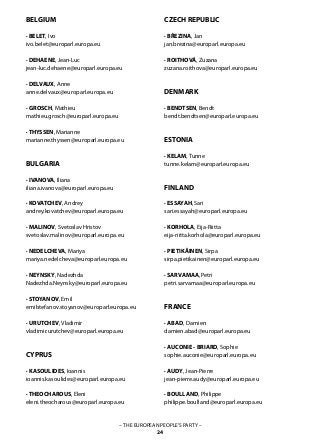
  • 21.
    1– THE EUROPEANPEOPLE’S PARTY – 11 EPP Presidents · TINDEMANS, Leo 1976-1985 · BUCKMAN, Piet 1985-1987 · SANTER, Jacques 1987-1990 · MARTENS, Wilfried 1990- Honorary Presidents · NIINISTÖ, Sauli · TINDEMANS, Leo EPP Congresses 1978 Congress I held in Brussels adopted the EPP’s political program. 1979 Congress II also in Brussels, decided the electoral platform for the first direct elections to the European Parliament. 1980 Congress III in Cologne discussed the overall theme “The Christian democrats in the Eighties – Securing Freedom and Peace Com- pleting Europe”. 1982 Congress IV took place in Paris under the slogan “Preserve Peace – Create Peace – Unite Europe”. 1984 Congress V in Rome formulated the EPP Action Program 1986 Congress VI in the Hague focused on Economic Development and Environmental Problems. 1988 Congress VII in Luxembourg prepared for another European Election and approved the document“On the Side of the Citizens”. 1990 CongressVIII in Dublin faced a new poli- tical landscape and published“A Federal Cons- titution for the European Union”. 1992CongressIXinAthensdiscussed,drafted, and approved the EPP“Basic Programme“. 1993 Congress X was held in Brussels and ad- opted the action program,“Europe 2000: Unity in Diversity”. 1995 Congress XI in Madrid was hosted under the thematic slogan“EPP- Force of the Union“. 1997 Congress XII in Toulouse approved the document“We are all Part of One World“. 1999 Congress XIII in Brussels outlined its new vision for Europe,“On the Way to the 21st Cen- tury“. EUCD formally merged with EPP. 2001 Congress XIV in Berlin revisited its roots, and adopted the working document “A Union of Values“. 2002 Congress XV in Estoril prepared for the Constitution process, and declared that EU needed “A Constitution for a Strong Europe“. EDU fomally merged with EPP. 2011 In February, TOP09 party from the Czech Republic granted full membership andMoldova’sPLDMpartygrantedobserver membership. In April, Marietta Giannakou’s Report on improving the legal status of EU- level political parties, approved in the Eu- ropean Parliament. On the sidelines of the June EPP Summit, the EPP hosted a special event to celebrate its 35th anniversary. The XX Congress in Marseille approved the do- cument “Moving Europe Forward“. 2012 On 4th February the EPP Honorary Presi- dent, Sauli Niinistö, is elected President of Fin- land. In February three Armenian parties, the Republican Party, Rule of Law and Heritage are granted observer member status. On March 1st Herman Van Rompuy was re-elected President of the European Council for another 2.5 year mandate. On 16th -18th October 2012 the EPP will hold its XXI Congress in Bucharest, Roma- nia.
  • 22.
    2004 Congress XVIin Brussels where the main objective was to prepare for the European Elec- tions. The“Action Program 2004-2009“ was ap- proved. 2006 Congress XVII in Rome approved the “Rome Manifesto”document. 2009 Congress XVIII in Warsaw approved the “Strong for the People“ EPP Election Manifesto. 2009 Congress XIX in Bonn approved the do- cument “The Social Market Economy in a Glo- balised World“. 2011CongressXX in Marseille approved the document “Moving Europe Forward“. 2012 Congress XXI to be held in Bucharest, Romania on 16th-18th October. – THE EUROPEAN PEOPLE’S PARTY – 12
  • 23.
    EPP Structure Presidency, PoliticalAssembly and Congress The EPP is led by President Wilfried MARTENS, former Prime Minister of Belgium, the Secre- tary General, 10 Vice Presidents and the Trea- surer. The Secretary General Antonio LÓPEZ- ISTÚRIZ runs the day to day operations of the Party. The EPP has three levels of decision-making: Presidency, Political Assembly and Congress. EPP heads of state and government can give policy recommendations at the level of the EPP Summit, whereas EPPWorking Groups perform preparatory political work. The Presidency decides on the general politi- cal guidelines and presides over the Political Assembly. The Presidency is composed of the President, the Secretary General, 10 Vice-Presi- dents, and the Treasurer. The Chairman of the EPP Group in the European Parliament is ex officio Vice President of the EPP. Currently, the Presidents of the European Commission and European Council are also ex officio members of the EPP Presidency. The Political Assembly defines the political positions of the Party between Congresses, decides on membership applications and fi- nal political guidelines. The Political Assembly also decides on the budget and safeguards the political presence of the EPP between the Con- gress meetings. The Political Assembly is com- posed of the designated delegates of the EPP member-parties, associated member-parties, parliamentary groups and member-associa- tions of the EPP. The number of delegates for each party is linked to the election result in the last European elec- tions so that parties are weighted according to their strength. This allows for taking decisions by majority. The Political Assembly meets three to four times a year. The Political Assembly defi- nes the mandate of the Working Groups which prepare the Party’s policy documents and re- commendations. All member-parties and asso- ciated member-parties and members of the EPP Group in the European Parliament can partici- pate in the Working Groups. The Congress is the highest decision-making body of the Party. It is composed of delegates from EPP member-parties, associate member- parties, member associations, and parliamen- tary groups. The EPP Congress meets at least once every three years. It elects the EPP Presiden- cy and decides on the main policy documents, electoral programmes and hosts the EPP heads of state and government and party leaders. For more information on the EPP, please visit: www.epp.eu EPP PRESIDENCY President · MARTENS, Wilfried Secretary General · LÓPEZ-ISTÚRIZ, Antonio Vice Presidents · BARNIER, Michel · DAVID, Mário · HINTZE, Peter · JELEVA, Rumiana · KATAINEN, Jyrki · KENNY, Enda · ORBÁN, Viktor · SARYUSZ-WOLSKI, Jacek · TAJANI, Antonio · WORTMANN-KOOL, Corien · BARROSO, José Manuel (e.o.) · VAN ROMPUY, Herman (e.o.) · DAUL, Joseph (e.o.) Who is Who in the EPP 1– THE EUROPEAN PEOPLE’S PARTY – 13
  • 24.
    – THE EUROPEANPEOPLE’S PARTY – 14 EPP SECRETARIAT Secretary General · LÓPEZ-ISTÚRIZ, Antonio alopez@epp.eu Deputies Secretary General · KREMER, Christian ckremer@epp.eu · VANDEPUTTE, Luc lvandeputte@epp.eu Spokesman · SASMATZOGLOU, Kostas spokesman@epp.eu Secretary of External Relations · BRIEC, Nicolas nbriec@epp.eu Officials and Personnel · FURNIERE, Brenda Head of the President‘s Office, bfurniere@epp.eu · FARRIS, Emanuala Senior Political Adviser, efarris@epp.eu · JIMENEZ, Javier Senior Press and Communication Officer, jjimenez@epp.eu · DURSIN, Mélanie Political Adviser, mdursin@epp.eu · FOMENCHENKO, Galina Political Adviser, gfomenchenko@epp.eu · MAGAZ, Juan Political Adviser, jmagaz@epp.eu · PRAINSACK, Ines Political Adviser, iprainsack@epp.eu · MURESAN, Siegfried Political Adviser, smuresan@epp.eu · MILHEIRO, Karine Press and Communication Officer, kmilheiro@epp.eu · DE ANTA, Beatriz Assistant to the Secretary General Antonio López-Istúriz, bdeanta@epp.eu · HELBIG, Christopher Assistant to Deputy Secretary General Christian Kremer, chelbig@epp.eu · LAMAL, Daphné Assistant to Deputy Secretary General Luc Vandeputte, dlamal@epp.eu · HEYMANS-ŠPAČKOVÁ, Pavlína Assistant to the Spokesman Kostas Sasmatzoglou, pheymans@epp.eu · ZALUTSKAJA, Julia Assistant to the Secretary of External Relations Nicolas Briec, jzalutskaja@epp.eu · TORRES, Yelba Working Groups and Ministerial Meetings, ytorres@epp.eu Treasurer · FRIEDRICH, Ingo
  • 25.
    1– THE EUROPEANPEOPLE’S PARTY – 15 · DUTTON, Lisa Assistant to the President‘s Office ldutton@epp.eu · PAEME, Sophie General Administration and Logistics, spaeme@epp.eu · VOLCKAERT, Guy Manager of Informatics & Internet, gvolckaert@epp.eu Working Groups are the backbone of the EPP’s political work, where high-profile representati- vesfromtheEPPmember-partiesdevelopcom- mon positions and strategies on major policy areas and submit specific recommendations to the Political Assembly for final approval. AWor- king Group can be given a specific mandate for preparatory work for EPP Summits and the EPP Congress. Working Groups are also responsible for organising conferences, roundtable discus- sions and other events. European Policy Chaired by the EPP President Wilfried MARTENS togetherwithEPPVicePresidentPeterHINTZE,the Working Group has the task of preparing the EPP’s mostvitalpolicypapersandCongressdocuments. Economic and Social Policy The working group, co-chaired by Gunnar HÖKMARK and Rumiana JELEVA, EPP Vice- President, is focused on responding to the cur- rent economic and financial crisis, the Lisbon process, demographic issues, and research and development. EPP Membership Chaired by Corien WORTMANN-KOOL, EPP Vice President, this Working Group is respon- sible for promoting, facilitating and incorpo- rating new EPP members, associate members, and observers throughout the continent.When a party is accepted into the EPP, its elected re- presentatives automatically join the EPP Group in the European Parliament, and all other EPP Groups in other institutional and organisatio- nal formations. Ad hoc Working Groups 1) Common Agricultural Policy 2) Climate Change Campaign Managers Meeting The EPP organises meetings twice a year with the campaign managers of member-parties to review national and regional election cam- paigns and in order to exchange experiences, develop different strategies and analyse com- munication tactics. At the Summit of the EPP, heads of state and government, party leaders in coalition govern- ments and in opposition, the EPP Presidency and the Presidents of the European Council and Commission, meet regularly prior to the Euro- pean Council Summit. These important sessions offer EPP leaders - in an informal and confidential setting - the opportunity to air differences and seek consensus within the EPP family in an effort to formulate common positions at the European Council. The EPP has 16 out of the 27 heads of state and governmentintheEuropeanCouncilaswellasse- ven non-EU heads of state and government that participate as guests at the enlaged EPP Summit. It also has seven heads of state and government who originate from EPP member-parties and do not normally take part in the European Council: EPP Working Groups EPP in the European Council – EPP Summit
  • 26.
    – THE EUROPEANPEOPLE’S PARTY – 16 AníbalCAVACOSILVA(Portugal,PSD),Bronislaw KOMOROWSKI (Poland, PO), Sauli NIINISTÖ (Finland, KOK), Rosen PLEVNELIEV (Bulgaria, GERB), and François FILLON (France, UMP). On the 19th November 2009 the European Council decided unanimously to appoint the then Bel- gian Prime Minister Herman VAN ROMPUY as the first ever President of the European Coun- cil. He was re-elected on 1st March 2012. President of the European Council · VAN ROMPUY, Herman | Belgium, CD&V EU Heads of State and Government · BĂSESCU, Traian | Romania, PD-L · BORISOV, Boyko | Bulgaria, GERB · DOMBROVSKIS, Valdis | Latvia, JL · GONZI, Lawrence | Malta, PN · JANŠA, Janez | Slovenia, SDS · JUNCKER, Jean-Claude | Luxembourg, CSV · KATAINEN, Jyrki | Finland, KOK · KENNY, Enda | Ireland, FG · KUBILIUS, Andrius | Lithuania, TS-LKD · MERKEL, Angela | Germany, CDU · ORBÁN, Viktor | Hungary, FIDESZ · PASSOS COELHO, Pedro | Portugal, PSD · RAJOY, Mariano | Spain, PP · REINFELDT, Fredrik | Sweden, M · SARKOZY, Nicolas | France, UMP · TUSK, Donald | Poland, PO Non-EUHeadsof StateandGovernment · BERISHA, Sali | Albania, DP · ERDOĞAN, Recep Tayyip | Turkey, AKP · IZETBEGOVIĆ, Bakir | Bosnia and Herzegovina, SDA · FILAT, Vlad | Moldova, PLDM · GRUEVSKI, Nikola | Former Yugoslav Republic of Macedonia ,VMRO-DPMNE · SAAKASHVILI, Mikheil | Georgia, UNM · SARGSYAN, Serzh | Armenia, HHK The European People’s Party organises and coordinates a total of twelve Ministerial meetings ahead of the Council meetings from its Brussels headquarters. The EPP Ministerial meetings underpin the horizontal activity of the Party with all the main EU institutions including the Council of the EU. Economic and Financial Affairs Since February 2008, this political coordina- tion meeting has quickly become a valuable discussion forum for our EPP Ministers, es- pecially in view of the difficult decisions that were needed in the Eurozone member coun- tries in the aftermath of the financial crisis. Under the leadership of Christine LAGARDE (France), Jyrki KATAINEN (Finland), and Giulio TREMONTI (Italy) to begin with, and subsequently under the guidance of Luc FRIEDEN (Luxemburg) and Anders BORG (Sweden), the ministers discussed measures to safeguard financial stability in the Euro area, the future of the European Stability Mechanism (ESM), the legislative package on strengthened economic governance (“six pack”), the fiscal compact and possible Tre- aty changes to strengthen the Stability and Growth Pact. Home Affairs The EPP Ministerial Meetings on Home Affairs are chaired by the German Minister of Inte- rior Hans-Peter FRIEDRICH and Manfred WEBER, MEP. In September 2011 the Ministers adopted the EPP position on Cyber Security and, furthermore, prepared the resolution on “Immigration and Integration”, which was ad- opted at the EPP Congress in Marseille in De- cember 2011. In addition, the Arab Spring and EPP in the Council of the EU – EPP Ministerial Meetings
  • 27.
    1– THE EUROPEANPEOPLE’S PARTY – 17 related migration flows, as well as the Schen- genenlargementtoBulgariaandRomania,were high on the agenda during these meetings. Justice The EPP Justice Ministers Meetings were or- ganised for the first time in spring 2011. These meetings were chaired by the Vice President oftheEuropeanCommission, VivianeREDING and Angelino ALFANO from Italy, followed later by Beatrice ASK from Sweden. During these meetings the Ministers adopted posi- tions on European Contract Law, Data Protec- tion, Collective Redress and EU Criminal Law. The focus was on “justice for growth” in order to abolish barriers and to achieve the full po- tential of the internal market. Foreign Affairs EPP Foreign Ministers convene on a regular basis and discuss issues such as the Western Balkans, the Eastern Partnership, Mediter- ranean Union, Middle East, Iran and Afgha- nistan. In 2011, under the co-chairmanships of Elmar BROK and Franco FRATTINI, the EPP organised two seminars in Sarajevo (17th March) and in Bordeaux (30th October – 1st September) with its Foreign Ministers and with the participation of EPP and like-minded non-EU Foreign Ministers. A position paper on EU-Russia relations was approved by the EPP Foreign Ministers and introduced to the EPP Political Assembly with the aim of contri- buting to a new and enhanced strategic part- nership between the EU and Russia. Environment The EPP Environment Ministers Meeting is chaired by the Irish Minister Phil HOGAN. The focus of these meetings in 2011 was on the Glo- bal Climate Change negotiations, which took place in December in Durban, South Africa. Other important topics were the EU Biodiversity Strategy, the EU Roadmap to a low carbon eco- nomy by 2050 and the water policy for the EU. Agriculture The EPP Agriculture Ministers Meeting is chaired by Niki BERLAKOVICH, the Austrian Minister of Agriculture and Forestry, Environ- ment and Water Management. During the course of the year the Agriculture Ministers had a very dynamic and constructive debate on the future of the Common Agriculture Po- licy. EU Commissioner for Agriculture, Dacian CIOLOŞ, actively participated in the discus- sions and during the October 2011 meeting presented new proposals to the Ministers on the CAP reform, which dominated the agenda at the end of 2011 and will remain the main topic for 2012. Energy The EPP Energy Ministers Meeting is chaired by EPP Vice President and MEP, Jacek SARYUSZ-WOLSKI. In September 2011, EU Commissioner Günther OETTINGER, who actively participates in the EPP meetings, launched new initiatives on the external ener- gy policy as well as on infrastructure. During the meeting on 23rd November, EU Commis- sioner Janusz LEWANDOWSKI was invited as the special guest and informed Ministers about the financing of the EU’s energy infra- structure. Defense The EPP Defence Ministers’ Meetings, chaired by Belgian Minister of Defence Pieter DE CREM and launched in 2009, continued suc- cessfully in 2011 (23rd May in Brussels and 22nd September in Wrocław, Poland). On the one hand, the meetings were important as a useful forum to discuss the EU’s engagement in Libya. Whilst on the other hand, the Mini- sters were able to use the meetings to concen- trate on pooling and sharing expertise in the field of military capabilities as well as CSDP
  • 28.
    – THE EUROPEANPEOPLE’S PARTY – 18 Operations (i.e. EUNAVFOR Atalanta, EUFOR Althea in BiH). Employment As a natural reaction to the economic and so- cial effects of the financial crisis in Europe, the Ministers of Employment and Social Affairs of the EPP member parties started to meet in March 2010, under the chairmanship of Enda KENNY (Ireland) and Maurizio SACCONI (Ita- ly). During 2011, as unemployment levels in Europe continued to rise in many countries, the EPP Ministers focused their discussions on the EU2020 Strategy for growth and em- ployment, on the preparations of the social agenda of the G-20, and on the Working Time Directive and the European Globalisation Ad- justment Fund. In September 2011, Xavier BERTRAND (France) took over leadership and during the French G-20 Presidency organised a meeting with EPP and like-minded Emplo- yment Ministers in Paris. Moreover, the EPP Employment Ministers drafted a resolution on “Job Creation: A Priority for Growth Policies”, which was approved in Marseille during the EPP Political Assembly (7th-8th December). In early 2012, Ursula von der LEYEN (Germany) agreed to co-chair the EPP Employment Mini- sters‘ group. Industry Under the continued chairmanship of Antonio TAJANI, Vice President of the European Com- mission and the EPP, the Ministers worked to find common solutions on topics such as the current competitiveness levels of industrial output across the EU and how to increase it. Furthermore, they focused on the mid-term review of the Small Business Act in order to improve conditions for the small and medium enterprises in Europe. Finally, they also had extensive exchanges of views on the Annual Growth Survey and the Europe 2020 Strategy, assessing the contribution of the industrial sector to the EU Semester. Transport 2011 was a particularly important year to dis- cuss the state-of-play of the transport sector in Europe. Under the chairmanship of Anca BOAGIU (Romania), many issues were ana- lysed and discussed, such as the revision of the TEN-T policies (financing and methodo- logy), the establishment of a truly European maritime Safety Agency and the Commission White Paper on the future of the EU transport policy until 2020. Finally, the issue of public- private partnerships (PPPs) was debated ex- tensively by the EPP Transport Ministers, resul- ting in the drafting of a resolution on how to improve access to financing for PPP projects in the transport sector. In November 2011, the EPP Political Assembly adopted the PPP reso- lution. Finally, in 2012, Alexandru NAZARE (Romania) took over the leadership of this Mi- nisterial group. General Affairs The EPP General Affairs Ministers’ meeting is co-chaired by Lucinda CREIGHTON, Minister of State for European Affairs and TD (Ireland), and Jacek SARYUSZ-WOLSKI, EPP Vice Presi- dent and MEP (Poland). This Ministerial mee- ting provides a platform for EPP Ministers to discuss upfront the issues on the EU General Affairs Council, formulate priorities and deve- lop an EPP common approach. 13 European and Foreign Affairs Ministers met for the first time in February 2012 and discussed a series of measures that will enable economic growth and jobs’ creation.
  • 29.
    1– THE EUROPEANPEOPLE’S PARTY – 19 President · BARROSO, José Manuel | Portugal, PSD jose-manuel.barroso@ec.europa.eu Vice Presidents · REDING, Viviane | Luxembourg, CSV Justice, Fundamental Rights and Citizenship viviane.reding@ec.europa.eu · TAJANI, Antonio | Italy, PdL Industry and Entrepreneurship antonio.tajani@ec.europa.eu Members · BARNIER, Michel | France, UMP Internal Market and Services michel.barnier@ec.europa.eu The European People’s Party has always played an important role in the European Commission, the executive arm of the EU that implements the Union‘s policies. With José Manuel BAR- ROSO – a long-standing leader of the EPP fa- mily – at the helm, the Barroso II Commission brings vitality and dynamism to EU policy ma- king. The Commission has a total of 13 Members that are affiliated to the EPP. The EPP Commissioners meet on an ad hoc basis in the Party headquar- ters and many Commissioners participate regu- larly in the EPP Ministerial meetings. President José Manuel BARROSO, an ex officio member of the EPP Presidency, also participates at the EPP Summit meetings. EPP in the European Commission · CIOLOŞ, Dacian | Romania Agriculture and Rural Development dacian.ciolos@ec.europa.eu · DALLI, John | Malta, PN Health and Consumer Policy john.dalli@ec.europa.eu · HAHN, Johannes | Austria, ÖVP Regional Policy johannes.hahn@ec.europa.eu · HEDEGAARD, Connie | Denmark, DKF Climate Action connie.hedegaard@ec.europa.eu · GEORGIEVA, Kristalina | Bulgaria International Cooperation, Humanitarian Aid and Crisis Response kristalina.georgieva@ec.europa.eu · LEWANDOWSKI, Janusz | Poland, PO Budget and Financial Programming janusz.lewandowski@ec.europa.eu · OETTINGER, Günther | Germany, CDU Energy gunther.oettinger@ec.europa.eu · PIEBALGS, Andris | Latvia Development andris.piebalgs@ec.europa.eu · ŠEMETA, Algirdas | Lithuania, TS-LKD Taxation and Customs Union, Audit and Anti-Fraud algirdas.semeta@ec.europa.eu For more information on the European Com- mission, please visit: www.ec.europa.eu
  • 30.
    – THE EUROPEANPEOPLE’S PARTY – 20 The EPP Group has been the largest political group in the European Parliament since July 1999. 271 Members of the European Parliament (MEPs) sit in the EPP Group, representing some 36 per cent of the total. The Group is led by French politician Joseph DAUL who is ex officio member of the EPP Presidency and participa- tes regularly at the EPP Summit meetings. The Group strives to advance the goal of a more competitive and democratic Europe, closer to its citizens and to resist the political priorities of the left. Originally founded in June 1953 as the Chris- tian Democrat Group in the embryonic Com- mon Assembly of the European Coal and Steel Community (comprised of nominated mem- bers of national parliaments), the EPP Group has been involved at every stage in the history of the European Union, from its earliest begin- nings until the present. As the largest political group in the European Parliament, the EPP Group is in a stronger po- sition than any other to set that body‘s political agenda and to win its most critical votes. In see- king to maximise its influence, the EPP Group has been able to draw on the fact that the Eu- ropean Parliament has become increasingly influential within the European Union. In July 2009 the European Parliament overwhelmingly elected as its President the former Polish Prime Minister and EPP candidate Jerzy Buzek for a 2½ year term. He completed his term in Janu- ary 2012. Vice-Presidents of the EP · VIDAL-QUADRAS, Alejo alejo.vidal-quadras@europarl.europa.eu · PAPASTAMKOS, Georgios georgios.papastamkos@europarl.europa.eu EPP in the European Parliament · ANGELILLI, Roberta roberta.angelilli@europarl.europa.eu · KARAS, Othmar othmar.karas@europarl.europa.eu · WIELAND, Rainer rainer.wieland@europarl.europa.eu · PROTASIEWICZ, Jacek jacek.protasiewicz@europarl.europa.eu · SURJÁN, László laszlo.surjan@europarl.europa.eu Quaestors of the EP · LULLING, Astrid astrid.lulling@europarl.europa.eu · HIGGINS, Jim jim.higgins@europarl.europa.eu Presidency of the EPP Group Chairman: · DAUL, Joseph joseph.daul@europarl.europa.eu Vice-Chairmen: · BONSIGNORE, Vito vito.bonsignore@europarl.europa.eu · HÖKMARK, Gunnar gunnar.hokmark@europarl.europa.eu · KASOULIDES, Ioannis ioannis.kasoulides@europarl.europa.eu · MARINESCU, Marian-Jean marian-jean.marinescu@europarl.europa.eu · MAYOR OREJA, Jaime jaime.mayororeja@europarl.europa.eu · OLBRYCHT, Jan jan.olbrycht@europarl.europa.eu
  • 31.
    1– THE EUROPEANPEOPLE’S PARTY – 21 · RANGEL, Paulo paulo.rangel@europarl.europa.eu · SZÁJER, József jozsef.szajer@europarl.europa.eu · WEBER, Manfred manfred.weber@europarl.europa.eu · WORTMANN-KOOL, Corien corien.wortmann@europarl.europa.eu Secretary General The staff of the EPP Group is led by Secretary General · Martin KAMP. martin.kamp@europarl.europa.eu For more information on the EPP Group in the European Parliament, please visit: www.eppgroup.eu Heads of national delegations GERMANY (42 Members) · REUL, Herbert herbert.reul@europarl.europa.eu · FERBER, Markus markus.ferber@europarl.europa.eu ITALY (35 Members) · MAURO, Mario mario.mauro@europarl.europa.eu · GARGANI, Giuseppe giuseppe.gragani@europarl.europa.eu FRANCE (30 Members) · AUDY, Jean-Pierre jean-pierre.audy@europarl.europa.eu POLAND (29 Members) · SARYUSZ-WOLSKI, Jacek jacek.saryusz-wolski@europarl.europa.eu SPAIN (25 Members) · MAYOR OREJA, Jaime jaime.mayororeja@europarl.europa.eu HUNGARY (14 Members) · GYÜRK, András andras.gjurk@europarl.europa.eu ROMANIA (14 Members) · STOLOJAN, Theodor Dimitru theodordimitru.stolojan@europarl.europa.eu PORTUGAL (10 Members) · RANGEL, Paulo paulo.rangel@europarl.europa.eu · MELO, Nuno nuno.melo@europarl.europa.eu BULGARIA (7 Members) · KOVATCHEV, Andrey andrey.kovatchev@europarl.europa.eu GREECE (7 Members) · GIANNAKOU, Marietta marietta.giannakou@europarl.europa.eu AUSTRIA (6 Members) · KARAS, Othmar othmar.karas@europarl.europa.eu
  • 32.
    – THE EUROPEANPEOPLE’S PARTY – 22 SLOVAKIA (6 Members) · ZÁBORSKÁ, Anna anna.zaborska@europarl.europa.eu BELGIUM (5 Members) · THYSSEN, Marianne marianne.thyssen@europarl.europa.eu NETHERLANDS (5 Members) · VAN DE CAMP, Wim wim.vandecamp@europarl.europa.eu SWEDEN (5 Members) · HÖKMARK, Gunnar gunnar.hokmark@europarl.europa.eu IRELAND (4 Members) · MITCHELL, Gay gay.mitchell@europarl.europa.eu FINLAND (4 Members) · KORHOLA, Eija-Riitta eija-riitta.korhola@europarl.europa.eu LITHUANIA (4 Members) · LANDSBERGIS, Vytautas vytautas.landsbergis@europarl.europa.eu LATVIA (4 Members) · KARIŅŠ, Arturs Krišjānis krisjanis.karins@europarl.europa.eu SLOVENIA (4 Members) · ZVER, Milan milan.zver@europarl.europa.eu LUXEMBOURG (3 Members) · ENGEL, Frank frank.engel@europarl.europa.eu CZECH REPUBLIC (2 Members) · ROITHOVÁ, Zuzana zuzana.roithova@europarl.europa.eu CYPRUS (2 Members) · KASOULIDES, Ioannis ioannis.kasoulides@europarl.europa.eu MALTA (2 Members) · BUSUTTIL, Simon simon.busuttil@europarl.europa.eu DENMARK (1 Member) · BENDTSEN, Bendt bendt.bendtsen@europarl.europa.eu ESTONIA (1 Member) · KELAM, Tunne tunne.kelam@europarl.europa.eu
  • 33.
    1– THE EUROPEANPEOPLE’S PARTY – 23 EPP Group coordinators in the parliamentary committees · SALAFRANCA, José Ignacio Committee on Foreign Affairs · TŐKÉS, László / · VAIDERE, Inese Subcommittee on Human Rights · GAHLER, Michael Subcommittee on Security and Defence · MITCHELL, Gay / · KACZMAREK, Filip Committee on Development · CASPARY, Daniel Committee on International Trade · GARRIGA-POLLEDO, Salvador Committee on Budgets · GRÄSSLE, Ingeborg Committee on Budgetary Control · GAUZÈS, Jean-Paul Committee on Economic and Monetary Affairs · ŐRY, Csaba Committee on Employment and Social Affairs · LIESE, Peter / · SEEBER, Richard Committee on the Environment, Public Health and Food Safety · del CASTILLO VERA, Pilar Committee on Industry, Research and Energy · SCHWAB, Andreas Committee on Internal Market and Consumer Protection · GROSCH, Mathieu Committee on Transport and Tourism · VAN NISTELROOIJ, Lambert Committee on Regional Development · DESS, Albert CommitteeonAgricultureandRuralDevelopment · ANTINORO, Antonello Committee on Fisheries · SCURRIA, Marco Committee on Culture and Education · ZWIEFKA, Tadeusz Committee on Legal Affairs · BUSUTTIL, Simon Committee on Civil Liberties, Justice and Home Affairs · TRZASKOWSKI, Rafał Committee on Constitutional Affairs · NEDELCHEVA, Mariya Committee onWomen‘s Rights and Gender Equality · JAHR, Peter Committee on Petitions Members AUSTRIA · BECKER, Heinz K. heinz.becker@europarl.europa.eu · KARAS, Othmar othmar.karas@europarl.europa.eu · KÖSTINGER, Elisabeth elisabeth.koestinger@europarl.europa.eu · PIRKER, Hubert hubert.pirker@europarl.europa.eu · RÜBIG, Paul paul.ruebig@europarl.europa.eu · SEEBER, Richard richard.seeber@europarl.europa.eu
  • 34.
    – THE EUROPEANPEOPLE’S PARTY – 24 BELGIUM · BELET, Ivo ivo.belet@europarl.europa.eu · DEHAENE, Jean-Luc jean-luc.dehaene@europarl.europa.eu · DELVAUX, Anne anne.delvaux@europarl.europa.eu · GROSCH, Mathieu mathieu.grosch@europarl.europa.eu · THYSSEN, Marianne marianne.thyssen@europarl.europa.eu BULGARIA · IVANOVA, Iliana iliana.ivanova@europarl.europa.eu · KOVATCHEV, Andrey andrey.kovatchev@europarl.europa.eu · MALINOV, Svetoslav Hristov svetoslav.malinov@europarl.europa.eu · NEDELCHEVA, Mariya mariya.nedelcheva@europarl.europa.eu · NEYNSKY, Nadezhda Nadezhda.Neynsky@europarl.europa.eu · STOYANOV, Emil emilstefanov.stoyanov@europarl.europa.eu · URUTCHEV, Vladimir vladimir.urutchev@europarl.europa.eu CYPRUS · KASOULIDES, Ioannis ioannis.kasoulides@europarl.europa.eu · THEOCHAROUS, Eleni eleni.theocharous@europarl.europa.eu CZECH REPUBLIC · BŘEZINA, Jan jan.brezina@europarl.europa.eu · ROITHOVÁ, Zuzana zuzana.roithova@europarl.europa.eu DENMARK · BENDTSEN, Bendt bendt.bendtsen@europarl.europa.eu ESTONIA · KELAM, Tunne tunne.kelam@europarl.europa.eu FINLAND · ESSAYAH, Sari sari.essayah@europarl.europa.eu · KORHOLA, Eija-Riitta eija-riitta.korhola@europarl.europa.eu · PIETIKÄINEN, Sirpa sirpa.pietikainen@europarl.europa.eu · SARVAMAA, Petri petri.sarvamaa@europarl.europa.eu FRANCE · ABAD, Damien damien.abad@europarl.europa.eu · AUCONIE - BRIARD, Sophie sophie.auconie@europarl.europa.eu · AUDY, Jean-Pierre jean-pierre.audy@europarl.europa.eu · BOULLAND, Philippe philippe.boulland@europarl.europa.eu
  • 35.
    1– THE EUROPEANPEOPLE’S PARTY – 25 · CADEC, Alain alain.cadec@europarl.europa.eu · CAVADA, Jean-Marie jean-marie.cavada@europarl.europa.eu · DANJEAN, Arnaud arnaud.danjean@europarl.europa.eu · DANTIN, Michel michel.dantin@europarl.europa.eu · DATI, Rachida rachida.dati@europarl.europa.eu · DAUL, Joseph joseph.daul@europarl.europa.eu · DE VEYRAC, Christine christine.deveyrac@europarl.europa.eu · FRANCO, Gaston gaston.franco@europarl.europa.eu · GALLO, Marielle marielle.gallo@europarl.europa.eu · GAUZÈS, Jean-Paul jean-paul.gauzes@europarl.europa.eu · GROSSETÊTE, Françoise francoise.grossetete@europarl.europa.eu · HORTEFEUX, Brice brice.hortefeux@europarl.europa.eu · JUVIN, Philippe philippe.juvin@europarl.europa.eu · LAMASSOURE, Alain alain.lamassoure@europarl.europa.eu · LE BRUN, Agnès agnes.lebrun@europarl.europa.eu · LE GRIP, Constance constance.legrip@europarl.europa.eu · MATHIEU, Véronique veronique.mathieu@europarl.europa.eu · MORIN-CHARTIER, Elisabeth elisabeth.morinchartier@europarl.europa.eu · PONGA, Maurice maurice.ponga@europarl.europa.eu · PROUST, Franck franck.proust@europarl.europa.eu · RIQUET, Dominique dominique.riquet@europarl.europa.eu · ROATTA, Jean jean.roatta@europarl.europa.eu · SAÏFI, Tokia tokia.saifi@europarl.europa.eu · SANCHEZ-SCHMID, Marie-Thérèse marie-therese.sanchez-schmid@europarl.europa.eu · STRIFFLER, Michèle michele.striffler@europarl.europa.eu · VLASTO, Dominique dominique.vlasto@europarl.europa.eu GERMANY · BALZ, Burkhard burkhard.balz@europarl.europa.eu · BÖGE, Reimer reimer.boege@europarl.europa.eu · BROK, Elmar elmar.brok@europarl.europa.eu · CASPARY, Daniel daniel.caspary@europarl.europa.eu · COLLIN-LANGEN, Birgit birgit.collin-langen@europarl.europa.eu · DESS, Albert albert.dess@europarl.europa.eu · EHLER, Christian christian.ehler@europarl.europa.eu
  • 36.
    – THE EUROPEANPEOPLE’S PARTY – 26 · FERBER, Markus markus.ferber@europarl.europa.eu · FLORENZ, Karl-Heinz karl-heinz.florenz@europarl.europa.eu · GAHLER, Michael michael.gahler@europarl.europa.eu · GRÄSSLE, Ingeborg ingeborg.graessle@europarl.europa.eu · HOHLMEIER, Monika monika.hohlmeier@europarl.europa.eu · JAHR, Peter peter.jahr@europarl.europa.eu · JEGGLE, Elisabeth elisabeth.jeggle@europarl.europa.eu · KASTLER, Martin martin.kastler@europarl.europa.eu · KLASS, Christa christa.klass@europarl.europa.eu · KOCH, Dieter-Lebrecht dieter-lebrecht.koch@europarl.europa.eu · KUHN, Werner werner.kuhn@europarl.europa.eu · LANGEN, Werner werner.langen@europarl.europa.eu · LEHNE, Klaus-Heiner klaus-heiner.lehne@europarl.europa.eu · LIESE, Peter peter.liese@europarl.europa.eu · MANN, Thomas thomas.mann@europarl.europa.eu · MAYER, Hans-Peter hans-peter.mayer@europarl.europa.eu · NIEBLER, Angelika angelika.niebler@europarl.europa.eu · PACK, Doris doris.pack@europarl.europa.eu · PIEPER, Markus markus.pieper@europarl.europa.eu · PÖTTERING, Hans-Gert hans-gert.poettering@europarl.europa.eu · POSSELT, Bernd bernd.posselt@europarl.europa.eu · QUISTHOUDT-ROWOHL, Godelieve godelieve.quisthoudt-rowohl@europarl.europa.eu · REUL, Herbert herbert.reul@europarl.europa.eu · SCHNELLHARDT, Horst a.schumann@schnellhardt-europa.de · SCHNIEBER-JASTRAM, Birgit birgit.schnieber-jastram@europarl.europa.eu · SCHWAB, Andreas andreas.schwab@europarl.europa.eu · SOMMER, Renate renate.sommer@europarl.europa.eu · ULMER, Thomas thomas.ulmer@europarl.europa.eu · VERHEYEN, Sabine sabine.verheyen@europarl.europa.eu · VOSS, Axel axel.voss@europarl.europa.eu · WEBER, Manfred manfred.weber@europarl.europa.eu · WEISGERBER, Anja anja.weisgerber@europarl.europa.eu · WIELAND, Rainer rainer.wieland@europarl.europa.eu · WINKLER, Hermann hermann.winkler@europarl.europa.eu
  • 37.
    1– THE EUROPEANPEOPLE’S PARTY – 27 · ZELLER, Joachim joachim.zeller@europarl.europa.eu GREECE · GIANNAKOU, Marietta marietta.giannakou@europarl.europa.eu · KOUMOUTSAKOS, Georgios georgios.koumoutsakos@europarl.europa.eu · KRATSA-TSAGAROPOULOU, Rodi rodi.kratsa-tsagaropoulou@europarl.europa.eu · PAPANIKOLAOU, Georgios georgios.papanikolaou@europarl.europa.eu · PAPASTAMKOS, Georgios georgios.papastamkos@europarl.europa.eu · POUPAKIS, Konstantinos konstantinos.poupakis@europarl.europa.eu · TSOUKALAS, Ioannis A. ioannis.tsoukalas@europarl.europa.eu HUNGARY · ÁDER, János janos.ader@europarl.europa.eu · BAGÓ, Zoltán zoltan.bago@europarl.europa.eu · DEUTSCH, Tamás tamas.deutsch@europarl.europa.eu · GÁL, Kinga kinga.gal@europarl.europa.eu · GÁLL-PELCZ, Ildikó ildiko.gall-pelcz@europarl.europa.eu · GLATTFELDER, Béla bela.glattfelder@europarl.europa.eu · GYÜRK, András andras.gyurk@europarl.europa.eu · HANKISS, Ágnes agnes.hankiss@europarl.europa.eu · JÁRÓKA, Lívia livia.jaroka@europarl.europa.eu · KÓSA, Ádám adam.kosa@europarl.europa.eu · ŐRY, Csaba csaba.ory@europarl.europa.eu · SCHÖPFLIN, György gyorgy.schopflin@europarl.europa.eu · SURJÁN, László laszlo.surjan@europarl.europa.eu · SZÁJER, József jozsef.szajer@europarl.europa.eu IRELAND · HIGGINS, Jim jim.higgins@europarl.europa.eu · KELLY, Seán sean.kelly@europarl.europa.eu · McGUINNESS, Mairead mairead.mcguinness@europarl.europa.eu · MITCHELL, Gay gay.mitchell@europarl.europa.eu ITALY · ALBERTINI, Gabriele gabriele.albertini@europarl.europa.eu · ANGELILLI, Roberta roberta.angelilli@europarl.europa.eu · ANTINORO, Antonello antonello.antinoro@europarl.europa.eu · ANTONIOZZI, Alfredo alfredo.antoniozzi@europarl.europa.eu
  • 38.
    – THE EUROPEANPEOPLE’S PARTY – 28 · BALDASSARRE, Raffaele raffaele.baldassarre@europarl.europa.eu · BARTOLOZZI, Paolo paolo.bartolozzi@europarl.europa.eu · BERLATO, Sergio sergio.berlato@europarl.europa.eu · BONSIGNORE, Vito vito.bonsignore@europarl.europa.eu · CANCIAN, Antonio antonio.cancian@europarl.europa.eu · CASINI, Carlo carlo.casini@europarl.europa.eu · COMI, Lara lara.comi@europarl.europa.eu · DE MITA, Luigi Ciriaco luigiciriaco.demita@europarl.europa.eu · DORFMANN, Herbert herbert.dorfmann@europarl.europa.eu · FIDANZA, Carlo carlo.fidanza@europarl.europa.eu · GARDINI, Elisabetta elisabetta.gardini@europarl.europa.eu · GARGANI, Giuseppe giuseppe.gargani@europarl.europa.eu · IACOLINO, Salvatore salvatore.iacolino@europarl.europa.eu · LA VIA, Giovanni giovanni.lavia@europarl.europa.eu · MASTELLA, Clemente clemente.mastella@europarl.europa.eu · MATERA, Barbara barbara.matera@europarl.europa.eu · MAURO, Mario mario.mauro@europarl.europa.eu · MAZZONI, Erminia erminia.mazzoni@europarl.europa.eu · MOTTI, Tiziano tiziano.motti@europarl.europa.eu · MUSCARDINI, Cristiana cristiana.muscardini@europarl.europa.eu · PALLONE, Alfredo alfredo.pallone@europarl.europa.eu · PATRICIELLO, Aldo aldo.patriciello@europarl.europa.eu · RIVELLINI, Crescenzio crescenzio.rivellini@europarl.europa.eu · RONZULLI, Licia licia.ronzulli@europarl.europa.eu · SALATTO, Potito potito.salatto@europarl.europa.eu · SARTORI, Amalia amalia.sartori@europarl.europa.eu · SCURRIA, Marco marco.scurria@europarl.europa.eu · SILVESTRIS, Sergio Paolo Francesco sergio.silvestris@europarl.europa.eu · TATARELLA, Salvatore salvatore.tatarella@europarl.europa.eu ·TREMATERRA, Gino gino.trematerra@europarl.europa.eu · ZANICCHI, Iva iva.zanicchi@europarl.europa.eu LATVIA · KALNIETE, Sandra sandra.kalniete@europarl.europa.eu · KARIŅŠ, Arturs Krišjānis krisjanis.karins@europarl.europa.eu
  • 39.
    1– THE EUROPEANPEOPLE’S PARTY – 29 · ŠADURSKIS, Kārlis karlis.sadurskis@europarl.europa.eu · VAIDERE, Inese inese.vaidere@europarl.europa.eu LITHUANIA · ANDRIKIENĖ, Laima Liucija laimaliucija.andrikiene@europarl.europa.eu · LANDSBERGIS, Vytautas vytautas.landsbergis@europarl.europa.eu · MORKŪNAITĖ-MIKULĖNIENĖ, Radvilė radvile.morkunaite-mikuleniene@europarl.europa.eu · SAUDARGAS, Algirdas algirdas.saudargas@europarl.europa.eu LUXEMBOURG · BACH, Georges georges.bach@europarl.europa.eu · ENGEL, Frank frank.engel@europarl.europa.eu · LULLING, Astrid astrid.lulling@europarl.europa.eu MALTA · BUSUTTIL, Simon simon.busuttil@europarl.europa.eu · CASA, David david.casa@europarl.europa.eu NETHERLANDS · van de CAMP, Wim wim.vandecamp@europarl.europa.eu · de LANGE, Esther esther.delange@europarl.europa.eu · van NISTELROOIJ, Lambert lambert.vannistelrooij@europarl.europa.eu · OOMEN-RUIJTEN, Ria ria.oomen-ruijten@europarl.europa.eu · WORTMANN-KOOL, Corien corien.wortmann@europarl.europa.eu POLAND · BORYS, Piotr piotr.borys@europarl.europa.eu · BRATKOWSKI, Arkadiusz Tomasz arkadiusztomasz.bratkowski@europarl.europa.eu · BUZEK, Jerzy jerzy.buzek@europarl.europa.eu · GRZYB, Andrzej andrzej.grzyb@europarl.europa.eu · HANDZLIK, Małgorzata malgorzata.handzlik@europarl.europa.eu · HIBNER, Jolanta Emilia jolantaemilia.hibner@europarl.europa.eu · HÜBNER, Danuta Maria danuta.huebner@europarl.europa.eu · JAZŁOWIECKA, Danuta danuta.jazlowiecka@europarl.europa.eu · JĘDRZEJEWSKA, Sidonia Elżbieta sidonia.jedrzejewska@europarl.europa.eu · KACZMAREK, Filip filip.kaczmarek@europarl.europa.eu · KALINOWSKI, Jarosław jarosaw.kalinowski@europarl.europa.eu · KOLARSKA-BOBIŃSKA, Lena lena.kolarska-bobinska@europarl.europa.eu · KOZŁOWSKI, Jan jan.kozlowski@europarl.europa.eu
  • 40.
    – THE EUROPEANPEOPLE’S PARTY – 30 · LISEK, Krzysztof krzysztof.lisek@europarl.europa.eu · ŁUKACIJEWSKA, Elżbieta Katarzyna elzbietakatarzyna.lukacijewska@europarl.europa.eu · MARCINKIEWICZ, Bogdan Kazimierz bogdan.marcinkiewicz@europarl.europa.eu · NITRAS, Sławomir Witold slawomir.nitras@europarl.europa.eu · OLBRYCHT, Jan jan.olbrycht@europarl.europa.eu · PROTASIEWICZ, Jacek jacek.protasiewicz@europarl.europa.eu · SARYUSZ-WOLSKI, Jacek jacek.saryusz-wolski@europarl.europa.eu · SIEKIERSKI, Czesław Adam czeslaw.siekierski@europarl.europa.eu · SKRZYDLEWSKA, Joanna Katarzyna joanna.skrzydlewska@europarl.europa.eu · SONIK, Bogusław boguslaw.sonik@europarl.europa.eu · THUN UND HOHENSTEIN, Róża, Gräfin von roza.thun@europarl.europa.eu · TRZASKOWSKI, Rafał rafal.trzaskowski@europarl.europa.eu · WAŁĘSA, Jarosław Leszek jaroslaw.walesa@europarl.europa.eu · ZALEWSKI, Paweł pavel.zalewski@europarl.europa.eu · ZASADA, Artur artur.zasada@europarl.europa.eu · ZWIEFKA, Tadeusz tadeusz.zwiefka@europarl.europa.eu PORTUGAL · BASTOS, Regina regina.bastos@europarl.europa.eu · CARVALHO, Maria Da Graça mariadagraca.carvalho@europarl.europa.eu · COELHO, Carlos carlos.coelho@europarl.europa.eu · DAVID, Mário mario.david@europarl.europa.eu · FEIO, Diogo diogo.feio@europarl.europa.eu · FERNANDES, José Manuel josemanuel.fernandes@europarl.europa.eu · MELO, Nuno nuno.melo@europarl.europa.eu · PATRÃO NEVES, Maria do Céu mariadoceu.patraoneves@europarl.europa.eu · RANGEL, Paulo paulo.rangel@europarl.europa.eu · TEIXEIRA, Nuno nuno.teixeira@europarl.europa.eu ROMANIA · ANTONESCU, Elena Oana elenaoana.antonescu@europarl.europa.eu · BĂSESCU, Elena elena.basescu@europarl.europa.eu · BODU, Sebastian Valentin sebastianvalentin.bodu@europarl.europa.eu · LUHAN, Petru Constantin petru.luhan@europarl.europa.eu · MACOVEI, Monica Luisa monica.macovei@europarl.europa.eu
  • 41.
    1– THE EUROPEANPEOPLE’S PARTY – 31 · MARINESCU, Marian-Jean marian-jean.marinescu@europarl.europa.eu · MATULA, Iosif iosif.matula@europarl.europa.eu · NICULESCU, Rareş-Lucian rares-lucian.niculescu@europarl.europa.eu · PREDA, Cristian Dan cristiandan.preda@europarl.europa.eu · SÓGOR, Csaba csaba.sogor@europarl.europa.eu · STOLOJAN, Theodor Dumitru theodordumitru.stolojan@europarl.europa.eu · TŐKÉS, László laszlo.tokes@europarl.europa.eu · UNGUREANU, Traian traian.ungureanu@europarl.europa.eu · WINKLER, Iuliu iuliu.winkler@europarl.europa.eu SLOVAKIA · BAUER, Edit edit.bauer@europarl.europa.eu · KUKAN, Eduard eduard.kukan@europarl.europa.eu · MÉSZÁROS, Alajos alajos.meszaros@europarl.europa.eu · MIKOLÁŠIK, Miroslav miroslav.mikolasik@europarl.europa.eu · ŠŤASTNÝ, Peter peter.stastny@europarl.europa.eu · ZÁBORSKÁ, Anna anna.zaborska@europarl.europa.eu SLOVENIA · JORDAN CIZELJ, Romana romana.jordancizelj@europarl.europa.eu · MAZEJ KUKOVIČ, Zofija zofija.mazejkukovic@europarl.europa.eu · PETERLE, Alojz alojz.peterle@europarl.europa.eu · ZVER, Milan milan.zver@europarl.europa.eu SPAIN · ARIAS ECHEVERRÍA, Pablo pablo.ariasecheverria@europarl.europa.eu · AYUSO GONZALEZ, Pilar pilar.ayuso@europarl.europa.eu · del CASTILLO VERA, Pilar pilar.delcastillo@europarl.europa.eu · DÍAZ DE MERA GARCÍA CONSUEGRA, Agustín agustin.diazdemera@europarl.europa.eu · CORREA ZAMORA, María Auxiliadora mariaauxiliadora.correazamora@europarl.europa.eu · ESTARÀS FERRAGUT, Rosa rosa.estaras@europarl.europa.eu · FISAS AYXELA, Santiago santiago.fisasayxela@europarl.europa.eu · FRAGA ESTÉVEZ, Carmen carmen.fragaestevez@europarl.europa.eu · GARRIGA POLLEDO, Salvador salvador.garrigapolledo@europarl.europa.eu · de GRANDES PASCUAL, Luis luis.degrandespascual@europarl.europa.eu · GUTIÉRREZ CORTINES, Cristina cristina.gutierrez-cortines@europarl.europa.eu
  • 42.
    – THE EUROPEANPEOPLE’S PARTY – 32 · HERRANZ GARCÍA, Esther esther.herranzgarcia@europarl.europa.eu · ITURGAIZ ANGULO, Carlos José carlos.iturgaizangulo@europarl.europa.eu · JIMÉNEZ-BECERRIL BARRIO, Teresa teresa.jimenez-becerril@europarl.europa.eu · LOPE FONTAGNÉ, Veronica veronica.lopefontagne@europarl.europa.eu · LÓPEZ-ISTÚRIZ WHITE, Antonio antonio.lopezisturiz@europarl.europa.eu · MATO ADROVER, Gabriel gabriel.mato@europarl.europa.eu · MAYOR OREJA, Jaime jaime.mayororeja@europarl.europa.eu · MILLÁN MON, Francisco francisco.millanmon@europarl.europa.eu · NARANJO ESCOBAR, Juan Andrés juan.naranjoescobar@europarl.europa.eu · ORTIZ VILELLA, Eva eva.ortizvilella@europarl.europa.eu · SALAFRANCA SÁNCHEZ-NEYRA, José Ignacio joseignacio.salafranca@europarl.europa.eu · SEDÓ i ALABART, Salvador salvador.sedo@europarl.europa.eu · VIDAL-QUADRAS, Alejo alejo.vidal-quadras@europarl.europa.eu · ZALBA BIDEGAIN, Pablo pablo.zalbabidegain@europarl.europa.eu SWEDEN · CORAZZA BILDT, Anna Maria annamaria.corazzabildt@europarl.europa.eu · FJELLNER, Christofer christofer.fjellner@europarl.europa.eu EPP in the Committee of the Regions · HÖKMARK, Gunnar gunnar.hokmark@europarl.europa.eu · IBRIŠAGIĆ, Anna anna.ibrisagic@europarl.europa.eu · SVENSSON, Alf alf.svensson@europarl.europa.eu The Committee of the Regions (CoR) is the poli- tical assembly that provides local and regional authorities with a voice at the heart of the Eu- ropean Union. The EPP Group, led by President Michael SCHNEIDER, is a leading political pil- lar in the CoR, making it the driving force for strengthening and increasing the role and in- fluence of local and regional authorities in the EU decision-making process. The EPP Group in the CoR cooperates closely with the European Commission by organising high level meetings with Commissioners on to- pical EU issues such as energy policy, the new transport policy and the future EU maritime policy. On the other hand, the EPP Group in the CoR has continued to strengthen its cooperati- on with the European Parliament and most no- tably with the Committee for Regional Affairs for the promotion of local and regional interests in Europe. The Presidency The Presidency is made up of the President and Vice-Presidents. It‘s responible for the imple- mentation of the duties designated by the Group Bureau, it represents the Group inside and outside the CoR, it supports the President on Group matters, and in the event of an emer- gency, it is responsible for taking decisions on behalf of the competent bodies. Currently, the Presidency is composed of the following
  • 43.
    1– THE EUROPEANPEOPLE’S PARTY – 33 Members: · SCHNEIDER, Michael State Secretary - Representative of the land Saxony Anhalt to the Federal Government michael.schneider@lv.stk.sachsen-anhalt.de · LEBRUN, Michel Member of the Regional Parliament of Wallonia mlebrun@skynet.be · HANNIFFY, Constance Member of Offaly County Council, Midland and West Regional Authority connieh@iol.ie · KNAPE, Anders Councillor of Karlstad Municipality anders.knape@skl.se · LOUCAIDES, Eleni Town Councillor of Lefkosia eloucaidou@logosnet.cy.net · OSTAFICIUC, Constantin President, Department Council of Timisoara constantin.ostaficiuc@cjtimis.ro · PELLA, Roberto HeadofJointGroupCouncilloroftheValdengoComune robertopella@libero.it · SCHAUSBERGER, Franz Delegate of the Region of Salzburg schausberger@salzburg.gv.at · WOZNIAK, Marek Marshall of the Wielkpolskie Region marszalek@umww.pl The Bureau The Group Bureau is responsible for preparing Group decisions on all political, administrative and financial matters and it monitors their im- plementation, together with the work of the Secretariat. It meets prior to each of the CoR‘s ordinary bureau meetings. It is comprised of: · the Group President · thenine GroupVice-Presidents,oneofwhom acts as treasurer · the CoR President, first Vice-President of the CoR, and CoR Bureau members, Presidents of Commissions and/or the heads of national delegations, as long as they are Group Members For more information on the EPP Group in the Committee of the Regions, please visit: www.cor.europa.eu/eppweb 1st CoR Vice President · VALCÁRCEL SISO, Ramón Luis (PP-Spain) President of the Autonomous Community of Murcia Presidents of CoR Commissions · ABRAMAVIČIUS, Arnoldas (TS-LKD-Lithuania) Mayor of Zarasai district municipality Chairman of the ECOS Commission · KALOGEROPOULOS, Dimitros (ND-Greece) Municipial Councillor of Egaleo Chairman of the NAT Commission · VAN DEN BRANDE, Luc (CD&V-Belgium) Chairman of the Flemish-European Liaison Agency Chairman of the CIVEX Commission CoR Bureau Members · ABRAMAVIČIUS, Arnoldas (TS-LKD-Lithuania) Mayor of Zarasai district municipality · BELICA, Milan (IND-Slovak Republic) President of the Nitra self-governing Region · BLANC, Jacques (UMP-France) Mayor of Canourgue · CAPPELLACCI, Ugo (PdL-Italy) President of the Region Sardinia · CASTIGLIONE, Giuseppe (PdL-Italy) President of the Province of Catania
  • 44.
    – THE EUROPEANPEOPLE’S PARTY – 34 · GÉMESI, Györgi (MDF-Hungary) Mayor of Gödöllo · HAIJANEN, Pauliina (KOK-Finland) Member of the Executive Board of Laitila City Council · HANNIFFY, Constance (FG-Ireland) OffalyCountyCouncilandMidlandRegionalAuthority · HERRERA CAMPO, Juan Vicente (PP-Spain) President of the Region Castilla y Leon · JAHN, Helmut Max (CDU-Germany) District Executive of the Hohenlohe District Assembly · JARDIM, Alberto João (PSD-Portugal) President of the Regional Government of Madeira · JOSTMEIER, Werner Heinrich (CDU-Germany) Member of the NRW State Assembly · KALOGEROPOULOS, Dimitros (ND-Greece) Municipial Councillor of Egaleo · KISSIOV, Vladimir (UDF-Bulgaria) Municipal Councilor of Sofia Municipality · KNAPE, Anders (M-Sweden) Member of Karlstad Municipal Council · LÍNEK, Roman (KDU-ČSL-Czech Rep.) Deputy President of Pardubice Region · MONAGO TERRAZA, José Antonio (PP-Spain) President of the Junta of Extremadura · MÜÜRSEPP, Kurmet (IRL-Estonia) Member of Antsla Rural Municipality Council · ORAVEC, Ján (Slovakia) Major of the city of Štúrovo · OSTAFICIUC, Constantin (PD-L-Romania) President of Timiş County Council · POULSEN, Søren Pape (KDF-Denmark) Mayor of Viborg Municipality · SCHNEIDER, Michael (CDU-Germany) State Secretary - Representative of the land Saxony Anhalt to the Federal Government · STRUZIK, Adam (PSL-Poland) Marshall of the Mazowsze Region · VAN DE DONK W.B.H.J., Wim (CDA-Netherlands) Her Majesty‘s Governor in the Province of Noord- Brabant · VAN DEN BRANDE, Luc (CD&V-Belgium) Chairman of the Flemish-European Liason Agency · VAN STAA, Herwig (ÖVP-Austria) President of the Tirol Regional Assembly · WOŹNIAK, Marek (PO-Poland) Marshall of the Wielkpolskie Region · ŽAGAR, Ivan (SLS-Slovenia) Mayor of Slovenska Bistrica List of Representatives AUSTRIA · BUCHMANN, Christian christian.buchmann@stmk.gv.at · LINHART, Markus buergermeister@bregenz.at · MOHR, Erwin erwin.mohr@wolfurt.at · PRÖLL, Erwin landeshauptmann.proell@noel.gv.at · PÜHRINGER, Josef lh.puehringer@ooe.gv.at · SCHAUSBERGER, Franz schausberger@salzburg.gv.at · VAN STAA, Herwig lh.vanstaa@tirol.gv.at
  • 45.
    1– THE EUROPEANPEOPLE’S PARTY – 35 · WALLNER, Markus markus.wallner@vorarlberg.at BELGIUM · CHABERT, Josef joschabert@skynet.be · LEBRUN, Michel mlebrun@skynet.be · SAUWENS, Johan johan.sauwens@bilzen.be · VAN DEN BRANDE, Luc luc.vandenbrande@pandora.be BULGARIA · KISSIOV, Vladimir vkissiov@sofia.bg · NIKOLOVA, Detelina dobrich@dobrich.org · SLAVOV, Georgi Ivanov kmet@obshtinayambol.org · ZHIVKOV, Zlatko montana@net-surf.net CYPRUS · KATTIRTZIS, Christodoulos cuc@cytanet.com.cy · LOUCAIDES, Eleni eloucaides@logosnet.cy.net CZECH REPUBLIC · BENEŠĺK, Ondřej starosda@strani.cz · LÍNEK, Roman Ing. roman.linek@pardubickykraj.cz DENMARK · POULSEN, Søren Pape pape@viborg.dk ESTONIA · KALLASVEE, Teet teet@tennis.ee · MÜÜRSEPP, Kurmet kurmetster@gmail.com FINLAND · HAIJANEN, Pauliina pauliina@haijanen.fi · HERTELL, Sipra sirpa.hertell@vihreat.fi · MARKKULA, Markku markku.markkula@aautouniversity.fi FRANCE · BLANC, Jacques jacques.blanc21@wanadoo.fr · BOEGLIN, Danièle daniele.boeglin@cg10.fr · BOURG-BROC, Bruno cabinet.mairie@chalons-en-champagne.net · COMMEINHES, Françoise f.commeinhes@ville-sete.fr · HUGON, Pierre cabinet@cg48.fr GERMANY · HERBST, Niclas niclas.herbst@cdu.ltsh.de
  • 46.
    – THE EUROPEANPEOPLE’S PARTY – 36 · JAHN, Helmut Max helmut.m.jahn@hohenlohekreis.de · JOSTMEIER, Werner Heinrich jostmeier@landtag.nrw.de · KARTMANN, Norbert adr@ltg.hessen.de · KROGMANN, Martina Dr. martina.krogmann@stk.niedersachsen.de · KUDER, Uta-Maria doris.junewitz@stk.mv-regierung.de · LEHMANN, Heinz heinz.lehmann@slt.sachsen.de · MAURUS, Heinz heinz.maurus@stk.landsh.de · MÜLLER, Emilia adr@stk.bayern.de · MÜLLER, Peter c.geib@eu.saarland.de · REINHART, Wolfgang nicola.schelling@stm.bwl.de · ROTH, Petra petra.roth@stadt-frankfurt.de · SCHNEIDER, Michael michael.schneider@lv.stk.sachsen-anhalt.de · VOGEL, Hans-Josef buergermeister@arnsberg.de GREECE · KALOGEROPOULOS, Dimitrios dimitroskalogeropoulos@yahoo.com · KOTRONIAS, Georgios grdrh@lamia-city.gr · PSOMIADIS, Panayotis grper@pmk.gov.gr · ZAFIROPOULOS, Grigorios info@gzafiropoulos.gr HUNGARY · BÓKA, István polgarmester@balatonfured.com · GÉMESI, Gyorgy gemesi@godollo.hu · KISS, Attila polgarmester@hajduboszormeny.hu · KOVÁCS, Sándor jnszm.elnok@jnszm.hu · MANNINGER, Jenő elnok@nydrft.hu · NAGY, Sándor polgarmester@kistelek.hu · RIBÁNYI, József polgarmester@tamasi.hu IRELAND · BREEN, Gerry gerry.breen@dublincity.ie · HANNIFFY, Constance connieh@iol.ie · SHEAHAN, John jsheahan@limerickcoco.ie ITALY · CAPPELLACCI, Ugo presidenza@regione.sardegna.it · CASTIGLIONE, Giuseppe g.delvecchio@upi-tecla.eu · COPPOLA, Maria Luisa ass.bilancio@regione.veneto.it
  • 47.
    1– THE EUROPEANPEOPLE’S PARTY – 37 · CHIODI, Giovanni giovanni.chiodi@regione.abruzzo.it · DURNWALDER, Luis Presidente@provincia.bz.it · PELLA, Roberto robertopella@libero.it · POLVERINI, Renata segretariaparticolare@regione.lazio.it · RUOCCO, Roberto ruocco2010@katamail.com · SCOPELLITI, Giuseppe am.comito@regcal.it · VENTRE, Riccardo riccardoventre@gmail.com · VITAGLIANO, Gianfranco vitagliano@regione.molise.it LATVIA · RASSA, Indra i.rassa@saldus.lv LITHUANIA · ABRAMAVIČIUS, Arnoldas meras@zarasai.lt · KUPČINSKAS, Andrius andrius.kupcinskas@kaunas.lt LUXEMBOURG · ROTH, Gilles groth@chd.lu MALTA · AZZOPARDI, Samuel samuel.azzopardi@gmail.com · MIFSUD, Malcolm mmifsud@mifsudadvocates.com.mt NETHERLANDS · JANSSEN J.F.M., Hans hans.janssen@oisterwijk.nl · LAMERS, Cor secretariaatbestuur@houten.nl · MAIJ W.H., Hester wh.maij@overijssel.nl · ROMBOUTS, Anton dinl@s.hertogenbosch.nl · VAN DE DONK W.B.H.J., Wim hdmug@brabant.nl POLAND · ADAMOWICZ, Pawel prezydent@gdansk.gda.pl · GEBLEWICZ, Olgierd marszalek@wzp.pl · HETMAN, Krzysztof marszalek@lubelskie.pl · JARUBAS, Adam Sebastian marszalek@sejmik.kielce.pl · JAWORSKI, Lech ljaworski@warszawa.um.gov.pl · PROTAS, Jacek marszalek@wzp.pl · SEBESTA, Józef marszalek@umwo.opole.pl · SOWA, Marek msow@malopolska.mw.gov.pl · STEPIEŃ, Witold marszalek@lodzkie.pl
  • 48.
    – THE EUROPEANPEOPLE’S PARTY – 38 · STRUK, Mieczysław m.struk@woj-pomorskie.pl · STRUZIK, Adam a.struzik@mazovia.pl · TRUSKOLASKI, Tadeusz prezydent@um.bialystok.pl · WĘGRZYN, Ludwik Kajetan starosta.kbc@powiatypolskie.pl · WOŹNIAK, Marek marszalek@umww.pl PORTUGAL · CORREIA MACARIO, José presidente@cm-tavira.pt · FREXES, Manuel Joaquim manuelfrexes@netvisao.pt · JARDIM, Alberto João gabimprensa.presidencia@gov-madeira.pt · PINTO, Carlos Alberto info@cm-covillia.pt · RIO DA SILVIA, Rui Fernando dmri@cm-porto.pt · RUAS CARVALHO, Fernando presidencia@cm-viseu.pt ROMANIA · ARNĂUTU, Decebal primar@primariatgneam.ro · DIACONU IONITA, Veronica primar@gorgota.ro · FALCĂ, Gheorghe gfalca@yahoo.com · LOKODI, Edita Emoke lokodi@cjmures.ro · OSTAFICIUC, Constantin constantin.ostaficiuc@cjtimis.ro SLOVAKIA · BELICA, Milan predseda@unsk.sk · FREŠO, Pavol bratislavskykraj@region-bsk.sk · ORAVEC, Ján primator@sturovo.sk · ZACHARIAŠ, István Zacharias.istvan@moldava.sk SLOVENIA · ROKAVEC, Franci franci.rokavec@litijo.si · SMRDELJ, Robert zupan@pivka.si · ŽAGAR, Ivan ivan.zagar@slov-bistrica.si SPAIN · AGUIRRE GIL DE BIEDMA, Esperanza mj.moreno@madrid.org · BARBERÁ NOLLA, Rita alcaldia@ayto-valencia.es · BARCINA ANGULO, María Yolanda secretarias.presidenta@navarra.es · BAUZA DÍAZ, José Ramón president@caib.es · DE COSPEDAL GARCÍA, María Dolores marivi.alonso@jccm.es · DIEGO PALACIOS, Juan Ignacio ceballos_lo@cantabria.es
  • 49.
    1– THE EUROPEANPEOPLE’S PARTY – 39 · FABRA PART, Alberto silvestre_mis@gva.es · HERRERA CAMPO, Juan Vicente hersagma@jcyl.es · MONAGO TERRAZA, José Antonio secretaria.presidente@juntaex.es · NÚÑEZ FEIJOÓ, Alberto ravial@fundaciongaliciaeuropa.eu · RUDI ÚBEDA, Luisa Fernanda presidenta@aragon.es · SANZ ALONSO, Pedro presidente@larioja.org ·VALCÁRCEL SISO, Ramon Luis presidente@carm.es SWEDEN · DRENJANIN, Jelena jelena.drenjanin@moderat.se · KNAPE, Anders Anders.Knape@skl.se · LINDQUIST, Paul paul.lindquist@lidingo.se · SEGERSTEN LARSSON, Catarina catarina.segersten.larsson@moderat.se The EPP is committed to its involvement in the Council of Europe, an organisation that pro- motes the principles of the rule of law and on the values of human rights and fundamental freedoms. Through their actions within the Council of Europe and in their national parliaments, more than 200 members of the Group of the European People’s Party (EPP/CD Group) have committed themselves to consolidating and stabilising freedom and democracy, human rights, peace, prosperity, solidarity and social cohesion throughout the European continent and in the wider world. The members of the EPP/CD Group defend freedom of expression and information, as well as freedom of move- ment of ideas and of religious tolerance. Mo- reover, the EPP/CD Group works to promote respect for the principle of subsidiary and lo- cal autonomy, as well as the defense of nati- onal, social and other minorities. The EPP/CD Group is led by Chairman Luca VOLONTÈ. On 23rd January 2012 Jean-Claude MIGNON (UMP, France) , Vice-President of the EPP/CD Group was elected President of the Parliamen- tary Assembly of the Council of Europe. Presi- dent Mignon will serve a two-year mandate. For more information please visit: www.epp-cd.eu List of Representatives ALBANIA · PERNASKA, Lajla lajla@parlament.al EPP in the Council of Europe
  • 50.
    – THE EUROPEANPEOPLE’S PARTY – 40 · RUSMALI, Ilirjan ilir_rusmali@yahoo.com · TRASHANI, Arenca atrashani@parlement.al ARMENIA · POSTANJYAN, Zaruhi postanjyan@mail.ru AUSTRIA · DONABAUER, Karl karl.donabauer@parlament.gv.at · HAKL, Karin karin.hakl@parlament.gv.at · MAYER, Edgar edgar.mayer@parlament.gv.at · NEUGEBAUER, Fritz fritz.neugebauer@goed.at AZERBAIJAN · RZAYEV, Rovshan international@meclis.gov.ase · SULEYMANOV, Elkhan international@meclis.gov.ase BELGIUM · FRANSSEN, Cindy cfranssen@senaat.cdenv.be · VERCAMER, Stefaan stefaan.vercamer@dekamer.be BULGARIA · DIMITROV, Kirtcho K_dimitrov@mail.bg · GROZDANOVA, Dzhema J_Grozdanova@abv.bg · IVANOV, Stanislav stanislav.ivanov@parliament.bg · KOLEVA, Yuliana yuliana.koleva@parliament.bg · MINCHEV, Krasimir minchev@triada.bg · NENKOV, Aleksandar al_nenkov@gerb.bg · PETROV, Petar peter.m.petrov@gmail.com · TOSHEV, Latchezar latchezar.toshev@gmail.com BOSNIA AND HERZEGOVINA · DERVOZ, Ismeta ismeta.dervoz@parlament.ba · IVANIĆ, Mladen mladen.ivanic@parlament.ba · KAPETANOVIĆ, Nermina nermina.kapetanovic@parlament.ba · KRIŠTO, Borjana borjana.kristo@parlament.ba · ŠEPIĆ, Senad senad.sepic@parlament.ba CROATIA · KALMETA, Božidar bozidar.kalmeta@sabor.hr · MATUŠIĆ, Frano frano.matusic@sabor.hr · MILOŠEVIĆ, Domagoj Ivan n/a
  • 51.
    1– THE EUROPEANPEOPLE’S PARTY – 41 CYPRUS · KYRIAKIDOU, Stella skyriakidou@parliament.cy CZECH REPUBLIC · KOSTŘICA, Rom kostricar@psp.cz · KUBATA, Václav kubatav@psp.cz DENMARK · MØLLER, Per Stig per.stig.moller@ft.dk ESTONIA · HERKEL, Andres andres.herkel@riigikogu.ee FINLAND · PELKONEN, Jaana jaana.pelkonen@parliament.fi · SASI, Kimmo kimmo.sasi@eduskunta.fi · VIROLAINEN, Anne-Mari anne-mari.virolainen@parliament.fi FRANCE · BLUM, Roland rblum@assemblee-nationale.fr · BOCKEL, Jean Marie jm.bockel@senat.fr · COLOMBIER, Georges gcolombier@assemblee-nationale.fr · COUSIN, Alain cousin.alain@wanadoo.fr · FOURNIER, Bernard b.fournier@senat.fr · GROSSKOST, Arlette depute.grosskost@wanadoo.fr · HOSTALIER, Françoise francoise.hostalier@wanadoo.fr · JACQUAT, Denis djacquat@wanadoo.fr · LEGENDRE, Jacques jacques.legendre@wanadoo.fr · LORRAIN, Jean Louis jl.lorrain@senat.fr · MARIN, Christine chris-marin@orange.fr · MARLAND-MILITELLO, Muriel mmarland@assemblee-nationale.fr · MIGNON, Jean-Claude jcmignon@assemblee-nationale.fr · NACHBAR, Phillippe p.nachbar@senat.fr · POZZO DI BORGO, Yves y.pozzodiborgo@senat.fr · REISS, Frédéric reiss.depute@wanadoo.fr · ROCHEBLOINE, Françoise frochebloine@assemblee-nationale.fr · SALLES, Rudi rsalles@assemblee-nationale.fr · SCHNEIDER, André aschneider@assemblee-nationale.fr ZIMMERMANN, Marie-Jo mjzimmermann@assemblee-nationale.fr
  • 52.
    – THE EUROPEANPEOPLE’S PARTY – 42 FORMER YUGOSLAV REPUBLIC OF MACEDONIA · ALIU, Imen n/a · NIKOLOSKI, Aleksandar alaksandarnikoloski@yahoo.com · SPASENOVSKI, Alexandar n/a GEORGIA · DARCHIASHVILI, David ddarchiashvili@parliament.ge · GABASHVILI, Giorgi gokagaba@hotmail.com · KANDELAKI, Giuiorgui gkandelaki@parliament.ge · MACHAVARIANI, Mikheil mmachav@parliament.ge · TARGAMADZÉ, Giorgi g.tagamadze@parliament.ge · TSISKARISHVILI, Petré p.tsiskarishvili@parliament.ge GERMANY · CONNEMANN, Gitta gitta.connemann@bundestag.de · FEIST, Thomas thomas.feist@bundestag.de · FISCHER, Axel E. axel.fischer@bundestag.de · FRANKENHAUSER, Herbert herbert.frankenhauser@bundestag.de · FRITZ, Erich Georg erich.fritz@bundestag.de · GLOS, Michael michael.glos@bundestag.de · HENNRICH, Michael michael.hennrich@bundestag.de · HÖRSTER, Joachim joachim.hoerster@bundestag.de · HÜBINGER, Anette anette.huebinger@bundestag.de · RÖRING, Johannes johannes.roering@bundestag.de · SIEBERT, Bernd bernd.siebert@bundestag.de · STRENZ, Karin karin.strenz@bundestag.de · WADEPHUL, Johann johann.wadepuhl@bundestag.de · WELLMANN, Karl-Georg karl-georg.wellmann@bundestag.de GREECE · DENDIAS, Nikolaos dendias@otenet.gr · MEIMARAKIS, Evangelos meimarak@otenet.gr · PAPADIMITRIOU, Elsa elsapapademitriou@parliament.gr · TZAVARAS, Konstantinos n/a · VARVITSIOTIS, Miltiadis miltiadis@mvarvitsiotis.gr HUNGARY · BRAUN, Márton marton.braun@parlament.hu;
  • 53.
    1– THE EUROPEANPEOPLE’S PARTY – 43 · ÉKES, József jozsef.ekes@parlament.hu · GRUBER, Attila attila.gruber@parlament.hu · HOPPÁL, Péter peter.hoppal@parlament.hu · KALMÁR, Ferenc ferenc.kalmar@parlament.hu · KOSZORÜS, László laszlo.koszorus@parlament.hu · MIHALOVICS, Péter peter.mihalovics@parlament.hu · NAGY, Gábor Tamás gabor.nagy@parlament.hu · SZÉKYNÉ SZTRÉMI, Melinda szekyne@parlament.hu · VEJKEY, Imre imre.vejkey@parlament.hu IRELAND · CLUNE, Deirdre deirdre.clune@oireachtas.ie · FLANAGAN, Terence terence.flanagan@oireachtas.ie · O‘REILLY, Joseph joe.oreilly@oireachtas.ie · PHELAN, John Paul john-paul.phelan@oireachtas.ie ITALY · BERGAMINI, Deborah deborah.bergamini@gmail.com · BOCCHINO, Italo bocchino_i@camera.it · CIARRAPICCO, Giuseppe giuseppe.ciarrapicco@senato.it · COMMERCIO, Roberto Mario Sergio commercio_r@camera.it · DELL‘UTRI, Marcello m.dellutri@senato.it · FARINA, Renato farina_renato@camera.it · MALGIERI, Gennaro malgieri_g@camera.it · NESSA, Pasquale pasquale.nessa@senato.it · NIRENSTEIN, Fiamma nirenstein_f@camera.it · SANTINI, Giacomo giacomo.santini@senato.it · SARO, Giuseppe | ITALY giuseppe.saro@senato.it · TOFANI, Oreste oreste.tofani@senato.it · VITALI, Luigi vitali_l@camera.it · VOLONTÈ, Luca Giuseppe volonte_l@camera.it · ZELLER, Karl zeller_k@camero.it LATVIA · ČIGĀNE, Lolita lolita.cigane@saeima.lv · LĪBIŊA-EGNERE, Inese inese.libina-egnere@saeima.lv
  • 54.
    – THE EUROPEANPEOPLE’S PARTY – 44 LIECHTENSTEIN · FROMMELT, Doris doris.frommelt@landtag.li · NEGELE, Gebhard gebine@powersurf.li · SCHÄDLER, Leander leander.schaedler@landtag.li · WOHLWEND, Renate renate.wohlwend@treudrwo.li LITHUANIA · VAREIKIS, Egidijus egvare@lrs.lt · ZINGERIS, Emanuelis emanuelis.zingeris@lrs.lt LUXEMBOURG · BODEN, Fernand fboden@chd.lu · HAUPERT, Norbert nhaupert@chd.lu · SPAUTZ, Marc mspautz@chd.lu MALTA · AGIUS, Francis francis.agius@gov.mt · DEBONO, Giovanna giovanna.debono@gov.mt · FALZON, Joseph joseph.falzon@gov.mt · FENECH ADAMI, Joseph bfc@wddonet.net.mt MOLDOVA · GHILETCHI, Valeriu valeriuga@yahoo.com · PALIHOVICI, Liliana liliana.palihovici@parlament.md MONACO · GARDETTO, Jean-Charles gardetto.lawoffice@wanadoo.fr · MANZONE-SAQUET, Nicole nicole.manzone-saquet@consiel-national.mc · NOUVION, Laurent n/a NETHERLANDS · FRANKEN, Hans h.franken@eerstekamer.nl · OMTZIGT, Pieter p.omtzigt@tweedekamer.nl NORWAY · GRAHAM, Sylvi sylvi.graham@stortinget.no · SCHOU, Ingjerd ingjerd.schou@stortinget.no POLAND · GÓRCZYŃSKI, Jarosław jaroslaw.gorczynski@sejm.pl · HALICKI, Andrzej andrzej.halicki@sejm.pl · HUSKOWSKI, Stanisław stanislaw.huskowski@platforma.org
  • 55.
    1– THE EUROPEANPEOPLE’S PARTY – 45 · KAZMIERCZAK, Jan jan.kazmierczak@polsl.pl · KLICH, Bogdan n/a · KRZAKALA, Marek n/a · MARCZULAJTIS-WALCZAK, Jagna jagna.marczulajtis-walczak@sejm.pl · NYKIEL, Miroslawa mnykiel@promarket.biz · OLSZEWSKI, Pawel pavel.olszewski@sejm.pl · ORZECHOWSKI, Maciej maciej.orzechowski@sejm.pl · RADZISZEWSKA, Elzbieta elzbieta.radziszewska@sejm.pl · ROTNICKA, Jadwiga biuro@jadwigarotnicka.pl · WACH, Piotr wach@po.opole.pl PORTUGAL · BARATA LOPES, Joana jrlopes@psd.parlamento.pt · CORREIA, Telmo correia@cds.parlamento.pt · COSTA NEVES, Carlos ccostaneves@psd.parlamento.pt · GONÇALVES, Carlos Alberto carlosgoncalves@psd.parlamento.pt · LEITE RAMOS, Luís lramos@psd.parlamento.pt · MEIRINHO, Manuel meirinho@ psd.parlamento.pt · MENDES BOTA, José mendesbota@psd.parlamento.pt · MOTA AMARAL, João Bosco mota.amaral@ar.parlamento.pt ROMANIA · ANGHEL, Florin Serghei pace@cdep.ro · BADEA, Viorel Riceard viorel.badea@senat.ro · BLAGA, Iosif Veniamin pace@cdep.ro · ĈALIAN, Petru petru-calian@yahoo.com · FRUNDA, György gyorgy.frunda@senat.ro · IGAŞ, Traian Constantin igasconstantin@yahoo.com · KELEMEN, Atilla Bela equi-can@cdep.ro · PREDA, Cezar-Florin pace@cdep.ro · STAVROSITU, Maria maria.stavrositu@cdep.ro · STOICA, Mihaela mihaelastoica@yahoo.com SAN MARINO · OTTAVIANI, Nadia n/a SERBIA · ALEGRUDIĆ, Miloš alegrudic@yahoo.com
  • 56.
    – THE EUROPEANPEOPLE’S PARTY – 46 · GRUJIĆ, Mladen mladen@lilly.rs · IVANJI, Željko g17+sekretar@parlament.gov.rs · KOVÁCS, Elvira elvira_kovac@yahoo.com SLOVAKIA · FRONC, Martin martin.fronc@nrsr.sk · KUBOVIČ, Pavol Pavol.kubovic@nrsr.sk · ROSOVÁ, Tatiana Tatiana.rosova@nrsr.sk SLOVENIA · PRESEČNIK, Jakob jakob.presecnik@dz-rs.si SPAIN · AGRAMUNT FONT DE MORA, Pedro pedro.agramunt@senado.es · BARREIRO FERNÁNDEZ, José Manuel jmanuel.barreiro@senado.es · BENEYTO PÉREZ, José María jose.beneyto@congreso.es · CONDE BAJÉN, Agustin augustin.conde@congreso.es · MORENO-BUSTOS, Ramón ramon.moreno@congreso.es · MUÑOZ ALONSO LEDÓ, Alejandro alejandro.munoz-alonso@senado.es · PARERA, Eva eva.parera@senado.es · PINTADO BARBANOJ, Angel angel.pintado@senado.es · PUCHE RODRÍGUEZ-ACOSTA, Gabino gabino.puche@congreso.es · QUINTANILLA BARBA, María del Carmen carmen.quintanilla@congreso.es · SALAS MACHUCA, Rafael Javier rjavier.salas@senado.es · SANÍN NARANJO, Luz Elena luzelena.sanin@senado.es · SORAVILLA, Roberto roberto.soravilla@congreso.es · VERA PRÓ, Juan Carlos juan.vera@congreso.es SWITZERLAND · PFISTER, Gerhard gerhard.pfister@parl.ch · SCHNEIDER-SCHNEITER, Elisabeth elisabeth.schneider@parl.ch · SCHWALLER, Urs urs.schwaller@parl.ch SWEDEN · CEDERBRATT, Mikael mikael.cederbratt@riksdagen.se · JOHANSSON, Mats mats-johansson@riksdagen.se · OSKARSSON, Mikael mikael.oskarsson@riksdagen.se · POURBAIX-LUNDIN de, Marietta marietta.de.pourbaix-lundin@riksdagen.se
  • 57.
    1– THE EUROPEANPEOPLE’S PARTY – 47 EPP in the OSCE · ZVARYCH, Roman n/a The "EPP and like-minded Group" in the OSCE- PA is the most active political Group of the OSCE. The Group meets on a regular basis and promotes the EPP positions at levels of the decision-making process. The members of the EPP Group also participate in election monito- ring missions of the OSCE and are committed in promoting democratic values and practices. The Group is chaired by Walburga HABSBURG DOUGLAS (Sweden). The Group Presidency includes the following Vice Presidents: Consiglio DI NINO (Canada), Vilija Aleknaitė ABRAMIKIENĖ (Lithuania), Laura ALLEGRINI (Italy) and George TSERETELI (Georgia). For more information please contact: Email: osce@epp.eu Twitter: @JuanEPP OSCE-PA Vice-Presidents: · BILORUS, Oleh (Ukraine) · GARDETTO, Jean-Charles (Monaco) · GROSSRUCK, Wolfgang (Austria) · HABSBURG DOUGLAS, Walburga (Sweden) · MIGLIORI, Riccardo (Italy) OSCE-PA Committee Officers: First General Committee on Political Affairs and Security: · WELLMANN, Karl-Georg (Germany), Chair · ABRAMIKIENĖ, Vilija Aleknaitė (Lithuania), Rapporteur TURKEY · DIȘLI, Șaban saban.disli@tbmm.gov.tr · ERKAL KARA, Tülin tulin.erkalkara@tbmm.gov.tr · KAYATÜRK, Burhan burhan6677@hotmail.com · TEKELIOĞLOU, Mehmet mehmet.tekelioglou@tbmm.gov.tr UKRAINE · BILOZIR, Oksana info@bilozir.com · BONDARENKO, Olena bondarenko.f.olena@rada.gov.ua · FELDMAN, Oleksandr feldman.oleksandr@rada.gov.ua · HERASYM’YUK, Olha herasymiuk.olha@rada.gov.ua · JEMILIEV, Mustafa dzhemiliev.mustafa@rada.gov.ua · PYLYPENKO, Volodymyr pylypenko.volodymyr@rada.gov.ua · PYSAREKO, Valeriy pysarenko.valerii@rada.gov.ua · SOBOLEV, Serhiy sobolev.serhii@rada.gov.ua; ref.ord@com.ua ·SUSLOV, Yevgeniy suslov.yevhenii@rada.gov.ua · VETVYTSKYI, Dmytro vetvytskyi.dmytro@rada.gov.ua · ZHEVAHO, Kostiantyn Zhevago.Kostiantyn@rada.gov.ua
  • 58.
    Second General Committeeon Economic Affairs, Science, Technology and Environment: · SHEVCHUK, Serhiy (Ukraine), Rapporteur Third General Committee on Democracy, Hu- man Rights and Humanitarian Questions: • CÖRÜZ, Çoskun (The Netherlands), Rapporteur List of Representatives AUSTRIA (Full Members) · GROSSRUCK, Wolfgang wolfgang.grossruck@ooe-oevp.or.at BELGIUM (Full Members) · LANJRI, Nahima nahima.lanjri@dekamer.be · WATERSCHOOT, Kristof kristof.waterschoot@dekamer.be BULGARIA (Full Members) · AVRAMOV, Dimitar dimitar.avramov@parliament.bg · BOGOMILOV IVANOV, Lachezar lachezarbogomilov@parliament.bg · FIDOSOVA, Iskra fidosova@gbg.bg · TANCHEV, Svetlin s.tanchev@parliament.bg · TSIPOV, Krasimir krasimir.tsipov@parliament.bg CYPRUS (Full Members) · STYLIANIDES, Christos cstylianides@parliament.cy CZECH REP. (Full Members) · SARAPATKA, Borivoj sarapatkab@psp.cz DENMARK (Full Members) · BARFOED, Lars lars.barfoed@ft.dk · ESPERSEN, Lene lene.espersen@ft.dk ESTONIA (Full Members) · JUKU-KALLE, Raid juku-kalle.raid@riigikogu.ee · INDREK, Raudne indrek.raudne@riigikogu.ee FINLAND (Full Members) · KANERVA, Ilkka ikka.kanerva@parliament.fi · KAUMA, Pia pia@piakauma.fi · ORPO, Petteri petteri.orpo@parliament.fi FRANCE (Full Members) · BLUM, Roland rblum@assemblee-nationale.fr · PINTAT, Xavier x.pintat@senat.fr · PLAGNOL, Henri hplagnol@assemblee-nationale.fr · RAOULT, Eric ericraoult2007@yahoo.fr – THE EUROPEAN PEOPLE’S PARTY – 48
  • 59.
    · VOISIN, Michel mvoisin@assemblee-nationale.fr GERMANY(Full Members) · ALOIS, Karl karl.alois@bundestag.de · GRUND, Manfred manfred.grund@bundestag.de · HOERSTER, Joachim joachim.hoerster@bundestag.de · KLIMKE, Jürgen juergen.klimke@bundestag.de · MISSFELDER, Philipp philipp.missfelder@bundestag.de · PFEIFFER, Sibylle sybille.pfeiffer@bundestag.de · SCHIPANSKI, Tankred tankred.schipanski@bundestag.de · SILBERHORN, Thomas thomas.silberhorn@bundestag.de · WANDERWITZ, Marco marco.wanderwitz@bundestag.de · WELLMANN, Karl-Georg karl-georg.wellman@bundestag.de GREECE (Full Members) · LYKOURENTZOS, Andreas lykouren@otenet.gr HUNGARY (Full Members, Like Minded) · GYOPAROS, Alpar gyoparos.alpar@fidesz.hu · NAGY, Andor andor.nagy@parlament.hu 1– THE EUROPEAN PEOPLE’S PARTY – 49 IRELAND (Full Members) · HUMPHREYS, Heather heather.humphreys@oir.ie · MURPHY, Eoghan eoghan.murphy@oir.ie ITALY (Full Members) · ALLEGRINI, Laura lauraallegrini@gmail.com · BARBIERI, Emerenzio barbieri_e@camera.it · BATTAGLIA, Antonio battaglia_a@senato.it · COMPAGNA, Luigi luigi.compagna@senato.it · MANTINI, Pierluigi mantini_p@camera.it · MIGLIORI, Riccardo migliori_r@camera.it · PICCHI, Guglielmo picchi_g@camera.it LITHUANIA (Full Members) · ABRAMIKIENĖ, Villija Aleknaitė vilija.abramikiene@lrs.lt LUXEMBOURG (Full Members) · MOSAR, Laurent lmosar@chd.lu · ROTH, Gilles groth@chd.lu · WEYDERT, Raymond rweydert@chd.lu
  • 60.
    – THE EUROPEANPEOPLE’S PARTY – 50 MALTA (Full Members) · AZZOPARDI, Frederick frederick.azzopardi@gov.mt · DEGUARA, Louis louis.deguara@gov.mt NETHERLANDS (Full Members) · ÇÖRÜZ, Çoskun c.coruz@tweedekamer.nl · FERRIER, Katheleen k.ferrier@tweedenkamer.nl POLAND (Full Members) · BORYS-DAMIECKA, Barbara biuro@biurosenatorskie.pl · FABISIAK, Joanna joanna.fabisiak@sejm.pl · GRAD, Mariusz mariusz.grad@sejm.gov.pl · GRZESZCZAK, Eugeniusz eugeniusz.grzeszczak@sejm.pl · KLEINA, Kazimierez kazimierez.kleina@sejm.pl · LENZ, Tomasz tomasz.lenz@sejm.pl · OSWIECIMSKI, Konstanty konstantyoswiecimski.@sejm.pl PORTUGAL (Full Members) · CAEIRO, Teresa tcaeiro@cds.parlamento.pt · CAMPOS FERREIRA, Luis luiscf@psd.parlamento.pt · SANTOS, Miguel msantos@psd.parlamento.pt · SENA, Nilza nsena@psd.parlamento.pt · SILVA, Adão adaosilva@psd.parlamento.pt ROMANIA (Full Members) · IGAS, Traian Constantin igasconstantin@yahoo.com · MOVILA, Petru petrumovilais@yahoo.com · RADULESCU, Cristian cradulescu@senat.ru · VISAN, Gelu gelu.visan@cdep.ro SLOVAKIA (Full Members) · MURANSKY, Peter peter_muranski@nrsr.sk · TKACOVA, Jarmila jarmila_tkacova@nrsr.sk SLOVENIA (Full Members) · MARINIC, Branko branko.marinic@dz-rs.si · ZERJAV, Radovan radovan.zerjav@dz-rs.si SPAIN (Full Members) · POSADA MORENO, Jesus jesus.posada@diputado.congreso.es · BURGOS, Tomas tomas.burgos@senado.es
  • 61.
    1– THE EUROPEANPEOPLE’S PARTY – 51 · SANZ, Antolin antolin.sanz@senado.es SWEDEN (Full Members) · BLIX, Gustav gustav.blix@riksdagen.se · CEDERFELT, Margareta margareta.cederfelt@riksdagen.se · ENOCHSON, Annelie annelie.enochson@riksdagen.se · FORSELL, Johan johan.forsell@riksdagen.se · HABSBURG DOUGLAS, Walburga walburga.habsburg.douglas@riksdagen.se · HOLM, Christian christian.holm@riksdagen.se ALBANIA (Observer Members) · BUMCI, Aldo abumci@parlament.al · DODA, Mesila mesilad@hotmail.com BOSNIA AND HERZEGOVINA (Ass.Members) · ČOVIĆ, Dragan dragan.covic@parlament.ba CROATIA (Associated Members) · MATUŠIĆ, Frano frano.matusic@sabor.hr · ZUBOVIĆ, Mario mario.zubovic@sabor.hr FORMER YUGOSLAV REPUBLIC OF MACEDONIA (Associate Members) · GJORCEV, Vladimir vgjorcev@yahoo.com · STEVANANDZIJA, Dimitar d.stevanandzija@sobranie.mk GEORGIA (Observer Members) · BAKRADZE, David n/a · TSERETELI, George tsereteli@parliament.ge · BALAVADZE, Vakhtang n/a · KANDELAKI, George n/a · MINAHVILI, Akaki n/a MOLDOVA (Observer Members) · BUTMALAI, Ion ion.butmalai@parlament.md · FURDUI, Simion simion.furdui@parlament.md NORWAY (Associated/Observer Members) · BEKKEVOLD, Geir Joergen geir-jorgen.bekkevold@strontinget.no · GITMARK, Peter Skovholt peter.gitmark@strontinget.no · HELLELAND, Trond trond.helleland@strontinget.no
  • 62.
    – THE EUROPEANPEOPLE’S PARTY – 52 SAN MARINO (Observer Members) · MINA, Oscar omina@alice.sm SERBIA (Associated Members) · GRUBJEŠIĆ, Suzana suzana.grubjesic@g17plus.rs SWITZERLAND (Associated Members) · BUECHLER, Jakob buechler@linth.net · NIEDERBERGER, Paul paul.niederberger@parl.ch TURKEY (Observer Members) · ACBA, Sait sait.acba@tbmm.gov.tr · AÇIKGÖZ, Ruhi ruhi.acikgoz@tbmm.gov.tr · AYALAN, Sükrü sukru.ayalan@tbmm.gov.tr · BOSTANCI, Mehmet Naci mehmetnaci.bostanci@tbmm.gov.tr · ONEM, Abdulkadir Emin emin.onem@tbmm.gov.tr UKRAINE (Observer Members) · BILORUS, Oleh bilorus.oleh@rada.gov.ua · BIRYUK, Lev lev.biryuk@rada.gov.ua · BONDARENKO, Volodymyr volodymyr.bondarenko@rada.gov.ua · GASIUK, Petro hasiuk.petro@rada.gov.uk · OROBETS, Lesia orobets.lesia@rada.gov.ua · PINCHUK, Andriy pinchuk.andrii@rada.gov.ua · SHEVCHUK, Serhiy shevchuk.serhii@rada.gov.ua · ZHEBRIVSKYI, Pavlo zhebrivskyi.pavlo@rada.gov.ua · ZUBOV, Valentyn valentyn.zubov@rada.gov.ua ARMENIA (Like Minded) · DAVTYAN, Artak adavtyan@parliament.am · HARUTYUNYAN, Khachik khachik.harutyunyan@parliament.am AZERBAIJAN (Like Minded) · ASLANOVA, Rabiyyat international@meclis.gov.az · IBRAHIMOV, Eldar R. international@meclis.gov.az · MURADOVA, Bahar A. international@meclis.gov.az · VALIYEV, Agalar azeragrartikinti@mail.ru CANADA (Like Minded) · ALLISON, Dean dean.allison@sen.parl.gc.ca · DI NINO, Consiglio dininc@sen.parl.gc.ca
  • 63.
    1– THE EUROPEANPEOPLE’S PARTY – 53 · TILSON, David david.tilson@parl.gc.ca ICELAND (Like Minded) · BLÖNDAL, Pétur H. petur@althingi.is · HERBERTSSON, Tryggvi tryggviih@althingi.is LIECHTENSTEIN (Like Minded) · KINDLE-KÜHNIS, Marion marion.kindle-kuehnis@landtag.li · KRANZ, Werner werner.kranz@landtag.li MONACO (Like Minded) · BOCCONE-PAGES, Brigitte brigitte.boccone-pages@conseil-national.mc · GARDETTO, Jean-Charles jean-charles.gardetto@conseil-national.mc · MANZONE-SAQUET, Nicole nicole.manzone-saquet@conseil-national.mc · POYARD-VATRICAN, Anne anne.poyard-vatrican@conseil-national.mc · ROSE, Guillaume guillaume.rose@conseil-national.mc UNITED KINGDOM (Like Minded) · BOTTOMLEY, Peter bottomleyp@parliament.uk · BOWNESS, Peter bownessp@parliament.uk · CROUCH, Tracey tracey.crouch.mp@parliament.uk · DE BOIS, Nick nick.debois.mp@parliament.uk · DIXON, 3RD BARON GLENTORAN, Robin glentoranr@parliament.uk · GUMMER, Ben ben.gummer.mp@parliament.uk · REEVELL, Simon simon.reevell.mp@parliament.uk · STEWART, Bob bob.stewart.mp@parliament.uk · STEWART, Rory rory.stewart.mp@parliament.uk USA (Like Minded) · ADERHOLT, Robert http://aderholt.house.gov · AYOTTE, Kelly http://ayotte.senate.gov · BURGESS, Michael http://burgess.house.gov · CHAMBLISS, Saxby http://chambliss.senat.gov · GINGREY, Phil http://gingrey.house.gov · PITTS, Joseph http://house.gov/pitts/ · RUBIO, Marco http://rubio.senate.gov/public/ · SMITH, Christopher http://chrissmith.house.gov/ · WICKER, Roger F. http://wicker.senate.gov/public/
  • 64.
    – THE EUROPEANPEOPLE’S PARTY – 54 Following the by-laws of the Party, the EPP is also present in the NATO Parliamentary As- sembly (NATO-PA) and forms the “EPP and Associated Members” Group. It is an active political Group, which is led by German CDU politician Karl A. LAMERS, who is also the current President of the NATO-PA. For more information please contact: Email: nato@epp.eu Twitter: @JuanEPP Bureau of the Assembly President · LAMERS, Karl A. (Germany, CDU) Vice President · ZAKRZEWSKA, Jadwiga (Poland, PO) Treasurer · NOLIN, Pierre Claude (Canada, Conservative Party) Committees and Subcommittees Committee on the Civil Dimension of Security (CDS) Chairperson · EMERSON, Jo Ann (USA, Republican) Vice Chairperson · GARRIAUD-MAYLAM, Joëlle (France, UMP) General Rapporteur · JOPLING, Michael (United Kingdom, Conservative) EPP in the NATO Sub Committee on Democratic Governance (CDSDG) Chairperson · ORMEL, Hendrik Jan (Netherlands, CDA) Rapporteur · MALAN, Lucio (Italy, PdL) Defence and Security Committee (DSC) Vice Chairpersons · SHIMKUS, John (USA, Republican) Sub Committee on Future Security and Defence Capabilities (DSCFC) Rapporteur · KNOPS, Raymond (Netherlands, CDA) Economics and Security Committee (ESC) Vice Chairpersons · REITZER, Jean-Luc (France, UMP) Sub-Committee on Transatlantic Economic Relations (ESCTER) Chairperson · BENOIT, Leon (Canada, Conservative Party) Vice Chairpersons · BOOZMAN, John (USA, Republican) · BOTTOMLEY, Peter (United Kingdom, Conservative)
  • 65.
    1– THE EUROPEANPEOPLE’S PARTY – 55 Political Committee (PC) Chairperson · ANDREYCHUK, Raynell (Canada, Conservative Party) Vice Chairperson · SIDOROWICZ, Wladyslaw (Poland, PO) General Rapporteur · AGOV, Assen (Bulgaria, DSB) Sub Committee on NATO Partnerships (PCNP) Vice Chairperson · GAMBA, Pierfrancesco (Italy,PdL) Sub-Committee on Transatlantic Relations (PCTR) Chairperson · DE GREGORIO, Sergio (Italy, PdL) Vice Chairperson · AURILLAC, Martine (France, UMP) Science and Technology Committee (STC) Vice Chairpersons · GALAZEWSKI, Andrzej (Poland, PO) · NOLIN, Pierre Claude (Canada, Conservative Party) Special Rapporteur on Afghanistan Sub Committee on Energy and Environmental Security (STCEES) Vice Chairpersons · TURNER, Michael (USA, Republican) Rapporteur · VITEL, Philippe (France, UMP) Mediterranean and Middle East Special Group (GSM) Vice Chairpersons · ANDREYCHUK, Raynell (Canada, Conservative Party) · BOUVARD, Loïc (France, UMP) European Democrat Students (EDS) EDS is the official students’ organisation of the EPP. Since its foundation in 1961, EDS has brought together students and young political leaders from all over Europe to promote a political pro- European exchange. Although being a students’ organisation and, therefore, taking a special in- terest in topics like the Bologna Process, the orga- nisation is especially aware of the importance of promoting values like freedom, democracy and human rights. Led by its Chairman Juraj Antal, it has 43 member organisations from 36 countries, representing over 1,600,000 students and young- sters. EDSpublishesitsmagazinetheBullsEyefour times a year. EPP Associations
  • 66.
    – THE EUROPEANPEOPLE’S PARTY – 56 Chairman: Juraj ANTAL For more information please visit: www.edsnet.eu European Senior Citizen’s Union (ESCU) Withmorethan1millionmembers,theEuropean Senior Citizens’ Union is the largest political seni- or citizens’ organisation in Europe. Represented in 27 countries with 41 organisations, the ESCU is dedicated to advancing the rights of Europe- an senior citizens and promoting issues such as the role of the elderly in ageing European socie- ties, discrimination against the elderly, European pension systems, volunteering and seniors active commitment in society. At its regional conferences and through its Sum- mer Academy in Vienna in 2011, the ESCU sup- ported the concerns expressed by the 2011 Eu- ropean Year of Volunteering. It turned out that senior citizens adhered to the existing palette of proven forms of volunteering for the common goodwhileatthesametimeexploringnewfields of activity that representatives of different gene- rations can tap into. President: Bernhard WORMS For more information please visit: www.eu-seniorunion.info European Union of Christian Democratic Workers(EUCDW) The European Union of Christian Democra- tic Workers is the workers’ association of the European People’s Party (EPP) with 24 mem- ber organisations from 17 different European countries. As the official EPP representative for wage-earners, the EUCDW supports all related work carried out by the EPP and pro- motes the interests of its affiliated democratic trade unions, political associations and civil society organisations in the EPP, the European Parliament and at all political and trade union levels in Europe. President: Elmar BROK For more information please visit: www.eucdw.org Small and Medium Entrepreneurs Union (SME UNION) TheSMEUNIONisthebusinessorganisationofthe EPP and network of pro-business Christian demo- crat, conservative and centre-right politicians and political organisations. As an officially recognised EPP Association, its main objective is to shape EU policyinamoreSMEfriendlyway.Itstoppriorityis toreformthelegalframeworkforSMEsthroughout Europe and to promote and support the interests of small and medium-sized enterprises, which are the engine of the European economy; thereby contributing to eradicating unemployment and promoting economic growth in Europe. President: Nadezhda NEYNSKY For more information please visit: www.sme-union.eu WomenoftheEuropeanPeople’sParty (EPPWomen) EPP WOMEN (EPPW) is a Member Association of the EPP, which consists of national women’s organisations of EPP Member Parties from all over Europe. EPP WOMEN unites over 40 mem- ber organisations from countries of the Europe- an Union and non-EU countries. EPP WOMEN is dedicated to the advancement of women’s political emancipation throughout Europe and the promotion of important women-related
  • 67.
    1– THE EUROPEANPEOPLE’S PARTY – 57 issues. Most recently EPP WOMEN addressed is- sues such as gender justice, trafficking, equality between women and men, and women in conflict zones and newly developing demo- cracies. President: Doris PACK For more information please visit: www.epp-women.org Youth of the European People’s Party (YEPP) Bringing together more than 50 centre- right youth political organisations from 38 countries all over Europe, YEPP is the big- gest political organisation for the Europe- an centre-right youth. It constitutes a ge- nuine meeting point for those committed to European integration and sharing our values: the rule of law, freedom, human dignity, preserving our traditions and the rejection of any kind of extremism. President: Csaba DÖMÖTÖR For more information please visit: www.youthepp.eu
  • 68.
  • 69.
    2,SectionEU and NON-EUCOUNTRIES – EU-COUNTRIES – 59
  • 70.
    4 324 782sq km 502 503 966 Brussels (primary) / Strasbourg / Luxembourg Hybrid intergovernmental and supranational entity €13,540.56 trillion 27: Belgium, the Netherlands, Luxembourg, France, Italy and Germany (founding members); Denmark, Ireland and United Kingdom (1973); Greece (1981); Portugal and Spain (1986); Austria, Finland and Sweden (1995); Cyprus, Czech Republic, Estonia, Latvia, Lithuania, Hungary, Malta, Poland, Slovakia and Slovenia (2004); Bulgaria and Romania (2007) 9 May 1950 originally as the European Coal and Steel Community Europe Day 9 May (1950), the day that Robert SCHUMAN proposed the creation of the European Coal and Steel Community The European Parliament (751 members allocated to Member States in relative proportionality, according to the Lisbon Treaty, but currently with 754 members until next elections as part of a transitional provision. Members are elected for five-year terms by direct universal suffrage.) Elections: last held on 4-7 June 2009 (next to be held in June 2014). Election results: percent of vote for Europarties and alliances and seats (out of 736 at the time)- EPP 36%, PES 25%, ELDR 11.4%, Greens/EFA 7.5%, AECR 7.3%, GUE/NGL 4.8%, EFD 4.3%, independents 3.7%; current seats for each Group - EPP 264, S&D (PES+) 185, ALDE (ELDR+) 85, Greens/EFA 56, ECR 56, GUE/NGL 34, EFD 27, non-at- tached 29. EUROPEAN UNION – EU-COUNTRIES – 60 QUICK FACTS: Land Area: Population: Seat: Political system: GDP: Member States: Established: European day: Legislative branch:
  • 71.
    European People’s Party| EPP · Founding date: 8 July 1976 · President of the Party: MARTENS, Wilfried | president@epp.eu · Secretary General: LÓPEZ-ISTÚRIZ, Antonio | alopez@epp.eu · Vice-Presidents: BARNIER, Michel; DÁVID, Mario; HINTZE, Peter; JELEVA, Rumiana; KATAINEN, Jyrki; KENNY, Enda; ORBÁN, Viktor; SARYUSZ-WOLSKI, Jacek; TAJANI, Antonio; WORTMANN-KOOL, Corien; BARROSO, José Manuel (e.o.); VAN ROMPUY, Herman (e.o.); DAUL, Joseph (e.o.); FRIEDRICH, Ingo (Treasurer) · Deputy Secretaries General: KREMER, Christian; VANDEPUTTE, Luc ckremer@epp.eu; lvandeputte@epp.eu · Spokesman: SASMATZOGLOU, Kostas | spokesman@epp.eu · Secretary of External Relations: BRIEC, Nicolas | nbriec@epp.eu · EPP Members in the European Commission: 13 / 27 · EPP Members in the European Council: 16 / 27 · EPP Group Members in the European Parliament: 271 / 754 · EPP Group Members in the Committee of the Regions: 130 / 344 · EPP Group Members in the Council of Europe: 212 · EPP Group Members in the OSCE: 151 · International Affiliation: Centrist Democrat International, Internation Democrat Union Contact Details: Rue du Commerce 10 | B-1000 Brussels Phone: +32-2-285 4140 | Fax: +32-2-285 4141 | info@epp.eu | epp.eu facebook.epp.eu | twitter.epp.eu | flickr.epp.eu | youtube.epp.eu | linkedin.epp.eu | myepp.eu | myepp.tv MARTENS, Wilfried 2– EU-COUNTRIES – 61
  • 72.
    QUICK FACTS: Land Area: Population: Capital: Political system: Date of entry in EU: Date of entry in Euro Zone: GDP: Seats in European Parliament: Administrative divisions: Independence: National holiday: Constitution: Legislative branch: Election results – EU elections 2009: 82 444 sq km 8 419 776 (Jul. 2011 est.) Vienna Parliamentary Republic 1995 1999 € 300.86 billion (2010 est.) 19 9 states 12 November 1918 (republic proclaimed) 26 October (1955) Came into force in 1920; revised in 1929; abolished in 1934; reinstated in 1945 Bicameral Parliament, consists of an upper house, the Federal Council – Bundesrat - (variable membership, currently 62 seats; members chosen by state parliaments with each state receiving 3 to 12 members in proportion to its population; members serve five- or six-year terms) and a lower house, the National Council - Nationalrat - (183 seats; members elected by direct popular vote to serve five-year terms). Elections: National Council - last held on 28 September 2008 (next to be held by September 2013). Election results: National Council - percent of vote by party - SPÖ 29.3%, ÖVP 26%, FPÖ 17.5%, BZÖ 10.7%, Greens 10.4%, other 6.1%. ÖVP 29.98%, SPÖ 23.74%, Independent list Dr. Martin 17,67%, FPÖ 12,71%, Greens 9,93%, BZÖ 4.58% AUSTRIA – EU-COUNTRIES – 62
  • 73.
    Österreichische Volkspartei |ÖVP In English: Austrian People‘s Party · Date of Entry in the EPP: 1991 · Membership Status: Full Member · President of the Party: SPINDELEGGER, Michael michael.spindelegger@oevp.at · Secretary General: RAUCH, Hannes hannes.rauch@oevp.at · International Secretary: VOLLER, Patrick patrick.voller@oevp.at · Government status: In government as a junior coalition partner · Seats in national Parliament: Lower House: 51/183; Upper House: 28/62 · Members in the EPP Group in the European Parliament: 6 · Members in the EPP Group in the Council of Europe: 4 · Delegates in the EPP Political Assembly: 7 · International Affiliation: IDU · Additional information: Michael Spindelegger is Vice-Chancellor and Minister of Foreign Affairs of Austria. Johannes Hahn is the European Commissioner for Regional Policy. Contact Details: Lichtenfelsgasse 7, 1010 Wien Phone: +43.1.401.260 | Fax: + 43.1.401.26109 | email@oevp.at | www.oevp.at | epp.eu/oevp SPINDELEGGER, Michael – EU-COUNTRIES – 63 2
  • 74.
    QUICK FACTS: Land Area: Population: Capital: Political system: Date of entry in EU: Date of entry in Euro zone: GDP: Seats in European Parliament: Administrative divisions: Independence: National holiday: Constitution: Legislative branch: Election results – EU elections 2009: BELGIUM 30 278 sq km 10 951 665 (2011 est.) Brussels Parliamentary Monarchy 1957-founding member 1999 € 374.44 billion 22 3 regions and 3 linguistic communities | note: as a result of the 1993 constitutional revision thatfurthereddevolutionintoafederalstate,therearenowthreelevelsofgovernment(fede- ral,regional,andlinguisticcommunity)withacomplexdivisionofresponsibilities;thisreality leavessixgovernments,eachwithitsownlegislativeassembly. 21 July 1831 (King LEOPOLD I ascended to the throne) 21 July (1831) Came into force in 1831; revised in 1993 to create a federal state; amended several times Bicameral Parliament consists of an upper house the Senate - Senaat / Senat - (71 seats; 40 members directly elected by popular vote, 31 indirectly elected; members serve four- yearterms)andalowerhousetheChamberofDeputies-KamervanVolksvertegenwoor- digers / Chambre des Representants - (150 seats; members directly elected by popular vote on the basis of proportional representation to serve four-year terms). Elections: last held on 13 June 2010 (next to be held no later than June 2014). Election results: Chamber of Deputies - percent of vote by party - N-VA 17.4%, PS 13.7%, CD&V 10.9%, MR 9.3%, sp.a 9.2%, OpenVLD 8.6%,VB 7.8%, cdH 5.5%, Ecolo 4.8%, Groen! 4.4%,other8.4%. Senate-percentofvotebyparty-N-VA19.6%, PS13.6%,CD&V10%,sp.a9.5%,MR9.3%, OpenVLD8.2%,VB7.6%,Ecolo5.5%,cdH5.1%Groen!3.9%,other7.7%; CD&V 14.43%, Open VLD 12,75%, PS 10.88%, VB 9.85%, MR 9.74%, ECOLO 8.55%, sp.a 8.21%, N-VA 6.13%, cdH 4.99%, Groen! 4.9%, LDD 4.51%, CSP 0.19%. – EU-COUNTRIES – 64
  • 75.
    – EU-COUNTRIES – 652 Christen-Democratisch en Vlaams | CD&V In English: Christian-Democratic and Flemish · Date of Entry in the EPP: 1976 (2001 CD&V) · Membership status: Full Member · President of the Party: BEKE, Wouter voorzitter@cdenv.be · Secretary General: CARDOEN, Jonathan jcardoen@cdenv.be · International Secretary: VAN ROMPUY, Peter pvanrompuy@cdenv.be · Government status: In government as junior coalition partner · Seats in national Parliament: Lower House 17 / 150; Upper House 4 / 71 · Members in the EPP Group in the European Parliament: 3 · Members in the EPP Group in the Council of Europe: 2 · Delegates in the EPP Political Assembly: 7 · International Affiliation: CDI · Additional information: Herman Van Rompuy is the President of the European Council. Steven Vanackere is Deputy Prime Minister and Minister of Finance and Sustainable Development, in charge of the Public Service. Wilfried Martens is EPP President. Contact Details: Wetstraat 89, 1040 Brussels Phone: +32.2.238.38.11 | Fax: +32.2.230.43.60, +32.2.238.01.29 | info@cdenv.be | www.cdenv.be | epp.eu/cdenv BEKE, Wouter
  • 76.
    Centre Démocrate Humaniste| cdH In English: Humanist Democratic Centre · Date of Entry in the EPP: 1976 (2002 cdH) · Membership status: Full Member · President of the Party: LUTGEN, Benoît presidence@lecdh.be · Secretary General: PONCIN, Eric poncin@lecdh.be · International Secretary: DALLEMAGNE, Georges dallemagne@lecdh.be · Government status: In government as junior coalition partner · Seats in national Parliament: Lower House 8 /150; Upper House 4 / 71 · Members in the EPP Group in the European Parliament: 2 · Members in the EPP Group in the Council of Europe: 0 · Delegates in the EPP Political Assembly: 2 · International Affiliation: CDI · Additional Information: Joëlle Milquet is Deputy Prime Minister and Minister of Employment and Equal Opportunities of Belgium. Contact Details: Rue des Deux Eglises 41, 1040 Brussels Phone: +32.2.238.0111 | Fax: +32.2.238.0129 | info@lecdh.be | www.lecdh.be | epp.eu/cdh – EU-COUNTRIES – 66 LUTGEN, Benoît
  • 77.
  • 78.
    – EU-COUNTRIES – 68 110910 sq km 7 364 570 (Census, Feb. 2011) Sofia Parliamentary Republic 2007 1.96 Bulgarian leva (BGN) = 1 Euro € 38.37 billion (2010 est.) 18 28 provinces 3 March 1878: from the Ottoman Empire 3 March (1878) Effective since 1991 Unicameral Parliament, the National Assembly - Narodno Sabranie (240 seats; mem- bers elected by popular vote to serve four-year terms). Elections: last held on 5 July 2009 (next to be held in mid-2013) Election results: percent of vote by party - GERB 39.7%, BSP 17.7%, MRF 14.4%, ATAKA 9.4%, Blue Coalition (UDF, DSB) 6.8%, RZS 4.1%, other 7.9%. GERB 24.36%, BSP 18.5%, DPS 14.14%, ATAKA 11.96%, NDSV 7.96%, UDF-DSB 7.95% BULGARIA QUICK FACTS: Land Area: Population: Capital: Political system: Date of entry in EU: Currency: GDP: Seats in European Parliament: Administrative divisions: Independence: National holiday: Constitution: Legislative branch: Election results – EU elections 2009:
  • 79.
    Graždani za EvropeĭskoRazvitie na Bălgarija | GERB In English: Citizens for European Development of Bulgaria · Date of Entry in the EPP: 2007 · Membership Status: Full Member · President of the Party: BORISOV, Boyko boyko.borisov@gerb.bg · Secretary General: PAUNOV, Tsvetomir paunov@gerb.bg · International Secretary: PANAYOTOVA, Monika and BAYCHEVA, Pavlina international@gerb.bg · Government status: Single party government · Seats in national Parliament: 117 / 240 · Members in the EPP Group in the European Parliament: 5 · Members in the EPP Group in the Council of Europe: 6 · Delegates in the EPP Political Assembly: 4 · International Affiliation: – · Additional information: Rosen Plevneliev is the President of Bulgaria. Boyko Borisov is the Prime Minister of Bulgaria. Rumiana Jeleva is EPP Vice-President. Contact Details: Pl.Bulgaria1, NDK Administrativna sgrada, et. 17, 1000 Sofia Phone: +359.884.800.005 | Fax: +359.2.490.09.51 | international@gerb.bg | www.gerb.bg | epp.eu/gerb – EU-COUNTRIES – 69 2 BORISOV, Boyko
  • 80.
    Săjuz Na DemokratičniteSili | UDF In English: Union of Democratic Forces · Date of Entry in the EPP: 1998 · Membership Status: Full Member · President of the Party: DIMITROV, Martin m.dimitrov@sds.bg · Secretary General: IVANOV, Dimitar dimitar@sds.bg · International Secretary: HRISTOVA, Antoaneta ahristova@sds.bg · Government status: In opposition · Seats in national Parliament: Seats elected in the political block ”The Blue Coalition“ 10 / 240 · Members in the EPP Group in the European Parliament: 1 · Members in the EPP Group in the Council of Europe: 2 · Delegates in the EPP Political Assembly: 2 · International Affiliation: CDI, IDU · Additional information: – Contact Details: 134 Rakovski Street, 1000 Sofia Phone: +359.2.9306.100 | Fax: +359.2.9809.777 | www.sds.bg | epp.eu/udf – EU-COUNTRIES – 70 DIMITROV, Martin
  • 81.
    Demokrati za SilnaBălgarija | DSB In English: Democrats for a Strong Bulgaria · Date of Entry in the EPP: 2006 · Membership Status: Full Member · President of the Party: KOSTOV, Ivan ikostov@dsb.bg · Secretary General: DOBREVA, Svetla sdobreva@dsb.bg · International Secretary: MAVROV, Borislav bmavrov@dsb.bg · Government status: In opposition · Seats in national Parliament: Seats elected in the political block ”The Blue Coalition“ 5 / 240 · Members in the EPP Group in the European Parliament: 1 · Members in the EPP Group in the Council of Europe: 0 · Delegates in the EPP Political Assembly: 2 · International Affiliation: – · Additional information: – Contact Details: 18 Vitosha Blvd. (Karnigradska Str. Entrance), 1000 Sofia Phone: +359.2.400.9921 | Fax: +359.2.980.5334 | dsb@dsb.bg | www.dsb.bg | epp.eu/dsb – EU-COUNTRIES – 71 2 KOSTOV, Ivan
  • 82.
    Demokratičeska Partija |DP In English: Democratic Party · Date of Entry in the EPP: 1998 · Membership Status: Full Member · President of the Party: PRAMATARSKI, Alexander a.pramatarski@parti.eu · Secretary General: IVANOVA, Lili liliivanova@abz.bg · International Secretary: GENCHEV, Demitrov · Government status: – · Seats in national Parliament: 0 / 240 · Members in the EPP Group in the European Parliament: 0 · Members in the EPP Group in the Council of Europe: 0 · Delegates in the EPP Political Assembly: 2 · International Affiliation: CDI · Additional information: – Contact Details: 61 Hristo Botev Bld, 1113 Sofia Phone: +359.2.930.8030 | Fax: +359.2.930.8031 | www.demparty.eu | epp.eu/dp – EU-COUNTRIES – 72 PRAMATARSKI, Alexander
  • 83.
    Zemedelski Naroden Sajuz| ZNS In English: Agrarian People‘s Union · Date of Entry in the EPP: 1998 · Membership Status: Full Member · President of the Party: LITCHEV, Stefan stefan_litchev@abz.bg · Secretary General: GENCHEV, Hranimir hranimir.genchev@abz.bg · International Secretary: IONTCHEV, Roumen r.iontchev@gmail.com · Government status: – · Seats in national Parliament: 0 / 240 · Members in the EPP Group in the European Parliament: 0 · Members in the EPP Group in the Council of Europe: 0 · Delegates in the EPP Political Assembly: 2 · International Affiliation: CDI · Additional information: – Contact Details: Nikola Vapcarov 23, 1000 Sofia Phone: +359.2.987.0577 | Fax: +359.2.987.0577 | office@zns.bg | www.zns.bg | epp.eu/zns – EU-COUNTRIES – 73 2 LITCHEV, Stefan
  • 84.
    – EU-COUNTRIES – 74 9250 sq km 838 897 (Census, Dec. 2011) Nicosia Presidential 2004 2008 € 18.16 billion 6 6 districts 16 August 1960: from the UK 1 October (1960) Came into force in 1960 House of Representatives - Vouli ton Antiprosópon - 56 seats; last held on 22 May 2011 (next to be held in May 2016) Election results: House of Representatives - percent of vote by party - DISY 34.28%, AKEL 32.67%, DIKO 15.76%, EDEK 8.93%, EVROKO 3,88%, ECOLO 2,21% DISY 35.65%, AKEL 34.9%, DIKO 12.28%, EDEK 9.85%, EVROKO 4.12% CYPRUS QUICK FACTS: Land Area: Population: Capital: Political system: Date of entry in EU: Date of entry in Euro zone: GDP: Seats in European Parliament: Administrative divisions: Independence: National holiday: Constitution: Legislative branch: Election results – EU elections 2009:
  • 85.
    Dimokratikos Synagermos |DISY In English: Democratic Rally · Date of Entry in the EPP: 1994 · Membership status: Full Member · President of the Party: ANASTASIADES, Nicos proedros@disy.org.cy · Secretary General: ANTONIOU, Panayiotis epikinonia@disy.org.cy · International Secretary: SINKA, Alexandros a.sinka@btinternet.com · Government status: In opposition · Seats in national Parliament: 20 / 56 · Members in the EPP Group in the European Parliament: 2 · Members in the EPP Group in the Council of Europe: 1 · Delegates in the EPP Political Assembly: 4 · International Affiliation: CDI, IDU · Additional Information: – Contact Details: Pindarou 25, P.O. Box 25305, 1308 Nicosia Phone: +357.22.883.000, +357.22.883.171 | Fax: +357.22.753.821 disy@disy.org.cy; epikinonia@disy.org.cy | www.disy.org.cy | epp.eu/disy – EU-COUNTRIES – 75 2 ANASTASIADES, Nicos
  • 86.
    – EU-COUNTRIES – 76 QUICKFACTS: Land Area: Population: Capital: Political system: Date of entry in EU: Currency: GDP: Seats in European Parliament: Administrative divisions: Independence: National holiday: Constitution: Legislative branch: Election results – EU elections 2009: 78 876 sq km 10 562 214 (Census, Mar. 2011) Prague Parliamentary Republic 2004 25.29 koruny (CZK) = 1 euro € 149.89 billion 22 13 regions and 1 capital city 1 January 1993: split of Czechoslovakia 28 October (1918) Came into force in 1993; amended five times Bicameral Parliament consists of an upper house the Senate - Senat (81 seats; mem- bers elected by popular vote to serve six-year terms; one-third elected every two ye- ars) and a lower house the Chamber of Deputies - Poslanecká sněmovna - (200 seats; members are elected by popular vote to serve four-year terms) Elections: Senate - last held in two rounds on 15-16 and 22-23 October 2010 (next to be held by October 2012); Chamber of Deputies - last held on 28-29 May 2010 (next to be held by 2014) Election results: Senate - percent of vote by party - NA; Chamber of Deputies - percent of vote by party - CSSD 22.1%, ODS 20.2%, TOP09 16.7%, KSCM 11.3%, VV 10.9% ODS 31.45%, CSSD 22.38%, KSCM 14.18%, KDU-ČSL 7.64% CZECH REPUBLIC
  • 87.
    TOP 09 In English:TOP 09 · Date of Entry in the EPP: 2011 · Membership Status: Full Member · President of the Party: SCHWARZENBERG, Karel schwarzenberg@top09.cz · Secretary General: SEVERA, Pavel pavel.severa@top09.cz · International Secretary: ŽENÍŠEK, Marek international@top09.cz · Government status: In government as a junior coalition partner · Seats in national Parliament: Lower House 41 / 200; Upper House 5 / 81 · Members in the EPP Group in the European Parliament: 0 · Members in the EPP Group in the Council of Europe: 2 · Delegates in the EPP Political Assembly: 2 · International Affiliation: – · Additional Information: Karel Schwarzenberg is Deputy Prime Minister and Minister of Foreign Affairs of the Czech Republic. Contact Details: Michnův Palác, budova č.2 | Újezd 450/40 | 11800 Prague 1 - Malá Strana Phone: +420.255.790.914 | Fax: +420.255.790.899 | info@top09.cz | www.top09.cz en.top09.cz | epp.eu/top09 – EU-COUNTRIES – 77 2 SCHWARZENBERG, Karel
  • 88.
    Křesťanská a DemokratickáUnie – Československá Strana Lidová | KDU-ČSL In English: The Christian and Democratic Union-Czechoslovak People’s Party · Date of Entry in the EPP: 1996 · Membership Status: Full Member · President of the Party: BĚLOBRÁDEK, Pavel predseda@kdu.cz · Secretary General: HOŘAVA, Pavel gs@kdu.cz · International Secretary: ČIŽINSKÝ, Jan cizinsky@kdu.cz · Government status: – · Seats in national Parliament: Lower House 0 / 200; Upper House 6 / 81 · Members in the EPP Group in the European Parliament: 2 · Members in the EPP Group in the Council of Europe: 0 · Delegates in the EPP Political Assembly: 3 · International Affiliation: CDI · Additional Information: – Contact Details: Karlovo náměstí 5, 12801 Prague 2 Phone: +420.226.205.340 | Fax: +420.226.205.100 | inter@kdu.cz | www.kdu.cz | epp.eu/kdu BĚLOBRÁDEK, Pavel – EU-COUNTRIES – 78
  • 89.
  • 90.
    – EU-COUNTRIES – 80 43094 sq km 5 579 204 (Oct. 2011 est.) Copenhagen Parliamentary Monarchy 1973 7.43 kroner (DKK) = 1 euro € 247.76 billion 13 5 regions. Besides the self-governing territories of Greenland and the Faroe Islands, which hold different status towards the EU. First organised as a unified state in 10th century; in 1849 became a constitutional monarchy None designated; Constitution Day, 5 June (1849) is generally viewed as the National Day Came into force in 1849; amended four times, last time in 1953 Unicameral Parliament, the People‘s Assembly - Folketing - (179 seats, including 2 from Greenland and 2 from the Faroe Islands; members elected by popular vote on the basis of proportional representation to serve four-year terms) Elections: Last held on 15 September 2011. (Next to be held in September 2015 the latest) Election results: Percent of vote by party –Venstre 26,7%; SD 24,8%; DF 12,3%; Radikale Venstre 9,5%; SF 9,2%; Enhl 6,7%; Ny Alliance 5,0%; DKF 4,9% SD 21,5%; Venstre 20,2%; SF 15,9%; DF 15,3%; DKF 12,7%; N 7,2% DENMARK QUICK FACTS: Land Area: Population: Capital: Political system: Date of entry in EU: Currency: GDP: Seats in European Parliament: Administrative divisions: Independence: National holiday: Constitution: Legislative branch: Election results – EU elections 2009:
  • 91.
    Det Konservative Folkeparti| DKF In English: Conservative People‘s Party · Date of Entry in the EPP: 1993 · Membership status: Full Member · President of the Party: BARFOED, Lars · Secretary General: DAHL, Martin md@konservative.dk · International Secretary: RUGE-ANDERSEN, Ida kfidra@ft.dk · Government status: In opposition · Seats in national Parliament: 8 / 179 · Members in the EPP Group in the European Parliament: 1 · Members in the EPP Group in the Council of Europe: 1 · Delegates in the EPP Political Assembly: 4 · International Affiliation: IDU · Additional Information: Connie Hedegaard is the European Commissioner for Climate Action. Contact Details: Christiansborg, 1240 Copenhagen K Phone: +45.33.374.344 | Fax: +45.33.374.310 info@konservative.dk | www.konservative.dk | epp.eu/dkf – EU-COUNTRIES – 81 2 BARFOED, Lars
  • 92.
    Kristendemokraterne | KD InEnglish: Christian Democrats · Date of Entry in the EPP: 1993 · Membership status: Full Member · President of the Party: JØRGENSEN, Per Ørum per@kd.dk · Secretary General: HANSEN, Bent bent.hansen@kd.dk · International Secretary: GRENOV, Stig stig.grenov@mail.tele.dk · Government status: In opposition · Seats in national Parliament: 0 / 179 · Members in the EPP Group in the European Parliament: 0 · Members in the EPP Group in the Council of Europe: 0 · Delegates in the EPP Political Assembly: 2 · International Affiliation: CDI · Additional Information: – Contact Details: Skindergade dale, 24/1, 1159 Copenhagen Phone: +45.33.277.810 | kd@kd.dk | www.kd.dk | epp.eu/kd-dk – EU-COUNTRIES – 82 JØRGENSEN, Per Ørum
  • 93.
  • 94.
    – EU-COUNTRIES – 84 45226 sq km 1 340 194 (Jan. 2011 est.) Tallinn Parliamentary Republic 2004 2011 € 15.95 billion 6 15 counties 24 February 1918 (independence from Soviet Russia); 20 August 1991 (independence from Soviet Union) 24 February (1918) Came into force in 1992 Unicameral Parliament – Riigikogu – (101 seats; members elected by popular vote to serve four-year terms) Elections: last held on 6 March 2011 (next to be held in March 2015) Election results: percent of vote by party - ER 28.6%, KE 23.3%, IRL 20.5%, SDE 17.1% KE 26.07%, I. Tarand (Ind) 25.81%, ER 15.34%, IRL 12.21%, SDE 8.7% ESTONIA QUICK FACTS: Land Area: Population: Capital: Political system: Date of entry in EU: Date of entry in the Euro zone: GDP: Seats in European Parliament: Administrative divisions: Independence: National holiday: Constitution: Legislative branch: Election results – EU elections 2009:
  • 95.
    Isamaa ja ResPublica Liit | IRL In English: Pro Patria and Res Publica Union · Date of Entry in the EPP: 2004 · Membership status: Full Member · President of the Party: REINSALU, Urmas urmas.reinsalu@ riigikogu.ee · Secretary General: SIBUL, Priit priit.sibul@riigikogu.ee · International Secretary: TEEÄÄR, Berit berit.teeaar@irl.ee · Government status: In government as a junior coalition partner · Seats in national Parliament: 23 / 101 · Members in the EPP Group in the European Parliament: 1 · Members in the EPP Group in the Council of Europe: 1 · Delegates in the EPP Political Assembly: 3 · International Affiliation: IDU · Additional Information: – Contact Details: Paldiski mnt. 13, 10137 Tallin Phones: +372.624.0400 , +372.555.146.00 | Fax: +372.669.1071 | info@irl.ee | www.irl.ee | epp.eu/irl – EU-COUNTRIES – 85 2 REINSALU, Urmas
  • 96.
    – EU-COUNTRIES – 86 338145 sq km 5 404 100 (Feb. 2012 est.) Helsinki Parliamentary Republic 1995 1999 € 191.49 billion 13 18 regions. (+ Åland) 6 December 1917 6 December (1917) Effective since 2000 Unicameral Parliament - Eduskunta - (200 seats; members elected by popular vote on a proportional basis to serve four-year terms) Elections: last held on 17 April 2011 (next to be held by April 2015) Election results: percent of vote by party - KOK 20.4%, SDP 19.1%, True Finns 19.0%, KESK 15.8%, VAS 8.1%, VIHR 7.2%, SFP 4.3%, KD 4.0%, + Åland 1 representative KOK 23.2%, KESK 19%, SDP 17.5%, KD-PS 14%, VIHR 12.4%, SFP (RKP) 6.1% FINLAND QUICK FACTS: Land Area: Population: Capital: Political system: Date of entry in EU: Date of entry in Euro zone: GDP: Seats in European Parliament: Administrative divisions: Independence: National holiday: Constitution: Legislative branch: Election results – EU elections 2009:
  • 97.
    Kansallinen Kokoomus |KOK In English: The National Coalition Party · Date of Entry in the EPP: 1995 · Membership Status: Full Member · President of the Party: KATAINEN, Jyrki jyrki.katainen@kokoomus.fi · Secretary General: TUJUNEN, Taru taru.tajunen@kokoomus.fi · International Secretary: RAJALA, Pasi pasi.rajala@kokoomus.fi · Government status: In government as the senior coalition partner · Seats in national Parliament: 44 / 200 · Members in the EPP Group in the European Parliament: 3 · Members in the EPP Group in the Council of Europe: 3 · Delegates in the EPP Political Assembly: 4 · International Affiliation: IDU · Additional information: Sauli Niinistö is the President of Finland. Jyrki Katainen is the Prime Minister of Finland and EPP Vice President. Contact Details: Kansallinen Kokoomus, Kansakoulukuja 3a, Fin-00100 Helsinki Phone: +358.207.488.488 | Fax: +358.207.488.505 | info@kokoomus.fi | www.kokoomus.fi epp.eu/kokoomus – EU-COUNTRIES – 87 2 KATAINEN, Jyrki
  • 98.
    Kristillisdemokraatit | KD InEnglish: Christian Democrats · Date of Entry in the EPP: 2001 · Membership Status: Observer Member · President of the Party: RÄSÄNEN, Päivi paivi.rasanen@kd.fi · Secretary General: MAANSELKÄ, Asmo asmo.maanselka@kd.fi · International Secretary: ÖSTMAN, Peter peter.ostman@kd.fi · Government status: In government as a junior coalition partner · Seats in national Parliament: 6 / 200 · Members in the EPP Group in the European Parliament: 1 · Members in the EPP Group in the Council of Europe: 0 · Delegates in the EPP Political Assembly: 2 (Non-voting) · International Affiliation: – · Additional information: Päivi Räsänen is the Minister of Interior of Finland. Contact Details: Karjalankatu 2C7 krs, 00520 Helsinki Phone: +358.9.3488.2200 | Fax: +358.9.3488.2228 | kd@kd.fi | www.kd.fi | epp.eu/kd-fi – EU-COUNTRIES – 88 RÄSÄNEN, Päivi
  • 99.
  • 100.
    – EU-COUNTRIES – 90 643427 sq kms 65 350 000 (Jan. 2012 est.) Paris Semi-presidential 1957-founding member 1999 € 1,987.58 billion 74 22 metropolitan regions and 5 overseas regions for a total of 27. Besides there are several territories and collectivities with different status. 486 (Frankish tribes unified); 843 (Western Francia established from the division of the Carolingian Empire); 5 October 1958 Fifth Republic constitution 14 July (1790) Came into force in 1958; amended several times Bicameral Parliament – Parlement – consists of an upper house, the Senate – Senat (348 members indirectly elected by an electoral college to serve six-year terms; one half elected every three years); and a lower house, the National Assembly – Assemb- lée nationale – 577 members elected by popular vote under a single-member majori- ty system to serve five-year terms Elections: Senate – last held on 25 September 2011 for half of the seats. Next to be held in September 2014. National Assembly – last held on 10 and 17 June 2007. Next to be held on 10 and 17 June 2012. Election results: Senate - percent of vote by party - NA; National Assembly - percent of vote by party - UMP 46.4%, PS 42.2% UMP 27.8%, PS 16.48%, Europe ecologie 16.28%, MoDem 8.4%, FN 6.3%, FG 6%, NPA 4.9%, Libertas (MPF-CPTN) 4.6% FRANCE QUICK FACTS: Land Area: Population: Capital: Political system: Date of entry in EU: Date of entry in Euro zone: GDP: Seats in European Parliament: Administrative divisions: Independence: National holiday: Constitution: Legislative branch: Election results – EU elections 2009:
  • 101.
    Union pour unMouvement Populaire | UMP In English: Union for a Popular Movement · Date of Entry in the EPP: 1999 (2002 UMP) · Membership Status: Full Member · Secretary General: COPÉ, Jean-François · Secretary for Foreign Affairs: MARIANI, Thierry tmariani@u-m-p.org · Government status: Single party government · Seats in national Parliament: Lower House 305 / 577, Upper House 132 / 343 · Members in the EPP Group in the European Parliament: 24 (plus 6 allied members elected on UMP list) · Members in the EPP Group in the Council of Europe: 16 · Delegates in the EPP Political Assembly: 16 · International Affiliation: CDI, IDU · Additional information: Nicolas Sarkozy is the President of France. François Fillon is the Prime Minister of France. Michel Barnier is the European Commissioner for Internal Market and Services, and EPP Vice President. Joseph Daul is the Chairman of the EPP Group in the European Parliament. Contact Details: 238, rue de Vaugirard, 75015 Paris | Phone: +33.1.40.766.000 | Fax: +33.1.49.556.406 ump@u-m-p.org | www.lemouvementpopulaire.fr | epp.eu/ump – EU-COUNTRIES – 91 2 COPÉ, Jean-François
  • 102.
    – EU-COUNTRIES – 92 357021 sq km 81 768 000 (Jun. 2011 est.) Berlin Parliamentary Republic 1957-founding member 1999 € 2,568.19 billion 99 16 states Note: Bavaria, Saxony, and Thuringia refer to themselves as Free states. West Germany and East Germany unified 3 October 1990 3 October (1990) Came into force in 1949; amended many times including in 1990 as part of the reunifi- cation process Bicameral Parliament consists of an upper house the Federal Council - Bundesrat - (69 votes; representatives of state governments sit in the Council; each has three to six votes in proportion to population and are required to vote as a block) and a lower house the Federal Assembly - Bundestag - (622 seats; members elected by popular vote for a four-year term under a system of personalised proportional representation). Elections: Bundestag - last held on 27 September 2009 (next to be held no later than autumn 2013); note - there are no elections for the Bundesrat; composition is deter- mined by the composition of the state-level governments, and has the potential to change any time one of the 16 states holds an election. Election results: Bundestag - percent of vote by party - CDU/CSU 33.8%, SPD 23%, FDP 14.6%, Left 11.9%, Greens 10.7%, other 6% CDU 30.7%, SPD 20.8%, Greens 12.1%, FDP 11%, Left 7.5%, CSU 7.2% GERMANY QUICK FACTS: Land Area: Population: Capital: Political system: Date of entry in EU: Date of entry in Euro zone: GDP: Seats in European Parliament: Administrative divisions: Independence: National holiday: Constitution: Legislative branch: Election results – EU elections 2009:
  • 103.
    Christlich Demokratische Union| CDU In English: Christian Democratic Union · Date of Entry in the EPP: 1976 · Membership Status: Full Member · President of the Party: MERKEL, Angela angela.merkel@cdu.de · Secretary General: GRÖHE, Hermann hermann.groehe@cdu.de · International Secretary: WENGER, Bertil bab@cdu.de · Government status: In government as the senior coalition partner · Seats in national Parliament: 193 / 620 · Members in the EPP Group in the European Parliament: 34 · Members in the EPP Group in the Council of Europe: 12 · Delegates in the EPP Political Assembly: 19 · International Affiliation: CDI, IDU · Additional information: Angela Merkel is the Chancellor of Germany. Günther Oettinger is the European Commissioner for Energy. Peter Hintze is EPP Vice President. Contact Details: Klingelhöferstrasse 8, 10785 Berlin | Phone: +49.30.220.700 | Fax: +49.30.220.70.111 Bureau of Foreign Relations Tel: +49-30-220-70-160 | bab@cdu.de | www.cdu.de | epp.eu/cdu – EU-COUNTRIES – 93 2 MERKEL, Angela
  • 104.
    Christlich-Soziale Union inBayern | CSU In English: Christian-Social Union of Bavaria · Date of Entry in the EPP: 1976 · Membership Status: Full Member · President of the Party: SEEHOFER, Horst horst.seehofer@csu-bayern.de · Secretary General: DOBRINDT, Alexander alexander.dobrindt@csu-bayern.de · International Secretary: LUTHER, Susanne susanne.luther@csu.de · Government status: In federal government as a coalition partner In government in Bavaria · Seats in national Parliament: 44 / 620 · Seats in Bavarian Parliament: 92 / 187 · Members in the EPP Group in the European Parliament: 8 · Members in the EPP Group in the Council of Europe: 2 · Delegates in the EPP Political Assembly: 8 · International Affiliation: IDU · Additional information: Horst Seehofer is the Minister-President of Bavaria. Ingo Friedrich is EPP Treasurer. Contact Details: Nymphenburger Str. 64, 80335 Munich Phone: +49.89.1243.0 | Fax: +49.89.1243.299 | landesleitung@csu-bayern.de | www.csu.de | epp.eu/csu – EU-COUNTRIES – 94 SEEHOFER, Horst
  • 105.
  • 106.
    – EU-COUNTRIES – 96 131.940sq km 10 787 690 (Census, Jun. 2011) Athens Parliamentary Republic 1981 2001 € 220.85 billion 22 7 decentralised administrations besides the self-governing territory of Mount Athos 25 March 1821 25 March (1821) Came into force in 1975; revised three times, last time in 2008 Unicameral Parliament - Vouli ton Ellinon - (300 seats; members elected by direct popular vote to serve four-year terms) Elections: Last held on 4 October 2009. Snap elections expected by May 2012. Election results: percent of vote by party - PASOK 43.9%, ND 33.5%, KKE 7.5%, LAOS 5.6%, SYRIZA 4.6%, other 4.9% PASOK 36.65%, ND 32.29%, KKE 8.35%, LAOS 7.15%, SYRIZA 4.7% GREECE QUICK FACTS: Land Area: Population: Capital: Political system: Date of entry in EU: Date of entry in Euro zone: GDP: Seats in European Parliament: Administrative divisions: Independence: National holiday: Constitution: Legislative branch: Election results – EU elections 2009:
  • 107.
    Nea Demokratia |ND In English: New Democracy · Date of Entry in the EPP: 1983 · Membership status: Full Member · President of the Party: SAMARAS, Antonis proedros@nd.gr · Secretary of the Central Committee: LYKOYRENTZOS, Andreas lykouren@otenet.gr · International Secretary: PAPASTAVROU, Stavros ir@nd.gr · Government status: Junior partner in transition government · Seats in national Parliament: 67 / 300 · Members in the EPP Group in the European Parliament: 7 · Members in the EPP Group in the Council of Europe: 4 · Delegates in the EPP Political Assembly: 7 · International Affiliation: CDI, IDU · Additional Information: Stavros Dimas is Minister of Foreign Affairs. Contact Details: Leoforos Syngrou 340, Kallithea 17673 Phone: +30.210.944.4000 | Fax: +30.210.723.6017 | ir@nd.gr | www.nd.gr | epp.eu/nd – EU-COUNTRIES – 97 2 SAMARAS, Antonis
  • 108.
    – EU-COUNTRIES – 98 89608 sq km 9 985 722 (Jan. 2011 est.) Budapest Parliamentary Republic 2004 293.69 forint (HUF) = 1 euro € 96.39 billion 22 19 counties, 23 urban counties and 1 capital city 25 December 1000 (crowning of King STEPHEN I, traditional founding date) 20 August / 15 March (1848) / 23 October (1956) Effective since 2012 Unicameral Parliament the National Assembly - Országgyűlés (386 seats; members elected by popular vote under a system of proportional and direct representation to serve four-year terms) Elections: last held on 11 and 25 April 2010 (next to be held in April 2014) Election results: percent of vote by party - FIDESZ-KDNP 52.7%, MSZP 19.3%, JOBBIK 16.67%, LMP 7.47% FIDESZ-KDNP 56.36%, MSZP 17.37%, JOBBIK 14.77%, MDF 5.31% HUNGARY QUICK FACTS: Land Area: Population: Capital: Political system: Date of entry in EU: Currency: GDP: Seats in European Parliament: Administrative divisions: Independence: National holiday: Constitution: Legislative branch: Election results – EU elections 2009:
  • 109.
    Fidesz- Magyar PolgáriSzövetség | FIDESZ In English: Fidesz-Hungarian Civic Union · Date of Entry in the EPP: 1996 · Membership status: Full Member · President of the Party: ORBÁN, Viktor orbanviktor@orbanviktor.hu · Secretary General: KUBATOV, Gabor fidesz@fidesz.hu · International Secretary: PERENYI, Zsigmond zsigmond.perenyi@parlament.hu · Government status: In government as the senior coalition partner · Seats in the national Parliament: 226 / 386 · Members in the EPP Group in the European Parliament: 13 · Members in the EPP Group in the Council of Europe: 7 · Delegates in the EPP Political Assembly: 10 · International Affiliation: CDI, IDU · Additional information: Viktor Orbán is the Prime Minister of Hungary and EPP Vice-President. Contact Details: 28 Lendvay St. | 1062 Budapest Phone: +36.1.555.2000 | Fax: +36.1.555.2001 | fidesz@fidesz.hu | www.fidesz.hu | epp.eu/fidesz – EU-COUNTRIES – 99 2 ORBÁN, Viktor
  • 110.
    Kereszténydemokrata Néppárt |KDNP In English: Christian Democratic People’s Party · Date of Entry in the EPP: 2007 · Membership Status: Full Member · President of the Party: SEMJÉN, Zsolt zsolt.semjen@me.gov.hu · Secretary General: CSORBA, Béla bela.csorba@gmail.com · International Secretary: NAGY, Andor andor.nagy@parlament.hu · Government status: In goverment as a junior coalition partner · Seats in national Parliament: 37 / 386 (elected on a coalition list with Fidesz) · Members in the EPP Group in the European Parliament: 1 (elected on a coalition list with Fidesz) · Members in the EPP Group in the Council of Europe: 2 · Delegates in the EPP Political Assembly: 2 · International Affiliation: – · Additional information: Zsolt Semjén is the Deputy Prime Minister of Hungary. Contact Details: Bazsaróza u. 69, 1144 Budapest Phone: +36.1.489.0880 | Fax: +36.1.489.0879 | www.kdnp.hu | epp.eu/kdnp – EU-COUNTRIES – 100 SEMJÉN, Zsolt
  • 111.
  • 112.
    – EU-COUNTRIES – 102 70280 sq km 4 581 269 (Census, Apr. 2011) Dublin Parliamentary Republic 1973 1999 € 157.31 billion 12 29 counties and 5 cities 6 December 1921 17 March Came into force in 1937; revised several times Bicameral Parliament - Oireachtas - consists of an upper house the Senate - Seanad Éireann - (60 seats; 49 members elected by the universities and from candidates put forward by five vocational panels, 11 are nominated by theTaoiseach; members serve five-year terms) and a lower house the House of Representatives - Dáil Éireann - (166 seats; members elected by popular vote on the basis of proportional representation to serve five-year terms) Elections: Senate - last held in 2011 (next to be held in 2016); House of Representati- ves - last held on 25 February 2011 (next to be held by May 2016) Election results: Senate - percent of vote by party - NA; House of Representatives - percent of vote by party - FG 36.1%, Lab. 20.5%, FF 15.1%, SF 10.1%, Independents 15.5% FG 29.13%, FF 24.08%, Lab. 13.92%, SF 11.24%, M. Harkin (Ind) 4.63%, SP 2.76% IRELAND QUICK FACTS: Land Area: Population: Capital: Political system: Date of entry in EU: Date of entry in Euro zone: GDP: Seats in European Parliament: Administrative divisions: Independence: National holiday: Constitution: Legislative branch: Election results – EU elections 2009:
  • 113.
    – EU-COUNTRIES – 103 FineGael | FG In English: Family of the Irish · Date of Entry in the EPP: 1976 · Membership status: Full Member · President of the Party: KENNY, Enda taoiseach@taoiseach.gov.ie · Secretary General: CURRAN, Tom tom@finegael.com · International Secretary: KENNELLY, Mark mark.kennelly@taoiseach.gov.ie · Government status: In government as the senior coalition partner · Seats in national Parliament: Lower House 76 / 166; Upper House 18 / 60 · Members in the EPP Group in the European Parliament: 4 · Members in the EPP Group in the Council of Europe: 4 · Delegates in the EPP Political Assembly: 5 · International Affiliation: CDI · Additional Information: Enda Kenny is the Taoiseach of Ireland and EPP Vice-President. Contact Details: 51, Upper Mount Street, Dublin 2 Phone: +353.1.619.8444 | Fax: +353.1.662.5046 | finegael@finegael.com | www.finegael.ie | epp.eu/fg 2 KENNY, Enda
  • 114.
    – EU-COUNTRIES – 104 301230 sq km 60 757 278 (Aug. 2011 est.) Rome Parliamentary Republic 1957-founding member 1999 € 1,589.42 billion 73 15 regions and 5 autonomous regions 17 March 1861 (Kingdom of Italy proclaimed; Italy was not finally unified until 1870) 25 April (1945) / 2 June (1946) Came into force in 1948; amended many times, last one in 2007 Bicameral Parliament -Parlamento - consists of an upper house the Senate - Se- nato della Repubblica - (315 seats; members elected by proportional vote with the winning coalition in each region receiving 55% of seats from that region; members to serve five-year terms; and up to 5 senators for life appointed by the president of the Republic; and former Presidents of the Republic) and a lower house the Chamber of Deputies - Camera dei Deputati - (630 seats; members elected by popular vote with the winning national coalition receiving 54% of chamber seats; members to serve five-year terms). Elections: Senate - last held on 13-14 April 2008 (next to be held in April 2013); Cham- ber of Deputies - last held on 13-14 April 2008 (next to be held in April 2013). Election results: Senate - percent of vote by party - S. Berlusconi coalition 47.3%, W. Veltroni coalition 38%, UDC 5.7%; Chamber of Deputies - percent of vote by party - S. Berlusconi coalition 46.8%, W. Veltroni coalition 37.5 %, UDC 5.6 %, SVP 0.4% PdL 35.26%, PD 26.13%, LN 10.2%, IdV- Lista Di Pietro 8%, UDC 6.51%, SVP 0.46% ITALY QUICK FACTS: Land Area: Population: Capital: Political system: Date of entry in EU: Date of entry in Euro zone: GDP: Seats in European Parliament: Administrative divisions: Independence: National holiday: Constitution: Legislative branch: Election results – EU elections 2009:
  • 115.
    – EU-COUNTRIES – 105 Popolodella Libertá | PdL In English: People of Freedom · Date of Entry in the EPP: 1999 (2008 PdL) · Membership status: Full Member · President of the Party: BERLUSCONI, Silvio berlusconi_s@camera.it · Secretary General: ALFANO, Angelino alfano_a@camera.it · Government status: Supporting government · Seats in national Parliament: Lower House 210 / 630; Upper House 131 / 315 · Members in the EPP Group in the European Parliament: 28 · Members in the EPP Group in the Council of Europe: 12 · Delegates in the EPP Political Assembly: 17 · International Affiliation: – · Additional information: Antonio Tajani is European Commission Vice President, responsible for Industry and Enterpreneurship, and EPP Vice President. Contact Details: Via dell‘Umilà 36, 00187 Rome Phone: +39.06.67311 | Fax: +39.06.699.413.92 | www.ilpopolodellaliberta.it | epp.eu/pdl 2 BERLUSCONI, Silvio
  • 116.
    Unione di Centro| UDC In English: Union of the Centre · Date of Entry in the EPP: 1976 (2002 UDC) · Membership status: Full Member · President of the National Party: BUTTIGLIONE, Rocco buttoglione_r@udc-italia.it · Secretary General: CESA, Lorenzo lorenzo.cesa@udc-italia.it · Government status: Supporting government · Seats in national Parliament: Lower House 38/ 630; Upper House 5/ 315 · Members in the EPP Group in the European Parliament: 6 · Members in the EPP Group in the Council of Europe: 1 · Delegates in the EPP Political Assembly: 4 · International Affiliation: CDI · Additional information: Pier Ferdinando Casini is the President of CDI. Contact Details: Via Due Macelli 66, 00187 Rome Phone: +39.06.6979.1001 | Fax: +39.06.6791.574 | udcitalia@gmail.com | www.udc-italia.it | epp.eu/udc – EU-COUNTRIES – 106 BUTTIGLIONE, Rocco
  • 117.
    – EU-COUNTRIES – 107 UDEURPopolari per il Sud | UDEUR In English: People for the South · Date of Entry in the EPP: 2001 · Membership status: Full Member · President of the Party: MASTELLA, Clemente clemente.mastella@europarl.europa.eu · Government status: – · Seats in national Parliament: – · Members in the EPP Group in the European Parliament: 1 (elected on PdL list) · Members in the EPP Group in the Council of Europe: 0 · Delegates in the EPP Political Assembly: 2 · International Affiliation: CDI · Additional information: – Contact Details: Phone: +39 06.58300 208 r.a. | Fax: +39 06 5881 538 info@popolariudeur.it | www.popolariudeur.it | epp.eu/udeur 2 MASTELLA, Clemente
  • 118.
    Südtiroler Volkspartei |SVP In English: South Tyrolean People‘s Party · Date of Entry in the EPP: 1993 · Membership status: Observer Member · President of the Party: THEINER, Richard richard.theiner@svp.eu · Secretary General: ACHAMMER, Philipp info@svp.eu · International Secretary: WIDMANN, Thomas thomas.widmann@svp.eu · Government status: – · Seats in national Parliament: Lower House 2 / 630; Upper House 2 / 315 · Members in the EPP Group in the European Parliament: 1 · Members in the EPP Group in the Council of Europe: 1 · Delegates in the EPP Political Assembly: 2 (Non Voting) · International Affiliation: – · Additional information: – Contact Details: Brennerstrasse 7/A, 39100 Bolzano Phone: +39.0471.304.000 | Fax: +39.0471.981.473 | info@svp.eu | www.svp.eu | epp.eu/svp – EU-COUNTRIES – 108 THEINER, Richard
  • 119.
  • 120.
    – EU-COUNTRIES – 110 64589 sq km 2 067 887 (Census, Mar. 2011) Riga Parliamentary Republic 2004 0.70 lati (LVL) = 1 euro € 19.47 billion 9 110 municipalities and 9 republican cities 18 November 1918 (independent from Soviet Russia); 21 August 1991 (independence from the Soviet Union) 18 November (1918) Came into force in 1922; abolished only de facto in 1934; reinforced in 1993; amen- ded in several occasions, last time in 2009 Unicameral Parliament - Saeima - (100 seats; members elected by proportional re- presentation from party lists by popular vote to serve four-year terms) Elections: Last held on 17 September 2011. Next to be held on 2015 the latest. Election results: Percent of vote by party/coalition – SC 28,4%; ZRP 20,8%;Vienotība 18,8%; LNNK 13,9%; ZSS 12,2%; LPP/LC 2,41% PS 24.32%, SC 19.57%, PCTVL 9.66%, LPP/LC 7.49%, TB/LNKK 7.45%, JL 6.66% LATVIA QUICK FACTS: Land Area: Population: Capital: Political system: Date of entry in EU: Currency: GDP: Seats in European Parliament: Administrative divisions: Independence: National holiday: Constitution: Legislative branch: Election results – EU elections 2009:
  • 121.
    ĀBOLTIŅA, Solvita Vienotība |V In English: Unity · Date of Entry in the EPP: 2003 / March 2011 · Membership Status: Full Member · President of the Party: ĀBOLTIŅA, Solvita solvita.aboltina@saeima.lv · Secretary General: KAMPARS, Artis artis.kampars@vienotiba.lv · International Secretary: KRISTOVSKIS, Ģirts Valdis girts.kristovskis@vienotiba.lv · Government status: In government as the senior coalition partner · Seats in national Parliament: 20 / 100 · Members in the EPP Group in the European Parliament: 4 · Members in the EPP Group in the Council of Europe: 1 · Delegates in the EPP Political Assembly: 5 · International Affiliation: – · Additional information: Valdis Dombrovskis is the Prime Minister of Latvia. Contact Details: Blvd. Meierovica 12, 1050 Riga Phone: +371.67.205.472 | Fax: +371.67.205.473 | birojs@vienotiba.lv | sekretare@vienotiba.lv www.vienotiba.lv | epp.eu/v – EU-COUNTRIES – 111 2
  • 122.
    – EU-COUNTRIES – 112 65200 sq km 3 199 300 (Jan. 2012 est.) Vilnius Parliamentary Republic 2004 3.45 litai (LTL) = 1 euro € 30.58 billion 12 10 counties 16 February 1918 (independence from Soviet Russia); 6 September 1991 (independence from the Soviet Union) 16 February (1918) Effective since 1992; amended in 2004 UnicameralParliament–Seimas–(141seats;71memberselectedbypluralityinsingle- member constituencies and 70 elected by proportional representation; members to serve four-year terms) Elections: last held on 12 and 26 October 2008 (next to be held in October 2012) Election results: percent of vote by party - TS-LKD 19.7%, TPP 15.1%, TT 12.7%, LSDP 11.7%, KDP+J 9%, LRLS 5.7%, LCS 5.3%, LLRA 4.8%, LVLS 3.7%, NS 3.6%, other 8.7% TS-LKD 26.86%, LSDP 18.61%, TT 12.22%, DP 8.79%, LLRA (AWPL) 8.42%, LRLS 7.36% LITHUANIA QUICK FACTS: Land Area: Population: Capital: Political system: Date of entry in EU: Currency: GDP: Seats in European Parliament: Administrative divisions: Independence: National holiday: Constitution: Legislative branch: Election results – EU elections 2009:
  • 123.
    – EU-COUNTRIES – 1132 Tėvynės Sąjunga – Lietuvos Krikščionys Demokratai | TS-LKD In English: Homeland Union - Lithuanian Christian Democrats · Date of Entry in the EPP: 1996 · Membership status: Full Member · President of the Party: KUBILIUS, Andrius andrius.kubilius@lrs.lt · Secretary General: ALEKNA, Raimundas r.alekna@tsajunga.lt · International Secretary: UZDILAITE, Giedre giedre.uzdilaite@europarl.europa.eu · Government status: In government as the senior coalition partner · Seats in the Parliament: 46 / 141 · Members in the EPP Group in the European Parliament: 4 · Members in the EPP Group in the Council of Europe: 2 · Delegates in the EPP Political Assembly: 5 · International Affiliation: IDU · Additional information: Andrius Kubilius is the Prime Minister of Lithuania. Algirdas Šemeta is the European Commissioner for Taxation and Customs Union, Audit and Anti-Fraud. Contact Details: L.Stuokos-Gucevičiaus Str. 11, 01122, Vilnius Phone: +370.5.212.1657 | Fax: +370.5.278.4722 | sekretoriatas@tsajunga.lt | www.tsajunga.lt | epp.eu/ts-lkd KUBILIUS, Andrius
  • 124.
    – EU-COUNTRIES – 114 2586 sq km 511 840 (Jan. 2011 est.) Luxembourg Parliamentary Monarchy 1957-founding member 1999 € 44.54 billion 6 3 districts 1839 23 June Came into force 1868; amended many times Unicameral Parliament, the Chamber of Deputies – Chambre des députés / Abgeord- netenkammer – (60 members elected by popular vote under proportional represen- tation to serve five year terms) Elections: last held on 7 June 2009 (next to be held by June 2014) Election results: percent of vote by party - CSV 38%, LSAP 21.6%, DP 15%, Green Party 11.7%, ADR 8.1%, The Left 3.3%, other 2.3% note: there is also a Council of State that serves as an advisory body to the Chamber of Deputies; the Council of State has 21 members appointed by the Grand Duke on the advice of the prime minister CSV 31.33%, LSAP 19.42%, DP 18.71%, Green Party 16.84%, ADR 7.37% LUXEMBOURG QUICK FACTS: Land Area: Population: Capital: Political system: Date of entry in EU: Date of entry in Euro zone: GDP: Seats in European Parliament: Administrative divisions: Independence: National holiday: Constitution: Legislative branch: Election results – EU elections 2009:
  • 125.
    – EU-COUNTRIES – 115 ChrëschtlechSozial Vollekspartei | CSV In English: Christian Social People‘s Party · Date of Entry in the EPP: 1976 · Membership Status: Full Member · President of the Party: WOLTER, Michel | csv@csv.lu · Secretary General: ZEIMET, Laurent | csv@csv.lu · International Secretary: ENGEL, Frank | frank.engel@europarl.europa.eu · Government status: In government as the senior coalition partner · Seats in national Parliament: 26 / 60 · Members in the EPP Group in the European Parliament: 3 · Members in the EPP Group in the Council of Europe: 3 · Delegates in the EPP Political Assembly: 6 · International Affiliation: CDI · Additional information: Jean-Claude Juncker is the Prime Minister of Luxembourg and President of the Euro Group. Viviane Reding is Vice-President of the European Commission responsible for Justice, Fundamental Rights and Citizenship. Contact Details: 4, rue de l‘Eau, P.B. 826 L-2018, 1449 Luxembourg Phone: +352.225.73.11 | Fax: +352.472.716 | csv@csv.lu | www.csv.lu | epp.eu/csv 2 WOLTER, Michel
  • 126.
    – EU-COUNTRIES – 116 316sq km 417 617 (Jan. 2011 est.) Valletta Parliamentary Republic 2004 2008 € 6.60 billion 6 68 local councils 21 September 1964 21 September (1964) / 13 December (1974) Came into force in 1964; amended several times Unicameral Parliament the House of Representatives - Kamra tad-Deputati - (nor- mally 65 seats; members are elected by popular vote on the basis of proportional representation to serve five-year terms; note - the Parliament elected in 2008 is com- posed of 69 seats; when the political party winning the plurality of votes does not win a majority of seats, the constitution provides that a sufficient number of seats will be added to Parliament to ensure that the party that won the elections has a majority in Parliament) Elections: last held on 8 March 2008 (next to be held by March 2013) Election results: percent of vote by party - PN 49.3%, PL 48.8%, other 1.9% PL (MLP) 54.77%, PN 40.49% MALTA QUICK FACTS: Land Area: Population: Capital: Political system: Date of entry in EU: Date of entry in Euro zone: GDP: Seats in European Parliament: Administrative divisions: Independence: National holiday: Constitution: Legislative branch: Election results – EU elections 2009:
  • 127.
    – EU-COUNTRIES – 117 PartitNazzjonalista | PN In English: Nationalist Party · Date of Entry in the EPP: 2004 · Membership status: Full Member · President of the Party: GONZI, Lawrence | lgonzi@pn.org.mt · Secretary General: BORG OLIVIER, Paul | pborgolivier@pn.org.mt · International Secretary: BONELLO, John | jbonello@pn.org.mt · Government status: Single party government · Seats in national Parliament: 35 / 69 · Members in the EPP Group in the European Parliament: 2 · Members in the EPP Group in the Council of Europe: 4 · Delegates in the EPP Political Assembly: 4 · International Affiliation: CDI, IDU · Additional Information: Lawrence Gonzi is the Prime Minister of Malta. John Dalli is the European Commissioner for Health and Consumer Policy. Contact Details: Triq Herbert Ganado, Pieta‘ PTA 1450 Phone: +356.2124.3641 | Fax: +356.2124.3640 | communications@pn.org.mt | www.pn.org.mt | epp.eu/pn 2 GONZI, Lawrence
  • 128.
    – EU-COUNTRIES – 118 41526 sq km 16 727 255 (Nov. 2011 est.) Amsterdam Parliamentary Monarchy 1957-founding member 1999 € 607.46 billion 26 12 provinces 23 January 1579 (the northern provinces of the Low Countries conclude the Union of Utrecht breaking with Spain; on 26 July 1581 they formally declared their indepen- dence with an Act of Abjuration) 30 April Came into force in 1815; important revisions in 1843 and 1983; amended in other occcasions Bicameral Parliament the Staten Generaal consists of an upper house the Eerste Ka- mer (75 seats; members indirectly elected by the country‘s 12 provincial councils to serve four-year terms) and a lower house the Tweede Kamer (150 seats; members elected by popular vote to serve four-year terms) Elections: Eerste Kamer - last held 23 May 2011 (next to be held in May 2015);Tweede Kamer - last held 9 June 2010 (next to be held by June 2015) Election results: Eerste Kamer - percent of vote by party – NA;Tweede Kamer - percent of vote by party - VVD 20.5%, PvdA 19.6%, PVV, 15.4%, CDA 13.6%, SP 9.8%, D66 6.9%, GL 6.7%, CU 3.2, other 4.3%. CDA 20.05%, PVV 16.97%, PvdA 12.05%, VVD 11.39%, D66 11.32%, GroenLinks 8.87%, SP 7.1%, ChristenUnie-SGP 6.82%, PvdD 3.46% NETHERLANDS QUICK FACTS: Land Area: Population: Capital: Political system: Date of entry in EU: Date of entry in Euro zone: GDP: Seats in European Parliament: Administrative divisions: Independence: National holiday: Constitution: Legislative branch: Election results – EU elections 2009:
  • 129.
    – EU-COUNTRIES – 119 ChristenDemocratisch Appèl | CDA In English: Christian Democratic Appeal · Date of Entry in the EPP: 1976 · Membership status: Full Member · President of the Party: PEETOOM, Ruth · Secretary General: VAN GEEL, Pieter pietervangeel@vangeelconsultancy.eu · International Secretary: POT, Bronne pot@cda.nl · Government status: In government as a junior coalition partner · Seats in national Parliament: Lower House 21 / 150 ; Upper House 11 / 75 · Members in the EPP Group in the European Parliament: 5 · Members in the EPP Group in the Council of Europe: 2 · Delegates in the EPP Political Assembly: 5 · International Affiliation: CDI · Additional Information: Maxime Verhagen is Deputy Prime Minister and Minister of Economic Affairs, Agriculture and Innovation of the Netherlands. Corien Wortmann-Kool is EPP Vice President. Contact Details: Buitenom 18, Postbus 30453, 2500 GL The Hague Phone: +31.70.3424.888 | Fax: +31.70.3643.417 | leden@cda.nl | www.cda.nl | epp.eu/cda 2 PEETOOM, Ruth
  • 130.
    – EU-COUNTRIES – 120 312685 sq km 38 200 037 (Jan. 2011 est.) Warsaw Parliamentary Republic 2004 4.23 złoty (PLN) = 1 euro € 353.83 billion 51 16 provinces 11 November 1918 (republic proclaimed) 3 May (1791) Effective since 1997 Bicameral Parliament consists of an upper house, the Senate – Senat - (100 seats; members elected by a majority vote on a provincial basis to serve four-year terms), and a lower house, the Sejm (460 seats; members elected under a complex system of proportional representation to serve four-year terms); the designation of National Assembly - Zgromadzenie Narodowe - is only used on those rare occasions when the two houses meet jointly. Elections: Last held on 9 October 2011. Next to be held by 2015 the latest. Election results: Percent of vote by party –PO 39,2%; PiS 29,3%; RP 10%; PSL 8,4%; SLD 8,2% PO 44.43%, PiS 27.4%, SLD-UP 12.34%, PSL 7.01% POLAND QUICK FACTS: Land Area: Population: Capital: Political system: Date of entry in EU: Currency: GDP: Seats in European Parliament: Administrative divisions: Independence: National holiday: Constitution: Legislative branch: Election results – EU elections 2009:
  • 131.
    – EU-COUNTRIES – 121 PlatformaObywatelska | PO In English: Civic Platform · Date of Entry in the EPP: 2003 · Membership status: Full Member · President of the Party: TUSK, Donald dtusk@platforma.org · Secretary General: WYROBIEC, Andrzej andrzej.wyrobiec@platforma.org · International Secretary: SARYUSZ-WOLSKI, Jacek jacek.saryusz-wolski@europarl.europa.eu · Government status: In government as the senior coalition partner · Seats in national Parliament: Lower House 207 / 460; Upper House 63 / 100 · Members in the EPP Group in the European Parliament: 25 · Members in the EPP Group in the Council of Europe: 12 · Delegates in the EPP Political Assembly: 15 · International Affiliation: – · Additional Information: Bronisław Komorowski is the President of Poland. Donald Tusk is the Prime Minister of Poland. Janusz Lewandowski is the European Commissioner for Budget and Financial Programming. Jacek Saryusz-Wolski is EPP Vice President. Contact Details: ul. Andersa 21, 00-159 Warsaw | Phone: +48.22.635.7879 | Fax: +48.22.635.7641 foreigndesk@platforma.org | www.platforma.org | epp.eu/po 2 TUSK, Donald
  • 132.
    Polskie Stronnictwo Ludowe| PSL In English: Polish People‘s Party · Date of Entry in the EPP: 2004 · Membership status: Full Member · President of the Party: PAWLAK, Waldemar biuronkw@psl.org.pl · Secretary Office Director: KOSINIAK-KAMYSZ, Władysław wkosiniakkamysz@gmail.com · International Secretary: JARECKA-GOMEZ, Joanna joanna.jarecka@europarl.europa.eu · Government status: In government as a junior coalition partner · Seats in national Parliament: Lower House 28 / 460; Upper House 2 / 100 · Members in the EPP Group in the European Parliament: 4 · Members in the EPP Group in the Council of Europe: 1 · Delegates in the EPP Political Assembly: 3 · International Affiliation: – · Additional Information: Waldemar Pawlak is the Deputy Prime Minister and Minister of Economy of Poland. Contact Details: ul. Kopernika 36/40, 00-924 Warsaw Phone: +48.22.620.6020 | Fax: +48.22.654.3583 | biuronkw@psl.org.pl | www.psl.pl | epp.eu/psl – EU-COUNTRIES – 122 PAWLAK, Waldemar
  • 133.
  • 134.
    – EU-COUNTRIES – 124 92391 sq km 10 561 614 (Census, Mar. 2011) Lisbon Parliamentary Republic 1986 1999 € 171.22 billion 22 18 districts and 2 autonomous regions 1143 (Kingdom of Portugal recognised); 5 October 1910 (republic proclaimed) 10 June (1580) Came into force in 1976; revised in 1982 and 1989 Unicameral Parliament the Assembly of the Republic - Assembleia da República - (230 seats; members elected by popular vote to serve four-year terms) Elections: last held on 5 June 2011 (next to be held in fall 2015) Election results: percent of vote by party - PSD 38.6%, PS 28%, CDS-PP 11.7%, PCP- PEV 7.9%, BE 5.2% PSD 31.71%, PS 26.53%, BE 10.72%, CDU (PCP-PEV) 10.64%, CDS-PP 8.26% PORTUGAL QUICK FACTS: Land Area: Population: Capital: Political system: Date of entry in EU: Date of entry in Euro zone: GDP: Seats in European Parliament: Administrative divisions: Independence: National holiday: Constitution: Legislative branch: Election results – EU elections 2009:
  • 135.
    Partido Social Democrata| PSD In English: Social Democratic Party · Date of Entry in the EPP: 1996 · Membership status: Full Member · President of the Party: PASSOS COELHO, Pedro | presidente@psd.pt · Secretary General: MATOS ROSA, José | secretariogeral@psd.pt · International Secretary: BRAGA DE MACEDO, Jorge | international@psd.pt · Government status: In government as the senior coalition partner · Seats in national Parliament: 108 / 230 · Members in the EPP Group in the European Parliament: 8 · Members in the EPP Group in the Council of Europe: 7 · Delegates in the EPP Political Assembly: 8 · International Affiliation: CDI · Additional Information: Aníbal Cavaco Silva is the President of Portugal. Pedro Passos Coelho is the Prime Minister of Portugal. José Manuel Durão Barroso is the President of the European Commission. Mário David is EPP Vice President. Contact Details: 9 Rue de São Caetano, 1249-089 Lisbon Phone: +351.213.918.500 | Fax: +351.213.976.967 | psd@psd.pt | www.psd.pt | epp.eu/psd – EU-COUNTRIES – 125 2 PASSOS COELHO, Pedro
  • 136.
    Centro Democrático eSocial - Partido Popular | CDS-PP In English: Democratic and Social Centre - People‘s Party · Date of entry in the EPP: 2009 · Membership status: Full Member · President of the Party: PORTAS, Paulo presidencia@cds.pt · Secretary General: MONTEIRO, António Carlos secretaria-geral@cds.pt · International Secretary: QUEIRO, Luis lqueiro@netcabo.pt · Government status: In government as the junior coalition partner · Seats in national Parliament: 24/226 · Members in the EPP Group in the European Parliament: 2 · Members in the EPP Group in the Council of Europe: 1 · Delegates in the EPP Political Assembly: 3 · International Affiliation: IDU · Additional Information: Paulo Portas is the Minister of State, Minister for Foreign Affairs of Portugal. Contact Details: Largo Adelino Amaro da Costa 5, 1149-063 Lisbon Phone: +351.218.814.700 | Fax: +351.218.860.454 | cds-pp@cds.pt | www.cds.pt | epp.eu/cds – EU-COUNTRIES – 126 PORTAS, Paulo
  • 137.
  • 138.
    – EU-COUNTRIES – 128 237500 sq km 19 042 936 (Census, Oct. 2011) Bucharest Semi-presidential 2007 4.35 lei (RON) = 1 euro € 124.83 billion 33 41 counties and 1 municipality 9 May 1877 1 December (1918) Came into force in 1991; revised in 2003 Bicameral Parliament - Parlamentul României - consists of an upper house the Sena- te - Senatul - (137 seats; members elected by popular vote in a mixed electoral sys- tem to serve four-year terms) and a lower house the Chamber of Deputies - Camera Deputaţilor (334 seats; members elected by popular vote in a mixed electoral system to serve four-year terms) Elections: Senate - last held on 30 November 2008 (next expected to be held in No- vember 2012); Chamber of Deputies - last held on 30 November 2008 (next expected to be held in November 2012) Election results: Senate - percent of vote by alliance/party - PSD-PC 34.2%, PD-L 33.6%, PNL 18.7%, RMDSZ 6.4%, other 7.1%; Chamber of Deputies - percent of vote by alliance/party - PSD-PC 33.1%, PD-L 32.4%, PNL 18.6%, RMDSZ 6.2%, ethnic minorities 3.6%, other 6.1% PSD-PC 31.07%, PD-L 29.71%, PNL 14.52%, RMDSZ 8.92%, PRM 8.65%, Băsescu E. 4.22% ROMANIA QUICK FACTS: Land Area: Population: Capital: Political system: Date of entry in EU: Currency: GDP: Seats in European Parliament: Administrative divisions: Independence: National holiday: Constitution: Legislative branch: Election results – EU elections 2009:
  • 139.
    – EU-COUNTRIES – 129 PartidulDemocrat - Liberal | PD-L In English: Democratic Liberal Party · Date of Entry in the EPP: 2005 · Membership status: Full Member · President of the Party: BOC, Emil cabinetpresedinte@pd.ro · Secretary General: OLTEAN, Ioan sg@pd.ro · Government status: In government as the senior coalition partner · Seats in national Parliament: Lower House 115 / 332; Upper House 51 / 137 · Members in the EPP Group in the European Parliament: 11 · Members in the EPP Group in the Council of Europe: 8 · Delegates in the EPP Political Assembly: 9 · International Affiliation: CDI · Additional Information: Traian Băsescu is the President of Romania. Contact Details: Modrogan nr. 1, 011825 Bucharest Sector 1 Phone: +40.21.230.37.01 | Fax: +40.21.230.16.25; +40.21.230.22.62 | www.pdl.org.ro | epp.eu/pd-l 2 BOC, Emil
  • 140.
    Uniunea Democrată Maghiarădin România / Romániai Magyar Demokrata Szövetség | UDMR In English: Democratic Alliance of Hungarians in Romania · Date of Entry in the EPP: 1998 · Membership status: Full Member · President of the Party: KELEMEN, Hunor international@rmdsz.ro · Secretary General: KOVÁCS, Péter international@rmdsz.ro · International Secretary: VINCZE, Lorant vincze@rmdsz.ro ; internationalsecretary@rmdsz.ro · Government status: In government as a junior coalition partner · Seats in national Parliament: Lower House 20 / 332; Upper House 8 / 137 · Members in the EPP Group in the European Parliament: 3 · Members in the EPP Group in the Council of Europe: 2 · Delegates in the EPP Political Assembly: 3 · International Affiliation: CDI · Additional Information: Bela Markó is the Deputy Prime Minister of Romania. Hunor Kelemen is the Minister of Culture of Romania. Contact Details: Alexander Pushkin 5, sect. 1, 011995 Bucharest Phone/Fax: +40.21.314.6849, +40.21.314.4583, +40.21.314.4356 international@rmdsz.ro | www.rmdsz.ro | epp.eu/udmr – EU-COUNTRIES – 130 KELEMEN, Hunor
  • 141.
    – EU-COUNTRIES – 131 PartidulNaţional Ţărănesc Creştin Democrat | PNŢCD In English: Christian-Democratic National Peasants‘ Party · Date of Entry in the EPP: 1996 · Membership status: Full Member · President of the Party: to be determined · Secretary General: to be determined · International Secretary: to be determined · Government status: – · Seats in national Parliament: Lower House 1 / 332; Upper House 0 / 137 · Members in the EPP Group in the European Parliament: 0 · Members in the EPP Group in the Council of Europe: 0 · Delegates in the EPP Political Assembly: 2 · International Affiliation: CDI · Additional Information: – Contact Details: Bd. Carol I nr 24, s2, 7000 Bucharest Phone: +40.21.264.1460 | Fax: +40.21.312.3436 | www.pntcd.ro | epp.eu/pntcd 2
  • 142.
    – EU-COUNTRIES – 132 48845 sq km 5 445 324 (Sep. 2011 est) Bratislava Parliamentary Republic 2004 2009 € 68.82 billion 13 8 regions 1 January 1993 (Czechoslovakia split into the Czech Republic and Slovakia) 1 September (1993) Came into force in 1992 (some parts in 1993); amended five times, last one in 2004 Unicameral Parliament the National Council of the Slovak Republic - Národná rada Slovenskej republiky - (150 seats; members elected on the basis of proportional representation to serve four-year terms) Elections: Last held on 10 March 2012. Election results: percent of vote by party - Smer-SD 44.4%, KDH 8.8%, OĽaNO 8,5%, Most-Híd 6.8%, SDKÚ-DS 6.1%, SaS 5.8% Smer 32.02%, SDKÚ-DS 16.99%, SMK-MPK 11.34%, KDH 10.87%, LS-HZDS 8.98%, SNS 5.56%, SAS 4.72% SLOVAKIA QUICK FACTS: Land Area: Population: Capital: Political system: Date of entry in EU: Date of entry in Euro zone: GDP: Seats in European Parliament: Administrative divisions: Independence: National holiday: Constitution: Legislative branch: Election results – EU elections 2009:
  • 143.
    – EU-COUNTRIES – 133 KresťanskodemokratickéHnutie | KDH In English: Christian Democratic Movement · Date of Entry in the EPP: 2002 · Membership status: Full Member · President of the Party: FIGEL‘, Ján predseda@kdh.sk · Secretary General: MUCHA, Emil tajomnik@kdh.sk · International Secretary: KOSSEY, Pavol international@kdh.sk · Government status: In opposition · Seats in national Parliament: 16 / 150 · Members in the EPP Group in the European Parliament: 2 · Members in the EPP Group in the Council of Europe: 1 · Delegates in the EPP Political Assembly: 3 · International Affiliation: CDI · Additional Information: – Contact Details: Bajkalska‘ 25, 82101 Bratislava Phone: +421.2.5057.4001 | Fax: +421.2.5057.4048 | international@kdh.sk | www.kdh.sk | epp.eu/kdh 2 FIGEL‘, Ján
  • 144.
    Slovenská Demokratická aKresťanská Únia – Demokratická Strana | SDKÚ-DS In English: Slovak Democratic and Christian Union - Democratic Party · Date of Entry in the EPP: 2003 · Membership status: Full Member · President of the Party: DZURINDA, Mikuláš · Secretary General: HUDEC, Štefan stefan.hudec@sdkuonline.sk · International Secretary: NADASSKA, Lubica lubica.nadasska@sdkuonline.sk · Government status: In opposition · Seats in national Parliament: 11 / 150 · Members in the EPP Group in the European Parliament: 2 · Members in the EPP Group in the Council of Europe: 2 · Delegates in the EPP Political Assembly: 2 · International Affiliation: CDI · Additional Information: – Contact Details: Ružinovská 28, 82735 Bratislava Phone: +421.2.4341.4102 (-05) | Fax: +421.2.4341.4106 | www.sdku-ds.sk | epp.eu/sdku – EU-COUNTRIES – 134 DZURINDA, Mikuláš
  • 145.
    – EU-COUNTRIES – 135 StranaMaďarskej Koalície / Magyar Koalíció Pártja | SMK-MKP In English: Party of Hungarian Coalition · Date of Entry in the EPP: 2000 · Membership status: Full Member · President of the Party: BERÉNYI, József jozsef_berenyi@nrsr.sk · Secretary General: PECZÁR, Károly smk@smk.sk · International Secretary: LANCZ, Attila lanczati@gmail.com · Government status: – · Seats in national Parliament: 0 / 150 · Members in the EPP Group in the European Parliament: 2 · Members in the EPP Group in the Council of Europe: 0 · Delegates in the EPP Political Assembly: 2 · International Affiliation: CDI · Additional Information: – Contact Details: Čajakova 8, 81105 Bratislava Phone: +421.2.524.95164 | Fax: +421.2.524.95264 | smk@smk.sk | www.mkp.sk | epp.eu/mkp 2 BERÉNYI, József
  • 146.
    – EU-COUNTRIES – 136 20273 sq km 2 056 270 (Feb. 2011 est.) Ljubljana Parliamentary Republic 2004 2007 € 37.11 billion 8 211 municipalities of which 11 have urban status 25 June 1991 25 June (1991) Came into force in 1991; amended four times, last one in 2004 Bicameral Parliament consists of an upper house the National Council - Državni Svet - (40 seats; members indirectly elected by an electoral college to serve five-year terms; note - this is primarily an advisory body with limited legislative powers; it may pro- pose laws, ask to review any National Assembly decision, and call national referenda) and a lower house the National Assembly - Državni Zbor (90 members; 88 elected on a proportional basis and two for national minorities; members serve four-year terms) Elections: Last held on 4 December 2011. Next to be held by December 2015. Election results: Percent of vote by party –ZJL-PS 28,51%; SDS 26,19%; SD 10,52%; LGV 8,37%; DeSUS 6,97%; SLS 6,83%; NSi 4,88% SDS 26.92%, SD 18.45%, N.Si 16.33%, LDS 11.52% SLOVENIA QUICK FACTS: Land Area: Population: Capital: Political system: Date of entry in EU: Date of entry in Euro zone: GDP: Seats in European Parliament: Administrative divisions: Independence: National holiday: Constitution: Legislative branch: Election results – EU elections 2009:
  • 147.
    – EU-COUNTRIES – 137 SlovenskaDemokratska Stranka | SDS In English: Slovenian Democratic Party · Date of Entry in the EPP: 2001 · Membership status: Full Member · President of the Party: JANŠA, Janez janez.jansa@sds.si · Secretary General: BAH-ŽIBERT, Anja anja.bah.zibert@sds.si · International Secretary: DRAKSLER, Kaja kaja.draksler@sds.si · Government status: In government as the senior coalition partner · Seats in national Parliament: 26 / 90 · Members in the EPP Group in the European Parliament: 3 · Members in the EPP Group in the Council of Europe: 1 · Delegates in the EPP Political Assembly: 3 · International Affiliation: CDI, IDU · Additional Information: Janez Janša is the Prime Minister of Slovenia. Contact Details: Trstenjakova 8, 1000 Ljubljana Phone: +386.1.4345.450 | Fax: +386.1.4345.452 | tajnistvo@sds.si | www.sds.si | epp.eu/sds 2 JANŠA, Janez
  • 148.
    Slovenska Ljudska Stranka| SLS In English: Slovenian People‘s Party · Date of Entry in the EPP: 2001 · Membership status: Full Member · President of the Party: ŽERJAV, Radovan radovan.zerjav@sls.si · Executive Officer: JAGODIČ, Mateja mateja.jagodic@sls.si · International Secretary: KLASINC, Peter Pavel international.office@sls.si · Government status: In government as a junior coalition partner · Seats in national Parliament: 6 / 90 · Members in the EPP Group in the European Parliament: 0 · Members in the EPP Group in the Council of Europe: 1 · Delegates in the EPP Political Assembly: 2 · International Affiliation: – · Additional Information: Radovan Žerjav is a Deputy Prime Minister and Minister of Economic Development and Technology. Contact Details: Beethovnova 4, 1000 Ljubljana Phone: +386.1.241.8820 | Fax: +386.1.251.1741 | tajnistvo@sls.si | www.sls.si | epp.eu/sls – EU-COUNTRIES – 138 ŽERJAV, Radovan
  • 149.
    – EU-COUNTRIES – 139 NovaSlovenija - Krščanska Ljudska Stranka | NSi In English: New Slovenia – Christian People‘s Party · Date of Entry in the EPP: 2001 · Membership status: Full Member · President of the Party: NOVAK, Ljudmila ljudmila.novak@nsi.si · Secretary General: ILC, Robert robert.ilc@nsi.si · International Secretary: LONGAR, Matjaž matjaz.longar@nsi.si · Government status: In government as a junior coalition partner · Seats in national Parliament: 4 / 90 · Members in the EPP Group in the European Parliament: 1 · Members in the EPP Group in the Council of Europe: 0 · Delegates in the EPP Political Assembly: 2 · International Affiliation: CDI · Additional Information: Ljudmila Novak is a Deputy Prime Minister of Slovenia. Contact Details: Cankarjeva cesta 11, 1000 Ljubljana Phone: +386.1.241.6650 | Fax: +386.1.241.6670 | tajnistvo@nsi.si | www.nsi.si | epp.eu/nsi 2 NOVAK, Ljudmila
  • 150.
    – EU-COUNTRIES – 140 504782 sq km 46 196 278 (Jan. 2011 est.) Madrid Parliamentary Monarchy 1986 2002 € 1,087.46 billion 54 17 autonomous communities and 2 autonomous cities 1492; the unification of several kingdoms is traditionally considered the forging of present-day Spain 12 October (1492) Came into force in 1978; reformed twice, last time in 2011 Bicameral Parliament the General Courts - Las Cortes Generales- consists of an upper house the Senate - Senado - (264 seats as of 2008; 208 members directly elected by popular vote and the other 56 - as of 2008 - appointed by the regional legislatures; members to serve four-year terms) and a lower house the Congress of Deputies - Con- greso de los Diputados - (350 seats; each of the 50 electoral provinces fills a minimum of two seats and the North African enclaves of Ceuta and Melilla fill one seat each with members serving a four-year term; the other 248 members are determined by proportional representation based on popular vote on block lists who serve four-year terms). Elections: Last held on 20 November 2011. Next to be held by November 2015 the latest. Election results: Congress of Deputies – percent of vote by party –PP 44,63%; PSOE 28,76%; IU 6,92%; UPyD 4,70%; CiU (UDC is part of coalition) 4,17% PP 42.23%, PSOE 38,51%, CpE 5.12%, IU-ICV-EUIA-Ba 3.73%, UPyD 2.87%, EdP-V 2.5% SPAIN QUICK FACTS: Land Area: Population: Capital: Political system: Date of entry in EU: Date of entry in Euro zone: GDP: Seats in European Parliament: Administrative divisions: Independence: National holiday: Constitution: Legislative branch: Election results – EU elections 2009:
  • 151.
    – EU-COUNTRIES – 141 PartidoPopular | PP In English: People’s Party · Date of Entry in the EPP: 1991 · Membership status: Full Member · President of the Party: RAJOY, Mariano presidencia@pp.es · Secretary General: de COSPEDAL GARCÍA, María Dolores · International Secretary: GARCÍA-HERNÁNDEZ, José Ramón internacionalpp@pp.es · Government status: Single party government · Seats in national Parliament: Lower House 186 / 350 ; Upper House 136 / 208 · Members in the EPP Group in the European Parliament: 24 · Members in the EPP Group in the Council of Europe: 13 · Delegates in the EPP Political Assembly: 15 · International Affiliation: CDI, IDU · Additional Information: Mariano Rajoy is the Prime Minister of Spain. Antonio López-Istúriz is EPP Secretary General. Contact Details: Calle Genova 13, 28004 Madrid Phone: +34.91.557.7329 | Fax: +34.91.308.7017 | internacionalpp@pp.es | www.pp.es | epp.eu/pp 2 RAJOY, Mariano
  • 152.
    Unió Democràtica deCatalunya | UDC In English: Democratic Union of Catalonia · Date of Entry in the EPP: 1986 · Membership status: Full Member · President of the Party: DURAN i LLEIDA, Josep A. duran-lleida@unio.cat · Secretary General: PELEGRI, Josep Maria jmp@unio.cat · International Secretary: SEDO i ALABART, Salvador ssedo@unio.cat · Government status: – · Seats in national Parliament: Lower House 6 / 350; Senate 3 / 264 · Members in the EPP Group in the European Parliament: 1 · Members in the EPP Group in the Council of Europe: 1 · Delegates in the EPP Political Assembly: 2 · International Affiliation: CDI · Additional Information: – Contact Details: C/Napoles 35-39, Local, 08018 Barcelona Phone: +34.93.240.2200 | Fax: +34.93.240.2206 | www.unio.org | epp.eu/unio – EU-COUNTRIES – 142 DURAN i LLEIDA, Josep A.
  • 153.
  • 154.
    – EU-COUNTRIES – 144 449964 sq km 9 475 954 (Oct. 2011 est.) Stockholm Parliamentary Monarchy 1995 8.80 kronor (SEK) = 1 euro € 404.46 billion 20 21 counties 6 June 1523 6 June (1523) Effective since 1975 Unicameral Parliament - Riksdag - (349 seats; members are elected by popular vote on a proportional representation basis to serve four-year terms). Elections: last held on 19 September 2010 (next to be held in September 2014). Election results: percent of vote by party - Social Democrats (S) 30.7%, Moderates (M) 30.1%, Greens 7.3%, Liberal People‘s Party (FP)7.1%, Center Party (C) 6.6%, Sweden Democrats 5.7%, Christian Democrats (KD) 5.6%, Left Party 5.6% S 24.41%, M 18.83%, FP 13.58%, MP 11.02%, PP 7.13%, V 5.66%, C 5.47%, KD 4.68% SWEDEN QUICK FACTS: Land Area: Population: Capital: Political system: Date of entry in EU: Currency: GDP: Seats in European Parliament: Administrative divisions: Independence: National holiday: Constitution: Legislative branch: Election results – EU elections 2009:
  • 155.
    Moderaterna | M InEnglish: Moderate Party · Date of Entry in the EPP: 1995 · Membership status: Full Member · President of the Party: REINFELDT, Fredrik fredrik.reinfeldt@moderat.se · Secretary General: ARKELSTEN, Sofia sofia.arkelsten@moderat.se · International Secretary: GUSTAVSSON, Eva eva.gustavsson@moderat.se · Government status: In government as the senior coalition partner · Seats in national Parliament: 107 / 349 · Members in the EPP Group in the European Parliament: 4 · Members in the EPP Group in the Council of Europe: 3 · Delegates in the EPP Political Assembly: 4 · International Affiliation: IDU · Additional Information: Fredrik Reinfeldt is the Prime Minister of Sweden. Contact Details: Box 2080, 10312 Stockholm Phone: +46.8.676.8000 | Fax: +46.8.676.8086 | info@moderat.se | www.moderat.se | epp.eu/mod – EU-COUNTRIES – 145 2 REINFELDT, Fredrik
  • 156.
    – EU-COUNTRIES – 146 Kristdemokraterna| KD In English: Christian Democrats · Date of Entry in the EPP: 1995 · Membership status: Full Member · President of the Party: HÄGGLUND, Göran goran.hagglund@kristdemokraterna.se · Secretary General: JOHANSSON ANKARBERG, Acko acko@kristdemokraterna.se · International Secretary: DAMM, Sofia sofia.damm@kristdemokraterna.se · Government status: In government as a junior coalition partner · Seats in national Parliament: 19 / 349 · Members in the EPP Group in the European Parliament: 1 · Members in the EPP Group in the Council of Europe: 1 · Delegates in the EPP Political Assembly: 2 · International Affiliation: CDI · Additional Information: Göran Hägglund is the Minister of Health and Social Affairs of Sweden. Contact Details: Box 2373, 10318 Stockholm Phone: +46.8.723.2500 | Fax: +46.8.723.2510 info@kristdemokraterna.se | www.kristdemokraterna.se | epp,eu/kd-se HÄGGLUND, Göran
  • 157.
  • 158.
    – NON EU-COUNTRIES– 148 28 758 sq km 2 831 741 (Census, Oct. 2011) Tirana Parliamentary Republic Albania signed a Stabilisation and Association Agreement (SAA) with the EU in 2006 Albania has submitted the application for candidate status to the EU in 2009. 137.54 lekë (ALL) = 1 euro € 9.61 billion 12 counties 28 November 1912 28 November (1912) Came into force in 1998 Unicameral Parliament the Assembly - Kuvendi i Shqipërisë (140 seats; 100 members elected by direct popular vote and 40 by proportional vote to serve four-year terms). Elections: last held on 28 June 2009 (next to be held by 2013). Election results: percent of vote by party - PD 46.92%, PS 45.34%, LSI 5.56% ALBANIA QUICK FACTS: Land Area: Population: Capital: Political system: Relations with the EU: Currency: GDP: Administrative divisions: Independence: National holiday: Constitution: Legislative branch:
  • 159.
    – NON EU-COUNTRIES– 149 Partia Demokratike e Shqipërisë | PD In English: Democratic Party of Albania · Date of Entry in the EPP: 2003 · Membership status: Observer Member · President of the Party: BERISHA, Sali profsberisha@albaniaonline.net · Secretary General: BODE, Ridvan · International Secretary: BOGDANI, Gerti gbogdani@gmail.com · Government status: In government as the senior coalition partner · Seats in national Parliament: 70 / 140 · Members in the EPP Group in the Council of Europe: 3 · Delegates in the EPP Political Assembly: 2 (Non Voting) · International Affiliation: CDI, IDU · Additional Information: Bamir Myrteza Topi is the President of Albania. Sali Berisha is the Prime Minister of Albania. Contact Details: Rr. Punëtorët e Rilindjes Nr. 1 Tiranë, 1001 Phone: +355.4.228.091 | Fax: +355.4.223.525 | www.pd.al | epp.eu/pd 2 BERISHA, Sali
  • 160.
    – NON EU-COUNTRIES– 150 29 743 sq km 3 266 300 (Oct. 2011 est) Yerevan Presidential Republic ENP Action Plan signed in 2006 505.36 dram (AMD) = 1 euro € 7.68 billion 10 provinces and 1 special administrative division: the capital Yerevan. 21 September 1991 28 August 1918 Effective since 1995; amended in 2005 National Assembly – Azgayin Zhoghov – Consists of 131 members elected for four- year terms: 56 elected in single-seats constituencies and 75 under proportional representation. Elections: Last held on 27 May 2007. Next to be held on 6 May 2012. Election results: Percent of vote by party –HHK 33,91%; BHK 15,13%; ARF 13,16%; OEK 7,05%; Zharangutyun 6% ARMENIA QUICK FACTS: Land Area: Population: Capital: Political system: Relations with the EU: Currency: GDP: Administrative divisions: Independence: National holiday: Constitution: Legislative branch:
  • 161.
    – NON EU-COUNTRIES– 151 Hayastani Hanrapetakan Kusaktsuyun | HHK In English: Republican Party of Armenia · Date of Entry in the EPP: 2012 · Membership status: Observer Member · President of the Party: SARGSYAN, Serzh ssargsyan@hhk.am · Secretary General: – · International Secretary: ASHOTYAN, Armen ashotyan@gmail.com · Government status: In government as the senior coalition partner · Seats in national Parliament: 63 / 131 · Members in the EPP Group in the Council of Europe: (Number TBC after elections in May 2012) · Delegates in the EPP Political Assembly: 2 (Non Voting) · International Affiliation: – · Additional Information: Serzh Sargsyan is the President of Armenia. Tigran Sargsyan is the Prime Minister of Armenia. Contact Details: Melik-Adamyan Str. 2, Yerevan Phone: +374.10.580.031 ; +374.10.564.297 | Fax: +374.10.581.259 info@hhk.am | www.hhk.am | epp.eu/hhk 2 SARGSYAN, Serzh
  • 162.
    – NON EU-COUNTRIES– 152 Orinats Erkir | OEK In English: Rule of Law · Date of Entry in the EPP: 2012 · Membership status: Observer Member · President of the Party: BAGHDASARYAN, Artur info@oek.am · Secretary General: GHUKASYAN, Artur info@oek.am · International Secretary: SHAHGELDYAN, Mher mher.shahgeldyan@yahoo.com · Government status: In government as a junior coalition partner · Seats in national Parliament: 7 / 131 · Members in the EPP Group in the Council of Europe: (Number TBC after elections in May 2012) · Delegates in the EPP Political Assembly: 2 (Non Voting) · International Affiliation: CDI · Additional Information: – Contact Details: Abovyan Str. 43, Yerevan Phone: +374.10.569.969 | Fax: +374.10.569.969 info@oek.am | www.oek.am | epp.eu/oek BAGHDASARYAN, Artur
  • 163.
    – NON EU-COUNTRIES– 153 Zharangutyun | Z In English: Heritage · Date of Entry in the EPP: 2012 · Membership status: Observer Member · President of the Party: HOVANNISIAN, Raffi K. raffi.k.hovannisian@acnis.an · Secretary General: HAKOBYAN, Ruben ruben@heritage.am · International Secretary: SAFARYAN, Styopa ssafaryan@parliamant.am ; stiopasafaryan@yahoo.com · Government status: In opposition · Seats in national Parliament: 7 / 131 · Members in the EPP Group in the Council of Europe: 1 · Delegates in the EPP Political Assembly: 2 (Non Voting) · International Affiliation: – · Additional Information: – Contact Details: Moscovian Str. 31, Yerevan Phone: +374.10.536.913 | Fax: +374.10.532.697 office@heritage.am | www.heritage.am | epp.eu/z 2 HOVANNISIAN, Raffi K.
  • 164.
    – NON EU-COUNTRIES– 154 207 600 sq km 9 466 000 (Dec. 2011 est) Minsk Authoritarianism – 10,940.10 rubles (BYR) = 1 euro € 22.38 billion 6 provinces and the capital city 25 August 1991 3 July (1944) Came into force in 1994; amended twice, last time in 2004 Bicameral Parliament the National Assembly - Natsionalnoye Sobraniye - consists of an upper house the Council of the Republic - Sovet Respubliki - (64 seats; 56 mem- bers elected by regional and Minsk city councils and 8 members appointed by the president, to serve four-year terms) and a lower house the Chamber of Representa- tives - Palata Predstaviteley - (110 seats; members elected by popular vote to serve four-year terms). Elections: Next to be held in September 2012 Election results: Sovet Respubliki - percent of vote by party - NA; Palata Predstaviteley - percent of vote by party - NA BELARUS QUICK FACTS: Land Area: Population: Capital: Political system: Relations with the EU: Currency: GDP: Administrative divisions: Independence: National holiday: Constitution: Legislative branch:
  • 165.
    – NON EU-COUNTRIES– 155 Biełaruski Narodny Front | BPF In English: Belarusan Popular Front · Date of Entry in the EPP: 2006 · Membership status: Observer Member · Chairman of the Party: YANUKEVICH, Aleksey yanukevich@yahoo.com · Secretary General: LALKOU, Igar lalkou@gmail.com · International Secretary/ 1st Deputy Chairman: MARKOUSKAJA, Kaciaryna katjona@gmail.com · Government status: In opposition · Seats in national Parliament: 0 / 110 · Members in the EPP Group in the Council of Europe: – · Delegates in the EPP Political Assembly: 2 (Non Voting) · International Affiliation: CDI, IDU · Additional Information: – Contact Details: Krapotkina 93a, 220005 Minsk Phone: +375.17.213.3008 | Fax: +375.17.213.3008 | narodny@narodny.org www.narodny.org | epp.eu/bnf 2 YANUKEVITCH, Aleksey
  • 166.
    Abjadnanaja Hramadzianskaja PartyjaBiełarusi | UCP In English: United Civil Party of Belarus · Date of Entry in the EPP: 2006 · Membership status: Observer Member · President of the Party: LEBEDKO Anatoly ucpb@ucpb.org · Secretary General: MARGOLIN, Lev ucpb@ucpb.org · International Secretary: LAVRENTIEV, Yury lavrentiev.yury@ucpb.org · Government status: In opposition · Seats in national Parliament: 0 / 110 · Members in the EPP Group in the Council of Europe: – · Delegates in the EPP Political Assembly: 2 (Non Voting) · International Affiliation: IDU · Additional Information: – Contact Details: V.Khoruzhey 22 – 1701, 220123 Minsk Phone: +375.17.289.5009 | Fax: +375.17.289.5009 ucpb@ucpb.org | www.ucpb.org | epp.eu/ucp – NON EU-COUNTRIES – 156 LEBEDKO Anatoly
  • 167.
  • 168.
    – NON EU-COUNTRIES– 158 51 129 sq km 3 839 737 (Jun. 2011 est) Sarajevo Parliamentary Republic Bosnia and Herzegovina signed a Stabilisation and Association Agreement (SAA) with the EU in June 2008 1.96 marks (BAM) = 1 euro € 12.95 billion 2 first-order administrative divisions – entities – and 1 internationally supervised district 1 March 1992 25 November (1943) The Dayton Peace Accords, signed on 14 December 1995 in Paris, included a constitu- tion; note - each of the entities also has its own constitution. Bicameral Parliament the Assembly - Skupština consists of an upper house the House of Peoples - Dom Naroda - (15 seats, 5 Bosniak, 5 Croat, 5 Serb; members elected by the Bosniak/Croat Federation‘s House of Representatives and the Republika Srpska‘s National Assembly to serve four-year terms); and a lower house the state-level House of Representatives - Predstavnički Dom (42 seats, 28 seats allocated for the Federati- on of Bosnia and Herzegovina and 14 seats for the Republika Srpska; members elec- ted by popular vote on the basis of proportional representation to serve four-year terms); note - Bosnia and Herzegovina‘s election law specifies four-year terms for the state and entity legislatures Elections: Parliamentary elections last held on 3 October 2010 (next to be held by October 2014) Election results: House of Peoples - percent of vote by party/coalition - NA; Predstavnički Dom - percent of vote by party/coalition – SDP 20%, SNSD 19.5%, SDA 15.1%, SDS 9.7%, SBB 9.2%, HDZBIH 8%, SBIH 6.1%, HDZ1990 3.5%, NS 3%, PDP 2,8%, DNS 2.1%, DNZ 1% BOSNIA AND HERZEGOVINA QUICK FACTS: Land Area: Population: Capital: Political system: Relations with the EU: Currency: GDP: Administrative divisions: Independence: National holiday: Constitution: Legislative branch:
  • 169.
    Stranka Demokratske Akcije| SDA In English: Party of Democratic Action · Date of Entry in the EPP: 2004 · Membership status: Observer Member · President of the Party: TIHIĆ, Sulejman sehada.kolenovic@gmail.com · Secretary General: ZUKIĆ, Amir sda@sda.ba · International Secretary: JURIŠIĆ, Josip josip.bracojurisic@hotmail.com · Government status: In government as a coalition partner · Seats in national Parliament: 7 / 42 · Members in the EPP Group in the Council of Europe: 2 · Delegates in the EPP Political Assembly: 2 (Non Voting) · International Affiliation: – · Additional Information: Bakir Izetbegović is the Bosniak member of the 3-member Presidency of Bosnia and Herzegovina and currently presiding. Contact Details: Ul. Mehmeda Spahe 14, 71000 Sarajevo Phone: +387.33.216.906 | Fax: +387.33.225.363 | sda@sda.ba | www.sda.ba | epp.eu/sda – NON EU-COUNTRIES – 159 2 TIHIĆ, Sulejman
  • 170.
    – NON EU-COUNTRIES– 160 Hrvatska Demokratska Zajednica Bosne i Hercegovine | HDZBiH In English: Croatian Democratic Union of Bosnia and Herzegovina · Date of Entry in the EPP: 2004 · Membership status: Observer Member · President of the Party: ČOVIĆ, Dragan hdzbih@hdzbih.org · Secretary General: DŽOIĆ, Vlado gt@hdzbih.org · International Secretary: KRALJEVIĆ, Petar | ZOVKO, Željana gt@hdzbih.org · Government status: In government as a coalition partner · Seats in national Parliament: 3 / 42 · Members in the EPP Group in the Council of Europe: 1 · Delegates in the EPP Political Assembly: 2 (Non Voting) · International Affiliation: – · Additional Information: Vjekoslav Bevanda is the Prime Minister of Bosnia and Herzegovina. Contact Details: Knez Domagoja bb, 88000 Mostar Phone: +387.36.310.701; +387.36.314.686 | Fax: +387.36.322.799 hdzbih@hdzbih.org | www.hdzbih.org | epp.eu/hdzbih ČOVIĆ, Dragan
  • 171.
    Partija Demokratskog Progresa| PDP In English: Party of Democratic Progress · Date of Entry in the EPP: 2004 · Membership status: Observer Member · President of the Party: IVANIĆ, Mladen pdp@blic.net · Secretary General: CRNADAK, Igor igor.crnadak@gmail.com · Government status: In opposition · Seats in national Parliament: 1 / 42 · Members in the EPP Group in the Council of Europe: 1 · Delegates in the EPP Political Assembly: 2 (Non Voting) · International Affiliation: IDU · Additional Information: – Contact Details: Prvog Krajiškog Korpusa 130, 78000 Banja Luka Phone: +387 51 346 210; 51 346 230 | Fax: +387 51 300 956 pdp@blic.net | www.pdpinfo.net | epp.eu/pdp – NON EU-COUNTRIES – 161 2 IVANIĆ, Mladen
  • 172.
    – NON EU-COUNTRIES– 162 56 542 sq km 4 290 612 (Census, Mar. 2011) Zagreb Parliamentary Republic The Accession Treaty signed in December 2011. Accession date set for 1 July 2013. 7.58 kuna (HRK) = 1 euro € 45.69 billion 21 counties, including the capital city 25 June 1991 8 October (1991) Effective since 1990; amended four times, last one in 2011 Unicameral Parliament the Assembly - Hrvatski Sabor (may have a minimum of 100 and a maximum of 160 members, currently has 151 seats; members elected from party lists by popular vote to serve four-year terms. Most representatives come from the Croatian mainland counties, but there are also guaranteed minority and Diaspora seats). Elections: Last held on 4 December 2011. Next to be held by the end of 2015. Election results: Percent of the vote by party/coalition – Kukuriku coalition 41.08%; HDZ, HGS, DC 23.5%; HL 5.22%; HDSSB 2.96%; HSS 3.03%; IGL 2.84%; HSP, HČSP 2.81% CROATIA QUICK FACTS: Land Area: Population: Capital: Political system: Relations with the EU: Currency: GDP: Administrative divisions: Independence: National holiday: Constitution: Legislative branch:
  • 173.
    Hrvatska Demokratska Zajednica| HDZ In English: Croatian Democratic Union · Date of Entry in the EPP: 2002 · Membership status: Associate Member · President of the Party: KOSOR, Jadranka ured-predsjednice@hdz.hr · Secretary General: BAČIĆ, Branko glavni-tajnik@hdz.hr · International Secretary: STIER, Davor davor.stier@hdz.hr · Government status: In opposition · Seats in national Parliament: 47 / 151 · Members in the EPP Group in the Council of Europe: 4 · Delegates in the EPP Political Assembly: 2 · International Affiliation: CDI, IDU · Additional Information: – Contact Details: Trg žrtava fašizma 4, 10000 Zagreb Phone: +385.1.4553.000 | Fax: +385.1.4614.555 | hdz@hdz.hr | www.hdz.hr | epp.eu/hdz – NON EU-COUNTRIES – 163 2 KOSOR, Jadranka
  • 174.
    – NON EU-COUNTRIES– 164 Hrvatska Seljačka Stranka | HSS In English: Croatian Peasant Party · Date of Entry in the EPP: 2002 · Membership status: Associate Member · President of the Party: HRG, Branko hss@hss.hr · Secretary General: ĆORIĆ, Ilija ilija@hss.hr · International Secretary: TILL, Darko darko.till@hss.hr · Government status: In opposition · Seats in national Parliament: 1 / 151 · Members in the EPP Group in the Council of Europe: 1 · Delegates in the EPP Political Assembly: 1 · International Affiliation: – · Additional Information: – Contact Details: Ulica kralja Zvonimira 17, 10000 Zagreb Phone: +385.1.4553.624;-627 | Fax: +385.1.4553.631 | hss@hss.hr | www.hss.hr | epp.eu/hss HRG, Branko
  • 175.
  • 176.
    – NON EU-COUNTRIES– 166 25 333 sq km 2 057 284 (Jan. 2011 est.) Skopje Parliamentary Republic Candidate since 2005 61.50 denari (MKD) = 1 euro € 7.66 billion 84 municipalities 8 September 1991 2 August (1903) Effective since 17 November 1991; amended many times, last one in 2001 Unicameral Parliament, the Assembly - Sobranie - (123 seats; members elected by popular vote from party lists based on the percentage of the overall vote the parties gain in each of seven electoral districts; members serve four-year terms) Elections: last held on 5 June 2011 (next to be held by July 2015) Election results: percent of vote by party - VMRO-DPMNE-led block 39%, SDSM-led block 32.8%, BDI/DUI 10.2%, PDSh/DPA 5.9%, RDK 2.7% FORMER YUGOSLAV REPUBLIC OF MACEDONIA QUICK FACTS: Land Area: Population: Capital: Political system: Relations with the EU: Currency: GDP: Administrative divisions: Independence: National holiday: Constitution: Legislative branch:
  • 177.
    – NON EU-COUNTRIES– 167 Vnatrešna Makedonska Revolucionerne Organizacija- Demokratska Partija za Makedonsko Nacionalno Edinstvo | VMRO-DPMNE In English: ”Internal Macedonian Revolutionary Organisation – Democratic Party for Macedonian National Unity“ · Date of Entry in the EPP: 2007 · Membership status: Associate Member · President of the Party: GRUEVSKI, Nikola cabinet@primeminister.gov.mk · Secretary General: BOŽINOVSKI, Kiril kiril.bozinovski@gs.gov.mk · International Secretary: GJORČEV, Vladimir | RUNČEVA, Hristina vgjorcev@yahoo.com | runceva@gmail.com · Government status: In government as the senior coalition partner · Seats in national Parliament: 54 / 120 · Members in the EPP Group in the Council of Europe: 2 · Delegates in the EPP Political Assembly: 2 · International Affiliation: IDU · Additional Information: Gjorge Ivanov is the President of the Former Yugoslav Republic of Macedonia. Nikola Gruevski is the Prime Minister of the Former Yugoslav Republic of Macedonia. Contact Details: ul. Makedonija 17a, 1000 Skopje Phone: + 389.2.3215.550 | Fax: +389.2.3290.663 | www.vmro-dpmne.org.mk | epp.eu/vmro-dpmne 2 GRUEVSKI, Nikola
  • 178.
    69700 sq km 4469 200 (Jan. 2011 est.) Tbilisi Semi-presidential The European Neighborhood Policy Action Plan was adopted in 2005; Member of EU Eastern Partnership Programme 2.16 lari (GEL) = 1 euro € 10.92 billion 9 regions, 2 autonomous republics and the capital city 9 April 1991 26 May (1918) Came into force in 1995; amended twice, last time in 2010 Unicameral Parliament - Sakartvelos parlamenti - (150 seats; 75 members elected by proportional representation, 75 from single-seat constituencies; members to serve four-year terms) Elections: last held on 21 May 2008 (next to be held in October 2012) Election results: percent of vote by party - UNM 59.2%, NC-NR (a nine-party bloc) 17.7%, CDM 8.8%, LP 7.4%, RP 3.8% GEORGIA QUICK FACTS: Land Area: Population: Capital: Political system: Relations with the EU: Currency: GDP: Administrative divisions: Independence: National holiday: Constitution: Legislative branch: – NON EU-COUNTRIES – 168
  • 179.
    SAAKASHVILI, Mikheil – NONEU-COUNTRIES – 169 2 Ertiani Natsionaluri Modzraoba | UNM In English: United National Movement · Date of Entry in the EPP: 2008 · Membership status: Observer Member · President of the Party: SAAKASHVILI, Mikheil international@unm.ge · Secretary General: MACHAVARIANI, Mikheil international@unm.ge · International Secretary: KAVTARADZE, Irakli i_kavtaradze@parliament.ge · Government status: Single party government · Seats in national Parliament: 118 / 150 · Members in the EPP Group in the Council of Europe: 5 · Delegates in the EPP Political Assembly: 2 (Non Voting) · International Affiliation: IDU · Additional Information: Mikheil Saakashvili is the President of Georgia. Contact Details: 45a, Kakheti Highway, 0151 Tbilisi Phone: +995.32.292.3084 | Fax: +995.32.292.3091 international@unm.ge | www.unm.ge | epp.eu/unm
  • 180.
    – NON EU-COUNTRIES– 170 33 843 sq km 3 560 400 (Jan. 2011 est.) Chisinau Parliamentary Republic The European Neighbourhood Policy Action Plan was adopted in 2005 15.33 lei (MDL) = 1 euro € 5.48 billion 32 districts, 3 municipalities, 1 autonomous territorial unit and 1 territorial unit 27 August 1991 27 August (1991) Came into force in 1994 Unicameral Parliament - Parlamentul - (101 seats; members elected on an at-large basis by popular vote to serve four-year terms) Elections: last held on 28 November 2010 (next to be held in 2014) Election results: percent of vote by party - PCRM 39.3%, PLDM 29.4%, PDM 12.7%, PL 10% MOLDOVA QUICK FACTS: Land Area: Population: Capital: Political system: Relations with the EU: Currency: GDP: Administrative divisions: Independence: National holiday: Constitution: Legislative branch:
  • 181.
    – NON EU-COUNTRIES– 171 2 Partidul Liberal Democrat Din Moldova | PLDM In English: Liberal Democratic Party of Moldova · Date of Entry in the EPP: 2011 · Membership status: Observer Member · President of the Party: FILAT, Vlad vlad.filat@gmail.com · Secretary General: ROSCA, Victor secretar.general.pldm@gmail.com · International Secretary: CHIRILA, Victor victor.chirila@yahoo.com · Government status: In government as the senior coalition partner · Seats in national Parliament: 31 / 101 · Members in the EPP Group in the Council of Europe: 2 · Delegates in the EPP Political Assembly: 2 (Non Voting) · International Affiliation: – · Additional Information: Vlad Filat is the Prime Minister of Moldova. Contact Details: Str. Bucuresti 88, MD-2012 Chisinau Phone: +373.22.815.154 | Fax: +373.22.815.163 info@pldm.md | www.pldm.md | epp.eu/pldm FILAT, Vlad
  • 182.
    Partidul Popular CreştinDemocrat | PPCD In English: Christian Democratic People‘s Party · Date of Entry in the EPP: 2005 · Membership status: Observer Member · President of the Party: CIOBANU, Victor ciobanu@ppcd.md · Secretary General: TURCANU, Dinu turcanu@ppcd.md · International Secretary: CATISEV, Elena international@ppcd.md · Government status: – · Seats in national Parliament: 0 / 101 · Members in the EPP Group in the Council of Europe: 0 · Delegates in the EPP Political Assembly: 2 (Non Voting) · International Affiliation: CDI · Additional Information: – Contact Details: Str. Nicolae Iorga 5, 2009 Chisinau Phone: +373.22.238.666, +373.22.234.480 | Fax: +373.22.234.480 magic@ppcd.md | www.ppcd.md | epp.eu/ppcd – NON EU-COUNTRIES – 172 CIOBANU, Victor
  • 183.
  • 184.
    – NON EU-COUNTRIES– 174 323 802 sq km 4 992 300 (Feb. 2012 est) Oslo Parliamentary Monarchy EEA Agreement entered into force in 1994 in addition to various bilateral agreements; Member of the Schengen Area 7.55 kroner (NOK) = 1 euro € 351.07 billion 19 counties 7 June 1905 17 May (1814) Effective since 1814; amended several times Modified unicameral Parliament - Storting - (169 seats; members elected by popular vote by proportional representation to serve four-year terms) Elections: last held on 14 September 2009 (next to be held in September 2013) Election results: percent of vote by party - DNA 35.4%, FrP 22.9%, H 17.2%, SV 6.2%, Sp 6.2%, KrF 5.5%, V 3.9%, other 2.7%; seats by party - DNA 64, FrP 41, H 30, SV 11, Sp 11, KrF 10, V 2 Note: for certain purposes, the parliament divides itself into two chambers and elects one-fourth of its membership in the Lagting and three-fourths of its membership in the Odelsting NORWAY QUICK FACTS: Land Area: Population: Capital: Political system: Relations with the EU: Currency: GDP: Administrative divisions: Independence: National holiday: Constitution: Legislative branch:
  • 185.
    – NON EU-COUNTRIES– 175 Høyre | H In English: Conservative Party · Date of Entry in the EPP: 1995 · Membership status: Associate Member · President of the Party: SOLBERG, Erna erna.solberg@hoyre.no · Secretary General: RYSSDAL, Lars Arne lar@hoyre.no · International Secretary: BERGESEN, Tord tord.bergesen@stortinget.no · Government status: In opposition · Seats in national Parliament: 30 / 169 · Members in the EPP Group in the Council of Europe: 2 · Delegates in the EPP Political Assembly: 2 · International Affiliation: IDU · Additional Information: – Contact Details: Stortingsgt. 20, Pb. 1536 Vika, 0117 Oslo Phone: +47.22.829.000 | Fax: +47.22.829.080 | politikk@hoyre.no | www.hoyre.no | epp.eu/hoyre 2 SOLBERG, Erna
  • 186.
    Kristelig Folkeparti |KrF In English: Christian Democratic Party · Date of Entry in the EPP: 1999 · Membership status: Observer Member · President of the Party: HAREIDE, Knut Arild krf@krf.no · Secretary General: JAHR, Knut H. knut.h.jahr@krf.no · International Secretary: LØLAND, Andreas andreas.loland@krf.no · Government status: In opposition · Seats in national Parliament: 10 / 169 · Members in the EPP Group in the Council of Europe: – · Delegates in the EPP Political Assembly: 2 (Non Voting) · International Affiliation: CDI · Additional Information: – Contact Details: Slottsgate 18-20, 0154 Oslo ; Postal address: Postboks 478 Sentrum, 0105 Oslo Phone: +47.23.102.800 | Fax: +47.23.102.810 | krf@krf.no | www.krf.no | epp.eu/krf – NON EU-COUNTRIES – 176 HAREIDE, Knut Arild
  • 187.
  • 188.
    – NON EU-COUNTRIES– 178 61.2 sq km 32 166 (Nov. 2011 est.) San Marino Parliamentary Republic The establishment of official relations between the Republic of San Marino and the European Community dates back to February 1983. 1999 € 0.79 Billion (2010 est.) 9 municipalities 3 September (301) Founding of the Republic, 3 September (301) Composed of two documents: the Statutes of 1600 and the Declaration of Citizen Rights of 1974; the latest amended in 2002 Unicameral Parliament the Grand and General Council - Consiglio Grande e Generale (60 seats; members elected by popular vote to serve five-year terms) Elections: last held on 9 November 2008 (next to be held by June 2013) Election results: percent of vote by party - Pact for San Marino coalition 54.2%: PDCS 31.9%, AP 11.5%, Freedom List 6.3%, SMUM 4.2%; Reforms and Freedom coalition 45.8%, PSD 32%, United Left 8.6%, DC 4.9% SAN MARINO QUICK FACTS: Land Area: Population: Capital: Political system: Relations with the EU: Date of entry in the euro zone: GDP: Administrative divisions: Independence: National holiday: Constitution: Legislative branch:
  • 189.
    Partito Democratico CristianoSammarinese | PDCS In English: Sammarinese Christian Democratic Party · Date of Entry in the EPP: 1993 · Membership status: Observer Member · President of the Party: LONFERNINI, Teodoro pdcs@omniway.sm · Secretary General: GATTI, Marco pdcs@omniway.sm · International Secretary: TERENZI, Gian Franco pdcs@omniway.sm · Government status: In government as the senior coalition partner · Seats in national Parliament: Seats elected in coalition Patto per San Marino: 16 / 60 · Members in the EPP Group in the Council of Europe: 1 · Delegates in the EPP Political Assembly: 2 (Non Voting) · International Affiliation: CDI · Additional Information: Gabriele Gatti is Captain Regent Contact Details: Via delle Scalette n.6, 47890 Città di San Marino Phone: +378.0549.991.193 | Fax: +378.0549.992.694 pdcs@omniway.sm | info@ pdcs.sm | www.pdcs.sm | epp.eu/pdcs – NON EU-COUNTRIES – 179 2 LONFERNINI, Teodoro
  • 190.
    – NON EU-COUNTRIES– 180 88 361 sq km 7 120 666 (Census, Oct. 2011) Belgrade Parliamentary Republic EU candidate since March 2012 106.95 dinara (RSD) = 1 euro € 31.41 billion 150 municipalities, 24 cities and two autonomous provinces, one of which (Kosovo) unilaterally declared independence in 2008. The legitimacy of this process remains disputed. 13 July 1878 15 February (1835) Came into force in 2006 Unicameral Parliament the National Assembly – Narodna Skupština Republike Srbije - (250 seats; deputies elected according to party lists to serve four-year terms) Elections: last held on 11 May 2008 (next to be held by May 2012) Election results: percent of vote by party - For a European Serbia coalition 38.4%, SRS 29.5%, DSS-NS 11.6%, SPS-led coalition 7.6%, LPD 5.2%, other 7.7% SERBIA QUICK FACTS: Land Area: Population: Capital: Political system: Relations with the EU: Currency: GDP: Administrative divisions: Independence: National holiday: Constitution: Legislative branch:
  • 191.
    G17 PLUS · Dateof Entry in the EPP: 2003 · Membership status: Associate Member · President of the Party: DINKIĆ, Mlađan office@g17plus.rs · Executive Director: BAJČETA, Bojan bojan.bajceta@g17plus.rs · International Secretary: GRUBJEŠIĆ, Suzana suzana.grubjesic@g17plus.rs · Government status: In government as a junior coalition partner · Seats in national Parliament: 23 / 250 · Members in the EPP Group in the Council of Europe: 1 · Delegates in the EPP Political Assembly: 2 · International Affiliation: IDU · Additional Information: Verica Kalanović is Deputy Prime Minister of Serbia. Contact Details: Trg Republike 5/IV, 11000 Belgrade Phone: +381.11.3210.355 | Fax: +381.11.3284.054 | office@g17plus.rs | www.g17plus.rs | epp.eu/g17plus – NON EU-COUNTRIES – 181 2 DINKIĆ, Mlađan
  • 192.
    – NON EU-COUNTRIES– 182 Savez Vojvođanskih Mađara / Vajdasági Magyar Szövetség | SVM In English: Alliance of Hungarians in Vojvodina · Date of Entry in the EPP: 2007 · Membership status: Observer Member · President of the Party: PÁSZTOR, István paszto@tippnet.rs · Secretary General: PÁL, Károly office@vmsz.org.rs · International secretary: DÉVAVÁRI, Zoltán office@vmsz.org.rs · Government status: In opposition · Seats in national Parliament: 4 / 250 · Members of the EPP Group in the Council of Europe: 1 · Delegates in the EPP Political Assembly: 2 (Non Voting) · International affiliation: – · Additional Information: – Contact Details: Age Mamužića 11/1, 24000 Subotica Phone / Fax: + 381.24.553.801 | office@vmsz.org.rs | www.vmsz.org.rs | epp.eu/svm PÁSZTOR, István
  • 193.
  • 194.
    – NON EU-COUNTRIES– 184 41 290 sq km 7 866 500 (Jan. 2011 est.) Bern Parliamentary Republic The EC-Switzerland Agreement of 1972 and 16 additional agreements form the basis of the bilateral relations; Member of the Schengen Area 1.21 francs (CHF) = 1 euro € 468.78 billion 26 cantons note: 6 of the cantons are styled half cantons because they elect only one member to the Council of States and, in popular referendums where a majority of popular votes and a majority of cantonal votes are required, these six cantons only have a half vote 1 August 1291 1 August (1291) Came into force in 2000 Bicameral Federal Assembly - Bundesversammlung / L‘Assemblée fédérale / Assemb- lea Federale consists of an upper house the Council of States - Ständerat / Le Conseil des États / Consiglio degli Stati (46 seats; membership consists of 2 representatives from each canton and 1 from each half canton; members to serve four-year terms) and a lower house the National Council - Nationalrat / Conseil National / Consiglio Nazionale (200 seats; members elected by popular vote on the basis of proportional representation to serve four-year terms) Elections: Council of States – Last held between October, November and December of 2011 (each canton determines when the next election will be held); National Coun- cil – Last held on 23 October 2011. Next to be held by October 2015 Election results: Council of States – percent of vote by party – NA; National Council – per- cent of vote by party – Swiss People’s Party (SVP/UDC) 26,6%; Social Democratic Party (SPS/PSS) 18,7%; The Liberals (FDP/PLR) 15,1%; Christian Democratic People’s Party (CVP/PDC) 12,3%; Grenn Party (GPS/PES) 8,4%; Green Liberal Party (GLP/PVL) 5,4%; Con- servative Democratic Party (BDP/PBD) 5,4%; Evangelical People’s Party (EVP/PEV) 2,0% SWITZERLAND QUICK FACTS: Land Area: Population: Capital: Political system: Relations with the EU: Currency: GDP: Administrative divisions: Independence: National holiday: Constitution: Legislative branch:
  • 195.
    Christlich Demokratische Volkspartei| CVP/PDC/PPD/PCD In English: Christian Democratic People‘s Party · Date of Entry in the EPP: 1994 · Membership status: Associate Member · President of the Party: DARBELLAY, Christophe christophe.darbellay@parl.ch · Secretary General: FREY, Tim frey@cvp.ch · International Secretary: EIGENMANN, Sibyl eigenmann@cvp.ch · Government status: In government as a coalition partner · Seats in national Parliament: Lower House 31 / 200; Upper House 13 / 46 · Members in the EPP Group in the Council of Europe: 3 · Delegates in the EPP Political Assembly: 2 · International Affiliation: CDI · Additional Information: Doris Leuthard is a Member of the Federal Council of Switzerland. Contact Details: Klaraweg 6, Postfach 5835, 3001 Bern Phone: +41.31.357.3333 | Fax: +41.31.352.2430 info@cvp.ch | www.cvp.ch | epp.eu/cvp – NON EU-COUNTRIES – 185 2 DARBELLAY, Christophe
  • 196.
    – NON EU-COUNTRIES– 186 780 580 sq km 73 722 988 (Dec. 2011 est) Ankara Parliamentary Republic EU candidate since 1999 - started accession negotiations in 2005. 2.31 lira (TRY)=1Euro € 543.12 billion 81 provinces 29 October 1923 29 October (1923) Effective since 1982; amended in several occasions, last time in 2010 Unicameral Parliament the Grand National Assembly of Turkey - Türkiye Büyük Millet Meclisi - (550 seats; members elected by popular vote to serve four-year terms) Elections: last held on 12 June 2011(next to be held by July 2015) Election results: percent of vote by party - AKP 49.9%, CHP 25.9%, MHP 13%, BDP 6.7% TURKEY QUICK FACTS: Land Area: Population: Capital: Political system: Relations with the EU: Currency: GDP: Administrative divisions: Independence: National holiday: Constitution: Legislative branch:
  • 197.
    Adalet ve KalkınmaPartisi - AKP In English: Justice and Development Party · Date of Entry in the EPP: 2005 · Membership status: Observer Member · President of the Party: ERDOĞAN, Recep Tayyip rte@akparti.org.tr · Secretary general: ŞAHİN, İdris Naim idrisnaimsahin@akparti.org.tr · Vice Chairman for Foreign Affairs/ CELIK, Ömer International Secretary: zeynep.erul@yahoo.com · Government status: Single party government · Seats in national Parliament: 326 / 542 · Members in the EPP Group in the Council of Europe: 4 · Delegates in the EPP Political Assembly: 2 (Non Voting) · International Affiliation: – · Additional Information: Abdullah Gül is the President of Turkey. Recep Tayyip Erdoğan is the Prime Minister of Turkey. Contact Details: Sogutozu Caddesi 6, 06520 Ankara Phone: +90.312.204.5000 | Fax: +90.312.204.5020 www.akparti.org.tr | epp.eu/akp – NON EU-COUNTRIES – 187 2 ERDOĞAN, Recep Tayyip
  • 198.
    – NON EU-COUNTRIES– 188 603 700 sq km 45 655 163 (Nov. 2011 est.) Kyiv Semi-presidential Signed the European Neighbourhood Action Plan in 2005. 10.43 hryven (UAH) = 1 euro € 124.35 billion 24 provinces (oblasti), 1 autonomous republic and 2 municipalities with oblast status 24 August 1991 24 August (1991) Came into force in 1996; amendments adopted in 2004 overturned by the Constitu- tional Court in 2010 Unicameral Parliament, the Supreme Council - Verkhovna Rada - (450 seats; mem- bers allocated on a proportional basis to those parties that gain 3% or more of the national electoral vote; members to serve five-year terms) Elections: Last held on 30 September 2007. Next to be held on 28 October 2012. Election results: percent of vote by party/bloc - Party of Regions 34.4%, Bloc Yulia Tymoshenko 30.7%, Our Ukraine-People‘s Self Defense 14.2%, CPU 5.4%, Lytvyn Bloc 4%, other parties 11.3% UKRAINE QUICK FACTS: Land Area: Population: Capital: Political system: Relations with the EU: Currency: GDP: Administrative divisions: Independence: National holiday: Constitution: Legislative branch:
  • 199.
    Batkivshchyna In English: FatherlandParty · Date of Entry in the EPP: 2008 · Membership status: Observer Member · President of the Party: TYMOSHENKO, Yulia · Secretary General: TURCHYNOV, Oleksandr · International Secretary: NEMYRIA, Hryhoriy h.nemyria@byut.com.ua · Government status: In opposition · Seats in national Parliament: Seats elected in the political block ”Yulia Tymoshenko“ 106 / 450 · Members in the EPP Group in the Council of Europe: 8 · Delegates in the EPP Political Assembly: 2 (Non Voting) · International Affiliation: – · Additional Information: – Contact Details: Turivska Str.15 , 04080 Kyiv, Ukraine Phone: +380.44.393.2052/53 | Fax: +380.44.393.3561 nlysova@byut.com.ua | y.dudchak@byut.com.ua www.byut.com.ua | www.tymoshenko.ua | epp.eu/batkivshchyna – NON EU-COUNTRIES – 189 2 TYMOSHENKO, Yulia
  • 200.
    – NON EU-COUNTRIES– 190 Nasha Ukraïna | NU In English: Our Ukraine · Date of Entry in the EPP: 2005 · Membership status: Observer Member · President of the Party: NALYVAICHENKO, Valentyn nvo@nasha-ukraina.org · Secretary General: BONDARCHUK, Sergiy · Government status: In opposition · Seats in national Parliament: 11 / 450 · Members in the EPP Group in the Council of Europe: 2 · Delegates in the EPP Political Assembly: 2 (Non Voting) · International Affiliation: – · Additional Information: – Contact Details: Spaska Str. 37, 04070 Kyiv Phone: +380.44.590.5730 | Fax: +380.44.590.5701 press@nasha-ukraina.org | www.razom.org.ua | epp.eu/nsnu NALYVAICHENKO, Valentyn
  • 201.
    Narodnyi Rukh Ukraïny| RUKH In English: People‘s Movement of Ukraine · Date of Entry in the EPP: 2005 · Membership status: Observer Member · President of the Party: TARASYUK, Borys reception@nru.org.ua · Secretary General: SUSHKO, Roman rs@nru.org.ua · International Secretary: GRINEVYCH, Maria mariartym@gmail.com · Government status: In opposition · Seats in national Parliament: 3 / 450 · Members in the EPP Group in the Council of Europe: – · Delegates in the EPP Political Assembly: 2 (Non Voting) · International Affiliation: – · Additional Information: – Contact Details: O. Honchara Str. 33, 01034 Kyiv Phone: +380.44.246.4767 | Fax: +380.44.531.3042 | info@nru.org.ua | www.nru.org.ua | epp.eu/nru – NON EU-COUNTRIES – 191 2 TARASYUK, Borys
  • 202.
  • 203.
    3,SectionPOLITICAL FOUNDATIONS ANDTHINK-TANKS – POLITICAL FOUNDATIONS AND THINK-TANKS – 193
  • 204.
    CENTRE FOR EUROPEANSTUDIES · Country: EU (registered in Belgium) · President: Wilfried Martens · Director: Tomi Huhtanen · Year of establishment: 2007 · Party affiliation: EPP Contact Details: 20, rue du commerce, 1000 Brussels  Phone: +32.2.300.80.04 | Fax : +32.2.300.80.11 | info@thinkingeurope.eu |  www.thinkingeurope.eu  Director: Tomi Huhtanen th@thinkingeurope.eu Research Team: Roland Freudenstein Deputy Director, Head of Research rf@thinkingeurope.eu Stefaan De Corte Senior Research Officer sdc@thinkingeurope.eu Vít Novotný Research Officer vn@thinkingeurope.eu Ingrid Habets Research Officer ih@thinkingeurope.eu Communication Team: José Luis Fontalba Communication and Marketing Manager jlf@thinkingeurope.eu Ioana Lung Communication and Marketing Officer il@thinkingeurope.eu Project Team: Panos Tasiopoulos Project Manager pt@thinkingeurope.eu Sara Pini Project Officer spi@thinkingeurope.eu Administration: Bernada Cunj Administrator bc@thinkingeurope.eu Diana Wasilewska Administrator dw@thinkingeurope.eu – POLITICAL FOUNDATIONS AND THINK-TANKS – 194
  • 205.
    3– POLITICAL FOUNDATIONSAND THINK-TANKS – 195 The Executive Board of the Centre for Euro- pean Studies is composed of a maximum of eight members - including the President and the Secretary-Treasurer - elected by the Gene- ral Assembly.The Executive Board manages the Centre, has all the competences which are not attributed to the General Assembly and has to convene at least twice a year. President: Wilfried Martens Secretary Treasurer: Antonio López-Istúriz Members: Joseph Daul Olof Ehrenkrona Raymond H.J.M. Gradus György Granasztói Hans-Gert Pöttering Yannis Valinakis Permanent Guest: Werner Fasslabend Executive Board tre are individuals and political foundations/ think-tanks, and can number between three and seventy. Currently the Centre has ordinary members, made up of individuals and found- ations/think-tanks. Individuals are accepted as ordinary members by a simple majority vote in the General Assembly, after recommendation of the EPP Presidency to the Executive Board. These individuals represent the interests of the EPP and its member-parties. In order for a po- litical foundation/think-tank to become an or- dinary member of the Centre, it must be reco- gnized by its respective EPP member party and be engaged in promoting political information and debate and facilitating EU integration. Ad- ditionally, the Centre can accept supporting members as non-voting members. All mem- bers have to be committed to supporting the objectives and aims of the Centre. Individual Members: Kristóf Altusz Timothy Beyer Helm João Marques de Almeida Jacob Lund Nielsen Baron Charles Ferdinand Nothomb Miguel Papi-Boucher Nicolas Pascual de la Parte Kostas Sasmatzoglou Filippo Terruso Marianne Thyssen Antti Timonen General Assembly The General Assembly is composed of all the ordinary members of the Centre. Every new or- dinary member has the right to vote (one vote per member). The President of the Centre can invite guests as observers at the General As- semblymeeting.OrdinarymembersoftheCen-
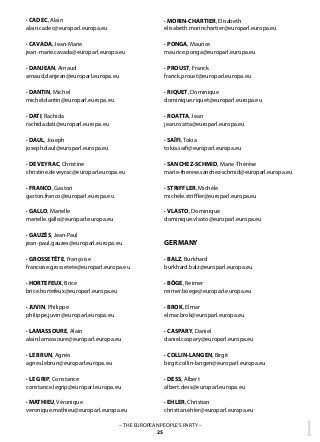
  • 206.
    – POLITICAL FOUNDATIONSAND THINK-TANKS – 196 Members: Werner Fasslabend, Chairman Konstantina Botsiou Bruno Aguilera Barchet John Bruton Olof Ehrenkrona Jos J.A.M. van Gennip Risto Harisalo Mart Laar Žiga Turk Paweł Śpiewak Academic Council In order to increase the academic scope of the Centre for European Studies and oversee the scientific standards of the research and studies, the Executive Board can nominate esteemed academics and researchers as members of the Academic Council. Overseeing the scientific standards of the research and studies of the Academic Council will specifically include: Foundations · · · · · · enhancing the standing and the academic cre- dibilityoftheCentreforEuropeanStudiesinaca- demic sphere contributing expertise, advice and ideas to en- sure the Centre is always pursuing cutting-edge research proposing new and innovative research projects to the Centre implementing the highest standard of peer re- view for the research of the Centre ensuring that all documents are technically cor- rectandconformtoconventionsofstructureand referencing active involvement and participation in research projects and the communication of their results Political Academy of the ÖVP / Austria CEDER Study Centre of CD&V / Belgium Croatian Statehood Foundation / Croatia Glafcos Clerides Institute for Eurodemocracy / Cyprus European Academy for Democracy / Czech Rep. Pro Patria Training Centre / Estonia The National Educational Association / Finland Hanns Seidel Foundation / Germany Konrad Adenauer Foundation / Germany Konstantinos Karamanlis Institute for Democracy / Greece Foundation for a Civic Hungary / Hungary Institute Luigi Sturzo / Italy Academy for the Development of a Democratic Environment / Malta CDA Research Institute / Netherlands Høyres Study Centre / Norway Institute for Popular Studies / Romania Institute for Modern Slovakia / Slovakia Dr. Jože Pučnik Institute / Slovenia Foundation for Social Research and Analysis / Spain Institute for Humanistic Studies Miquel Coll and Alentorn / Spain Jarl Hjalmarson Foundation / Sweden
  • 207.
    The CES wasestablished in 2007 as the political foundation of the EPP. Like other European political foundations, the CES is governed by the Regulation 1524/2007 of the European Parliament and of the Council amending Regulation 2004/2003 on the regulations governing political parties at European level and the rules regarding their funding. Following this Regulation, the CES underpins and complements the objectives of the EPP by performing the following tasks: - observing, analysing and contributing to the debate on European public policy issues and on the process of European integration, - developing activities linked to European public policy issues, such as organi- sing and supporting seminars, training, conferences and studies on such issues between relevant stakeholders, including youth organisations and other representatives of civil society, and - serving as a framework for national political foundations, academics, and other relevant actors to work together at European level. At the beginning of 2012, the CES had 21 member foundations from 19 coun- tries and 15 individual members. Each CES member foundation or think-tank is officially recognised by an EPP member party. The CES embodies a pan-European mindset, promoting Christian Democrat, con- servative and like-minded political values. It facilitates cooperation between EPP member parties and associations.The CES contributes to the updating of the EPP political platform and to other policy documents of the EPP. It hosts discussions and seminars at EPP congresses. The CES contributes to formulating EU and national public policies. Through its papers, conferences, authors’ dinners and website, the CES offers a platform for discussion among experts, politicians, policymakers and the European public. The CES also organises seminars on EU policies and on the process of European integration.TheannualEconomicIdeasForumhostspoliticians,policymakersand experts and provides a focus for debates on current economic issues. The 2012 Economic Ideas Forum took place in Dublin. The CES engages in training.The CES Academy for young centre-right leaders was launched in March 2012. At the beginning of 2012, the CES launched Springeneration.eu, an online platform which aims to elicit views of young people from North Africa and the Middle East on what Europeans should do to build positive partnerships with Arab Countries. In 2011, CES supported over 60 common projects with its member founda- tions; the events dealt with a wide variety of topics and were different in size and scope, but all successfully contributed to enriching EU policy discussions across Europe and beyond. · History: · Activities: 3– POLITICAL FOUNDATIONS AND THINK-TANKS – 197
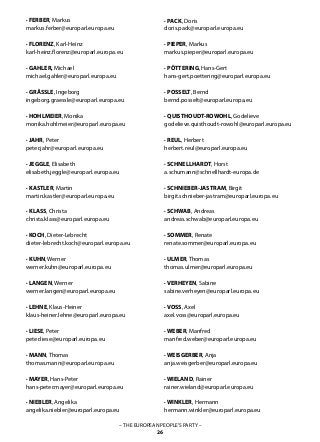
  • 208.
    The CES createsa wide range of publications. Research papers and policy briefs are produced within six clusters: • party structures and EU institutions, • economic and social policies, • EU foreign policy, • environment and energy, • values and religion, and • new societal challenges (including population ageing, immigration and integration, and the Internet and politics). In 2012, there are two ‘horizontal themes’ that are emphasised in CES research activities: • the campaign strategy for the European Parliament election in 2014, and • the implications of the Arab Spring for Europe and the EPP. Recent CES research papers and policy briefs include: • B. Aguilera-Barchet,‘A Higher Education for theTwenty-first Century: European and US approaches‘ (2012) • V. Novotný, ‘Immigration and Integration in the European Union‘ (2012) • H. Geeroms, W. Moesen and S. De Corte, ‘The European Union at a Crossroads: An Action Plan (2011) • F. Hartleb, ‘After their Establishment: Right-wing Populist Parties in Europe‘ (2011) • J. Jamet, W. Mussler and S. De Corte, ‘EU Economic Governance: The French and German Views‘ (2011) • F. Hartleb,‘The New Euroscepticism‘ (2011) • W. Phares, L. Vidino and A. Hamzawy, ‘Political Islam in Europe and the Mediterranean: Three Contributions’(2011). At the beginning of 2012, the CES published, in cooperation with its member foundations, a book Opening the Door? Immigration and Integration in the Euro- peanUnion. This in-depth study of immigration and integration policies covers thirteen EU countries and one region, as well as the EU itself. It offers policy recommendations for the EU and its Member States. The biannual European View is an intellectual platform for politicians, opinion makers and academics. It tackles contemporary themes of European politics, focusing on one specific theme in each issue. What makes the European View unique is its hybrid nature: it involves academics, experts, as well as high level politicians and decision makers. The topic of the first 2012 issue is ‘What kind of Union’, focusing on contemporary economic affairs. Finally, the electronic CES Flash consists of briefs analysing the political, economic and social developments in Europe from the centre-right perspective. · Publications: – POLITICAL FOUNDATIONS AND THINK-TANKS – 198
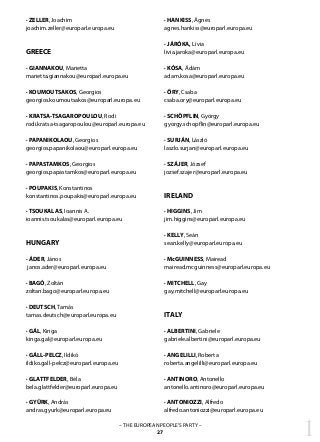
  • 209.
    · History: CES MemberFoundation: Politische Akademie der ÖVP In English: Political Academy of the Austrian People’s Party, PolAk · Country: AUSTRIA · Chair: Werner Fasslabend · Executive Director: Dietmar Halper · Year of establishment: 1972 · EPP m/p affiliation: ÖVP Contact Details: Tivoligasse 73, 1120 Vienna Phone: +43.1.814.200 | akademie@polak.at | www.polak.at The Politische Akademie (Political Academy of the Austrian People‘s Party) in the Viennese district of Meidling consists of three buildings: the historical Springer- Schlößl, built in the 19th century, the half-timbered house which now accommodates the Julius Raab-Stiftung, and the hotel, built in 1975. The Springer-Schlößl (which was named after Baron Springer) is now a training and research centre for the Austrian People‘s Party (ÖVP). Five modern class- rooms are located on the ground floor. The offices of the Political Academy are housed on the first floor. The archive of the Karl von Vogelsang-Institut and a large research library are situated in the basement. With the ”Anschluß“ in 1938 began a period of misfortune for the Springer- Schlößl until in 1953 the whole estate was given back to the original owners. Since that time, the local ÖVP has been organising events and seminars. In 1975, the Political Academy was founded. In only 90 days the building was re- constructed, and the Politische Akademie started its work on 11 October 1975, in the rooms of the Springer-Schlößl. In the spring of 1977, the new hotel buil- ding was opened. 3– POLITICAL FOUNDATIONS AND THINK-TANKS – 199
  • 210.
    – POLITICAL FOUNDATIONSAND THINK-TANKS – 200 · Publications: · Activities: The Political Academy is the leading conservative think tank in Austria.The Aca- demy tries to define, through a theoretical approach, what neo-conservative policies stand for. A wide field of macroeconomic and philosophical topics are discussed on an academic level. Empirical political studies support the efficien- cy of everyday party politics. Hence, the Political Academy is developing tools to improve the impact of political campaigns. Through concrete project work, the Academy puts its concepts into practice. Within the field of international activities, the European Union and the countries of Southeastern Europe are main focus of the Political Academy. The Political Academy is an institution of political education and research. It applies itself to political and strategic research and project work. Training and the further education of trainers as well as coaching are as much a part of the activities of the Political Academy as is the extensive supply of information, which it offers concerning current political events. In addition to this, the Aca- demy also provides for the training and further education of political represen- tatives, MPs, functionaries and party workers. The Political Academy is committed to fulfilling the role of a meeting place and discourse medium for both national and international experts and represen- tatives from various fields of policy-making, politics, science and research and diplomacy. A dense programme of activities such as panel discussions, work shops, conferences and public lectures as well as regular publications is aimed at informing and involving the public. · Woschnagg, Gregor / Mück, Werner / Payrleitner, Alfred (Hg.) Hinter den Kulissen der EU Österreichs EU-Vorsitz und die Zukunft Europas · Karner, Stefan / Duffek, Karl (Hg.) Widerstand in Österreich 1938 – 1945 · Burkert-Dottolo, Günther/ Moser, Christian Sebastian (Hg.) Stichwortgeber für die Politik Band I · Danich, Peter/ Moser, Christian Sebastian (Hg.) Stichwortgeber für die Politik Band II · Burkert-Dottolo, Günther R. und Moser, Christian Sebastian (Hrsg.) Zukunftsmodell Liberalkonservativ Perspektiven für die ÖVP (Reihe: Aktuelle Fragen der Politik)
  • 211.
    3– POLITICAL FOUNDATIONSAND THINK-TANKS – 201 · Moser, Christian Sebastian / Freudenstein, Roland Konservative Korrekturen The Political Academy also publishes many reports & analyses including: · The US Primary Elections · Reader: Social Fairness · Reader: Kosovo · Reader: Internet & Politics · Reader: Compassionate Conservatism · The Benes-Decrees · Reader: Freedom & Security · Fasslabend, Werner / Pröll, Josef The European People‘s Party: Success and Future Challenges With Portraits of Selected Countries · Khol, Andreas / Ofner, Günther / Karner, Stefan / Halper, Dietmar: Österreichisches Jahrbuch für Politik 2011
  • 212.
    – POLITICAL FOUNDATIONSAND THINK-TANKS – 202 · History: CES Member Foundation: CEDER Studiecentrum CD&V In English: CEDER Study Centre of CD&V · Country: BELGIUM · Director: Niko Gobbin · Year of establishment: 2001 · EPP m/p affiliation: CD&V Contact Details: Wetstraat 89 | 1040 Brussel Phone: +32 (0)2 238 38 87 | Fax: +32 (0)2 238 38 80 | ceder@cdenv.be | ceder.cdenv.be CEDER was established in 2001. It is the Flemish heir of the former national party study centre CEPESS. Governmental Negotiations: Jan – Mar 2008: Negotiations for the new federal government under the leadership of CD&V Prime Minister Yves Leterme; 2008: Negotiations at the Federal and Regional level (‘Gemeenschapsdialoog’) for state reform; June 2009: Negotiations for the establishment of a new Flemish government under the leadership of CD&V Minister-President Kris Peeters. June 2010 – December 2011: Negotiations for the new federal government (Di Rupo I) and the 6th institutional reform of Belgium. · Activities:
  • 213.
    3– POLITICAL FOUNDATIONSAND THINK-TANKS – 203 Party Congress‘Ready for the world’on different globalisation themes: Preparation in different CEDER working groups of an ideological party congress on globalisation‘Ready for the world’with a focus on five themes: migration and education, accessibility of energy, poverty with focus on single families, flexicuri- ty on the labour market and quality work in international cooperation; Public Events: Ceder dialogues (2011-2012) · “New Industrial Policy” – Flemish Minister-President Kris Peeters and Caroline Ven (head of the employers federation VKW) · “The (future) role of musea within the cultural policy” – Flemish Minister of Culture Joke Schauvliege and Jan Hoet (founder of the City Museum for Contemporary Art in Ghent) · “How can municipalities deal with crime?” – Former Minister of Justice Stefaan De Clerck and Tom Meeuws (head of“Living Together”, Antwerp) “Applied Christian Democracy: the Rhineland Model“ (publication in partnership with CES) “The catholic church: Present and future” (Welke kerk? Vandaag en morgen, Da- vidsfonds publishing) book published by CEDER collaborator Jürgen Mette- penningen “Public finances in Europe anno 2010” chapter by CEDER collaborator Niko Gobbin in“Glocal policy in Europe”(Glokaal Beleid in Europa, Acco publishing – ed. Marc De Clercq) Belgian chapter in “Opening the door” (publication of CES) by CEDER collabora- tor Paolo De Francesco · Publications:
  • 214.
    – POLITICAL FOUNDATIONSAND THINK-TANKS – 204 CES Member Foundation: Zaklada Hrvatskog Državnog Zavjeta In English: Croatian Statehood Foundation, ZHDZ · Country: CROATIA · Chairman: Srećko Prusina · Year of establishment: 1995 · EPP m/p affiliation: HDZ Contact Details: Gundulićeva 21a, 10000 Zagreb Phone: +385.1.4854.555 | Fax: +385.1.4854.439 zaklada.hdz@zg.t-com.hr | srecko.prusina@zhdz.hr | www.zhdz.hr The Croatian Statehood Foundation was established in October 1995, and it started operating in April 1996. As such, it is the first political foundation of this type in Croatia. The Foundation’s Trustee is the Croatian Democratic Uni- on, and the Trustee is represented by the Central Committee of the Croatian Democratic Union. The Croatian Statehood Foundation has its registered head office in Zagreb, and it is administered, based on the Trustee’s decision, by the Foundation Board and the Chairman of the Foundation Management Board. The Foundation’s Chairman of the Management Board, according to a decision made by the Founder on 16 May 2006, is Srećko Pusina. The Foundation’s mission is to become a centre of excellence for political edu- cation and political consultation, operating on the basis of Christian demo- cratic principles. Since the political doctrine of Christian democracy largely centres on Christian social teaching, the Foundation‘s principles focus on the individual and the dignity of all individuals. With reference to Christian social teaching, the fundamental values of the Croatian Statehood Foundation rest · History: · Activities:
  • 215.
    3– POLITICAL FOUNDATIONSAND THINK-TANKS – 205 on social justice for the political community, which ultimately exists on behalf of the greater good, so the Foundation’s core task is to engender political edu- cation with a commitment to peace, freedom and justice both at home and abroad. The Foundation’s objective is to contribute to strengthening political culture, the culture of dialogue, and to support the development and enhancement of democratic society and the rule of law, and a socially-conscious market econo- my so that democracy may be reinforced, since democracy underpins human dignity and freedom. The Foundation works towards the achievement of its objectives by organis- ing seminars, round table lectures and conferences. In this regard, the Foun- dation has held seminars dealing with political communication, EU accession and a number of economic themes. The Foundation also dedicates particular attention to the youth, and their role in Croatia’s future. · Bemporad, Jack, Shevack, Michael, Our era: Historical and new era of Christian – Jewish mutual understanding, 1999 · Milardović, dr. Anđelko, Overview of the political and state work activity of Franjo Tuđman 1989 – 1999, 2000 · Soave, Antonio J., My beloved Croatia: a moment in the life of Franjo Tuđman and the country he helped to establish, 2002 · Milardović, dr. Anđelko, Franjo Tuđman – speeches and lectures 1998 – 1999, 2007 · CES / ZHDZ: Croatia in the European Union, Brussels 2009 · Publications:
  • 216.
    · History: · Activities: –POLITICAL FOUNDATIONS AND THINK-TANKS – 206 CES Member Foundation: Institouto Evrodimokratias Glafcos Clerides In English: Glafcos Clerides Institute for Eurodemocracy · Country: CYPRUS · President: Katherine Clerides · Vice President: Chrysostomos Sofianos · Year of establishment: 1999 · EPP m/p affiliation: DISY Contact Details: 5 Ioannis Clerides str., 1070 Nicosia Phone +357.22.883.133 | Fax +357.22.752.751 | insteurodemocracy@cytanet.com.cy The Institute for Eurodemocracy was established in 1999 as the official poli- tical foundation of the Democratic Rally Party of Cyprus. It serves as a think tank and centre for social, economic and political research. The Institute for Eurodemocracy has its registered head office in Nicosia. The Institute also supports the work of the‘Middle East Observatory’, an EPP- sponsored initiative hosted by the Democratic Rally, inaugurated by EPP Pre- sident Wilfried Martens in Nicosia in July 2007. It aims to encourage discussion on developments of the European Union and the international sphere by hosting a number of conferences, seminars and lectures in association with similar institutions, particularly within the Euro- pean Union. Notable activities include: ”Privatisation of Public Service Industries“. Keynote speaker: Kostas Karamanlis, President New Democracy party, Greece. (1999) ”New Prospects and Challenges for the European Union“.
  • 217.
    Keynote speaker: EUCommissioner Hans van den Broek. (2001) ”Path to the Future: Prospects and Challenges“. Keynote speaker: Shimon Peres, Foreign Minister of Israel. (2001) Since 2002, the Institute has opted to organise smaller-sized seminars and roundtable discussions on a wide-range of policy-oriented topics. Open Discussion on ”The European Union after the Lisbon Treaty“. Speaker: Dora Bakoyannis, Foreign Minister of Greece (06.2008) Open Discussion on ”Transatlantic Relations in the age of Obama“. (11.2008) Series of 4 Round Table Discussions on ”Turkey in the 21st Century: Prospects and Challenges“. Topics covered: EU- Turkish Relations, the democratisation process, Kemalism, Islam and democracy, and Turkish Foreign policy under Davutoglu. (2008-2009) Public Debate on ”The European Parliament and the importance of the June '09 Elections“. (11.2009) Presentation of the book“I struggle, I overcome”by Wilfried Martens, President of the EPP (05.2010). Training courses for members of Democratic Rally in EPP Philosophy and Eu- ropean Union Political, Social, Economic policies organized by the Institute for Eurodemocracy Glafcos Clerides, the Centre for European Studies and the School for Political Education of Democratic Rally (02. – 05.2010) Seminar on‘ Rethinking Democracy, Justice and Education in the Age of Obama’ (06.2009) International Seminar‘From conflict to partnership, The environment of reconstruction’ (10.2010). 3– POLITICAL FOUNDATIONS AND THINK-TANKS – 207
  • 218.
    Discussion on‘Building thefoundation for the a peaceful future: A review of truth and reconciliation in peace process’ (11.2010). Lecture on‘The course of International Negotiations on Climate Change’ (11.2010). Conference on‘The International Migration System: Challenges and Opportunities’ (Migration Policy Institute, 03.2011). International workshop‘Cyprus: Bridging the Divide, EU Foreign policy, conflict Resolution and negotiation skills’ (04.2011). Co-organised with CES and YEPP a Summer School Session on‘Common Foreign and Security Policy’ (07.2011). ‘Building the Future of Cyprus, a multi stakeholder strategic planning form’ (02-03.12.2011). – POLITICAL FOUNDATIONS AND THINK-TANKS – 208
  • 219.
    – POLITICAL FOUNDATIONSAND THINK-TANKS – 209 CES Member Foundation: Evropská Akademie pro Democracii In English: European Academy for Democracy · Country: CZECH REPUBLIC · President: Jan Kasal · Director: Jaroslav Hulák · Year of establishment: 1991 · EPP m/p affiliation: KDU-ČSL Contact Details: Karlovo nám. 5 | 128 00 Praha 2 Tel. +420.724.138.914 | akademie@ead.cz | www.ead.cz The European Academy for Democracy is a non-profit civic association. Esta- blished in 1991, the European Academy for Democracy has been promoting centre-right and Christian Democratic values, and working toward improving relations between countries and nations of Europe. The European Academy for Democracy organises seminars on political and cultural topics and provides consultancy services to regional and local govern- ments in the Czech Republic. It provides courses and workshops for politicians and civil servants from municipal and regional governments, MPs and sena- tors, leaders of the Christian and Democratic Union – Czechoslovak People’s Party (KDU-ČSL) as well as new KDU-ČSL members. Some educational activi- ties are organised in collaboration with theYoung Christian Democrats, the As- sociation of KDU-ČSL Women, and the Association of Christian Seniors. Since 2010, educational activities have been organised under the title Christian De- mocratic Academy’(Lidovecká akademie), a project approved by the KDU-ČSL Congress and Board. Some recent workshop topics include: ethics and socie- · History: · Activities: 3
  • 220.
    – POLITICAL FOUNDATIONSAND THINK-TANKS – 210 · Publications: ty, media literacy, the pension reform, the economic and social reforms in the Czech Republic and the social teaching of the Church, and the social market economy. Educational activities for the wider public are organised under the title ‘Evening dialogues’; leading politicians, Church leaders, theologians and scientists are invited as speakers. Overall, the educational activities attract some 1,000 participants a year. The European Academy for Democracy closely cooperates with partners in Austria, Germany and Slovakia. In addition to its membership in the CES, the European Academy for Democracy is a member of the European Network of Political Foundations (ENoP). Until 2009: Obzory (Horizonts) magazine that covered political and cultural topics from the Christian Democratic and conservative viewpoints. 2007: M. Pehr et al., Cestami křesťanské politiky: Biografický slovník k dějinám křesťanských stran v českých zemích [Christian Politics: A Biographical Dictio- nary for the History of Christian Parties in the Czech Lands] (Praha: Evropská akademie pro demokracii a Nakladatelství Akropolis, 2007).
  • 221.
    – POLITICAL FOUNDATIONSAND THINK-TANKS – 211 CES Member Foundation: Pro Patria Koolituskeskus In English: Pro Patria Institute · Country: ESTONIA · Executive Director: Kaja Villem · Year of establishment: 1995 · EPP m/p affiliation: IRL Contact Details: Kivisilla 4-9 | 10145 Tallinn, Estonia Tel. +372.773.42.01 | Mobile: +372.534.589.01 | Fax +372.773.42.07 | kaja.villem@irl.ee Pro Patria Koolituskeskus was established in 1995 as a non-profit voluntary organisation which provides right of centre political, economic and general cultural education. Pro Patria Koolituskeskus is the only organisation attached to Pro Patria and Res Publica Union that provides political education for party members, and organises conferences and seminars for the wider public with an aim to promote the political programme of the party. The activities of Pro Patria Institute include conferences, training programmes, as well as publications of an educational and political nature. Conferences and training programmes: For the wider public - To promote right of centre political ideas and support the party programme; on general political topics: social, economic, educatio- nal, environmental policies, as well as foreign and security policy, etc. For the members of local governments - to provide them with knowledge and skills. · History: · Activities: 3
  • 222.
    – POLITICAL FOUNDATIONSAND THINK-TANKS – 212 · Publications: For party members - to provide them with political knowledge and skills, team building training, etc. For election candidates - to provide them with political knowledge as well as skills like debating, public performance, etc. Practical handbooks: Public relations (1997) Christian Democracy and local politics (1999) How to survive in daily political life (2001) A Christian democratic party in action (2001) Books about ideology: Soft-spoken inspiration (2004) Education freedom (2005) The Many Faces of Conservatism. The essence, history and future of the conservative thought (2011)
  • 223.
    – POLITICAL FOUNDATIONSAND THINK-TANKS – 213 CES Member Foundation: Kansallinen Sivistysliitto In English: The National Educational Association, KANSIO · Country: FINLAND · Chair: Taru Tujunen · Executive Director: Markku Pyykkölä · Year of establishment: 1980 · EPP m/p affiliation: KOK Contact Details: Kansakoulukuja 3.2.krs., 00100 Helsinki Phone +358.500.442.761 | markku.pyykkola@kansio.fi | hakime.arat@kansio.fi | www.kansio.fi The National Educational Association is a non-profit association under Finnish law and is a separate legal entity from the National Coalition Party. KANSIO was founded in 1980 and has operated actively ever since. KANSIO consists of over 100 associations which all belong to the consortium of the National Coalition Party (e.g. associations for women, students, youth, senior citizens and all the regional associations of the National Coalition Party). Training: Based on annually planned trainings and events, KANSIO provides indepen- dently or jointly with its member associations short- and long-term educa- tional programmes as well as cultural events. Even year-long training modu- les are tailored to the main target groups including local politicians, election candidates, persons interested in EU politics, individuals interested in political ideology, the members of the political party or member associations respon- sible for leading local associations. · History: · Activities: 3
  • 224.
    – POLITICAL FOUNDATIONSAND THINK-TANKS – 214 The main themes of the short-term courses are training in information tech- nology, communications and presentation skills. The yearly number of partici- pants in the training is approximately 57,000. Research: KANSIO is also responsible for organising the research activities of the party. The yearly research programme includes a member satisfaction survey, indivi- dual research studies ordered by the member associations and a joint research of the five largest parties on government success, image of the party leaders and demographics of support for different political parties. At present the think tank activities are organised under the marketing name of the Hope of FinlandThinkTank.The allocation of state funds to the research and publishing activities, which are at the same time close to the parties and beneficial for the government’s decision-making, will continue at least during the present government’s term of office until 2012. Consultancy: KANSIO facilitates various development processes for the member associa- tions. Typical processes deal with staff training needs identification, planning of staff training and assisting in strategic planning processes. KANSIO publishes annually two to four research reports and several other leaflets e.g. for election campaigns. · Publications:
  • 225.
    CES Member Foundation: Hanns-Seidel-Stiftung InEnglish: Hanns Seidel Foundation · Country: GERMANY · Chairman: Prof. Dr. h. c. mult. Hans Zehetmair, Former Minister of State · Chief Executive Officer: Dr. Peter Witterauf · Year of establishment: 1967 · EPP m/p affiliation: CSU Contact Details: Hanns-Seidel-Stiftung, Lazarettstraße 33, 80636 Munich Phone: +49.89.1258.0 | Fax: +49.89.1258.356 | info@hss.de | www.hss.de – POLITICAL FOUNDATIONS AND THINK-TANKS – 215 The Hanns Seidel Foundation was founded in Munich in 1967. It is named af- ter Dr. Hanns Seidel (12 October 1901 – 5 August 1961), Minister President of Bavaria from 1957 to 1960 and Party Chairman of the Christian Social Union of Bavaria (CSU) from 1955 to 1961. Mission and Scope of Activities The Hanns Seidel Foundation has been committed to its fundamental philo- sophy of ”serving democracy, peace and development“ since 1967. It fulfils its mission in a true Christian spirit in currently more than 60 countries worldwide. Altogether 273 employees work for the Hanns Seidel Foundation in Germany and abroad. They are spread out over the Headquarters in Munich, about 90 joint development projects, the Banz Monastery and Wildbad Kreuth Training Centres, the Munich Conference Centre, the Berlin Office and Liaison Bureaus in Brussels, Moscow, and Washington. · History: · Activities: 3
  • 226.
    – POLITICAL FOUNDATIONSAND THINK-TANKS – 216 The Hanns Seidel Foundation is a registered association dedicated exclusively and directly to public interests. The mission and commitment of the associa- tion are: to promote democratic and civic education of the German population on the basis of Christian values, to promote education, popular and vocational training including the support of students in particular by giving individuals with appropriate talents and character values access to scientific and research training, to promote science, in particular by conducting scientific studies and re- search, to promote an international spirit and communication among nations as well as the unification of Europe, in particular by inviting foreign groups and sup- porting travel abroad, to promote cultural interests, in particular by supporting the maintenance of works of culture and supporting the preservation of monuments, to promote foreign aid and development. The various objectives are implemented by: The Academy for Politics and Current Affairs offers practice-oriented politi- cal advisory services. Fundamental data and information for political decisions are compiled on a scientific basis, just as the Academy organises conferences and publishes various studies, reports and other informative material. The Institute for Political Education promotes democratic and civic educa- tion among broad groups of the population. Its primary objective is to enhan- ce the political involvement of citizens. The Institute for Scholarship Programmes promotes the further education of scholars. Other activities are media politics and the promotion of young journalists. Its primary mission is to offer young, university and college gradu- ates specific support and promotion. The Institute for International Cooperation promotes international coope- ration in development projects, focusing on vocational training, the strengthe- ning of administrative systems, consultation and advice for parties and govern- ments, improvement of the infrastructure etc. • • • • • •
  • 227.
    – POLITICAL FOUNDATIONSAND THINK-TANKS – 217 The Office for Foreign Relations cultivates long-standing contacts with po- litical friends of the Hanns Seidel Foundation around the world and carefully assesses potential new partners. The work of the Office concentrates mainly on the analysis of European and extra-European political party landscapes, in particular upon Christian-Democratic and Conservative parties. The Liaison Bureaus in Washington, Brussels, Moscow/International Confe- rences have the task of promoting the understanding of nations and European unification through international debates and conferences. Publications & Archives The journal PolitischeStudien(Political Studies) is being published as a bi-month- ly periodical producing numerous documents relating to the activities and re- search interests. Further pubishing projects are the series ”Statements and Ma- terials on Contemporary History“, ”Current Analyses“ and ”Reports and Studies“. The Archives for Christian-Social Politics are responsible for collecting and pre- serving material of the Christian Social Union regarding organizational and ad- ministrative structures, leading party figures, elected officials and parliamentary groups. · Publications: 3
  • 228.
    – POLITICAL FOUNDATIONSAND THINK-TANKS – 218 CES Member Foundation: Konrad Adenauer Stiftung In English: Konrad Adenauer Foundation, KAS · Country: GERMANY · Chair: Dr. Hans-Gert Pöttering, MEP · Secretary General: Michael Thielen · Year of establishment: 1952 (renamed in 1964) · EPP m/p affiliation: CDU Contact Details: Klingelhöferstraße 23, 10785 Berlin Phone: +49.30.269.960 | zentrale-berlin@kas.de | www.kas.de Konrad Adenauer and his principles form the guidelines, the basis of the mis- sion and engagement of KAS. The Foundation took on the name of the first Federal Chancellor in 1964. It was originally established in 1955 as the Society for Christian-Democratic Civic Education. The Konrad Adenauer Foundation is a political foundation with a strong pre- sence throughout Germany thanks to two conference centres and 16 regio- nal offices. The foreign offices oversee 200 programmes in 100 countries. The headquarters are Sankt Augustin near Bonn and Berlin. Through civic education programmes both at home and abroad the Konrad Adenauer Foundation promotes freedom, peace and justice. The Foundation‘s most important goals are strengthening democracy, furthering European uni- fication, improving transatlantic relations and deepening development coope- ration. KAS develops practical, solution-oriented concepts to address current issues in the fields of domestic policy, social policy, economic policy · History: · Activities:
  • 229.
    – POLITICAL FOUNDATIONSAND THINK-TANKS – 219 and foreign policy. The academy, located in Berlin, is a forum for dialogue on issues crucial for the future – from politics and the economy to religion, society and science. Conferences and events bring together people who “have something to say”. In Germany alone, KAS offers more than 2,500 events each year, which attract over 145,000 participants. The Foundation provides moral and material support to intellectually talented young people from Germany and abroad, during their undergraduate and gra- duate studies. KAS stays in close contact with more than 10,000 alumni. Exhibitions, readings and awards are also distinctive elements of the Foundation‘s work. It promotes young artists and awards every year the pres- tigious Literature Prize. The Foundation also supports young journalists with specific programmes. Since 1980, KAS awards an annual prize for excellent local journalism. The Social Market Economy Prize has recognised since 2002 distinguished personalities who have particularly supported and encouraged the development of the Social Market Economy. For the past eight years, the Denkt@g competition has awarded an annual prize to websites where young people confront issues surrounding the Nazi dictatorship and the Holocaust, as well as right-wing extremism, xenophobia, intolerance and violence. The Archive of Christian Democratic Politics researches and explores the his- tory of Christian democracy in Germany and Europe. Users have access to a comprehensive body of documents, state-of-the-art media and a specialised library with about 176,000 volumes of books on history and politics. · Publications: 3
  • 230.
    – POLITICAL FOUNDATIONSAND THINK-TANKS – 220 CES Member Foundation: Institouto Dimokratias Konstantinos Karamanlis In English: Konstantinos Karamanlis Institute for Democracy · Country: GREECE · Chair: Evangelos Meimarakis · Director: Mariana Pirgioti · Year of establishment: 1998 · EPP m/p affiliation: ND Contact Details: 18 Rigillis Street | 106 74 Athens Phone: +30.210.725.7495 | Fax: +30.210.725.7510 info@idkaramanlis.gr | www.idkaramanlis.gr Goal and Objectives A non-profit organization, the Konstantinos Karamanlis Institute for Democra- cy was established in Athens in January 1998. Its mission is to promote demo- cracy, a balanced mix of economic development and social cohesion, good governance and European integration through policy proposals that are based on the study of political, economic and social issues. The Institute’s activities include research projects, publications, public events, education and training about a wide range of issues: state and society, economy and development, education science and culture, politics and ideology. International Cooperation The Institute participates in all major networks of like-minded European and international political foundations. It is a founding member of the Centre for · History: · Activities:
  • 231.
    – POLITICAL FOUNDATIONSAND THINK-TANKS – 221 · Publications: European Studies, the official think-tank of the EPP, and active member of the European Ideas Network, which formulates policy positions on European issu- es for the EPP. Furthermore, the Institute participates in the European Network of Political Foundations that aims to promote democracy and development in third countries. On a bilateral basis, the Institute cooperates with several inter- national organizations for conferences, policy seminars and research projects. Policy Studies The Institute engages in systematic policy-oriented research covering the are- as of foreign and defence policy, energy, environment, economy, education and culture. Policy proposals and position papers are prepared by academics and technical experts, who also participate in round-table discussions and conferences. Political Analysis The Institute conducts comprehensive research and surveys on social, electo- ral and political issues as a tool for monitoring ideological trends and propo- sing new policies. It also develops communication strategies and techniques, and produces relevant material. Political Academy The Political Academy was established in 2002. Since then it has provided poli- tical training to over 300 policy-makers, journalists, professionals and members of youth organizations, from all regions of Greece. The seminars of the Political Academy are instructed by prominent political analysts and academics. Publications focus on policies and ideas that shape the domestic and interna- tional political agenda. They include: · The quarterly journal“Liberal Emphasis”, presenting political views and documentation on current political events. · The“Monograph Series”, fostering original academic research in political science and political philosophy, economics, history, international affairs, law, environment, and culture. · The“Working Papers on Politics and Economics”, featuring policy papers and edited volumes. · The“Working Papers Series”, offering edited conferences proceedings. · The“Special Collection Series”, sponsoring extensive works of political documentation.
  • 232.
    – POLITICAL FOUNDATIONSAND THINK-TANKS – 222 · The e-journal“e-LOGOS”, presenting different viewpoints on current issues of political interest. · “The Konstantinos Karamanlis Institute for Democracy Series on European and International Affairs”(published by Springer), analyzing contemporary international politics. · “The Konstantinos Karamanlis Institute for Democracy Yearbook Series” (published by Springer), presenting selected political and scholarly analyses.
  • 233.
    · History: CES MemberFoundation: Polgári Magyarországért Alapítvány In English: Foundation for a Civic Hungary, PMA · Country: HUNGARY · President: Zoltán Balog · Year of establishment: 2003 · EPP m/p affiliation: FIDESZ Contact Details: Address: 1013 Budapest, Pauler u. 11, Hungary Phone: +36.1.391.4880 | Fax: +36.1.391.4889 | alapitvany@szpma.hu | www.szpma.hu By Act XLVII of 2003, the National Assembly authorised the parliamentary par- ties to establish foundations for the purposes of disseminating knowledge, supporting research and initiating educational projects that help their acti- vities. Accordingly, Fidesz established the Foundation for a Civic Hungary in November 2003, which defines itself as follows: ”The moral basis of our Union is constituted by the perceptions and recogni- tions arising from the fallibility of human nature. We profess that there exists a moral order that is above human will. The truth is cognisable and can be tur- ned into the starting point of public activity. Following decades of dehumani- sing events in the 20th century leading to moral uncertainty, we are inevitably in need of spiritual and intellectual renewal.“ Equally important is to educate representatives of parties representing a centre-right, Christian, patriotic set of values, the strengthening of their back- ground institutions, as well as providing them with the knowledge and skills necessary to meet the challenges of the 21st century. Ever wider publicity is necessary for ideas and public behaviour based on Christian humanity, the de- mocracy of free citizens and a social market economy. – POLITICAL FOUNDATIONS AND THINK-TANKS – 223 3
  • 234.
    – POLITICAL FOUNDATIONSAND THINK-TANKS – 224 · Activities: · Publications: The Foundation launches and supports research projects focusing on the development of Hungarian social and locality structure and issues central to the European integration of Hungary. It is also the Foundation‘s objective to collect and gather existing information in this domain. Also, the Foundation intends to process findings and research results so that they enhance the qua- lity of the work done by Fidesz - Hungarian Civic Union and its parliamentary group. Furthermore the Foundation for Civic Hungary undertakes the following: · Collection and compilation of documents related to the history and the ori- gins of Fidesz - Hungarian Civic Union and the Hungarian centre-right for the archives and for academic research purposes; · Organising and supporting the education of citizens who express a need for information and training; · Supporting talent by promoting the education of Hungarian youth in Hun- gary and in the neighbouring countries. The Foundation‘s objective is to increase the coherence of those professing centre right values, so that they pursue their tasks in a coordinated and profes- sionally well-founded manner. To this end the Foundation supports research projects, publications and dialogues which enhance the authentic, effective and professional representation of Civic Hungary‘s interests. This is in an effort to introduce to Hungary the mindset of European and Euro-Atlantic Christian democrats, conservatives and peoples parties and construct relationships with like-minded organisations and professional workshops. The Foundation also initiated dialogue and cooperation with representatives of the foundations as- sisting other political parties.
  • 235.
    · History: CES MemberFoundation: Istituto Luigi Sturzo In English: Luigi Sturzo Institute · Country: ITALY · President: Roberto Mazzotta · Secretary General: Flavia Piccoli Nardelli · Year of establishment: 1951 · EPP m/p affiliation: UDC Contact Details: Via delle Coppelle 35, 00186 Rome Phone: +39.06. 68.40.421 | infopoint@sturzo.it | www.sturzo.it The Luigi Sturzo Institute, established in 1951, is a cultural foundation based in Rome. The Institute is located in Palazzo Baldassini, edifice built by the ar- chitect Antonio da Sangallo between 1515 and 1518. Fresco paintings, by Raffaello’s school artists, cover the ceilings and walls of the inside rooms. The Institute is committed to the preservation and valorisation of cultural heritage, and carries out training activities and research in historical, sociological, poli- tical and economic fields. The Institute collaborates with many national and international institutions. The Library is specialized in social sciences, modern and contemporary history focusing mainly on political history and sociological philosophy, and on the his- tory of political parties. It is continuously updated with the most recent Italian and foreign publications and holds about 130,000 volumes.The Journals section includes about 600 journals focused on sociological matters, although historical and political journals are also present. The Library of the Luigi Sturzo institute has been a member of the National Librarian Service since 1990. Lately the Lib- rary published the Luigi Sturzo’s Opera Omnia on the web. – POLITICAL FOUNDATIONS AND THINK-TANKS – 225 3 · Activities:
  • 236.
    The HistoricalArchiveArea holdsover 10.000envelopes of documents, which have been recognised by the State to be of considerable historical interest. It specialises in retrieval and awareness-raising initiatives, studies and publica- tions, concerning sources for the history of the Catholic movement carried out by researchers and intellectuals. The Archive holds writings and documents that are indispensable to better appreciate the history of Italy and of the Ca- tholic movements from the crisis of the Liberal State up to the coming of Fas- cism. Moreover it holds documents related to the lives of anti-fascist exiles, the establishment of the Republic and the promulgation of the Constitutional Charter. More specifically, it holds writings and papers by Luigi Sturzo, Gio- vanni Gronchi, Filippo Meda, Flaminio Piccoli, Mario Scelba, Piero Malvestiti, Giuseppe Spataro, Maria Eletta Martini, Tina Anselmi, Giulio Andreotti and, fur- thermore the Democrazia Cristiana records. In addition the Historical Archive holds iconographic, photographic and audio-visual materials representing an innovative methodology for historical research: one hundred thousand pictu- res coming from Il Popolo, the Democrazia Cristiana’s newspaper, published from 1943 to 2004; one thousand and five hundred propaganda posters and three hundred propaganda films produced by Democrazia Cristiana’s cinema office, from 1944 to 1975. The Research and Studies Area designs projects in social science topics. The investigation method is related to the social structures and political institu- tions knowledge. The study of social sciences is relevant to the understanding of Italy’s political, social and economic situation. The main research guidelines concern Italian history between XIX and XX century (mostly oriented to the Italian monarchy, post-unification and republican age, to the history of the Ca- tholic Church, to the history of national and European public institutions, to globalisation processes, to cultural, social and economic changes). The Training Area develops integrated training systems distinguished by a territorial and sectorial character. The cultural and heritage field is the primary area of interest (systems of life long learning for employees of cultural organi- zations and courses to promote young people’s employability). The Training Area carries out training activities oriented at improving the cultural heritage accessibility and fruition; it designs research projects detecting new professio- nal profile skills needed in the labour market; it manages projects concerning the definition of credits calculating systems and outlines training programmes. The Digital Laboratory focuses its activity on innovative digital technologies applied on bibliographic and archival research. The laboratory’s activities star- ted on 2005 and developed new methods of digital cataloguing to preserve iconographic, photographic and audio-visual materials.The records, uploaded on digital databases, are accessible on-line. A recent acquisition of audiovi- sual and photograph materials encouraged training programmes to enhance the competences in the management of non-traditional resources extensively used, at present, in the historical, sociological, political and cultural research. – POLITICAL FOUNDATIONS AND THINK-TANKS – 226
  • 237.
    CES Member Foundation: Akkademjaghall-Izvilupp ta’Ambjent Demokratiku In English: Academy for the Development of a Democratic Environment, AZAD · Country: MALTA · Chair: Simon Busuttil · Year of establishment: 1976 · EPP m/p affiliation: PN Contact Details: Casa Pererra 224, Republic Street, Valletta Phone: +356.21.247.515; +356.21.234.884 | Fax: +356.21.220.496 info@azad-malta.com | admin@azad-malta.com · History: AZAD (Foundation for the development of a democratic environment) was es- tablished in 1976, at a time when democracy in Malta was approaching the brink. AZAD was founded as an academy with the aim of being an autono- mous think-tank and centre of adult education, inspired by Christian Democrat principles. In Malta it took a lead in promoting the ideal of European integrati- on, a dialogue society and the rights of future generations. The Academy and its associates have wide interests but AZAD is currently focused on Euro- Medi- terranean issues and maritime affairs. Among its past chairmen and board members, there feature four future Pre- sidents of the Republic, a future prime minister and two future ministers of foreign affairs, a future Speaker of the House of Representatives and a future judge on the European Court of Human Rights. AZAD is a member of the fol- lowing organizations and networks: European Centre for Workers’ Questions (EZA), European Network of Political Foundations (ENOP, founding member), the European Ideas Network and EPP‘s Centre for European Studies. – POLITICAL FOUNDATIONS AND THINK-TANKS – 227 3
  • 238.
    – POLITICAL FOUNDATIONSAND THINK-TANKS – 228 As a think tank, AZAD organizes policy roundtable discussions with Maltese and international leaders in the public and private sector, and public lectures, debates and discussions. As a centre for adult education, AZAD organizes some 20-25 courses per year, embracing a variety of subjects to do with politics, culture and civilization, and personal skills. AZAD sees these courses as preparing for, and contributing to, a globalised, multicultural society of life-long learning. As a cultural centre, AZAD’s activities have had a very popular following over the years since its inception. It’s most notable success in recent years has been the establishment of a festival of satire as an annual event that plays to full houses. Cooperation: In the past, AZAD organised several initiatives together with renouned politi- cal foundations in Europe. Amongst there, there were: Karamanlis Institute for Democracy, Foundation Pour l’Innovation Politique, the Konrad Adenauer Stiftung, the Hanns Seidel Stiftung, FAES, EZA and the Centre for European Studies (CES). Today: AZAD is today a fully fledged Christian Democrat think-tank, which was rein- stituted as a foundation after Nationalist Party leader Lawrence Gonzi signed the new statute. In a symbolic ceremony, a public deed established AZAD – the centre for po- litical studies - as a foundation at law. The ceremony took place at the newly refurbished premises at Casa Pereira in Republic Street, Valletta. Board of Directors: MEP Simon Busuttil is the President of AZAD whereas the board is composed of Pierre Attard; Noel Buttigieg Scicluna (who serves as Executive Director); Richard Cachia Caruana; Alan Camilleri; Gordon Cordina; Alan Deidun; Ann Fenech; Josef Lauri; Alex Perici Calascione; RoseMarie Privitelli; Anika Psaila Savona; Franco Valletta and David Zahra. Max Ganado serves as an external consultant to the board. · Activities:
  • 239.
    CES Member Foundation: WetenschappelijkInstituut voor het CDA In English: CDA Research Institute · Country: NETHERLANDS · President: Drs. Th.J.F.M. Bovens · Year of establishment: 1981 · EPP m/p affiliation: CDA Contact Details: Buitenom 18 | Postbus 30453, 2500 GL Den Haag Phone: +31.70.342.4872 | Fax: +31.70.392.6004 | wi@cda.nl | www.wi.cda.nl The Research Institute for CDA was founded in 1977, as a result of the merger of the Catholic KVP, the Protestant CHU and the Reformed ARP into the Chris- tian Democratic Party CDA. Former Dutch Prime Minister Jan Peter Balkenende started his career at the Research Institute. Former Minister Ab Klink was the director of the Research Institute before he accepted his post as Minister of Health, Welfare and Sport in 2007. Since 1 January 2008 Raymond Gradus has been the head of the Re- search Institute. The Institute‘s goal is to conduct scientific research for the CDA based on the foundations of the CDA and its program of principles. The Institute gives do- cumented advice about the out-lines of policy, either by its own initiative or upon request of the CDA and/or its members in representative bodies. · History: · Activities: – POLITICAL FOUNDATIONS AND THINK-TANKS – 229 3
  • 240.
    – POLITICAL FOUNDATIONSAND THINK-TANKS – 230 · Publications: · “Reforms to Limit Increases in Health Care Expenditures. With Special Attention to the Netherlands.” | March 2012 · “Health Care Reforms in an Ageing European Society. With a focus on the Netherlands.” | January 2011 · “Flat but fair. A Proposal for a socially conscious Flat Rate Tax.” | June 2009 · “Crossing bridges. Democratization in the Middle East and a Christian Democratic Approach.” | September 2008 · “Man, where are you?. An exploration of the Christian Democratic portrayal of mankind.” | June 2008
  • 241.
    CES Member Foundation: AftenskolenHøyres Studieforbund In English: Høyres Study Centre · Country: NORWAY · Chairperson: Kari-Lise Holmberg · General Manager: Birgitte Helena Johnsen · Year of establishment: 1952 · EPP m/p affiliation: Høyre Contact Details: Stortingsgt 20, Postboks 1536 Vika, 0117 Oslo Phone: +47.22.829.171 | Fax: +47.22.290.88 aftenskolen@aftenskolen.no | brigitte.h.johnsen@aftenskolen.no | www.aftenskolen.no Established in 1952, Høyres Studieforbund is an educational centre owned by Høyre but which operates as an independent organisation. The HS central office is located in Oslo. The office consists of 2 employees that coordinate and lead work all over the country. HS has seven regional offices located in: · Drammen og omegn · Kristiansand og omegn · Oslo og Bærum · Ringerike · Sandefjord og Tønsberg · Stavanger og omegn · Trondheim · History: – POLITICAL FOUNDATIONS AND THINK-TANKS – 231 3
  • 242.
    – POLITICAL FOUNDATIONSAND THINK-TANKS – 232 Every year the HS organises about 21,000 hours of educational training, in dif- ferent topics. This includes 950 different classes with about 7,500 participants and 350 different teachers. Besides educational training the HS is also involved in democracy projects and North/South related information campaigns. This includes: · Annual election monotoring · Seminars about human rights, free trade and development, which involve about 1,000 participants. · Information campaigns related to development · Support to magazines (Xtra, Minerva, Muligheter together about 250,000 copies per year) and web pages that focuses on North/South related issues · HIV/AIDS information · Activities:
  • 243.
    – POLITICAL FOUNDATIONSAND THINK-TANKS – 233 CES Member Foundation: Institutul de Studii Populare In English: Institute for Popular Studies, ISP · Country: ROMANIA · Director: Cristina Trailă · Year of establishment: 2008 · EPP m/p affiliation: PD-L Contact Details: Str. Alecu Russo nr. 13-19 | Ap. 3, Sector 2, Bukaresti Phone: +40 31 1076645 | Fax: +40 21 6191989 office@isp.org.ro | www.isp.org.ro Institute for Popular Studies is the foundation of the Democrat-Liberal Party (PD-L) in Romania, a think tank that focuses on the doctrine and political iden- tity of PD-L. ISP’s mission is to contribute to the consolidation of democratic values in Romania and in the region. ISP aims to participate in the develop- ment and the promotion of the popular doctrine in Romania and to formulate and recommend public policies necessary for an efficient centre-right govern- ment. The activities of the ISP include organizing debates, conferences, training acti- vities, preparing publications etc. ISP organises a number of events on subjects such as the state reform, chan- ging of the Constitution, reform of the social system, or public policies such as Ordoliberalism and social market economy or migration issues. · History: · Activities: 3
  • 244.
    – POLITICAL FOUNDATIONSAND THINK-TANKS – 234 In 2011 ISP organized: · In many regions of Romania a series of debates about values and political principles of the centre-right, · Training for young politicians: Efficient Local Administration at European Level (in cooperation with CES and Konrad Adenauer Foundation), · Several public debates with experts from Government and Presidency on institutional reform of the state (in cooperation with Hanns Seidel Foundation), with the participation of the President of Romania and the Prime Minister of Romania, · A working-group on social market economy which produced a manifesto for the reform of the Romanian Society. Books: · “Centre Right – A New School of Thought” · “Opening the Door? Immigration and Integration in the European Union” (Romanian contribution to the CES reader) · “Wilfried Martens - Europe: I Struggle, I Overcome” (Romanian edition, in cooperation with CES) · “100 Questions and Answers Regarding the Popular Doctrine” · “Romanian Right Wing Intellectual Highlights” Supplements: Weekly “22 Magazine” thematic supplements for the development and promotion of the popular doctrine in Romania Partners: In December 2011 ISP signed an Agreement for cooperation with the Political Academy of the Austrian People’s Party · Publications:
  • 245.
    CES Member Foundation: Inštitútpre moderné Slovensko – odvaha, vzdelanosť, zodpovednosť In English: Institute for Modern Slovakia – Courage, Knowledge, Responsibility, IPMS · Country: SLOVAKIA · Head of the Board of Directors : Mikuláš Dzurinda · Executive Director: Jana Kviečinská · Year of establishment: 2007 · EPP m/p affiliation: SDKÚ-DS Contact Details: Šancova ul.70, 81105 Bratislava Phone: + 421.2.572.04.620 | ipms@ipms.sk | www.ipms.sk The idea to establish an institute, an educational support and service agency for party members and wide centre right oriented public, occurred at the SDKÚ Party Congress in November 2002 and the need was re-confirmed at Party Congress in 2006. The Institute for Modern Slovakia was established as a civic association in March 2007 targeted to create a space for further education, lifelong enhancement of knowledge and skills of centre right-wing oriented people, whose views, opinions and attitudes are close to SDKÚ-DS, with a spe- cial focus on education for party members. The objectives and aims of the Institute are to support educational activities for individuals, the versatile preparation of publicly active persons, the free exchange of experience and knowledge at the domestic and European levels, breaking through the barriers between political, academic, entrepreneurial, media and civil spheres as well as among various groups of society. Last but not least, the mission of the Institute is also aimed at evoking lively interest in public issues, both at the national and European levels and popula- rising centre right thinking and policies. · History: – POLITICAL FOUNDATIONS AND THINK-TANKS – 235 3
  • 246.
    – POLITICAL FOUNDATIONSAND THINK-TANKS – 236 · Activities: 1. Space for participation: ·Conferencesandforums:aseriesofforumsondifferenttopicsforthewiderpublic (covering the whole of Slovakia) to present alternatives towards existing policies and to enable the public to express their views and support an open discussion. · Commemorative actions: Milan Hodža Commemorative Day (in Martin), 17 November: the Day of Fight for Freedom and Democracy (in Bratislava) 2. Space for personal growth: · Seminars and trainings for local and regional counsellors, mayors (on day-to- day political management, political marketing and anti-corruption strategies) · Training for the MPs, their assistants and employees of the Central Office of the SDKÚ-DS and its regional offices (on interpersonal relations and intra-orga- nisational communication and team-building skills) · Seminars for young political activists, leaders, members of the New Generati- on, a youth organisation of the SDKÚ-DS (on theories, methods and practice of public policy, both national and European, public administration with special focus on educational, environmental and welfare issues) 3. Space for ideas: · Course Art in politics – Art of politics for an artists, scholars and all those who are interested in creating a space for further development, refinement and cla- rification of values constituting and connecting art and politics · Round tables on the impact of the financial crisis for representatives of all par- ties gathered in the EPP and influential NGO’s aimed at provoking discussion on the expert level of what solutions and actions are to be taken at the natio- nal level which has led to the creation of the program ”The plan for Slovakia in crisis: how to help economy, how to help people.“ · Round table on the state of justice, judiciary system, reinforcing the law and anti-corruption strategies in Slovakia for representatives of all parties gathered in EPP and influential NGO’s, lawyers, judges and journalists · Miloš Zeman, Mikuláš Dzurinda: Dialogues without Boundaries · Oľga Gyárfášová: Voters of Centre Right Parties in Slovakia and the EU Membership · Publications:
  • 247.
    CES Member Foundation: Inštitutdr. Jožeta Pučnika In English: Dr. Jože Pučnik Institute, IJP · Country: SLOVENIA · President: Mihael Brejc · Director: Nataša Šuštar · Year of establishment: 2006 · EPP m/p affiliation: SDS Contact Details: Institute dr. Jože Pučnik | Hribarjevo nabrežje 13 | SI-1000 Ljubljana Tel.: +386 1 425 30 87 | Fax: +386 1 425 3089 | info@ijpucnik.si | www.ijpucnik.si The Jože Pučnik Institute (IJP) was founded in 2006 as a think-tank of scientists, policymakers and experts from various fields with the goal of enhancing poli- tical culture in Slovenia. With its activities the IJP wishes to encourage and support the free exchange of opinions on topical questions in society which are important for develop- ment of democratic thought. In accordance with political thinking and the work of Dr. Jože Pučnik the IJP strives for implementation of high standards of the European political culture in Slovenia, democratic and open society, a society of Slovenian and European values, tolerance and understanding in pu- blic life, enhancement of plural cultural and scientific creativity, stabilization of Europe with the enlargement of the European Union and with the support of democratic forces in the accession process, for cooperation with the political, cultural and scientific groups and individuals in Europe and around the world joined together by the principles of the society of democracy, openness and solidarity. · History: – POLITICAL FOUNDATIONS AND THINK-TANKS – 237 3
  • 248.
    – POLITICAL FOUNDATIONSAND THINK-TANKS – 238 · Publications: ThemainactivitiesoftheInstituteare:organisationofpublicdebatesandother forms of exchange of opinion, providing expertise on topical political and so- cial issues, supporting scientific and cultural creativity, encouraging political dialogue of various opinions on relevant themes at public events, in various publications and in media, international connections and exchanges. The Institute published two books and nine publications with the collections of conference papers, three of them in English: · Where are the limits of the EU?, 2009 – a collection of conference papers from the event ”Where are the limits of EU?“, which was organised in December 2008 with CES. · Matej Avbelj: European common market and human rights, 2009 – In 2009 ”Perspektive“, a new research series of young Slovenian intellectuals and re- searchers was launched. · TheRoleofNationalParliamentsintheEUDecision-MakingProcesses, 2008 -The book is dedicated to political, legal and theoretical aspects of the relationships between national parliaments and the EU as well as to possible solutions and suggestions for better cooperation. · Activities:
  • 249.
    CES Member Foundation: Fundacionpara el Análisis y los Estudios Sociales In English: Foundation for Social Research and Analysis, FAES · Country: SPAIN · Chair: José María Aznar · General Secretary: Javier Zarzalejos · Year of establishment: 1989 · EPP m/p affiliation: PP Contact Details: C/ María de Molina 40 - 6ª planta, 28006 Madrid Phone: +34.91.576.6857 | fundacionfaes@fundacionfaes.org | www.fundacionfaes.org FAES, Foundation for Social Studies and Analysis, is a private non-profit organi- sation that works in the sphere of ideas and political proposals. Linked to the Partido Popular since its creation in 1989, FAES Foundation is presided over by José María Aznar. FAES is a leading think tank committed to nurturing the political ideas and activities of the liberal and reformist centre. At the service of Spain and all its citizens, FAES seeks to reinforce the values of Western freedom, democracy and humanism. Its aim is to create, promote and spread ideas which are based on political, intellectual and economic freedom - ideas capable of offering political alternatives to socialism and ways of thin- king that are different and which can be adopted and turned into programmes of political activity by those in positions of political responsibility. · History: – POLITICAL FOUNDATIONS AND THINK-TANKS – 239 3
  • 250.
    – POLITICAL FOUNDATIONSAND THINK-TANKS – 240 The instruments FAES uses to achieve these aims include discussion groups, seminars, lectures, summer conferences (FAES Campus), and training courses. FAES issues electronic publications, a magazine (Cuadernos de pensamiento politico), reports called FAES Papers, and books published by its publishing house Gota a Gota. The Foundation also undertakes a considerable amount of activities in the field of international relations with other foundations and think tanks in Europe, the United States, and Latin America, as well as with experts and scholars all over the world. What does FAES do? FAES works in four different areas. It generates ideas, disseminates them, edu- cates those wanting to become involved in political activity and sets up and plays an active role in similar networks. • Generating ideas Seminars. FAES organises seminars for a restricted number of people — whe- ther experts, professors, businessmen or politicians — which take place behind closed doors. One speaker introduces a topic which is discussed by the people present. Their conclusions are then used by the Foundation, which sometimes publishes them electronically or on paper. Research. FAES commissions specialists to write monographic research reports on different subjects of interest.Their conclusions are sometimes published by the Foundation. Sometimes, research is carried out in collaboration with other important think tanks from both sides of the Atlantic. FAES Economic Observatory. The aim of this forum is to analyse Spanish eco- nomy, its situation, outlook, and its economic policies. The experts comprising this Observatory meet on a regular basis. The Observatory group includes academics and highly reputed professionals from the field of economics. The Economic Observatory is presided by Juan Velarde, Prince of Asturias for Social Sciences laureate and Trustee of the Foundation. FAES Centre for Latin American Studies. This centre, which has its origin in the work carried out by the Foundation on Latin America, functions like an ob- servatory. The work of this centre is supported by the principles defended by the Foundation. FAES believes that common values establish Latin America as an essential part of the Western community and that democracy, political and economic freedom and the rule of law pave the only legitimate road to accom- plish the full development of Latin American nations. · Activities:
  • 251.
    – POLITICAL FOUNDATIONSAND THINK-TANKS – 241 • Promotion of ideas Conferences and launches. FAES organises public sessions with one or several speakers with the purpose of presenting a particular piece of work or of decla- ring a position regarding a specific matter. Books. FAES publishes books on different topics, in some cases reflecting the contributions made during conferences or seminars. Strategic Reports. FAES writes strategic reports on key matters for a better fu- ture. Many of these are also translated into English and other languages. FAES has recently published the following reports: A Case for an Open Atlantic Pros- perity Area; Latin America: An Agenda for Freedom; Europe: Proposals for Free- dom; The Reform of the International Financial System; and NATO: An Alliance for Freedom. Gota a Gota. FAES’publishing house. Gota a Gota regularly publishes books of a political, economic, historical or sociological nature, available in bookshops. Our books study the new ideas and vicissitudes taking place in Spain today, the changes that are happening around the world, and the meaning and de- finition of classical liberalism in the history of Spain. Gota a Gota has its own website where its books can be purchased online. Cuadernos de Pensamiento Político. This is a quarterly journal published in Spanish with a meticulous presentation, featuring substantial articles written by Spanish and foreign experts covering a wide range of political, economic, social and cultural topics. You can subscribe to our journal here. FAES Papers. FAES regularly issues and distributes by email and conventional mail a concise publication which reflects a specific thesis on a particular mat- ter – usually a current affairs issue. Thousands of people already receive FAES Papers by email. Documentation Centre. FAES has a library which includes an extensive collec- tion of books and documents on philosophy, political theory, economics and various social issues as well as on the Partido Popular and many of its activities. Access to this documentation is available, under certain conditions, to all those wishing to consult it. • Training programmes Training for political action. FAES organises training courses addressed to peo- ple who are engaged in political careers. These courses mainly focus on trai- ning for political action as well as on improving communication skills. · Publications: 3
  • 252.
    – POLITICAL FOUNDATIONSAND THINK-TANKS – 242 FAES Campus. Main reference forum focusing on the discussion of ideas and arguments over the summer. The FAES Campus lasts ten days and brings to- gether several first-rate leading experts from Spain and abroad who contri- bute new approaches and ideas on issues related to the present and future of Spain and theWestern world.The sessions, open to the media, are attended by hundreds of mostly young people. FAES internships. Every year FAES selects a group of interns, each specialising in a different field, who wish to complete their training and work for one year at the Foundation. • Creating Networks International relations. FAES plays an active role in different networks of Euro- pean and American think tanks, and maintains close ties with Latin American organisations. It also organises joint seminars with foreign foundations with which it has collaboration agreements. Latin American visitors programme. Every year, fifty young people selected by their outstanding political profiles and coming from different countries of La- tin America come and take part in a two-week programme for the exchange of ideas in Madrid, Salamanca, Valladolid and Brussels. This programme has generated a network that spreads the values of freedom and democracy advo- cated by FAES in Latin America. This programme also helps to develop tighter bonds with similar Latin American institutions.
  • 253.
    – POLITICAL FOUNDATIONSAND THINK-TANKS – 243 CES Member Foundation: Institut d´Estudis Humanístics Miquel Coll i Alentorn In English: Institute for Humanistic Studies Miquel Coll and Alentorn, INEHCA · Country: SPAIN · President: Llibert Cuatrecasas i Membrado · Director: Francesc de Paula Gambús i Millet · Year of establishment: 1993 · EPP m/p affiliation: UDC Contact Details: Carrer de Nàpols 35-39 / 08018 Barcelona Phone: +34.934.869.754 | Fax: +34.934.864.192 | secretaria@inehca.cat | www.inehca.cat INEHCA was established in 1993 as a think tank with strong links to the Unió Democràtica de Catalunya, the steering committee of which appoints the board of the Foundation. The objective of the Foundation is the dissemination, both direct and indirect, of each of the democratic values inspired by the Christian humanistic traditi- on and with special consideration of Catalan society and people, as well as its development and application on a local, Catalan, national and international level. The aim of INEHCA is to be an open space for dialogue, where everybody can express their ideas, their convictions, their reflections freely, in order to gra- dually move forward in the development of individual and collective human rights, for the good of humanity and world peace. · History: 3
  • 254.
    – POLITICAL FOUNDATIONSAND THINK-TANKS – 244 · Activities: · Publications: INEHCA organises various activities, including seminars, conferences and cour- ses, as well as the compilation and publication of books and magazines, with the intention of offering a wide vision of the ideas of Christian Democratic va- lues which underpin the philosophy of UDC. The seminars that INEHCA organises are offered to the members of UDC and all interested persons and entities. They are structured with the purpose of propagating and reflecting on the importance of historic and current topics seen from different approaches, with the participation of recognised experts and academics as well as institutions. The Institute also carries out every year its Summer School, a two-day meeting that focuses on the members of UDC. The Summer School allows the partici- pants to pause from their daily political activities and analyse topics related to the ideas and values of the organisation and other relevant current affairs. INEHCA courses are focused on strengthening the skills of specific groups in- side the organisation, such as young people and theme leaders, in specific as- pects like oratory development, delegation and time management, and com- munication strategies. Since 1998, INEHCA publishes the quarterly magazine ”Diàlegs“ which offers a platform for debate for different approaches on social and political issues related to UDC‘s ideological foundations. The Institute also supports the publi- cation of books and papers on related topics of interest.
  • 255.
    – POLITICAL FOUNDATIONSAND THINK-TANKS – 245 CES Member Foundation: Jarl Hjalmarson Stiftelsen In English: Jarl Hjalmarson Foundation, JHS · Country: SWEDEN · Chair: Göran Lennmarker · Managing Director: Eva Gustavsson · Year of establishment: 1994 · EPP m/p affiliation: M Contact Details: Stora Nygata 30, Box 2080, 10312 Stockholm Phone: +46.8.676.8000 | Fax: +46.8.676.8086 info@hjalmarsonstiftelsen.se | www.hjalmarsonstiftelsen.se The Jarl Hjalmarson Foundation was founded in Stockholm, Sweden in 1994. The Foundation aims to promote development and European co-operation and integration, on the basis of freedom, democracy and market economy. This goal is achieved by activities intended to promote the development of democracy, such as lectures and seminars arranged in cooperation with po- litical parties and organisations. During its first years the Foundation centred its activities on countries in the Baltic region: Estonia, Latvia, Lithuania, Poland and the St Petersburg area. With the entry into the EU of ten new member states, the Foundation‘s work there was done; thus today its activities are cen- tred on states that are the neighbours of the expanded Union, i.e. Azerbaijan, Belarus, Georgia and Ukraine. Projects are also organized in the Balkans and Turkey as well as Africa and Latin America. The Jarl Hjalmarson Foundation is an independent entity with close ties to the Moderate Party of Sweden. It is a small organisation assisted by a number of dedi- cated volunteer lecturers that offer their time and expertise to the Foundation. · History: 3
  • 256.
    – POLITICAL FOUNDATIONSAND THINK-TANKS – 246 Activities aimed at politically active women, youth and students are prioritised in the countries in which the Foundation operates. This is an efficient way of reaching those who in the future will occupy important political positions in their home countries. The activities are principally funded through the Swe- dish International Development Authority. The main objective of the deve- lopment aid, carried out by the Swedish politically affiliated organisations, is according to the government’s guidelines: to facilitate the emergence of a well functioning party system in the countries of Central and Eastern Europe as well as in the developing world. The ultimate aim is to promote a democratic and representative form of government in those countries. The projects initiated by the Jarl Hjalmarson Foundation are designed to reach these goals. It is the Foundation‘s intention to consolidate the partner organi- sations by helping them build strong and democratic internal structures. The Foundation also seeks to develop the capabilities of individuals to participate in the political debate and thus to influence the political development and to further the development of democracy. In addition, the Foundation arranges seminars on the principles and functioning of democracy and European integ- ration. All these activities are mainly aimed at political parties. The cooperation with party organisations follows a four-point programme that has proven highly successful: · Providing support in setting up organisational structures. · Teaching communication, campaigning and media handling skills. · Offering ideological training. · Giving advice on practical politics. The book Principles for a Free Society explains the fundamental principles and values essential for a free, democratic and open society. Words such as demo- cracy, freedom and equality are frequently used but rarely correctly under- stood. Principles for a Free Society examines twelve central ideas, demonst- rates why they are necessary for a free society and applies them to political controversies. Readers are given the intellectual tools to contribute to the debate about the future of their country and the world.This book has been used as a study guide at almost a hundred seminars arranged by the Jarl Hjalmarson Foundation. A couple of thousand participants have been able to study the Principles for a Free Society since the book was first published in 1999. The book has been translated into six languages and is currently available in English, Lithuanian, Spanish, Russian, Azerbaijani (Azeri), Serbian, Swedish and Turkish. · Activities: · Publications:
  • 257.
    – POLITICAL FOUNDATIONSAND THINK-TANKS – 247 The anthology Triumph of Democracy was published 20 years after the fall of the Iron Curtain. Six authors tell their stories and give analyses of the fall of the Berlin Wall in 1989. What happened and why? The book Communism in the Baltic States was published the first time in 1999. It is still one of the most extensive documentations of the crimes against human rights in the Baltic States committed by the Soviet communists. The book was written by Andres Küng, author, debater and entrepreneur. Diaries of Dissidents is a collection of 15 diaries written by political prisoners in Belarus prisons. The foreword is written by Vytautas Landsbergis, Head of state of Lithuania after its independence and today Member of the European Parliament. In the anthology Balkan Blend – the Road to Renewal eight diverse stories are told how the Balkan countries are dealing with the legacy of Communist Yu- goslavia as well as the regional wars and demands of the EU –to become EU members. Elections in Belarus 2010 - Repressions intended to wipe out the Democrat Opposition can be found on www.hjalmarsonfoundation.se. The report is up- dated once a week. In this online publication developments are told, day by day, since the Presidential elections on December 19, 2010. Ten times a year the Hjalmarson Foundation publishes a newsletter which is mainly distributed via email. The content is foreign policy as well as news from and analysis of the countries where the Foundation is running projects. 3

  • 258.
    – POLITICAL FOUNDATIONSAND THINK-TANKS – 248 Other Political Foundations AndThinkTanks: European Ideas Network The European Ideas Network is a pan-European process designed to promote new thinking on the key policy challenges facing the European Union and its Member States. Launched in 2002 by the then EPP-ED Group with the active support of the EPP, the network has rapidly emerged as an important mee- ting point and intellectual cross-roads for the centre-right in European Politics. With an active membership of around 600 policy makers and opinion-shapers across the EU, the EIN brings together politicians, businessmen, academics, policy advisors, think tankers, journalists as well as outside non-party experts and commentators interested in the issues being addressed. The EIN currently has 12 working groups, addressing key domestic and inter- national questions. Operating on an annual cycle, they undertake research and develop new thinking, to prepare in-puts into the annual summer university. They attract prominent policy experts as chairmen and rapporteurs. The EIN is chaired by Jaime MAYOR OREJA. For more on the EIN, please visit: www.ein.eu The Robert Schuman Institute The Union of the Robert Schuman Institute for Developing Democracy in Cen- tral and Eastern Europe (RSI) has been operating under the auspices of the EPP with an extended scope of activities since 1995. RSI organises international courses for potential young leaders, party members and officials of the EPP sister and co-operating parties of the developing democracies in the region receiving both theoretical and practical training. The EU accession of the CEE countries in 2004/2007 triggered an important shift in the target countries of RSI’s activities. The mission of the Institute, how- ever, has been uninterrupted and consistent for countries of the Western Bal- kans of the Eastern Partnership.
  • 259.
    RSI is alsowell-experienced in organizing educational activities in a Euro- pean framework. A large number of trainings were organized before the EU enlargements of 2004/2007 for politicians from the candidate states such as potential members of the European Parliament/EPP Group, parliamentary officials and parliamentary assistants. After 2007 political education was further provided for the students from member states, (potential) accession countries as well as Eastern Partnership states. The President of the Institute is Othmar KARAS, the Director is Kinga SZABÓ. For more information, please visit: www.schuman-institute.eu The Robert Schuman Foundation The Robert Schuman Foundation for Cooperation among Christian Democrats in Europe, founded in 1989, is an entity of the EPP Group in the European Parli- ament, registered in the Grand Duchy of Luxembourg. Since its establishment, the Foundation has provided one month internships in the European Parli- ament for more than 500 young people, primarily from Central and Eastern Europe, but also from Latin America, Russia and the southern Caucasus. Every two years the Foundation organises meetings of former interns in the form of political seminars. The Foundation is chaired by Jacques SANTER. For more on the Robert Schuman Foundation, please visit: www.schumanfoundation.eu 3– POLITICAL FOUNDATIONS AND THINK-TANKS – 249
  • 260.
  • 261.
  • 262.
    APPENDIX I     Amended bythe EPP Congress on 7th December 2011, Marseille, France BY-LAWS OF THE EUROPEAN PEOPLE’S PARTY (international non-profit association) PREAMBLE “Political parties at European level are important as a factor for integ- ration within the European Union. They contribute to forming a Euro- pean awareness and to expressing the political will of the citizens of the Union.“ (Article 191 of the Treaty establishing the European Com- munity). On the basis - of the Christian view of mankind and the Christian Democratic concept of society, - of their joint will to create a federal European Union as a Union of free peoples and citizens conscious of their own responsibilities, the Christian Democrat, Centrist and like-minded parties of the European People’s Party as heirs of Europe‘s Founding Fathers accept these responsibili- ties and create an international non-profit association. This association will be a member of the Christian /Centrist Democrat International (CDI), a worldwide organisation of Christian Democrats and like-minded political parties and the International Democrat Union (IDU), a worldwide organisation of Conserva- tive, Christian Democrat and like-minded political parties of the centre and centre right. Therefore, 1) – the “Christen Democratisch Appèl (CDA)”, having the legal personality ac- cording to dutch law of an association with full legal competence (Verening met volledige rechtsbevoegdheid), with registered office in 2512 XA Den Haag, Buitenom 18, represented byWilfried Martens, lawyer, domiciled in 1050 Ixelles (Brussels), place Marie-José 14/10, having the power of attorney to participate in the constitution of the international non-profit association “Parti Populaire Européen, in short PPE/EVP/EPP”; – APPENDICES – 252
  • 263.
    2) – the“PartidoPopular (PP)”, having the legal personality according to spanish law of an association with full legal competency (enregistered in the Register of Political Parties (Ministery of Interior Affairs), with registered office in 28004 Madrid, Calle Génova n° 13, represented by Antonio LÓPEZ-ISTÚRIZ, Avda Menendes Pelayo 27, Madrid, Spain, lawyer, having the power of attorney to participate in the constitution of the international non-profit association“Parti Populaire Européen, in short PPE/EVP/EPP”; agree to create an international non-profit association according to Belgian law and determine its by-laws as follows: I. NAME – OFFICE – PURPOSE - DURATION Article 1 The association, an alliance of political parties at European level, is named“Par- ti populaire européen / Europese Volkspartij / Europäische Volkspartei / Euro- pean People’s Party”, abbreviated as“PPE/EVP/EPP”).This name must always be preceded or followed by the words“association internationale sans but lucratif / internationale vereniging zonder winstoogmerk”or the abbreviation AISBL / IVZW. The association is governed by title III of the law of 27 June 1921 on the non- profit associations, the foundations and the international non-profit associa- tions. Article 2 The registered office of the association is established at rue du Commerce 10, 1000 Brussels, in the Brussels judicial district. The Presidency is authorized to transfer the registered office of the association to another location within this judicial district and to establish other offices and/or subsidiaries within or outside this judicial district. Article 3 The purpose of the association is to: - promote and foster close and ongoing collaboration among its members for the purpose of implementing their common policy at European level; - encourage and organise unanimous action by its members at European level; - work (i) to achieve free and pluralistic democracy, (ii) for respect for human rights, fundamental freedoms and the rule of law on the basis of a common programme; - promote the process of unification and federal integration in Europe as a constituent element of the European Union. 4– APPENDICES – 253
  • 264.
    In order torealize this purpose and in order to establish, develop, implement and promote its policies, the association organizes several discussion and de- cision forums, major events and fact finding missions according to strict demo- cratic principles and issues publications of all sorts. The association is also authorised to execute all legal instruments (including real estate transactions) directly or indirectly useful or necessary for the pro- motion and achievement of the above-mentioned aims. Through their national policies the member parties of the association support positions taken by the association in the context of the European Union. In the context of national responsibilities, they shall maintain their own name, their identity and their freedom of action.The association is represented in the European Parliament by the Group of the European People’s Party (Christian Democrats) (Group of the EPP in the European Parliament). Member parties oblige parliamentarians elected to the European Parliament on their list, and/or sent to the Committee of the Regions, or the Parliamen- tary Assemblies of the Council of Europe, the OSCE and NATO, to join the EPP Groups therein. Article 4 The association is incorporated for an indefinite duration. II. MEMBERSHIP Article 5 The number of members is unlimited, but may not be less than two. Requests for membership shall be submitted to the Presidency in writing. They shall comprise a statement on the adoption of the Political programme and by-laws and internal regulations of the association, in addition to a copy of the by-laws of the applicant party and information on the background and organisation of said applicant. The Presidency will transmit the application to the Political Assembly. Without prejudice to article 6 and subject to what follows, the Political Assem- bly is authorised to grant, at its own discretion, the applicant one of the fol- lowing member status in the EPP: Ordinary Member Party, Associated Member Party, Member Association or Individual Member (as defined here below). - Ordinary Member Parties The Political Assembly is authorised to grant member status in the association to any Christian Democrat or like-minded party, based in the European Uni- on, which subscribes to the association’s political programme and accepts its by-laws and internal regulations (hereinafter referred to as “Ordinary Member Parties”). – APPENDICES – 254
  • 265.
    - Associated MemberParties The Political Assembly is also authorised to grant member status to any po- litical party of Christian Democrat or like-minded orientation, based outside the European Union, from states whose applications for membership of the European Union have been introduced and / or states belonging to the Euro- pean Free Trade Association (EFTA), which subscribe to the objectives referred to in article 3 of the by-laws and to the association’s political programme, and which accept its by-laws and internal regulations (hereinafter referred to as“As- sociated Member Parties”).They shall not participate in decisions involving the policies and structure of the European Union nor of its institutional system. If the state in which the Associated Member Party is established effectively be- comes a member of the European Union, such Associated Member Party shall automatically become an Ordinary Member Party as from the date of the adhe- rence of such state to the European Union. - Member Associations The status of Member Association can be granted to any Member Association within the meaning of article 26 of the by-laws and section XI of the internal regulations and which subscribes to the association‘s political programme and accepts its by-laws and internal regulations (hereinafter referred to as“Member Associations”). - Individual Members In addition, all members of the EPP Group in the European Parliament elected on a list of a member party are also members ex officio of the association (her- einafter referred to as“Individual Members”). Other members of the European Parliament can become Individual Members of the association by decision of the Political Assembly on the proposal of the Presidency of the association. The speaking and voting rights of the Individual Members within the organs of the association are personal and inalienable. If a candidate for membership in the association is a legal person within the meaning of the law applicable to it, it must name in its application for mem- bership a natural person who will represent it in the association.The same pro- vision applies if the candidate does not have legal personality under the law applicable to it. It shall then designate a natural person who will act on behalf of all members of the candidate member without legal personality, as its repre- sentative. In case of a change of representation, the President of the associati- on is immediately informed in writing. In the transitional provisions, exception to these provisions is made for gran- ting member status to the Ordinary Member Parties, Associated Member Par- ties, Observer Member Parties and Individual Members joining the association immediately after its incorporation, before the first meeting of the Political As- sembly. 4– APPENDICES – 255
  • 266.
    Article 6 Parties closeto the EPP, from (i) European Union Member States, (ii) states which have applied for European Union membership as well as from (iii) Euro- pean states that are members of the Council of Europe, may be granted obser- ver status by the Political Assembly, on the proposal of the Presidency, except for the parties granted observer status immediately after the incorporation of the association and before the first meeting of the Political Assembly, in ac- cordance with the transitional provisions. This category of members is called “Observer Member Parties”. Article 7 Ordinary Member Parties, Associated Member Parties, Member Associations and Observer Member Parties individually pay annual dues of no more than 500.000 (five hundred thousand) euros. The amount of the dues is determined annually by the Political Assembly. Dues are payable within two weeks of ha- ving been set and communicated by the Political Assembly to the members. Article 8 The Presidency keeps a membership register at the registered office of the as- sociation. This register lists the surname, first name, place of residence, date and place of birth of members or, in the case of legal persons or de facto asso- ciations, the name, legal form, address of the registered office, identity of the representative and, where applicable, the registration number in accordance with existing legislation and/or regulations. All members may consult this re- gister at the registered office of the association. The EPP Membership is strictly exclusive. In no case may an EPP member as defined under Articles 5 and 6 Section II of the EPP Statutes also be member of any other Political Party at European Level recognized under Regulation (EC) N° 2004/2003 of the European Parliament and of the Council of 4 November 2003 laying down the regulations governing political parties at European level and the rules regarding their funding. An EPP member that is found to be also member of another Political Party at European Level will be automatically excluded according to Article XIV of the EPP Internal Regulations. Article 9 Any member may resign from the association at any time. The member gives notice to the Presidency of the decision to resign by registered letter. Members that resign are obliged to fulfil their financial obligations toward the association for the year during which the resignation is submitted and for all previous years. The suspension and the exclusion of a member may only be decided by the – APPENDICES – 256
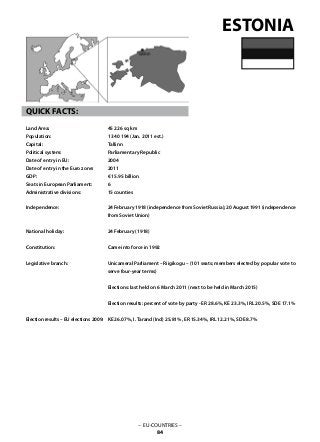
  • 267.
    Political Assembly. Itis not obliged to disclose its reasons. A proposal for the exclusion of a member may only be submitted by the Presidency, or seven Or- dinary or Associated Member Parties from five different countries. The Presi- dency may hear the member concerned. A proposal for the exclusion of an Individual Member may only be submitted by the Presidency of the EPP Group in the European Parliament. If a Member Party is not any more a viable political force in its respective coun- try and, in particular, has not been represented in regional or national or Eu- ropean Parliament(s) for two consecutive parliamentary terms, the EPP Presi- dency can recommend to the Political Assembly its suspension or exclusion, according to the procedures stated in the previous paragraph. A member’s affiliation ceases automatically upon death, disqualification, liqui- dation or in cases of temporary administration, court-ordered settlement or insolvency. The affiliation of an individual member ends automatically when this member is no longer a member of the European Parliament and the affili- ation of a Member Association ends automatically when this member does no longer fulfil the criteria that were necessary for its preliminary recognition as a Member Association and which are set out in the internal regulations. Members that resigned or were excluded and the legal successors of such members or of deceased members have no claims on the assets of the associ- ation and may never be reimbursed for dues paid, contributions or any other payments made to the association, unless otherwise expressly provided for in the by-laws. In no case may a member that resigned or was excluded demand the commu- nication of or a copy of the accounts, the placing of official seals on the proper- ty of the association or the drawing up of an inventory. III. ORGANS OF THE ASSOCIATION Article 10 The organs of the association are: (i) The Presidency (ii) The Political Assembly (iii) The Congress. The EPP strives towards equal participation of women and men in all its organs. 4– APPENDICES – 257
  • 268.
    IV. PRESIDENCY Article 11 Theassociation is managed by the Presidency, the executive organ. The Presi- dency is composed of: (i) the President of the EPP; (ii) the President of the European Commission, the President of the European Council, the High Representative on Foreign and Security Policy, the President of the European Parliament (to the extent that these persons are affiliated to the EPP); (iii) the Chairman of the EPP Group in the European Parliament; (iv) the Honorary President(s); (v) ten Vice-Presidents; (vi) the Treasurer; and (vii) the Secretary General. Except for the Honorary President(s) who are elected by the Political Assem- bly, and for the President of the European Commission, the President of the European Council, the High Representative on Foreign and Security Policy, the President of the European Parliament, the Chairman of the Group of the EPP in the European Parliament, who are ex officio members of the Presidency, the members of the Presidency are elected by the Congress by secret ballot and by separate vote, for a renewable term of three years, exception made for the first nomination of the members of the Presidency immediately after the incor- poration of the association, which will be carried out in accordance with the transitional provisions. The Congress elects first the President who, subsequently, proposes to the Congress a Secretary General to be elected. Only representatives of Ordinary and Associated Member Parties are eligible for these functions. Candidates who obtain a simple majority of the valid votes cast are elected. Abstentions are not considered valid votes. Candidates for the functions of President, Vice-Presidents and Treasurer must be nominated, in writing, to the Secretariat General, seven days prior to the date of the election. Presidents and Secretaries General are entitled, on behalf of Ordinary and Associated Member Parties and on behalf of Member Associ- ations, to propose candidates provided that all candidates are member of an Ordinary or Associated Member Party. All Ordinary and Associated Member Parties and all Member Associations shall be informed of the names of the can- didates not less than three days prior to the elections. The members of the Presidency may resign at any time, by giving notice to the Presidency of the decision to resign by registered letter. Their mandate is at any time revocable by the Congress. – APPENDICES – 258
  • 269.
    If a mandatefalls vacant, the Political Assembly may, in accordance with the previous paragraphs of this article, elect a replacement. At the following Con- gress, confirmation of this election is requested and the Congress determines the duration of the term of office. Members of the Presidency may be re-elec- ted. Members of the Presidency whose terms of office are coming to an end must, before expiry of the term, call a Congress for the purpose of electing new members of the Presidency. If they fail to do so, they are obliged to remain in office until such time as a replacement can be found, without prejudice to their responsibility for any damage caused by their omission. On the proposal of the President, and in accordance with the requirements of the agenda, the following persons may be invited to attend meetings of the Presidency: - members of the European Commission who are member of a Member Party - the President of the EPP Group at the Parliamentary Assemblies of the Council of Europe, the OSCE and NATO as well as in the Committee of the Regions The following persons are permanently invited: - the Deputy Secretary(ies)-General of the EPP - The Secretary-General of the EPP Group in the European Parliament. The EPP President and/or Secretary General can attend, at will, any meetings of any organs of EPP Groups and Associations. The members of the Presidency are not remunerated for the exercise of their mandate, unless decided otherwise by the Political Assembly. In case the President would be prevented to fulfil his powers, as attributed to him by these by-laws and the internal regulations, he will delegate one of the Vice-Presidents as his representative. Article 12 The Presidency has the powers attributed to it by the law, these by-laws and the Internal Regulations. Its competences consist inter alia of: - ensuring the implementation of decisions taken by the Political Assembly; - preparing the annual accounts and budget; - ensuring the permanent political presence of the EPP; - monitoring the work of the General Secretariat, and more in particular the budget management; - issuing statements on behalf of the EPP in the framework of its political program further to a decision of the Political Assembly; - proposing candidates for the function of Deputy Secretary(ies) 4– APPENDICES – 259
  • 270.
    General to thePolitical Assembly in agreement with the Secretary General; - proposing candidates for nomination as Honorary President to the Political Assembly. Article 13 The members of the Presidency shall meet at least eight times annually, upon convocation by the President, by letter, fax or email at the latest two weeks in advance, unless in case of urgency. The meetings take place on the day and at the time and place stated in the convocation notice. The notice also contains the agenda, which is fixed by the President. The Presidency may only debate the items on the agenda, unless all the members are present and unanimously agree to deliberate and to approve the agenda set at that time. The Presidency shall validly deliberate if a majority of its members are present. In case of failure to achieve this quorum, a second meeting shall be convened with the same agenda, which can validly deliberate, regardless of the atten- dance quorum. Decisions shall be taken by an absolute majority of the votes cast. All members of the Presidency shall have one vote. In case of a tie, the President has the casting vote. The meetings are chaired by the President. The Secretary General or a Deputy Secretary General shall draw up the minu- tes of the meetings, which shall be kept at the registered office of the associ- ation. Membership of the Presidency is strictly personal. A representative of a mem- ber of the Presidency will not be admitted to meetings. The mandate of the members of the Presidency will automatically expire if, during the course of the year, a member has not participated in at least half of the meetings. On the proposal of the President, the Presidency may share work between its members or mandate certain members for specific tasks and delegate specific powers to one or more of its members. Article 14 If the President considers it advisable, the Presidency may approve a proposal by having all members of the Presidency sign for approval a circular setting out the proposal. In this case, the Presidency is not required to call a meeting. The circular must include the following information: – APPENDICES – 260
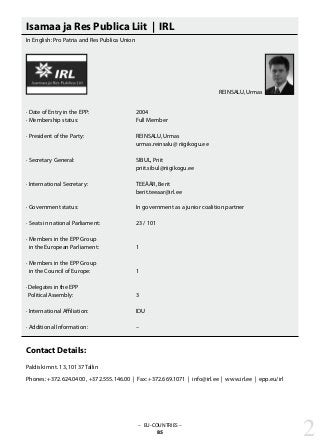
  • 271.
    - a statementthat the text is a proposal for a decision of the Presidency; - a statement that the decision shall only be approved if signed by all the members of the Presidency; - a statement that the decision may not be amended and that no reservations may be expressed by members of the Presidency; - a statement that all the members of the Presidency must return the document signed and with the handwritten words“read and approved”; - a statement that the signed circular must be returned within ten days to the association. The meetings of the Presidency may also be organized by video- or teleconference. V. POLITICAL ASSEMBLY Article 15 The Political Assembly is the strategic organ of the association. It is composed of: a. members ex officio: - members of the Presidency; - members of the Presidency of the Group of the EPP in the European Parliament; - Presidents of Ordinary or Associated Member Parties, Member Associations or their mandated representatives; - Presidents of national delegations of member parties of the Group of the EPP in the European Parliament; - Members of the Presidency of the European Parliament, of the European Commission and of the Presidency of the Committee of the Regions, provided they belong to an Ordinary Member Party; - Presidents of the EPP Groups in the Committee of the Regions and in the Parliamentary Assemblies of the Council of Europe, the OSCE and NATO, provided that they are member of an Ordinary Member Party or Associate Member Party. The mandate of these members of the Political Assembly ends when they loo- se the capacity in which they became member of the Political Assembly. b. delegated members: - Representatives of Ordinary Member Parties and Associated Member Parties. The Ordinary Member Parties and Associated Member Parties shall nominate their delegates together with an equivalent number of substitutes. 4– APPENDICES – 261
  • 272.
    - The delegatesand voting rights of Ordinary Member Parties are assigned proportionally to the number of Individual Members of the association; - The delegates and voting rights of the Associated Member Parties are assigned by the Presidency. The mandate of these members of the Political Assembly ends when the dele- gation by which they became member of the Political Assembly comes to an end. The composition of the Political Assembly is calculated by the Secretary General twice in a legislature of the European Parliament (i): at the beginning and (ii) half-way through the European parliament legislature (any delay in the- se calculations is limited to a maximum of six months).This calculation must be approved by the Political Assembly. c. non voting members - The deputy Secretary(ies) General of the Association; - The Secretary General of the EPP Group in the European Parliament, and Secretaries General of the EPP Group in the Committee of the Regions and in the parliamentary Assemblies of the Council of Europe, the OSCE and NATO; - Two delegates of each Observer Member Party. On the proposal of the President, the Political Assembly may invite certain per- sonalities to give advice. Article 16 The Political Assembly has the powers attributed to it by the law, these by-laws and the Internal Regulations. Its competences consist inter alia of: - ensuring unity of action by the EPP and influencing the achievment of European policy in the spirit of its program; - electing the Deputy Secretary(ies) General on the proposal of the Presidency; - stimulating and organizing systematic relations between national parliamentary groups and member parties in agreement with the Group of the EPP in the European Parliament; - adopting the annual accounts and the budget; - deciding on the applications for membership as well as on the recognition of Member Associations; - deciding on the exclusion of members and revoking the recognition of Member Associations; - deciding on the amount of annual dues to be paid by the members; - formulating recommendations to the Congress as to modifications of the by-laws; - adopting the Internal Regulations; - electing the Honorary President(s) on the proposal of the Presidency, except for the first Honorary President(s) elected before the first meeting of the Political Assembly in accordance with the – APPENDICES – 262
  • 273.
    transitional provisions; -appointing the statutory auditor. The Political Assembly may establish standing commissions and ad hoc wor- king groups to study specific problems, and decide to dissolve them after ha- ving heard the president of the commission or working group. Article 17 On the invitation of the President, the Political Assembly meets at least four times annually, whenever the object or the interest of the association so requi- res; an extraordinary meeting can be held at the request of either one-third of the Ordinary Member Parties and Associated Member Parties, or of the Presi- dency of the Group of the EPP in the European Parliament. The Political Assembly shall validly deliberate if it is convened regularly, i.e. by letter, fax or email at the latest two weeks in advance, unless in case of urgency, and if a majority of its members are present. Failure to achieve this quorum can only be established on the basis of a formal proposal, at the request of the delegations of at least seven Ordinary Member Parties or Associated Member Parties. If a second meeting has been convened with the same agenda, within at least two weeks and at most two months after the establishing of the failure to achieve the quorum, this second meeting can validly deliberate, regardless of the quorum. The convocation notice sets out the agenda. Meetings are held at the registe- red office of the association or at the place stated in the notice of the meeting. For an item not listed on the agenda to be validly put to the vote, at least two thirds of members present must consent. All votes and election procedures shall be made by absolute majority of the members present. In case of a tie, the President has the casting vote. The meetings are chaired by the President. The Secretary General or a Deputy Secretary General shall draw up the minu- tes of the meetings, which shall be kept at the registered office of the associ- ation. All members will receive copies of these minutes within four weeks of each meeting. The Political Assembly normally meets‘”in camera”. On the request of the Pre- sidency or of one tenth of the delegates, the Political Assembly may decide, by simple majority, to admit the public to the meeting. 4– APPENDICES – 263
  • 274.
    VI. CONGRESS Article 18 TheCongress has the following competences: - deciding on the political program of the EPP; - deciding on modifications of the by-laws; - electing the President, Vice-Presidents, the Secretary General and the Treasurer; - deciding on the dissolution of the association. The composition and the functioning of the Congress are regulated in the Internal Regulations. VII. SECRETARY GENERAL Article 19 Exception made for the first nomination of the Secretary General immediate- ly after the incorporation of the association, which will be carried out in ac- cordance with the transitional provisions, the Congress elects, on the proposal of the President, a Secretary General, in charge of the day-to-day management of the association, including the representation of the association within the limits of the day-to-day management. This day to day management includes inter alia (i) the management of the General Secretariat and exercise of the decisions taken by the organs, (ii) the supervision of the cooperation between Ordinary Member Party, Associated Member Party and Member Association, General Secretariats, Member Associ- ations, and the General Secretariat of the Group of the EPP in the European Par- liament, (iii) the drawing up, in agreement with the President, of agendas for meetings of organs, the supervision of the convening of meetings, their pre- paration, and the writing of minutes, (iv) the responsibility to the Presidency and the Political Assembly for proper and adequate budgetary management, and (v) the drawing up of a report of the activities of the General Secretariat and organisational perspectives to the Political Assembly at the beginning of each year. The Secretary General is also entitled to implement decisions of the Presidency and in particular to authorize an attorney at law to represent the association in judicial proceedings either as applicant or defendant. On the proposal of the Presidency and in agreement with the Secretary Gene- ral, the Political Assembly, following the election of the Presidency, elects the Deputy Secretary (ies) General for a period of three years. – APPENDICES – 264
  • 275.
    VIII. REPRESENTATION Article 20 Alllegal acts on behalf of the association not falling within the scope of the day-to-day management or of a special delegation of powers, must be signed by the President or by two members of the Presidency. IX. MODIFICATIONS OF THE BY-LAWS Article 21 Proposals for modifications of the by-laws may be introduced by the Presiden- cy, Ordinary Member Parties, Associated Member Parties or Member Associa- tions and by the EPP Group at the European Parliament and the Presidents of theEPPGroupsintheCommitteeoftheRegions,theParliamentaryAssemblies of the Council of Europe, the OSCE and NATO provided that they are member of an Ordinary Member Party or Associated Member Party. Proposals must be presented in writing to the Secretary General who will transmit them to the Members of the Political Assembly for deliberation at least four weeks prior to the meeting at which the Political Assembly will deli- berate on those proposals. Proposals shall be presented to the Congress for adoption only if they have obtained a two-thirds majority in the Political Assembly. Approval of modifi- cations to the by-laws presented by the Political Assembly requires a simple majority of the members of Congress present. The Congress may by a two- thirds majority of the members present overrule the proposals of the Political Assembly. X. CENTRE FOR EUROPEAN STUDIES Article 22 The Centre for European Studies (CES) is the official European political foun- dation of the European People‘s Party. The CES will function as the sole and official think-tank of the EPP and shall, in particular, serve as a common Eu- ropean framework for national foundations/think-tanks recognized by EPP member-parties. 4– APPENDICES – 265
  • 276.
    XI. FINANCIAL YEAR– ANNUAL ACCOUNTS AND BUDGET – STATUTORY AUDITOR Article 23 Ordinary Member Parties, Associated Member Parties, Member Associations and Observer Member Parties contribute to the financing of the association. The conditions are strictly defined in the Internal Regulations. Article 24 The association’s financial year runs from 1 January to 31 December. At the end of each financial year, the Presidency closes the accounts for the year ended and establishes the budget for the following financial year in ac- cordance with the applicable legal provisions; the annual accounts are submit- ted to the Political Assembly for approval. The Treasurer will assist the Presidency in drawing up the accounts and the budget. He controls the budgetary management of the General Secretary and reports to the Presidency. He is responsible in particular for the financing of the association and its activities, by means of membership fees, donations or otherwise. The surplus is added to the association’s assets and in no case may be paid to members in the form of dividends. Article 25 Exception made for the first appointment of the statutory auditor immedia- tely after the incorporation of the association, which will be carried out in ac- cordance with the transitional provisions, the Political Assembly appoints one or more statutory auditors assigned with auditing the accounts submitted by the Presidency and presenting a report on the accounts. The auditor is appointed for a renewable term of three years. The Political As- sembly fixes his remuneration. His mandate may be revoked at any time by the Presidency. In the absence of an auditor or if the auditor is unable to fulfil his functions, the President convenes within one month a meeting of the Political Assembly for the purpose of appointing an auditor or replacing the auditor. The auditor appointed to replace an auditor who has resigned in the course of his term of office completes the latter’s term. – APPENDICES – 266
  • 277.
    XII. DISSOLUTION Article 26 Theassociation is not dissolved as a result of the death, dissolution or resigna- tion of a member, provided the number of members is not less than two. The association may be dissolved voluntarily by a decision of the Congress with a three-quarters majority of the members present, in accordance with the rules applicable to its functioning, as set out in the Internal Regulations. In the event of voluntary dissolution, the Congress elects the liquidator(s). In the absence of liquidator(s), the members of the Presidency will act as liquida- tors. In the event of dissolution, the Political Assembly decides on the disposal of the assets. Such disposal must serve a not-for-profit purpose. XIII. INTERNAL REGULATIONS Article 27 At the proposal of the Presidency, the Political Assembly decides on the In- ternal Regulations in which issues of internal order and of financial order not mentioned in these by-laws shall be set out. In the Internal Regulations, some additional bodies will be created, such as the EPP Summit and the notions of “Member Associations”and“Supporting Member”will be defined. Proposals for amendments to the Internal Regulations may be submitted by the Ordinary Member Parties, Associated Member Parties and Member Asso- ciations and by the Presidency. Said proposals must be submitted in writing to the Secretary General four weeks prior to the meeting of the Political Assembly at which they will be considered and they must be notified to the members. 4– APPENDICES – 267
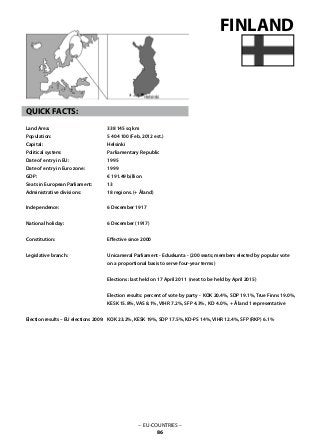
  • 278.
    Amended by theEPP Political Assembly on 7th November 2011, Brussels INTERNAL REGULATIONS OF THE EUROPEAN PEOPLE’S PARTY (international non-profit association) By and under supervision of the Political Assembly, the following additional bodies with decision-making powers will be established and function within the association. The rules regarding the functioning and composition of these bodies, as well as other rules relating to the functioning of the international association which are not set out in the by-laws, will be set out in these Internal Regulations. I. CONGRESS a. Composition The members of Congress are: - Members of the EPP Presidency; - Presidents of Ordinary Member Parties, Associated Member Parties and Member Associations; - Delegates of Ordinary Member Parties, Associated Member Parties and Member Associations; - Heads of State and of Government of Member States of the European Union, who are members of an Ordinary Member Party; - The President of the European Council provided he is member of an Ordinary Member Party; - Individual Members of the Association (cf. article 5, alinea 4 of the by-laws) ; - Members of the European Commission provided they are members of an Ordinary Member Party; - Presidents of the EPP Groups at the Committee of the Regions, and at the Parliamentary Assemblies of the Council of Europe, the OSCE and NATO, provided that they are a member of an Ordinary Member Party or an Associated Member Party; - Delegates of the EPP Groups in the Committee of the Regions and in the Parliamentary Assembly of the Council of Europe, provided that they are member of an Ordinary Member Party or Associated Member Party. The overall number of delegates shall be decided upon by the Political Assem- bly prior to convening the Congress. – APPENDICES – 268
  • 279.
    Delegates of OrdinaryMember Parties, Associated Member Parties, Member Associations, the EPP Group in the Committee of the Regions and in the Parlia- mentary Assembly of the Council of Europe respectively form delegations. They must, in the composition of their delegation, give priority to their repre- sentatives at the Political Assembly. The number of delegates from each Ordinary Member Party, Associated Mem- ber Party and Member Association is calculated in accordance with the num- ber of delegate members of the Political Assembly. Members ex officio are not taken into account. Ordinary Member Parties and Associated Member Parties are entitled to a mi- nimum of three delegates. Member Associations and the Groups of the EPP in the Committee of the Regions and in the Parliamentary Assembly of the Coun- cil of Europe are entitled to six delegates. The following are invited to the Congress as guests: - three representatives of each Observer Member Party, in accordance with article 6 of the by-laws; - members of the Presidency of the EPP Groups at the Committee of the Regions and at the Parliamentary Assemblies of the Council of Europe, at, the OSCE and NATO; - parliamentarians of the Group of the EPP in the European Parliament who are not Individual Members of the association; - all former Presidents and Secretaries-General of the party; - Supporting Members. The President has the right to invite other personalities to the meetings of the Congress. b. Functioning The Congress meets at least every three years. It is convened by a decision of the Political Assembly which determines the venue, date, agenda and regula- tions of the Congress. Convening of the Congress is the responsibility of the President on behalf of the Political Assembly. The Political Assembly debates and approves the draft EPP Congress docu- ment. Notice shall be made in writing and contain the venue, date and proposed agenda. It must be dispatched, together with a copy of the regulations of the Congress, four weeks prior to the Congress. Organisations that have delegates are responsible for informing them. The venue and date of an ordinary Congress, as well as the number of delega- tes per delegation, must be communicated at least two months in advance. 4– APPENDICES – 269
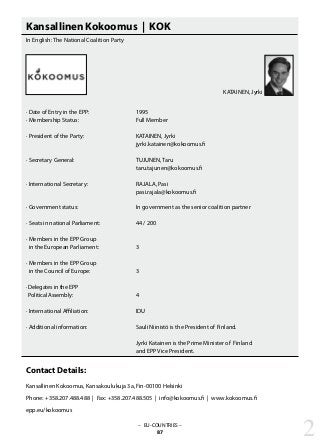

  • 280.
    The Political Assemblycan decide to convene an extraordinary Congress. At the request of the Group of the EPP in the European Parliament or at least one-third of the Ordinary Member Parties and Associated Member Parties, the Political Assembly shall convene an Extraordinary Congress. The time period set out in the previous paragraphs shall be reduced to minimum three weeks. The Congress can validly take decisions if it has been correctly convened and if the majority of its members are present. Failure to reach a quorum must be established by a formal motion. A motion preventing valid deliberation may be introduced by: - the presidency of the Congress; - at least seven Ordinary Member Parties and Associated Member Parties from five different countries; - the Presidency of the EPP Group in the European Parliament. If the Congress is unable to make a valid deliberation, the President shall, af- ter consultation with the EPP Presidency, determine the date and agenda of an extraordinary Congress. The stipulations concerning the notice and notice period shall not apply. This extraordinary Congress may nonetheless validly deliberate. This must be mentioned in the invitation. Decisions shall be taken by an absolute majority of the votes cast. Decisions on modifications to the by-laws are governed by article 21 of the by-laws. Each member of Congress has one vote. The Congress normally meets in public. On the request of the Congress Presi- dency, the Congress may decide, by simple majority, to meet“in camera”. II. POLITICAL ASSEMBLY Following Article 15 b) of the EPP By-laws, the number of the delegates and voting rights of the Associated Member Parties and Member Associations are assigned by the Presidency. The number of delegates shall be limited to a ma- ximum of 2 besides the Party Chairman. III. EPP SUMMIT a. Competences The EPP Summit prepares the position to be taken by the EPP Heads of State and of Government at the European Council and issues recommendations on the strategy and political orientation of the association. – APPENDICES – 270
  • 281.
    b. Composition The EPPSummit is composed of: - the members of the EPP Presidency; - the members of the European Council (Heads of State and of Government), the President of the European Parliament and the President of the European Commission or a Vice-President to represent members of the European Commission, as far as they are a member of an EPP Ordinary Member Party; - Presidents of parties in coalition governments in EU Member States in cases where the Head of Government is not a member of an EPP Ordinary Member Party; - the President of the largest opposition party in each Member State of the European Union in the event that no EPP Ordinary Member Party is part of the government. Where EPP Ordinary Member Parties candidate only in com plementary regions, the President of each party is invited. The President has the right to invite other personalities to the meetings of the EPP Summit. The President will report to the Political Assembly on the outcome and general direction of the EPP Summit. IV. INTERNATIONAL SECRETARIES STEERING COMMITTEE The Secretary General chairs the ‘International Secretaries Steering Commit- tee’, an ad hoc consultative body that will assist, when necessary, the work of the institutional bodies of the EPP. All international, external or related Secre- taries have the right to participate in this Committee. V. EPP MINISTERIAL MEETINGS The EPP organizes on a regular basis EU Ministerial Meetings of Foreign Minis- ters and ECOFIN Minsters in order to improve political coordination and policy synergy in the Council. Ministerial Meetings will be organized in relevant EU policy sectors. At the recommendation of the EPP President, EPP Vice-Presi- dents or other outstanding EPP political personalities may chair such meetings if they have relevant policy experience and expertise. VI. WORKING GROUP CHAIRMEN The Members of the Presidency should commit themselves in the bodies of the party, e.g. working groups, fora, ad-hoc committees. In case of vacancies, the Presidency together with the Secretary General will appoint a high profile EPP personality to Chair a working Group. In case of poor performance by an appointed working Group Chairperson, the Presidency and the Secretary Ge- neral have the right to replace the Chairperson with a new appointment. 4– APPENDICES – 271
  • 282.
    Member Parties whodo not participate in two consecutive meetings of the Working Group Meetings, will not be able to present and/or vote amendments to EPP Working Group documents or resolutions in the two following Working Group Meetings, unless otherwise agreed by the relevant Working Group. VII. BILATERAL AGREEMENTS The EPP has the right to establish Bilateral Agreements with parties, organisa- tions, think tanks, NGOs, etc., as an instrument to develop broader relations. The specific terms of the Agreement have to be accepted by the Presidency and approved by the Political Assembly. At the proposal of the Presidency, the Political Assembly has the right to revoke a Bilateral Agreement if the terms of the Agreement have been breached. VIII. SECRETARY OF EXTERNAL RELATIONS EPP’s bilateral and multilateral relations with like-minded political parties and organisations beyond the EU and in other continents shall be coordinated by the Secretary of External Relations. The Secretary of External Relations will perform his task under the monitoring of the Secretary General and the De- puty Secretary General (responsible for political affairs). Adopting the same nomination and election procedure of the Statutes/By-laws stated in Article 12 (point 6, Article 16 (point 2) and Article 19 (last paragraph), the Secretary for External Relations is elected for a period of three years. IX. SPOKESPERSON EPP‘s Press and Communication department will be headed by the Spokesper- son. The Spokesperson is responsible for promoting the profile and work of the EPP and the members of the EPP Presidency in all media and related public fora. The Spokesperson performs his/her tasks under the direction of the Pre- sident and Secretary General, and receives guidelines from the Presidency. Ad- opting the same nomination and election procedure on the Statutes/By-laws stated in Article 12 (point6), Article 16 (point 2), and Article 19 (last paragraph), the Spokesperson is elected for a period of three years. X. MEMBER ASSOCIATIONS Recognition as an Association presupposes that: - national sections, linked to an Ordinary Member Party of the EPP, exist in at least half the Member States of the EU; - their activities are performed on the basis of by-laws governing their responsibilities and the right of representation; - their activities and the positions taken are in line with the EPP Program and the party’s political directives. The EPP Member Associations must clearly indicate in their name their rela- tionship to the EPP. As a general rule, the Member Associations must accept the participation of the corresponding national associations of the Ordinary – APPENDICES – 272
  • 283.
    Member Parties andAssociated Member Parties. Associations may apply in writing to the Presidency to be recognized. The ap- plication must include the program and by-laws of said association and infor- mation concerning the organisation and the number of members. The Presidency must submit the application to the members of the Political Assembly at least one month prior to its examination. The Political Assembly may decide to hear representatives of an applicant as- sociation. On the proposal of the Presidency, and after having heard the association con- cerned, the Political Assembly may revoke its recognition of an association. XI. BUDGET AND ACCOUNTS At the first meeting of each odd-numbered year, the Political Assembly elects four Internal Auditors who may not be members of the EPP Presidency. Their mandate lasts two years. XII. MEMBERSHIP ADMISSION During its preliminary examination of the membership application as menti- oned in article 5 of the By-Laws, the Political Assembly may decide to hear a representative of the applicant party. After its preliminary examination, the Political Assembly transmits the appli- cation for advice to the EPP Working Group on‘EPP Membership‘. The Political Assembly will take a decision on the application on one of its next meetings following the receipt of the advice of the EPP Working Group on‘EPP Member- ship‘. XIII. MEMBERSHIP SUSPENSION The suspension of a member as defined in article 9 of the By-Laws may only be decided by the Political Assembly after hearing the member concerned. If the member fails to turn up for the hearing, the Political Assembly is autho- rized to decide on the suspension of the member. Suspended members lose their speaking and/or voting rights within the or- gans and bodies of the association as well as their right to propose candidates for positions within the association, until the Political Assembly has lifted the suspension, it being understood that they have to continue to comply with their membership obligations during the whole time of the suspension. XIV. MEMBERSHIP EXCLUSION The exclusion of a member as defined in article 9 of the By-Laws may only be decided by the Political Assembly after hearing the member concerned. If the 4– APPENDICES – 273
  • 284.
    member fails toturn up for the hearing, the Political Assembly is authorized to decide on the exclusion of the member. XV. SUPPORTING MEMBERS The Presidency may also grant the title of Supporting Member to other per- sons or associations. They do not enjoy the same rights as the members men- tioned in article 5 of the by-laws but may be invited by the President to attend meetings of certain organs or bodies of the association. XVI. FINANCIAL REGULATIONS a. Membership Fees of EPP Ordinary Member Parties The annual Membership Fees of the EPP Ordinary Member Parties is based on: a) a basic sum calculated on the basis of the votes obtained by that party in the last European Elections b) a basic sum per member of that party in the EPP Group in the European Parliament The basic calculation is made for the first budget following European Elections, on the proposal of the Treasurer and the Secretary General and after approval of the Political Assembly. When a modification in Membership Fees is necessary, it is possible to vote for either a modification of basic sum a) or for a modification of basic sum b) or for a modification of both sums. b. Membership Fees for Associated Member Parties and Observer Member Parties On the proposal of the Treasurer and Secretary General, the Membership Fees of EPP Associated Member Parties, is calculated by the Political Assembly on the basis of the votes obtained by these Associated Member parties during the last national elections. The Associated Member Parties will start paying Mem- bership Fees immediately after their admission as an Associated Member Party, pro rata temporis.The same procedure is for 50 % applied to Observer Member Parties. c. Membership Fees for Member Associations The Membership Fees of EPP Member Associations are determined by the Poli- tical Assembly upon proposal of the Treasurer and Secretary General. d. Contribution of Supporting Members Supporting Members can contribute to the financing of the EPP. The Sup- porting Member Contribution is at least 20 euro. – APPENDICES – 274
  • 285.
    e. General Stipulations MembershipFees are fixed in euro; they are payable without deduction of in- curred costs. Membership Fees are adjusted annually in line with Belgian infla- tion levels. f. Arrears Ordinary Member Parties, Associated Member Partiers and Observer Member Parties which accumulate arrears in the payment of their annual Membership Fee lose their speaking and/or voting rights within the organs and bodies of the association as well as their right to propose candidates for positions within the association, until they have paid off their arrears. The Presidency will propose to the Political Assembly to exclude Ordinary, Associated and Observer Member Parties which accumulated arrears for two years. Interest, equivalent to double the relevant year’s annual inflation rate in Bel- gium, will be added to the amount of the arrears. A list outlining the current Membership Fees’situation will be distributed at each meeting of the EPP Po- litical Assembly. g. Subventions to Member Associations 1. The EPP in so far as possible supports the activities of its Member Associ- ations. The nature and conditions of this support is determined by the EPP authorities responsible for the budget. 2. Each Member Association submits its budget at the beginning of the bud- getary year (by 1 February at the latest) to the Political Assembly. It also furni- shes its accounts and balance sheet of the year prior to the previous budgetary year. The balance sheet and accounts are to be accompanied by the report of the financial auditors and the minutes of the meeting at which this report was approved. 3. Each Member Association must present an activity report of the previous 12 month period to the EPP Political Assembly at the very latest at the time of the final adoption of the EPP budget. 4. Each Member Association must present a draft Activity Programme for the year to come to the EPP General Secretariat at the latest on November 1. 5. Following this, each Member Association receives (following the approval of the EPP budget) a subvention for its normal administrative costs (“office costs”). This subvention will be maximum 30% of the total amount of financial means put at the disposal of the Member Associations by the EPP. 6. Furthermore, each Member Association receives a credit line (following the approval of the EPP budget) for the realization of the activities as mentioned 4– APPENDICES – 275
  • 286.
    – APPENDICES – 276 inpoint 4 and enlisted in the EPP Grant Application to the European Parliament as ‘co-productions’. This credit line is allocated in part or in whole on a case by case basis following an agreement with the EPP General Secretariat. 7. For the granting of such subventions, the following provisions must be en- sured: On all invitations to the activities and on all publications concerning the activi- ties of the Member Associations as mentioned in point 4, the EPP logo must be present and clearly identified. This is a necessary prerequisite for every single use (in part or in whole) of the credit line. h. Financial support to related organisations Should the EPP Political Assembly decide to give annual financial support to other related organisations, these organisations should follow the same proce- dure as described above, in section g. i. Administration of Resources The EPP Treasurer and Secretary General are entrusted by the EPP Presidency and Political Assembly with the proper administration and use of the financial resources of the association. j. Financial Year – Annual Accounts and Budget – Statutory Auditor In accordance with Article 12 and Article 24 of the By-laws, any member of the EPP Presidency who is a Member of the European Commission or President of the European Parliament does not take part in the decision-making process regarding the annual accounts and budget of the association. These persons cannot be appointed as Statutory Auditor according to Article 25 of the By- laws. XVII. EPP MERIT AWARD The EPP Presidency has the right to grant an “EPP Merit Award” to individuals that have made an outstanding contribution in promoting the EPP. The EPP Presidency will receive nominations and examine them on a case-by-case basis before granting the Award.
  • 287.
    APPENDIX II     BY-LAWS OFTHE CENTRE FOR EUROPEAN STUDIES (international non-profit association) Brussels, 13th September 2007 (Amended 2nd May 2010) The following individuals, representing the interests of the European People’s Party (EPP) and its member-parties: · Wilfried Martens, lawyer, domiciled in 1050 Ixelles (Brussels), place Marie- José 14/10, Born in Sleidinge on 19.04.1936; · Antonio López-Istúriz White, lawyer, domiciled in Ronda de la Sacedilla 13.1 BAJO B, 28221 Madrid, Spain, Born in Pamplona on 1.04.1970; and the following organizations which are national political foundations/think- tanks linked to EPP member-parties: · Constantinos Karamanlis Institute for Democracy, scientific non-profit com- pany, 10, Vas.Sofias Ave., 10674 Athens, represented by Skilas, Pantelis, Head of the international cooperation department; · Fundación para el análisis y los estudios sociales, foundation, calle Juan Bravo nro 3-C, 7th floor, Madrid, represented by Magaz van Nes, Juan Alejandro, Lawyer; · Hanns-Seidel-Stiftung e.v., registered association, Lazarettstrasse 33, D-80636 München represented by Luther, Susanne, Head of the Office for Foreign Relations; · Jarl Hjalmarson Stiftelsen, foundation, Stora Nyagatan 30, OldTown, Stockholm, Box 2080, SE-103 12 Stockholm, Sweden, represented by Gustavsson, Eva, Managing Director; · Konrad-Adenauer-Stiftung e.V., registered association, Rathausallee 12, D-53757 Sankt Augustin, Germany represented byWeilemann, Peter , Director; – APPENDICES – 277 4
  • 288.
    · Politische Akademieder ÖVP, registered association, Tivoligasse 73, 1120 Vienna, represented by Kroiher, Erik, Head of the International Office of Political Academy and International Secretary of ÖVP; · Stichting Wetenschappelijk Instituut voor het CDA, foundation, Buitenom 18, 2512 XA Den Haag / The Hague, The Netherlands, represented by Van Asselt Evert-Jan, Deputy Director; · Szövetség A Polgári Magyarországért Alapítvány, foundation, 1062 Buda- pest, Lendvay utca 28, Hungary, represented by Balog, Zoltán, Chairman of the executive board. have agreed to incorporate a Belgian non-profit organization (“Associationsans but lucratif/Vereniging zonder winstoogmerk”) pursuant to the Belgian law of 27 June 1921 on non-profit associations, international non-profit associations and foundations, the By-laws of which are as follows: TITLE I – NAME, REGISTERED OFFICE, PURPOSE, DURATION Article 1. Name The name of the non-profit association is:“Centre for European Studies ASBL”, abbreviated as“CES”, referred to here below as the“Centre”. Article 2. Registered office 2.1. The registered office of the Centre is located at 1000 Brussels, Rue du Commerce, 10, in the judicial district (“arrondissement judiciaire/gerechtelijk arrondissement”) of Brussels. 2.2. The registered office can be transferred to any other place in Belgium by a decision of the General Assembly complying with the linguistic legislation in Belgium. 2.3. By decision of the General Assembly – according to the provisions of the Regulation (EC) No 2004/2003 of the European Parliament and of the Council of 4 November 2003 on the regulations governing political parties at European level and the rules regarding their funding - the Centre has the right to re-register its office in any other Member State of the European Union. Article 3. Object and Purpose 3.1. The Centre shall constitute the official think-tank of the European People’s Party (EPP) and shall, in particular, serve as a common European framework for national foundations/think-tanks recognized by EPP member- parties. – APPENDICES – 278
  • 289.
    In this respect,the Centre, as a non-profit entity, shall amongst others: · monitor, analyze and contribute to the debate of the policy priorities of the European Union; · organize and support seminars, training, conferences and publications on important European themes; · collaborate with high-profile academics, journalists, experts and opinion- makers, as well as with independent centres and institutes. · use all possible means to disseminate the results of its activities. 3.2. The Centre will realize these objectives in close cooperation with its members. It can undertake any action directly or indirectly related to the above-mentioned purposes or to facilitate the development or achievement thereof. 3.3. The Centre is affiliated to the EPP and will function as its sole European political foundation in accordance with the Regulation (EC) No 2004/2003 of the European Parliament and of the Council of 4 November 2003 on the regu- lations governing political parties at European level and the rules regarding their funding. Article 4. Duration The Centre has an unlimited duration and can only be dissolved by judicial decision or a decision of the General Assembly pursuant to Article 26. TITLE II – MEMBERSHIP Article 5. Minimum Number of Members 5.1. The Centre has at least three ordinary members. The number of ordinary members is limited to seventy (70). Additionally, the Centre can accept supporting members as non-voting members. All members have to be committed to support the objectives and aims of the Centre. 5.2. An ordinary members‘ registry is kept updated at the registered office of the Centre and a copy thereof is filed with the Clerk‘s office of the Commer- cial Court. The ordinary members are entitled to consult the member‘s registry at the registered office of the Centre. Article 6. Admission of Members 6.1. Ordinary members of the Centre are individuals and political founda- tions/think-tanks. Every ordinary member has the right to vote. Up to 35 of the number of the ordinary members will represent political foundations/think-tanks. – APPENDICES – 279 4
  • 290.
    6.2. Individualsare accepted as ordinary members by a simple majority vote in the General Assembly, after recommendation of the EPP Presidency to the Executive Board. These individuals represent the interests of the EPP and its member-parties. The EPP Presidency must submit to the Executive Board a written proposal, at least 14 days prior to a General Assembly meeting. Indivi- duals have a mandate of three years. The EPP Presidency will be requested to review CES Individual Memberships every 3 years and present its recommen- dations for Individual Members, to be accepted by the General Assembly. 6.3. In order for a political foundation/think-tank to become a ordinary member of the Centre, it must be recognized by its respective EPP member- party and be engaged in promoting political information and debate and faci- litating EU integration, for instance, by: · observing, analyzing and contributing to the debate on public policy issues at national or at European level; · supporting seminars, training, conferences, publications or studies on such issues; · serving as framework for national experts, politicians and academics to work together at national or at European level. A political foundation/think-tank must have staff, demonstrate regular activity and issue regular financial reports. 6.4. In order to consider a new political foundation/think-tank for member- ship, an application must be submitted to the Executive Board.The application must be accompanied by a letter of recognition from an EPP member-party, signed by the President or Secretary General of the respective EPP member- party confirming that: (1) the applicant is considered as the official political foundation/think-tank of the respective EPP member-party, and (2) the political foundation/think-tank fulfills the criteria of Article 6.3. Only one endorsement of a foundation/think- tank per EPP member-party shall be accepted. 6.5. The General Assembly, after considering the recommendations of the Executive Board on membership applications of political foundations/think- tanks, approves their admission as ordinary members by a simple majority of the votes cast. 6.6. The Executive Board can recommend to the General Assembly the ac- ceptance of supporting members. Supporting members can be individuals representingacademicinstitutionsorotherrelevantorganizations.Supporting members do not have the right to vote. The supporting members have the right to participate in the meetings of the General Assembly as observers. 6.7. Apart from the rights and obligations that are specified in these By- laws and in the relevant provisions of the Belgian law, members do not have any additional obligations towards the Centre. – APPENDICES – 280
  • 291.
    Article 7. Resignationand Expulsion of Members 7.1. A member can terminate its membership in the Centre by giving the Executive Board written notice of resignation with immediate effect. 7.2. The expulsion of members from the Centre can be proposed to the General Assembly by the Executive Board if there is sufficient evidence that the member in question has violated the by-laws of the Centre or if a member does not participate in 2 consecutive meetings of the General Assembly. The Executive Board notifies to the member its proposal to the General Assembly to expel it. The member will automatically be suspended between the date of such notification and the date of the General Assembly. The expulsion of a member requires a vote with a special majority of 2/3 of the votes cast by the General Assembly. TITLE III – ORGANS SUBTITLE I - GENERAL PROVISIONS Article 8. Statutory and Non-Statutory Organs 8.1. The Statutory organs of the Centre are the‘General Assembly’, and the ‘Executive Board’. 8.2. The Non-Statutory organs are the ‘Honorary Board’ and the ‘Academic Council’. SUBTITLE II - GENERAL ASSEMBLY Article 9. Composition 9.1. The General Assembly is composed by all the ordinary members of the Centre. Every new ordinary member has the right to vote (one vote per member). The President of the Centre can invite guests as observers at the General Assembly meeting. 9.2. The General Assembly is chaired by the President or in his absence and in agreement with the Executive Board, the most senior member of the Execu- tive Board. 9.3. Individual ordinary members cannot be represented in the General Assembly by proxy. A political foundation/think-tank ordinary member can only be represented in the General Assembly according to its own organizational rules. – APPENDICES – 281 4
  • 292.
    Article 10. Competences Thecompetences of the General Assembly are: · amendment of the By-laws of the Centre; · admission (upon recommendation of the Executive Board) and exclusion of members of the Centre; · appointment and dismissal of the members of the Executive Board; · appointment and dismissal of the statutory auditor, if any, and determination of its remuneration if the mandate is remunerated; · grant of discharge to the members of the Executive Board and to the statutory auditor, if any; · approval of the budget and the annual accounts; · approval of the annual program; · dissolution of the Centre; · conversion of the Centre into a “société à finalité sociale/vennootschap met een sociaal oogmerk“ Article 11. Meetings 11.1. The General Assembly meets at least once a year and is convened by the Executive Board or upon request of at least 1/5 of the ordinary members. In any case, an statutory General Assembly meeting shall be held at latest on 31 May of each year, in order to deliberate on the approval of the annual accounts of the preceding accounting year and on the discharge of the members of the Executive Board and the statutory auditor, if any, as well as on the budget for the next accounting year. 11.2. Ordinary members are convened in writing (by mail and/or e-mail), at least 28 days in advance. The convocation letter shall include date, time and location of the General Assembly meeting, as well as the agenda thereof. Each agenda item proposal, signed by 1/20 of the ordinary members, shall be added to the agenda. Such a proposal has to be sent to the Executive Board at least 14 days prior to the date of the General Assembly meeting. Article 12. Decisions 12.1. Each ordinary member is entitled to one vote. 12.2. Unless otherwise stated in the By-laws or in the relevant provisions of – APPENDICES – 282
  • 293.
    the Belgian Law,General Assembly decisions are validly taken by a simple ma- jority of the votes cast. 12.3. In the event of a tie vote, the vote of the President shall be decisive. Article 13. Minutes 13.1. Minutes of the General Assembly shall be signed by the President and by the ordinary members wishing to do so. 13.2. The minutes shall be recorded in a special register to be kept at the registered office of the Centre. 13.3. Copies or extracts of the minutes to be produced in court or elsewhere shall be signed by two members of the Executive Board. SUBTITLE III – EXECUTIVE BOARD Article 14. Composition 14.1. The Executive Board of the Centre is composed by a total maximum of eight members - including President and Secretary-Treasurer - and is elected by the General Assembly. 14.2. The members of the Executive Board are elected by the General As- sembly as follows: · following the recommendation of the EPP Presidency, elect maximum three individual ordinary members, as members of the Executive Board. · elect maximum three political foundation/think-tank ordinary members, as members of the Executive Board. All resolutions of appointment must specify the identity of the natural person who will be entitled to represent, on a per- manent basis, the political foundation/think-tank within the Executive Board for the entire duration of the elected term; · additionally, elect maximum two individual ordinary members, as members of the Executive Board. The normal duration of the term of the Executive Board is 3 years. 14.3. The Director has a standing invitation to attend the meetings of the Executive Board without the right to vote. 14.4. Political foundation/think-tank members of the Executive Board must represent the interests of all political foundations/think-tanks that are mem- bers of the General Assembly. – APPENDICES – 283 4
  • 294.
    14.5. Ifa member of the Executive Board fails to attend 3 consecutive mee- tings, the Executive Board may recommend to the General Assembly the repla- cement of this member with the election of a new member, in accordance and in the spirit of the provisions of Article 14.2. Article 15. Competences The Executive Board manages the Centre and has all the competences which are not attributed to the General Assembly, including: · ensuring the implementation of the decisions taken by the General Assembly; · ensuring the general management of the Centre; · drafting the annual program; · preparing the annual accounts and the budget; · monitoring the work of the Director and staff; · the legal representation of the Centre; · the appointment of external auditors, e.g. accountants; · the proposal of admission and exclusion of the members of the General Assembly; · the supervision and control of the activities and the assets of the Centre. Article 16. Meetings 16.1. The Executive Board has to convene at least twice a year. The President shall announce meetings of the Executive Board no later than 28 days prior to such meeting. 16.2. In addition, meetings of the Executive Board shall be convened if at least two members make a written request.This request must addressed to the President. 16.3. Members of the Executive Board shall be convened by invitation (mail or email), at least 14 days in advance.The invitation shall include the date, time and location of the Board meeting, as well as the agenda thereof. 16.4. Every member of the Executive Board has one vote each.The decisions of the Executive Board are taken by simple majority. In the event of a tie vote, the vote of the President is decisive.The Executive Board cannot validly delibe- rate unless the majority of the members are present. There shall be no voting by proxy. – APPENDICES – 284
  • 295.
    Article 17. Minutes 17.1. Minutes of the Executive Board shall be signed by the President and the members of the Executive Board who wish to do so. 17.2. The minutes shall be recorded in a special register to be kept at the registered office of the Centre. SUBTITLE IV - PRESIDENT, SECRETARY-TREASURER Article 18. President The President is elected by the General Assembly following the recommendation of the EPP Presidency.The President chairs the Executive Board. Article 19. Secretary-Treasurer The Secretary-Treasurer is elected by the General Assembly following the recommendation of the EPP Presidency. The Secretary-Treasurer oversees the administrative and financial management of the Centre. SUBTITLE V - DIRECTOR Article 20. Director The Director is elected by the General Assembly for a three-year term which can be renewed, following the recommendation of the EPP Presidency. The General Assembly can dismiss the Director at any time. The Director is respon- sible for the daily management and the implementation of the activities of the Centre and accordingly, reports to the Executive Board. The Executive Board can delegate specific responsibilities and competences to the Director. SUBTITLE VI – NON-STATUTORY ORGANS Article 21. Honorary Board For the purpose of enhancing the profile of the Centre, the Executive Board can nominate high-profile personalities as members of the Honorary Board. Article 22. Academic Council For the purpose of enhancing the academic scope of the Centre and oversee the scientific standards of the research and studies, the Executive Board can nominate esteemed academics and researchers as members of the Academic Council. – APPENDICES – 285 4
  • 296.
    SUBTITLE VII –REPRESENTATION Article 23. Representation The Centre is validly represented by the President or the Secretary-Treasurer, acting solely or alternatively, two members of the Executive Board acting joint- ly. With regard to the daily management, the Centre is validly represented by the Director acting solely. TITLE IV – FINANCES Article 24. Finances The activities and projects of the Centre shall be financed by subventions as specified in the budget of the European Union, fundraising activities and volun- tary contributions. Members are not obliged to submit financial contributions. Article 25. Accounting year and annual accounts 25.1. The accounting year of the Centre begins on the first of January and ends on the thirty-first of December of each year. 25.2. Should the Centre meet at least two of the three criteria set out in Ar- ticle 17 §3 of the Law of 27 June 1921 on non-profit associations, international non-profit associations and foundations, then the General Assembly must ap- point a statutory auditor and determine its/his/her remuneration, if any. TITLE V – DISSOLUTION Article 26. Dissolution 26.1. Any proposal for the dissolution of the Centre shall be addressed by registered letter to the ordinary members so that they receive it at least two months prior to the meeting of the General Assembly when the proposal for a decision is submitted for a vote. 26.2. The Centre can be dissolved by a decision taken by a four fifths majority of the votes cast in the General Assembly where two thirds of the ordinary mem- bers are present or represented. Should this last quorum not be met at the first meeting, then a second meeting will be convened which will be allowed to deli- berate regardless of the number of ordinary members present or represented. 26.3. The General Assembly or the liquidators will decide on the allocation of the net assets of the Centre. – APPENDICES – 286
  • 297.
    TITLE VI –INTERNAL REGULATIONS Article 27. Internal Regulations Internal regulations of the Centre shall be adopted and, if applicable amended, by the General Assembly upon proposal of the Executive Board. Internal Regu- lations regulate issues of internal order not mentioned in these By-laws. Also, the way of functioning of the non-statutory organs will be further detailed. TITLE VII – FINAL PROVISION Article 28. Final Provision Matters not expressly referred to in these By-laws are subject to the provisions of the Law of 27 June 1921 on non-profit associations, international non-profit associations and foundations. TRANSITIONAL PROVISIONS The first members of the Executive Board of the Centre will be, as a transitional measure and subject to confirmation by the next General Assembly: Wilfried Martens, lawyer, domiciled in 1050 Ixelles (Brussels), place Marie-José 14/10, Born in Sleidinge on 19.04.1936; Antonio López-Istúriz White, lawyer, domiciled in Ronda de la Sacedilla 13.1 BAJO B, 28221 Madrid, Spain, Born in Pamplona on 1.04.1970; Joseph Daul, farmer, domiciled in 2, rue de Berstett, F - 67370 Pfettisheim, Born in Strasbourg on 13.04.1947: Peter Weilemann, Director, domiciled in Jägerweg 33, D - 53177 BONN, Born in Kaiserslautern (Germany) on 6.8.1949. The first Director of the Center will beTomi Huhtanen, Avenue Albert Lancaster 9, b6, B-1180 Uccle (Brussels), Born in Helsinki on 20.10.1972. The first accounting year of the Centre will end on 31 December 2007.Therefo- re the first statutory General Assembly will be held in 2008. Done in Brussels in 2 originals copies on 13 September 2007. – APPENDICES – 287 4
  • 298.
    INTERNAL REGULATIONS OFTHE CENTRE FOR EUROPEAN STUDIES (international non-profit association) Brussels, 12th October 2010 Part 1 | GENERAL REGULATIONS 1. OBJECTIVE OF THE INTERNAL REGULATIONS 1.1 The objective of the Internal Regulation is to establish specific guidelines for the daily operations of the Centre. 1.2 In case of conflicts of interpretation between an article in the Statutes and one in the internal regulations, the interpretation given to the article in the Statutes prevails. 2. LANGUAGE OF THE CENTRE 2.1 The working language of the Centre is English. 3.THETASKS, POWERS AND FUNCTIONS OFTHE NON-STATUTORY BOARDS The Honorary Board 3.1 The Honorary Board and its Chairman are nominated by the Executive Board. 3.2 The Honorary Board has the power to have meetings to enhance the profile and exposure of the Centre. 3.3 Meetings have to be approved by the Executive Board. The Academic Council 3.4 The members of the Academic Council and its Chairman are nominated by the Executive Board for a period of 3 years. 3.5 The Academic Board is composed of esteemed academics and researchers. – APPENDICES – 288
  • 299.
    3.6 TheAcademic Board secures and maintains the high academic standards of the Centre by reviewing the progress of the Research, publications and Studies of the Centre and giving recommendations to the Executive Board. 3.7 The Academic Board has a duty of promoting the Centre and its activities to the academic world. 3.8 The Academic board has a maximum of 15 members. 3.9 The Academic Council will be supported by an‘Academic Council Group of Experts’composed of a maximum of 40 experts. 3.10 The Experts are nominated by the Executive Board. 3.11 Experts are academics, researchers and individuals who can contribute significantly to the research and communication projects of the Centre. 3.12 Experts function as a network of the Centre and support the Research Activities of the Centre. 3.13 Experts are not members of the Academic Council. 3.14 The Academic Council can nominate temporary ad-hoc working groups of experts to assist in a particular research project. 3.15 The members of the Academic Council Group of Experts and of the ad-hoc working groups do not have regular meetings unless otherwise instructed by the Executive Board. 4. POLITICAL AUDITORS 4.1 Political Auditors are responsible for conducting an independent appraisal of the Centre’s financial activities within the limits of the council regulation (EC, Euratom) No1605/2002 on the Financial Regulation applicable to the general budget of the European Communities. 4.2 The political auditors are responsible for giving assurance to the General Assembly and the Executive Board on financial aspects of the Centre. 4.3 The political auditors have the right to access all financial documents of the Centre which it considers necessary to fulfill its responsibility. 4.4 The political auditors are nominated by the General Assembly for a mandate of 2 years. – APPENDICES – 289 4
  • 300.
    4.5 Politicalauditors are not a statutory position unlike the external auditors and hold no executive position in the Centre. 4.6 There is a maximum of 4 political auditors. 5. FUNDRAISING COMMITTEE 5.1 The Fundraising Committee will be responsible for searching for sponsors, and donors and for their screening. The Fundraising Committee will be responsible for planning all fundraising activities in support of sponsored events and/or sponsored publications of the Centre for European Studies. The Committee will be chaired by the Chairperson appointed by the Executive Board. 5.2 The members of the Fundraising Committee will be proposed by the Chair of the Fundraising Committee and accepted by the Executive Board. 5.3 The Fundraising Committee and its Chair will be responsible to the Executive Board and all the decisions regarding the functioning of the Fundraising Committee and the sponsoring activities will be due for the approval of the Executive Board. 6. SPECIFIC GUIDELINES Guidelines for Co-operation 6.1 Centre in this section refers to Statutory and non statutory boards, auditors and the Secretariat of the Centre 6.2 Co-operations in the sense of the internal regulations do not imply any obligations unless specifically agreed upon. 6.3 To fulfill its objectives and to broaden its exposure, the Centre has the right to enter on an individual basis to specific forms of co-operation with Universities, organizations, think tanks, institutes, foundations, NGOs and other relevant organizations. 6.4 Co-operations must be completed in order to enhance the work of the Centre. – APPENDICES – 290
  • 301.
    Guidelines for theelection of the executive board 6.5 All candidatures for a position on the Executive Board must be submitted to the Secretariat at least a week prior to the election. 6.6 The Secretariat then informs the Executive Board of the candidatures. Guidelines for membership 6.7 For the ordinary member application of a Political Foundation/Think Tank to be valid it must be submitted at least 28 days prior to the next General Assembly meeting. 6.8 Political foundation/Think-tank ordinary membership applicant will be invited to a General Assembly meeting to present the membership application with the agreement with the President of the Centre. Guidelines for Membership Suspension 6.9 An expulsion of a Member under article 7 of the Bylaws of Centre can only be exercised by the General Assembly once the concerned member has had a hearing on the matter of expulsion in front of the General Assembly. 6.10 If a member is absent at his expulsion hearing the General Assembly has the right to suspend the member at its discretion. 6.11 A suspended member loses his voting powers, his speaking power and the rightto propose candidates for positions within the Centre until the suspension is lifted by the General Assembly. Guidelines for expulsion 6.12 An expulsion under article 7 of the By-Laws may only be decided after a hearing of the member concerned by the General Assembly. 6.13 If the member does not show up for his hearing the General Assembly has the power to expulse him at its discretion. – APPENDICES – 291 4
  • 302.
    Part 2 |INTERNAL FINANCIAL REGULATIONS The ‘Regulations governing Political parties at European level: statute and funding (amend. Reg. (EC) 2004/2003)’ prevail over the internal regulati- ons of the Centre in case of conflict of interpretation. 1. SIGNATORIES 1.1 Authorised signatories for the approval of orders and issues of cheques on behalf of Centre are: - The President - The Secretary Treasurer - The Director 1.2 All payments need to be approved and signed by two signatories. 1.3 Authorised signatories cannot approve costs incurred by their person. 2. BANKING 2.1 The Director and/or the Secretary Treasurer are responsible for, on behalf of the Executive Board, liaison with the Centre’s bankers in relation to all bank accounts and the issue of cheques. 2.2 Cheques/Paying in slips shall be ordered only by the Director who shall make arrangements for their safe keeping. 2.3 All bank accounts shall be in the name of Centre for European Studies. 2.4 The Director is responsible for ensuring that all bank accounts are regularly reconciled. 3. ACCOUNTS AND AUDIT ARRANGEMENTS 3.1 The Director will keep the following documents on behalf of the Centre for a period of six years: Orders Invoices Bank statements Receipts Audited accounts – APPENDICES – 292
  • 303.
    3.2 TheTreasurer will arrange for an annual audit of the Centre’s accounts to be presented to the General Assembly meeting once a year. 3.3 The audit will be exercised by the external statutory auditor and the Internal Auditors. 3.4 All invoicing will be arranged through the Director. 4. BUDGET 4.1 The Executive Board will prepare an annual budget to be presented to the Annual General Meeting for approval. 4.2 Projects with a value of 50.000 Euros or more must be approved by the Executive Board prior to being executed. 4.3 The Executive Board when face with a 4.2 request can take a decision outside of a scheduled meeting via mail, fax or email. 4.4 A decision taken by the Executive Board outside of a scheduled meeting requires a simple majority of Members in order to be valid. 4.5 All expenses of over 10.000 Euros outside of research proposals and expenses falling under the“restricted calls”1 must go through a tender a process and be presented with three competitive offers. 5. AUTHORITY TO PLACE ORDERS 5.1 All substantial purchases for goods and/or services must have prior approval of the Executive Board. 6. EVENT INCOME 6.1 The Event organiser will submit the balance from the conference to the Director as soon as possible after the end of the conference. 7. EXPENSES 7.1 Members of the Secretariat may make claims for reimbursement of reasonable travel and subsistence when on an official Centre mission. All the requests need to be approved by the Director. (1) i.e. only possible service provider, one specific location or venue suitable for person or the service provider has been used before and it can be demonstrated that services is still the most advantageous. – APPENDICES – 293 4
  • 304.
    7.2 Allclaims for payment of travel, subsistence and incidental expenses should be presented to the Director within one month of being incurred using a Centre claim form and be accompanied by appropriate invoices. 7.3 Any claims for overnight accommodation must first be approved by the Director. 7.4 Claims for work lunches or dinners by staff members must be introduced with the bill of the set lunch or dinner accompanied with the names of the people attending it and the purpose of the meal. The reimburse- ment if it meets the criteria must be approved by one of the authorized signatories for the claim to be executed. 7.5 The nature of costs spent while representing the Centre must remain reasonable and proportional to the occasion. Luxurious consumable items are not authorized. 7.6 No internal representation is allowed between staff members of the Centre. 7.7 Honorariums and financial fees paid to the Members of the CES organs and advisory bodies should be considered exceptions and require decisions of the Executive board. 8. LOANS 8.1 No Staff member of Centre may enter into loans or other credit on its behalf. 9. INVENTORY 9.1 An inventory of all equipment owned by the Centre will be kept by the Director and reported to the General Assembly. 9.2 The disposal of any assets must be agreed in advance by the Executive Board. – APPENDICES – 294
  • 305.
    APPENDIX III     15.11.2003 Official Journalof the European Union (Acts whose publication is obligatory) REGULATION (EC) No 2004/2003 OF THE EUROPEAN PARLIAMENT AND OF THE COUNCIL of 4 November 2003 on the regulations governing political parties at European level and the rules regarding their funding THE EUROPEAN PARLIAMENT AND THE COUNCIL OF THE EUROPEAN UNION, Having regard to the Treaty establishing the European Community, and in par- ticular Article 191 thereof, Having regard to the proposal from the Commission, Acting in accordance with the procedure laid down in Article 251 of the Treaty (1), Whereas: (1) Article 191 of the Treaty states that political parties at European level are important as a factor for integration within the Union and that they contri- bute to forming a European awareness and to expressing the political will of the citizens of the Union. (2) A number of basic rules should be laid down, in the form of regulati- ons, for political parties at European level, in particular with regard to their fun- ding. Experience acquired in applying this Regulation should reveal the extent to which these regulations should, or should not, be supplemented by further rules. (1) Opinion of the European Parliament of 19 June 2003 (not yet published in the Official Journal) and Council Decision of 29 September 2003. – APPENDICES – 295 4
  • 306.
    (3) Experiencehas shown that a political party at European level will have as its members either citizens gathered together in the form of a political party or political parties which together form an alliance. The terms ‘political party’ and ‘alliance of political parties’ used in this Regulation should therefore be clarified. (4) In order to be able to identify a ‘political party at European level’, it is important to set ertain conditions. In particular, it is necessary for political par- ties at European level to observe the principles on which the European Union is founded, as set out in the Treaties and recognised in the Charter of Funda- mental Rights of the European Union. (5) The procedure to be followed by political parties at European level which wish to receive funding pursuant to this Regulation should be laid down. (6) Provision should also be made for regular verification of the conditions applied for identifying a political party at European level. (7) Political parties at European level which have received funding under this Regulation should submit to obligations aimed at ensuring transparency of sources of funding. (8) In accordance with Declaration No 11 on Article 191 of the Treaty es- tablishing the European Community annexed to the Final Act of the Treaty of Nice, the funding granted pursuant to this Regulation should not be used to fund, either directly or indirectly, political parties at national level. By virtue of same declaration, the provisions on the funding of political parties at Euro- pean level should apply, on the same basis, to all the political forces represen- ted in the European Parliament. (9) The nature of the expenditure that can be funded under this Regulati- on should be defined. (10) The appropriations allocated to funding under this Regulation should be determined in accordance with the annual budgetary procedure. (11) It is necessary to ensure maximum transparency and financial control of political parties at European level funded from the general budget of the European Union. (12) A scale should be set for distributing the appropriations available each year, taking into account, on the one hand, the number of beneficiaries and, on the other, the number of elected members in the European Parliament. (13) Technical assistance to be afforded by the European Parliament to political parties at European level should be guided by the principle of equal treatment. – APPENDICES – 296
  • 307.
    (14) Theapplication of this Regulation and the activities funded should be examined in a report from the European Parliament which should be publis- hed. (15) The judicial control which falls within the jurisdiction of the Court of Justice will help ensure the correct application of this Regulation. (16) In order to facilitate transition towards the new rules, the application of some of the provisions of this Regulation should be postponed until the European Parliament has been formed after the elections due in June 2004, HAVE ADOPTED THIS REGULATION: Article 1 Subject matter and scope This Regulation establishes rules on the regulations governing political parties at European level and rules regarding their funding. Article 2 Definitions For the purposes of this Regulation: 1. ‘political party’means an association of citizens: · which pursues political objectives, and · which is either recognised by, or established in accordance with, the legal order of at least one Member State; 2. ‘alliance of political parties’means structured cooperation between at least two political parties; 3. ‘political party at European level’means a political party or an alliance of political parties which satisfies the conditions referred to in Article 3 Article 3 Conditions A political party at European level shall satisfy the following conditions: (a) it must have legal personality in the Member State in which its seat is located; (b) it must be represented, in at least one quarter of Member States, by Members of the European Parliament or in the national Parliaments or regi- onal Parliaments or in the regional assemblies, or it must have received, in at least one quarter of the Member States, at least three per cent of the votes cast in each of those Member States at the most recent European Parliament elections; – APPENDICES – 297 4
  • 308.
    (c) itmust observe, in particular in its programme and in its activities, the principles on which the European Union is founded, namely the principles of liberty, democracy, respect for human rights and fundamental freedoms, and the rule of law; (d) it must have participated in elections to the European Parliament, or have expressed the intention to do so. Article 4 Application for funding 1. In order to receive funding from the general budget of the European Union, a political party at European level shall file an application with the Eu- ropean Parliament each year. The European Parliament shall adopt a decision within three months and authorise and manage the corresponding appropria- tions. 2. The first application shall be accompanied by the following docu- ments: (a) documents proving that the applicant satisfies the conditions laid down in Article 3; (b) a political programme setting out the objectives of the political party at European level; (c) a statute defining in particular the bodies responsible for political and financial management as well as the bodies or natural persons holding, in each of the Member States concerned, the power of legal representation, in particu- lar for the purposes of the acquisition or disposal of movable and immovable property and of being a party to legal proceedings. 3. Any amendment concerning the documents referred to in paragraph 2, in particular a political programme or statute, which have already been pre- sented, shall be notified to the European Parliament within two months. In the absence of such notification, funding shall be suspended. Article 5 Verification 1. The European Parliament shall verify regularly that the conditions set out in Article 3(a) and (b) continue to be met by political parties at European level. 2. With regard to the condition specified in Article 3(c), at the request of one quarter of its members, representing at least three political groups in the European Parliament, the European Parliament shall verify, by a majority of its members, that the condition in question continues to be met by a political – APPENDICES – 298
  • 309.
    party at Europeanlevel. Before carrying out such verification, the European Parliament shall hear the representatives of the relevant political party at European level and ask a committee of independent eminent persons to give an opinion on the subject within a reasonable period. The committee shall consist of three members, with the European Parliament, the Council and the Commission each appointing one member.The secretariat and funding of the committee shall be provided by the European Parliament. 3. If the European Parliament finds that any of the conditions referred to in Article 3(a), (b) and (c) is no longer satisfied, the relevant political party at Eu- ropean level, which has for this reason forfeited this status, shall be excluded from funding under this Regulation. Article 6 Obligations linked to funding A political party at European level shall: (a) publish its revenue and expenditure and a statement of its assets and liabilities annually; (b) declare its sources of funding by providing a list specifying the donors and the donations received from each donor, with the exception of donations not exceeding EUR 500; (c) not accept: · anonymous donations, · donations from the budgets of political groups in the European Parliament, · donations from any undertaking over which the public authorities may exer- cise directly or indirectly a dominant influence by virtue of their ownership of it, their financial participation therein, or the rules which govern it, · donations exceeding EUR 12 000 per year and per donor from any natural or legal person other than the undertakings referred to in the third indent and without prejudice to the second subparagraph. Contributions from political parties which are members of a political party at European level shall be ad- missible. They may not exceed 40 % of that party‘s annual budget. Article 7 Prohibition of funding The funding of political parties at European level from the general budget of the European Union or from any other source may not be used for the direct or indirect funding of other political parties, and in particular national political parties, which shall continue to be governed by national rules. – APPENDICES – 299 4
  • 310.
    Article 8 Nature ofexpenditure Appropriations received from the general budget of the European Union in ac- cordance with this Regulation may only be used to meet expenditure directly linked to the objectives set out in the political programme referred to in Article 4(2)(b). Such expenditure shall include administrative expenditure and expen- diture linked to technical assistance, meetings, research, cross-border events, studies, information and publications. Article 9 Implementation and control 1. Appropriations for funding political parties at European level shall be determined under the annual budgetary procedure and shall be implemented in accordance with the Financial Regulation applicable to the general budget of the European Communities (1). 2. The valuation of movable and immovable property and its deprecia- tion shall be carried out in accordance with Commission Regulation (EC) No 2909/2000 of 29 December 2000 on the accounting management of the Euro- pean Communities‘ non-financial fixed assets (2). 3. Control of funding granted under this Regulation shall be exercised in accordance with the Financial Regulation and the implementing rules the- reto. Control shall also be exercised on the basis of annual certification by an external and independent audit. This certification shall be transmitted, within six months of the end of the financial year concerned, to the European Parlia- ment. 4. Further to application of this Regulation, any funds improperly recei- ved by political parties at European level from the general budget of the Euro- pean Union shall be refunded to that budget. 5. Any document or information required by the Court of Auditors in or- der to carry out its task shall be supplied to it at its request by the political par- ties at European level receiving funding granted under this Regulation.Where expenditure is committed by political parties at European level jointly with national political parties and other organisations, evidence of the expenditure incurred by the political parties at European level shall be made available to the Court of Auditors. (1) Council Regulation (EC, Euratom) No 1605/2002 of 25 June 2002 on the Financial Regulation applicable to the general budget of the European Communities (OJ L 248, 16.9.2002, p. 1). (2) OJ L 336, 30.12.2000, p. 75. – APPENDICES – 300
  • 311.
    6. Fundingof political parties at European level in their capacity as bodies pursuing an objective of general European interest shall not be subject to the provisions of Article 113 of the Financial Regulation relating to the decreasing of the funding. Article 10 Distribution 1. Available appropriations shall be distributed annually as follows among the political parties at European level which have obtained a positive decision on their application for funding as referred to in Article 4: (a) 15 % shall be distributed in equal shares; (b) 85 % shall be distributed among those which have elected members in the European Parliament, in proportion to the number of elected members. For the application of these provisions, a Member of the European Parliament may be a member of only one political party at European level. 2. Funding charged to the general budget of the European Union shall not exceed 75 % of the budget of a political party at European level. The bur- den of proof shall rest with the relevant political party at European level. Article 11 Technical support All technical support from the European Parliament to political parties at Euro- pean level shall be based on the principle of equal treatment. It shall be gran- ted on conditions no less favourable than those granted to other external or- ganisations and associations that may be accorded similar facilities and shall be supplied against invoice and payment. The European Parliament shall publish details of the technical support provided to each political party at Eu- ropean level in an annual report. Article 12 Report The European Parliament shall publish a report not later than 15 February 2006 on the application of this Regulation and the activities funded.The report shall indicate, where appropriate, possible amendments to be made to the funding system. Article 13 Entry into force and application This Regulation shall enter into force three months following the date of its publication in the Official Journal of the European Union. Articles 4 to 10 shall – APPENDICES – 301 4
  • 312.
    apply from thedate of the opening of the first session held after the European Parliament elections of June 2004. This Regulation shall be binding in its entirety and directly applicable in all Member States. Done at Brussels, 4 November 2003. For the European Parliament The President P. COX For the Council The President G. TREMONTI – APPENDICES – 302
  • 313.
    APPENDIX IV     27.12.2007 Official Journalof the European Union REGULATION (EC) No 1524/2007 OF THE EUROPEAN PARLIAMENT AND OF THE COUNCIL of 18 December 2007 amending Regulation (EC) No 2004/2003 on the regulations governing political parties at European level and the rules regarding their funding THE EUROPEAN PARLIAMENT AND THE COUNCIL OF THE EUROPEAN UNION, Having regard to the Treaty establishing the European Community, and in par- ticular Article 191 thereof, Having regard to the proposal from the Commission, Acting in accordance with the procedure laid down in Article 251 of the Treaty (1), Whereas: (1) Article 12 of Regulation (EC) No 2004/2003 of the European Parliament and of the Council (2) provides that the European Parliament is to publish a re- port on the application of that Regulation, including — where appropriate — possible amendments to be made to the funding system. (2) In its Resolution of 23 March 2006 on European political parties (3), the European Parliament considered that, in light of experience gained since its entry into force in 2004, Regulation (EC) No 2004/2003 should be improved as regards a number of points, all of them with the overriding objective of im- proving the funding situation of those political parties and the foundations affiliated with them. (1) Opinion of the European Parliament of 29 November 2007 (not yet published in the Official Journal) and Council Decision of 17 December 2007. (2) OJ L 297, 15.11.2003, p. 1. (3) OJ C 292 E, 1.12.2006, p. 127. – APPENDICES – 303 4
  • 314.
    (3) Provisionsto provide financial support for political foundations at Eu- ropean level should be laid down, as political foundations at European level affiliated with the political parties at European level may through their activi- ties support and underpin the objectives of the political parties at European level notably in terms of contributing to the debate on European public policy issues and on European integration, including by acting as catalysts for new ideas, analysis and policy options. This financial support should be provided in the section headed‘Parliament’of the general budget of the European Union, as is the case for political parties at European level. (4) It remains an important objective to ensure the broadest possible par- ticipation of citizens in the democratic life of the European Union. In this con- text, political youth organisations can play a special role in fostering interest in, and concrete knowledge about, the political system of the European Union amongst young people, actively promoting their participation in democratic activities at European level. (5) In order to improve the conditions for the funding of political parties at European level, while encouraging them to ensure adequate long-term fi- nancial planning, the minimum co-funding requirement should be adjusted. The same level of co-funding should be required for political foundations at European level. (6) With a view to further enhancing and promoting the European nature of the elections to the European Parliament, it should be established clearly that appropriations received from the general budget of the European Union may also be used for the financing of campaigns conducted by the political parties at European level in the context of European Parliament elections, pro- vided that this does not constitute a direct or indirect financing of national political parties or candidates. Political parties at European level act in the con- text of European Parliament elections in particular in order to highlight the European character of those elections. In accordance with Article 8 of the Act concerning the election of the members of the European Parliament by direct universal suffrage, annexed to Council Decision 76/787/ECSC, EEC, Euratom (4), the funding of and limitation of election expenses at European Parliament elections is governed in each Member State by national provision. National law also applies for election expenses at national elections and referenda, HAVE ADOPTED THIS REGULATION: Article 1 Amendments to Regulation (EC) No 2004/2003 (4) OJ L 278, 8.10.1976, p. 1. Decision as amended by Decision 2002/772/EC, Euratom (OJ L 283, 21.10.2002, p. 1). – APPENDICES – 304
  • 315.
    Regulation (EC) No2004/2003 is hereby amended as follows: 1. the following points shall be added to Article 2: 4. “political foundation at European level”means an entity or network of entities which has legal personality in a Member State, is affiliated with a political party at European level, and which through its activities, within the aims and fundamental values pursued by the European Union, underpins and complements the objectives of the political party at European level by perfor- ming, in particular, the following tasks: · observing, analysing and contributing to the debate on European pu- blic policy issues and on the process of European integration, · developing activities linked to European public policy issues, such as organising and supporting seminars, training, conferences and studies on such issues between relevant stakeholders, including youth organisations and other representatives of civil society, · developing cooperation with entities of the same kind in order to pro- mote democracy, · serving as a framework for national political foundations, academics, and other relevant actors to work together at European level; 5. “funding from the general budget of the European Union” means a grant within the meaning of Article 108(1) of Regulation (EC, Euratom) No 1605/2002 (*) (hereinafter referred to as the Financial Regulation). (*) Council Regulation (EC, Euratom) No 1605/2002 of 25 June 2002 on the Financial Regulation applicable to the general budget of the European Communities (OJ L 248, 16.9.2002, p. 1). Regulation as last amended by Regulation (EC) No 1525/2007 (OJ L 343, 27.12.2007, p. 9).’; 2. in Article 3, the sole paragraph shall become paragraph 1 and the following paragraphs shall be added: ‘2. A political foundation at European level shall satisfy the following conditions: (a) it must be affiliated with one of the political parties at European level recognised in accordance with paragraph 1, as certified by that party; (b) it must have legal personality in the Member State in which its seat is located. This legal personality shall be separate from that of the political party at European level with which the foundation is affiliated; – APPENDICES – 305 4
  • 316.
    (c) itmust observe, in particular in its programme and in its activities, the principles on which the European Union is founded, namely the principles of liberty, democracy, respect for human rights and fundamental freedoms, and the rule of law; (d) it shall not promote profit goals; (e) its governing body shall have a geographically balanced compositi- on. 3. Within the framework of this Regulation, it remains for each political party and foundation at European level to define the specific modalities for their relationship, in accordance with national law, including an appropriate degree of separation between the daily management as well as the governing structures of the political foundation at European level, on the one hand, and the political party at European level with which the former is affiliated, on the other hand.’; 3. Article 4 shall be amended as follows: (a) paragraph 2(a) shall be replaced by the following: ‘(a) documents proving that the applicant satisfies the conditions laid down in Articles 2 and 3;’ (b) the following paragraphs shall be added: ‘4. A political foundation at European level may apply for funding from the general budget of the European Union only through the political party at European level with which it is affiliated. 5. Funding for a political foundation at European level shall be allocated on the basis of its affiliation with a political party at European level, subject to Article 10(1). Articles 9 and 9a shall apply to the funds thus allocated. 6. Funding allocated to a political foundation at European level shall only be used for the purpose of financing its activities in accordance with Artic- le 2(4). On no account may it be used to finance elections or referenda cam- paigns. 7. Paragraphs 1 and 3 shall apply mutatis mutandis to the political foun- dations at European level when assessing applications for funding from the general budget of the European Union.’; 4. the following paragraphs shall be added to Article 5: ‘4. Paragraph 2 shall apply mutatis mutandis to the political foundations at European level. – APPENDICES – 306
  • 317.
    5. Ifthe political party at European level with which a political founda tion at European level is affiliated forfeits its status, the political foundation at European level in question shall be excluded from funding under this Regulation. 6. If the European Parliament finds that any of the conditions referred to in Article 3(2)(c) are no longer satisfied, the political foundation at European level in question shall be excluded from funding under this Regulation.’; 5. Articles 6, 7 and 8 shall be replaced by the following: ‘Article 6 Obligations linked to funding 1. A political party at European level as well as a political foundation at European level shall: (a) publish its revenue and expenditure and a statement of its assets and liabilities annually; (b) declare its sources of funding by providing a list specifying the donors and the donations received from each donor, with the exception of donations not exceeding EUR 500 per year and per donor. 2. A political party at European level as well as a political foundation at European level shall not accept: (a) anonymous donations; (b) donations from the budgets of political groups in the European Parlia- ment; (c) donations from any undertaking over which the public authorities may exercise directly or indirectly a dominant influence by virtue of their ow- nership of it, their financial participation therein, or the rules which govern it; (d) donations exceeding EUR 12 000 per year and per donor from any na- tural or legal person other than the undertakings referred to in point (c) and without prejudice to paragraphs 3 and 4; (e) donations from any public authority from a third country, including from any undertaking over which the public authorities may exercise directly or indirectly a dominant influence by virtue of their ownership of it, their finan- cial participation therein, or the rules which govern it. 3. Contributions to a political party at European level from national poli- tical parties which are members of a political party at European level or from a natural person who is a member of a political party at European level shall – APPENDICES – 307 4
  • 318.
    be admissible. Contributionsto a political party at European level from nati- onal political parties or from a natural person shall not exceed 40 % of the annual budget of that political party at European level. 4. Contributions to a political foundation at European level from national political foundations, which are members of a political foundation at European level, as well as from political parties at European level, shall be admissible. Those contributions shall not exceed 40 % of the annual budget of that politi- cal foundation at European level and may not derive from funds received by a political party at European level pursuant to this Regulation from the general budget of the European Union. The burden of proof shall rest with the political party at European level concerned. Article 7 Prohibition of funding 1. The funding of political parties at European level from the general budget of the European Union or from any other source may not be used for the direct or indirect funding of other political parties, and in particular natio- nal parties or candidates. These national political parties and candidates shall continue to be governed by national rules. 2. The funding of political foundations at European level from the gene- ral budget of the European Union or from any other source shall not be used for the direct or indirect funding of political parties or candidates either at Eu- ropean or national level or foundations at national level. Article 8 Nature of expenditure Without prejudice to the funding of political foundations, appropriations re- ceived from the general budget of the European Union in accordance with this Regulation may only be used to meet expenditure directly linked to the objec- tives set out in the political programme referred to in Article 4(2)(b). Such expenditure shall include administrative expenditure and expenditure linked to technical assistance, meetings, research, cross-border events, studies, information and publications. The expenditure of political parties at European level may also include finan- cing campaigns conducted by the political parties at European level in the context of the elections to the European Parliament, in which they participate as required in Article 3(1)(d). In accordance with Article 7, these appropriations shall not be used for the direct or indirect funding of national political parties or candidates. – APPENDICES – 308
  • 319.
    Such expenditure shallnot be used to finance referenda campaigns. However, in accordance with Article 8 of the Act concerning the election of the members of the European Parliament by direct universal suffrage, the fun- ding of and limitation of election expenses for all parties and candidates at European Parliament elections is governed in each Member State by national provision.’; 6. in Article 9, paragraphs 1, 2 and 3 shall be replaced by the following: ‘1. Appropriations for funding of political parties at European level and political foundations at European level shall be determined under the annual budgetary procedure and shall be implemented in accordance with the Finan- cial Regulation and its implementing provisions. The implementing procedures of this Regulation shall be laid down by the au- thorising officer. 2. The valuation of movable and immovable property and its deprecia- tion shall be carried out in accordance with the provisions applicable to the institutions as laid down in Article 133 of the Financial Regulation. 3. Control of funding granted under this Regulation shall be exercised in accordance with the Financial Regulation and its implementing provisions. Control shall also be exercised on the basis of annual certification by an ex- ternal and independent audit. This certification shall be transmitted, within six months of the end of the financial year concerned, to the European Parlia- ment.’; 7. the following Article shall be inserted: ‘Article 9a Transparency The European Parliament shall publish jointly in a section of its website created for the purpose the following documents: · an annual report with a table of the amounts paid to each political party and each political foundation at European level, for each financial year for which grants have been paid, · the report of the European Parliament on the application of this Regulation and the activities funded, as referred to in Article 12, · the provisions for the implementation of this Regulation.’; – APPENDICES – 309 4
  • 320.
    8. inArticle 10, paragraph 2 shall be replaced by the following: ‘2. Funding charged to the general budget of the European Union shall not exceed 85 % of those costs of a political party or political foundation at European level which are eligible for funding. The burden of proof shall rest with the relevant political party at European level.’; 9. Article 12 shall be replaced by the following: ‘Article 12 Evaluation The European Parliament shall publish, by 15 February 2011, a report on the application of this Regulation and the activities funded. The report shall in- dicate, where appropriate, possible amendments to be made to the funding system.’ Article 2 Transitional provisions The provisions laid down by this Regulation shall apply to grants awarded to political parties at European level as from the financial year 2008. For the financial year 2008, any applications for funding of political foundations at European level pursuant to Article 4(4) of Regulation (EC) No 2004/2003 shall relate exclusively to eligible costs incurred after 1 September 2008. Political parties at European level that have duly submitted their applications for grants for 2008 may, by 28 March 2008, submit a supplementary applica- tion for funding based on the modifications introduced by this Regulation and, where appropriate, an application for a grant for the political foundation at European level affiliated to that political party. The European Parliament shall adopt appropriate implementation measures. Article 3 Entry into force This Regulation shall enter into force on the day following its publication in the Official Journal of the European Union. This Regulation shall be binding in its entirety and directly applicable in all Member States. Done at Brussels, 18 December 2007. For the European Parliament For the Council The President | H.-G. PÖTTERING The President | M. LOBO ANTUNES – APPENDICES – 310
  • 321.
    European Parliament resolutionof 6 April 2011 on the application of Regulation (EC) No 2004/2003 on the regulations governing political parties at European level and the rules regarding their funding (2010/2201(INI)) Rapporteur: Marietta Giannakou, Committee on Constitutional Affairs The European Parliament, · having regard to Article 10(4) of theTreaty on European Union and Article 224 of the Treaty on the Functioning of the European Union, · having regard to Article 12(2) of the Charter of Fundamental Rights of the European Union, · having regard to Regulation (EC) No 2004/2003 of the European Parliament and of the Council of 4 November 2003 on the regulations governing political parties at European level (political parties and their foundations as defined in Article 2(3) and (4) thereof) and the rules regarding their funding1 (the Fun- ding Regulation), particularly Article 12 thereof, · having regard to its resolution of 23 March 2006 on European political parties2, · having regard to the Secretary-General’s report to the Bureau of 18 October 2010 on party funding at European level, submitted pursuant to Article 15 of the Bureau decision of 29 March 20043 on implementing the Funding Regu- lation, · having regard to the Bureau note of 10 January 2011 as the revised version of the Bureau decisions taken on 13 December 2010, 1 OJ L 297, 15.11.2003, p. 1. 2 OJ C 292 E, 1.12.2006, p. 127. 3 Amended by Bureau decision of 1 February 2006 and 18 February 2008. – APPENDICES – 311 APPENDIX V     4
  • 322.
    · having regardto Rules 210(6) and 48 of its Rules of Procedure, · having regard to the report of the Committee on Constitutional Affairs (A7- 0062/2011), whereas Article 10(4) of the Treaty on European Union states that ‘political parties at European level contribute to forming European political awareness and to expressing the will of citizens of the Union’, while Parliament and the Council, in accordance with Article 224 of the Treaty on the Functioning of the European Union, lay down the regulations governing these parties and their political foundations and, in particular, the rules regarding their funding, whereas the Charter of Fundamental Rights of the European Union states clearly that political parties at Union level contribute to expressing the politi- cal will of the citizens of the Union, whereas the European Union must function on the basis of the principle of ‘representative democracy’, as stated in Article 10(1) of theTreaty on European Union, whereas the foundations for European political parties were laid in theTreaties of Maastricht and Nice, which introduced the possibility of funding and thus gave them operational autonomy vis-à-vis the parliamentary groups, whereas in 2007, following a call by Parliament1, the Commission presented a proposal introducing the funding of political foundations at European level (European political foundations), which was adopted in December 2007, with a view to supporting the European political parties in the debate on public policy issues and on European integration, whereas the 2007 amending Regulation2 seeks to facilitate the integration process for European political parties by enabling the political parties within the Union to structure and organise themselves more effectively, whereas the 2007 amending Regulation considerably enhanced the role of the European political parties in elections to the European Parliament by stipu- lating that their expenditure could include funding for election campaigns; whereas, however, this option was restricted by the condition that the appro- priations concerned should not be used for the direct or indirect funding of national political parties or candidates, whereas all the European political parties that are funded have signed a code of conduct, regarded by the Bureau as binding on all parties, laying down rules to be complied with during election campaigns, 1 Resolution of 23 March 2006 on European political parties, paragraph 14 (OJ C 292 E, 1.12.2006, p. 127). 2 Regulation (EC) No 1524/2007 of the European Parliament and of the Council of 18 December 2007, OJ L 343, 27.12.2007, p. 5. – APPENDICES – 312 A. B. C. D. E. F. G. H.
  • 323.
    whereas the enhancementof the role of European political parties is necessa- rily tied to their involvement in elections to the European Parliament, whereas the 2007 amending Regulation calls for more formal recognition of the European political parties, whereas the 2007 amending Regulation is oriented towards the creation of fully organised and effective political parties at European and Member State level through a balanced process of institutionalisation, whereas the 2007 amending Regulation seeks to bring about the organisati- onal convergence of political parties and their foundations at European level, while at the same time recognising the different tasks pursued by, respectively, political parties and political foundations, whereas this organisational convergence can be achieved only by establishing a common political, legal and fiscal status for the European political parties, although this must not entail any standardisation of the organisation of Euro- pean political parties and their foundations, for which the European political parties and their foundations themselves have sole competence, whereas the requirement to adopt a legal statute for the European political parties and their political foundations based on the law of the European Union is a clear and substantial step towards enhancing democracy in the Union, whereas organisational and functional convergence and improvements to the funding process can be achieved only by adopting a uniform and common Eu- ropean statute for all European political parties and their political foundations based on the law of the European Union, whereas the regulation on political parties at European level does not draw a distinction between the recognition and the funding of political parties, whereas the Bureau note of 10 January 2011 recommended tightening the criteria for the funding of European political parties; whereas this amounts to a restriction of party competition at European level as long as the criteria for the legal recognition and funding of political parties are identical, whereas the 2007 amending Regulation provides a clear legal and financial basis for the establishment of integrated political parties at European Union level in order to raise European awareness and effectively express the will of the citizens of the European Union, whereas the funding of European political parties is subject to the provisions of Title VI,‘Grants’, of the Financial Regulation1 and its Implementing Rules2, 1 Council Regulation (EC, Euratom) No 1605/2002 of 25 June 2002, OJ L 248, 16.9. 2002, p. 1. 2 Commission Regulation (EC, Euratom) No 2342/2002 of 23 December 2002, OJ L 357, 31.12.2002, p. 1. – APPENDICES – 313 I. J. K. L. M. N. O. P. Q. R. S. 4
  • 324.
    whereas the Bureau,as the body responsible for implementing the Funding Regulation within Parliament, decided in 2006 on a number of significant im- provements to the implementing rules, such as increasing the prefinancing option from 50 % to 80 % in order to simplify the procedure and improve the solvency of the beneficiaries, and relaxing the rules on transfers between chapters in the budgets of beneficiaries in order to enable them to adjust their budgets to changing political circumstances, whereas experience with the funding of European political parties and their affiliated European political foundations has shown that they need more flexi- bility and comparable conditions as regards the carrying-over of funds to the following financial year and the building-up of reserves from own resources over and above the prescribed minimum level of expenditure to be financed from their own funds, whereas the European political parties spend on average almost half of their budgets on centralised administration (staff, rent, etc.) and another quarter on meetings of (statutory and non-statutory) party bodies, the rest being spent on election campaigns and support for affiliated organisations, whereas the European political foundations have a different expenditure pat- tern, spending on average 40 % of their budgets on centralised administration and meetings and another 40 % on external services, such as studies, research, publications and seminars, whereas the main source of the European political parties’ own resources is membership fees collected from the member parties, and whereas less than 5 % of their total income is made up of individual membership subscriptions and donations, whereas the share of their total income accounted for by funding from the Union budget is higher in the case of the European political parties than in that of the European political foundations, whereas donations do not yet represent a significant part of the funding, with only three parties and two foundations receiving donations on a regular basis in 2009, whereas there is a potential conflict between, on the one hand, the aim of fa- cilitating and speeding up funding, thus making it more effective, and, on the other, the aim of minimising the financial risk to the Union budget, whereas during the period covered by this report, 2008-2011, no penalties have had to be imposed on any party or foundation funded, whereas the European political parties and foundations have to acquire legal personality in accordance with the law of the Member State of their seat in order to be eligible for funding, and whereas they do not have a common legal status, – APPENDICES – 314 T. U. V. W. X. Y. Z. AA. AB. AC.
  • 325.
    whereas the subsidiesfor European political parties and foundations are ‘grants’within the meaning ofTitle VI of the Financial Regulation and its Imple- menting Rules, but their specific nature means that they are not comparable with any grant awarded and administered by the Commission; whereas this is reflected in a significant number of provisions in the Funding Regulation set- ting out exceptions; whereas this solution is not satisfactory, The new political environment Notes that political parties – and their linked political foundations – are es- sential instruments of a parliamentary democracy, holding parliamentarians to account, helping to shape the political will of citizens, drawing up political programmes, training and selecting candidates, maintaining dialogue with ci- tizens and enabling citizens to express their views; Stresses that the Treaty of Lisbon provides for this role of the political parties and their foundations with a view to creating a European polis, a political space at EU level, and a European democracy, of which the European Citizens‘ Initiative is a key constitutive element; Notes that the European political parties, as they stand, are not in a position to play this role to the full because they are merely umbrella organisations for national parties and not directly in touch with the electorate in the Member States; Notes with satisfaction, however, that the European political parties and politi- cal foundations have nevertheless become indispensable actors in the political life of the European Union, in particular by shaping and voicing the respective positions of the various‘political families’; Emphasises the need for all European political parties to conform to the high- est standards of internal party democracy (as regards the democratic election of party bodies and democratic decision-making processes, including for the selection of candidates); Takes the view that, once it has met the conditions for being regarded as a political party at EU level, a party may receive funding only if it is represented in the European Parliament by at least one of its members; Points out that political parties have rights, obligations and responsibilities and should therefore follow converging general organisational patterns; considers that this organisational convergence can only be achieved by establishing a common legal and fiscal status based on EU law for the European political par- ties and their political foundations; Is convinced that authentic legal status for the European political parties and a legal personality of their own, based directly on the law of the European Uni- – APPENDICES – 315 AD. 1. 2. 3. 4. 5. 6. 7. 8. 4
  • 326.
    on, will enablethe European political parties and their political foundations to act as representative agents of the European public interest; Takes the view that the European political parties should interact and compete on matters relating to common European challenges and the European Union and its development at three levels: regionally, nationally and at European le- vel; considers that it is of the utmost importance for European political parties to be efficient and productive at EU and national level and beyond; Stresses the important challenges in terms of organisational capacity that the European political parties will have to face in the light of the reforms that may be made to the European electoral system (creation of an additional constitu- ency, establishment of transnational lists), ; Notes that this is, in principle, in keeping with the idea of European political parties participating in referendum campaigns, when the referendums con- cerned are directly linked to issues relating to the European Union; Decides, therefore, to request the Commission to propose a draft statute for European political parties in accordance with Article 225 of the Treaty on the Functioning of the European Union; Notes that what is needed on a shorter-term basis is an improved regulatory environment for the European political parties and foundations, involving, as a first step, the adoption of the European statute; Additional reform proposals Considers that Members sitting in regional parliaments or assemblies should be taken into account in connection with the fulfilment of the funding condi- tions only if the parliament or assembly in question is endowed with legislati- ve powers; Points out that the award of funding and the closure of the accounts of the European political parties and foundations are bureaucratic and cumberso- me procedures; considers that this stems to a great extent from the fact that funding payments are regarded as‘grants’within the meaning of the Financial Regulation, which is appropriate for the funding of projects or associations, but not for parties; Takes the view, therefore, that the Commission should propose the creation of a new title in the Financial Regulation devoted solely and tailored specifically to the funding of European parties and foundations; considers that the Fun- ding Regulation should, as far as its implementation is concerned, refer to the provisions of this new title; Stresses that the self-financing of parties and foundations is a sign of vi- tality; believes that it should be encouraged by raising the present limit – APPENDICES – 316 9. 10. 11. 12. 13. 14. 15. 16. 17.
  • 327.
    of EUR 12,000per year for donations to EUR 25 000 per year/per donor, combined, however, with a requirement to disclose the donor’s identity at the time of receipt, in accordance with the legislation in force and in the interests of transparency; Considers that requiring the submission of‘annual work programmes’as a pre- condition for funding is inappropriate for political parties; points out, moreo- ver, that such a requirement does not exist in any EU Member State; Underlines the fact that the timing of funding is crucial if it is to fulfil its purpo- se; calls, as an exception to the implementing rules for the Financial Regulati- on, for the funding to be made available at the beginning of the financial year at 100 %, not 80 %; considers that in view of positive past experiences the risk to Parliament is negligible; Points out that the Financial Regulation stipulates that grants‘may not finance the entire operating expenditure of the beneficiary body’; observes that com- plying with this rule is especially difficult for foundations and leads to evasive bookkeeping techniques (for example ‘contributions in kind’); points out that almost none of the funding schemes in Member States require partial self-fi- nancing, as this can disadvantage smaller or recently established parties; Points out that the independent resources that the European political parties are required to demonstrate could be reduced to 10 % of their total budget, in order to further enhance their development; at the same time, believes that their own resources in the form of physical resources should not exceed 7.5 % of their total budget; Notes that in the case of European political foundations the revision of the le- gal instrument should be taken as an opportunity to abolish the requirement to demonstrate that they have resources of their own; Points out that in the context of this revision the limitation imposed on Euro- pean political foundations requiring them to use their funds within the Euro- pean Union should be removed; thereby enabling the foundations to play a role both inside and outside the EU; Emphasises, however, that relaxing the funding regime would have to be counterbalanced by providing for sanctions in the Funding Regulation whe- re they are currently lacking; these sanctions could take the form of financial penalties in the event of infringements of the rules concerning, for example, the transparency of donations; emphasises the need to lay down the same conditions governing the building-up of reserves from own resources above the limit and the carrying-over of funds for both European political parties and their affiliated European political foundations; Points out that since 2008 European political parties have been entitled to use sums received as grants for ‘financing campaigns conducted ... in the context of the elections to the European Parliament’(Article 8, third paragraph, of the Funding Regulation); also points out, however, that they are prohibited from – APPENDICES – 317 18. 19. 20. 21. 22. 23. 24. 25. 4
  • 328.
    usingthesesumsforfinancing‘referendumcampaigns’;believes,however,that if European politicalparties are to play a political role at EU level, they should have the right to participate in such campaigns as long as the subject of the referendum has a direct link with issues concerning the European Union; Invites the European political parties to start a process of considering the terms for direct individual membership and appropriate arrangements for in- dividuals’direct or indirect participation in the internal activities and decision- making processes of the parties; ° ° ° Instructs its President to forward this resolution to the Council and the Com- mission. – APPENDICES – 318 26. 27.
  • 329.
    APPENDIX VI     RULES OFPROCEDURE OF THE GROUP OF THE EUROPEAN PEOPLE’S PARTY (CHRISTIAN DEMOCRATS) IN THE EUROPEAN PARLIAMENT June 2009 CHAPTER I THE EPP GROUP Article 1 Constitution The Group was constituted on 11 September 1952. It was officially recognised on 23 June 1953, pursuant to the Resolution adopted on 16 June 1953 by the Common Assembly of the European Coal and Steel Community. It was recons- tituted on 19 March 1958 within the framework of the European Parliament. The Declaration of Constitution, containing the first name of the Group, the signatures of its founder members and the composition of its Bureau, was han- ded to the President of the Common Assembly of the European Coal and Steel Community and published on 28 April 1954 in the Official Journal of the Euro- pean Coal and Steel Community (Vol. 3, No 7, page 309). The Declaration of Reconstitution, also containing the signatures of the Group members, was forwarded to the President of the European Parliament. Article 2 Name of the Group The political group is called: in Bulgarian: Група на Европейската Народна Партия (Християндемократи) ЕНП in Czech: Poslanecký klub Evropské lidové strany (Křesťanských demokratů) ELS – APPENDICES – 319 4
  • 330.
    in Danish: Det Europæiske Folkepartis Gruppe (Kristelige demokrater) EPP in Dutch: Fractie van de Europese Volkspartij (Christen Democraten) EVP in English: Group of the European People‘s Party (Christian Democrats) EPP in Estonian: Euroopa Rahvapartei (kristlike demokraatide) fraktsioon ERP in Finnish: Euroopan kansanpuolueen ryhmä (kristillisdemokraatit) EPP in French: Groupe du Parti Populaire Européen (Démocrates-Chrétiens) PPE in Gaelic: Grúpa Pháirtí an Phobail Eorpaigh (Na Daonlathaithe Críostaí) PPE in German: Fraktion der Europäischen Volkspartei (Christdemokraten) EVP in Greek: Κoιvoβoυλευτική Ομάδα τoυ Ευρωπαϊκoύ Λαϊκoύ Κόμματoς (Χριστιαvoδημoκράτες) ΕΛΚ in Hungarian: Európai Néppárt (Kereszténydemokraták) Képviselőcsoport ENP in Italian: Gruppo del Partito Popolare Europeo (Democratico Cristiano) PPE in Latvian: Eiropas Tautas partijas (Kristīgie Demokrāti) grupa ETP in Lithuanian: Europos liaudies partijos (krikščionių demokratų) grupė ELP in Maltese: Grupp tal-Partit Popolari Ewropew (Demokristjani) PPE in Polish: Grupa Europejskiej Partii Ludowej (Chrześcijańscy Demokraci) EPL in Portuguese: Grupo do Partido Popular Europeu (Democratas-Cristãos) PPE – APPENDICES – 320
  • 331.
    – APPENDICES – 321 inRomanian: Grupul Partidului Popular European (Creştin Democrat) PPE in Slovak: Poslanecký klub Európskej ľudovej strany (kresťanský demokrati) EĽS in Slovenian: Poslanska skupina Evropske ljudske stranke (Krščanskih demokratov) ELS in Spanish: Grupo del Partido Popular Europeo (Demócratacristianos) PPE in Swedish: Europeiska folkpartiets grupp (kristdemokrater) EPP Article 3 Membership of the Group (1) The Group shall consist of Members elected to the European Parliament on the lists of the member parties of the European People‘s Party. (2) Other Members of the European Parliament may become Members of the Group of the European People‘s Party if they subscribe to the political pro- gramme of the European People‘s Party and accept these Rules of Procedure. (3) These Members (Article 3 paragraph 1 and paragraph 2) are committed to a policy, which, on the basis of a Constitution, pursues the process of federal unification and integration in Europe, which is a constituent element of the European Union as a Union of citizens and States. (4) Acting on the basis of the Community model within the EU, they define their values and aims in line with the current election programme of the EPP, in accordance with principles such as freedom and democracy, as well as the rule of law, respect for human rights and subsidiarity. Article 4 Allied Members of the Group Members of the European Parliament may become allied Members of the Group if they subscribe to the basic policies of the Group of the European People‘s Party and if they accept these Rules of Procedure. 4
  • 332.
    Article 5 Admission ofMembers (1) Decisions according to Article 3 paragraph 2 and Article 4 on the admissi- on of Members have to be supported by the majority of Group Members. The delegation/delegations of the Members elected in the same Member Sta- te as the applicant shall be consulted at least 14 days prior to that decision. (2) Each new Member shall sign two copies of the Declaration of Constitution of the Group. One copy shall be passed by the Group secretariat to the Secre- tary-General of the European Parliament; the other shall be preserved in the Group records. Article 6 Voting in Plenary and Committees (1) Members commit themselves to support, as a rule, the Group line during votes; however, they have the right to vote according to their conscience and political convictions. Members are supposed to inform the Chairman of the Group or the Group Plenary Assembly the day before the vote in case they intend not to vote along the Group line in an important issue. (2) Members should inform, by electronic means, the responsible Vice-Chair- man if they cannot participate in a vote in plenary. (3) Paragraph 1 and 2 shall apply mutatis mutandis to votes in committees. Article 7 Termination of Membership (1) Membership or allied membership of the Group shall end on the terminati- on of a Member‘s appointment to the European Parliament or on resignation. (2) The Group‘s Plenary Assembly can decide upon the exclusion of a Member of the Group by secret ballot. A proposal for exclusion from the Group has to be submitted to all Members of the Group in writing at least three days be- fore the vote. The Group shall hear the opinion of the Members of the same nationality as the Member in question. The decision is taken by a two-thirds majority of votes cast. The decision shall be valid if at least half the Members have participated in the vote. CHAPTER II GROUP ORGANS Article 8 Group Organs: Membership and Powers The organs of the Group of the European People‘s Party are: – APPENDICES – 322
  • 333.
    – APPENDICES – 323 -the Plenary Assembly (Art. 9); - the Presidency (Art. 11); - the Group Presidency and Heads of National Delegations (Art. 14); - the Bureau (Art. 15). Article 9 Group Plenary Assembly (1)The Plenary Assembly meets on convocation of the Presidency at least once during group weeks and once during plenary sessions. (2) At the request of one third of the Members or one national delegation, the Presidency convenes the Plenary Assembly to an extraordinary meeting. (3) The Plenary Assembly may deliberate, adopt the agenda and vote, whate- ver the number of Members present. (4) At the invitation of the Presidency, other persons may attend meetings and speak. (5)The minutes of the Group Plenary Assembly meetings shall include a record of attendance, the names of speakers and the decisions taken. They shall be made available to the Members of the Group and preserved in the records of the Group. Article 10 Responsibilities of the Group Plenary Assembly The Plenary Assembly shall: (a) decide on admissions and termination of membership of the Group; (b) take decisions on all political matters dealt with inside or outside the Euro- pean Parliament; (c) elect the Presidency; (d) set up Standing Working Groups of the Group; (e) appoint, on proposal by the Presidency, Members to fill any vacancies set aside for the Group on Committees, Sub-Committees, Temporary Commit- tees and Inter-Parliamentary and other Delegations; (f) establish, on proposal by the Presidency, the Group‘s annual budget, adopt the balance sheet (statement of accounts) and decide whether to grant a di- scharge in respect of the implementation of the annual budget; 4
  • 334.
    (g) appoint threeauditors; (h) take decisions concerning the Group‘s Rules of Procedure and Financial Regulation (revisions and amendments). Article 11 Composition of the Presidency (1) The Presidency shall consist of the Group Chairman and ten Vice-Chairper- sons. (2) The Members of the Presidency shall agree among themselves on an allo- cation of tasks, including the task of Treasurer and the Chairmanships of the Standing Working Groups. This decision shall be brought to the notice of the Group. Article 12 Responsibilities of the Presidency The Presidency shall be responsible for: (a) convening and presiding over Group meetings, the meetings of the Stan- ding Working Groups and leading the Group in plenary sittings; (b) representing the Group externally; (c) taking decisions, on proposal by the Secretary-General, on the composition of the secretariat and the working method of the secretariat; (d) informing the Group on strategic and political decisions it has taken at its meetings; (e) taking decisions in urgent cases instead of the competent body; any such decisions shall be submitted to the competent body; (f) preparing Bureau and Group decisions in the financial field; (g) preparing the Bureau‘s deliberations on the Group‘s Financial Regulation (revisions and amendments); (h) external communications, including press releases, on behalf of the Group. Article 13 Election of the Group Presidency (1) The Group Plenary Assembly shall elect the Chairman and the ten Vice- Chairpersons. – APPENDICES – 324
  • 335.
    – APPENDICES – 325 (2)The elections shall be held before the beginning of the new legislature. (3)The term of office of the Group Presidency shall be the same as the effective term of office of the President of Parliament. If this term ends before the end of the legislature, new elections shall be held at least one month before the end of term of office of the President of Parliament. Article 14 Group Presidency and Heads of National Delegations The Group Presidency and the Heads of National Delegations shall meet at least once a month to discuss key and strategic issues, to prepare political de- cisions of major importance and to deliberate on questions of special internal relevance to the Group. Article 15 Composition of the Bureau of the Group (1) The Bureau of the Group shall consist of: (a) the Members of the Presidency; (b) the Heads of National Delegations and an additional Member for every ten Members; (c) the Members of the Presidency of the Parliament belonging to the Group; (d) the Chairmen of Standing Committees belonging to the Group; (e) the Coordinator within each of the Standing Committees; (f) the Chairman and the Secretary-General of the European People‘s Party, if they are Members of the European Parliament. (2) If the Chairman and the Secretary-General of the European People‘s Party are not Members of the European Parliament, they are permanently invited ad personam to the meetings of the Bureau. Article 16 Responsibilities of the Bureau of the Group (1) The Bureau of the Group shall: (a) prepare the strategic and political decisions of the Group; (b) prepare for the plenary sessions highlighting the most relevant questions 4
  • 336.
    for the Groupfrom the different national perspectives; (c) propose to the Group, on an initiative from the Presidency, the Group‘s Ru- les of Procedure and Financial Regulation. (2) The Bureau shall meet at the invitation of the Presidency. The Bureau, a na- tional delegation or one third of the Members of the Group may also request that a meeting be convened. CHAPTER III ORGANISATION OF WORK WITHIN THE GROUP Article 17 Fixing of the Agenda, Quorum The Plenary Assembly may deliberate and fix the agenda whatever the num- ber of Members present. Article 18 Decisions Except where otherwise provided for in the Rules of Procedure, a simple majo- rity of votes cast shall be required for the decisions of all organs. Article 19 Elections (1) Elections shall be notified at least three days in advance. A deadline for nominations of at least two days shall be set; this deadline shall expire at least 24 hours before the vote starts. (2) All elections shall be held by secret ballot. (3) If a number of candidates have been nominated for one post, the candidate obtaining the absolute majority of the votes cast shall be elected. If more than two candidates participate and no candidate obtains the required majority at the first and second ballot a final ballot shall be held between the two candi- dates who got the highest number of votes at the second ballot. (4) If the same number of candidates have been nominated for a number of posts, a collective ballot can be held. If a higher number of candidates have been nominated for a number of posts, the candidates obtaining the highest number of votes cast shall be elected. – APPENDICES – 326
  • 337.
    – APPENDICES – 327 Article20 Committee Working Groups (1) The Members of the Group belonging to the same Parliamentary Commit- tee shall form a Working Group coordinated by a Coordinator elected from among these Members. The Working Group may elect a Deputy Coordinator. (2) The Coordinator is the responsible spokesperson of the Group with respect to the remit of the Committee Working Group and is responsible for the co- ordination of the work of the Group‘s Members in the respective committee. Article 21 Standing Working Groups (1) Committee Working Groups may be grouped together to form Standing Working Groups. Each Member of the relevant Committee Working Groups is a Member of the Standing Working Group. Each Member of the Group can participate in every Working Group meeting and has an advisory vote. (2) The Standing Working Groups shall be chaired by a Member of the Presi- dency (Vice-Chairperson of the Group); they are the responsible spokesper- sons of the Group with respect to the remit of the Standing Working Group and are responsible for the coordination of the work of the Group‘s Members in their respective committees. (3) The Working Group proposes to the Group Plenary Assembly a list of Mem- bers who will speak in the Plenary on behalf of the Group. (4) The agendas of the Working Groups are made available to all Members of the Group. Minutes are taken for each meeting and are sent to the Members of the Presidency. Article 22 Internal Rules of Working Groups The tasks of Standing Working Groups and Committee Working Groups shall be laid down by internal rules. Article 23 Parliamentary Initiatives Members shall inform the Presidency and the responsible Coordinator in ad- vance on legislative initiatives in accordance with Article 5 of the Members‘ Statute. 4
  • 338.
    CHAPTER IV GROUPSECRETARIAT Article 24 The Group Secretariat The staff of the Group secretariat shall fulfil a supranational function and is subject to the Regulation laying down the Staff Regulations of Officials and the Conditions of Employment of Other Servants of the European Community. Article 25 Tasks of the Group Secretariat The secretariat shall assist the Group. The secretariat shall perform conscientiously and to the best of their ability all duties assigned to them in the Group secretariat, exclusively serving the Group‘s interests and neither seeking nor accepting instructions from any body or person outside the Group in the performance of these duties. Article 26 Secretary-General of the Group (1)The Secretary-General shall be appointed by the Bureau on a proposal from the Presidency. (2) The Secretary-General shall head and coordinate the Secretariat. He shall also prepare the deliberations of the Bureau and Presidency relating to the se- cretariat itself. CHAPTER V BUDGET Article 27 Group Budget and Balance Sheet Before the beginning of a new financial year, the Treasurer shall, with the as- sistance of the Secretary-General, submit the draft estimates to the Presidency and to the Bureau which, having established them, shall forward them to the Assembly for approval. Article 28 Representation The Chairman or his delegate shall be empowered to commit expenditure on – APPENDICES – 328
  • 339.
    – APPENDICES – 329 behalfof the Group within the limits of the estimates adopted by the Plenary Assembly. Article 29 Auditing At the first meeting after the beginning of a new financial year, the Group shall appoint three auditors who are not Members of the Bureau. They shall audit the accounts of the previous financial year, submit a report in writing to the Plenary Assembly and propose that a discharge be granted in respect of the implementation of the annual budget. Article 30 Group‘s financial regulations Financial transactions shall be governed by the Group‘s financial regulations. CHAPTER VI FINAL PROVISIONS Article 31 Modifications of the Rules of Procedure Amendments to the Rules of Procedure may be adopted by a two-thirds majo- rity of votes cast. The decision shall be valid if at least half the Group Members have participated in the vote. Article 32 Entry into force This version of the Rules of Procedures replaces that of 17 December 2008 with effect from 17 June 2009. ANNEX A staff committee shall be constituted, consisting of members elected by the staff of the secretariat. This committee shall give its opinion to the Presidency of the Group on all problems concerning the staff. Its terms of reference shall be set out in details in a protocol established by common accord between the members of the secretariat and the Presidency of the Group. 4
  • 340.
    – APPENDICES – 330 APPENDIXVII     RULES OF PROCEDURE OF THE EUROPEAN PEOPLE’S PARTY IN THE COMMITTEE OF THE REGIONS December 2009 CHAPTER I · Constitution Rule 1 The Group shall be called the“Group of the European People‘s Party”, hereinaf- ter referred to as“the Group”. Rule 2 The Group was established on 8 March 1994. CHAPTER II · Membership Rule 3 The Group shall comprise: a) Full and alternate members of the CoR, who belong to the member parties of the European People‘s Party. b) Full and alternate members of the CoR, belonging to parties whose MEPs have been members of the EPP Group and former EPP-ED Group in the European Parliament and are in sympathy with EPP‘s local and regional government policy, accept these Rules of Proceedure, and who have indicated to the EPP General-Secretariat that they wish to join the EPP Group in the Committee of the Regions. Rule 4 Full and alternate members of the CoR may also join the Group, if they are in sympathy with the EPP‘s policy and accept these Rules of Procedure. The Group shall decide on their admission by a majority vote.
  • 341.
    Rule 5 Membership ofthe Group shall end either on loss of CoR office, on resignation or on loss of membership of one of the EPP member parties or parties which belong to the EPP Group in the European Parliament, or by a decision adopted by two-thirds of the votes cast by Group members. Such decisions shall be valid only if an absolute majority (50% + 1) of entitled members has taken part in the vote. Rule 6 Only full members are entitled to vote within the Group. Alternates may, how- ever, vote if instructed to do so by a full member in the latter‘s absence. CHAPTER III · Constituent bodies: powers and membership Rule 7 The constituent bodies of the Group shall be: · the Plenary Session; · the Bureau; · the Presidency; · the President. Rule 8 The Group Plenary Session shall: · take decisions on all political matters dealt with inside or outside the CoR; · elect the Group President and Vice-Presidents; · nominate Commission spokesmen (coordinators) and other office holders; · arrange funding for the Group‘s activities with particular responsibi lity for the preparation and discharge of the budget; · take decisions on the Rules of Procedure. Rule 9 The Group Bureau shall comprise: · the Group President; · the nine Group Vice-Presidents, one of whom shall act as treasurer; · the CoR President, CoR Vice-President, full members of the CoR Bureau or in their absence, their duly mandated alternates, Commission Presidents, the heads of national delegations, and former Presidents of the CoR provided they are Group members. Rule 10 The Group Bureau shall: · prepare Group decisions on all political, administrative and financial matters and monitor their implementation; · assign various responsibilities, after hearing the interested parties, if they so wish and shall brief the Group accordingly; · monitor the work of the Secretariat. – APPENDICES – 331 4
  • 342.
    – APPENDICES – 332 Rule11 The Group Presidency shall comprise the Group President and the Group Vice-Presidents. Its duties shall be as follows: · to ensure implementation of the duties designated by the Group Bureau; · to represent the Group inside and outside the CoR; · to endeavour to support the President on Group matters; · to ensure implementation of any other task determined by the President of the Group or the Group Bureau; · in the event of an emergency, to take decisions on behalf of the competent bodies; in that event, the bodies concerned must be informed of the decisi- ons taken. Rule 12 The Group President, acting in conjunction with the Group Vice-Presidents, shall: · convene and preside over Group meetings; · represent the Group within and outside the CoR; · take decisions, after consulting the Group Bureau, on the composition of the Group‘s Secretariat, recruitment, the termination of contracts and pro- motions; · prepare decisions of the EPP Bureau. Rule 13 The Group President and Vice-Presidents shall be elected by secret ballot and their term of office shall coincide with that of the President of the CoR. This election shall take place before the beginning of the new term and at all events when the Plenary session is renewed. They shall be eligible for re- election. Candidates obtaining an absolute majority of votes cast by eligible members on the first ballot shall be elected; in the event of a second round a simple majority shall suffice. Abstentions will not be taken into account. CHAPTER IV · Organisation of Group activities Rule 14 The Group Plenary Session and the Group Bureau shall generally assemble for ordinary CoR meetings on notice from the Group President. Convening noti- ces for Group Plenary Sessions must normally be sent out by the Secretariat two weeks before the meeting, at the latest. An extraordinary meeting may be convened at the request of one-third of Group members or by a majority of the Group‘s Bureau members. Rule 15 Group Plenary Sessions and Group Bureau meetings shall not be public; the confidentiality of the discussions must be respected. Representatives of the European, national and regional institutions as well as members of national Parliaments or other officials may attend and address meetings at the invitation of the Group President.
  • 343.
    The Group Presidentmay invite experts to assist the Group in defining its position on specific issues. By way of exception, persons not belonging to the Group may attend meetings as observers at the invitation of the Group President. Rule 16 The Group‘s Plenary Session may deliberate regardless of the number of members present and define the agenda, provided it has been duly conve- ned. It may take decisions where there is a quorum, i.e. where at least 50% of those entitled to vote are present; these are full members, or alternates who have been authorised to vote by an absent full member. Each Group member shall have a maximum of three proxy votes. Rule 17 The decisions of all the Group bodies shall be taken by a simple majority, un- less otherwise provided by the Rules of Procedure. Members must endeavour to achieve consensus; they are not, however, bound by Group decisions. CHAPTER V · Group Secretariat Rule 18 The Group must have a Secretariat to service it in line with the CoR Rules of Procedure. The Secretariat shall assist the Group in the performance of its duties; its composition shall be decided by the Group Bureau. The Secretariat shall be headed by a Secretary-General who shall also prepare discussions of the Group Bureau and of the Group Presidency. Rule 19 The Secretary-General shall be appointed by the Group Bureau, on a proposal from the Group Presidency. Rule 20 By signing the contract of employment, Secretariat staff undertake to carry out their duties conscientiously and loyally in the exclusive interests of the Group and not to seek nor accept instructions from any person outside the Group when carrying out these duties. CHAPTER VI · Budget and balance sheet Rule 21 Before the beginning of each financial year, the Treasurer, assisted by the Secretary-General, shall submit the draft estimates to the Group Bureau for submission to the Group Plenary Session after review. – APPENDICES – 333 4
  • 344.
    – APPENDICES – 334 Rule22 The Group President and Treasurer shall be empowered to incur expenditure on behalf of the Group, within the limits of the budget adopted and appro- ved by the Group Plenary Session. Rule 23 At the first meeting in each financial year, the Group shall designate three auditors who shall not be members of the Group Bureau. The auditors shall examine the accounts for the previous financial year, shall submit a written report to the Group Plenary Session and propose that a discharge be granted in respect of the annual budget. CHAPTER VII · General provisions Rule 24 Amendments to the Rules of Procedure shall require a two-thirds majority of the votes cast at the Group Plenary Session. The requisite quorum shall be an absolute majority (50% + 1) of members entitled to vote. Rule 25 The Group shall be represented in the constituent bodies of the European People‘s Party by its authorised members. Only members or alternate mem- bers belonging to a national party which is a member of the EPP can repre- sent the EPP Group in the EPP Congress or in any other meetings of the EPP and/or EPP Group in the European Parliament. Rule 26 Members of the EPP Group in the European Parliament and Commissioners of the European Commission as well as delegates of the Congress of Local and Regional Authorities of the Council of Europe (CLRAE) belonging to the EPP Group can participate in the Group‘s Plenary Sessions as observers.
  • 345.
    APPENDIX VIII     RULES OFPROCEDURE OF THE GROUP OF THE EUROPEAN PEOPLE'S PARTY / CHRISTIAN DEMOCRATS IN THE PARLIAMENTARY ASSEMBLY OF THE COUNCIL OF EUROPE July 2007 A. OBJECTIVES, NAME, HEADQUARTERS Article 1. Objectives The Group of the European People‘s Party/Christian Democrats in the Parlia- mentary Assembly of the Council of Europe promotes cooperation in Europe in a democratic and social framework, based on individual freedom, linked to the concept of christian responsibility and according to the principles and the values of moral law. Article 2. Name The name of the group is : Group of the European People‘s Party/Christian De- mocrats in the Parliamentary Assembly of the Council of Europe, in its abbrevi- ated form: EPP/CD hereafter referred to as„the Group“. Article 3. Headquarters The Group has its headquarters in Strasbourg. B. MEMBERSHIP Article 4. Conditions for Membership 1) All members of the Parliamentary Assembly being members of a member, associated member or observer party of the European People‘s Party (EPP) can become members of the Group. 2) Any new member of the Parliamentary Assembly who is willing to fulfil his/ her mandate in the Council of Europe in accordance with the values indicated in Article 1 of these Rules of Procedure may become a member of the Group. – APPENDICES – 335 4
  • 346.
    3) Membership inthe EPP/CD Group is also open to the representatives of member parties which were members of the EDU but not of the EPP at the time of the EDU’s dissolution and who are willing to fulfil their mandate in accordance with the values indicated in Article 1. Article 5. Procedure of Admission 1) Members of the Parliamentary Assembly qualifying under Article 4 (1) of these rules are automatically members of the Group, unless they explicitly dis- connect themselves from the Group or if they affiliate themselves to another political group in the Parliamentary Assembly. 2) Insofar as a member of the Parliamentary Assembly would like to be admit- ted to the Group and being not a member party of the EPP, the approval of the majority of the members of the Group is required. If an applicant to the EPP / CD Group is a representative of a Member State where the EPP already has a member party, the representatives of this party must indicate their approval of the admission. In the case that their approval is not forthcoming, the applicant can be admitted by a three quarters majority of the members of the Group after the opinion of the EPP Political Bureau has been requested and given. Article 6. Observers The EPP/CD Group can decide to accept and to invite observers coming from countries not being Member States of the Council of Europe, sharing the valu- es articulated in Article 1. Article 7. Rights of the Members All Members have the right to take part in the activities of the Group, in votes and in elections within the Group. Article 8. Guests The Group can decide to invite members of the Parliamentary Assembly as guests to its Group meetings. Guests are allowed to be present but are not allowed to take the floor or to take part in elections or to vote. Article 9. Members, Assistant Members and Observers may not at the same time be Members, Assistant Members or Observers of another political group. – APPENDICES – 336
  • 347.
    C. ORGANS Article 10.Group Organs The organs of the Group are: 1) the Plenary Assembly 2) the Enlarged Bureau 3) the Bureau Article 11. Composition of the Plenary Assembly The Plenary Assembly is made up by all the members of the Group. It meets at least once during each Ordinary Part Session of the Parliamentary Assembly. Article 12. Competences of the Group 1) The Plenary Assembly deals with both matters relating to the Parliamenta- ry Assembly and to the external affairs of the Council of Europe. The Plenary Session prepares decisions to be taken on the basis of Reports presented to the Parliamentary Assembly and elaborates its own proposals. 2) The Plenary Assembly decides also on the cooperation between the Group and other political groups within the Parliamentary Assembly of the Council of Europe and with those represented in other European institutions. 3) The Plenary Assembly elects the members of the Bureau: - the President - fifteen Vice Presidents - the Treasurer 4) The Plenary Assembly examines the reports of the Bureau and of the Treasu- rer and takes appropriate decisions concerning these issues. The Plenary Assembly votes on the annual budget of the Group. 5) The Plenary Assembly elects two Auditors who notify it of the results of their audit. 6) The Plenary Assembly proceeds, if necessary, to the dissolution of the Group. Article 13. Composition of the Enlarged Bureau 1) The Enlarged Bureau of the Group consists of members of the Bureau and one representative of each national delegation which is not already represen- ted within the Bureau of the Group. 2) The enlarged Bureau can invest the members of the Group with particular – APPENDICES – 337 4
  • 348.
    missions. These membersare therefore members of the Enlarged Bureau with non voting rights. Article 14. Competences of the Enlarged Bureau 1) All political questions and issues concerning the organisations of the Group fall within the competence of the Enlarged Bureau insofar as such questions are not within the competence of the Plenary Assembly. 2) The Enlarged Bureau meets during each Ordinary Part Session of the Parlia- mentary Assembly, in order to prepare the plenary sittings of the Parliamentary Assembly. Article 15. Composition of the Bureau 1) The Bureau consists of the President, fifteen Vice Presidents, the Treasurer, two Auditors and the Secretary General who is appointed by the Enlarged Bureau on the proposal of the President. 2) Members of the Bureau can not be substituted for in their absence. Article16. Competences of the Bureau 1) The Bureau leads the Group. It carries out decisions taken by the Plenary Assembly and the Enlarged Bureau. 2) The Group is represented in external matters by the President and the Secre- tary General. 3) The Treasurer manages the finances of the Group in agreement with the Bureau. 4) The day-to-day running of the Group is dealt with by the Secretary General of the Group working in close cooperation with the President of the Group. Article 17. Elections 1) Members of Bureau of the Group are elected for two calendar years. The election should take place during the First Part of the Ordinary Session. 2) The election of each member of the Bureau requires an individual ballot. Article18. Sessions of the Organs of the Group 1) The President convenes the organs of the Group. 2) The President or one of fifteen Vice Presidents chairs Group meetings. During the re election of the Bureau, the oldest member of the Group exerts the presi- dency. – APPENDICES – 338
  • 349.
    – APPENDICES – 339 D.PROCEDURES Article 19. Quorum 1) An election can only be valid if the members of the Group have been con- vened at least two weeks in advance of the meeting and have received the Agenda. 2) Within the Bureau and the Enlarged Bureau, at least half of the members having the right to vote, must be present in order to ensure that the election is valid. Article 20. Majorities Required In matters upon which the present Regulations have not anticipated other ar- rangements, decisions are adopted by a simple majority of the votes cast. If the vote is tied, the proposal is considered to be rejected. Amendments to the present Regulations require an absolute majority of the members of the Plenary Assembly having the right to vote. A decision on the dissolution of the Group requires a three quarters majority of the votes. Article 21. Votes 1) Votes may take place by acclamation, by a show of hands, or by secret ballot if three members present so request it. 2) During a vote each member has the right to abstain if he/he so wishes. Article 22. Elections 1) The election of members of the Bureau shall take place by secret ballot. How- ever, if there is only one candidate for one function, the election can take place by acclamation or by a show of hands in the event that there is no objection to this procedure. 2) The majority of valid votes cast is required for each election. In the event that no majority is reached, a second ballot shall take place between the two high- est placed candidates. If several candidates obtain the same number of votes as the candidate in second place, they are included in the second ballot. 3) If following the second ballot none of the candidates has obtained a relative majority, lots will be drawn. 4) Abstentions and invalid votes are not taken into account in the calculation of the majority. 4
  • 350.
    GROUP OF THEEUROPEAN PEOPLE’S PARTY & LIKE-MINDED MEMBERS IN THE PARLIAMENTARY ASSEMBLY OF THE ORGANISATION FOR SECURITY AND CO-OPERATION IN EUROPE September 2008 RULES OF PROCEDURE A. OBJECTIVES, NAME, SECRETERIAT Article 1. Objectives The Group of the European People‘s Party (EPP) and like-minded members stri- ves to promote political cooperation at the level of the Organisation for Secu- rity and Co-operation (OSCE) in Europe and its respective participating states. Through its work, it will promote and uphold center-right values and democra- tic principles, with particular emphasis in countries of democratic transition. Article 2. Name The official name of the Group is:“Group of the European People‘s Party and like-minded members in the Parliamentary Assembly of the Organisation for Security and Co-operation in Europe.”Its abbreviated form is:“EPP Group.” Article 3. Secretariat The Secretariat of the Group is based in Brussels. B. MEMBERSHIP Article 4. Conditions for Membership All members of the Parliamentary Assembly being members of a full-member, associated-member or observer-member party of the European People‘s Party are automatically members of the EPP Group. Membership is also open to APPENDIX IX     – APPENDICES – 340
  • 351.
    members of member-partiesof the International Democrat Union. All other membership requests are subject to approval by the Group Presidency. Group members may not at the same time be members of another political group. Article 5. Guests The Presidency of the Group can decide to invite members of the Parliamentary Assembly as guests to its Group meetings. Guests are allowed to be present but are not allowed to take the floor or to take part in elections or to vote. Article 6. Rights of the Members All Members have the right to take part in the activities of the Group, in votes and in elections within the Group. C. ORGANS Article 7. Group Organs The organs of the Group are: 1) the Plenary Assembly, 2) the Presidency. Article 8. Composition of the Plenary Assembly The Plenary Assembly is made up by all the members of the Group. It meets at least once during each Ordinary Part Session of the Parliamentary Assembly. Article 9. Competences of the Plenary Assembly 1) The Plenary Assembly deals with all matters relating to the Parliamentary Assembly of the OSCE. The Plenary Session prepares decisions to be taken on the basis of Reports presented to the Parliamentary Assembly and elaborates its own proposals. 2) The Plenary Assembly decides also on the cooperation between the Group and other political groups within the Parliamentary Assembly of the OSCE. The Group cooperates on relevant matters with other EPP Groups in other internati- onal organisations and/or European institutions. 3) The Plenary Assembly elects the members of the Presidency: - the Chairman - five Vice Chairmen - the Treasurer 4) The Plenary Assembly examines the reports of the Presidency and takes ap- propriate decisions concerning these issues. 5) The Plenary Assembly proceeds, if necessary, to the dissolution of the Group. – APPENDICES – 341 4
  • 352.
    Article 10. Compositionof the Presidency 1) The Bureau consists of the Chairman, five Vice Chairmen, and the Treasurer. 2) Members of the Presidency can not be substituted for in their absence. Article 11. Competences of the Presidency 1) The Presidency leads the Group. It carries out decisions taken by the Plenary Assembly. 2) The Group is represented in external matters by the Chairman. He/she also participates and reports at the Political Bureau of the European People‘s Party. 3) The Treasurer manages the finances of the Group in agreement with the Bureau. 4) The day-to-day running of the Group is run by the Brussels Secretariat in close cooperation with the Chairman of the Group. In particular, the Secretariat will disseminate all relevant information to the members of the Group and will update regularly the Group’s membership list. Article 12. Elections Members of Presidency of the Group are elected for two calendar years. The election should take place during the First Part of the Ordinary Session. Article 13. Sessions of the Organs of the Group 1) The Chairman convenes the organs of the Group. 2) The Chairman or one of the five Vice-Chairmen chairs the Group meetings. D. PROCEDURES & PROVISIONS Article 14. Quorum Within the Plenary Assembly and the Presidency, at least half of the members having the right to vote, must be present in order to ensure that the election is valid. Article 15. Majorities Required In matters upon which the present Regulations have not anticipated other arrangements, decisions are adopted by a simple majority of the votes cast. If the vote is tied, the proposal is considered to be rejected. Amendments to the present Regulations require an absolute majority of the members of the Plenary Assembly having the right to vote. A decision on the dissolution of the Group requires a three-quarters majority of the votes. – APPENDICES – 342
  • 353.
    Article 16. Votes 1)Votesmay take place by acclamation, by a show of hands, or by secret ballot. 2) During a vote each member has the right to abstain if he/he so wishes. Article 17. Elections 1) The election of members of the Presidency shall take place by secret ballot. However, if there is only one candidate for one function, the election can take place by acclamation or by a show of hands in the event that there is no objec- tion to this procedure. 2) The majority of valid votes cast are required for each election. In the event that no majority is reached, a second ballot shall take place between the two highest placed candidates. If several candidates obtain the same number of votes as the candidate in second place, they are included in the second ballot. 3) If following the second ballot none of the candidates has obtained a relative majority, lots will be drawn. 4) Abstentions and invalid votes are not taken into account in the calculation of the majority. Article 18. Working Language Due to financial limitations, which do not permit the hiring of translation servi- ces, the working language of the Group will be English. Done in Toronto, Canada 19 September 2008 – APPENDICES – 343 4