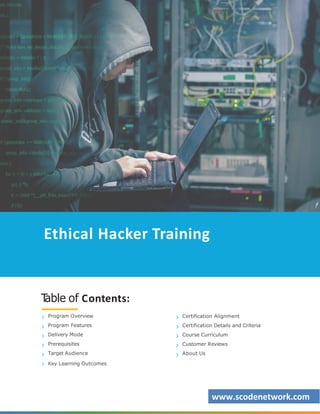
Ethical Hacker Training
T
able of Contents:
Program Overview
Program Features
Delivery Mode
Prerequisites
Target Audience
Key Learning Outcomes
Certification Alignment
Certification Details and Criteria
Course Curriculum
Customer Reviews
About Us
www.scodenetwork.com
Program Overview:
Simplilearn’s CEH certification training course provides you with the hands-on training
required to master the techniques hackers use to penetrate network systems, helping you
fortify your system against it. This ethical hacking course is aligned with the latest version
of CEH (v11)by the EC-Council and adequately prepares you to increase your blue team
skills.
Program Features:
40 hours of instructor-led training
Accredited training partner of EC-Council
Six months free access to CEH v11iLabs
Study material by EC-Council (e-kit)
20 current security domains
Covers 340 attack technologies
Exam pass guarantee (For the US only)
Delivery Mode:
Blended Learning
Prerequisites:
There is no specific eligibility criteria for Certified Ethical Hacker (CEH) training and
certification, but we recommend a basic knowledge of TCP/IP.
T
arget Audience:
Network security officers and
practitioners
Site administrators
IS/IT specialist, analyst, or manager
IS/IT auditor or consultant
IT operations manager
IT security specialist, analyst, manager,
architect, or administrator
IT security officer, auditor, or engineer
Network specialist, analyst, manager,
architect, consultant, or administrator
Technical support engineer
Senior systems engineer
Systems analyst or administrator
www.scodenetwork.com
Key Learning Outcomes:
This ethical hacking course will help you:
Grasp the step-by-step methodology and tactics that hackers use to penetrate network
systems
Understand the finer nuances of trojans, backdoors, and countermeasures
Get a better understanding of IDS, firewalls, honeypots, and wireless hacking
Master advanced hacking concepts, including mobile device and smartphone hacking, writing
virus codes, exploit writing and reverse engineering, and corporate espionage
Gain expertise on advanced concepts such as advanced network packet analysis, securing IIS
and Apache web servers, Windows system administration using Powershell, and hacking SQL
and Oracle databases
Cover the latest developments in mobile and web technologies, including Android, iOS,
BlackBerry, Windows Phone, and HTML 5
Learn advanced log management for information assurance and manage information security
with more clarity
Certification Alignment:
Our Certified Ethical Hacker course is accredited by the EC-Council. We are the registered
training provider for this course.
Certification Details and Criteria:
Certification Details -
To become CEH certified, you must pass the CEH examination after either attending CEH training
at an accredited training center like Simplilearn or through self-study. If you choose self-study, you
must fill out an application and submit proof of at least two years of experience in the network
security domain. The purpose of the CEH credential is to:
Establish and govern minimum standards for credentialing professional information security
specialists in ethical hacking measures
Inform the public that credentialed individuals meet or exceed the minimum standards
Reinforce ethical hacking as a unique and self-regulating profession
About the Exam
Number of Questions: 125
Test Duration: 4 Hours
Test Format: Multiple Choice
Test Delivery: ECC EXAM, VUE
Exam Prefix: 312-50 (ECC EXAM), 312-50
(VUE)
Cost: $500 +$100 (registration fee)
www.scodenetwork.com
Simplilearn Certification Criteria:
Attend one complete class
Course Curriculum:
Module 01 - Introduction to Ethical Hacking
Lesson 01- Information Security Overview
Lesson 02 - Information Security Threats and Attack Vectors
Lesson 06 - Penetration Testing Concepts
Lesson 03 - Hacking Concepts
Lesson 04 - Ethical Hacking Concepts
Lesson 05 - Information Security Controls
Lesson 07 - Information Security Laws and Standards
Lesson 02 - Footprinting and Reconnaissance
Lesson 01- Footprinting Concepts
Lesson 02 - Footprinting through Search Engines
Lesson 03 - Footprinting through Web Services
Lesson 04 - Footprinting through Social Networking Sites
Lesson 05 - Website Footprinting
Lesson 06 - Email Footprinting
Lesson 07 - Competitive Intelligence
Lesson 08 - Whois Footprinting
Lesson 09 - DNS Footprinting
Lesson 10- Network Footprinting
Lesson 1
1
-Footprinting through Social Engineering
Lesson 12- Footprinting Tools
Lesson 13- Countermeasures
Lesson 14 - Footprinting Pen Testing
Module 03 - Scanning Networks
Lesson 01- Network Scanning Concepts
Lesson 02 - Scanning Tools
Lesson 03 - Scanning Techniques
Lesson 04 - Scanning Beyond IDS and Firewall
Lesson 05 - Banner Grabbing
Lesson 06 - Draw Network Diagrams
Lesson 07 - Scanning Pen Testing
www.scodenetwork.com
Module 04 - Enumeration
Lesson 01- Enumeration Concepts
Lesson 02 - NetBIOS Enumeration
Lesson 03 - SNMP Enumeration
Lesson 04 - LDAP Enumeration
Lesson 05 - NTP Enumeration
Lesson 06 - SMTP Enumeration and DNS Enumeration
Lesson 07 - Enumeration Countermeasures
Lesson 08 - Other Enumeration Techniques
Lesson 09 - Enumeration Pen Testing
Module 05 - Vulnerability Analysis
Lesson 01- Vulnerability Assessment Concepts
Lesson 02 - Vulnerability Assessment Solutions
Lesson 03 - Vulnerability Scoring Systems
Lesson 04 - Vulnerability Assessment Tools
Lesson 05 - Vulnerability Assessment Reports
Module 06 - System Hacking
Lesson 01- System Hacking Concepts
Lesson 02 - Cracking Passwords
Lesson 03 - Escalating Privileges
Lesson 04 - Executing Applications
Lesson 05 - Hiding Files
Lesson 06 - Covering Tracks
Lesson 07 - Penetration Testing
Module 07 - Malware Threats
Lesson 01- Malware Concepts
Lesson 02 - Trojan Concepts
Lesson 03 - Virus and Worm Concepts
Lesson 04 - Malware Analysis
Lesson 05- Countermeasures
Lesson 06- Anti-Malware Software
Lesson 07- Malware Penetration Testing
www.scodenetwork.com
Module 08 - Sniffing
Lesson 01-Sniffing Concepts
Lesson 02- Sniffing Technique: MAC Attacks
Lesson 03- Sniffing Technique: DHCP Attacks
Lesson 04- Sniffing Technique: ARP Poisoning
Lesson 05- Sniffing Technique: Spoofing Attacks
Lesson 06- Sniffing Technique: DNS Poisoning
Lesson 07- Sniffing Tools
Lesson 08- Countermeasures
Lesson 09- Sniffing Detection Techniques
Lesson 10- Sniffing Pen Testing
Module 09- Social Engineering
Lesson 01- Social Engineering Concepts
Lesson 02 - Social Engineering Techniques
Lesson 03- Insider Threats
Lesson 04 - Impersonation on Social Networking Sites
Lesson 05 - Identity Theft
Lesson 06 - Countermeasures
Lesson 07 - Social Engineering Penetration Testing
Module 10- Denial-of-Service
Lesson 01- DoS/DDoS Concepts
Lesson 02 - DoS/DDoS Attack Techniques
Lesson 03 - Botnets
Lesson 04 - DDoS Case Study
Lesson 05 - DoS/DDoS Attack Tools
Lesson 06 - Countermeasures
Lesson 07 - DoS/DDoS Protection Tools
Lesson 08 - DoS/DDoS Attack Penetration Testing
Module 11- Session Hijacking
Lesson 01-Session Hijacking Concepts
Lesson 02- Application Level Session Hijacking
Lesson 03- Network Level Session Hijacking
Lesson 04- Session Hijacking Tools
Lesson 05- Countermeasures
Lesson 06- Penetration Testing
www.scodenetwork.com
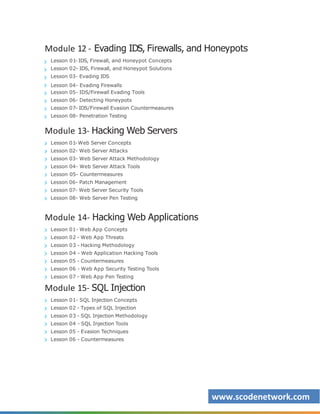
Module 12 - Evading IDS, Firewalls, and Honeypots
Lesson 01- IDS, Firewall, and Honeypot Concepts
Lesson 02- IDS, Firewall, and Honeypot Solutions
Lesson 03- Evading IDS
Lesson 04- Evading Firewalls
Lesson 05- IDS/Firewall Evading Tools
Lesson 06- Detecting Honeypots
Lesson 07- IDS/Firewall Evasion Countermeasures
Lesson 08- Penetration Testing
Module 13- Hacking Web Servers
Lesson 01-Web Server Concepts
Lesson 02- Web Server Attacks
Lesson 03- Web Server Attack Methodology
Lesson 04- Web Server Attack Tools
Lesson 05- Countermeasures
Lesson 06- Patch Management
Lesson 07- Web Server Security Tools
Lesson 08- Web Server Pen Testing
Module 14- Hacking Web Applications
Lesson 01- Web App Concepts
Lesson 02 - Web App Threats
Lesson 03 - Hacking Methodology
Lesson 04 - Web Application Hacking Tools
Lesson 05 - Countermeasures
Lesson 06 - Web App Security Testing Tools
Lesson 07 - Web App Pen Testing
Module 15- SQL Injection
Lesson 01- SQL Injection Concepts
Lesson 02 - Types of SQL Injection
Lesson 03 - SQL Injection Methodology
Lesson 04 - SQL Injection Tools
Lesson 05 - Evasion Techniques
Lesson 06 - Countermeasures
www.scodenetwork.com
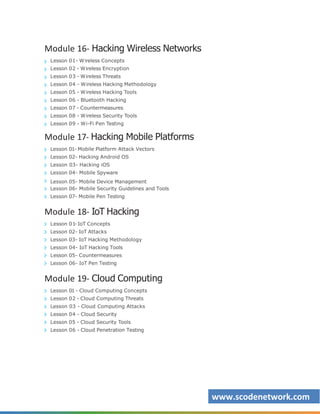
Module 16- Hacking Wireless Networks
Lesson 01- Wireless Concepts
Lesson 02 - Wireless Encryption
Lesson 03 - Wireless Threats
Lesson 04 - Wireless Hacking Methodology
Lesson 05 - Wireless Hacking Tools
Lesson 06 - Bluetooth Hacking
Lesson 07 - Countermeasures
Lesson 08 - Wireless Security Tools
Lesson 09 - Wi-Fi Pen Testing
Module 17- Hacking Mobile Platforms
Lesson 01- Mobile Platform Attack Vectors
Lesson 02- Hacking Android OS
Lesson 03- Hacking iOS
Lesson 04- Mobile Spyware
Lesson 05- Mobile Device Management
Lesson 06- Mobile Security Guidelines and Tools
Lesson 07- Mobile Pen Testing
Module 18- IoT Hacking
Lesson 01-IoT Concepts
Lesson 02- IoT Attacks
Lesson 03- IoT Hacking Methodology
Lesson 04- IoT Hacking Tools
Lesson 05- Countermeasures
Lesson 06- IoT Pen Testing
Module 19- Cloud Computing
Lesson 01 - Cloud Computing Concepts
Lesson 02 - Cloud Computing Threats
Lesson 03 - Cloud Computing Attacks
Lesson 04 - Cloud Security
Lesson 05 - Cloud Security Tools
Lesson 06 - Cloud Penetration Testing
www.scodenetwork.com
Module 20- Cryptography
Lesson 01-Cryptography Concepts
Lesson 02- Encryption Algorithms
Lesson 03- Cryptography Tools
Lesson 04- Public Key Infrastructure (PKI)
Lesson 05- Email Encryption
Lesson 06- Disk Encryption
Lesson 07- Cryptanalysis
Lesson 08- Countermeasures
www.scodenetwork.com

ethical hacking

  • 1.
    Ethical Hacker Training T ableof Contents: Program Overview Program Features Delivery Mode Prerequisites Target Audience Key Learning Outcomes Certification Alignment Certification Details and Criteria Course Curriculum Customer Reviews About Us www.scodenetwork.com
  • 2.
    Program Overview: Simplilearn’s CEHcertification training course provides you with the hands-on training required to master the techniques hackers use to penetrate network systems, helping you fortify your system against it. This ethical hacking course is aligned with the latest version of CEH (v11)by the EC-Council and adequately prepares you to increase your blue team skills. Program Features: 40 hours of instructor-led training Accredited training partner of EC-Council Six months free access to CEH v11iLabs Study material by EC-Council (e-kit) 20 current security domains Covers 340 attack technologies Exam pass guarantee (For the US only) Delivery Mode: Blended Learning Prerequisites: There is no specific eligibility criteria for Certified Ethical Hacker (CEH) training and certification, but we recommend a basic knowledge of TCP/IP. T arget Audience: Network security officers and practitioners Site administrators IS/IT specialist, analyst, or manager IS/IT auditor or consultant IT operations manager IT security specialist, analyst, manager, architect, or administrator IT security officer, auditor, or engineer Network specialist, analyst, manager, architect, consultant, or administrator Technical support engineer Senior systems engineer Systems analyst or administrator www.scodenetwork.com
  • 3.
    Key Learning Outcomes: Thisethical hacking course will help you: Grasp the step-by-step methodology and tactics that hackers use to penetrate network systems Understand the finer nuances of trojans, backdoors, and countermeasures Get a better understanding of IDS, firewalls, honeypots, and wireless hacking Master advanced hacking concepts, including mobile device and smartphone hacking, writing virus codes, exploit writing and reverse engineering, and corporate espionage Gain expertise on advanced concepts such as advanced network packet analysis, securing IIS and Apache web servers, Windows system administration using Powershell, and hacking SQL and Oracle databases Cover the latest developments in mobile and web technologies, including Android, iOS, BlackBerry, Windows Phone, and HTML 5 Learn advanced log management for information assurance and manage information security with more clarity Certification Alignment: Our Certified Ethical Hacker course is accredited by the EC-Council. We are the registered training provider for this course. Certification Details and Criteria: Certification Details - To become CEH certified, you must pass the CEH examination after either attending CEH training at an accredited training center like Simplilearn or through self-study. If you choose self-study, you must fill out an application and submit proof of at least two years of experience in the network security domain. The purpose of the CEH credential is to: Establish and govern minimum standards for credentialing professional information security specialists in ethical hacking measures Inform the public that credentialed individuals meet or exceed the minimum standards Reinforce ethical hacking as a unique and self-regulating profession About the Exam Number of Questions: 125 Test Duration: 4 Hours Test Format: Multiple Choice Test Delivery: ECC EXAM, VUE Exam Prefix: 312-50 (ECC EXAM), 312-50 (VUE) Cost: $500 +$100 (registration fee) www.scodenetwork.com
  • 4.
    Simplilearn Certification Criteria: Attendone complete class Course Curriculum: Module 01 - Introduction to Ethical Hacking Lesson 01- Information Security Overview Lesson 02 - Information Security Threats and Attack Vectors Lesson 06 - Penetration Testing Concepts Lesson 03 - Hacking Concepts Lesson 04 - Ethical Hacking Concepts Lesson 05 - Information Security Controls Lesson 07 - Information Security Laws and Standards Lesson 02 - Footprinting and Reconnaissance Lesson 01- Footprinting Concepts Lesson 02 - Footprinting through Search Engines Lesson 03 - Footprinting through Web Services Lesson 04 - Footprinting through Social Networking Sites Lesson 05 - Website Footprinting Lesson 06 - Email Footprinting Lesson 07 - Competitive Intelligence Lesson 08 - Whois Footprinting Lesson 09 - DNS Footprinting Lesson 10- Network Footprinting Lesson 1 1 -Footprinting through Social Engineering Lesson 12- Footprinting Tools Lesson 13- Countermeasures Lesson 14 - Footprinting Pen Testing Module 03 - Scanning Networks Lesson 01- Network Scanning Concepts Lesson 02 - Scanning Tools Lesson 03 - Scanning Techniques Lesson 04 - Scanning Beyond IDS and Firewall Lesson 05 - Banner Grabbing Lesson 06 - Draw Network Diagrams Lesson 07 - Scanning Pen Testing www.scodenetwork.com
  • 5.
    Module 04 -Enumeration Lesson 01- Enumeration Concepts Lesson 02 - NetBIOS Enumeration Lesson 03 - SNMP Enumeration Lesson 04 - LDAP Enumeration Lesson 05 - NTP Enumeration Lesson 06 - SMTP Enumeration and DNS Enumeration Lesson 07 - Enumeration Countermeasures Lesson 08 - Other Enumeration Techniques Lesson 09 - Enumeration Pen Testing Module 05 - Vulnerability Analysis Lesson 01- Vulnerability Assessment Concepts Lesson 02 - Vulnerability Assessment Solutions Lesson 03 - Vulnerability Scoring Systems Lesson 04 - Vulnerability Assessment Tools Lesson 05 - Vulnerability Assessment Reports Module 06 - System Hacking Lesson 01- System Hacking Concepts Lesson 02 - Cracking Passwords Lesson 03 - Escalating Privileges Lesson 04 - Executing Applications Lesson 05 - Hiding Files Lesson 06 - Covering Tracks Lesson 07 - Penetration Testing Module 07 - Malware Threats Lesson 01- Malware Concepts Lesson 02 - Trojan Concepts Lesson 03 - Virus and Worm Concepts Lesson 04 - Malware Analysis Lesson 05- Countermeasures Lesson 06- Anti-Malware Software Lesson 07- Malware Penetration Testing www.scodenetwork.com
  • 6.
    Module 08 -Sniffing Lesson 01-Sniffing Concepts Lesson 02- Sniffing Technique: MAC Attacks Lesson 03- Sniffing Technique: DHCP Attacks Lesson 04- Sniffing Technique: ARP Poisoning Lesson 05- Sniffing Technique: Spoofing Attacks Lesson 06- Sniffing Technique: DNS Poisoning Lesson 07- Sniffing Tools Lesson 08- Countermeasures Lesson 09- Sniffing Detection Techniques Lesson 10- Sniffing Pen Testing Module 09- Social Engineering Lesson 01- Social Engineering Concepts Lesson 02 - Social Engineering Techniques Lesson 03- Insider Threats Lesson 04 - Impersonation on Social Networking Sites Lesson 05 - Identity Theft Lesson 06 - Countermeasures Lesson 07 - Social Engineering Penetration Testing Module 10- Denial-of-Service Lesson 01- DoS/DDoS Concepts Lesson 02 - DoS/DDoS Attack Techniques Lesson 03 - Botnets Lesson 04 - DDoS Case Study Lesson 05 - DoS/DDoS Attack Tools Lesson 06 - Countermeasures Lesson 07 - DoS/DDoS Protection Tools Lesson 08 - DoS/DDoS Attack Penetration Testing Module 11- Session Hijacking Lesson 01-Session Hijacking Concepts Lesson 02- Application Level Session Hijacking Lesson 03- Network Level Session Hijacking Lesson 04- Session Hijacking Tools Lesson 05- Countermeasures Lesson 06- Penetration Testing www.scodenetwork.com
  • 7.
    Module 12 -Evading IDS, Firewalls, and Honeypots Lesson 01- IDS, Firewall, and Honeypot Concepts Lesson 02- IDS, Firewall, and Honeypot Solutions Lesson 03- Evading IDS Lesson 04- Evading Firewalls Lesson 05- IDS/Firewall Evading Tools Lesson 06- Detecting Honeypots Lesson 07- IDS/Firewall Evasion Countermeasures Lesson 08- Penetration Testing Module 13- Hacking Web Servers Lesson 01-Web Server Concepts Lesson 02- Web Server Attacks Lesson 03- Web Server Attack Methodology Lesson 04- Web Server Attack Tools Lesson 05- Countermeasures Lesson 06- Patch Management Lesson 07- Web Server Security Tools Lesson 08- Web Server Pen Testing Module 14- Hacking Web Applications Lesson 01- Web App Concepts Lesson 02 - Web App Threats Lesson 03 - Hacking Methodology Lesson 04 - Web Application Hacking Tools Lesson 05 - Countermeasures Lesson 06 - Web App Security Testing Tools Lesson 07 - Web App Pen Testing Module 15- SQL Injection Lesson 01- SQL Injection Concepts Lesson 02 - Types of SQL Injection Lesson 03 - SQL Injection Methodology Lesson 04 - SQL Injection Tools Lesson 05 - Evasion Techniques Lesson 06 - Countermeasures www.scodenetwork.com
  • 8.
    Module 16- HackingWireless Networks Lesson 01- Wireless Concepts Lesson 02 - Wireless Encryption Lesson 03 - Wireless Threats Lesson 04 - Wireless Hacking Methodology Lesson 05 - Wireless Hacking Tools Lesson 06 - Bluetooth Hacking Lesson 07 - Countermeasures Lesson 08 - Wireless Security Tools Lesson 09 - Wi-Fi Pen Testing Module 17- Hacking Mobile Platforms Lesson 01- Mobile Platform Attack Vectors Lesson 02- Hacking Android OS Lesson 03- Hacking iOS Lesson 04- Mobile Spyware Lesson 05- Mobile Device Management Lesson 06- Mobile Security Guidelines and Tools Lesson 07- Mobile Pen Testing Module 18- IoT Hacking Lesson 01-IoT Concepts Lesson 02- IoT Attacks Lesson 03- IoT Hacking Methodology Lesson 04- IoT Hacking Tools Lesson 05- Countermeasures Lesson 06- IoT Pen Testing Module 19- Cloud Computing Lesson 01 - Cloud Computing Concepts Lesson 02 - Cloud Computing Threats Lesson 03 - Cloud Computing Attacks Lesson 04 - Cloud Security Lesson 05 - Cloud Security Tools Lesson 06 - Cloud Penetration Testing www.scodenetwork.com
  • 9.
    Module 20- Cryptography Lesson01-Cryptography Concepts Lesson 02- Encryption Algorithms Lesson 03- Cryptography Tools Lesson 04- Public Key Infrastructure (PKI) Lesson 05- Email Encryption Lesson 06- Disk Encryption Lesson 07- Cryptanalysis Lesson 08- Countermeasures www.scodenetwork.com