Essential Cosmic Perspective8th Edition Bennett
Solutions Manual download pdf
https://testbankdeal.com/product/essential-cosmic-perspective-8th-
edition-bennett-solutions-manual/
Visit testbankdeal.com to explore and download the complete
collection of test banks or solution manuals!
2.
Here are somerecommended products for you. Click the link to
download, or explore more at testbankdeal.com
Essential Cosmic Perspective 8th Edition Bennett Test Bank
https://testbankdeal.com/product/essential-cosmic-perspective-8th-
edition-bennett-test-bank/
Essential Cosmic Perspective 7th Edition Bennett Test Bank
https://testbankdeal.com/product/essential-cosmic-perspective-7th-
edition-bennett-test-bank/
Essential Cosmic Perspective 6th Edition Bennett Test Bank
https://testbankdeal.com/product/essential-cosmic-perspective-6th-
edition-bennett-test-bank/
Fundamentals of Financial Management Concise Edition 9th
Edition Brigham Test Bank
https://testbankdeal.com/product/fundamentals-of-financial-management-
concise-edition-9th-edition-brigham-test-bank/
3.
Biology The Essentials3rd Edition Hoefnagels Test Bank
https://testbankdeal.com/product/biology-the-essentials-3rd-edition-
hoefnagels-test-bank/
Mastering Strategic Management vol1.1 1st Edition Ketchen
Test Bank
https://testbankdeal.com/product/mastering-strategic-management-
vol1-1-1st-edition-ketchen-test-bank/
Exploring Getting Started with Computing Concepts 1st
Edition Poatsy Test Bank
https://testbankdeal.com/product/exploring-getting-started-with-
computing-concepts-1st-edition-poatsy-test-bank/
Interpersonal Communication Relating to Others Canadian
7th Edition Beebe Test Bank
https://testbankdeal.com/product/interpersonal-communication-relating-
to-others-canadian-7th-edition-beebe-test-bank/
Management 7th Edition Chuck Williams Test Bank
https://testbankdeal.com/product/management-7th-edition-chuck-
williams-test-bank/
4.
Basic Technical Mathematics10th Edition Washington
Solutions Manual
https://testbankdeal.com/product/basic-technical-mathematics-10th-
edition-washington-solutions-manual/
Cairness's eyes turnedfrom a little ground owl on the top of a
mound and looked him full in the face. "I really can't see, sir," he
said, "how it can matter to any one."
It did not in the least matter to Brewster, but he was one of those
trying people whom Nature has deprived of the instinct for knowing
when to stop. A very perceptible sneer twitched his lips. "You seem
to be English," he said.
"I am," announced the soldier.
Now it is a hazardous undertaking to question an Englishman who
does not care to be questioned. A person of good judgment would
about as lief try to poke up a cross lion to play. But Brewster
persisted, and asked if Cairness would be willing to live among the
Apaches.
"They have their good traits, sir," said the man, civilly, "and chief
among them is that they mind their own business."
It was impossible to misunderstand, and Brewster was vexed beyond
the bounds of all wisdom. "The squaws have their good traits, too, I
guess. I hear one had her nose cut off on your account." He should
not have said it. He knew it, and he knew that the private knew it,
but the man made no reply whatever.
The remainder of the drive Cairness devoted to caring for the broken
wing of the hawk, and, during halts, to sketching anything that
presented itself,—the mules, the driver, passing Mexicans, or the
cows trying to graze from ground where the alkali formed patches of
white scum. He also accomplished a fine caricature of the lieutenant,
and derived considerable silent amusement therefrom.
The night of their return to the post, Cairness, crossing the parade
ground shortly before retreat, saw Felipa. He had been walking with
his eyes on the earth, debating within himself the question of his
future, whether he should reënlist, succumb to the habit of the
service, which is to ambition and endeavor what opium is to the
22.
system, or dropback into the yet more aimless life he had been
leading five years before, when a fit of self-disgust had caused him
to decide that he was good for nothing but a trooper, if even that.
A long sunset shadow fell across his path, and he looked up. Felipa
was walking beside a little white burro, and holding Mrs. Campbell's
golden-curled baby upon its back. She carried her head superbly
erect, and her step, because of the moccasins, was quite noiseless.
The glow of the sunset shone in her unflinching eyes, and lost itself
in the dull black mass of her hair. She studied his face calmly, with a
perfectly impersonal approval.
Cairness went on, back to the barracks, and sitting at the troop
clerk's desk, made a memory sketch of her. It did not by any means
satisfy him, but he kept it nevertheless.
That night he sat upon the edge of his bunk, in the darkness, after
taps, with his elbows on his knees and his chin in his hand, and
thought the matter to a conclusion. The conclusion was that he
would not reënlist, and the reason for it was the girl he had met on
the parade ground. He knew the power that beauty had over him. It
was as real, as irresistible, as a physical sensation. And he thought
Felipa Cabot the most beautiful woman he had ever seen. "She
should be done in a heroic bronze," he told himself; "but as I can't
do it, and as I haven't the right to so much as think about her, I shall
be considerably happier at a distance, so I'll go."
He went the next day but one, riding out of the post at daylight. And
he saw Felipa once more. She was standing by the creek, drawing
an arrow from her quiver and fitting it to her bow. Then she poised
the toe of her left foot lightly upon the ground, bent back, and drew
the bow almost to a semicircle. The arrow flew straight up into the
shimmering air, straight through the body of a little jay, which came
whirling, spinning down among the trees. Felipa gave a quick leap of
delight at having made such a shot, then she darted down in search
of the bird. And Cairness rode on.
24.
III
"Hullo there!"
Cairness drewup his pinto pony in front of a group of log cabins,
and, turning in his saddle, rested his hands upon the white and bay
flanks. "Hullo-o-o!" he repeated.
A mule put its head over the wall of a corral and pricked
interrogative ears. Then two children, as unmistakably Angles as
those of Gregory the Great, came around the corner, hand in hand,
and stood looking at him. And at length a man, unmistakably an
Angle too, for all his top boots and flannel shirt and cartridge belt,
came striding down to the gate. He opened it and said, "Hullo,
Cairness, old chap," and Cairness said, "How are you, Kirby?" which
answered to the falling upon each other's neck and weeping, of a
more effusive race.
Then they walked up to the corral together. Kirby introduced him to
his two partners, Englishmen also, and finished nailing up the boards
of a box stall which a stallion had kicked down in the night. After
that he threw down his hammer, took two big nails from his mouth,
and sat upon the tongue of a wagon to talk long and earnestly, after
the manner of men who have shared a regretted past.
"And so," said Kirby, as he drew a sack of short cut from his pocket
and filled his brier, "and so you have chucked up the army? What are
you going to do next? Going in for art?"
"Good Lord! no," Cairness's smile was rueful. "I've lost all ambition
of that sort years since. I'm too old. I've knocked about too long,
and I dare say I may as well knock about to the end."
25.
Kirby suggested, witha hesitation that was born not of insincerity
but of delicacy, that they would be awfully glad to have him stop
with them and help run the Circle K Ranch. But Cairness shook his
head. "Thanks. I'll stop long enough to recall the old times, though I
dare say it would be better to forget them, wouldn't it? Ranching
isn't in my line. Not that I am at all sure what is in my line, for that
matter."
After a while Kirby went back to his work, directing several
Mexicans, in hopelessly bad Spanish, and laboring with his own
hands at about the proportion of three to one.
Cairness, talking to one of the other men, who was mending a
halter, watched him, and recalled the youth in spotless white whom
he had last seen lounging on the deck of an Oriental liner and
refusing to join the sports committee in any such hard labor as
getting up a cricket match. It was cooler here in the Arizona
mountains, to be sure; but it was an open question if life were as
well worth living.
When the sun was at midheaven, and the shadows of the pines
beyond the clearing fell straight, the clanging of a triangle startled
the mountain stillness. The Mexicans dropped their tools, and the
white teamster left a mule with its galled back half washed.
In a moment there were only the four Englishmen in the corral.
Kirby finished greasing the nut of a wagon. Then he went to the
water trough and washed his hands and face, drying them upon a
towel in the harness room. He explained that they didn't make much
of a toilet for luncheon.
"Luncheon!" said Cairness, as he smoothed his hair in front of a
speckled and wavy mirror, which reflected all of life that came before
it, in sickly green, "cabalistic word, bringing before me memories of
my wasted youth. There was a chap from home in my troop, until he
deserted, and when we were alone we would say luncheon below
26.
our breaths. ButI haven't eaten anything except dinner for five
years."
At the house he met Kirby's wife, a fair young woman, who clung
desperately here in the wilderness, to the traditions, and to as many
of the customs as might be, of her south-of-England home.
The log cabin was tidy. There were chintz curtains at the windows,
much of the furniture, of ranch manufacture, was chintz covered, the
manta of the ceiling was unstained, there were pictures from London
Christmas papers on the walls, and photographs of the fair women
at "home."
There were also magazines and a few books in more than one
language, wild flowers arranged in many sorts of strange jars, and in
the corner, by an improvised couch, a table stacked with cups and
plates of Chelsea-Derby, which were very beautiful and very much
out of place.
The log cabins were built, five of them, to form a square. The largest
contained the sitting room and a bedroom, the three others,
bedrooms and a storehouse, and the kitchen and dining room were
in the fifth.
When they went into this last, the ranch hands were already at a
long oilcloth-covered table. The Kirbys sat at a smaller one, laid with
linen, and the lank wife of one of the men served them all, with the
help of a Mexican boy.
Cairness pitied Mrs. Kirby sincerely. But if she felt herself an object
of sympathy, she did not show it.
The woman fairly flung the ill-cooked food upon the table, with a
spitefulness she did not try to conceal. And she manifested her bad
will most particularly toward the pretty children. Cairness felt his
indignation rise against Kirby for having brought a woman to this, in
the name of love.
27.
"We have teaat five," Mrs. Kirby told him, as they finished, and her
husband started out to superintend and help with the digging of an
acequia.
So at five o'clock Cairness, coming again into that part of the cabin
which his hostess persistently named the drawing-room, found the
three Englishmen taking their tea, and a little man in clerical garb
observing the rite with considerable uncertainty. He would have no
tea himself, and his tone expressed a deep distrust of the beverage.
By the side of his chair stood a tall silk hat. It was in all probability
the only one in the territories, or west of the Missouri, for that
matter, and it caught Cairness's eye at once, the more especially as
it was pierced by two round holes. As he stirred his tea and ate the
thin slices of buttered bread, his glance wandered frequently to the
hat.
"Lookin' at my stove-pipe?" asked the Reverend Mr. Taylor. "Only one
in these parts, I reckon," and he vouchsafed an explanation of the
holes. "Them holes? A feller in Tucson done that for me."
What had he done to the fellow, if he might ask, Cairness inquired.
"What did I do? The same as he done unto me. Let the air into his
sombrero." He told them that he was studying the flora of the
country, and travelling quite alone, with an Indian pony, a pack-
mule, and a dog—a prospector's outfit, in short.
After tea the ranchers settled down to smoke and read. The
Reverend Taylor brought out his collection of specimens and dilated
upon them to Cairness.
"I put them in this here book," he said, "betwixt the leaves, and then
I put the book under my saddle and set on it. I don't weigh so
much, but it works all right," he added, looking up with a naïve smile
that reached from one big ear to the other. "To-morrow," he told him
later, "I'm going to ride over here to Tucson again. What way might
you be takin'?"
28.
"I think perhapsI'll go with you, if you'll wait over a day," Cairness
told him. He had taken a distinct fancy to the little botanist who
wore his clerical garb while he rode a bronco and drove a pack-mule
over the plains and mountains, and who had no fear of the Apache
nor of the equally dangerous cow-boy. Cairness asked him further
about the hat. "That chimney-pot of yours," he said, "don't you find
it rather uncomfortable? It is hot, and it doesn't protect you. Why do
you wear it?"
The little man picked it up and contemplated it, with his head on one
side and a critical glance at its damaged condition. Then he
smoothed its roughness with the palm of his rougher hand. "Why do
I wear it?" he drawled calmly; "well, I reckon to show 'em that I
can."
At six o'clock Kirby knocked the ashes from his pipe, the other two
men, who had buried themselves in the last Cornhill and Punch with
entire disregard of the rest of the room, put down the magazines,
and all of them rose. "We dine at seven," Mrs. Kirby said to Taylor
and Cairness as she passed through the door, followed by her
husband.
"Where are they all goin' to?" the Reverend Taylor asked in plaintive
dismay. He had risen to his feet because he had seen Cairness do it,
and now he sat again because Cairness had dropped back on the
couch. He was utterly at sea, but he felt that the safest thing to do
would be that which every one else did. He remembered that he had
felt very much the same once when he had been obliged to attend a
funeral service in a Roman Catholic Church. All the purple and fine
linen of the Scarlet Woman and the pomp and circumstance
surrounding her had bewildered him in about this same way.
Cairness reached out for the discarded Cornhill, and settled himself
among the cushions. "They're going to dress, I rather think," he
said. The minister almost sprang from his chair. "Good Lord! I ain't
got any other clothes," he cried, looking ruefully at his dusty black.
29.
"Neither have I,"Cairness consoled him, from the depths of a
rehearsal of the unwisdom of Ismaïl Pasha.
The Reverend Taylor sat in silence for a time, reflecting. Then he
broke forth again, a little querulously. "What in thunderation do they
dine at such an hour for?" Cairness explained that it was an English
custom to call supper dinner, and to have it very late.
"Oh!" said Taylor, and sat looking into the fire.
A few minutes before seven they all came back into the sitting room.
The men wore black coats, by way of compromise, and Mrs. Kirby
and the children were in white.
"Like as not she does up them boiled shirts and dresses herself,
don't you think?" was the minister's awed comment to Cairness, as
they went to bed that night in the bare little room.
"Like as not," Cairness agreed.
"She's mighty nice looking, ain't she?"
Cairness said "yes" rather half heartedly. That fresh, sweet type was
insipid to him now, when there was still so fresh in his memory the
beauty of a black-haired girl, with eagle eyes that did not flinch
before the sun's rays at evening or at dawn.
"I'll bet the help don't like the seven o'clock dinner."
Cairness suggested that they were given their supper at six.
"I know that. But they don't like it, all the same. And I'll bet them
cutaways riles them, too."
Cairness himself had speculated upon that subject a good deal, and
had noticed with a slight uneasiness the ugly looks of some of the
ranch hands. "They are more likely to have trouble in that quarter
than with the Indians," he said to himself. For he had seen much, in
the ranks, of the ways of the disgruntled, free-born American.
30.
Before he leftwith Taylor on the next morning but one, he ventured
to warn Kirby. But he was met with a stolid "I was brought up that
way," and he knew that argument would be entirely lost.
"Over here to Tucson" was a three days' ride under the most
favorable circumstances; but with the enthusiastic botanist
dismounting at short intervals to make notes and press and descant
upon specimens, it was five days before they reached, towards
nightfall, the metropolis of the plains.
They went at once for supper to the most popular resort of the
town, the Great Western Saloon and Restaurant. It was a long adobe
room, the whitewash of which was discolored by lamp smoke and fly
specks and stains. There were also bullet holes and marks of other
missiles. At one end was a bar, with a tin top for the testing of silver
coins. Several pine tables were set out with cracked sugar bowls,
inch-thick glasses, bottles of pickles and condiments, still in their
paper wrappings, and made filthy by flies, dust, and greasy hands.
Already there were half a dozen cow-boys and Mexicans, armed to
the teeth, standing about.
They glanced sideways at the big Englishman, who appeared to be
one of themselves, and at the little minister. On him, more especially
on his hat, their eyes rested threateningly. They had heard of him
before, most of them. They answered his genial greeting surlily, but
he was quite unruffled. He beamed upon the room as he seated
himself at one of the tables and ordered supper, for which, in
obedience to a dirty sign upon the wall, he paid in advance.
Having finished, he left Cairness to his own devices, and dragging a
chair under a bracket lamp, set peacefully about reading the
newspapers. For fully an hour no one heeded him. Cairness talked to
the bartender and stood treat to the aimless loungers. He had many
months of back pay in his pocket, and to save was neither in his
character nor in the spirit of the country.
31.
The ill-smelling roomfilled, and various games, chiefly faro and
monte, began. At one table two men were playing out a poker game
that was already of a week's duration. The reek of bad liquor
mingled with the smell of worse tobacco and of Mexican-cured
leather—like which there is no odor known to the senses, so
pungent and permeating and all-pervading it is. Several of the
bracket lamps were sending up thin streams of smoke.
The Reverend Taylor gradually became aware that the air was very
bad. He laid down the newspaper and looked round.
Then a big cow-boy left the bar and loitering over, with a clink of
spurs, touched him on the shoulder. "The drinks are on you," he
menaced. The minister chose to ignore the tone. He rose, smiling,
and stretching his cramped arms. "All right, my friend, all right," he
said, and going with the big fellow to the bar he gave a general
invitation.
In the expectation of some fun the men gathered round. Those at
the tables turned in their chairs and sat watching and pulling at their
fierce mustaches as they peered from under the brims of their
sombreros. In the midst of them all the little parson looked even
smaller than he was. But he was sweetly undaunted and good-
humored.
When the barkeeper had served the others, he turned to him.
"What'll you take?" he demanded, not too courteously.
"I'll take a lemon soda, thanks," said Taylor.
There followed one of those general pauses as explosive as a pistol
shot.
Then the cow-boy who had touched him on the shoulder suggested
that he had better take a man's drink.
But he was not to be changed. "I'll take lemon soda," he said to the
tender, with an amiability that the cow-boy made the mistake of
taking for indecision.
32.
"You better dowhat I say!" He was plainly spoiling for a fight.
But the minister still refused to see it. He looked him very squarely
in the eyes now, however. "See here, I am going to take lemon pop,
my friend," he said.
The friend swore earnestly that he would take what he was told to.
"You are mistaken, my good fellow, because I won't." There was not
the shadow of hesitation in his voice, nor did he lower his mild blue
eyes.
The cow-boy broadened the issue. "You will, and you'll take off that
plug, too, or I'll know what for."
"I reckon you'll know what for, then," beamed Taylor, immovably.
Cairness had been standing afar off, with his hands in his pockets,
watching with a gleam of enjoyment under his knitted brows, but he
began to see that there threatened to be more to this than mere
baiting; that the desperado was growing uglier as the parson grew
more firmly urbane. He drew near his small travelling companion
and took his hands suddenly from his pockets, as the cow-boy
whipped out a brace of six-shooters and pointed them at the hat.
Slowly, with no undue haste whatever, the Reverend Taylor produced
from beneath the skirts of his clerical garb another revolver. There
was a derisive and hilarious howl. When it had subsided, he turned
to the barkeeper. "Got my lemon pop ready?" he asked. The man
pushed it over to him, and he took it up in his left hand.
"Drop that!" called the cow-boy.
"Here's how," said the parson, and raised his glass. A bullet
shattered it in his grasp.
Cairness, his hand on the butt of his own pistol, wondered, a little
angrily, if Taylor were never going to be roused.
33.
He had lookeddown at the broken glass and the stream of water,
and then up quite as calmly but a little less smilingly. "If you do that
again, I'll shoot," he said. "Give me another pop."
There was a chuckle from the group, and a chorus to the effect that
they would be eternally condemned, the truth of which was patent
in their faces. "Leave the little codger be," some one suggested; "he
ain't skeered worth a sour apple."
It would have become the sentiment of the crowd in another
moment, but the little codger took up the second glass, and raised it
again. Then it fell smashing to the floor. A second bullet had broken
his wrist.
Cairness started forward and levelled his Colt, but the divine was too
quick for him. He fired, and the cow-boy sank down, struggling, shot
through the thigh. As he crouched, writhing, on the ground, he fired
again, but Cairness kicked the pistol out of his hand, and the bullet,
deflected, went crashing in among the bottles.
"Now," said Taylor, distinctly, "oblige me with another lemon pop,
mister." A cheer went up, and the minister standing above his fallen
enemy raised the third glass. "Here's to your better judgment next
time, my friend. 'Tain't the sombrero makes the shot," he said. His
seamed, small face was pale underneath its leathery skin, but by not
so much as a quiver of an eyelid did he give any further sign of pain.
"The gentleman who broke them glasses can settle for his part of
the fun," he said, as he paid his reckoning. Then he drew Cairness
aside and held out the limp wrist to be bound, supporting it with his
other hand. And presently they went out from the restaurant, where
the powder smoke was added to the other smells, and hung low, in
streaks, in the thick atmosphere, to hunt up a surgeon.
The surgeon, whose lore was not profound, and whose pharmacy
exhibited more reptiles in alcohol than drugs, set the bones as best
he knew how, which was badly; and, taking a fancy to Taylor, offered
him and Cairness lodgings for the night,—the hospitality of the West
34.
being very much,in those times, like that of the days when the
preachers of a new Gospel were bidden to enter into a house and
there abide until they departed from that place.
In the morning Cairness left them together and started for the San
Carlos Agency. He was to meet a prospector there, and to begin his
new fortunes by locating some mines.
35.
IV
It was abitterly cold January morning. There had been a rain in the
night, and the clouds yet hung gray over Mt. Graham and the black
gap. The wet wind went howling over the valley, so that the little
flag at the top of the staff snapped and whipped as though it would
be torn from the halyards. Sunday inspection and guard mounting
had been chilling ceremonies, performed in overcoats that were
hardly more blue than the men's faces. Having finished them,
Brewster hurried across the parade to Captain Campbell's quarters.
He found Felipa curled on the blanket in front of a great fire, and
reading by the glare of the flames, which licked and roared up the
wide chimney, a history of the Jesuit missionaries. It was in French,
and she must have already known it by heart, for it seemed to be
almost the only book she cared about. She had become possessed
of its three volumes from a French priest who had passed through
the post in the early winter and had held services there. He had
been charmed with Felipa and with her knowledge of his own
tongue. It was a truly remarkable knowledge, considering that it had
been gained at a boarding-school.
"You speak with the utmost fluency, my daughter," he had
commended, and she had explained that she found expression more
easy in French.
"It is curious," she said, "but it has always seemed as though English
were not my native tongue."
When the father returned to Tucson, he had sent her the history,
and she had read and reread it. In a way she was something of a
linguist, for she had picked up a good deal of Spanish from Mexicans
about the post, chiefly from the nurse of the Campbell children.
36.
There is acertain class of persons to whom it is always irritating to
find any one reading a book. It rubs them the wrong way instantly.
They will frequently argue that their own, and the best, manner of
studying life is from nature—an excellent theory in sound, and
commonly accepted as unanswerable, but about as practical in fact
as the study of music on the instrument alone, without primer or
method.
The mere sight of Felipa on the buffalo robe before the fire, poring
over the old history, exasperated Brewster. "That book again?" he
said crossly, as he drew up a chair and held out his hands to the
flames; "you must know it by heart."
"I do," she answered, blinking lazily.
He reflected that it is a trait of the semi-civilized and of children that
they like their tales often retold. But he did not say so. He was
holding that in reserve. Instead, he changed the subject, with an
abrupt inquiry as to whether she meant to ride to-day. "I suppose
not?" he added.
"I do, though," she said perversely, as she bent her head and tried
to put into order the tumbled mass of her hair. "I am going at eleven
o'clock."
"Alone?"
"No, not alone."
"It is bitterly cold."
"I don't mind, and neither does Captain Landor." Her guardian had
recently gotten his captaincy.
Brewster's irritation waxed. "Landor again?" he queried suggestively.
"Landor again," she yawned, ignoring his meaning-fraught tone. But
she watched his face from under her long lashes.
37.
He glanced overhis shoulder at the door. It was closed; so he
leaned forward and spoke in a lower voice. "Felipa, are you going to
marry Landor, or are you not?"
It was more than a mere impertinent question, and she did not
pretend to ignore it any longer. She clasped her hands slowly about
her knees and looked straight at him.
But he was unabashed, "What is he to you?" he insisted.
She thought for a moment before she answered. Then she spoke
deliberately, and there was a purring snarl under her voice. "It is
none of your business that I can see. But I will tell you this much, he
is a man I respect; and that is more than I have said of you when I
have been asked the same question."
"It is not only my business," he said, overlooking the last, and
bending more eagerly forward, "it is not only my business, it is the
business of the whole post. You are being talked about, my dear
young lady."
She sprang to her feet so suddenly that her arm struck him a blow in
the face, and stood close in front of him, digging her nails into her
palms and breathing hard. "If you—if you dare to say that again, I
will kill you. I can do it. You know that I can, and I will. I mean what
I say, I will kill you." And she did mean what she said, for the
moment, at any rate. There was just as surely murder in her soul as
though those long, strong hands had been closed on his throat. Her
teeth were bared and her whole face was distorted with fury and the
effort of controlling it. She drew up a chair, after a moment, and sat
in it. It was she who was leaning forward now, and he had shrunk
back, a little cowed. "I know what you are trying to do," she told
him, more quietly, her lips quivering into a sneer, "you are trying to
frighten me into marrying you. But you can't do it. I never meant to,
and now I would die first."
He saw that the game had reached that stage where he must play
his trump card, if he were to have any chance. "You are a mean little
38.
thing," he laughed."It is the Apache blood, I suppose."
She sat for a moment without answering. It was less astonishment
than that she did not understand. She knitted her brow in a puzzled
frown.
But he mistook her silence for dismay, and went on. "It is only what
one might expect from the daughter of a drunken private and a
Mescalero squaw."
She was still silent, but she leaned nearer, watching his face, her lips
drawn away from her sharp teeth, and her eyes narrowing. She
understood now.
In his growing uneasiness he blundered on rashly. "You didn't know
it? But it is true. Ask your guardian. Do you think he would have you
for a wife?" He gave a short laugh. "He hates an Apache as he does
a Gila monster. Very few men would be willing to risk it."
She leaned back in her chair, tapping her foot upon the floor. It was
the only sign of excitement, but the look of her face was not good.
Brewster avoided it, and became absorbed in making the tips of his
fingers meet as he pressed his hands together.
"Still," said Felipa, too quietly, "I would rather be the daughter of a
drunken private and a Mescalero squaw than the wife of a coward
and sneak."
He stood up and went nearer to her, shaking his finger in her face.
He knew that he had lost, and he was reckless. "You had better
marry me, or I will tell your birth from the housetops." But he was
making the fatal mistake of dealing with the child that had been,
instead of with the woman he had aroused.
She laughed at him—the first false laugh that had ever come from
her lips. "You had better go now," she said, rising and standing with
her arms at her side, and her head very erect.
39.
He hesitated, openinghis mouth to speak and shutting it again
irresolutely.
"I told you to go," she repeated, raising her brows.
He took up his cap from the table, and went.
When Landor came in half an hour later he found her in her riding
habit, sitting in front of the fire. She was still alone, and he felt
instantly that there was more softness than ever before in the smile
she gave him, more womanliness in the clinging of her hand.
Altogether in her attitude and manner there was less of the
restlessly youthful. He drew a chair beside hers, and settled back
comfortably.
"Mr. Brewster has just been here," she said at length, and she
played with the lash of her whip, avoiding his eyes, which was also a
new way for her.
"I wish Brewster would not come so often," he said.
For answer she put out her hand and laid it upon his, not as she had
often done it before, in the unattentive eagerness of some
argument, but slowly, with a shadow of hesitation.
He was surprised, but he was pleased too, and he took the long
fingers in his and held them gently.
"Do you still want me to marry you?" she asked him.
He told her that he most certainly did, and she went on.
"Is it because you think you ought to, or because you really want
me?" She was looking at him steadily now, and he could not have
lied to her. But the slender hand was warm and clinging, the voice
low and sweet, the whole scene so cosey and domestic, and she
herself seemed so much more beautiful than ever, that he answered
that it was because he wanted her—and for the moment it was quite
true. Had so much as a blush come to her cheek, had she lowered
40.
her earnest gaze,had her voice trembled ever so little, it might have
been true for all time. But she threw him back upon himself rudely,
with an unfeminine lack of tact that was common with her. "Then I
will marry you whenever you wish," she said.
"I began to tell you," she resumed directly, "that Mr. Brewster was
here, and that he informed me that my mother was a squaw and my
father a drunken private."
Landor jumped up from his chair. "Felipa!" he cried. At first he was
more shocked and sorry for her than angry with Brewster.
"I don't mind," she began; and then her strict truthfulness coming
uppermost, she corrected herself: "At least, I don't mind very much,
not so much as you thought I would."
He strode up and down, his face black with rage, expressing his
violent opinion of Brewster. Then he came to a stop, in front of her.
"How did he happen to tell you?" he asked.
She explained. "He says he will tell it broadcast," she ended, "but he
won't. It wouldn't be safe, and he knows it." Her cool self-possession
had its effect on him. He studied her curiously and began to calm
down.
She asked him about her father and mother. Going back to his chair
he told her everything that he knew, save only the manner of
Cabot's death. "Then I took you to Yuma," he finished, "and from
there to the East, via Panama." There was a pause. And then came
the question he had most dreaded.
"Did my father leave me any money?" she asked.
There was nothing for it but to admit that from the day of her
father's death she had been utterly Landor's dependant,—at a cost
to him of how many pleasures, she, who knew the inadequacy of a
lieutenant's pay, could easily guess.
41.
She sat thinking,with her chin in her palm, and a quite new look of
loneliness deep in her eyes. He could see that in the last hour she
had grasped almost the fulness of her isolation—almost, but not all;
only the years could bring forth the rest. She gave a heavy sigh.
"Well, I am glad I love you," she said.
But he knew that she did not love him. She was grateful. It was
sometimes an Apache trait. He realized that it was his curse and
hers that he could not for an instant forget the strain. He read her
character by it, half unconsciously. He saw it in her honesty, her
sinewy grace, her features, her fearlessness, her kindness with
children,—they were all Apache characteristics; and they were all
repellent. From his youth on, he had associated the race with cruelty
and every ghastly sight he had come upon, on the plains and in the
mountains. It was a prejudice with more than the force of a
heritage. He went on with his study of her, as she sat there. He was
always studying her. But he could not decide whether it was that she
lacked sensitiveness and was really not greatly disturbed, or a
savage sort of pride in concealing emotions.
He rose to his feet, shaking off an impatience with her and with
himself. "Come," he said peremptorily; and they went out and
mounted and rode away in the face of a whipping wind up the
gradual slope to the mountains, black and weird beneath the heavy,
low-hanging rain clouds.
Felipa had taught her horse to make its average gait a run, and she
would have started it running now, but that Landor checked her. It
was high time, he said, that he should teach her to ride. Now she
was more than a little proud of her horsemanship, so she was
annoyed as well as surprised.
But he went on, instructing her how it was not all of riding to stick
on, and rather a question of saving and seat and the bit.
"You give your horse a sore back whenever you go far, and you
always bring him back in a lather."
42.
It was halfbecause she felt it would prick him, and half in humility,
that she answered, "I suppose that is the Indian in me."
His horse started. He had dug it with the rowels. Then he reined it in
with a jerk that made it champ its curb. "Don't dwell on that all the
time," he said angrily; "forget it." And then it flashed across him, the
irreparable wrong he would be doing her if he taught her to consider
the Apache blood a taint.
She gave him an odd, furtive glance and did not answer for a time.
He was never quite able to divine with her just how much of his
thoughts she understood, and it put him at some disadvantage.
Presently she said: "I can't forget. And you can't. As for other people
—they don't matter anyway." In her scheme of things other people
rarely did matter. She hedged herself round with a barrier of
indifference that was very nearly contempt, and encouraged no
intimacies—not even with Landor. And he knew it.
She made it plainer to him by and by, as she went on to advise his
course about Brewster. "If I were you, I would ignore his having told
me, Jack. I ought to have pretended that I knew it, but I was taken
by surprise. He must not think you resent it as though it were an
insult, though. As for me, I won't have anything more to do with
him; but that is for reasons of my own."
He demanded that he be told the reasons, but she refused very
sweetly and very decidedly. And he was forced to accept the footing
upon which she placed him, for all time.
* * * * * * * *
It was quite in keeping with everything that had gone before that,
the day after a passing Franciscan priest had married them, Landor
should have been ordered off upon a scout, and Felipa should have
taken it as a matter of course, shedding no tears, and showing no
especial emotion beyond a decent regret.
43.
They had notgone upon a wedding trip for the excellent reason that
there was no place to go; and as they sat at dinner together in their
sparsely furnished quarters, there was a timid ring at the door-bell,
and Landor's Chinaman, the cook of his bachelor days, ushered in
the commanding officer, who looked humble apology for the
awkwardness of a visit he could not delay. He went straight to the
matter in hand, in spite of the tactful intentions that had made him
come himself instead of sending a subordinate.
"I say, Landor," he began, after having outwardly greeted Felipa and
inwardly cursed his luck at being obliged to tear a man away from so
fair a bride, "I say, there's been the dickens of a row up at the
Agency."
Landor went on with his dinner coolly enough. "There's quite likely
to be that at any time," he said, "so long as a pious and humane
Indian Bureau sends out special agents of the devil who burn down
the Agency buildings of peaceful Apaches as a means of inducing
them to seek illness and death in malarious river bottoms."
"That," objected the major, testily, "is ancient history. This trouble
started the way of most of the troubles of this age—whiskey." In his
agitation he carefully spilled a spoonful of salt on the cloth and
scraped it into a little mound with a knife. Then recollecting that
spilled salt causes quarrels, he hurriedly threw a pinch of it over his
left shoulder. "And—and, the worst of the whole business is, old
man, that you've got to go. Your troop and one from Apache are
ordered out. I'm awfully sorry." He would not look at Felipa at all.
But he stared Landor fairly out of countenance, as he waited for a
storm of tears and protestations.
When, therefore, Mrs. Landor said, with the utmost composure, that
it was too bad, his gasp was audible.
The captain knitted his thick brows and interposed quickly, talking
against time. "If the Tucson ring and the Indian Bureau had one
head, I should like the detail of cutting it off." His annoyance seemed
44.
to be ofan impersonal sort, and the commandant began to feel that
he must have handled the thing rather well, after all. He gained in
self-esteem and equanimity.
Felipa rose from the table, and going over to her husband laid her
hand on his shoulder. She asked when he must go. "To-night, my
dear lady, I am afraid," soothed the commandant. But she appeared
to be in no need of humoring, as she turned to Landor and offered
to do what she might to help him.
He had dreaded a scene, but he was not so sure that this was not
worse. "You are the wife for a soldier," he said somewhat feebly; "no
tears and fuss and—all that kind of thing."
Landor winced as he folded his napkin and stood up. "I am ready,"
he said, and going into the long hallway took his cap from the rack
and went with the major out into the night.
In half an hour he was back, and having produced his scouting togs
from the depths of a sky-blue chest, smelling horribly of tobacco and
camphor, he fell to dressing.
Felipa sat on the edge of the bunk and talked to him, a little excited,
and very anxious to try what a scout was like for herself.
As he put on his faded blouse he went and stood before her, holding
out his arms. She moved over to him and laid her head on his
shoulder. "Are you not sorry to have me go?" he asked, in the tones
of one having a grievance. He felt that he was entitled to something
of the sort.
Of course she was sorry, she protested, a little indignant that he
should ask it. She would be horribly lonesome.
He tried hard to warm her to something more personal. "I might
never come back, you know, dear." He realized that he was
absolutely begging for affection, most futile and unavailing of all
wastes of energy.
45.
But she onlyanswered that that was unlikely and slipped her arm
around his neck, as she added that if anything were to happen to
him, she would not have one real friend in the world. There was
something pathetic in the quiet realization of her loneliness.
He stroked her hair pityingly. After all, she was only a half-savage
creature bound to him by the ties of gratitude. He had seen the
same thing in a Chiricahua girl baby he had once rescued, horribly
burned, from the fire of an abandoned Indian camp, where she had
been thrown by the fleeing hostiles, because she was sickly and
hampered their progress. The hideous, scarred little thing had
attached herself to him like a dog, and had very nearly pined herself
to death when he had had to leave her for good. Afterward she had
married—at the ripe age of twelve—a buck of her own tribe. He
thought of how she also had slipped her hard, seamed arm around
his neck, and he drew away from Felipa.
When, in the darkness of a cloudy night, he said good-by to her on
the road before his quarters, bending to kiss the warm mouth he
could not see, he knew that it would have been possible for him to
have loved her, had she been nearly all that she was not.
Then he mounted the horse the orderly held for him, and trotted off.
46.
V
The Gila Rivercutting straight across the southern portion of
Arizona, from the Alkali flats on the east to the Colorado at Yuma on
the west, flowed then its whole course through desolation.
Sometimes cottonwoods and sycamore trees rose in the bottom, and
there was a patch of green around some irrigated land. But, for the
most part, the basin was a waste of glittering sand and white dust,
and beyond, the low hills, bare of every plant save a few stunted
wild flowers, cacti and sage, greasewood and mesquite, rolled for
miles and miles of barrenness. The chicken hawk and crow sailed
through the fiercely blue sky, the air waved and quivered with
incredible heat. At night malaria rose from the ground, the coyote
barked and whined at the light of the brilliant stars, and the polecat
prowled deliberately.
Here, toward the eastern part of the territory, the government had
portioned off the San Carlos Agency for its Apache wards, and some
thirty miles away, not far from the banks of the river, Camp Thomas
for its faithful soldiery.
On a day when the mercury registered 120 degrees, Felipa Landor
drove into the camp. Her life, since her marriage three years before,
had been the usual nomadic one of the place and circumstances,
rarely so much as a twelvemonth in one place, never certain for one
day where the next would find her. Recently Landor had been
stationed at the headquarters of the Department of Arizona. But
Felipa had made no complaint whatever at having to leave the
gayest post in the territories for the most God-forsaken, and she
refused flatly to go East. "I can stand anything that you can," she
told her husband when he suggested it, which was apparently true
enough, for now, in a heat that was playing out the very mules,
47.
covered as shewas with powdery, irritating dust, she was quite
cheerful as he helped her from the ambulance.
She stood looking round the post, across the white-hot parade
ground, to the adobe barracks and the sutler's store. Then she
turned and considered the officers' quarters. They were a row of
hospital, wall, and A tents, floored with rough boards and sheltered
by ramadas of willow branches.
In the middle of the line there was a one-room mud hut. This, with
the tents back of it, was her home. Landor had fitted up the hut with
Navajo blankets, Indian baskets, dolls, saddle bags, war bonnets,
and quivers; with stuffed birds and framed chromos, camp-chairs
and some rough quartermaster's furniture. A gray blanket, with a
yellow Q. M. D. in the centre, kept the glare out at the window, and
the room was cool enough. One advantage of adobe—and it has
others—is that it retains all summer the winter cold, and all winter
the summer heat.
Felipa expressed decided approval, and set to work making herself
comfortable at once. Within ten minutes she had changed her
travelling things for a white wrapper, had brushed the dust from her
hair, and left it hanging straight and coarse and dead black, below
her waist,—she was given to loosing it whenever the smallest excuse
offered,—and had settled herself to rest in a canvas lounging chair.
Landor had come to agree with the major at Grant, that she was an
excellent wife for a soldier. Her tastes were simple as those of a
hermit. She asked only a tent and a bunk and enough to eat, and
she could do without even those if occasion arose. She saw the best
of everything, not with the exasperating optimism which insists upon
smiling idiotically on the pleasant and the distinctly disagreeable
alike, and upon being aggressively delighted over the most annoying
mishaps, but with a quiet, common-sense intention of making the
objectionable no more so for her own part. There were wives who
made their husbands' quarters more dainty and attractive, if not
more neat; but in the struggle—for it was necessarily a struggle—
48.
lost much peaceof mind and real comfort. Upon the whole, Landor
was very well satisfied, and Felipa was entirely so. She was utterly
indifferent to being set down at a three-company post, where her
only companion was to be a woman she disliked from the first,
openly and without policy, as was her way.
The woman called early in the blazing afternoon, appearing clad in
silks, waving a gorgeous fan of plumes, and sinking languidly into a
chair. Felipa sat bolt upright on a camp-stool, and before the close of
an hour they were at daggers' points. The commandant's wife used
cheap French phrases in every other breath, and Felipa retaliated in
the end by a long, glib sentence, which was not understood. She
seemed absolutely dense and unsmiling about it, but Landor was
used to the mask of stolidity. He got up and went to the window to
arrange the gray blanket, and hide a smile that came, even though
he was perfectly aware of the unwisdom of making an enemy of the
C. O.'s wife.
From thenceforth the elegant creature troubled Felipa as little as the
nature of things would permit. She said that Mrs. Landor was une
sauvage and so brune; and Mrs. Landor said she was a fool and
dyed her hair. She was not given to mincing words. And she had
small patience with a woman who lay in bed until the sun was high,
and who spent her days lounging under the ramada, displaying tiny,
satin-shod feet for the benefit of the enlisted men and the Indians
who wandered over from the reservation.
She herself was up before dawn, riding over the hills with her
husband, watching the sun rise above the blue mountains on the
far-away horizon, and strike with lights of gold and rose the sands
and the clumps of sage, visiting the herd where it struggled to
graze, under well-armed guard, and gathering the pitiful wild flowers
from the baked, lifeless soil. She shot quail and owls, and dressed
their skins. She could endure any amount of fatigue, and she could
endure quite as well long stretches of idleness.
49.
Having no childrenof her own, she took for protégé a small White
Mountain, son of a buck who hung about the post most of the time,
bought him candy and peanuts at the sutler's store, taught him
English, and gathered snatches of his tribe's tongue in return.
Landor humored her, but did not quite approve. "If you begin that,
every papoose at the Agency will be brought down to us," he
suggested; and once when he had grown a little tired of having the
noiseless, naked little savage forever round, he offered him a piece
of canned lobster. Whereupon the boy fled wildly, and would not be
coaxed back for many days. Felipa seemed really to miss him, so
Landor never teased him after that, making only the reasonable
request that the youngster be not allowed to scratch his head near
him.
Another of her pets was a little fawn a soldier had caught and given
to her. It followed her tamely about the post.
One morning, shortly before dinner call, she sat under the ramada,
the deer at her feet, asleep, the little Apache squatted beside her,
amusing himself with a collection of gorgeous pictorial labels, soaked
from commissary fruit and vegetable cans. The camp was absolutely
silent, even the drowsy scraping of the brooms of the police party
having stopped some time before. Landor was asleep in his tent, and
presently she herself began to doze. She was awakened by the
sound of footsteps on the gravel in front of the ramada, and in
another moment a tall figure stood in the opening, dark against the
glare. Instantly she knew it was the man with whom she had come
face to face long before on the parade ground at Grant, though from
then until now she had not thought of him once, nor remembered
his existence.
She rose to her feet, standing slender and erect, the roused fawn on
one side and the naked savage on the other. And they faced each
other, disconcerted, caught mute in the reverberation, indefinite,
quivering, of a chord which had been struck somewhere in the
depths of that Nature to which we are willing enough to grant the
50.
power of causingthe string of an instrument to pulse to the singing
of its own note, but whose laws of sympathetic vibration we would
fain deny beyond material things.
The man understood, and was dismayed. It is appalling to feel one's
self snatched from the shifting foothold of individuality and whirled
on in the current of the Force of Things. Felipa did not understand.
And she was annoyed. She crashed in with the discord of a
deliberate commonplace, and asked what she could do for him,
speaking as to an inferior; and he, with a stiff resentment, answered
that he wished to see Captain Landor.
She did not return to the ramada, but before long her husband came
in search of her.
"That man is going to stay to luncheon," he told her.
She echoed "To luncheon!" in amazement. "But, Jack, he was a
soldier, wasn't he?"
"He was, but he isn't. I sent for him about some business, and he is
a very decent sort of a fellow. He has a little ranch on the
reservation."
"A squaw-man?" she asked.
"I dare say," he answered carelessly. "Come and meet him. You'll like
him."
She went, with none too good a grace.
Cairness said to himself that she was regal, and acknowledged her
most formal welcome with an ease he had fancied among the arts
he had long since lost.
"I have seen you before, Mrs. Landor," he said after a while.
"Yes?" she answered, and stroked the head of the fawn.
51.
"Yes," he persisted,refusing to be thwarted, "once when you were
crossing the parade at Grant, at retreat, and two days afterward
when you shot a blue jay down by the creek."
She could not help looking at him now, and his eyes held hers
through a silence that seemed to them so enduring, so
unreasonable, that Landor must wonder at it. But he had seen men
put at a disadvantage by her beauty before, and he had grown too
used to her lack of conventionality to think much about it, one way
or the other.
"Can't we send the hostile away?" he suggested, glancing at the
small Apache, who was digging viciously at his head and watching
Cairness with beady orbs. Felipa spoke to him, and he went.
"Do you like his kind?" the Englishman asked curiously.
"They have their good points," she answered, exactly as he himself
had answered Brewster's baiting long ago. Then she fastened her
gaze on the roof of the ramada.
It was evident that she had no intention of making herself
agreeable. Landor had learned the inadvisability and the futility of
trying to change her moods. She was as unaffected about them as a
child. So he took up the conversation he and Cairness had left off,
concerning the Indian situation, always a reliable topic. It was bad
that year and had been growing steadily worse, since the trouble at
the time of his marriage, when Arizona politicians had, for reasons
related to their own pockets, brought about the moving of the White
Mountain band to the San Carlos Agency. The White Mountains had
been peaceable for years, and, if not friendly to the government, at
least too wise to oppose it. They had cultivated land and were living
on it inoffensively. But they were trading across the territorial line
into New Mexico, and that lost money to Arizona. So they were
persuaded by such gentle methods as the burning of their Agency
buildings and the destruction of their property, to move down to San
Carlos. The climate there was of a sort fatal to the mountain
52.
Apaches,—the thing hadbeen tried before with all the result that
could be desired, in the way of fevers, ague, and blindness,—and
also the White Mountains were hereditary enemies of the San Carlos
tribes. But a government with a policy, three thousand miles away,
did not know these things, nor yet seek to know them. Government
is like the gods, upon occasions: it first makes mad, then destroys.
And if it is given time enough, it can be very thorough in both.
In the period of madness, more or less enduring, of the victim of the
Great Powers' policy, somebody who is innocent usually suffers.
Sometimes the Powers know it, oftener they do not. Either way it
does not worry them. They set about doing their best to destroy,
and that is their whole duty.
Not having had enough of driving to madness in '75 and '76, they
tried it again three years later. They were dealing this time with
other material, not the friendly and the cowed, but with savages as
cruel and fierce and unscrupulous as those of the days of Coronado.
Victorio, Juh, and Geronimo were already a little known, but now
they were to have their names shrieked to the unhearing heavens in
the agony of the tortured and the dying.
The Powers said that a party of Indians had killed two American
citizens, and had thereby offended against their sacred laws. To be
sure the Americans had sold the Indians poisonous whiskey, so they
had broken the laws, too. But there is, as any one should be able to
see, a difference between a law-breaking Chiricahua and a law-
breaking territorial politician. Cairness refused to see it. He said
things that would have been seditious, if he had been of any
importance in the scheme of things. As it was, the Great Powers did
not heed them, preferring to take advice from men who did not
know an Apache from a Sioux—or either from the creation of the
shilling shocker.
"I am not wasting any sympathy on the Apaches, nor on the Indians
as a whole. They have got to perish. It is in the law of advancement
that they should. But where is the use in making the process
53.
painful? Leave themalone, and they'll die out. It isn't three hundred
years since one of the biggest continents of the globe was peopled
with them, and now there is the merest handful left, less as a result
of war and slaughter than of natural causes. Nature would see to it
that they died, if we didn't."
"The philanthropist doesn't look at it that way. He thinks that we
should strive to preserve the species."
"I don't," Cairness differed; "it's unreasonable. There is too much
sympathy expended on races that are undergoing the process of
extinction. They have outgrown their usefulness, if they ever had
any. It might do to keep a few in a park in the interests of science,
and of that class of people which enjoys seeing animals in cages.
But as for making citizens of the Indians, raising them to our level—
it can't be done. Even when they mix races, the red strain corrupts
the white."
Landor glanced at his wife. She seemed to take it without offence,
and was listening intently.
"It's the old saying about a dog walking on its hind legs, when you
come to civilizing the Indian. You are surprised that he civilizes at all,
but he doesn't do it well, for all that. He can be galvanized into a
temporary semblance of national life, but he is dead at the core, and
he will decay before long."
"They could kill a good many of us before they died out, if we would
sit still and take it," Landor objected.
"It's six one, and half a dozen the other. They'd be willing enough to
die out in peace, if we'd let them. Even they have come to have a
vague sort of instinct that that's what it amounts to."
Landor interrupted by taking the slipper from Felipa's foot and killing
with it a centipede that crawled up the wall of the abode. "That's the
second," he said, as he put the shoe on again. "I killed one
yesterday; the third will come to-morrow." Then he went back to his
54.
Welcome to ourwebsite – the perfect destination for book lovers and
knowledge seekers. We believe that every book holds a new world,
offering opportunities for learning, discovery, and personal growth.
That’s why we are dedicated to bringing you a diverse collection of
books, ranging from classic literature and specialized publications to
self-development guides and children's books.
More than just a book-buying platform, we strive to be a bridge
connecting you with timeless cultural and intellectual values. With an
elegant, user-friendly interface and a smart search system, you can
quickly find the books that best suit your interests. Additionally,
our special promotions and home delivery services help you save time
and fully enjoy the joy of reading.
Join us on a journey of knowledge exploration, passion nurturing, and
personal growth every day!
testbankdeal.com





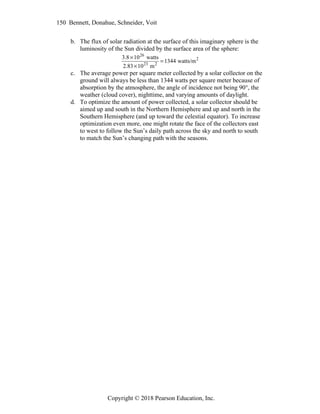
![140 Bennett, Donahue, Schneider, Voit
Copyright © 2018 Pearson Education, Inc.
when gravity overwhelms pressure, and gravitational equilibrium occurs
when gravity is in balance with pressure. (Note: In using the term
gravitational equilibrium, we are consistent with terminology used by
Mitch Begelman and Martin Rees in their book Gravity’s Fatal Attraction,
Scientific American Library Series [New York: W. H. Freeman, 1996].)
This concept of equilibrium was difficult for our own students, so our text
aims to emphasize this important concept and prepare the students for the
concepts they will re-visit in chapters on stars and stellar evolution.
• Energy balance is the other equilibrium achieved in the Sun, where the
energy generated in the core of the star balances the energy lost at the
surface of the star. This idea was given a graphic (Figure 11.3) in the 7th
edition. It is as important as gravitational equilibrium in understanding
stars and star lives, but it is the much more difficult concept for our
students.
• This section also raises a potential dilemma for instructors: whether to
describe the Sun as yellow or white. Because students already know that
the Sun is yellow, they can have trouble with the idea that the Sun would
look nearly white if they were not seeing it through Earth’s atmosphere.
However, when astronomers speak of “white stars,” they are usually talking
about stars considerably hotter than the Sun. For this reason, we depict
the Sun as yellow in our figures. (One way to demonstrate that the Sun is
whiter than it appears is to point out that clouds look white because they are
scattering both the blue light from the sky, which is indirect solar radiation,
and the direct yellow light from the Sun. Combining these two colors of
light more closely approximates the original color of the Sun.)
Section 11.2 Nuclear Fusion in the Sun
This section focuses on the process of nuclear fusion in the Sun and describes
how the balance between gravity and pressure acts as a thermostat in the solar
core, maintaining a constant fusion rate. Figure 11.8 is a useful aid to illustrate
this concept.
• The topic of fusion in the solar core presents an opportunity to discuss the
role of mathematical modeling in science and to explain how we can be so
certain of what’s going on when we can’t see the core and can’t send in a
probe to observe what’s going on there. Up to this point in the course,
we’ve been discussing planets, which some students regard as “more real”
because we have landed probes there. The Sun provides these students with
their first challenge to understand how we might be able to learn about a
place without actually visiting it.
• In this section, we also discuss solar neutrinos as a way to “observe” the
solar core, and we present the solar neutrino problem as a solved problem
in our understanding of the Sun.
• Based on experimental results confirming that neutrinos oscillate, we
presume that neutrinos do have mass (e.g., Fukuda et al., 1998, Physical
Review Letters, 81, 1562), although the amount of mass remains unknown.](https://image.slidesharecdn.com/7918-250626151843-7e042b70/85/Essential-Cosmic-Perspective-8th-Edition-Bennett-Solutions-Manual-7-320.jpg)
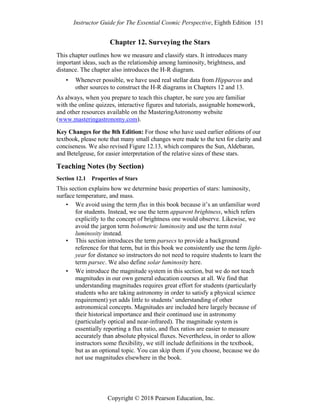
![Instructor Guide for The Essential Cosmic Perspective, Eighth Edition 141
Copyright © 2018 Pearson Education, Inc.
(Ironically, the best upper limits on the neutrino mass of about 0.23 eV come
not from detector experiments but from cosmological measurements, such as
those of the cosmic microwave background studied by the Planck mission
[Planck Collaboration, 2014, A&A, 571, A16; 2015, arXiv:1502.01589].)
Fast-moving (relativistic) cosmic neutrinos “free-stream” from any
structures that are too small to contain them, an effect that inhibits the
growth of these small structures as compared to the growth of larger
structures. The fact that small structures survive in our universe (and that
large systems are assembled from smaller systems) is evidence that neutrinos
do not have a mass sufficient to noticeably change the ratio of large and
small structures in the universe. Research on neutrinos, from those working
in both high-energy physics and cosmology, is an active field, so stay tuned.
• We provide the ideal gas law relation for thermal pressure in Cosmic
Calculation 11.1.
Section 11.3 The Sun–Earth Connection
This section discusses solar activity, including sunspots, and the ways in which
solar activity can affect Earth.
• Solar activity is one of the most direct ways in which cosmic events affect
human activity. Don’t miss this opportunity to engage your students with
examples of how solar weather affects Earth and, more relevantly, whether
solar activity can be considered a credible cause for global climate change.
Answers/Discussion Points for Think About It/See It for Yourself
Questions
The Think About It and See It for Yourself questions are not numbered in the
book, so we list them in the order in which they appear, keyed by section number.
Section 11.1
• (p. 290) At higher altitudes, there is less overlying air pressing down.
Because of the lower pressure, the atmosphere is less compressed.
• (p. 291) We need to know Earth’s period and distance from the Sun. We
measure the mass of the Sun by measuring the periods and semimajor axes
of planetary orbits and then plugging these measurements into Newton’s
version of Kepler’s third law. Because the Sun is so much heavier than
anything else in the solar system, the sum of the masses in the equation is
essentially equal to the Sun’s mass.
Section 11.2
• (p. 294) Heavier elements have more protons in their nuclei. Their greater
positive charge means they repel each other more strongly than do
hydrogen nuclei, which contain only 1 proton. The stronger repulsion
means that higher temperatures are required to overcome the repulsion and
make the nuclei fuse.](https://image.slidesharecdn.com/7918-250626151843-7e042b70/85/Essential-Cosmic-Perspective-8th-Edition-Bennett-Solutions-Manual-8-320.jpg)