ERP Software
For Textile
Industry
iTrobes Technologies Presents
Overview of the Textile Industry
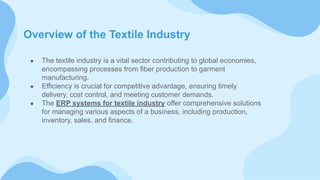
● The textile industry is a vital sector contributing to global economies,
encompassing processes from fiber production to garment
manufacturing.
● Efficiency is crucial for competitive advantage, ensuring timely
delivery, cost control, and meeting customer demands.
● The ERP systems for textile industry offer comprehensive solutions
for managing various aspects of a business, including production,
inventory, sales, and finance.
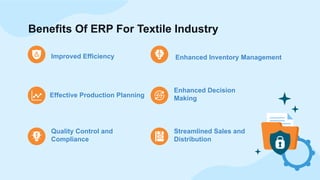
Enhanced Decision
Making
Improved Efficiency Enhanced Inventory Management
Effective Production Planning
Quality Control and
Compliance
Streamlined Sales and
Distribution
Benefits Of ERP For Textile Industry
Improved Efficiency
● Simplify complex processes such as supply chain management,
inventory tracking, and production scheduling.
● Minimizes manual interventions, reducing errors and delays.
Enhanced Inventory Management
● Provides real-time visibility into inventory levels across multiple
locations and warehouses.
● Optimizes inventory turnover rates and reduces carrying costs.
Effective Production Planning and Control
● Enables detailed production scheduling based on demand forecasts
and resource availability.
● Facilitates better utilization of machinery and labor resources,
reducing idle time and improving throughput.
Enhanced Decision Making
● Provides real-time visibility into inventory levels across multiple
locations and warehouses.
● Optimizes inventory turnover rates and reduces carrying costs.
Quality Control & Compliance
● Tracks quality metrics throughout the production process, enabling
timely identification and resolution of quality issues.
● Helps in adhering to regulatory compliance requirements related to
product safety and environmental regulations.
Streamlined Sales and Distribution
● Integrates sales processes with production and inventory
management systems for seamless order processing.
● Improves order accuracy and on-time delivery, enhancing customer
satisfaction.
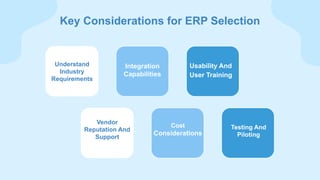
Key Considerations for ERP Selection
Understand
Industry
Requirements
Integration
Capabilities
Usability And
User Training
Vendor
Reputation And
Support
Cost
Considerations
Testing And
Piloting
Understand Industry Requirements
● Tailoring ERP functionalities to adapt textile-specific processes such
as dyeing, weaving, and garment assembly.
● Incorporating features for compliance with industry regulations and
standards, including environmental sustainability and product safety
guidelines.
Integration Capabilities
● Seamless integration with CAD/CAM software for design processes
and manufacturing execution systems (MES) for shop floor control.
● Interoperability with third-party logistics providers and suppliers for
streamlined supply chain management.
Usability And User Training
● Providing role-based training sessions tailored to different user groups
within the organization, such as production staff, warehouse
managers, and sales representatives.
● Offering self-paced online training modules and user guides to
facilitate continuous learning and skill development.
Vendor Reputation And Support
● Partnering with ERP vendors with a strong track record of successful
implementations in the textile industry, backed by positive customer
testimonials and industry awards.
● Ensuring the availability of dedicated support teams and service level
agreements (SLAs) for timely resolution of issues and ongoing system
maintenance.
Cost Considerations
● Conducting a thorough cost-benefit analysis to evaluate the total ERP
cost of ownership (TCO) of ERP implementation, including upfront
expenses, ongoing maintenance, and potential cost savings.
● Exploring flexible pricing models such as subscription-based licensing
or pay-per-use options to align with budget constraints and scalability
requirements.
Testing And Piloting
● Partnering with ERP vendors with a strong track record of successful
implementations in the textile industry, backed by positive customer
testimonials and industry awards.
● Ensuring the availability of dedicated support teams and service level
agreements (SLAs) for timely resolution of issues and ongoing system
maintenance.
Conclusion
● ERP implementation offers numerous benefits to the textile industry,
ranging from improved efficiency and inventory management to enhanced
decision-making capabilities.
● By leveraging ERP solutions, textile companies can streamline
operations, ensure compliance, and achieve sustainable growth in today's
competitive market. Choose the right ERP software provider like iTrobes
to improve your textile business efficiency.
THANKS!
Do you have any questions?
info@itrobes.com
+91 620 421 838
www.itrobes.com

ERP Software For Textile Industry | iTrobes

  • 1.
  • 2.
    Overview of theTextile Industry ● The textile industry is a vital sector contributing to global economies, encompassing processes from fiber production to garment manufacturing. ● Efficiency is crucial for competitive advantage, ensuring timely delivery, cost control, and meeting customer demands. ● The ERP systems for textile industry offer comprehensive solutions for managing various aspects of a business, including production, inventory, sales, and finance.
  • 3.
    Enhanced Decision Making Improved EfficiencyEnhanced Inventory Management Effective Production Planning Quality Control and Compliance Streamlined Sales and Distribution Benefits Of ERP For Textile Industry
  • 4.
    Improved Efficiency ● Simplifycomplex processes such as supply chain management, inventory tracking, and production scheduling. ● Minimizes manual interventions, reducing errors and delays. Enhanced Inventory Management ● Provides real-time visibility into inventory levels across multiple locations and warehouses. ● Optimizes inventory turnover rates and reduces carrying costs.
  • 5.
    Effective Production Planningand Control ● Enables detailed production scheduling based on demand forecasts and resource availability. ● Facilitates better utilization of machinery and labor resources, reducing idle time and improving throughput. Enhanced Decision Making ● Provides real-time visibility into inventory levels across multiple locations and warehouses. ● Optimizes inventory turnover rates and reduces carrying costs.
  • 6.
    Quality Control &Compliance ● Tracks quality metrics throughout the production process, enabling timely identification and resolution of quality issues. ● Helps in adhering to regulatory compliance requirements related to product safety and environmental regulations. Streamlined Sales and Distribution ● Integrates sales processes with production and inventory management systems for seamless order processing. ● Improves order accuracy and on-time delivery, enhancing customer satisfaction.
  • 7.
    Key Considerations forERP Selection Understand Industry Requirements Integration Capabilities Usability And User Training Vendor Reputation And Support Cost Considerations Testing And Piloting
  • 8.
    Understand Industry Requirements ●Tailoring ERP functionalities to adapt textile-specific processes such as dyeing, weaving, and garment assembly. ● Incorporating features for compliance with industry regulations and standards, including environmental sustainability and product safety guidelines. Integration Capabilities ● Seamless integration with CAD/CAM software for design processes and manufacturing execution systems (MES) for shop floor control. ● Interoperability with third-party logistics providers and suppliers for streamlined supply chain management.
  • 9.
    Usability And UserTraining ● Providing role-based training sessions tailored to different user groups within the organization, such as production staff, warehouse managers, and sales representatives. ● Offering self-paced online training modules and user guides to facilitate continuous learning and skill development. Vendor Reputation And Support ● Partnering with ERP vendors with a strong track record of successful implementations in the textile industry, backed by positive customer testimonials and industry awards. ● Ensuring the availability of dedicated support teams and service level agreements (SLAs) for timely resolution of issues and ongoing system maintenance.
  • 10.
    Cost Considerations ● Conductinga thorough cost-benefit analysis to evaluate the total ERP cost of ownership (TCO) of ERP implementation, including upfront expenses, ongoing maintenance, and potential cost savings. ● Exploring flexible pricing models such as subscription-based licensing or pay-per-use options to align with budget constraints and scalability requirements. Testing And Piloting ● Partnering with ERP vendors with a strong track record of successful implementations in the textile industry, backed by positive customer testimonials and industry awards. ● Ensuring the availability of dedicated support teams and service level agreements (SLAs) for timely resolution of issues and ongoing system maintenance.
  • 11.
    Conclusion ● ERP implementationoffers numerous benefits to the textile industry, ranging from improved efficiency and inventory management to enhanced decision-making capabilities. ● By leveraging ERP solutions, textile companies can streamline operations, ensure compliance, and achieve sustainable growth in today's competitive market. Choose the right ERP software provider like iTrobes to improve your textile business efficiency.
  • 12.
    THANKS! Do you haveany questions? info@itrobes.com +91 620 421 838 www.itrobes.com