Guest Speakers: Erica
Desreuisseau & Alexander Roll
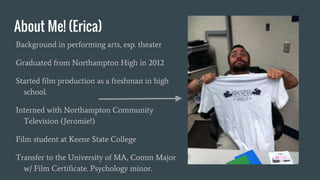
About Me! (Erica)
Background in performing arts, esp. theater
Graduated from Northampton High in 2012
Started film production as a freshman in high
school.
Interned with Northampton Community
Television (Jeromie!)
Film student at Keene State College
Transfer to the University of MA, Comm Major
w/ Film Certificate. Psychology minor.
About Me! (Alex)
Sophomore at UMass Amherst
Majors in Psychology w/ Film Certificate. Biological Anthropology Minor.
Recently directed first film, Black Cherry
Black Cherry
View the trailer:
What was the best part about making Black Cherry?
What were the challenges on the making of Black Cherry?
What was the process of directing a student film like?
Whatever else?
Running Embers + The Proof of Concept Trailer
View the trailer: https://vimeo.com/149438213
What is a Proof of Concept Trailer?
Wikipedia Says: “A proof of concept (PoC) or a proof of principle is a realization of a certain
method or idea to demonstrate its feasibility, or a demonstration in principle, whose purpose is to
verify that some concept or theory has the potential of being used.”
For the first time ever, Wikipedia is RIGHT! The proof of concept trailer was a trailer created by
the film’s director and a group of UMass students to demonstrate the film’s concept and it’s
potential to be made into a full film.
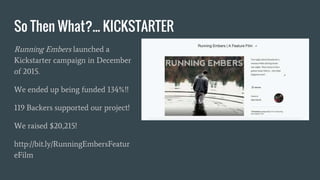
So Then What?... KICKSTARTER
Running Embers launched a
Kickstarter campaign in December
of 2015.
We ended up being funded 134%!!
119 Backers supported our project!
We raised $20,215!
http://bit.ly/RunningEmbersFeatur
eFilm
Running Embers Crew + Casting Call
What’s next?
The feature film production of Running Embers is currently seeking talented students
as cast and crew (including still photographers)!
The feature film will be shooting over the Summer 2016!
Casting and crew calls are happening now!
Questions?
Check us out on Social Media:
Black Cherry
Facebook:
https://www.facebook.com/blackcherryfilm
Running Embers
http://www.runningembers.com/
Watch our trailers! https://vimeo.com/alexkamb
Check out our IMDb Page!
http://imdb.to/1ThbJX6
See our Kickstarter!
http://bit.ly/RunningEmbersFilm
Like Us on Facebook!
https://www.facebook.com/runningembers
Follow Us on Twitter!
https://twitter.com/RunningEmbers
Follow Us on Snapchat! RunningEmbers
Find us on Instagram!
https://instagram.com/runningembers/
Follow us on Tumblr!
runningembersfilm.tumblr.com
Shot Types & What They Mean
Photography and Film are very similar. In Photography, a photographer takes a still
image. Film is nothing more than still images taken in succession to give the
appearance of movement. Therefore, the concerns of a photographer and a
cinematographer are not that different. This is referred to as frames per second, or
how many still images are taken in one second.
This fundamental similarity means that photographers and cinematographers face
many of the same decisions when deciding how to frame a shot.
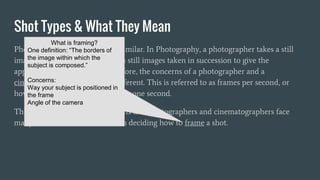
What is framing?
One definition: “The borders of
the image within which the
subject is composed.”
Concerns:
Way your subject is positioned in
the frame
Angle of the camera
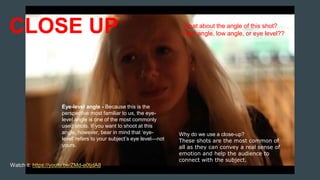
CLOSE UP
Why do we use a close-up?
These shots are the most common of
all as they can convey a real sense of
emotion and help the audience to
connect with the subject.
Watch it: https://youtu.be/ZMd-e0tjdA8
Eye-level angle - Because this is the
perspective most familiar to us, the eye-
level angle is one of the most commonly
used shots. If you want to shoot at this
angle, however, bear in mind that ‘eye-
level’ refers to your subject’s eye level—not
yours.
What about the angle of this shot?
High angle, low angle, or eye level??
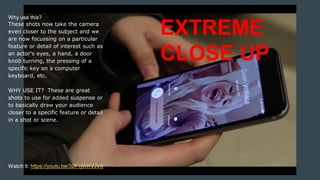
Why use this?
These shots now take the camera
even closer to the subject and we
are now focussing on a particular
feature or detail of interest such as
an actor's eyes, a hand, a door
knob turning, the pressing of a
specific key on a computer
keyboard, etc.
WHY USE IT? These are great
shots to use for added suspense or
to basically draw your audience
closer to a specific feature or detail
in a shot or scene.
EXTREME
CLOSE UP
Watch it: https://youtu.be/32F1jWKVJV8
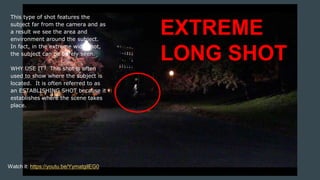
This type of shot features the
subject far from the camera and as
a result we see the area and
environment around the subject.
In fact, in the extreme wide shot,
the subject can be barely seen.
WHY USE IT? This shot is often
used to show where the subject is
located. It is often referred to as
an ESTABLISHING SHOT because it
establishes where the scene takes
place.
EXTREME
LONG SHOT
Watch it: https://youtu.be/YymatgilEG0
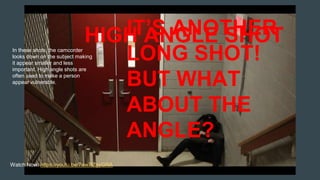
IT’S ANOTHER
LONG SHOT!
BUT WHAT
ABOUT THE
ANGLE?
In these shots, the camcorder
looks down on the subject making
it appear smaller and less
important. High angle shots are
often used to make a person
appear vulnerable.
Watch Now: https://youtu.be/7ew7lZgyGRA
HIGH ANGLE SHOT
Sources
https://en.wikipedia.org/wiki/Proof_of_concept
http://www.serif.com/appresources/MPX6/Tutorials/en-us/tutorials/basics_shottypes.htm
http://www.tvdsb.ca/webpages/takahashid/video.cfm?subpage=128730
http://www.mediaknowall.com/camangles.html
http://www.cod.edu/people/faculty/pruter/film/glossary.htm

Erica Presentation

  • 1.
  • 2.
    About Me! (Erica) Backgroundin performing arts, esp. theater Graduated from Northampton High in 2012 Started film production as a freshman in high school. Interned with Northampton Community Television (Jeromie!) Film student at Keene State College Transfer to the University of MA, Comm Major w/ Film Certificate. Psychology minor.
  • 3.
    About Me! (Alex) Sophomoreat UMass Amherst Majors in Psychology w/ Film Certificate. Biological Anthropology Minor. Recently directed first film, Black Cherry
  • 4.
    Black Cherry View thetrailer: What was the best part about making Black Cherry? What were the challenges on the making of Black Cherry? What was the process of directing a student film like? Whatever else?
  • 5.
    Running Embers +The Proof of Concept Trailer View the trailer: https://vimeo.com/149438213 What is a Proof of Concept Trailer? Wikipedia Says: “A proof of concept (PoC) or a proof of principle is a realization of a certain method or idea to demonstrate its feasibility, or a demonstration in principle, whose purpose is to verify that some concept or theory has the potential of being used.” For the first time ever, Wikipedia is RIGHT! The proof of concept trailer was a trailer created by the film’s director and a group of UMass students to demonstrate the film’s concept and it’s potential to be made into a full film.
  • 6.
    So Then What?...KICKSTARTER Running Embers launched a Kickstarter campaign in December of 2015. We ended up being funded 134%!! 119 Backers supported our project! We raised $20,215! http://bit.ly/RunningEmbersFeatur eFilm
  • 7.
    Running Embers Crew+ Casting Call What’s next? The feature film production of Running Embers is currently seeking talented students as cast and crew (including still photographers)! The feature film will be shooting over the Summer 2016! Casting and crew calls are happening now!
  • 8.
    Questions? Check us outon Social Media: Black Cherry Facebook: https://www.facebook.com/blackcherryfilm Running Embers http://www.runningembers.com/ Watch our trailers! https://vimeo.com/alexkamb Check out our IMDb Page! http://imdb.to/1ThbJX6 See our Kickstarter! http://bit.ly/RunningEmbersFilm Like Us on Facebook! https://www.facebook.com/runningembers Follow Us on Twitter! https://twitter.com/RunningEmbers Follow Us on Snapchat! RunningEmbers Find us on Instagram! https://instagram.com/runningembers/ Follow us on Tumblr! runningembersfilm.tumblr.com
  • 9.
    Shot Types &What They Mean Photography and Film are very similar. In Photography, a photographer takes a still image. Film is nothing more than still images taken in succession to give the appearance of movement. Therefore, the concerns of a photographer and a cinematographer are not that different. This is referred to as frames per second, or how many still images are taken in one second. This fundamental similarity means that photographers and cinematographers face many of the same decisions when deciding how to frame a shot. What is framing? One definition: “The borders of the image within which the subject is composed.” Concerns: Way your subject is positioned in the frame Angle of the camera
  • 10.
    CLOSE UP Why dowe use a close-up? These shots are the most common of all as they can convey a real sense of emotion and help the audience to connect with the subject. Watch it: https://youtu.be/ZMd-e0tjdA8 Eye-level angle - Because this is the perspective most familiar to us, the eye- level angle is one of the most commonly used shots. If you want to shoot at this angle, however, bear in mind that ‘eye- level’ refers to your subject’s eye level—not yours. What about the angle of this shot? High angle, low angle, or eye level??
  • 11.
    Why use this? Theseshots now take the camera even closer to the subject and we are now focussing on a particular feature or detail of interest such as an actor's eyes, a hand, a door knob turning, the pressing of a specific key on a computer keyboard, etc. WHY USE IT? These are great shots to use for added suspense or to basically draw your audience closer to a specific feature or detail in a shot or scene. EXTREME CLOSE UP Watch it: https://youtu.be/32F1jWKVJV8
  • 12.
    This type ofshot features the subject far from the camera and as a result we see the area and environment around the subject. In fact, in the extreme wide shot, the subject can be barely seen. WHY USE IT? This shot is often used to show where the subject is located. It is often referred to as an ESTABLISHING SHOT because it establishes where the scene takes place. EXTREME LONG SHOT Watch it: https://youtu.be/YymatgilEG0
  • 13.
    IT’S ANOTHER LONG SHOT! BUTWHAT ABOUT THE ANGLE? In these shots, the camcorder looks down on the subject making it appear smaller and less important. High angle shots are often used to make a person appear vulnerable. Watch Now: https://youtu.be/7ew7lZgyGRA HIGH ANGLE SHOT
  • 14.